Bookmarking Book Art — Georgia Russell

Georgia Russell’s
De Baudelaire au Surréalisme 2007

From England & Co’s online gallery:

“Russell’s work with books began during an artists’ residency in Paris while she was a student at the Royal College of Art. Old books have always seemed to her like sculptural objects ‘representing the many hands which have held them and the minds they have passed through’. She says that she has always chosen something which ‘holds within it a sense of its own personal history, an object which has a secret life’, and wants to resurrect her fragile materials and give them ‘a new life and new meaning’. There is a simultaneous sense of loss and preservation in each construction, as she wants to retain and reclaim the past as much as her techniques attack it.”

Like the phenomena in our transition between analog and digital, Russell’s shredded books and the other instances of book art or “bookworks” bookmarked here constitute another form of “creative destruction” to stretch Schumpeter’s economic concept.

The opening up of new markets, foreign or domestic, and the organizational development from the craft shop to such concerns as U.S. Steel illustrate the same process of industrial mutation—if I may use that biological term—that incessantly revolutionizes the economic structure from within, incessantly destroying the old one, incessantly creating a new one. This process of Creative Destruction is the essential fact about capitalism.

                      Capitalism, Socialism and Democracy (1942), p.83

Of course, without the old print book industry’s output, our Scottish artist and her kith and “ken” will eventually face a scarcity of raw material for their new art industry.  A sure sign of a misapplied economic theory, however apropos and paradoxical the misappropriation of the paradox may feel.

See also The First Seven Books of the Papier Biënnale Rijswijk

Bookmarking Book Art — Thomas Allen

wsj_ipad
Stories
Posted on March 9, 2013 by Thomas Allen

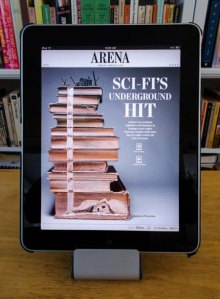
This image of Thomas Allen’s book art appears along with the story about fellow-North Carolinian Hugh Howey‘s self-published novel WOOL in the 7 March 2013 edition of The Wall Street Journal but only in the iPad App version. Go to SECTIONS, then ARENA.

Click on the image to the left to go to Allen’s website to see more of his work and find out how to purchase it.   If you can find the Fall 2006 issue of Zoetrope:  All Story, you can see more of Allen’s work, but click here to read Chip Kidd’s comments on Allen’s artistry.

Bookmarking a Book Burning – I

Julian Baggini (Aeon) has posted a thoughtful piecejulian-baggini-burning-books on the need for an important cultural artifact to evolve — not just in its codex form but in its very essence — the encyclopedia.  One reader/viewer (there’s a video as well) commented:

Which is worse? Burning books because they are now available in an electronic format? Or not having any physical books to burn, unless you steal them from a museum or collector?

Hold that thought (an “argument by false dichotomy”) and go to Baggini’s concluding paragraph:

I can’t help but mourn the passing of my set of Britannicas, but I do not mourn the passing of the institution. Encyclopædias have passed their use-by-date as fitting symbols for the esteem in which we hold culture and learning. The world is changing, and books, magazines and education have to change with it. Nostalgia for obsolete publications serves us only if we use it to remind us of the things we really value, and want to take forward into our own new world.

What if, though, the things we value and want to take forward into our new world are caught up in the “affordances” of such tangible institutions as the encyclopedia.  Maryanne Wolf hits this chord hard in Proust and the Squid when she worries about the effect of the Google universe on the nature of her children’s ability to read:

Reading is a neuronally and intellectually circuitous act, enriched as much by the unpredictable indirections of a reader’s inferences and thoughts as by the direct message from the eye to the text. … Will the constructive component at the heart of reading begin to change and potentially atrophy as we shift to computer-presented text, in which massive amounts of information appear instantaneously? … is there either sufficient time or sufficient motivation to process the information more inferentially, analytically and critically? … Or does the potential added information from hyperlinked text contribute to the development of the child’s thinking? …

I stray with these questions. But indeed we stray often when we read.  Far from being negative, this associative dimension is part of the generative quality at the heart of reading. … Charles Darwin saw in creation a similar principle, … ‘From so simple a beginning, endless forms most beautiful and most wonderful have been, and are being evolved.’  So it is with written language.  Biologically and intellectually, reading allows the species to go ‘beyond the information given’ to create endless thoughts most beautiful and wonderful.   We must not lose this essential quality in our present moment of historical transition to new ways of acquiring, processing and comprehending information. (pp. 16-17)

To go back to Baggini’s troubled reader/viewer, we will not burn books because we have them electronically.  As our different types of books evolve, some we will have electronically only and some we will have both in print and electronically.  We already have many digitised rare books and manuscripts in libraries, museums and collectors’ holdings.  Most people’s exposure to those works can only be electronic, and the more this is the case, the less the need to steal them.   But also the greater the need to understand and innovate to address the loss of tactility and the proprioceptive experience of “curling up with a good book.”  In alluding to Jerome Bruner’s collection of essays Beyond the Information Given, Wolf is reminding us (linking us?) to Bruner’s apt observation that Lev Vygotsky, the famous Soviet developmental psychologist, “was fond of an epigram from Bacon, “Nec manus, nisi intellectus, sibi permissus, multum valent” (Neither hand nor intellect left each to itself is worth much)” (247).   Perhaps neither print nor digital left each to itself is sufficient.

Bookmarking — A Variable Redletter Day?

In a report possibly falling under the category “What the Font?” or  simply “Sans Clue,” PoliceSpecials.com carried this story from the BBC today:

“Thousands of motorway speeding convictions could be overturned because the font used to display the numbers on some variable speed limit signs may not have complied with traffic regulations.  The Crown Prosecution Service said the signs showed mph numbers taller and narrower than they should have been.”

The typefaces mandated by the Department of Transport for traffic speed limit signs are Transport Medium, Transport Heavy and Motorway Permanent.  The designers were Jock Kinneir and Margaret Calvert.   Simon Garfield provides an amusing chapter in Just My Type on how their design came to be adopted.  But the typeface in question on which the BBC has belatedly reported (see the Daily Mail for the original scoop last December) is this:

variable

According to roadsuk.com (well, that is the URL, although a bit of blue in the letters “u” and “k” help to disambiguate the message),  the font seems to be named (imaginative this) “Variable Message Sign.”   But in the Daily Mail article, neither the “wrong” nor “right” signs illustrated seems to be in the Variable Message Sign typeface.  So, what the font?

article-2251985-169E2590000005DC-278_634x671 article-2251985-169E2560000005DC-717_634x668

Bookmarking The Gutenberg Bible – The Digital in Support of the Print

The beginning of the Gutenberg Bible: Volume 1...

The Harry Ransom Center at the University of Texas at Austin has updated its site displaying one of the only five copies of the Gutenberg Bible in the US.   There is much to admire here, and much to be curious about.  The illustration of the watermarks that distinguish the Pforzheimer Bible, the map of locations of other copies (complete and incomplete), the page-turning interactivity and the inclusion of a kids section are welcome.

The interactive map showing the spread of printing, however, does not compare well with those at Jeremy Norman’s From Cave Paintings to the Internet Database Maps, and an explanation of how the Center’s Bible was digitized, something on the order of Ann Tomalak’s informative essay at the British Library’s site describing what conservators must do to prepare fragile manuscripts for digitization, would enrich the Ransom Center’s offering.   

Equally the history of Gutenberg the man and his work with Johann Fust could have been more detailed as could the history of printing and its spread.  Jeremy Norman’s site is still hard to rival.  Other related sites worth a bookmark:

Sarah McCarthy’s review of Hendrik Willem van Loon’s Observations on the Mystery of Print and the Work of Johann Gutenberg at the New York City’s Center for Book Arts

Jeremy Norman’s speculation on Gutenberg’s possible contribution to stereotype printing

The British Library’s site where you can compare paper and vellum copies of the Gutenberg Bible

The Göttingen Gutenberg Bible site where you can also find reproduced the notarial instrument on the financial dispute between Gutenberg and Fust

The Keio University site that allows you to compare the Keio Gutenberg Bible with that of the University of Cambridge (require Javascript plugin)

And of course the Mainz Gutenberg Bible.