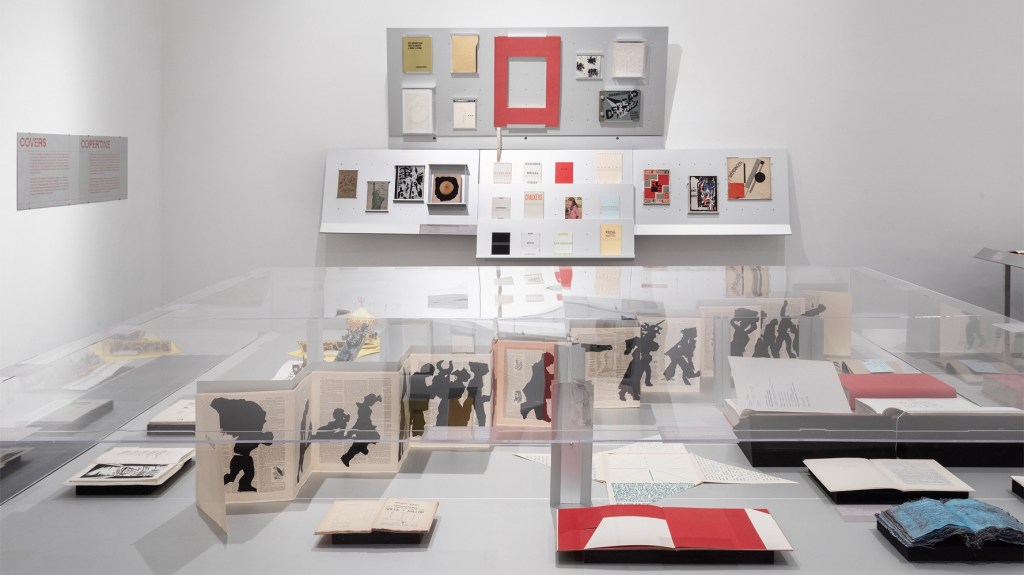
Installation of Artists Making Books: Pages of Refuge at the AAR Gallery (photograph by Daniele Molajoli)
Ilaria Puri Purini and Sebastian Hierl at the American Academy in Rome are to be congratulated on Artists Making Books: Pages of Refuge, an exhibition that ran from 27 September to 7 December 2024. It boasted works from the Academy’s own library and the collections of Claudia Consolandi and Giovanni Aldobrandini as well as innovative customized displays by the architectural design firm Supervoid.
Because the Academy has attracted artists to Rome with residencies and the Rome Prize, Purini and Hierl had a headstart with artists’ books by Jenny Holzer, William Kentridge, Ana Mendieta, Tricia Treacy, Kara Walker and many others. They were also able to draw on several works by Ed Ruscha from the Academy’s Arthur & Janet C. Ross Library. The Collezione Consolandi added stars such as Giuseppe Anselmo, Alighiero Boetti, Maurizio Cattelan, Hanne Darboven, Lucio Fontana, Sol LeWitt and Andy Warhol, while the Collezione Giovanni Aldobrandini brought Balthus, Marcel Duchamp, Wassily Kandinsky, El Lissitzky, Bruno Munari, Kurt Schwitters and, again, Andy Warhol. The duplicates enabled the curators and Supervoid to offer visitors multiple views of the same work, and two wall-mounted iPads allowed visitors to scroll through the entirety of dozens of the works on display.

Screenshot from Supervoid Architects’ website.

Although the eye might have been attracted to the wall display or the central large-scale vitrine shown in the first image above, an understated work just inside the entrance attracted mine. Pietre Foglie is a book of twenty lithographic prints, ten by Ana Mendieta and ten by Carl Andre. The title’s pietre (or stone) and foglie (leaves or folios) refer not only to the lithographic technique of the prints but also to the ten images of stone walls and the ten of arranged leaves. The self-reflection of title, technique, images and interleaving of the artists’ efforts make the book more than a mere portfolio of prints; they make it an artist’s book or rather a collaborative artists’ book. On display is Mendieta’s folio of five leaves arranged to evoke the female form. The caption to the display cites Mendieta’s aim of “carrying out a dialogue between the landscape and the female body”, to which this image contributes. The delicacy of the leaves contrasts with their earthy pose suggestive of the Artemis statue in the Vatican Museum or the Venus of Willendorf. As an example of artists’ books’ materiality and frequency of collaboration in their creation, Pietre Foglie captures two of the exhibition’s main themes. With the hindsight of Mendieta’s death in an abusive relationship, her leaves’ dialogue with Andre’s stone walls (not shown in the case or the mounted iPads, a perennial issue with the display of the artist’s book) might freeze informed viewers in their tracks. The depth of feeling in its choice reflects the curators’ thoughtfulness, and the rest of the exhibition did not disappoint.


Ana Mendieta (1984 Fellow)
Pietre Foglie. Roma: Bulla, 1984
The Arthur & Janet C. Ross Library American Academy in Rome
“I have been carrying out a dialogue between the landscape and the female body”, said Ana Mendieta, who explores this relationship in Pietre Foglie. She realized the book during her time in Rome in collaboration with her husband Carl Andre, with whom she had a relationship punctuated by his violence and abuse of her. — Academy’s display caption.
Throughout the exhibition, the focus on the materiality of the artist’s book naturally recurs. Of course, materiality surfaces in livres d’artiste and fine press books like the represented works of Picasso, Matisse or Arion Press, but its presence and use in works like Pietre Foglie or Tricia Treacy’s Slot (2018) is often the ingredient that nudges a work into that special category of artist’s book. The Academy and curators do a real service for this notion with their video of Treacy’s and Francis Offman’s discussion of their works, practices and the material nature of artists’ books.
Moderator Vittoria Bonifati: cofounder of Villa Lontana, focused on ancient and contemporary practices in both visual arts and sound.
Materiality and conceptual art are often considered separate streams in art, but a serendipitous inspiration that upends that notion struck when Purini and Hierl chose to display Maurizio Cattelan’s Permanent Food (2002). Only weeks before their exhibition’s close, the Chinese cryptocurrency entrepreneur Justin Sun ate his $6.2 million purchase of Cattelan’s duct-taped-to-a-wall banana entitled Comedian (2019). The complex and temporal levels of ironic self-reference between the two works makes one wish for a duct-taped-to-the-wall onion to have been juxtaposed with Permanent Food to encourage the unpeeling (and add to the tears of laughter).
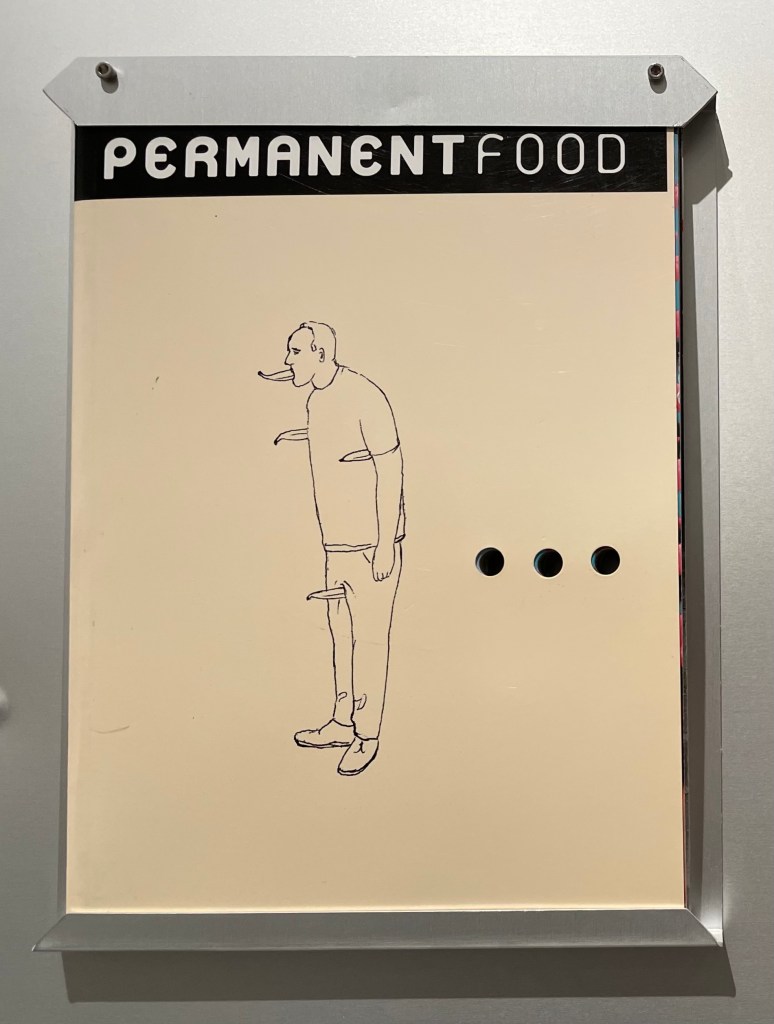
Maurizio Cattelan
Permanent Food, no. 8 / no. 9. 2002
Collezione Consolandi, Milan
In 1995, Cattelan, along with artist Dominique Gonzalez-Forster, founded Permanent Food to gather “images that belong to everyone,” as they stated in the preface. Later, with designer Paola Manfrin, they created what they termed a “second-generation” publication with no hierarchy of images and no copyright, serving as a free territory for image exchange before the rise of blogs and social media. — Academy’s display caption.
Another pleasure was the completely unfolded leporello by William Kentridge, benefiting from Supervoid’s design of the large central vitrine in the main room.
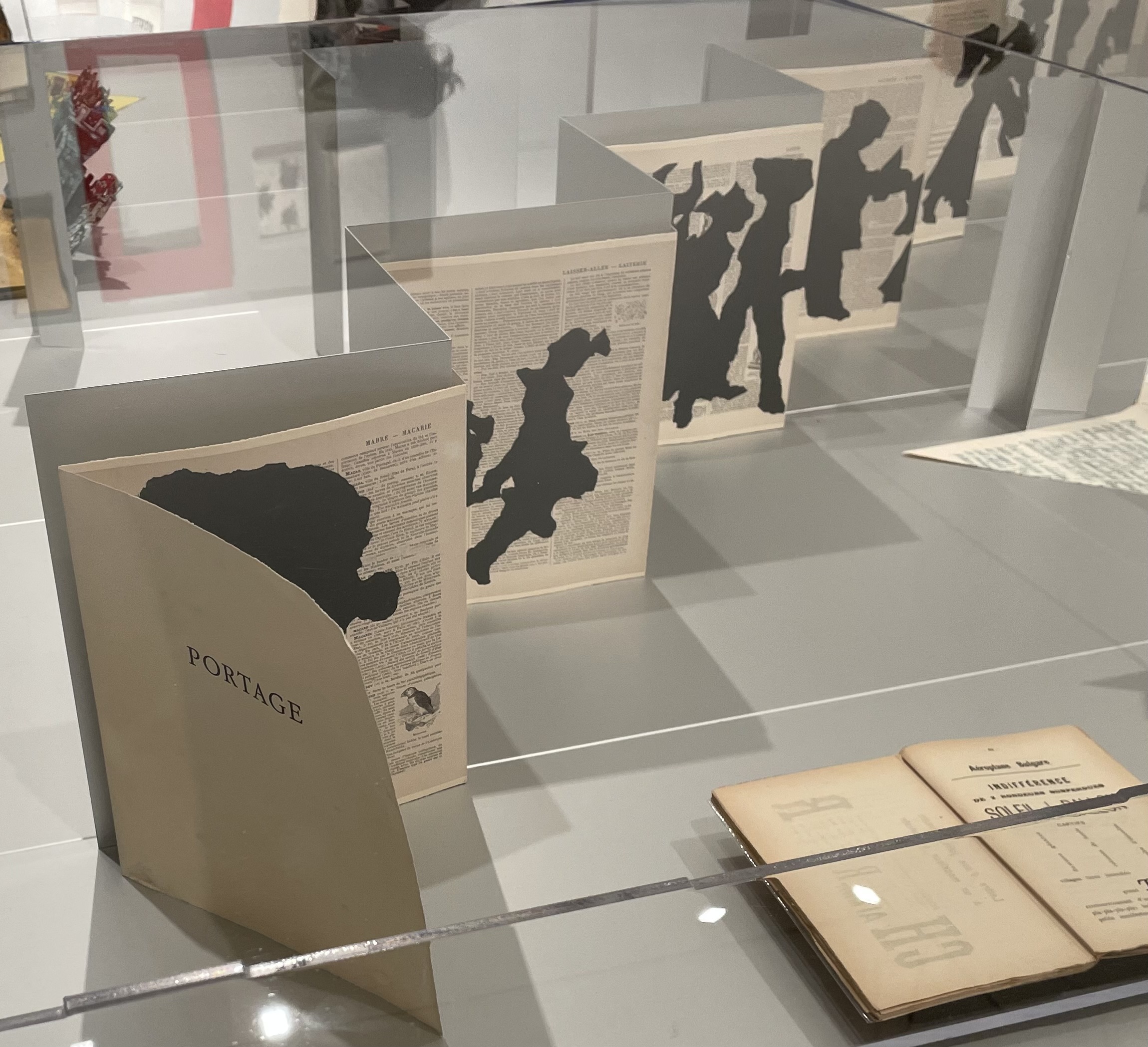

William Kentridge (2014 and 2016 Resident)
Portage. White River The Artist’s Press, 2000
Collezione Consolandi, Milan
Kentridge’s practice is focused on the traumatic memories he holds of South Africa. He frequently uses processions as a way to convey the heaviness of the narratives of history. In Portage, he juxtaposes silhouettes against the pages of the Encyclopédie, the compendium of Enlightenment thought, published in France in the mid-eighteenth century, creating random encounters between text and image, and asking fundamental questions about knowledge, progress, and power. — Academy’s display caption.
The exhibition also captured book artists’ interest in children’s books, spanning from Bruno Munari’s Le Macchine (1942) to Stefano Ariente’s alteration of Pinocchio (2006), which looks like a copy closely read by the puppet himself.

Bruno Munari
Le Macchine. Torino: Einaudi, 1942
Collezione Giovanni Aldobrandini, Rome
Le Macchine (The Machines) is Munari’s first children’s book, marking the beginning of his long collaboration with editor Giulio Einaudi. The book reveals Munari’s interest in games, education, and didactic principles. The machine become a surreal and playful object in this powerful graphic format, designed to surprise the reader. Munari controlled production and distribution of his books. — Academy’s display caption.
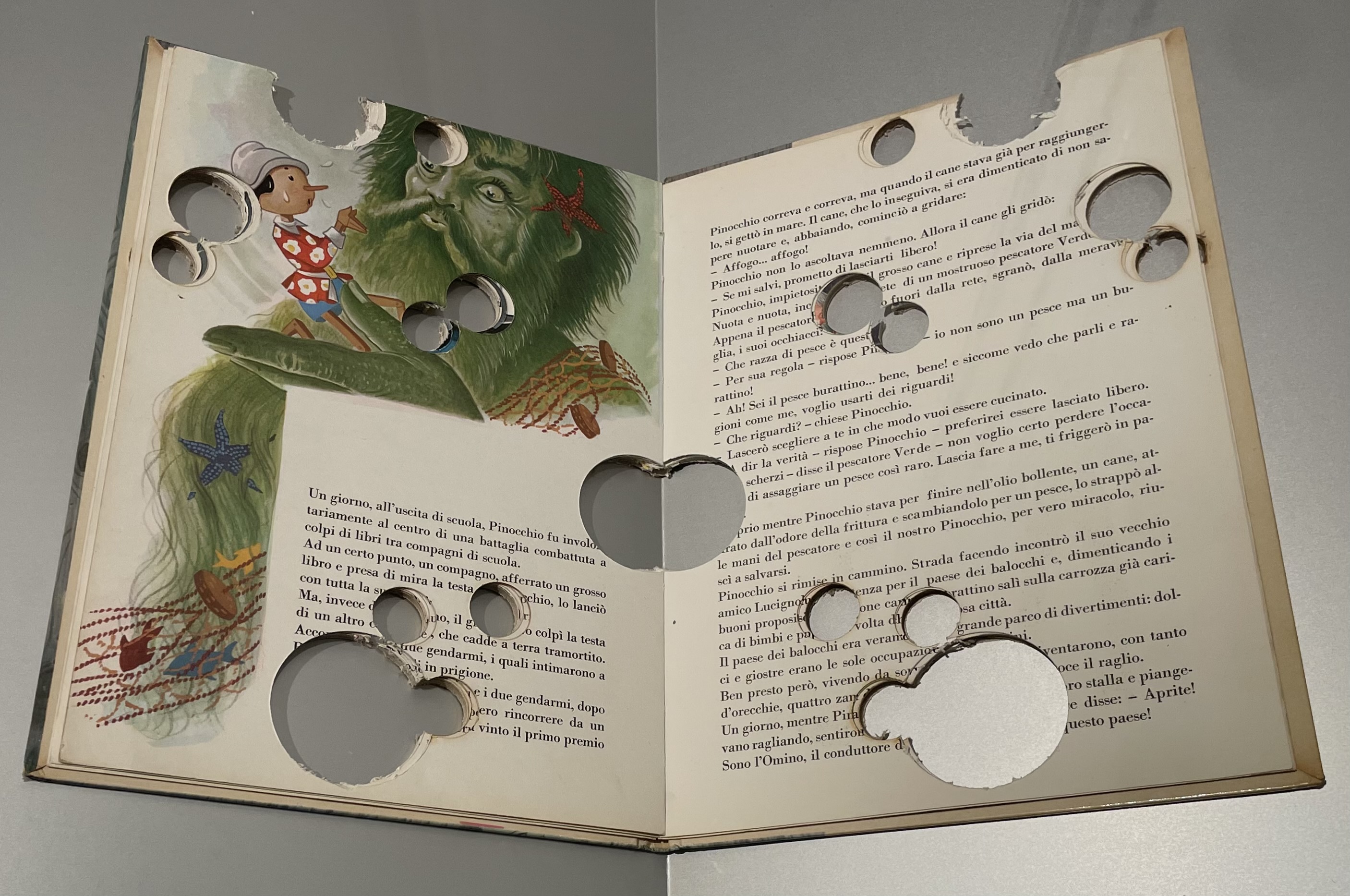
Stefano Arienti
Pinocchio, 2006
Collezione Consolandi, Milan
In Pinocchio, Stefano Arienti carves circles of various shapes into the pages, altering the reading experience of the original story. The work plays with the overlapping of different texts, generating a new vision for the book. Arienti’s career is marked by his reworking of common objects and popular culture images to create unexpected effects of the original material. — Academy’s display caption.
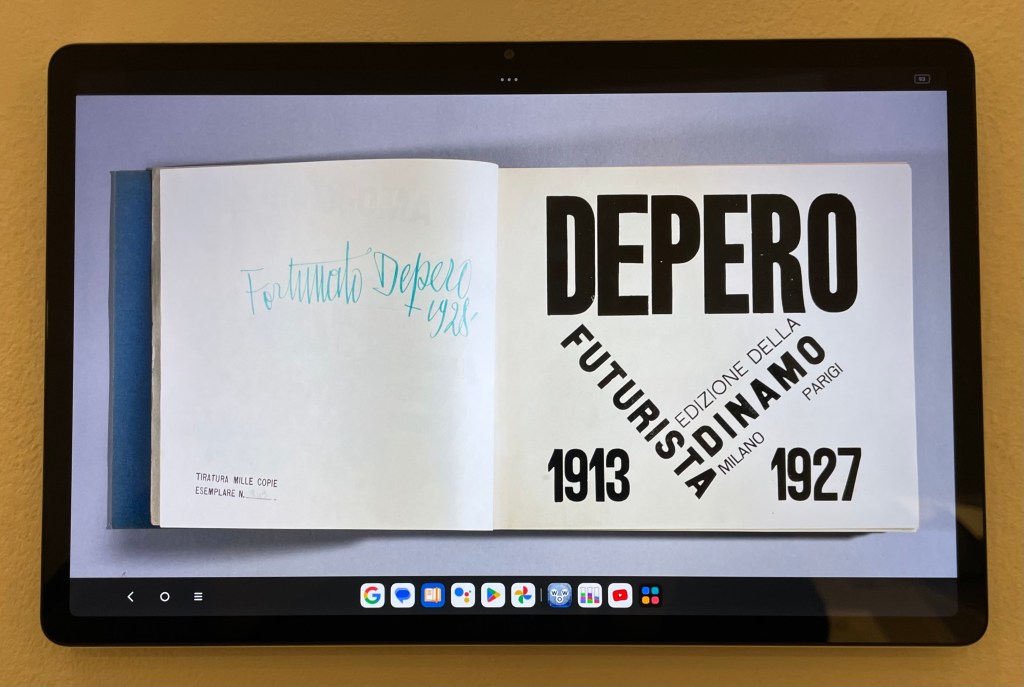
It was a pleasure to see on display the original of Fortunato Depero’s Depero Futurista and to find in the Rare Books Room the facsimile by Designers & Books, also in the Books On Books Collection. The added treat was the view of the entire book in the iPad display. Only a few are shown below, but Designers & Books offers all the pages here.

Fortunata Depero
Imbullonato. Milano: Azari, 1927
Collezione Giovanni Aldobrandini, Rome
Depero’s Imbullonato (bolted book) embodies ideas from the Futurist manifesto, such as the “destruction of syntax,” “imagination without strings,” and “words-in-freedom.” By rejecting traditional print formats and blending book mechanics with fantastical elements, Depero declared Imbullonato a “dangerous object,” as its metal plates could damage other books. The pages can be rearranged by the reader in any order. — Academy’s display caption.



Also displayed in the Rare Books room was a unique work by Huang Min, on loan from the AAIE Contemporary Art Center in Rome. The artist’s usual medium is the large-scale canvas (a showcase can be found at Blue Mountain Contemporary Art), so this leporello in which she has painted directly on the panels represents the unique end of the spectrum of book art.


The exhibition as a whole provided a good historical review of artists’ books from the 20th and early 21st centuries. Lecturers on artists’ books would have done well to take their students on a guided tour there. Other institutions with significant collections of this form of art would do well to mount similar exhibitions and issue invitations to local schools, art colleges and universities. The traffic would be ensured.
Further Reading & Viewing
“Claudia Consolandi & Giovanni Aldobrandini – On Collecting Books“. 26 September 2024. Rome: American Academy in Rome. In Italian.
“Darby English & Cornelia Lauf – Pick a Book“. 18 October 2024. Rome: American Academy in Rome. Features Kara Walker and Toni Morrison’s Five Poems and Ed Ruscha’s Every Building on the Sunset Strip from the exhibition.
 Books On Books