Feeling with Fingers that See (2017)

Feeling with Fingers that See (2017)
Stuart Whipps
Saddle stitched booklet with loop staples and marbled cover. H270 x W210 mm (W216 mm including loop staple). 52 pages and loose sheet for colophon. Edition of 300. Acquired from Loose Joints Publishing, 6 September 2022.
Photos: Books On Books Collection. Displayed with permission of the artist.
On 9 July to 18 September 2016, Spike Island (Bristol, UK) hosted Stuart Whipps’ installation entitled “Isle of Slingers“, which included a display of his ongoing artwork A System For Communicating With The Ghost Of Sir Christopher Wren. This book is part of that work.
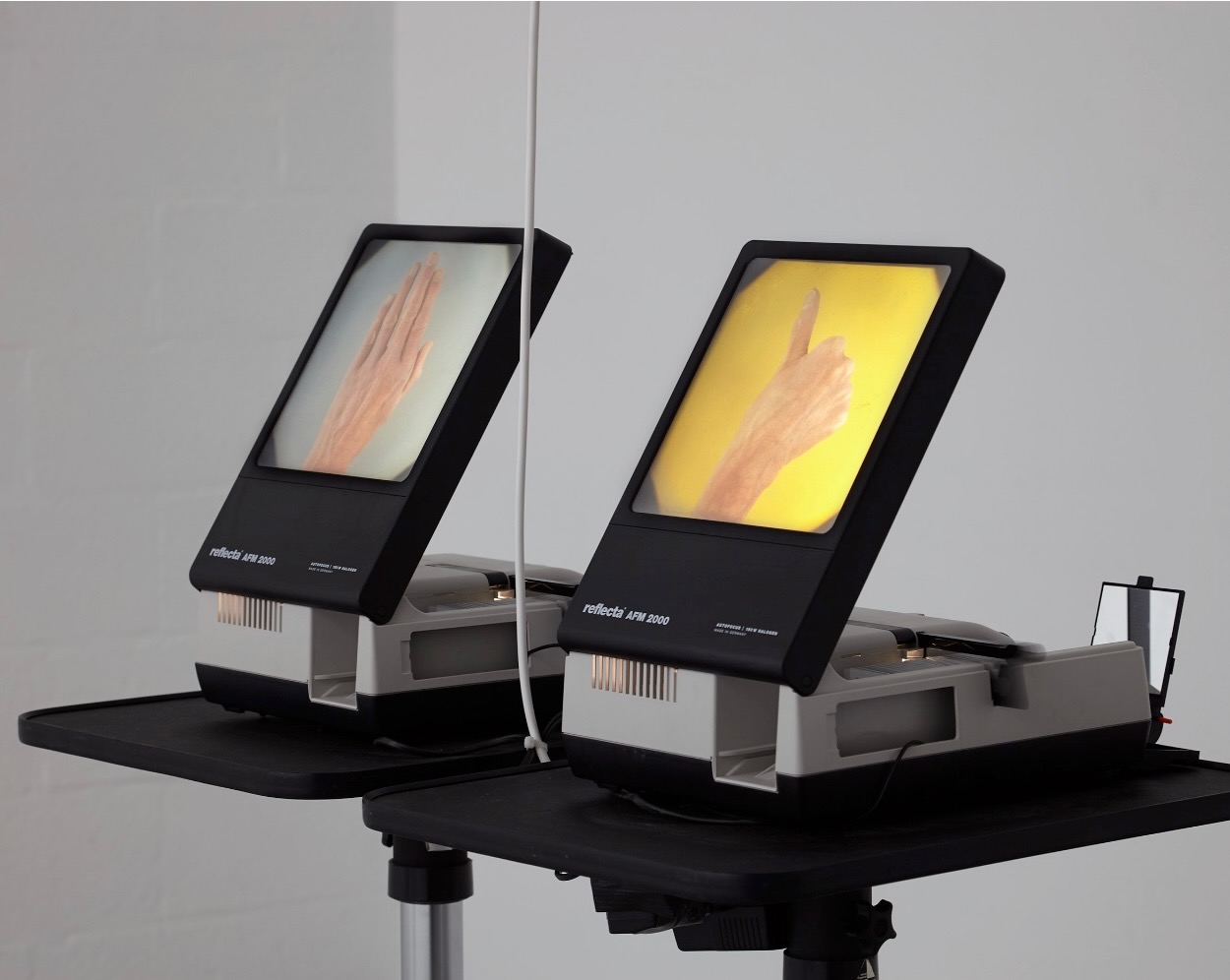

From “Isle of Slingers“, 9 July to 18 September 2016, Spike Island, Bristol, UK. Images: Courtesy of the artist.
Wren designed two systems of sign language (1650?). The diagrams for both were found interleaved in the Royal Institute of British Architects’ “heirloom copy” of Parentalia, a family memoir published in 1750 by Wren’s grandson also named Christopher. In the first system’s diagram, four letters are assigned to each of the fingers and thumb of the left hand, two each on the knuckle side and two each on the palm side. The five vowels are assigned to the fingertips on the palm side, with the letter I doing double duty for J, and U being subsumed by V. The letter W requires two hands yoked at the thumbs, and likewise the letter X, yoked at the forefingers. Y is created with the thumb spread away from the joined fingers, and Z, with a closed fist.
Whipps uses the second system’s diagram, which he recreates on the last page of his book. The first 25 letters of the alphabet are represented on the five digits of the left hand, and two flat hands represent the 26th letter. The digits of the right hand stand for the order of the letters on the left.

So, below, the display of the left and right thumbs means the letter A. The show of the left thumb and right little finger means E. But there is some “noise” in Whipps’ system. Why, for example, is the thumb for letter A held horizontally but for letter E, it is held vertically?
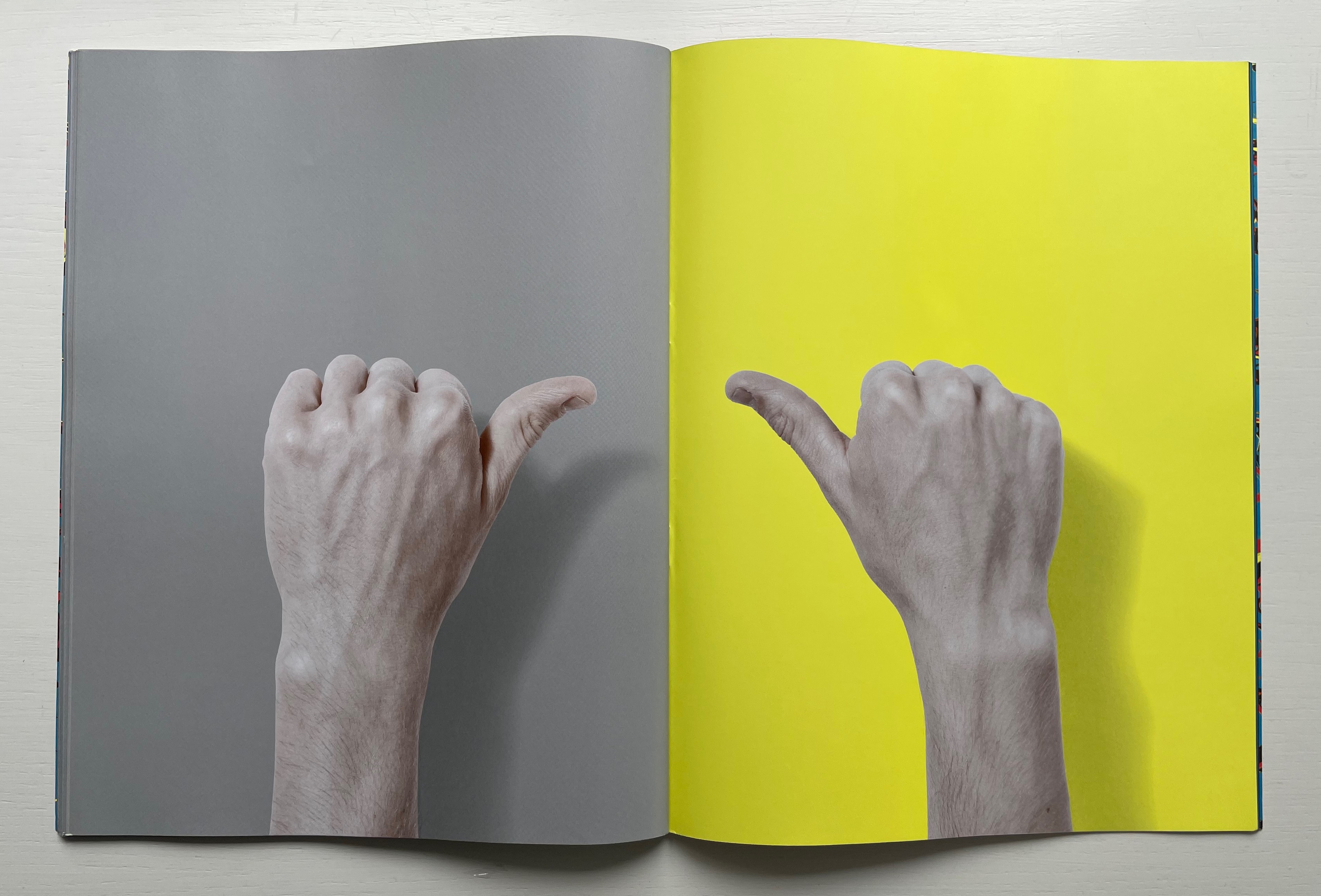

A and E
Likewise, sometimes a finger is displayed from the back of the hand, sometimes from the side –even for the same letter.


Variant letter E’s


Variant letter I’s
And in these two separate displays of the letter F, perhaps we also have noise introduced by a slip of the thumb.


F and F
The marbled cover and diagram’s explanation draw attention to a sort of noise reduction feature — color. The left hand always appears against a gray background; the right appears against a colored background. Where there might be some difficulty in distinguishing the fourth digit from the fifth in their side views, the colors bright blue and black are helpful.

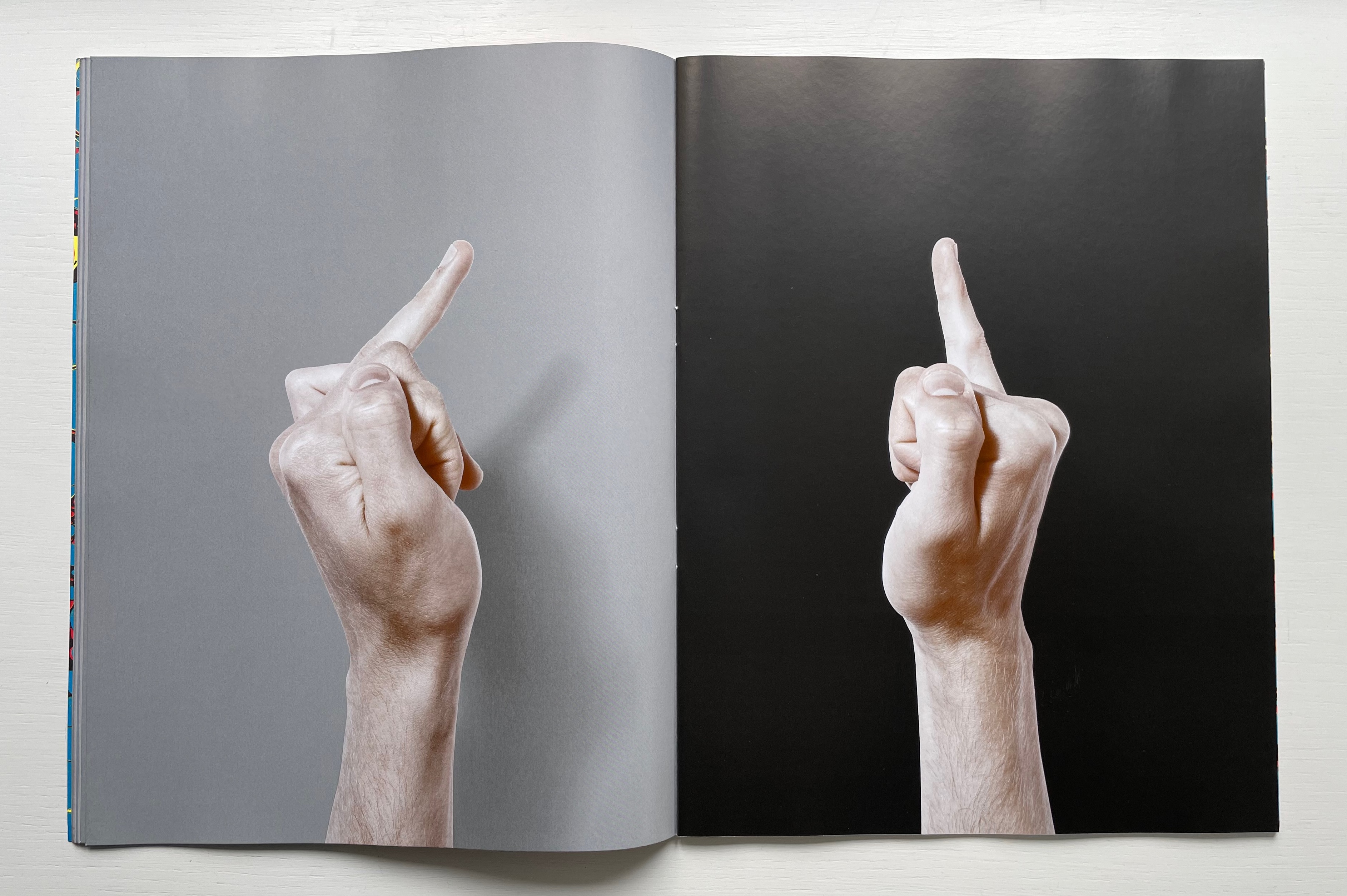
S (ring finger, fourth letter), T (ring finger, fifth letter)
But communicating with ghosts shouldn’t be too easy. In the exhibition, two projectors generated potential messages, and random combinations of letters were recorded throughout. The randomness in Whipp’s system — juxtaposed with Wren’s architectural order — and his introduction of color to an otherwise binary, black-and-white system — provide a depth reflected in that marbled cover. A paradox similar to that of “feeling with fingers that see”.
White Ashes Fell (2018)
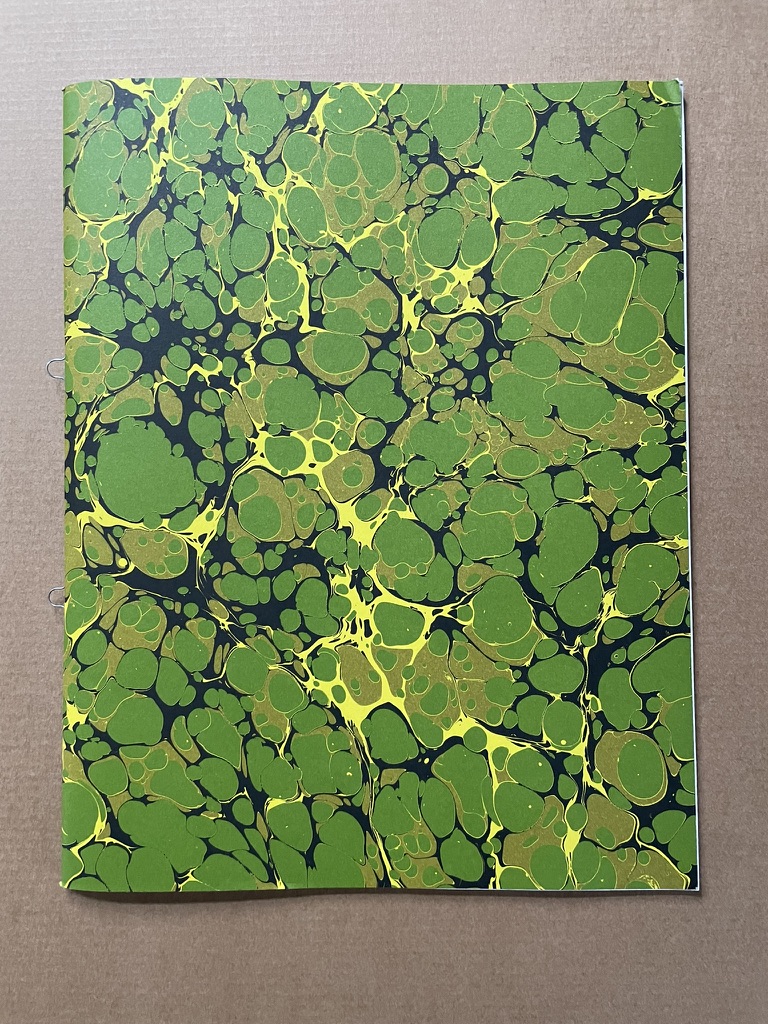
White Ashes Fell (2018)
Stuart Whipps
Saddle stitched booklet with loop staples and marbled cover. H270 x W210 mm (W216 mm including loop staple). [44] pages. Edition of 300. Acquired from Loose Joints Publishing, 27 December 2022.
Photos of the work: Books On Books Collection.
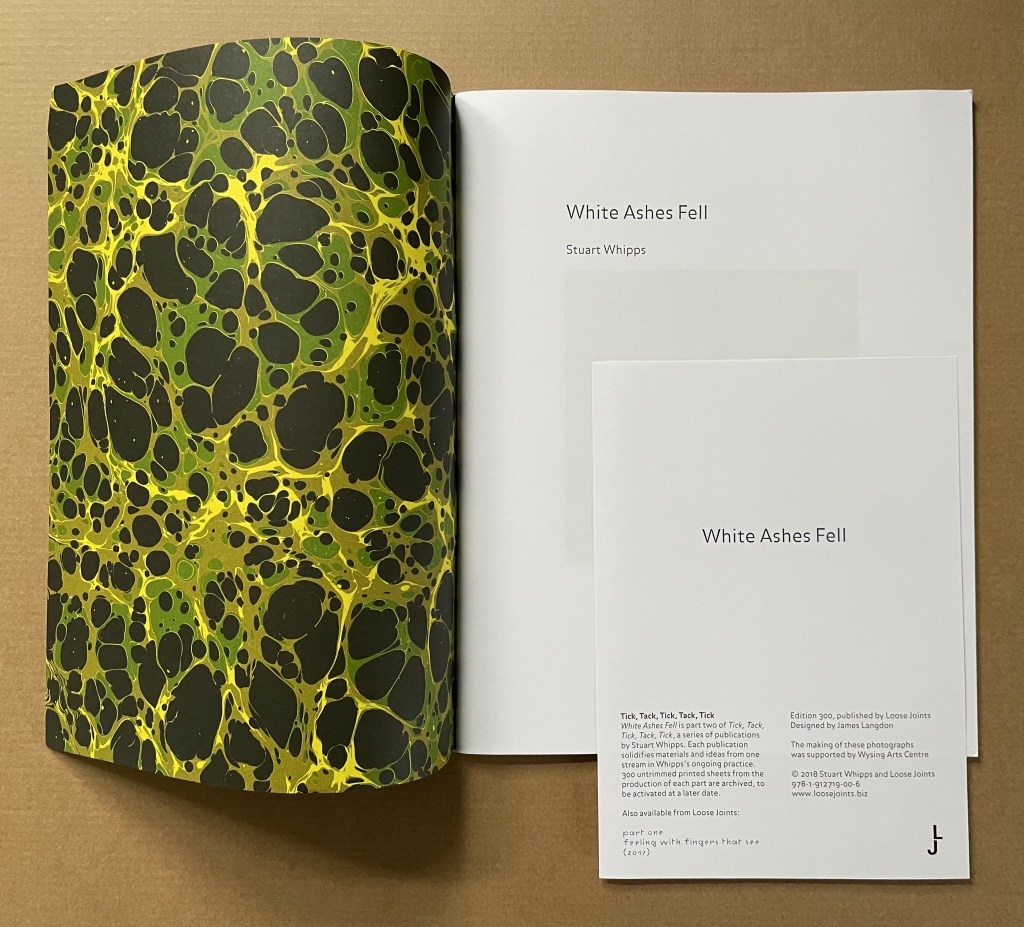
Publisher’s description: “White Ashes Fell presents photographs made by Stuart Whipps in Xilitla, Mexico in 2012. These photographs depict the surrealist sculpture garden of Las Pozas, a collection of 36 large concrete structures with titles such as The House with Three Stories That Could Be Five, and The Temple of The Ducks. Las Pozas was built by the English patron and poet Edward James between 1962 and 1979. These images are accompanied by photographs of the wooden moulds that were used to cast James’ structures. The title comes from a story told to George Melly and published in Swans Reflecting Elephants:
The building occurred only after the first 20 years here. For the first 20 years I was only interested in horticulture and then suddenly, in 62 there was a snowfall. Nobody had seen snow before, they didn’t know what it was. When I got back from New York a month later they said Don Edwardo, for 3 days white ashes fell and burnt everything so then I decided I would do something that couldn’t be killed by freak weather so I began building only then, things that look like trees and plants and flowers. Things that could not be killed by snow.


Las Pozas served to inspire Helen Douglas’ In Mexico (2014) also in the Books On Books Collection.
Further Reading
“Helen Douglas“. 24 February 2020. Books On Books Collection.
“Carina Hesper“. 18 July 2022. Books On Books Collection.
“Masoumeh Mohtadi“. 5 February 2021. Books On Books Collection.
“Xiao Long Hua“. 18 July 2022. Books On Books Collection.
 Books On Books