Monument (2018)

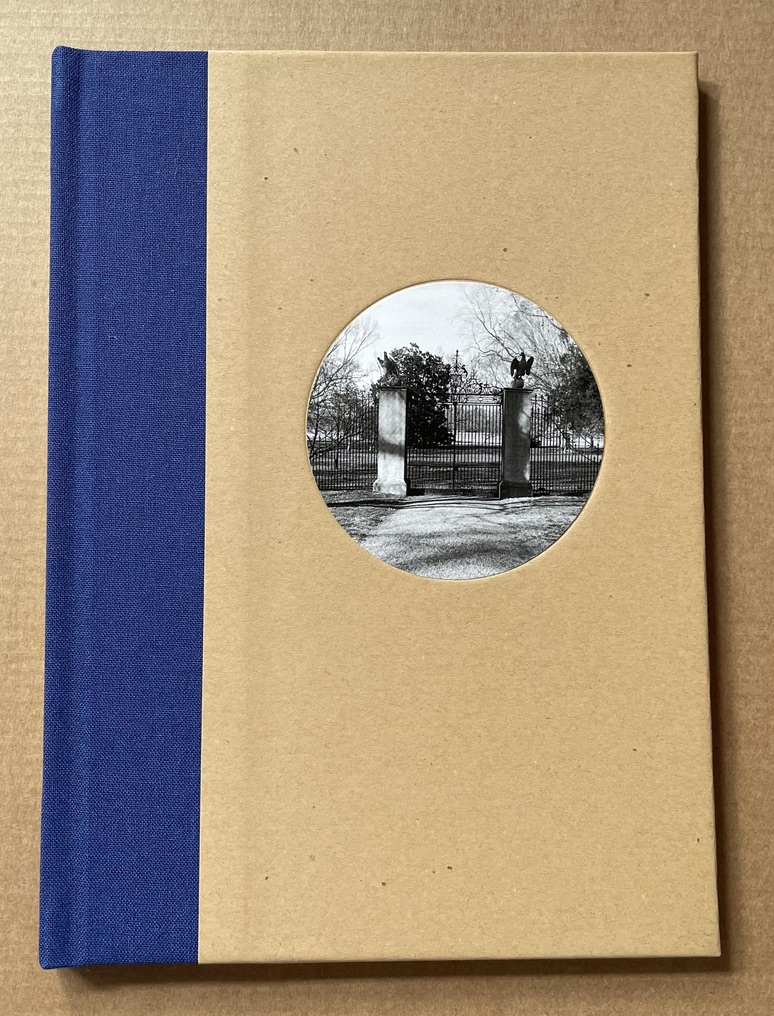
Monument (2018)
Carrie Mae Weems
Casebound hardback, cloth spine. H210 mm x W153 mm. [16] pages. Includes a duotone original print signed by the artist. Edition of 500, of which this is #455. Acquired from Nazraeli Press, 22 February 2021.
Photos of the work: Books On Books Collection.
Africa: Gems and Jewels (2021)
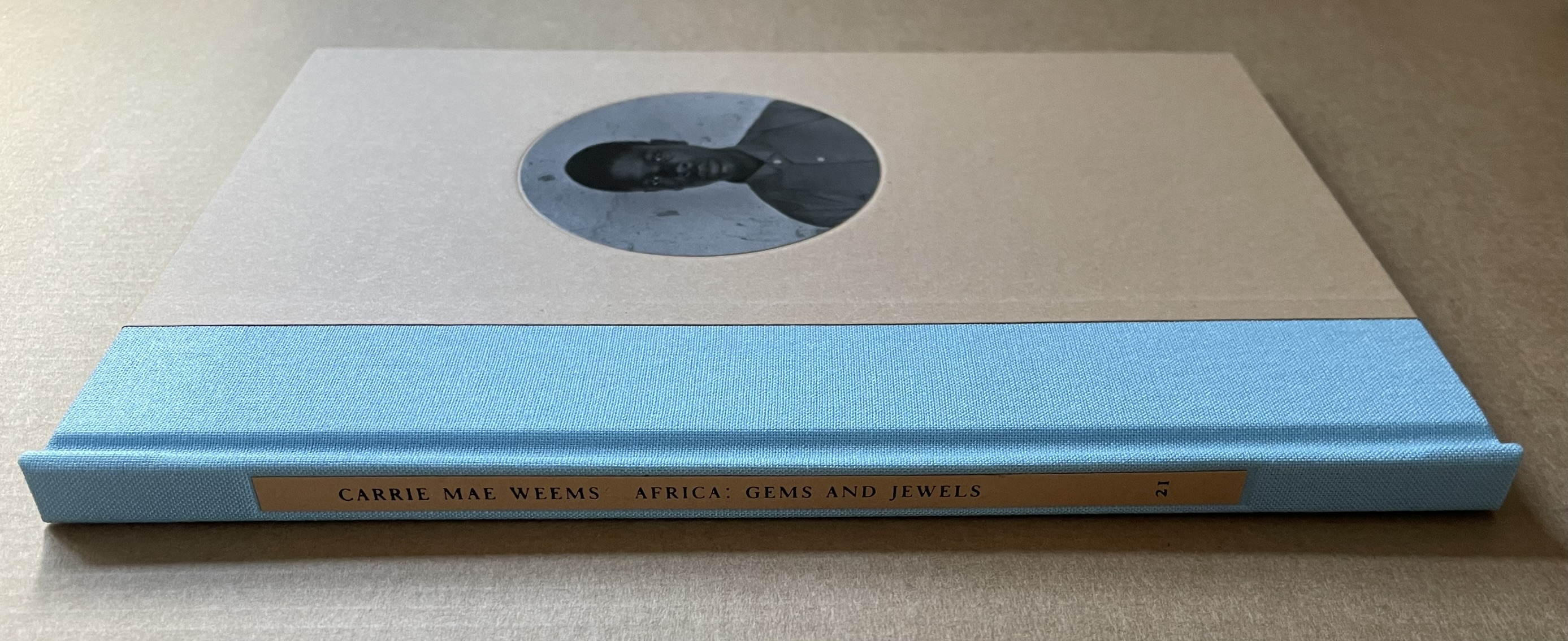
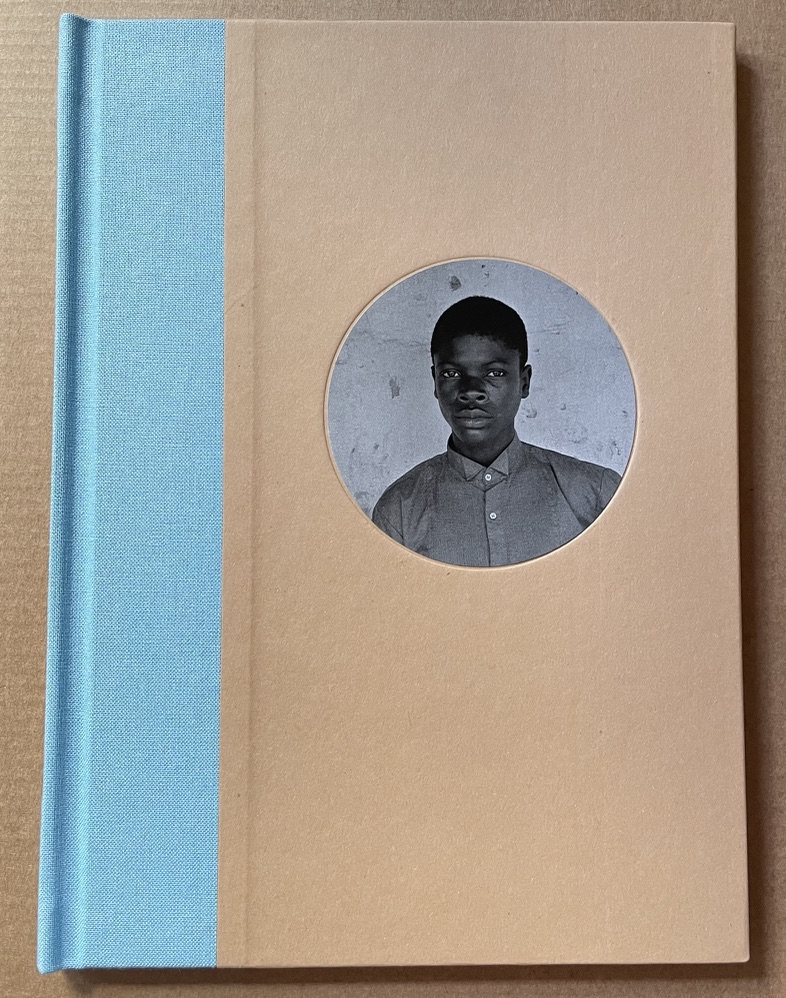
Africa: Gems and Jewels (2021)
Carrie Mae Weems
Casebound hardback. H210 mm x W153 mm. [16] pages. Includes an original print signed by the artist.
Edition of 500, of which this is #490. Acquired from Nazraeli Press, 22 February 2021.
Photos of the work: Books On Books Collection.
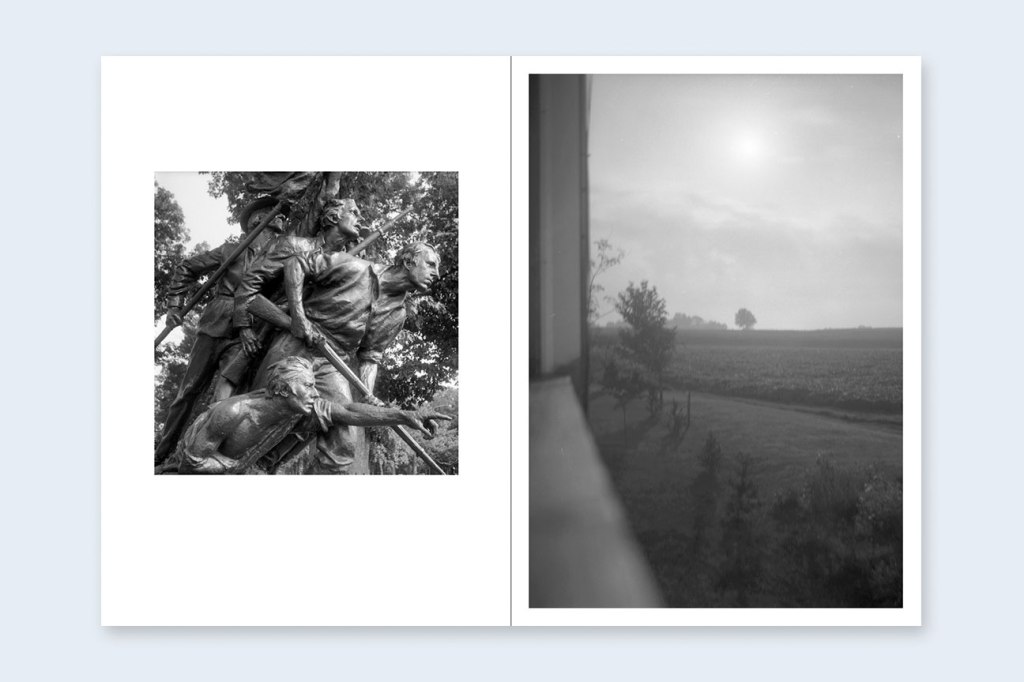
These two works by Carrie Mae Weems appear in the second round of the Nazraeli Press subscription series entitled “One Picture Book”. In its statement about the first round, which topped out at 100 books, the publisher explains the series: “The series consists of uniformly designed, modestly-sized hardcover books, comprising 16 pages that serve as a “canvas” for the artist to display one cohesive body of work”. As in both series, “picture” means “photograph”, the results could amount to catalogues, notebooks or photobooks. The phrase “one cohesive body of work” and the reference elsewhere to the works as “artists’ books” indicate that the publisher has more in mind. Weems’ two volumes rise to the intention. They stand on their own but also capture elements of the artist’s larger body of work.
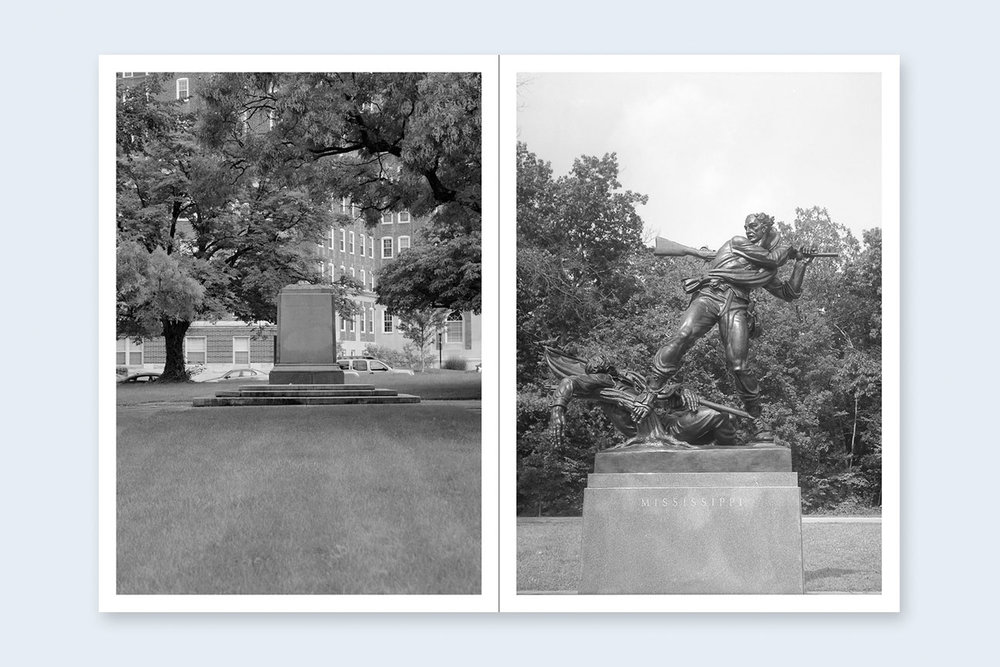
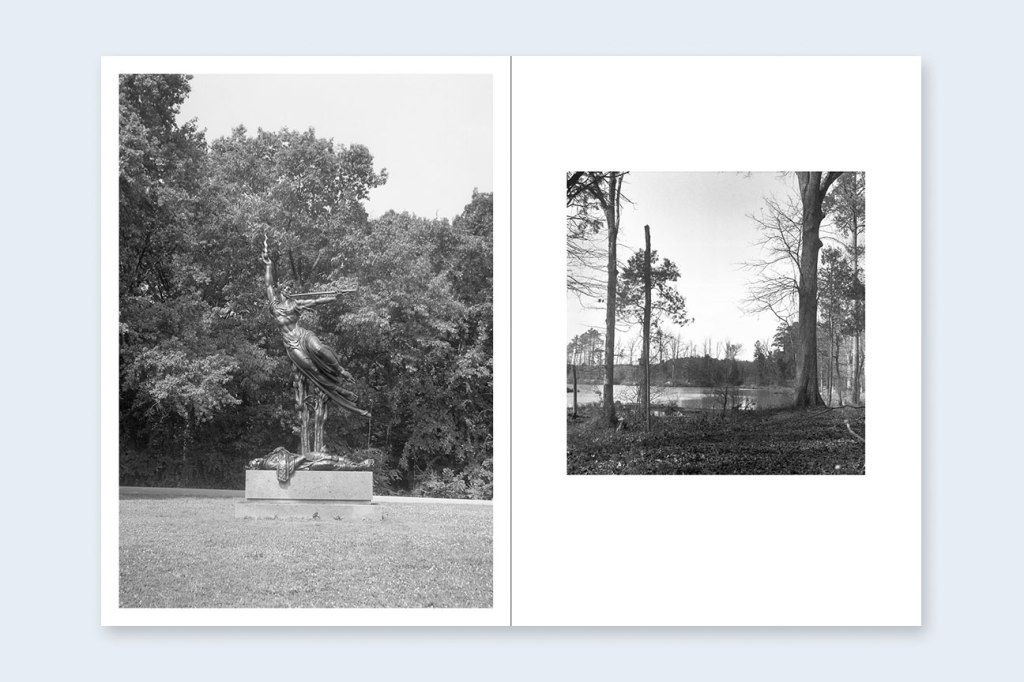
In Monument, the pages alternate between memorials to the Confederate dead and empty plinths from which they have been removed. It builds on three installation series: The Louisiana Project (2003), Museums (2006), Roaming (2006). All of these series are covered in the October Files book mentioned below. In each of these three series, Weems stands mostly with her back to the camera. In the first series, she gazes on and poses in various antebellum mansions; in the second, she stands dressed in a soutane-like black dress and, always with her back to us, gazes on museums; and in the third, in the same dress and same stance, gazes on ruins of ancient Rome. In The Louisiana Project, the stance speaks of dancing on the grave of exclusion — “the ruins of your remains”. In Museums, it speaks of possible inclusion but segregation. In Roaming, the stance speaks of 21st century Blackness in confrontation with empire. In those series, her presence forces the viewer to take her into account — into context.
In Monument, Weems is behind the camera. She relies on the absence and presence of the sculptures to convey her perspective. In two particular images without any monument — one of a plantation field and one of swamp land — absence is entirely the point; these are the places slaves died. A much earlier series — Slave Coast (1993) — comes closer to Monument in her physical absence in general and these two images in particular. The places where captives were once held awaiting shipment into slavery are presented under blazing sunlight or dark inside shadows and starkly empty. Unlike Monument, though, posters label the images with place names whose ambiguity, if any, disappears with one poster’s warning: GRABBING SNATCHING BLINK AND YOU BE GONE.
The power of architecture is extraordinary — the power of places that we are, or are not, invited into. Architecture defines for us. It tells us what a building means and to whom it belongs. — Carrie Mae Weems
“Identity, Relationships & More”
Crystal Bridges Distinguished Speaker Lecture, Crystal Bridges Museum of American Art, 8 December 2017
Absence and presence are used to assert the artist’s perspective just as strongly as her turned back does in the three later series. That power of perspective through absence and presence is what Weems deploys against this power of architecture. But the display of Weems’ name at an installation or on a book like Monument makes the reader well aware whose perspective is being asserted. What if the images of Monument appeared somewhere without attribution? If they were displayed along the corridors of a courthouse, hospital, state or municipal building, would the viewer register the weight of the absences and presences? More than likely, it would depend on the particular viewer’s sensibilities and ability to recognize them for what their presence or absence are to others — reminders of the “Lost Cause” or reminders from the Jim Crow era erected to memorialize a fight for slavery.
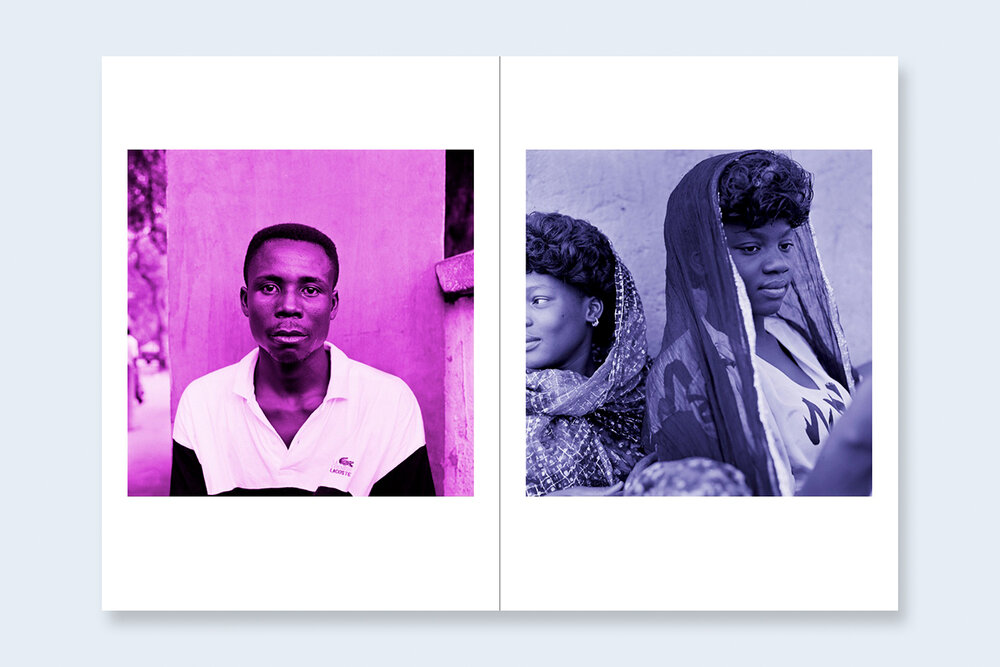
Africa: Gems and Jewels also builds on two earlier series: Colored People (1989-90) and From Here I Saw What Happened and I Cried (1995-96). As Weems herself puts it on the publisher’s website:
“In the earlier 90s after traveling throughout the Sea Islands on the Southeast Coast on the United States, I decided that it was time to go home, back to Africa. There was something that I needed to know about the nature of myself. In love with customs, beliefs and material cultural, I made many pictures, but only a … handful of people. The portraits for Africa: Gems and Jewels are that handful.” — Carrie Mae Weems
Like those from the installation Colored People, the portraits in this book are presented through lens filters of yellow, green, violet, blue and sepia. In both cases, the filters play off the titles of the works. Is the artist nudging us to recognize that we cannot be colorblind, that color gives color to the subject, that we may only recognize gems and jewels if we know what is filtering our perception?
Given how Weems modulates subject, composition, technique, text and platform in Monument and Africa: Gems and Jewels to lift them from simply a photobook to artist’s books, it is surprising that there seem to be no artist’s books associated with the installations of Colored People or From Here I Saw What Happened and I Cried. By no means does Weems always simply nudge with her technique. The blood red filters and text over the portraits in From Here I Saw What Happened and I Cried land hard. The chance to pore over those nudges and shoves is something an artist’s book would provide.
Further Reading
“Tia Blassingame“. 17 August 2020. Books On Books Collection.
“Sarah Matthews“. Books On Books Collection. In progress.
“Arial Robinson“. 15 May 2023. Books On Books Collection.
“Clarissa Sligh“. 2 September 2020. Books On Books Collection.
“Kara Walker“. Books On Books Collection. In progress.
American Historical Association. “Historians on the Confederate Monument Debate“.
Lewis, Sarah Elizabeth, ed. 2020. Carrie Mae Weems. Cambridge, Massachusetts: The MIT Press. See especially “Diasporic Landscapes of Longing (1994)” by bell hooks, pp. 15-23.
Smith, Cherise. 2019. “Carrie Mae Weems: Rethinking Historic Appropriations”. NKA (Brooklyn, N.Y.). Vol.44: 38–50.
Weems, Carrie Mae et al. 2023. Carrie Mae Weems : Reflections for Now. Ed. by Raúl Muñoz de la Vega, Florence Ostende, and Maja Wismer. Berlin: Hatje Cantz. See especially the sections entitled “Constructing History” and “Architecture & Power”.

