Out of Breath (2019)


Out of Breath (2019)
Jacobus Oudyn
Hardboard slipcase covered in textured paper, housing stab-bound book with waxed paper cover, attached page lifter. Slipcase: Box: H345 x W232 x D50 mm. Book: H300 x W202 mm. 34 pages. Unique. Also acquired, Artist’s Proof: H205 x W165 mm. Both from the artist, 1 June 2023.
Photos: Books On Books Collection. Displayed with permission of the artist.
In turning the thirty-four pages of this artist’s book, your fingers, eyes and ears pick up a rhythm: a labored inward and crackling outward breath, a catching and losing grasp of air, an alternating wet, dry, wet wheezing. The effects come from the material (sounds and touch that the slippery, thin and delicate rice paper gives against the wrinkled carbon paper that continues to shed its carbon), from the technique of alternating positive and negative prints, and from the ticklish action of picking up the pages with the card lifter. It takes a long time to turn these pages.


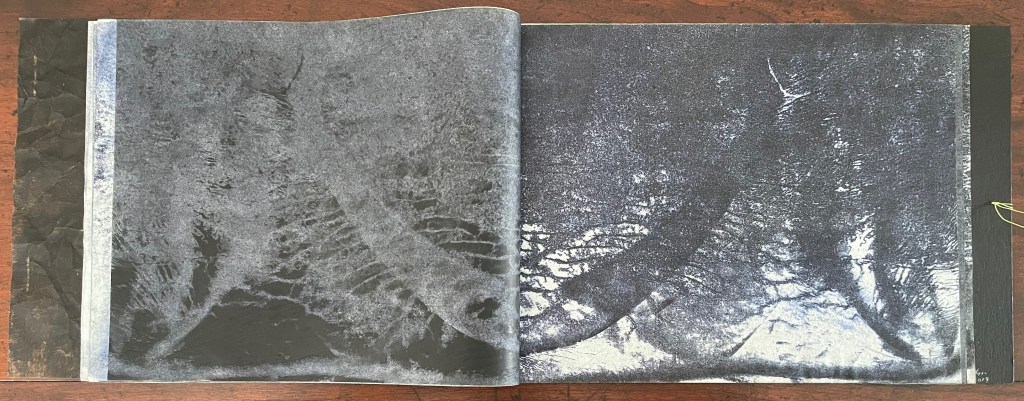
The artist’s note accompanying the work describes it as being “for all our friends and relations who have been victims of Mesothelioma and other ‘industrial’ lung disorders like Black Lung”. Indeed, the double-page spreads’ bilateral symmetry and their blackness, grayness and whiteness recall chest X-rays. The process by which Oudyn achieves this is worth remarking.



In correspondence with Books On Books, the artist notes that the process emerged from much chance and circumstance. It began with rubbings made against charred trees after a bush fire near Tewantin in 2018. Those results prompted childhood memories of the kind of carbon paper he knew as a child. Wanting to explore its use, he found that it was no longer stocked by stationers in the region, no doubt because computers, printers and photocopiers had made it superfluous. An online search yielded some boxes of very fine thin A4 sheets of bluish black and purer black carbon paper from China. Around the same time, he had been experimenting with momigami using various papers, mainly rice paper and mulberry but also cartridge and craft paper. While making books with the carbon paper and momigami results, he had reason to iron some sheets flatter, which yielded a variety of carbon prints on the rice paper. Different temperatures, durations and pressures as well as other papers yielded a range of prints on paper but also beautiful positives on the fine carbon paper itself. Experimenting with different orders in the steps, rewrinkling before or after ironing, and further grading and sorting the papers, Oudyn gained some control over the finished result. Then came the ideas that led to Out of Breath and the following works.
Opening Dark Windows (2020)

Opening Dark Windows (2020)
Jacobus Oudyn
Slipcase. Japanese stab binding, endpapers and a small card page lifter attached by thread. H220 x W300 mm. 20 folios. Unique. Acquired from the artist, 1 June 2023.
Photos: Books On Books Collection. Displayed with permission of the artist.
Opening Dark Windows has a variety of tactile sensations similar to those in Out of Breath. Both have covers generating an unusual sensation — a waxen flexible texture in Out of Breath, a dry rough stiff texture in Opening Dark Windows. Both alternate different weights of papers. Of the 20 folios in Opening Dark Windows, 10 are carbon tissue paper, 10 are cotton Ingres (108 gsm), and all show the experimentation described above. This work, however, also displays Oudyn’s characteristic use of multiple media and collage — black acrylic paint, white wax crayon, pva glue, graphite, inks and found text. Oudyn also adds further tactility with torn and cut flaps with their pull tabs. All of this is in service to an idea: an exploration of fading memory and the retrieval of material long thought forgotten, both of which are made interactive by the flaps (the physical “dark windows”) in the carbon tissue that reveal the collaged text, signs, fractions and drawings sometimes glued to or made on the underside of the tissue, sometimes on the underlying sheet of Ingres.

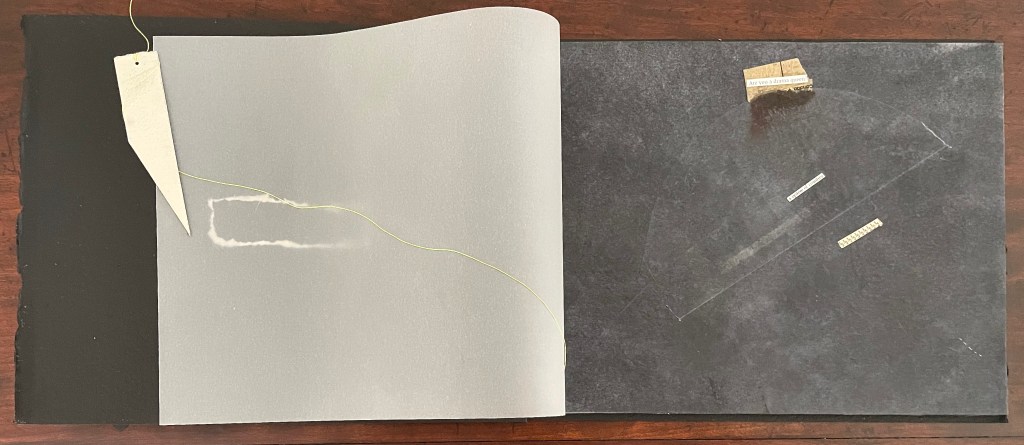

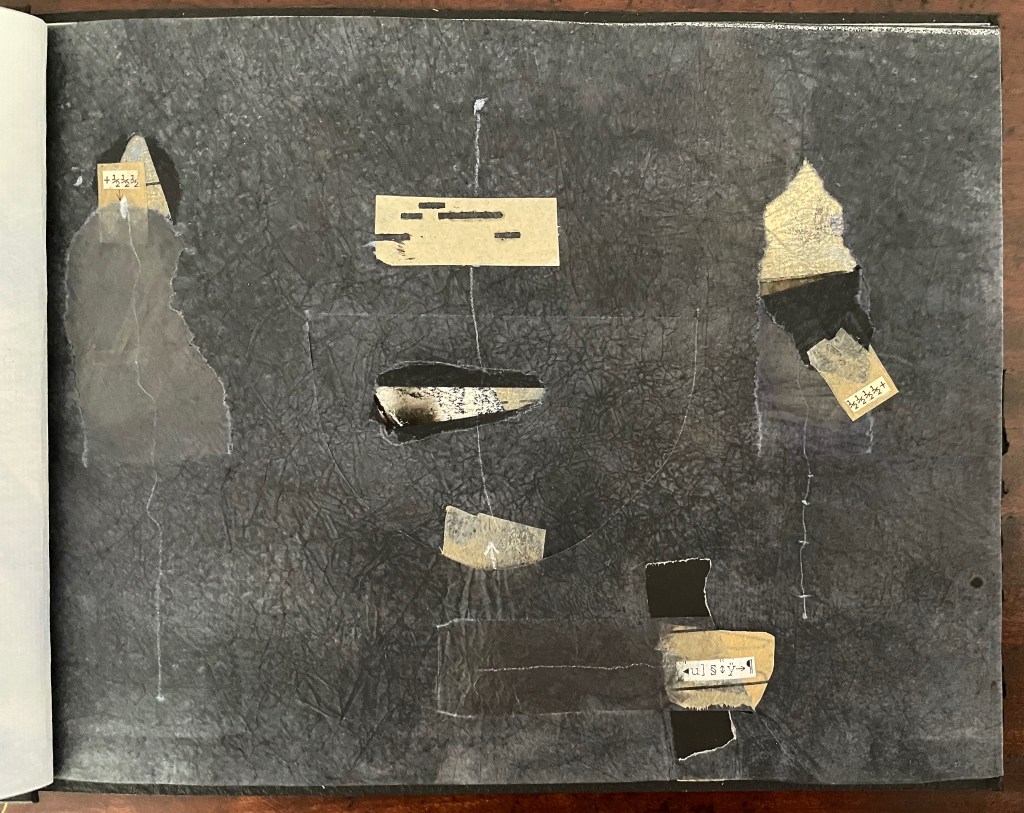

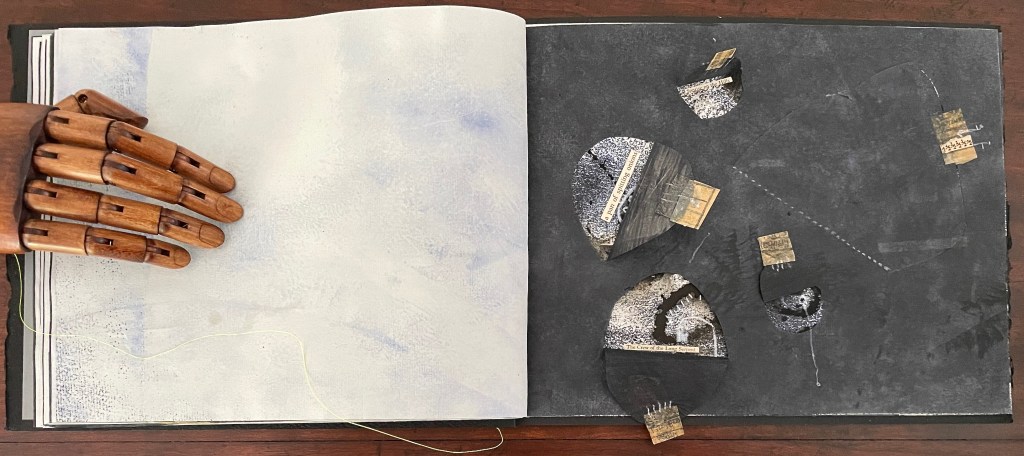


Texture and weight alternating from one layer to the next, textures juxtaposed as flaps peel away, truncated text expanding and changing as the page turns — this is mindscape as surreal scrapbook.
Flattening the Curve (2021)
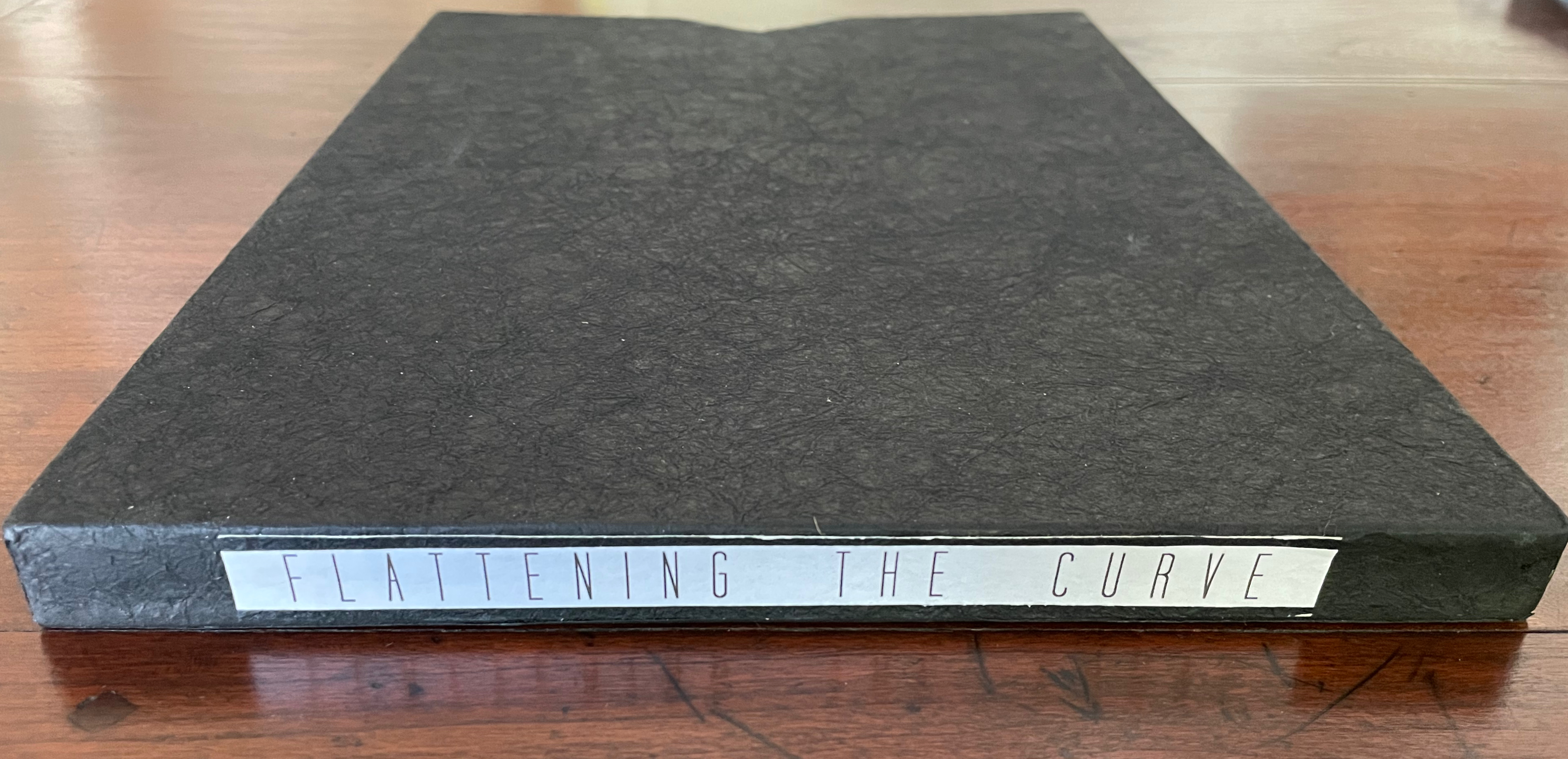

Flattening the Curve (2021)
Jacobus Oudyn
Slipcase. Japanese stab binding.H210 x W300 mm. 24 folios. Unique. Acquired from the artist, 1 June 2023.
Photos: Books On Books Collection. Displayed with permission of the artist.
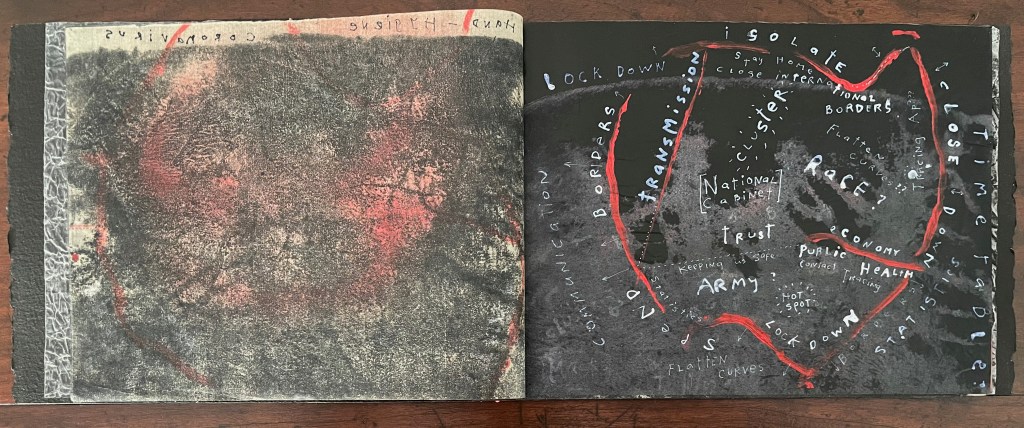
Like Out of Breath and Opening Dark Windows, Flattening the Curve (2021) uses the “swag” of black papers Oudyn had created. Although it is also a work of multiple media — the papers themselves, graphite and inks — the focus of Flattening the Curve rests more on a sort of narrative or documentary line showing how language changed as the Covid 19 pandemic progressed. A specific Covid language evolved as daily progress reports from political leaders and medical experts and interviews in the media became the focus of everyday life for two years. As the words on the page change reflecting their use for the purpose of authority and confidence, the seemingly fixed geographical boundaries in red break and shift. Even the height and width of the leaves shift.


M.L.A. (2021)


M.L.A. (2021)
Jacobus Oudyn
Softcover pamphlet-stitched, textured flyleaves. 18 sheets Chinese carbon paper, 18 sheets Chinese rice paper. Found text. H125 x W110 mm. 36 pages. Unique. Acquired from the artist, 1 June 2023.
Photos: Books On Books Collection. Displayed with permission of the artist.
Obviously from the works above, Oudyn deploys his set of tools, techniques and material imaginatively, but for this satiric portrait of a flip-flopping Member of the Legislative Assembly in Australia, the subject himself seems to have selected unwittingly the overprinting from carbon paper onto rice paper. Every turn presents a reversal.
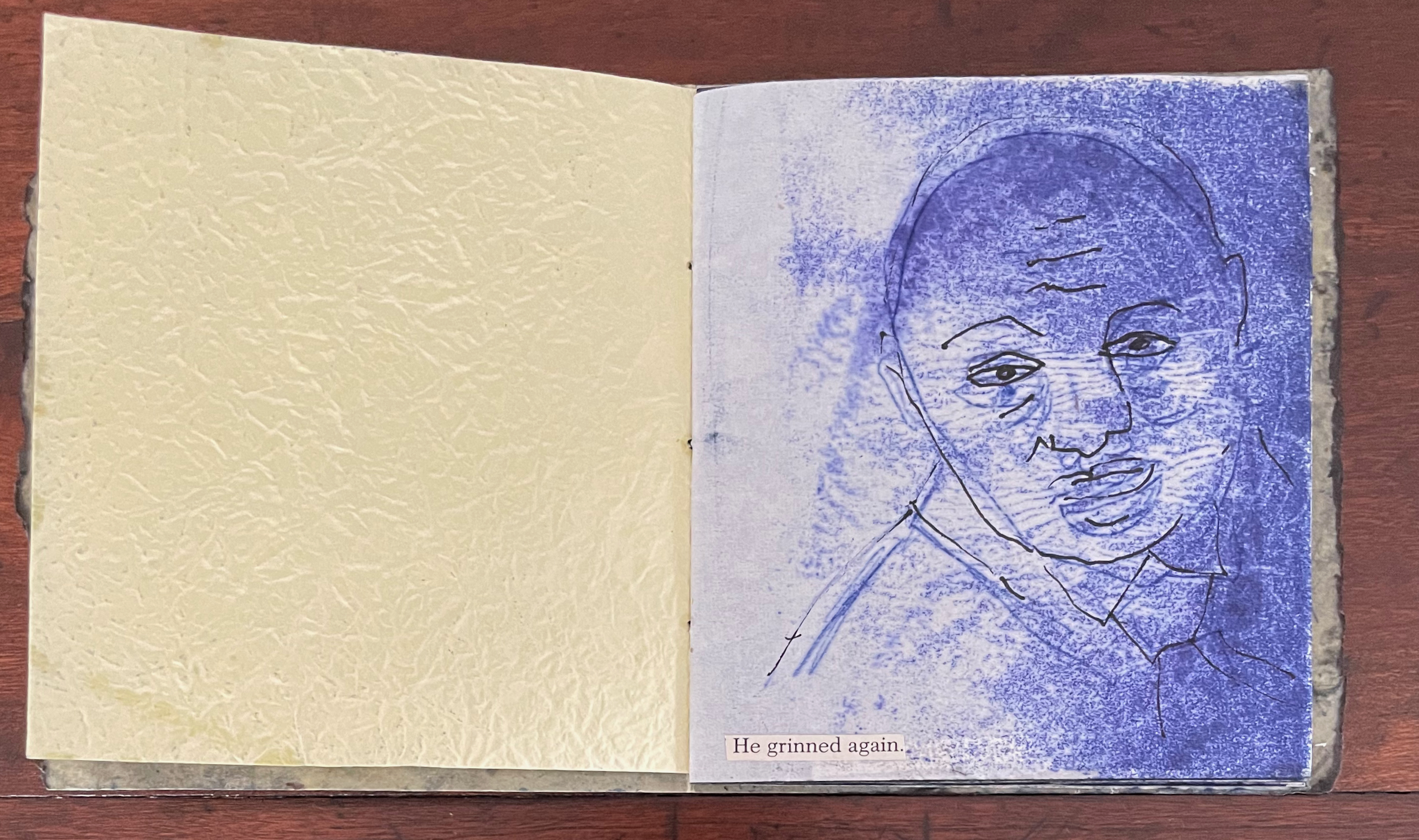


Even beneath the reversals, his previous faces to the world accumulate and peek out slightly askew from “today’s” view until at the end you can hardly tell what view would be next. To which the M.L.A would reply, does reply, “Yes, why not?”


Points of Reference (2022)
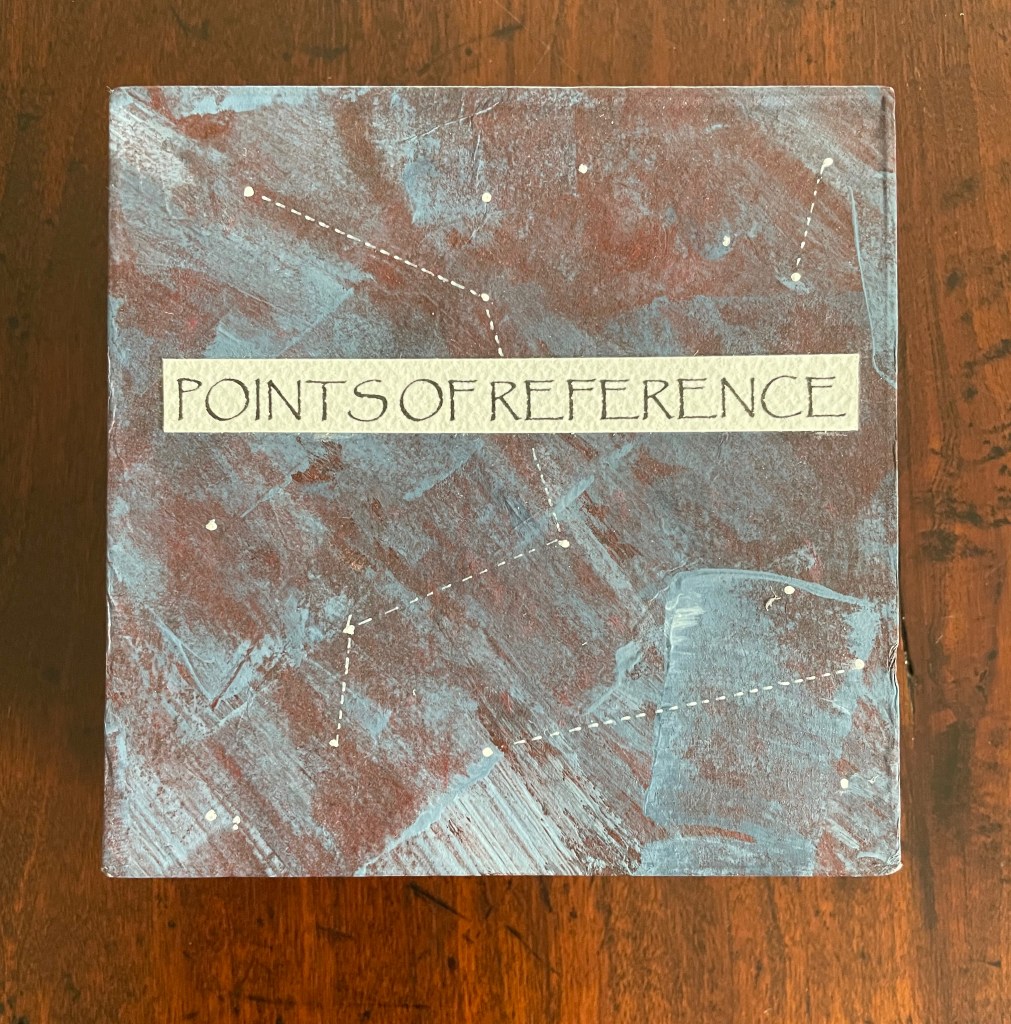
Points of Reference (2022)
Jacobus Oudyn
Box covered in illustrated paper. Three small books, each with five double-sided panels. Box: 115 x115 mm. Each book, closed: 103 x 103 mm; open: H260 x W 210 mm. 10 panels each book. Unique. Acquired from the artist, 1 June 2023.
Photos: Books On Books Collection. Displayed with artist’s permission.
Points of Reference recalls Oudyn’s earlier ‘16 Century Map‘ (2012) where the artist juxtaposed an old European map (showing Mesopotamia and the Euphrates, the Northern hemisphere’s cradle of civilization) with an Australian map of the Kakadu National Park, which covers ancient locations that evoke the concept of Tjukurpa, by which Australia’s Anangu refer to the creation period. The later work raises the earlier one’s implicit critique of European colonialism — “if we map it, we own it” — to a more all-embracing level.
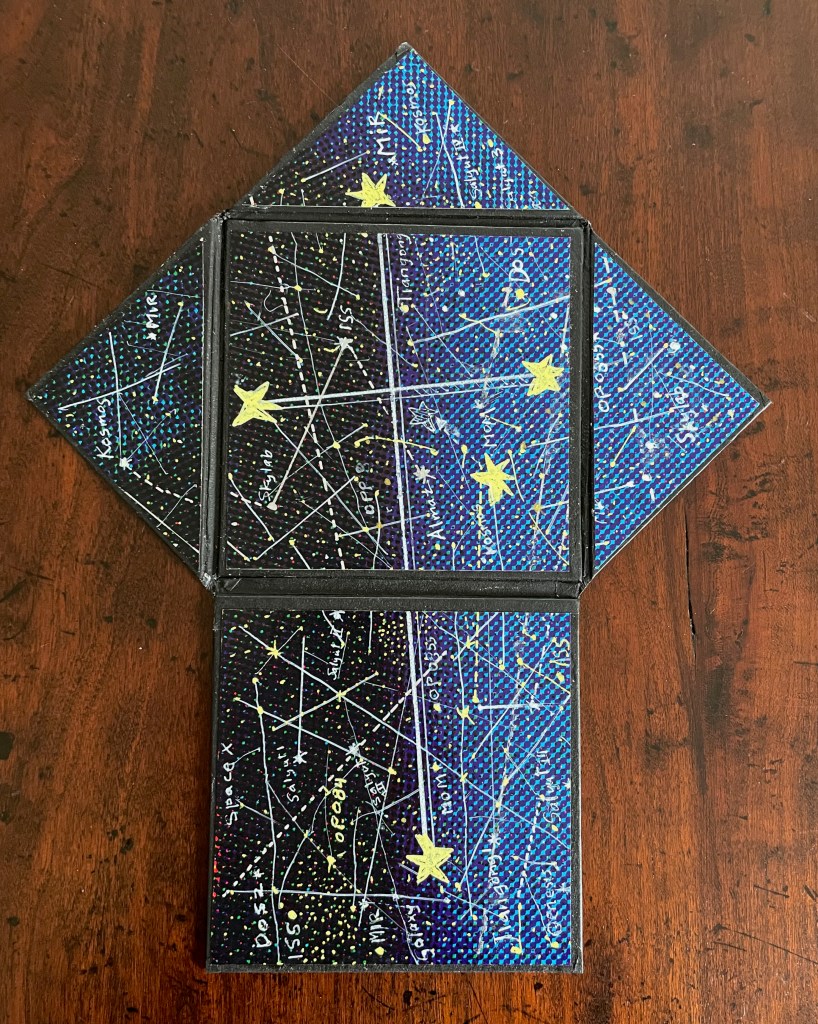
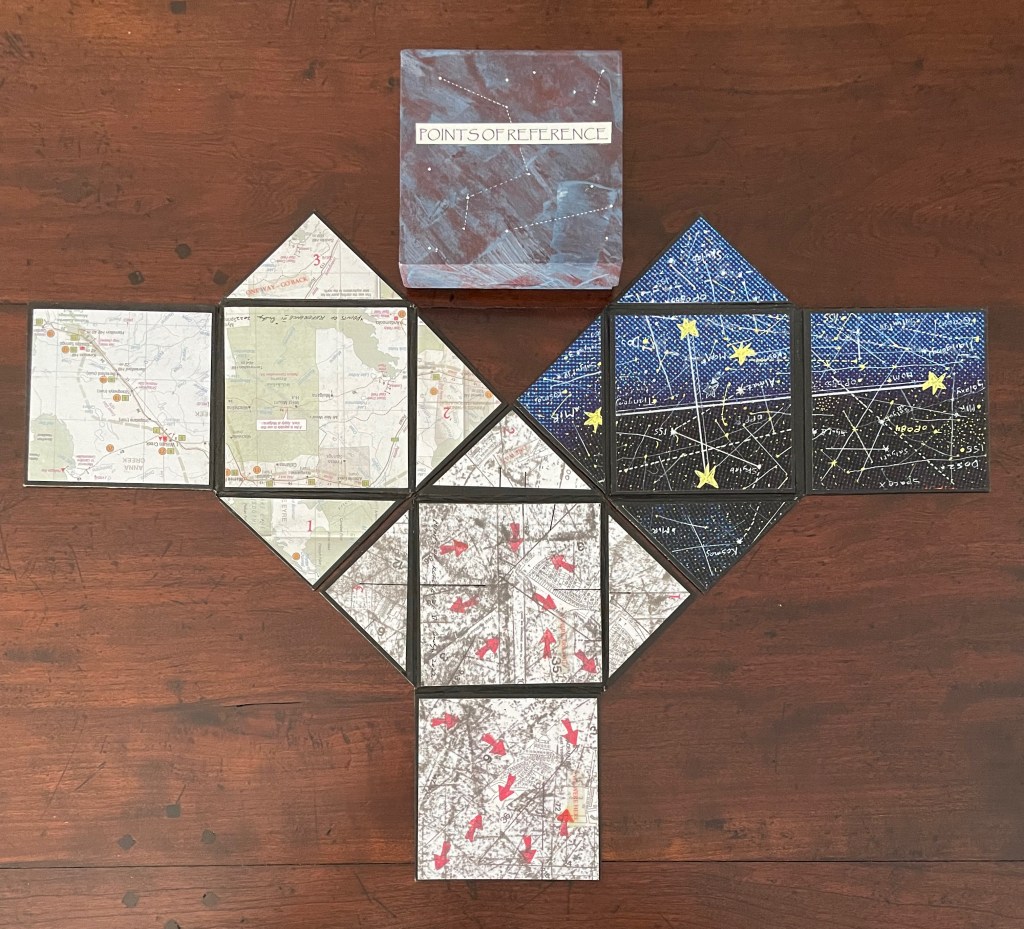
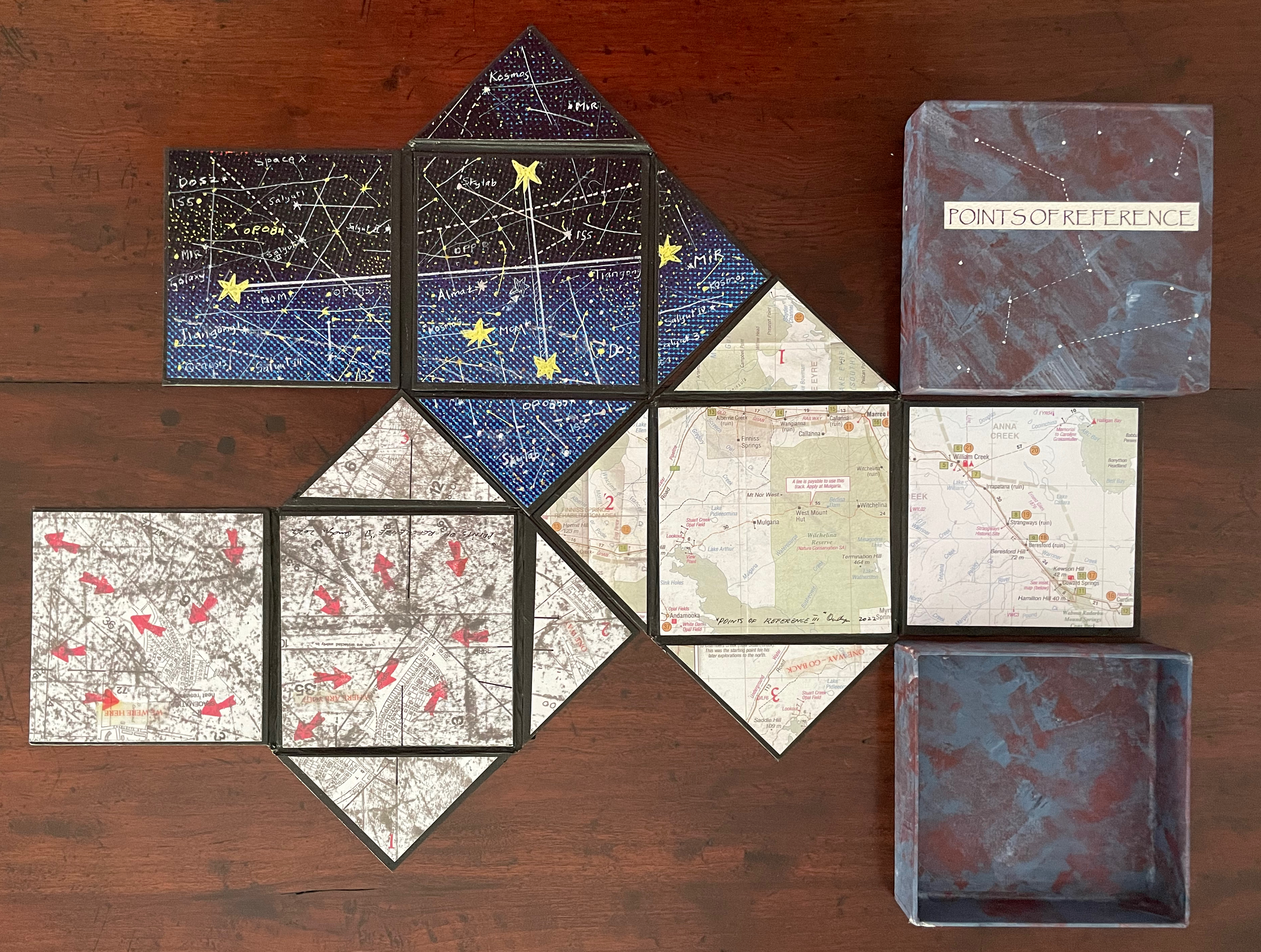
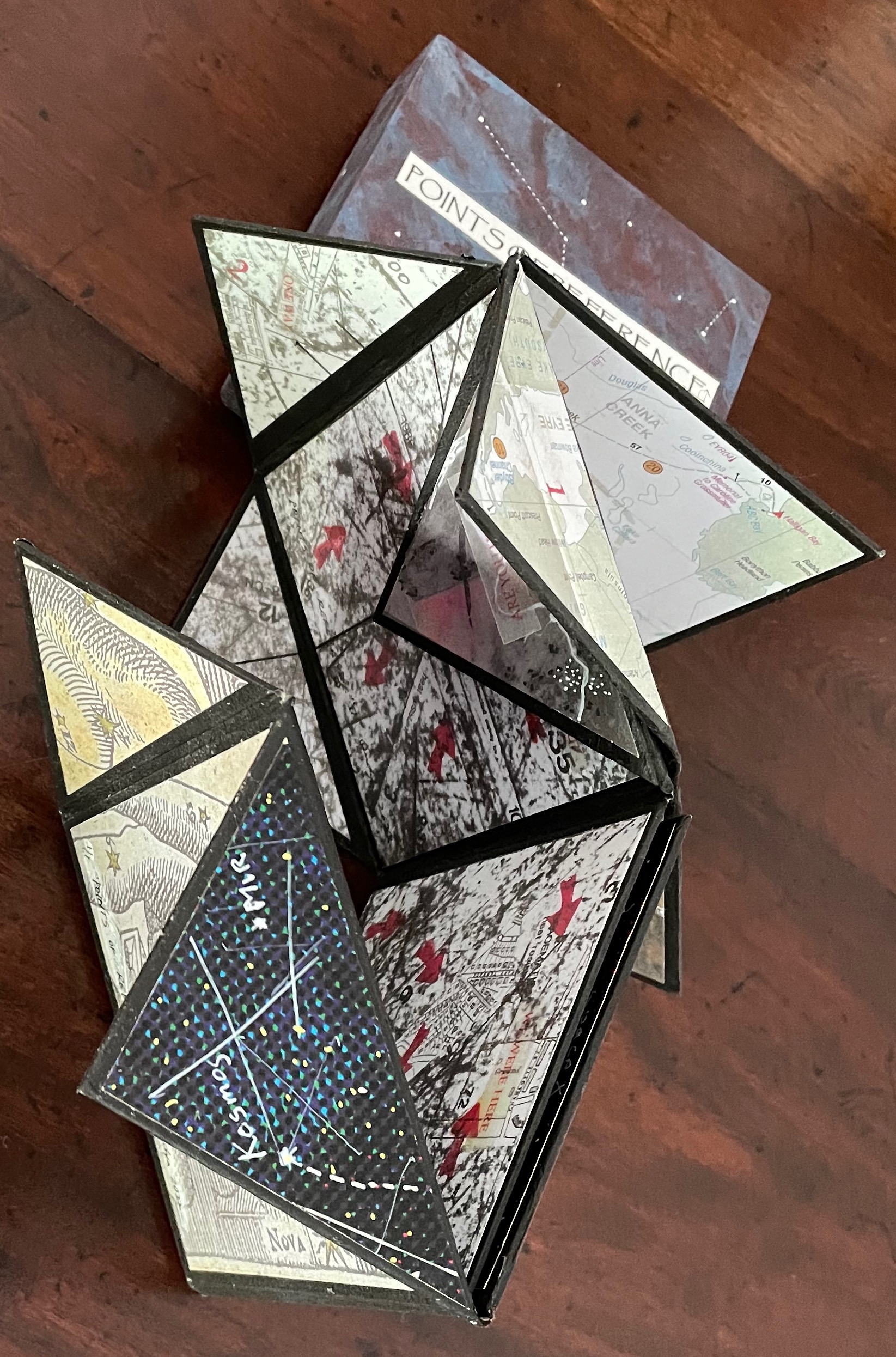
A paper-covered box holds three small identically shaped, double-sided folding panel books. Each has two square panels and three triangular panels. When fully opened, each book takes the shape of a directional arrow.
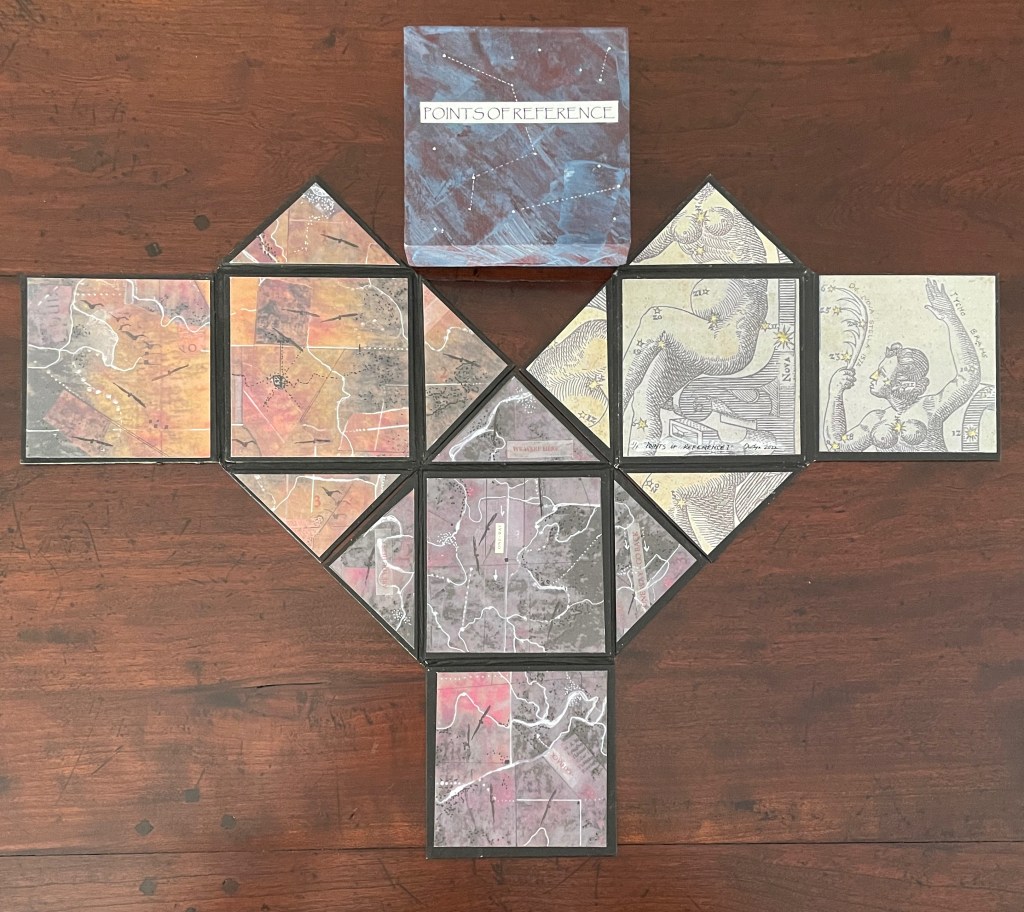
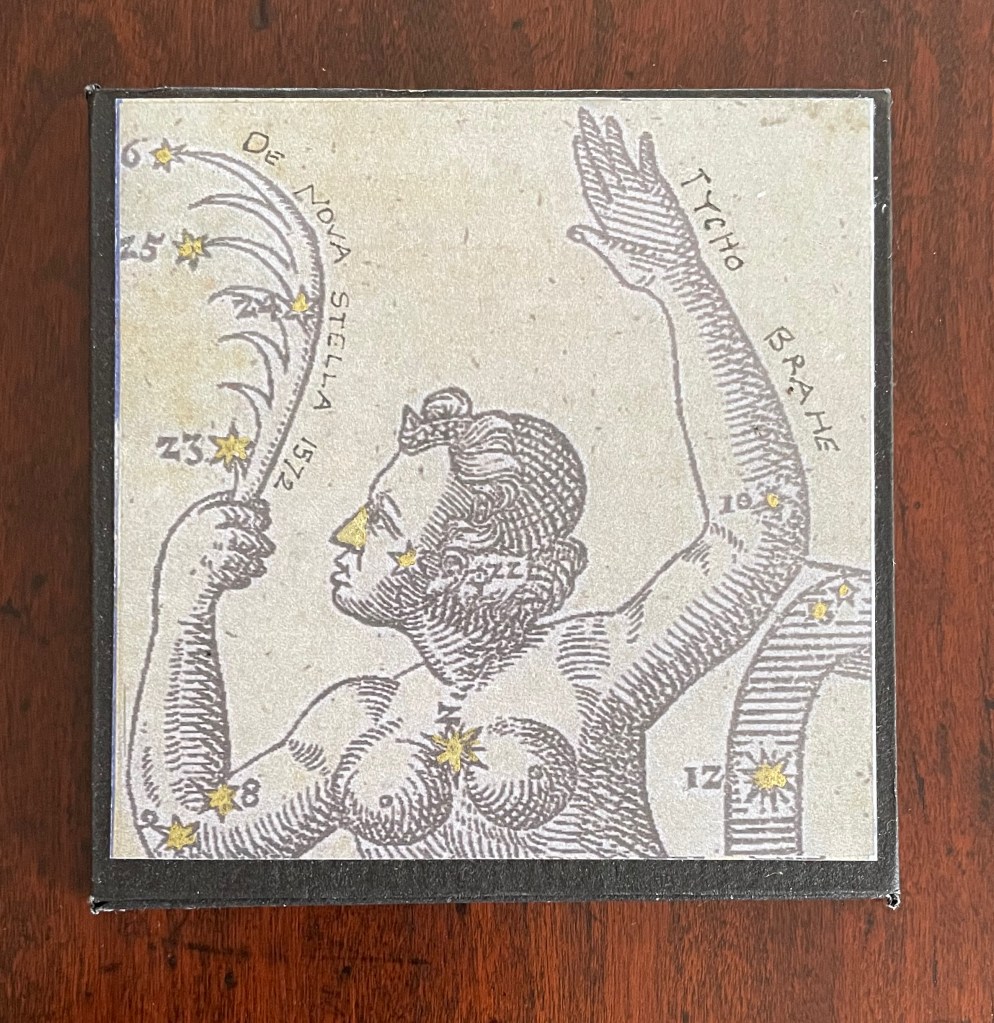
One book has an image from Tycho Brahe’s Stella Nova 1572 on one side and, on the other side, an imaginary space map of commercial and abandoned space junk around the Southern Cross.

The second book has a planimetric map on one side and, on the other, a map of the same area entirely painted over predominantly in a muted orange and yellow, with some brown and gray, and black-ink silhouettes of birds in flight and native Australian markings in white and black.


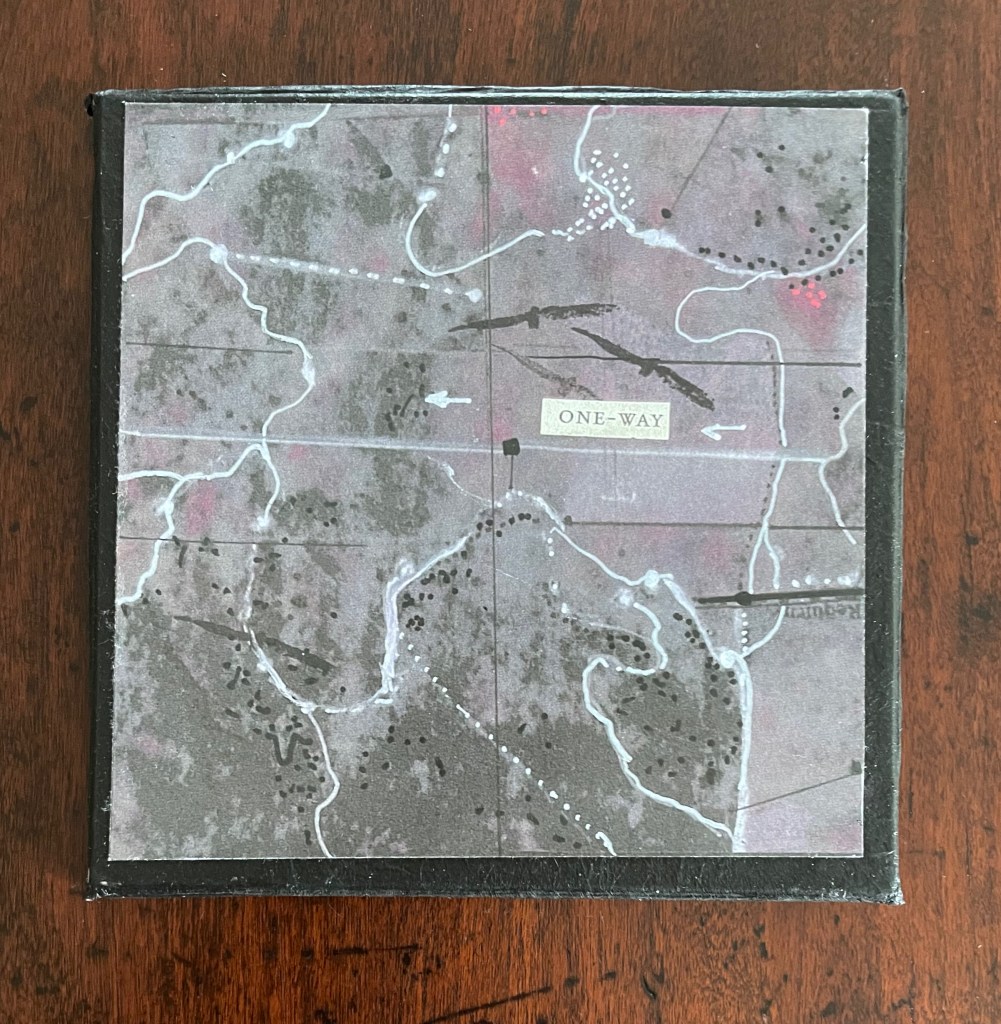
Similar to the second, the third book has a partially obscured cadastral map with plots of property on one side and, on the other side, a map of the same area entirely painted over in gray, with some rose accents and, again, black-ink silhouettes of birds in flight and native Australian markings in white and black.
The triangular panels in the second and third books are numbered 1 to 3 on both sides, signifying that the same areas are mapped on both sides. Also, both of these books have faint collagraphed snippets of found text on the overpainted sides. Uniquely, the third book has gameboard-like text on both sides. On one side, the text reads,”ONE WAY”, “WHERE ARE YOU?” and “WE WERE HERE”; on the other, it reads “ONE-WAY”, “ARE YOU HERE?”, “WE WERE HERE”, “ONE WAY – GO BACK” and “- GO BACK”.
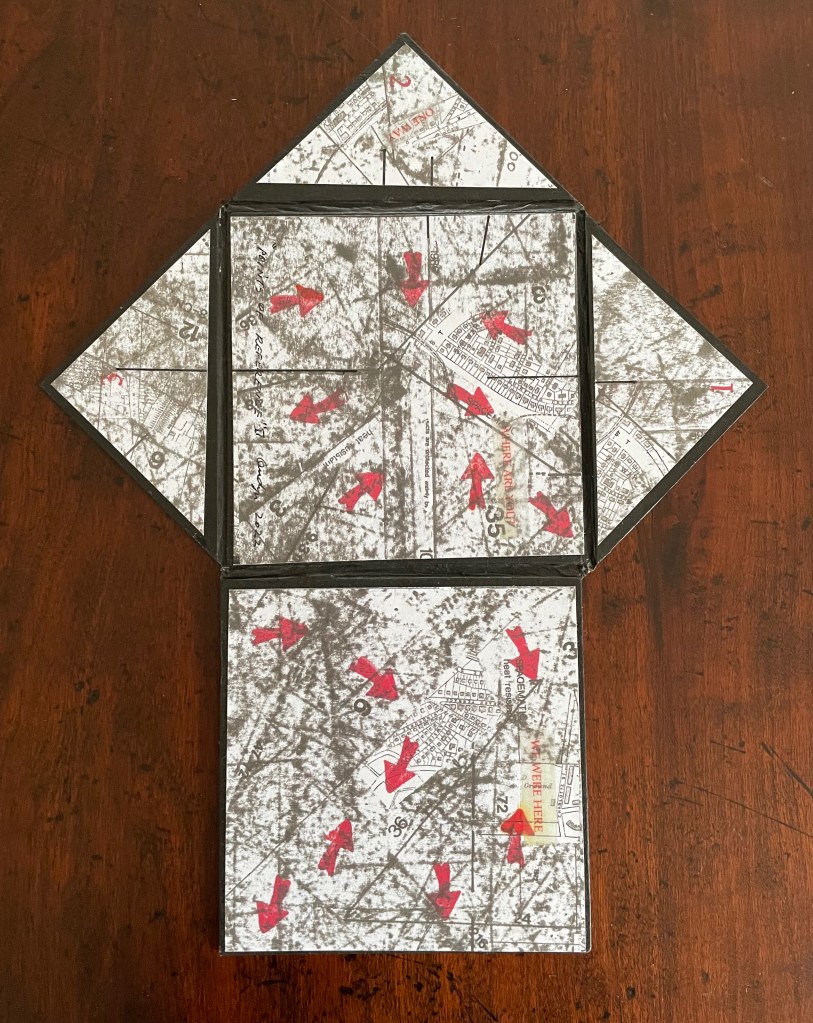

Along with their punning on the work’s title, the pointer-shaped open books’ re-arrangeability and their gameboard text suggest a playful invitation to consider how we imagine, mythologize, redefine and map what seems to us to be empty space challenging our place in it.


Facing Again (2023)

Facing Again (2023)
Jacobus Oudyn
Card cover, found-text title pasted on front cover. Pamphlet stitched, 10 portraits made of found text, collage and mixed media. H102 x W147 mm. Unique. Acquired from the artist, 1 June 2023.
Photos: Books On Books Collection. Displayed with permission of the artist.
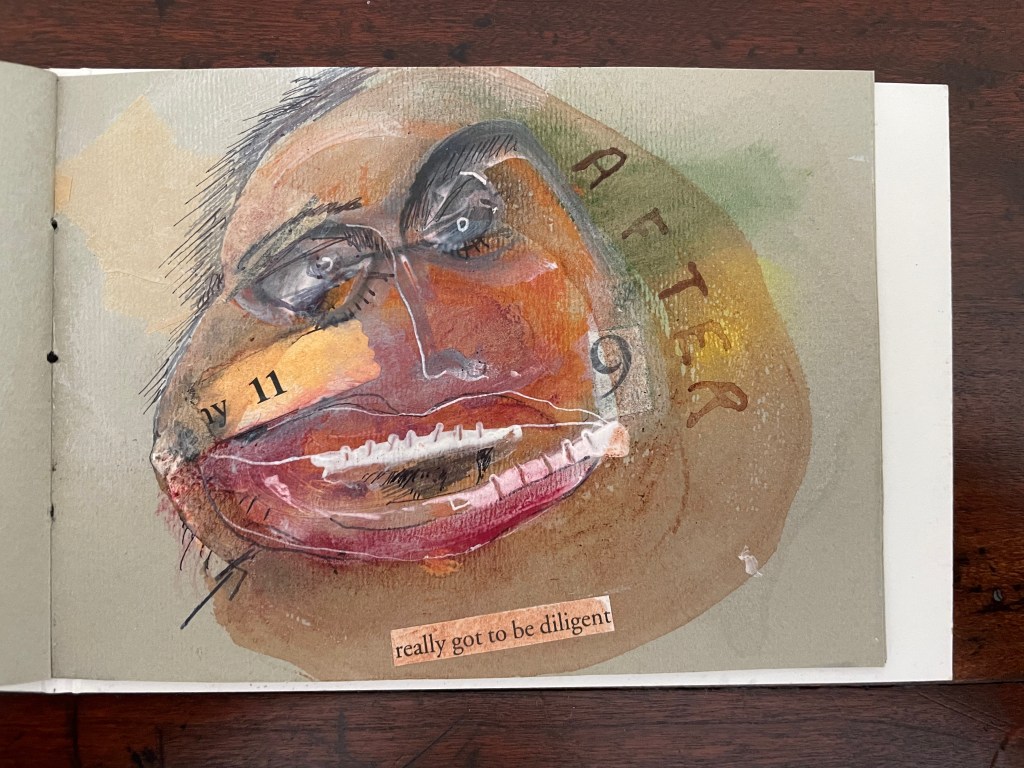
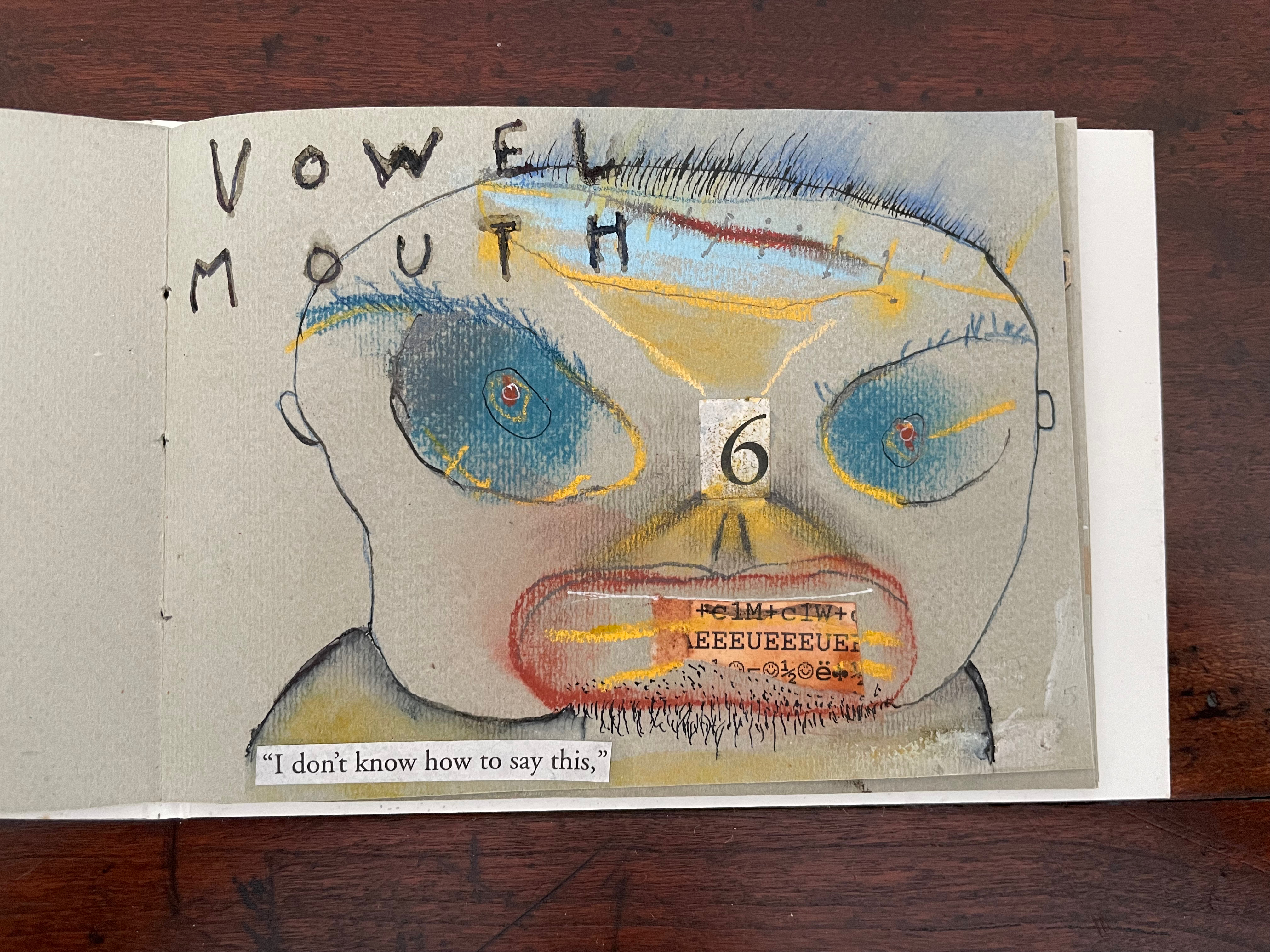
Something of a cross between the satire of R. Crumb and Spitting Image and the rawness of Lucien Freud and Francis Bacon, each of these ten portraits fills its half of an 80 gsm gray pastel paper folio. So, naturally, they loom larger than life in the near-miniature trim size. While the portrait in M.L.A. has a real-life subject of its satire, these faces in Facing Again are fictional, more general and reflective of “mental” issues afflicting 21st century first world societies. Common to most of the portraits, fractions appear as content in the mouths or in the minds of the portrayed — or almost as if they are brushstrokes conveying a characteristic. They imply a sense of psychological, social and political fractionation and division that have featured increasingly in the first three decades of the 21st century.
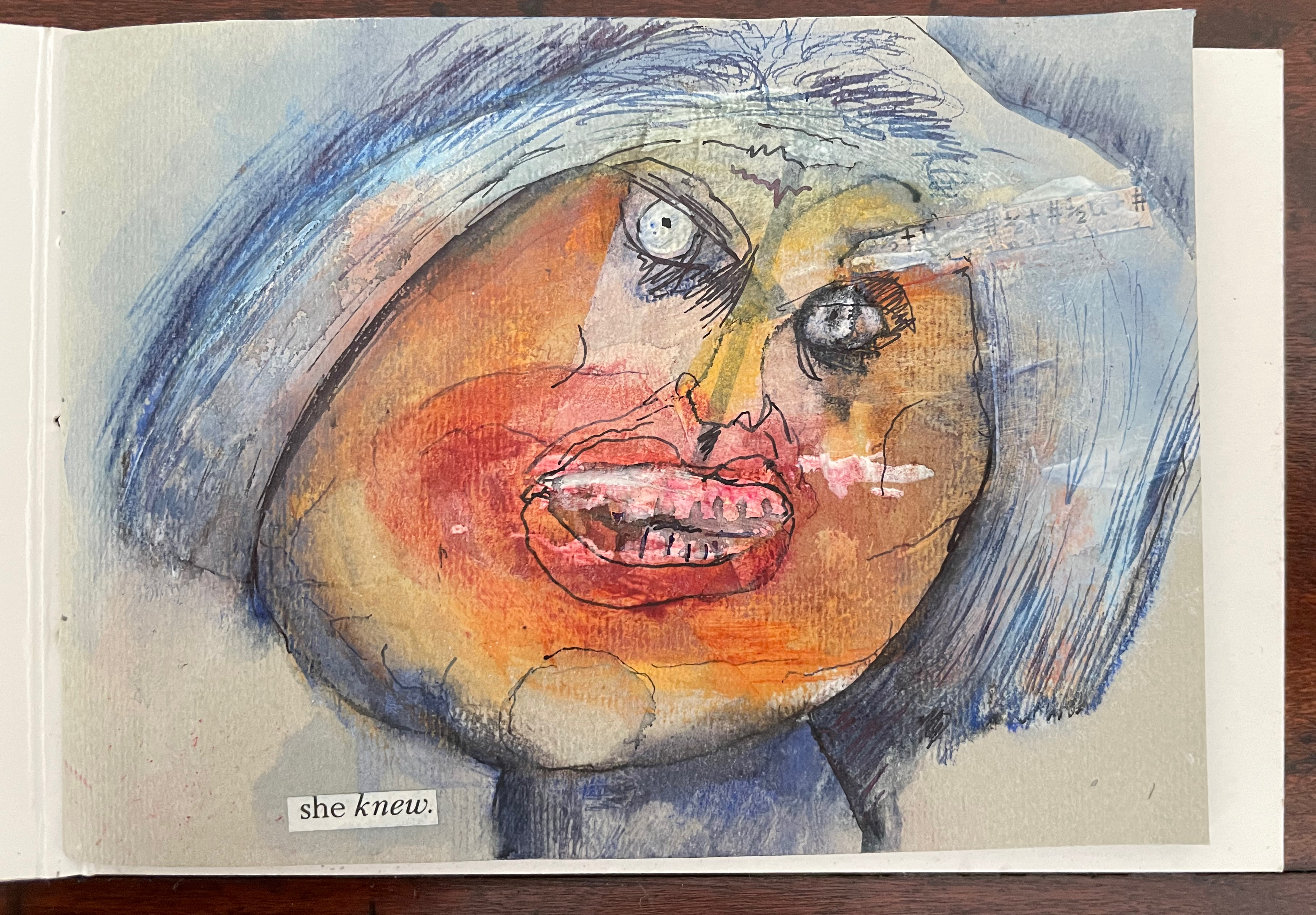
In the first portrait, above, a set of fractions seems to issue from the character’s forehead like a thought bubble, but this bubble is shard-shaped and could just as well be impaling the character’s forehead with fractions. In either case, they have to do with what “she knew” — the “what she knows” that inflames her face and contorts her nose and mouth into a snarl.
Although not a fraction, the eighth portrait’s reference below to the 9/11 event of 2001 and the text — “really got to be diligent” — evoke an identifiable instance of fractionation and division. This character is more physically distorted than the first. Its jaw dislocated, its teeth inverted, its eyes askew, the face looks submerged in a brown pool of 9/11 aftermath. Divisions on a global scale begat violence, which reinforced fear and division, which begat more violence and fear. If it were only that simple.
These portraits are images of confusion and uncertainty until the last, who seems able to weep only with one eye for “something else”.




Further Reading
“Jacobus Oudyn (I)“. 17 January 2021. Books On Books Collection.
 Books On Books