
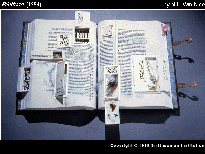
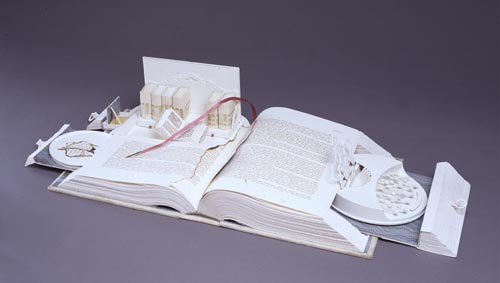
Micro-Pages, a book arts exhibition curated by Abigail Thomas, toured throughout the UK in 2009 & 2010.
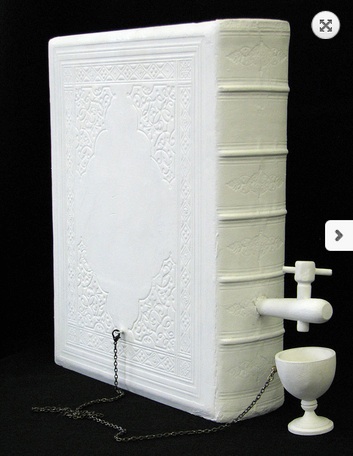
As a participating artist as well as being the curator and project instigator, and having worked in a library/archive for several years, I wanted to explore issues that affect libraries and archives as well as the book art world. Books have it in their nature to be handled; they are intimate objects whose feeling, texture, weight and smell are part of their artistic aura. Glass cases can remove the experience of the work, and you are unable to see it in its entirety, however, having books out also has its disadvantages. Should we treat artists’ books as archival material? This is the point that the project starts from. From the artist’s website.
The form of this exhibition also reflected Thomas’s concern with the book as machine, or reading machine. With microfilm, the reader is cast back into the age of scrolls and paginae, forerunners to the pages of the codex, yet is also suspended between the print codex and and arrival at what Thomas might agree is “an” imagined future escape from the page into the scrolling web.
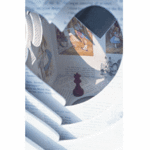
Only “an” because Reading the Imagined Escape from the Page is Thomas’s live reading event, consisting of a projection, a leaflet/bookwork/handout and her lecture-style commentary. First delivered at the Arnolfini, Bristol in April 2013, the performance echoed and extended Micro-Pages in its collage/collision of visual projection, paper and screen.


Another instance of an imagined escape from the page can be explored in Thomas’s essay “Bob Brown’s Reading Machine and the Imagined Escape from the Page”, published in Artist’s Book Yearbook 2014/15 (Impact Press, ISBN 978-1-906501-07-5). Here’s the author’s abstract:
Bob Brown imagined an escape from the page; the restrictive nature of the form of the ‘antiquated book’ following into new forms of technology and machine reading. This investigation functions as an inquiry into the idea of the reader as machine; in Bob Brown’s printed experiments in optical reading, can we ever escape the page? In writing for the imagined machine, and in using the page and its restrictions Brown was able to imagine these ideas and new ways of reading. Punctuation and page layout were devices used by Bob Brown and the poets involved with The Readies for Bob Brown’s Machine, The Readies, and Words to represent the movement and speed of a new form of reading through an imagined machine. This essay argues that they actually force the reader[s] themselves into becoming the reading machine perhaps without losing their humanity and without the need for the machine itself. The concepts contained within the writing, and the aspects of optical text design, challenges the page and the way we read, within all three books, and allows the machine to come alive within the text itself and so within the reader. From the author’s website.
Craig Saper (cited by Thomas) published a biography of Brown in 2016. More on Bob Brown and Abigail Thomas can be found in Amaranth Borsuk’s The Book (MIT Press, 2018), reviewed here.
Thomas’s works and their conceptual challenges to the page reify in a thought-provoking way the more academic explorations in Stoicheff and Taylor’s The Future of the Page. Rich in its consistent conceptualization, her work articulates the loss of the haptic but only seems poised to instantiate or at least insinuate a palpable physicality that would lift her art to new levels.
 Books On Books