Runic Alphabet (2023)
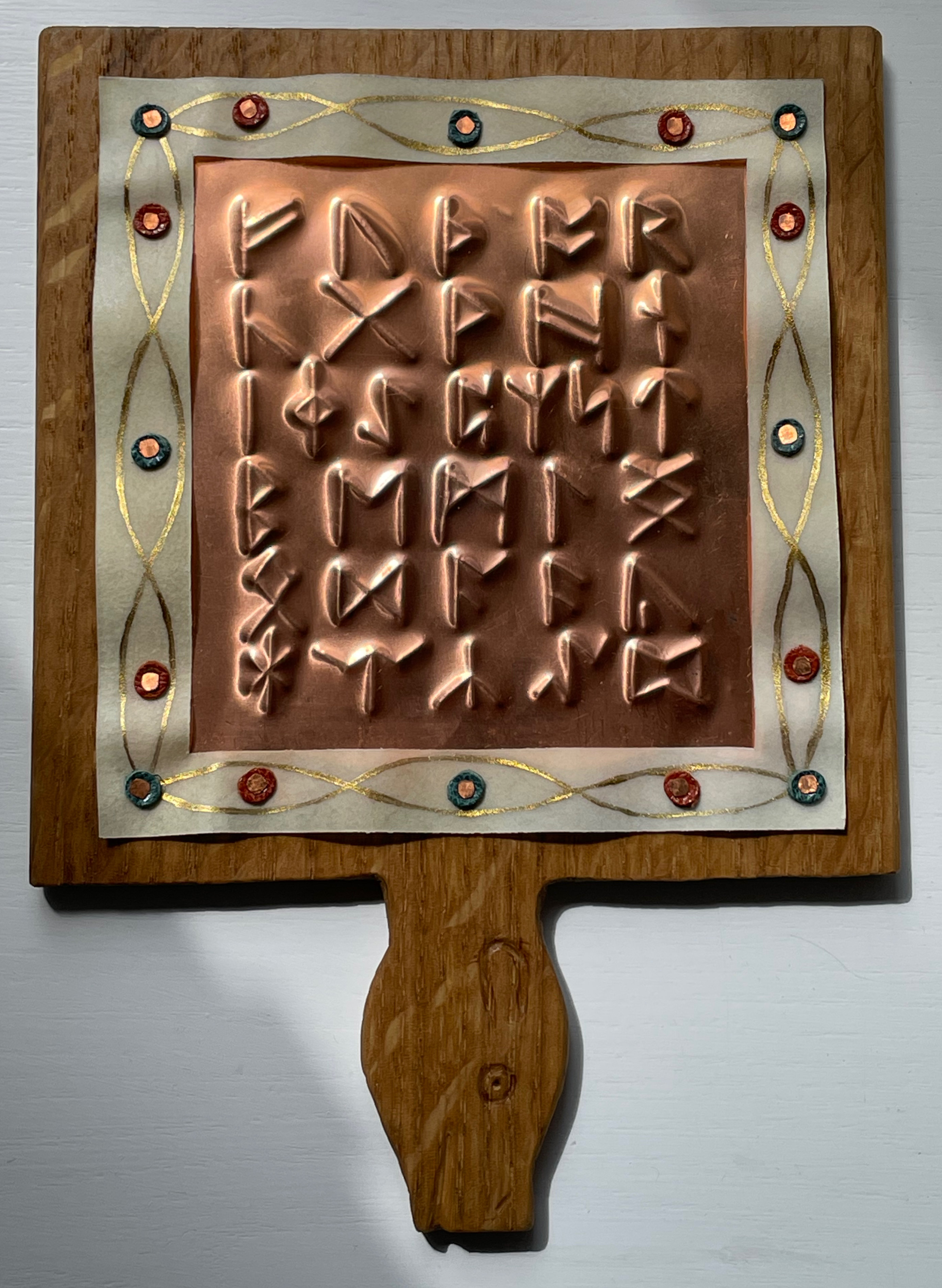
Runic Alphabet (2023)
Ashley Rose Thayer
Bag (H290 x W195 x D30 mm) enclosing horn-book (H177 x W167 mm) and colophon plaque (H63 x W88 mm). Unique edition. Acquired from the artist, 26 June 2023.
Photos: Books On Books Collection. Displayed with artist’s permission.
Through her affiliation with the Northwoods Book Arts Guild, Ashley Thayer organized a challenge to reinterpret the horn-book. Several spectacular and inventive works emerged, and at this writing, an exhibition is being organized. The Bodleian “Alphabets Alive!” exhibition (19 July 2023 – 13 January 2024) was lucky enough to acquire one of Thayer’s own efforts: Runic Alphabet. With this work, Thayer re-imagines the learning tool for the so-called Dark Ages. Runes eventually succumbed to the Roman alphabet as military and religious conquest extinguished pagan traditions. So, this horn-book is, in Thayer’s words, “an act of rebellion, an attempt to keep the old ways alive”.
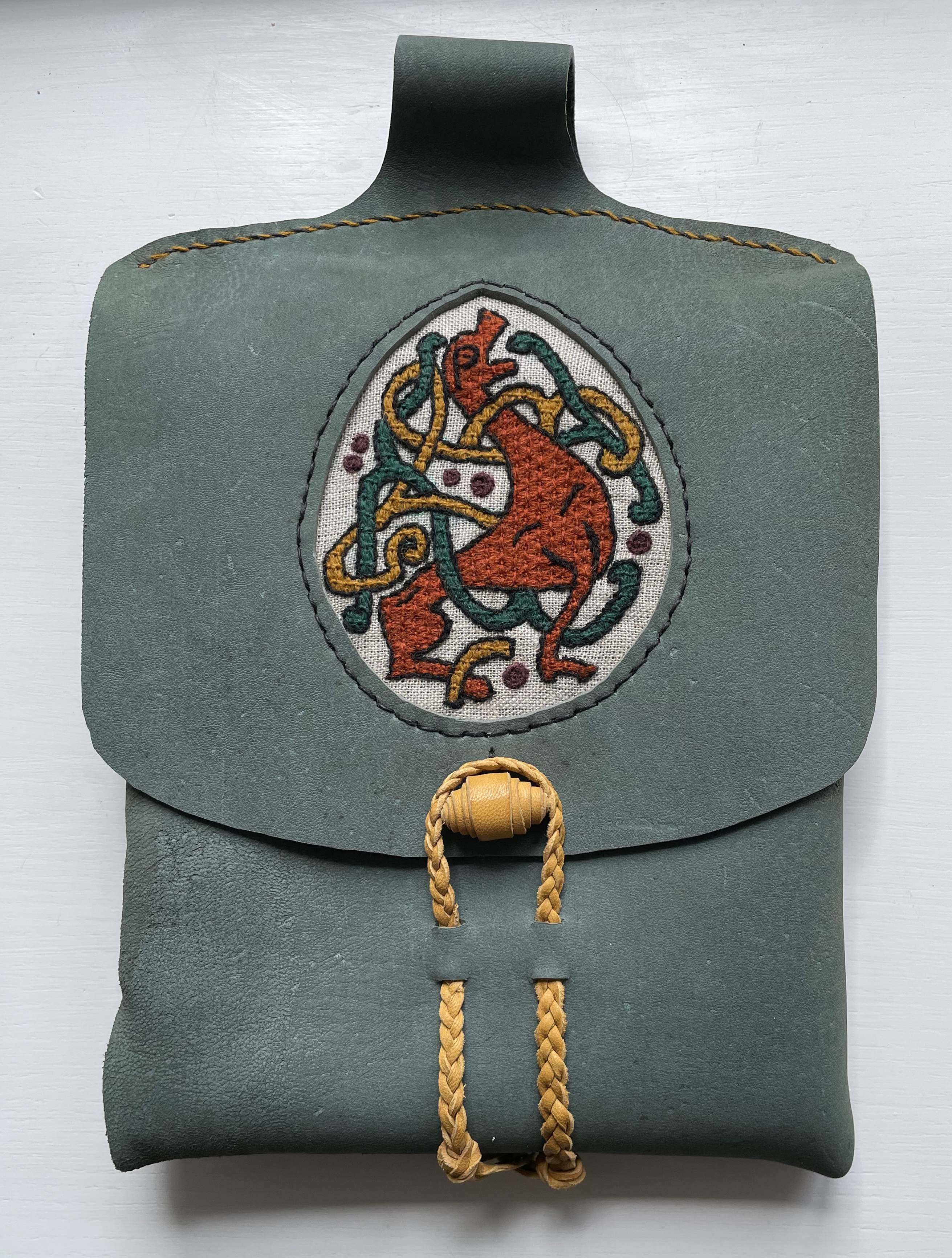
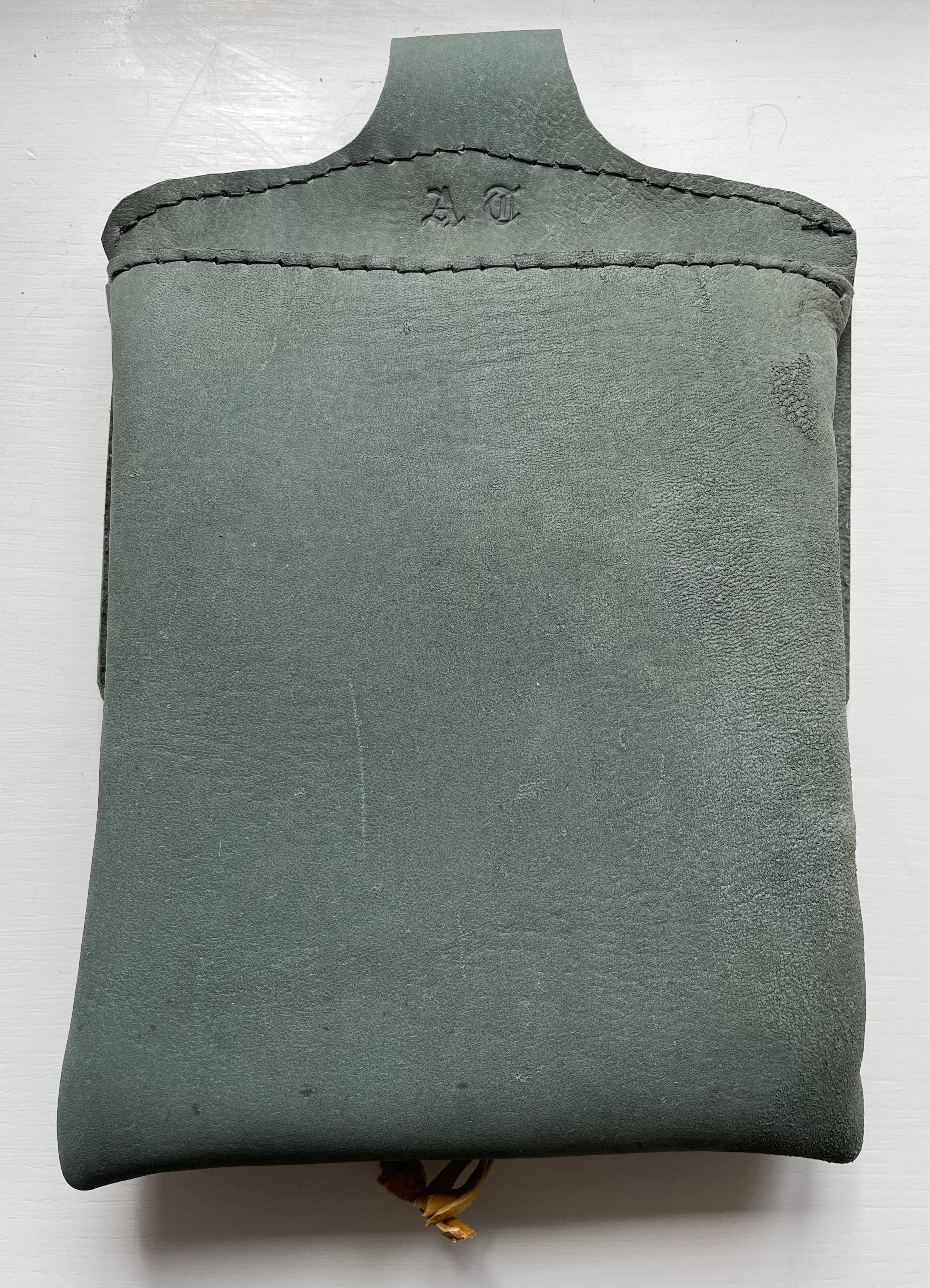
A hand-stitched deerskin bag with a wool embroidery inset of 9th century Anglo-Saxon pattern encloses the oak horn-book with a carved handle and faced with embossed copper and painted vellum with leather jewels. Also enclosed is a small oak plaque bearing the colophon.
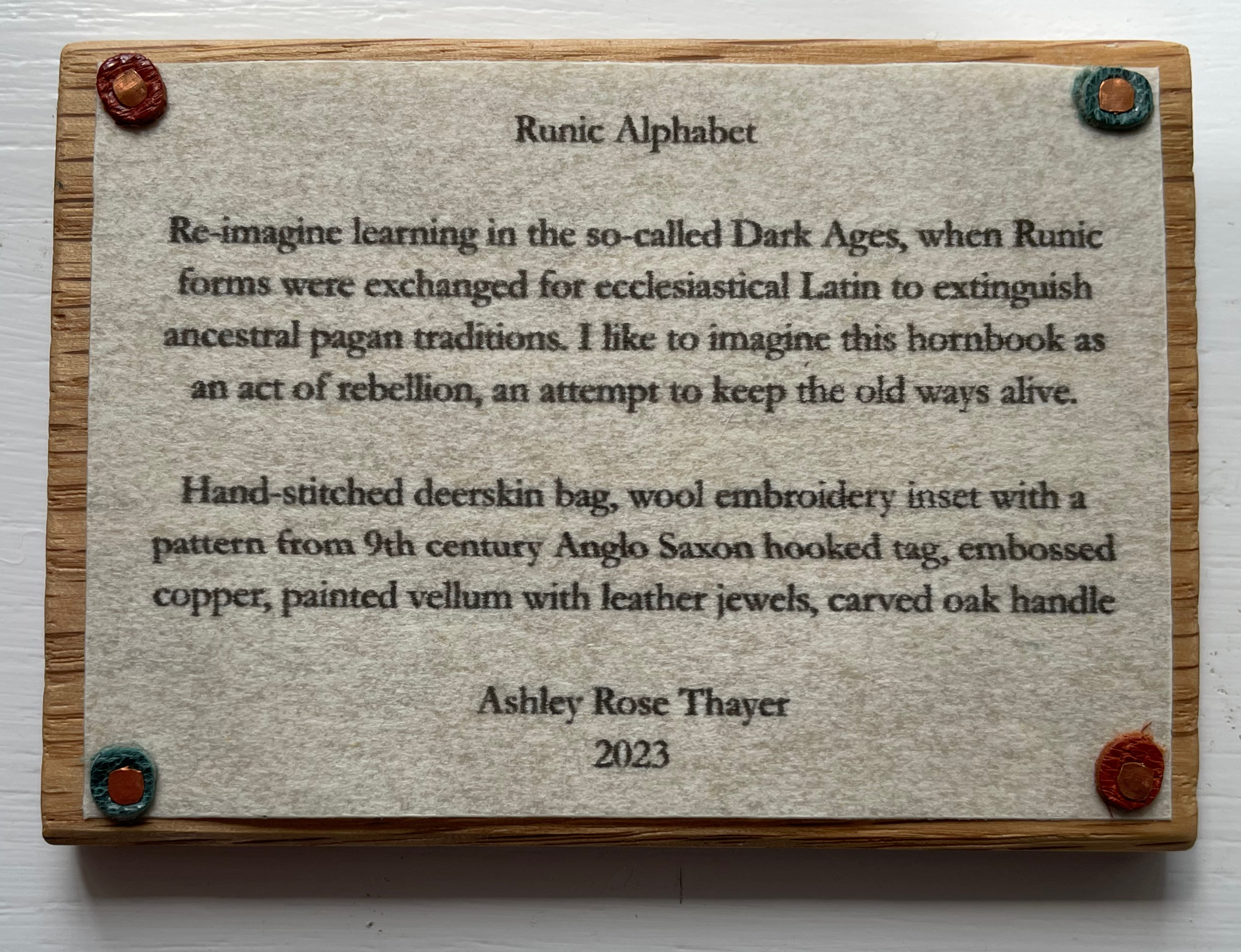
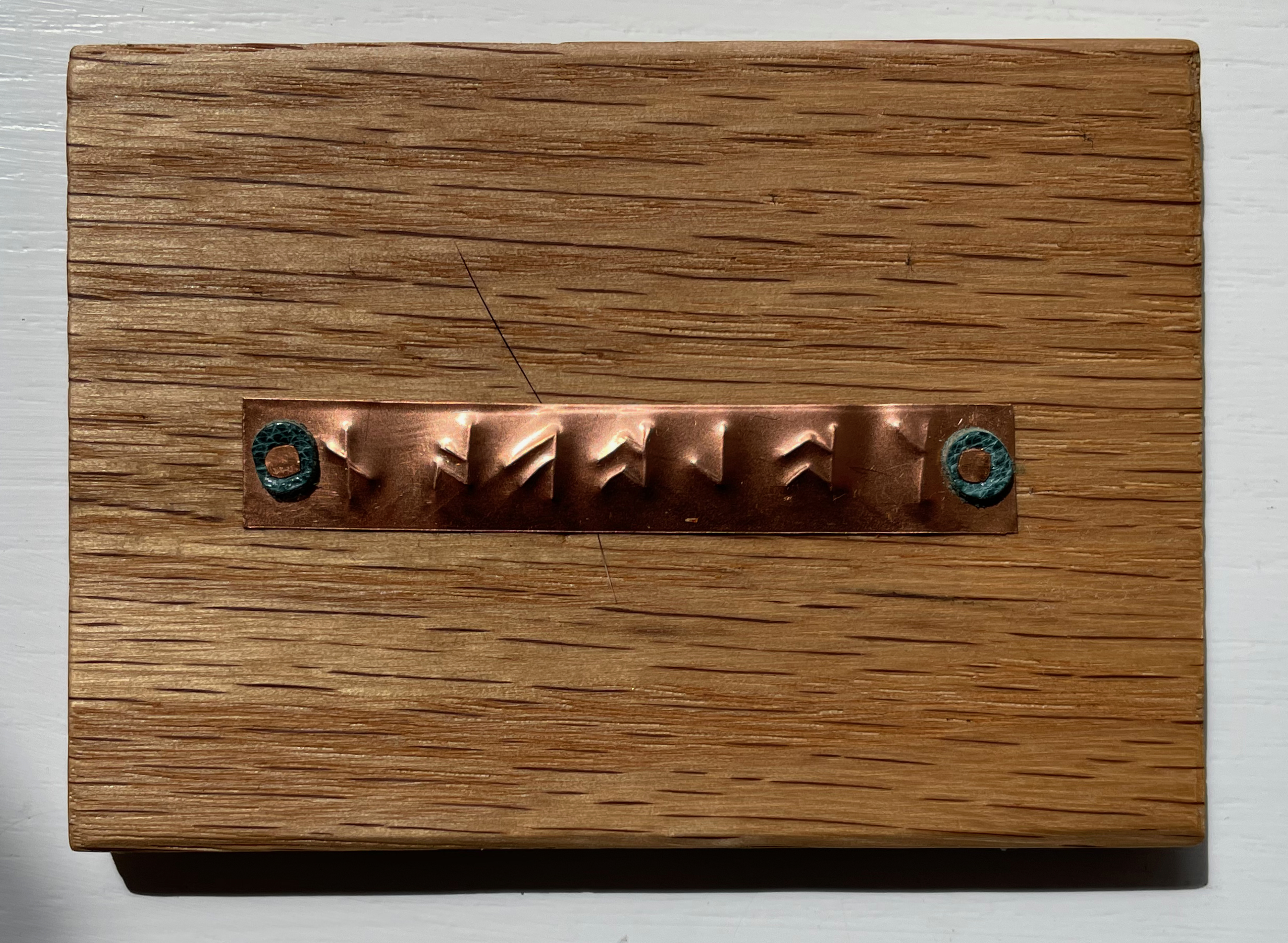
The reverse side of the colophon bears the word “colophon” transliterated into embossed runes
Following the Northwoods Book Arts Guild project, Thayer progressed to another age with this next work.
Mechanical Horn-book (2025)
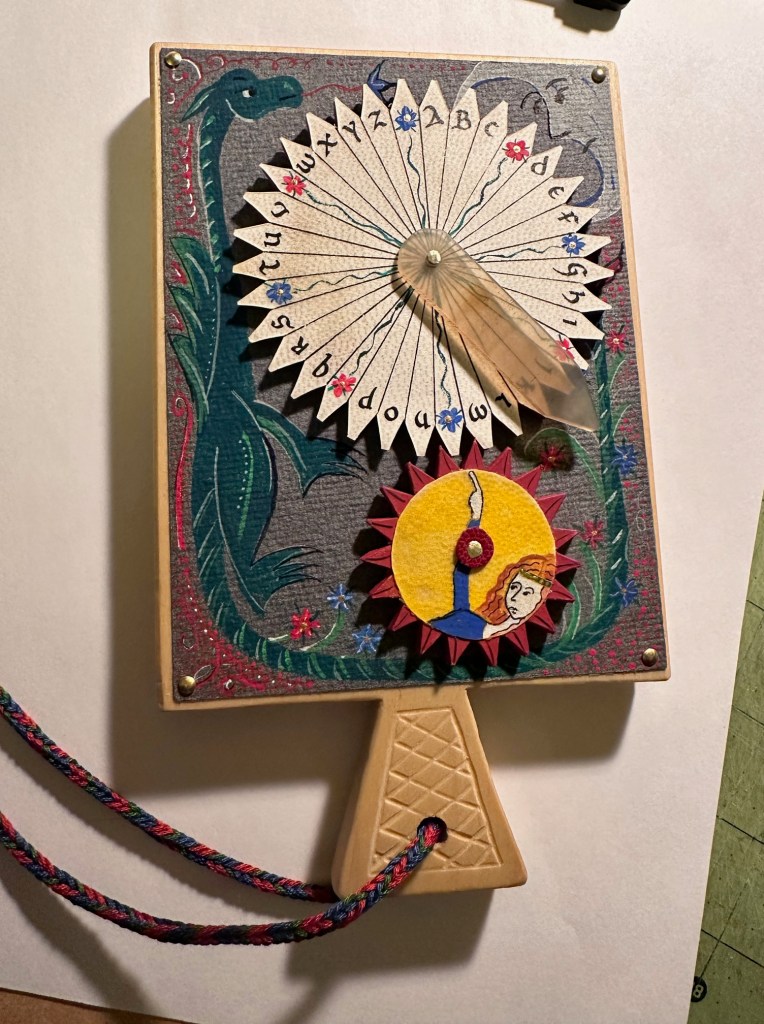
Mechanical Horn-book (2025)
Ashley Rose Thayer
Horn-book. On stand: H192 x W160 mm. Off stand: H192 x W115 mm. Unique. Acquired from the artist, 17 October 2025.
Photos: Courtesy of the artist. Books On Books Collection.
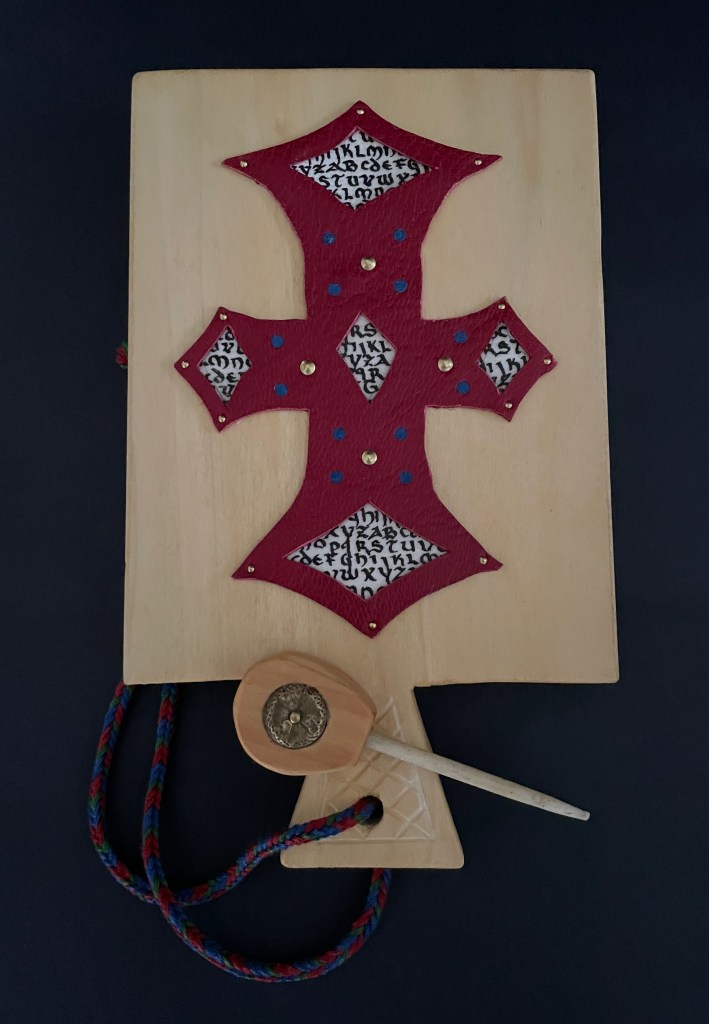
Mechanical Horn-book is an homage to the Anglo-Saxons of Old England. The paddle is made of pine wood, the gears of vellum-covered bookboard, the spinning “arm” of authentic cow horn, and the wrist loop of embroidery thread by a medieval finger loop braiding technique. On dark grey-blue Khadi paper, Thayer has painted a border of the moon, a berried floral garland, and a wyvern, the heraldic emblem associated with Wessex, the Anglo-Saxon kingdom from which Alfred the Great emerged in the 9th century. On the reverse, a cross of cut red leather with five inserts of calligraphed vellum alluding to Christ’s five wounds reflects the horn-book tradition of combining religion with learning the alphabet. It also makes this horn-book reflective of Alfred’s Anglo-Saxon and Christian background.
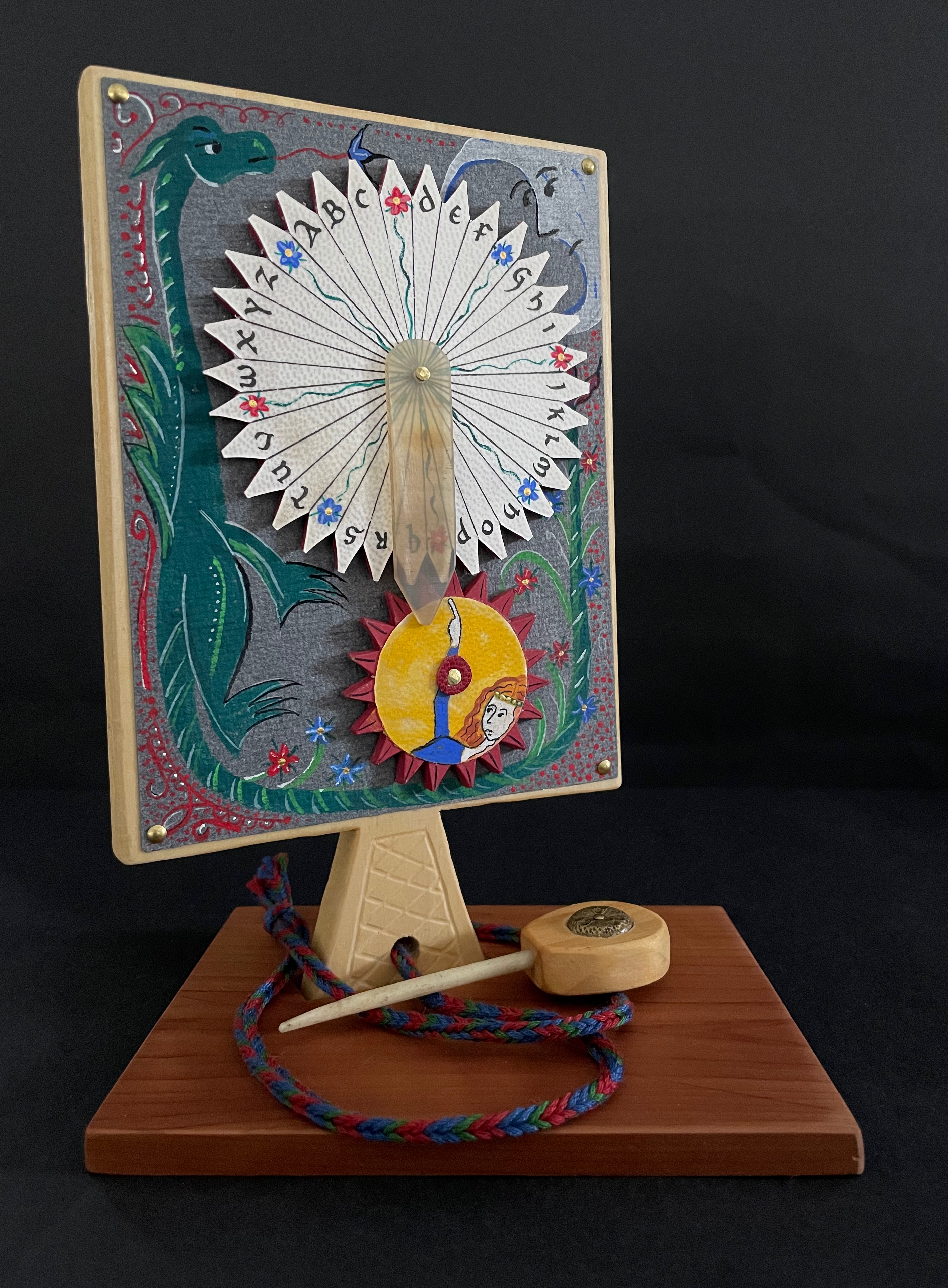
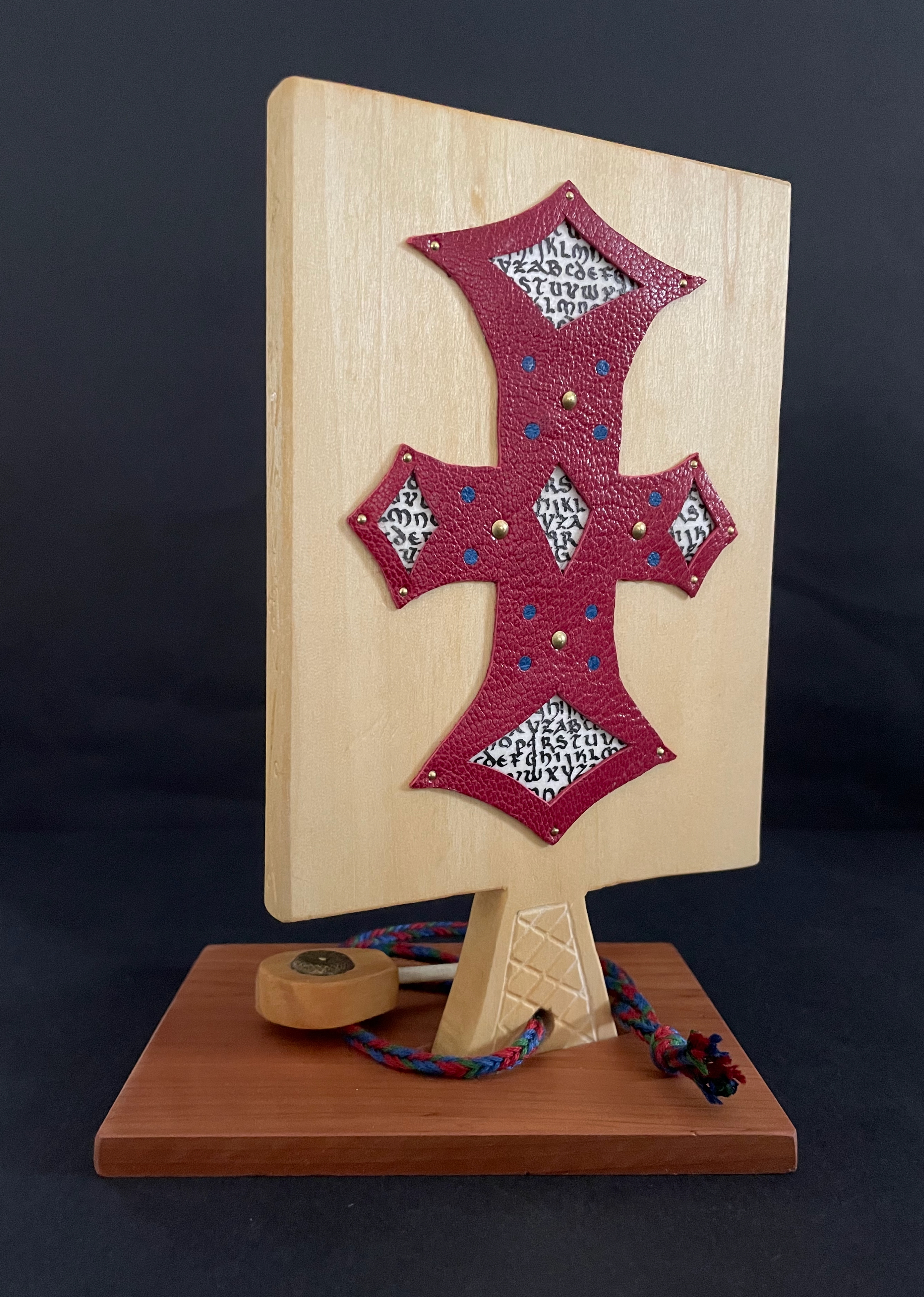
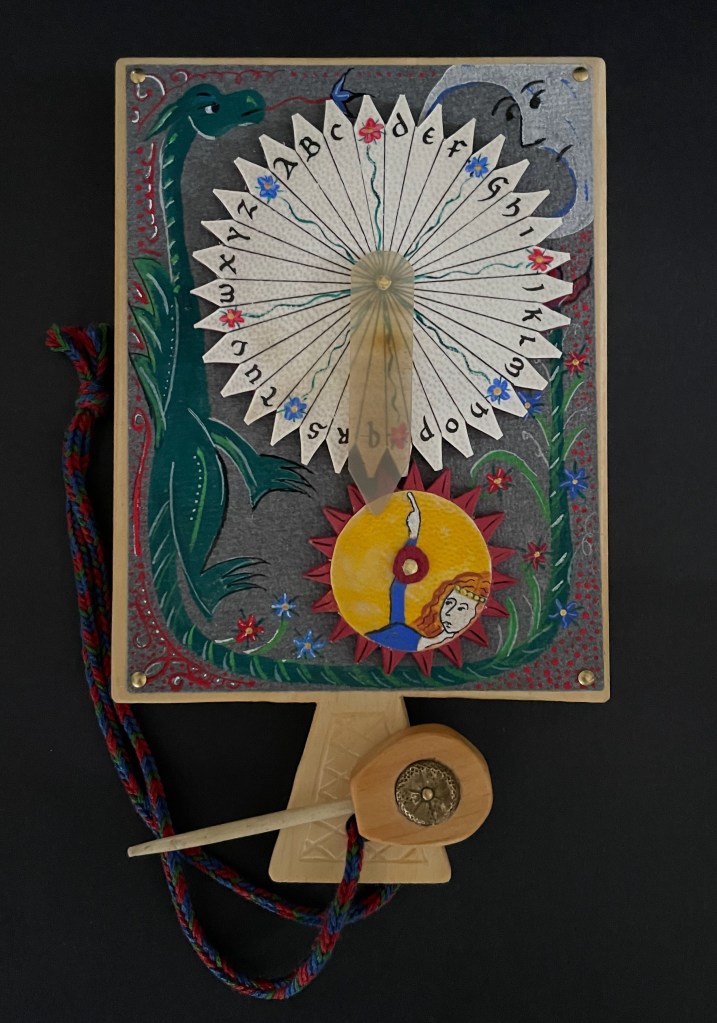
The pointer, called an aestel in Old English, is made from poplar wood, an antique button, and antique bone. Its inclusion isn’t simply functional. Appearing alongside the Wessex wyvern, it points to that famous aestel on display at the Ashmolean in Oxford: the Alfred Jewel.
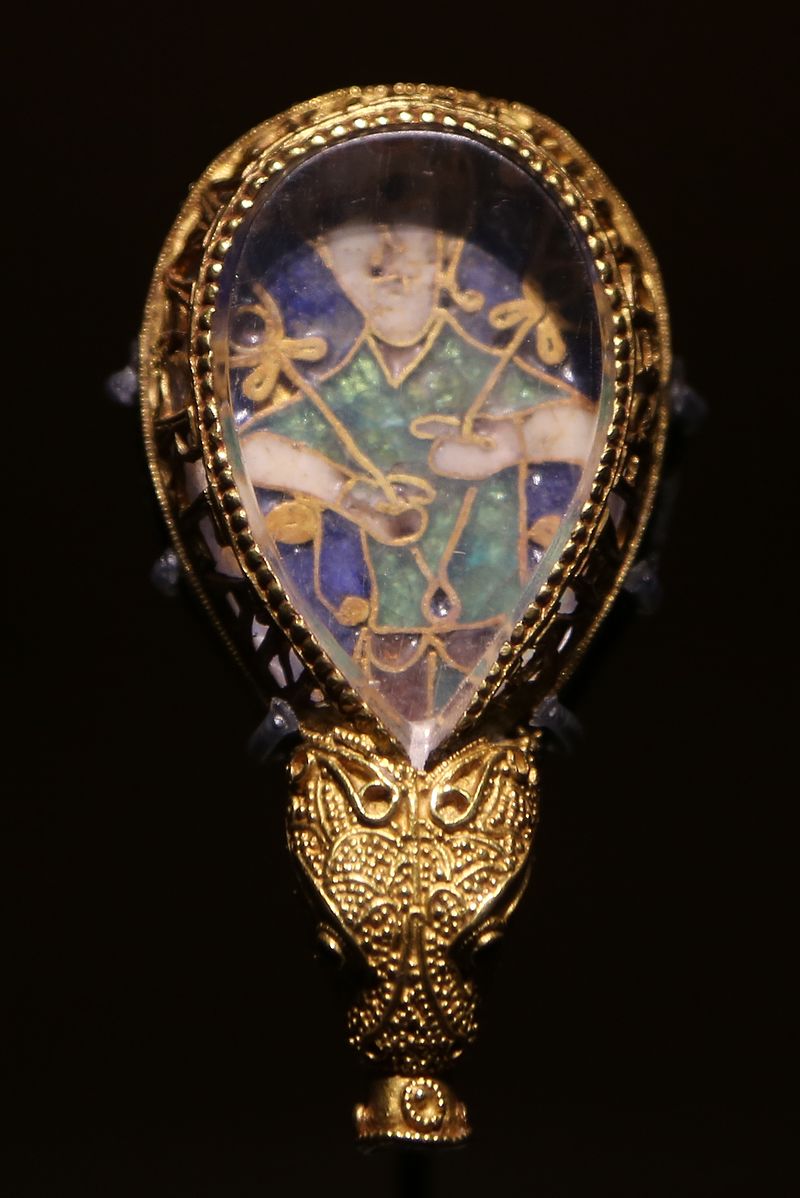
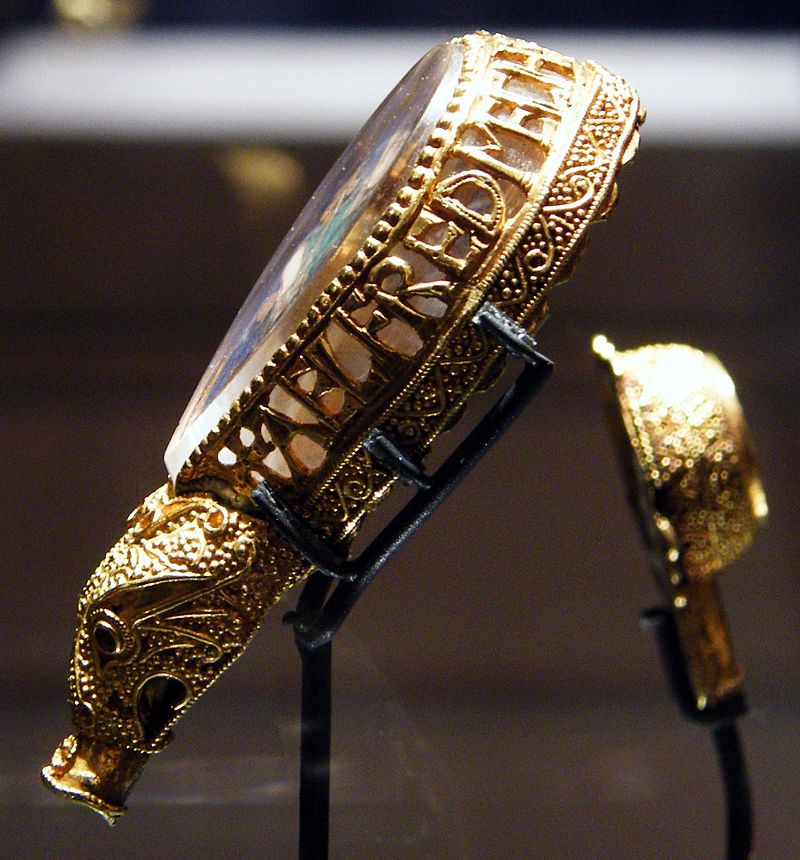
The Alfred Jewel, Ashmolean Museum, Oxford.
Photo taken from the front by Geni CC BY-SA 4.0. Photo taken from the side by Richard M Buck CC BY SA 3.0.
Further Reading
“Abecedaries I (in progress)“. Books On Books Collection.
“Alphabets Alive! – Criss-cross Row (Horn-books)“. 19 July 2023. Books On Books Collection.
“Kees Baart, Dick Berendes, Henk Francino and Gerard Post van der Molen“. 2 November 2022. Books On Books Collection.
“Brynja Baldursdottír“. 10 March 2023. Books On Books Collection.
“The Horn-book“. 12 November 2025. Books On Books Collection.
“Bård Ionson“. 9 July 20223. Books On Books Collection.
“Margo Klass“. 9 July 2023. Books On Books Collection.
“Karen Roehr“. 26 December 2022. Books On Books Collection.
“Connie Stricks“. 9 July 20223. Books On Books Collection.
“Andrew White Tuer“. 26 December 2022. Books On Books Collection.
Bodleian Libraries. 7 July 2023. “Alphabets Alive! 19 July 2023 – 21 January 2024, Treasury, Weston Library“. Accessed 7 July 2023.
Looijenga, Tineke. 2003. Texts & Contexts of the Oldest Runic Inscriptions. Leiden: BRILL, 2003.
Osborn Marijane and Stella Longland. 1982. Rune Games. London: Routledge & Kegan Paul.
 Books On Books