News Item – British Academy. Part of Literature Week at the British Academy for the Humanities and Social Sciences, an exhibit called “Turning the Page” and presenting the book sculptures of Justin Rowe, a bookseller in Cambridge, is being held from 20 May through 24 May. The works are in the “reverse ekphrastic” mode: the bookwork is an expression of, or meditation on, the text of the book from which it is made. The exhibit has attracted attention from the BBC and even the free Metro paper. Looks and sounds worth a visit if you can skive work for one of the lectures and a browse round the exhibit.
Update: Williams participated in “Frankenstein 2018, The Liverpool & Knowsley Book Art Exhibition”
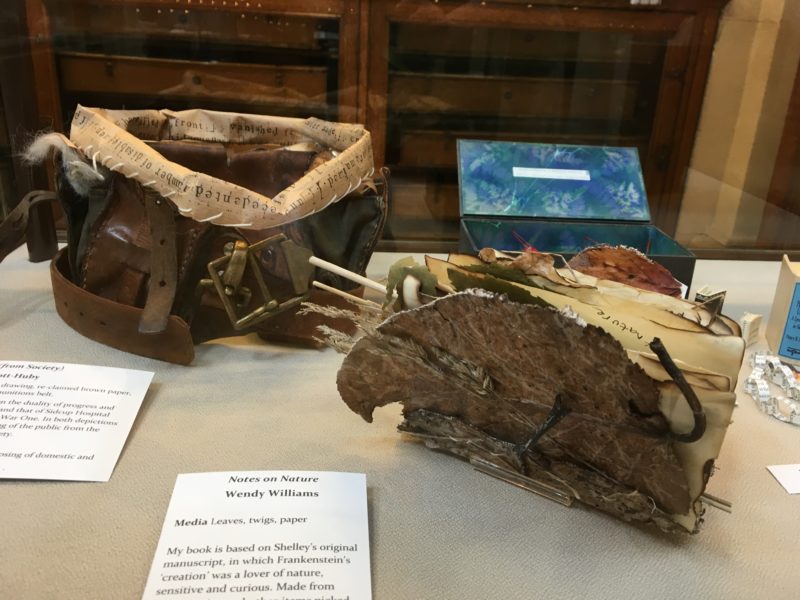
Wendy Williams ‘Notes on Nature’ portrays ‘the Monster’ as a ‘lover of nature, sensitive and curious’, something that Shelly hinted at in her original manuscript. Again, a very emotional angle to explore and one that really does make you want to reach into the display box and leaf through it.
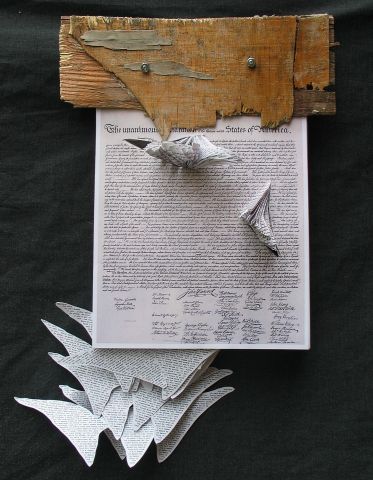
The “starflies” — those butterfly-shaped, W-shaped sheets of printed paper — are Wendy Williams’ signature (see the installation “King“).
In her 2010-11 “Travel Project,” she reached out to those who appreciate her work to put her signature to use with the Internet’s version of “Kilroy was here” as variously practiced by Travelocity and others in the “roaming gnome prank” and by film-maker Patrick Keiller and others with the fictional character Robinson. Not that she cited those examples, which I mention here to suggest how the “Travel Project” speaks to the “intentional fallacy” anyway.
In one of her blog entries in 2010, Williams writes, “The travel project is going OK. People are so hesitant to take a photo of something that isn’t theirs. I have got a few back, which is good as I can use them as examples to show what I’m after. I suppose February is a while off yet so there is plenty of time.” What is Williams “after”?
No one has stolen her “gnome” to take it on a global trek. The viewers of her art are not an army of enlistees or draftees intent on “marking” every tree, lampost and view with their cultural scent. The artist recognizes that there may be discomfort and hesitation in her viewer/artist arising from the boundaries of intellectual property lines. Even in the face of stated intention, the viewer/critic hesitates. In placing Williams’ starflies within the frame of photos taken around the world, what do the contributing participants become: the brush and maulstick of the artist? artists in our own “right” as well?
If the non-participating viewer or critic deems “Travel Project” a meaningful, artistic success, on what criteria is that success measured? Its reflection of Williams’ intention? The quality of Williams’ curation — how does the critic measure that quality if the critic is not privy to the elements “curated out”? The degree to which Williams’ signature integrates the many contributing hands or voices into the implicit hand or voice of a Robinsonian perspective?
By the standard of whether a work of art makes us think and whether it draws us back to itself, the “Travel Project” lays a fair claim.
Eight Points to Eternity Kat Buckley Photo by Keristin Gaber
The artist describes Eight Points to Eternity, created from a medical dictionary, as a “Continuous eight pointed star”. The description seems unnecessary. “Continuous” — yes, well, the title is “points to Eternity,” and the viewer can grasp that the bindings are linked in a circle. It rather over-explains the pun of the title (an 8 on its side is the symbol for — points to — eternity).
Bookworks can be over-titled and over-explained. Equally often, artists swing the other way, entitling works “Untitled” or simply giving them a number. The latter has the advantage of making the work stand on its own and, equally, forcing the viewer to stand on his or her own before the art object, and perhaps giving up.
“Altered books,” “bookwork” or “book art” — whether as mere craft or meaningful art — almost inevitably carry the freight of the original work’s content, structure and paratextual apparatus as well as their own “meaning.” Some bookworks may be a kind of ekphrasis in reverse. Rather than text playing off a work of art, the bookwork plays off the original book. The tunnel book showing cut-out characters or a collage of elements from the actual content of the altered book is the most evident example of this inverse ekphrasis.
Here, with Eight Points to Eternity, the artist strains a bit for an ekphrastic connection when she explains how the “medical freight” of the dictionary fits into the meaning of her bookwork:
Where do our modern medical ideas truly come from, and how much of it can we attribute to the past?
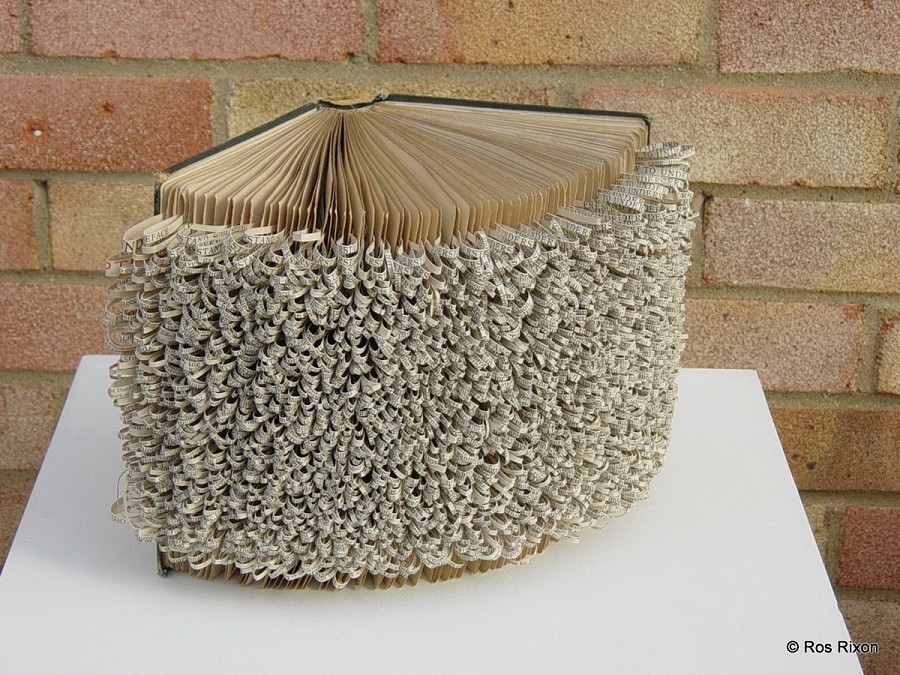
Buckley fares better with her bookwork entitled Good Intentions, in which she has excised the content from an old edition of Ogden Nash’s poetry and left only certain lines. The work reminds me of Ros Rixon‘s How we understand sculpture, a title that stems from the original book’s being a book about sculpture. Good Intentions and How we understand sculpture are subtle and conspire with the subject matter of the raw material with which Buckley and Rixon have worked.
How to understand sculpture Ros Rixon
Good Intentions Kat Buckley Photo by Keristin Gaber
Book Patrol‘s coverage of the Guardian‘s story dates back to July 2011, but because it is one of the most frequently viewed entries at Book Patrol and the artist has been frequently cited here, BOB cannot pass it up.
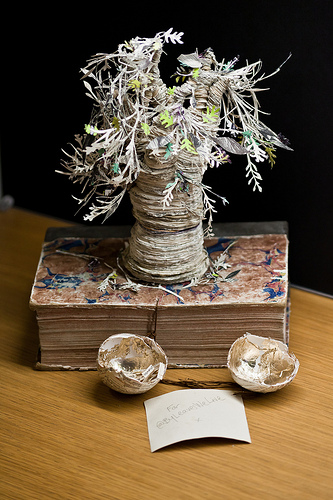
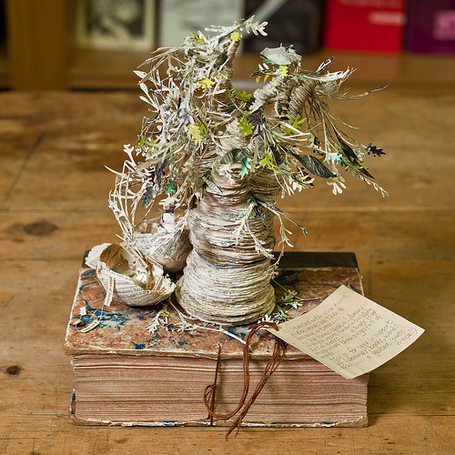
“Last month, the book art piece above was found at the National Library of Scotland. It was the fourth piece found since March in a book-friendly location in Scotland. All references are devised from the work of Scottish mystery writer Ian Rankin and include a note professing some book love.
First it was the Scottish Poetry Library where a ‘poetree’ was discovered on a bookshelf. The ‘poetree,’ comprised of intricately cut pages, had a note attached referencing a Patrick Geddes quote and the library’s Twitter name,@byleaveswelive.
Next up was a piece left at in the box office of Filmhouse Cinema with the following note ““For @filmhouse – a gift – In support of Libraries, Books, Words, Ideas…&; All things *magic*.”
“I transform books–recognizable symbols of recorded and shared information–and their pages into new forms, using the iconic materials to consider the recursive nature of ideas, regardless of how they were recorded e.g., in manuscripts, books, digital formats. Because I look at gain and loss, remembrance and lapses, permanence and impermanence, images of trees, plants and other organisms that have visible regeneration cycles, as well as the materials derived from them, are interpreted in my art.”
via Holly Senn – installation art, sculpture, conceptual art.
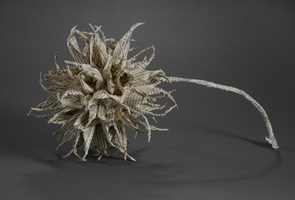
Senn is known for these sculptures and installations created from discarded library books. Through forms like the chestnut burr above, her art represents how ideas are generated and dispersed, or through the transformation of books into empty hornets’ nests, how they are abandoned and forgotten.
The craft and artistry is superlative. Do these bookworks reward re-viewing and contemplation the way the bookworks of
She is on her way to finding out: “Recent installations include “Inhabit” at Gallery @ the Jupiter in Portland; “Link” at Tollefson Plaza in Tacoma; “Cover” at Doppler PDX in Portland; “Re-Present” at Spaceworks in Tacoma; “Tale” at 23 Sandy Gallery in Portland; and “Windows on Nature and Knowledge” at Brooklyn Public Library, Brooklyn. Awards include the Artist Trust Grant for Artists Projects and a Tacoma Arts Commission Tacoma Artists Initiative Program grant.”
The artist and his bookworks, Nicholas Jones from Melbourne, Australia.
Extract from “The World of the Book” by Des Cowley & Clare Williamson, pp 218
The beauty inherent in a book’s form has often been revealed by artists who change and modify books. Nicholas Jones’s altered books are made with surgical precision, as he rips, tears, cuts and folds them into new shapes. His work attempts to highlight the beauty of the book through a process of changing it.
Instead of considering the book as a vehicle for narrative or ideas, we are instead confronted by the abstract quality of the book’s shape. Its original text is almost irrelevant to the final sculptural form, except as a fragmented pattern that peers out from beneath the finished folds or cuts. Jones’s father is a surgeon, and it is the very implements of this trade- scalpel, surgeon’s needle- that he uses to alter books. The act of defacement is the process whereby Jones renews the physical form of the book, divesting it of its original intent and allowing the viewer to ‘read’ it in an entirely new way.
“Can’t See the Trees for the Forest” by Julie Dodd is an installation of book pages cut in the shape of trees and suspended from the ceiling. The installation last appeared at the Bridewell in Liverpool. The oak trees in the back rank are clean and clearly readable while the firs in the front rank obscuring them are blackened. Dodd’s art is art with a green message, protesting the replacement of England’s native trees with non-native quick-growing species.
“The process of installing this work was more important than the finished piece to me. The indigenous trees although similar in shape, colour and content are all individual whilst the addition of the invasive fir trees obscuring the view left me wanting to tear them down to reveal the beauty behind.” “Can’t See the Trees for the Forest,” Julie Dodd
Since the installation above in 2013, Dodd has mounted installations at the CODA Museum in Apeldoorn, the Beeldentuin Achter de Westduinen in Ouddoorp and the Liverpool Book Art Exhibition.
The clearing of large areas of forest, plantations and peat land in Indonesia, Malaysia and Africa is having a detrimental impact on our planet. This is happening in order to sustain the demand for the production of palm oil and is causing terrible environmental damage.
“Coral Colony”, stripped back to basic shapes in paper and stripped of color in bleached paper, demonstrates the loss that is occurring in coral beds around the world as pollution and rising sea temperatures caused by climate change kill off the algae that gives the coral its hues.
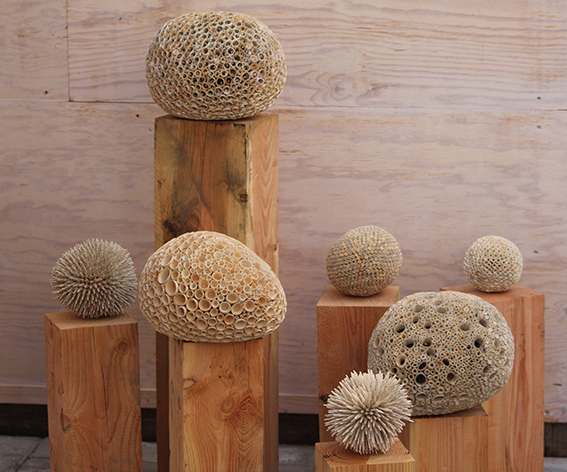
The fungal spores series is an ever changing project that sees new spores develop from the last through experimentation with different ways of rolling paper from old books.
The project started after throwing away some books that hadn’t been stored properly over the winter in my studio which had left the books with that damp old book smell. Which led to researching images of fungal spores under the microscope.
The destruction of the book will eventually produce many spores of various shapes and size to form a large installation.
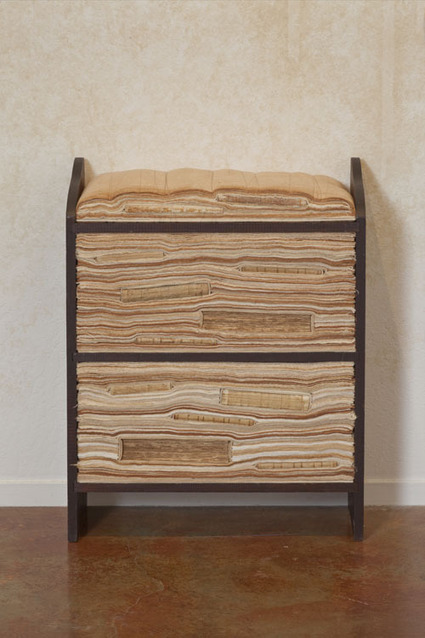
As with most book art (and almost all sculpture), Jody Alexander’s works celebrate the haptic so warmly that I wonder how an owner or viewer resists handling them. And celebrating the book arts (Alexander makes her own paper in the Eastern style), surely these bookworks on display should be touched —like the books on the shelves of public libraries — until they take on the wear and patina of fine books. Imagine the installation — call it “Touch This” — and what viewers would see and feel decades from now. A visit to her studio WishiWashi might come closest to this imagined event.
Alexander teaches at the San Francisco Center for the Book and blogs at Jalex Books Blog . As of this posting (12 May 2013), however, the most recent entry for information on exhibits, classes and new artwork is 5 July 2012.
Update:
Erin Fletcher at Flash of the Hand has tracked down Jody Alexander for an interview (2 August 2013).
While reading the interview, you will begin to understand the depth of Jody’s commitment to her materials and characters. This exclusive connection is the cause for such a well-rounded body of work. Her dedication to teaching is just as exceptional, offering her skills to several venues both online and in person. Read the interview after the jump and come back each Monday during the month of August for more posts on Jody Alexander.
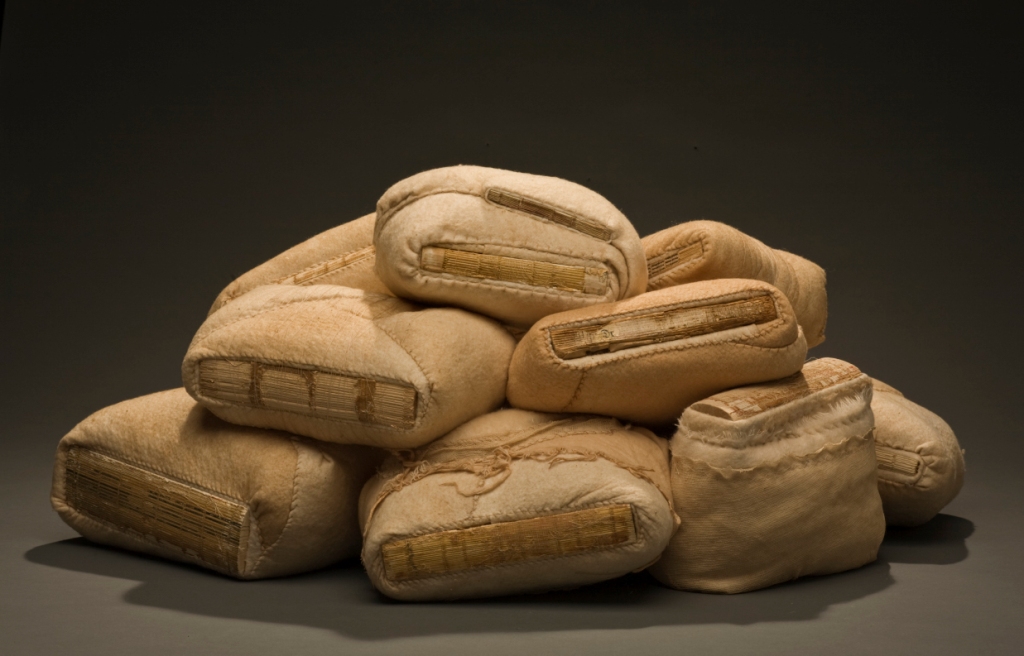
The photo above comes from Alexander’s series Sedimentals. This series, which “takes the form of tea staining cotton to replicate the colors of aged and browned bookspines and swaddling or layering them to create a safe haven for these beautiful objects, enshrining them”, is an interesting instance of book art to which Garrett Stewart’s Bookwork: Medium to Object to Concept to Art applies. Check out Alexander’s site, read Stewart’s book and see if you agree.
Flint, Kate. “The Aesthetics of Book Destruction” in Smyth, Adam, and Gillian Partington, eds. 2015. Book destruction from the medieval to the contemporary. Basingstoke: Palgrave Macmillan. P. 183. This essay also resonates with Kat Buckley‘s essay on “ruin porn”.
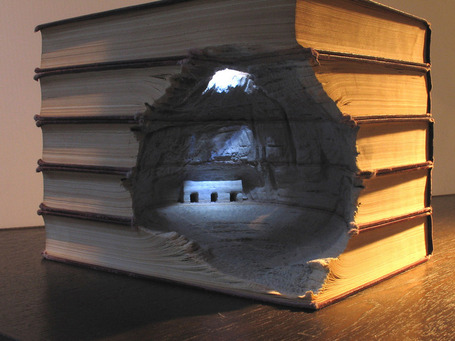
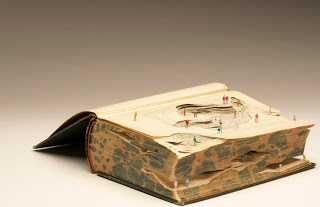
“Not long ago I visited the limestone and chalk cliffs on the North Norfolk coast. As I walked below them I remember constantly looking up to the top of the cliffs, overwhelmed and cautious of the overbearing layers of rock that towered above me. Placing myself in relation to the cliffs made me feel so insignificant, so small, and so fragile. I was unable to understand both their overwhelming scale and materiality….
Whilst drawn to natural landscape formations I am both overwhelmed and cautious in their presence. I find myself shrinking, hesitant to interact fully. I feel dwarfed, unable to understand the immense scale and materiality before me. My practice is an attempt to make sense of the natural landscape around me, to create my ideal. I understand and resolve through making, responding to forms and growths found in the natural world. I interpret by shrinking and condensing, implying forms by combining materials.” Statement, Kyle Kirkpatrick
Kirkpatrick’s imagined landscape works by being carved from an archetypal monumental man-made object — a visual encyclopedia — taken out of context and populated with human figurines dwarfed by the swirling, layered cutaway text. What is he pushing us to see beyond what he presents before us? That this human work of attempting to understand and make sense of the great world around us by capturing it in words and illustrated plates is a shrinking and condensing, an implication of forms by artifice? That even though the landscape is man-made, it overwhelms us?






 Books On Books