A Cuneiform Hornbook (2023)
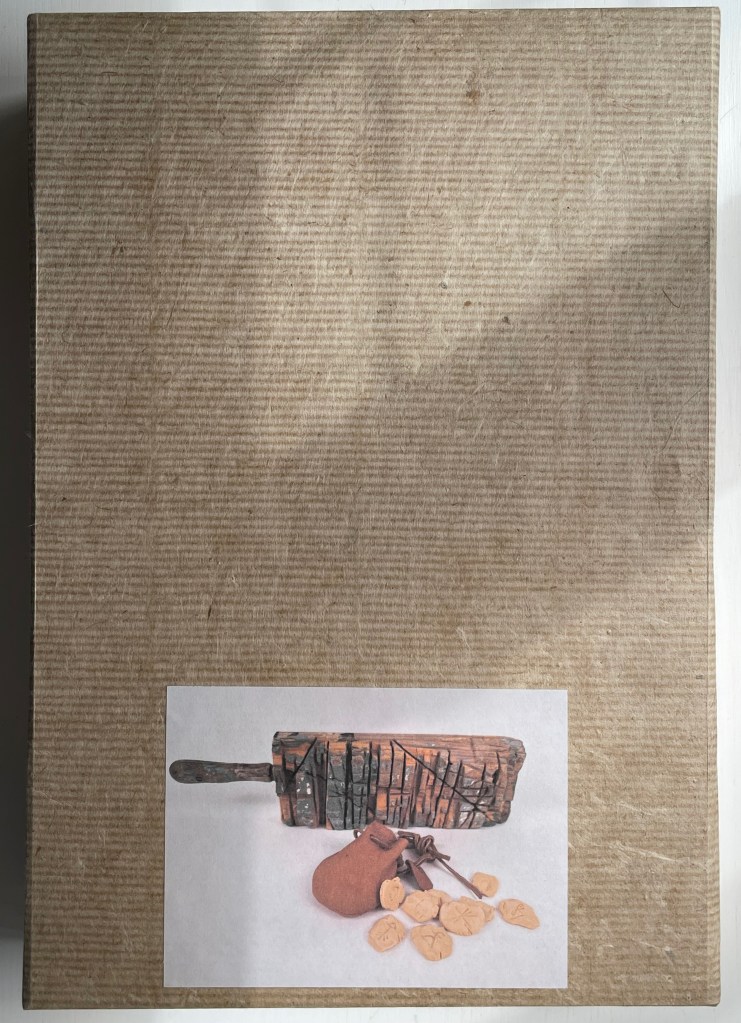
A Cuneiform Hornbook (2023)
Connie Stricks
Box: H340 x W233 x D57 mm. Horn-book: H333 x W85 x D40 mm. Leather pouch: H77 x W60 x D25 mm. Tokens: Variable 20 x 25 mm. Colophon folio: H101 x W71 mm. Unique edition. Acquired from the artist, 26 June 2023.
Photos: Books On Books Collection. Displayed with the artist’s permission.
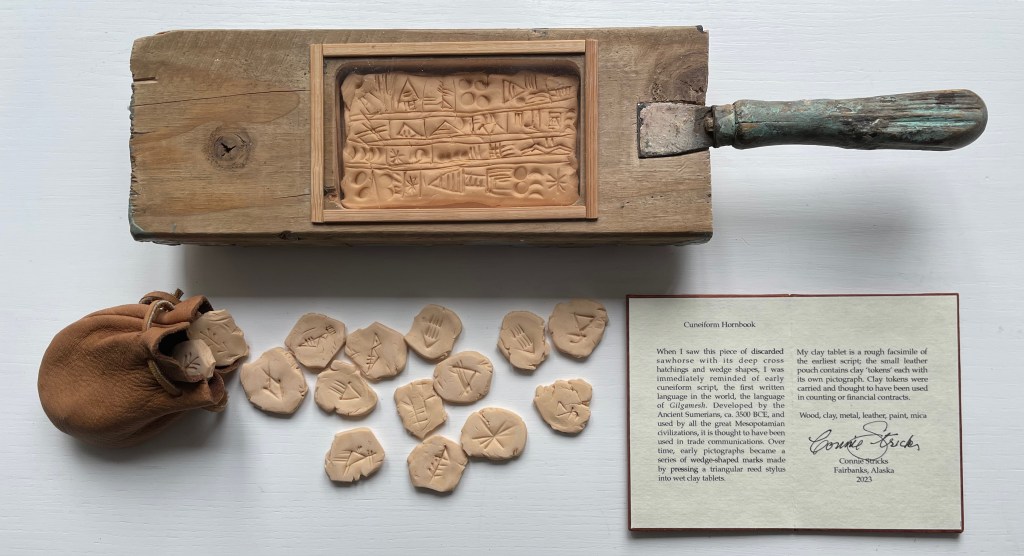
Connie Stricks has re-imagined the horn-book with found objects, leather craft, clay inscription and sculpture. Prompted by a workshop challenge, the artist found an echo of the earliest writing system — cuneiform — in the scars and cuts of a discarded saw horse.
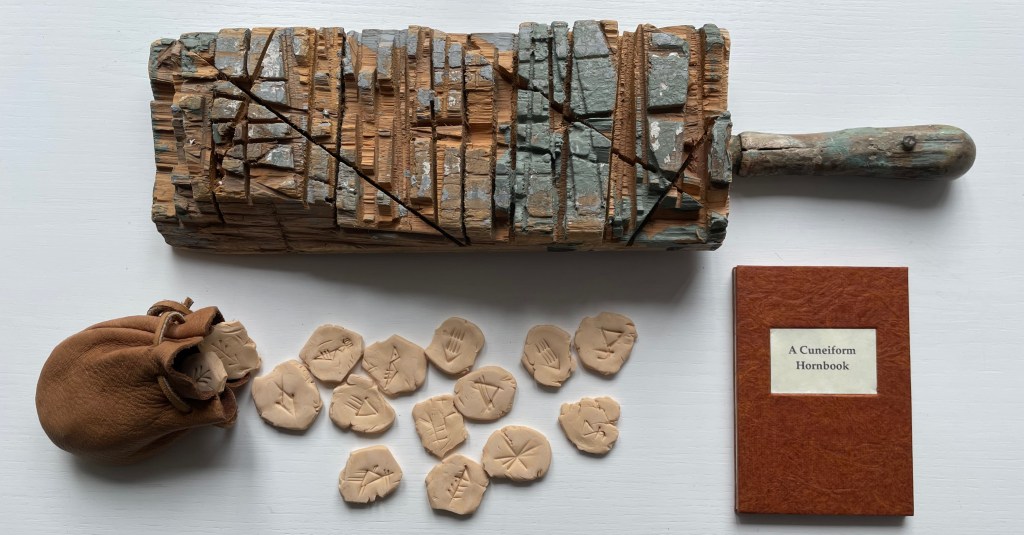
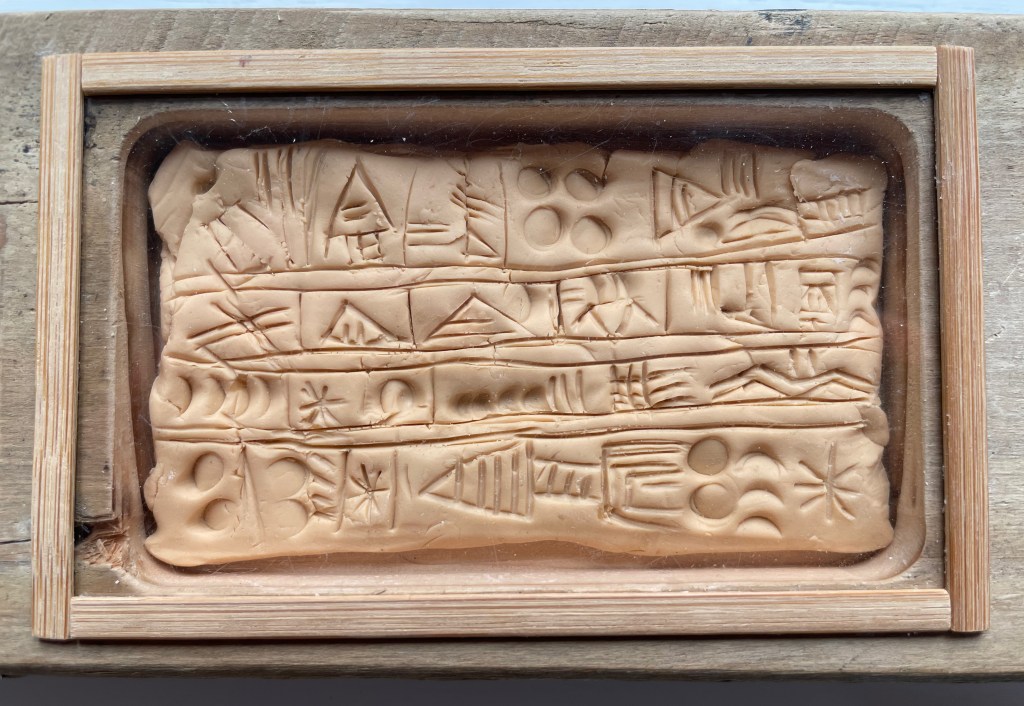
On the smooth side of the block of saw horse wood, she has carved out a shallow rectangle large enough to hold a small clay tablet she has inscribed with cuneiform marks. Like the traditional horn-book with its pared sheet of cow horn tacked down over the ABCs to protect the letters from wear and tear, the Cuneiform Hornbook has a sheet of clear plastic over the tablet. Stricks may also be having a bit of fun, hinting at the usual under-glass view we have of ancient artifacts.
The small bag of tokens nods toward the predominant assumption that cuneiform marks were developed to meet the accounting and administrative needs of Mesopotamian civilizations building on the underpinnings of agrarian and trade societies. The irregularly shaped tokens have marks on both sides. As trade grew, so grew the need for trust, and tokens indicating an exchange would be sealed in a clay purse (bullae) bearing a cuneiform-inscribed description of the contents.
An amusing “found-object” feature of A Cuneiform Hornbook lies in its packaging and storage. The snug, almost vacuum-like fit will be familiar to some. Confirmation for them and revelation for everyone else appear on the outside of the base.
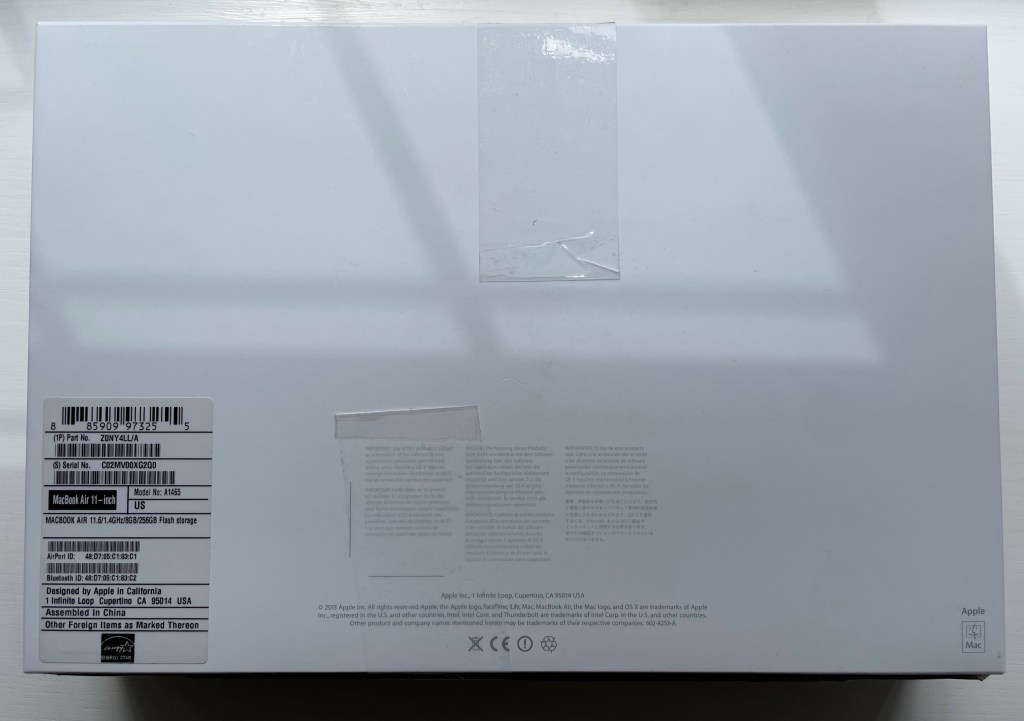
Like a MacBook Air, the multiple parts nestle among styrofoam blocks, and the leather pouch of tokens and small folio bearing the colophon are enclosed in the usual clear self-sealing cellophane envelopes. And now that MIT scientists have developed an AI transliterator and translator for Akkadian, the Cuneiform Hornbook’s reader need not worry about technological obsolescence.
Further Reading
“Abecedaries I (in progress)“. Books On Books Collection.
“Kees Baart, Dick Berendes, Henk Francino and Gerard Post van der Molen“. 2 November 2022. Books On Books Collection.
“Bård Ionson“. 9 July 20223. Books On Books Collection.
“Margo Klass“. 9 July 2023. Books On Books Collection.
“Karen Roehr“. 26 December 2022. Books On Books Collection.
“Ashley Thayer“. 26 December 2022. Books On Books Collection.
“Andrew White Tuer“. 26 December 2022. Books On Books Collection.
Bodleian Libraries. 7 July 2023. “Alphabets Alive! 19 July 2023 – 21 January 2024, Treasury, Weston Library“. Accessed 7 July 2023.
Chiera, Edward, and George G Cameron. 1938. They Wrote on Clay : The Babylonian Tablets Speak To-Day. Chicago Ill: University of Chicago Press.
Gutherz, Gai, et al. “Translating Akkadian to English with neural machine translation“. PNAS Nexus. 2:5.
 Books On Books