S: Ship of Theseus (2013)

S: Ship of Theseus by V.M. Straka (2013)
J.J. Abrams and Doug Dorst
Printed card slipcase. Casebound stamped and printed cloth over boards, gray doublures, yellow head- and endbands. H242 x W162 mm. 472 pages. 22 inserts (postcards, photocopies, photo, prayer card, circular cipher device, campus café napkin, etc.). Acquired from AbeBooks, 5 March 2024.
Photos: Books On Books Collection.
A young woman picks up a book left behind by a stranger. Inside it are his margin notes, which reveal a reader entranced by the story and by its mysterious author. She responds with notes of her own, leaving the book for the stranger, and so begins an unlikely conversation that plunges them both into the unknown. The book: Ship of Theseus, the final novel by a prolific but enigmatic writer named V.M. Straka, in which a man with no past is shanghaied onto a strange ship with a monstrous crew and launched onto a disorienting and perilous journey. The writer: Straka, the incendiary and secretive subject of one of the world’s greatest mysteries, a revolutionary about whom the world knows nothing apart from the words he wrote and the rumors that swirl around him. The readers: Jennifer and Eric, a college senior and a disgraced grad student, both facing crucial decisions about who they are, who they might become, and how much they’re willing to trust another person with their passions, hurts, and fears.— Publisher’s description on the slipcase.
Most of the reviewers’ and libraries’ summaries of Ship of Theseus describe it as a traditional narrative with a second story in the form of marginal notes, letters and objects left by two readers of the main narrative, but I count five, possibly six, narrative lines or plots in this strange book. First is the story of the main character “S”, the shanghaied man with no past. Second is the story of the author V.M. Straka and his mysterious identity told by the fictitious translator F. X. Caldeira in his “Translator’s Note and Foreword” and footnotes. Third is the story of the two readers, Jennifer Heyward and Eric Husch, and their pursuit of Straka’s identity and his novel’s “meaning”. Fourth is Jennifer’s and Eric’s personal narratives of their academic lives to be found in their notes and left objects. Fifth is their love story that unfolds in the margins and objects as they discover each other’s identity and share their stories.
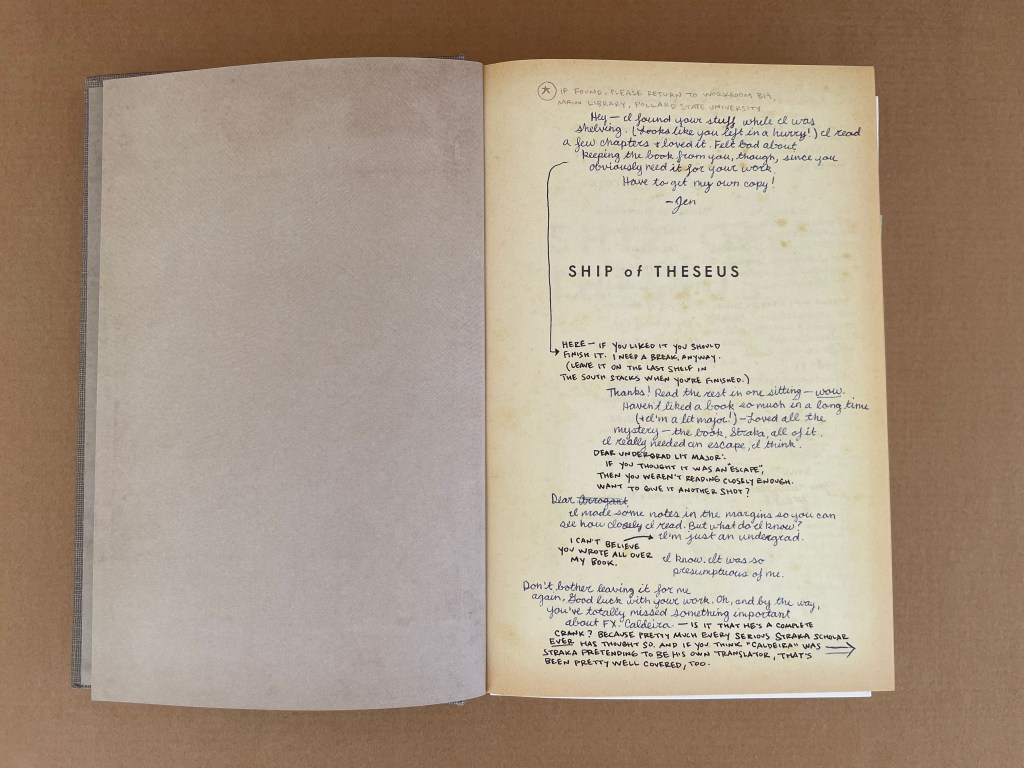
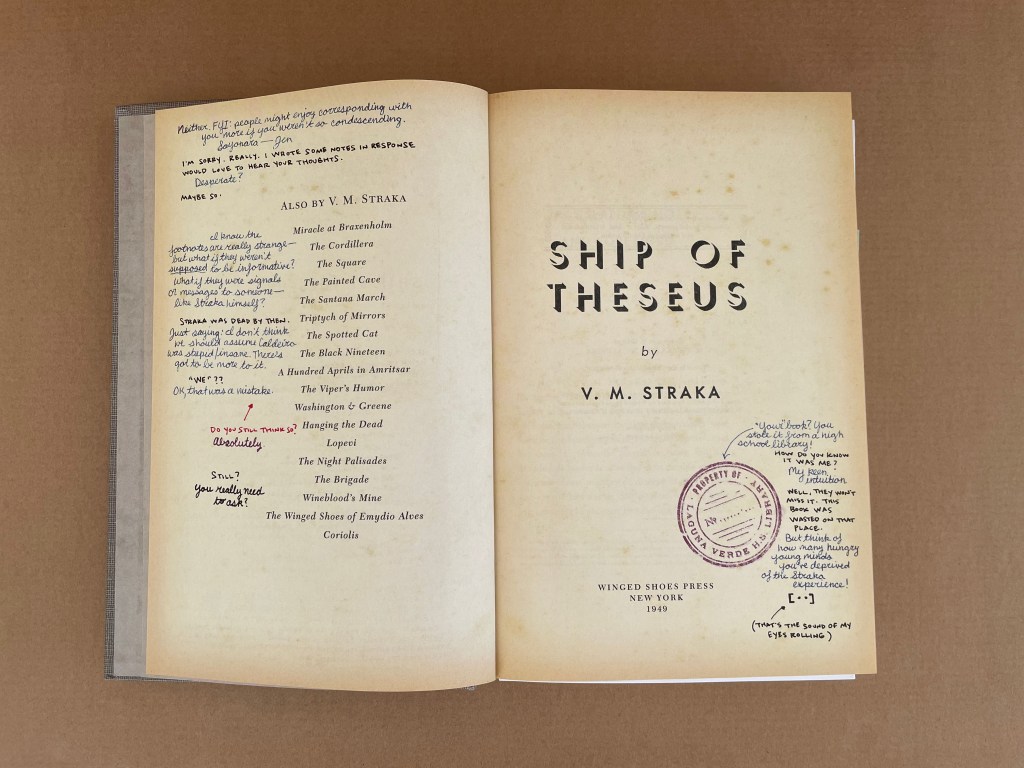
As for the sixth, in his Bibliography and the Sociology of Texts (1986), the scholar D.F. McKenzie writes: “every book tells a story quite apart from that recounted by its text”. Of course, McKenzie means the historical and social story told by the font, typesetting, binding, paper and so on. So the story of the production of Ship of Theseus would be its sixth narrative to be deduced from the book as object. Fortunately, Abrams and Dorst were interviewed in 2013 by Joshua Rothman in The New Yorker and told him a large part of that story. Sociologists of the book will revel in Abrams’ comparison of the book’s creation with that of a screenplay and movie, and they will marvel that, with all of its of seemingly one-off insertions and its realistic appearance as a used library book, it was produced as a trade book. A decade later, there are still copies available for purchase online. Speaking of online, S: Ship of Theseus has its own Wikipedia page and countless fan sites (academic and non-academic).
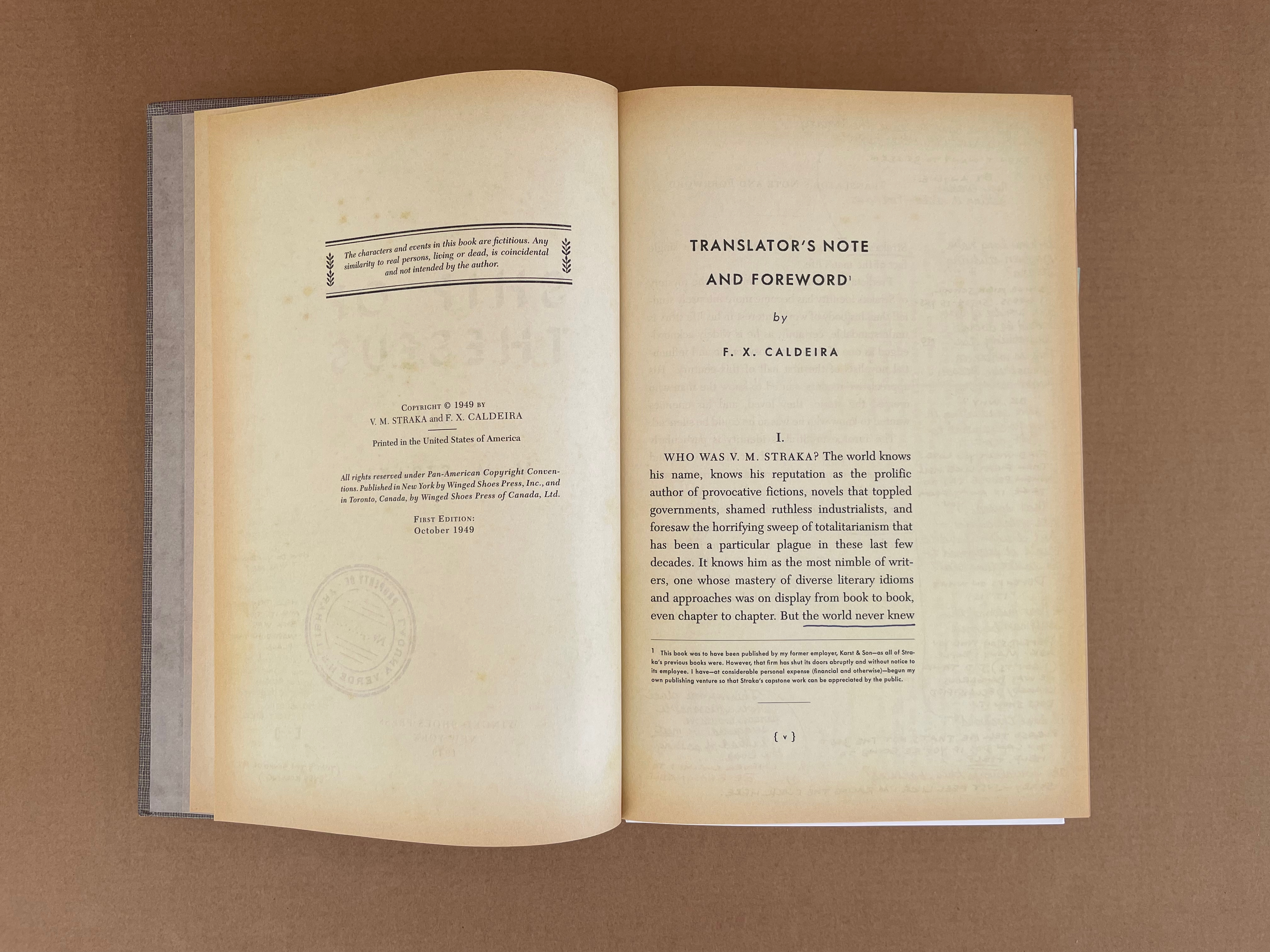
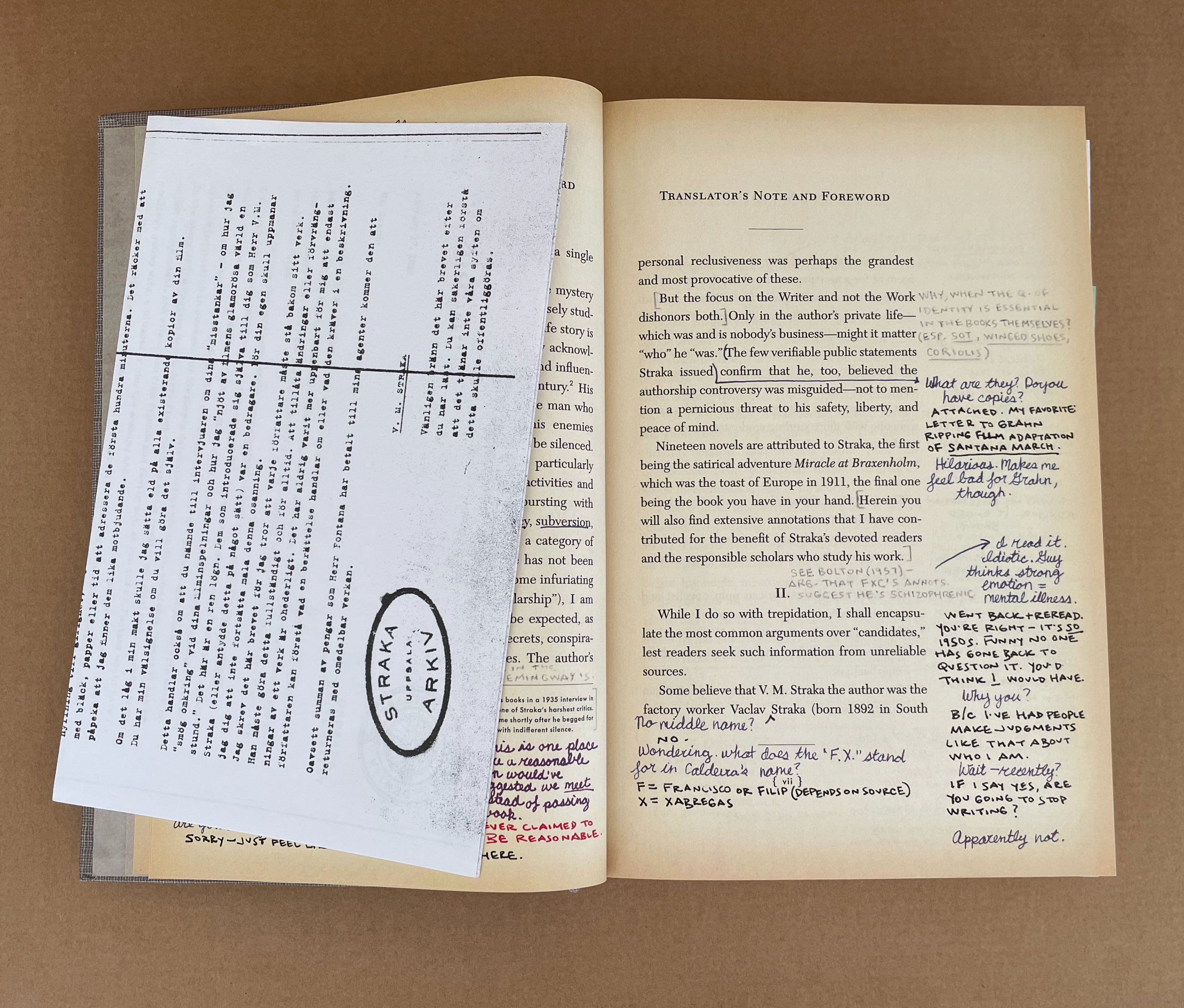
Like many artist’s books, S; Ship of Theseus has layers of self-referentiality “interrogating” the nature of the Book. Like many artist’s books, it challenges the act of reading — in this case with narrative frames, parallel color-coded narratives and objects of evidence each related to different narratives. The verisimilitude of its inserts and used-book appearance speaks to levels of craft and craftiness offered by many limited-edition works of book art. Like many artist’s books, it is the result of an intricate collaboration. But somehow it bulges the genre of the artist’s book.
After acquiring it, I came across Brian Davis’ two essays for the College Book Arts Association, which comment on S: Ship of Theseus. He must have felt the same “bulge” and found a sufficient number of similar works to coin a name for them: “Multimodal Book-Archives”. Yes, more academic jargon, but with a genre of art that has had its troubles with apostrophes and coinages such as “bookwork”, can we complain? Probably not, but we can cavil.
“Archives”can be temporally and spatially open ended without even hinting at boundedness. Works like S: Ship of Theseus and Warren Lehrer’s A Life in Books (2013), among others, do seem to “exploit the material and expressive possibilities of the book” through documentation, curation or compilation and preservation of artifacts. These two works, however, have not only a trade book boundedness, even allowing for loose inserts, but also a sense of narrative closure that makes “archives” not quite on the money. Faced with an artist’s book relying on narrative framing, documentation, and loose artifacts, we usually fall back on the terms of collage and assemblage to describe them, but then neither of the two examples has the pasted-down single view of collage or the sometimes disjointedness of assemblage.
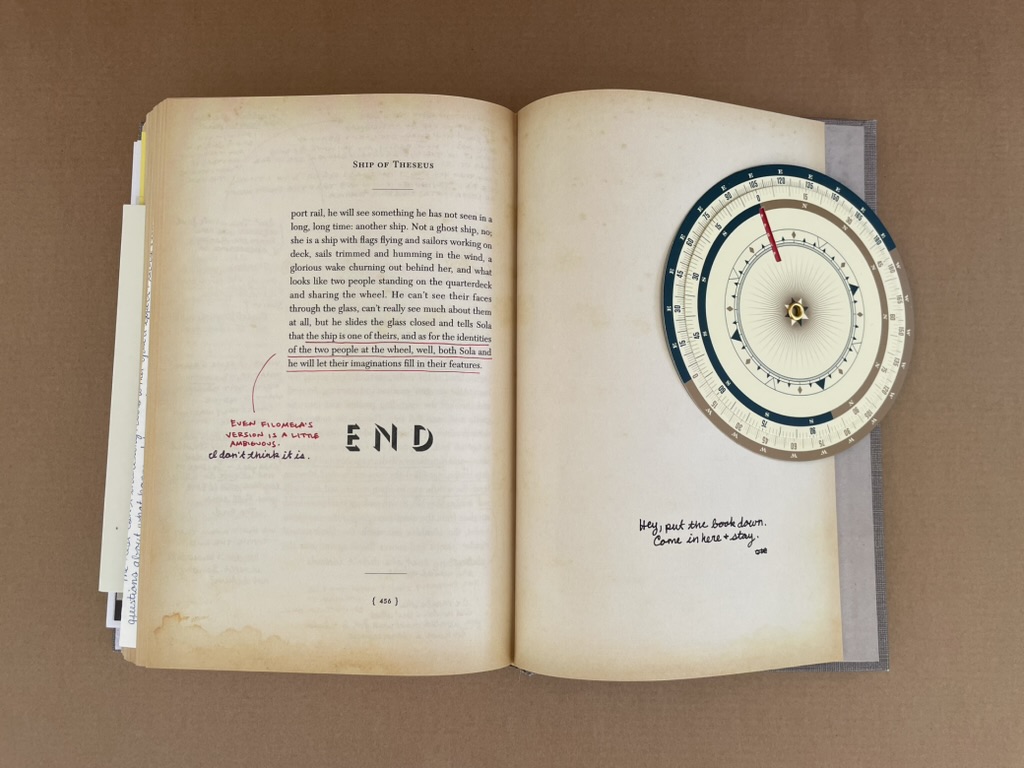
Narrative closure: “END” and “Hey, put the book down. Come in here & stay.”
“Archives” may not hit the mark, but Davis is right that these two works are multimodal. And/or, maybe they are instances of Dick Higgins’ “intermedia”, in which case I am reminded of his closing caveat:
And with this I would leave the matter of intermedia. It is today, as it was in 1965, a useful way to approach some new work; one asks oneself, “what that I know does this new work lie between?” But it is more useful at the outset of a critical process than at the later stages of it. Perhaps I did not see that at the time, but it is clear to me now. Perhaps, in all the excitement of what was, for me, a discovery, I overvalued it. I do not wish to compensate with a second error of judgment and to undervalue it now. But it would seem that to proceed further in the understanding of any given work, one must look elsewhere—to all the aspects of a work and not just to its formal origins, and at the horizons which the work implies, to find an appropriate hermeneutic process for seeing the whole of the work in my own relation to it.
Below are a few images of S: Ship of Theseus and its types of media. Below that is the product of “a poor devil of a Sub-Sub” librarian at the Fleet Library of the Rhode Island School of Design, who took the trouble to list all of the inserts and describe them as well as the features of the slipcase, spine, title page, etc., that contribute to its success.

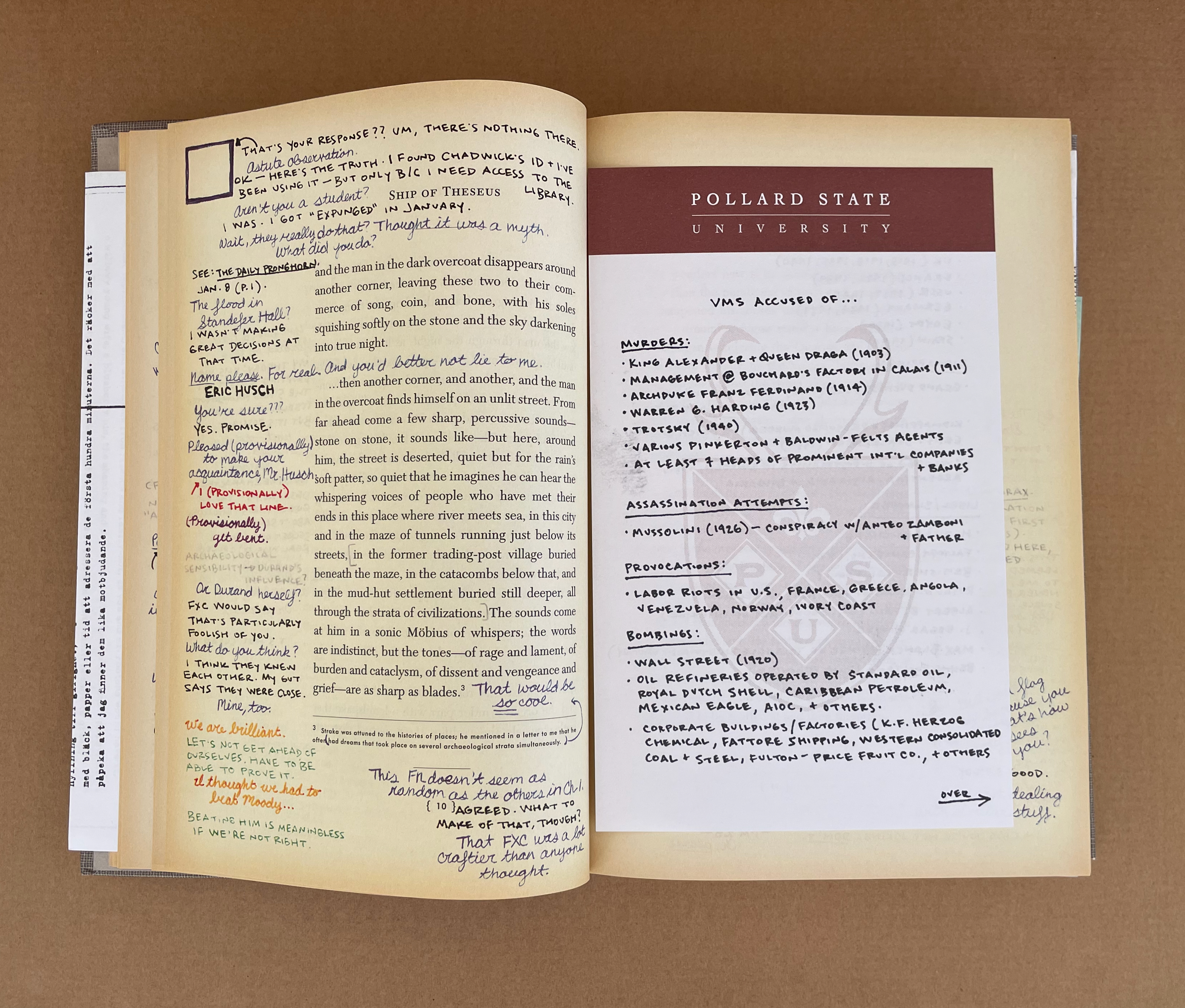
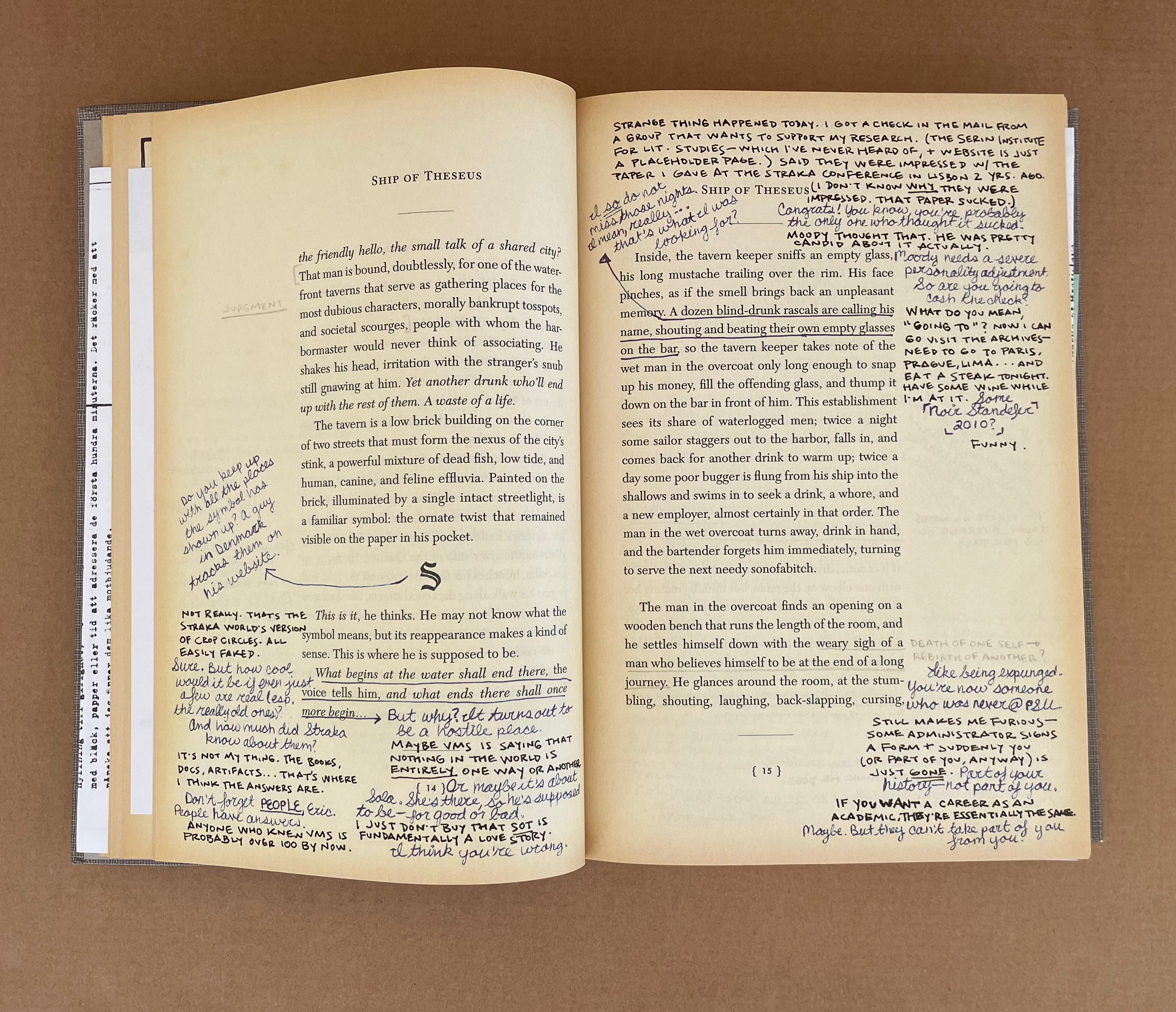
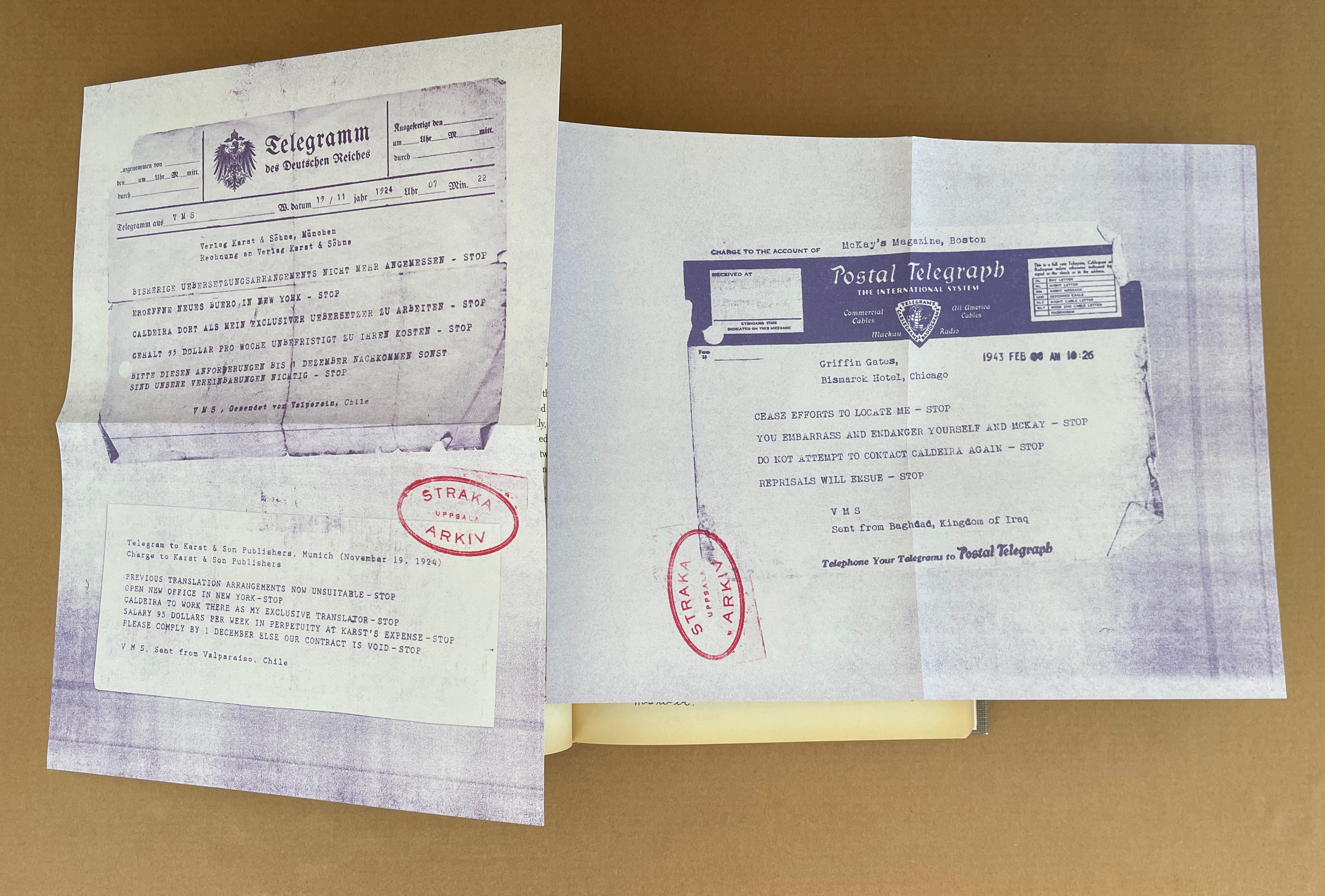
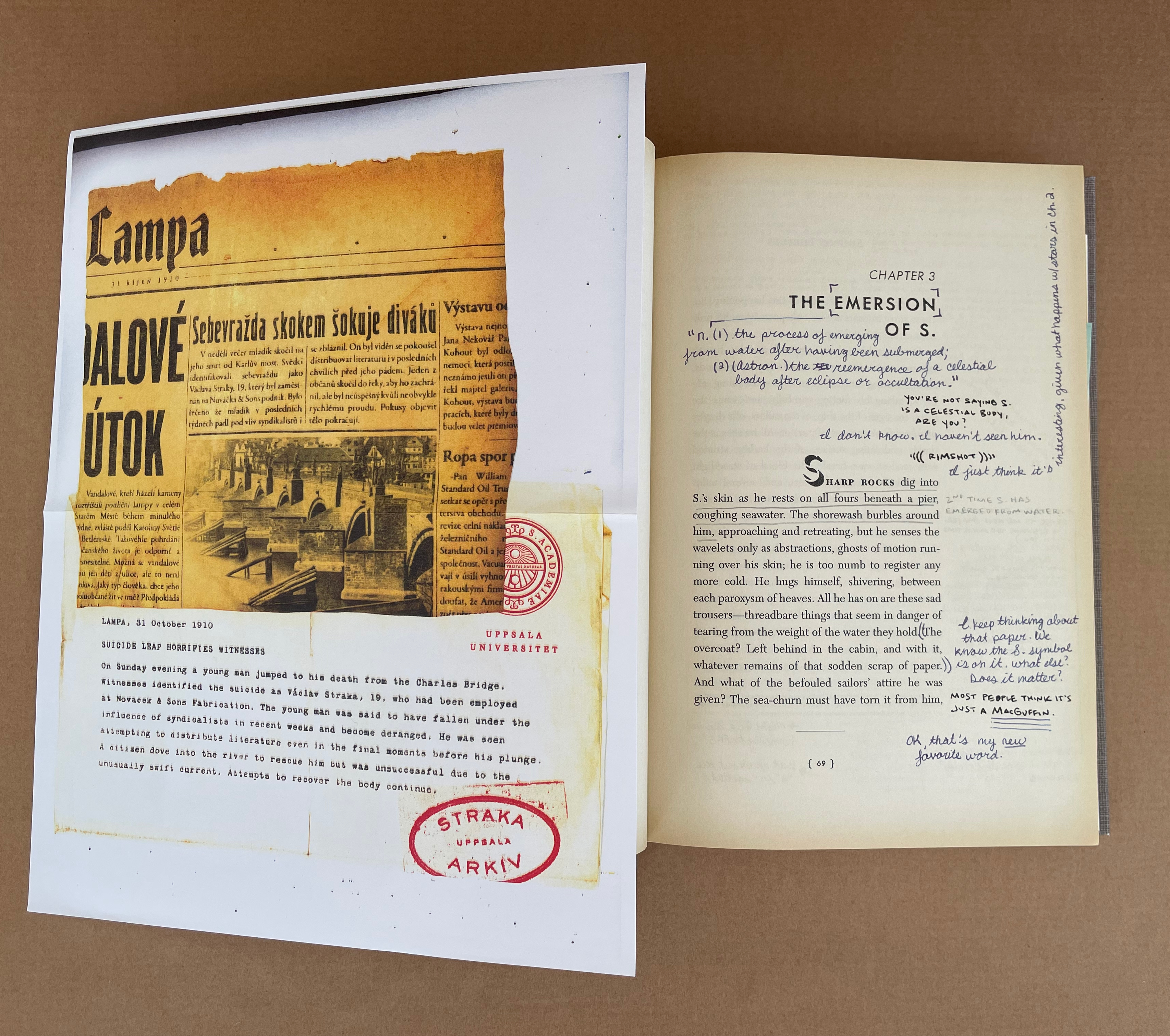
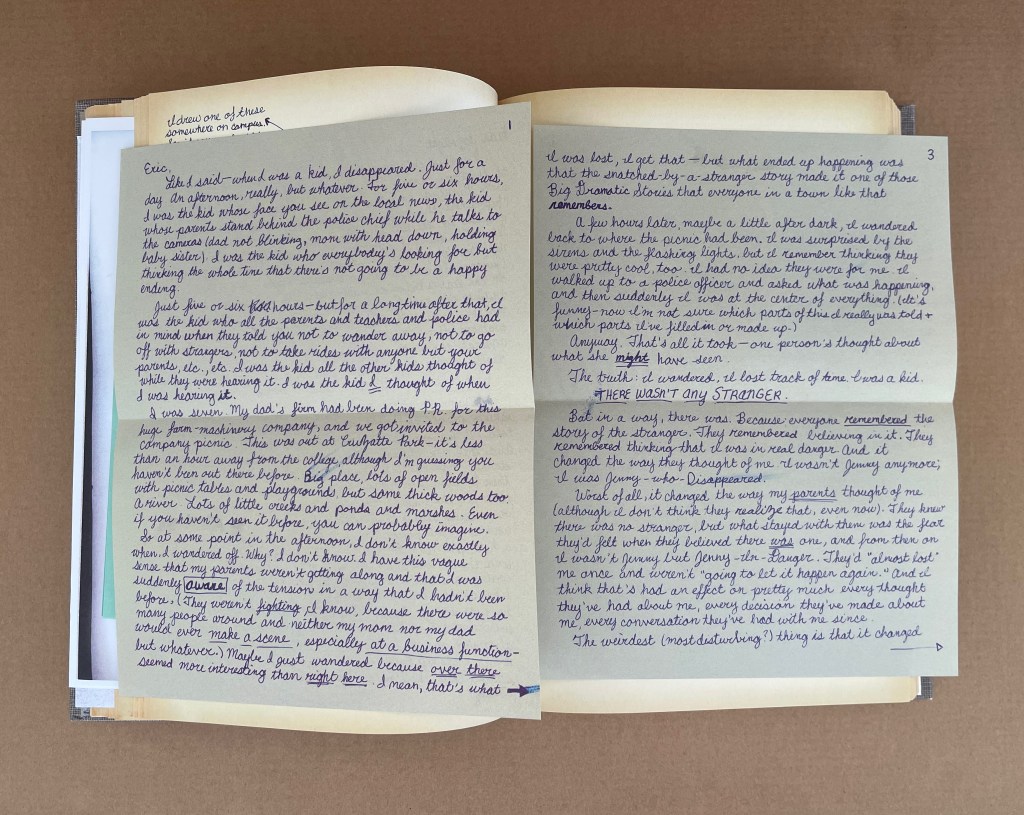
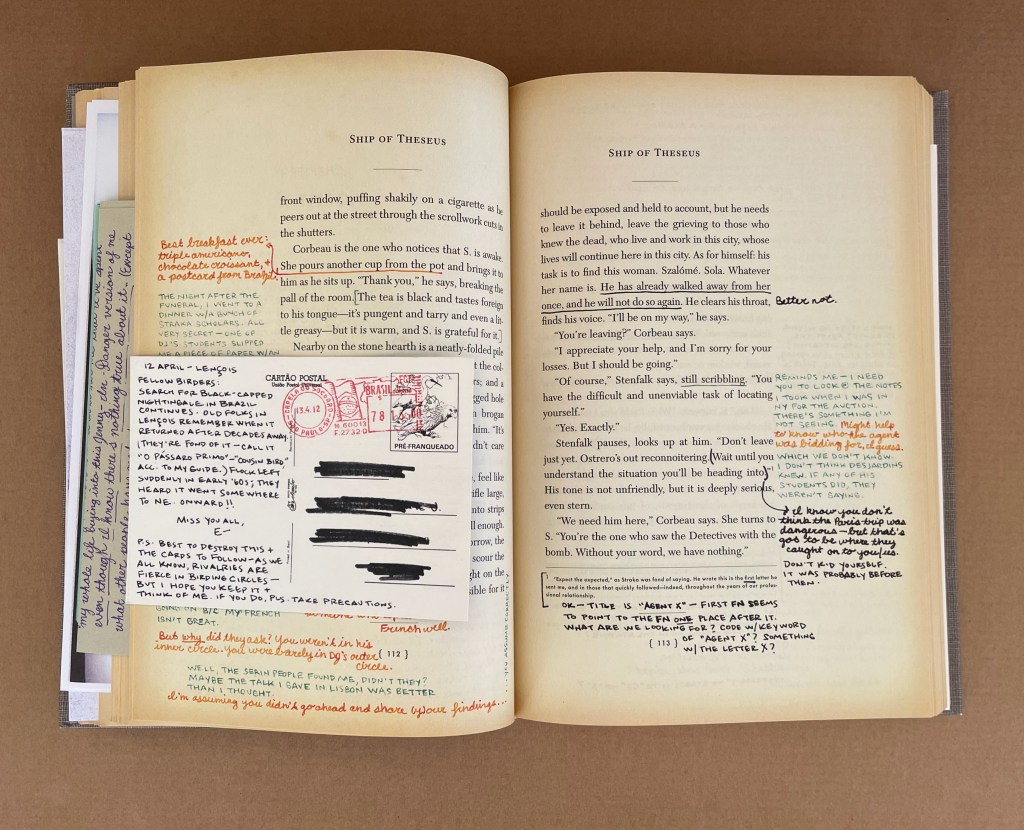
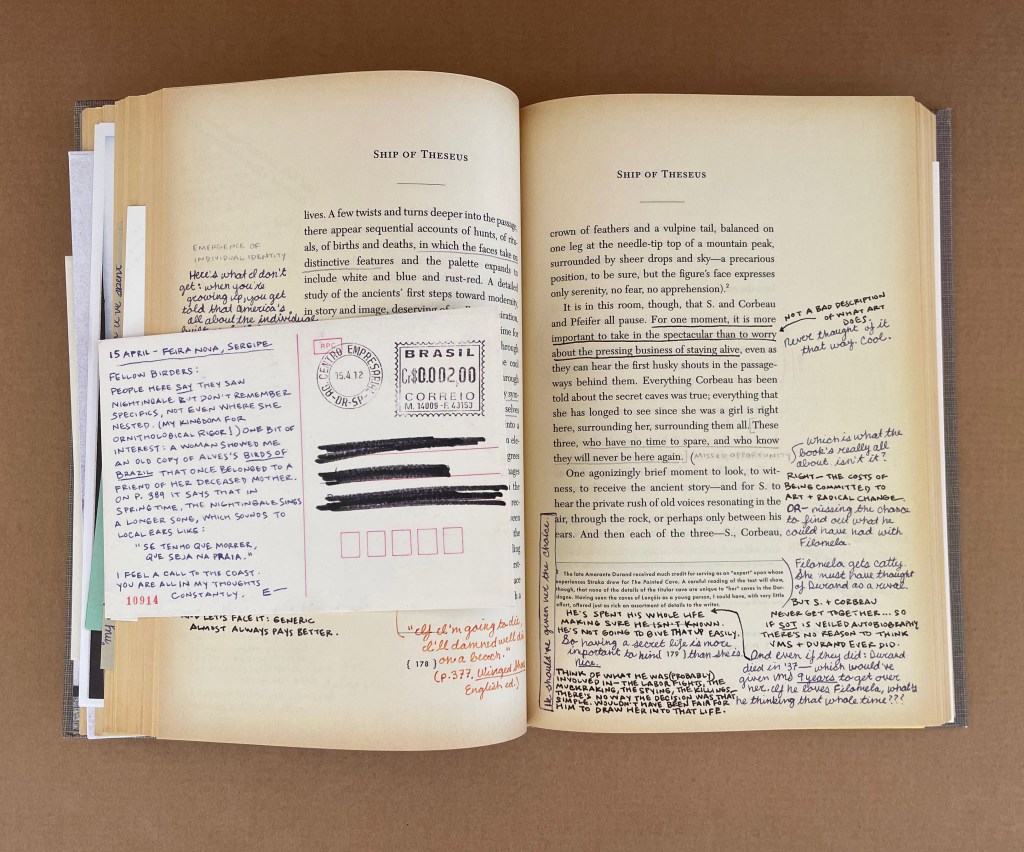
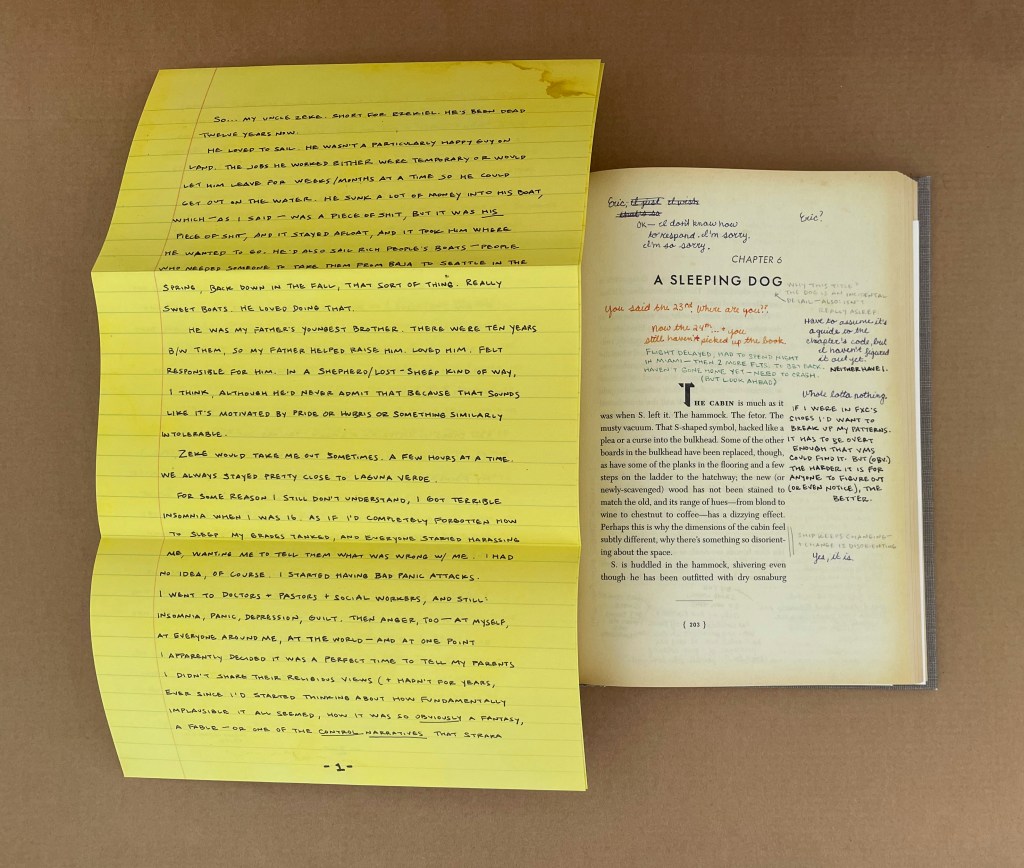
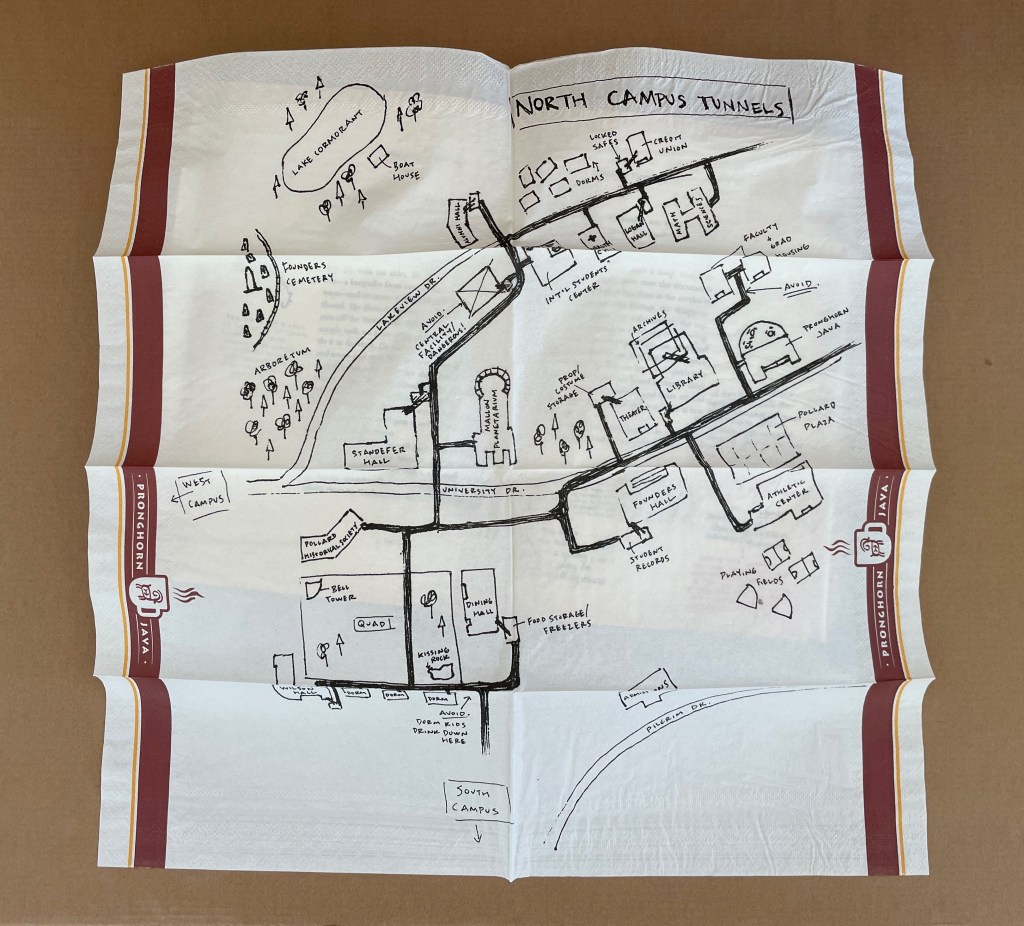
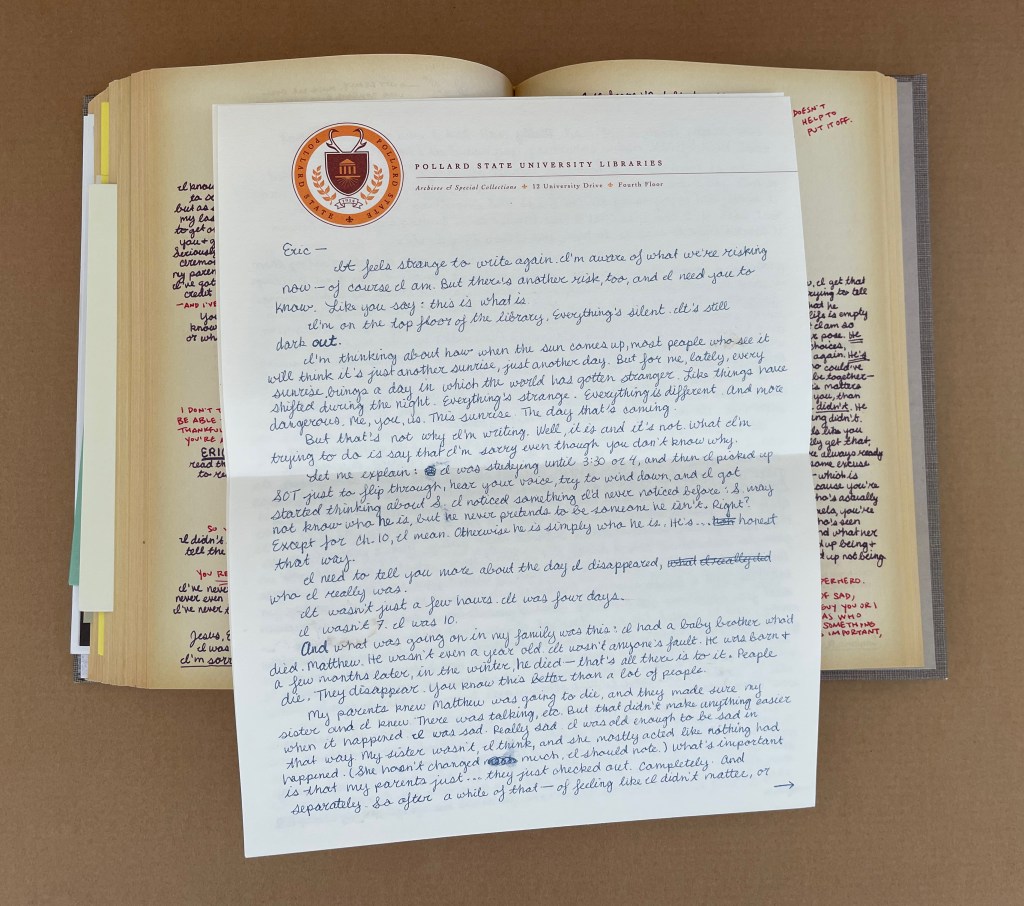
Konfidentiell letter (2 leaves) [insert between pages viii-ix] + Pollard State University : VMS accused of … (1 leaf) [insert between pages 10-11] + Xerox copy of journal article (1 leaf) [insert between pages 20-21] + Newspaper clipping (2 pages) [insert between pages 32 -33] + Telegram (2 leaves) [insert between pages 54-55] + 1 newspaper clipping/memo (1 leaf) [insert between pages 68-69] + Letter from Desjardins (1 leaf) [insert between pages 86-87] + Letter from Jen (4 pages) [insert between pages 100-101] + 1 Brazil postcard [insert between pages 112-113] + 1 photograph of stone wall [insert between pages 130-131] + 1 Birds of Brazil postcard [insert between pages 178-179] + 1 postcard of palms [insert between pages 190-191] + 1 postcard of a beach [insert between pages 192-193] + 1 Pictorial Brazil postcard (20 April near Marau) [insert between pages 200-201] + So … My Uncle Zeke (5 pages) [insert between pages 202-203] + 1 photograph of woman [insert between pages 242-243] + 1 newspaper clipping within 1 greeting card [insert between pages 256-257] + 1 map on napkin [insert between pages 306-307] + 1 in memoriam card [insert between pages 360-361] + Letter from J (4 pages) [insert between pages 376-377] + Letter from Esmerlinda Pega (1 leaf) [insert between pages 416-417] + 1 decoder wheel [insert between end leaf and pages 3 of cover]. Altered book. Issued in slipcase. Title and statement of responsibility from slipcase.”Bad Robot, Melcher Media.”–Spine of slipcase. Title page and cover title of volume inside slipcase: Ship of Theseus / V.M. Straka. Imprint on title page: Winged Shoes Press, New York, 1949. Title page and page [3] of cover printed with “stamps” of Laguna Verde High School Library; spine includes a Dewey call number label. Includes 23 items purporting to be documents concerning the “author,” V.M. Straka, and his “translator,” F.X. Caldeira from the Straka Arkiv; decoding wheel, letters, postcards and notes by the “readers,” Jennifer and Eric; and other related materials.Marginalia printed in various colors. Description from Fleet Library Special Collections, Rhode Island School of Design.
Further Reading
“Warren Lehrer“. 28 May 2024. Books On Books Collection.
Davis, Brian. 1 May 2024. “Part One: The Rise of Multimodal Book-Archives“. Book Art Theory. Starkville, MS: College Book Arts Association.
Davis, Brian. 15 May 2024. “Part Two: Warren Lehrer’s Life in Books“. Book Art Theory. Starkville, MS: College Book Arts Association.
Higgins, Dick and Hannah Higgins. 2001. “Intermedia“. Leonardo 2001; 34 (1): 49–54. Cambridge, MA: MIT Press.
McKenzie, D. F. 1986. Bibliography and the Sociology of Texts. London: British Library.
Rothman, Joshua. 23 November 2013. “The Story of ‘S’: Talking With J. J. Abrams and Doug Dorst“. The New Yorker.
 Books On Books