Richard J. Hoffman (1912-1989) was a fine press printer and taught print and design at California State University, Los Angeles. His interests in typography, miniature books and the alphabet are represented by two works in the Books On Books Collection: “Don’t Nobody Care about Zeds” (1987) and Otto Ege’s The Story of the Alphabet (1988).
Both books scratch the collection’s “alphabet itch”. The first provides the added satisfaction of complementing the children’s books that champion the alphabet’s last letter: Jon Agee’s Z Goes Home (2006), Alethea Kontis & Bob Kolar’s AlphaOops: The Day Z Went First (2012), Sean Lamb & Mike Perry’s Z Goes First (2018) and Lou Kuenzler & Julia Woolf’s Not Yet Zebra! . The second adds an alphabet history to the miniature abecedaries as well as a more than usually intricate design.
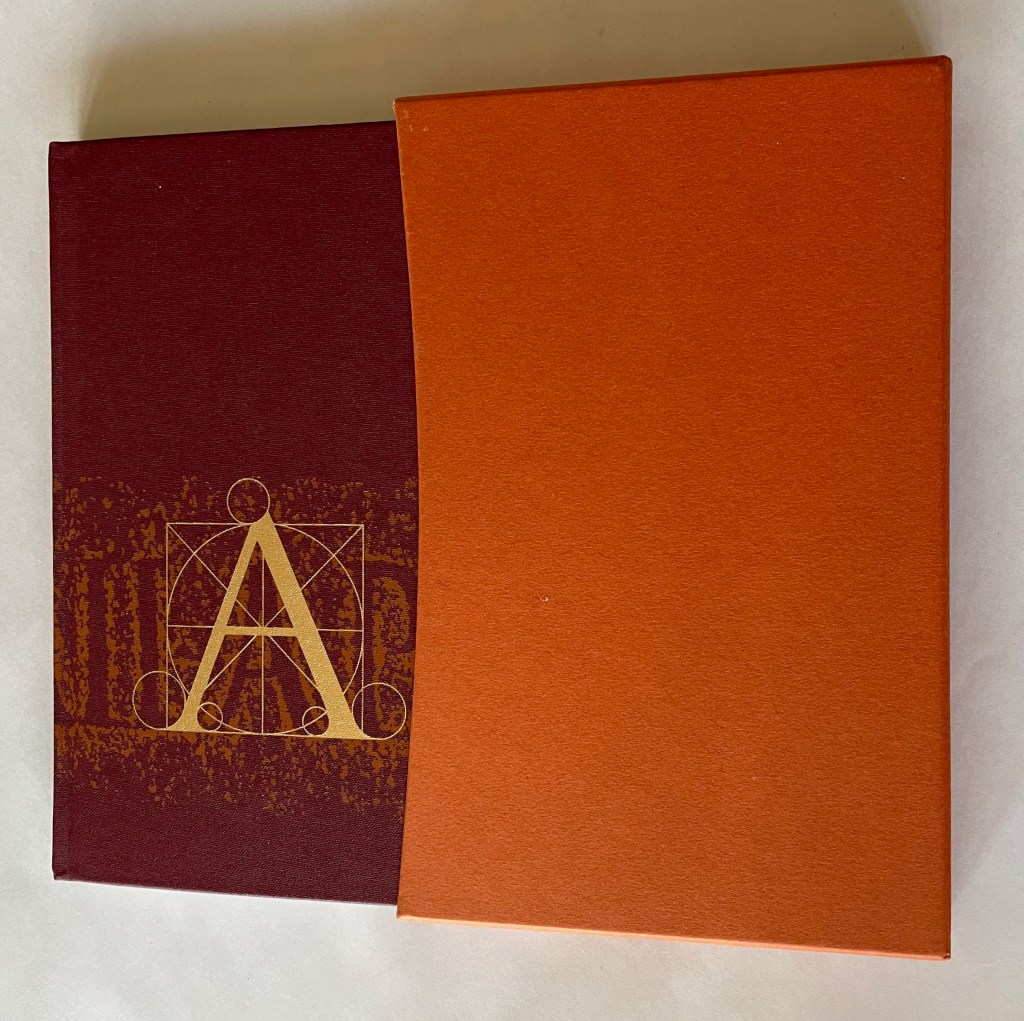
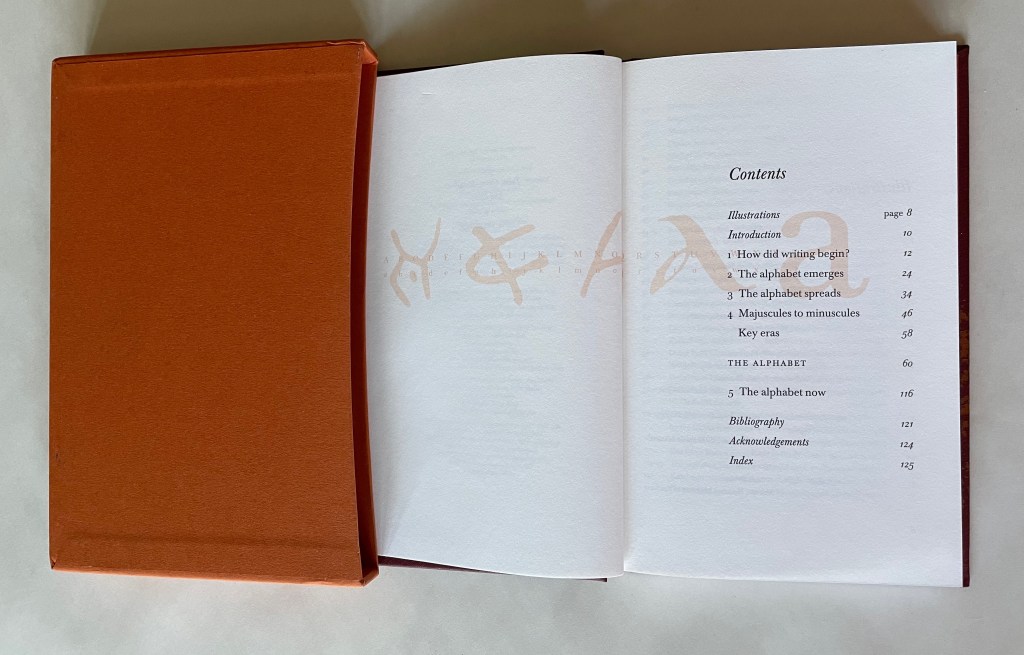
A is for Ox: A Short History of the Alphabet (2006) Lyn Davies Casebound, doublures matching slipcase. Slipcase: H205 x W133 mm. Book: H197 x W128 mm. 128 pages. Acquired from The Old Bakehouse, 13 July 2021. Photos: Books On Books Collection.
There are numerous histories of the alphabet. Some are even titled the same as Lyn Davies’ A is for Ox. Several books take the letter-by-letter approach that Davies does in the second half of his book. Only one of them falls in the category of fine press book or artist’s book, and that is Richard J. Hoffman’s miniature production of the bookseller Otto Ege’s text. Benefitting from the advice of Stephen Fischer and the infrastructure of The Folio Society, Davies has secured more of a place for A is for Ox than that distinction.
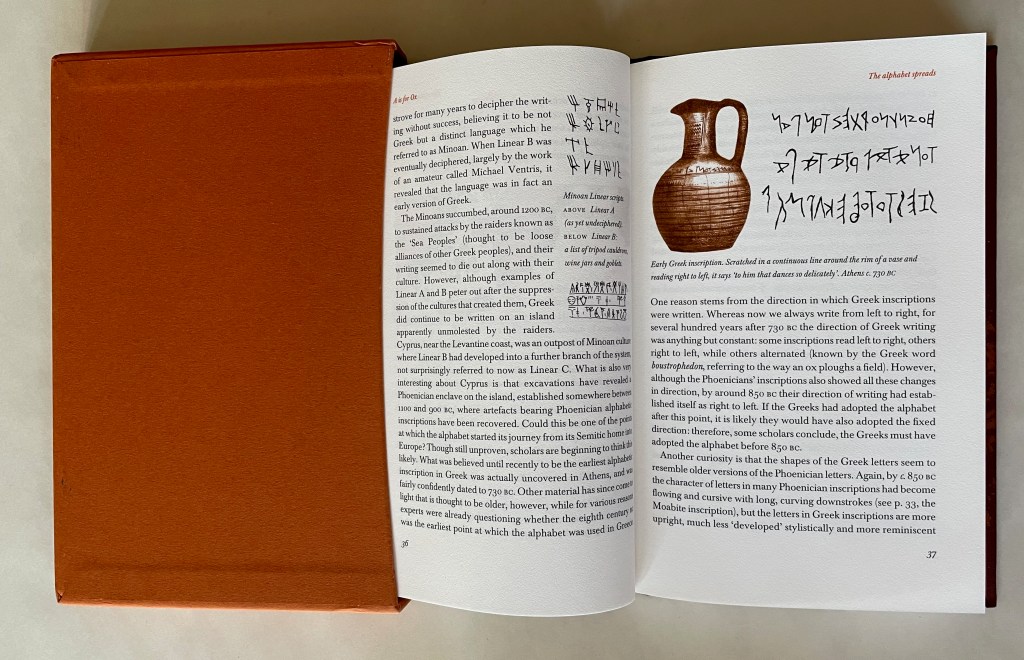
One distinction is the handling of two colors across the design of the book. Davies knows book design. The burnt umber or terra cotta color is used to great effect. Chapter subtitles, section heads and running heads stand out but do not overbear. In the second half of the book, the color turns each letter of the alphabet in its section into a subdued illuminated letter. Another distinction follows on from this: the handling of images in the first half of the book. By printing in black and white the full inscriptions on stone, clay and pottery depicted in photographs, Davies enhances the experience of those images, and somehow the tinting of the images makes it easier to match the markings with the print.
Despite its brevity, A is for Ox conveys just as much as many lengthier works. Somehow with Davies in ten pages it is easier to “peg” waw as the antecedent sound for the letters F, U, V, W and Y than it is in the lengthier works. In its “A is for …” organization of its second half, the book injects some lightness without descending into silliness, leaving the latter to the children’s books and some of the comedy-prone trade books.
The Ottakar’s 2004 and Folio Society 2006 editions are out of print, which is a shame for ordering in bulk for short courses on the history of the alphabet and writing. Fortunately both are available at more-than-reasonable prices on the used book market.
Clodd, Edward. 1913. The Story of the Alphabet. London: Hodder and Stoughton. 1913. Superseded by several later works, but is freely available online with line illustrations and some black and white photos.
Diringer, David, and Reinhold Regensburger. 1968. The alphabet: a key to the history of mankind. London: Hutchinson. A standard, beginning to be challenged by late 20th and early 21st century archaeological findings and palaeographical studies.
Thompson, Tommy. 1952. The ABC of our alphabet. London: Studio Publications. Not a fine press publication, but its layout, illustrations and use of two colors bear comparison with the Davies book. It too is out of print and unfortunately more rare.



 Books On Books