“Book of Hours was designed and created by Julie Chen & Keri Miki-Lani Schroeder. This long-distance collaboration, between California and Texas, took place during the 2020-21 pandemic. The format of Book of Hours is known as a blow book, a historical structure originally designed as a magic trick which allows the presenter to show completely different visual sequences of pages within the same book. … The first and last sequences on each side of the book were designed by the two artists collaboratively, and the other eight sequences were designed individually by each artist. …” — Colophon.
Book of Hours (2021)
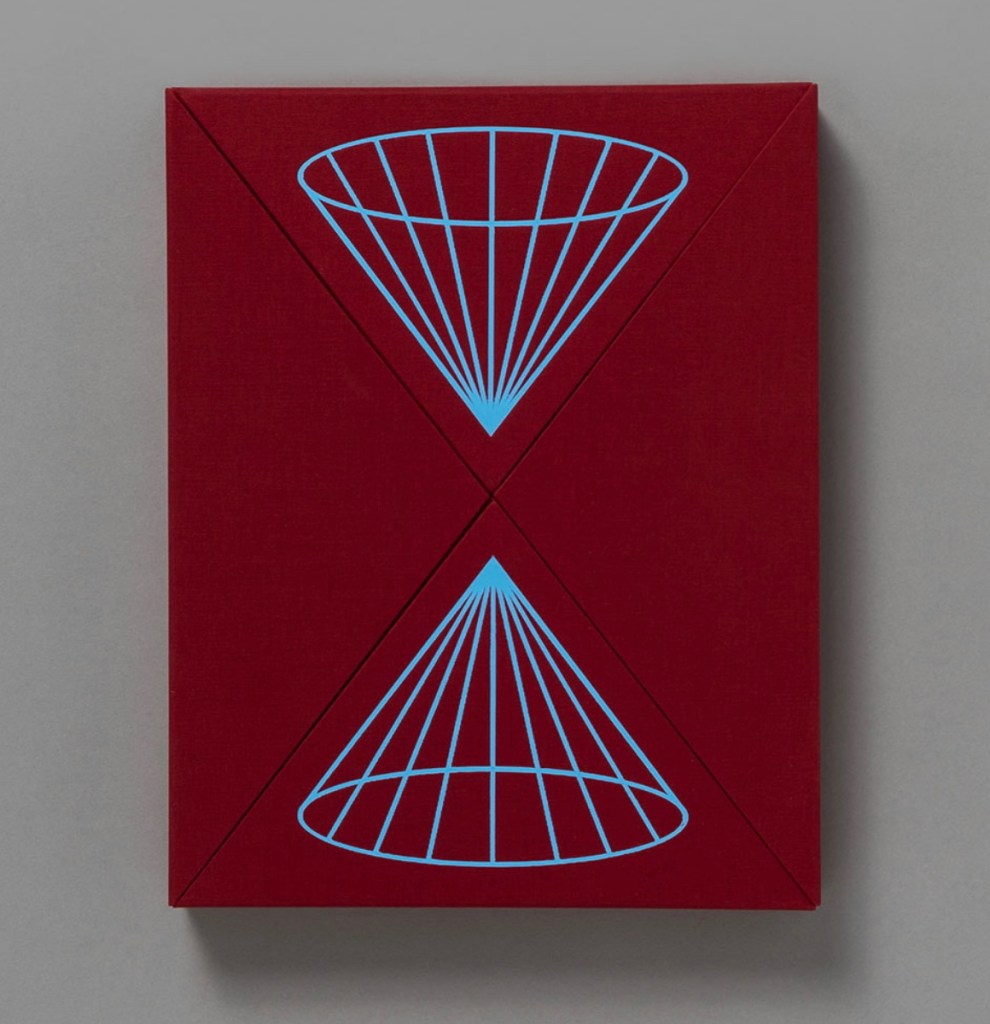
Book of Hours (2021)
Julie Chen & Keri Miki-Lani Schroeder
Box: H283 x W220 x D51 mm. Book: H279 x W216 x D48 mm. Artists’ book Structure #/88 Julie Chen 8 October 2024.
Photos: Courtesy of artists, and Books On Books Collection.
As with all blow books, hold the Book of Hours‘ spine in your left hand, place your right thumb at the upper end of the fore edge, and flick through the pages. A set of sequenced images appear from beginning to end. But start again, shifting the pressure of your thumb to a lower position on the fore edge, and a different set of sequenced images shows up in the riffling. Turn the book over on its horizontal axis, and yet another series of sequenced images become available. To distinguish one side of the Book of Hours from the other, Chen and Schroeder have designated one side as “ante meridiem” on its title page and the other side as “post meridiem”.
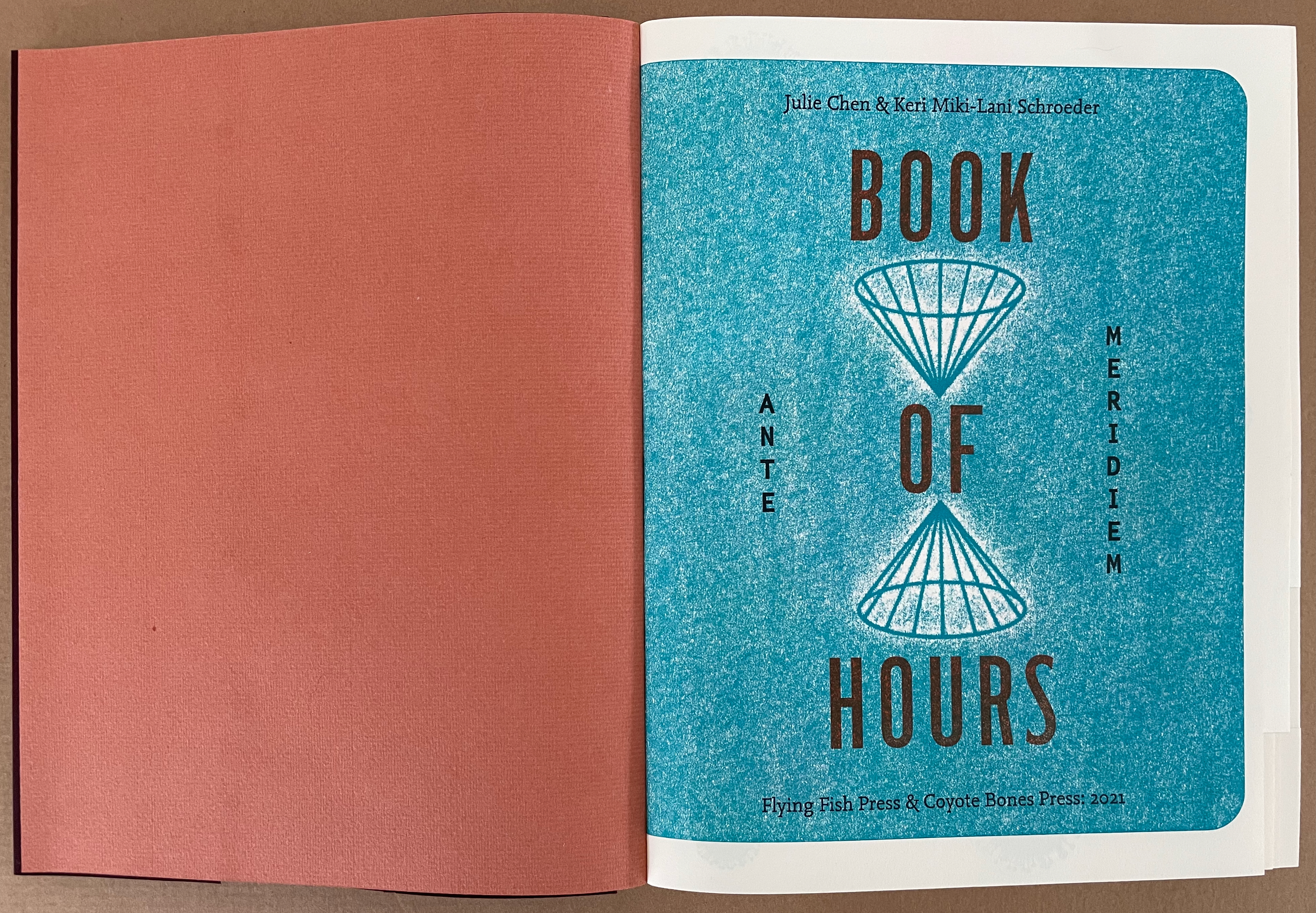
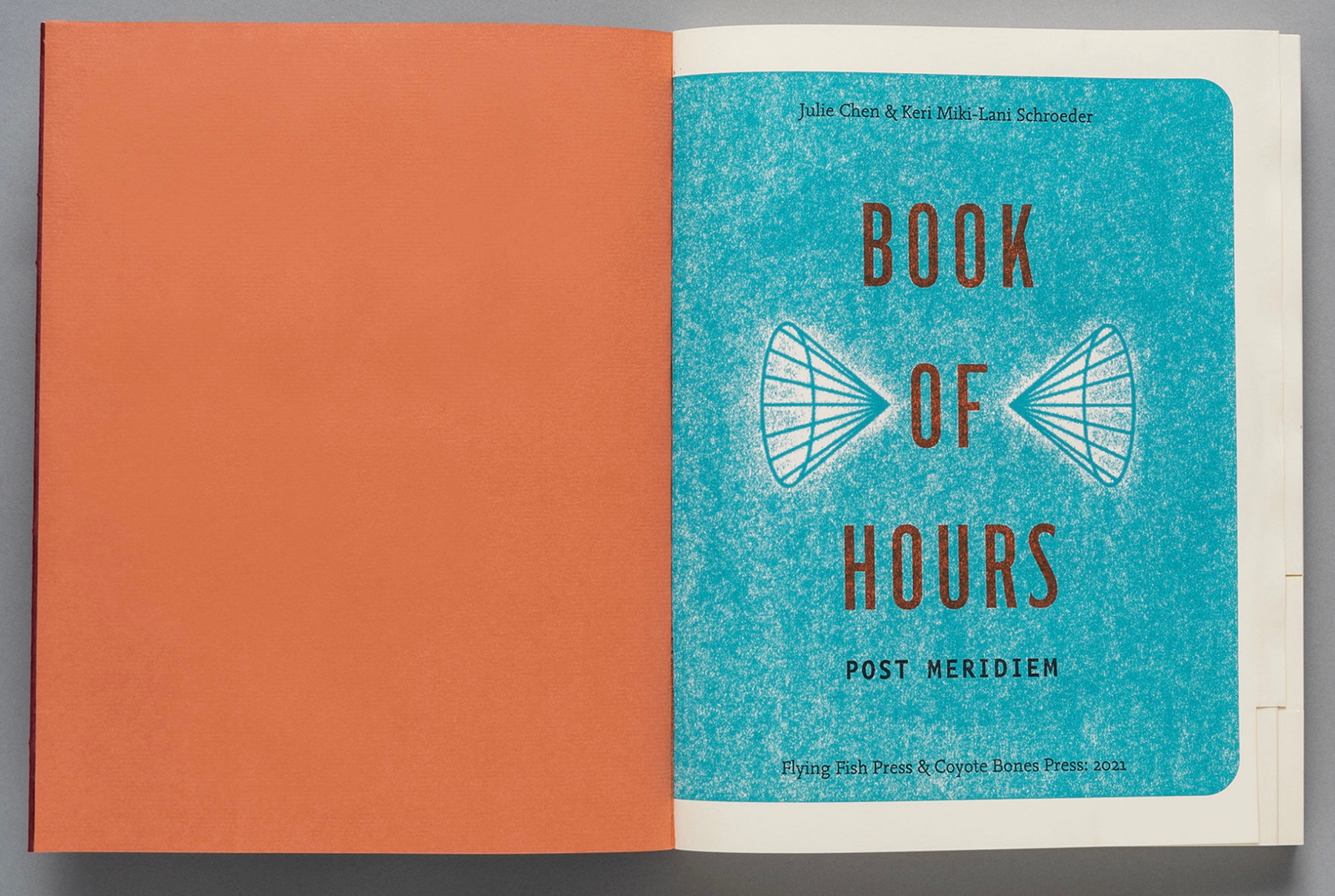
Ante Meridiem and Post Meridiem title pages.
There are 12 distinct sequences in the book, 6 to a side. Each sequence has 13 double-page spreads, except for the first which has 12. On both the ante and post meridiem sides, the first sequence consists of spreads, each with 4 sets of “light cones” running across the center of the spread. A light cone models the causal structure of spacetime. When sets of light cones are oriented in the same direction, flat spacetime is indicated. When a light cone tilts, indicating the pull of gravity on light, the curvature of spacetime is depicted. As Chen’s and Schroeder’s first sequence progresses, the light cones do just that until, in the “last” double-page spread, all four light cones are again aligned in the same direction.
Each spread presents a perplexing question related to time and space; for example, “Can you tell a story with no beginning and no ending?” and “Does time flow in only one direction?” The question is printed right side up at the top of the spread and upside down at the bottom of the spread. So if you turn the book from the AM side to the PM side to riffle the pages, the AM side’s last question becomes the PM side’s first question, and on the AM side, the light cones rotate clockwise, and on the PM side, they rotate anti-clockwise.
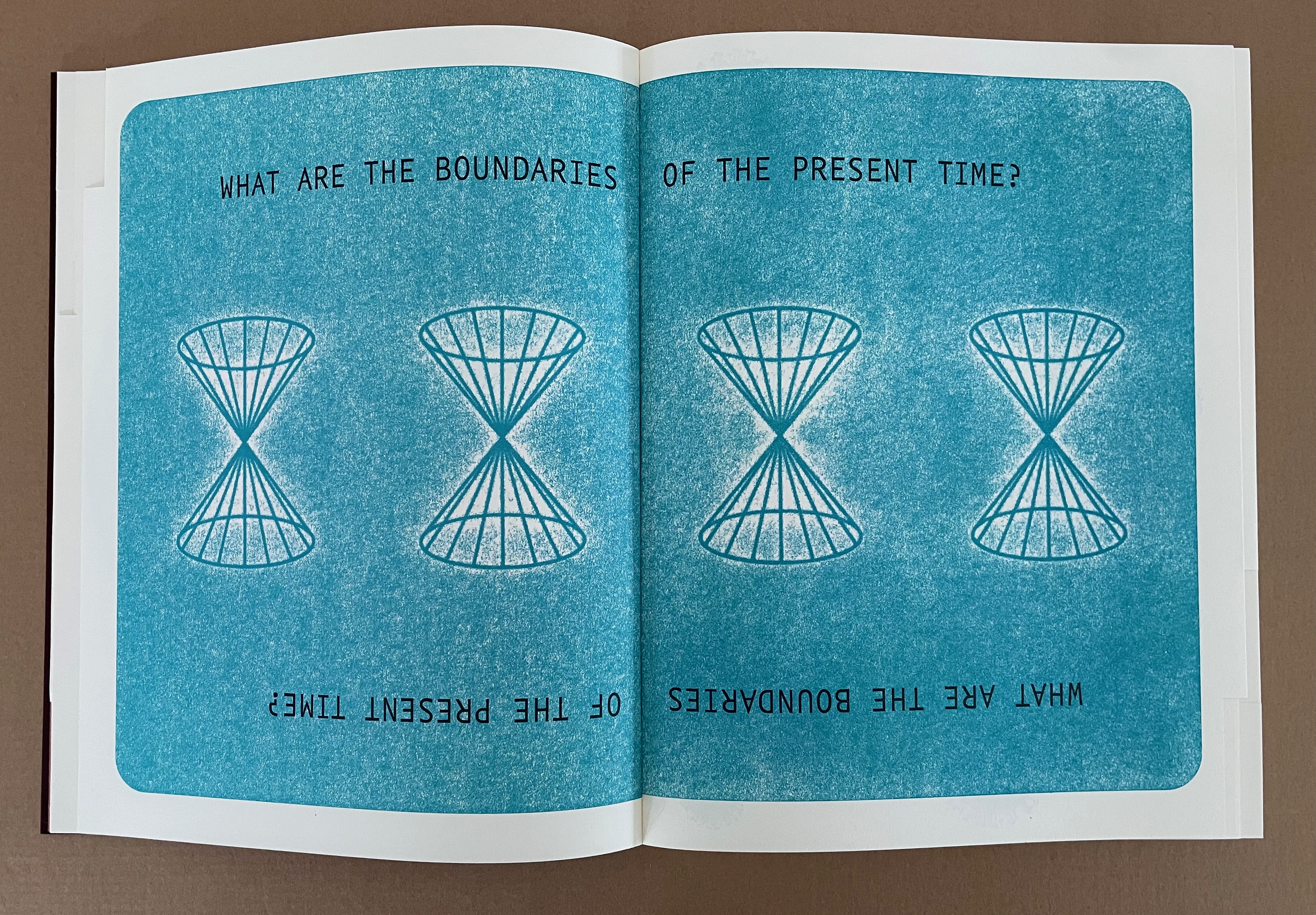
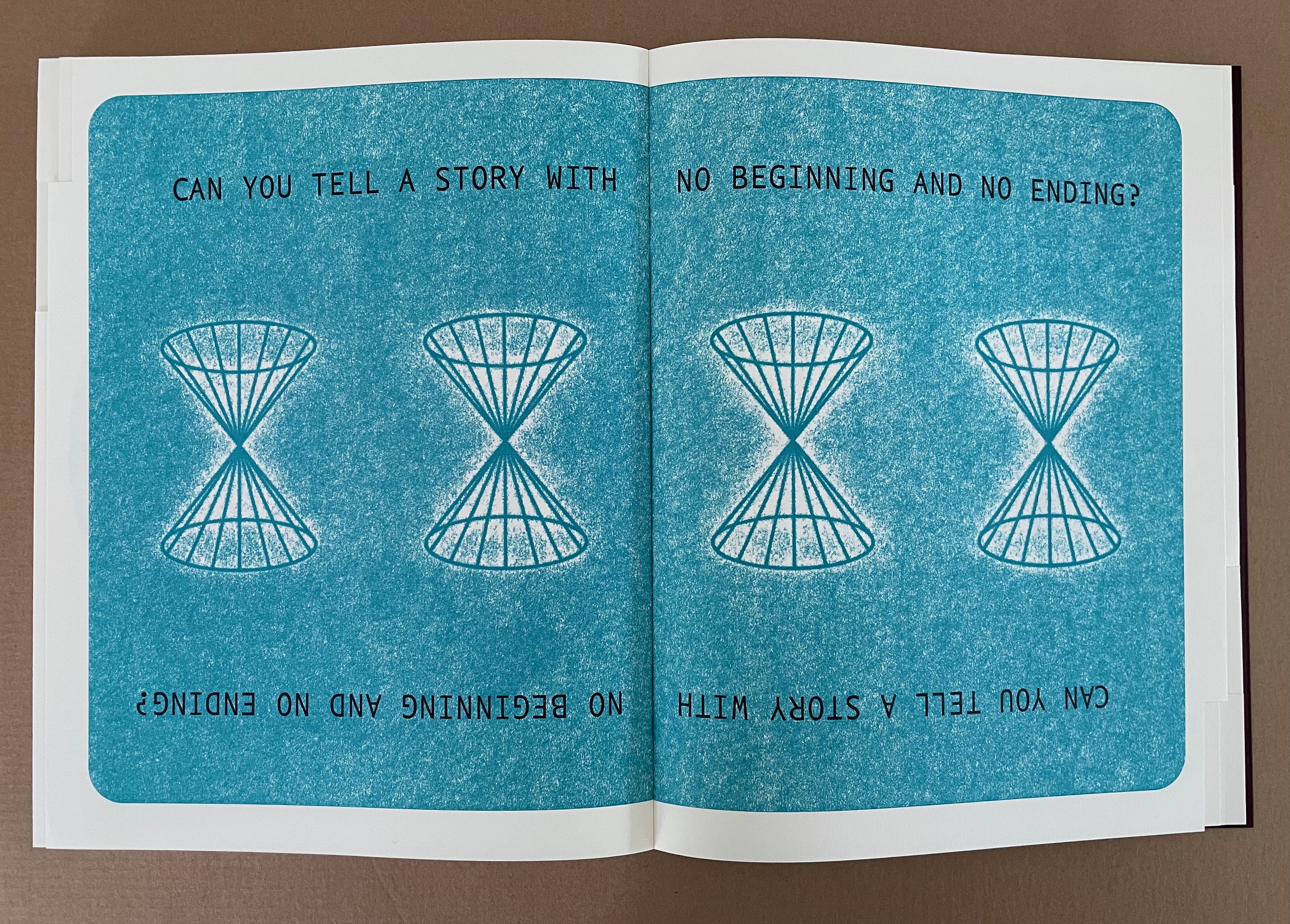
AM side’s first question. AM side’s last and PM side’s first question.

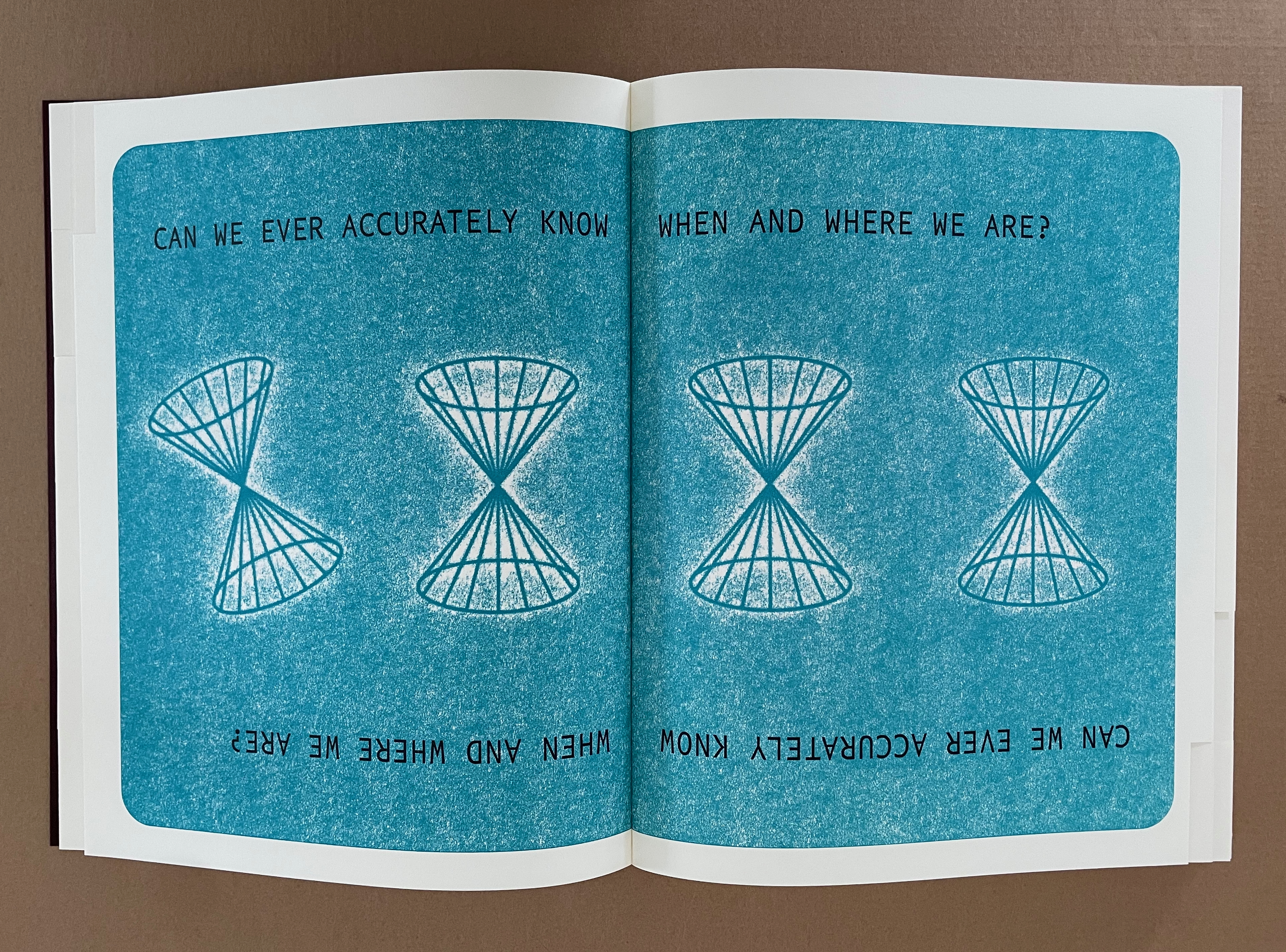
AM side’s second question and light cone turning clockwise. PM side’s second question and light cone turning anti-clockwise.
This first sequence in Book of Hours may be the most intellectually and materially conjoined of them all and the most pointedly a challenge to a traditional notion of the book. In the space of a traditional Western book, we read from left to right, and time seems to flow with it. Book of Hours asks, “Does time flow in only one direction?” And when it flips from AM to PM, its anti-clockwise light cones answer, “No.” But we cannot merely say that time only moves forwards then backwards. As the light cones turn anti-clockwise on the PM side, our reading of the text is still proceeding left to right in a clockwise direction. As the AM’s last question becomes the PM’s first and the PM’s last becomes the AM’s first, Book of Hours answers the question “Can you tell a story with no beginning and no ending?” with a resounding physical “Yes!”
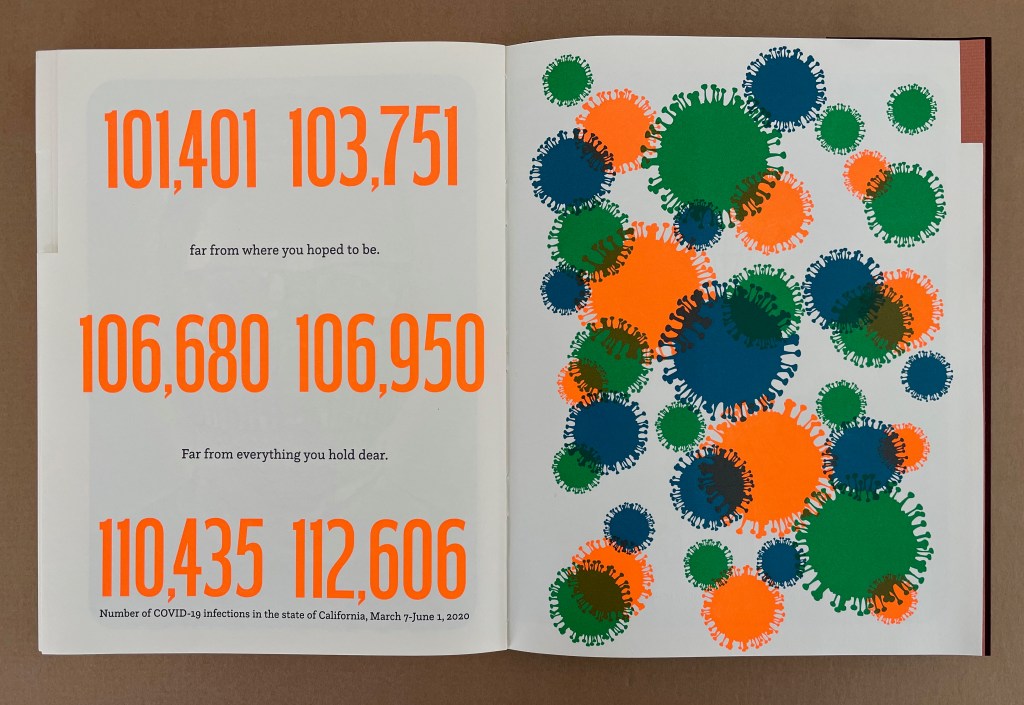
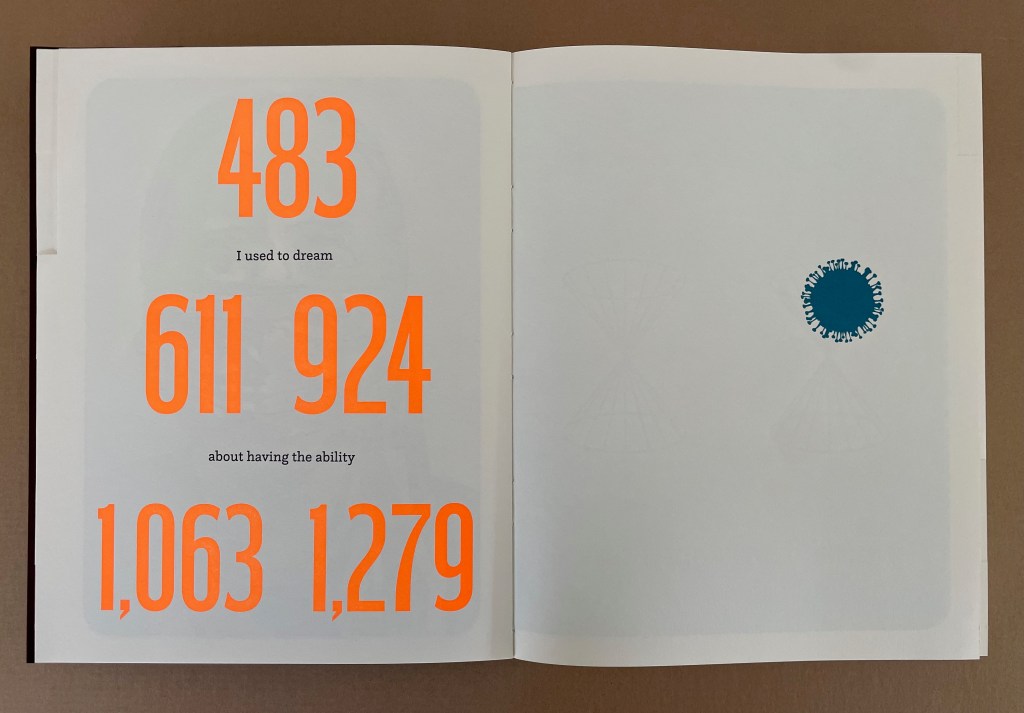
The second sequence on both the AM and PM sides introduces different but parallel topics. Unlike the first sequence, which doubles the number of images by revolving on the horizontal axis, the second sequence is actually two sets of images. The spreads on the AM side display a bomb site on the left and a graphic from the Doomsday Clock on the right. The spreads on the PM side show statistics and a graphic from the COVID-19 pandemic.
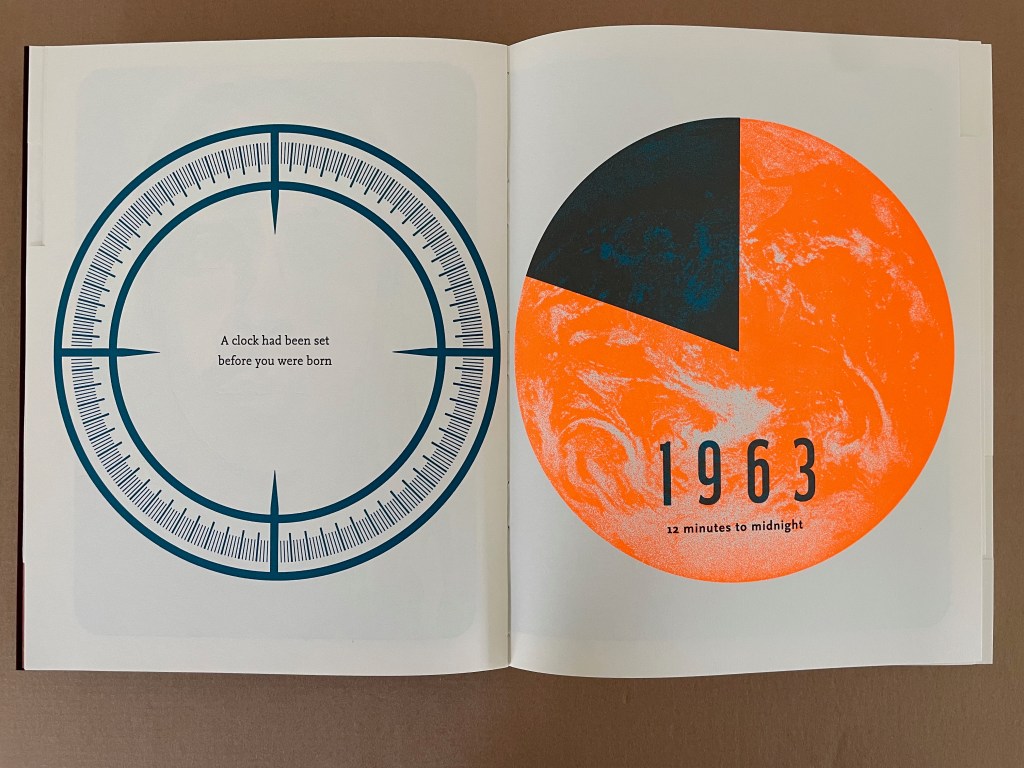
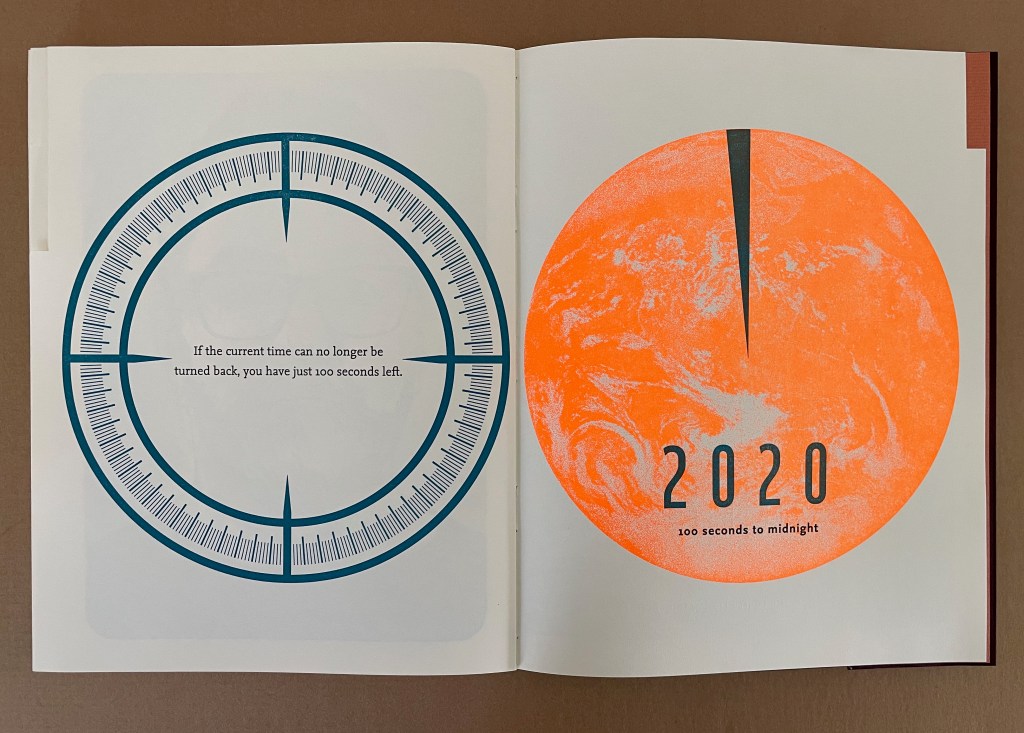
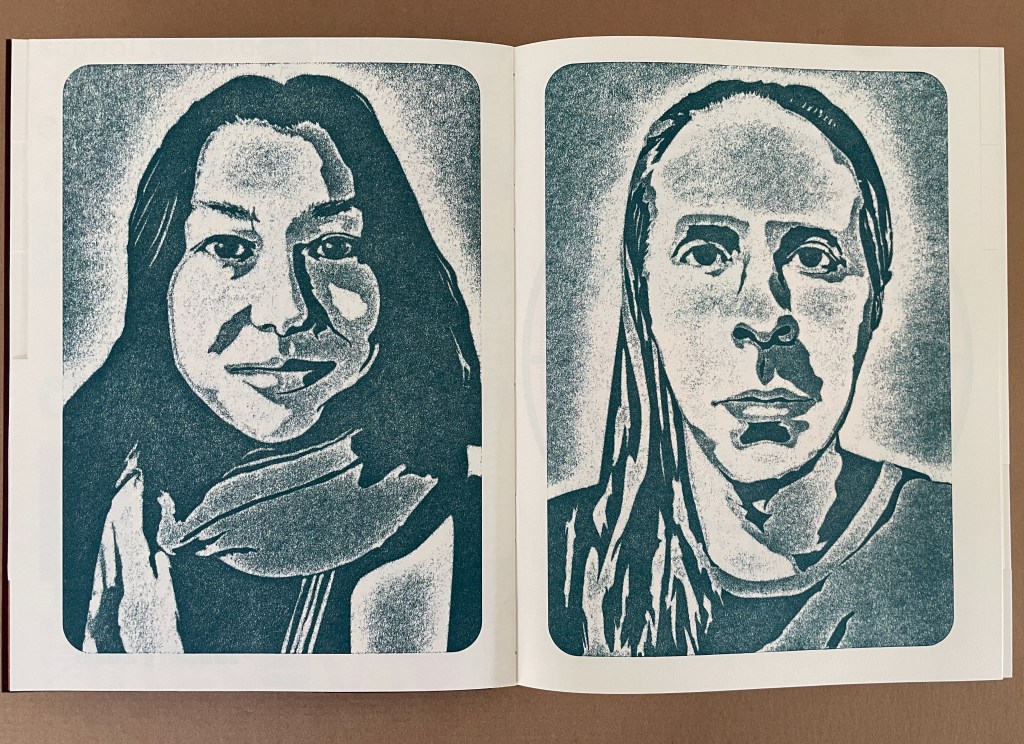
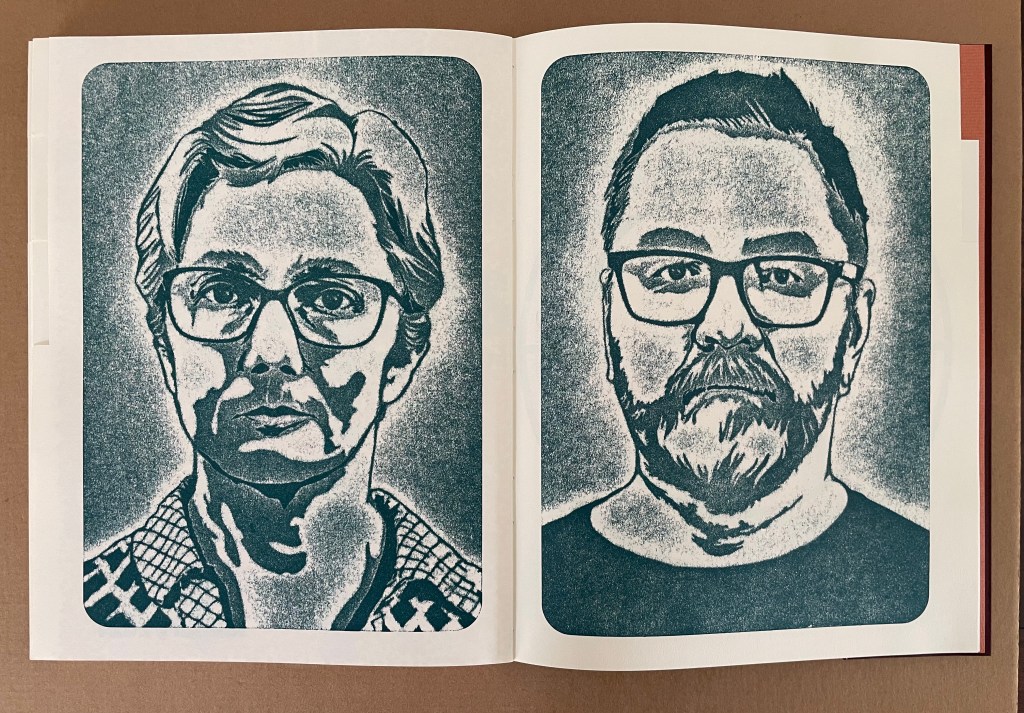
The third sequence on both the AM and PM sides consists of drawn portraits of Chen’s family and friends. The third sequence is again two sets of images — the AM set with faces unmasked, the PM set with faces COVID-masked.
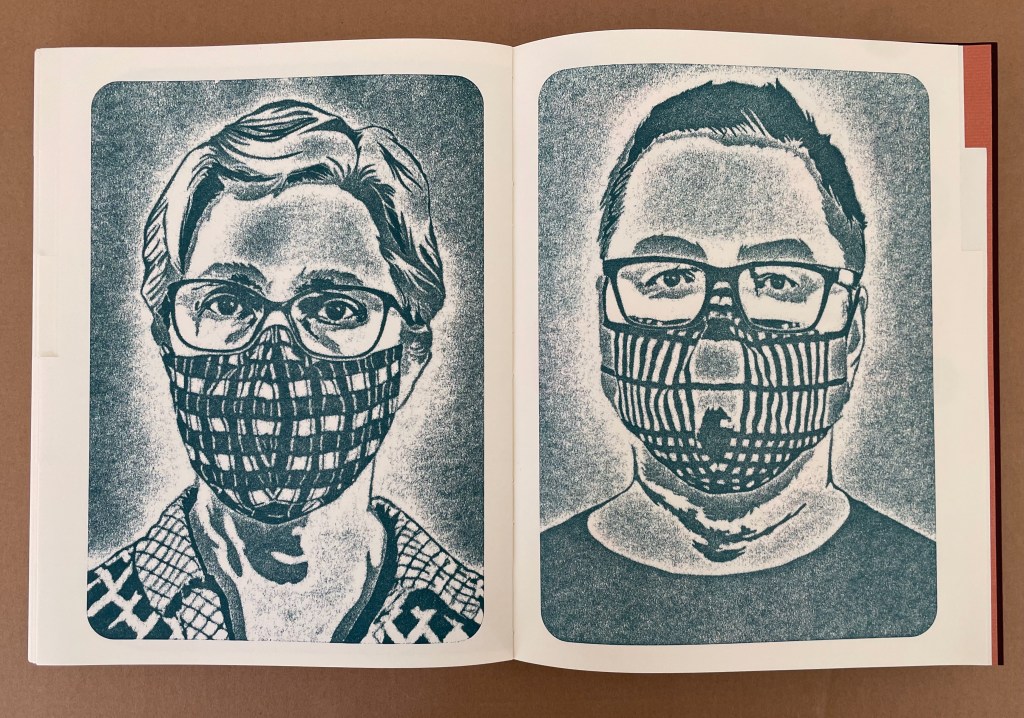

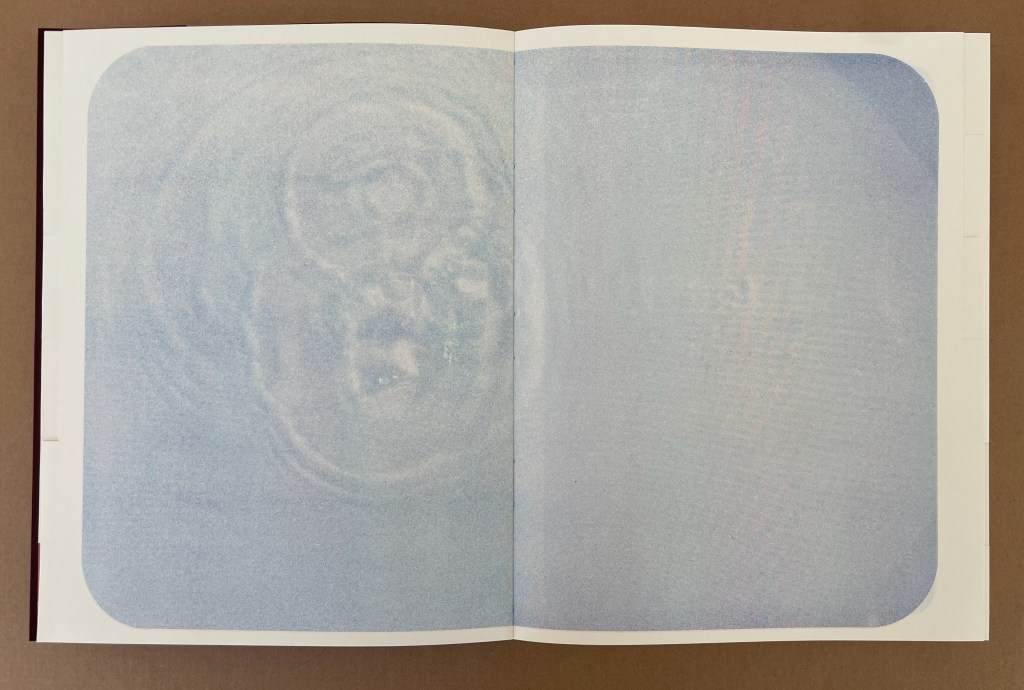
The fourth sequence on the AM side continues with the COVID theme, while on the PM side, it introduces a subtle juxtaposition of text on the theme of the eternal current of time and space with images of drops creating ripples in the surface of water.
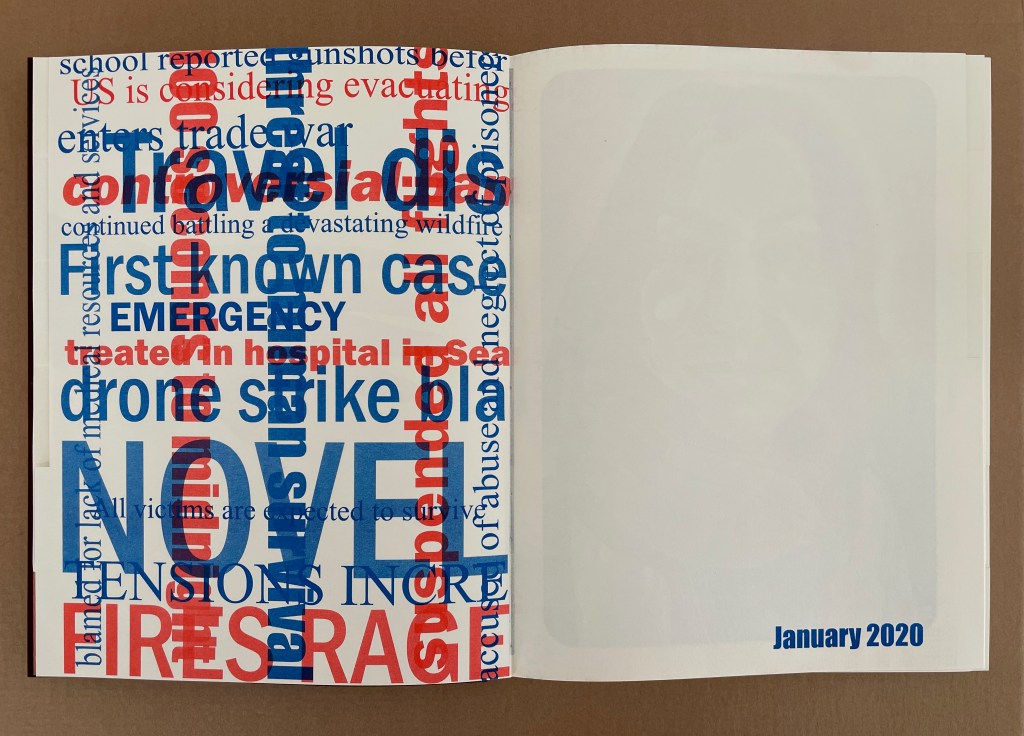
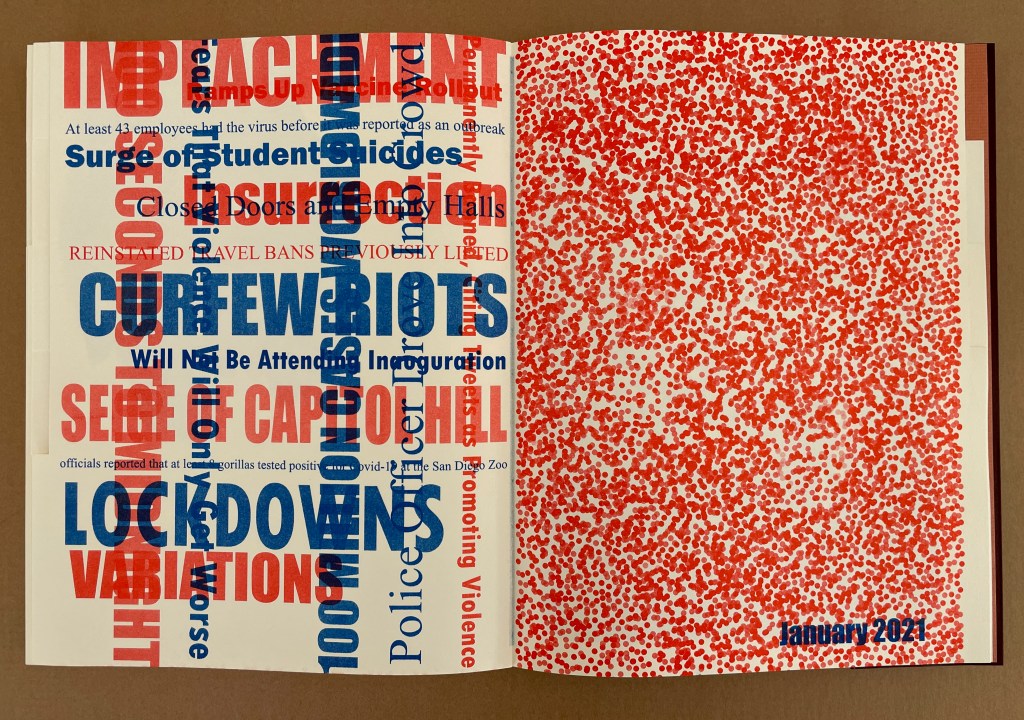
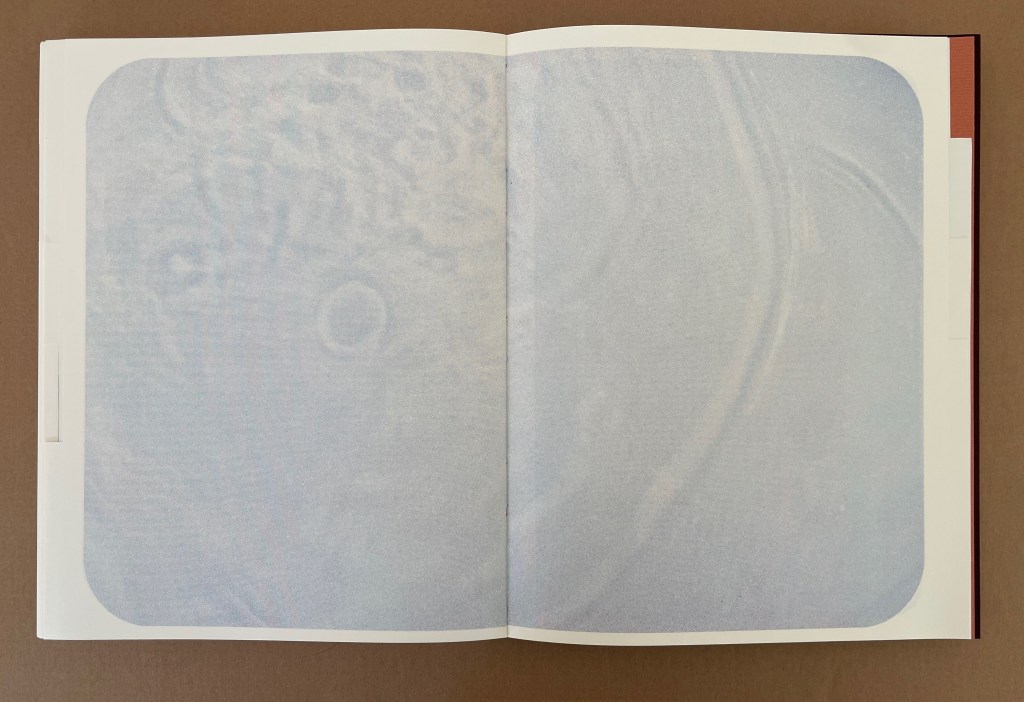
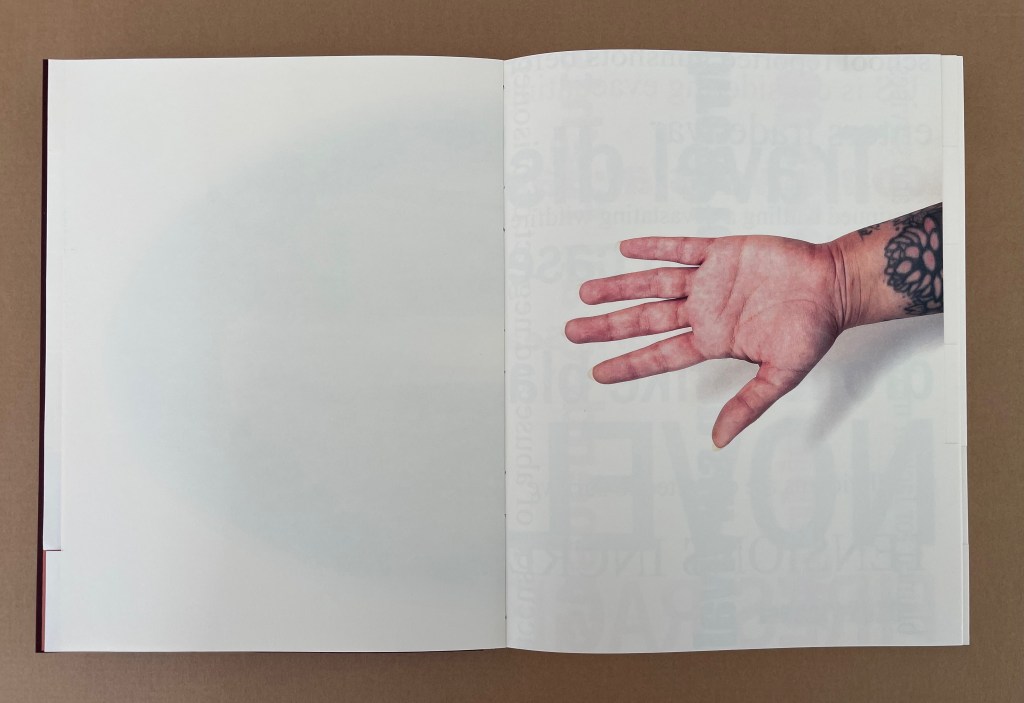
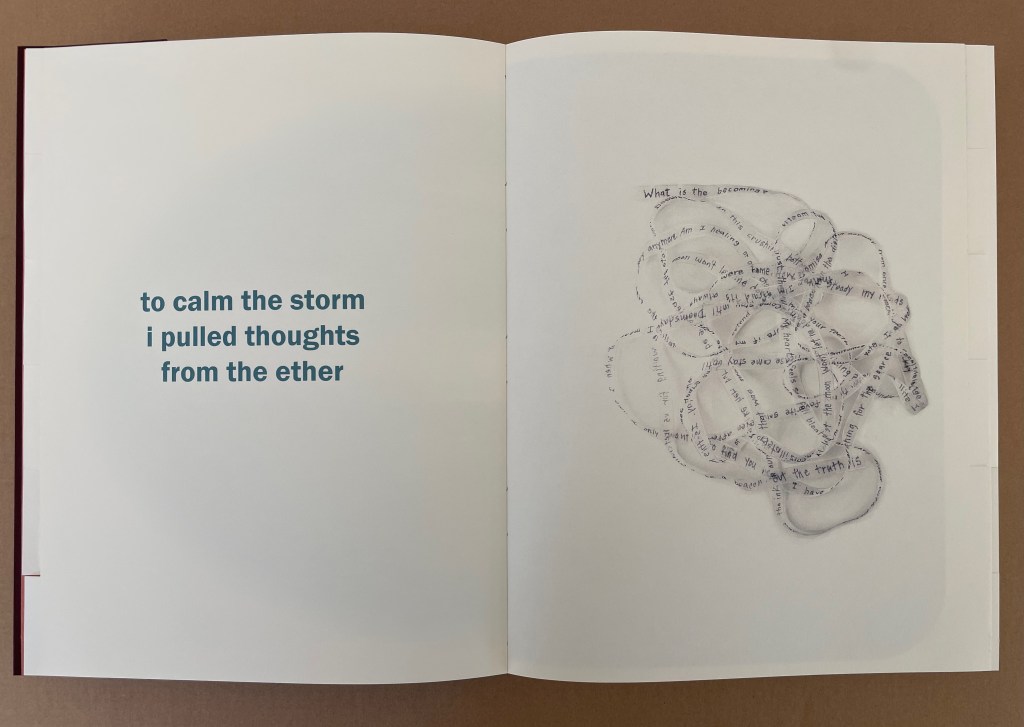
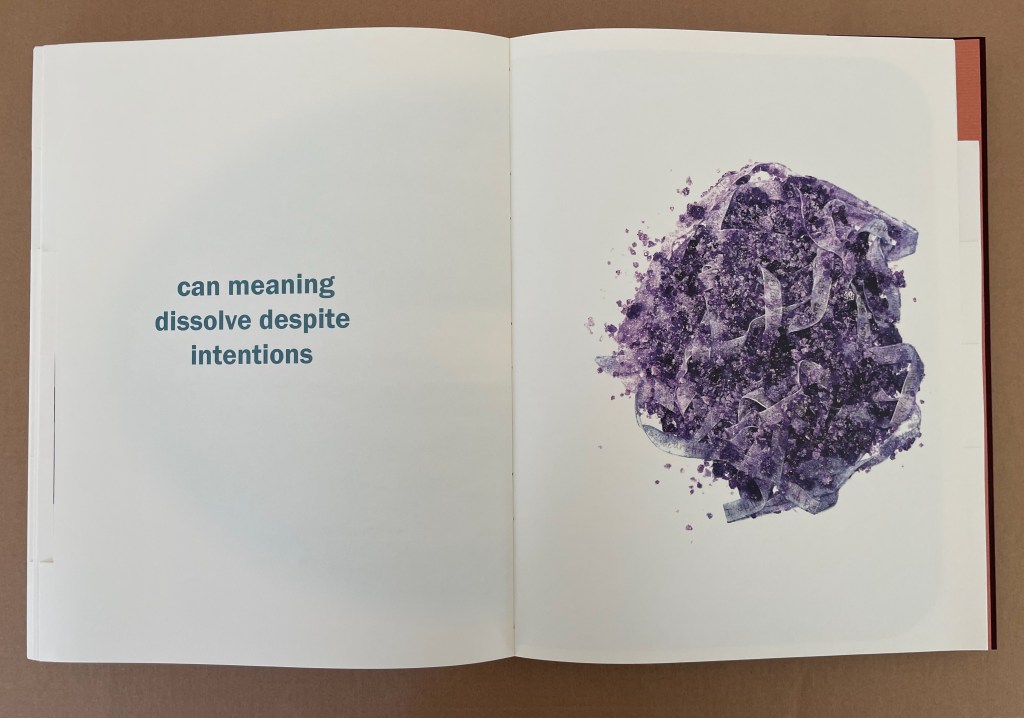
The fifth sequence on both the AM and PM sides seems to seek solace. The AM side seeks it in photographs of hands outstretched to one another. On the PM side, the search is more fraught, turning to language and its relation to thought, reality/the material, the substance of meaning. Across from this are images of a crumpled translucent ribbon bearing indecipherable sentences and attracting black, violet and crystalline debris like flies to strips of flypaper, until the ribbon and words are no longer perceptible.

Like each double-page spread in the first sequence, each spread in the sixth and last sequence is the same for both the AM and PM sides. When the book is turned on its horizontal axis, each AM spread becomes the PM spread; and vice versa when the book is flipped again. But there are subtle, major differences between the first and sixth sequences. The first sequence has 12 spreads of text and image. Across the top halves of the first sequence, the text changes as the orientation of the light cones changes until their orientation returns to its starting state. Flip the book, and the same happens, except the light cones turn anti-clockwise.
The sixth sequence has 13 spreads with only images, no text. The light at the center of the first image expands in the second and again in the third, culminating in the seventh blinding image when it then reverses in the eighth, returning by the thirteenth to its starting state, except that it is inverted. In other words, image 1 inverts to image 13; image 2 to 12; image 3 to 11; image 4 to 10; image 5 to 9; image 6 to 8; with image 7 at the center.
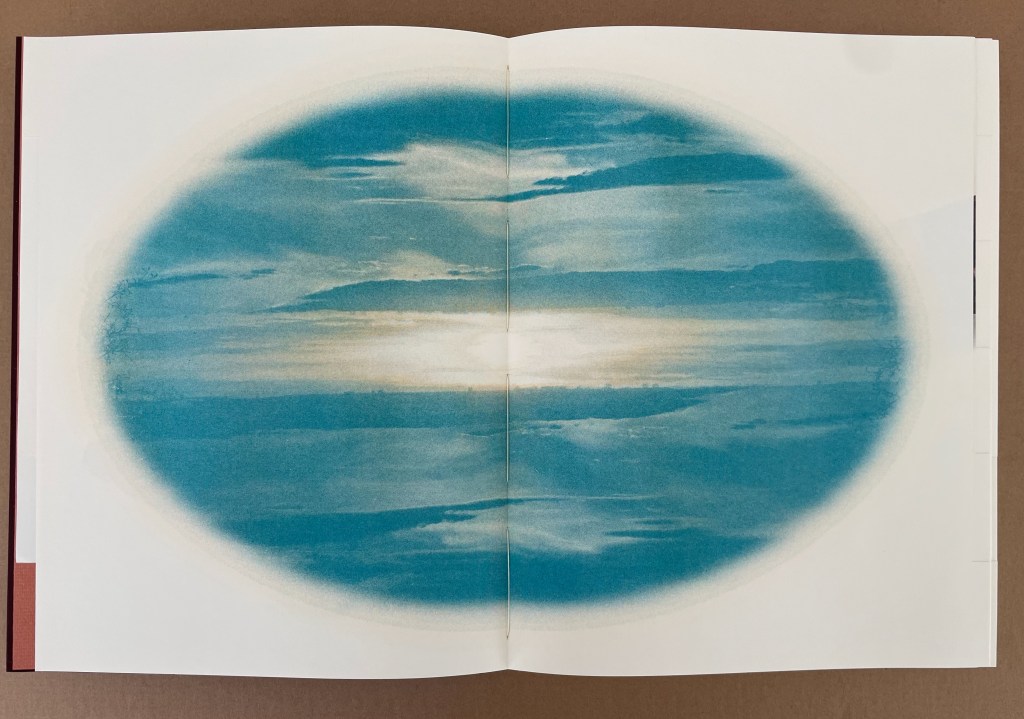
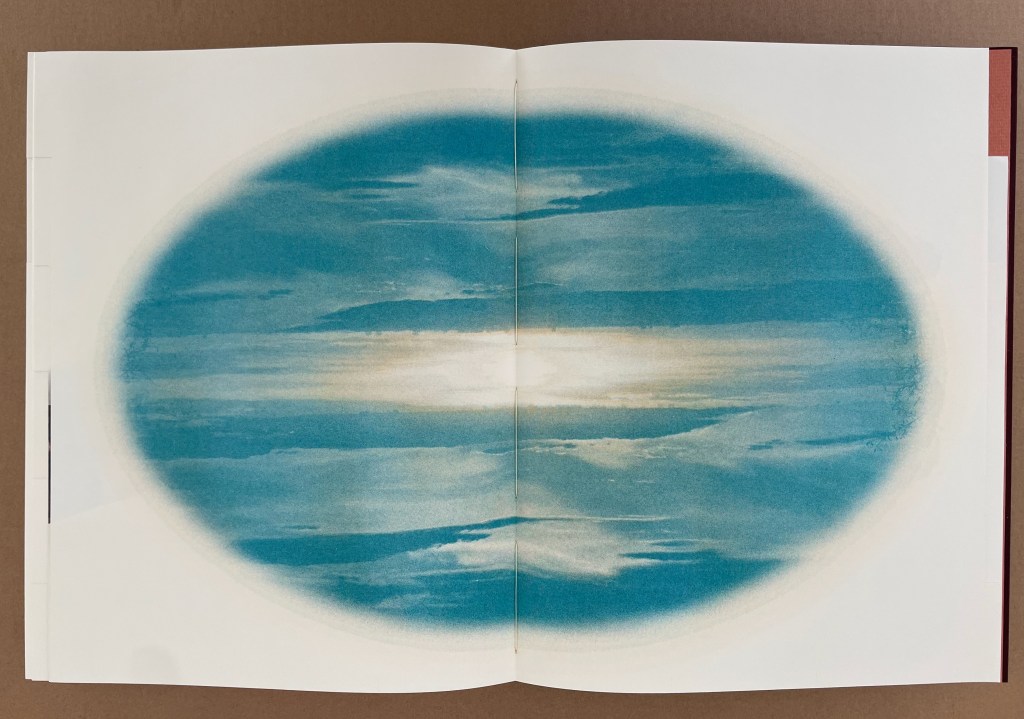
Left: the image is the first for the AM side and last for the PM side. Right: the image is the last for the AM side and first for the PM side.
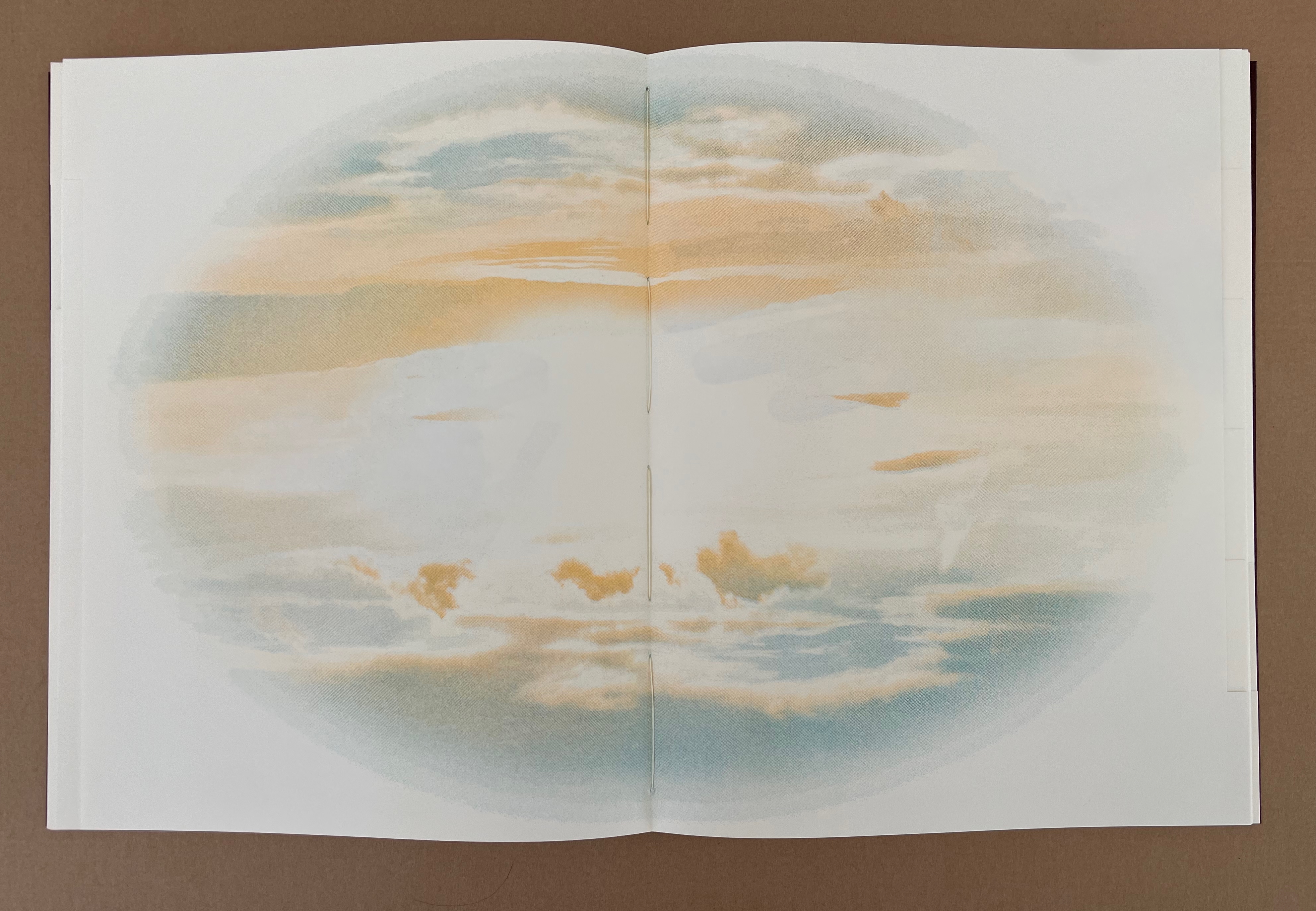
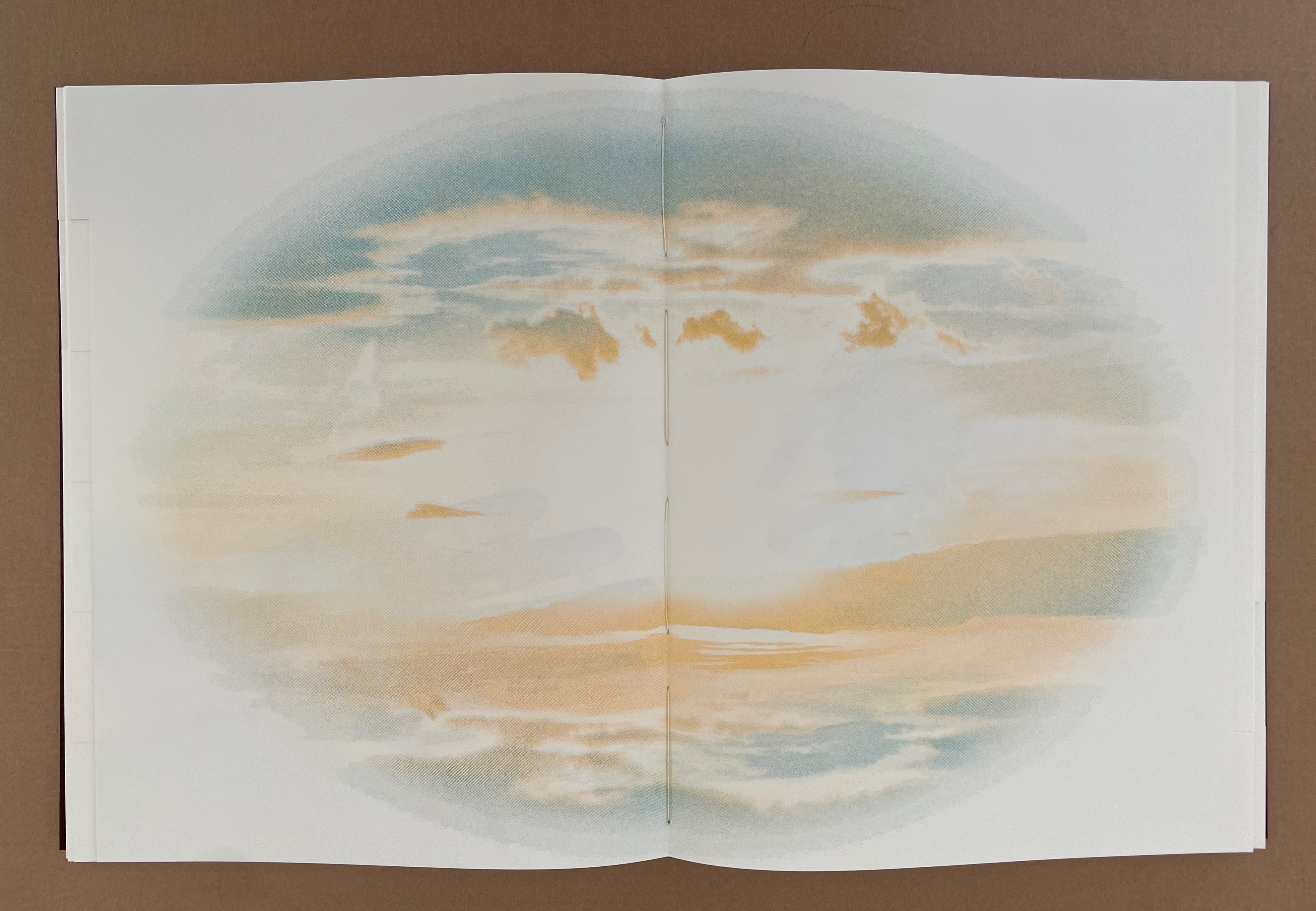
The seventh image in the book’s last sequence. Left, AM side; right, PM side.
Combining inverted images with the inversion of the blow book was a genius move in the first sequence. But perhaps the sixth sequence of images in Book of Hours is magically even more a case of metaphor and matter conjoined and more pointedly a confirmation of the complex nature of the book. Because its mechanics bamboozle our expectations of what is supposed to happen in a book, the blow book is an effective structure with which book artists can interrogate the nature of the book and explore meaty intellectual and emotional themes. It is surprising that there are not more of them. Horst Antes’s Flickbuch production uses the blow book structure to convey the artist’s aesthetic position. Ricky Jay’s definitive work The Magic Magic Book, which incorporates a blow book, is more of a fine press production.
Below is a quick flick through both sides of Book of Hours, followed by a longer exploration of the material and techniques the artists used individually and in their collaboration. Let there be a maelstrom of artists’ books in blow book form!
Book of Hours (2021). Flying Fish Press.
“Telling Time”
Julie Chen & Keri Miki-Lani Schroeder
Jaffe Center for Book Arts, Boca Raton, FL. Presentation about their collaboration Book of Hours, recorded live October 11, 2021. Start at 4’15”.
Further Reading & Viewing
Antes, Horst, and Hans Jakob Christoph von Grimmelshausen. 2000. Flickbuch. Offenbach am Main: Edition Volker Huber.
Chen, Julie. 2 June 2022. “Visiting Artist Lecture“. Minneapolis College of Art and Design. Video.
Craft in America. 7 October 2009. “PROCESS episode Julie Chen segment“. Craft in America. Public Broadcasting System. Also accessible by searching on “www.craftinamerica.org. Book artist Julie Chen segment. PROCESS episode PBS premiere: October 7, 2009.”
Dunstan, Dominique. 10 October 2021. “Treasures of the Library: the magic of blow books“. State Library Victoria. Video. Shows Horst Antes’ Flickbuch.
Eaton, Dolores, and Marilyn Stewart. 2017. “Julie Chen: Thinking Outside the Book“. Craft in America. Public Broadcasting System. PDF version.
Jay, Ricky, et al. 1994. The Magic Magic Book : An Inquiry into the Venerable History & Operation of the Oldest Trick Conjuring Volumes, Designated ‘Blow Books’ … New York, N.Y.: Library Fellows of the Whitney Museum of American Art.
Schroeder, Keri Miki-Lani. 24 May 2025. “Smoke & Mirrors: Using Stage Magic in Book Arts“. American Bookbinders Museum, San Francisco, CA. Video of webinar. “Magicians have been using illusionary techniques for centuries to intrigue or trick audiences. Many principles of stage illusions are relevant to book arts: sequencing and timing, hiding and revealing information, and curating an experience for the audience. In this talk I will discuss the connections between stage magic and illusionism to book arts. We will start with an overview of historical tricks and devices focusing on structures such as the magic blow book, magic wallet, and volvelles. I will reveal tricks of the trade and how I have researched and incorporated elements of magic to conjure creative content in my work and collaborations.”
Schroeder, Keri Miki-Lani. 23 April 2023. “Reading Beyond the Lines: Haptic Storytelling & Artist’s Books“. 2023 Charles W. Mann, Jr. Lecture in the Book Arts, Penn State University Libraries. Video.
Schroeder, Keri Miki-Lani. 6 January 2022. “From the Bench of Keri Miki-Lani Schroeder”. San Francisco Center for the Book.
UW-Madison Libraries. 5 March 2018. “Julie Chen gives 4th Annual Bernstein Book Arts Lecture“. News & Events. University of Wisconsin-Madison. Well-illustrated announcement for the lecture, plus an interview with Chen.
 Books On Books
One thought on “Books On Books Collection – Julie Chen & Keri Miki-Lani Schroeder”