Frédéric Bruly Bouabré (2013)
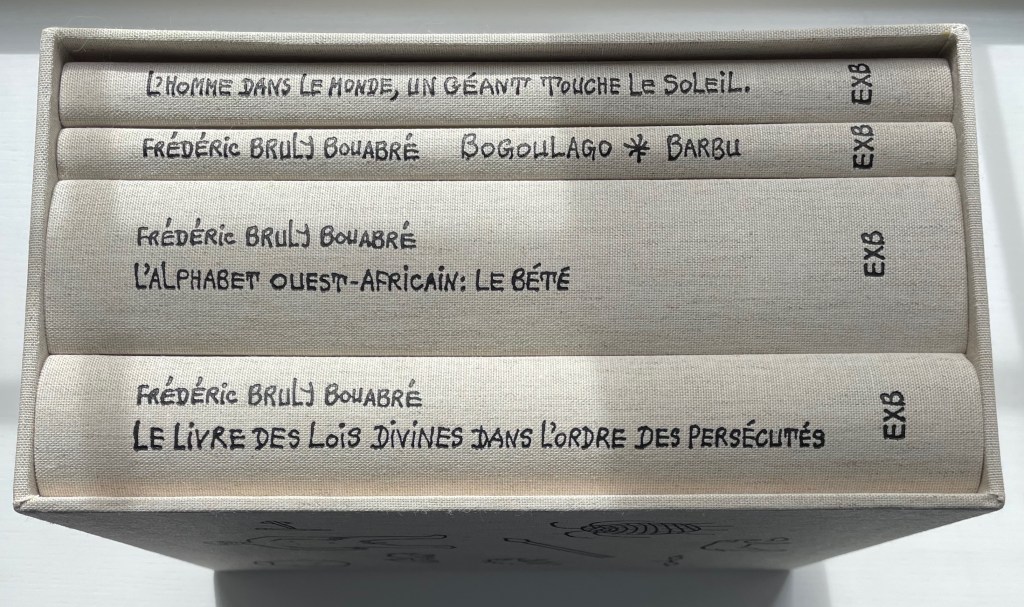
Frédéric Bruly Bouabré (2013)
Frédéric Bruly Bouabré (André Magnin, Yaya Savané and Denis Escudier)
Clothbound slipcase holding a set of four casebound, cloth-over-board volumes. 210 x 265 mm. 1436 pages. Acquired 2023.
Photos: Books On Books Collection. Displayed with permission of the publisher Éditions Xavier Barral.
Frédéric Bruly Bouabré designed the covers and bound each of the four volumes in this set the year before his death. For the Books On Books Collection, the thematic connection of this last monument by Bruly Bouabré lies in Volume two, L’Alphabet Ouest-Africain: Le Bété. Bruly Bouabré invented this syllabary for the Ivory Coast’s Bété peoples in 1954. Later he compiled it in a Toyota 1983 Agenda-Journal, which in effect created the artist’s book La méthodologie de la nouvelle écriture africaine “bété” : suivi de, L’alphabet de l’Ouest Africain (2003). An artwork version, entitled Alphabet Bété and consisting of 449 original drawings, resides at the Museum of Modern Art in New York.
Bruly Bouabré is one of the few individuals to have invented a syllabary or alphabet on his own. Sequoyah, the Cherokee Indian, was another. The Guinean brothers Ibrahima and Abdoulaye Barry also belong to the fellowship; they created ADLaM, a new alphabet for the Pulaar language of the Fulani people of West Africa.
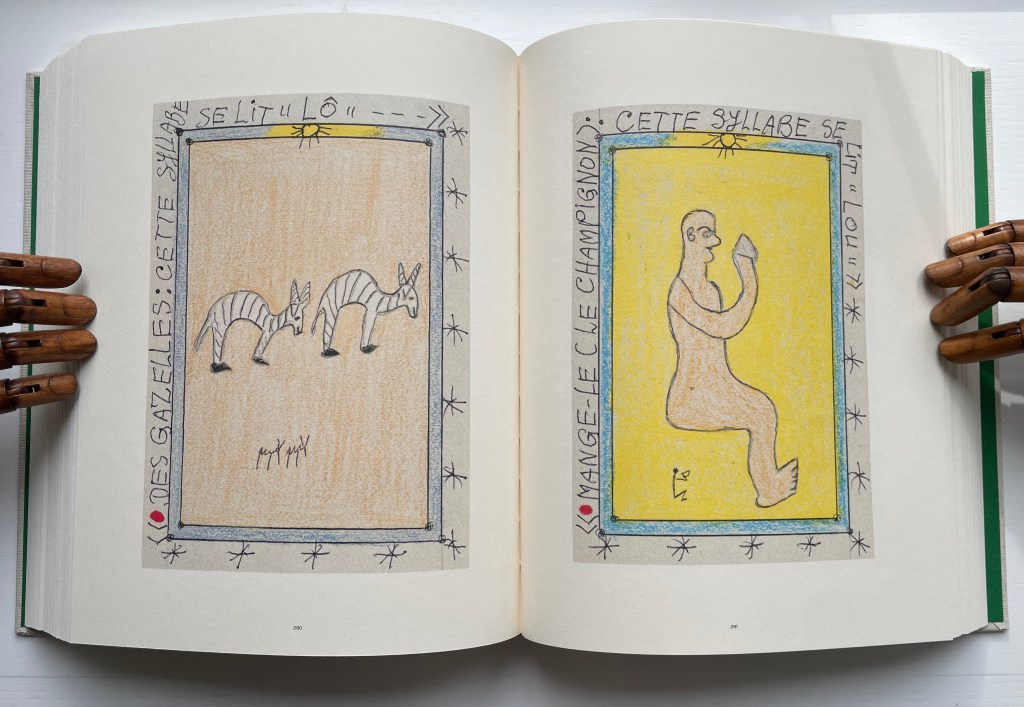
Left: [This syllable is pronounced “LÔ.”] Right: [Eat it (the mushroom). This syllable is pronounced “LOU.” ]
Photos: Books On Books Collection. Displayed with permission of the publisher Éditions Xavier Barral.
Using ballpoint pens and colored pencils, Bruly Boaubré drew pictograms and images associated with monosyllabic Bété words incorporating the individual syllables on postcard-size papers and framed the images with French text in Roman lettering. The captions in the frames around each syllable suggest that the images should be viewed in a landscape orientation as most postcards would be. Although the Alphabet Bété at the Museum of Modern Art does not have the book version’s frames or captions, most of its images also have a landscape orientation. It is curious, though, that the figure on the right above, which matches the portrait orientation of its MoMA counterpart, would assume a nonsensical position if turned to a landscape view. The two versions’ colors and figures also differ in other ways. For instance, in the MoMA version, the animals in the image on the left above appear against a green background, and the figure on the right is female. Which is to suggest that the 1436 pages of the book only hint at Bruly Bouabré’s prolific inventiveness.
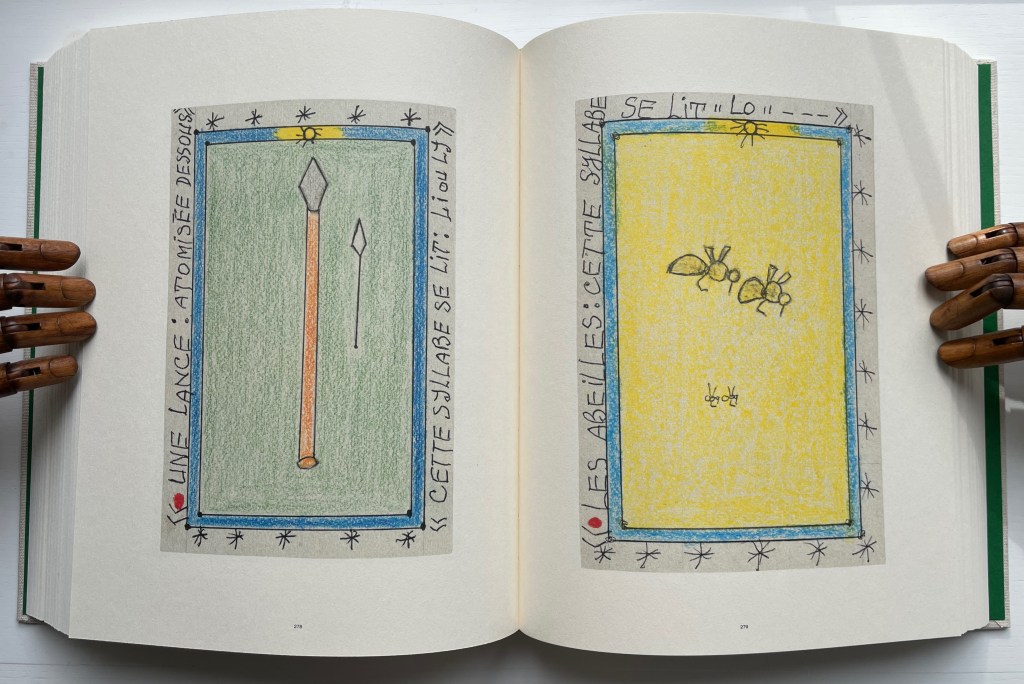
Left: [A spear : atomized {diagrammatized?] below. This syllable is read as: LI or LY.] Right: [Bees: This syllable is pronounced “LO”.]
Photos: Books On Books Collection. Displayed with permission of the publisher Éditions Xavier Barral.
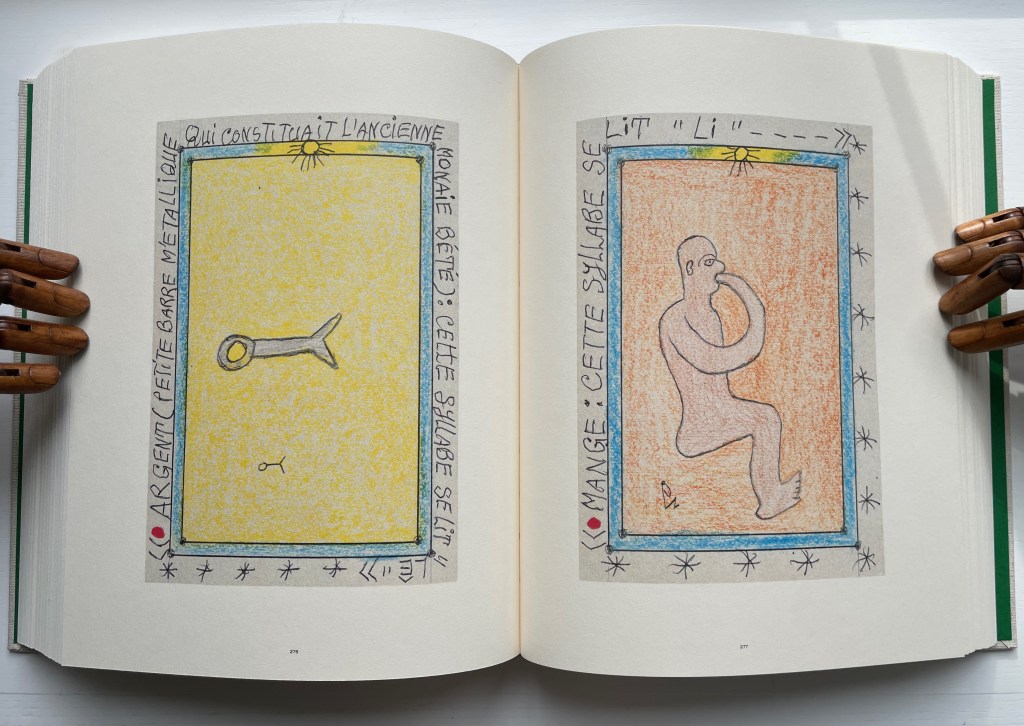
Left: [Silver (small metal bar that was the ancient currency of the Bété people) : This syllable is pronounced “LÊ”.] Right: [Eat : This syllable is pronounced “LI”.]
Photos: Books On Books Collection. Displayed with permission of the publisher Éditions Xavier Barral.
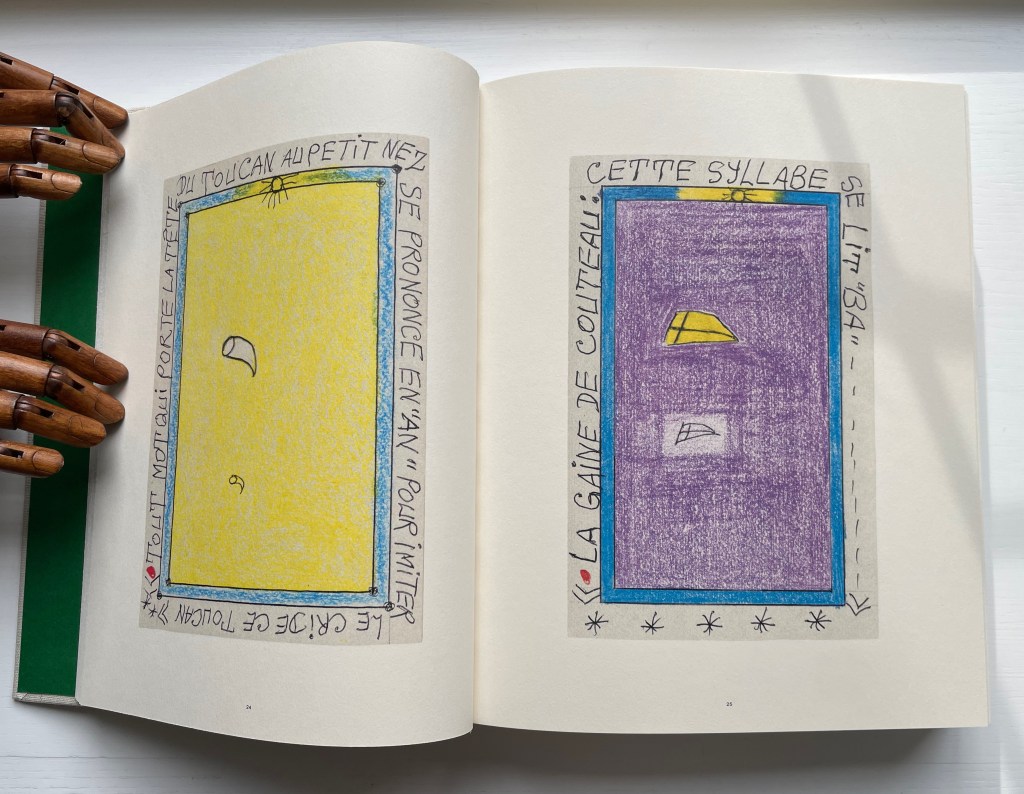
Left: [Any word that has the toucan’s head with its little nose is pronounced with an “AN” sound to imitate the cry of this toucan. ] Right: [The knife sheath: This syllable is pronounced “BA.”]
Photos: Books On Books Collection. Displayed with permission of the publisher Éditions Xavier Barral.
Bruly Bouabré’s fusion of art and syllabary offers a colorful and sophisticated contemporary illustration of the pictographic theory of the origin of writing.
Further Reading and Viewing
“Abecedaries I (in progress)“. Books On Books Collection.
“Alphabets Alive!“. 19 July 2023. Books On Books Collection.
Aviv, Nurith. 2005. Bruly Bouabré’s Alphabet [film]. Brooklyn, NY: Icarus Films.
Bruly Bouabré, Frédéric. 1990-91. Alphabet Bété. New York: Museum of Modern Art.
Bruly Bouabré, Frédéric, André Magnin, Savané Yaya, Denis Escudier and Emmanuelle Kouchner. 2013. Frédéric Bruly Bouabré. Paris: Éditions Xavier Barral.
Davies, Lyn. 2006. A Is for Ox : A Short History of the Alphabet. London: Folio Society. Bodleian.
Diringer, David, and Regensburger, Reinhold. 1968. The alphabet: a key to the history of mankind. London: Hutchinson. Bodleian. A standard, beginning to be challenged by late 20th and early 21st century archaeological findings and palaeographical studies.
Donaldson, Timothy J. 2008. Shapes for Sounds. 1st ed. New York City NY: Mark Batty.
Drucker, Johanna. 2022. Inventing the Alphabet : The Origins of Letters from Antiquity to the Present. Chicago: University of Chicago Press. Bodleian.
Linton, Samara. 5 May 2023. “Brothers Created Alphabet To Save Their Language From Extinction, Now Integrated Across Microsoft Platforms“. POCIT (People of Color in Tech).
Samoyault, Tiphaine. 1996, 1998 trans. Alphabetical order: how the alphabet began. New York: Viking. Bodleian. Children’s book.


I have followed your blog for a while now and am intrigued by your project. A question, not specifically related to this current blog, but your project in general: I’d like to suggest a work of my own and wonder if you know of my publication (an exhibition catalogue)- Notes from the stone-paved path
| | | | | |
|
| | | | Lewis Koch – Notes from the Stone-Paved Path: Meditations on North India…
“When I get to a new place… I want to learn what it is I didn’t know I would see.” -Barry Lopez, naturalist, wr… |
|
|
which presents pages of photographed text, from disparate sources, paired with photographs made in north India. I believe it is a rather unique use of text in conversation with image. If you are interested in the project, I would be glad to provide more information.
Regards,
Lewis Koch, lewiskoch@yahoo.com
LikeLike
Thanks for your note and the chance to acquaint myself with your work. The interplay of words, images, and the book is a characteristic that appeals to me, which I tried to express in my entries on Charles Agel, Michelle Stuart, and Clarissa Sligh. Wordless “photobooks”, like Michael Snow’s Cover to Cover, that play with the book as medium and concept are also the sort of work for which I keep an eye out. Notes from the Stone-Paved Path: Meditations on North India looks like it fits that bill.
LikeLike