The Paris-based publishers Les Trois Ourses announced that Katsumi Komagata died on 29 March 2024. Although the Bologna Children’s Book Fair responded quickly with a memorial on 8 April, it is strange that no significant obituary has yet appeared for such a major figure in the book arts, children’s books and artists’ books. Fortunately there is extensive biographical information on the site of his publishing firm One Stroke.
Piece of Mind (2022), one of his last limited edition works, becomes all the more treasured.
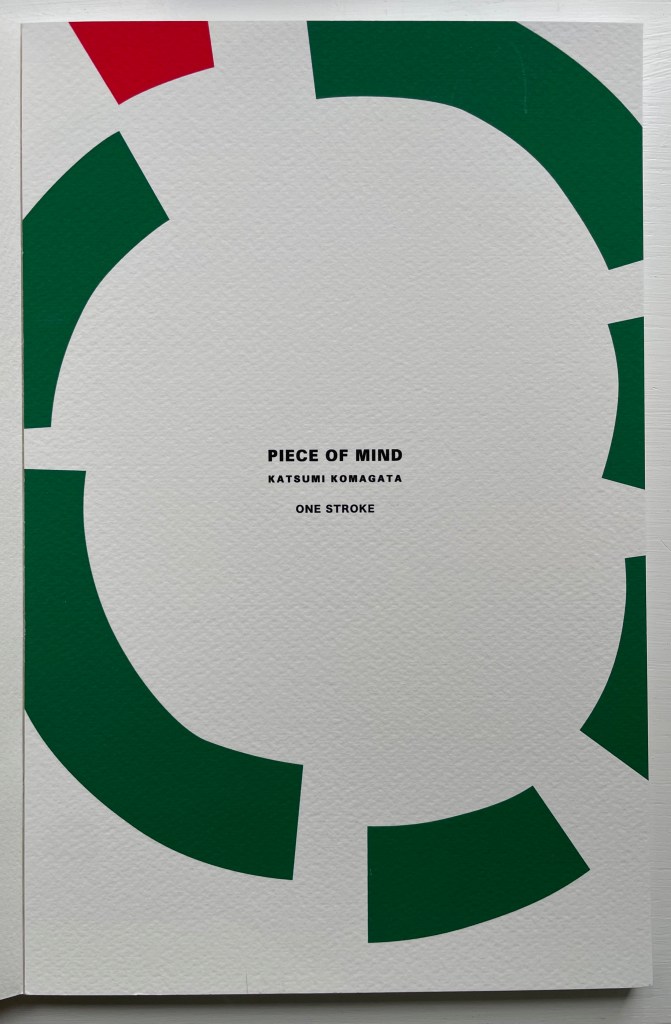
Piece of Mind (2022)
Katsumi Komagata
Casebound, card around perfect bound block of lighter card stock. H300 x W196 mm. [30] pages. Edition of 100, of which this #67. Acquired from One Stroke, 7 August 2023.
Photos: Books On Books Collection.
Like Little Tree (2008), Piece of Mind celebrates life and its seasons. While the text and pop-ups of Little Tree directly address both adults and children on the subject of human mortality, the flatter Piece of Mind requires reading more between the lines and collage work. The One Stroke site is generous with images of Komagata’s books, whether artist’s books or children’s books. The images here, however, come from the Books On Books Collection because photographing the pages in order enables that reading between the lines and images.
Piece of Mind begins and ends with seed.
In the first double-page spread, a lone line of Japanese and English introduces the idea of the seed, while a not quite invisible red shape lies buried in the soil of the collage on the right. In Japan, red is associated with vital forces. As the page turns to the next spread, a schematic appears beneath another line of Japanese and English. Its multi-colored outlined shapes provide the clue that we have zoomed out and are looking at a schematic of the collage from the preceding spread. On the facing page of the second spread, though, the pieces of collage shift, the red seed piece turning its curve downwards and moving up the page with the green and black pieces spreading to the margins and revealing a space of white.
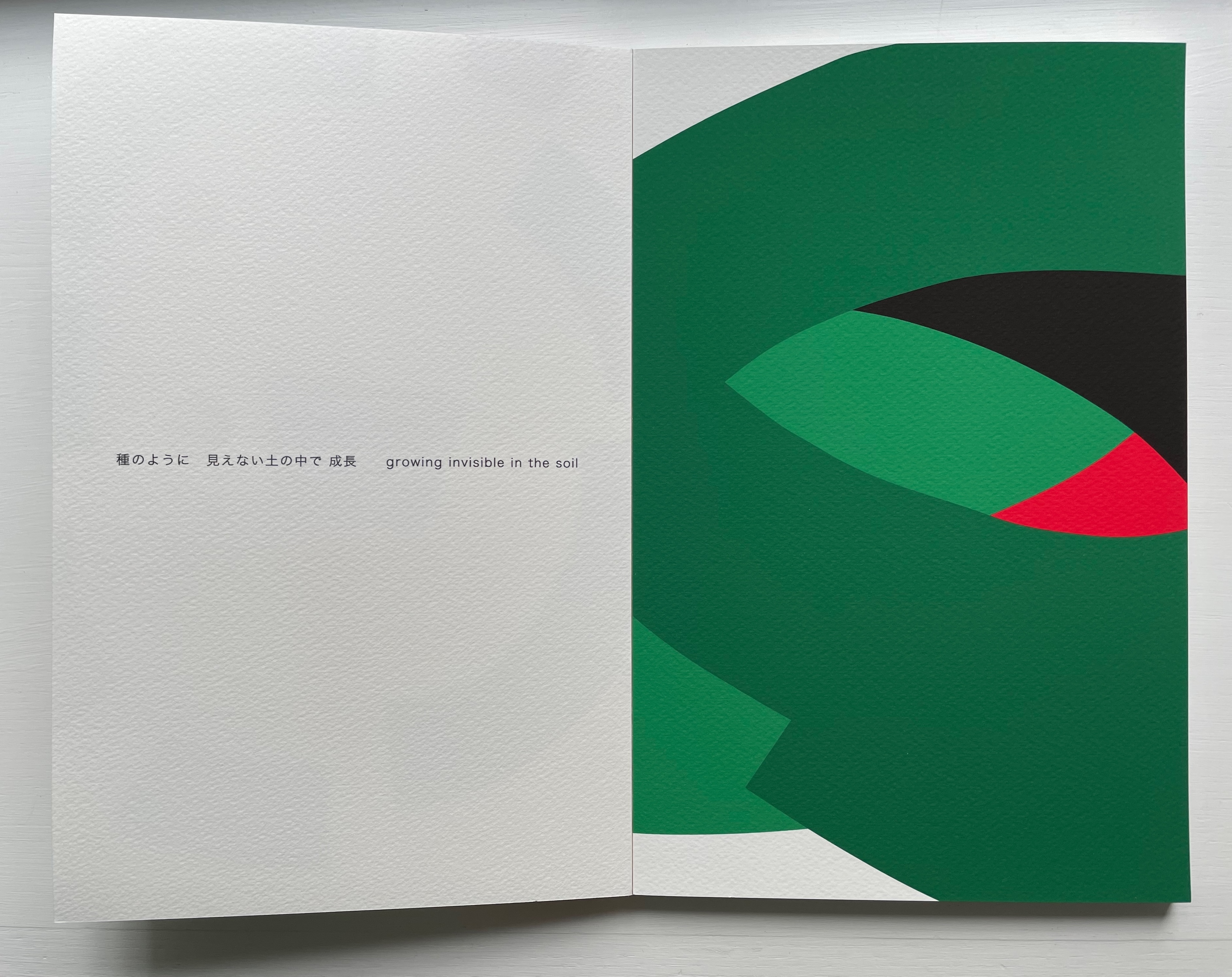
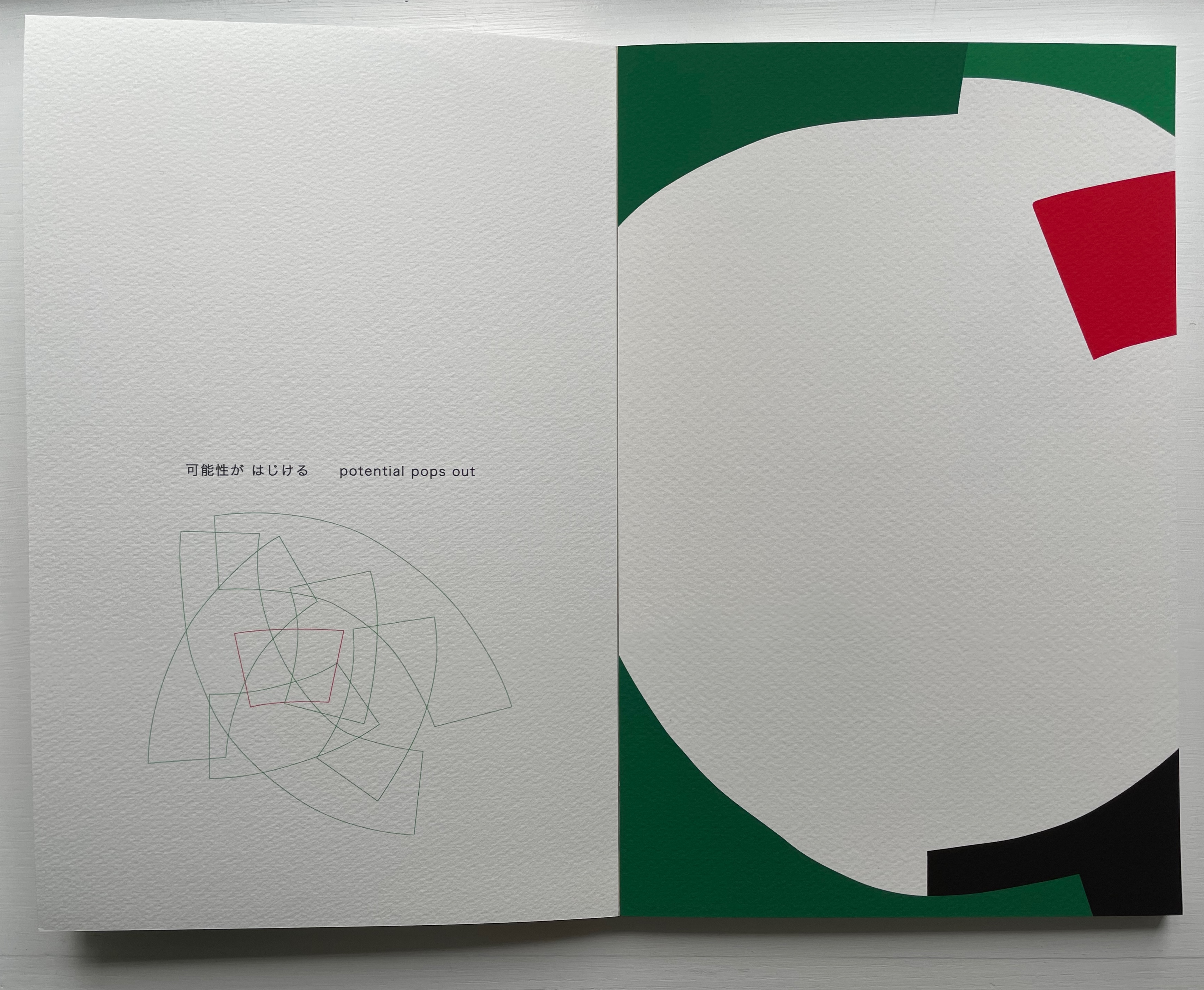
The interaction between those two double-page spreads — their texts, collages and the schematic — introduces the principles by which the book proceeds. There will be movement, shifts of perspective, possibilities will burst out. We will need to read how the words, the collage, the schematic, the single page, the double-page spread and spreads relate.
English is not the book’s strong suit. Whether the seed is being told to ride on the wind or the phrase is describing a (or the) ride on the wind, the gist is enough to see that the green-outlined shape gusting from the verso page’s lower left hand corner scatters the collage on the recto page and sends the red-shape seed into its upper right corner.

The next two spreads seem to follow the small red shape from where it lands to the tip of a branch offering it up like a flower or berry necessary to bees or birds. The schematics on the verso pages alternate in purpose: on the one hand, to signal the full hidden shape of the fallen seed; on the other, to add a branch or shadow to the flower- or fruit-bearing branch on the recto page. This technique of playing the single page sometimes off the double-page spread and other times into it becomes more and more unusual as the book progresses.
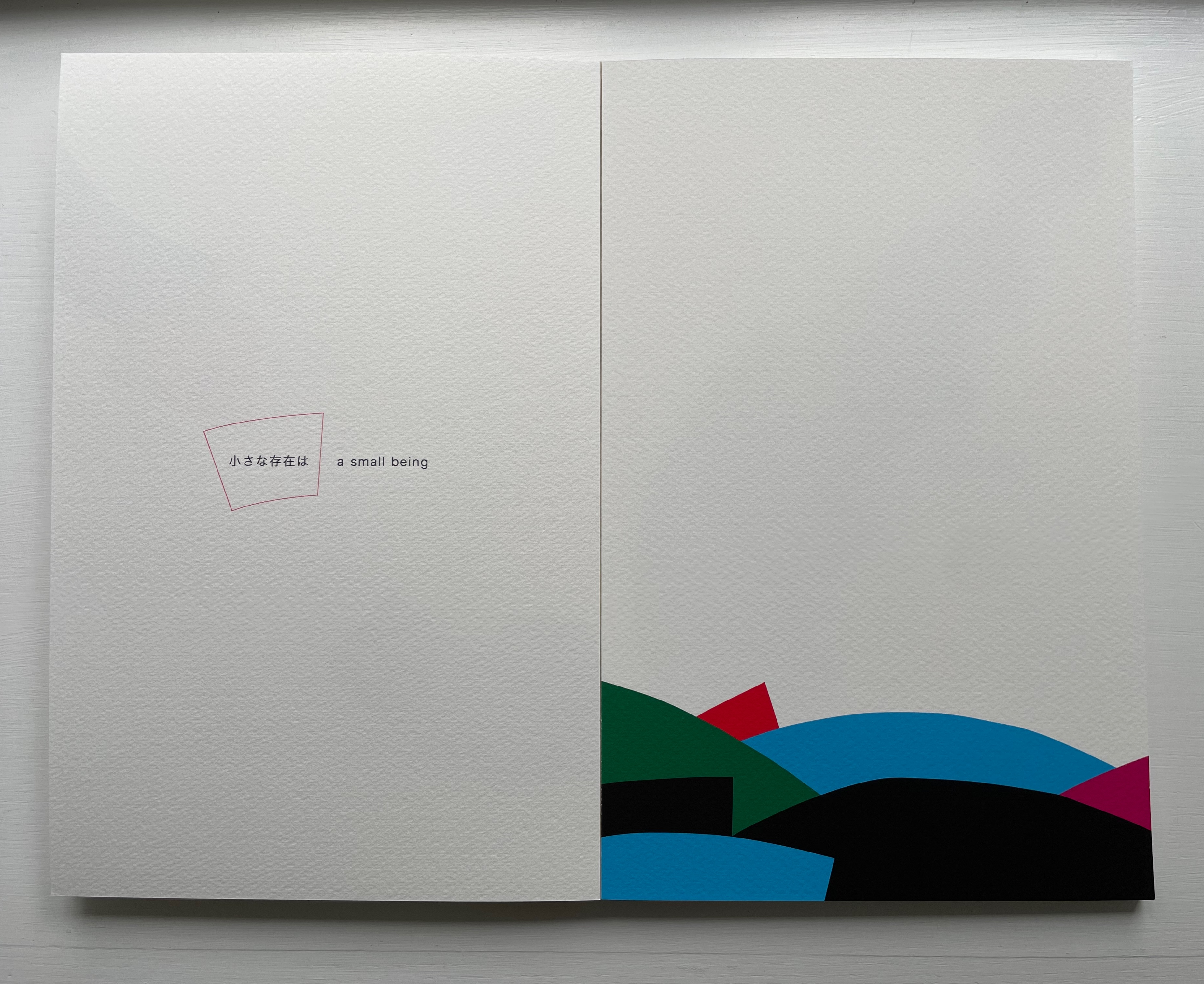

In these next two spreads, the first schematic is simply a one-to-one outline of the colored image facing it, while the second schematic calls attention to the absence of the red shape in the facing image. In the first instance, the text and outlined collage seem to call for the action of coloring in the dynamic collage of shapes. In the second instance, the text seems to call on the singular shape to step off the next page and look on the image from a perspective beyond.

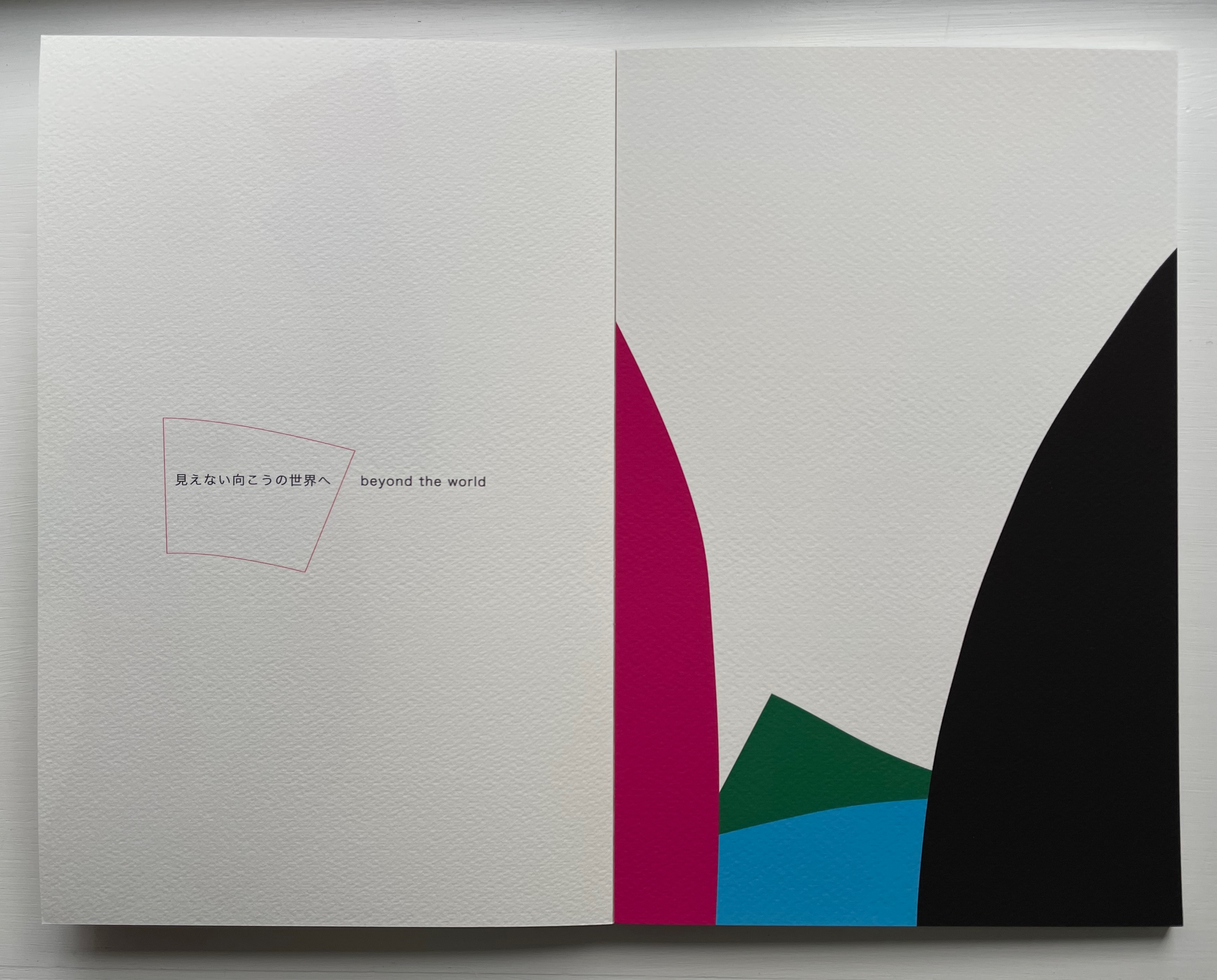
This subtle interaction of single pages with double-page spreads carries on throughout the rest of the book, concluding with the verso schematic and recto image joining one another. The exhortation “begin like a seed” is haunting in that there is no red shape on either page. There are other spreads without the red shape, but there is no other spread with an image of only two colors, and no other spread whose white space frames a single shape completed by a union of the schematic and pieces of collage. Against this background of white, which implies both purity and death in Japan, the circle appropriately takes on the color associated not only with vegetation but also, particularly in Japan, with peacefulness and rest.

Moon Phase (2019)

Moon Phase (2019)
Katsumi Komagata
Casebound, full-flap card around perfect bound book block. H297 x W185 mm. [32] pages. Acquired from One Stroke, 7 August 2023.
Photos: Books On Books Collection.
Moon Phase is an experimental picture book jointly produced with EDITHON, a publisher whose name is a combination of the English “edit” and the Japanese “hon” (book) and an allusion to the inventor Thomas A. Edison. The volume’s experiment was to create a children’s book that embodies the theme “There is individuality in the way colors are perceived.”
Color blindness is more common outside Japan, with 5% of its male population experiencing color vision deficiency or impairment. According to EDITHON, “it has been considered taboo to directly address this topic in the world of picture book publishing”. From elementary school onwards, Komagata himself experienced color vision differences from others. Color vision naturally became a theme he would tackle. Drawing on the results of workshops between EDITHON and Teikyo University Media Library Center (MELIC) that conducted experiments with university students to find new color combinations, Moon Phase emerged.
Most wordless picture books rely on changes in images to drive the reader from start to finish. Komagata, however, has also used the phases of the moon, an “around the world” theme, and dynamic cutouts to provide the forward thrust for this book. As the pages turn, the moon becomes an object. As the phases of the moon change its shape, so accordingly the object’s shape changes. As these changes take place, we move across settings from different parts of the world: from a cityscape under a full moon, then overseas to a jungle under a partial moon, later from an arctic setting under a new (empty) moon to a perspective in outerspace, and finally back to a cityscape. The book’s colophon includes a teasing color chart with the heading “Find the Same Color”, but no two are quite the same shade.


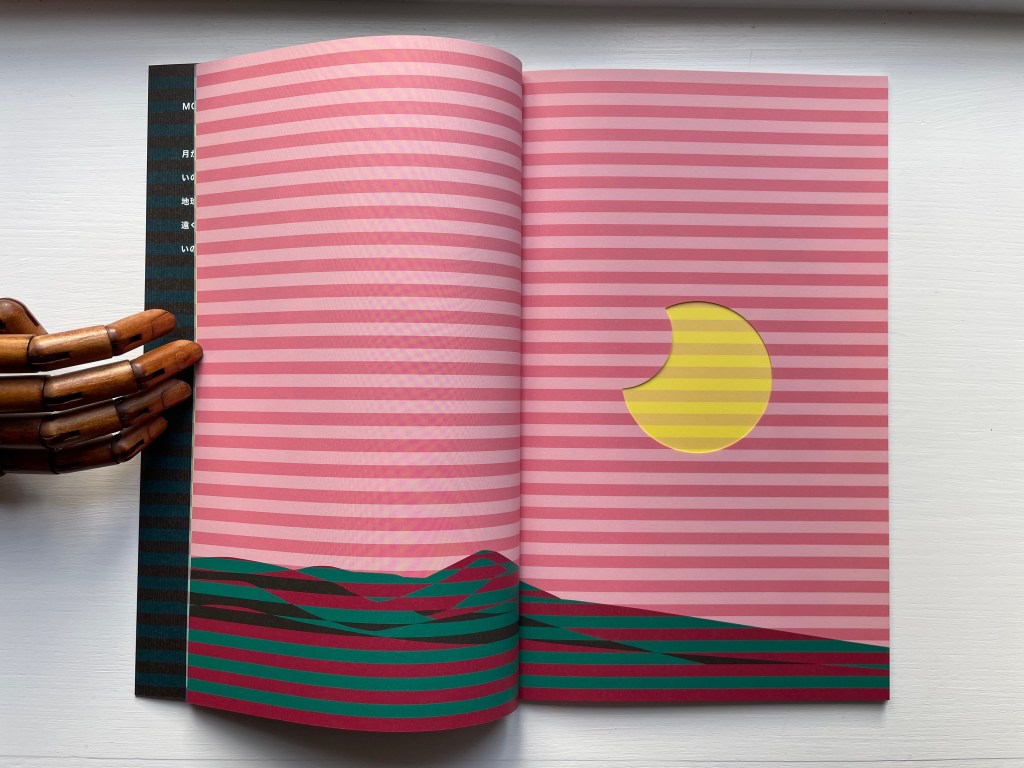


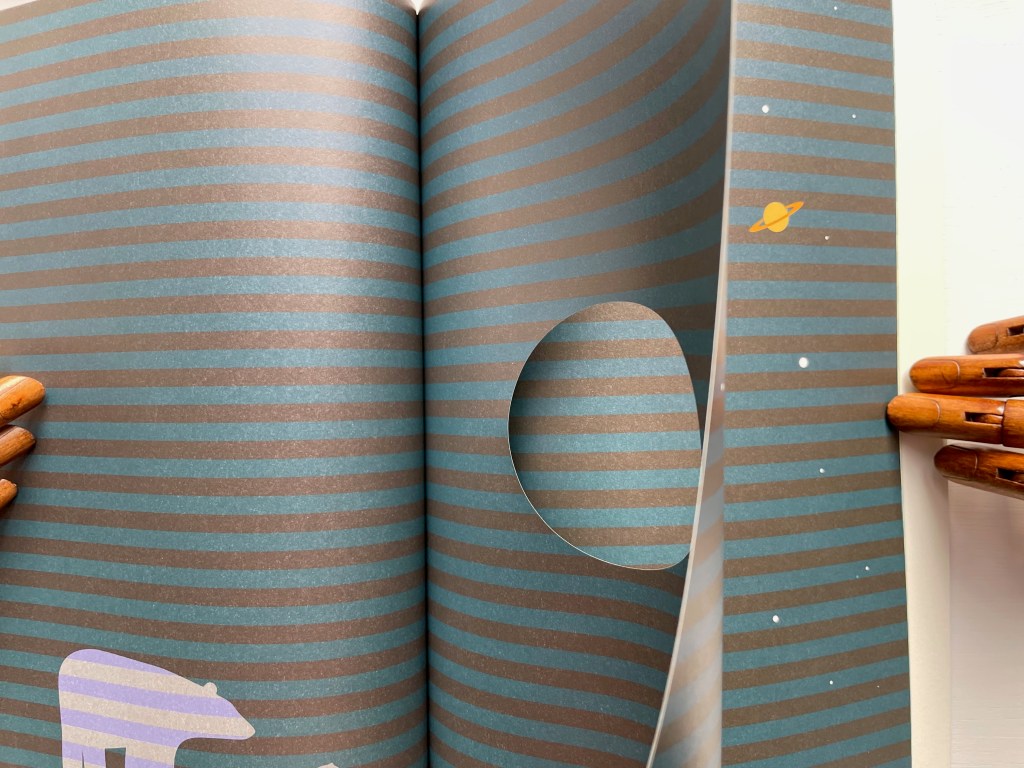

Moon Phase was nominated for the “Ilustrarte” award in Portugal in 2021 and won the Palazzo delle Esposizioni Museum Special Prize in Italy in 2023.
Pacu Pacu (2000)

Pacu Pacu (2000)
Katsumi Komagata
Casebound, full-flap card around perfect bound book block. H250 x W155 mm. [32] pages. Acquired from One Stroke, 7 August 2023.
Photos: Books On Books Collection.
Another wordless picture, but this time the driving forces are the narrative of a fish who will eat anything and pages whose shape change to reflect the story. The story of this perch was prompted by Komagata’s observation of his daughter who, like most toddlers, tended to put anything within reach in her mouth. In one end and out the other is the narrative pattern as the sequence of pages below shows.

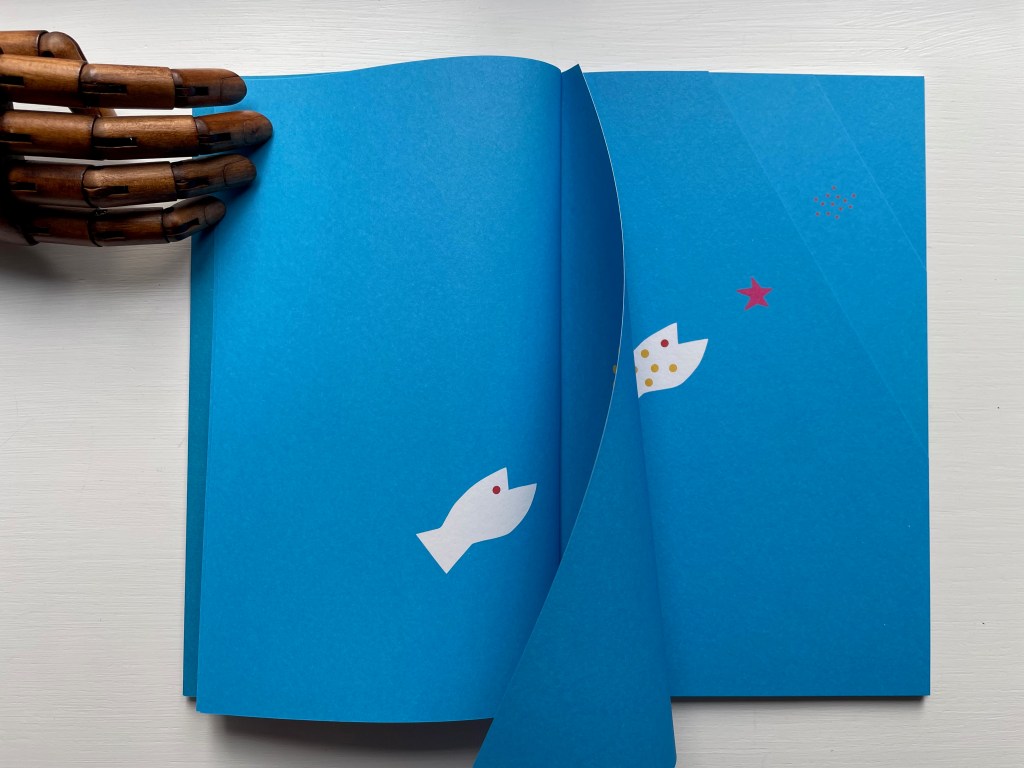
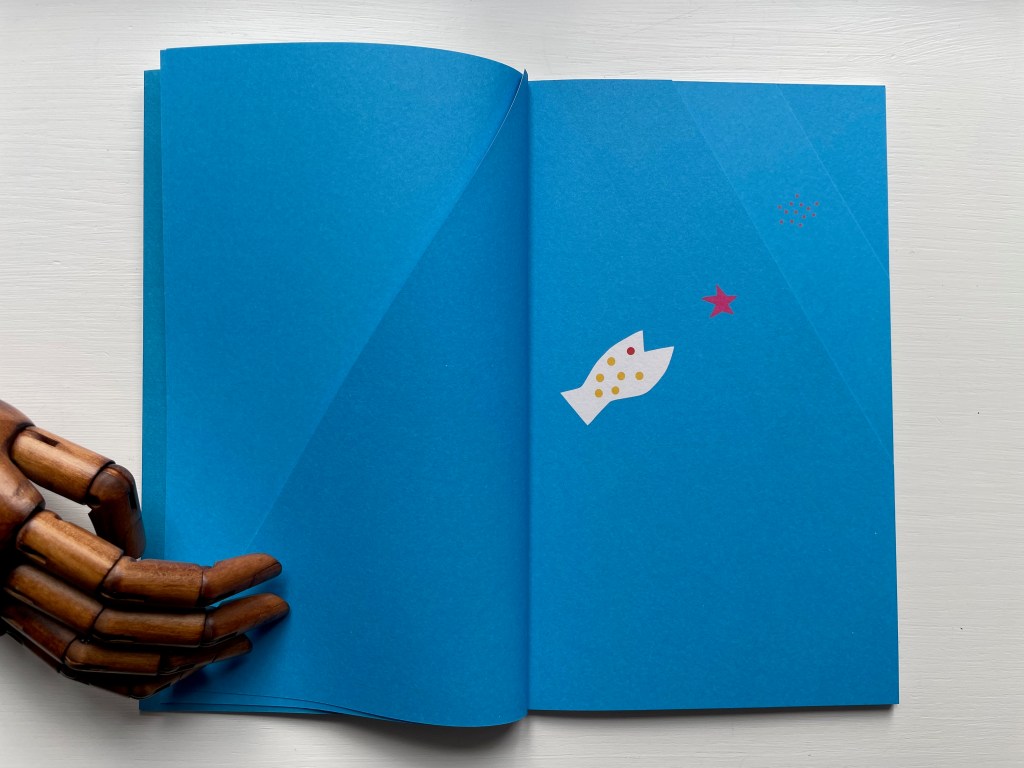

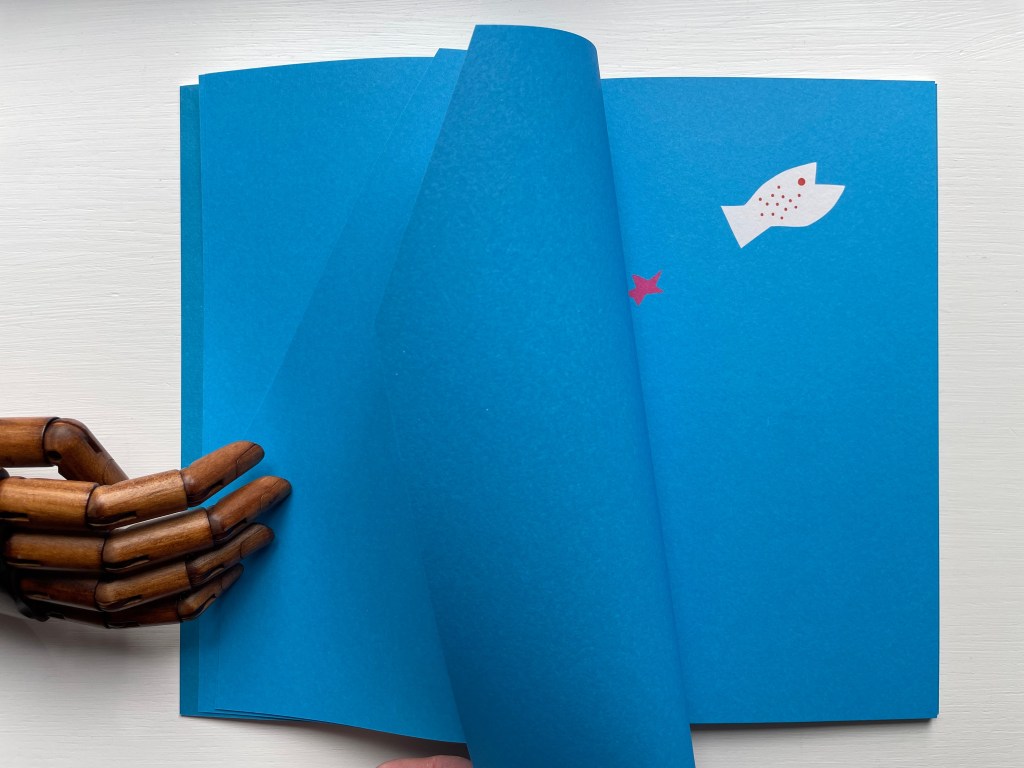
Pacu Pacu does get into trouble with swallowing a particularly oversized stone, but a munch of vegetation clears the problem and teaches the perch a trick with which to weather the turbulence in the next sequence signaled by the change of background color, bending weeds and the wavy shaping of one corner of the pages.

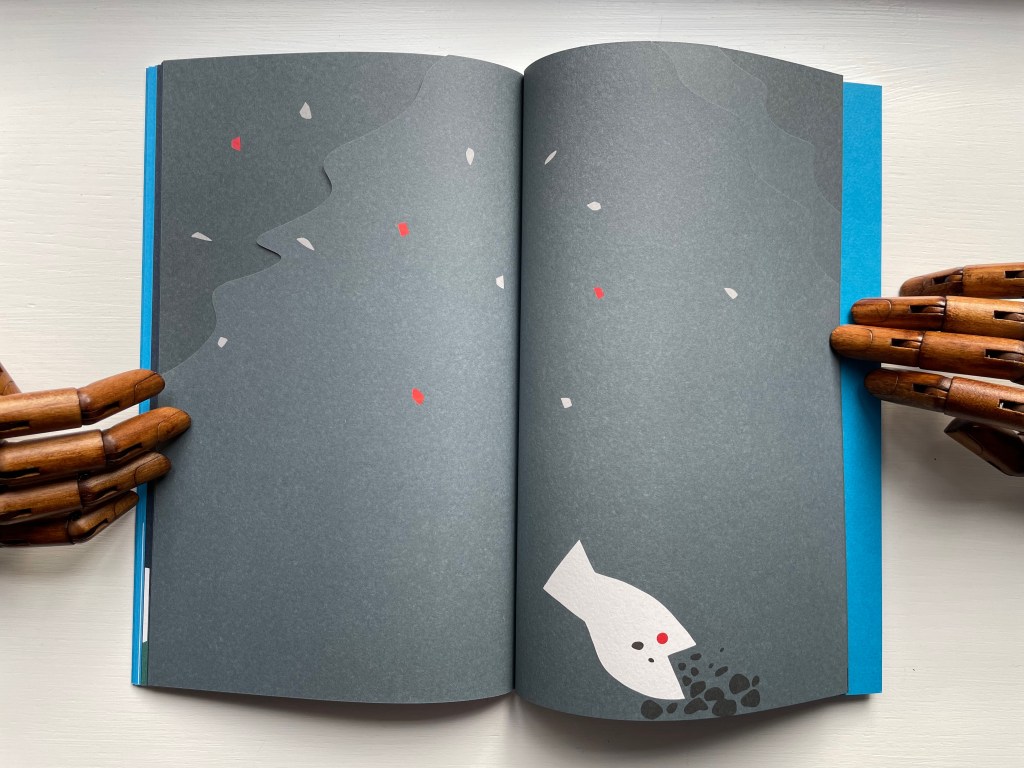
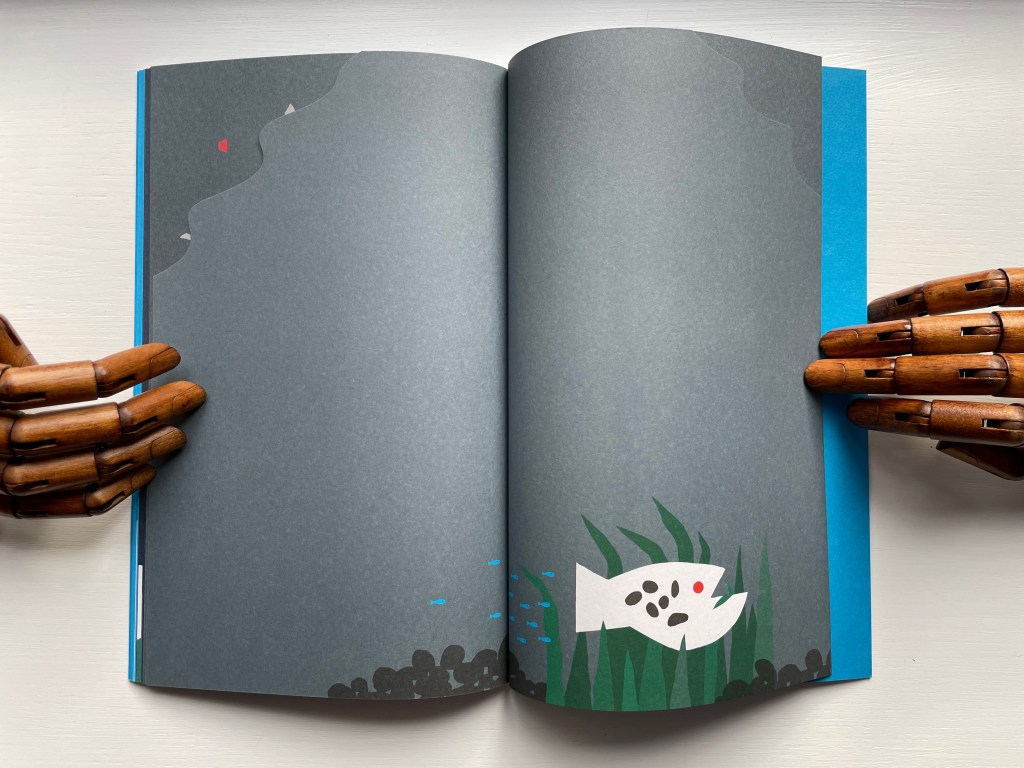
Pacu Pacu rewards re-reading because its simplicities heighten an awareness of how Komagata uses color, line, single page and double-page progressions, and shapes and cutouts to deliver narrative and aesthetic effects. It makes their discovery in his other works all the more enjoyable.
The Books of Katsumi Komagata (2019)

The Books of Katsumi Komagata (2019)
Katsumi Komagata
Casebound with softcover (Colorplan Lockwood Green 350 gsm), three-quarter-flap dustjacket (Colorplan Citrine 135 gsm). H280 x W220 mm. 192 pp. Acquired from Lazy Dog Press, 30 July 2023.
Photos: Books On Books Collection.
A catalogue raisonnée of Komagata’s work was published in French by Les Trois Ourses in 2013 and has been updated in Italian, translated into English, reformatted and published by Lazy Dog in 2019. Its essays by Stefano Salis, Kazumasa Nagai and Élisabeth Lortic and the brief comments by Komagata throughout are helpful in better appreciating the individual works. Although not mentioned in the table of contents, the book includes comments by Bruno Munari from a 1994 exhibition catalogue. Their presence is particularly apropos for Munari’s evident influence on Komagata. With additional works appearing up until Komagata’s death, a final catalogue raisonnée will present an opportunity for further exploration and exposition of all the works, their development and influences.


Komagata’s delightful comments on the origins of two works in the collection.
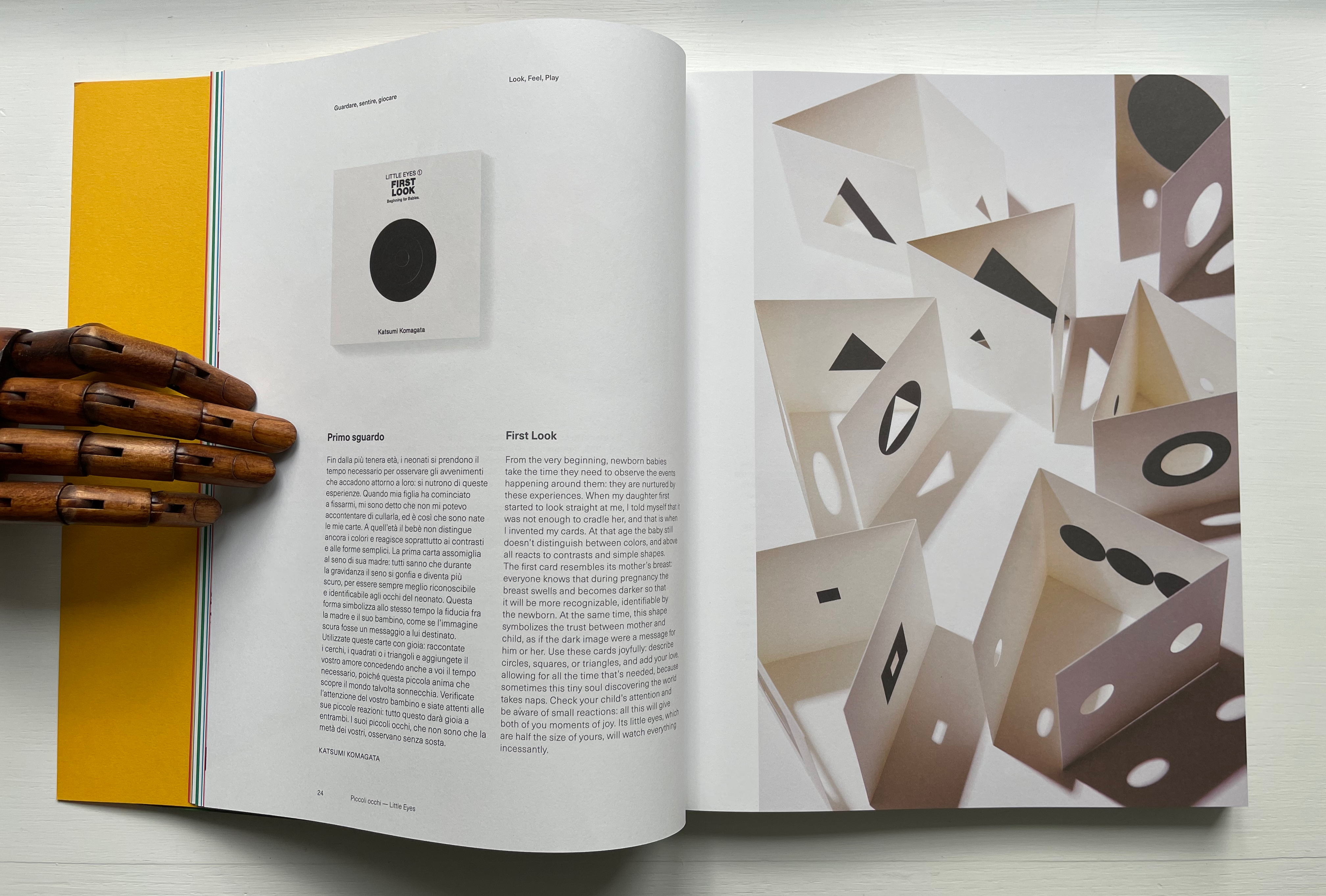

Komagata’s First Look on the left and Munari’s Square, Circle and Triangle books on the right.
As announced in Bologna (8 April 2024), the Komagata enterprise continues with his daughter Aï Komagata.
Further Reading
“Menena Cottin“. 12 July 2023. Books On Books Collection. See her The Black Book of Colors for an interesting comparison with Moon Phase.
“Katsumi Komagata (I)“. 22 March 2020. Books On Books Collection.
“Bruno Munari“. 19 August 2021. Books On Books Collection.
Beckett Sandra L. 2013. Crossover Picturebooks : A Genre for All Ages. London: Routledge.
Druker, E. and Kümmerling‐Meibauer, B., eds.2015. Children’s Literature and the Avant‐Garde. Amsterdam: John Benjamins.
Komagata, Katsumi. 2019. Komagata : I Libri Di = The Books of Katsumi Komagata. Milano: Lazy Dog Press.
Widmer, Jean, Katsumi Komagata and Agnès Martin (trans.). 2013. Les Livres de … Katsumi Komagata. Paris: Les Trois Ourses.
 Books On Books
One thought on “Books On Books Collection – Katsumi Komagata (II)”