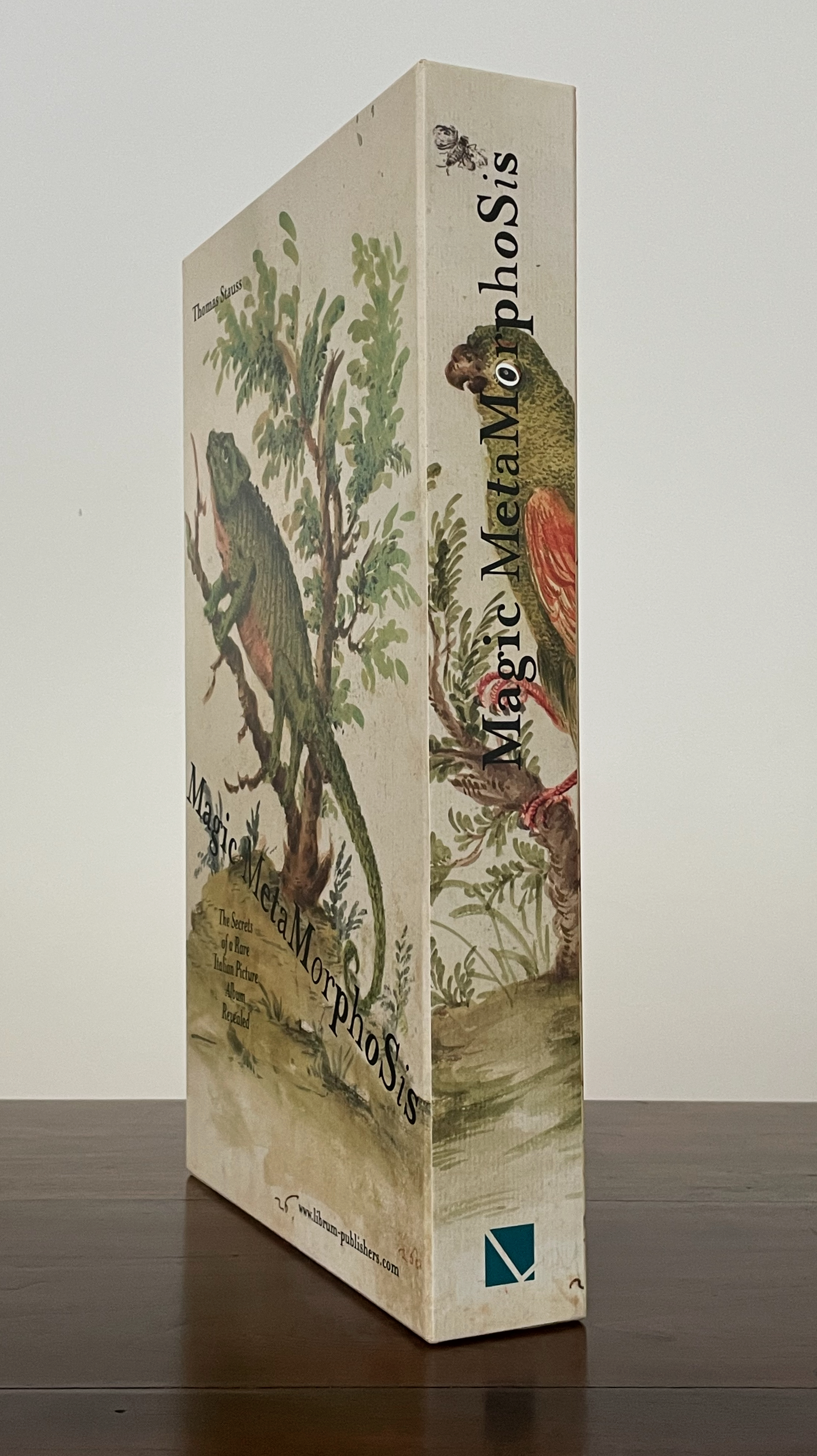
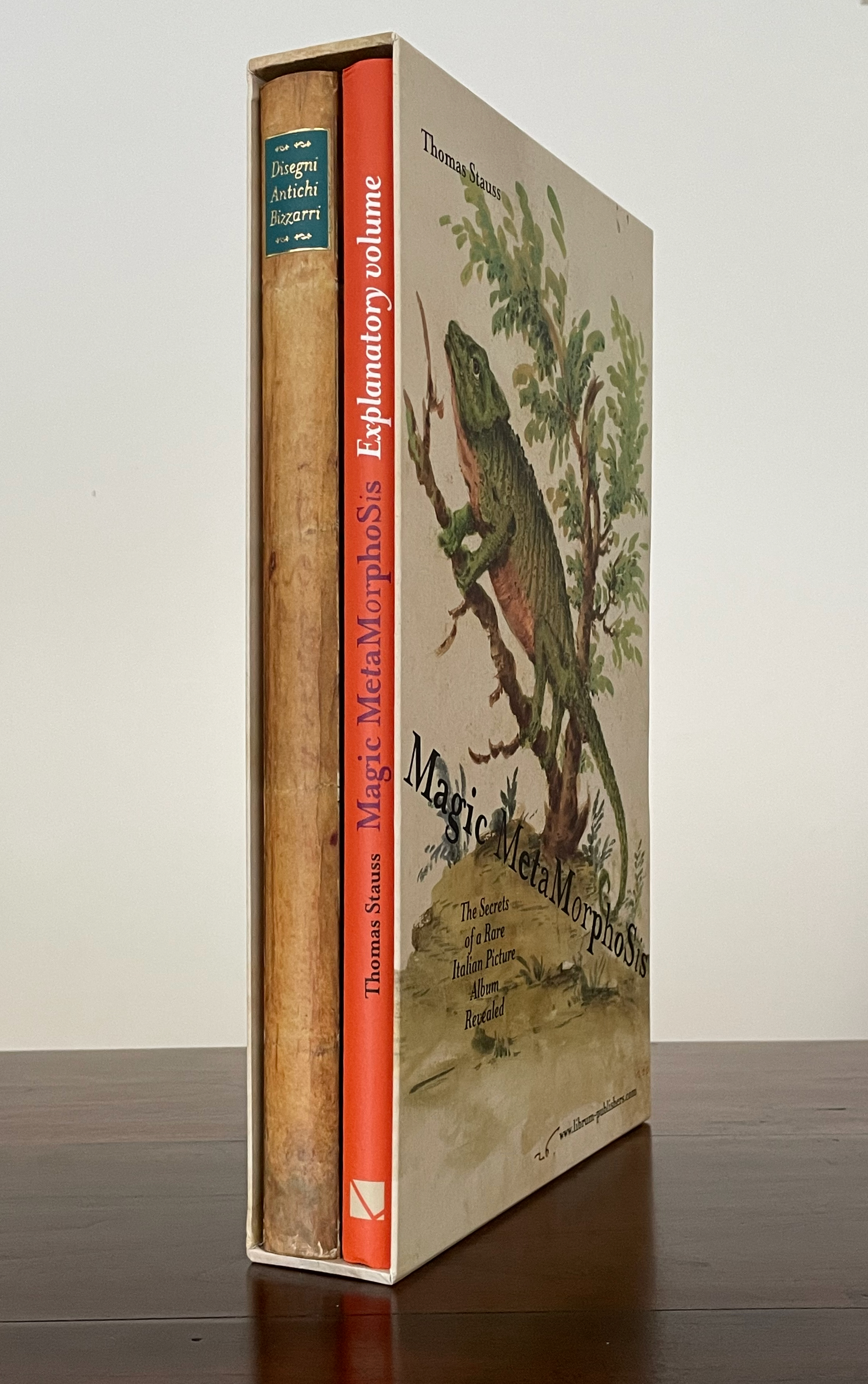
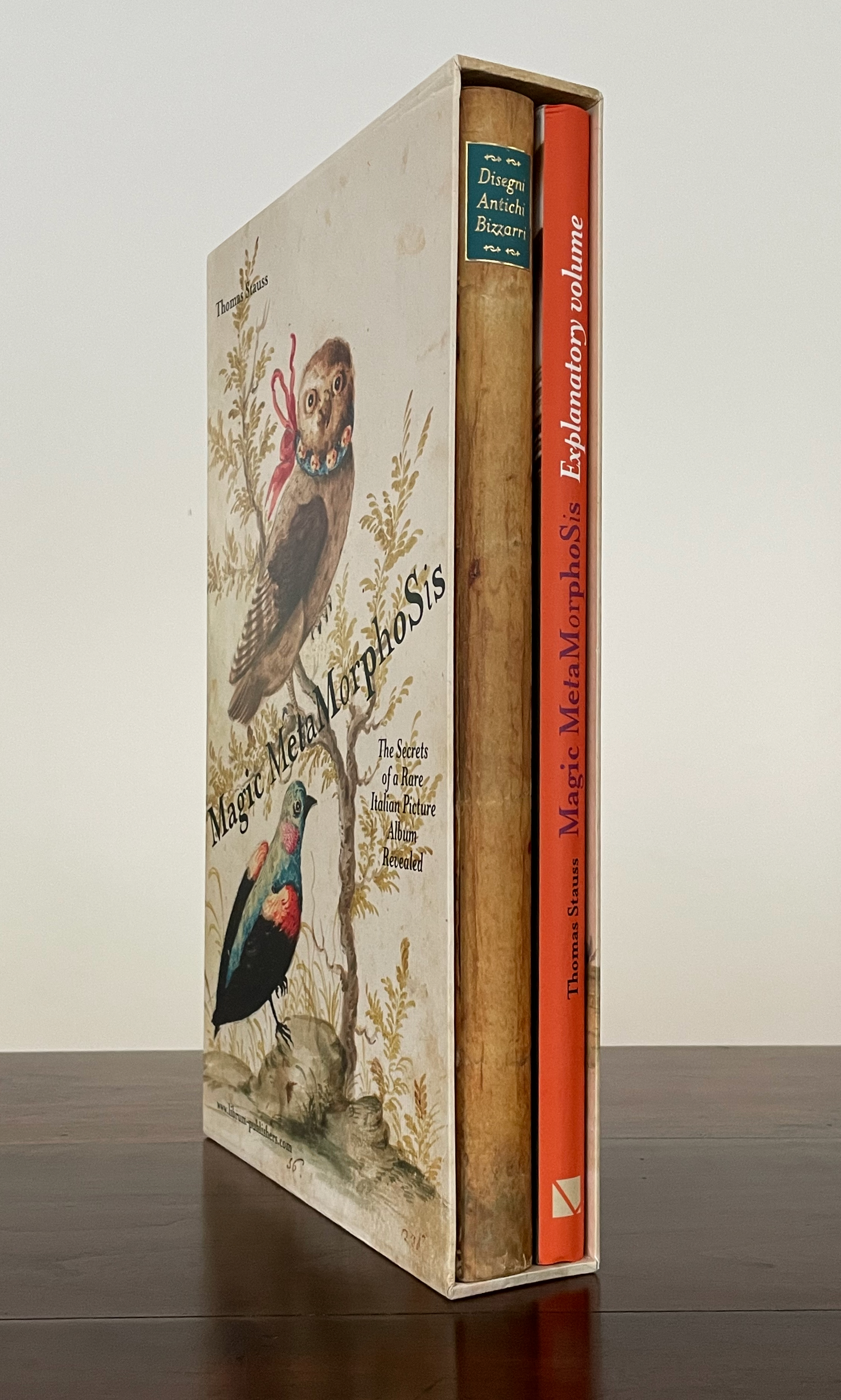
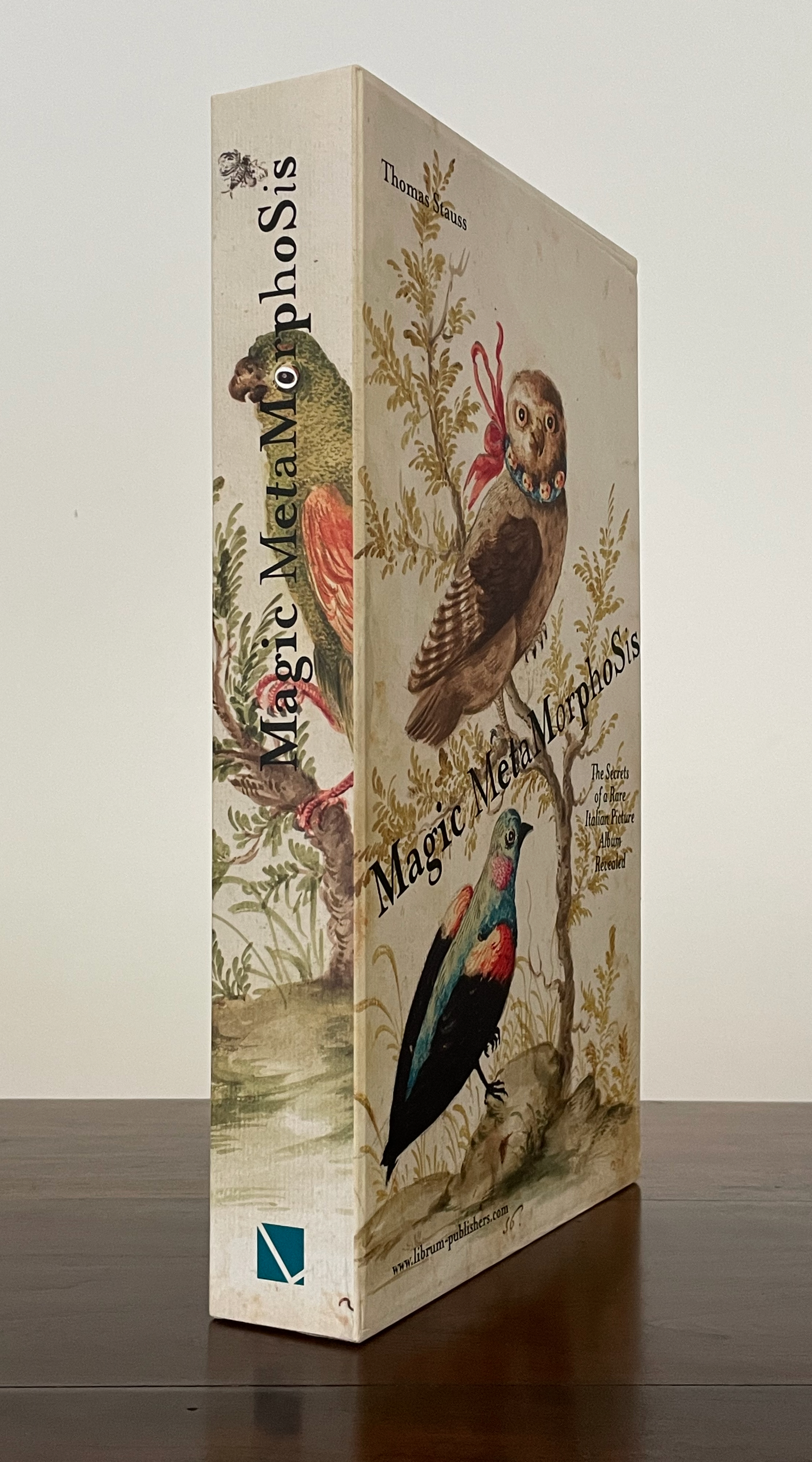
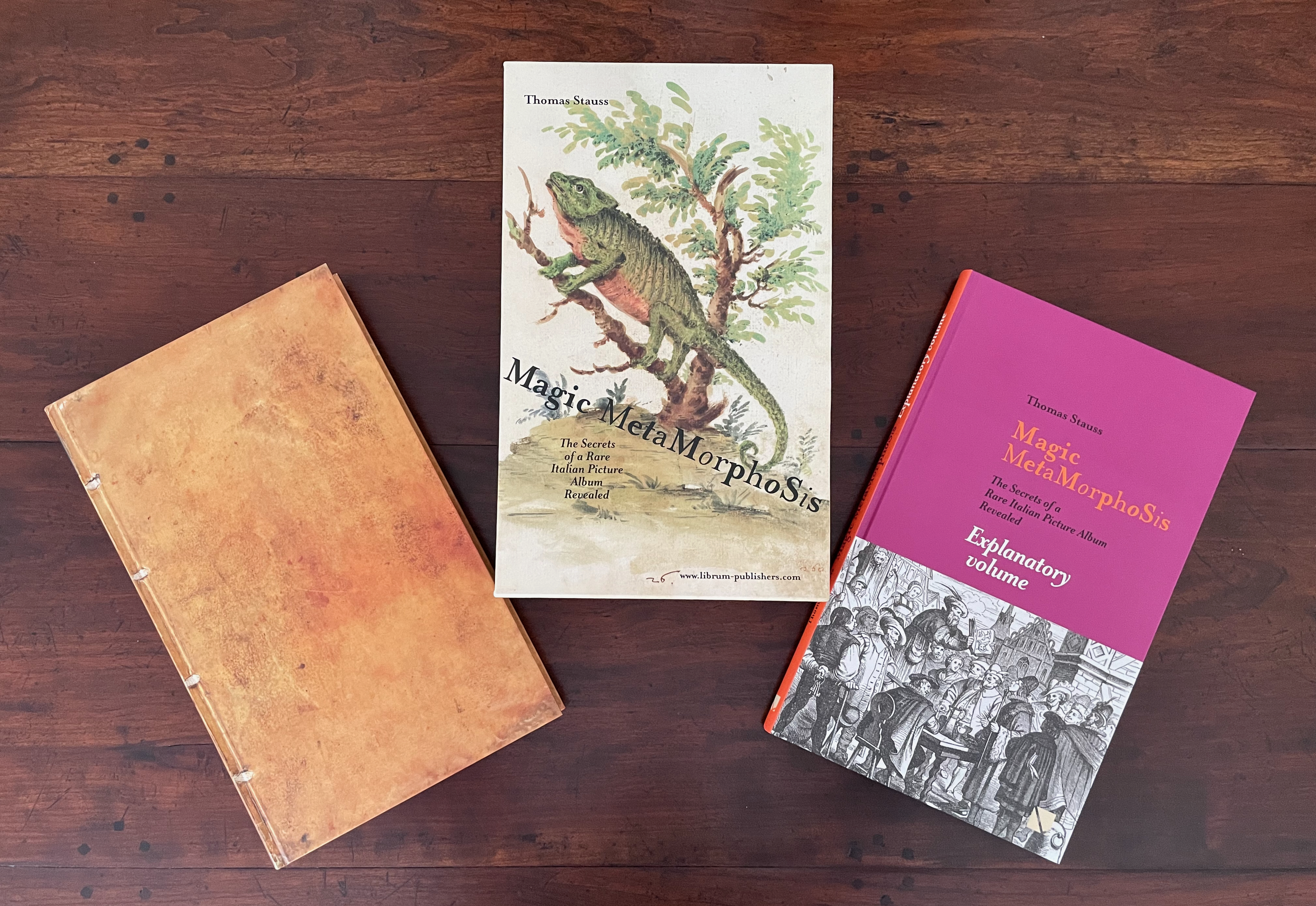
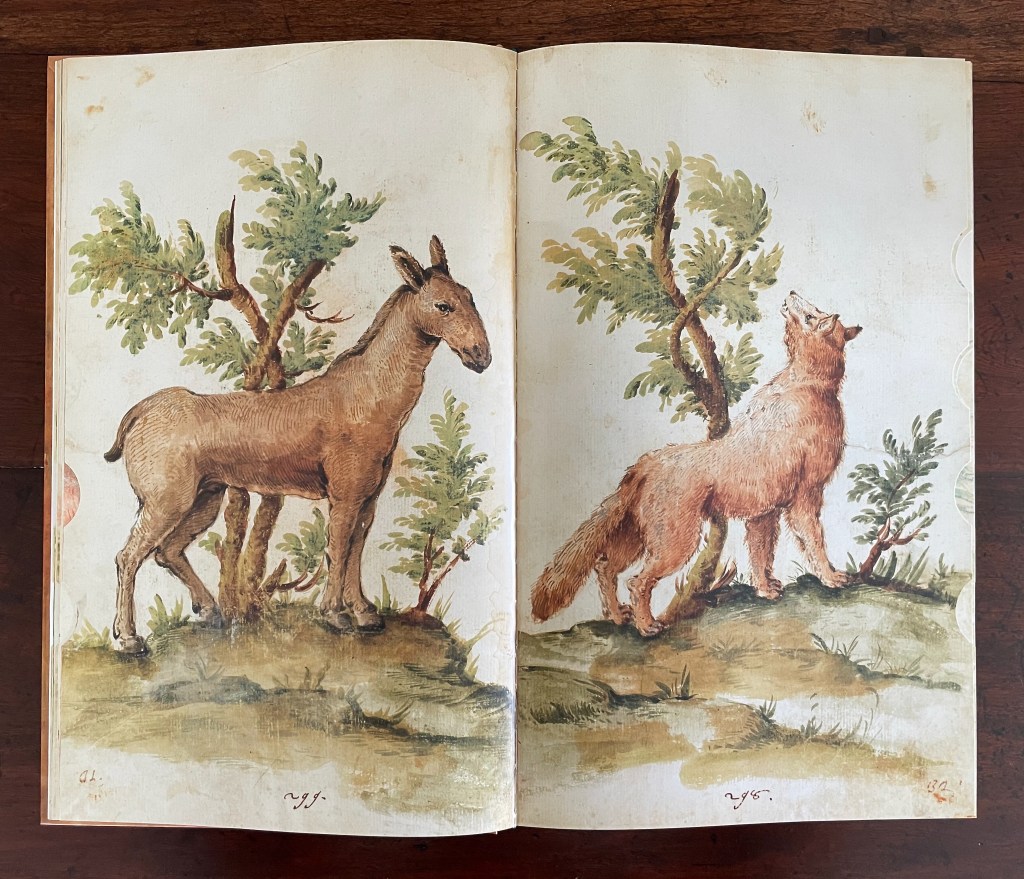
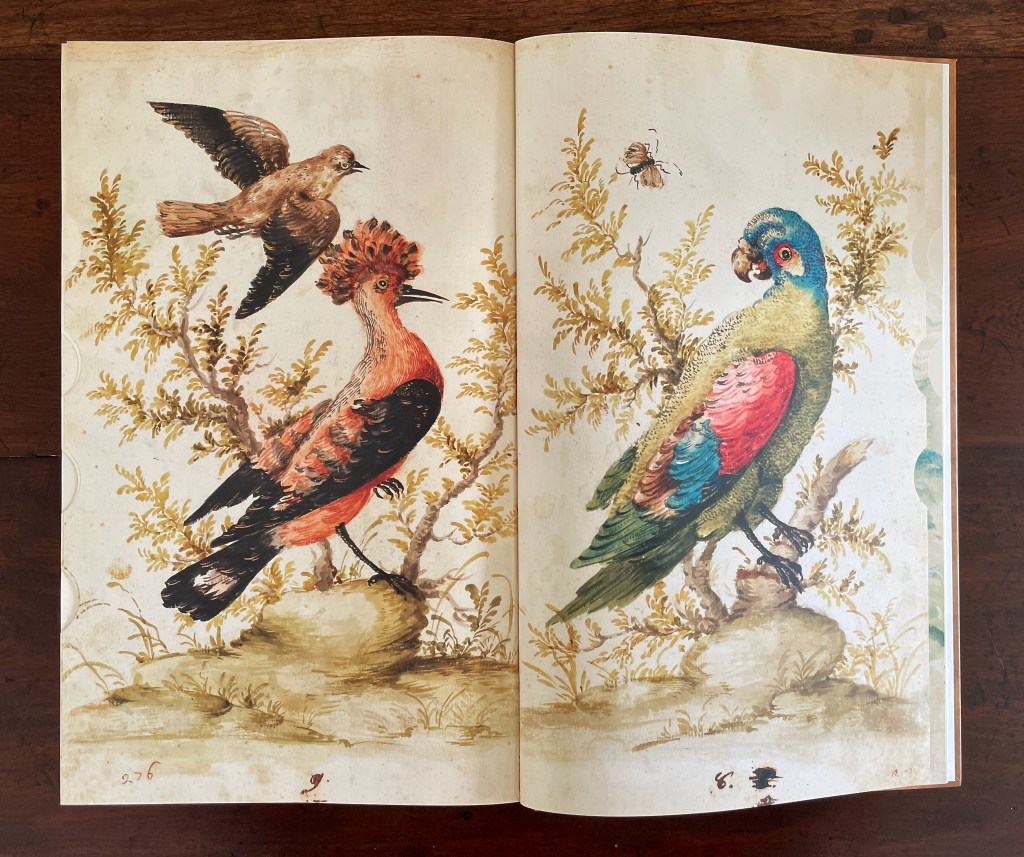
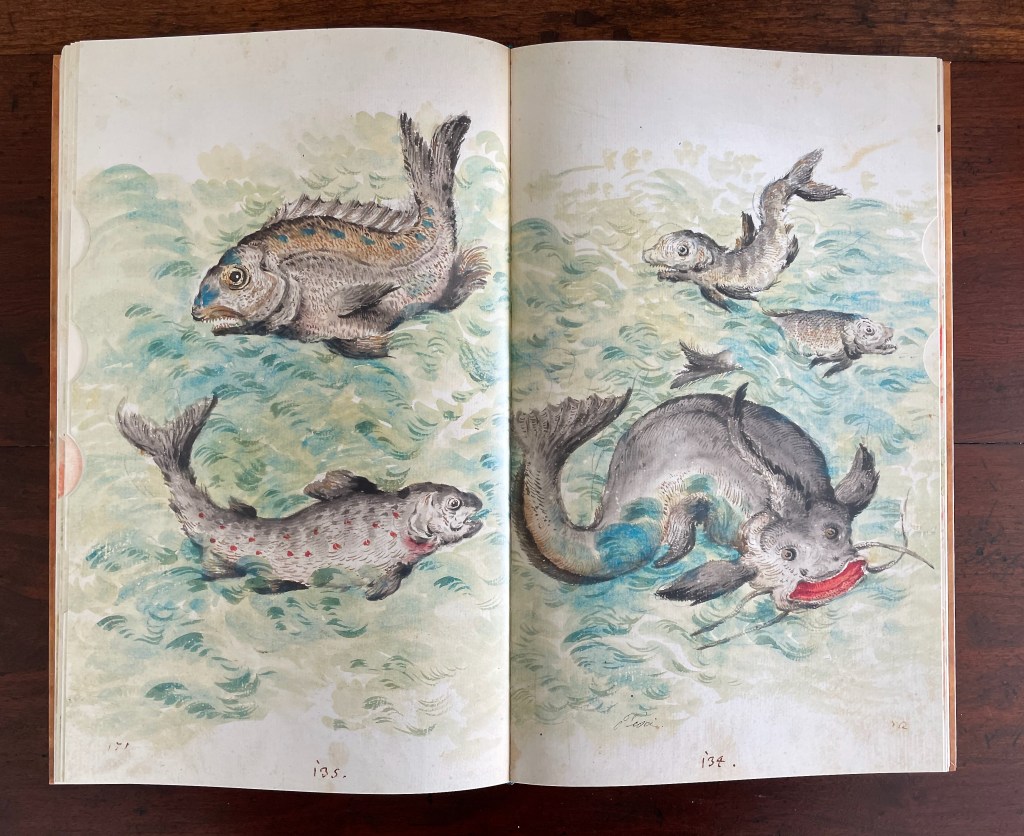
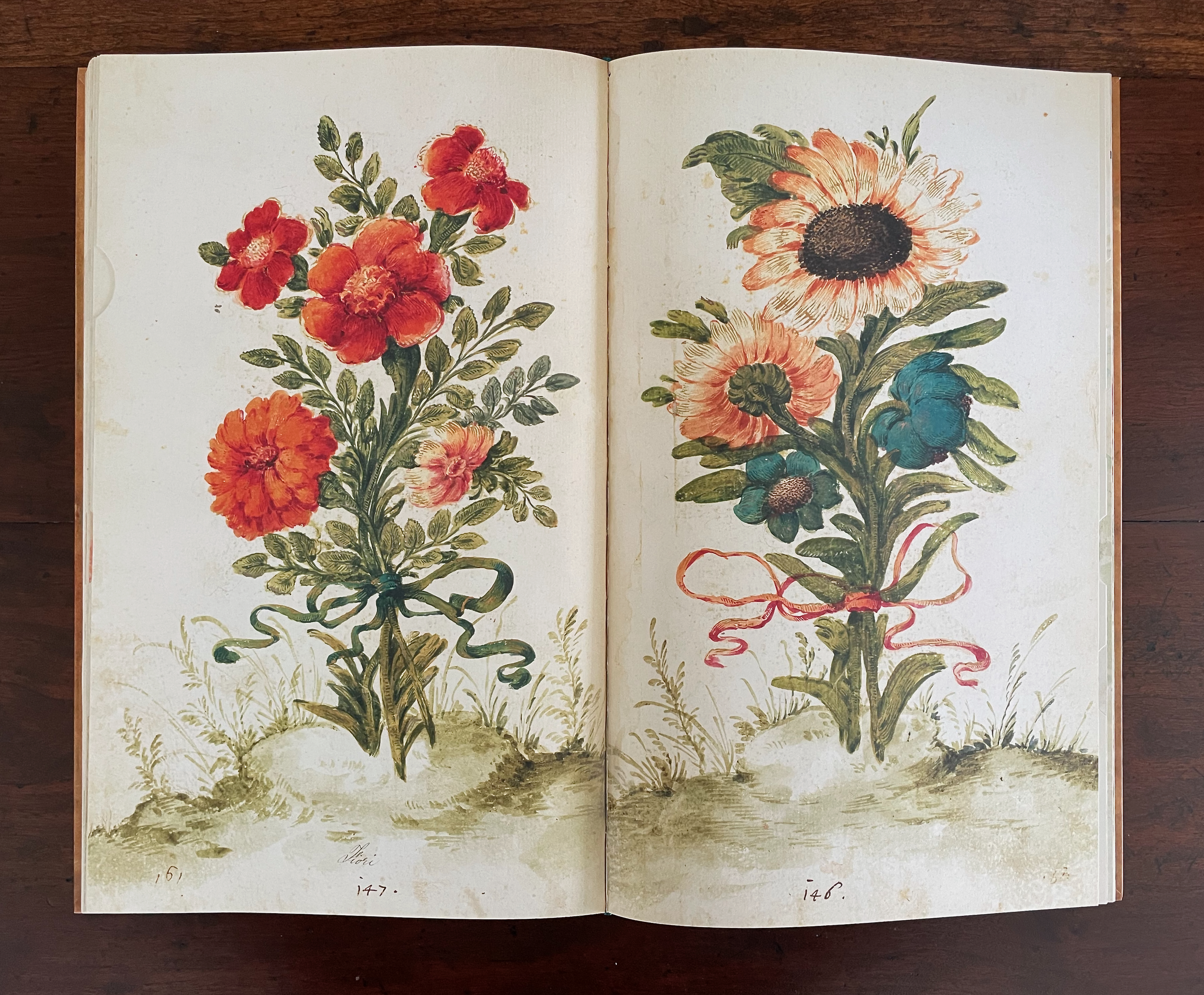
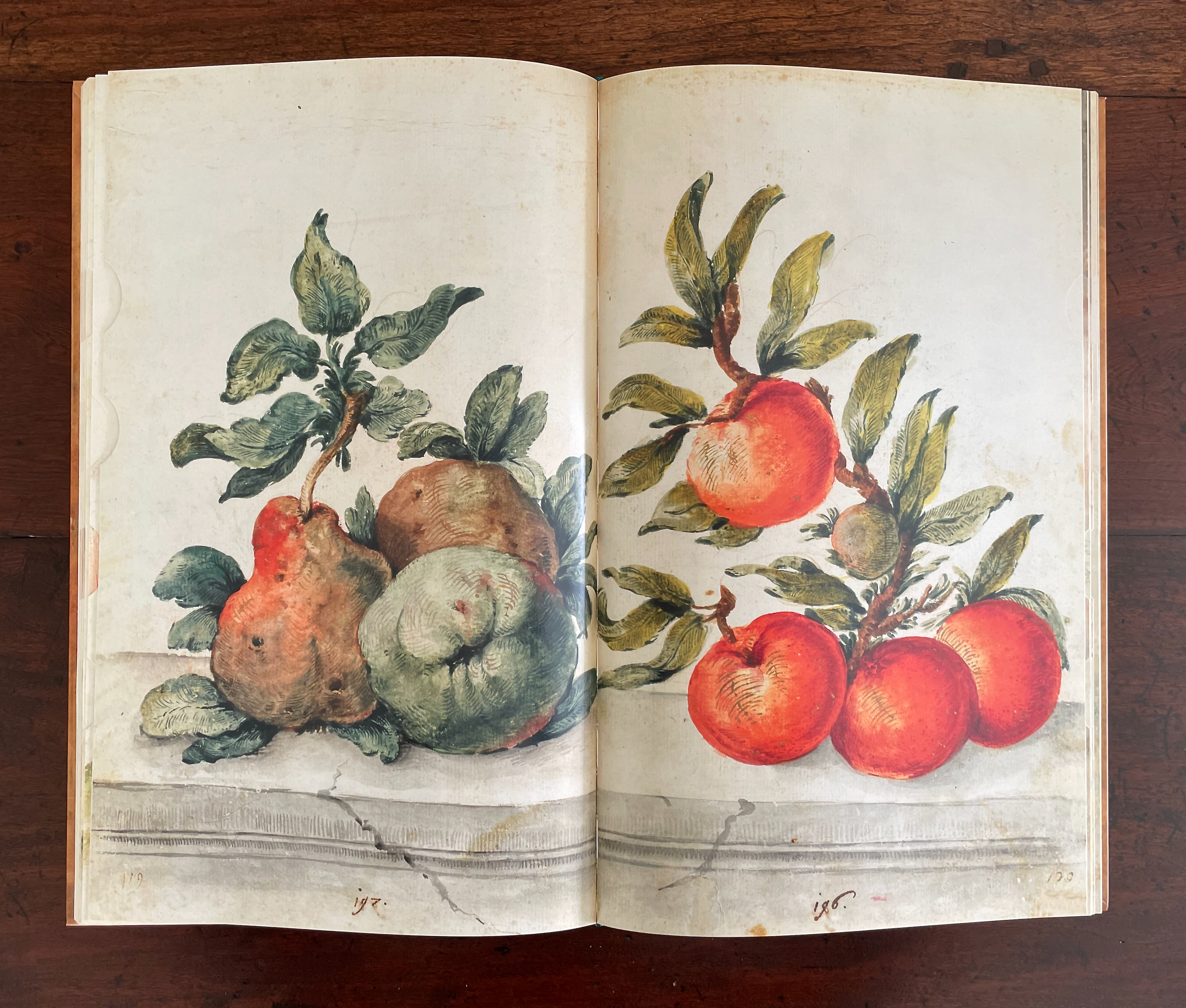
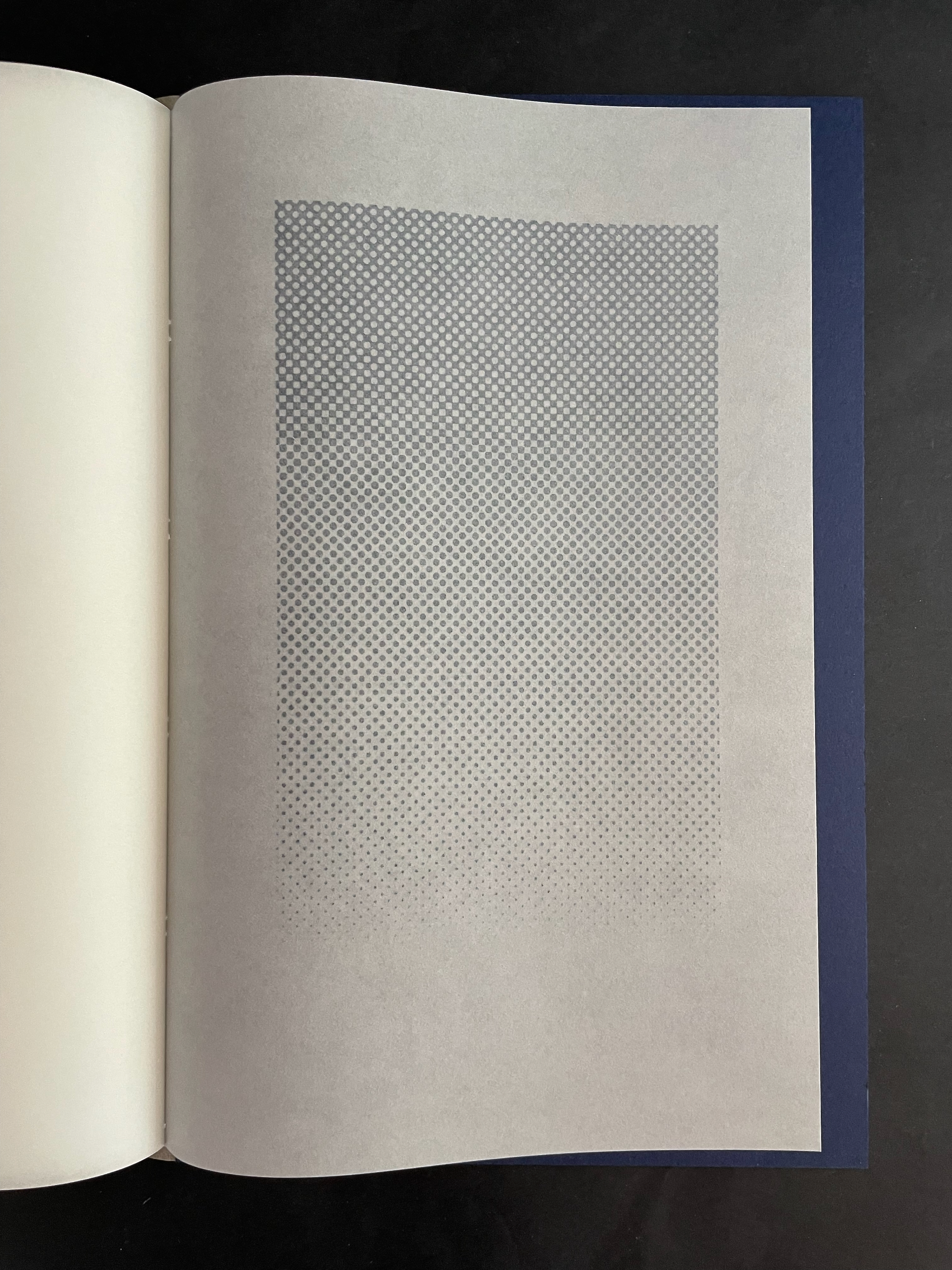
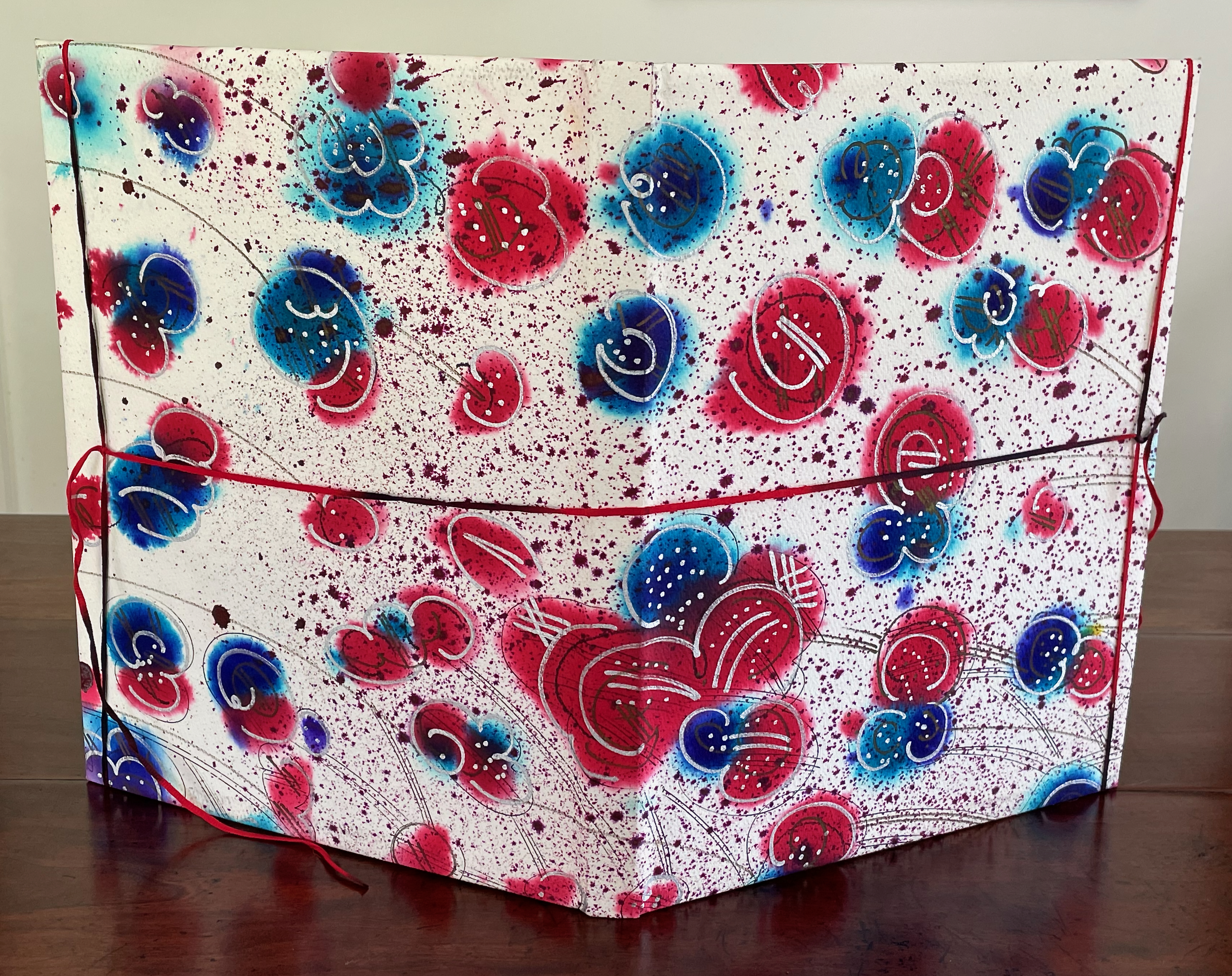
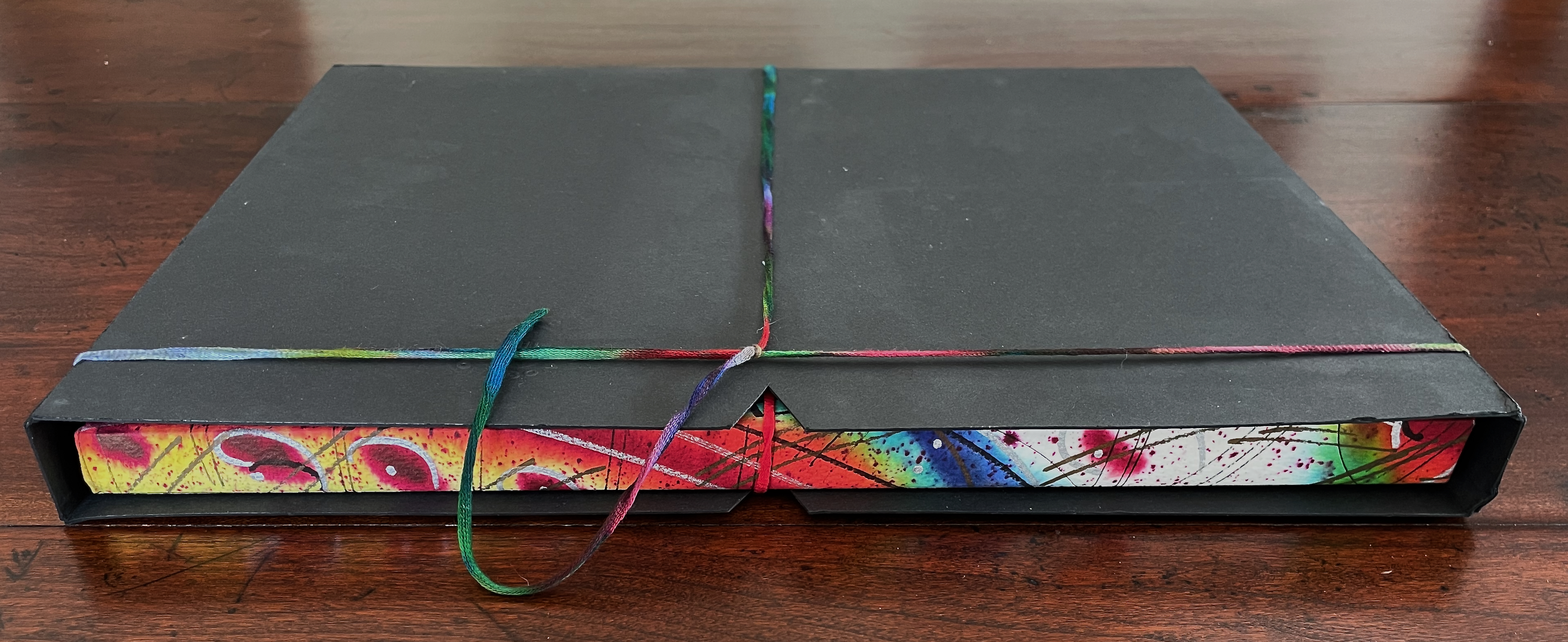
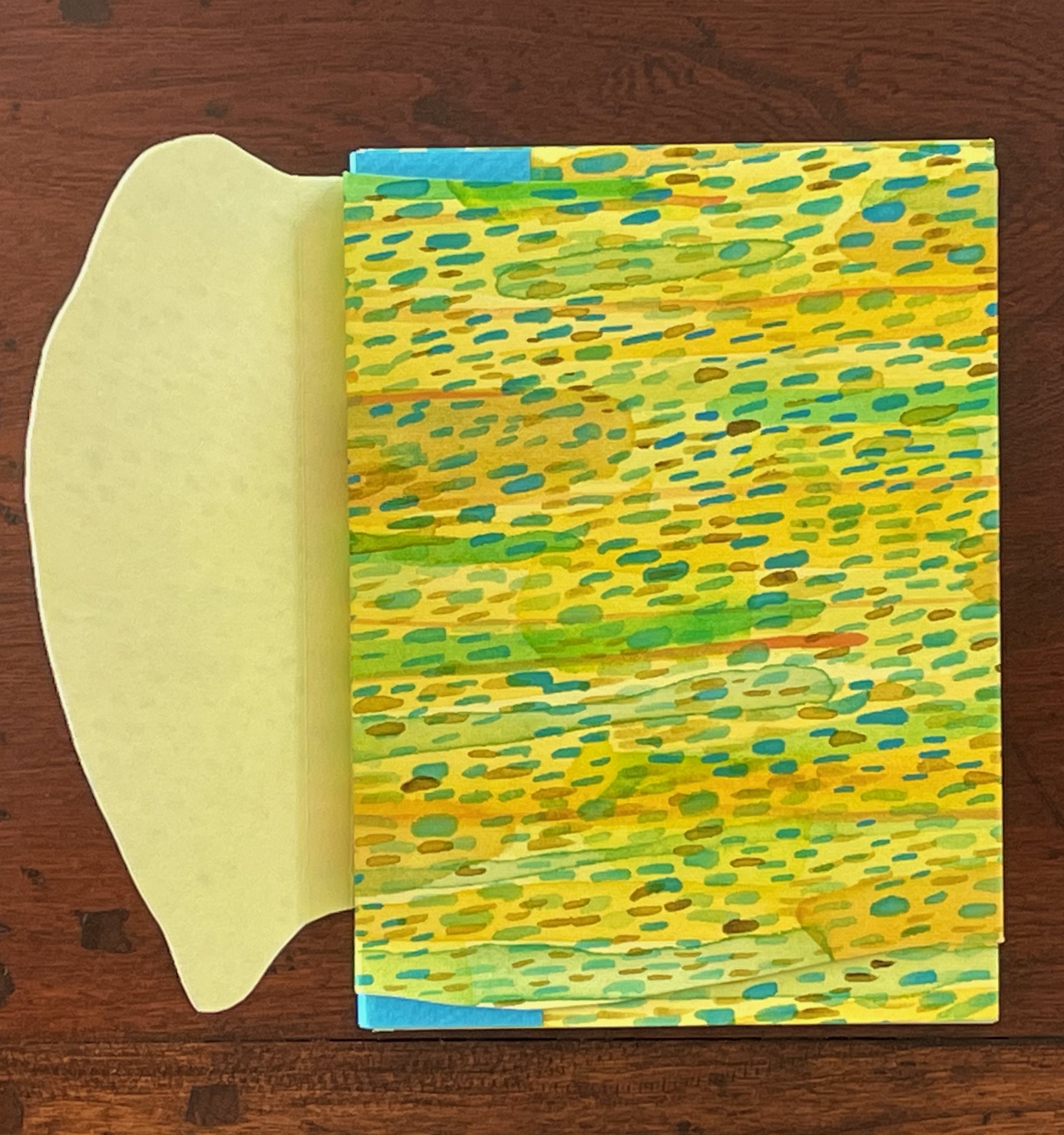
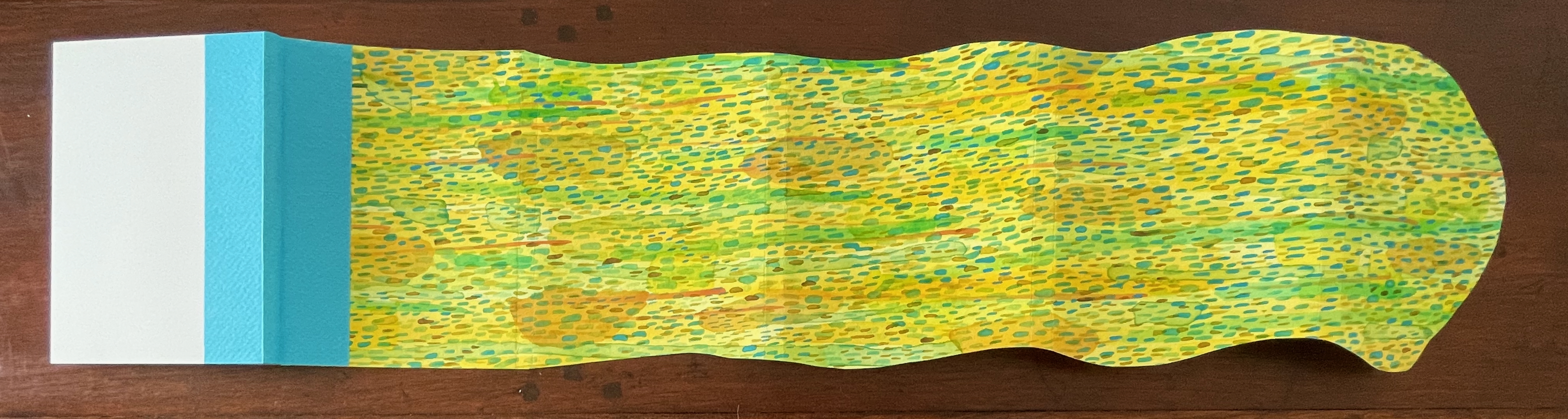
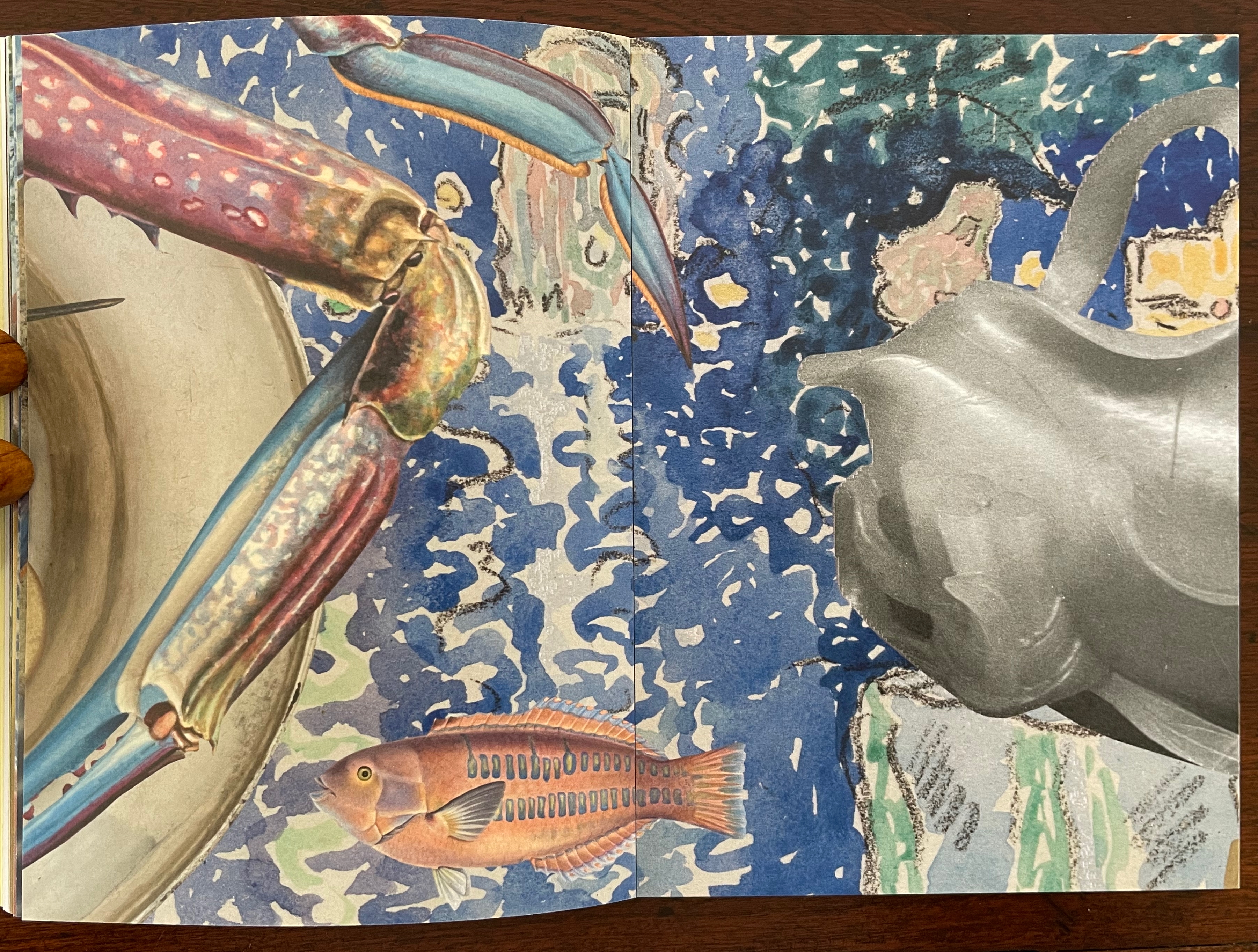
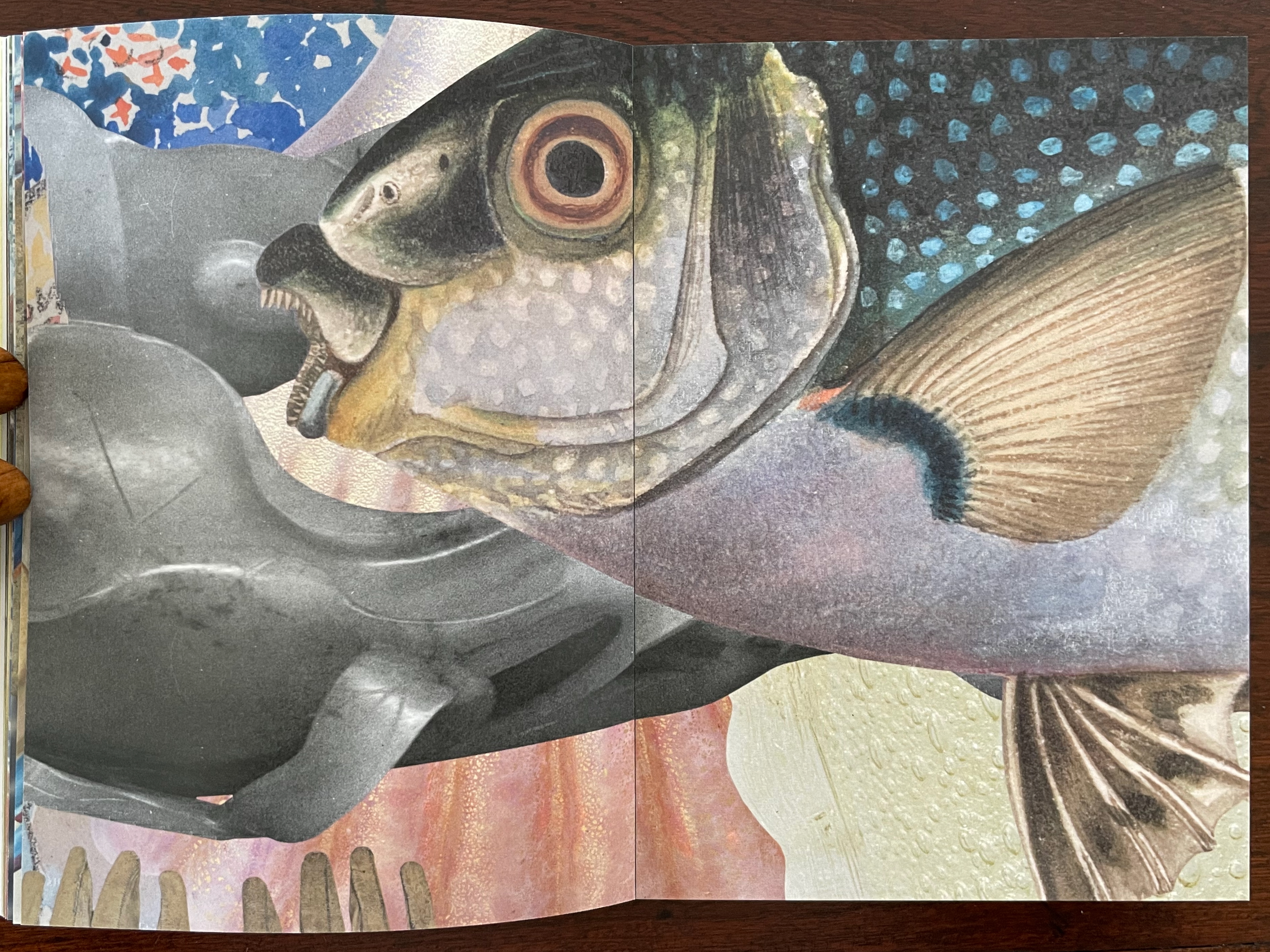
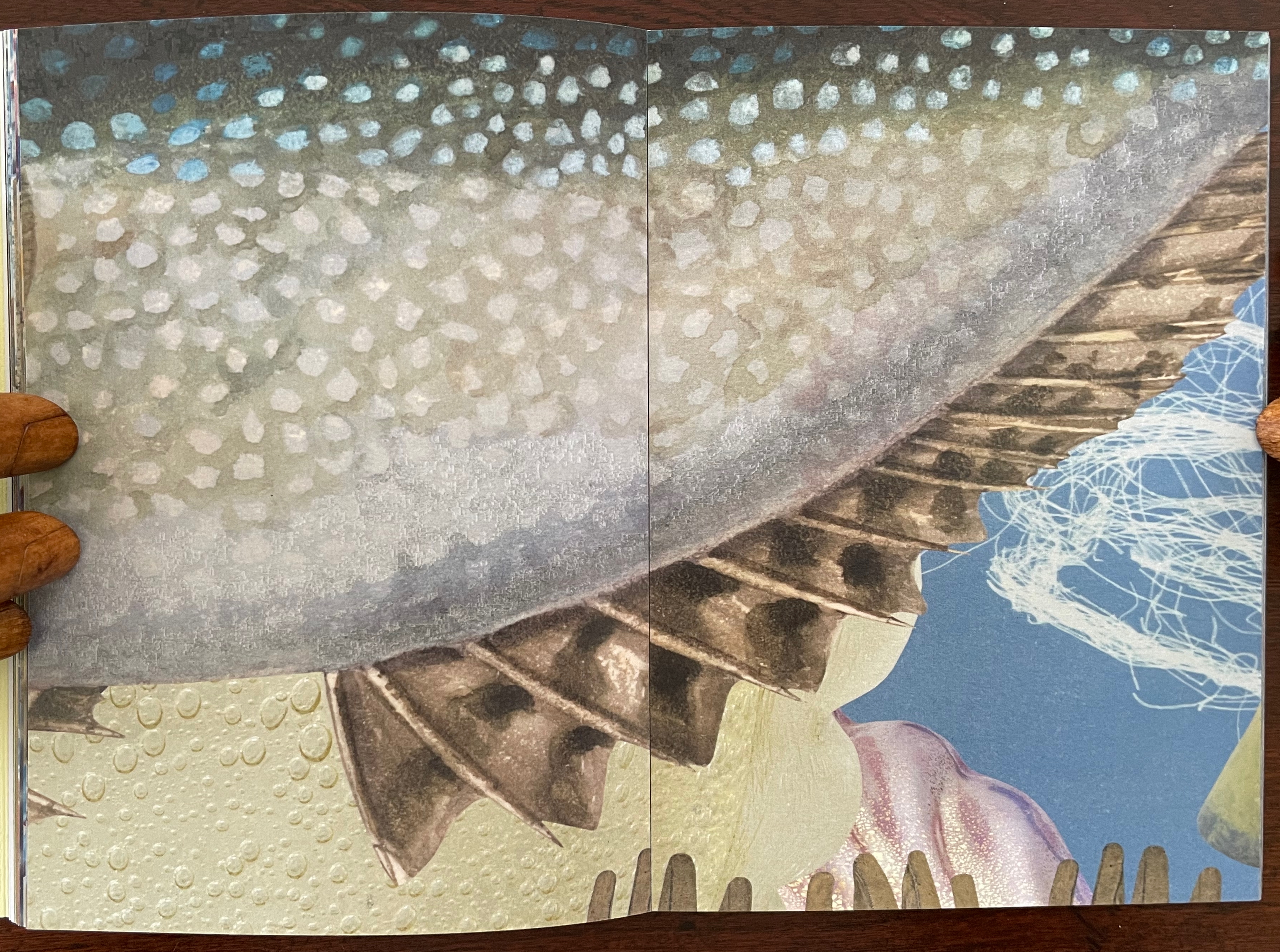
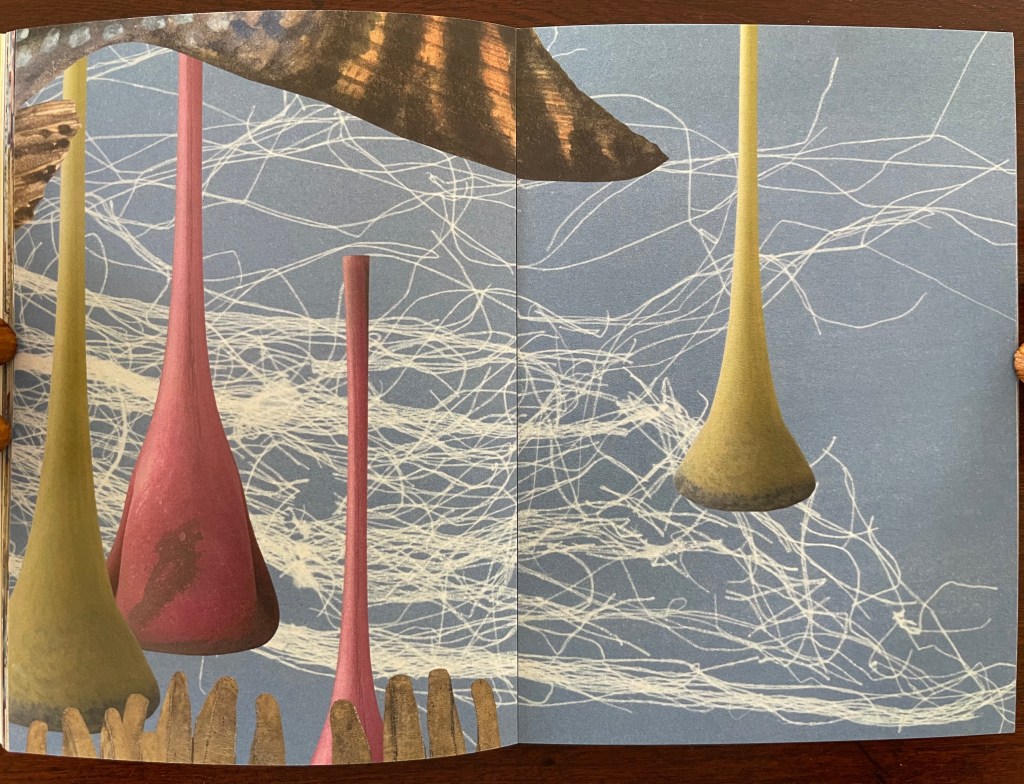
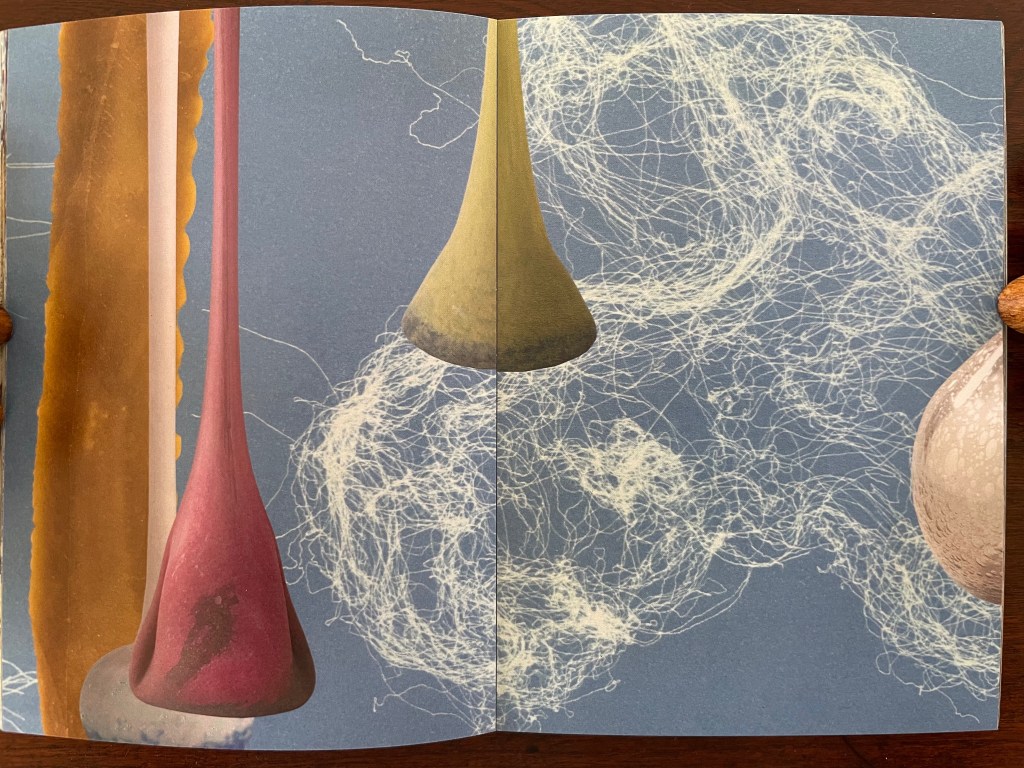
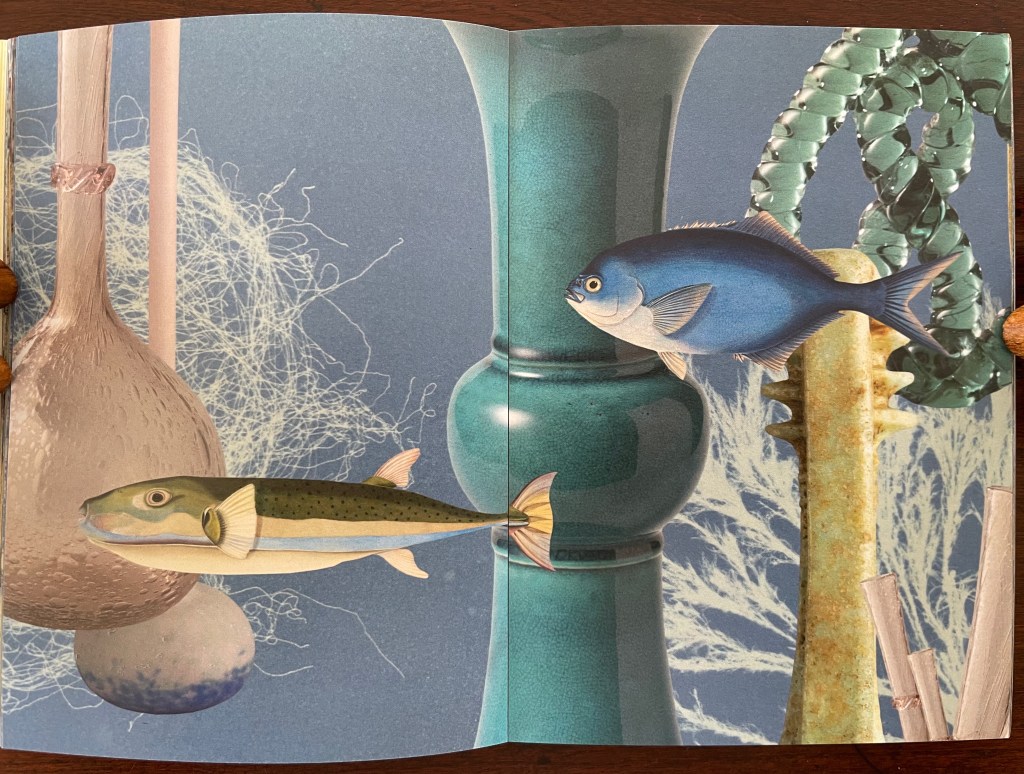
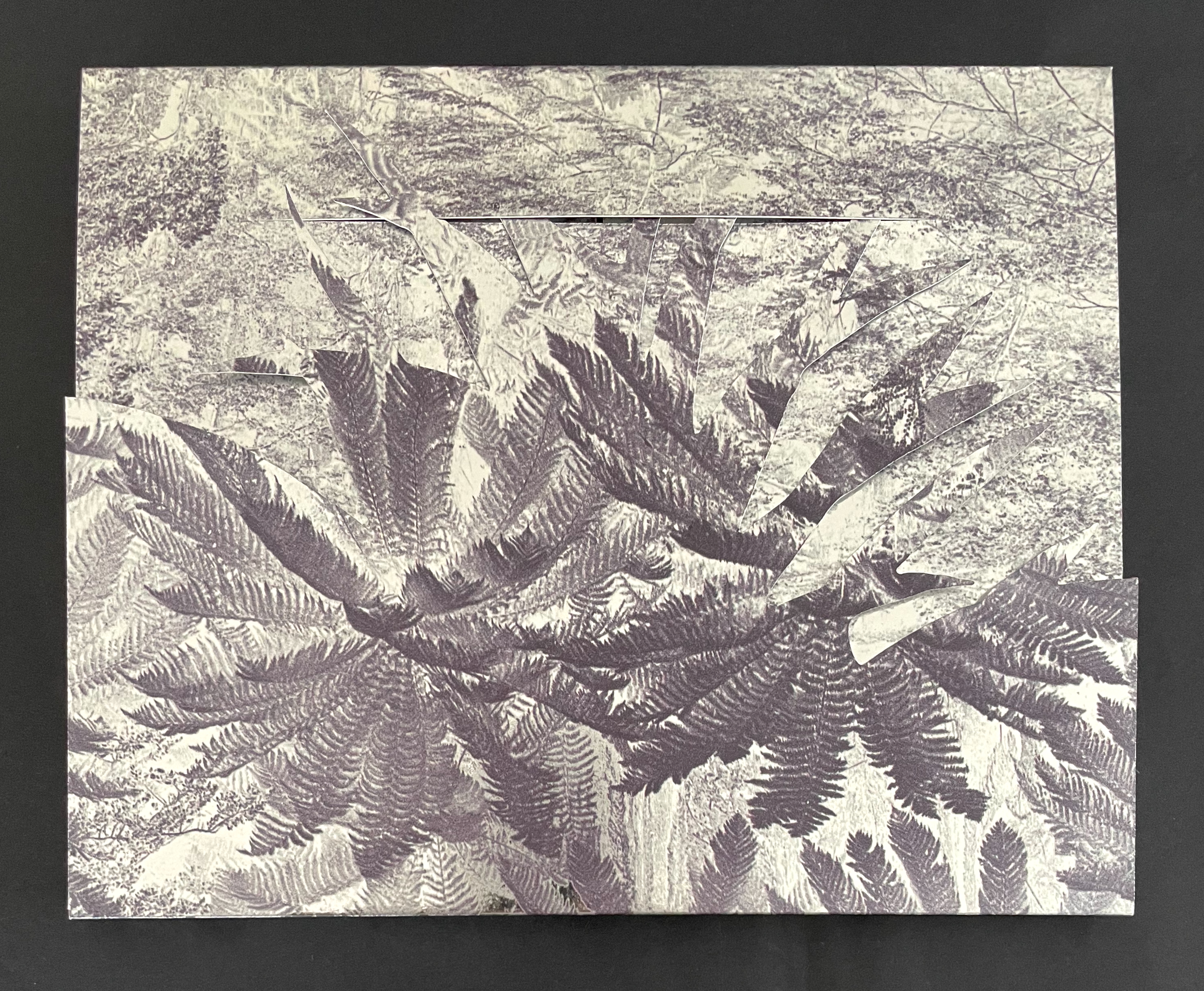
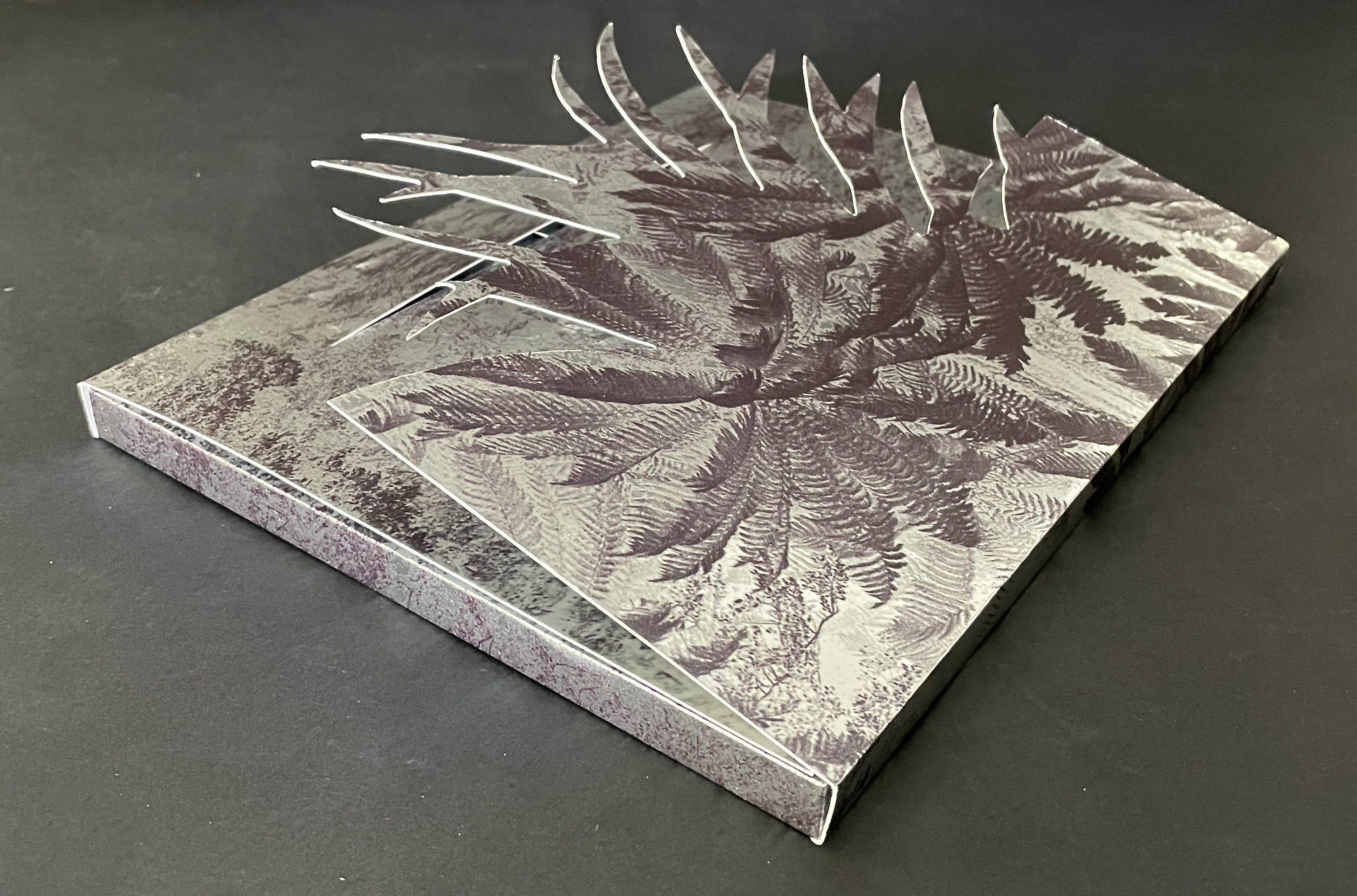
Magic Metamorphosis : The Secrets of a Rare Italian Picture Album Revealed (2025) Thomas Stauss Slipcased two volumes. Slipcase: H375 x W230 x D53 mm. Both vols: H362 x W225 mm. Facsimile: [336] pages. Explanatory vol: 256 pages. Published by LIBRUM Publishers and Editors (Basel, Switzerland). Acquired from Amazon, 2 September 2026. Photos: Books On Books Collection. See end of entry for credits to photographs in Magic Metamorphosis.
Collectors who can describe their collections and their searches without prompting yawns or worse are almost as rare as unicorn horns. Thomas Stauss knows how to tell a story. With his background in acquiring antique games and magicians’ apparatus, he was well equipped to recognize what the oddly organized portfolio volume presented to him in a Parisian book shop was meant to be — a “blow book”, a trick book that at first appears to be completely blank but then, with a magical breath blown over it, displays a set of themed images that, with another breath blown, changes into yet another set, and then another, and so on. But whoever commissioned these sets of watercolors in the 1600s had not had the finishing touches made before the sets were bound in a single volume. With a familiar and unassuming style, Stauss turns his discovery and its transformation into a page-turning read that is as magical as any blow book.
Until now, Ricky Jay’s Magic Magic Book (1994) could be considered the definitive work on this book structure and conjuror’s apparatus that arose in the wake of Gutenberg’s printing press. Thomas Stauss’s study now takes center stage and assumes that leading role. Perhaps his training in hydrology and geology — as well as his collector’s focus — instilled the curiosity and patience to accomplish this. Also he has been studying the history of science for over 25 years and, somewhere along the way, acquired the skills in bibliographical science necessary for this project. Stauss wears his scholarship lightly though. Discovery, fact, explanation, and conjecture proceed with fine balance and an engaging pace.
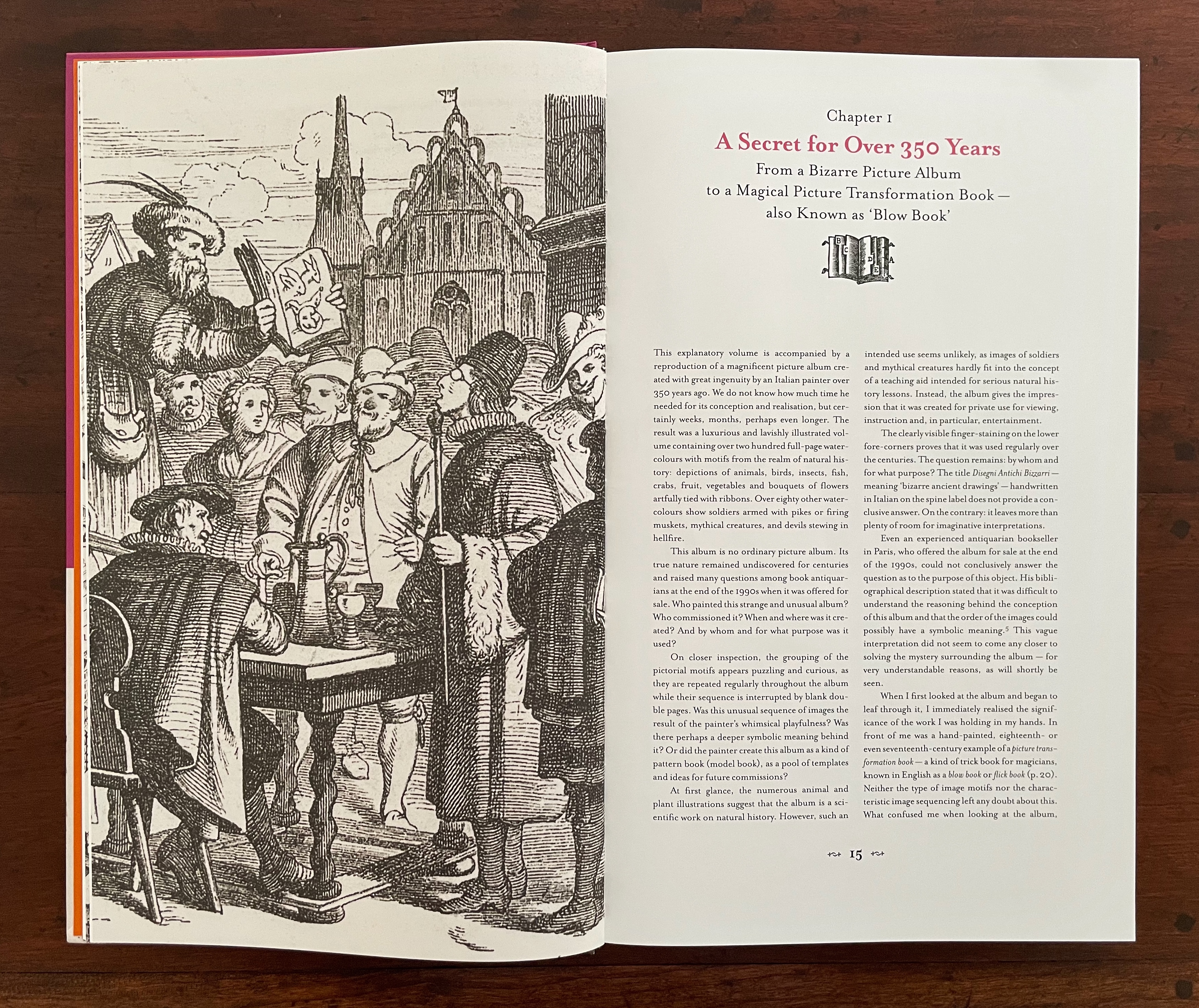
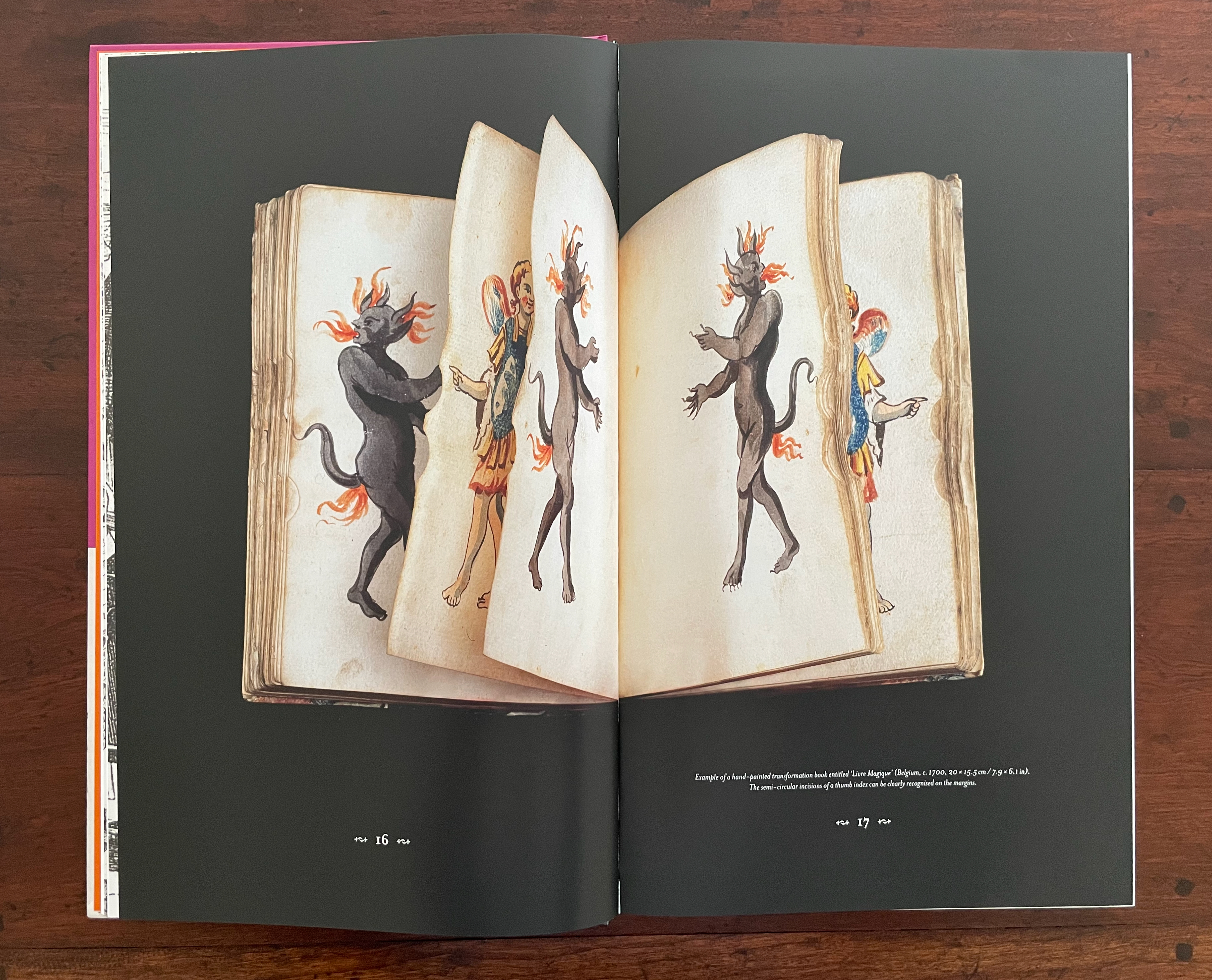
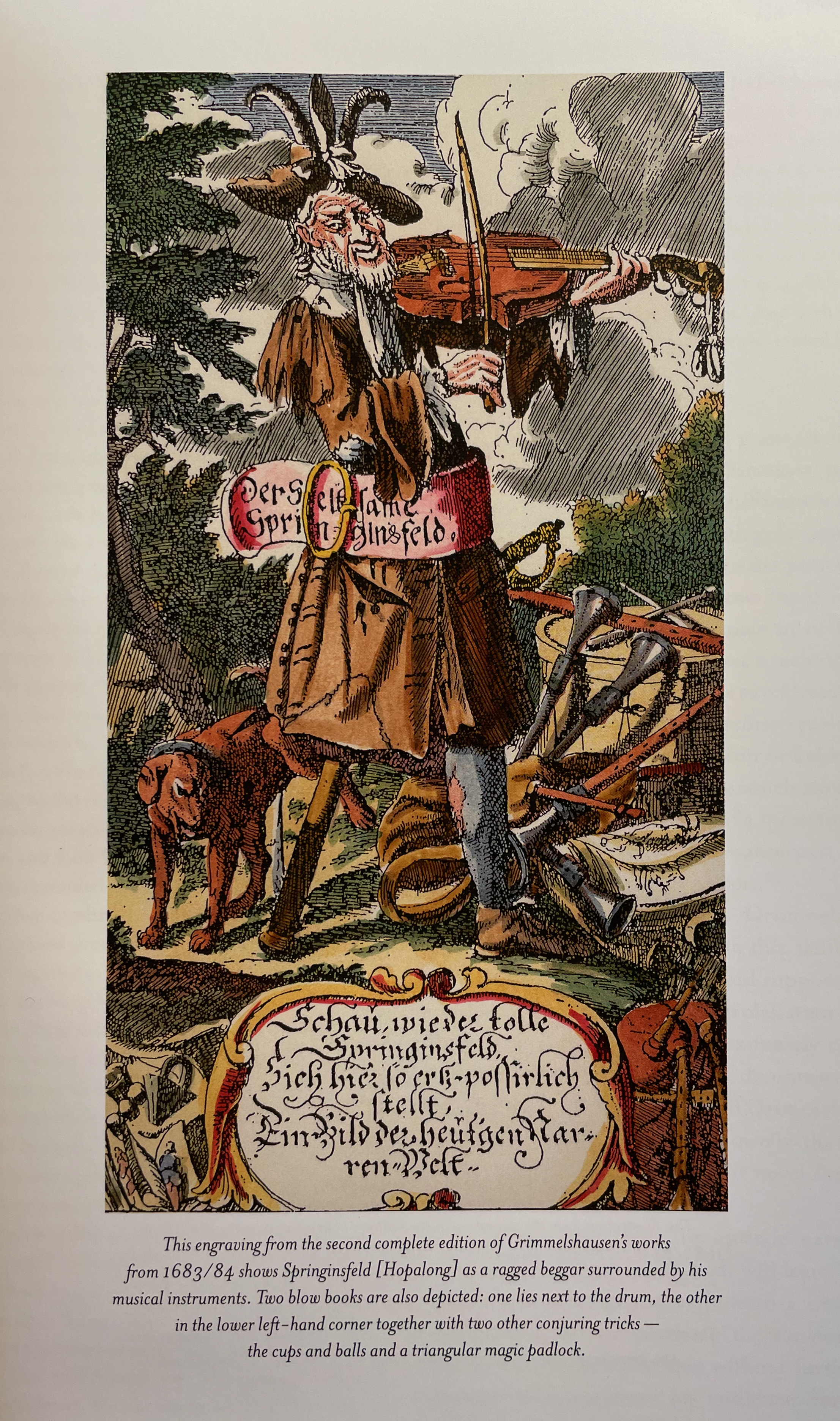
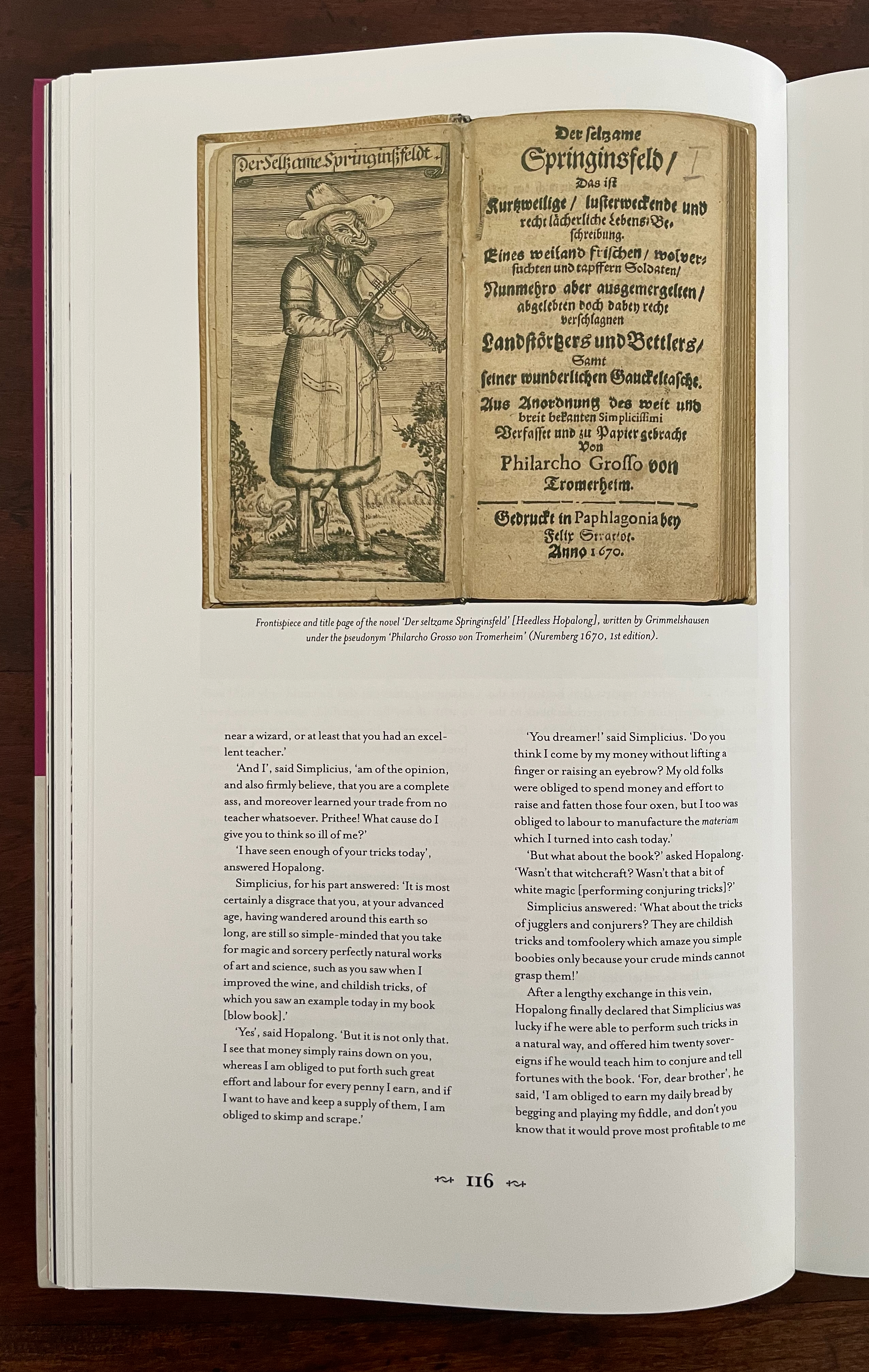
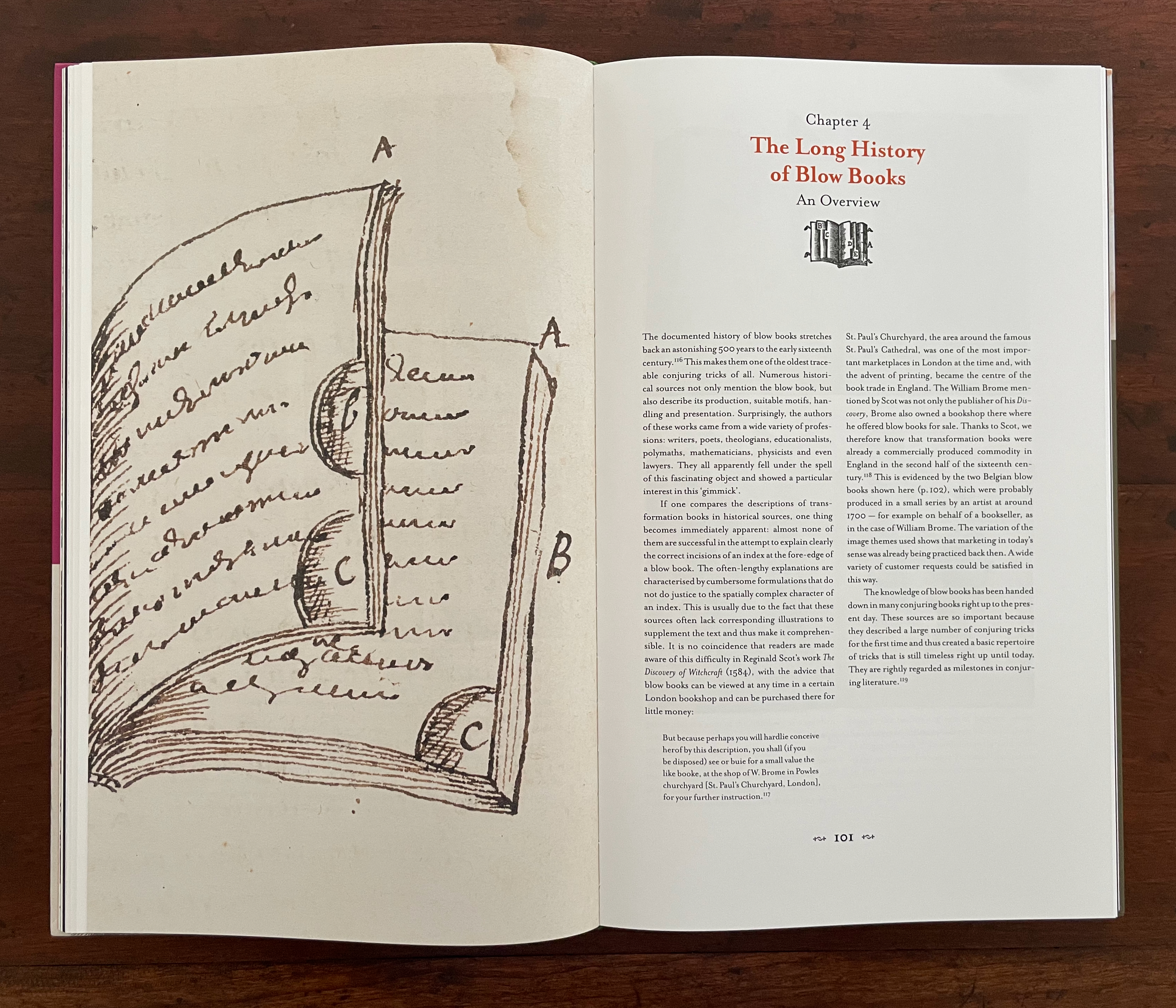
After the prologue recounting his discovery of Disegni Antichi Bizzarri [“Bizarre antique drawings”] Stauss’s first chapter introduces the history, nomenclature, structure, and working of the blow book. Its various methods of construction are clearly described and shown by diagram and photography, and the production team should be lauded for the quality and positioning of images with the explanatory text. No better description of how a performer worked the audience with a blow book has occurred since the mid-17th-century picaresque novel by Hans Jakob Christoffel von Grimmelshausen, and Stauss uses it to conclude the chapter.
From Magical Metamorphosis, p. 29.
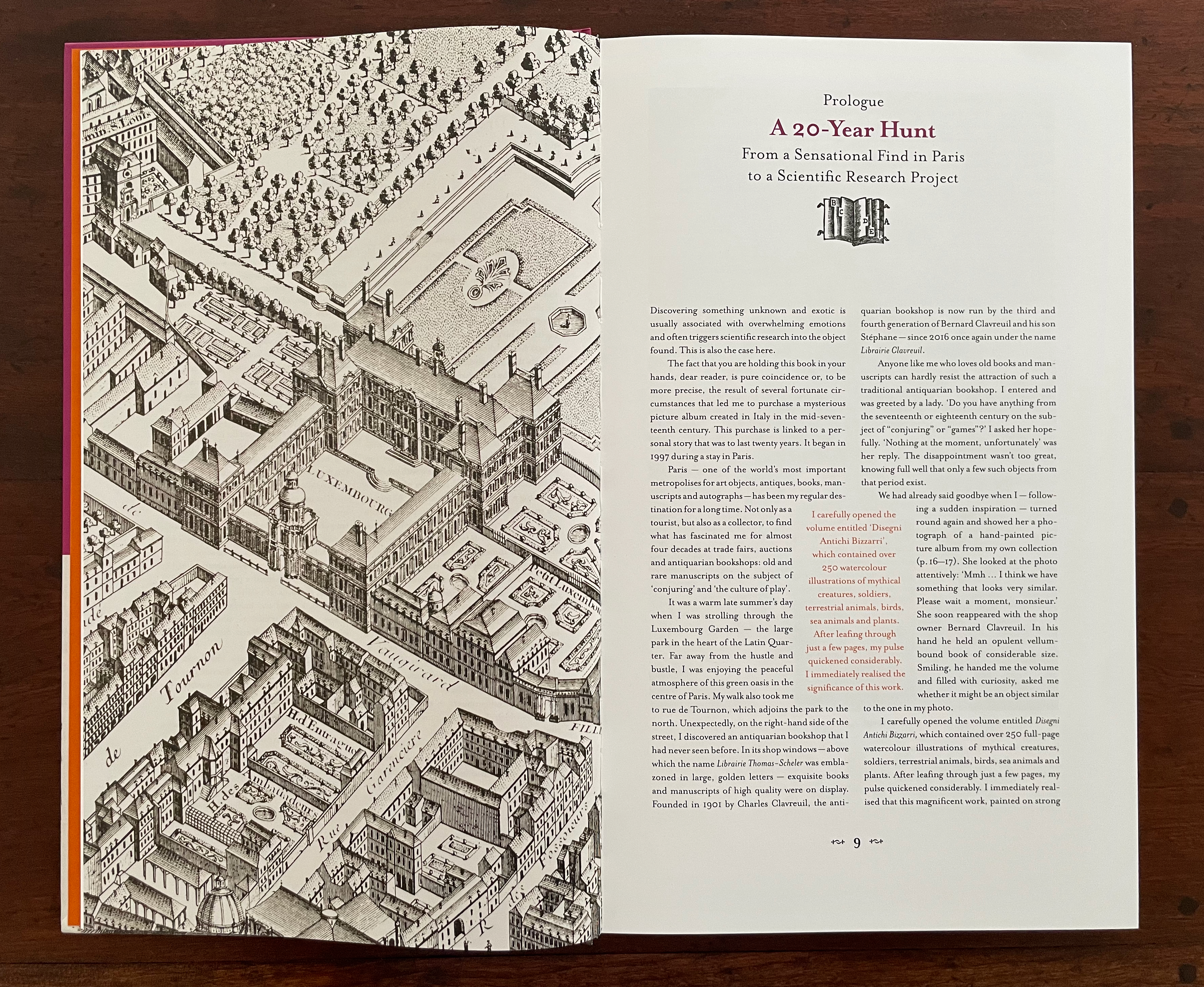
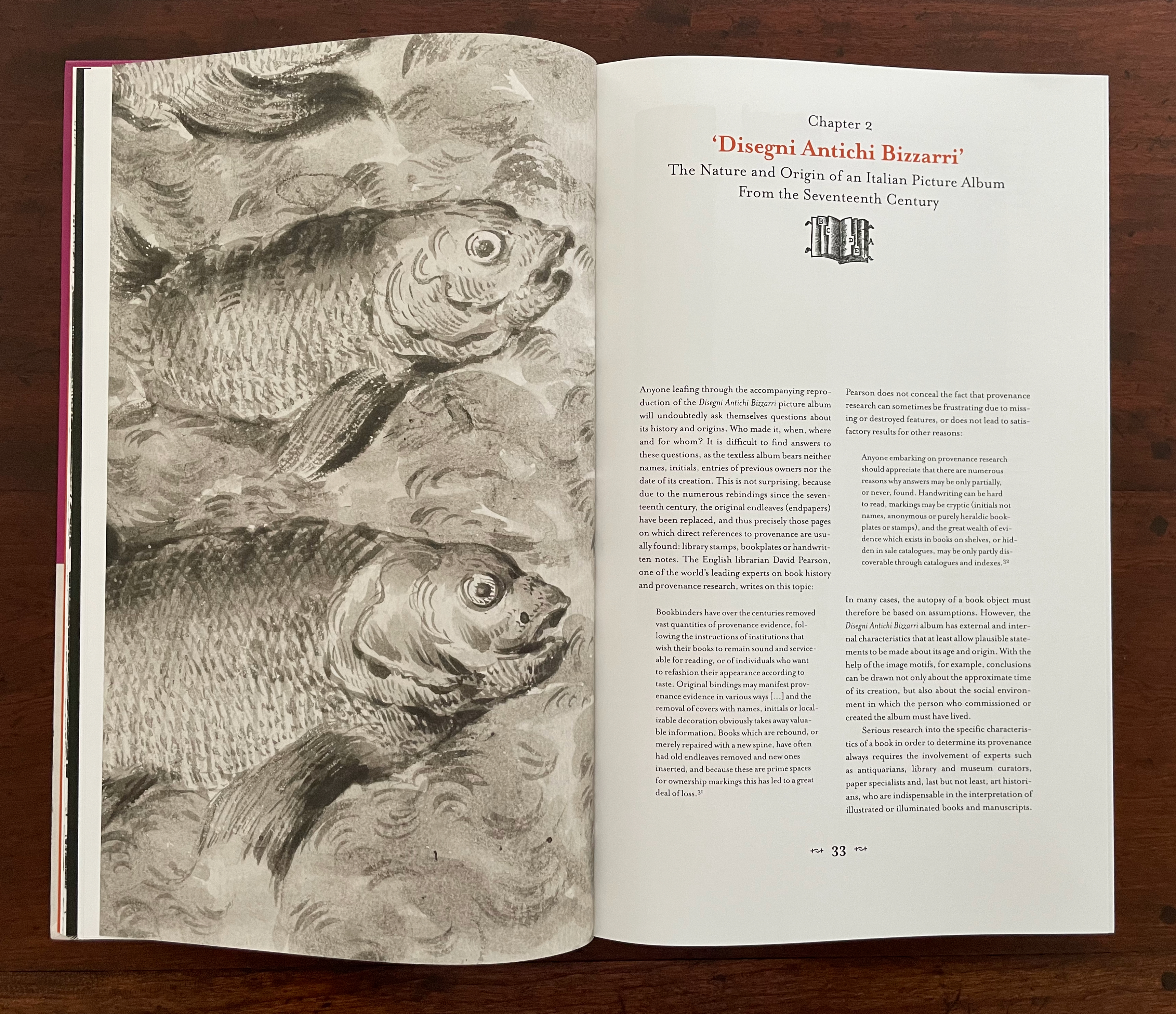
The second chapter delves into the history of Disegni Antichi Bizzarri itself and provides details on its collation, pagination, binding, geographical origins, dating, and provenance. The photography of the portfolio volume by Stauss and the Basel University Library is stunning.
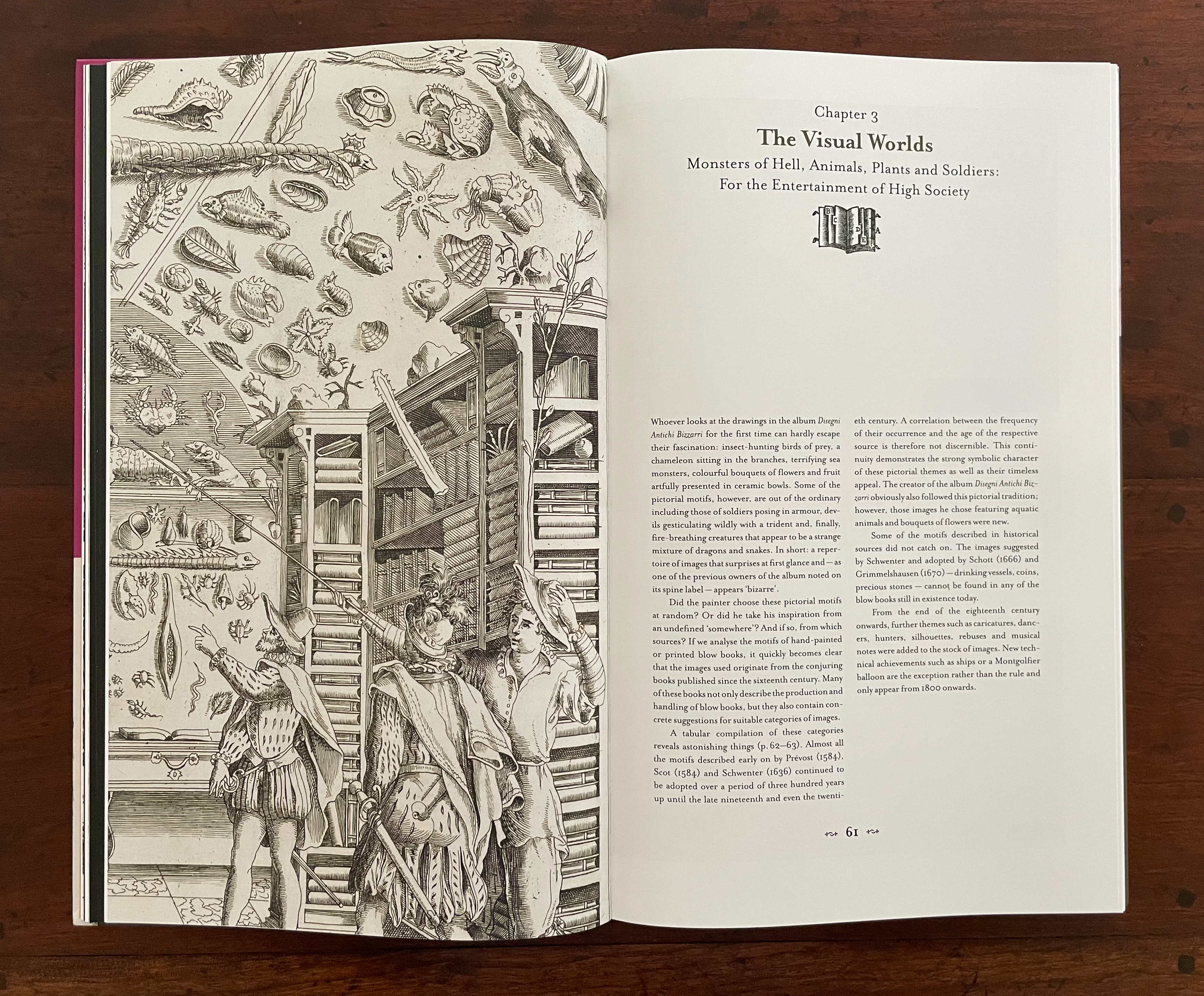
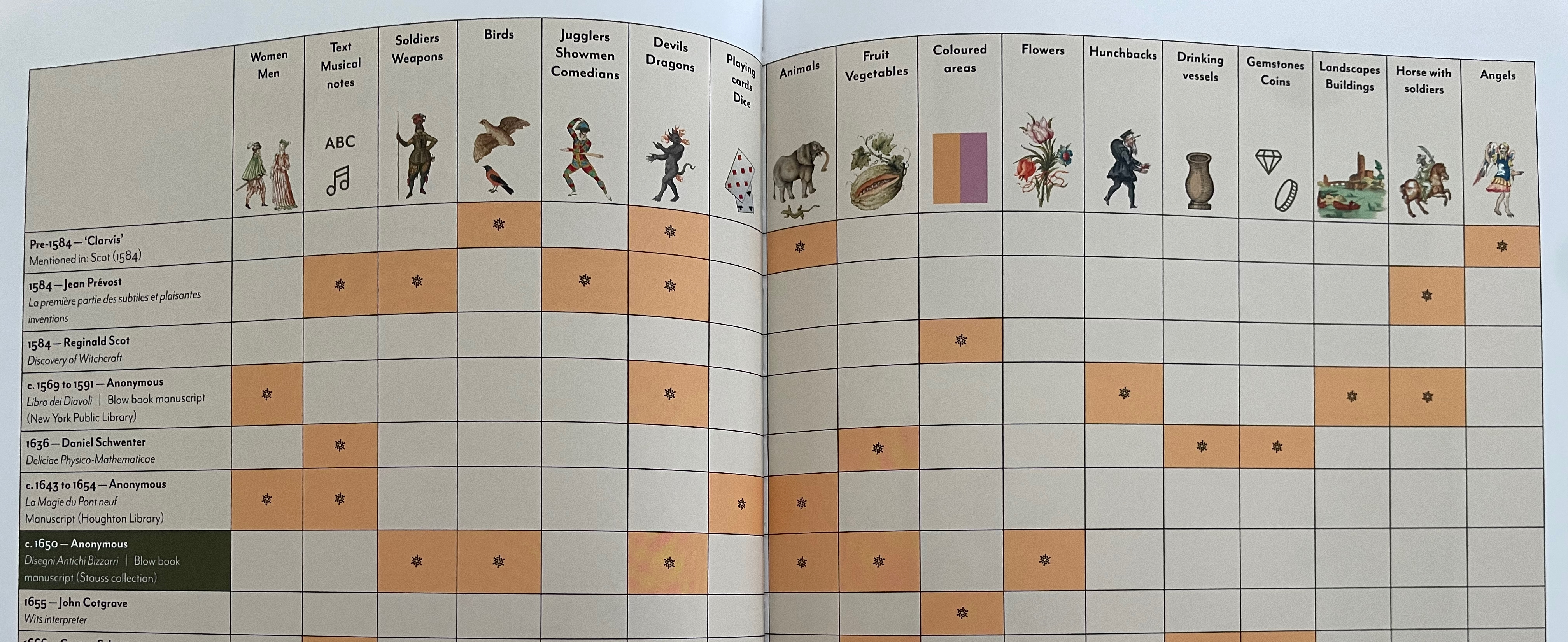
In the third chapter, Stauss rewards us with the results of his research into the pictorial motifs not only of Disegni Antichi Bizzarri but also of blow books pre-1670 up to 1870. Stauss provides visually convincing links of influence on the artist of DisegniAntichi Bizzarri from Hans Memling, Conrad Gessner, Ulisse Aldrovandi, Jan Jonston, Jacob de Gheyn II, Giovanni Battista Crescenzi, Giovanna Garzoni, Octavianus Monfort, Jean-Baptiste Monnoyer, Nicolas Robert, Guillaume Toulouze, and the album called Raccolta di disegni di animali (Modena, c. 1650).
The fourth chapter presents the history of blow books from 1550 through 1870 in greater detail and extensive illustration.
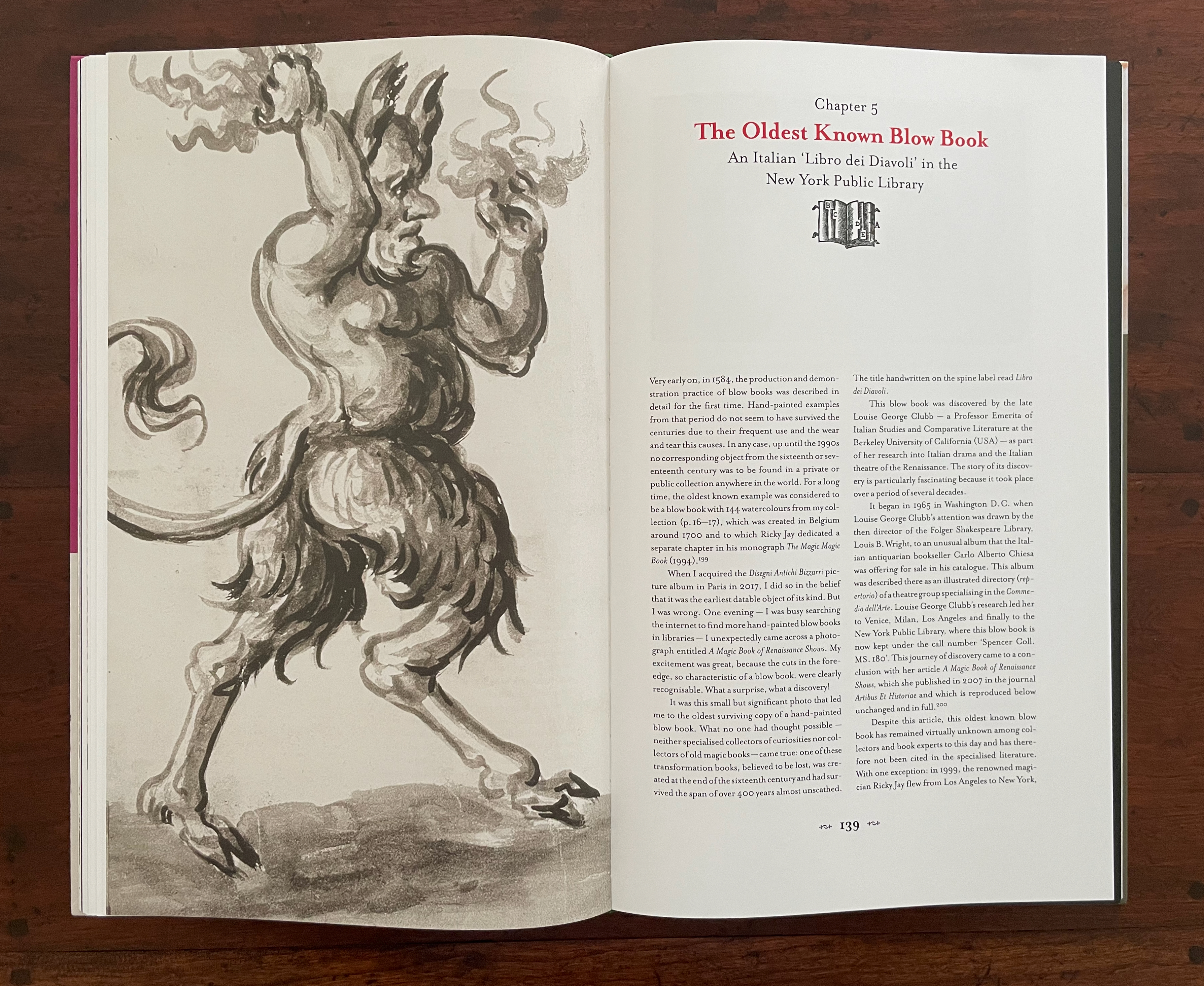
Adding to the definitive nature of Magic Metamorphosis, the fifth chapter delivers the surprise of over two hundred reproductions of the watercolor drawings from the oldest known blow book: Libro dei Diavolo (late 16th century), which resides in the New York Public Library. The images are accompanied by the entirety of Louise George Clubb’s essay that, similarly to Stauss’s rescue of Disegni Antichi Bizzarri, established the true nature of this work that had been misidentified for nearly half a century as a sampler of a commedia dell’arte troupe’s wares and repertoire.
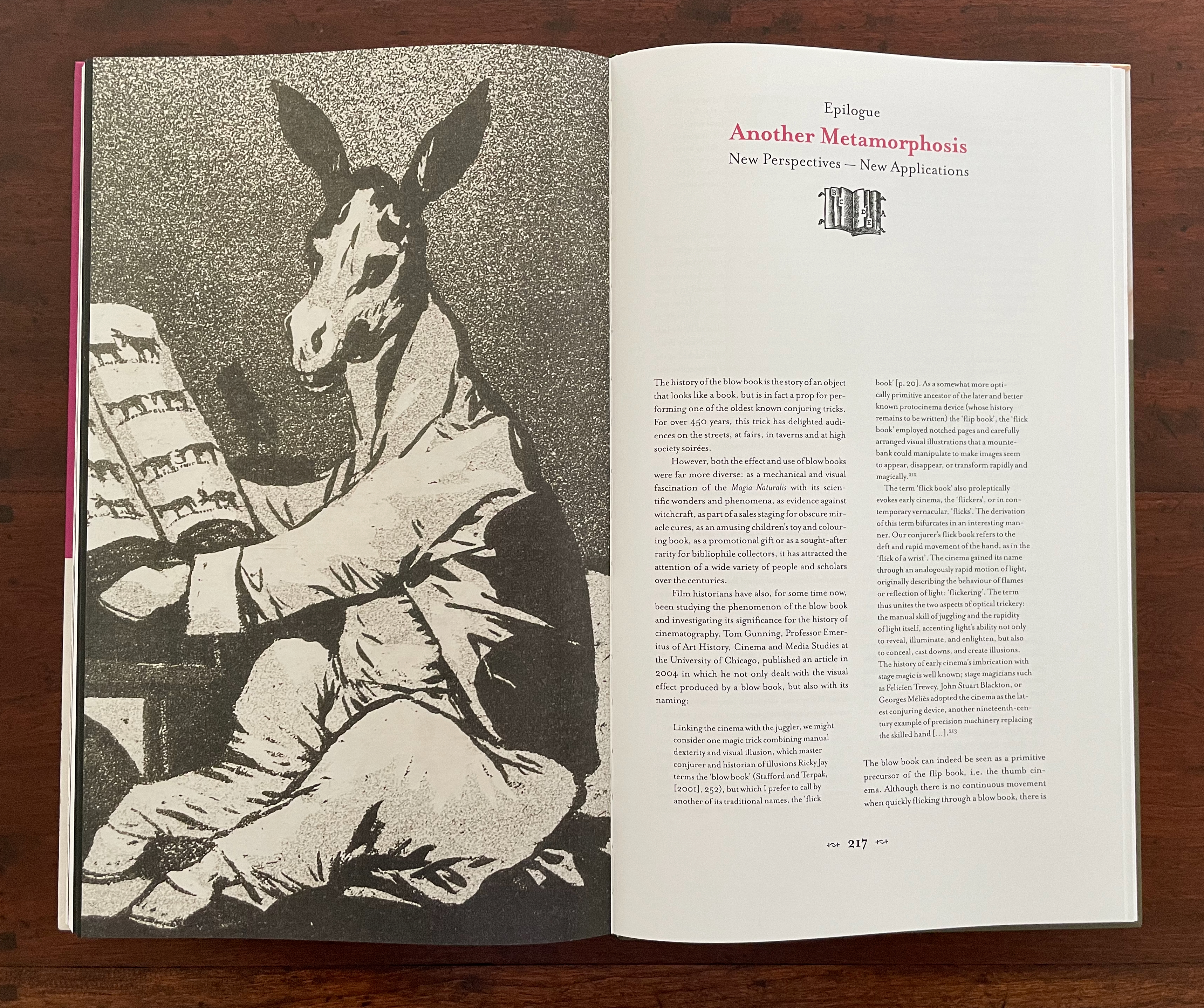
Stauss’s final chapter brings the blow book into the 21st century and his readers to the brink of enjoying his transformation of his discovered album into a facsimile working blow book. Although graciously giving ace-conjuror Ricky Jay the last word in the chapter, Stauss introduces his readers to the blow book’s possible transformation into an object of higher art.
Stauss notes that art historian Nancy Princenthal looked at Jay’s The Magic Magic Book and wrote in 1996 of the blow book from an art historical perspective, but he notes it only in passing. Princenthal was dismissive of any kinship between the blow book and book art:
The magic book has only an incidental kinship to elaborately structured bookworks built around accordion folds and gatefolds, cutouts and pop-up elements, whether historical or contemporary (as in the recent work of Scott McCarney, Clifton Meador, Margot Lovejoy, or Carol Barton). — Princenthal, p. 186.
Stauss underplays his alert observation of two 21st century blow books that are works that Princenthal’s roll-call of book artists would appreciate. The first is Horst Antes’ Flickbuch (2000); the second, Julie Chen’s & Keri Miki-Lani Schroeder’s Book of Hours (2021). Both of these works — as well as Jay’s two-volume set and the other serious contemporary blow book Stauss mentions, Ernst Strouhal’s Gespräch mit einem Esel (2019) — are in the Books On Books Collection. As with all of the other chapters, the photography illustrating these works is superb. They will entice institutional and individual collectors of artists’ books.
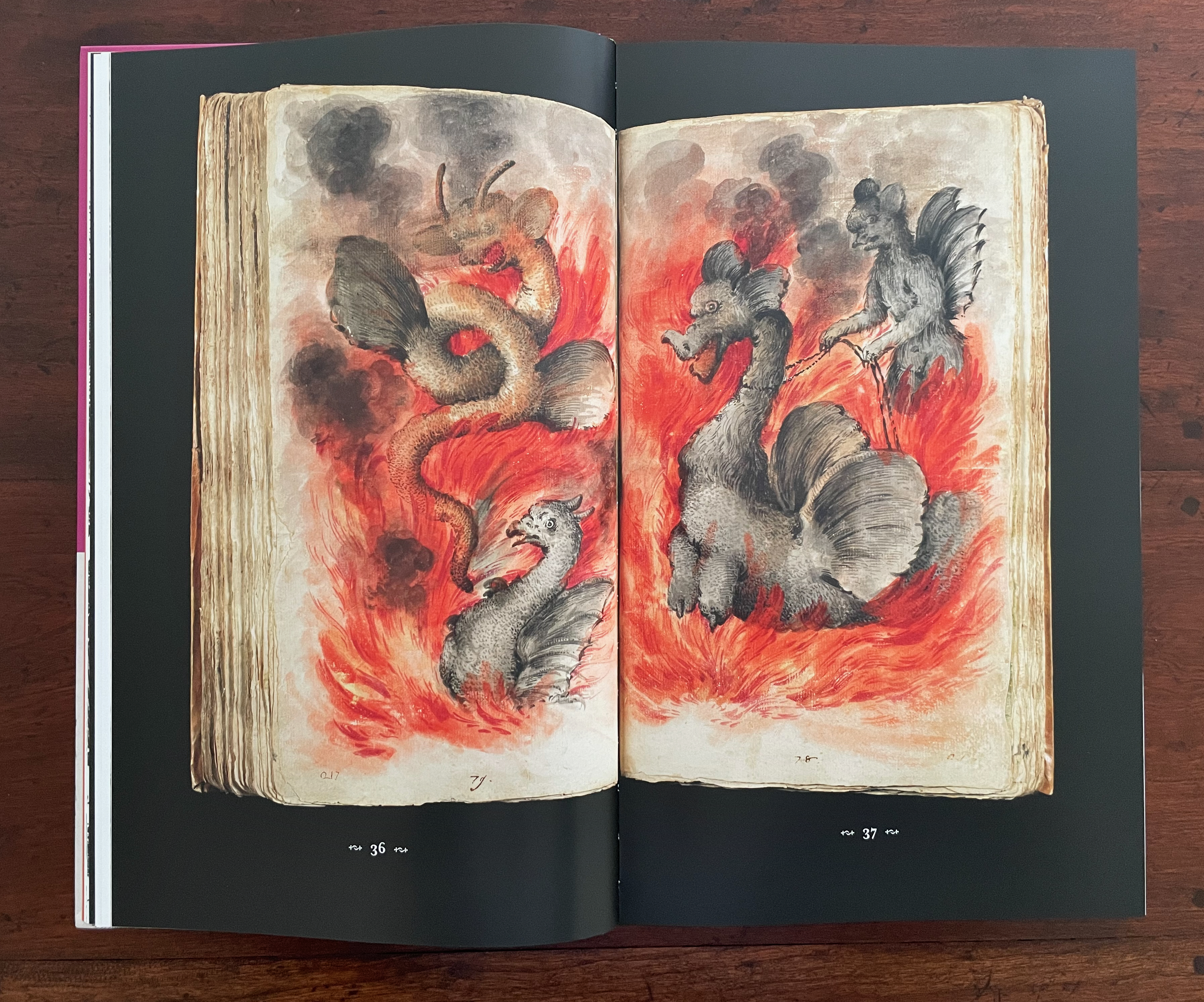
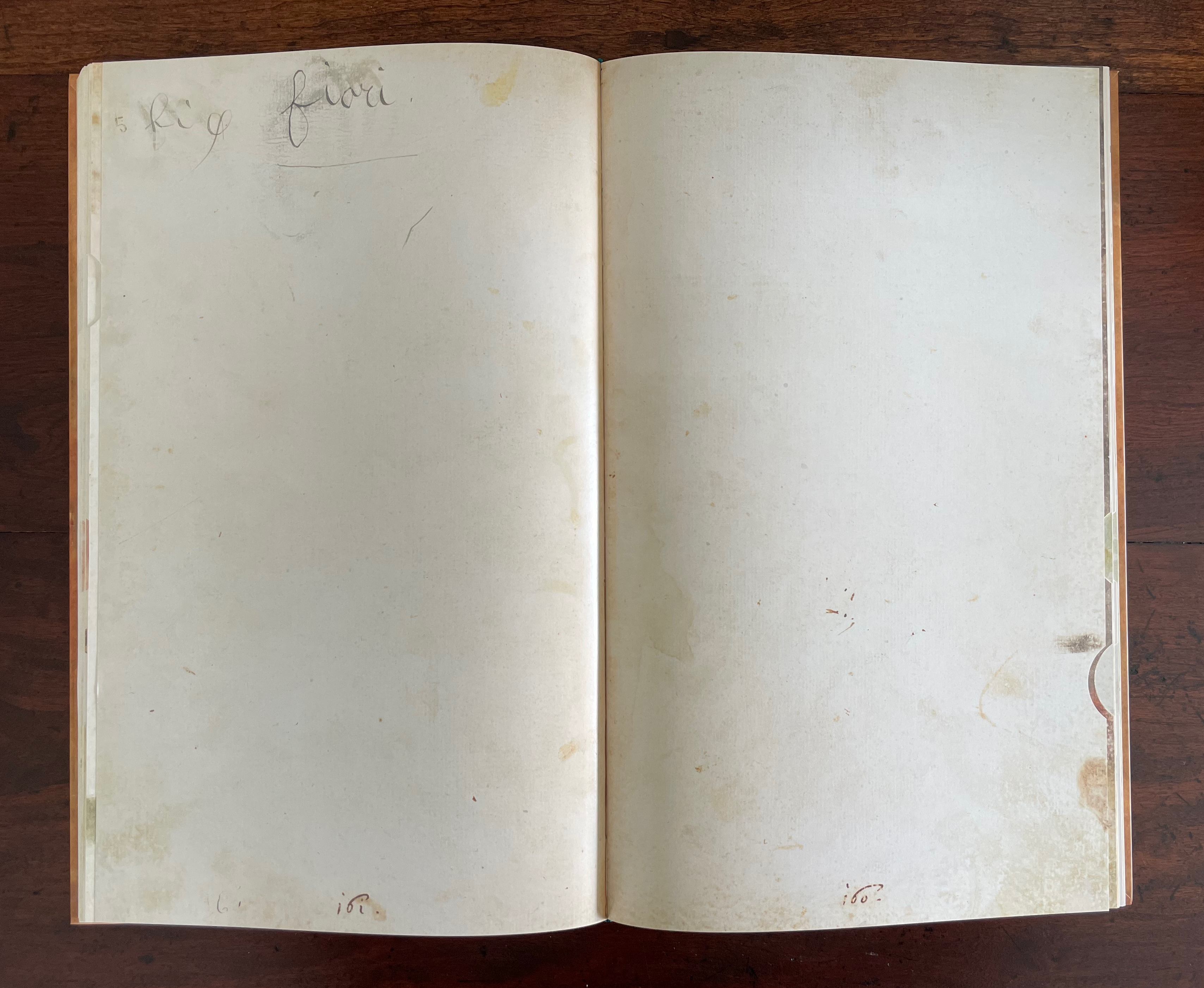
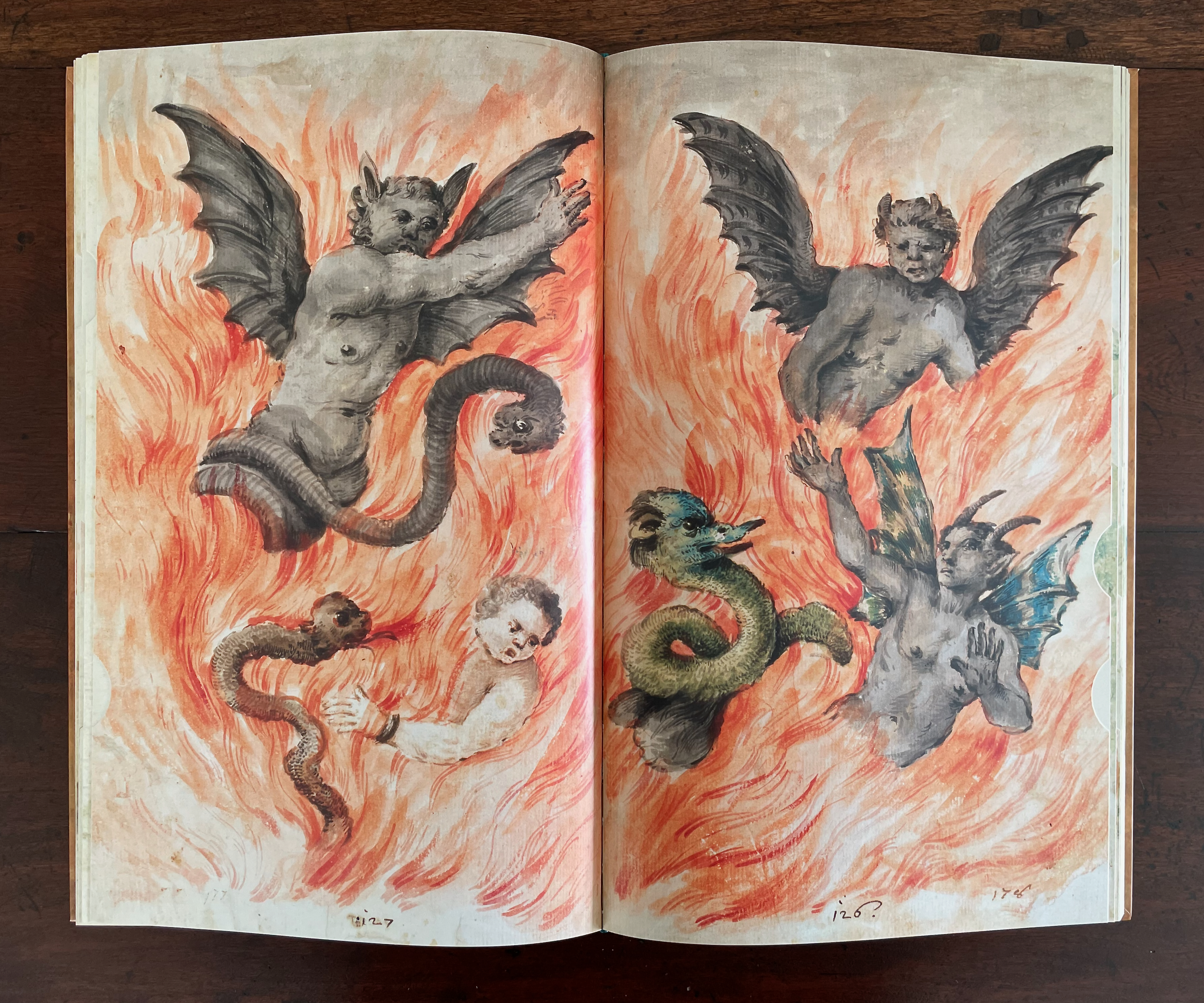
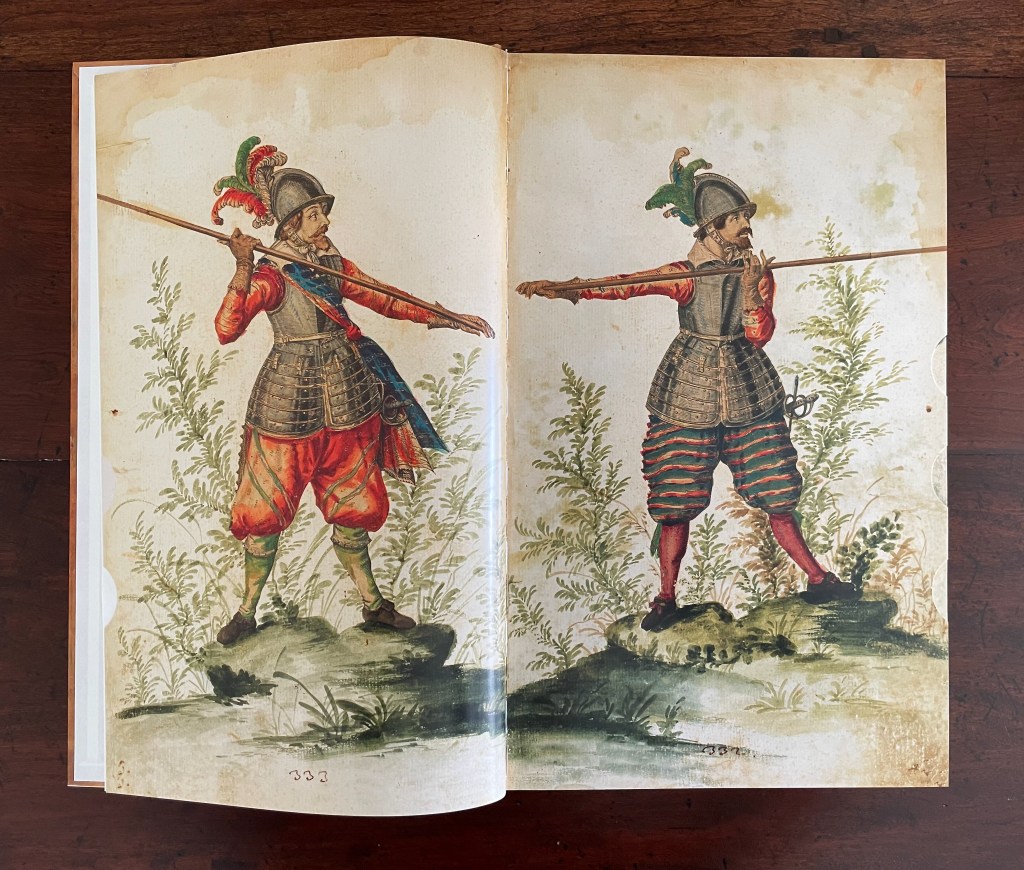
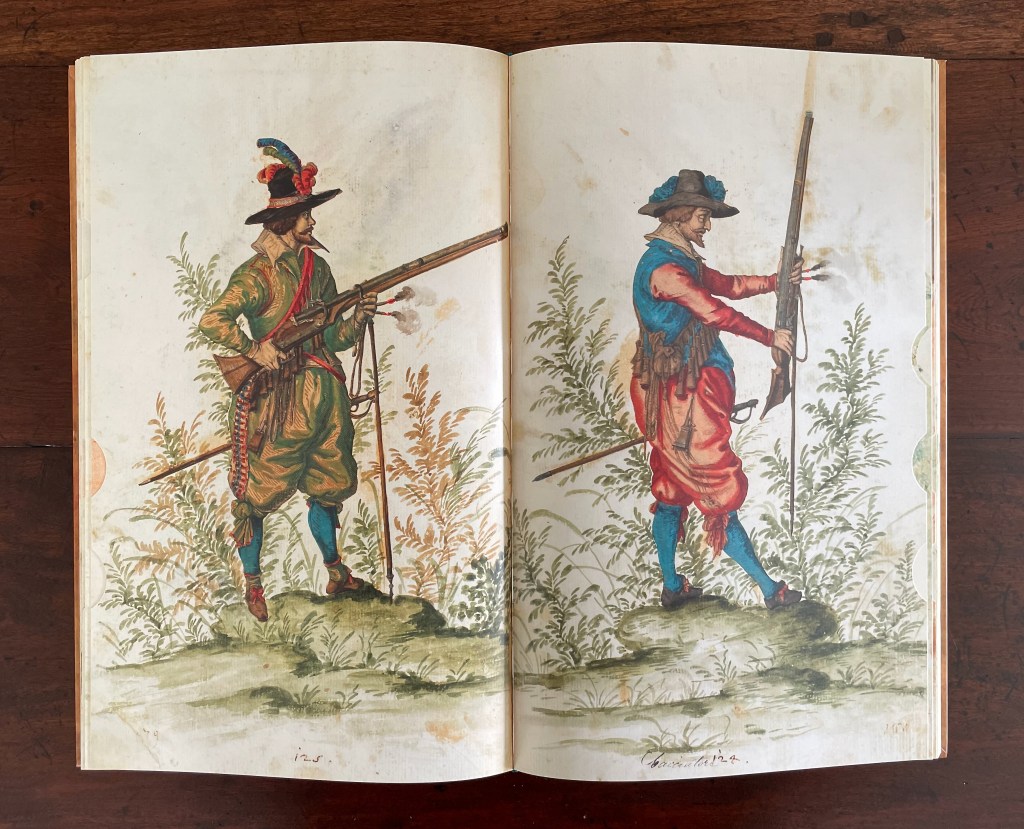
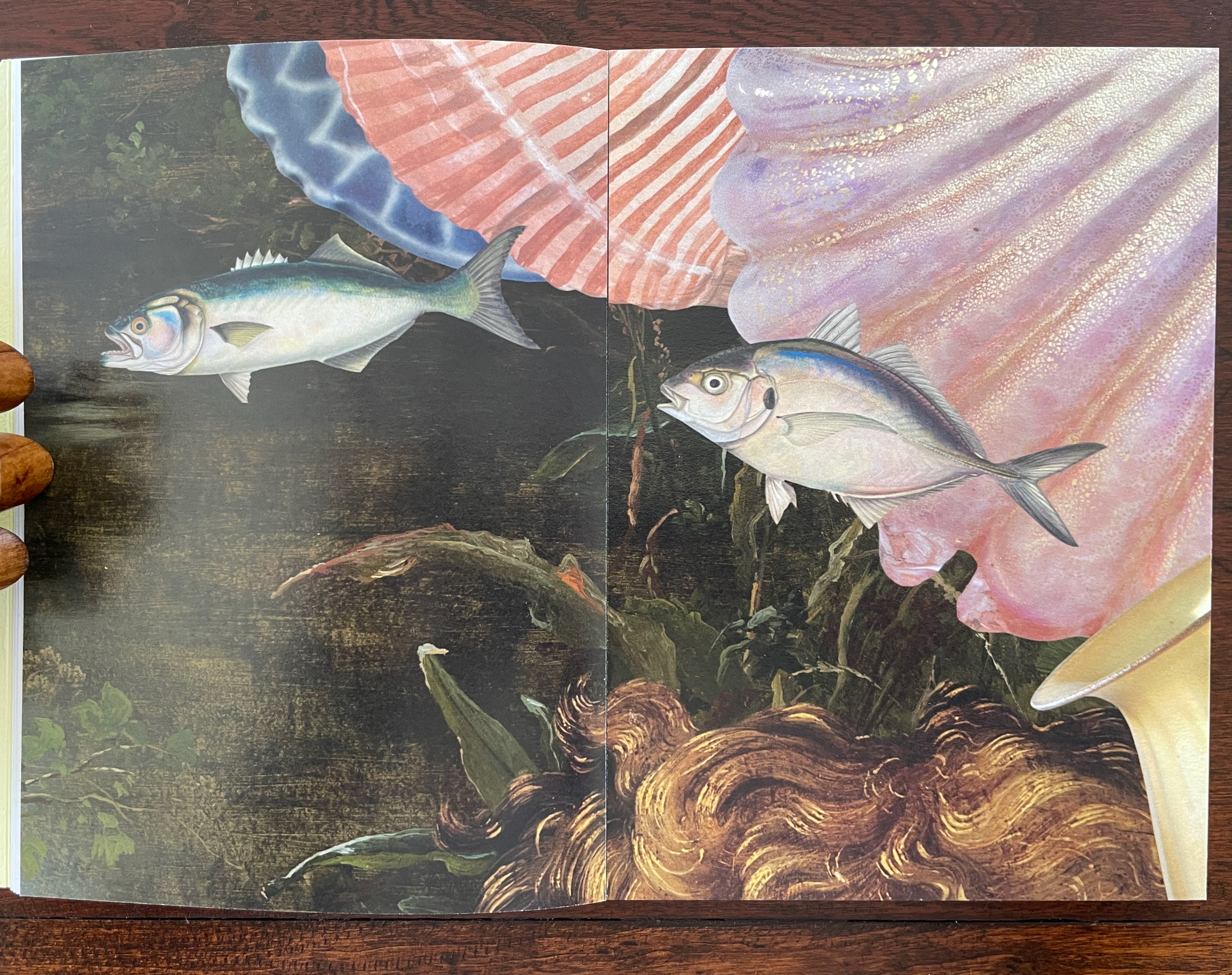
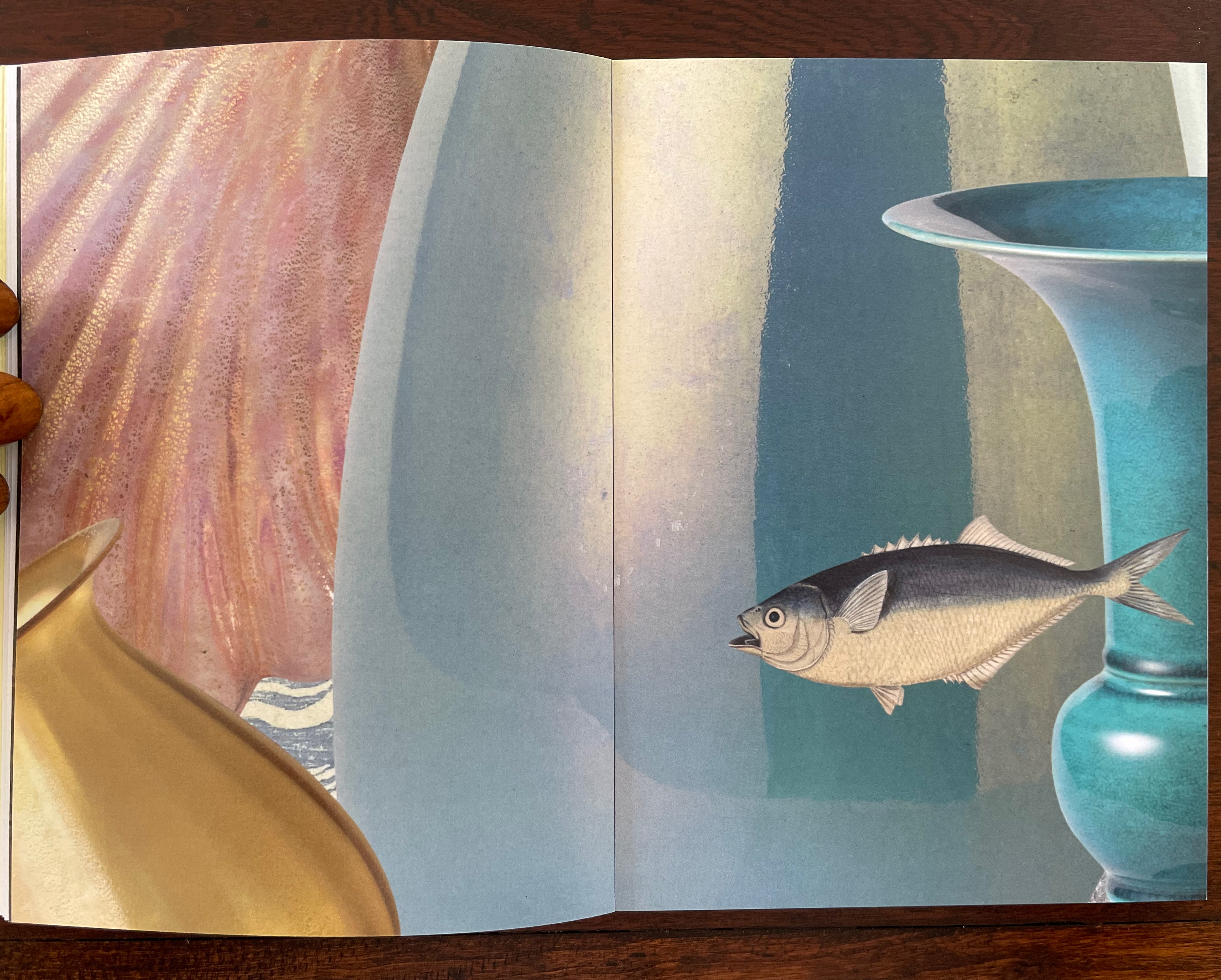
Including the spread of blank pages, there are eight transformations. Their printing order is 1) the spread of blank pages, 2) demons, 3) pike men and musketeers, 4) land animals, 5) birds and insects, 6) sea creatures, 7) fruit and vegetables, and 8) bouquets of flowers. Their order in performance would depend on the performer’s patter like that of Simplicius or Hopalong from the picaresque novel by Grimmelshausen, which Stauss excerpts in chapters two and four of the explanatory volume. Most likely, the performer would flip through the book showing only blank pages; then after blowing on the book, the performer might display spread after spread of bouquets of flowers; or with another magical breath, a variety of sea creatures.
Collections that specialize in art history and book history will be drawn by both the explanatory and facsimile volumes in this definitive work. Hopefully, book artists will find their way to it for inspiration toward many more magical metamorphoses.
Further Reading and Viewing
“Horst Antes“. 2 September 2026. Books On Books Collection.
“Ricky Jay“. 2 September 2026. Books On Books Collection.
“Nicholas Phillips“. 11 August 2020. Books On Books Collection. Phillips’ Egyptian Cards demonstrate a multiple image changes in a deck of cards.
“Ernst Strouhal“. In progress. Books On Books Collection.
Aling, Michael. n.d. “Publishing as Architectural Practice“. University of Greenwich. Architectural book designer Michael Aling put the “blow book” principle to work in Negative Equity: House Projects by Neil Spiller & Nic Clear. By adjusting the trim, Aling makes the book display only spreads with Spiller’s work if the codex is flicked through with the right thumb and only Clear’s spreads if flicked through with the left thumb. P. 6, Fig. 2.
Grimmelshausen, Hans Jakob Christoph von. 1981. The Singular Life Story of Heedless Hopalong. Translation by Robert Ludwig Hiller and John C. Osborne. Detroit: Wayne State University Press.
Schroeder, Keri Miki-Lani. 24 May 2025. “Smoke & Mirrors: Using Stage Magic in Book Arts“. American Bookbinders Museum, San Francisco, CA. Video of webinar. “Magicians have been using illusionary techniques for centuries to intrigue or trick audiences. Many principles of stage illusions are relevant to book arts: sequencing and timing, hiding and revealing information, and curating an experience for the audience. In this talk I will discuss the connections between stage magic and illusionism to book arts. We will start with an overview of historical tricks and devices focusing on structures such as the magic blow book, magic wallet, and volvelles. I will reveal tricks of the trade and how I have researched and incorporated elements of magic to conjure creative content in my work and collaborations.”
Credits for Photographs in Magic Metamorphosis:
The page numbers given below refer to the pagination in Stauss’s Magic Metamorphosis:
[8]: Turgo map of Paris (1739): akg-images (AKG3090703).
[14]: From Huber, Volker & Antes, Horst. 2003 (p. 8). Fresh Breath on the Blow Book. Humble (Texas).
29: akg-images (AKG 573051)
60: University Library Basel (UBH HA II 2 Folio).
[100]: Houghton Library, Harvard University, Cambridge, Massachusetts (MS Typ 530, p. 276)
116: Baden State Library, Karlsruhe (KK 408).
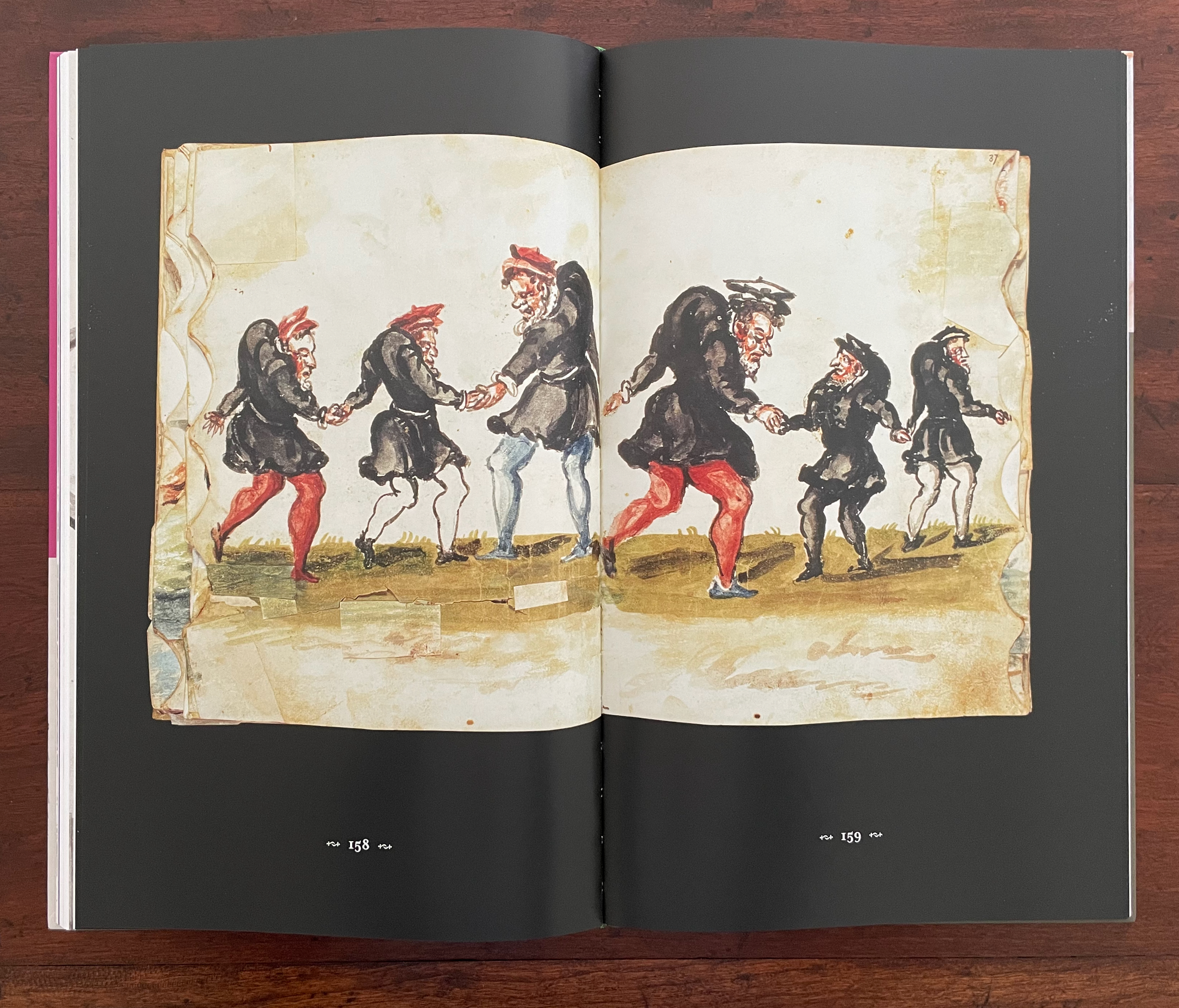
138, 158–159: New York Public Library (Spencer Collection MS. 180).
[216]: Zurich University of the Arts (9900-102).
Photographs from the original album Disegni Antichi Bizzarri: University Library, Basel (Switzerland)
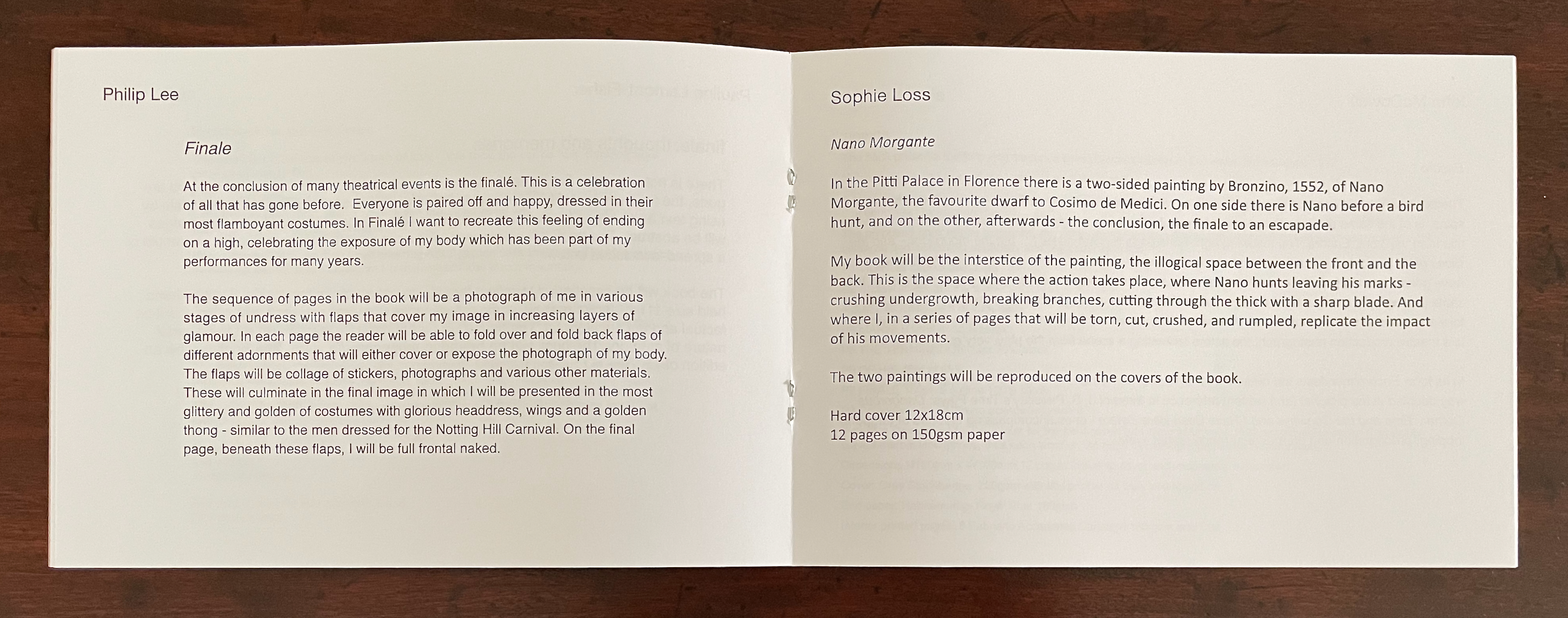
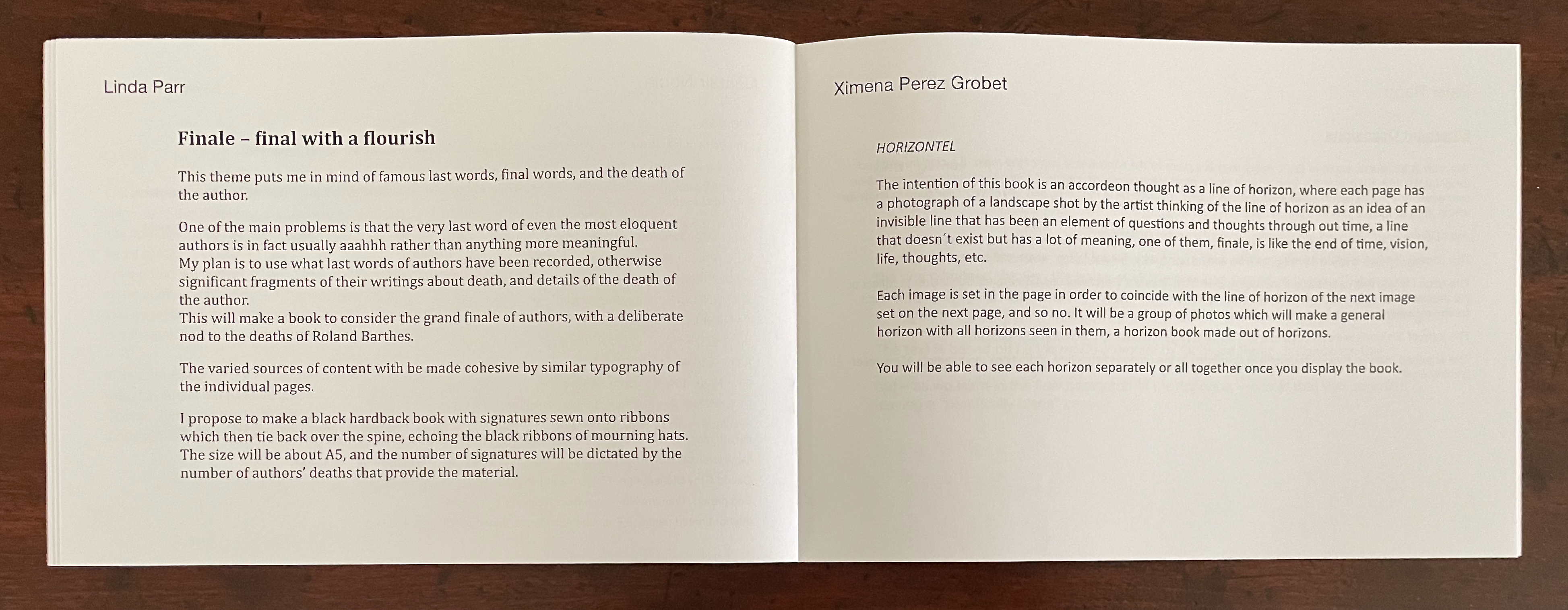
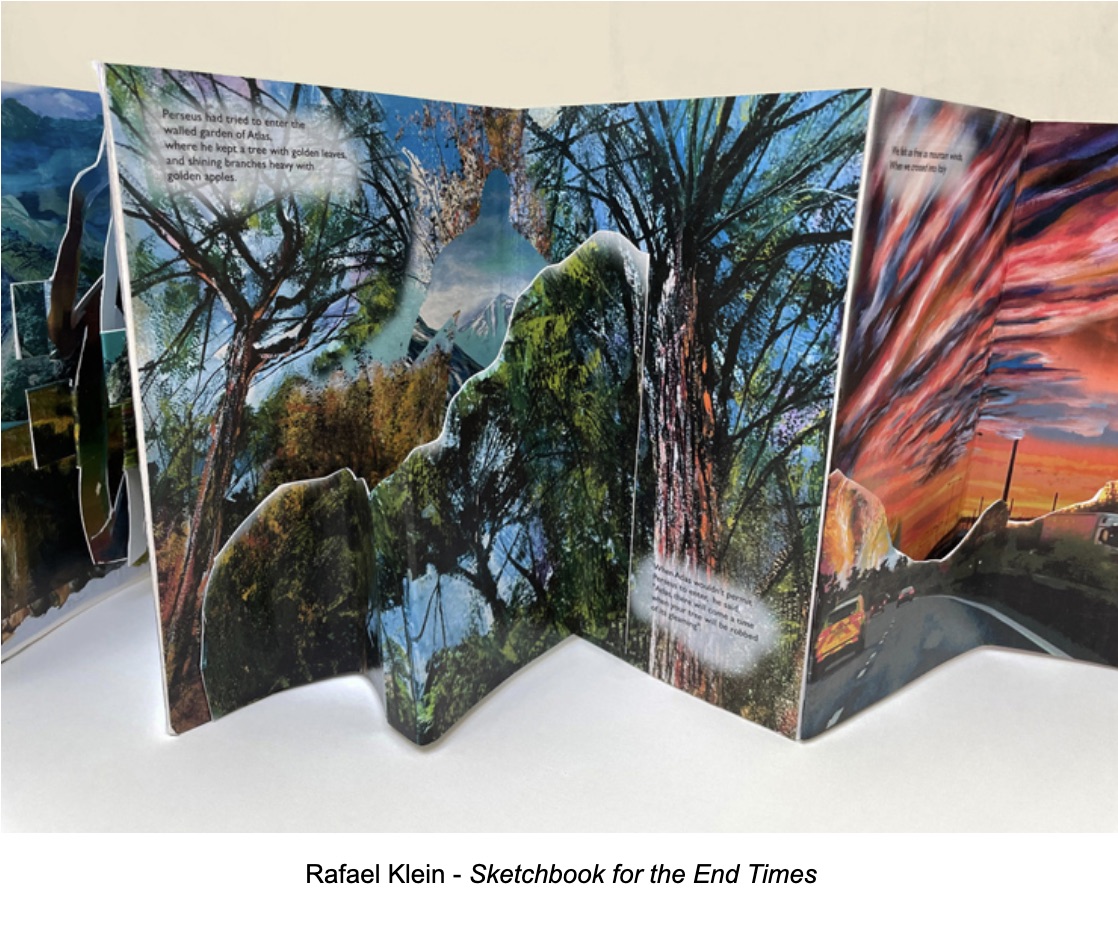
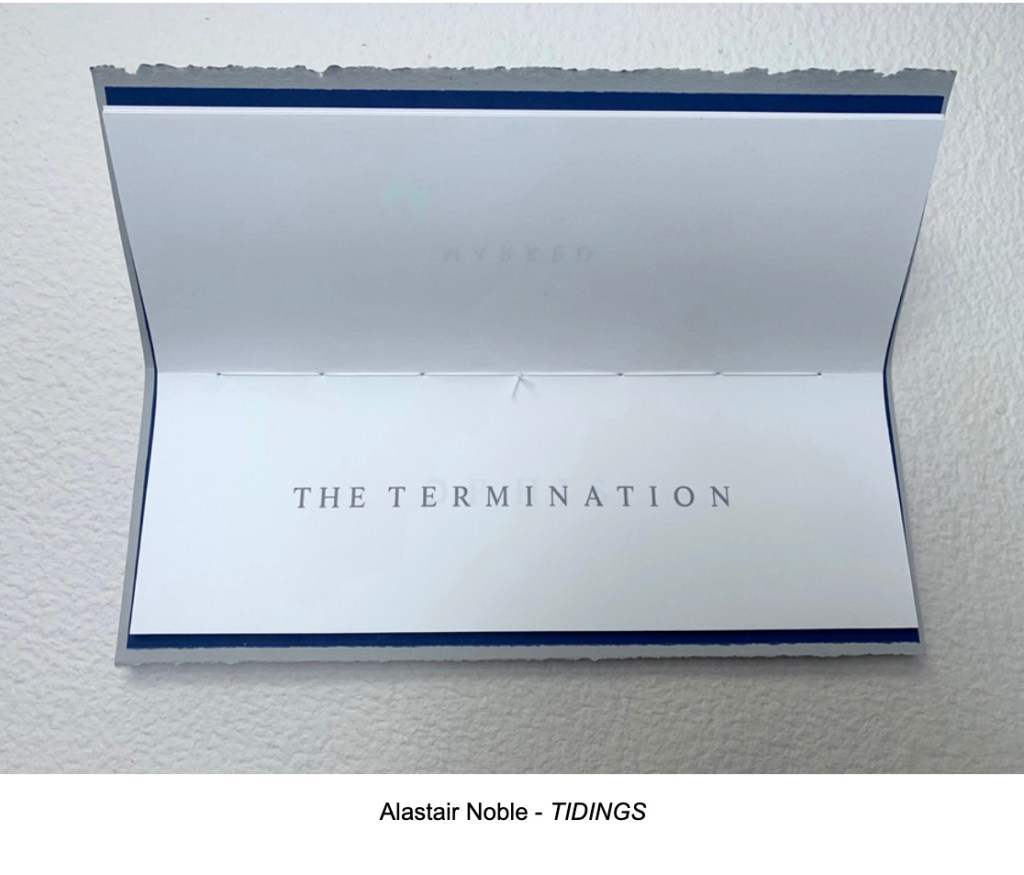
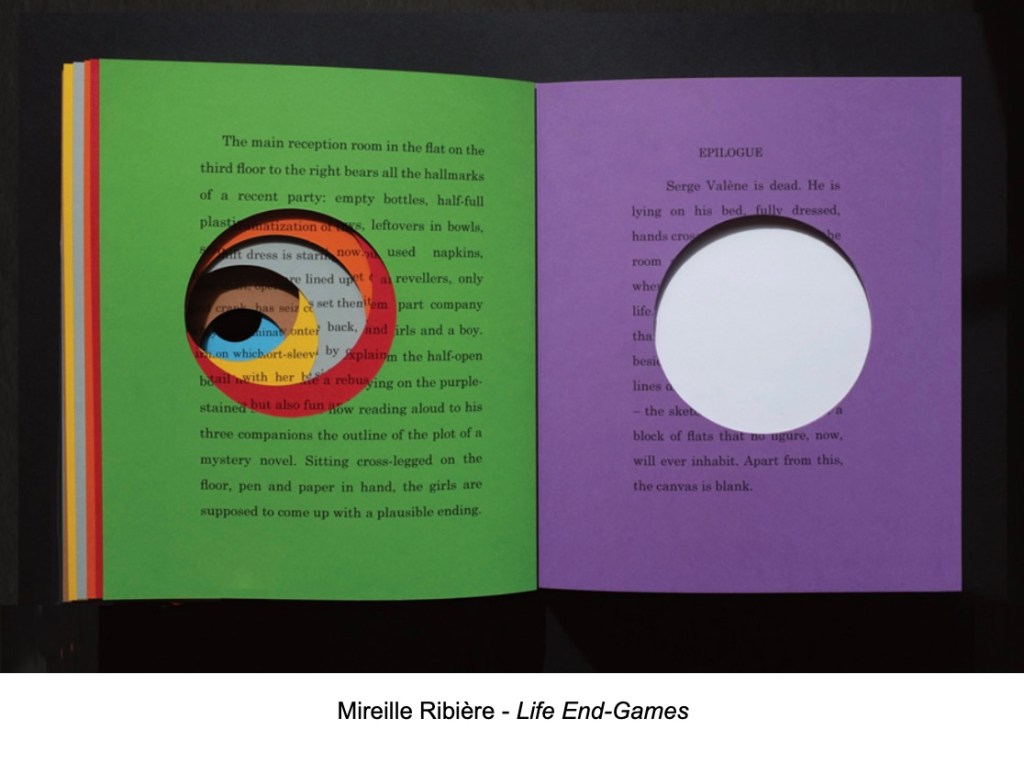
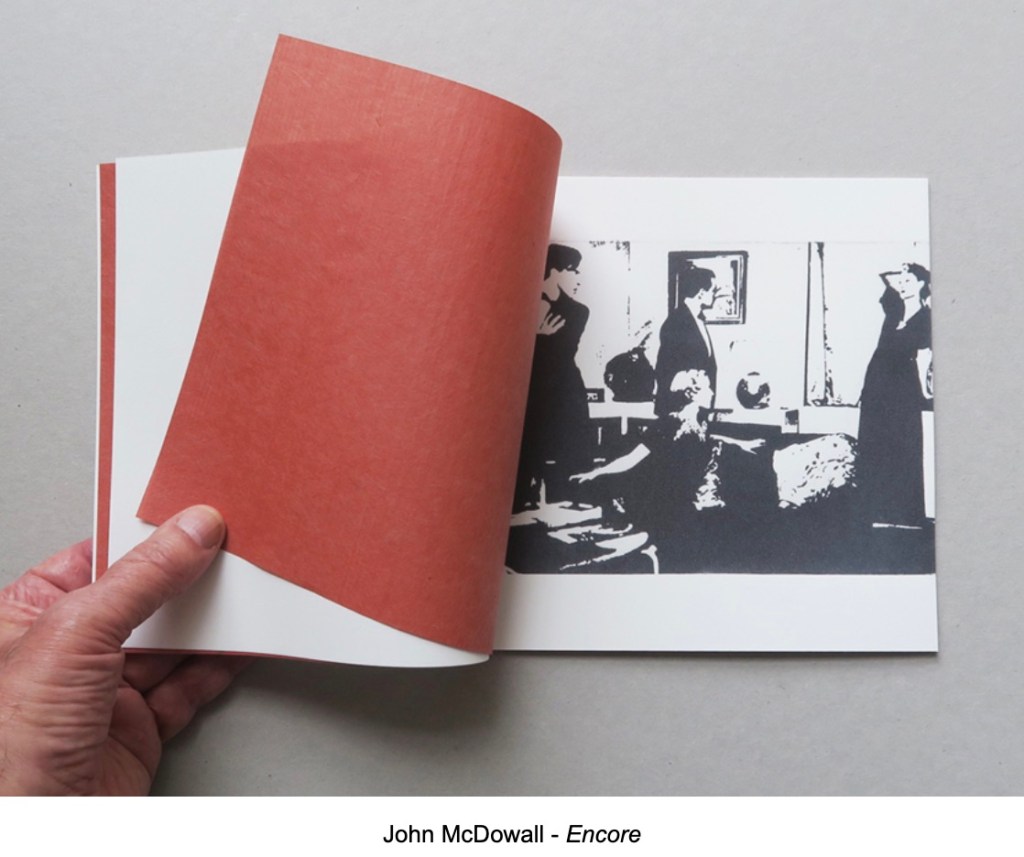
AMBruno’s last project Finale proved to be a fertile prompt for 19 artists and their 18 works. I thank Sophie Loss and John MacDowall for the fun and honor of reviewing the entries.
When I consider an artist’s book for acquisition or inclusion in an exhibit, I want it to make me read with my eyes, hands, and mind. Following the text is not enough. It should demand that I see the shapes of letters, words, images, pages, and the entire work itself. Turning a page is not enough. It should demand that I handle, unfold, rotate, manipulate – feel it. Mentally deciphering the work’s signs is not enough. I want it to make me think – about how the shape, material, and making work together – about how artists’ books before this one may be present – about how other literary, visual, sculptural, architectural, performative, or even digital art may be present.
So, you can appreciate what a challenge it was to select works on the basis of a few sentences or paragraphs describing what the artists planned to submit.
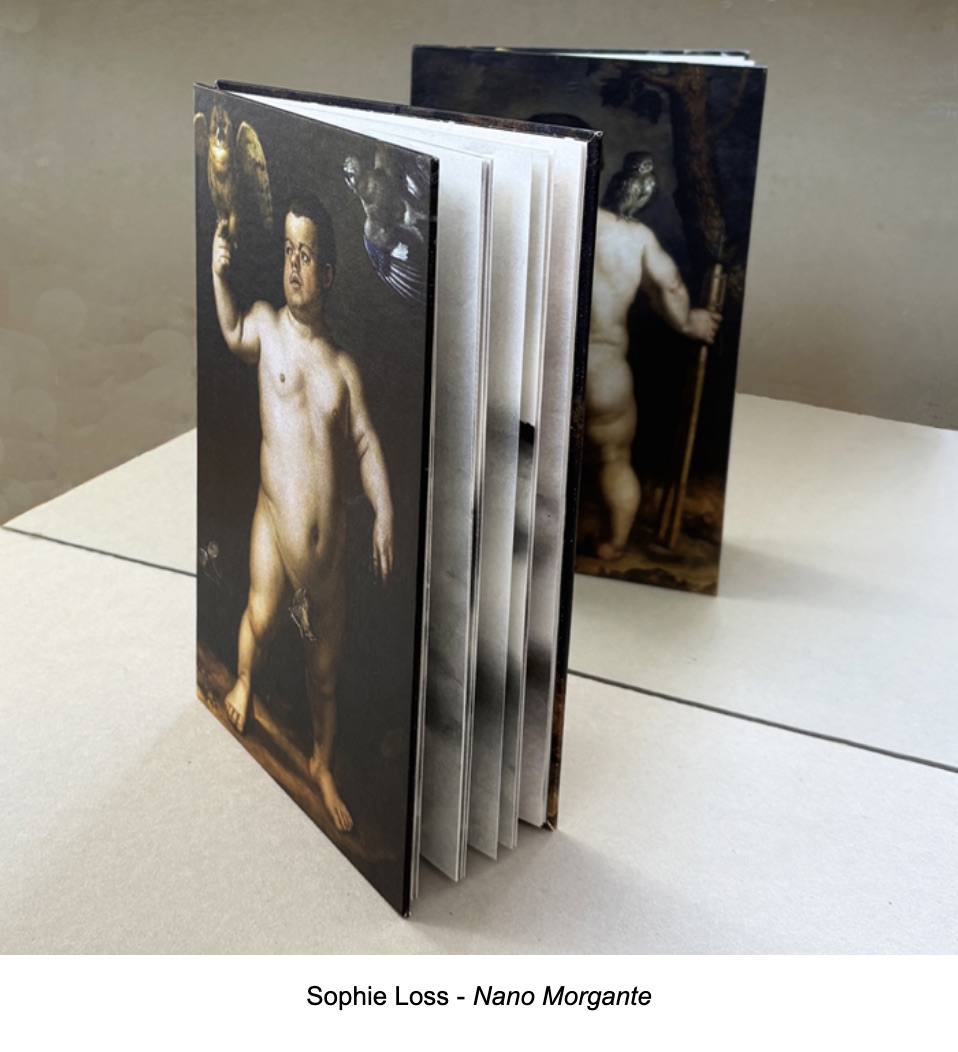
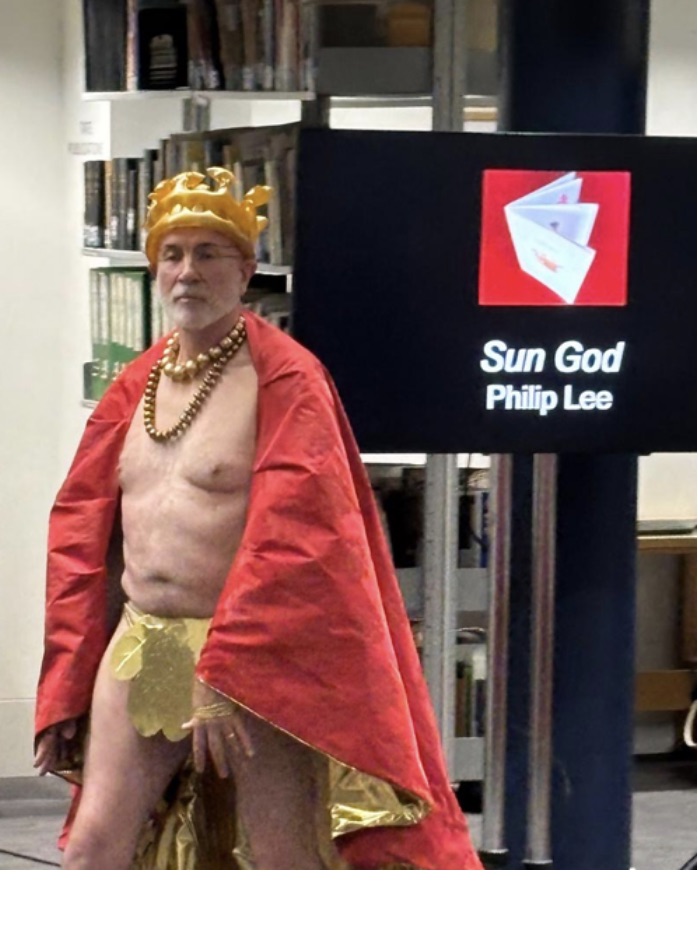
Now add that the proposals’ ranged from simple pamphlet fold to intricate concertina pop-up and to piano-hinged sculpture, from relief prints to photographic prints, from a Renaissance nude to a carnivalesque Full Monte, from entirely text to entirely blank, and from celebration to lamentation and back.
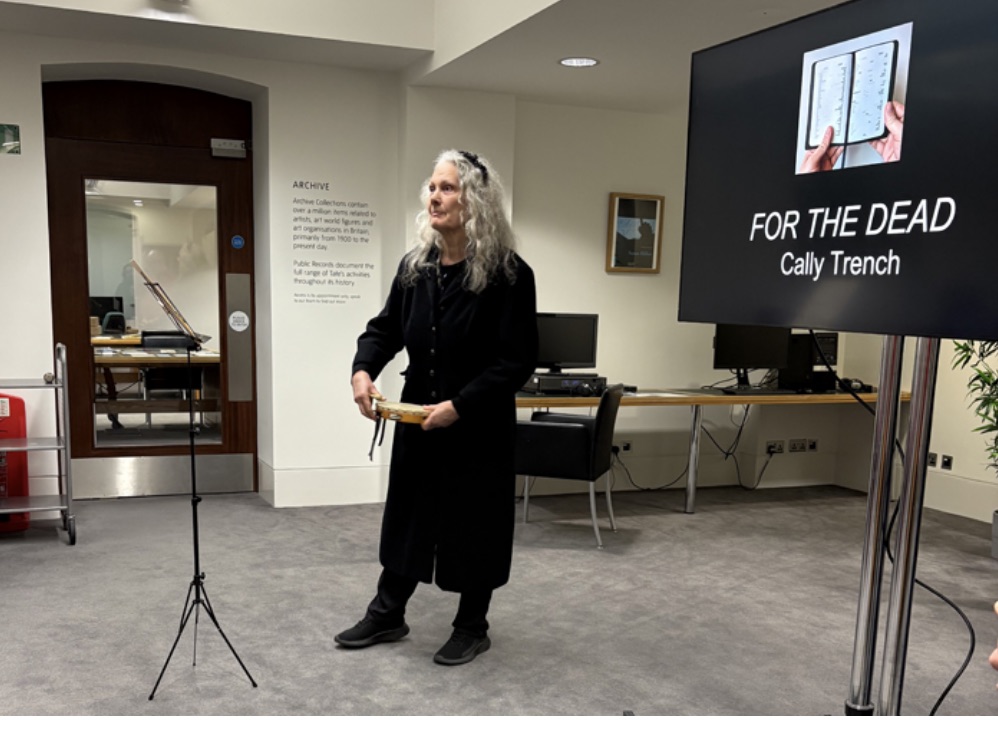
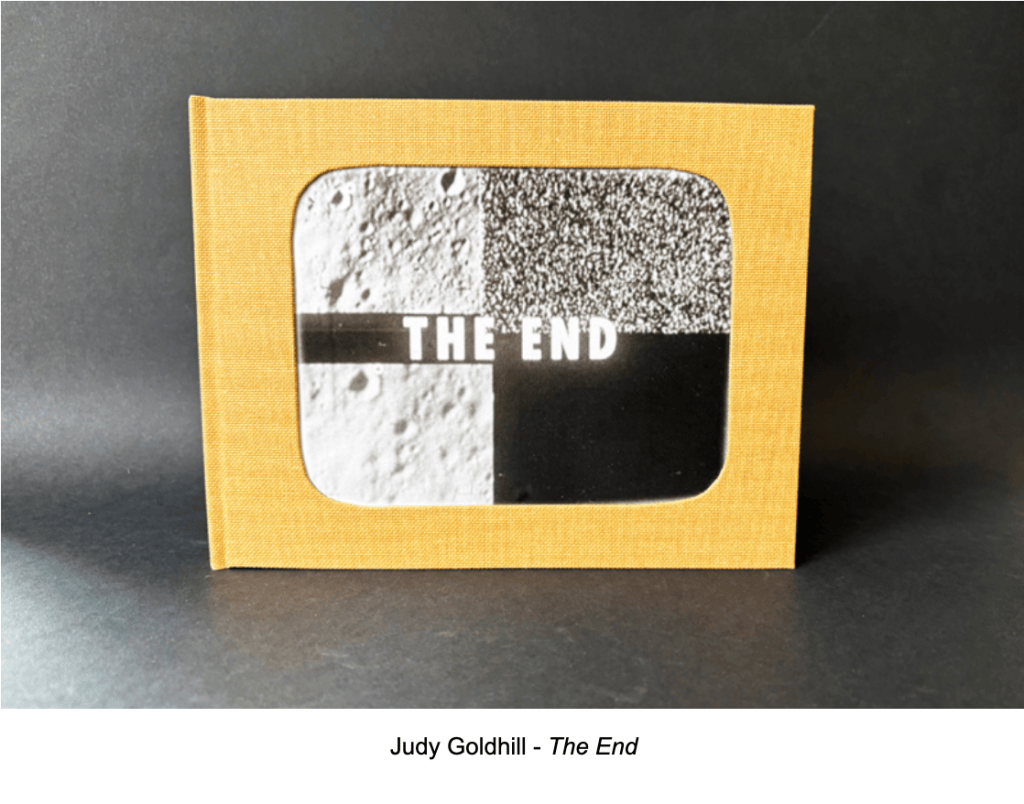
Now add their settings from fireworks displays, theatrical productions, the Book of Common Prayer’s Order for the Burial of the Dead, book burnings, a mythic road trip, and a televised lunar crash.
And then add the range of literary and other media influences – from the Greek myths, Bronzino, John Donne, James Joyce, Heinrich Heine, Georges Perec, J.B. Priestley, to the evening television news.
As I mentioned, it was an honor to be tortured with the challenge of imagining what the artists intended. On seeing the final results with Sophie and John via Zoom, my imagination was much relieved and delighted.
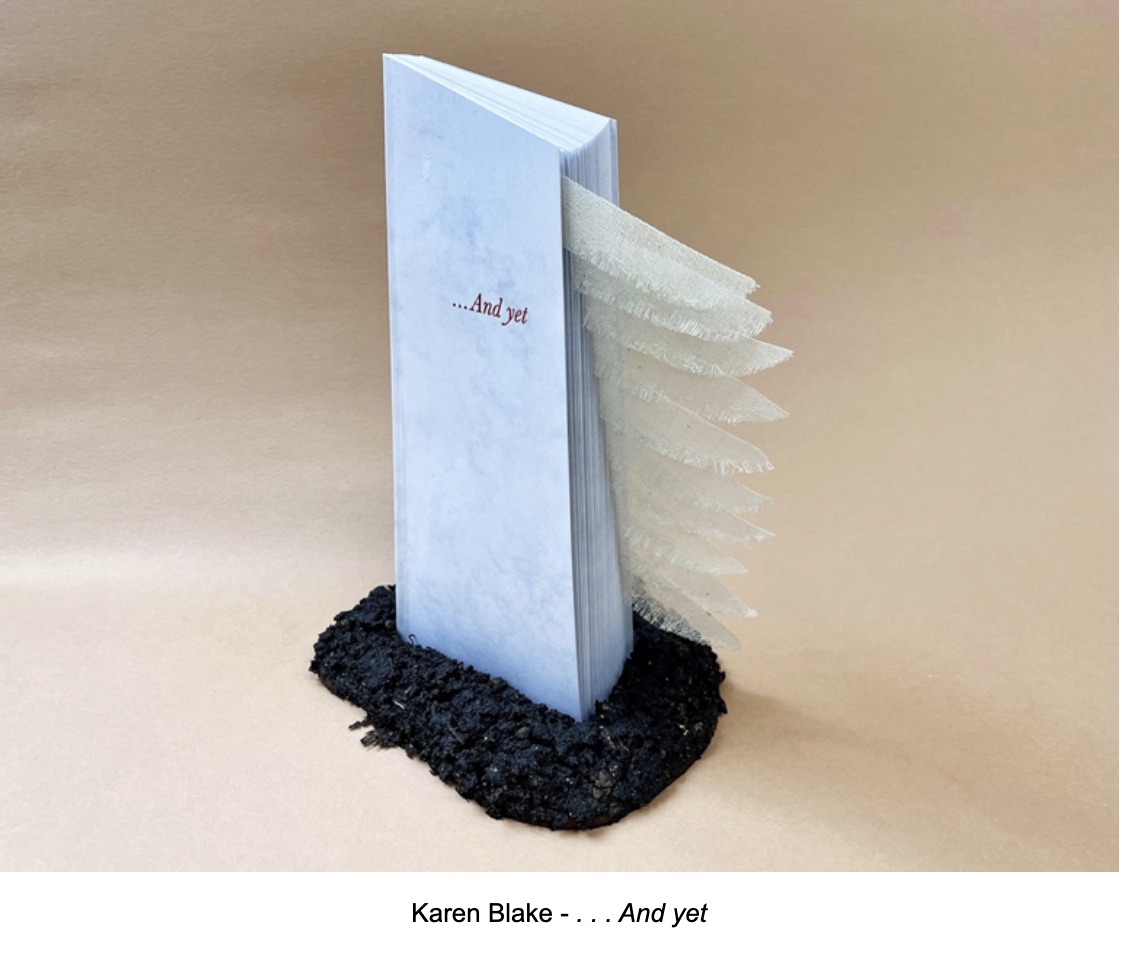
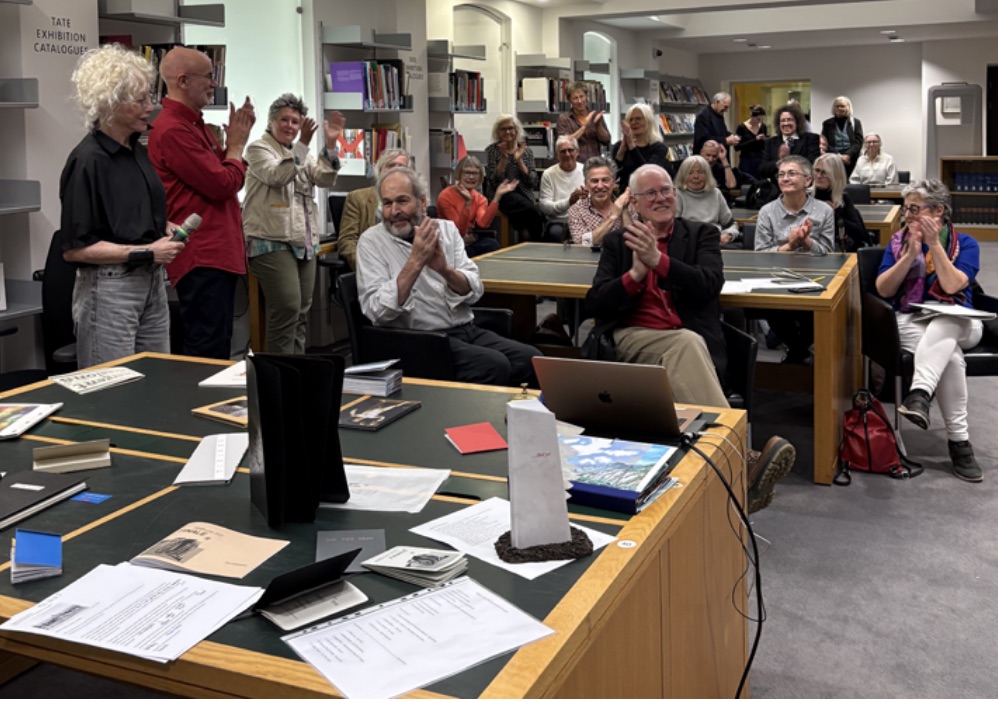
As I watched the artists present their works and the audience inspect the Finale selections, look hard and long, touch them, and think slowly, I was convinced of their delight as well.
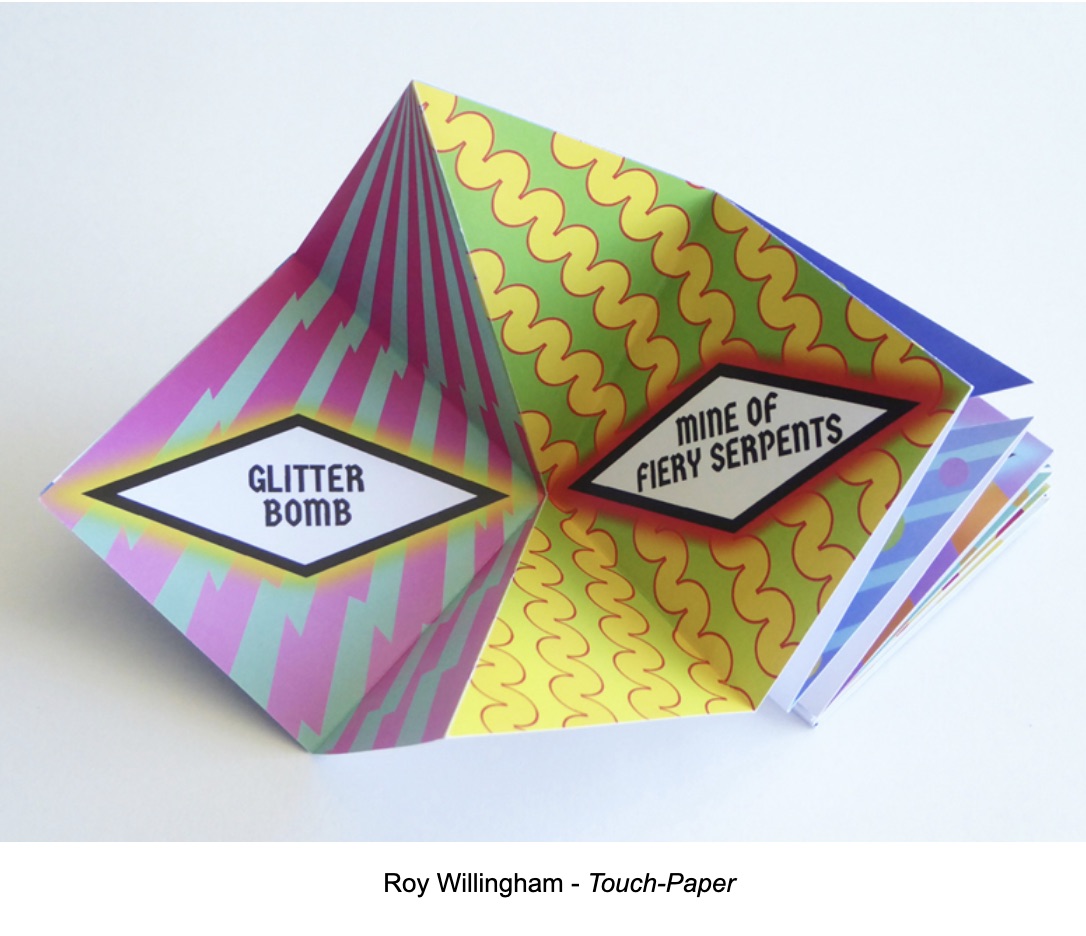
As a group, the entries represented almost every variety of artist’s book I have encountered. One form missing though was the un-openable book. I feared that someone might propose a tombstone carved in the shape of a book which would weigh like a lump on the proceedings. There was, however, a book that took on the shape of a tombstone but seemed to take flight when opened. And although among the entries there were mourners for the final AMBruno project, there were celebratory memorializers as well. In fact, as Sophie and John reviewed the arrivals alphabetically for me by Zoom, I laughed that chance ended our session with Roy Willingham’s Touch Paper, a wonderfully structured diamond-shaped concertina whose folios each burst open to name a traditional English firework and combine to make a larger diamond.
How fitting that the finale of AMBruno’s Finale turns out to be a firework display that should prompt not only oohs and aahs but also a round of applause for Sophie Loss and friends for the 16 AMBruno projects over the past 14 years.
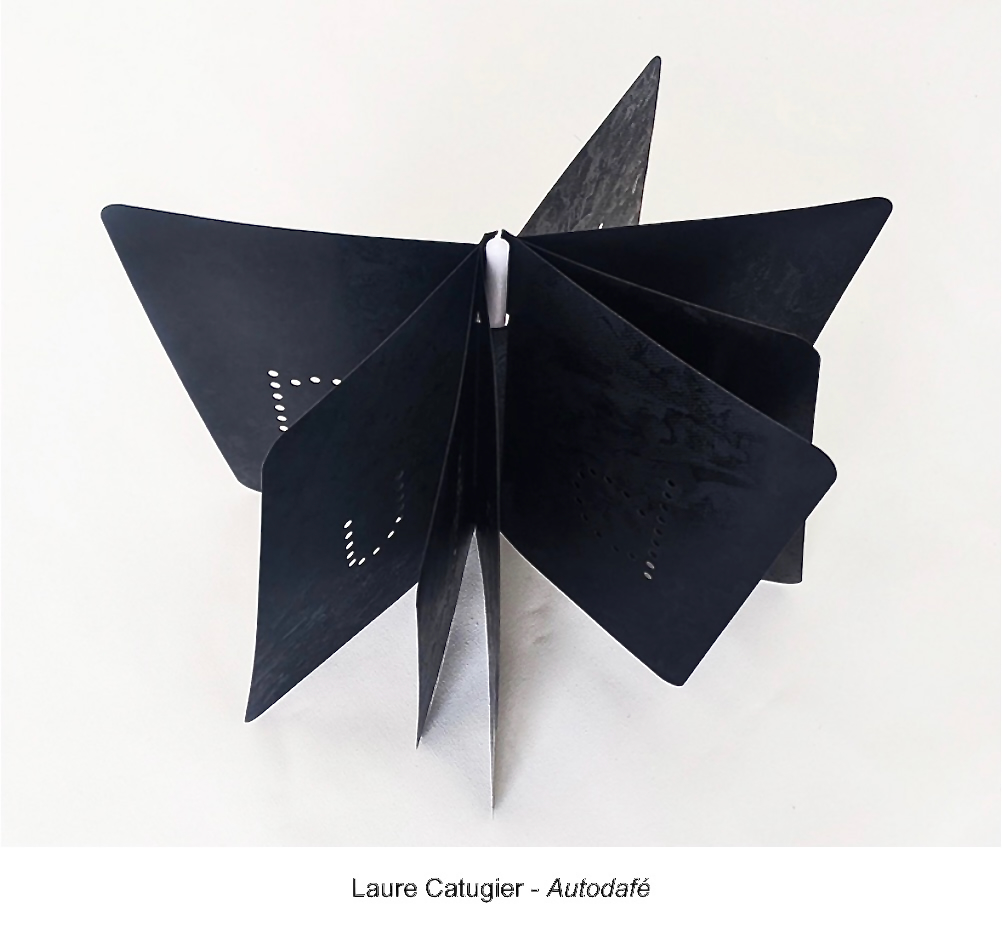
The nineteen Finale artists were: Karen Blake, Laure Catugier, Claudia de la Torre, Judy Goldhill, Susan Johanknecht & Katharine Meynell, Rafael Klein, Pauline Lamont-Fisher, Philip Lee, Sophie Loss, John McDowall, Alastair Noble, Linda Parr, Ximena Pérez Grobet, Peter Rapp, Mireille Ribière, Cally Trench, Maria White, and Roy Willingham. Visit the AMBruno siteand shop for additional views of the works.
Photography: Books On Books Collection, Sophie Loss, Judy Goldhill, Philip Lee, DDK, Julie Jones, Julia Davy-Brown, and Steve Davy-Brown.
I see that one way or another I keep circling around the idea of an interdependence between the unwritten world and the book I should write. This is why writing presents itself to me as an operation of such weight that I remain crushed by it. I put my eye to the spyglass and train it on the reader. Between her eyes and the page a white butterfly flutters. Whatever she may have been reading, now it is certainly the butterfly that has captured her attention. The unwritten world has its climax in that butterfly. The result at which I must aim is something specific, intimate, light. — Italo Calvino. If on a Winter’s Night a Traveller (Vintage Classics) (p. 172).
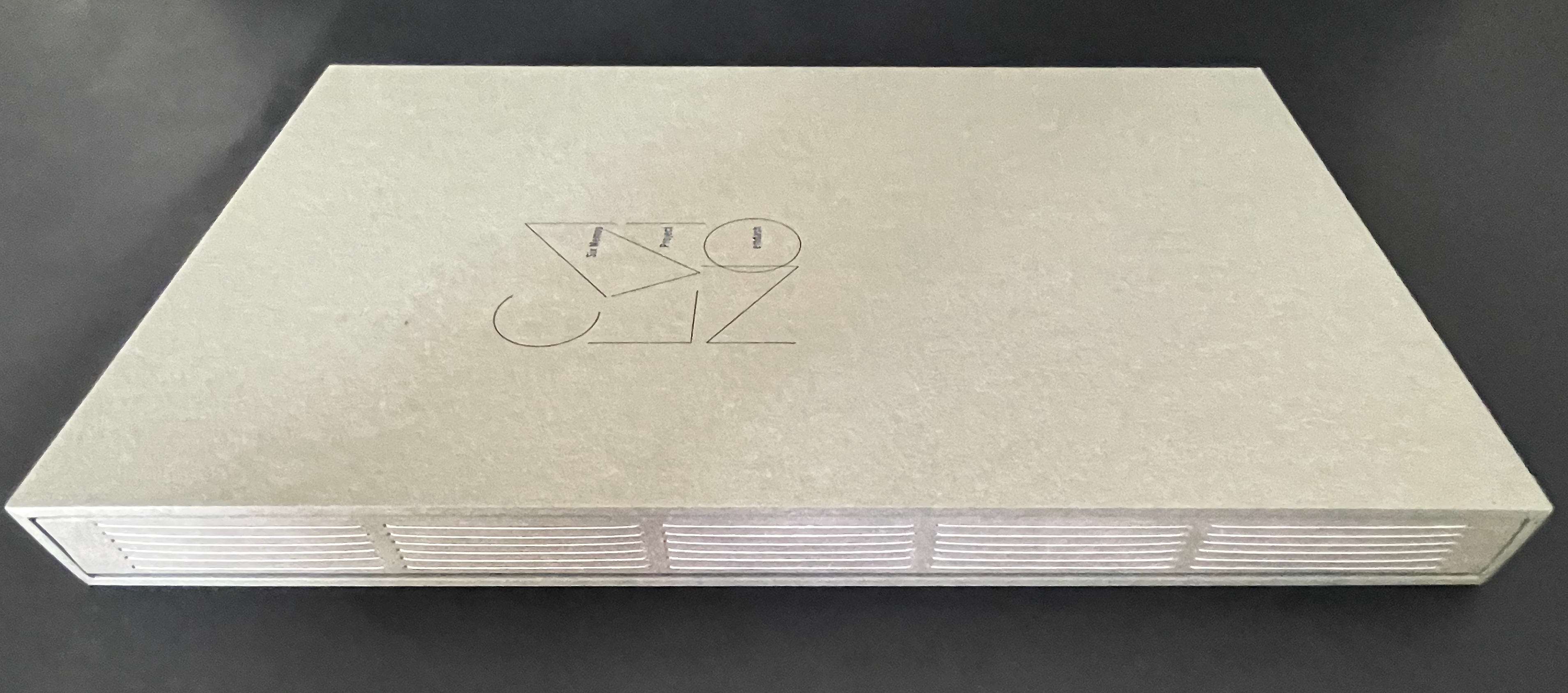
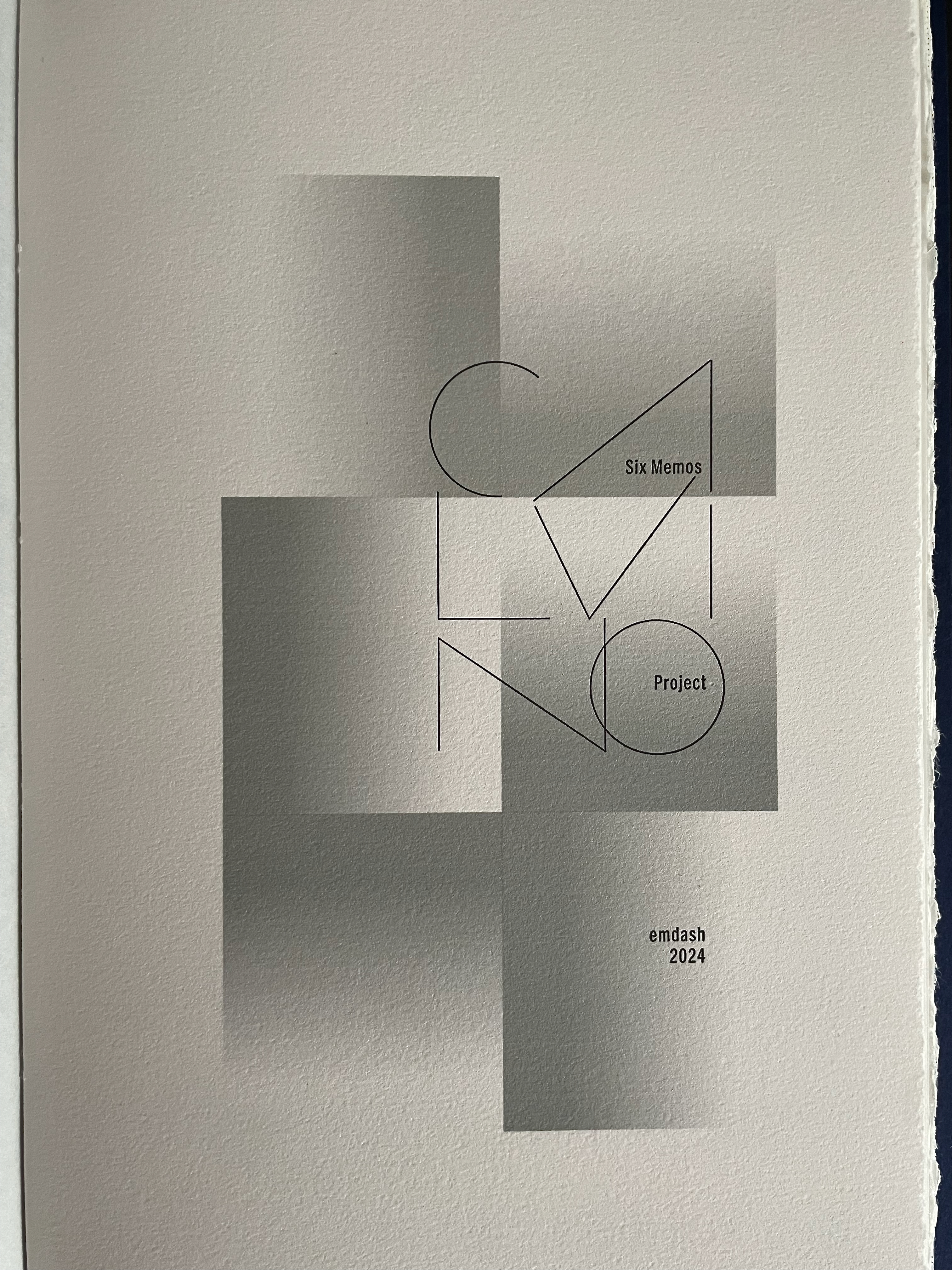
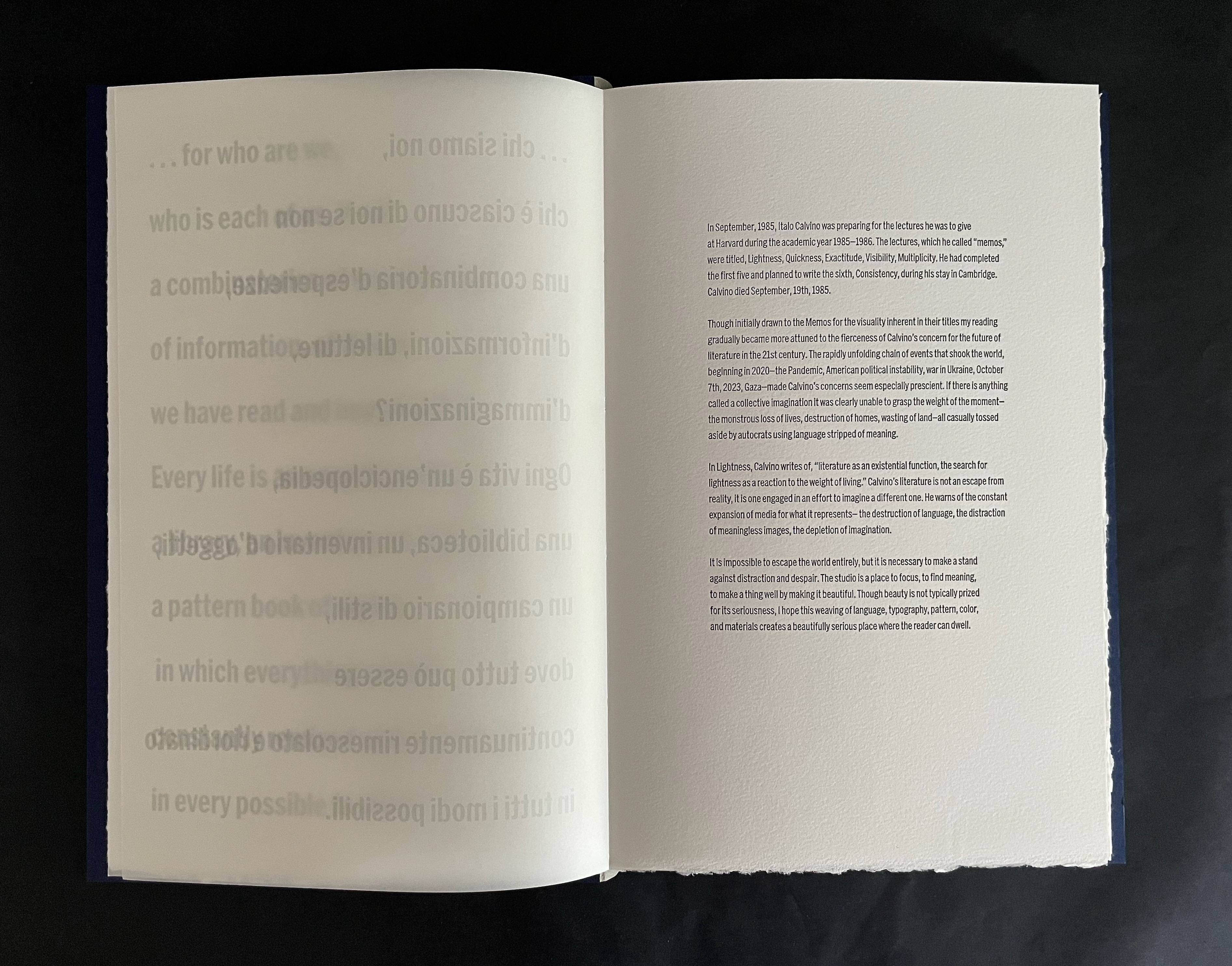
As homage and work of art, Ken Botnick’s Six Memos Project is that “something specific, intimate, light” to which Calvino’s narrator refers. It hovers between us and Calvino’s Six Memos for the Next Millennium (1985), his Charles Eliot Norton Lectures prepared for Harvard. All but the sixth lecture was written when Calvino died in the fall of 1985.
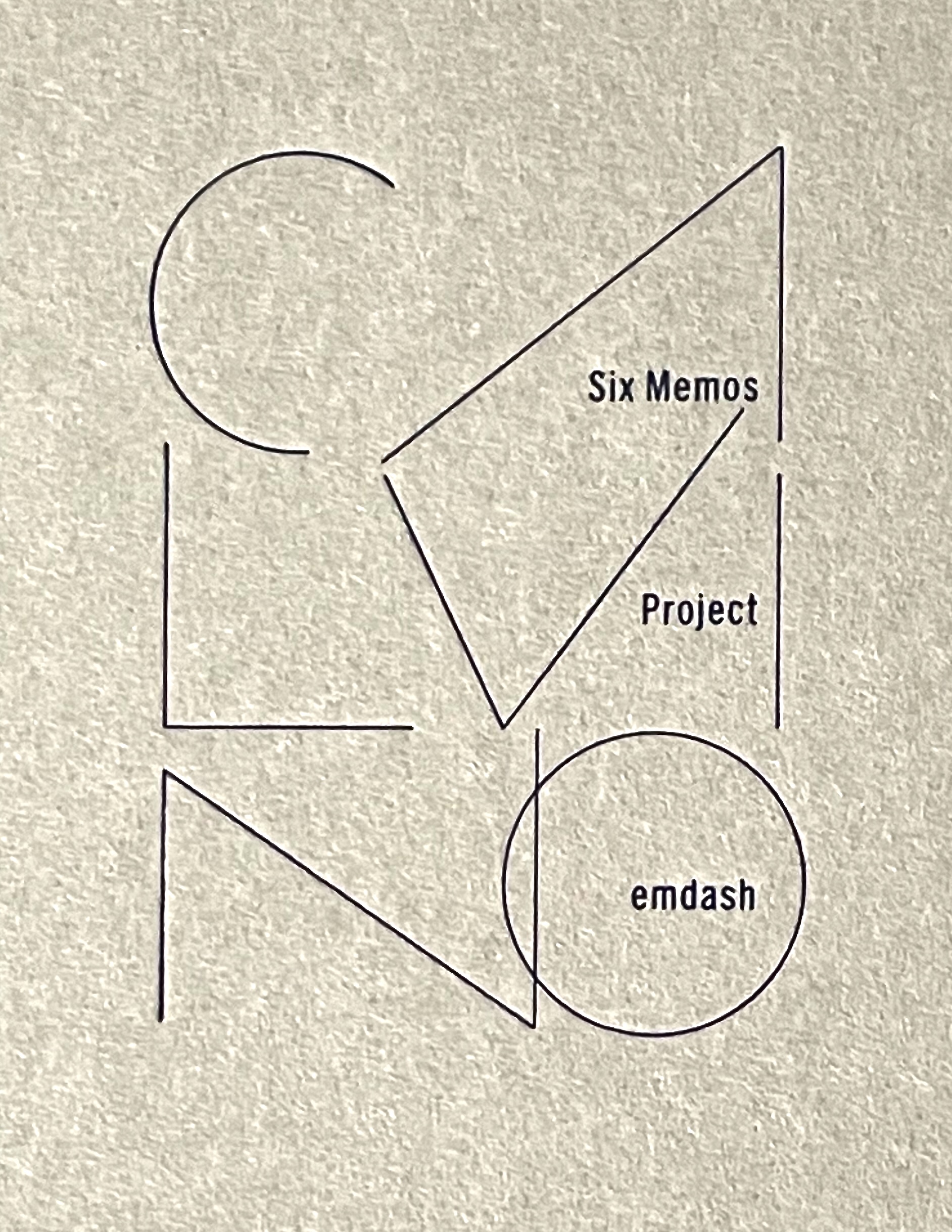
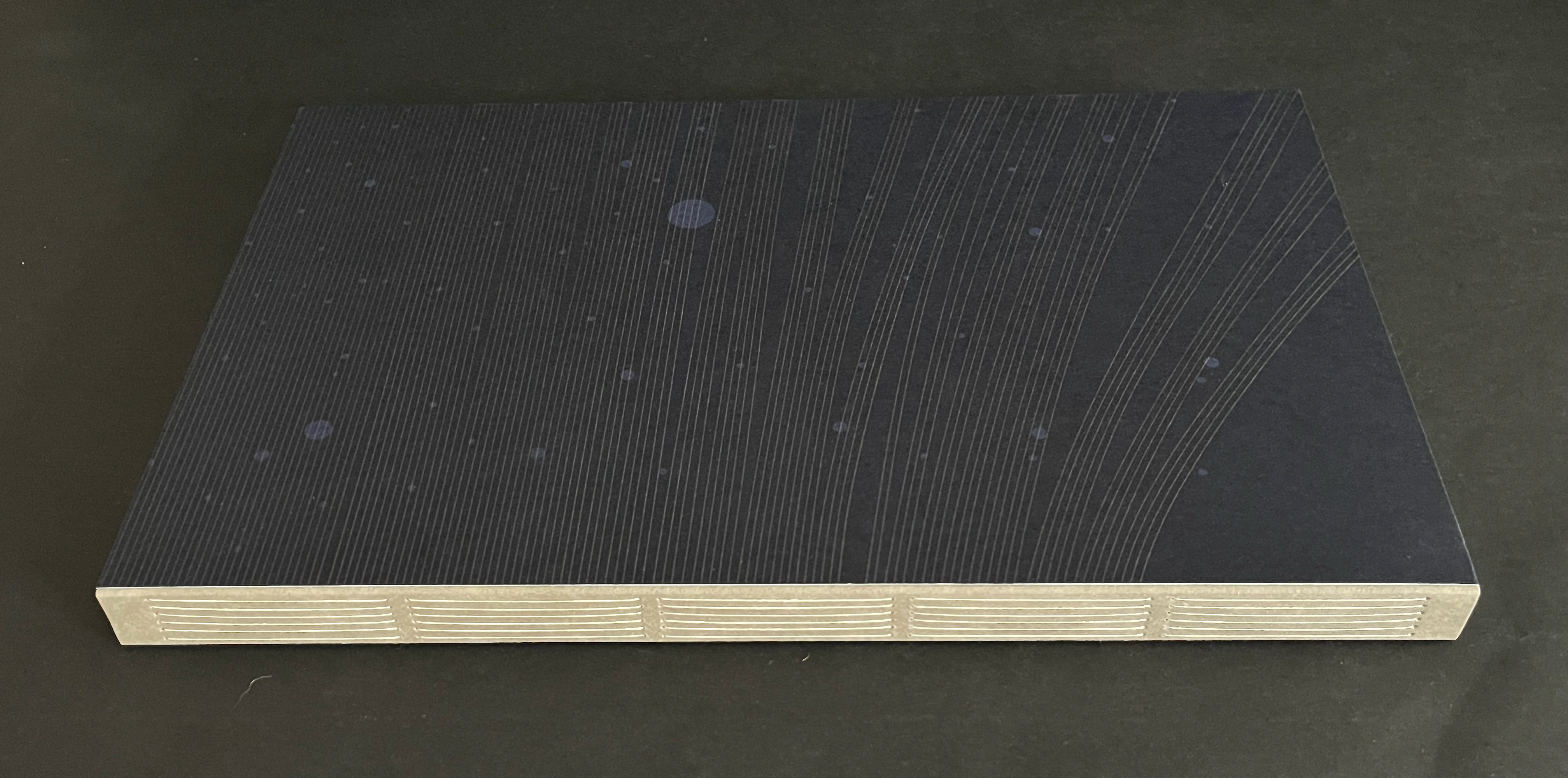
Six Memos Project (2020) Ken Botnick Board slipcase with inked embossed title. Open spine hardcover. H290 x W188 mm. [116] pages. Edition of 20, of which this is #12. Acquired from the artist, 14 July 2026. Photos: Books On Books Collection.
The Six Memos Project makes us want to read or re-read those lectures and make us long for that missing sixth. With its papers, ink, incisions, typographic layout, page structure, binding, and textures, this artist’s book captures our attention and wonder long enough to realize that it is acting as a lens on the lectures and, paradoxically, on itself and the act of reading. This self-reflexive artist’s book is the ideal medium for paying homage to Calvino’s writing about his writing.
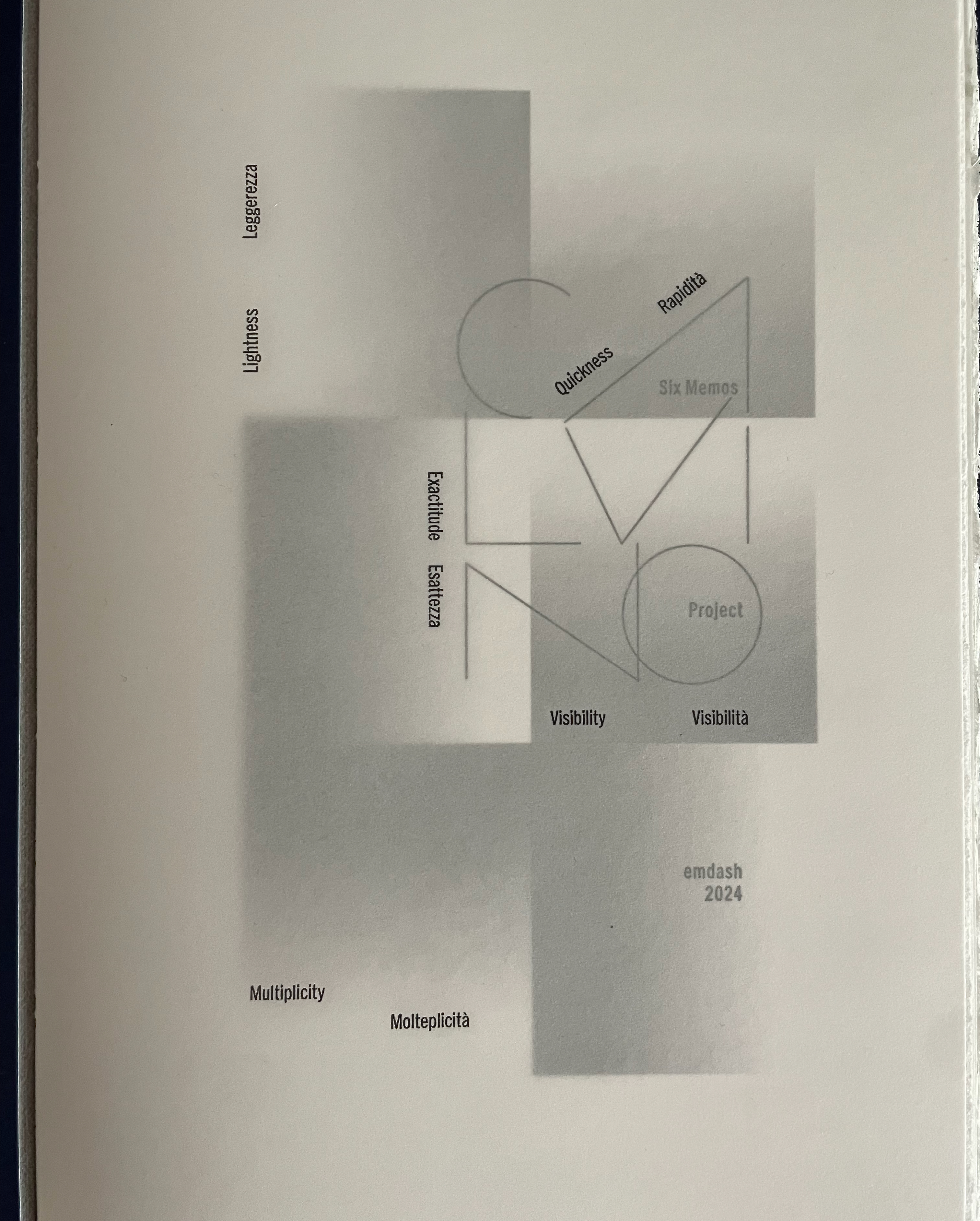
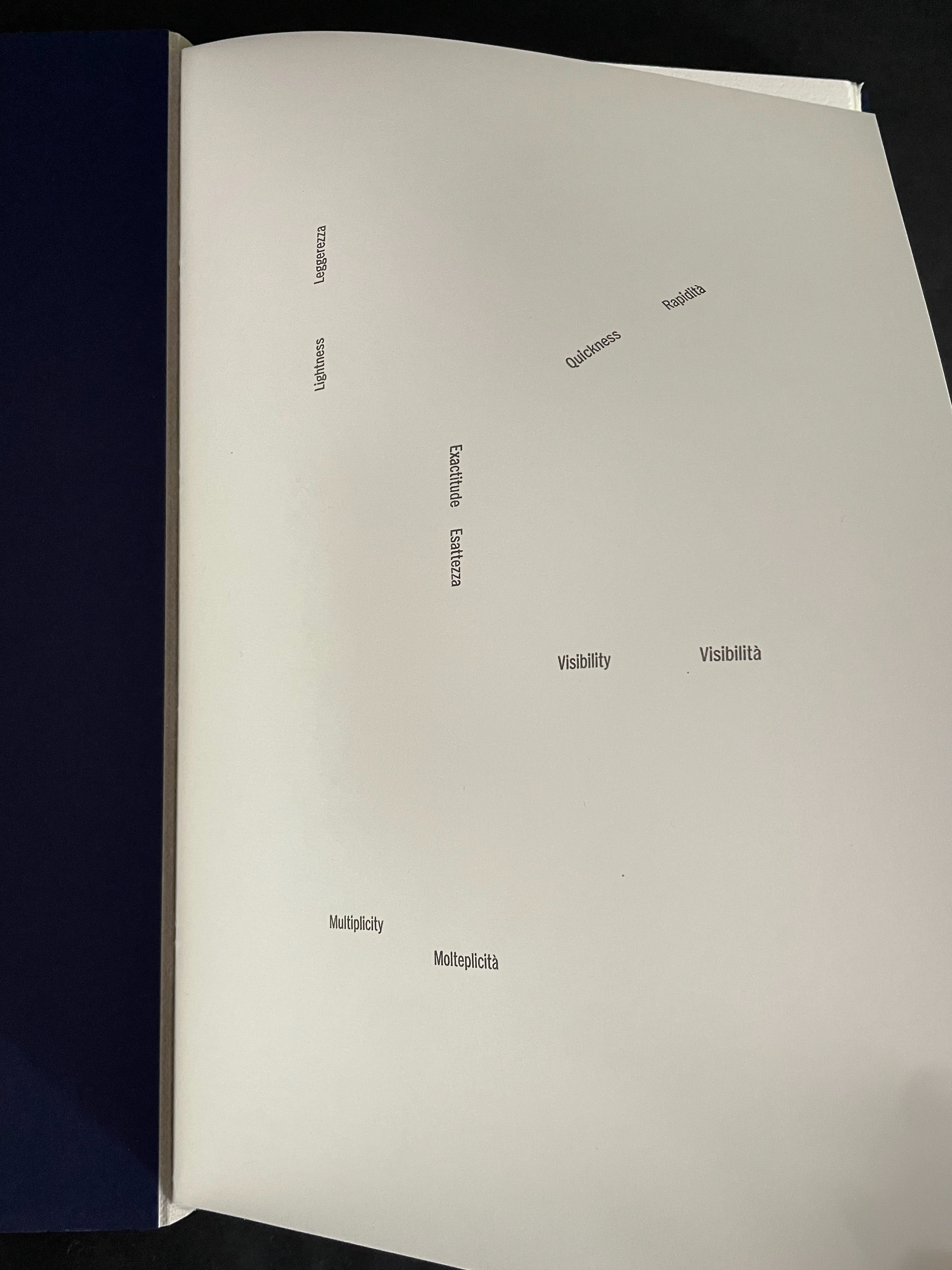
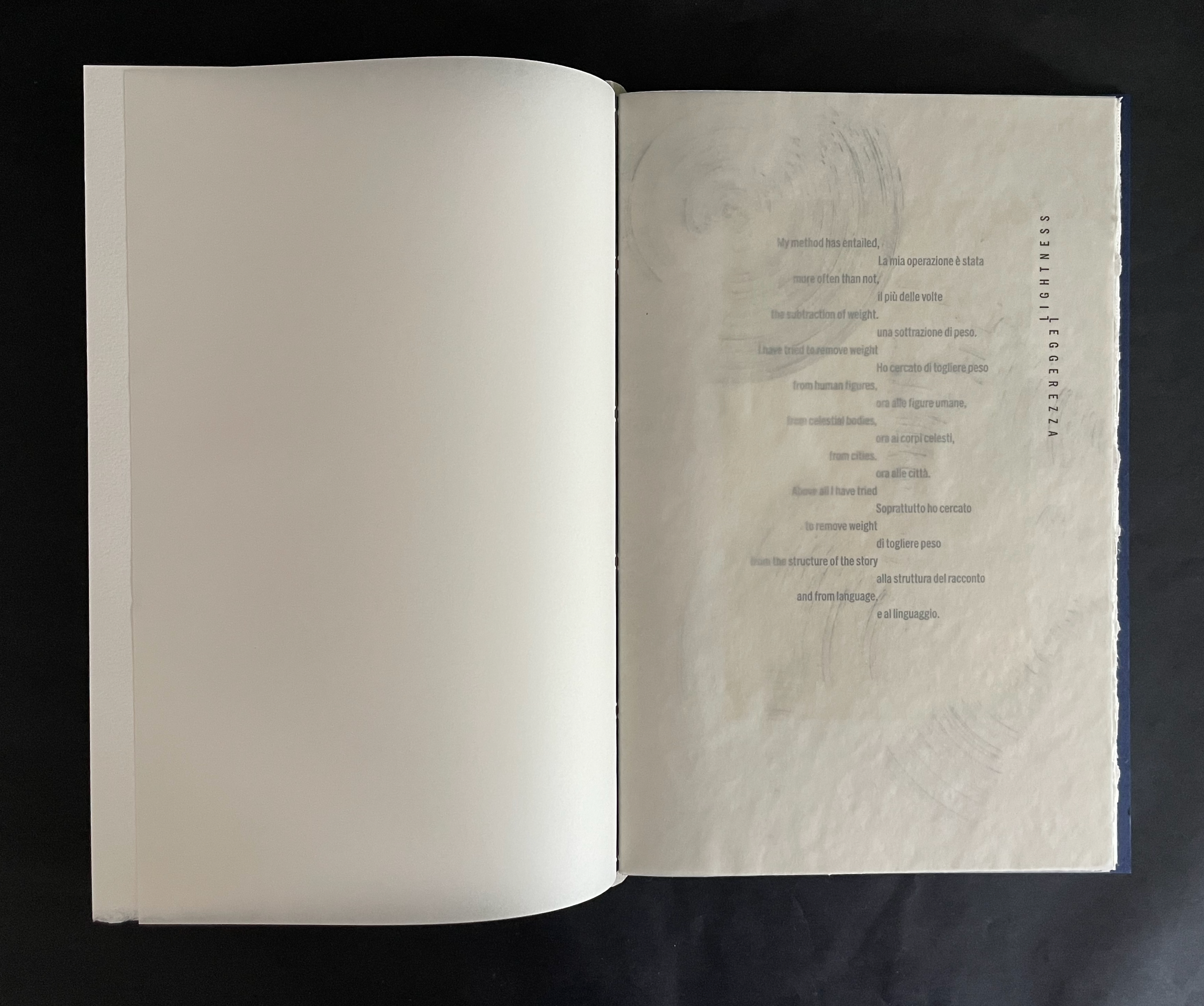
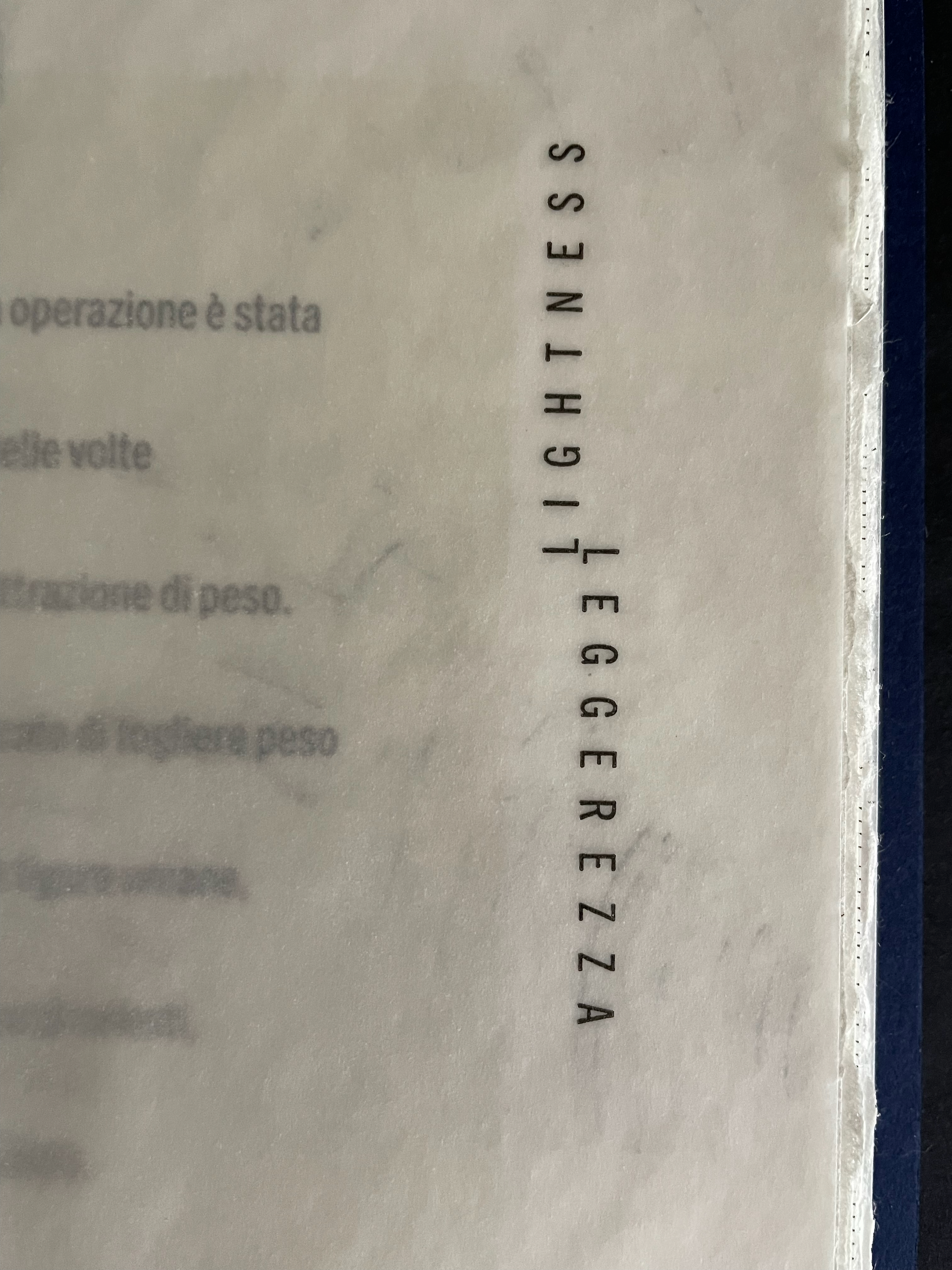
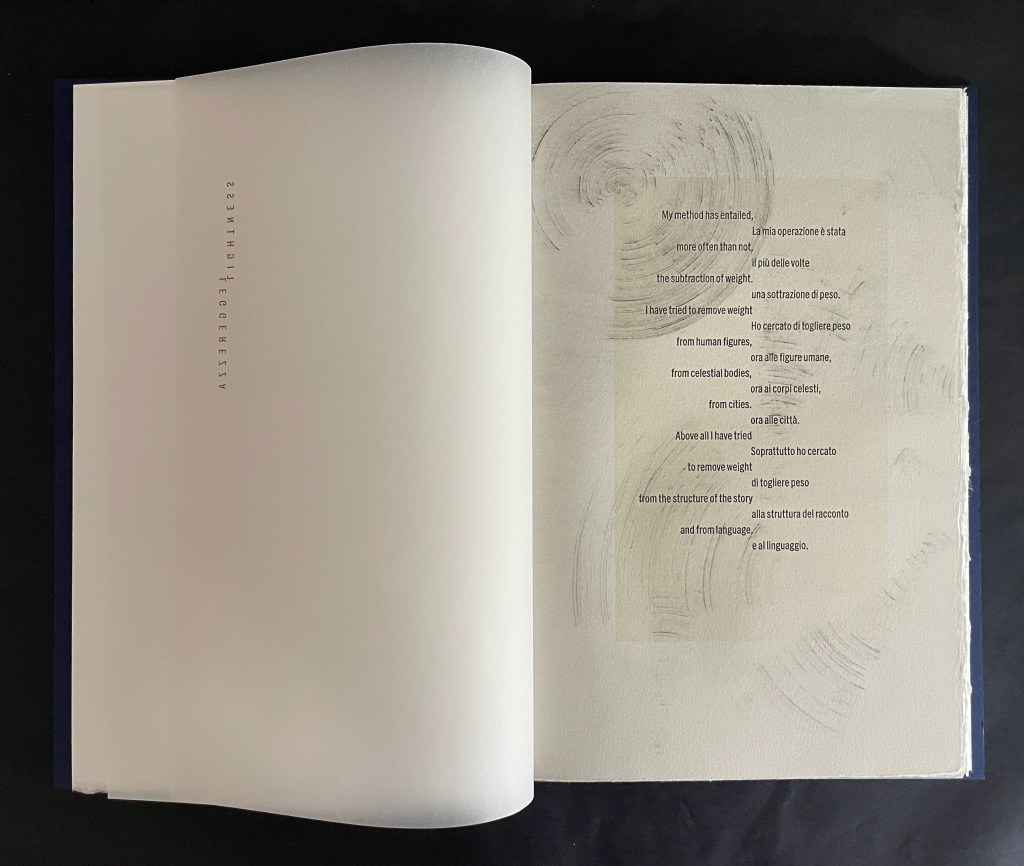
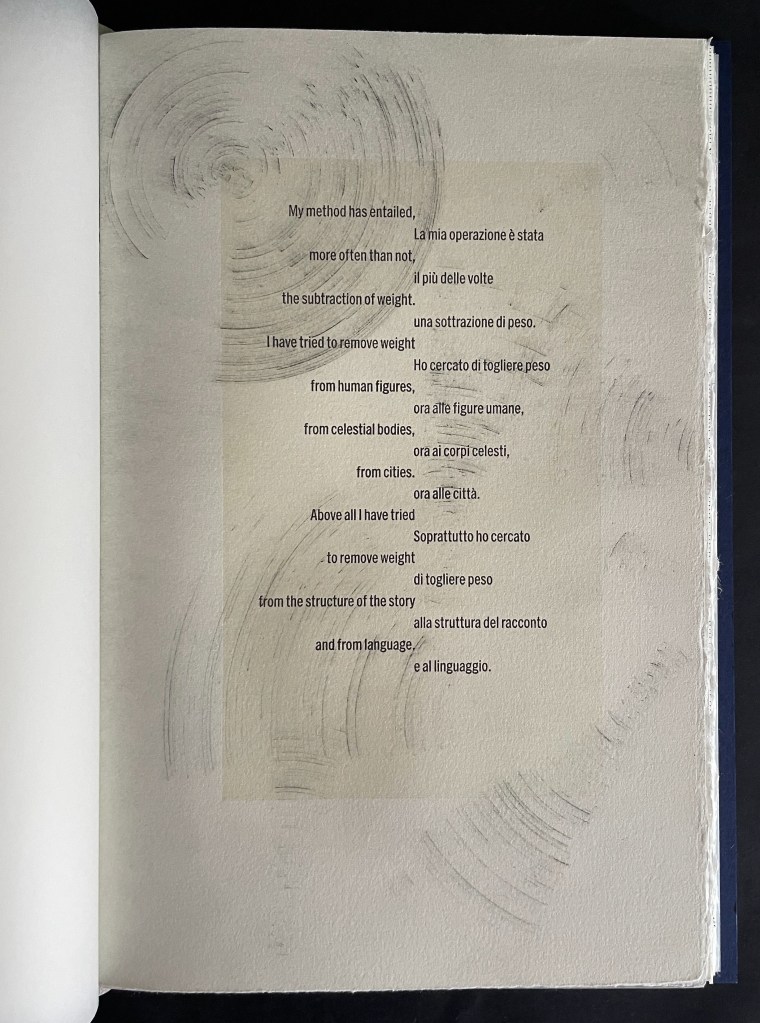
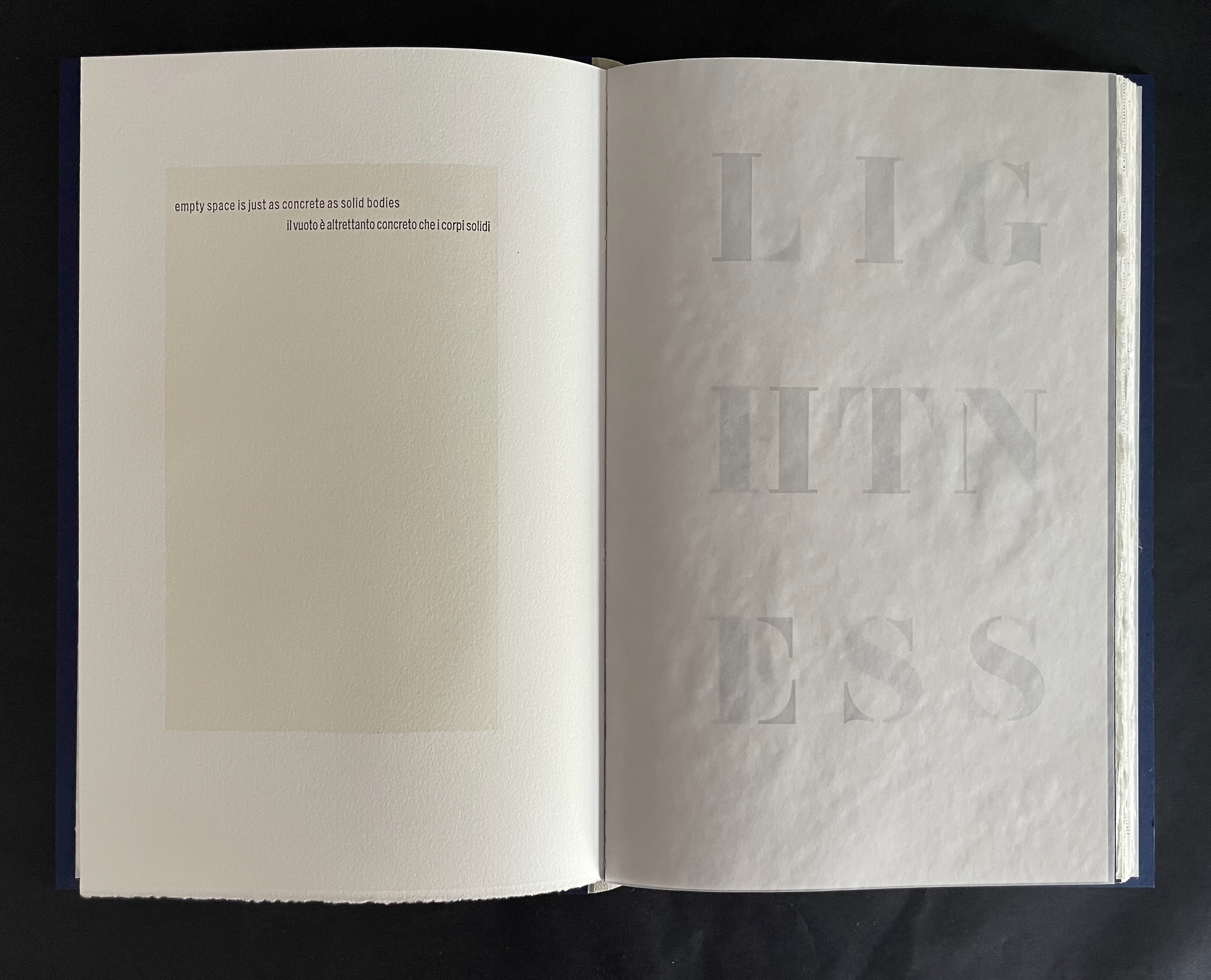
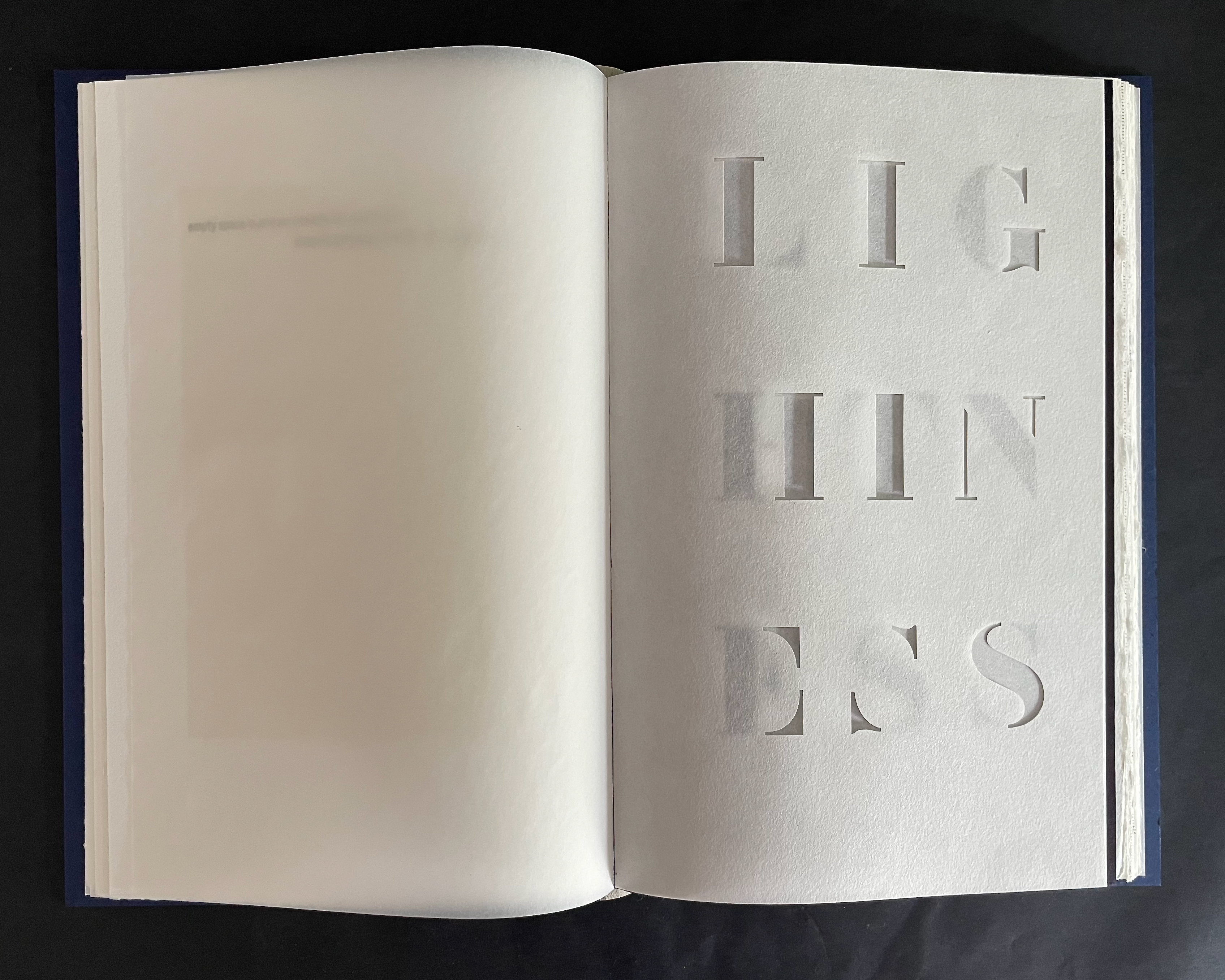
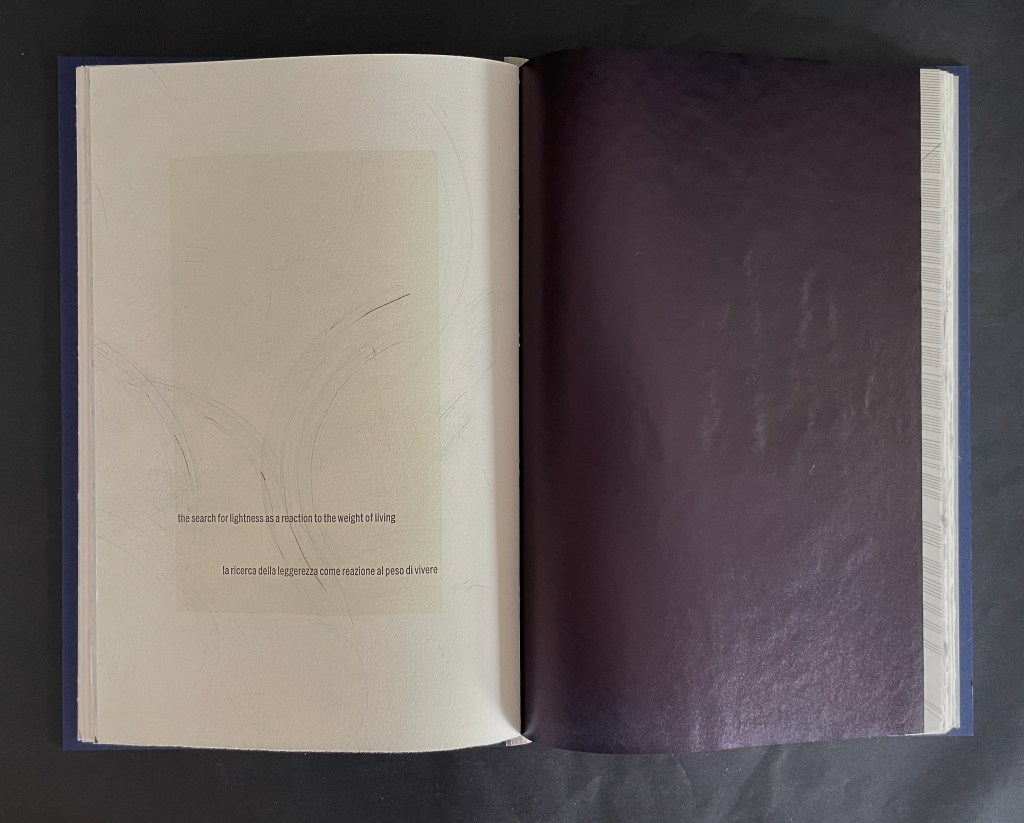
Lightness was the first of the six literary themes that Calvino commended to the next millennium. Botnick arranges its title in Italian and English on translucent paper so that it pivots on its initial letter, ascending and descending the margin. As the page turns to the left, the opening statement that Botnick has selected from the lecture emerges crisply in English on the left and Italian on the right, alternating like wings down the center of the page.
Matching Calvino’s description of his writing method, Botnick centrifugally subtracts segments from the image in the upper left corner of the same page. The expressive abstract image seems to float behind the statement’s tinted panel, and the enlarging subtracted segments surface through and over the panel as they move downwards from left to right.
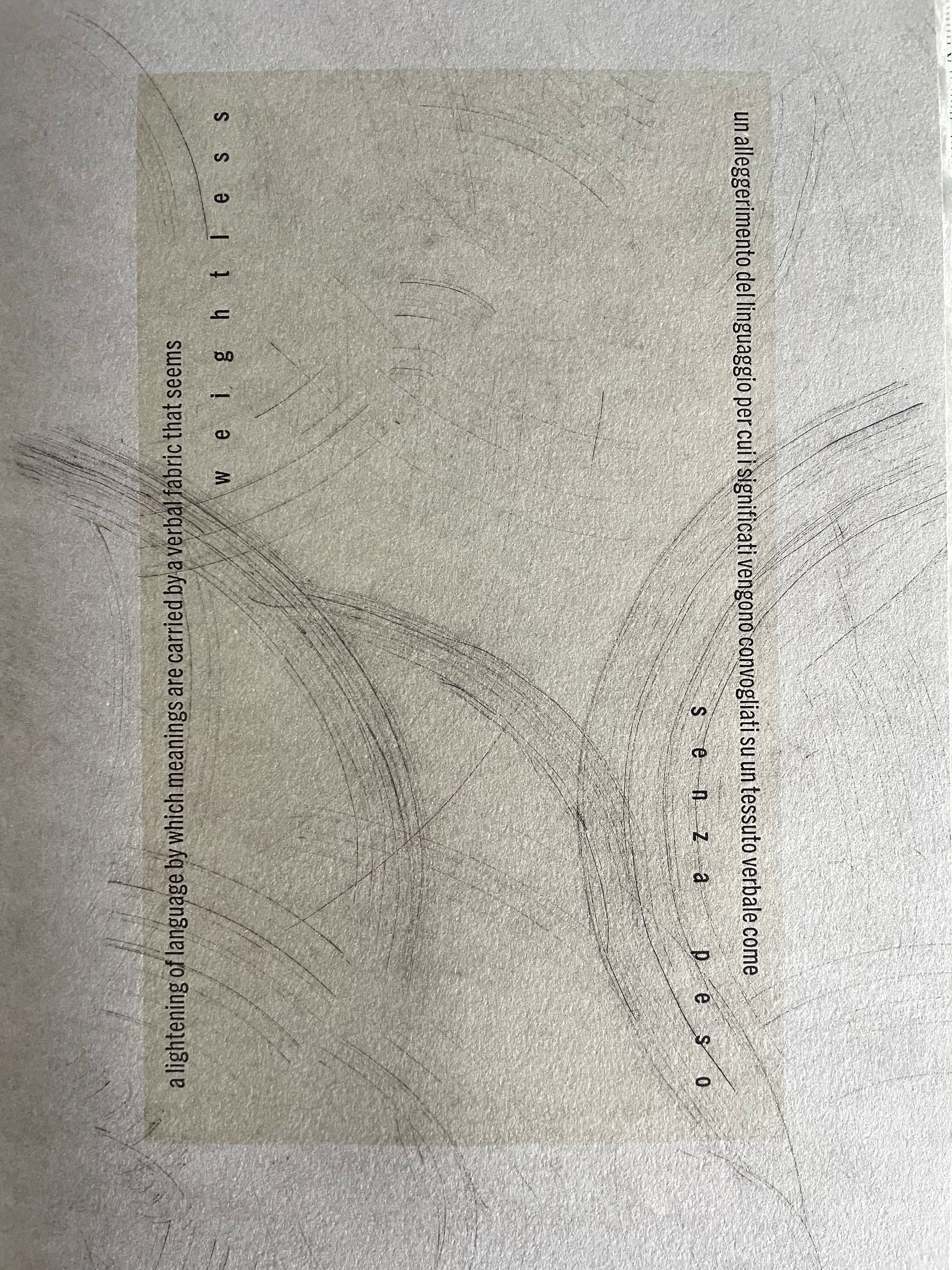
In the next spread, the enlarging segments continue to follow the gist of Calvino’s theme until they seem to float off the page.
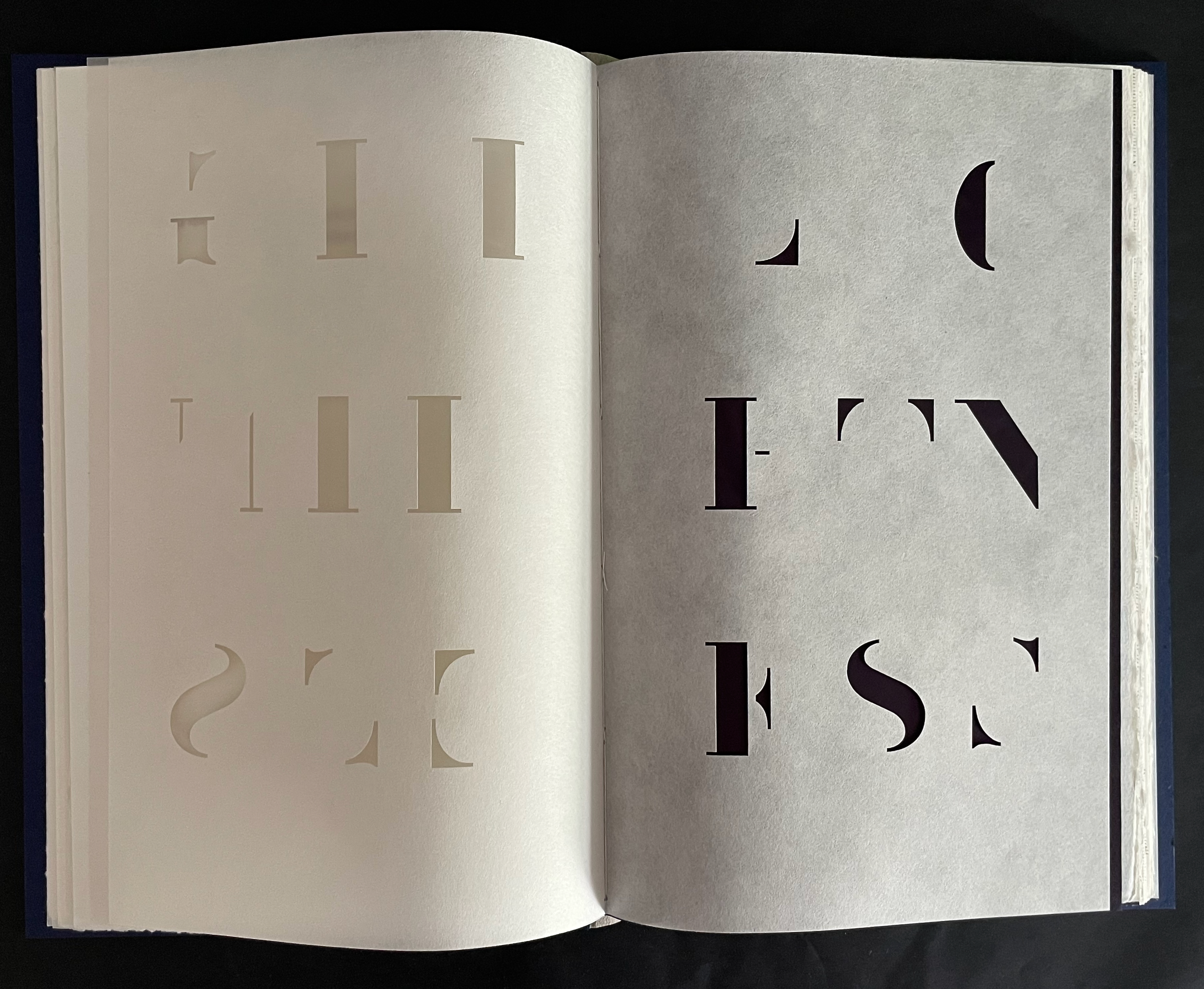
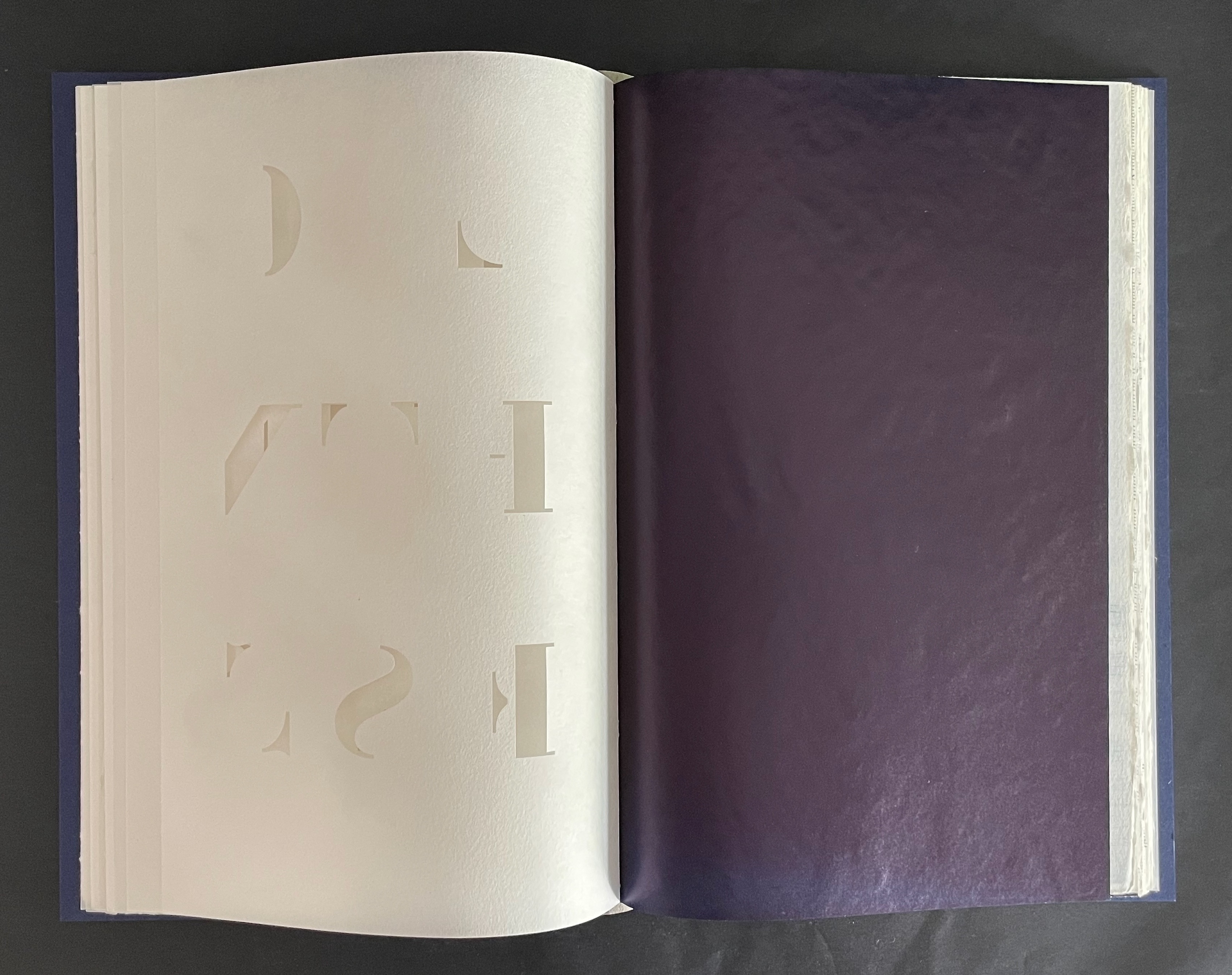
The following sequence switches techniques from inking to stenciling for the response to Calvino’s method and theme of lightness. Leaf by leaf it metaphorically enacts the removal of weight from the incised letters of the word “lightness”.
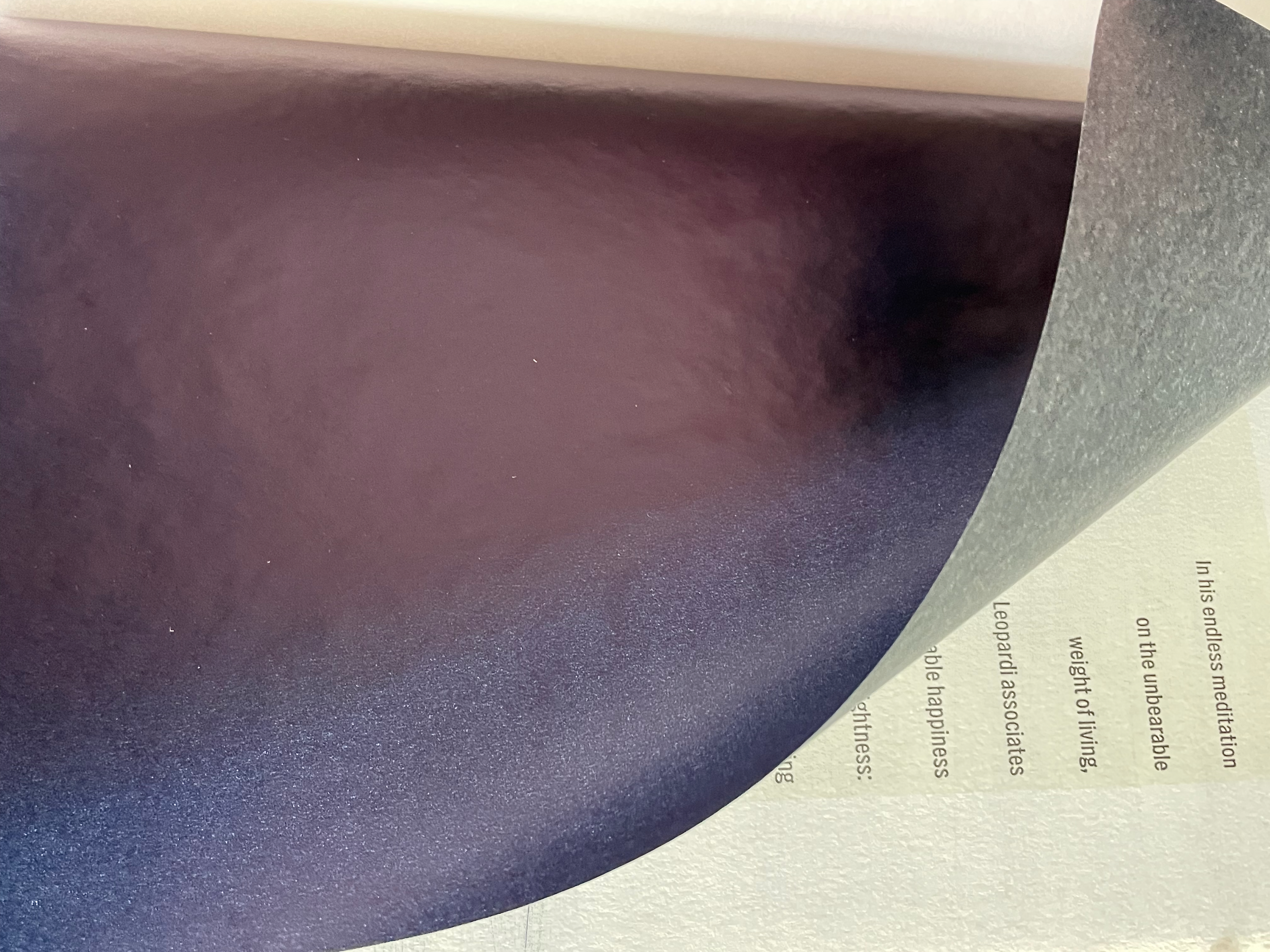
It is telling that the heavily ink-saturated opaque paper that gives the final absences their weight is used only in this section of the book. Its second and last use in the section is just as metaphorical and functional as its first. In response to the excerpt “the search for lightness as reaction to the weight of living”, it contrasts with bare remnants of the subtracted segments on the left and punctuates with its weight the end of “Lightness”.
In each of the next four sections, the artist exercises different functional metaphors corresponding to the themes and excerpts of the lectures that Calvino completed: Quickness, Exactitude, Visibility, and Multiplicity. As with the symbiosis of lightness and weight, Calvino proceeds by contrasts: quickness vs delay, exactitude vs insubstantiality, visibility of the imagination through words vs their failure under the weight of the “image civilization”, and multiplicity of language, viewpoints, and things vs a single language, an insular perspective, and a null undifferentiated whole.
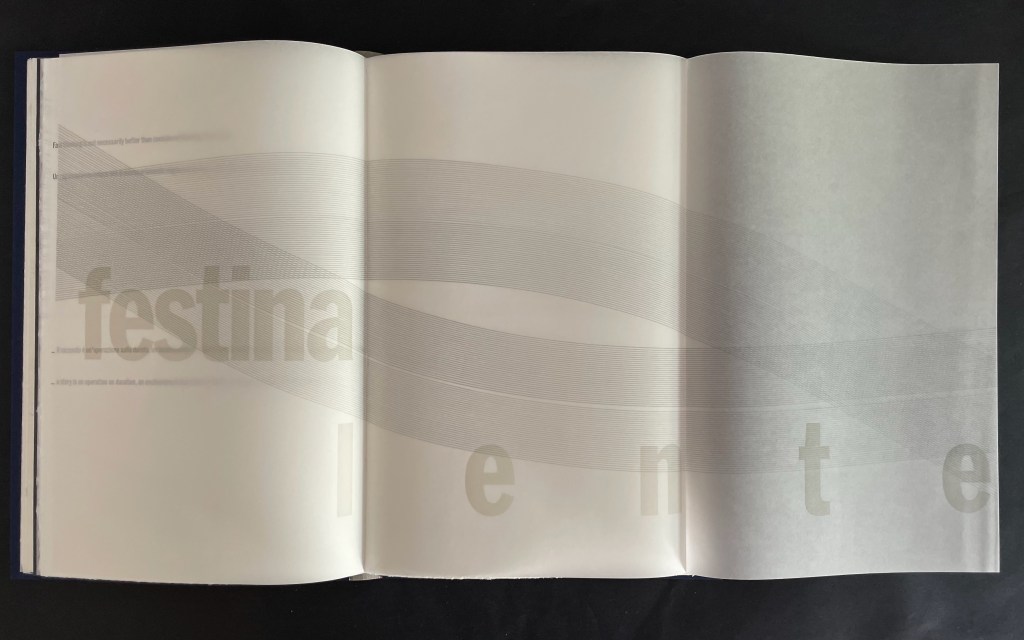
Where Calvino adopts Manutius’ motto festina lente [“make haste slowly”], Botnick gives us
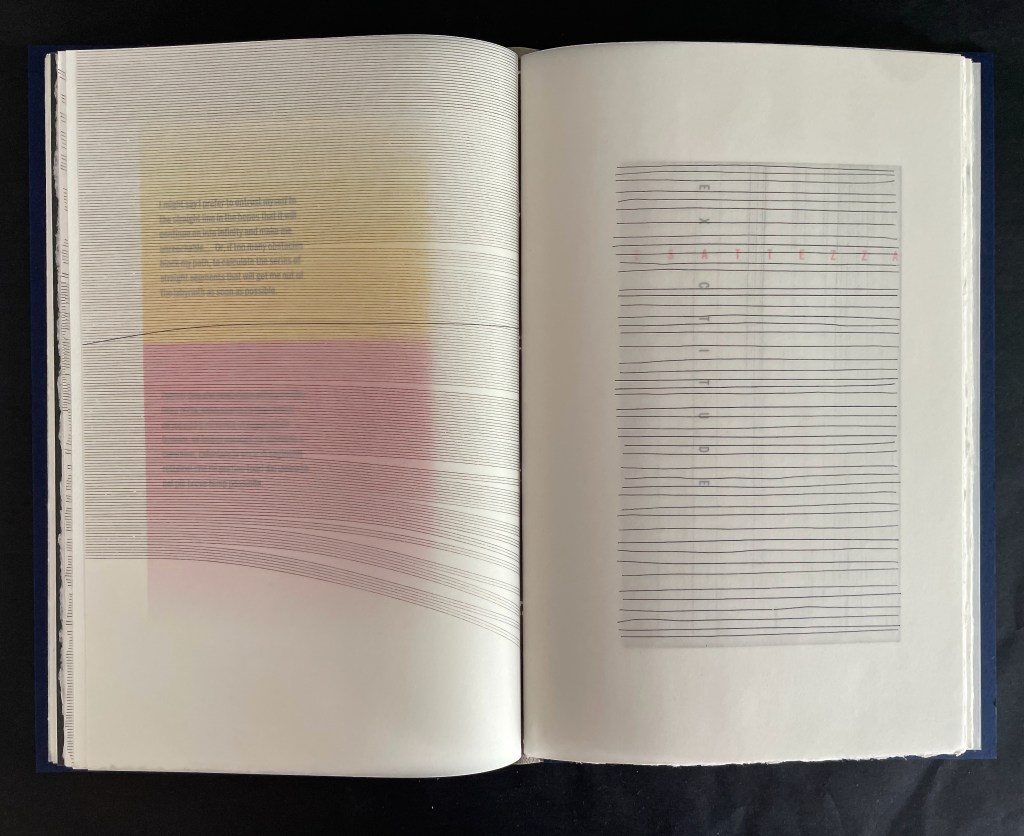
Where Calvino worries about straight lines of exactitude vs oblique curves by which to approach the unsayable, Botnick gives us
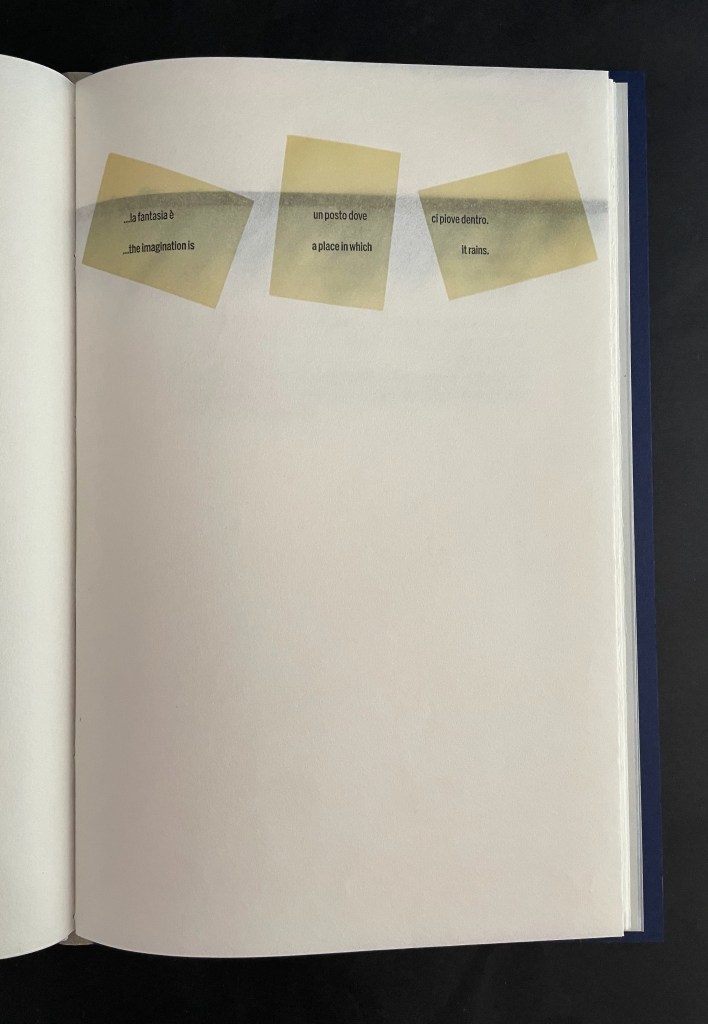
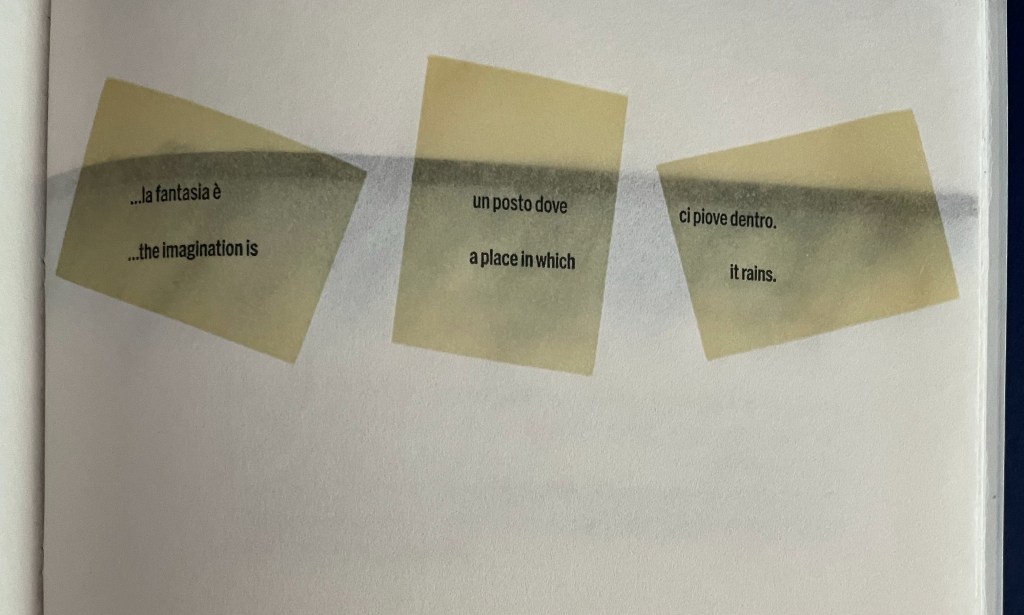
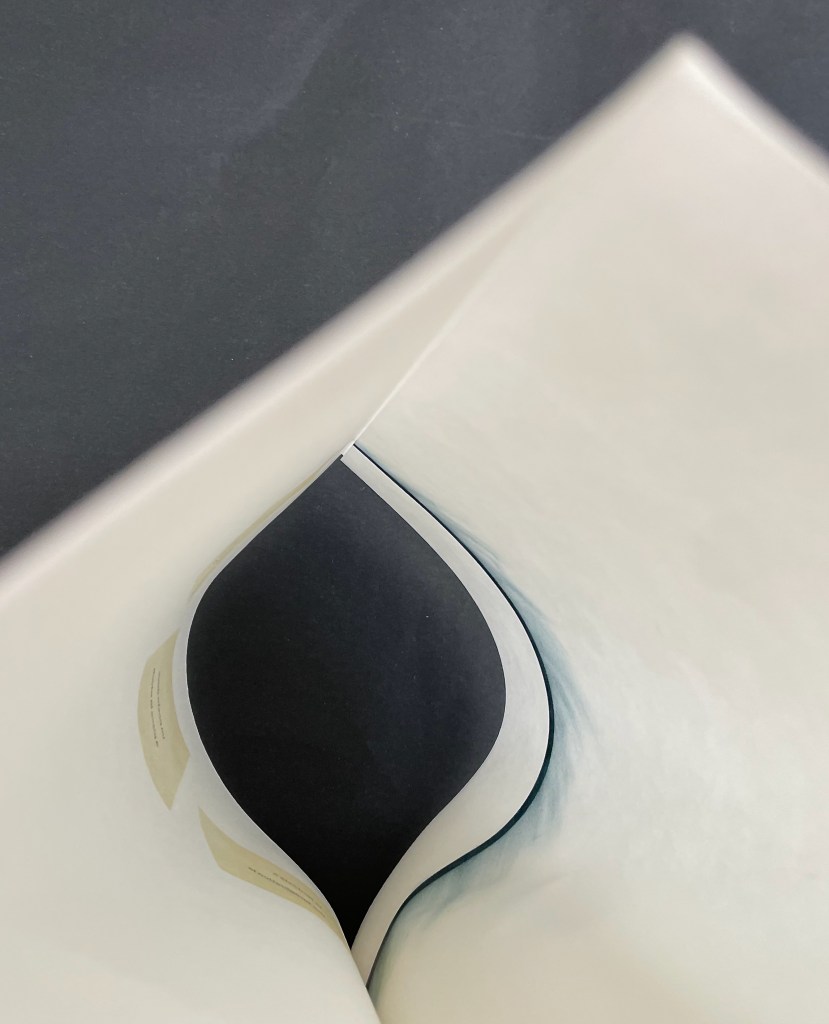
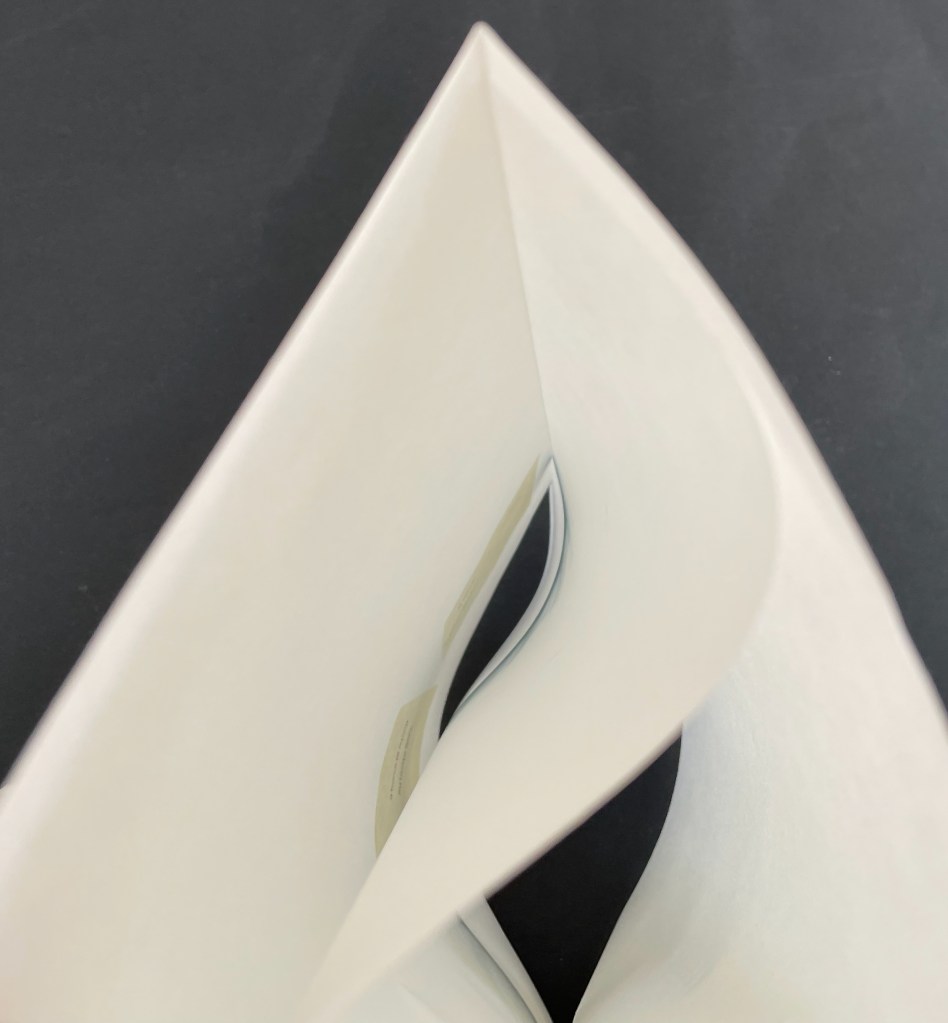
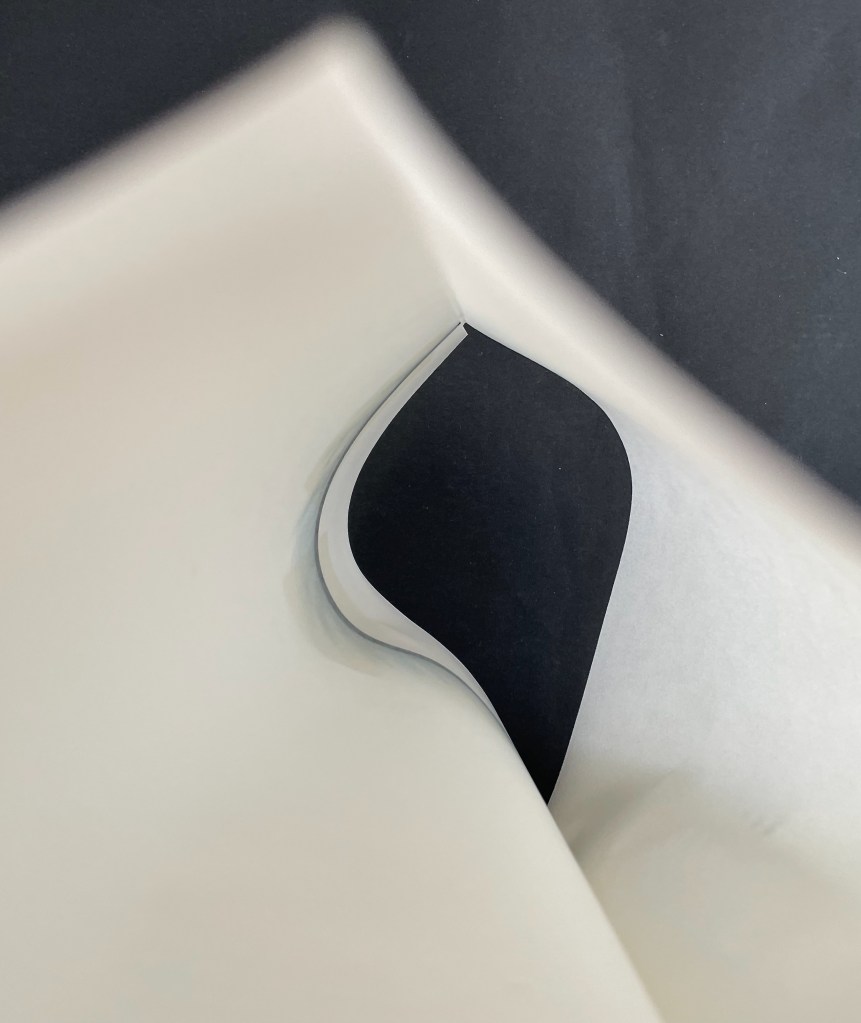
Where, in contemplating visibility, Calvino posits “the imagination is a place where it rains”, Botnick give us an image printed on a sheet held within the fold of another sheet on which Calvino’s text appears in blocks that seem to float on the watery image underneath.
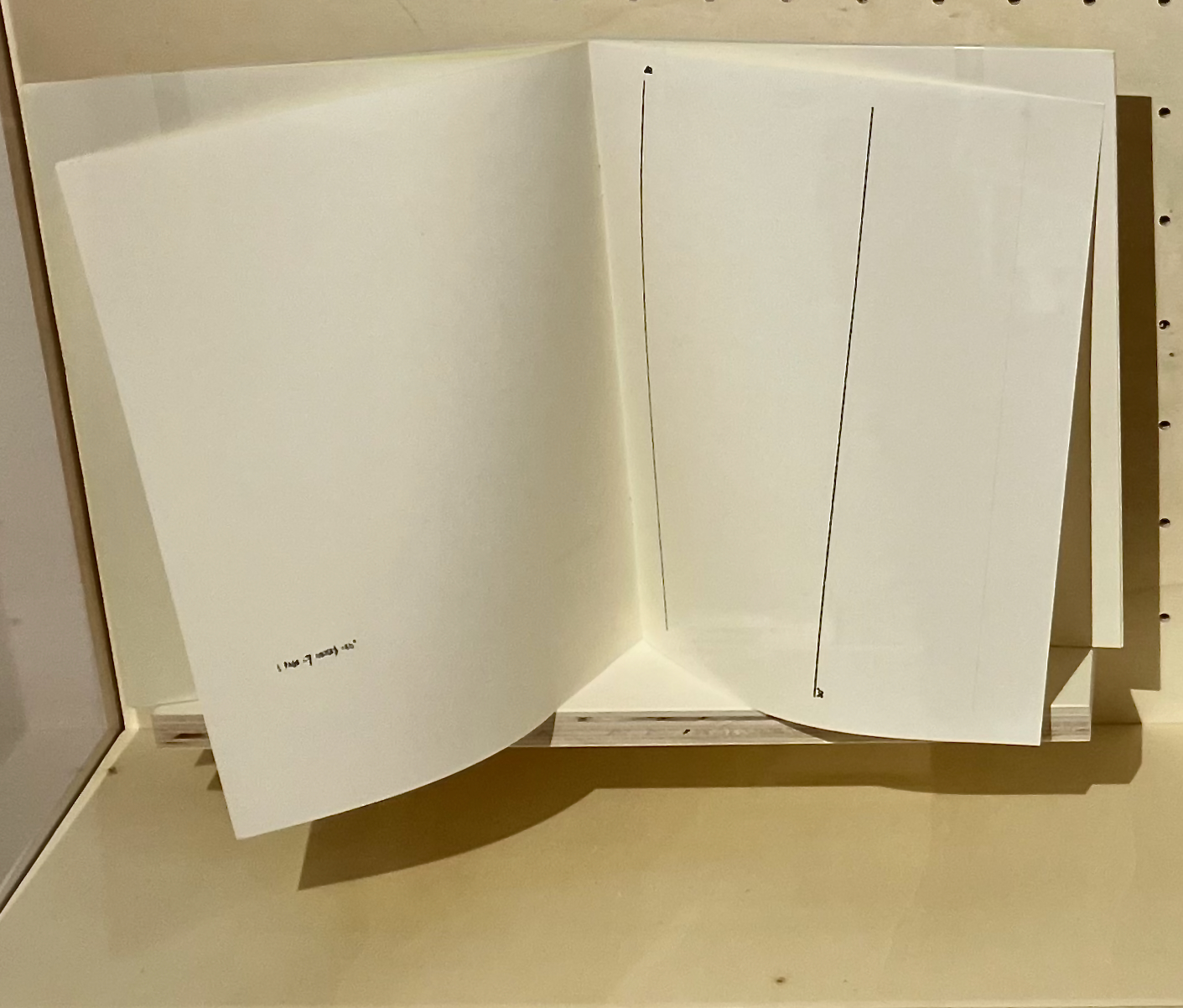
Below are internal shots of the French fold sheet that envelopes the single sheet bearing the watery image that appears through the sides of the French fold. The angle is from the spread bottom edge of the French fold with the first shot showing single sheet image bowed to the right, the second showing the single sheet curving between the sides of the French fold, and the third showing the single sheet image bowed to the left.
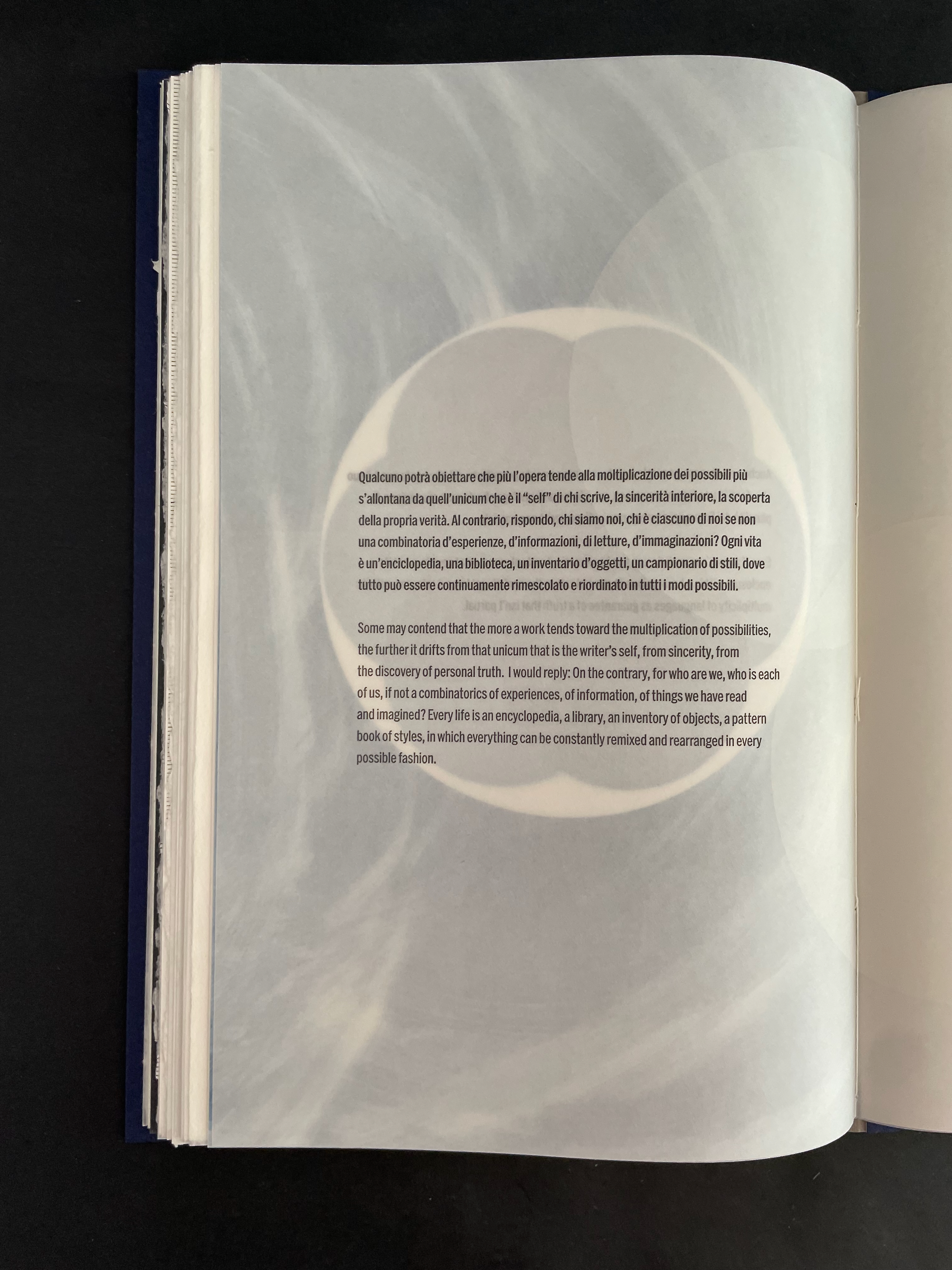
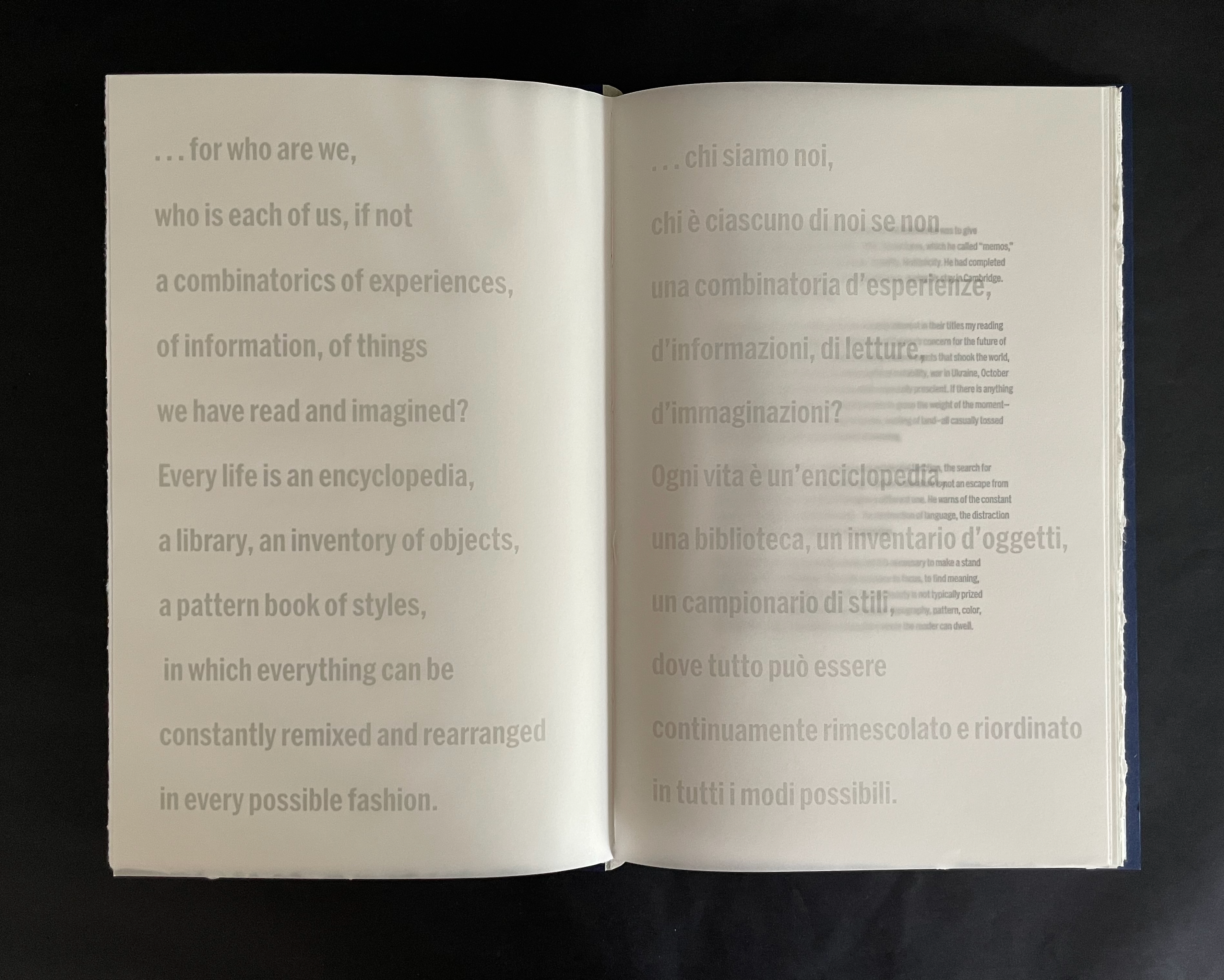
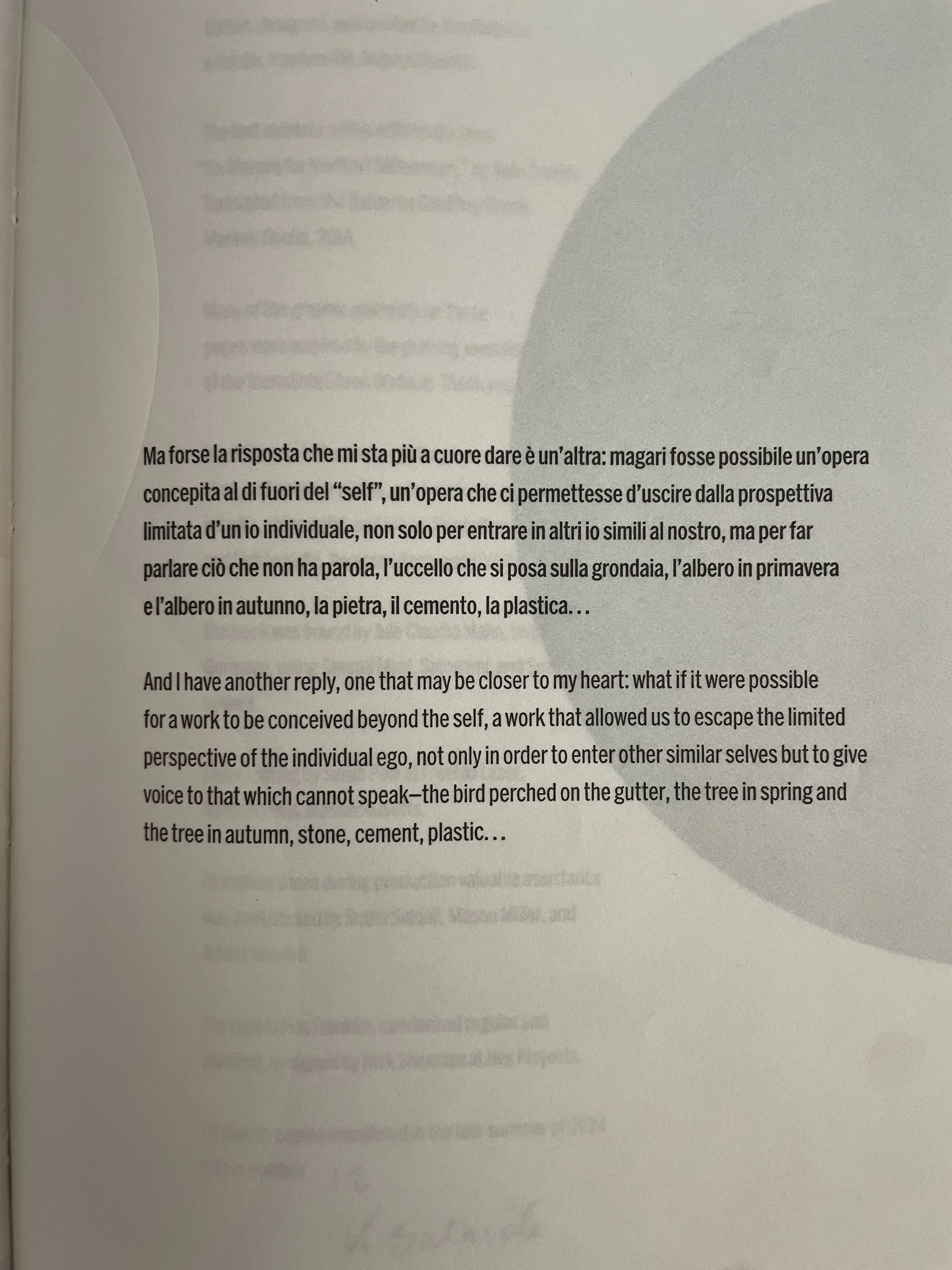
Where Calvino notes the argument of some “that the more a work tends toward the multiplication of possibilities, the further it drifts from the unicum that is the writer’s self, from sincerity, from the discovery of personal truth”, Botnick gives us the text of Calvino’s contrary reply below on the left, but note that it is the same text with which Botnick prefaced his artist’s book on the right:
That preface is the first of an enveloping move that Botnick completes at the end of Multiplicity and the end of the artist’s book. Calvino has the last word of the section in text that hovers over a large solid spot-varnished half circle. When this sheet and the next two are turned, …
we are left with this last abstract image capturing the combinatorics of our experiences, the rain descending in the imagination, and the multitude of the voices of things that cannot speak … including this object the book.
The unwritten sixth memo would have addressed the theme of Consistency. What did Calvino mean by that word? Would he have spoken of the regularity of results such as the consistent taste of the morning espresso at his local bistro? Or the mechanical consistency that worried Walter Benjamin in The Work of Art in the Age of Mechanical Reproduction (1935)? (Calvino might have had a conflict of interest given the lucrative reproduction of his fiction.) Or did he mean the essence of which a person, place, or thing consists? In Invisible Cities, the word refers to the celestial and infernal characters of the two versions of the city Beersheba, the one in the sky and the one on earth. Barring a manuscript find yet to be made, we won’t know. In the meantime, Botnick’s affinity with Calvino welcomes the speculation that his artist’s books offer the kind of consistency Calvino would have appreciated.
Further Reading
“Ken Botnick (I)“. 16 June 2022. Books On Books Collection. See for the Diderot Project (2015) and Table of Contents (2020).
“Angela Cavalieri”. In progress. Books On Books Collection.
“Karen Kunc“. 11 June 2026. Books On Books Collection.
“Pauline Lamont-Fisher“. In progress. Books On Books Collection.
Benjamin, Walter. 1968. Illuminations. Edited by Hannah Arendt. Translated by Harry Zorn. London: The Bodley Head Ltd.
Calvino, Italo. 2016. Six Memos for the Next Millennium. Translated by Geoffrey Brock. First Mariner books edition. Boston: Mariner Books/Houghton Mifflin Harcourt.
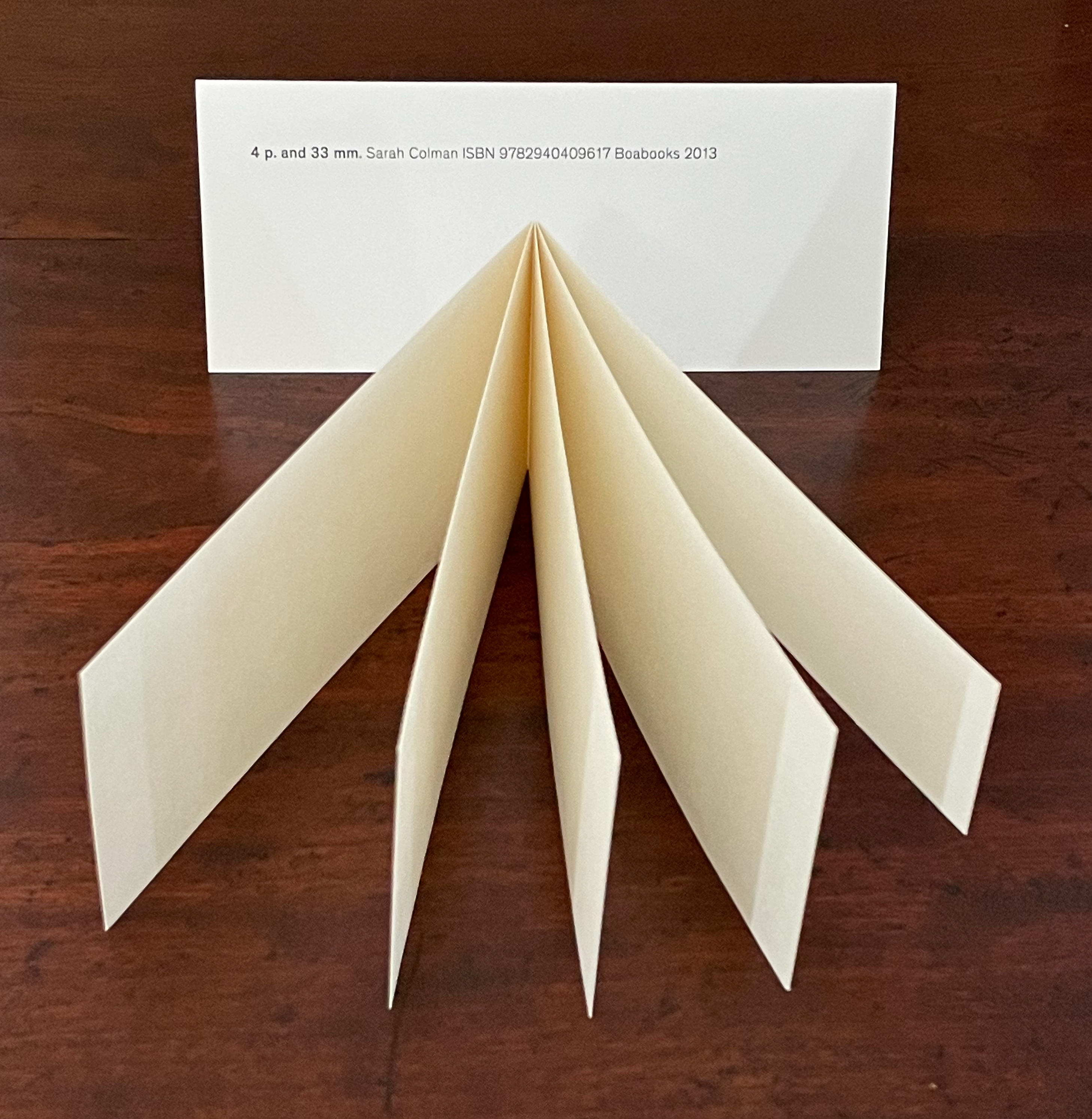
4 p. and 33mm (2013) Sarah Colman Card folder with title, author, publisher. Perfect binding of 4.33 folios. H66 x W148 mm [10] pages. Acquired from the artist, 1 August 2026. Photos: Books On Books Collection.
Colman’s 4 p. and 33 mm. was on display in the exhibition a minima at the Wittockiana in Brussels. If the work ‘s title directs us to consider first the four full folios and then the folio trimmed to half their size, then the item is displayed upside down in the image below. Observant visitors may have noticed it. Western books read from left to right.
Left: 4 p. and 33 mm. (2013). Sarah Colman. Geneva: Boabooks. Right: 4’33” (1993).John Cage. New York: Peters No. 6777a.
Being able to manipulate this work drives home the right orientation. First come the 4 pages that measure 66 mm and then the page that measures 33 mm. Of course, it ends hanging in air — just as Cage’s composition leaves the audience hanging as it ends after 4 minutes and 33 seconds.
In other words, Colman has turned Cage’s temporal art into spatial art. Given the performance origin of the next work, though, it’s not hard to imagine an invitation from Colman to watch her open 4 p. and 33 mm., place it atop a piano, and then close it at the conclusion of 4 minutes and 33 seconds.
Semiotics of the Studio (2015)
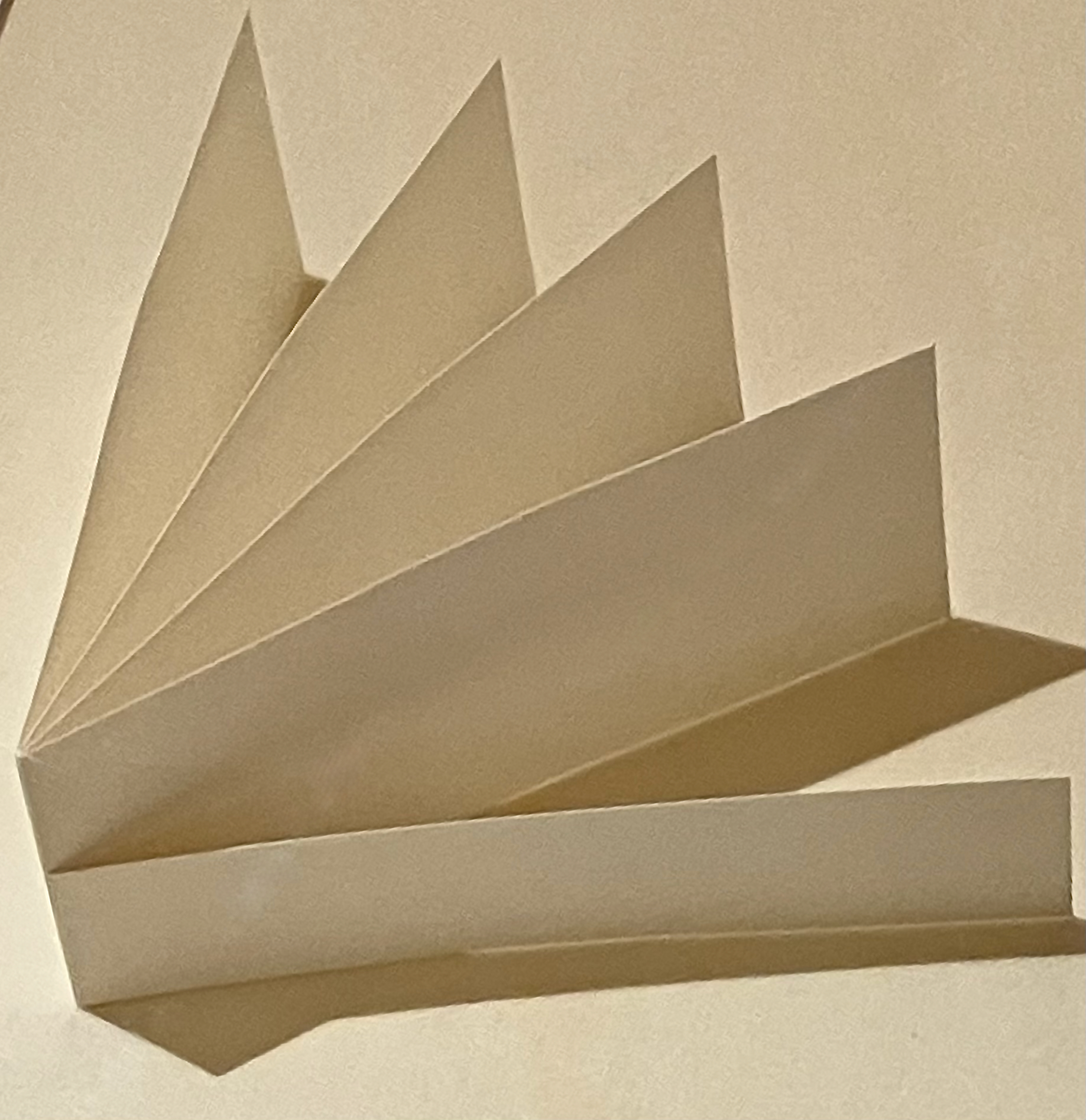
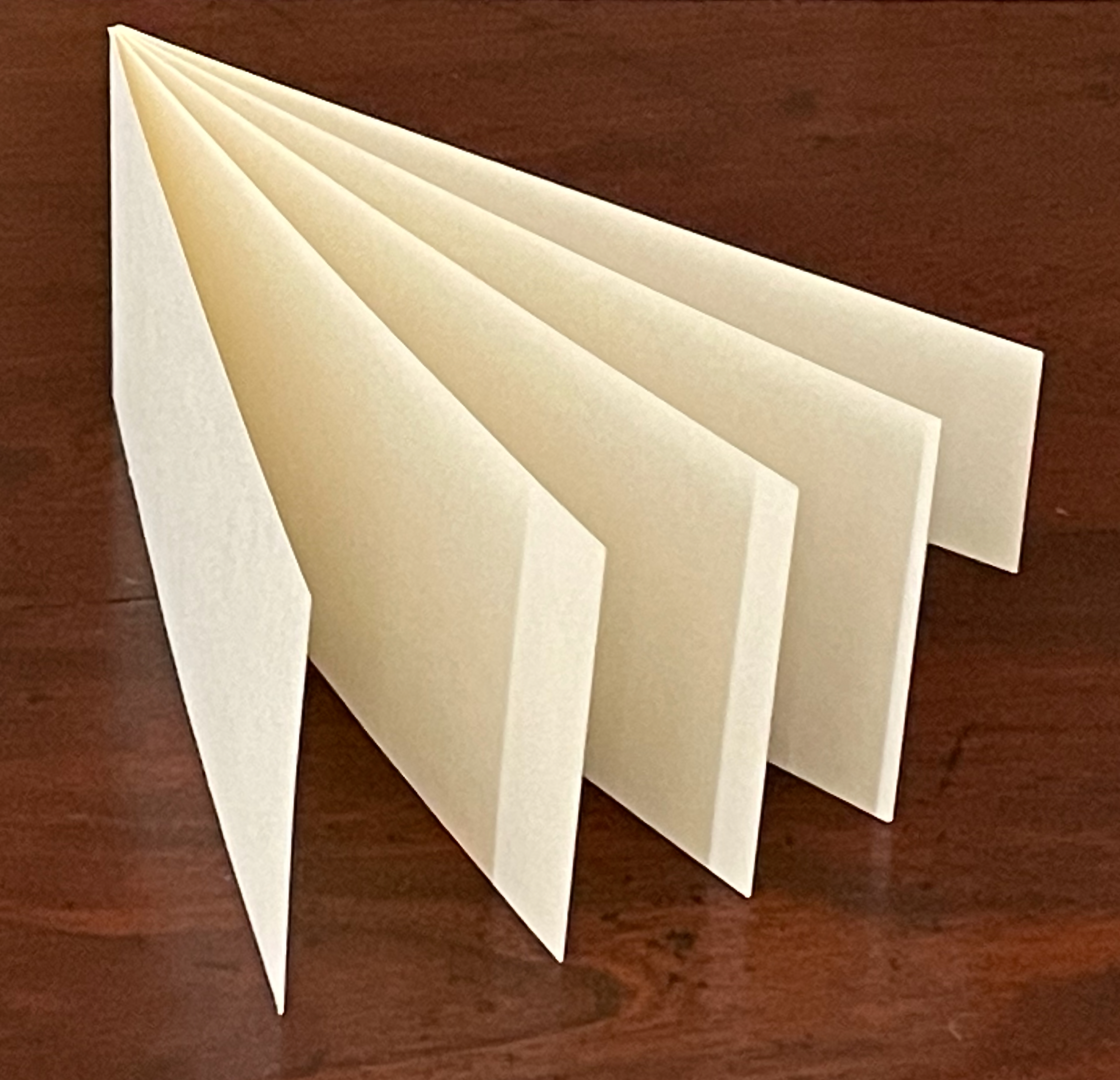
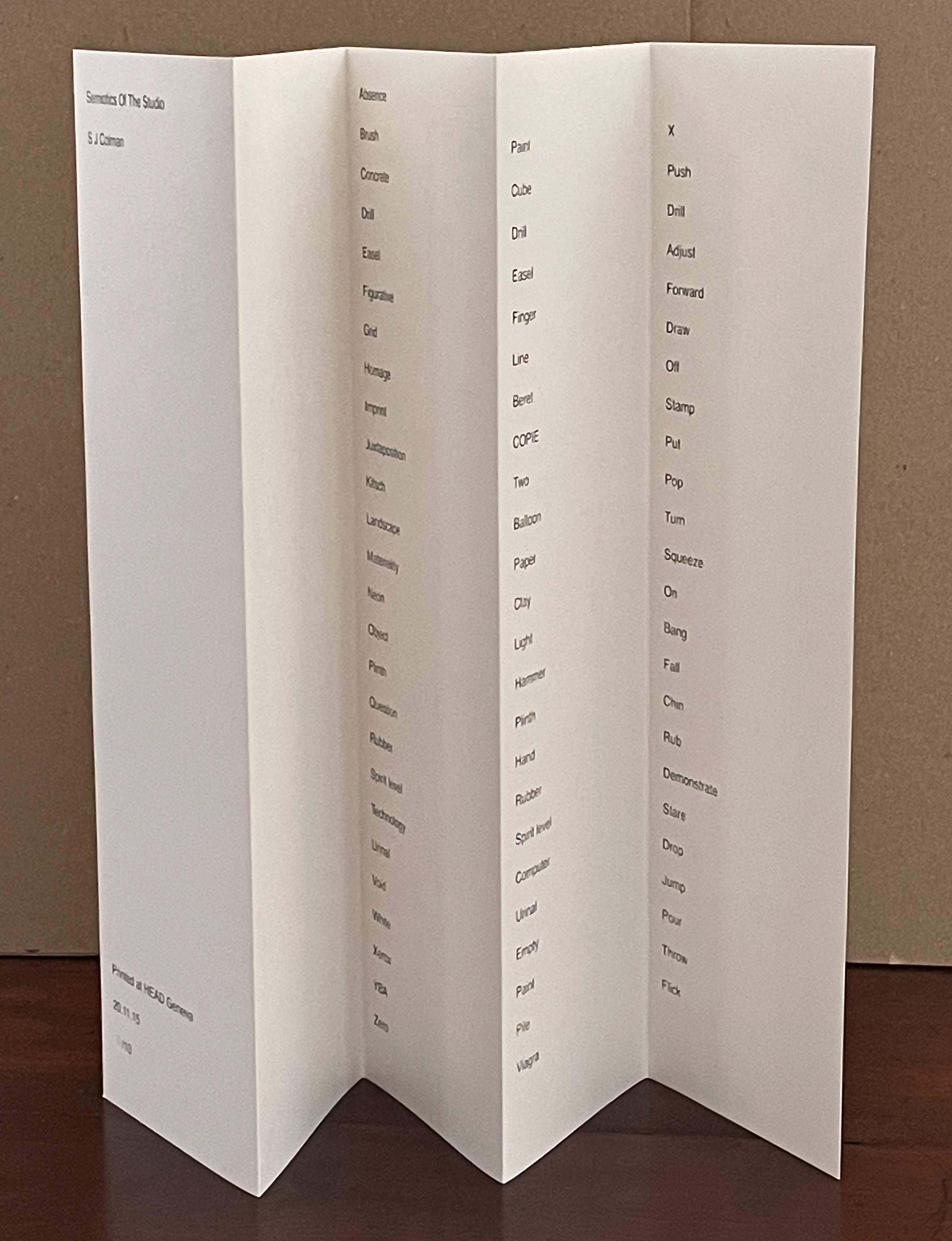
Semiotics of the Studio (2015) Sarah Colman Leporello H300 x W85 mm (closed), up to W425 mm (open). Five panels. Edition of 10, of which this is #10. Acquired from the artist, 1 August 2026. Photos: Books On Books Collection.
Like 4p. and 33mm, the Semiotics of the Studio translates a different medium into that of an artist’s book and very much insists on being experienced on its own terms.
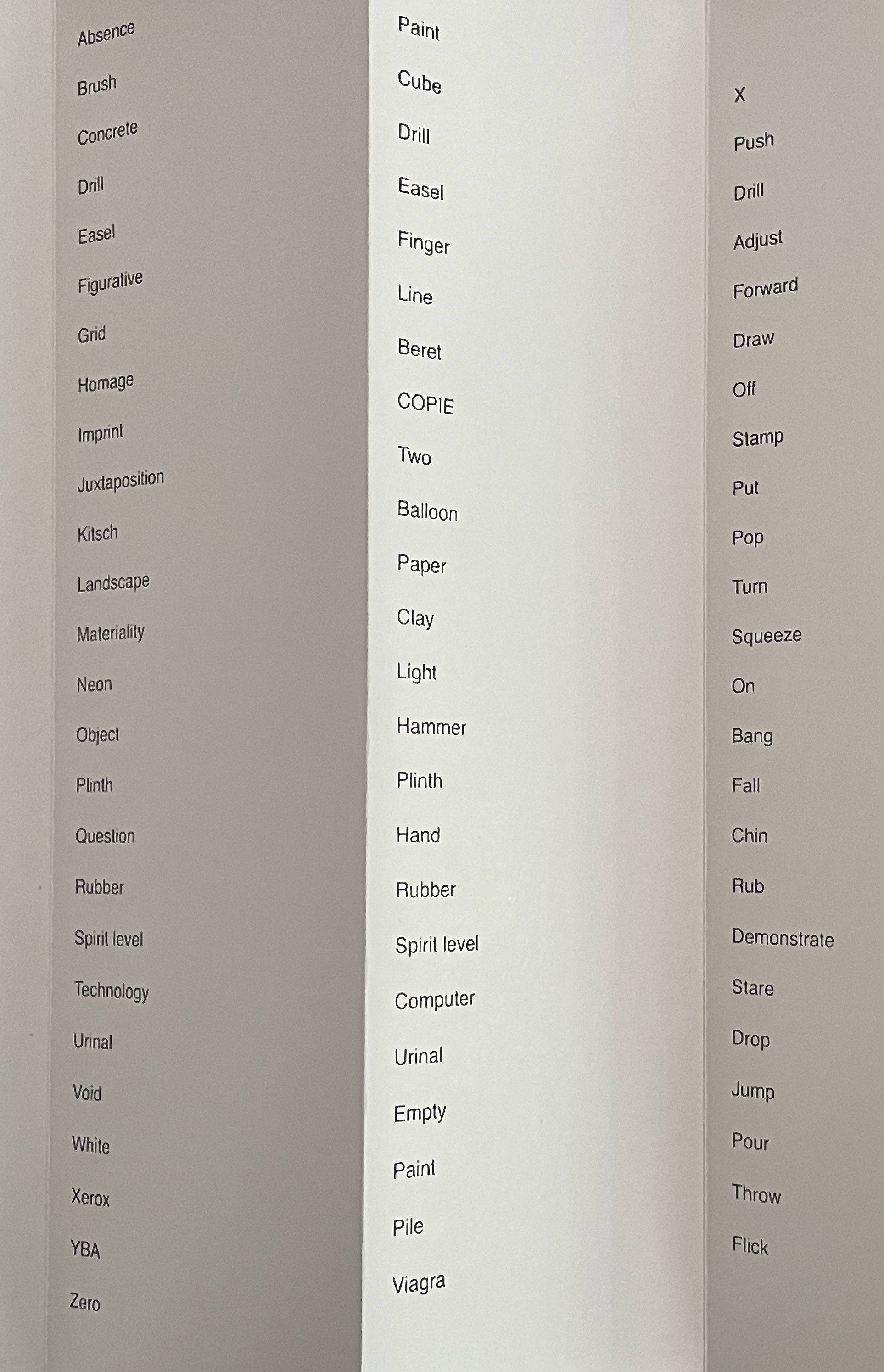
Laid flat or standing, Semiotics of the Studio presents itself as an accordion book, but the order of reading its text is not as straightforward (or downward) as the first panel’s alphabetical order suggests. The alphabetical order in panel 1 becomes a red herring in panel 2. With “Cube”, “Drill”, “Easel”, and “Finger”, Panel 2 resumes an alphabetical order only to abandon it, and in panel 3, there are no alphabetical pairs or triples at all.
Perhaps we should read from left to right across the three panels instead of down. Is the blank space at the top of the third panel showing us the product of “Absence” in the first panel and “Paint” in the second panel? But wait, maybe we should read backwards from “Paint” in the second panel to “Brush” in the first; after all, further down, we have “”Juxtaposition” in panel 1, then “Two” in panel 2, and “Put” in panel 3, suggesting that we put two in juxtaposition.
Just below that, if we put “Kitsch” and “Balloon” together with “Pop”, do we have a dig at Jeff Koons? And much further down, is the juxtaposition of “Urinal”, “Urinal”, and “Drop” taking the piss with Duchamp?
What about “Object”, “Hammer”, and “Bang”? If we are trying to figure out sentences from this, Subject, Verb, and Object seem to jump about. We need to put “Chin” (panel 3) on “Hand” (panel 2), and “Question” (panel 1) what is going on.
Another puzzle is that some words are repeated across from each other in panels 1 and 2. “Drill”, “Easel”, “Plinth”, “Rubber”, “Spirit Level”, and “Urinal”, as we have seen. Sometimes, panel 2 gives an example for the word in panel 1 (e.g., “Computer” for “Technology”). Sometimes, the words are descriptive or synonyms of one another (e.g., “Neon” and “Light” and “Void” and “Empty”, respectively).
Closer inspection reveals that the three columns of words do not precisely align horizontally. They cascade. “Absence” is slightly higher than “Paint”, “Paint” is slightly higher than “X”, and so on. Moreover, panel 1 has 26 words, panel 2 has 22, and panel 3 has 23. So perhaps we should be looking for sense in multiple directions, which is pretty much where semiotics as a discipline has landed.
Context, too, matters. Colman reaps the benefit of Martha Rosler’s kitchen setting for her subversive purposes. While Colman is in the studio, which suggests that her exploration of semiotics is one of creative process, she also slips in terms that challenge the clichés and politics of art, terms like “Beret”, “Kitsch”, and “Viagra”. It’s the artist’s book equivalent of donning the aprons and maintaining a deadpan delivery in the video.
By putting art words to work in a work of art — especially in the form of an artist’s book — Semiotics of the Studio “interrogates” itself and its subject.
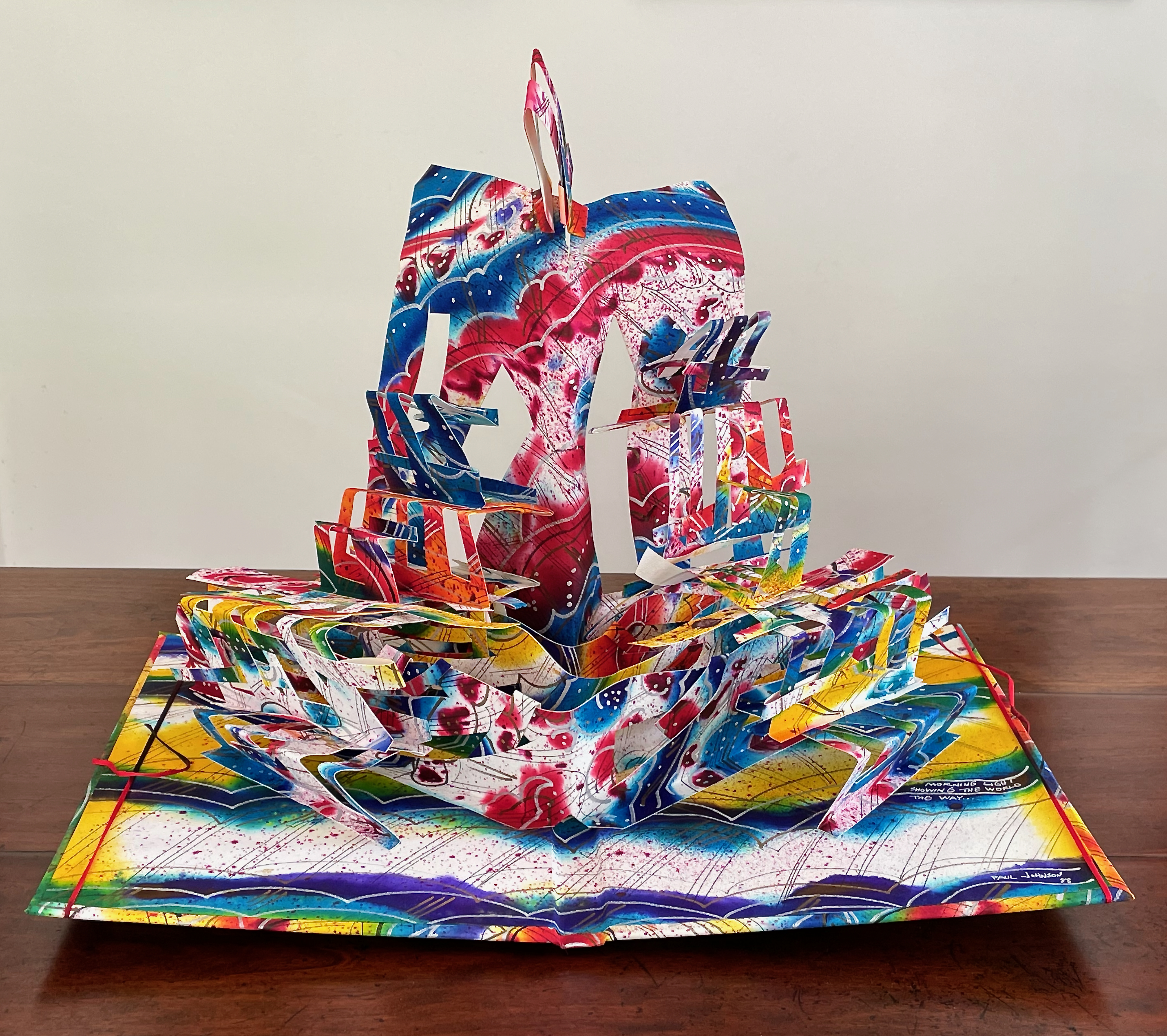
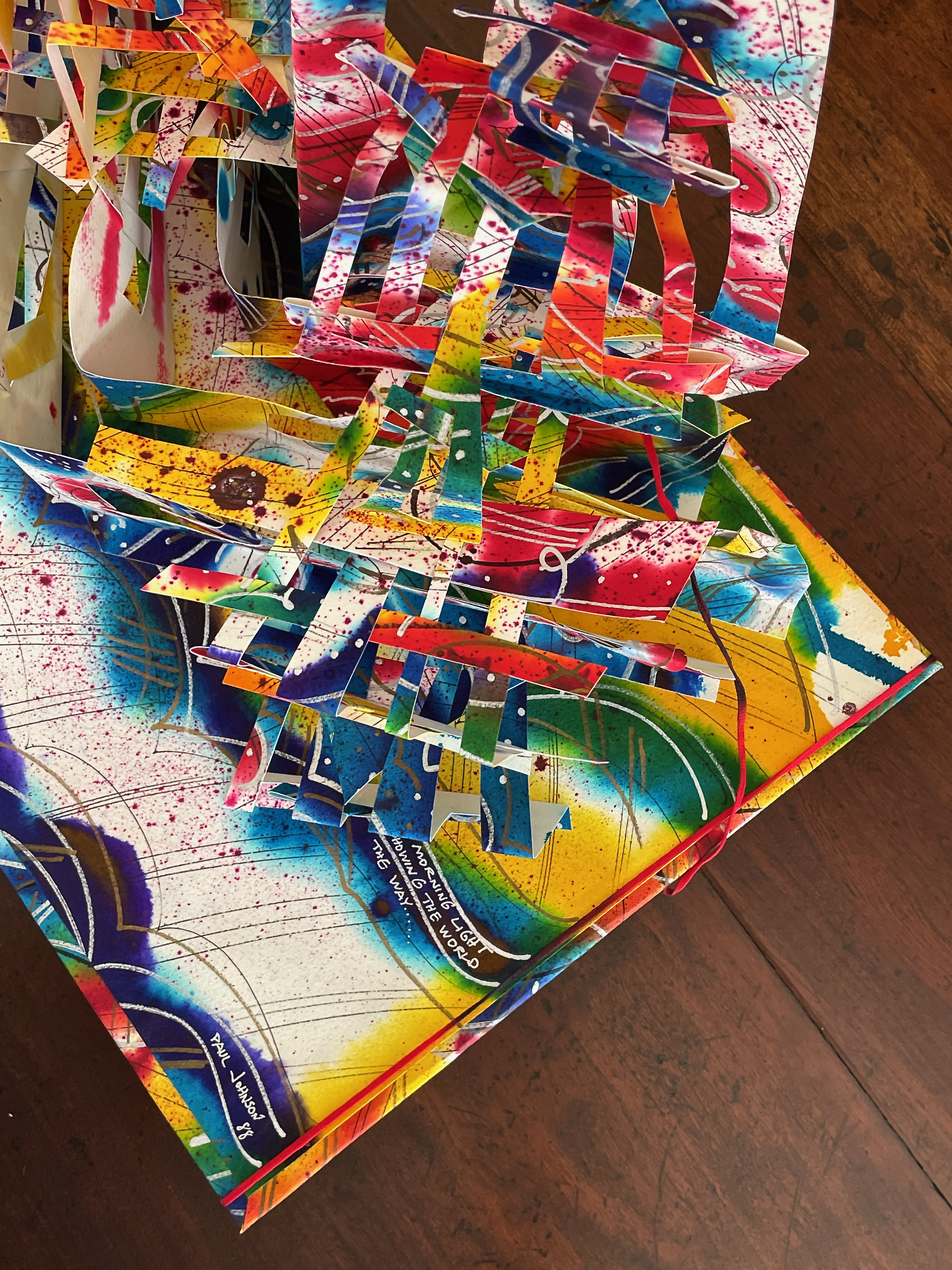
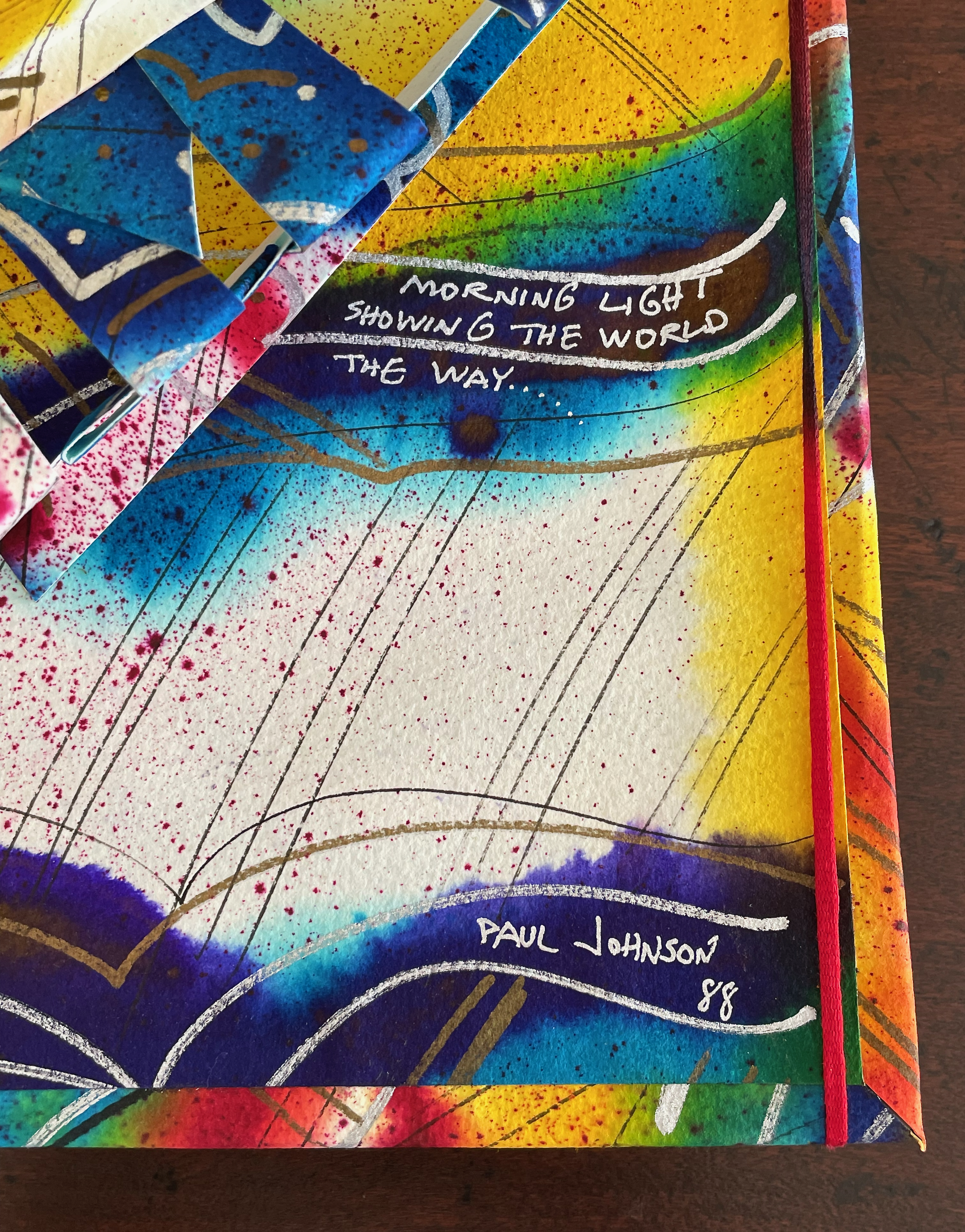
Paul Johnson’s book art has a childlike openness to delight, wonder, and joy. Those characteristics are signaled in his works’ titles — titles such as Suddenly from the centre of the universe came a symphony of light and The rivers of time carry the music of life down to the sea…. Below, the titles of two of his works in this collection also capture that exuberant spirit — The Sun Showers Symbols on the Earth and Morning Light Showing the World the Way. Some titles such as The Book Chair, Goldilocks & The Three Little Pigs, and The Pop-Up Unabridged History of the World, all also below, signal a quirkiness to be found in the works. And another vein of titles such as Ed Hutchins Studio, New York and Arthur Jaffe’s house, Florida reflects his works’ celebration of friendships, as demonstrated in the first work of Johnson’s to join this collection:
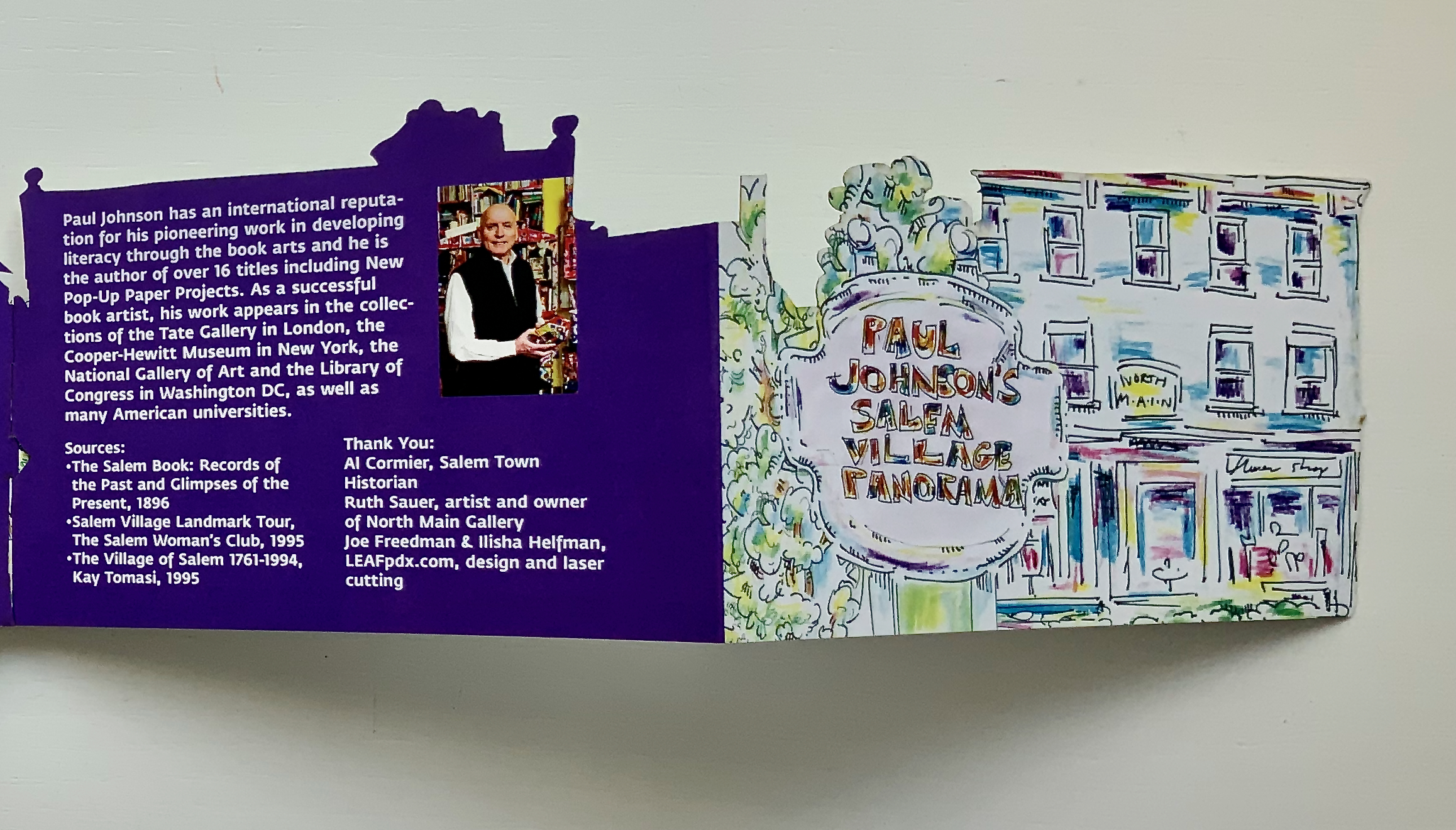
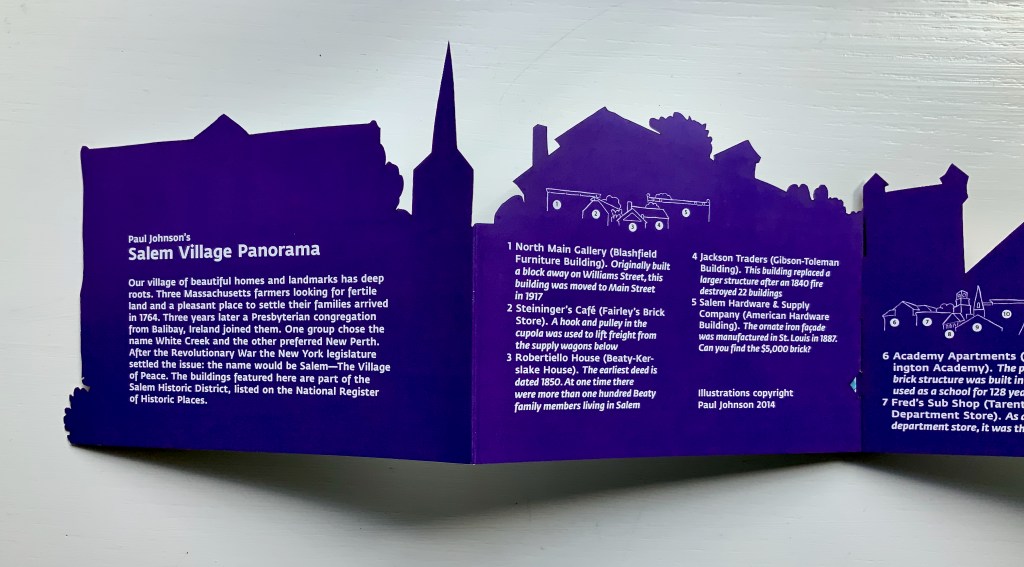
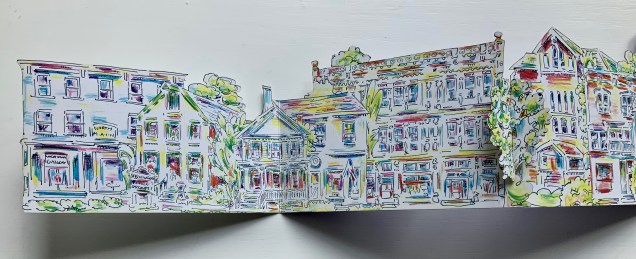
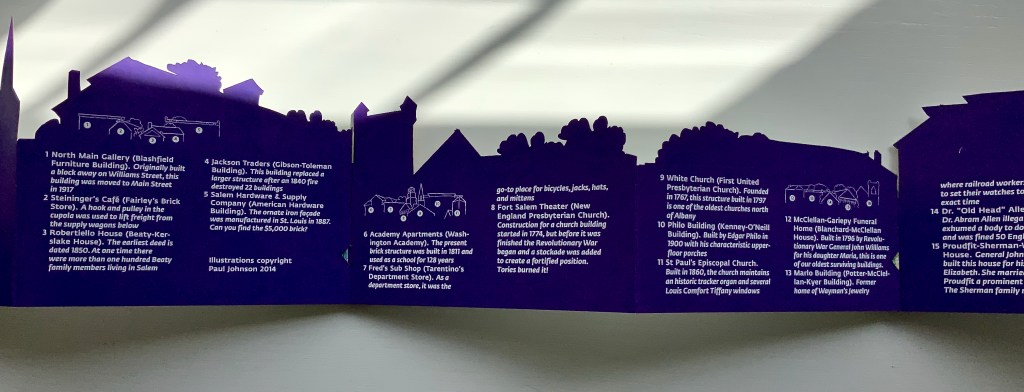
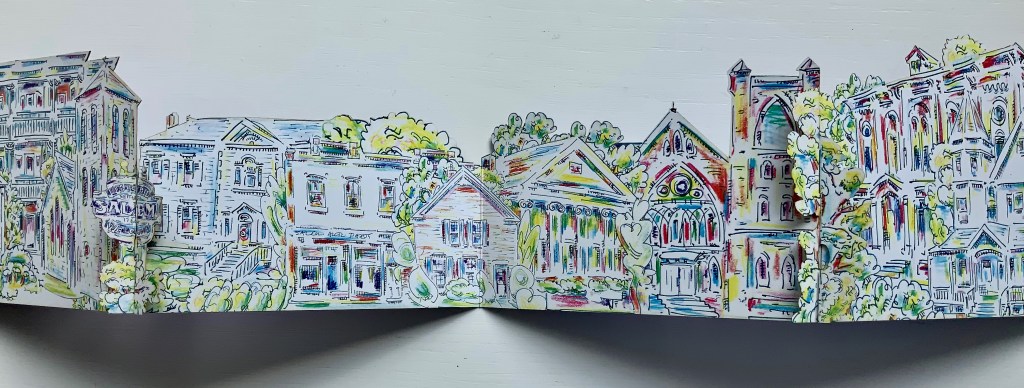
Paul Johnson’s Salem Village Panorama (2014)
Paul Johnson’s Salem Village Panorama(small version) (2014) Paul Johnson Pop-up double-sided leporello. H140 x W140 mm (closed), W974 mm (open). 8 panels. Limited edition (unknown quantity). Acquired from Ed Hutchins, 26 January 2022. Photos: Books On Books Collection.
Johnson’s good friend Ed Hutchins organized the show at North Main Gallery in Salem, NY. The town historian chipped in with historical sources, and local artist Paula Beardell Krieg announced it here with excited anticipation.
The next three works in the collection display Johnson’s penchant for unexpected and quirky explorations and that tell-tale characteristic of artists’ books: self-reflexivity.
The Pop-Up Unabridged History of the World (2008)
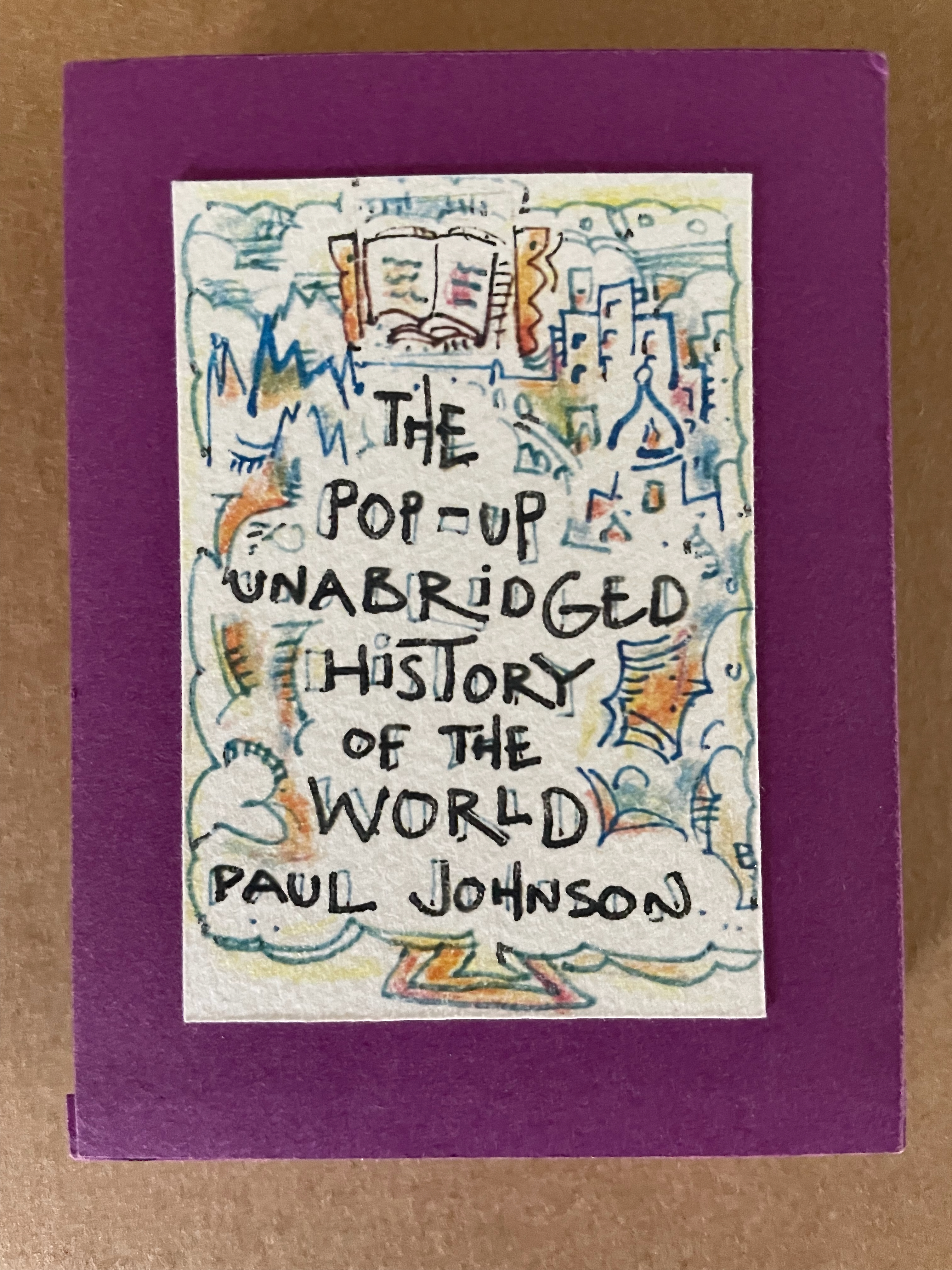
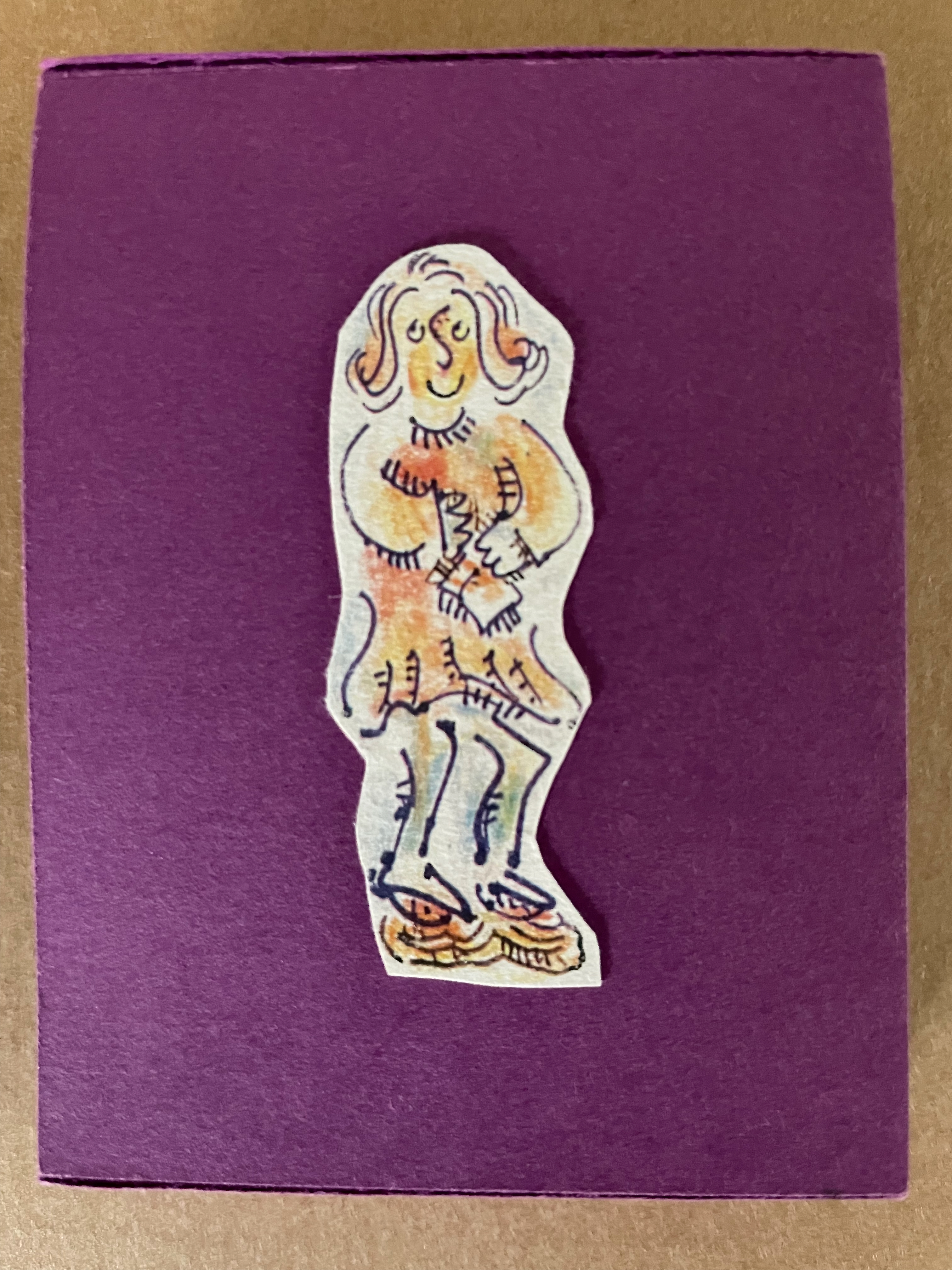
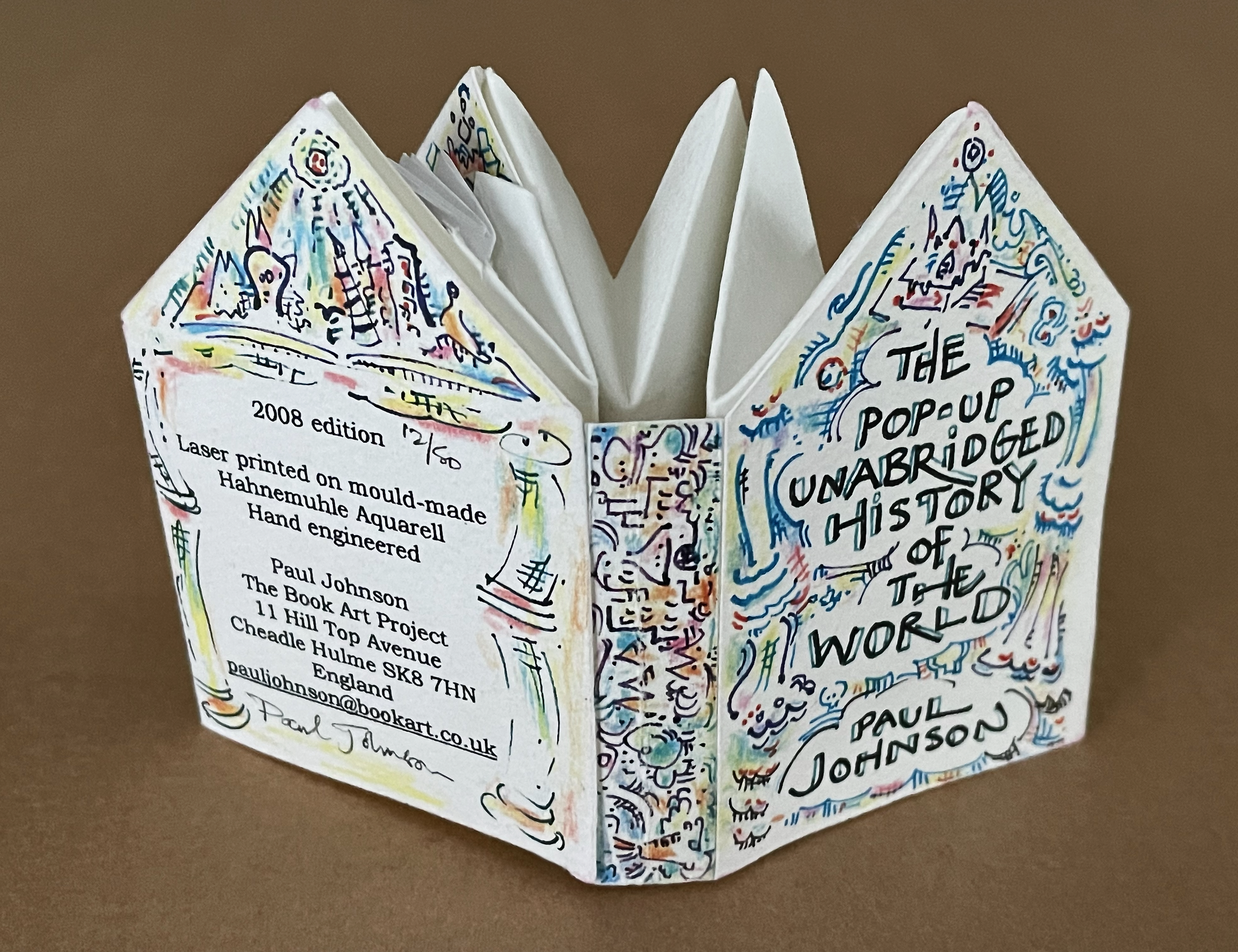
The Pop-Up Unabridged History of the World (2008) Paul Johnson Purple slipcase. Pop-up book. Slipcase: H86 x W65 mm. Book: H85 x W55 mm. [6] pages. Edition of 50, of which this is #12. Acquired from Collinge & Clark, 7 November 2024. Photos: Books On Books Collection.
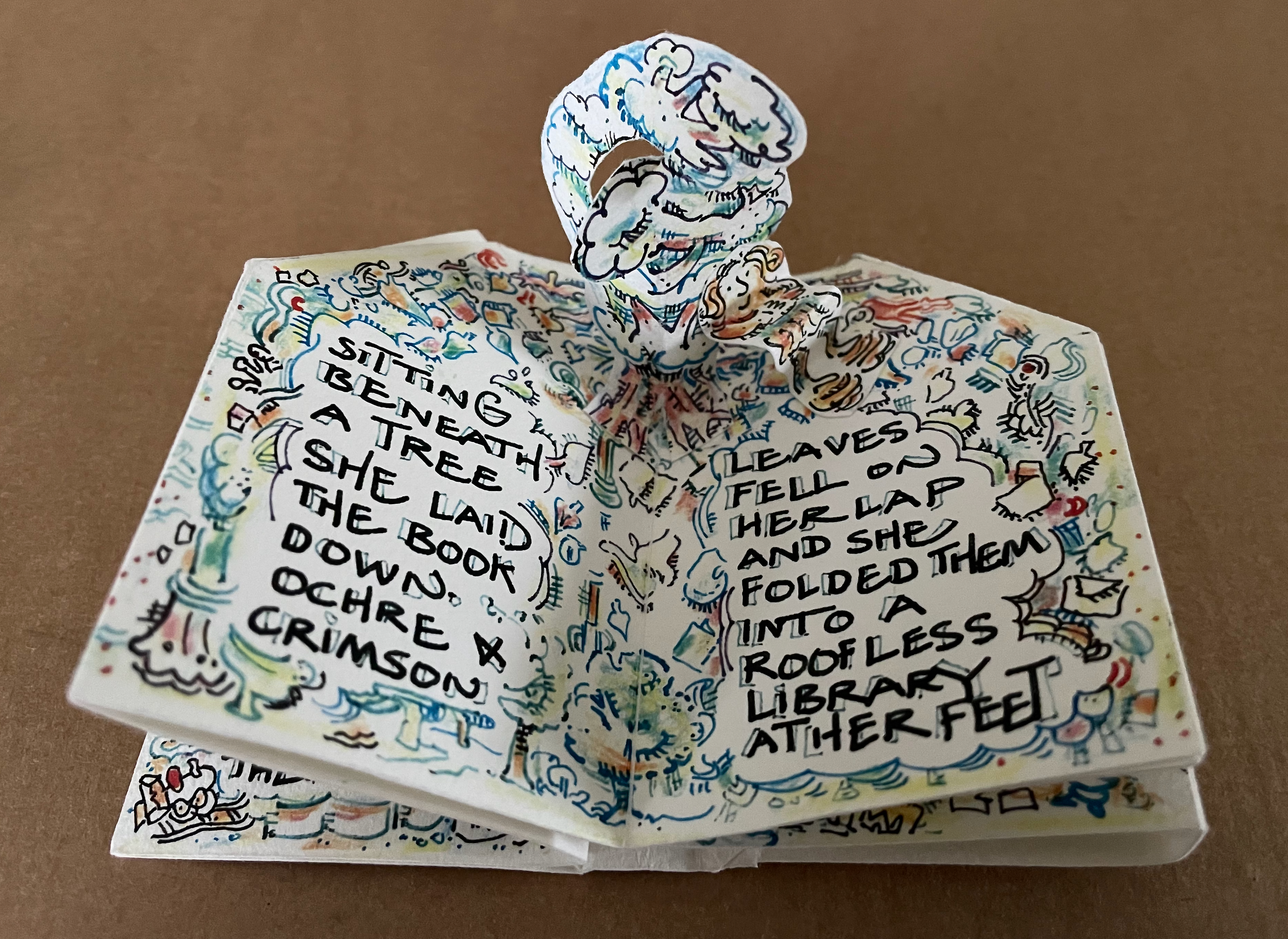
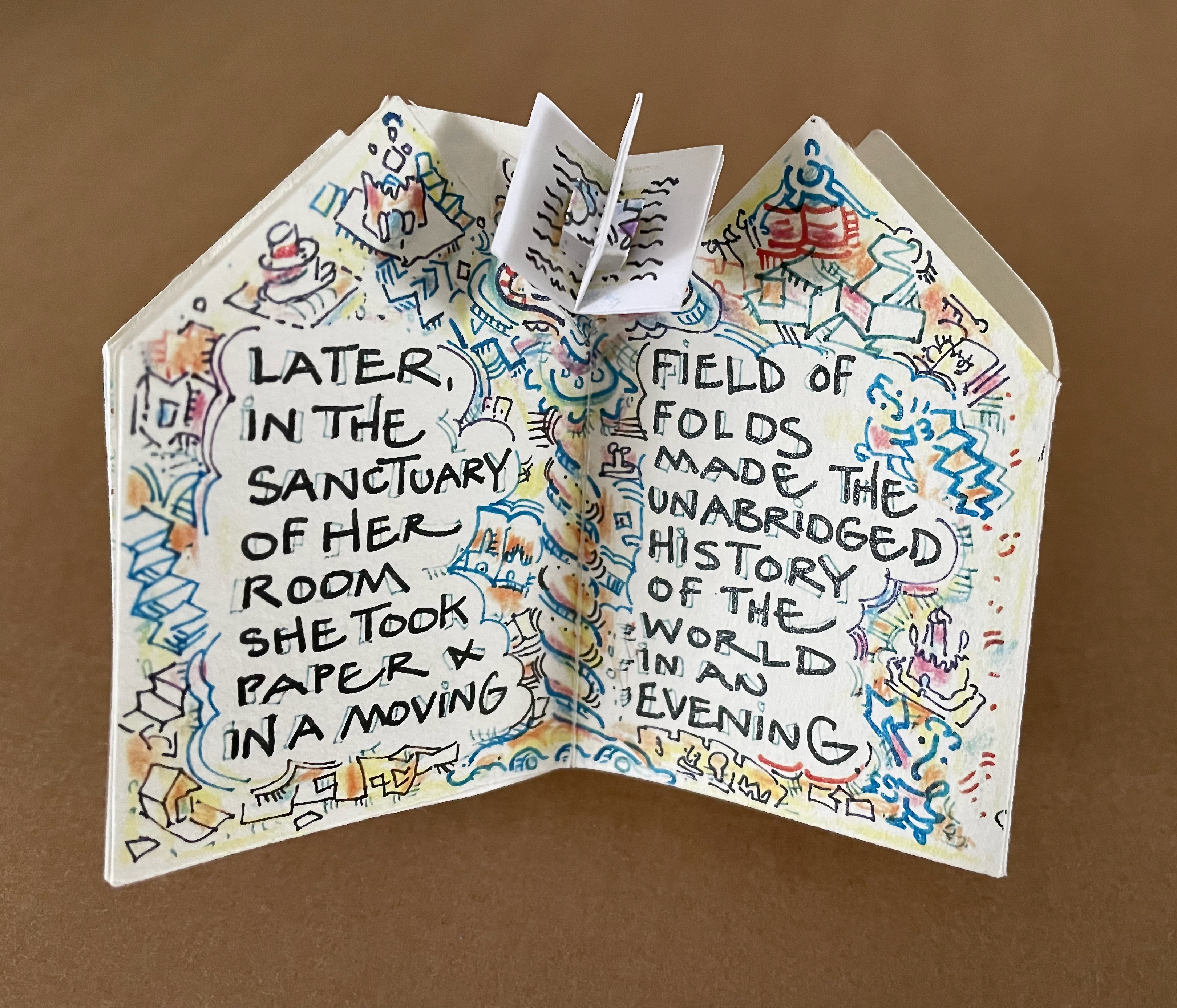
Again, title matters in Paul Johnson’s work. How can something so small, crafted from Hahnemuhle Aquarell, Johnson’s preferred paper, contain the unabridged history of the world?
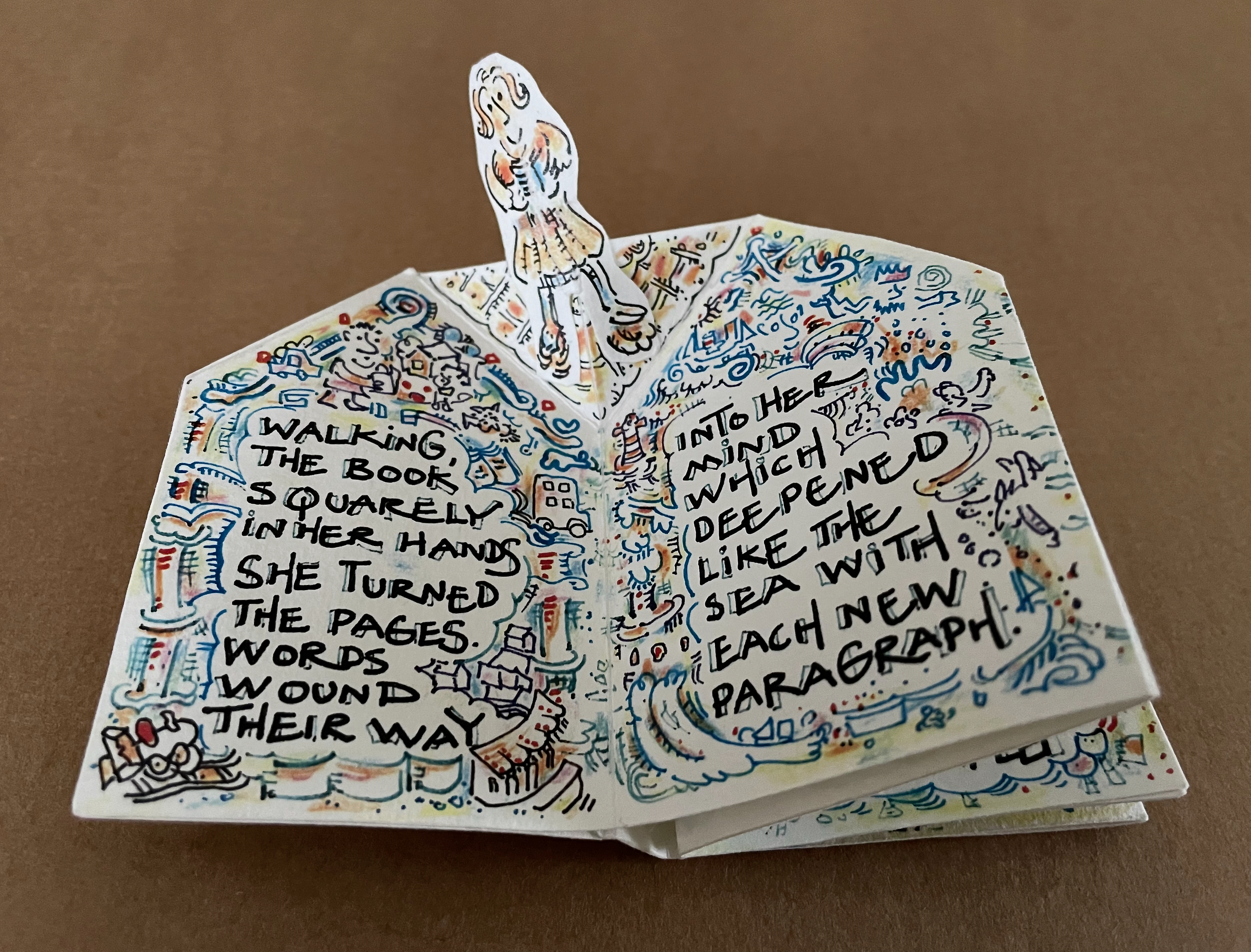
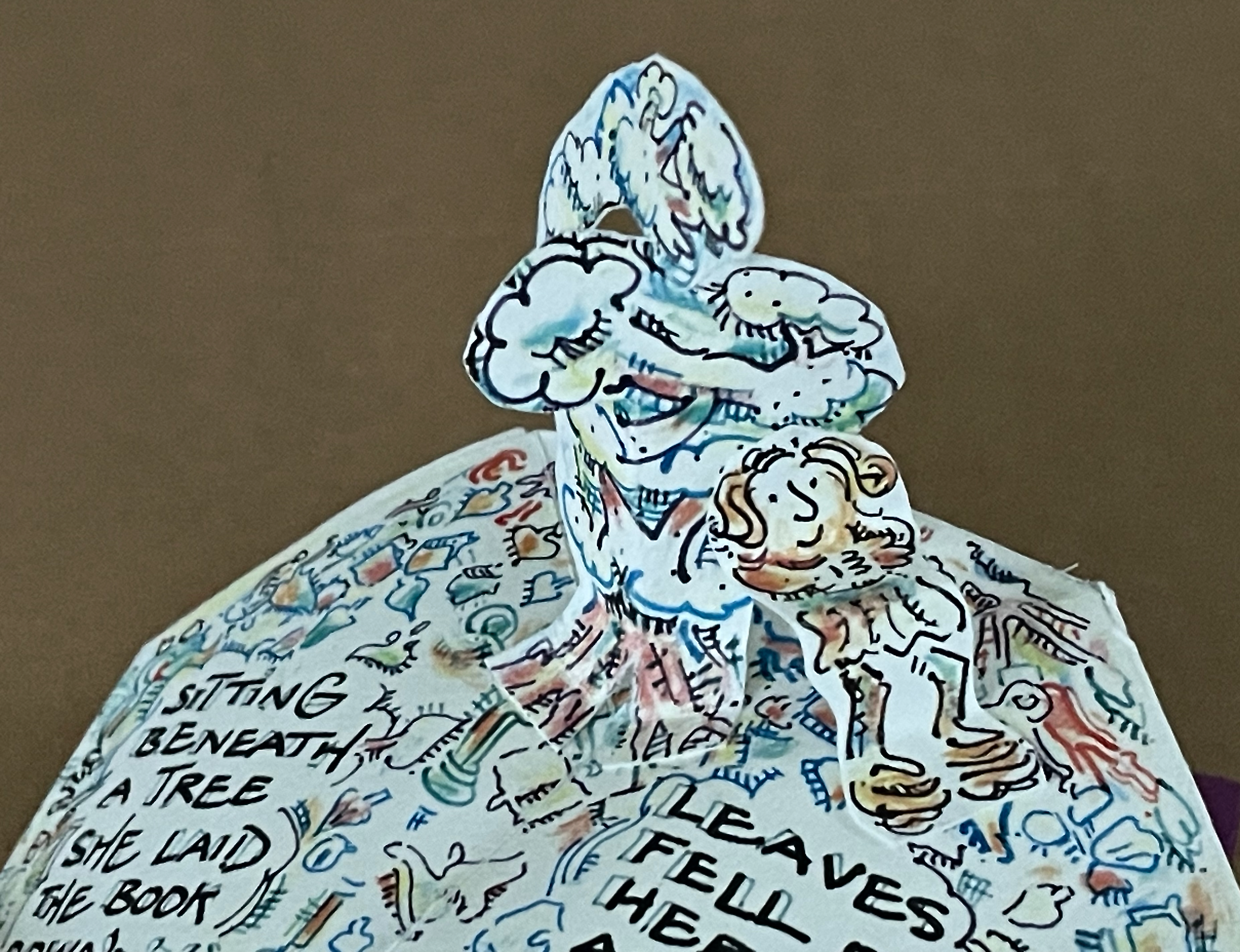
On the very first page, we find we are in a world of fiction, not non-fiction, but is the book the main character is reading fiction or non-fiction? Either could be deepening her mind.
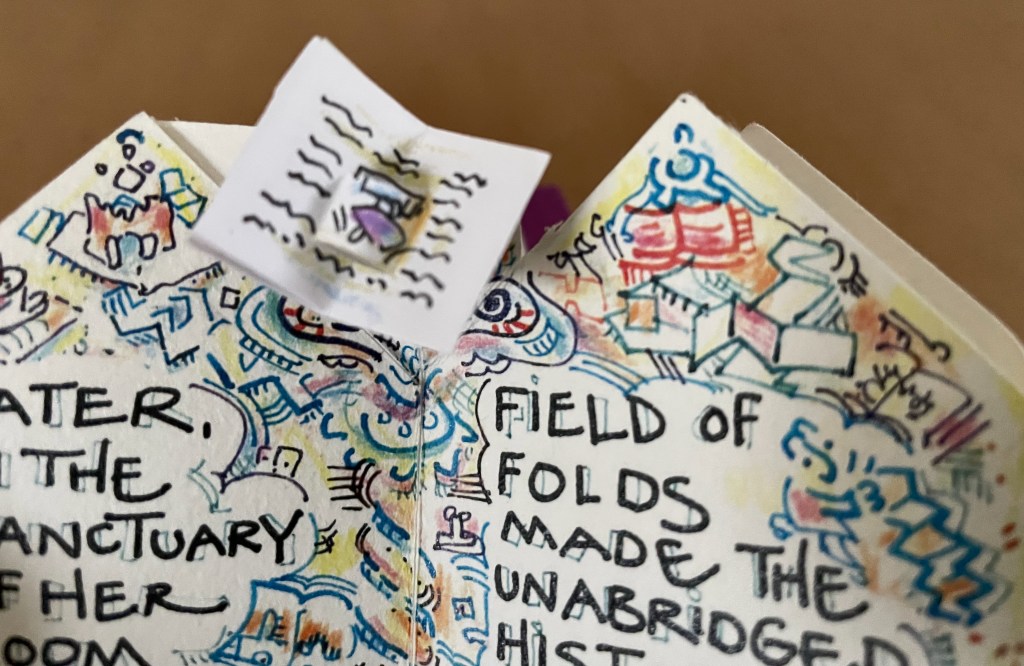
With the turn to the next page, the world’s leaves and the act of folding become as inclusive as the book’s leaves and the act of reading.
And with the turn to the last pages, we have the book she has made: a book within a book within a book.
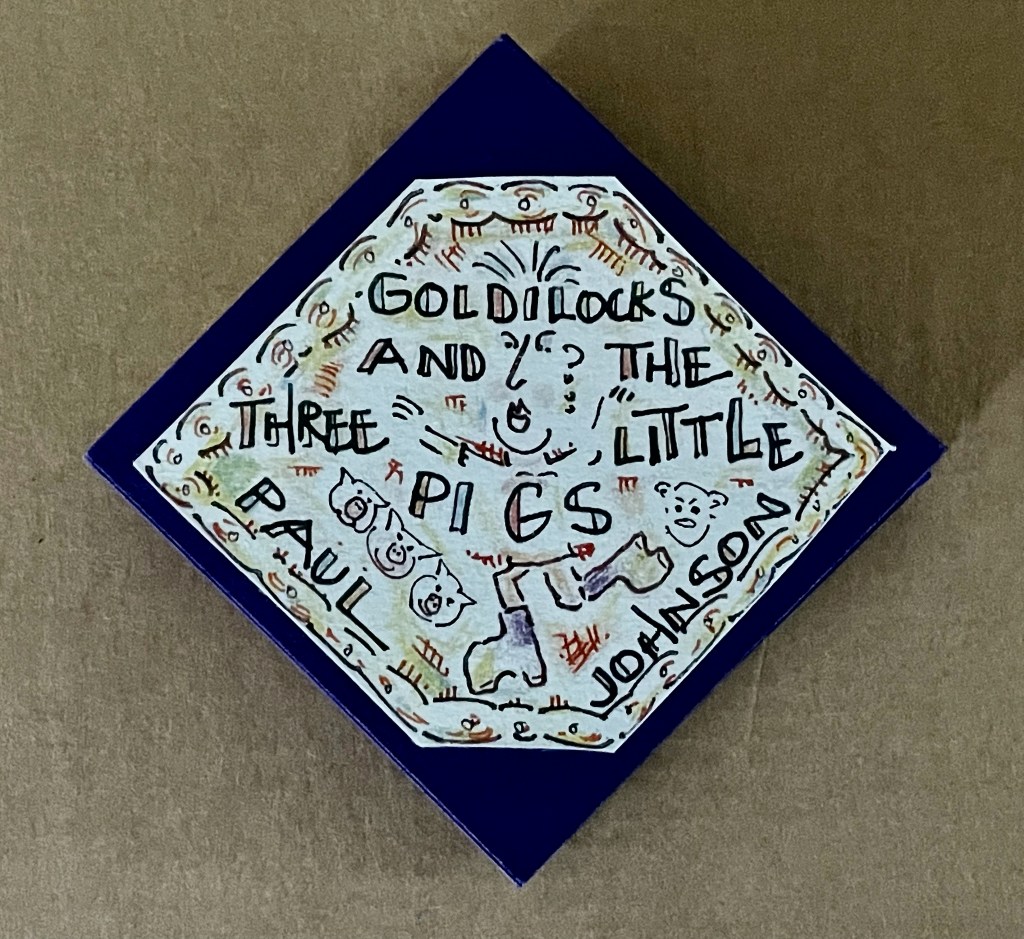
Goldilocks & the Three Little Pigs (2008)
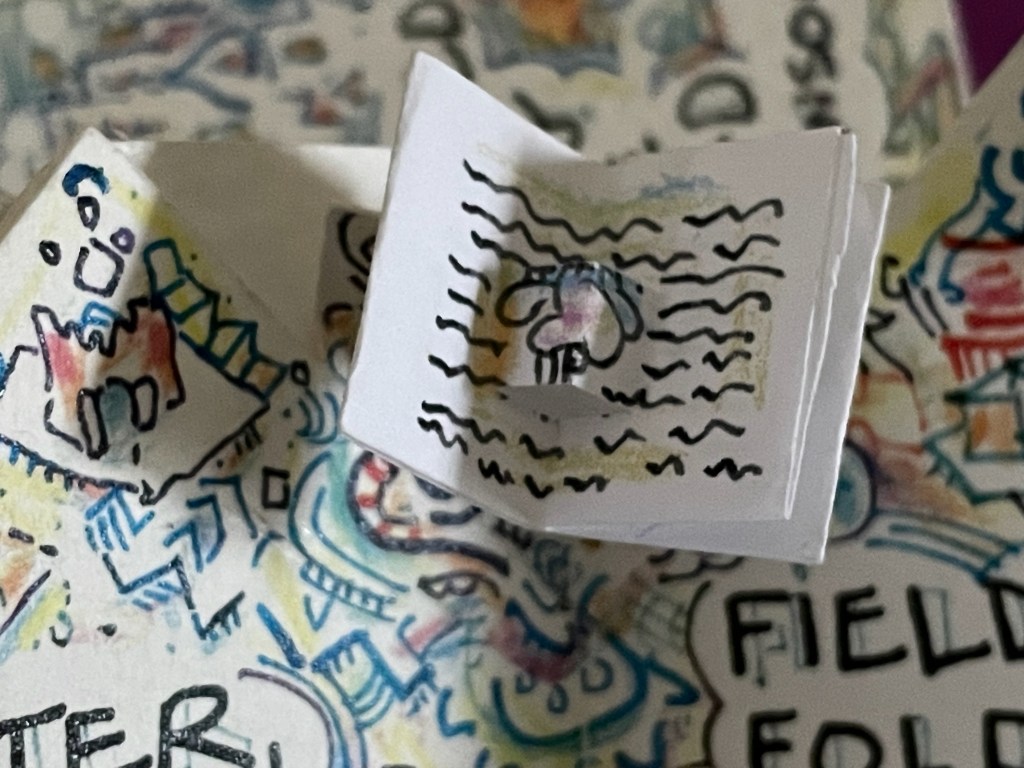
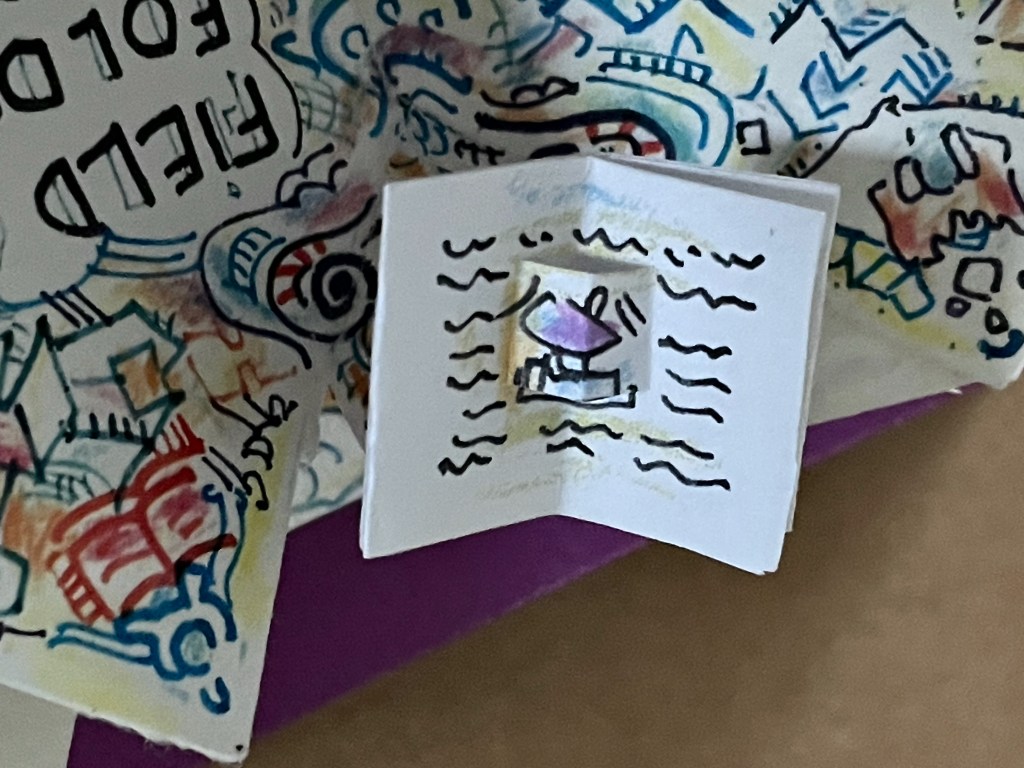
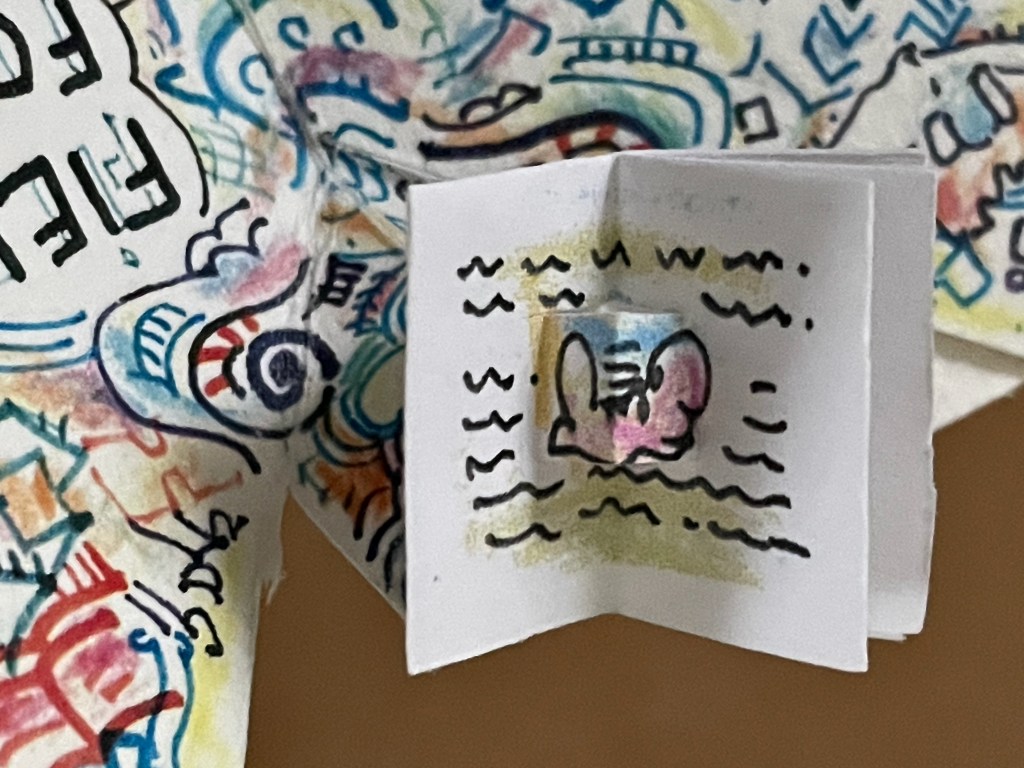
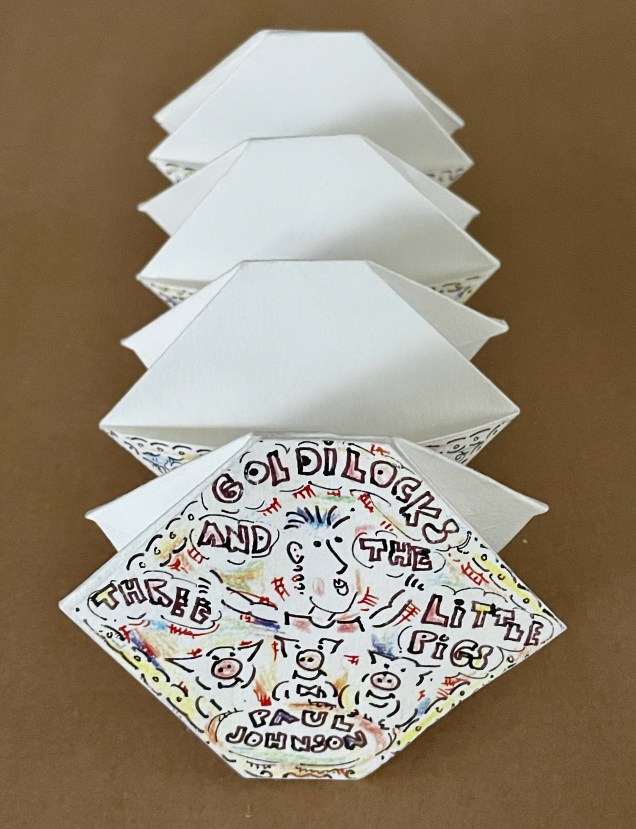
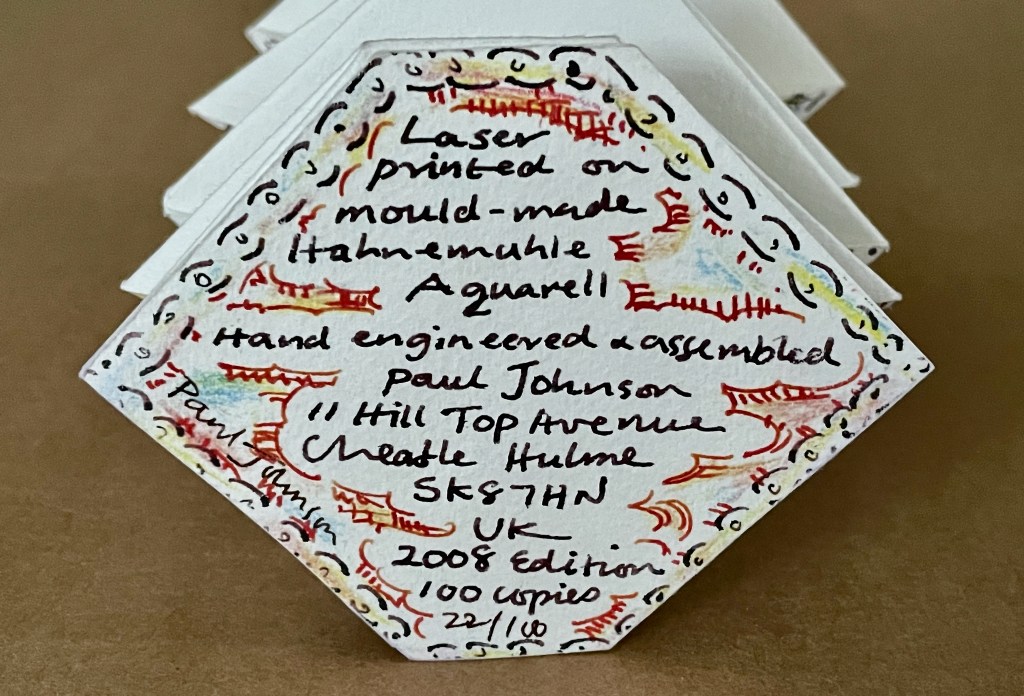
Goldilocks & the Three Little Pigs (2008) Paul Johnson Purple slipcase. Vertical, laddered pop-up. 75 x 75 mm [4] pages. Edition of 100, of which this is #22. Acquired from Collinge & Clark, 7 November 2024. Photos: Books On Books Collection.
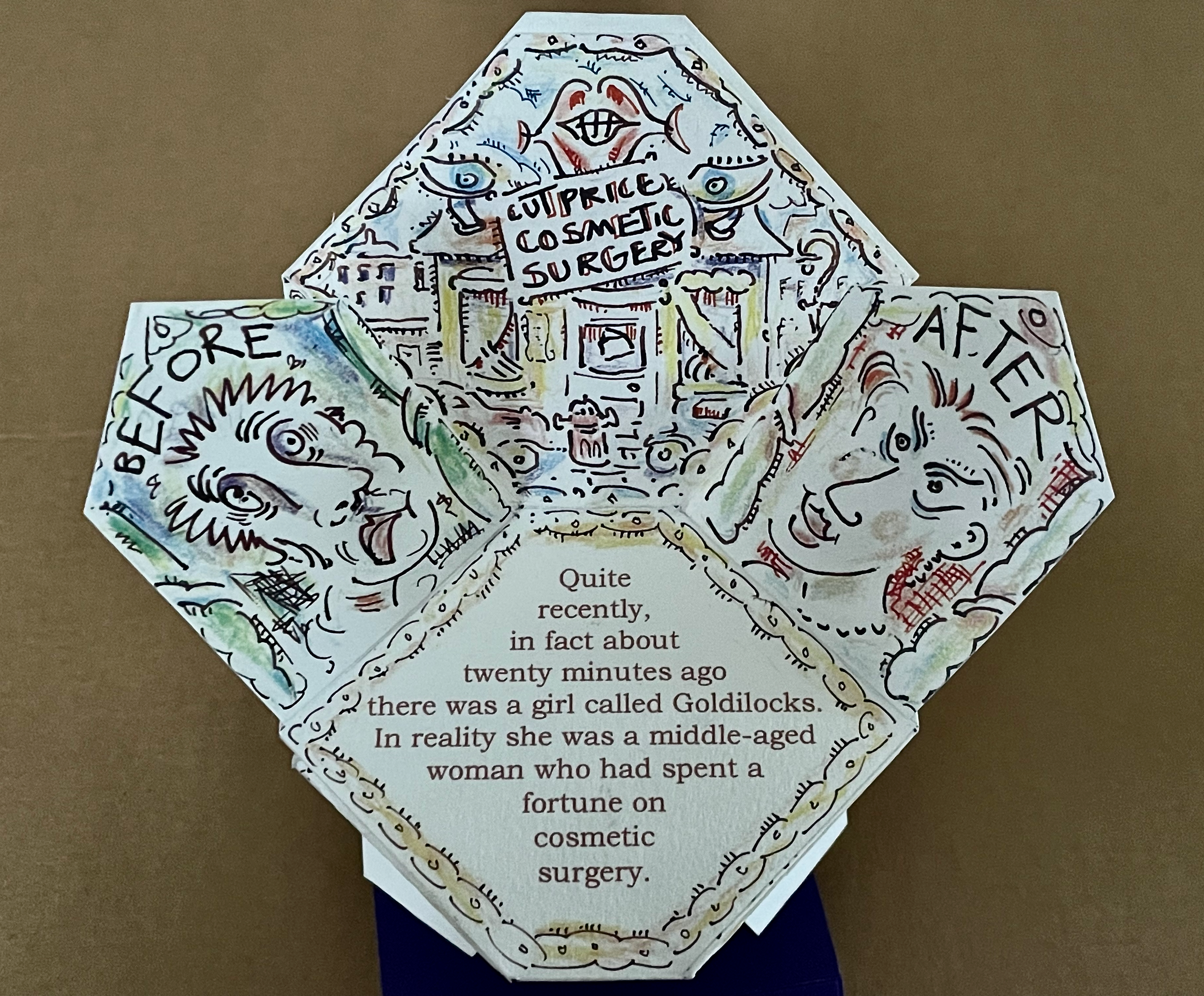
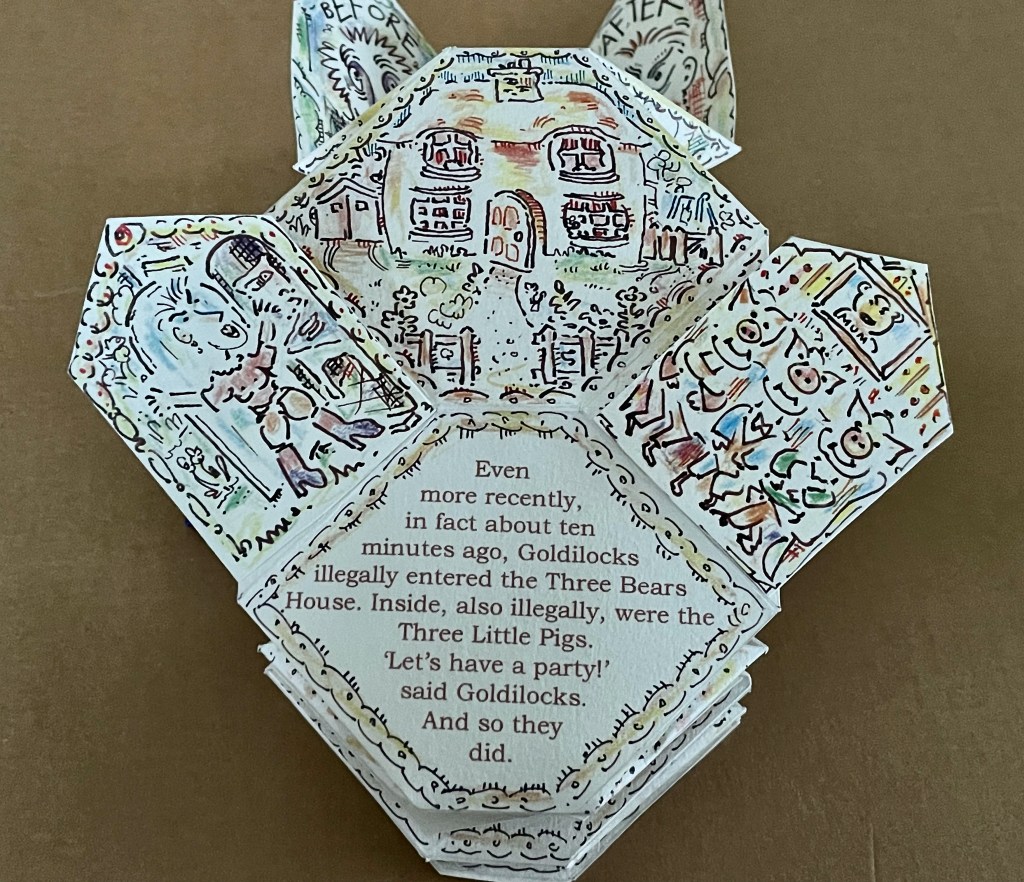
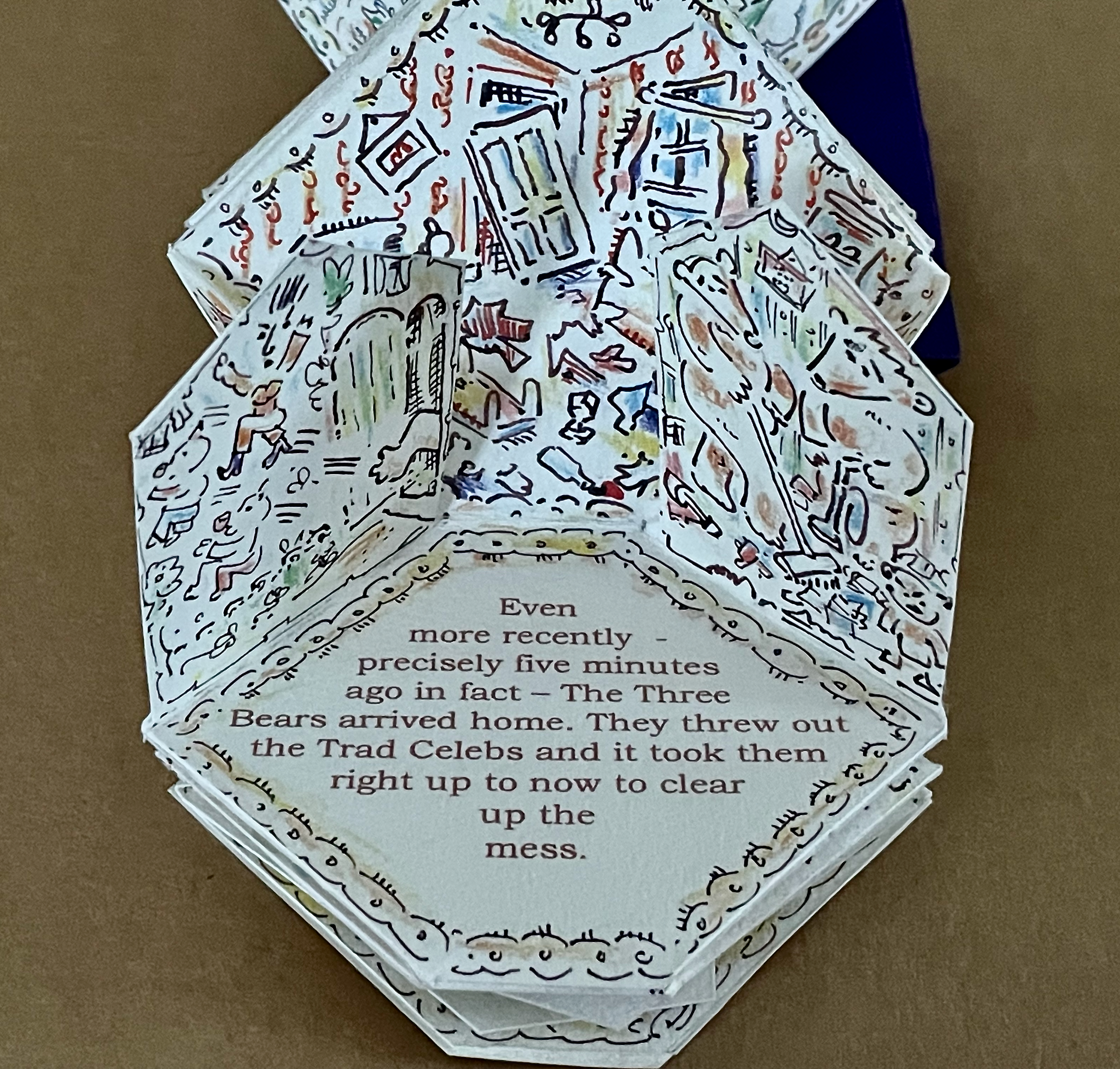
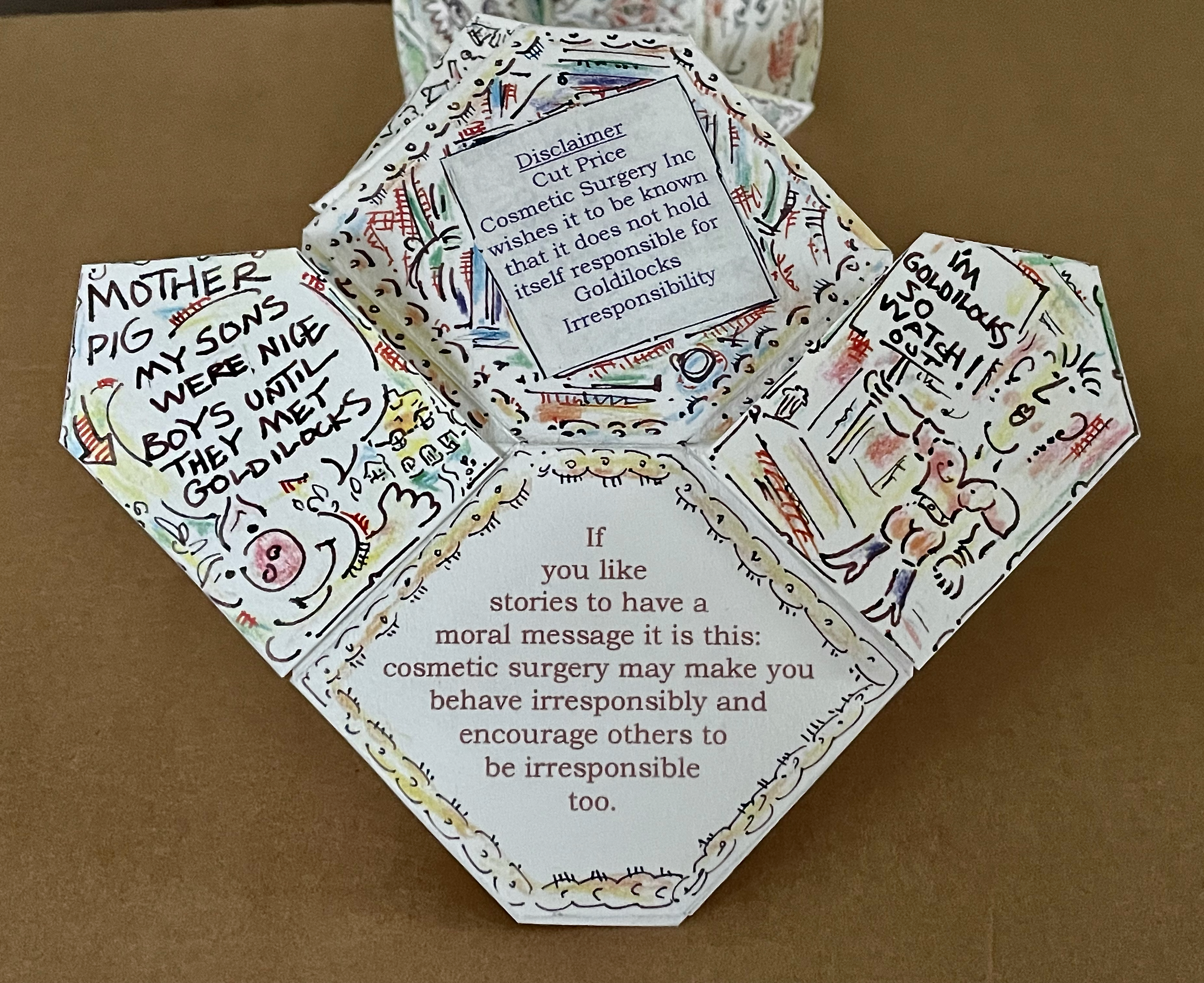
Hijacking Goldilocks from her traditional story and the Three Little Pigs from theirs leads Johnson’s imagination in a more acerbic direction than in his other limited editions. His softer whimsy still comes through in his changing the usual time frame of “Once upon a time” to “Quite recently, in fact twenty minutes ago”, appropriate enough for the pace of modern life as is his giving the pop-up the shape of a make-up compact.
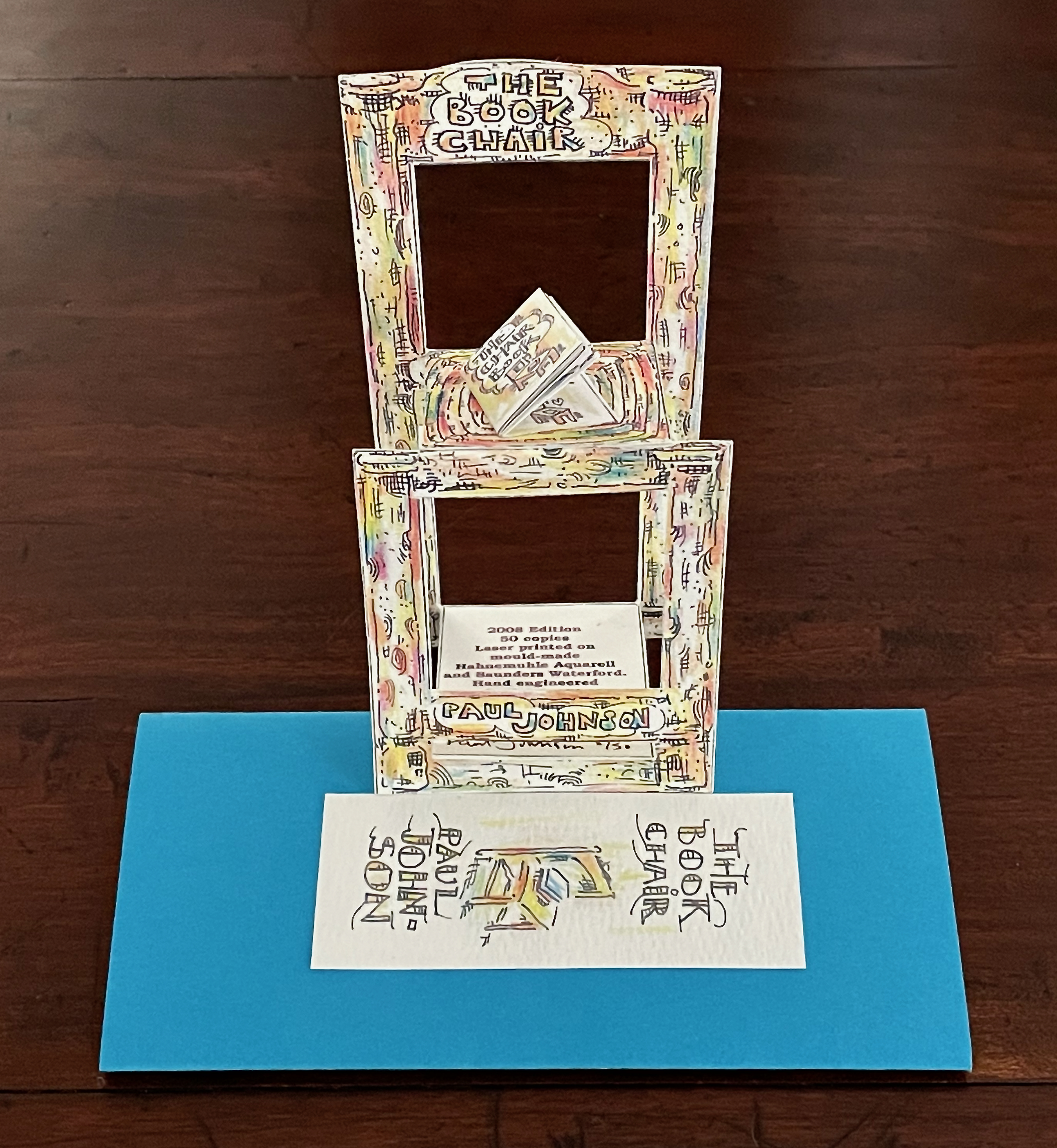
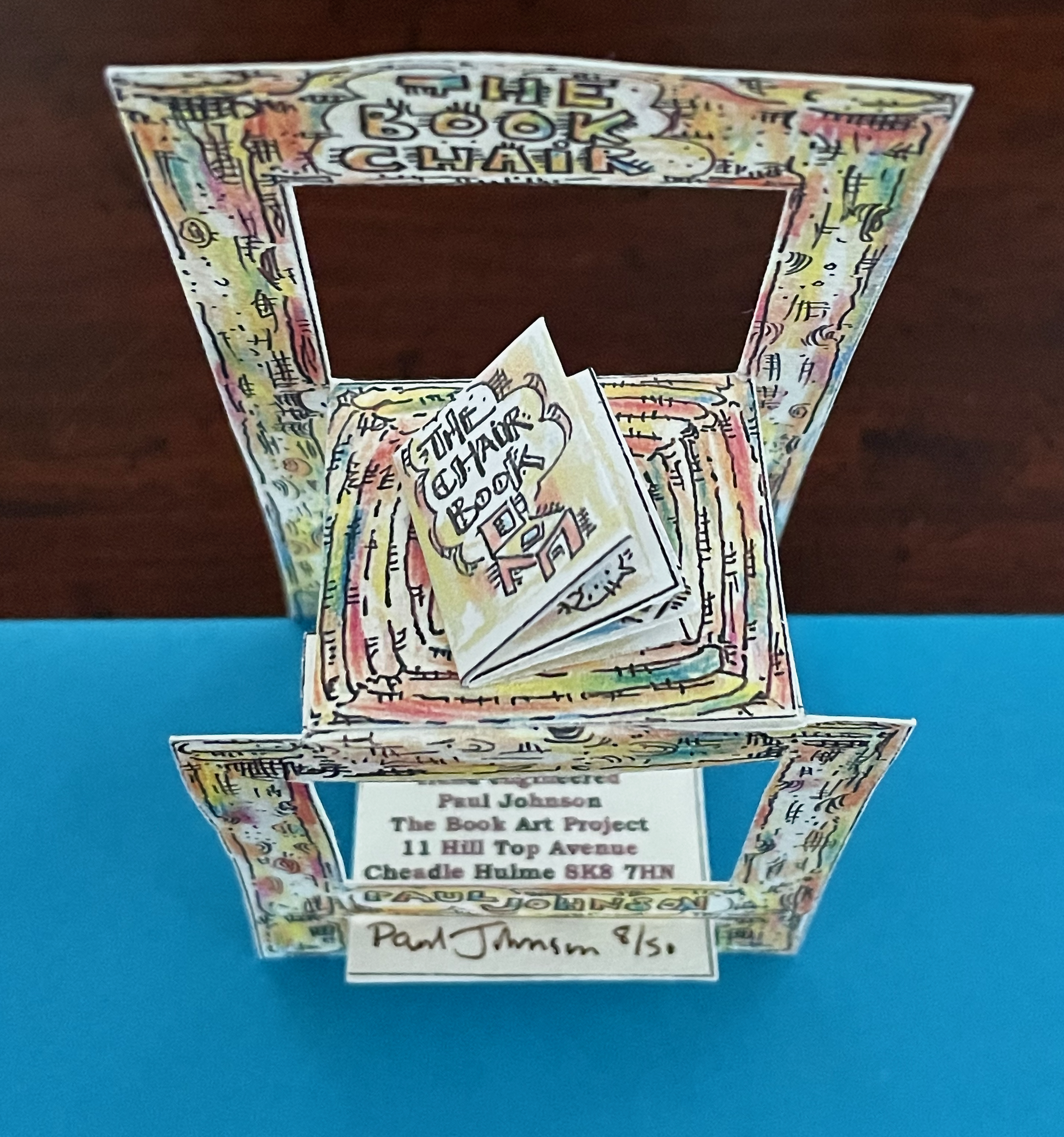
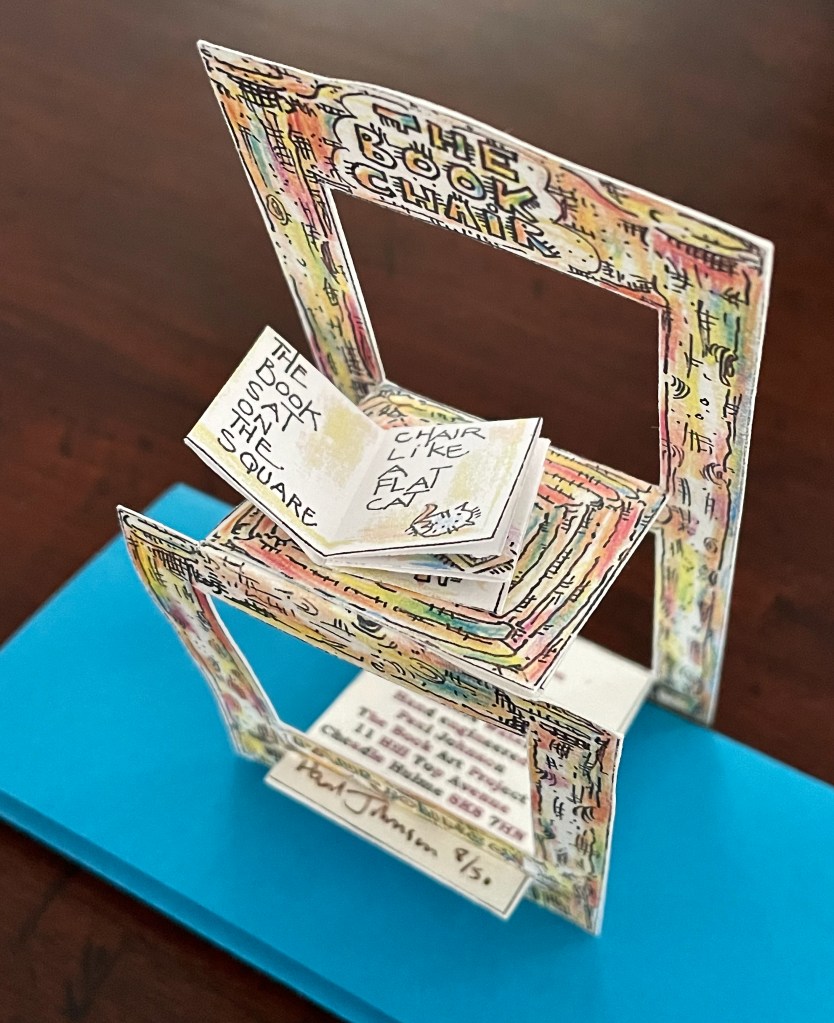
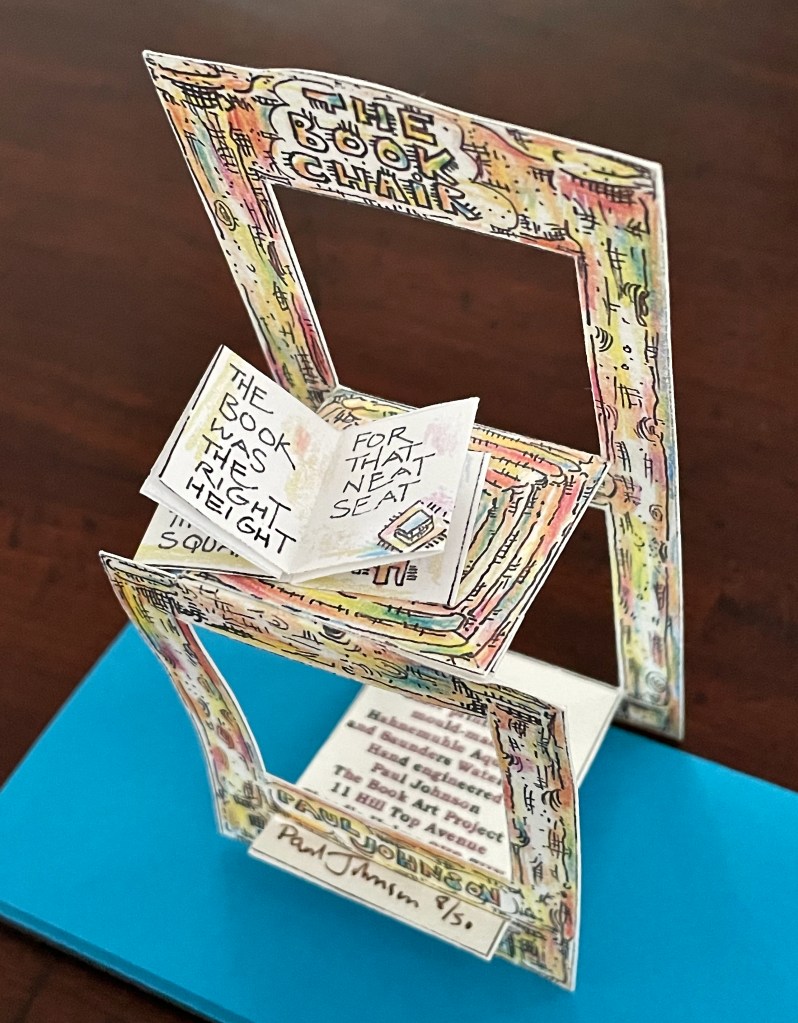
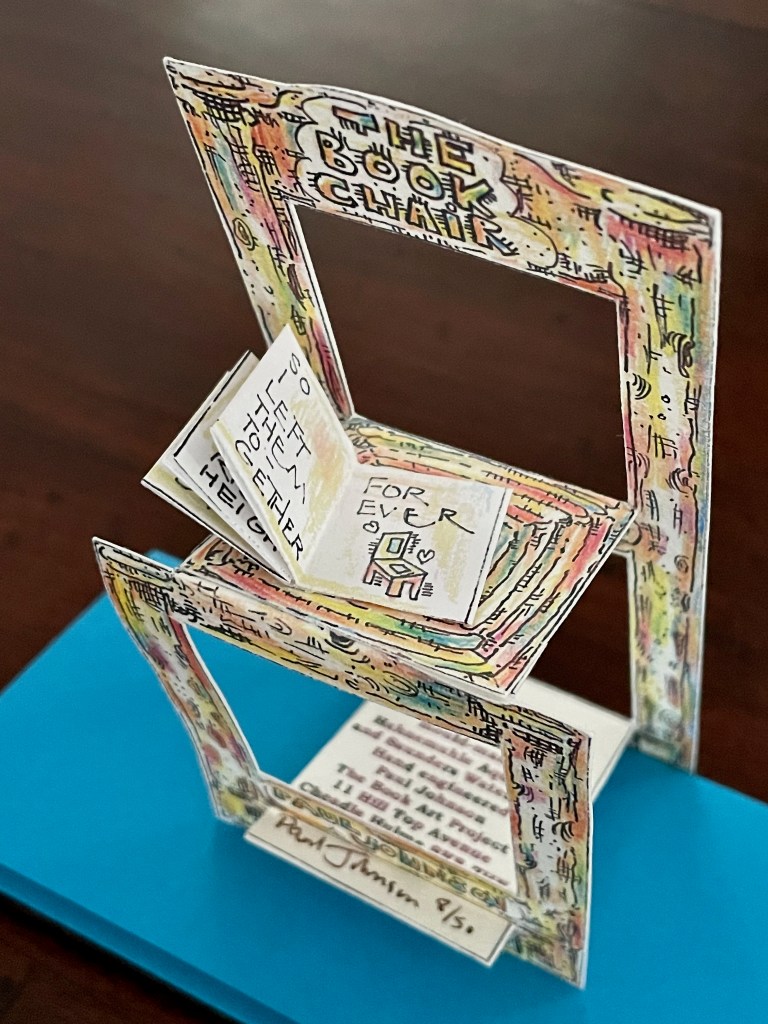
The Book Chair (2008)
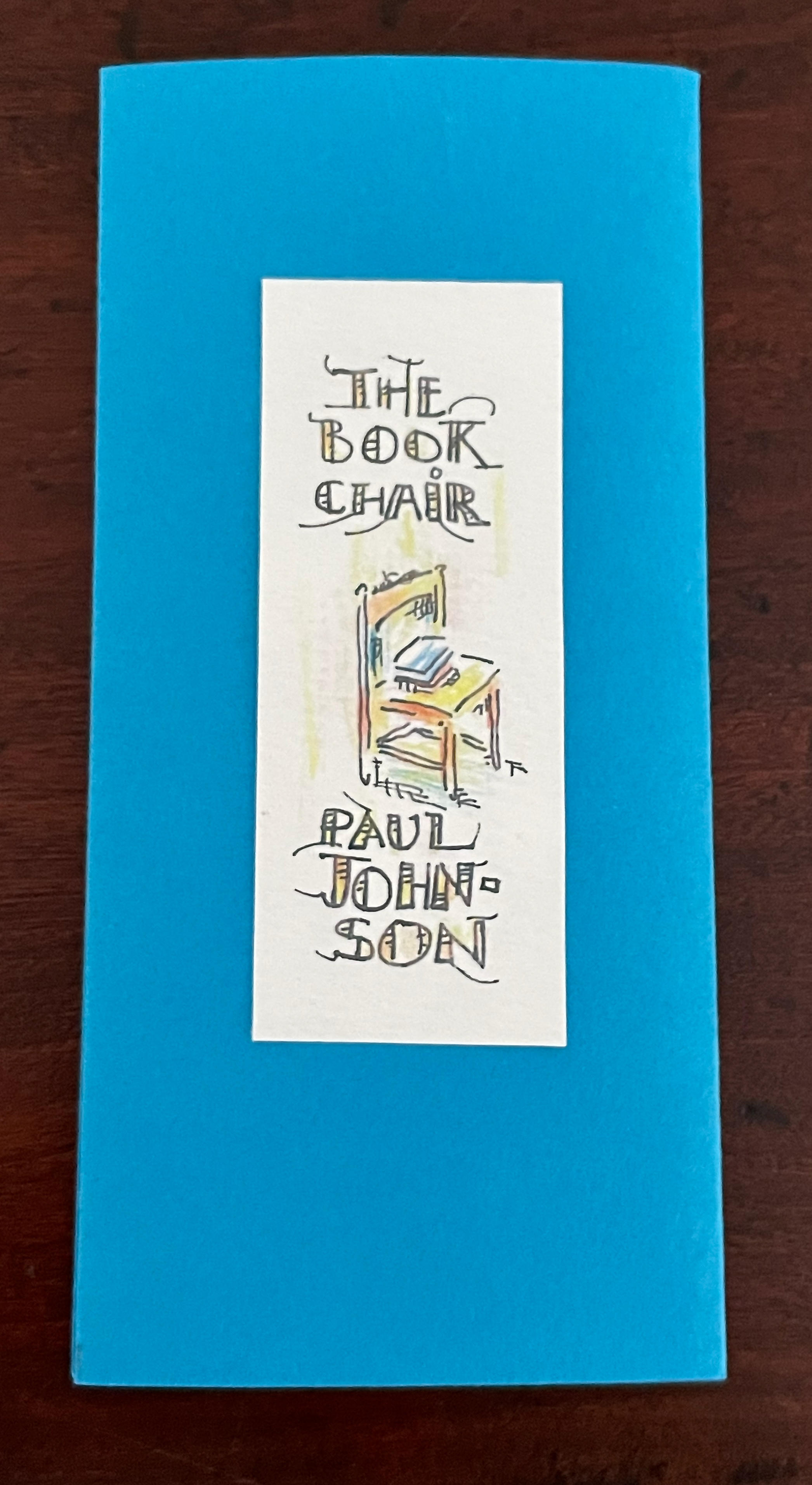
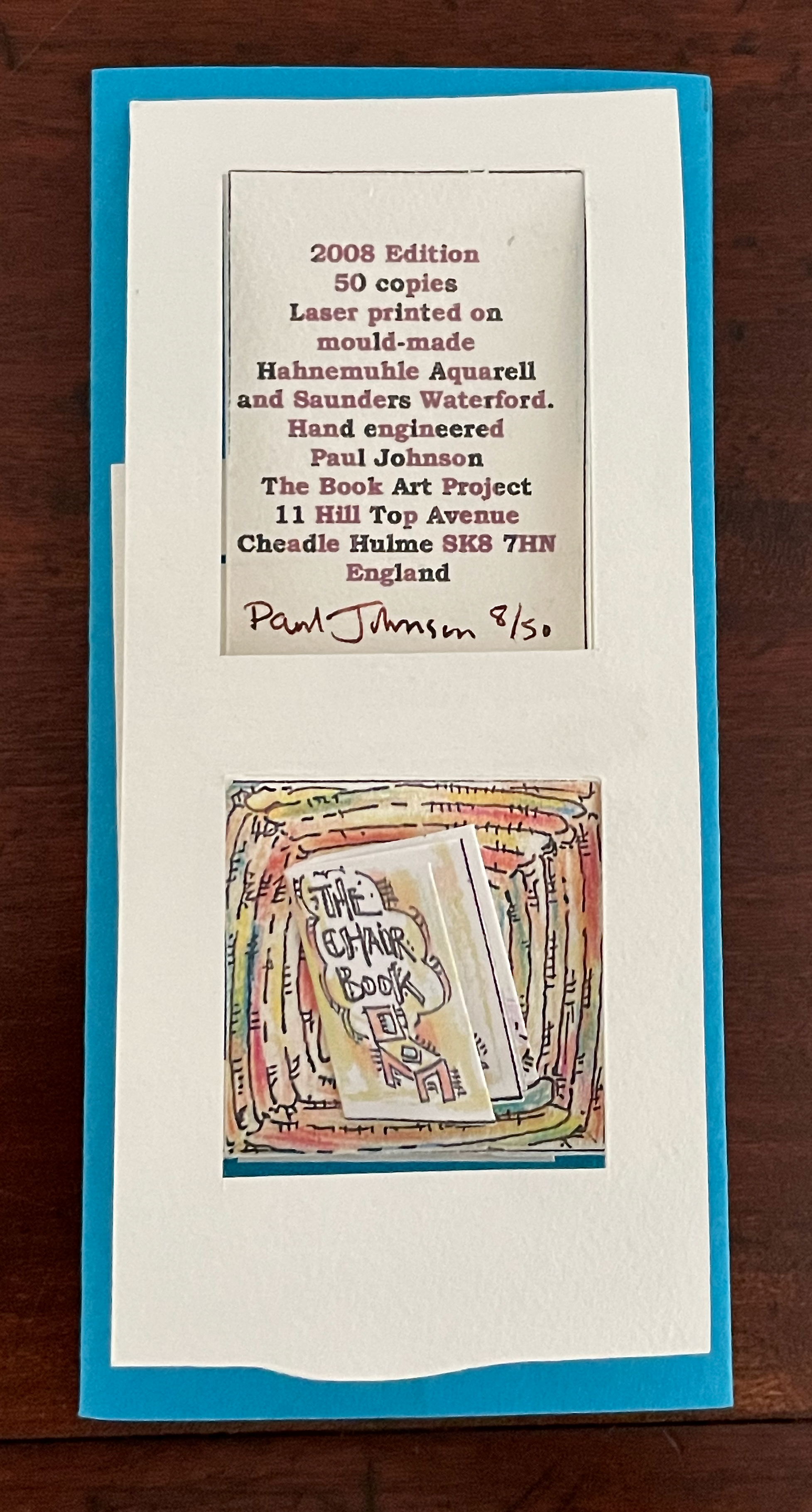
The Book Chair (2008) Paul Johnson Blue fold-around slip with illustrated label. A pop-up chair with an origami book on the seat. H136 x W62 x D47 mm. Edition of 50 copies , of which this is #8. Acquired from Collinge & Clark, 17 July 2025. Photos: Books On Books Collection.
The Book Chair repeats the book-within-a-book gambit from The Pop-up Unabridged History of the World. This time the miniature within the miniature, however, treats us to full text that delivers reflection on reflection on reflection. Is the chair the book’s chair, or is the book the chair’s book?
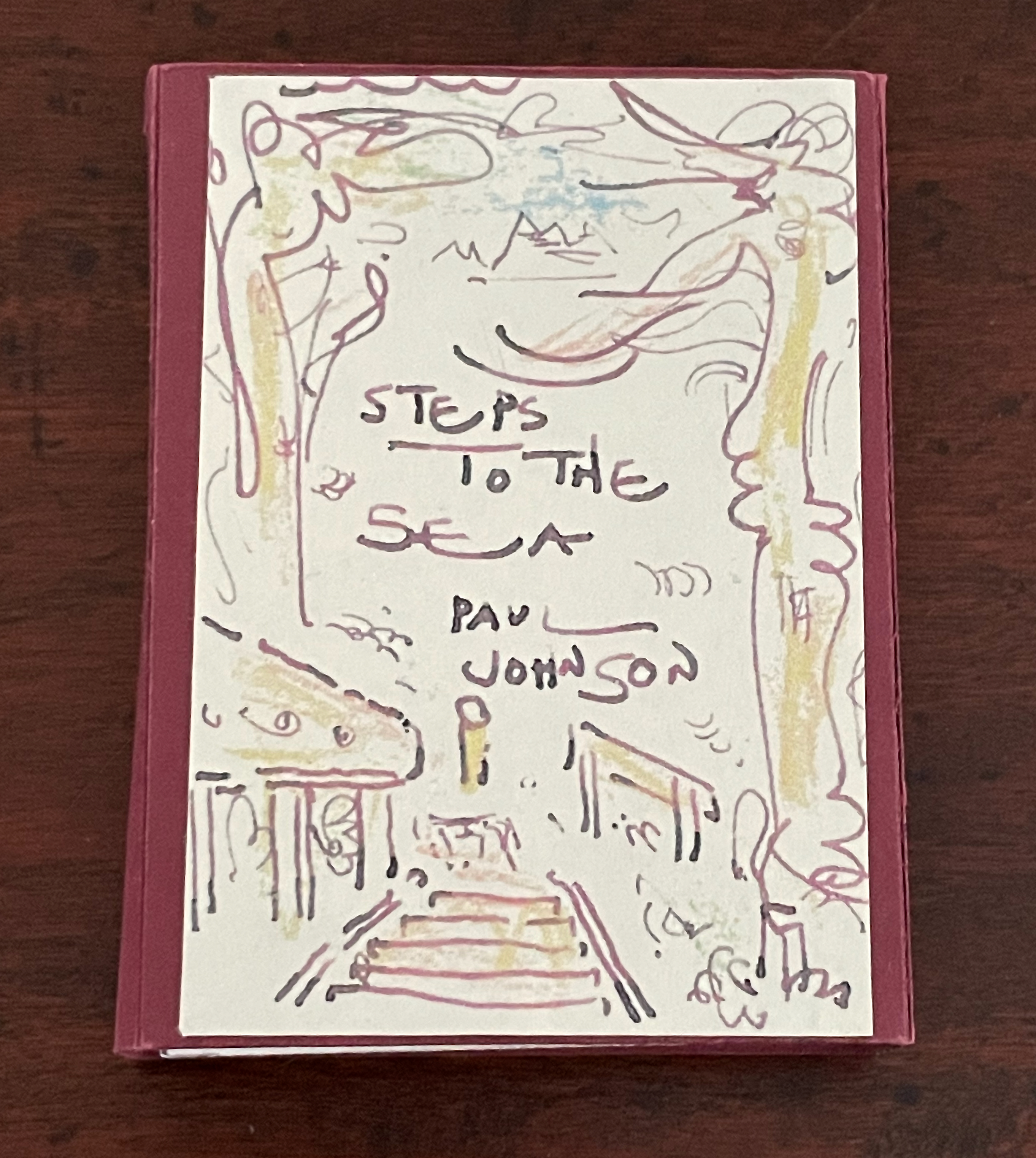
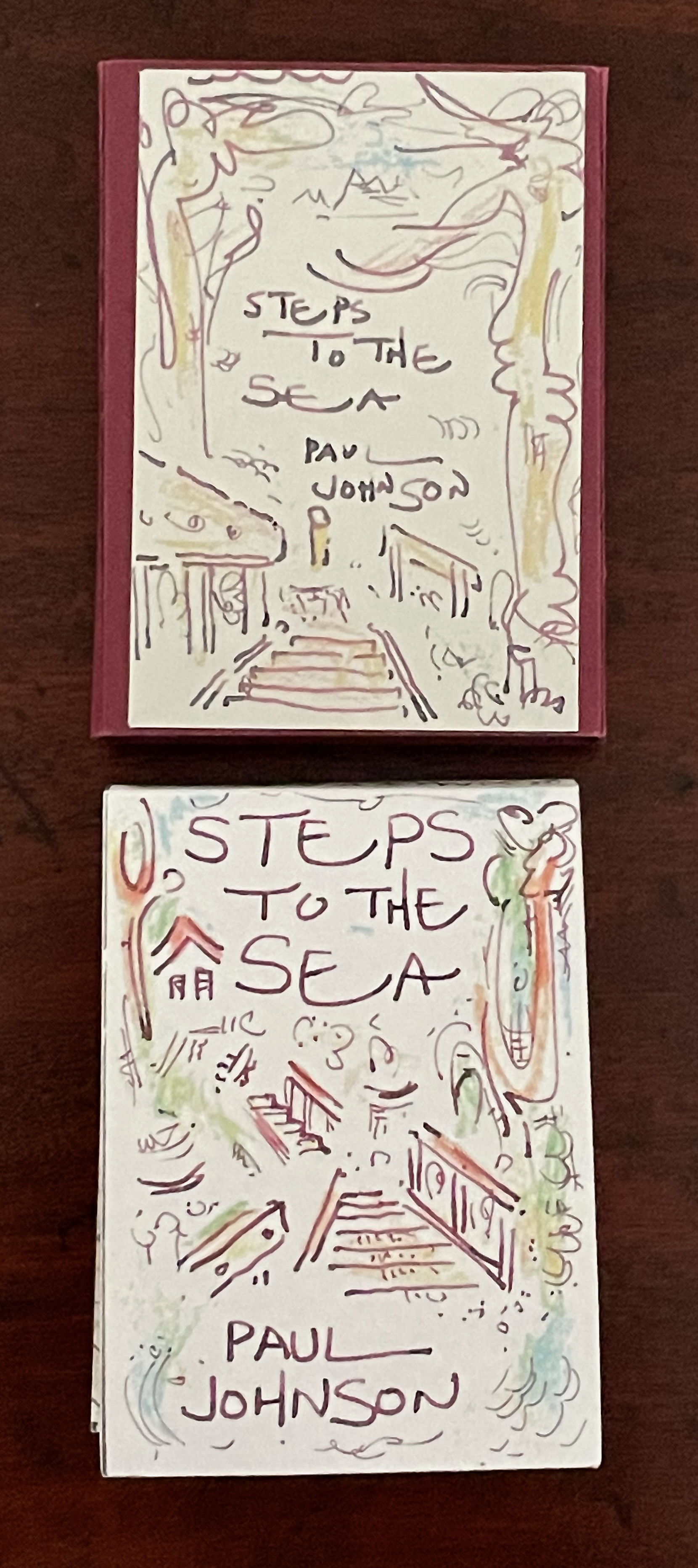
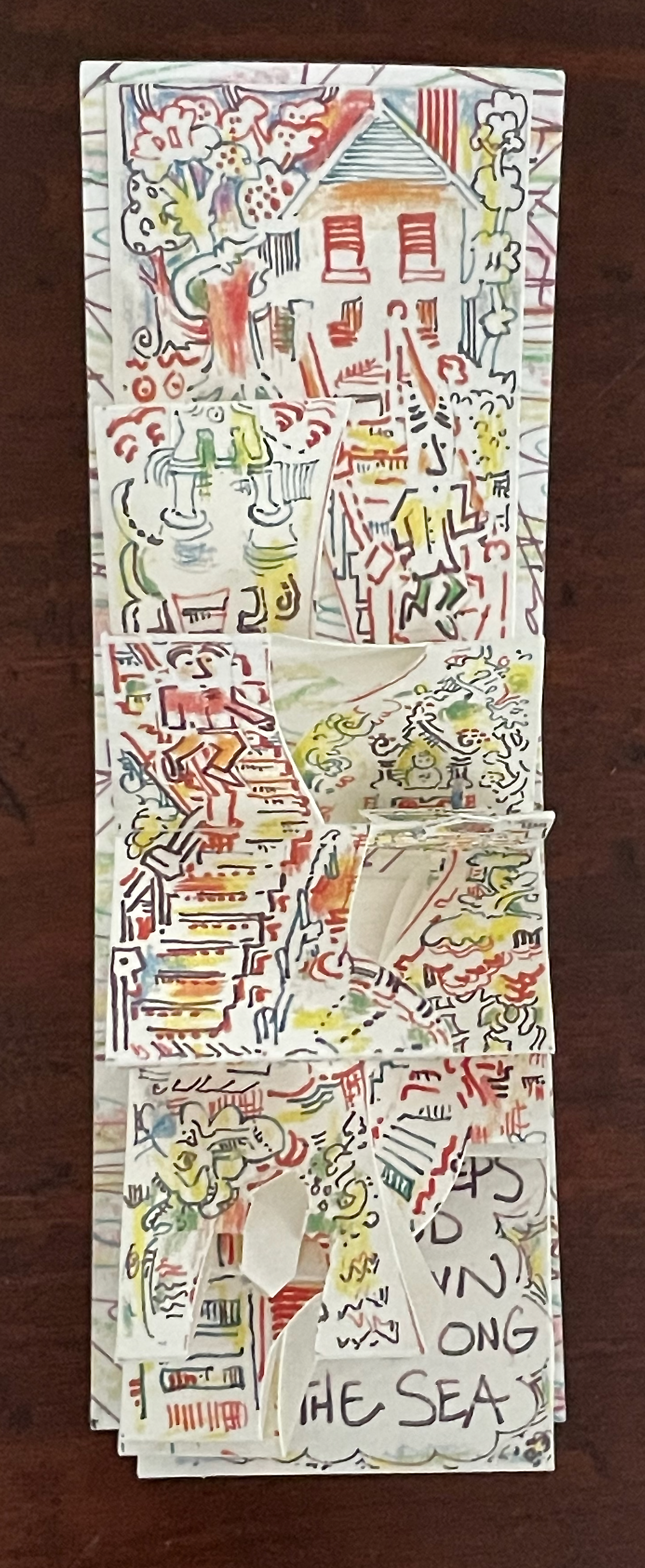
Steps to the Sea (2008)
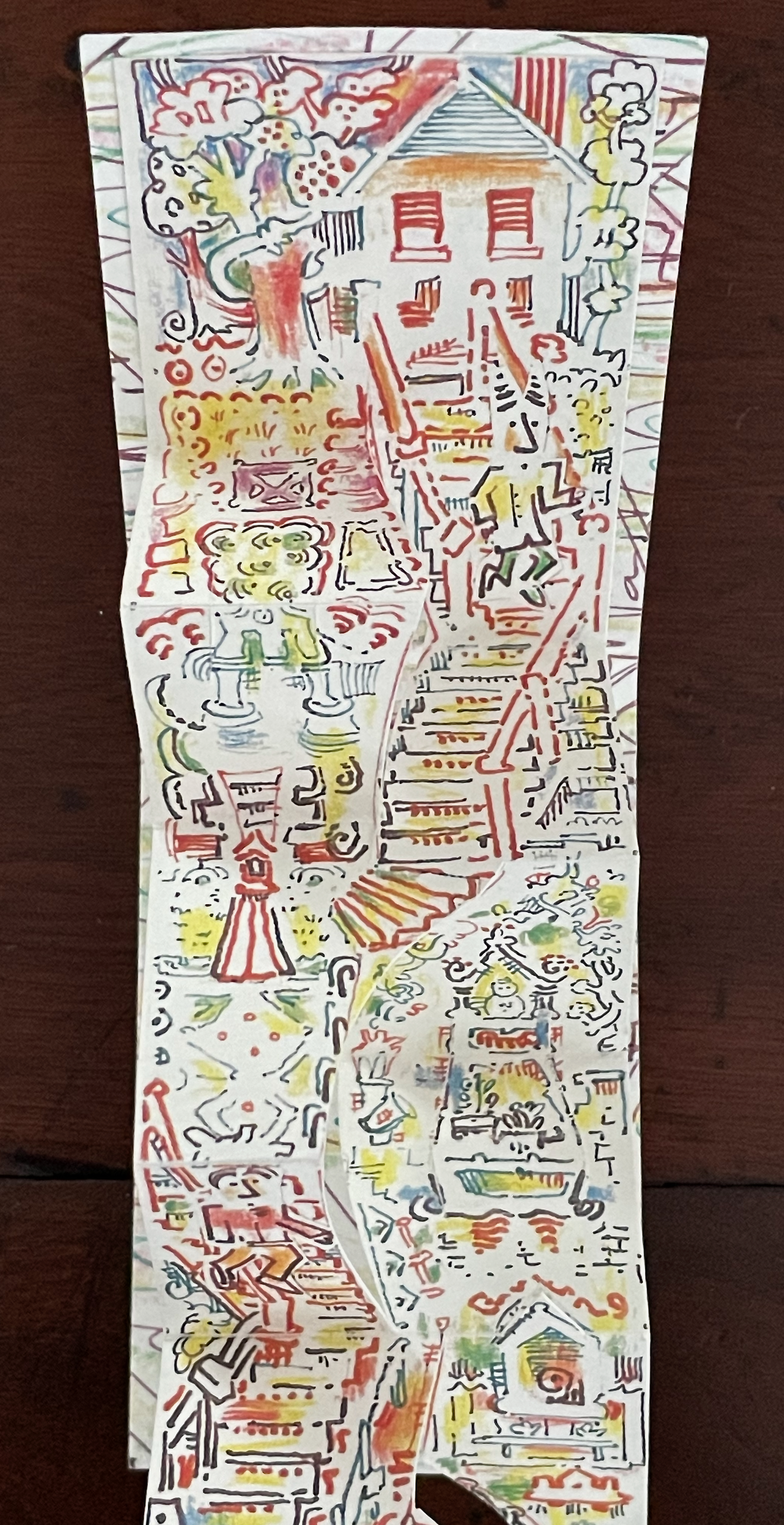
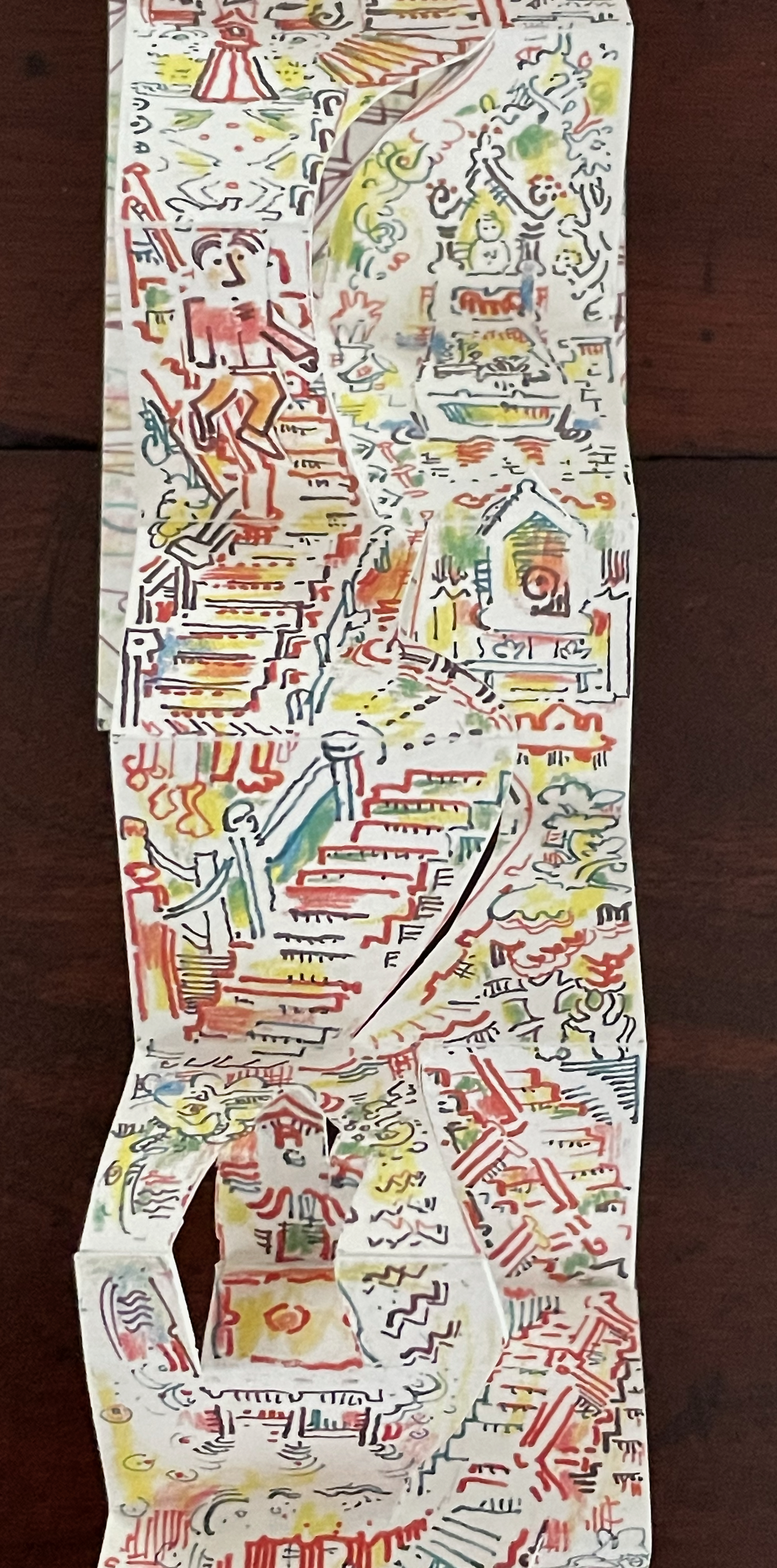
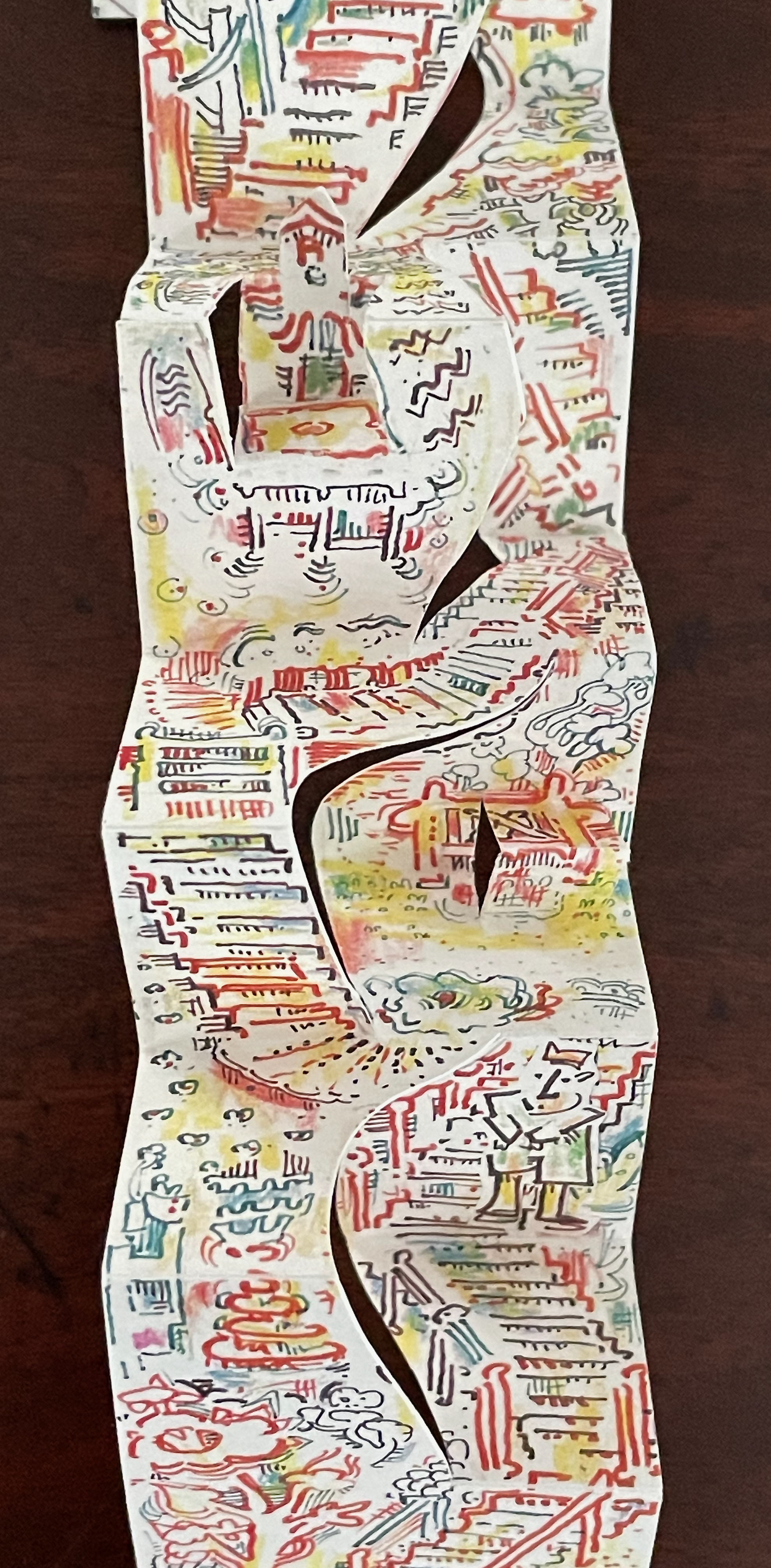
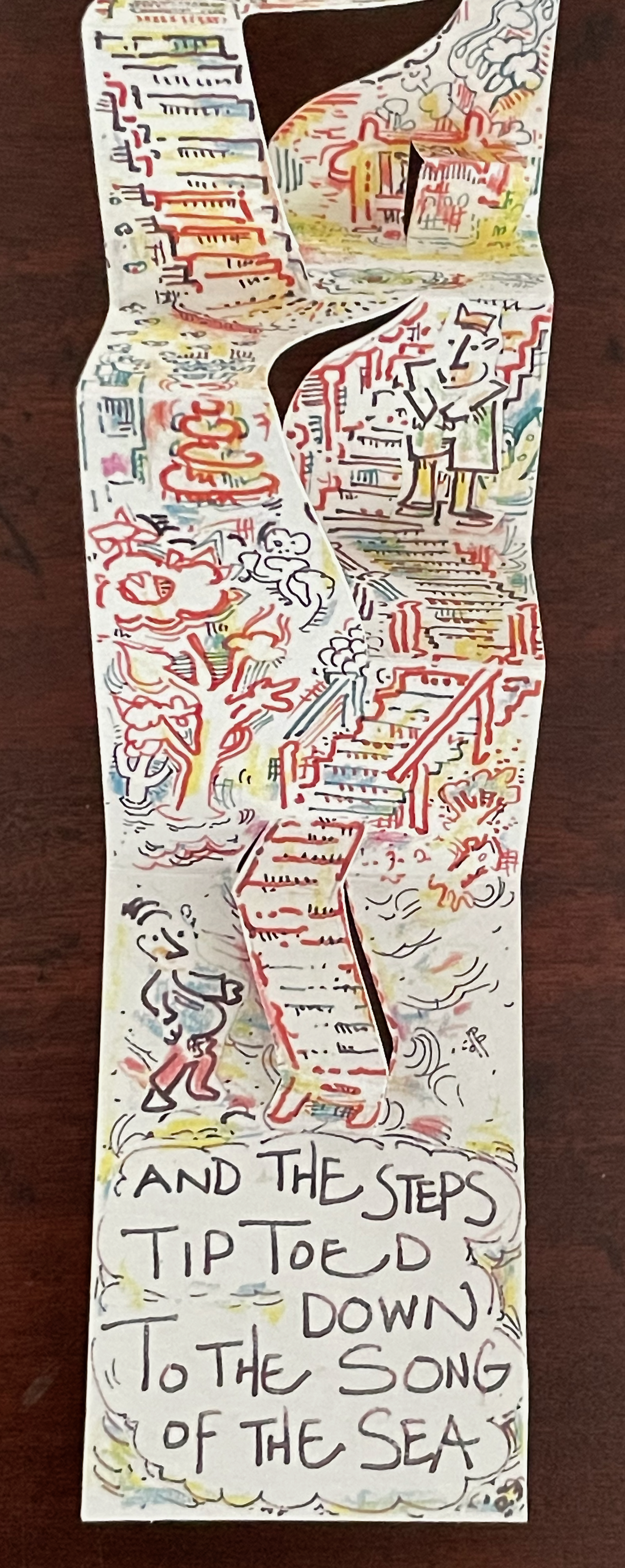
Steps to the Sea (2008) Paul Johnson Purple slipcase. A pop-out staircase attached to covering card. Slipcase: H76 x W57 x D18 mm. Card and pop-out: H75 x W59 x D12 mm (closed), H variable to 550 mm. Open edition. Acquired from Collinge & Clark 17 July 2025. Photos: Books On Books Collection.
Steps to the Sea may be based on a garden in Seattle, but if you have ever visited San Francisco and descended Lombard Street or the Filbert Steps, Johnson’s vertical pop-up will recall your vertigo for you.
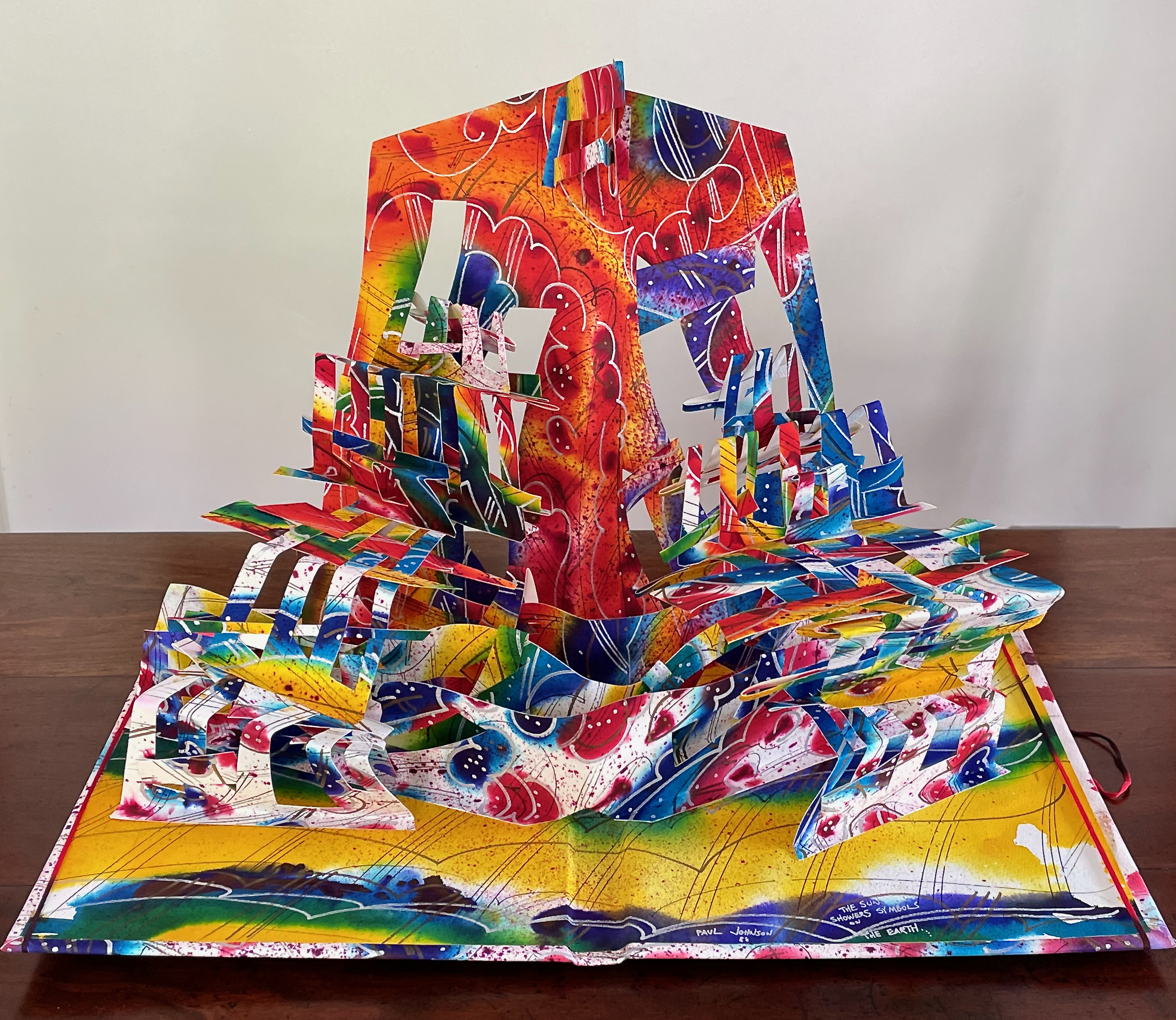
Wrapped in multicolored ribbon, the next two works in the collection — The Sun ShowersSymbols on the Earth and Morning LightShowing the World the Way — arrive like gifts.
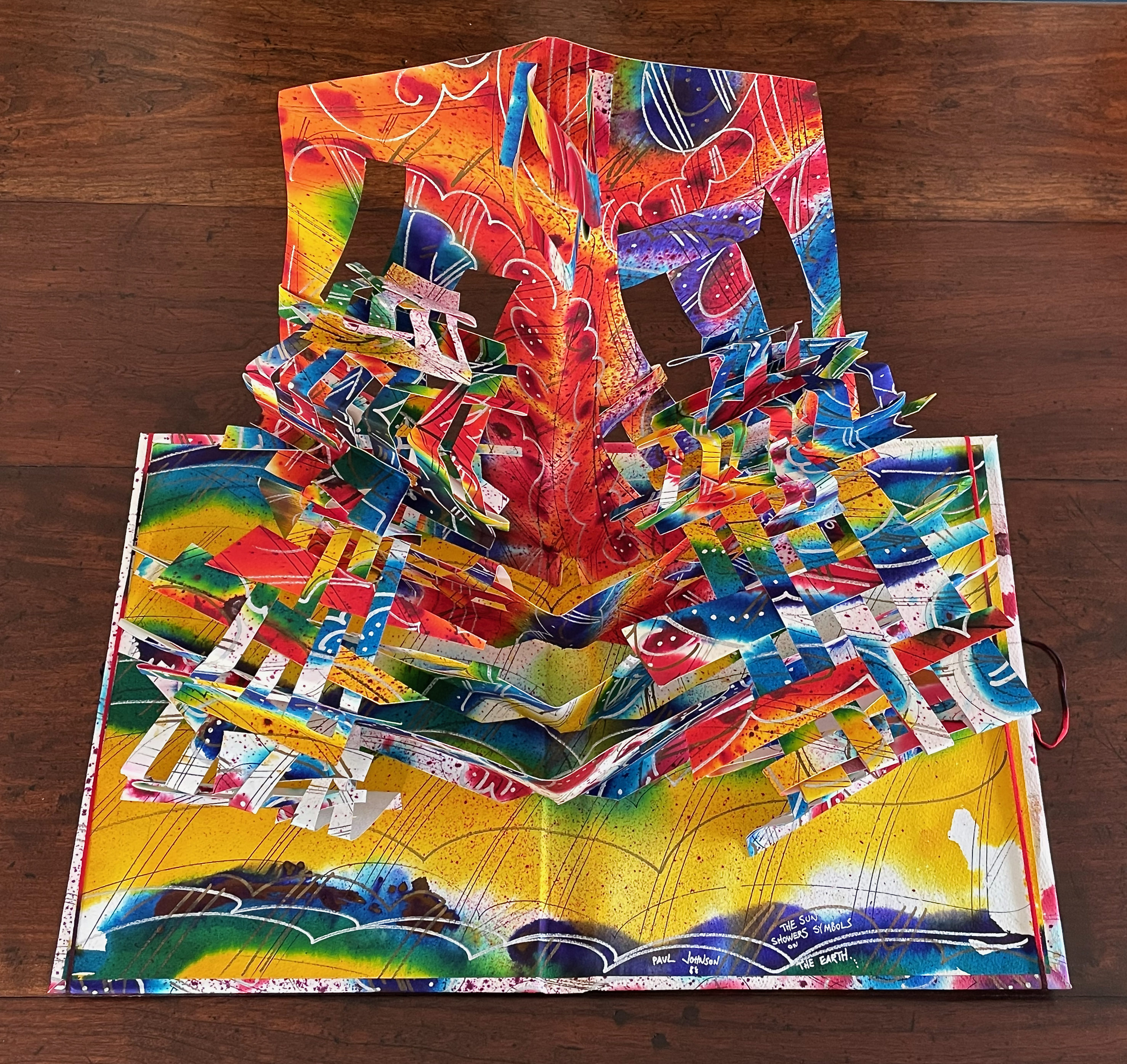
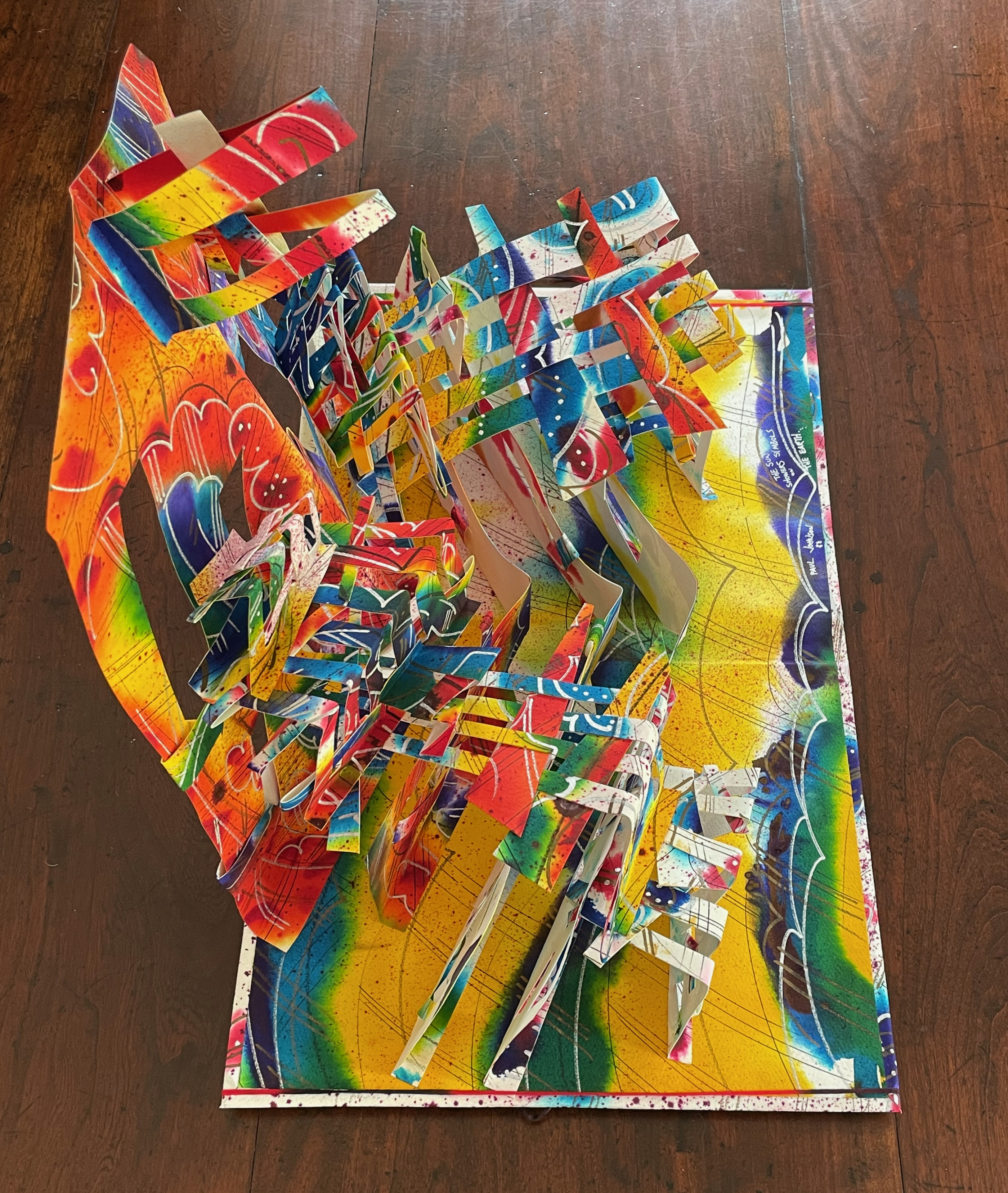
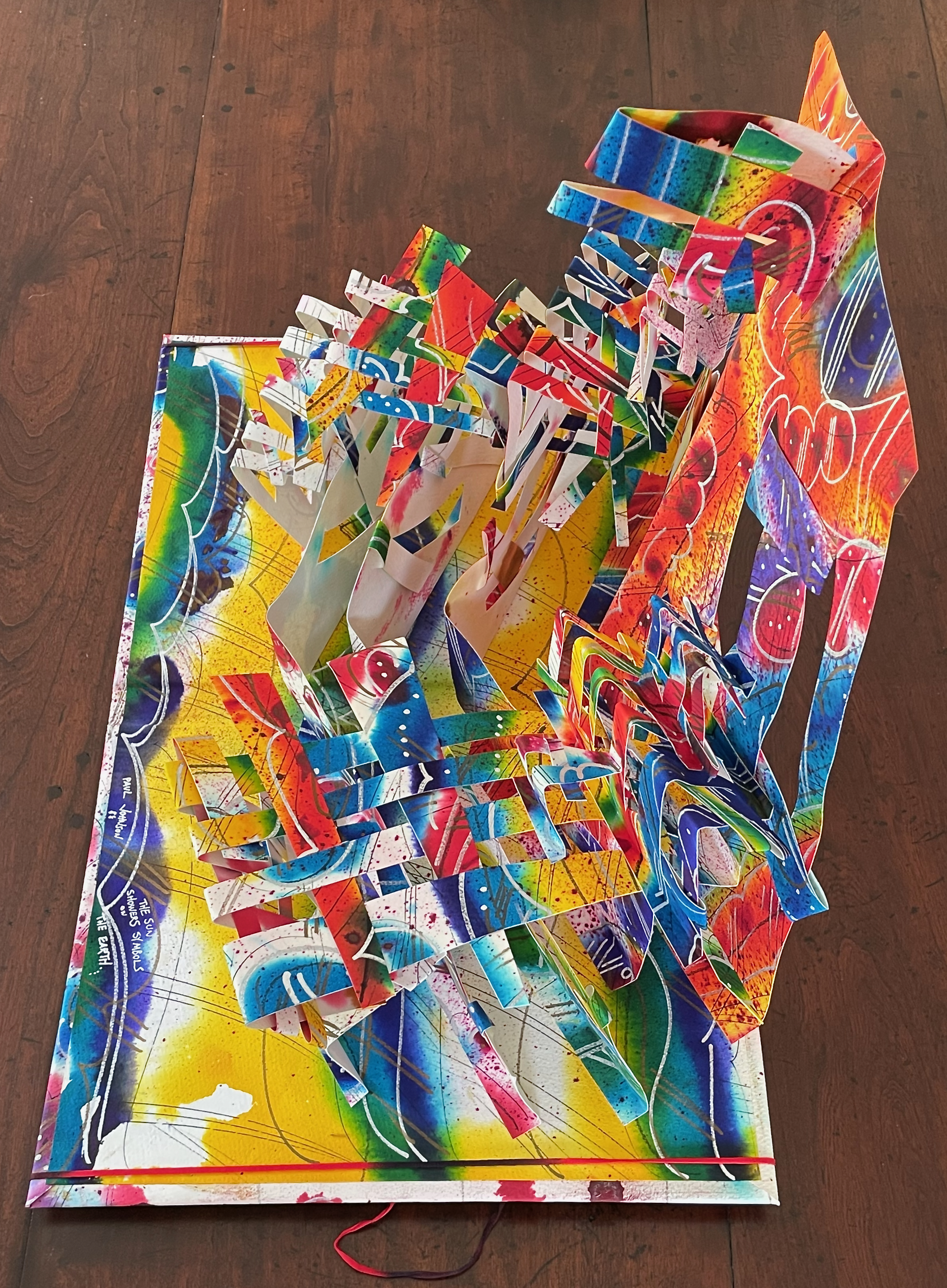
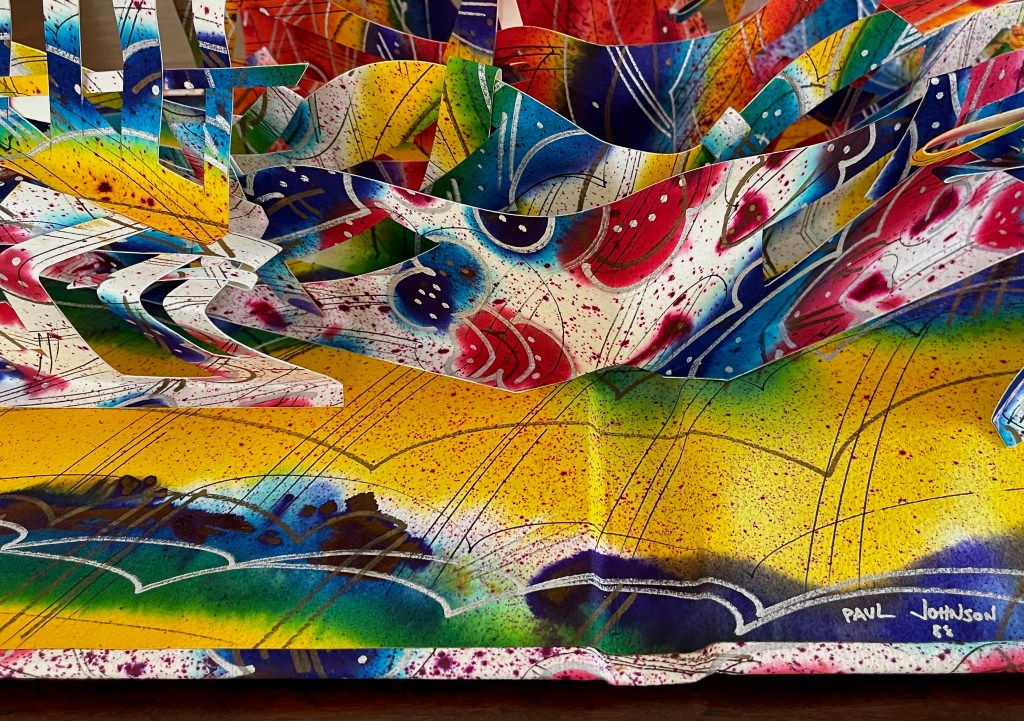
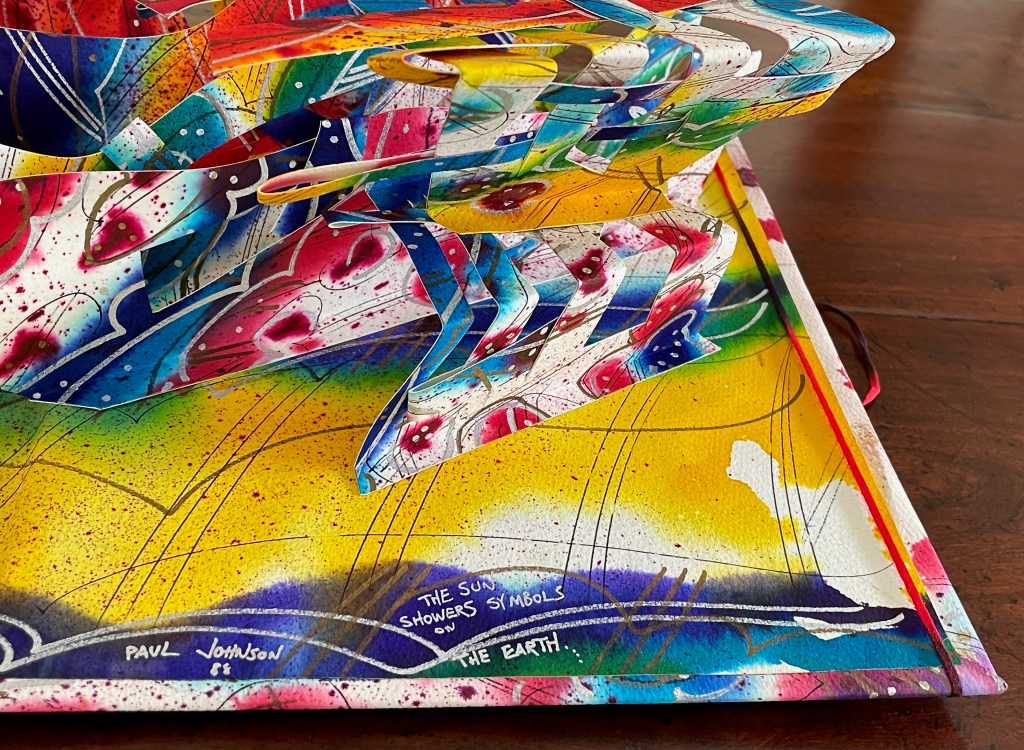
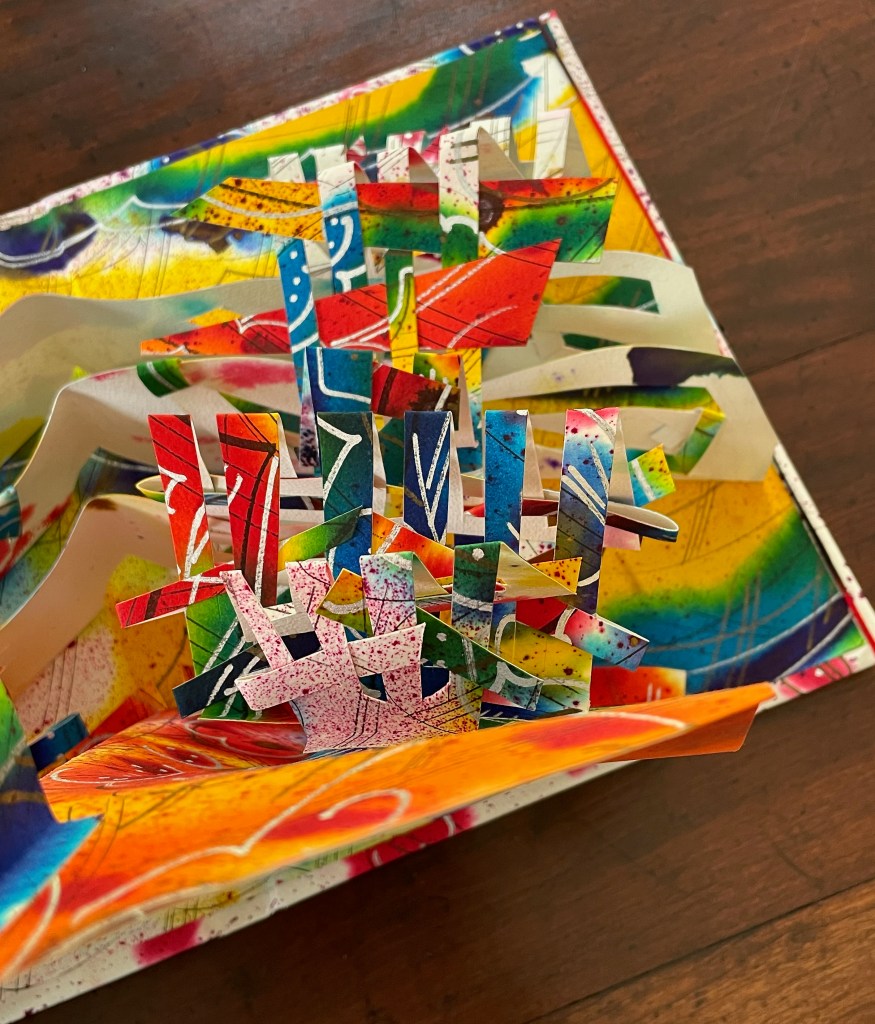
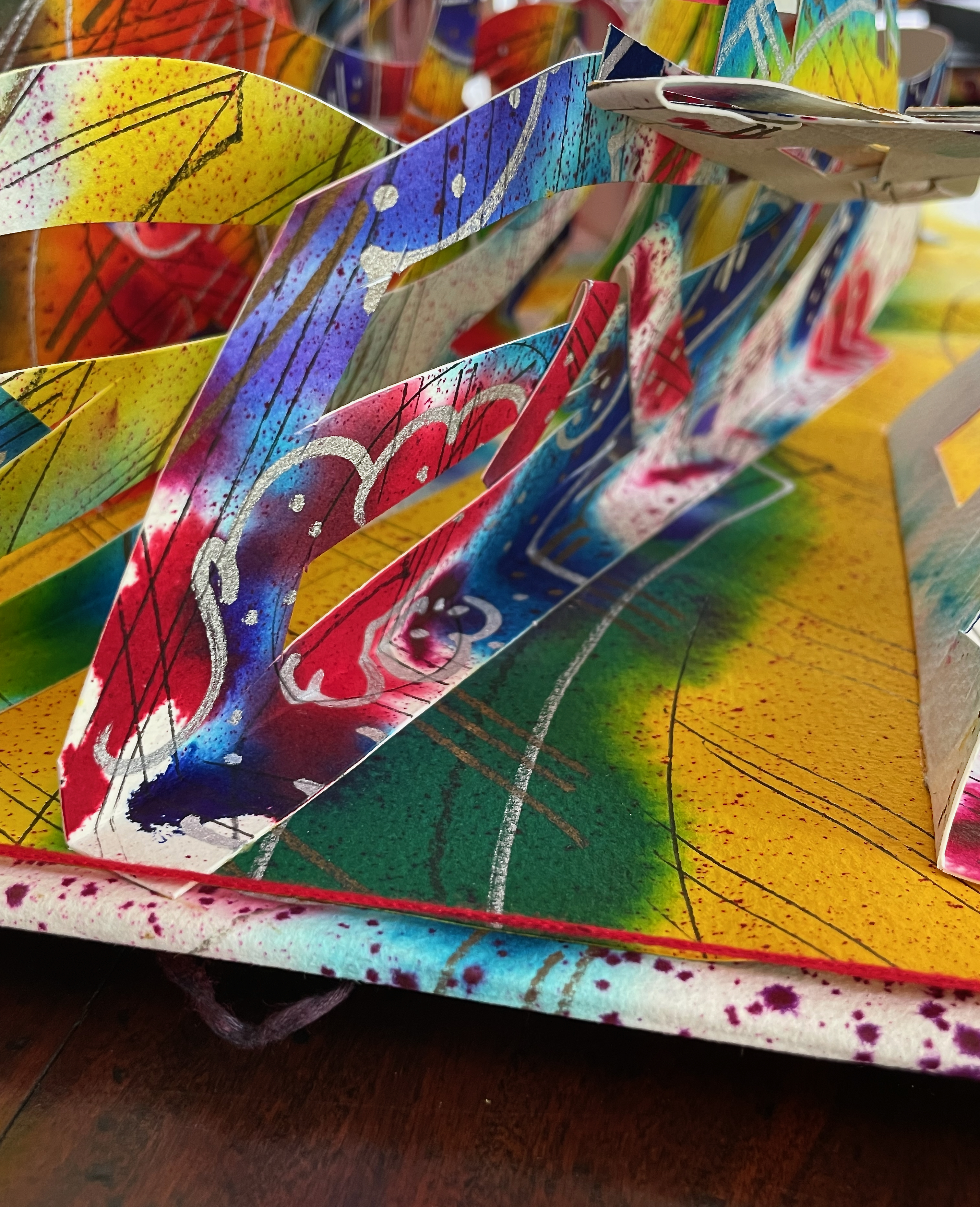
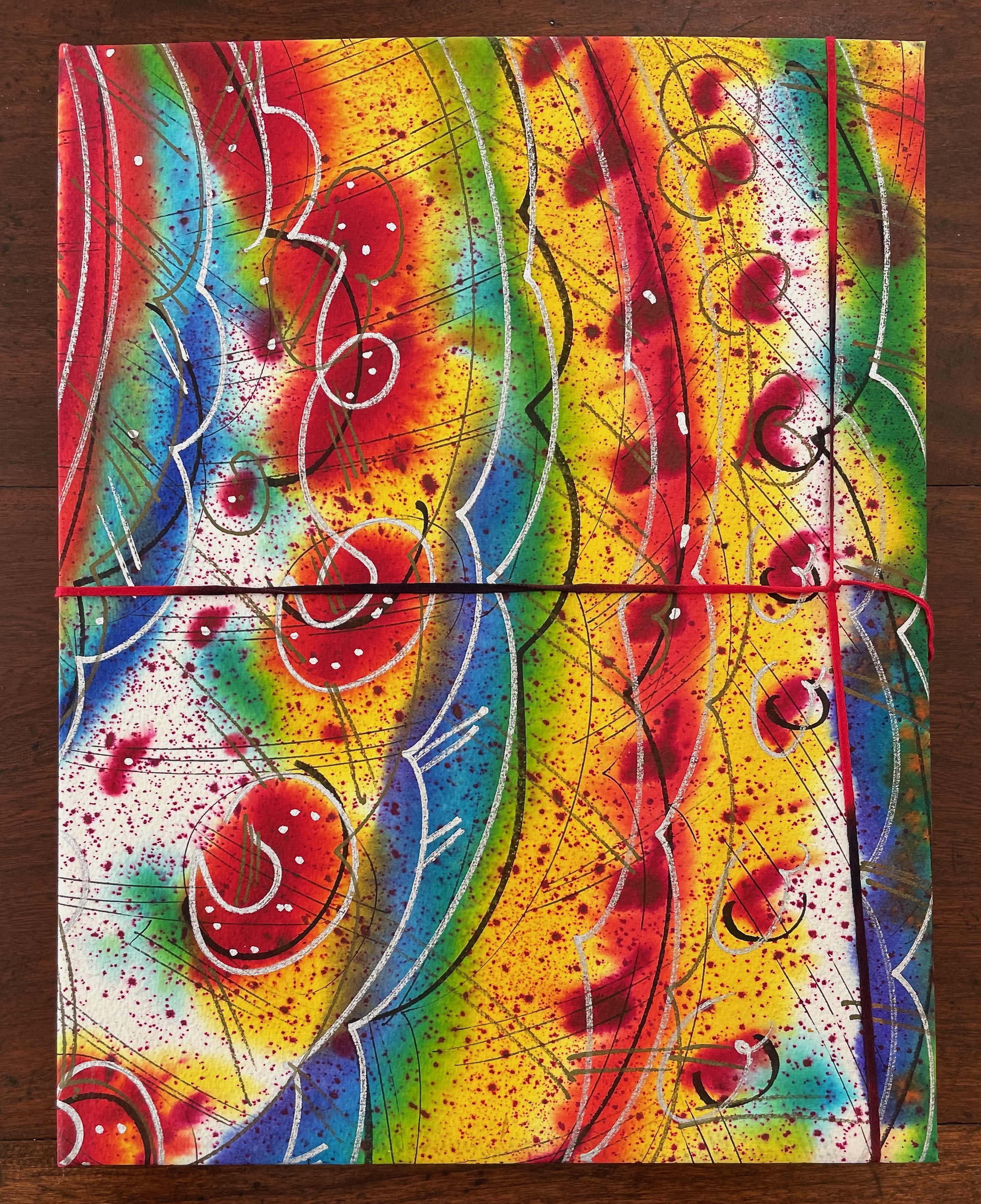
The Sun Showers Symbols on the Earth (1988)
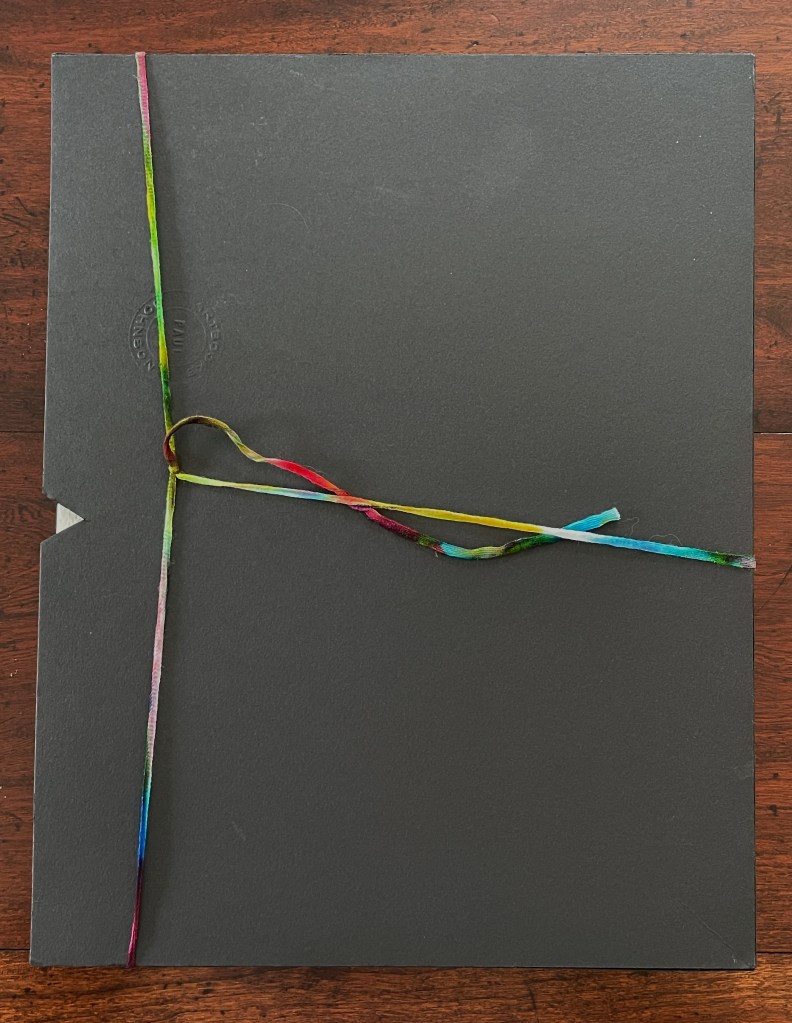
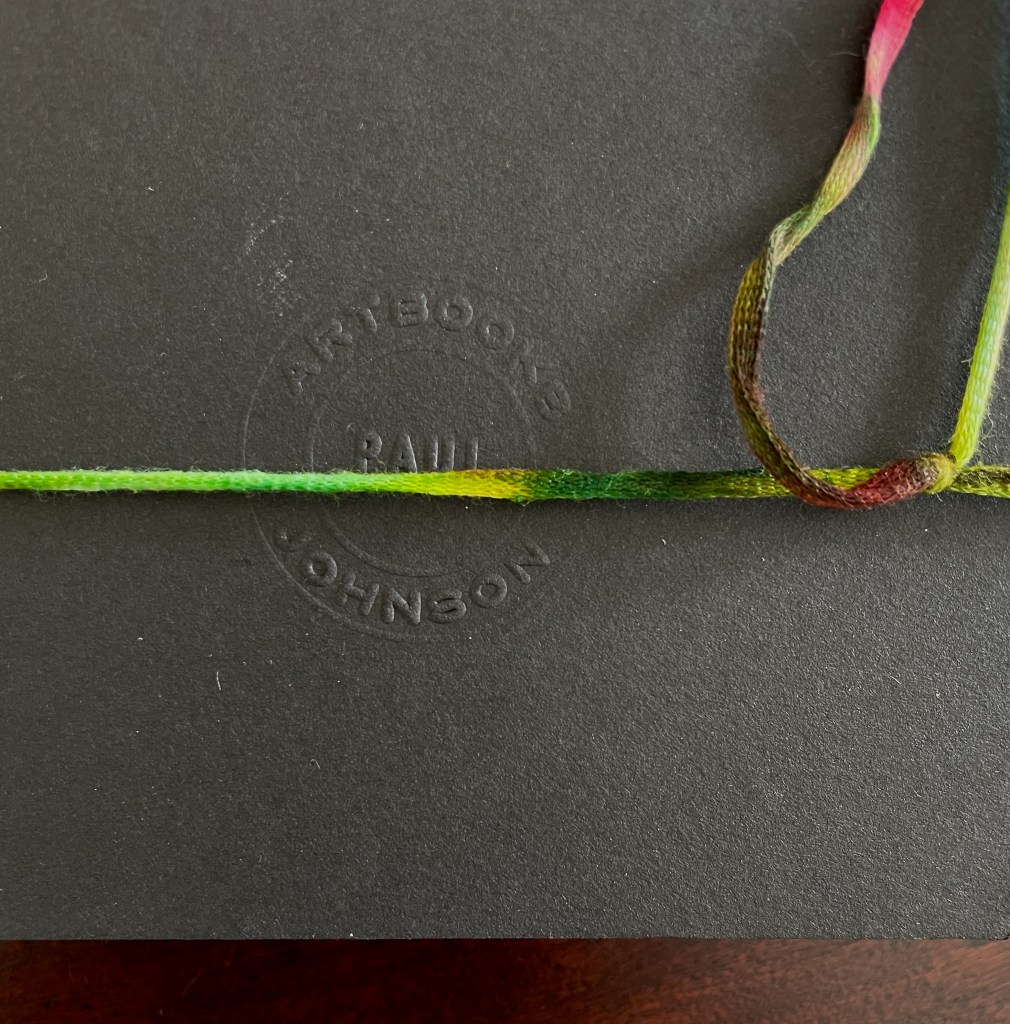
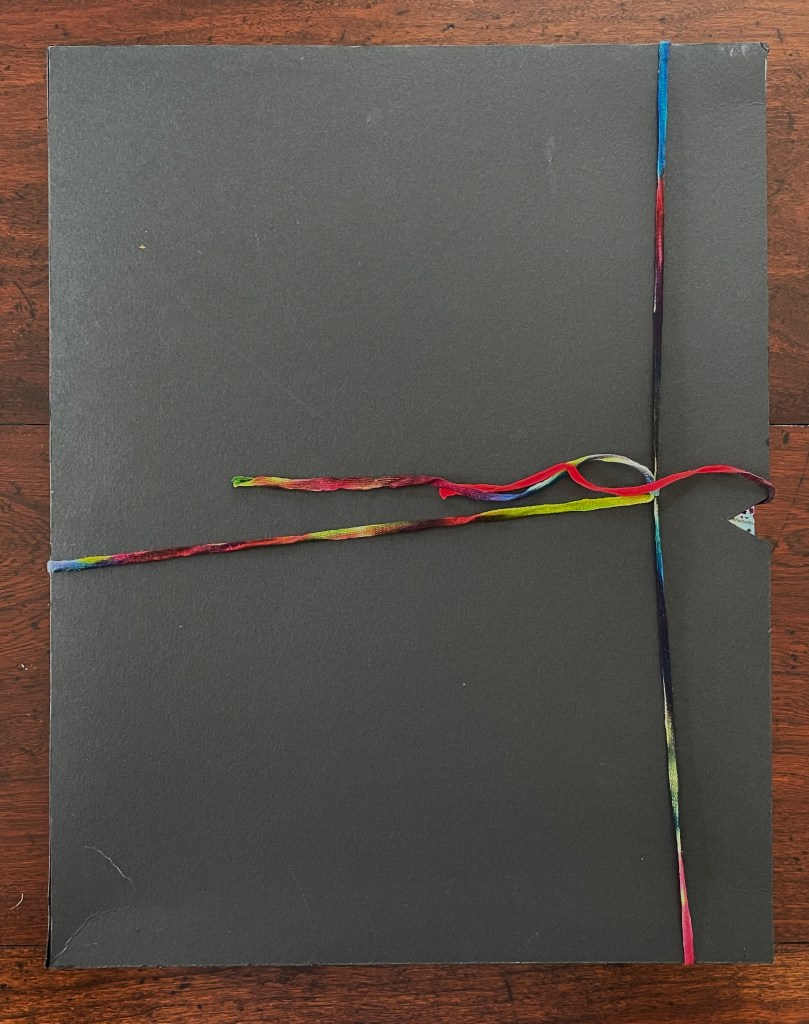
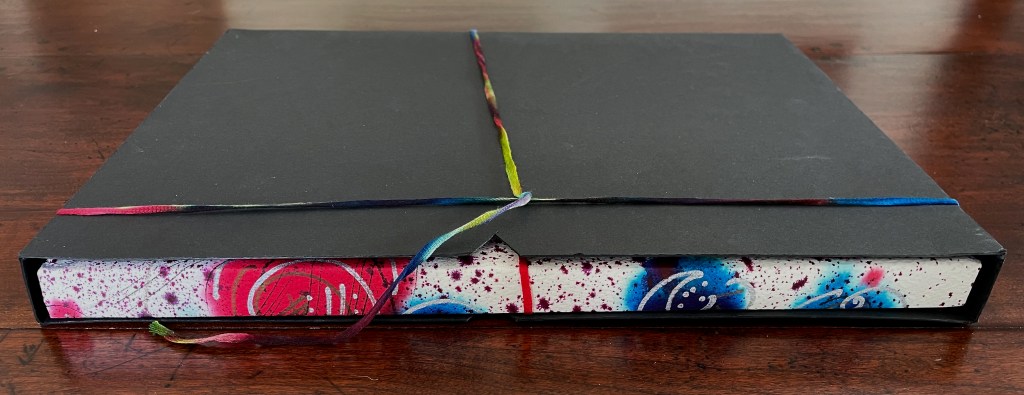
The Sun Showers Symbols on the Earth(1988) Paul Johnson Notched slipcase with multicolor inked ribbons. Single sculpture pop-up book. Slipcase: H330 x W256 x D28 mm. Book: H319 x W249 x D25 mm (closed); W515 x D340 mm (open). Unique. Acquired from Potter & Potter Auctions, 9 Jul 2026. Photos: Books On Books Collection.
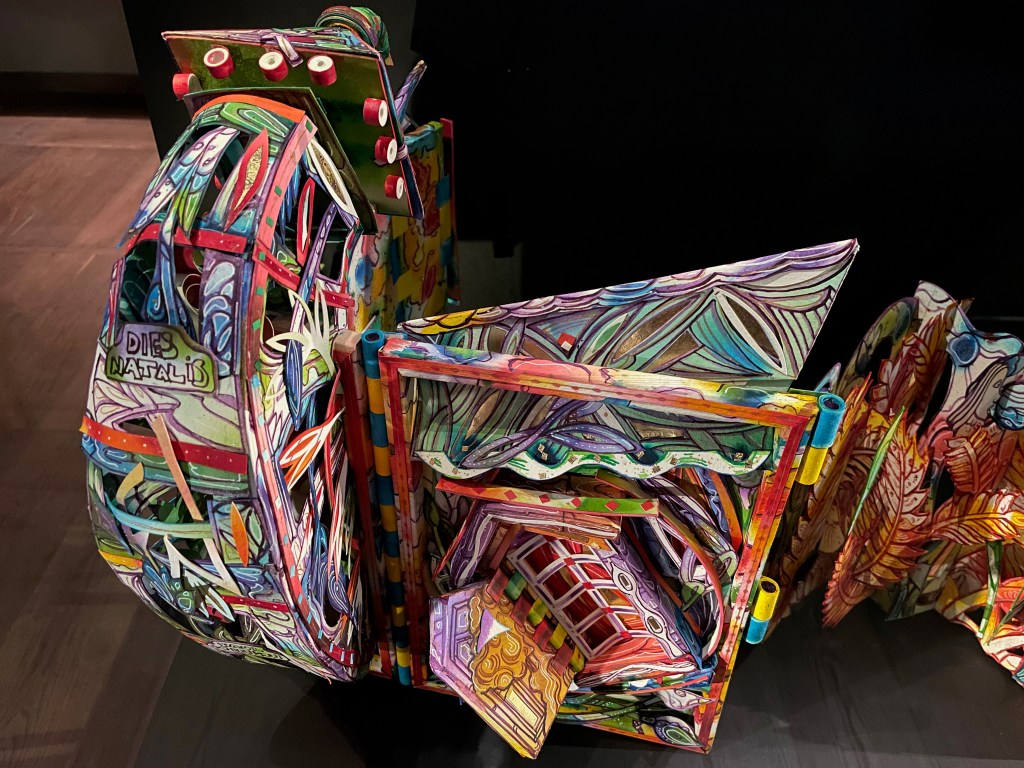
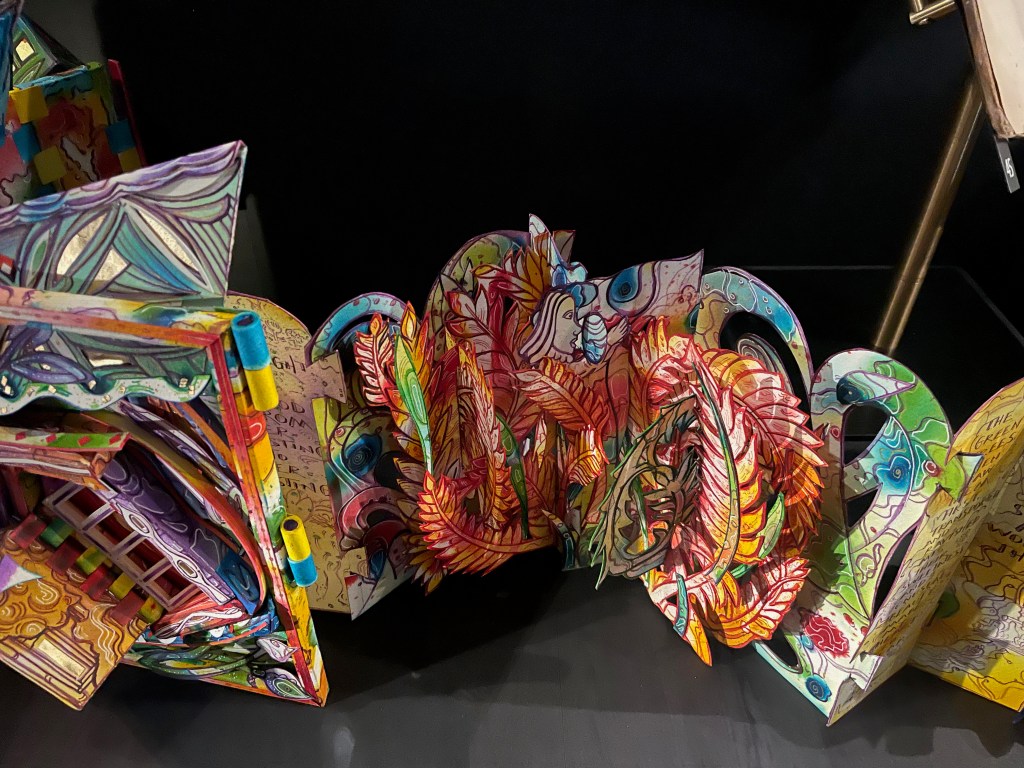
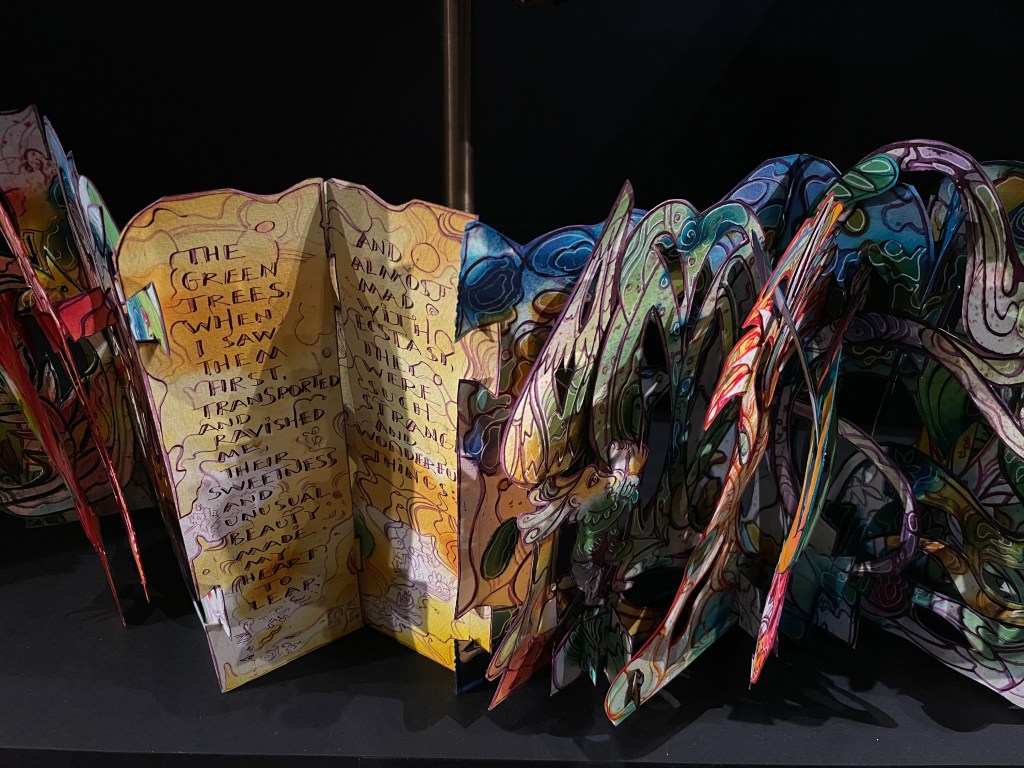
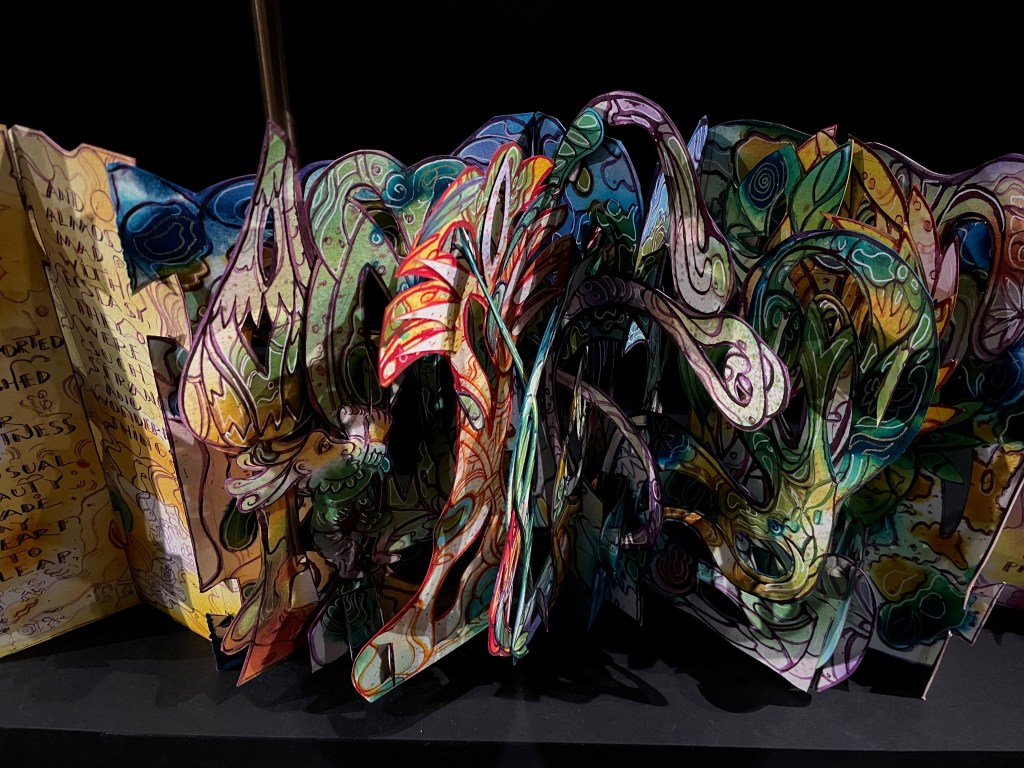
Compared with the later works above, The Sun Showers Symbols on the Earth is brighter and more abstract. Still later works, though, such as Serenade to Chaucer (2018), an abridgement of “The Miller’s Tale”, and Dies Natalis (2023), inspired by a cantata for voice and strings composed by Gerald Finzi (1901-56), inspired in turn by several poems by Thomas Traherne (1636-74), deploy colors just as bright. Both of those later works are considerably larger than the two shown here. The use of industrial fabric dyes seems to correlate with the size of the unique works, whereas watercolor correlates with the smaller limited edition works.
View from left side. View from right side.
View of lower edge.
View of left and right sides from above and behind.
Detail at left edge.
Front and back covers.
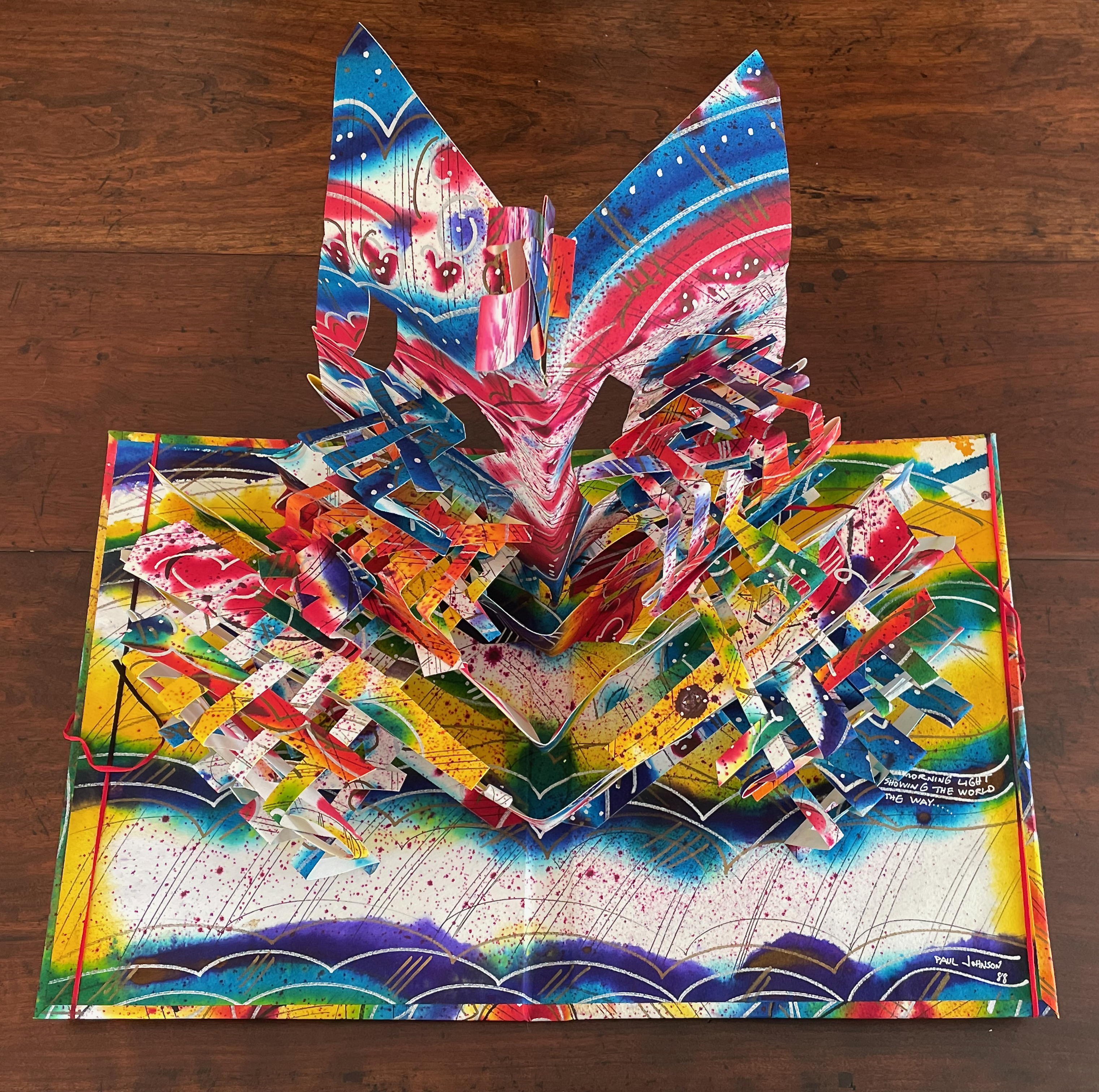
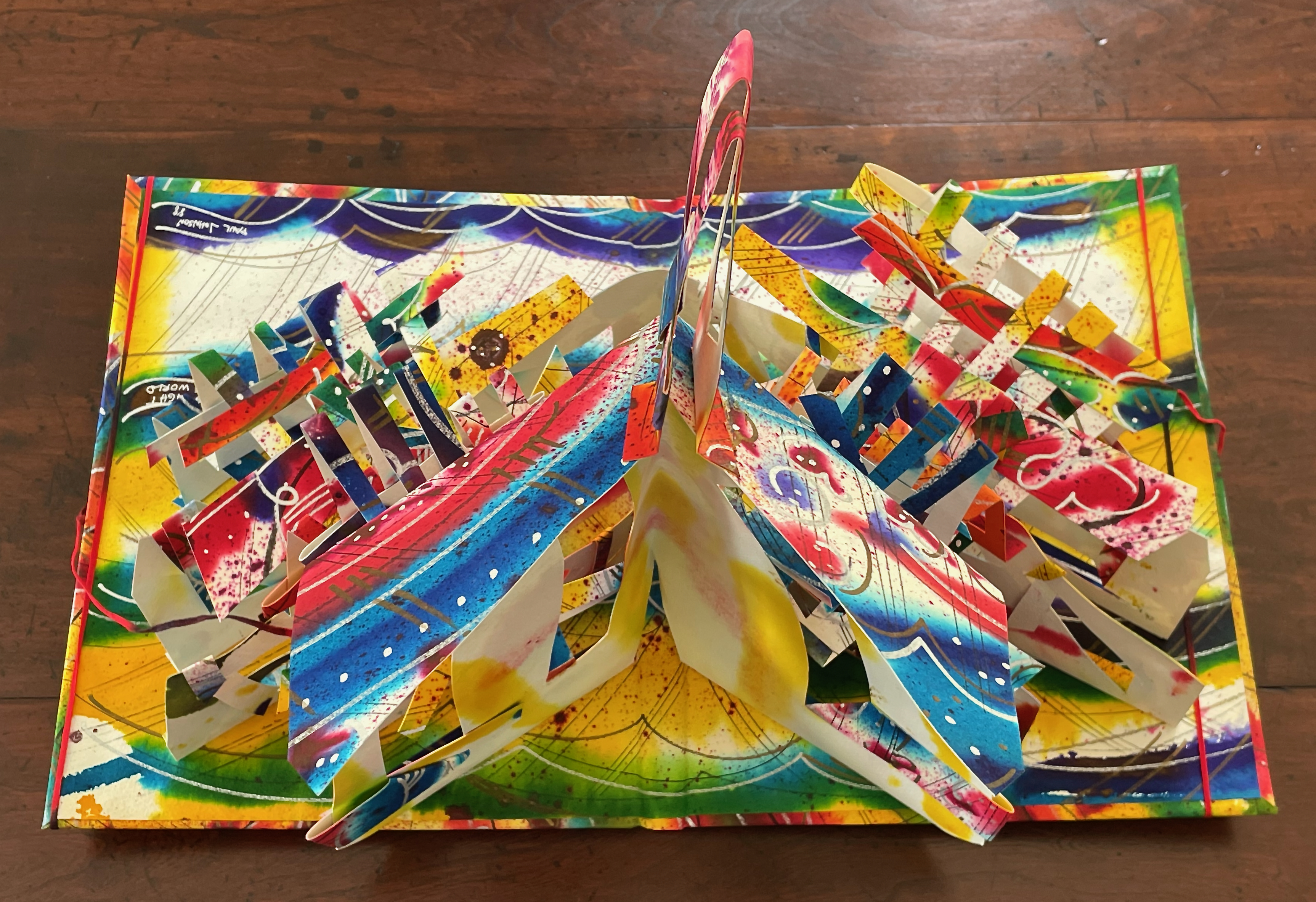
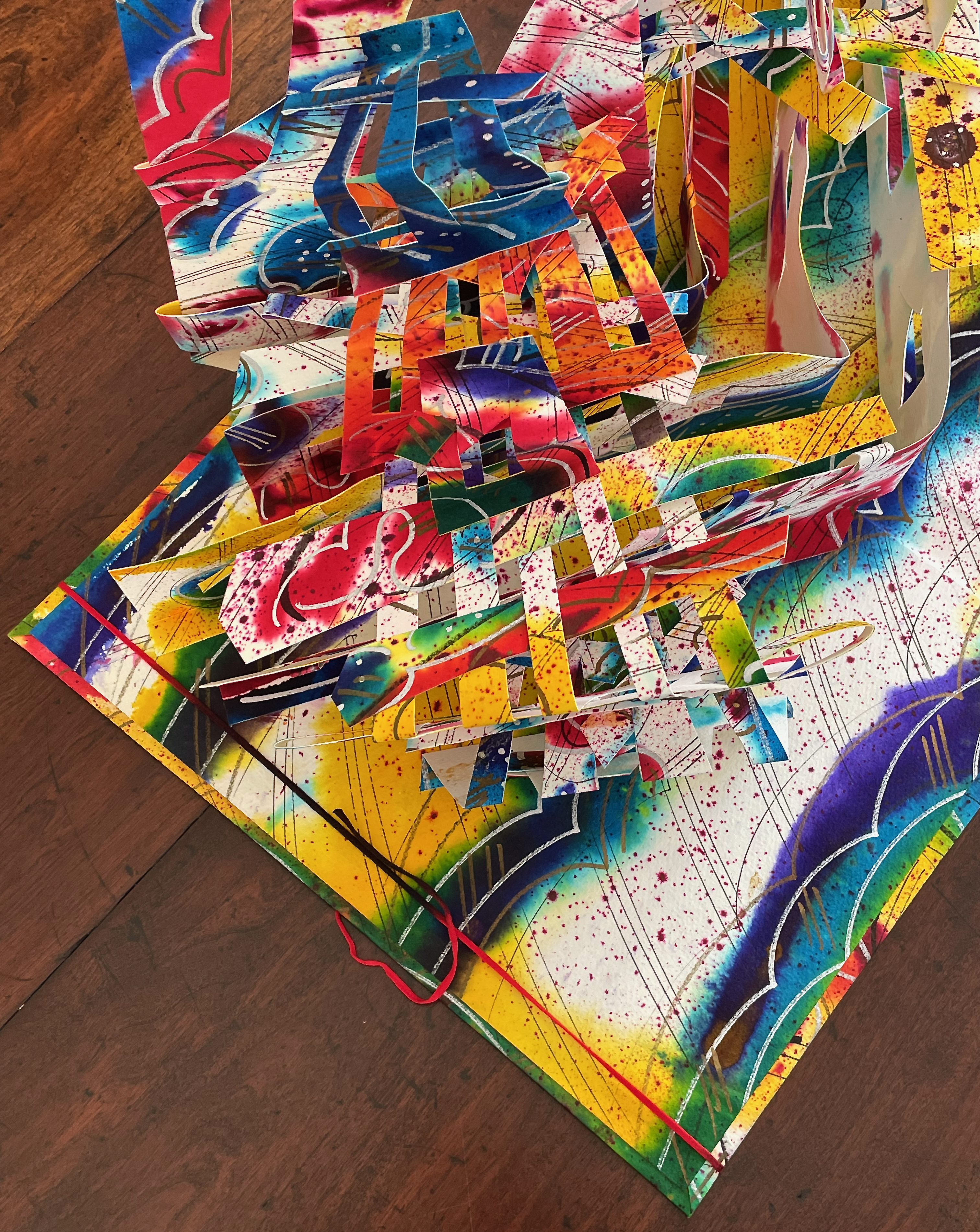
Morning Light Showing the World the Way (1988)
Morning Light Showing the World the Way(1988) Paul Johnson Notched slipcase with multicolor inked ribbons. Single sculpture pop-up book. Slipcase: H330 x W256 x D28 mm. Book: H319 x W250 x D25 mm (closed); W515 x D340 mm (open). Unique. Acquired from Potter & Potter Auctions, 9 Jul 2026. Photos: Books On Books Collection.
Johnson’s website refers to the stained glass windows of Norwich, where he grew up, as an influence on his work. In their titles, colors, and construction, The Sun Showers Symbols on the Earth and Morning Light Showing the World the Way fully bear this out. Their cascading tiers also bear out another influence: Hokusai (think of The Great Wave of Kanagawa).
View from above and behind.
Left side. Right side.
Detail of lower right.
Front cover.
The slipcasing of The Sun Showers Symbols on the Earth and Morning Light Showing the World the Way capture another characteristic of Paul Johnson’s work and the man himself — a giving nature — which foreshadows the monumental Dies Natalis, his gift to the Bodleian Libraries in 2023.
Dies Natalis (2023)
Dies Natalis(2023) Paul Johnson A gift from the artist, Dies Natalis resides at the Bodleian Libraries. Photos: Books On Books at the Bodleian exhibition Gifts and Books, curated by Dr. Nicholas Perkins, 19 June 2023 – 29 October 2023.
A birthday gift from the deity becomes a gift from the artist.
Further Reading
“Movables Now and Then“. 31 August 2024. Bookmarking Book Art. For background reading on movables.
“Květa Pacovská“. 19 July 2023. Books On Books Collection. For comparably colorful pop-ups.
Chen, Julie. 2013. 500 Handmade Books. Volume 2. New York: Lark. P. 26, for Johnson’s We Waited with Eyes Lifted (2012).
The most beautiful and perfect book in the world is a book with only blank pages, in the same way that the most complete language is that which lies beyond all that the words of a man can say. Every book of the new art is searching after that book of absolute whiteness, in the same way that every poem searches for silence. — Ulises Carrión: “The New Art of Making Books” Kontexts no. 6-7, 1975.
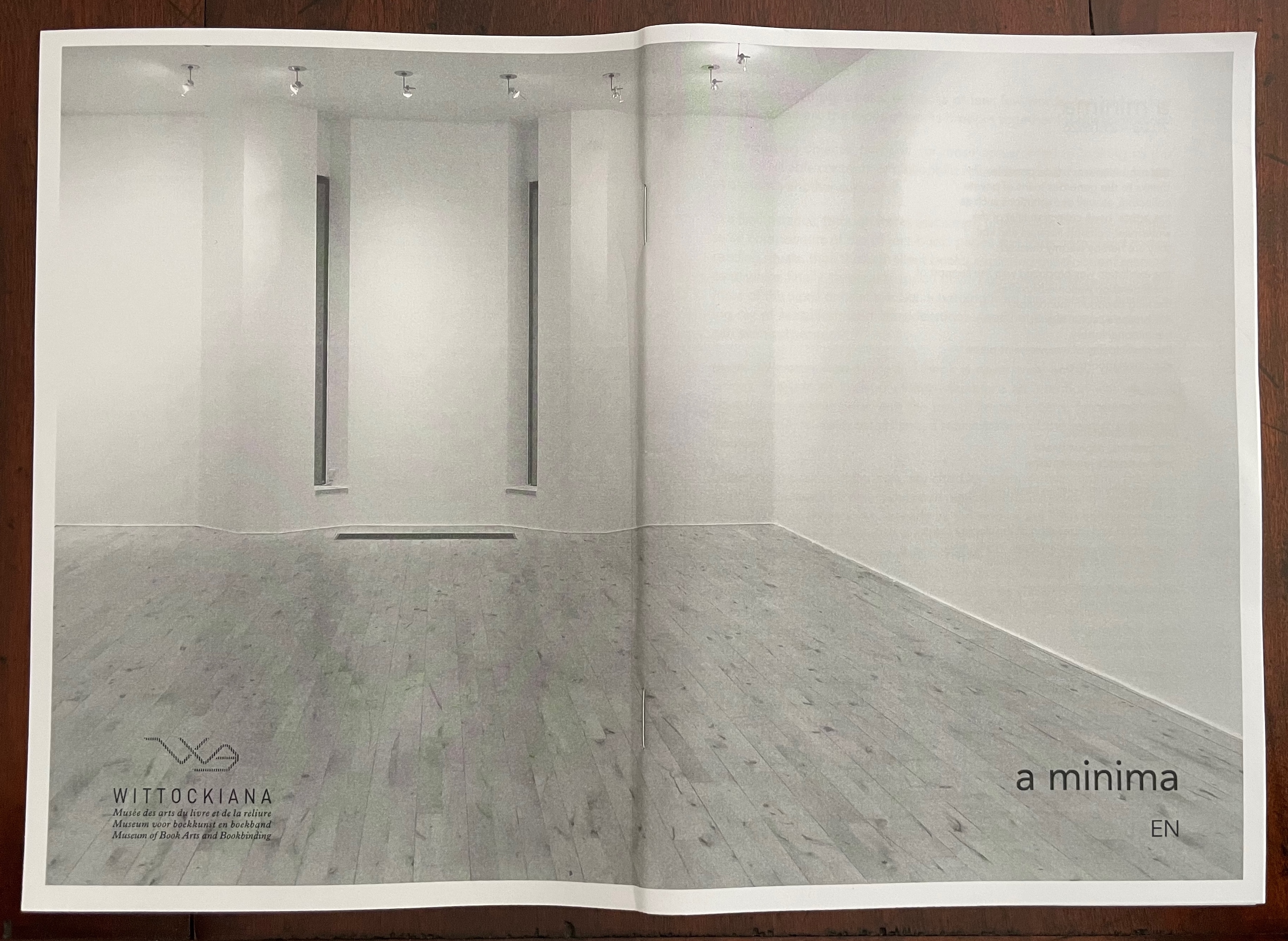
At the entrance to The Wittockiana. Back and front cover of the a minima catalogue.
If, as I did, you missed Moritz Küng‘s exhibition Blank. Raw. Illegible… Artists’ Books as Statements, 1960-2022 at the Leopold-Hoesch-Museum in Düren, Germany, in 2023, Didier Decoux‘s a minima presents an equally well-thought-out gathering of artists’ books that stretches out over 150 years (1876 – 2026). With 4 spacious rooms, 25 vitrines, 2 videos, and over 180 works, a minima requires several hours at a minimum to peruse and enjoy. Information on getting there is available here.
The comments and links below are in no way a substitute for visiting this exhibition, and keep in mind that Wittockiana also has permanent displays of presses, rare fonts, and books that should not be missed.
Book art always pushes at the edges. Whatever meets at the edges is book art’s business. Negative space and positive space. Letter stroke and counter. Margins and the gutter. Justified and unjustified. Legible and illegible. Bound and unbound. Art and craft. Unique and multiple. Self and other. Destruction and creation. Life and death.
Inscription 6 is about cuts and tears, mostly tears — creating edges. “Tears” is also a heteronym, a word whose meaning changes with the change of the sound of the vowel but whose spelling remains the same. We can have tears [/tɛ(ə)rz/ tairz] as in “torn parts or places, or rips asunder”. Or we can have tears [/tɪ(ə)rz/] as in “teardrops, or weeps”. Or, with art, we might paradoxically have both simultaneously as we shall see in this issue’s first contributed essay. Also, with art, we might find that tearing — creating edges — paradoxically binds what it divides.
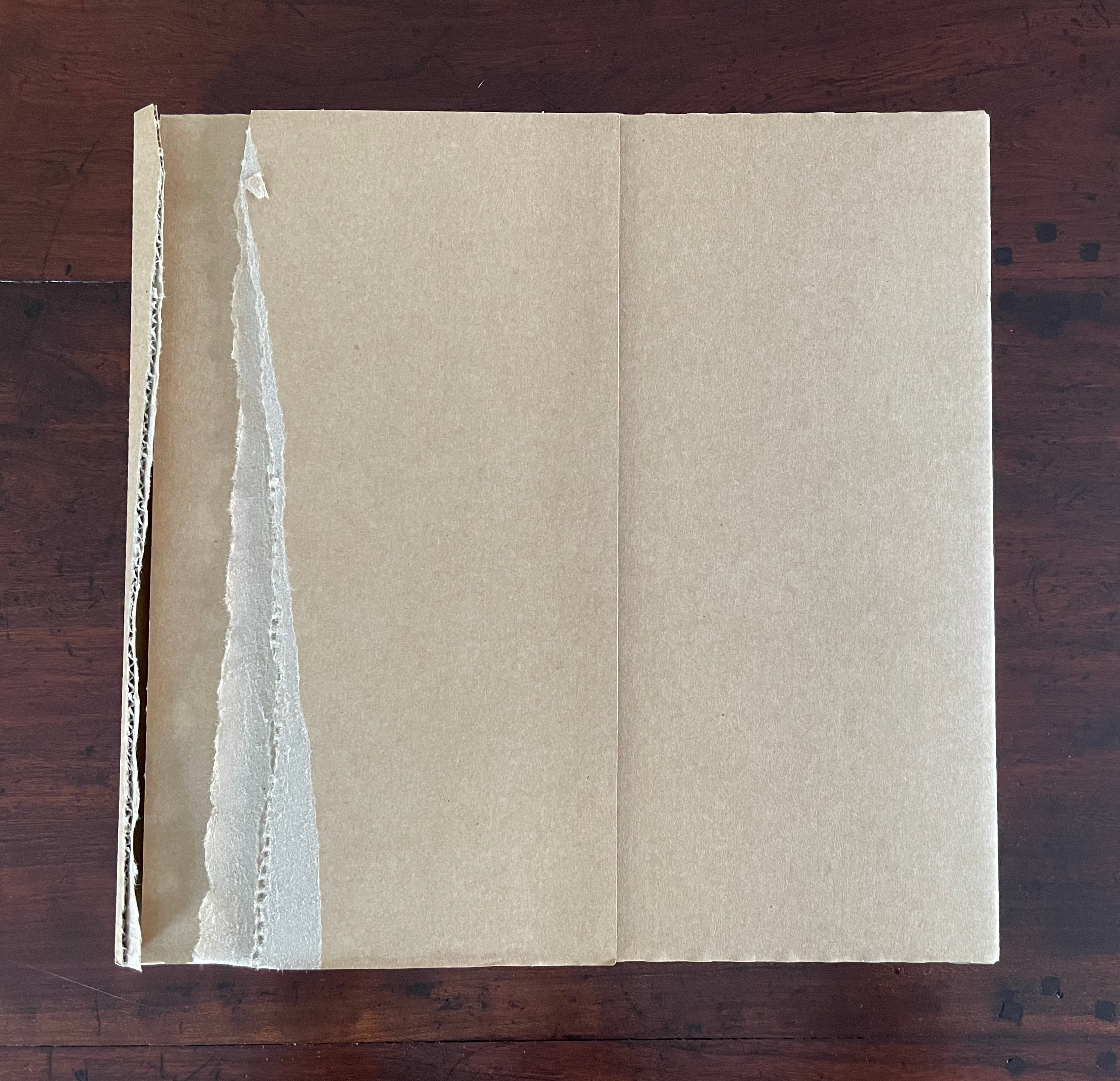
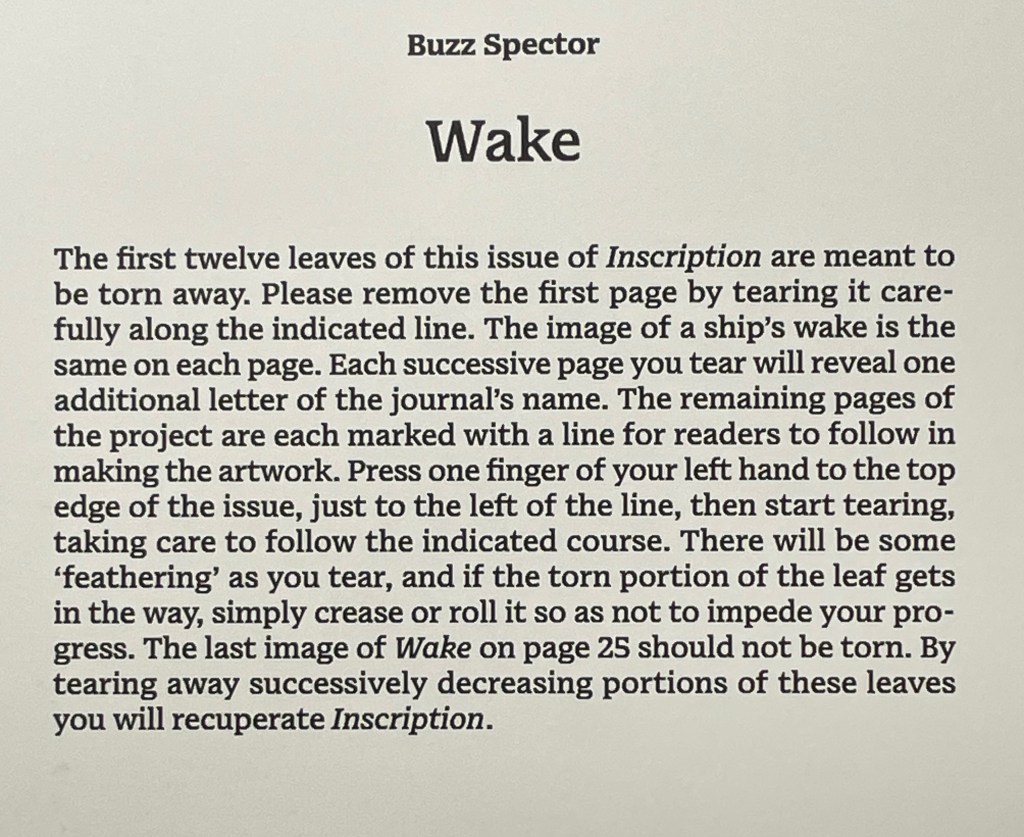
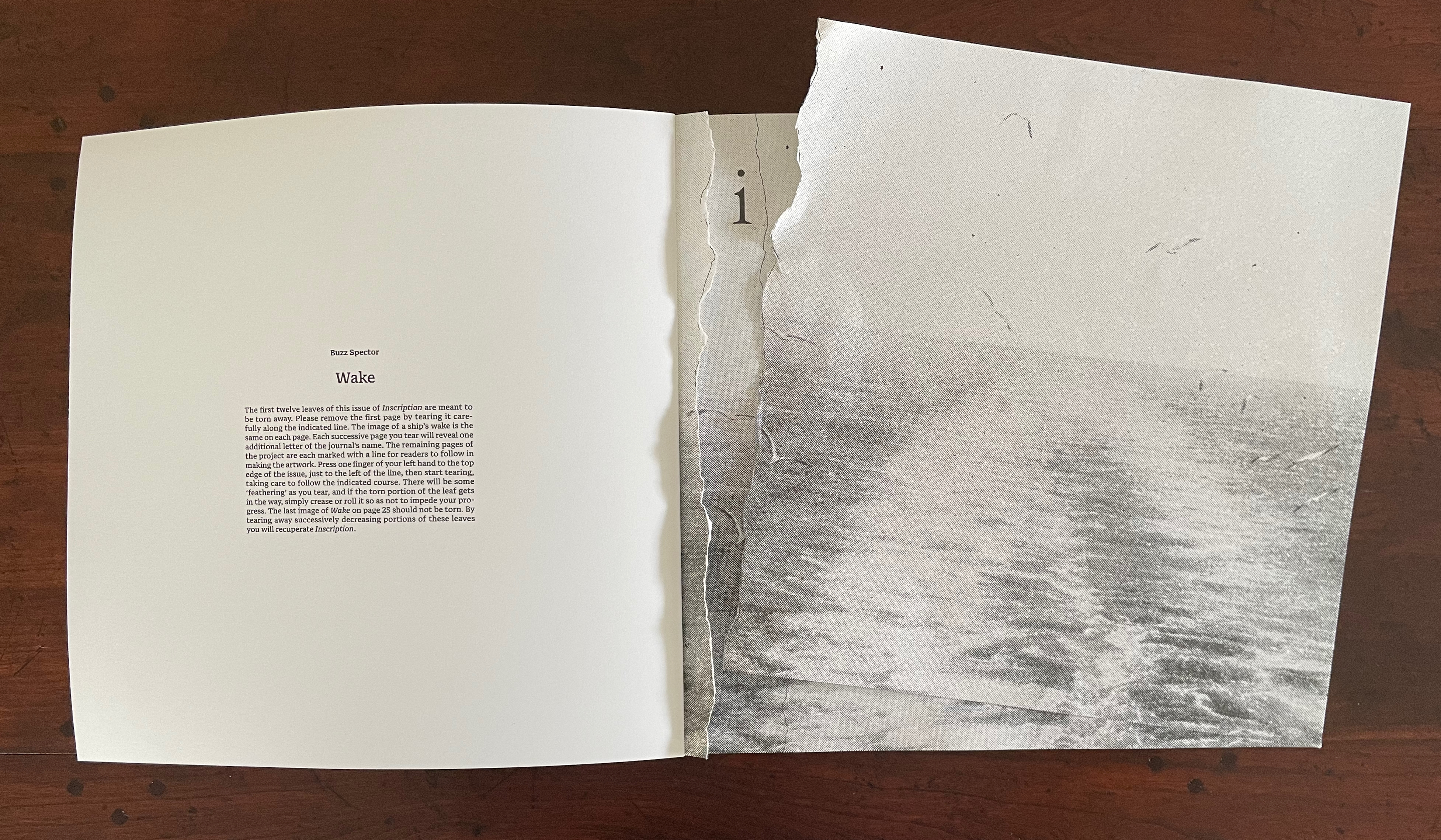
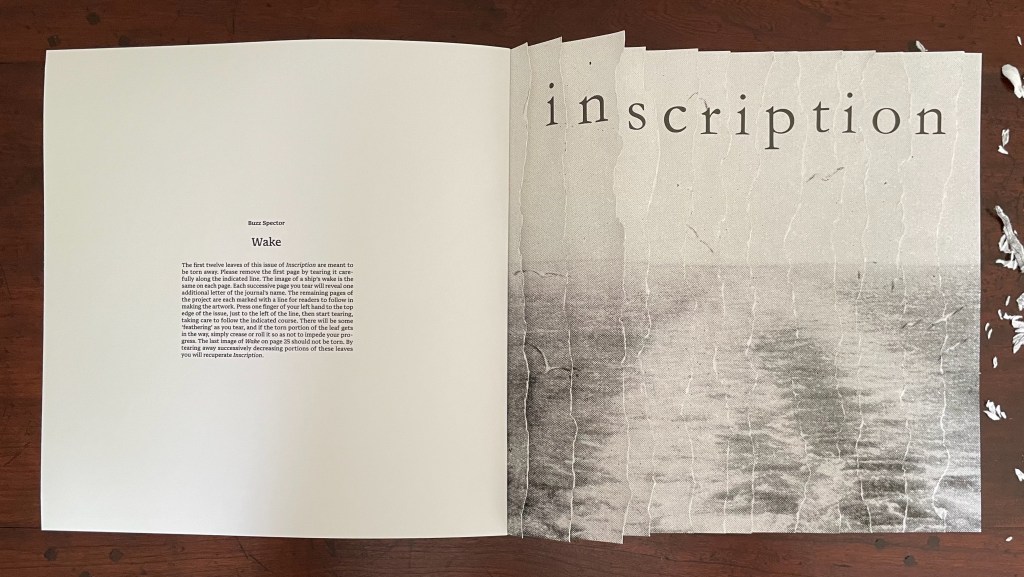
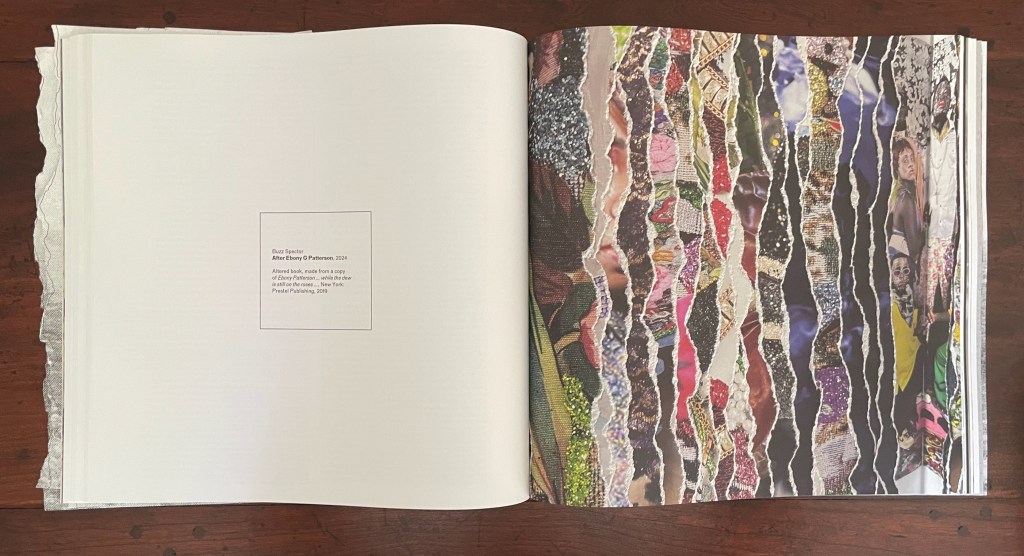
But first, as subscribers have come to expect, Inscription 6 opens with a surprise. Buzz Spector invites us to join in his artistic practice of tearing things up.
The artist says that he is asked all the time how he stands the tedium, to which he replies it is a meditative state he is sorry to see end. He is right. Once the initial unease over tearing pages from the issue subsides, a certain satisfaction ensues.
The “second” tear. (See further above for the first.)
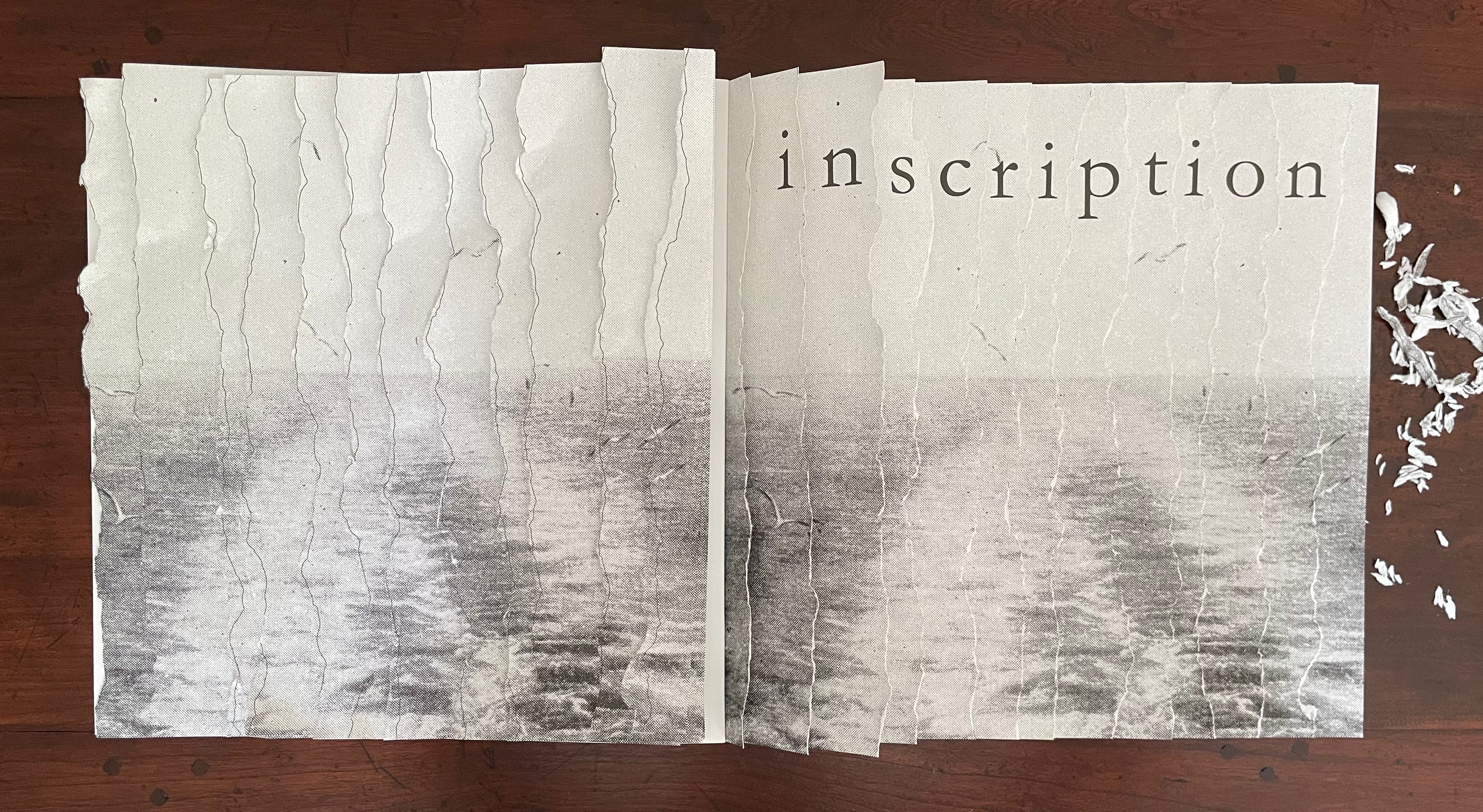
The result is the wake’s image restored in a composition of torn strips still bound to the book.
Rather than surrendering themselves to the bin, the removed strips beg to be reassembled for a wake on the other side of the gutter in keeping with the creative productivity of turning the singular into the plural.
Left: the Spector-esque result. Right: the removed strips rearranged.
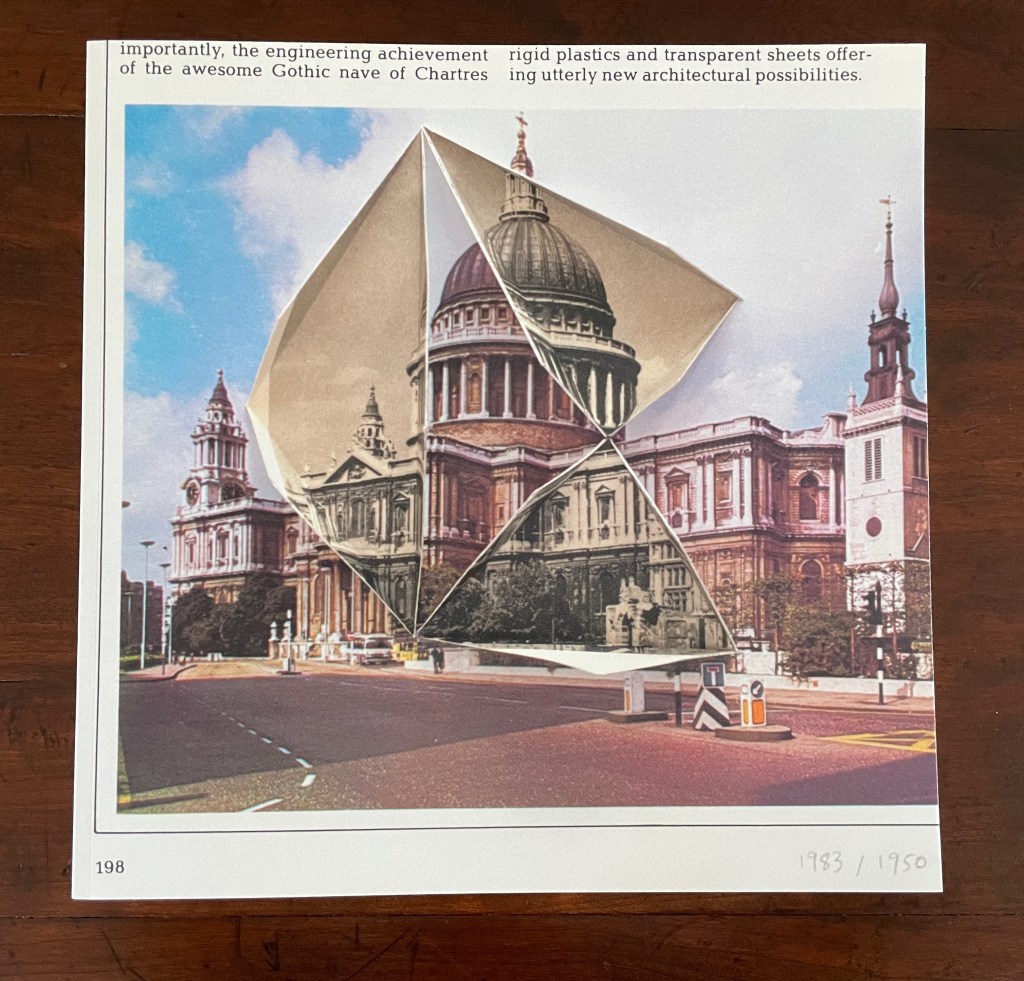
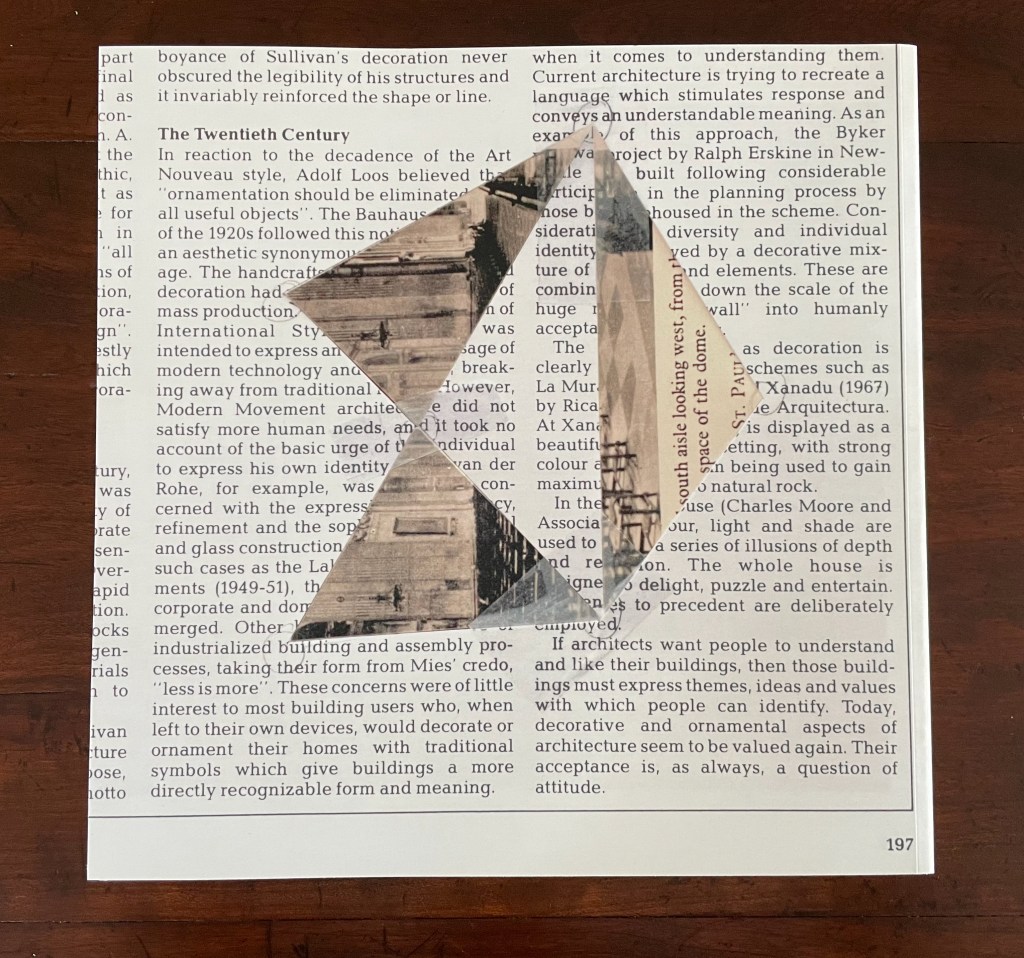
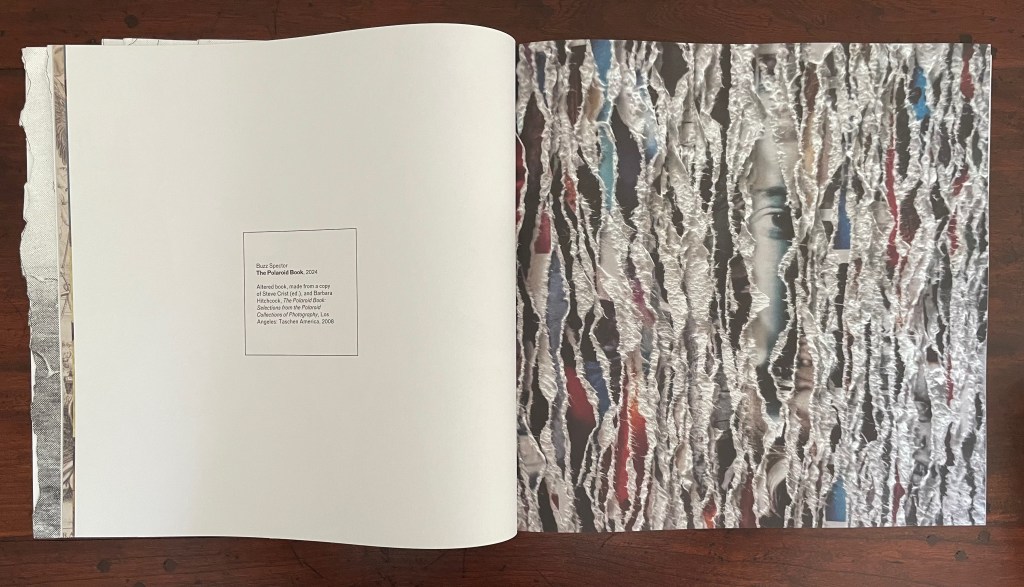
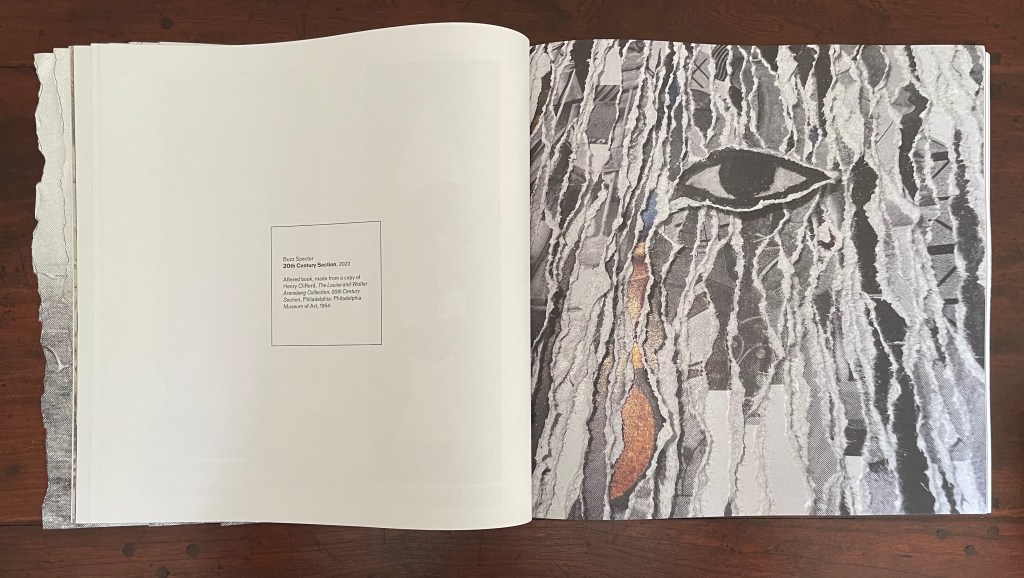
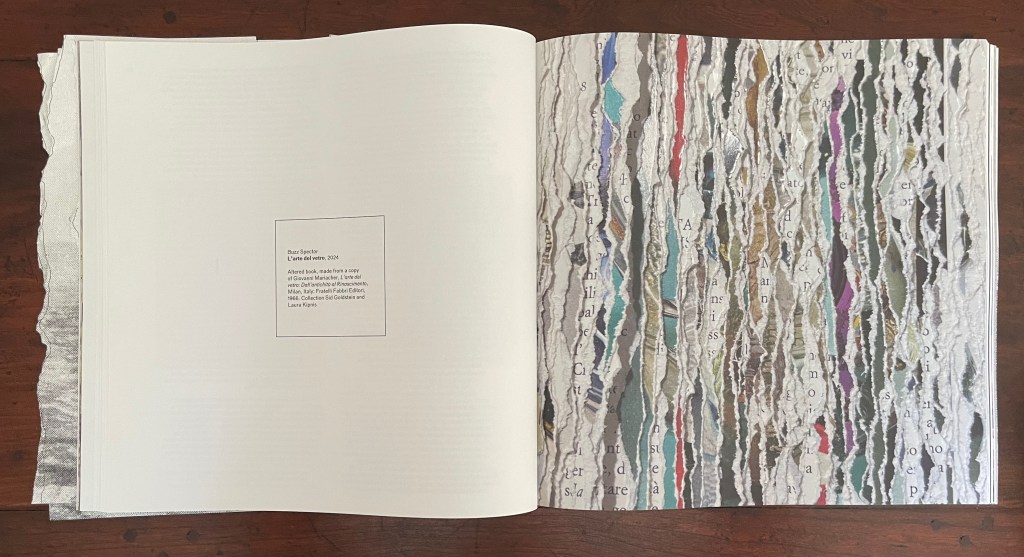
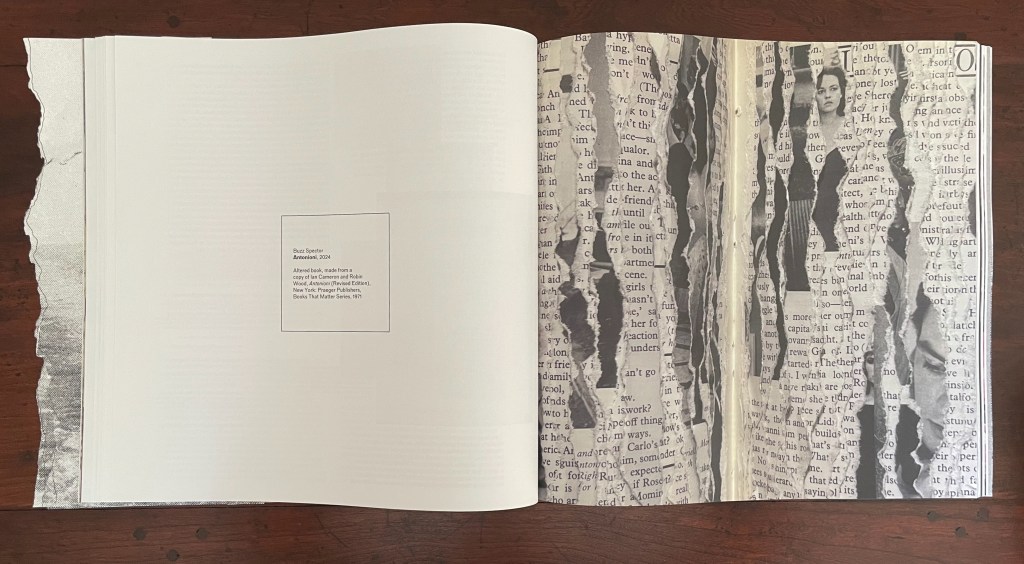
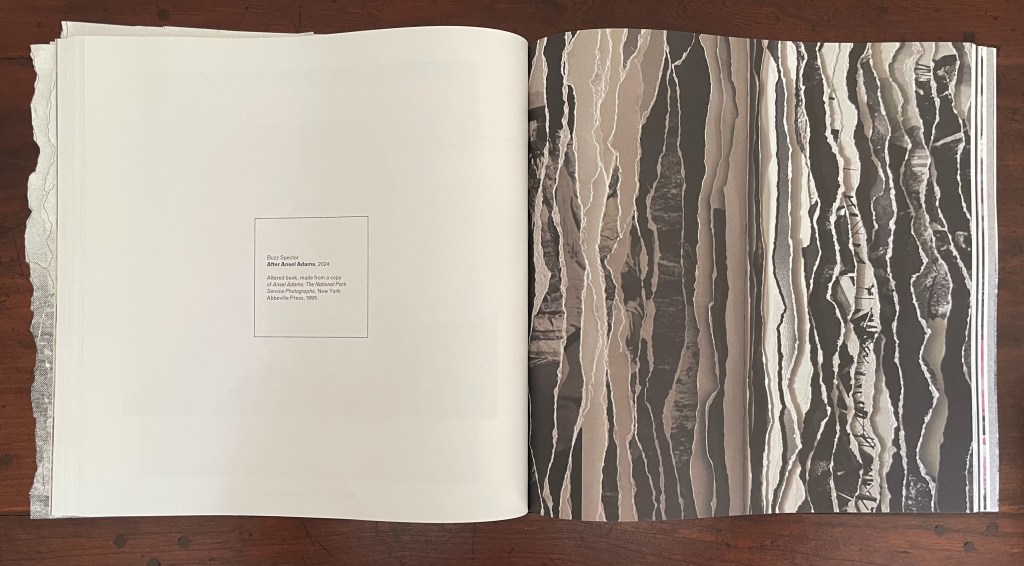
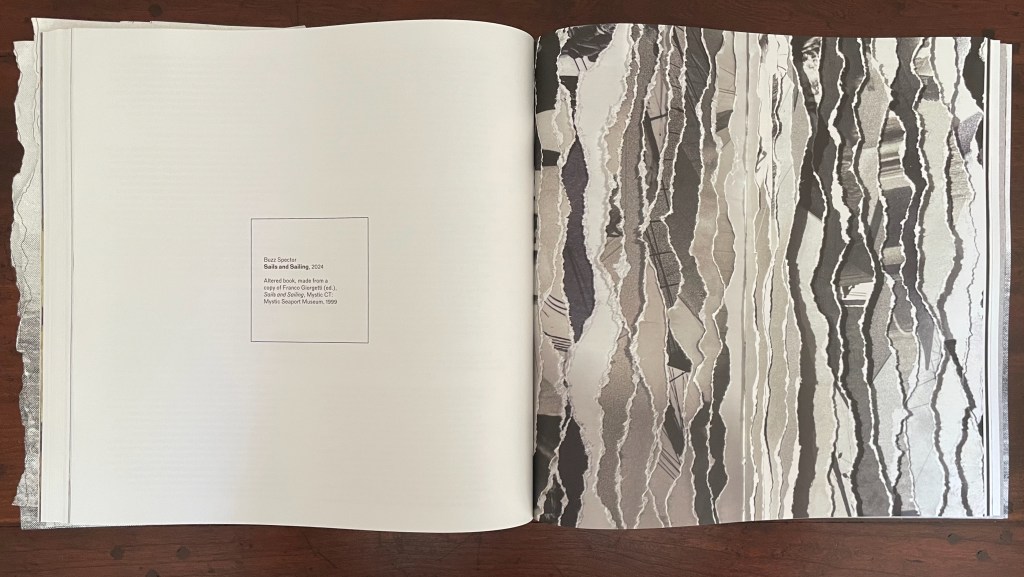
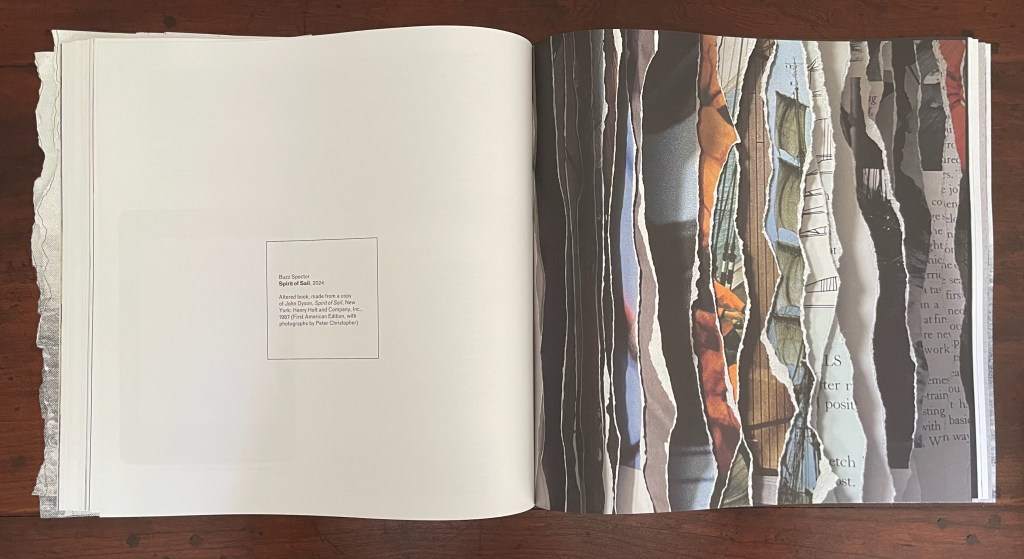
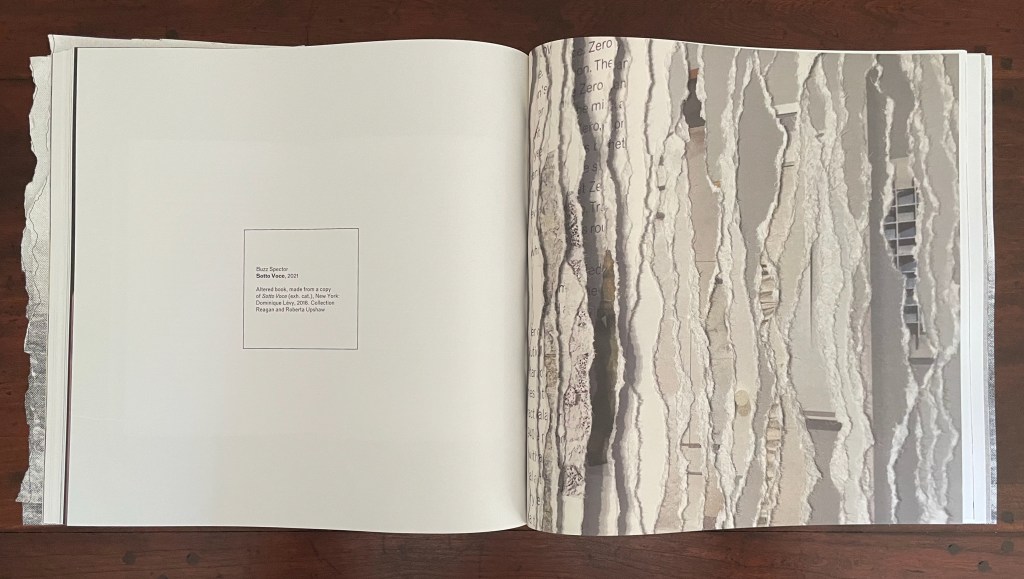
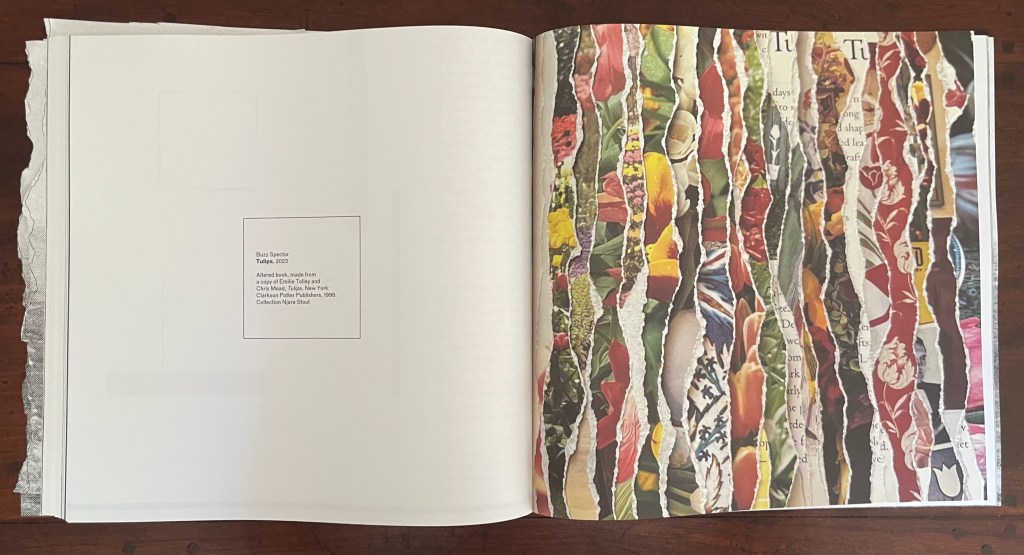
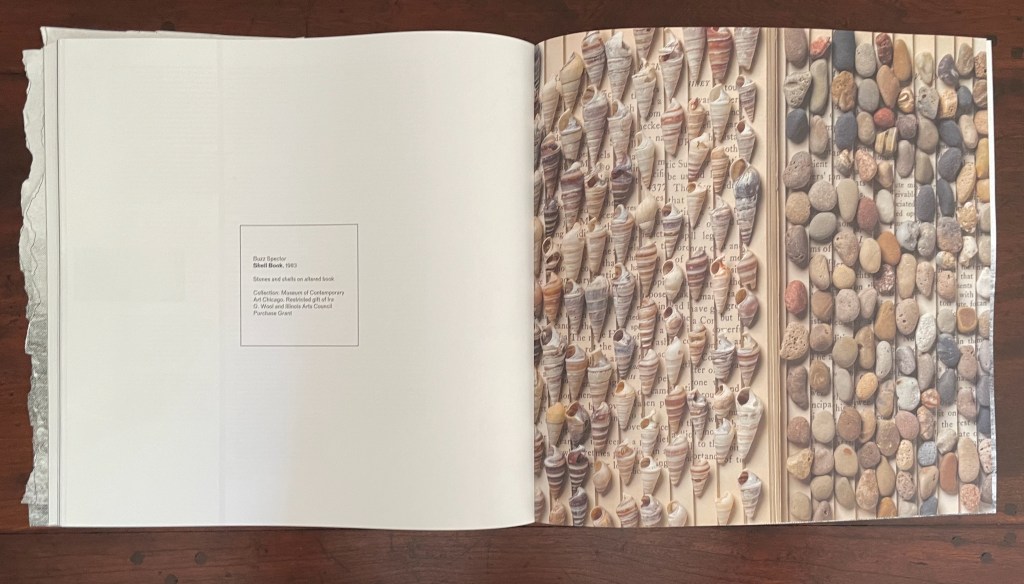
Buzz Spector is the star of this issue. Images from fourteen of his works divide the main sections and each contribution from one another. Works of torn edges create edges or boundaries between the issue’s contents. A stroke of genius from the issue’s editorial and design team. The range of Spector’s sources also draws attention to other boundaries inherent in the body of his work and the issue’s theme: the border between high and low in art, East and West, and Art and Nature. After the 12-page exercise, we have the altered Chinese translation of the self-help book Ego is the Enemy by Ryan Holiday; before the colophon, we have an array of shells and stones on an unidentified altered book, a sculpture held in the Museum of Contemporary Art Chicago. In between, there are alterations of catalogues of Ansel Adams’ photos and the Polaroid Collection, an academic study of Antonioni’s films, a foundational Italian volume on ancient and Renaissance glassmaking, a gardening book, and sailing photobooks.
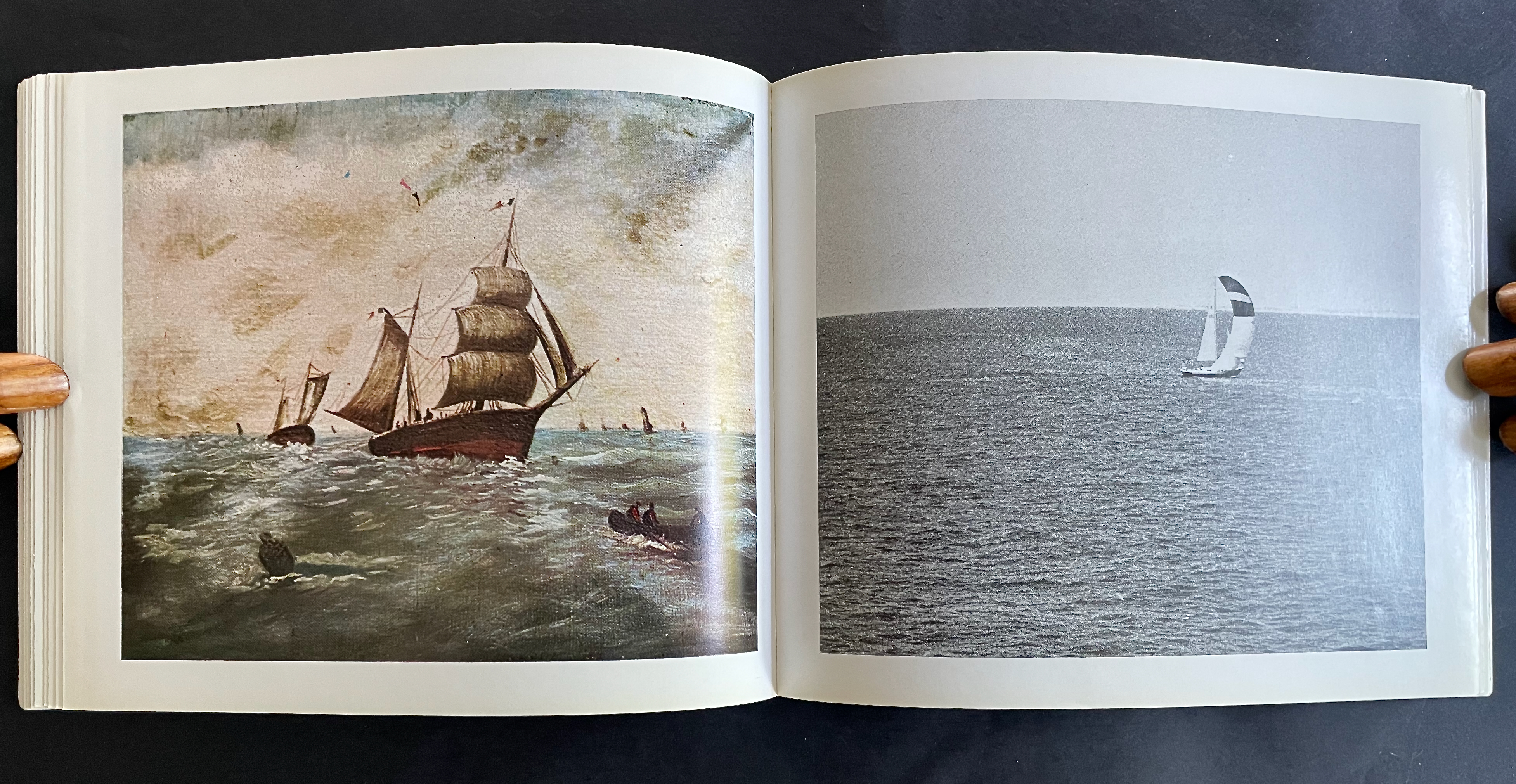
The altered sailing photobooks recall Spector’s North Sea (for M.B.) (1990), his homage to Marcel Broodthaers’ A Voyage on the North Sea (1974) in which Broodthaers juxtaposes a 19th century amateur painting of a tall-masted ship with his own photographs of a sailing ship. Tellingly for this issue of Inscription as well as the thrust of Spector’s homage, Broodthaers opens A Voyage with an elaborate warning not to cut the uncut pages of the book.
From A Voyage on the North Sea (1974) by Marcel Broodthaers. Photos: Books On Books Collection.
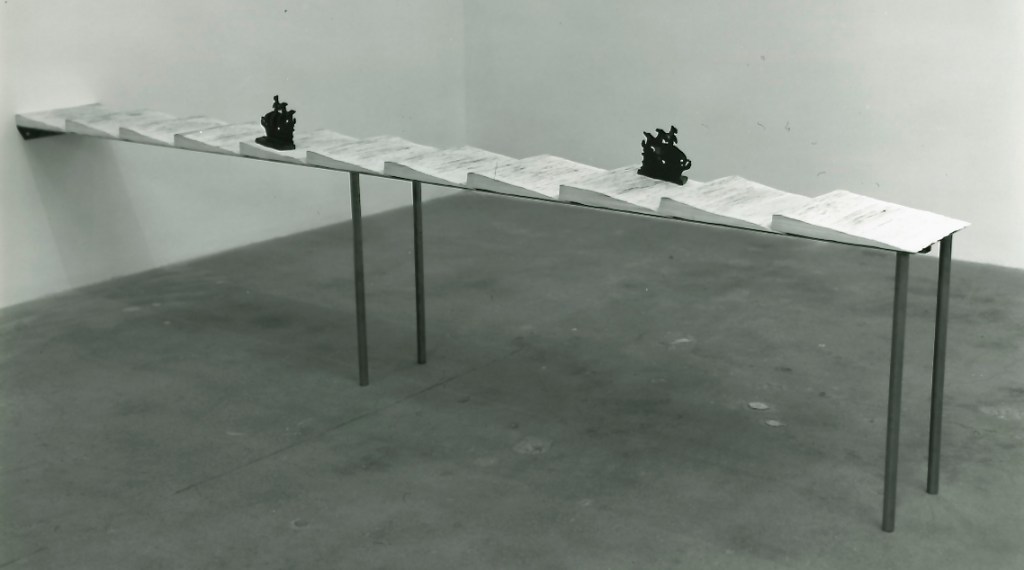
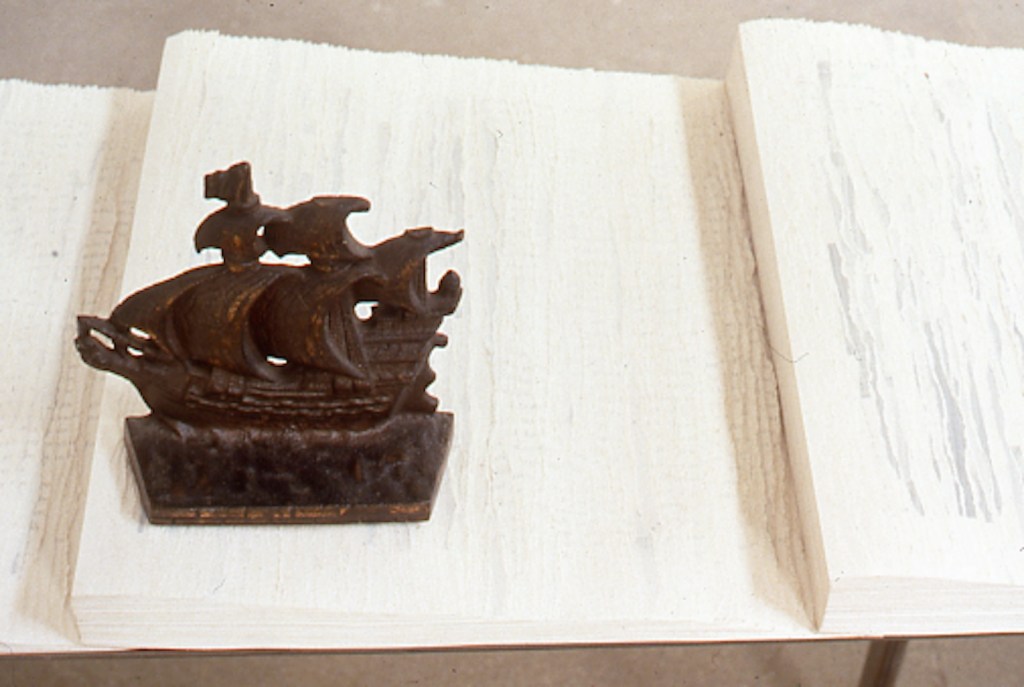
Spector’s homage is a work 10 feet long and presented on a table appropriately jutting out from the wall like a pier. The eleven “waves” of torn pages placed in a row on top of the steel shelf come from eleven copies of the Walker Art Center’s 1987 catalogue for Broodthaers’s first U.S. retrospective. Spector had all the pages in each copy painted with white gesso before tearing the pages. He saved the excised “wedges” and bound them at the fore edges. Because the gesso does not completely obscure the text and images from the catalogues, viewers who come close to the work can see slivers of some of Broodthaers’ works along with the word fragments typical of Spector’s altered books.
North Sea (for M.B.) (1990) by Buzz Spector
The echoes of Spector’s appropriation from the great appropriator (recall Broodthaers’ 1969 appropriation of Mallarmé’s poem in Image: Un Coup de Dés Jamais N’Abolira le Hasard) bring another set of boundaries into view: the space between originality and appropriation and the space between the auratic artwork and its mechanical reproduction raised in Walter Benjamin’s The Work of Art in the Age of Mechanical Reproduction (1936).
Across its 10 sections and 11 loose inserts, the sixth issue of Inscription takes the lead from Spector’s works and explores all these binaries and the cut or torn edges between them. As usual with Inscription, it isn’t all book art. There are prints, a vinyl record, bookmarks, postcards, installations, libraries, typography, a syllabary, and even moth-repellent cedarwood blocks, and its sources range from the London Missionary Society hospitals in early 20th century China, to an installation of Leonard and Virginia Woolf’s library shelves (at Washingon State University of all places), and to J.L. Carr’s home in Kettering. The eclecticism is a challenge to coherence as much as the number of contributors is a challenge to adherence to the theme. Complete success would be an issue that is an artwork of collage in itself.
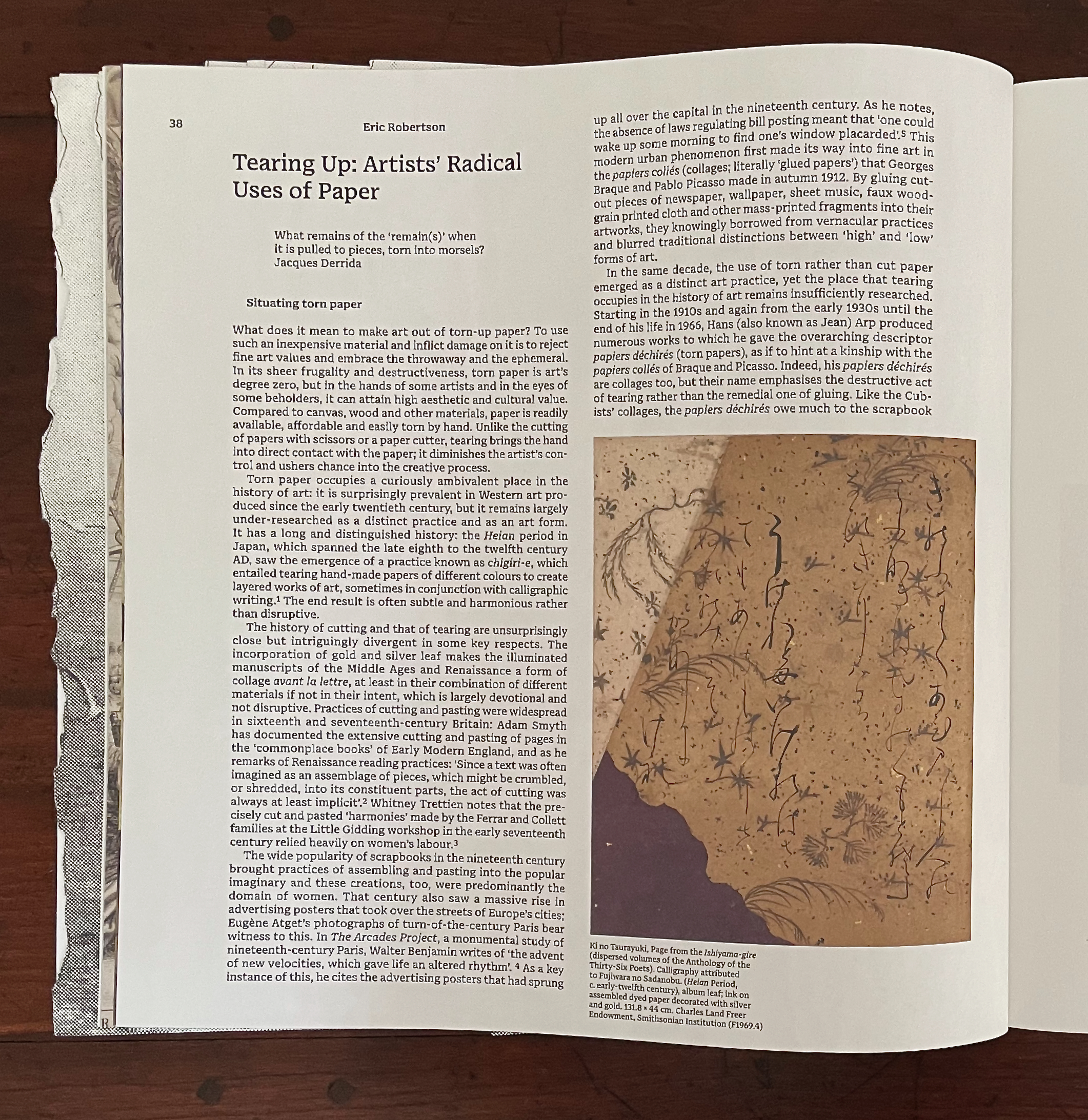
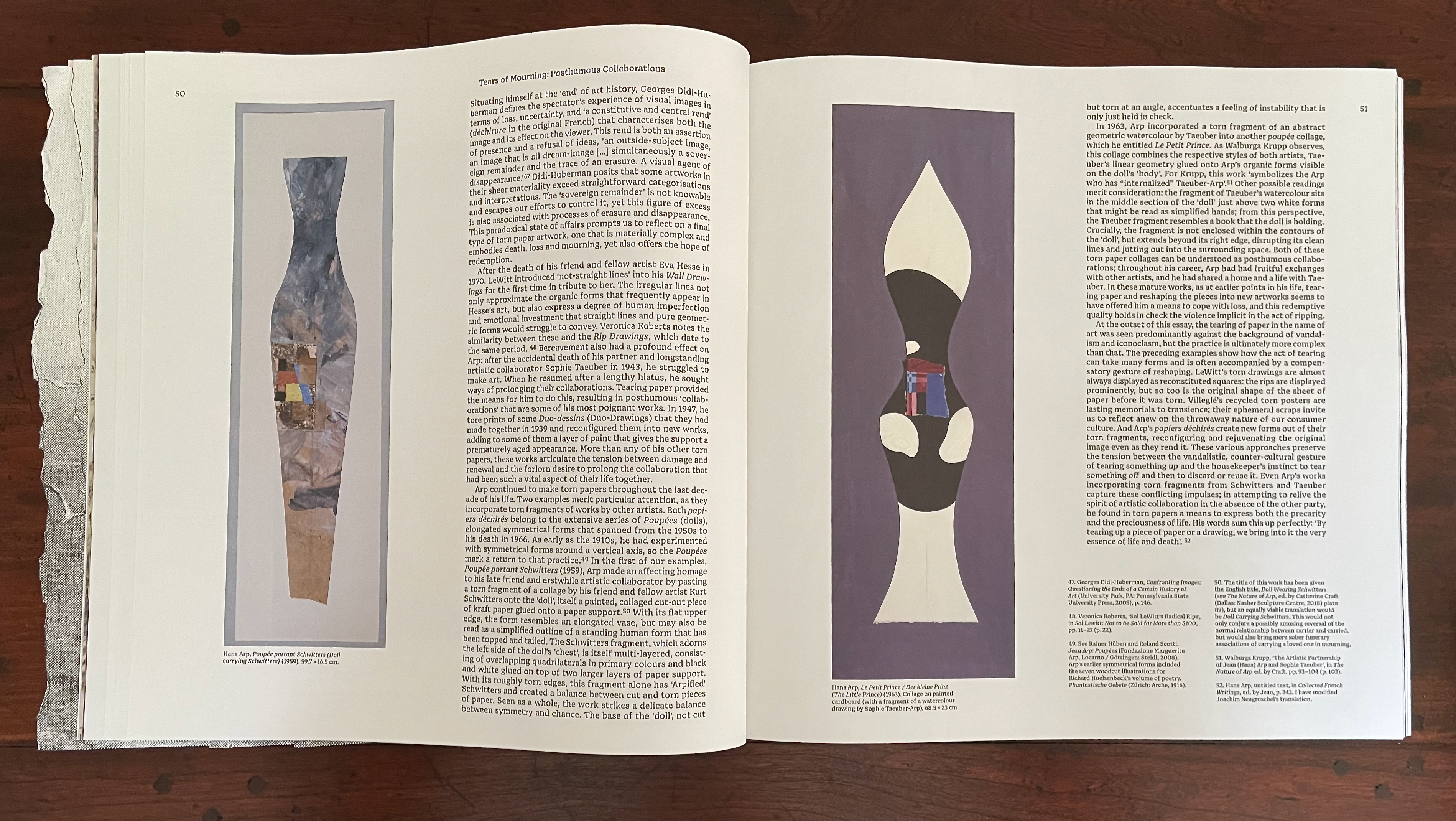
Collage is naturally where the first contributor’s article begins. “What does it mean to make art out of torn-up paper?” Eric Robertson uses Hans (Jean) Arp’s déchirés (torn pages), Raymon Hains’ and Jacques Villeglé’s torn posters, and Sol Lewitt’s “rip drawings” to take us beyond categorizing such works as vandalism, desecration, or iconoclasm.
By discussing Arp’s posthumous collaborations with friend Kurt Schwitters and partner Sophie Taeuber under the heading “Tears of Mourning”, Robertson bridges the dual meanings of the heteronym and well prepares the ground for his moving quotation of Arp in conclusion: “By tearing up a piece of paper or a drawing, we bring into it the very essence of life and death”.
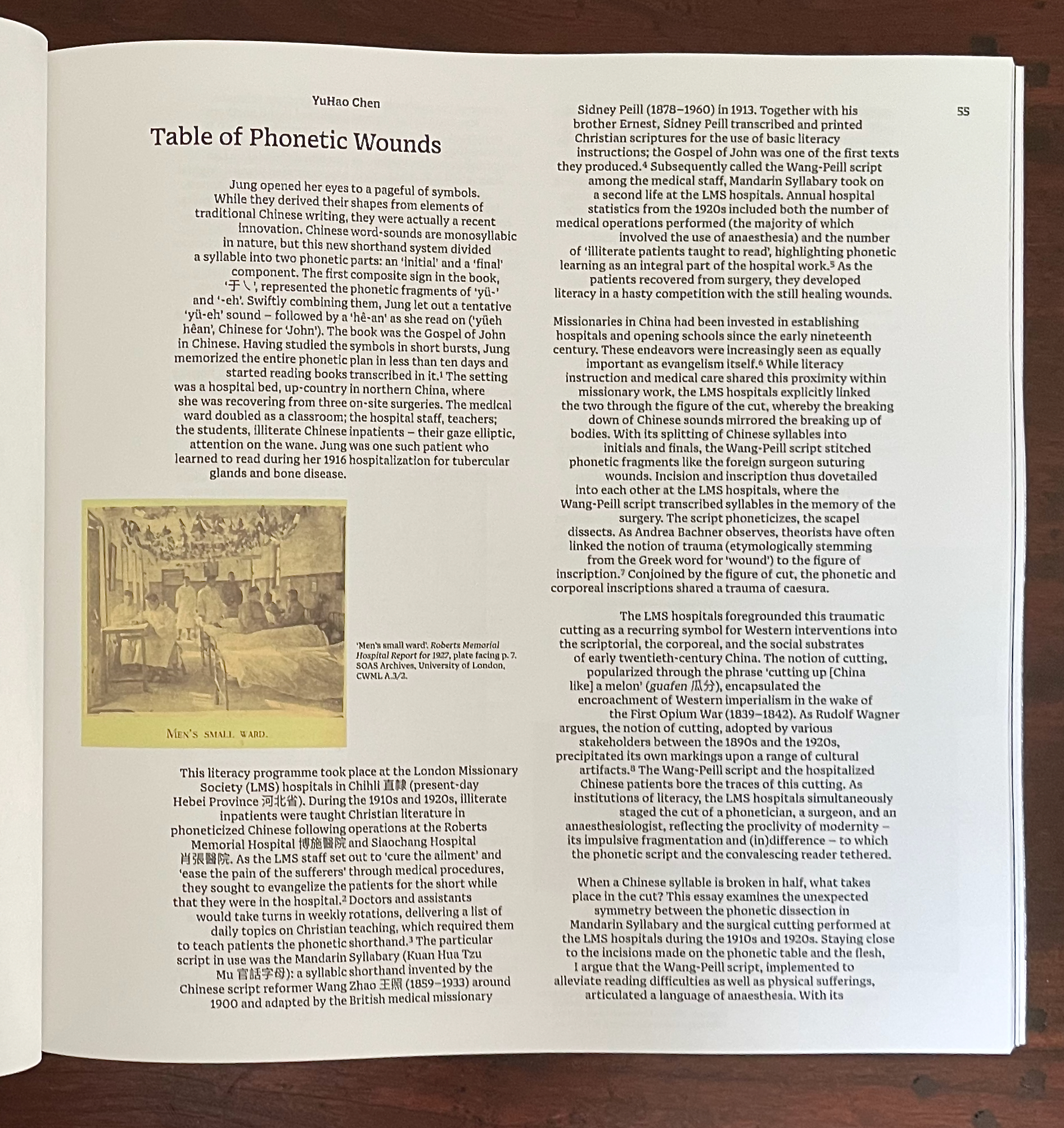
YuHao Chen‘s “Table of Phonetic Wounds” aims to make metaphorical connections among a host of pairings: surgical incision/skin, site of operation/cause for operation, the initial/final phoneme structure from the Wang-Peill Mandarin Syllabary, Western colonial intervention/China-the-sick-man-0f Asia, literacy/illiteracy, non-Christian/Christian, etc. Successful surgery equals achievement of literacy, healing equals conversion, etc., by which we should be convinced of causality (or not).
The justification running through the center of the article’s paragraphs offers a visual metaphor for all these binaries. Even the gap between the initial and final phonemes in the Mandarin Syllabary recalls the gap between the consonants of “tears”. It is a space in which something meaningful happens.
Reanna Brooks‘ “Cut and Paste: Virginia Woolf’s Bookcraft” provides a good case for looking carefully at the border between craft and art. Brooks finds a depth in Woolf’s bookbinding that should prompt us to ask more often, When do the book arts and book art overlap to create a new work of art?
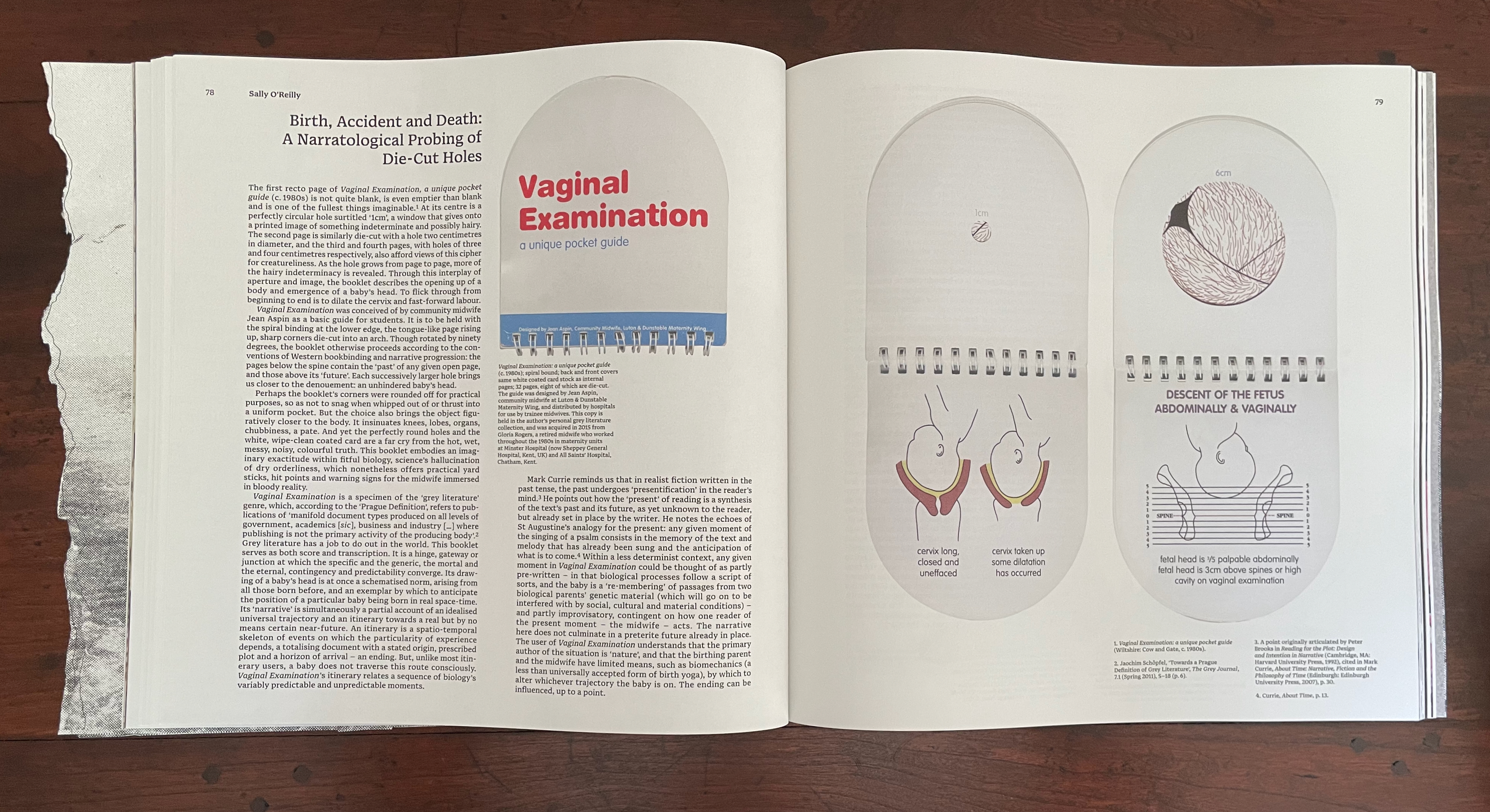
Sally O’Reilly‘s “Birth, Accident and Death: A Narratological Probing of Die-Cut Holes” would not have been out of place in Inscription No. 2 on “holes”. Its presence here demonstrates the extension of the theme of tearing to include cutting and holes. Removal by tearing or cutting may overlap, but the techniques are sharply different in their results as we saw with Arp’s “Doll carrying Schwitters” and “Le Petit Prince”. The differences here point to the messiness of giving birth contrasted with the tidiness of the neatly designed and pocketable guide for midwives that shows the growing diameter of the cervix stage by stage through a die-cut hole.
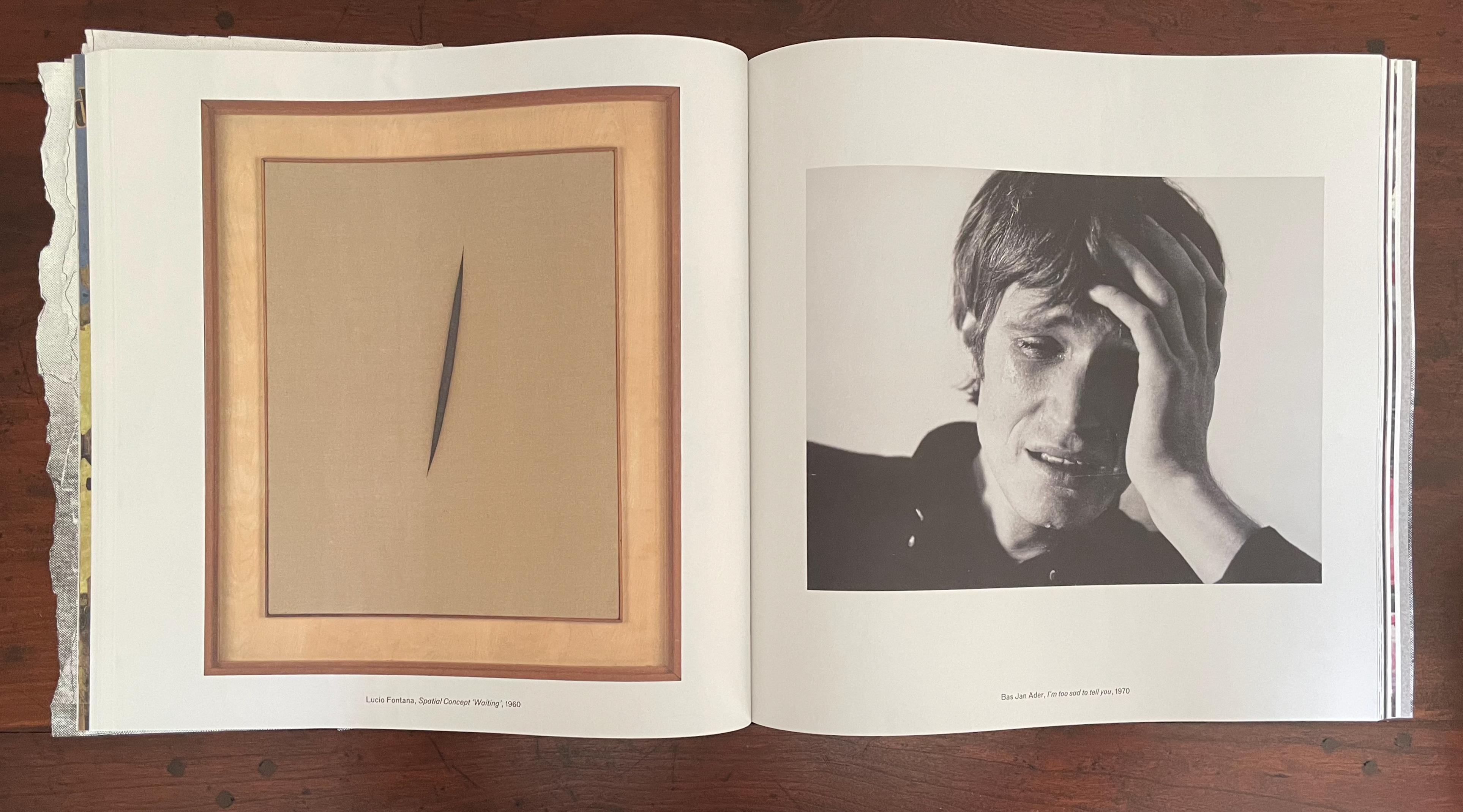
The following juxtaposition of Lucio Fontana‘s Spatial Concept “Waiting” and Bas Jan Ader‘s I’m too sad to tell you draws attention to the heteronym “tears”. It is set off in its own section, knowingly bracketed by Spector’s Displacement after Lawrence Weiner (2024) — conceptual artist — and After Ansel Adams (2024) — photographer. It is a meaningful curatorial gesture meant to be on a par with, say, Robertson’s effective bridging of the heteronymic meanings under the heading “Tears of Mourning”.
Tear: N1 A torn part or place; V1 To pull or split apart. Tear: N2 A secretion of the lachrymal gland; V2 To weep.
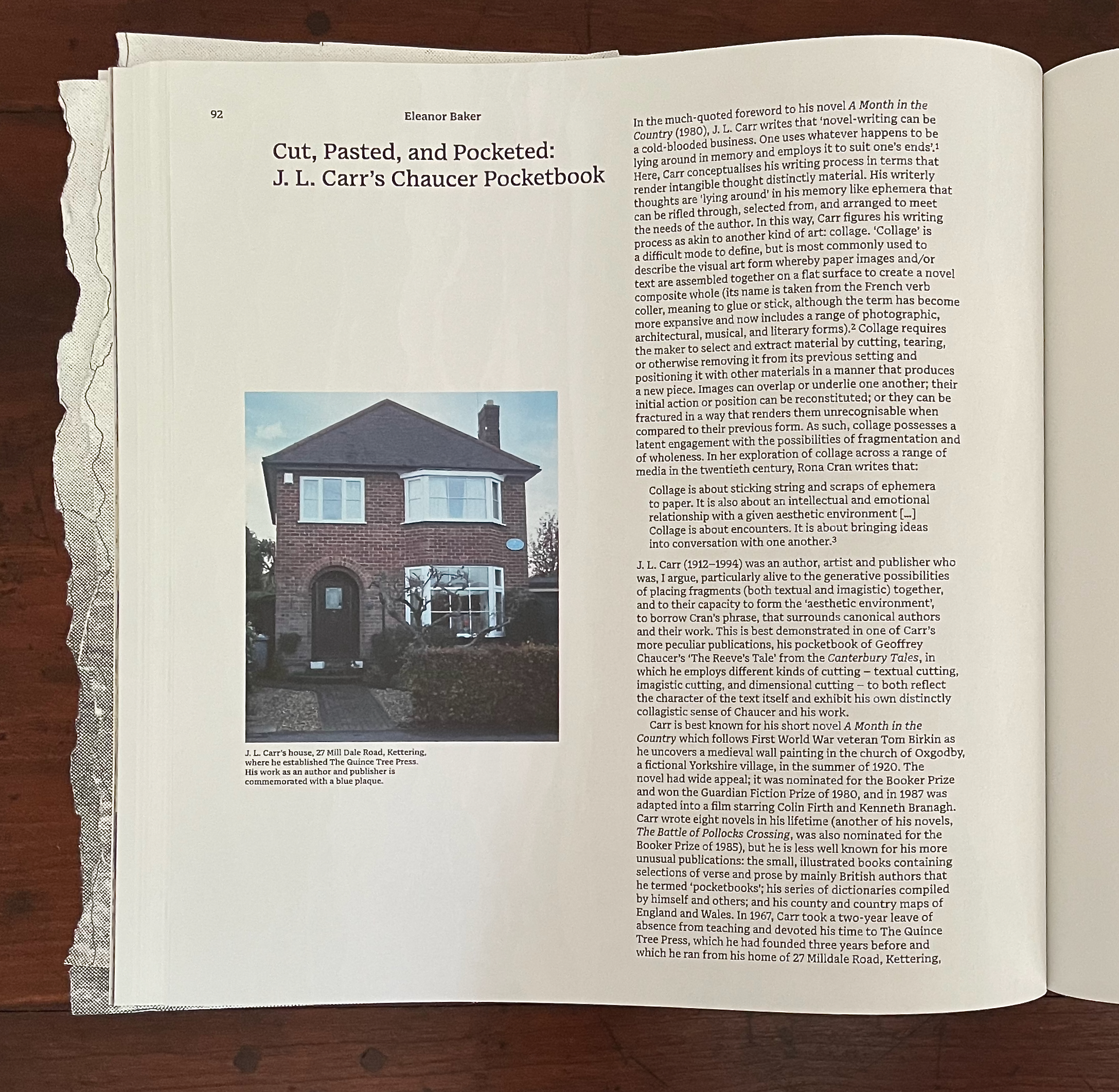
Eleanor Baker‘s “Cut, Paste, and Pocketed” explores J.L. Carr’s 1066 and All That treatment of Chaucer’s “The Reeve’s Tale”. While Carr would surely have been familiar with Sellar and Yeatman’s 1930 comic book history, Baker pegs Carr’s approach as a form of collage rather than comic strip. As we’ll see later with Angela Szczepaniak’s contribution, the two can be combined to drive a narrative forward. In Carr’s case, as Baker points out, the pocketbook approach and cheeky fragments of collage combine to deliver a comically modern sense of Chaucer’s world and an inventive match to the fragmentary nature of “The Reeve’s Tale”.
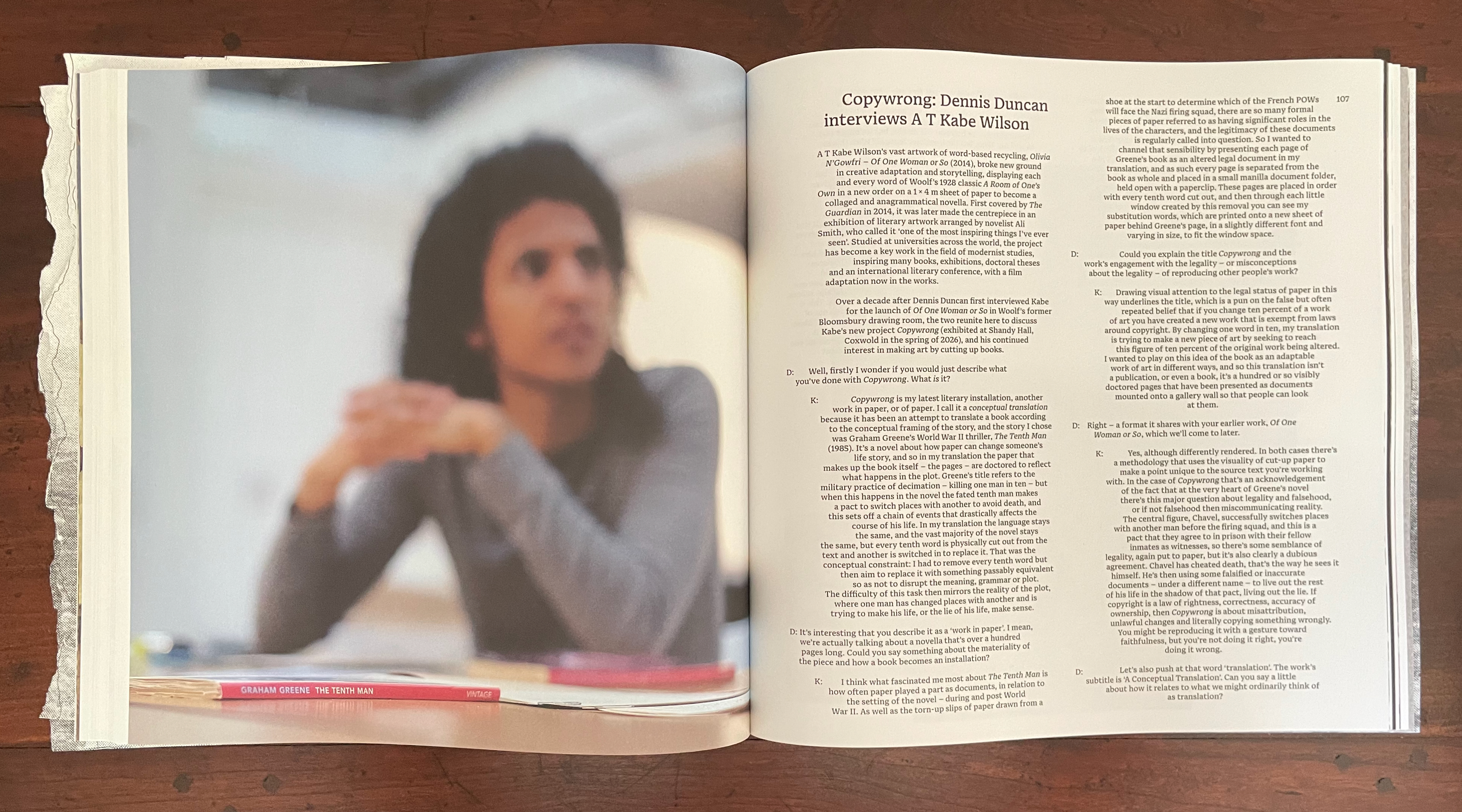
Using knives and punches, A T Kabe Wilson removes every tenth word in Graham Greene’s The Tenth Man and replaces it with a synonym or as near a proxy as he can manage to challenge the notion of copyright. The resulting pages are arranged to make up an installation where visitors can read the entire set of altered pages. There is no edition of Copywrong. It turns Walter Benjamin on his head: “The Unique Work of Art Produced from Two Copies of a Mechanical Reproduction”.
To bring this relevant work within the bounds of Inscription, the editors provide images of Wilson at work and rely on Dennis Duncan (University College of London) to elicit from Wilson where the work’s strange status places it in relationship to artists’ books and other visual art.
Kabe Wilson’s choice of every tenth word takes its impetus from the book’s story of collective punishment in wartime (“choose ten from among your number to be executed”). But it also turns on its head the common fallacy that ten percent of a work can be reproduced without violating copyright: hence the title Copywrong. In Greene’s novel, when the rich tenth man contracts with a poor man to trade places and switch identities in exchange for the rich man’s inheritance, a whole vein of copywrongs reveals itself for mining. Wilson sees his creative destruction of the novel as a form of translation and betrayal of the original. While challenging us to think where the line between book and not-book lies, and even to think of its sheets of paper as 3D objects, Copywrong becomes a way of asking where the line between original and copy, legal and illegal, and life and death lies.
The next contribution is Fraser Muggeridge‘s “Cuts and Tears as Justified and Unjustified Typesetting”. While the article gives an informative sketch of the history and development of the straight and ragged edges of print, its argument that unjustified typesetting is “torn typography” does not convince. An unjustified line does not begin with a justified line from which spacing is torn or cut. A justified setting may give a page the visual effect of having been evenly cut down the right, and a ragged right setting may give the visual effect of a tear down the right side, but whether they contribute to a work’s artistic meaning — not just an aesthetic effect on readability — needs convincing examples. With Apollinaire and his calligrammes, Stefan Themerson and his “internal vertical justification”, and Christian Bök’s Diamonds, Muggeridge make a good start. Most of the other variations on justified, unjustified, and mixed, however, are far cries from, say, Mallarmé’s breaks of the line and play with page layout in Un Coup de Dés Jamais N’Abolira le Hasard or from the meaningful typographical tearing and cutting that the avant-gardistes of the early 20th century perpetrated.
It’s odd, especially as the Fraser Muggeridge Studio designs Inscription, that the article does not mention the center justification used in several of the issue’s other articles. Their paragraphs decline to show off those even edges of justified-left and justified-right typesetting. Instead, they go for a ragged left and ragged right with a book-mimicking gutter of justified left and right in their center. When proofreaders were more a feature in typesetting houses, they not only had to catch “typos” but also to watch for “rivers in the type”, those breaks between words in one line that aligned with breaks in the next several lines to create a white rivulet of space trickling down the page and distracting the reader from the sense of the sentences. In Chen’s article, the “river” is a medial surgical cut. In Duncan’s interview with Wilson, the clear gutter in the middle of the paragraphs offers a sharp contrast with the uncomfortable binaries that Copywrong bids us to engage. Kudos to Fraser Muggeridge and studio.
Left: from Chen’s article. Right: from Wilson-Duncan interview.
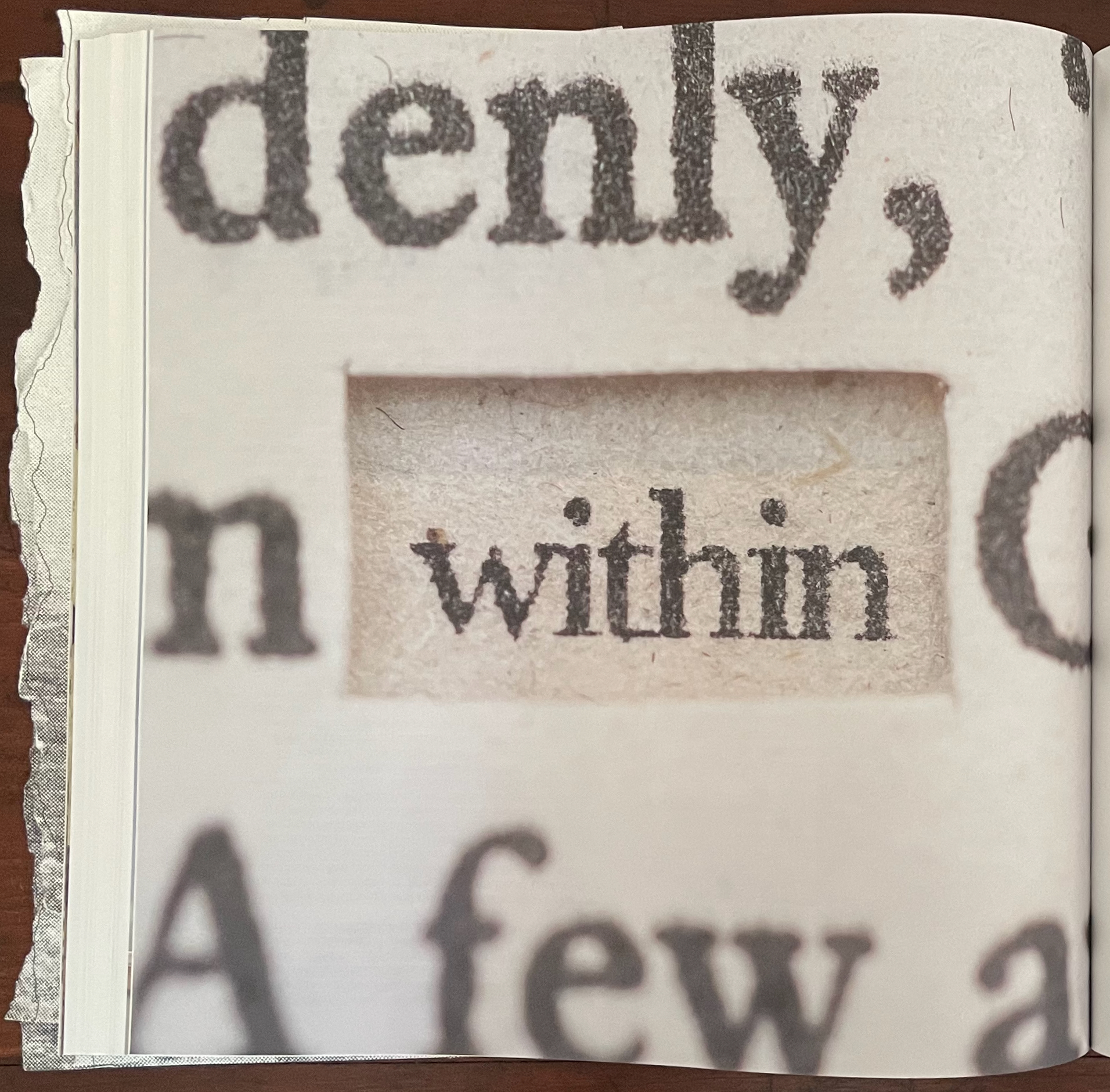
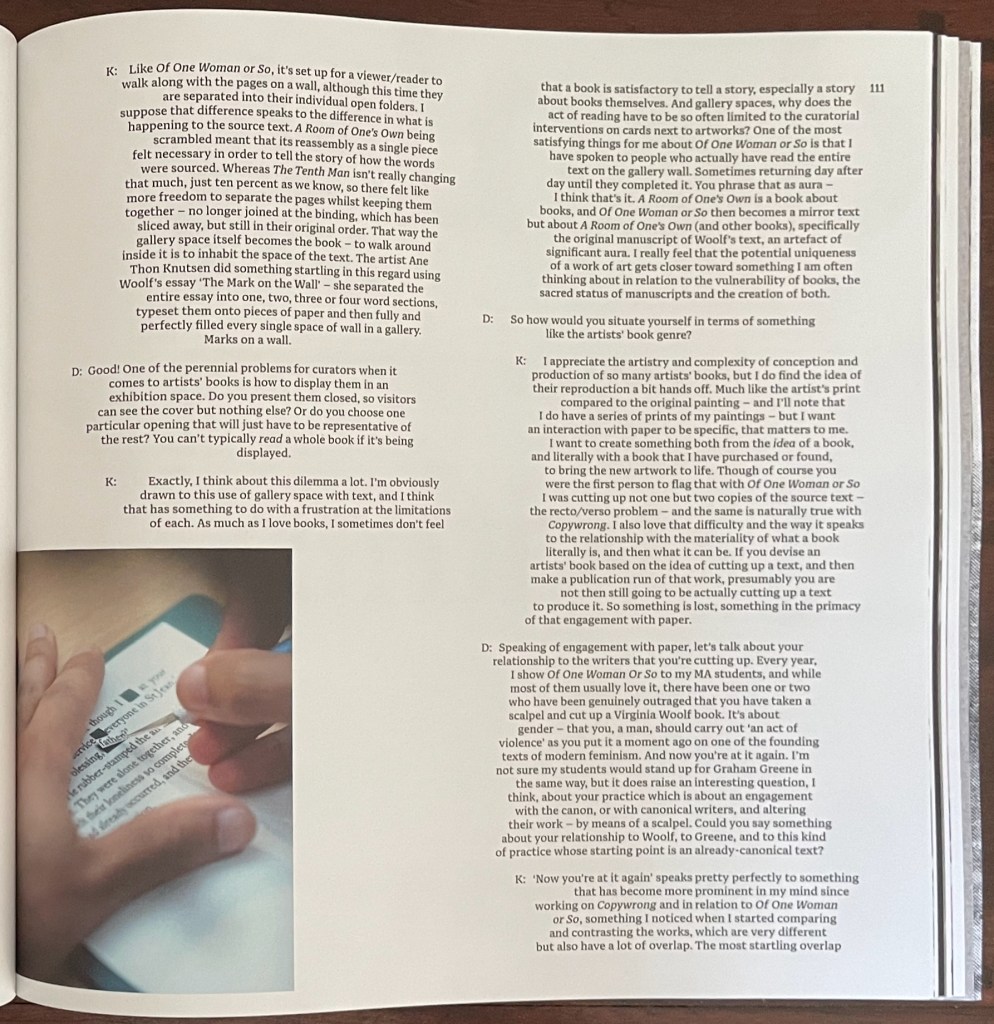
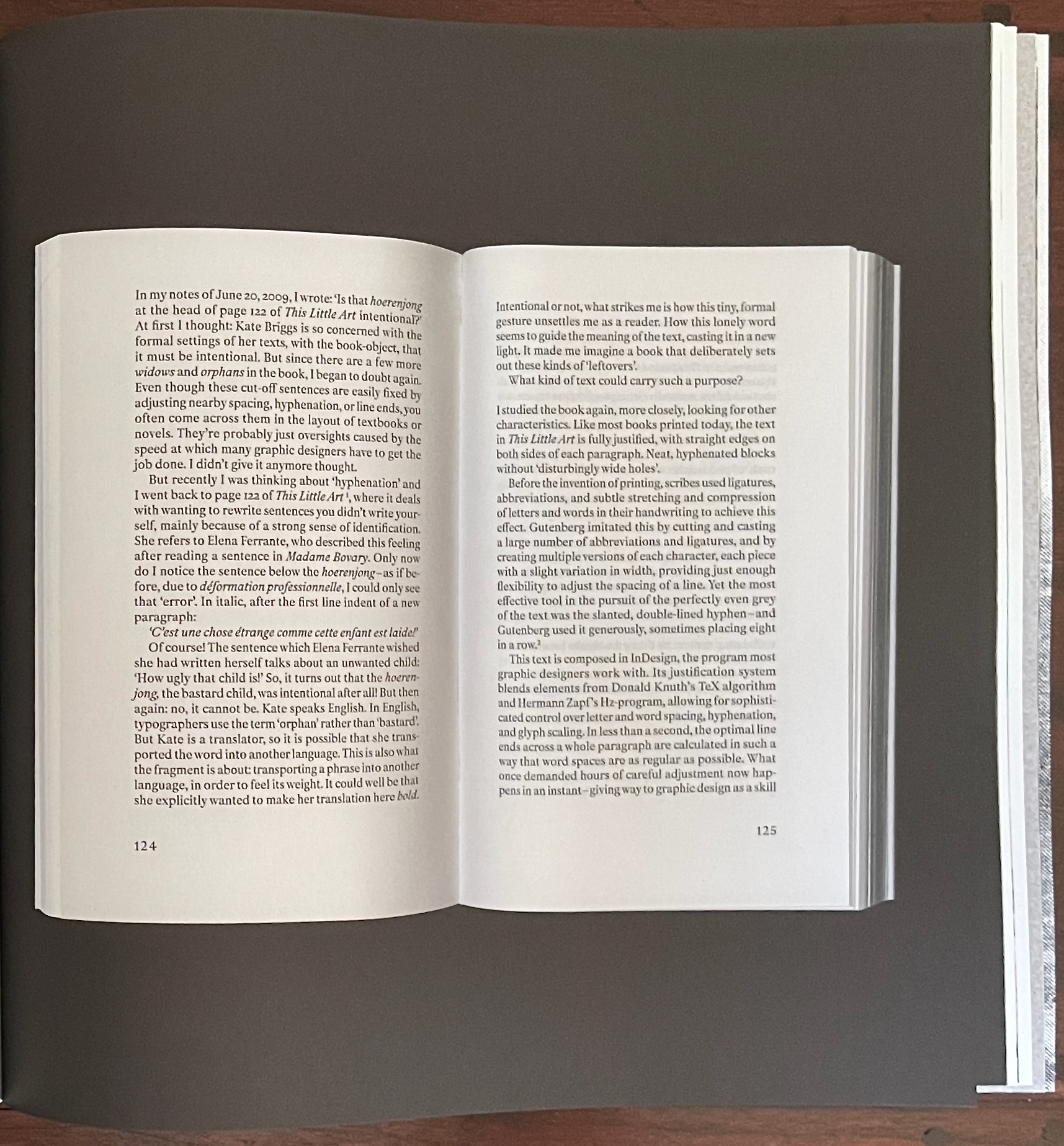
The next contribution — from the Leuven-based artists collective Rosetta, formed by Eva Moulaert, Anneleen Masschelein, and Willem Styfhals — continues with the topic of typesetting. Their starting point is those awkward phenomena of typesetting — widows and orphans. They are not deliberate renderings or loppings of words from a following or preceding sentence to be left stranded at the bottom or top of a page, respectively. But there they are. Are they tears or cuts, these weepy, abandoned strings of anthropomorphized type that are cause for tears among proofreaders, typesetters, and designers? No, they are cause for the fevered ponderings of the narrator in a book whose photographed pages make up this contribution.
No widows or orphans here.
This set of photographed double-page spreads (excised?) has plenty of widows and orphans. Even though they are likely deliberate, what is the point of them? And whose disembodied hand is that that keeps appearing, disappearing, and reappearing to hold the book facing out?
Orphan and widow.
The narrator winds “their” way through references to Gutenberg, Donald Knuth, Herman Zapf, Jean-François Lyotard, Martin Heidegger, Roland Barthes, Robert Bringhurst, Ellen Lupton, Frank Kermode, Amitav Ghosh, and half a dozen others to come to “a” point — an obsession with hyphenation. And the point of that? Why naturally for the narrator’s compound, hyphenated selves — Ro-set-ta — to hand over the pen to Rosetta, the widow at the end of “page 139”.
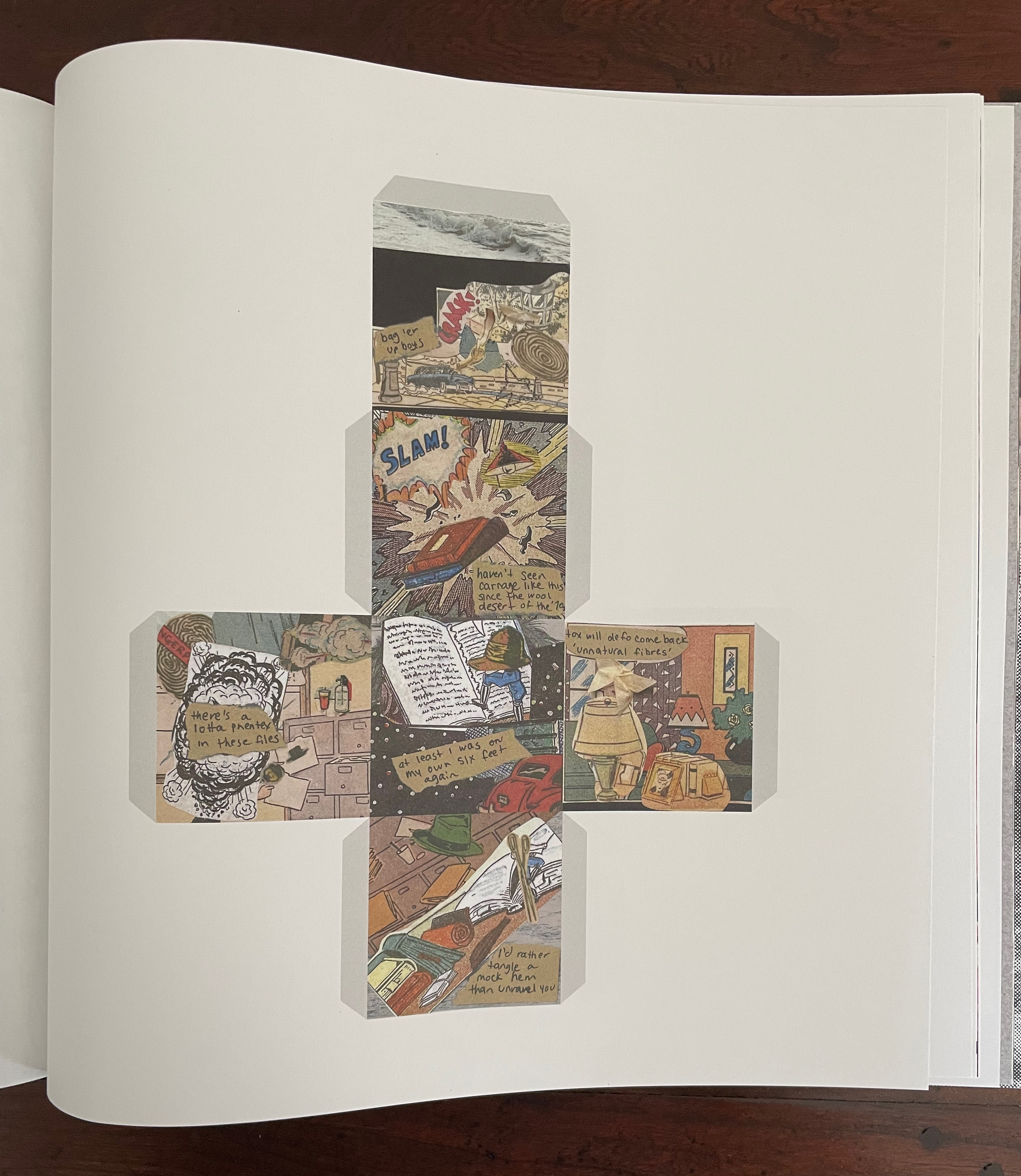
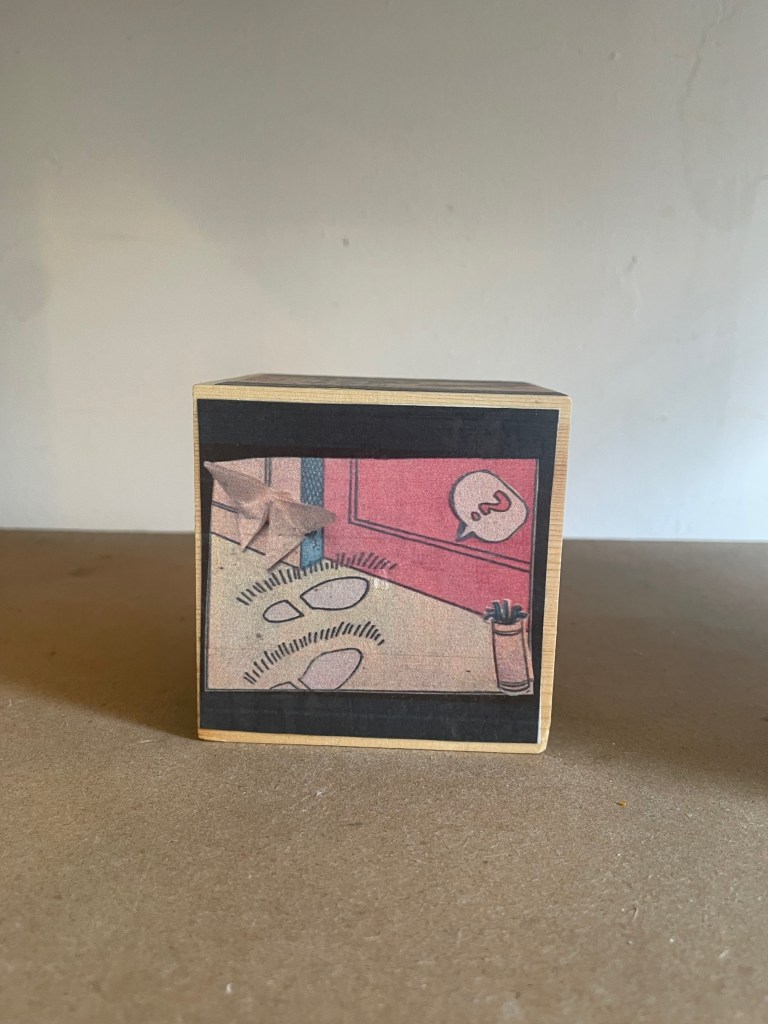
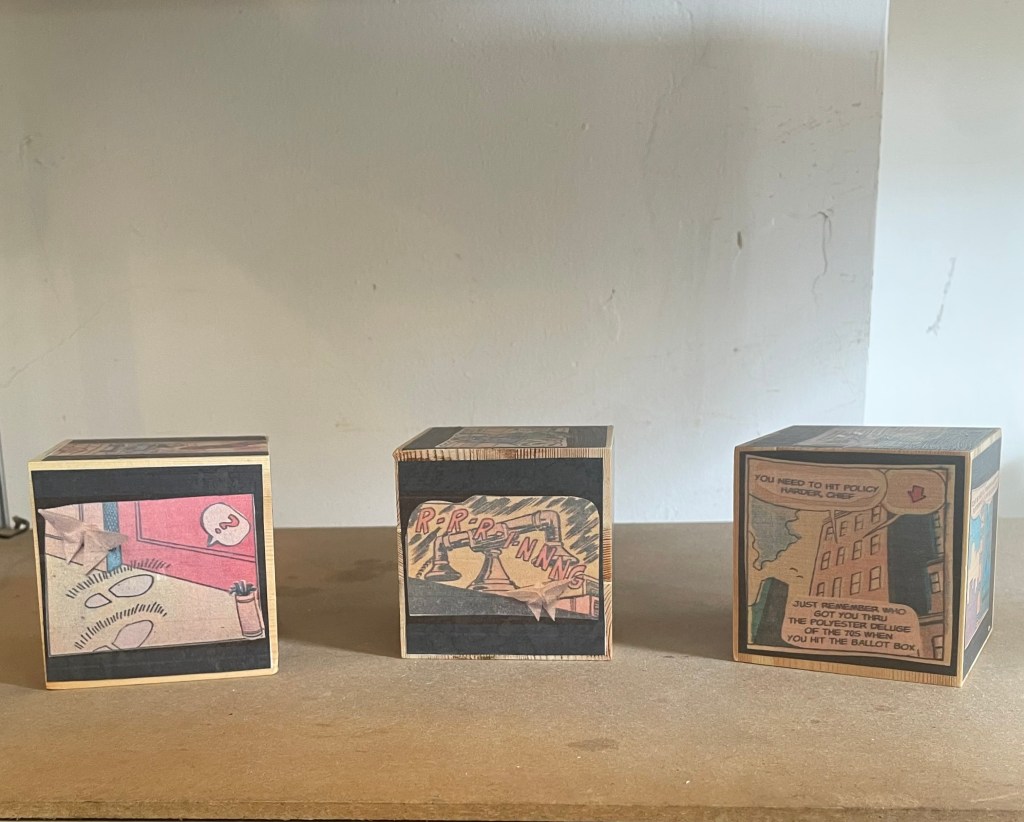
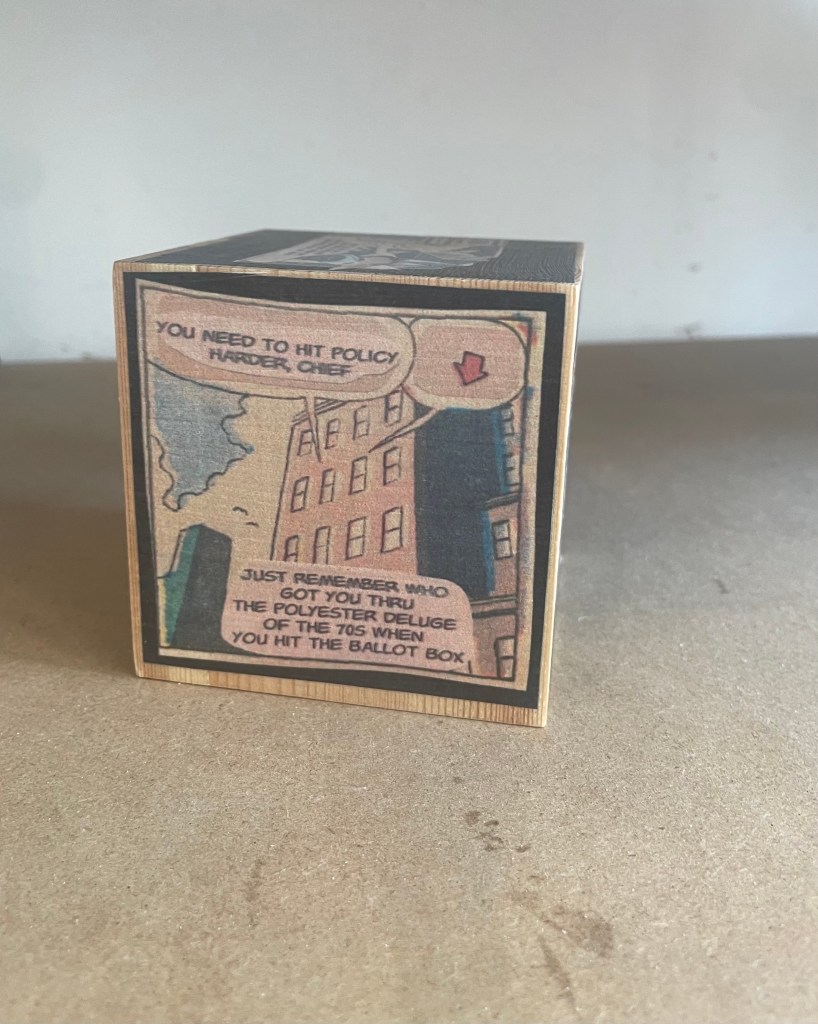
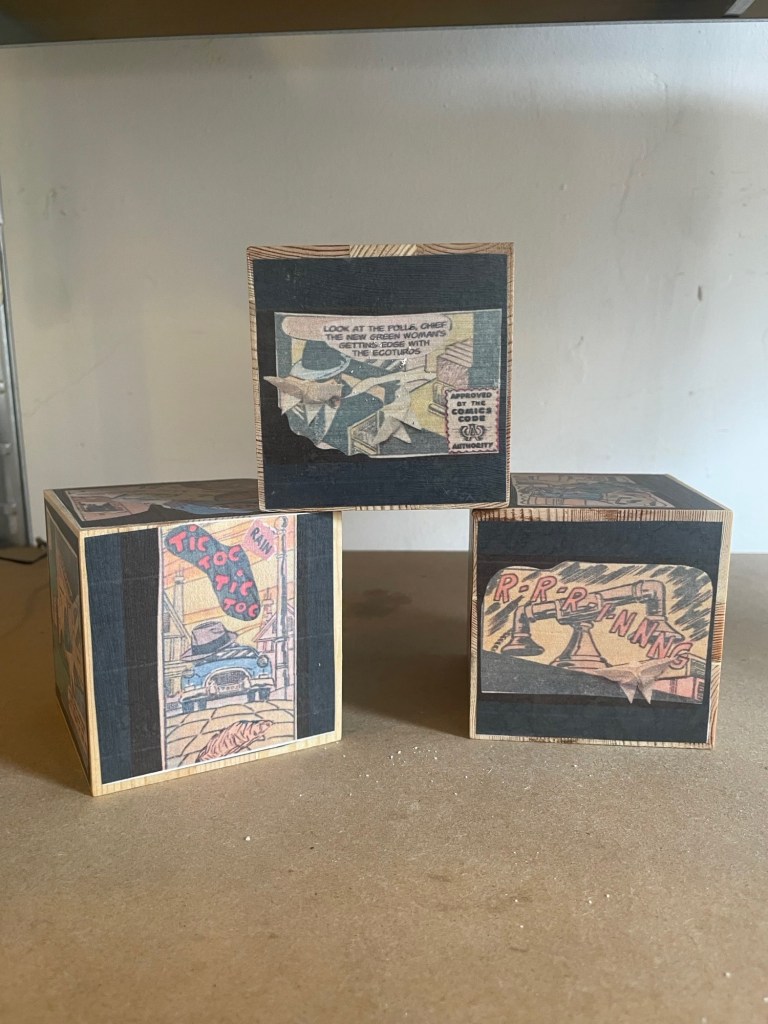
“The Extinctions Bureau” is a brilliant article with which to end this issue of Inscription. It offers readers a chance to wield scissors or papercutters if they are ready not to heed Broodthaers’ admonition above. It is also a clever conceptual extension of Will Eisner’s 1985 concept of “sequential art” that aimed to establish comics as a legitimate literary genre. Angela Szczepaniak first teases us with the narrative premise of a clothing moth-turned-detective on the trail of the Nylon Killer. If that is not hilarious enough, she posits conversion of the 2D linear narrative into a 3D existence around moth-repellent cedarwood. (She has created the blocks for exhibition display, but that’s not the point of the contribution.) Whether the blocks are more cruel to the detective or readers who now have to get their heads and hands around the idea of a “polysequential” story is a fine point. Readers who take up the challenge of cutting out the templates and folding them into cubes will have their own view.
By cutting and tearing the images for her collages from pulp comics, Szczepaniak rings all the bells of Inscription 6’s theme and reminds us of its subtitle: The Journal of Material Text.
Aside: below are images of the completed cedar block cubes on display in Nottingham. Photos courtesy of the artist.
Reminiscent of Aspen, Fluxus, The Journal of Artists’ Books, and the deluxe editions of Parenthesis, Inscription‘s artwork inserts contribute to the sense of the issue as an exhibition, a wunderkammer, a performance. No 33 LP this time; instead there is appropriately a cutdown 45-rpm record, albeit no instructions on “ripping” tracks from it to make up our own playlists. Putting together a thematically coherent journal is tricky. The artworks underscore and strengthen the issue’s theme of tearing and cutting. Two examples: Nick Thurston’s print Rips and Floods (2026) and Carolyn Thompson’s Tearjerker (2026) cover all the thematic notes of tearing, cutting, and weeping.
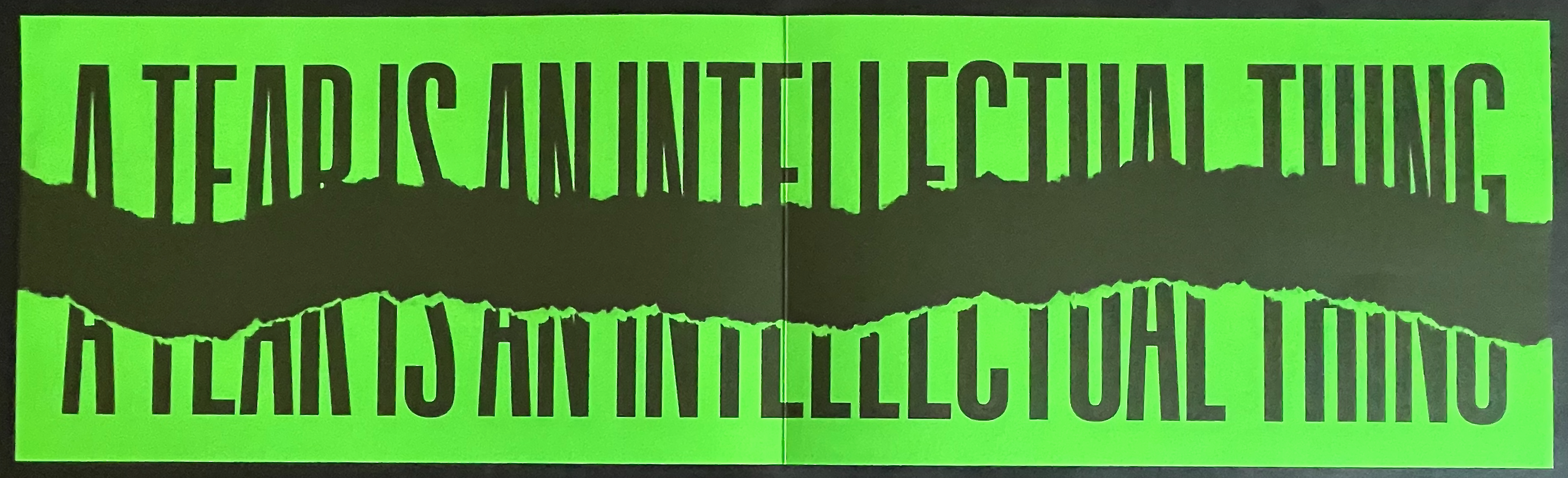
Thurston’s title for his print ensures that we don’t miss the heteronymic “tear”, which the visually torn phrase “A tear is an intellectual thing” might cause us to do. For those not well-versed in William Blake, a helpful note on page 160 identifies the phrase’s source as “The Grey Monk“. The editors mention Thurston’s truncation of Blake’s line, but leave it to us to supply the pun that it has been ripped from the poem. Blake’s preceding lines rule out the heteronymic meaning; for him, it’s the “Widow’s tear” that is ” an intellectual thing”. What makes Thurston’s print a strong work of art is how the tearing from the poem brings with it other key elements of the poem. For Blake, the Widow’s tears have more power than war to free the world from fear of the “Purple Tyrant”. In 2026, Thurston’s print reminds us that intellectual things — [/tɪ(ə)rz/] and [/tɛ(ə)rz/] — may have more power than Tangerine or Religious Tyrants.
Rips and Floods (2026), Nick Thurston
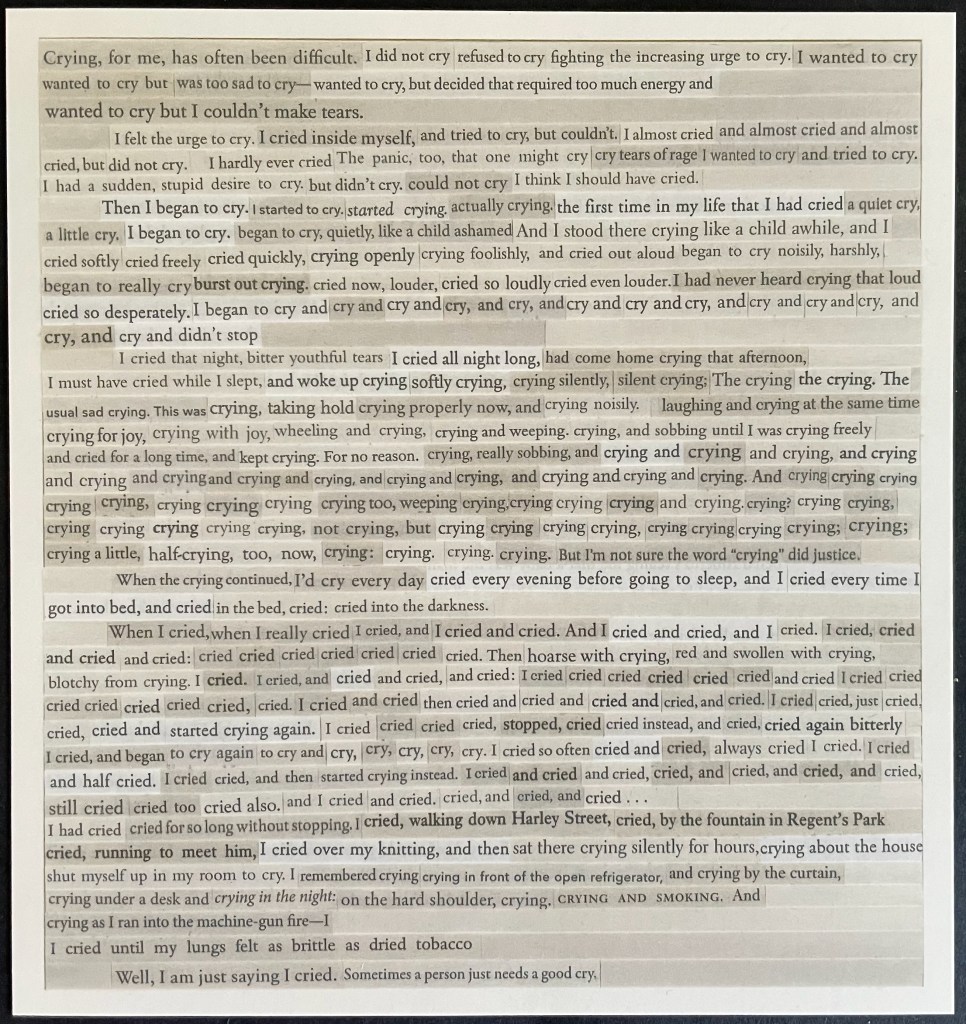
For her print, Carolyn Thompson excises words “from 30 works of literary fiction she has read since” 2016 to compose a sob story that well sums up the effects of Brexit (and the US election).
Tearjerker (2026) Carolyn Thompson
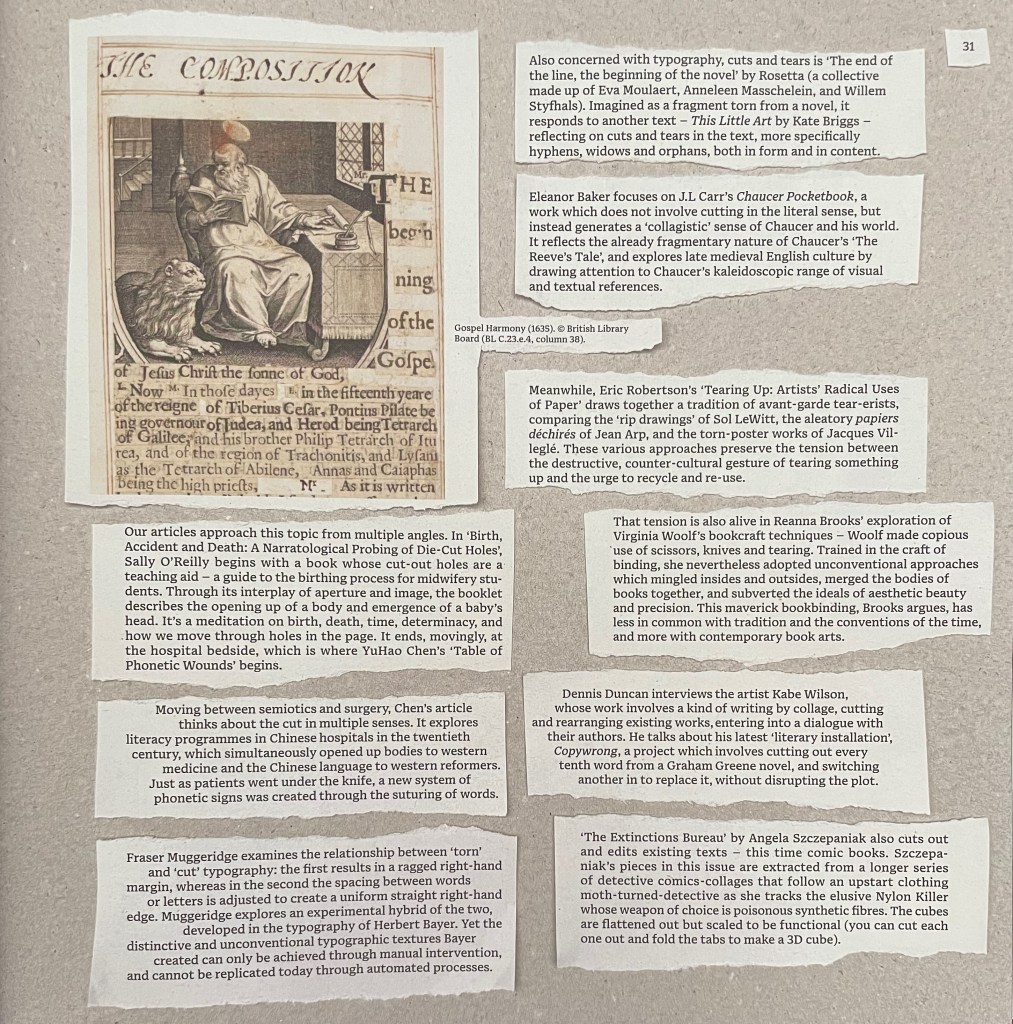
Pages 154-61 list the twenty-one artists/performers alphabetically with descriptions of their editions. Self-reflexively and in keeping with the issue’s theme, page 161 shows a blanked version of the torn segments from page 31 on which Partington and Smyth provide their introduction to the authors’ and artists’ contributions. (This blanked version is curious. If page 161 were showing the blank sides of the slips of paper, the four slips on the left would be flipped and on the right. Since one of the editors has let slip in correspondence that the theme of Issue 7 will be “blanks”, might this be an Easter egg?)
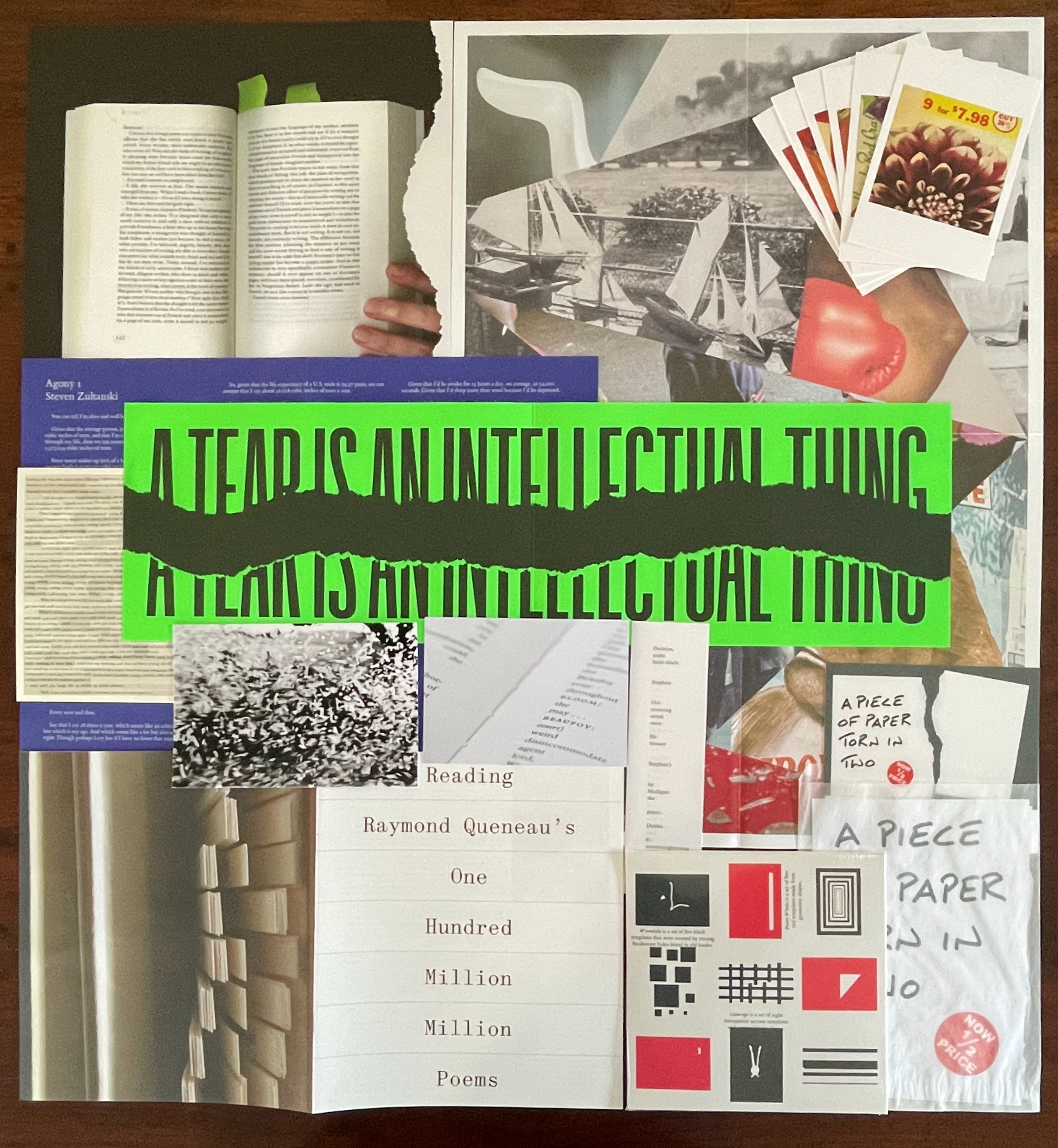
In homage to the journal and its edition contributors, below is a collage of the eleven loose inserts.
The wunderkammer nature of Inscription will send insatiable readers in search of more examples of creative destruction. To that end, here are a handful from the Books On Books Collection. If you can only find time for two, make it Eleonora Cumer’s Circoscrivere lo spazio No. 3 [Circumscribing space] (2021) and Cercare nella memoria [Searching Memory] (2021). They are her most sophisticated metaphoric works in the collection. They offer a circumvention of circumscription, which is another way of thinking about tears and the material text.
“Islam Aly“. 13 January 2020. Books On Books Collection. See 28 Letters (2013).
“Doug Beube“. 21 April 2020. Books On Books Collection. See Empty Talk (2016), Red Infinity #4 (2017), and Breaking the Codex (2011).
“Lizzie Brewer“. 4 July 2023. Books On Books Collection. See Babel(2019).
“Eleonora Cumer“. 6 September 2019. Books On Books Collection. See l’attesa/ l’attente (2010), visioni urbane/ visions urbane (2015), contaminazione (2015), Circoscrivere lo spazio No. 3 (2021), Cercare nella memoria (2021)
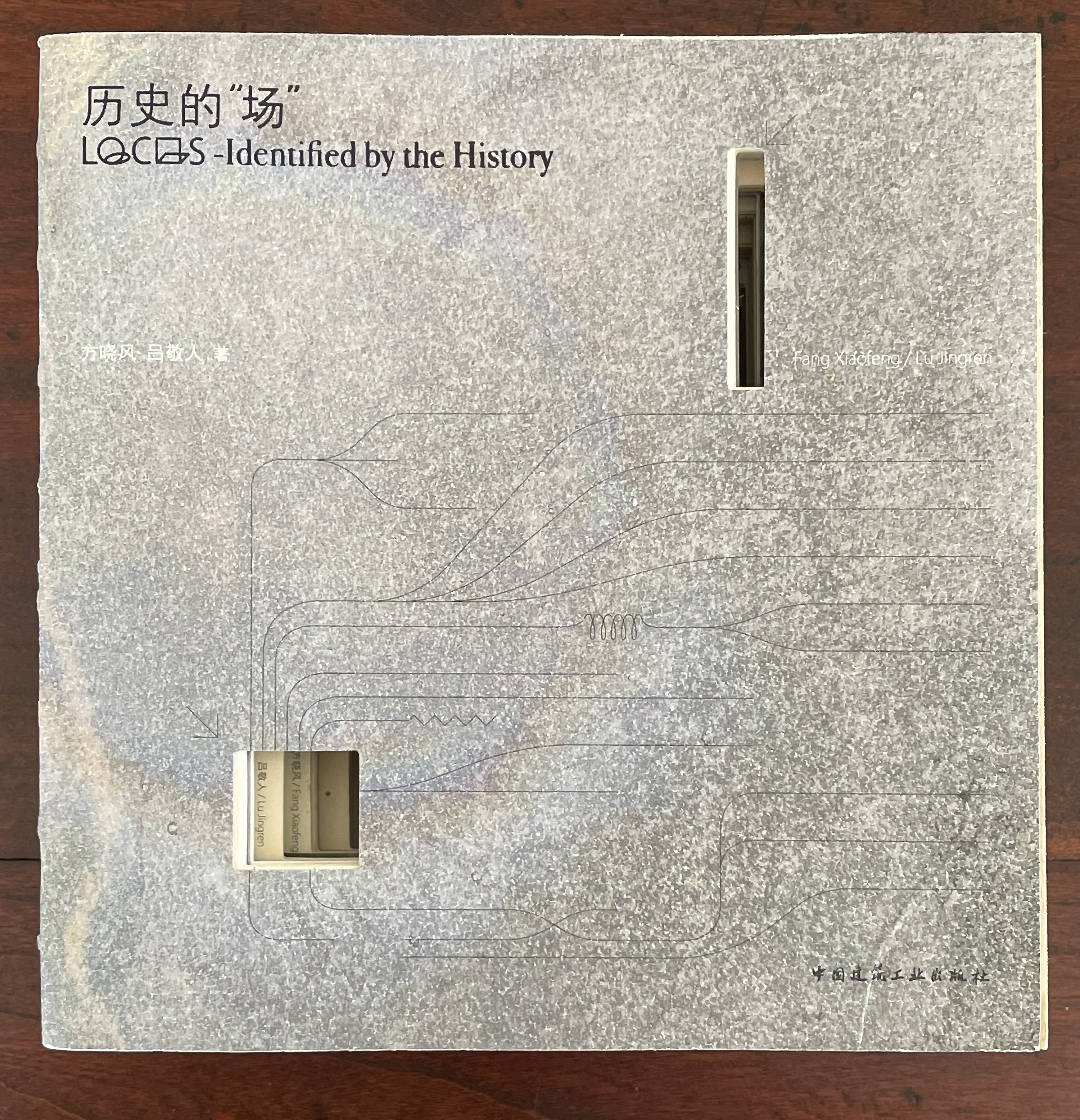
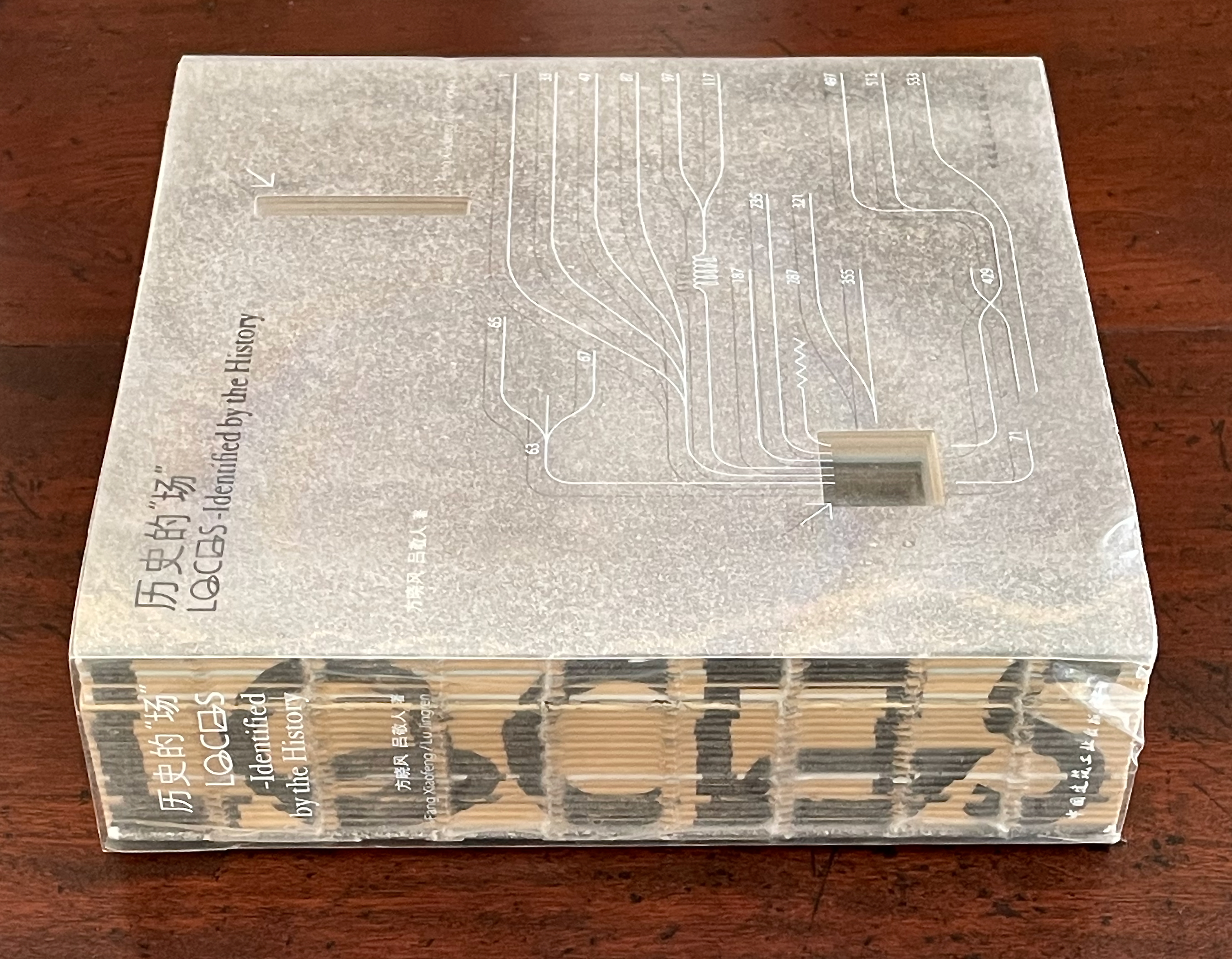
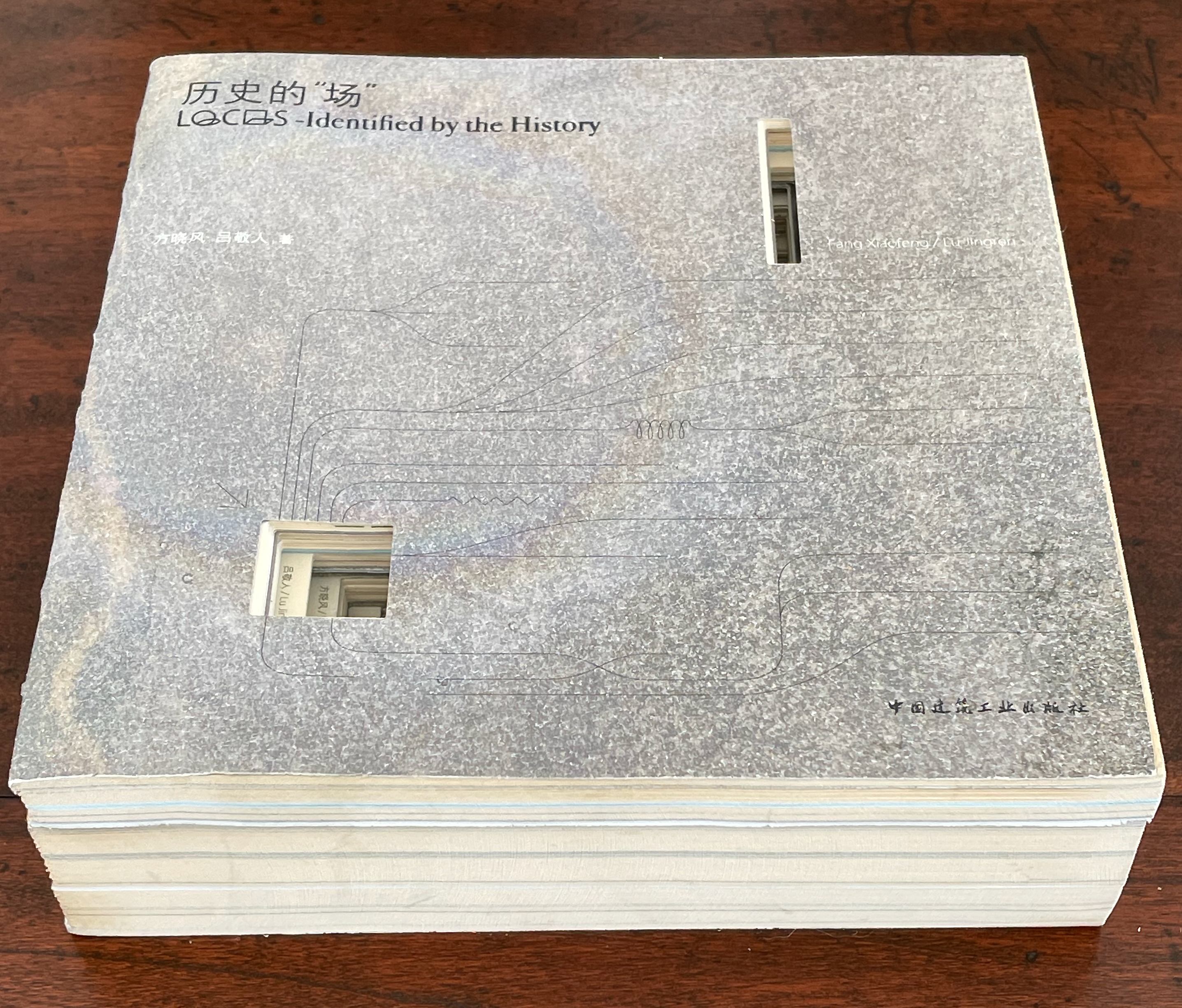
历史的”场 (Locus: Identified by the History) (2016) 方晓风 (Fang Xiaofeng) and 呂敬人 (Lu Jingren) Beijing Shi: Zhongguo jian zhu gong ye chu ban she.
Co-authored by architecture scholar Fang Xiaofeng and book designer Lu Jingren, Locus: Identified by the History (2016) springs from the Book – Architecture Project (书 – 筑 / Shu – Zhu Project), conceived by Lu Jingren, Fumihiko Maki (Japan), and Yi Ki-Ung (South Korea). The project initiated a multi-year series of exhibitions/forums called “Book – Architecture: Dialogues Between Architects and Book Designers” (2011-19) across all three countries. Locus was published on the occasion of the second exhibition/forum in 2016.
Locus pursues two overlapping lines of thought. The first and primary one rests on Lu’s design philosophy that a book is a built environment, a habitat for text and images to be engaged by readers and all five of their senses. Its layout, pacing, structure, and their interconnectedness with each other and the book’s materials mirror the architect’s design of rooms, hallways, stairs, windows, doors, thresholds, and their interconnectedness with each other and their materials. Likewise as habitats, they each have exteriors, are designed to occupy a locus in time and space, and relate to a world outside. In Lu’s philosophy, the design mechanics involve four pillars: binding + layout + editorial + information visualization. Successful execution results in an immersive spatial object (habitat) that triggers the reader’s visual, tactile, auditory, olfactory, and gustatory systems simultaneously.
Gracia Haby and Louise Jennison are exuberant archival eco-artists whose palette embraces the digital collections of the Metropolitan Museum of Art, New York Public Library, Rijksmuseum, State Library of New South Wales, State Library Victoria, and more. Their preferred media are paper, the artist’s book, and installations; their preferred technique, collage.
Dip and Bob (2021)
Dip and Bob (2021) Gracia Haby & Louise Jennison Casebound, softcover with five-panel irregular trim wraparound card. H149 x W110 mm. [72] pages. Edition of 50. Acquired from the artists, 21 February 2026. Photos: Books On Books Collection.
Like other works in the collection, Dip and Bob (2021) teases connections between the media of watercolor, artist’s book, performance, and installation. The cover is an original watercolor cover on Fabriano Artistico 300 gsm paper.
The 72 pages of prints on Impact 100% Recycled Uncoated 150gsm derives from a 620 cm long digital collage. Created for the 2021 NGV Melbourne Art Book Fair, its performance element was twofold. First, as the artists explain, the collage was made “in place of a swim”, the local pool being too busy. Second, toward the end of the making, several copies were bound live before the Book Fair attendees. Its installation element, however, is the greatest tease. There is and was no installation of the 620 cm long collage work. It rests in your hands, and you experience it by turning the pages, then turning them back, then turning them forward — like laps in the pool. Or if you happen to photograph the double-page spreads, you can jump out of the pool and look down on them joined end to end.
Their introduction, however, will lure you back into the collage, which is
Underwater, kind of. Yes. Dive in.
Don’t forget to hold your breath. …
Search the collection. Sift the collection. “Water”, Return key.
Invert a forest. A daguerreotype of poplars stretching across the plate could be bands of seaweed. …
A crab from a trade card. Not for the skillet. Zoom in, Moonfish.
The Young Saint John the Baptist hair tendrils ca. 1480–82, repurposed. Papyrus fragment with lines from Homer’s Odyssey, ca. 285–250 B.C., for kelp bands.
Haby and Jennison wear their eco-hearts on their sleeves and admit, or rather assert, “For us, above all, it is not the medium that is always of greatest import, but the message”, which is
Our only chance of a healthy, safe, joyous, and sustainable future is to return to being reciprocal with nature so nature can continue to look after us.
Stand up and fight for the oceans and the waterways.
And yet it is their long-held breath as they create their underwater collage and your breath caught as you paddle forwards and backwards over fore edges and through the collection of human and natural art that will most hold you.
The Remaking of Things (2023)
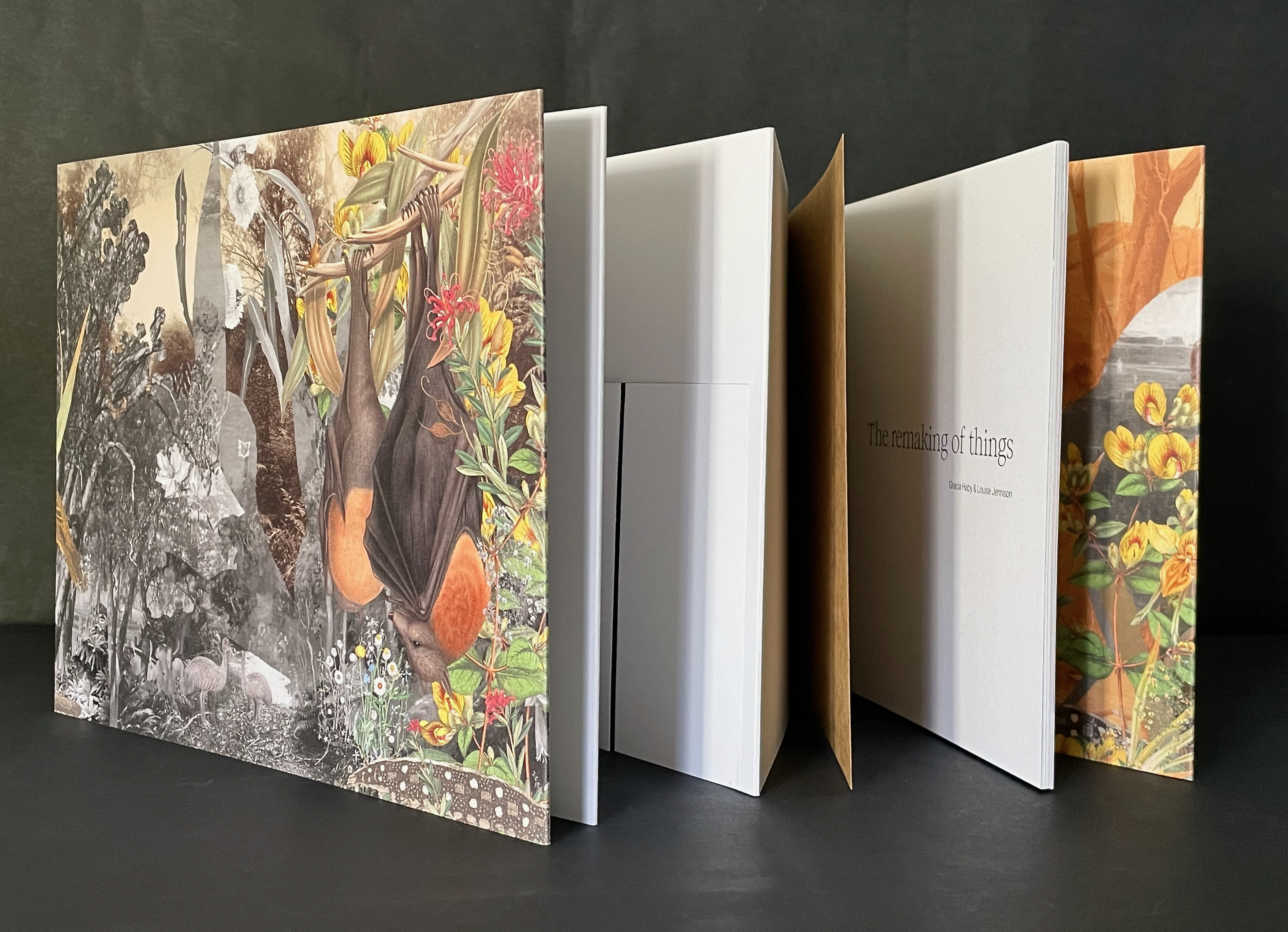
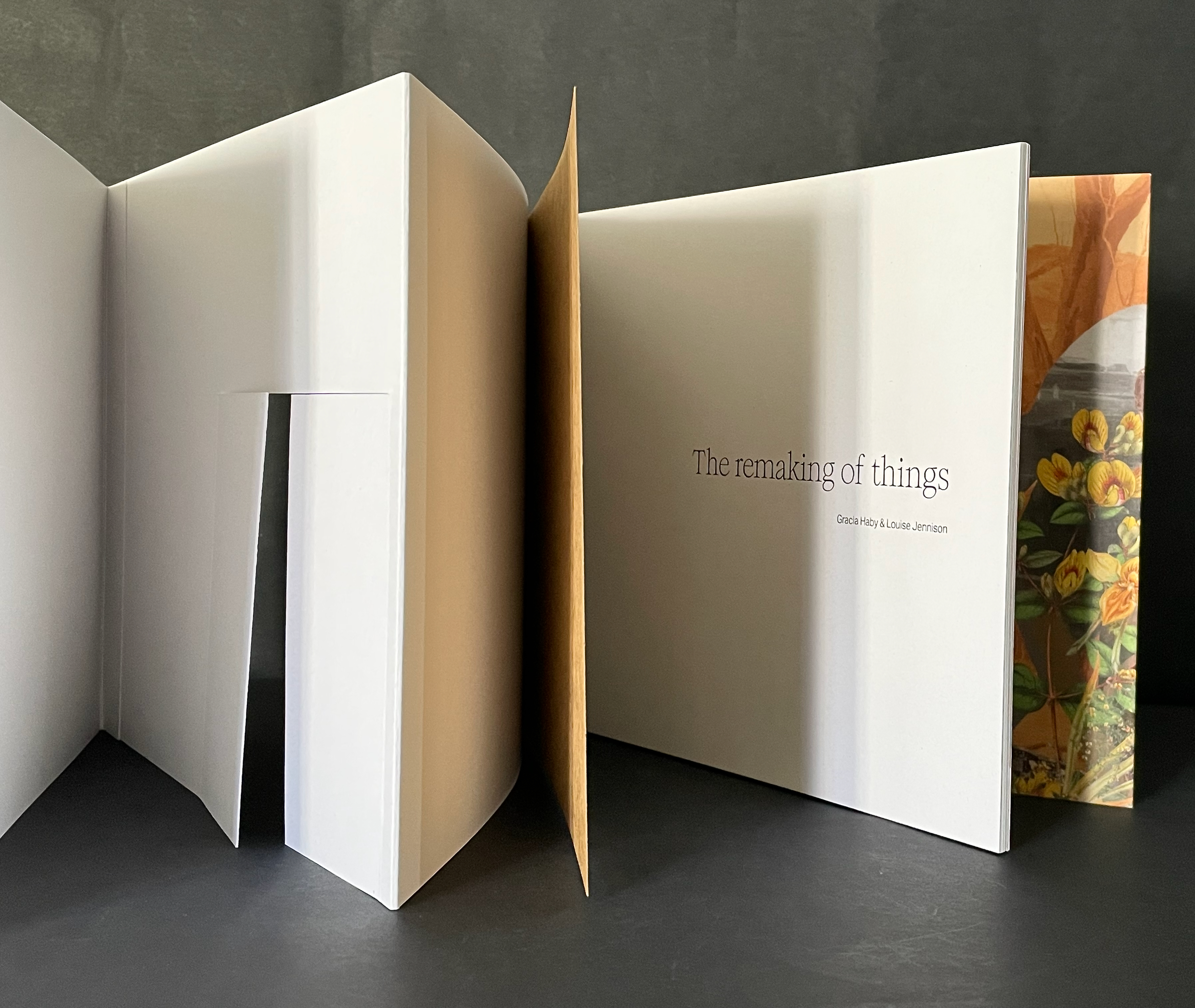
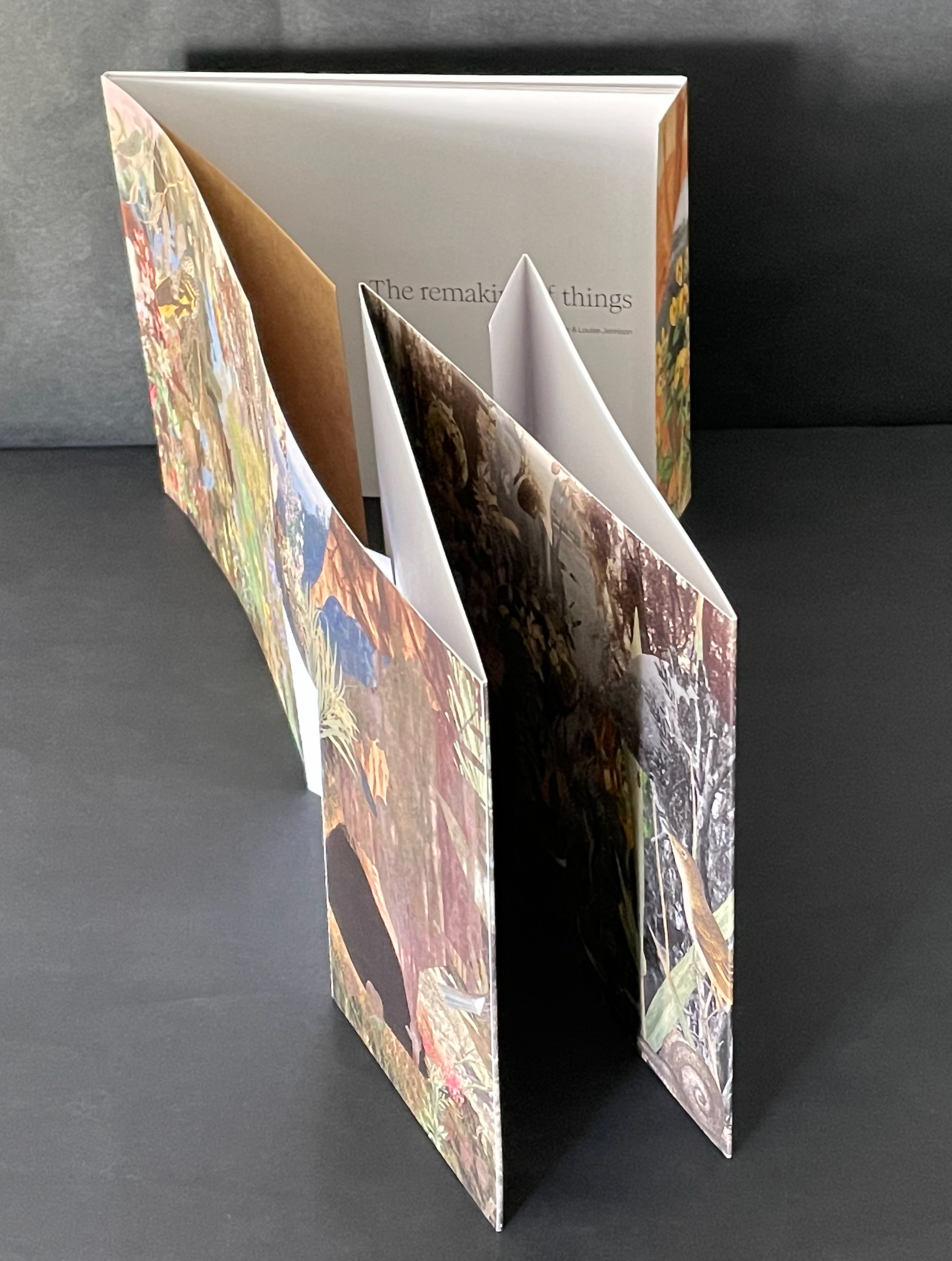
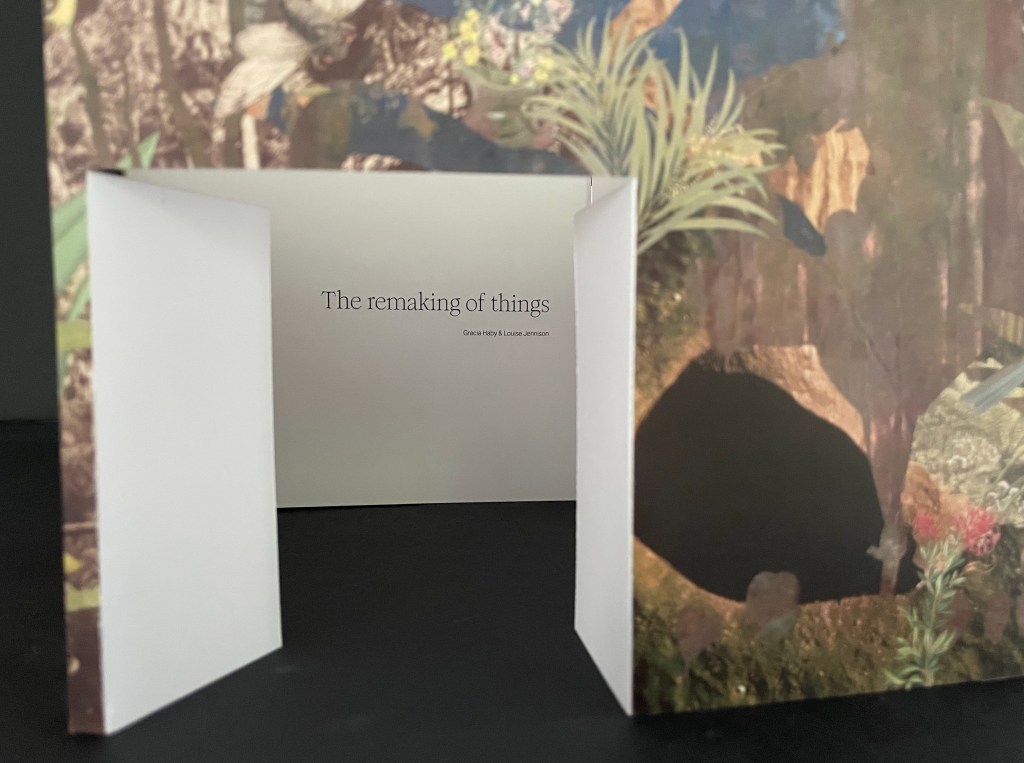
The Remaking of Things (2023) Gracia Haby & Louise Jennison Folded container with tab-and-slot closure, holding belly-band-secured front cover fold out, part of card cover casing a perfect bound book. Container: H186 x W228 x D15 mm. Book: H180 x W222 mm. [36] panels. Edition of 100, of which this is #25. Acquired from Vamp & Tramp, 21 May 2025. Photos: Books On Books Collection.
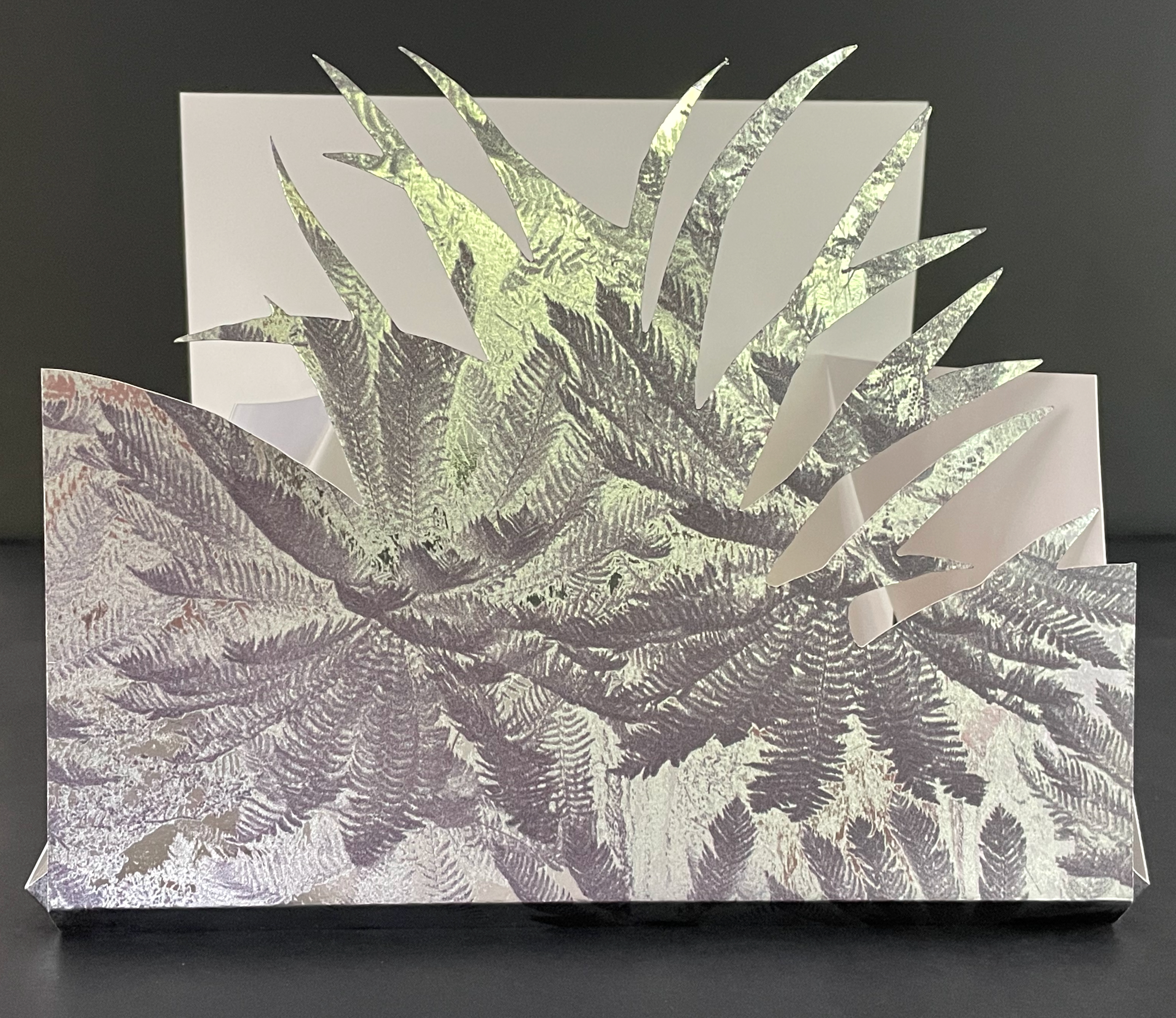
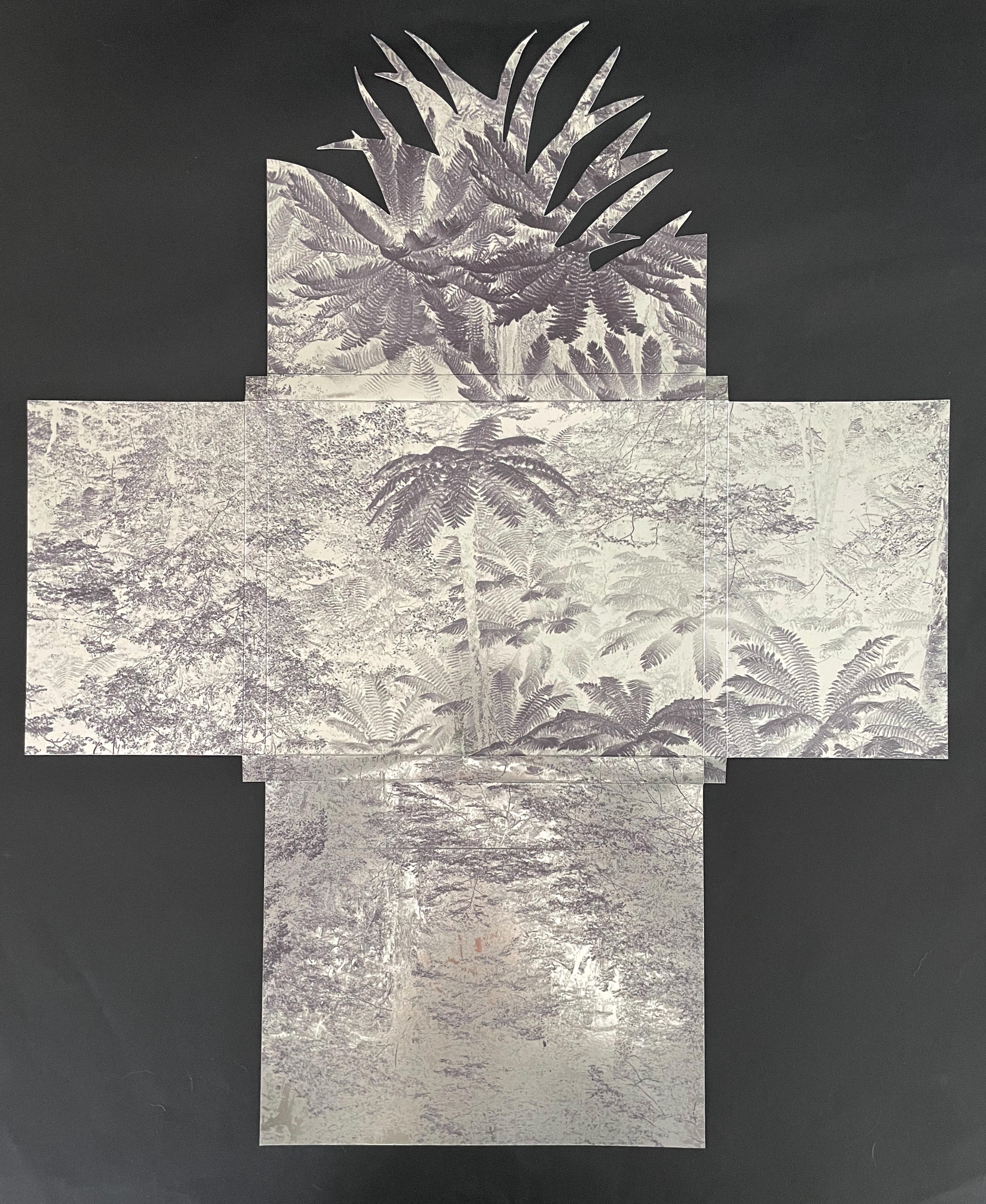
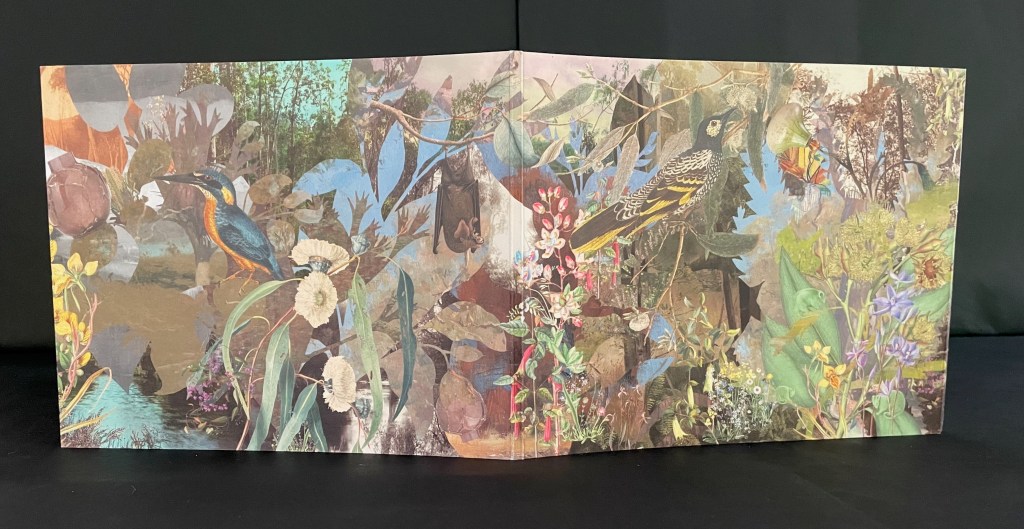
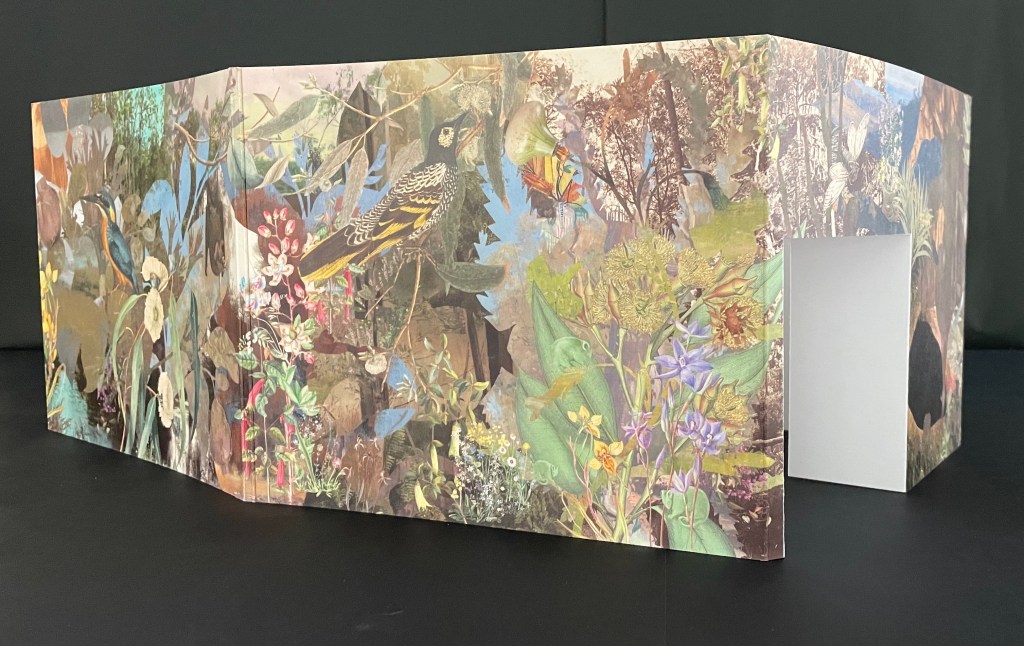
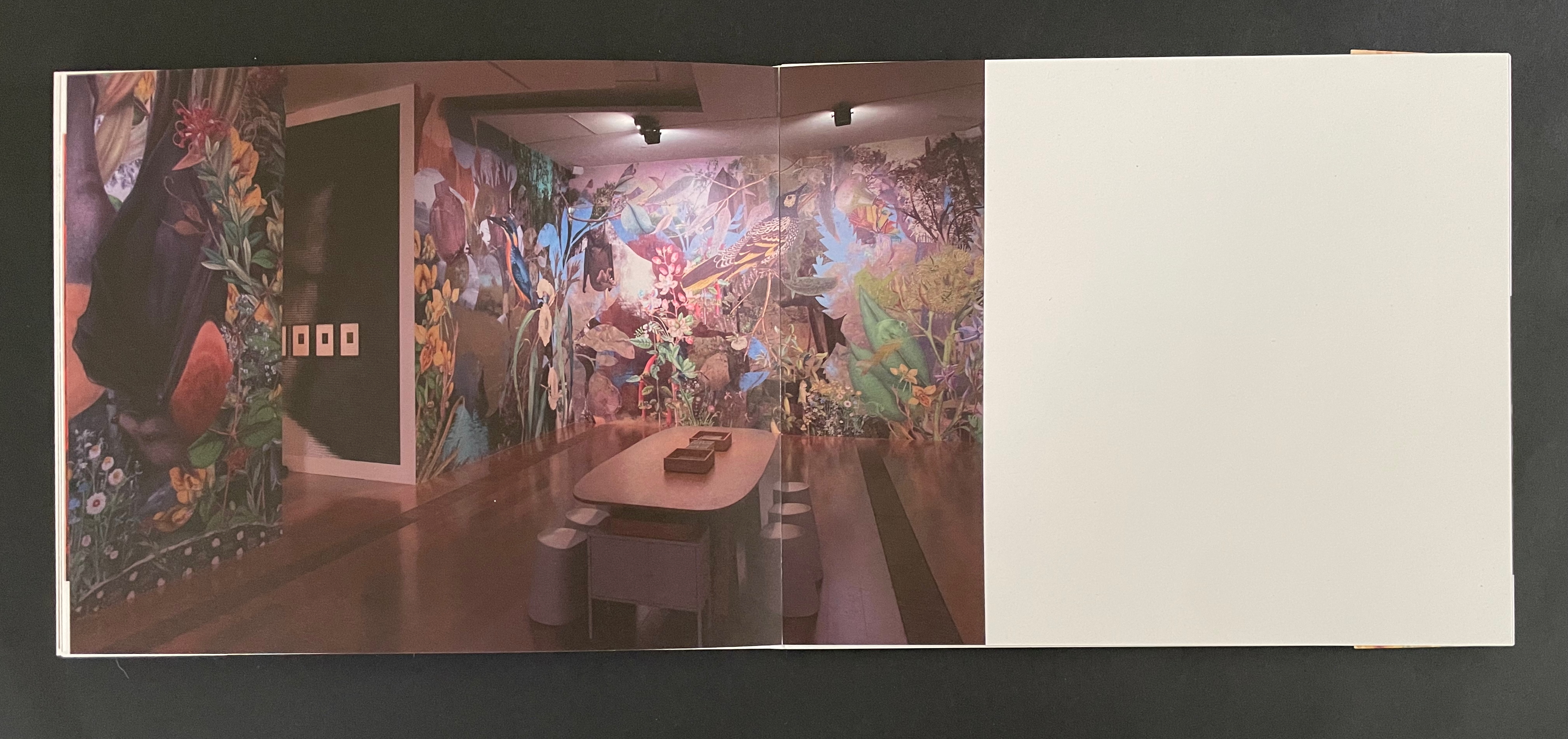
From 24 May through 20 August 2023, the Ian Potter Centre (NGV Australia) held hosted an installation of The Remaking of Things. This work produced for the exhibition comprises a silvery tab-and-slot folder, holding a casebound softcover artist’s book whose front cover opens into a desktop installation, making you wish for a sip of Alice’s “Drink me” potion or bite of the Caterpillar’s magic mushroom.
Tab-and-slot folder made of Silver Metalised Polyester satin paper 300 gsm, router cut, printed on a swissQprint inkjet printer. Image from Nicholas Caire‘s Fairy scene at the Landslip, Black’s Spur (c. 1878)
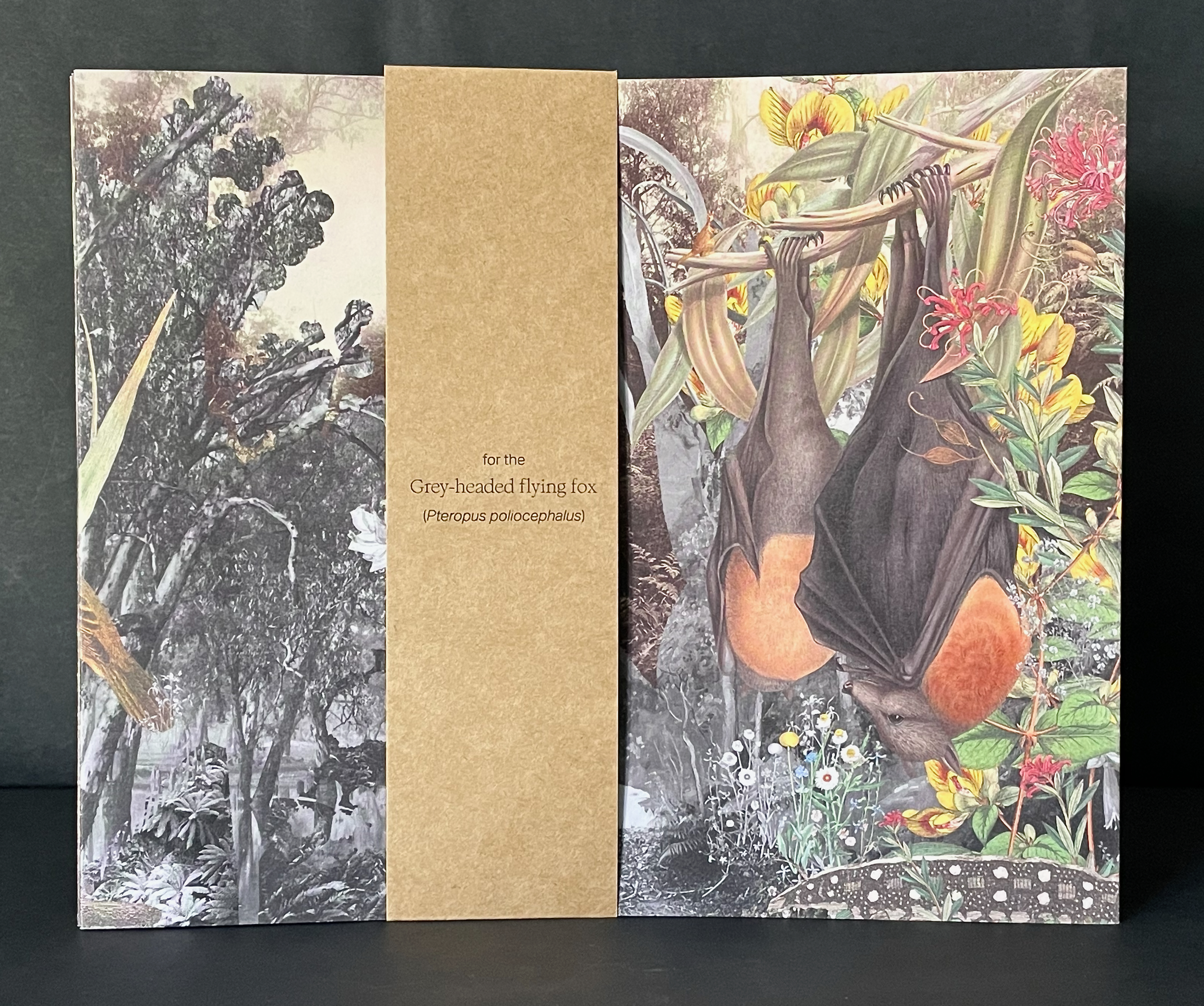
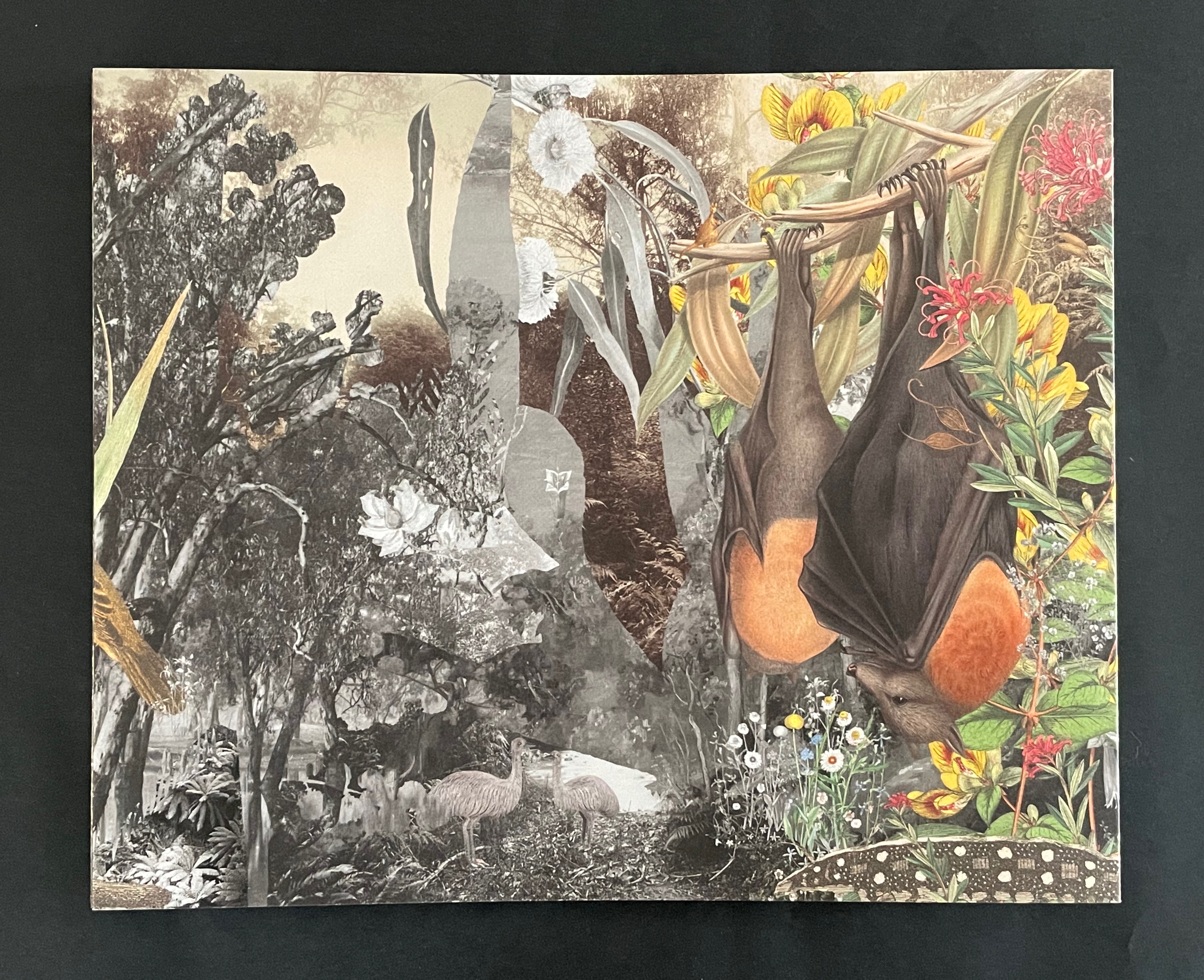
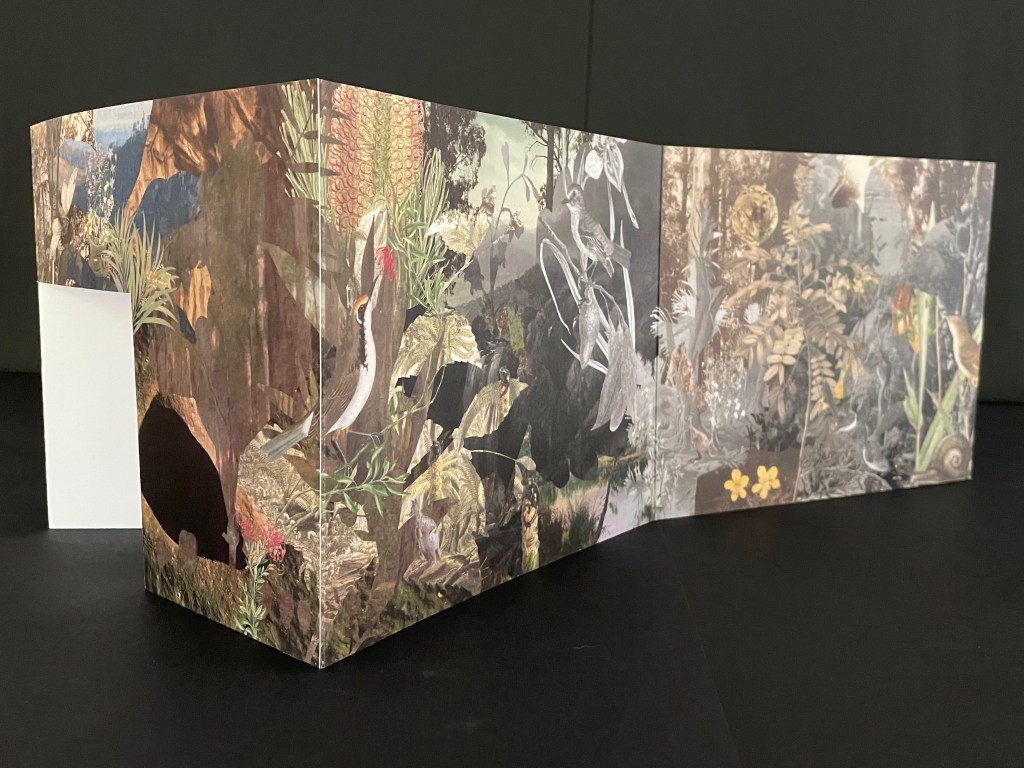
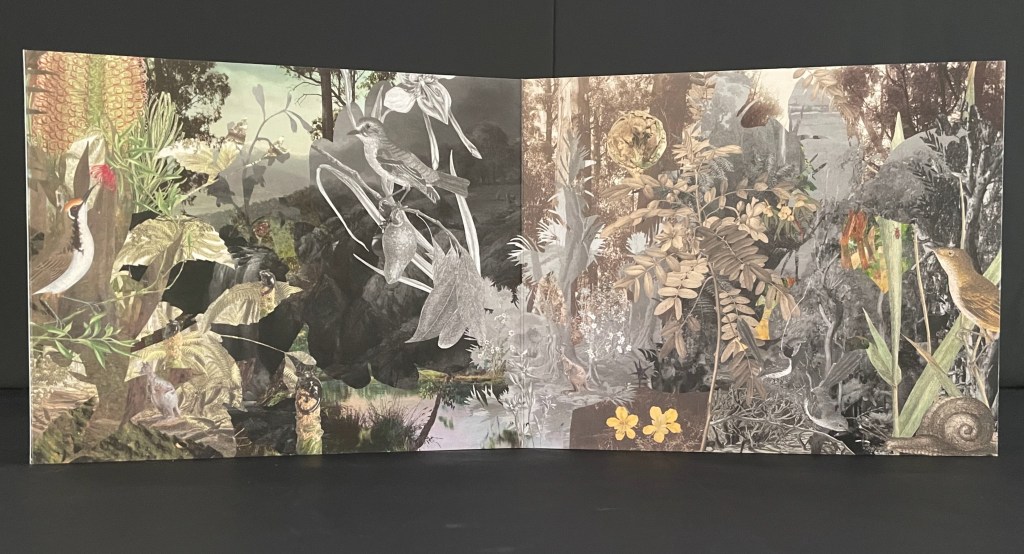
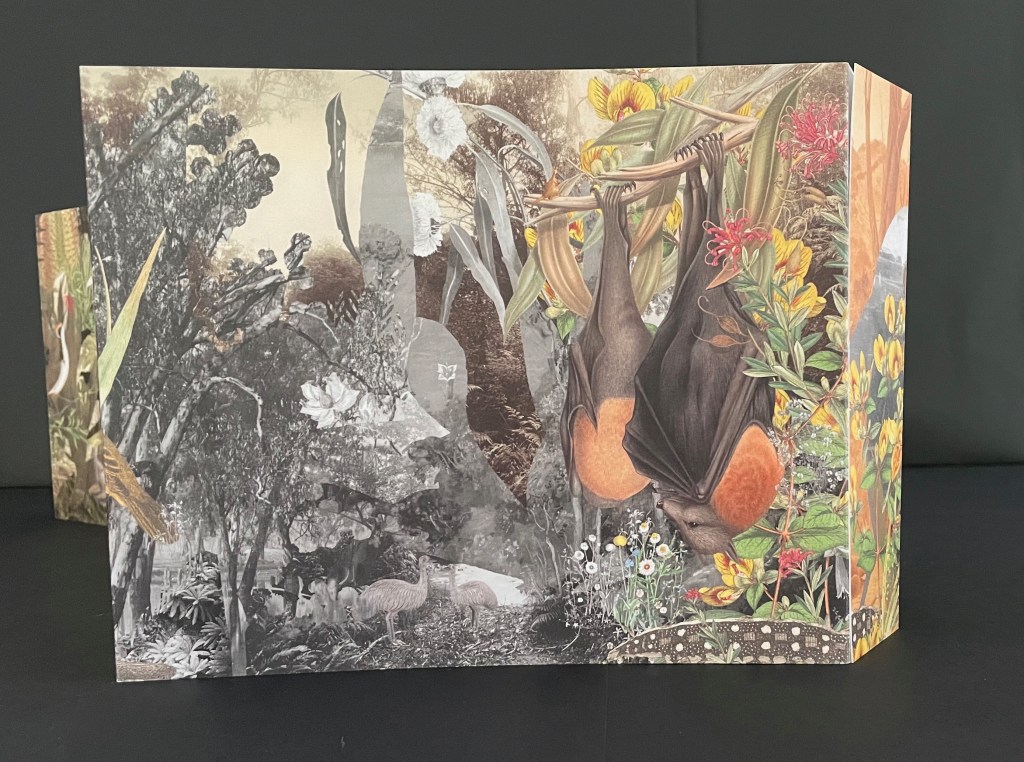
Although the work continues their archival poetics, drawing on “100 individual pieces in the NGV collection, spanning painting and photography by way of ceramics and silverware, textiles and works on paper”, it has its origin in Haby & Jennison’s restored eucalyptus forest habitat for the Grey-heading flying fox, the animal featured on the “wall” that serves for the front cover.
Front cover with and without belly band.
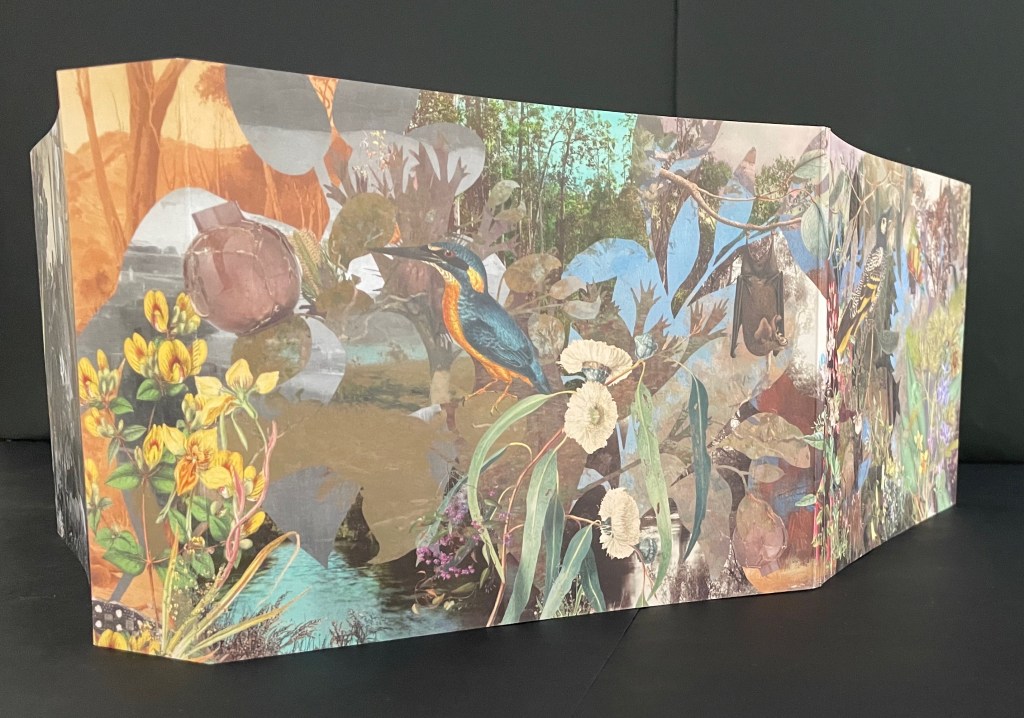
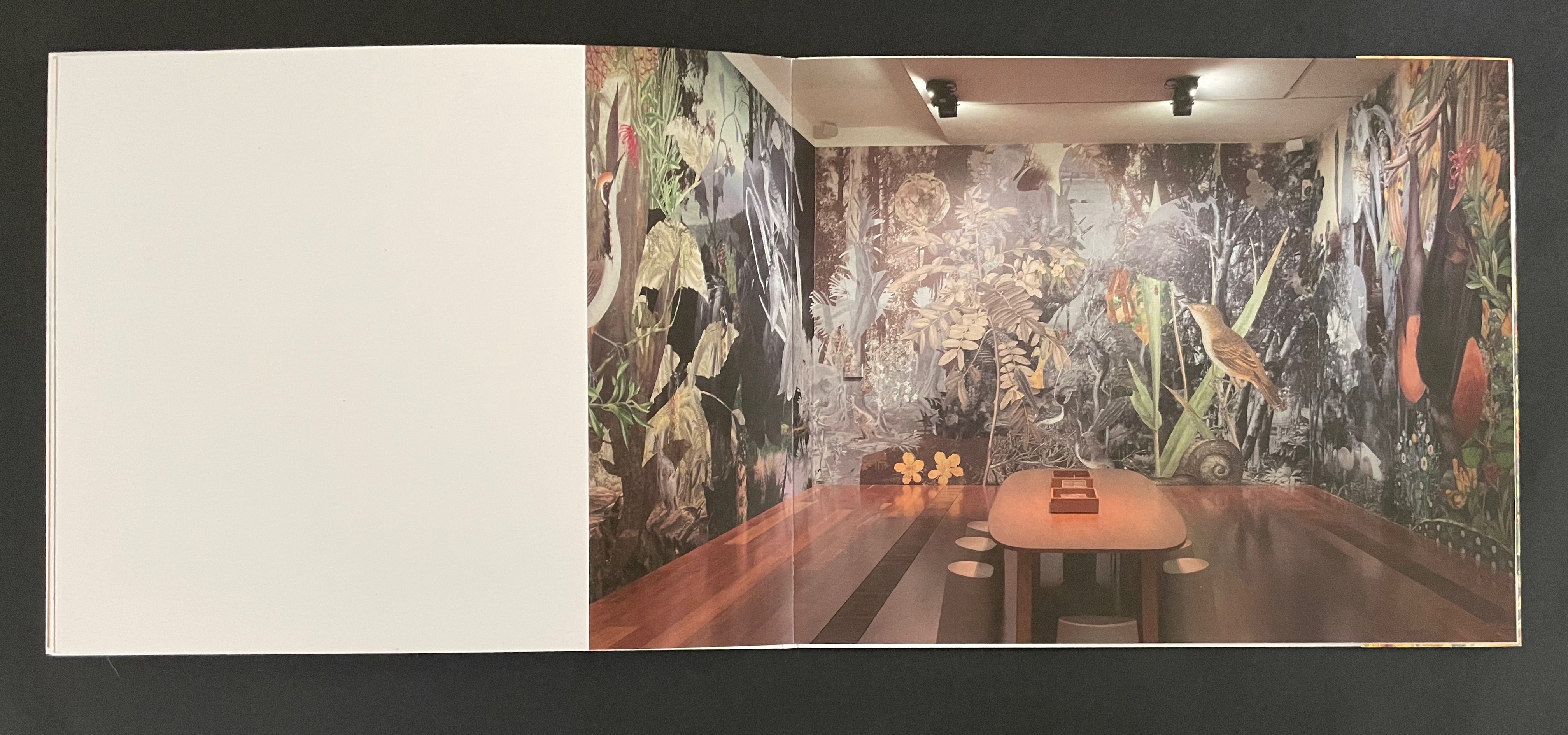
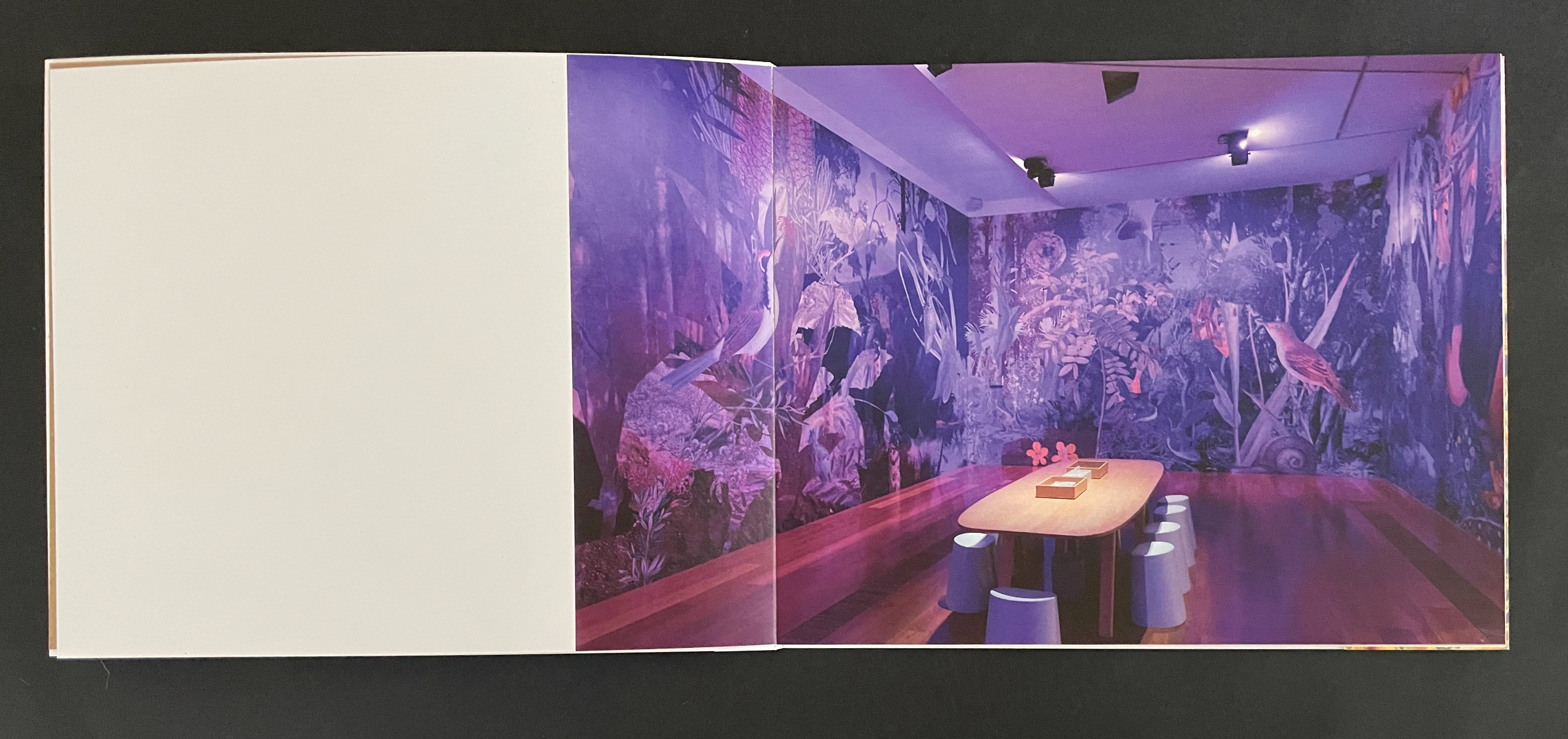
As the front cover unfolds, a double door appears, cut into one of the other walls. “Walking” to the right around the walls, you see the images that, enlarged, occupied the exhibition walls in Melbourne.
Within the exhibition rooms, a 24-minute for 24 hours sound track played as the lighting changed. Within the book, photographs of the exhibition rooms provide a sense of the visual experience and its scale.
The images within the book are likely to send you back to the images on your desktop installation. There, it is much easier to register James Sowerby‘s etching Tetratheca juncea (1793), John Lewin’s Warty-face Honey-sucker (1822), Richard Bunbury‘s Green native fuchsia (1844), Anne Paulson’s Sketches of Victorian bush flowers (c. 1861), Fanny Anne Charsley‘s The Wildflowers of Melbourne (1867), Eugene von Guérard‘s Ferntree gully (1867), Tom Humphrey‘s Summer walk (c. 1888), F.E. Striezel‘s Kookaburra carving (1915), A. Shelden‘s Possum and banksia (1920s), E.G. Adamson‘s Snow coral (1930s-40s), Grace Cossington Smith’s Bottlebrushes (1935), NASA’s Lunar Crater (1969), and the dozens of others listed in the center of the book that can be found on the NGV website. As Haby & Jennison indicate in the work, they “invite you to enter the pages of the book in a similar spirit as you would the gallery”. Across time, etchings, paintings, carvings, inkwells, snuff boxes, glass plate negatives, digital photographs and a host of other artefacts, they create a complex habitat of interconnectedness of art and species.
Given that aim, it is surprising that the fold-out cover is constructed for viewing around rather than within. Double-sided printing of the cover might have done the trick and offered an additional opportunity to show the change of lighting.
Looking for Green, Remaining Hopeful (2024)
Looking for Green, Remaining Hopeful(2024) Gracia Haby & Louise Jennison Accordion book. H135 x W92 mm (closed), W802 mm (open). [9] panels. Edition of 75, of which this is #4. Acquired from the artists, 21 February 2026. Photos: Books On Books Collection.
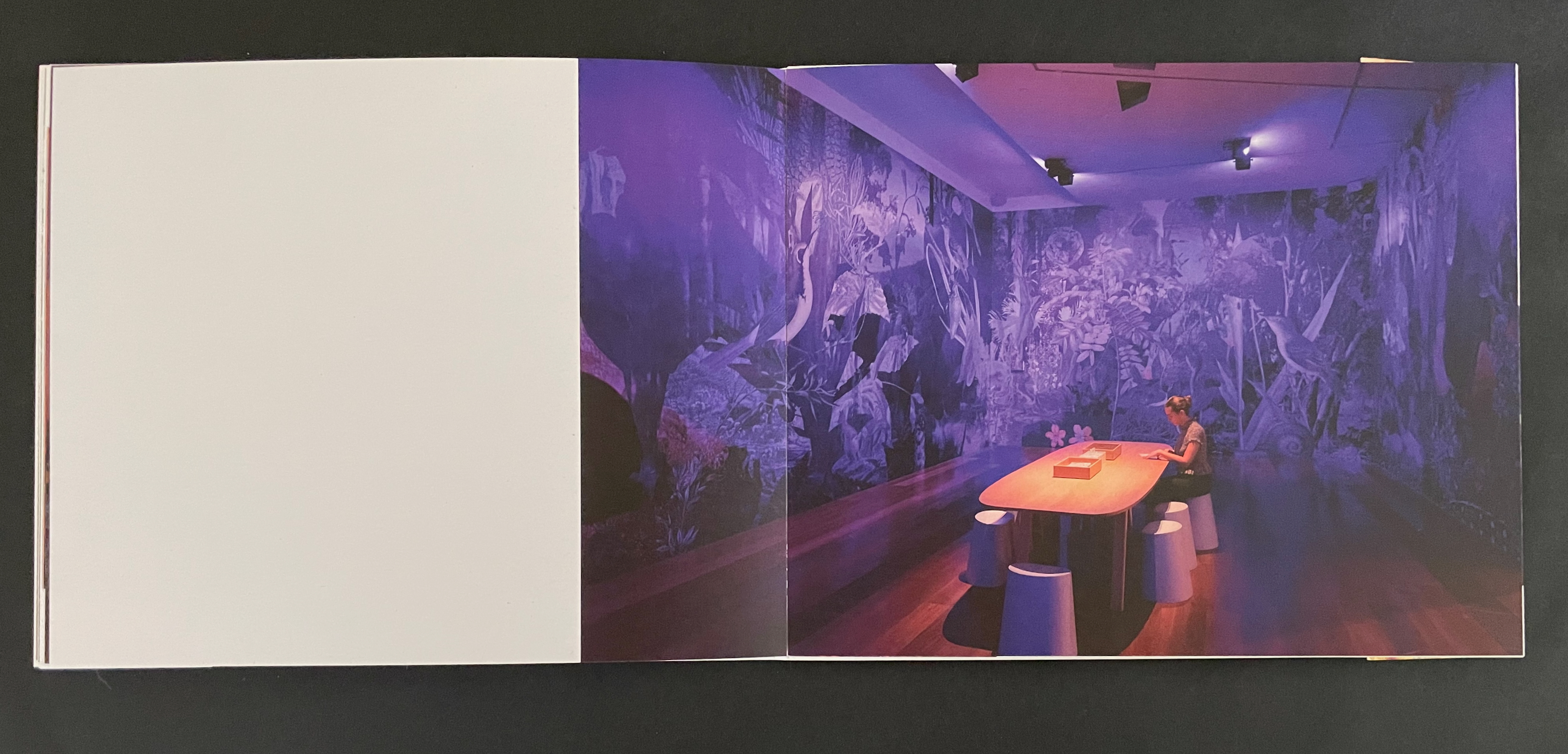
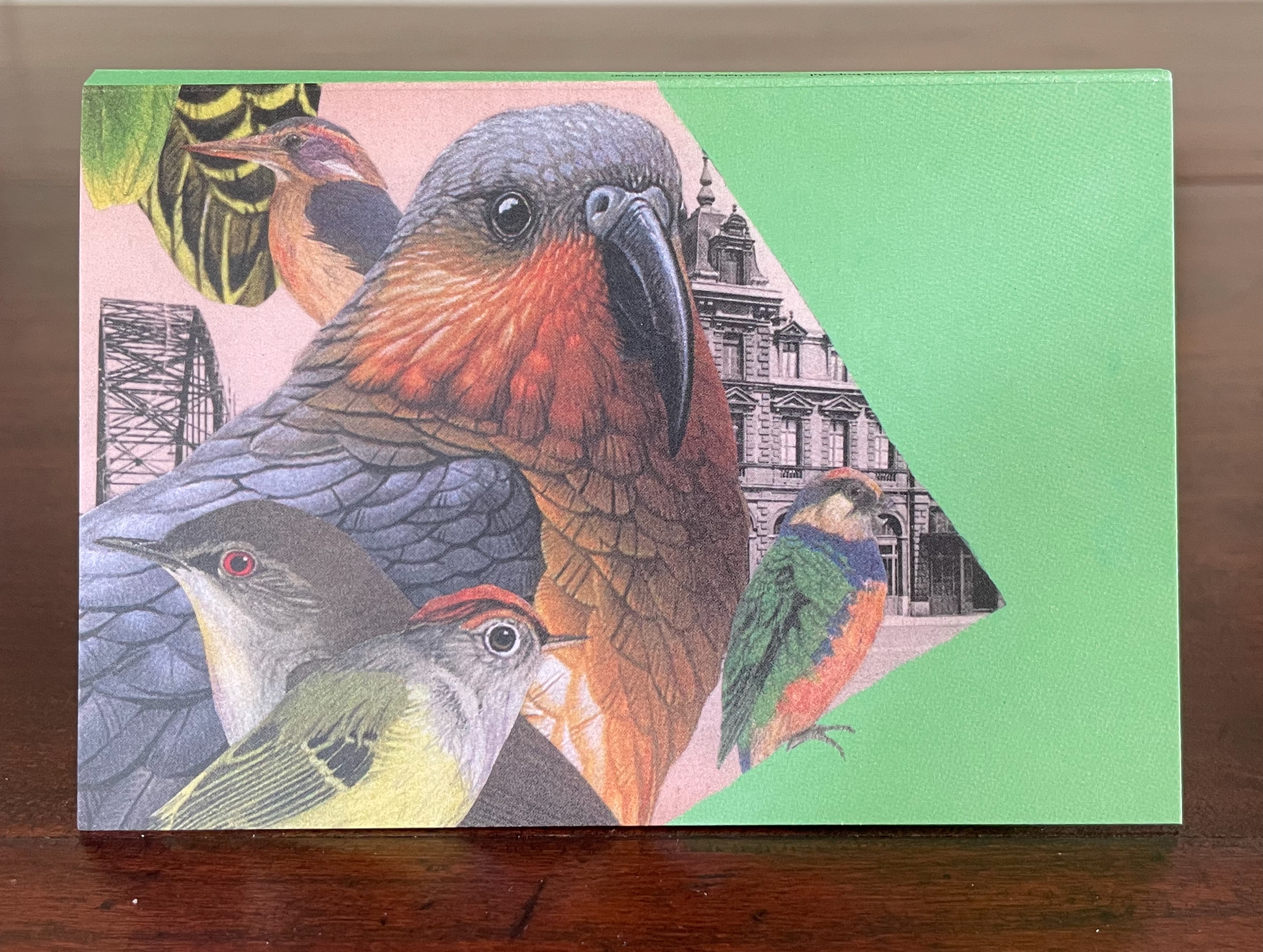
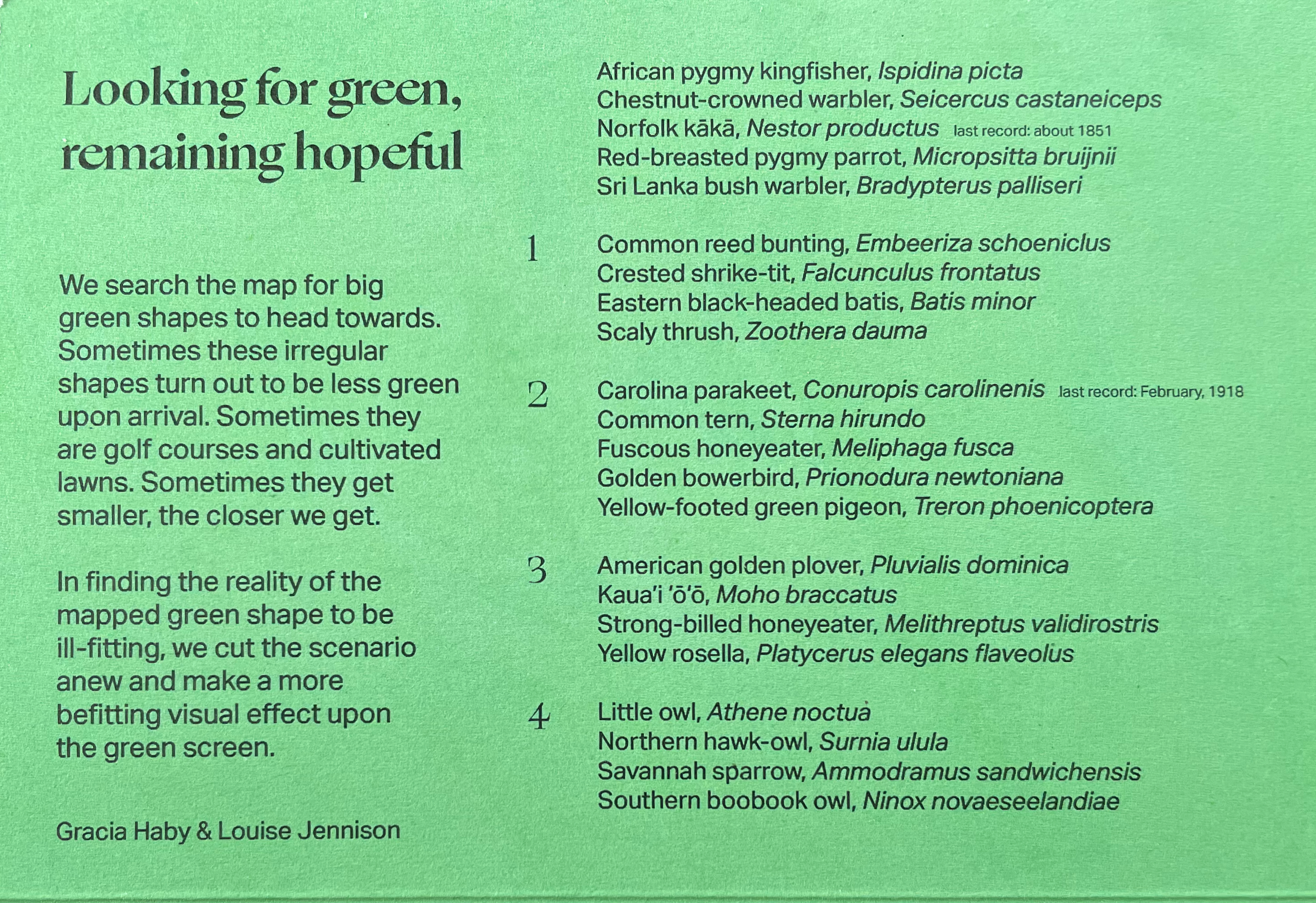
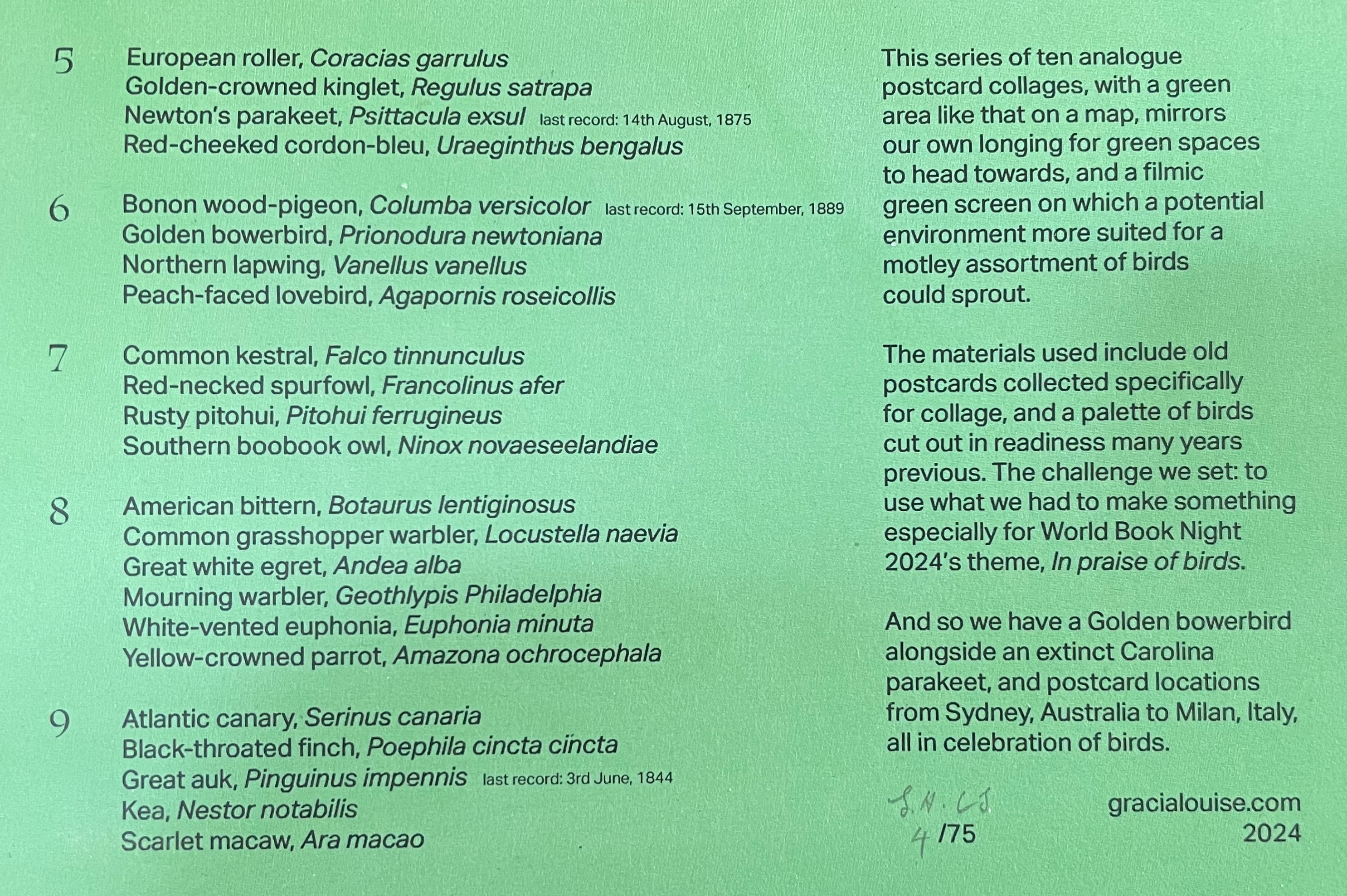
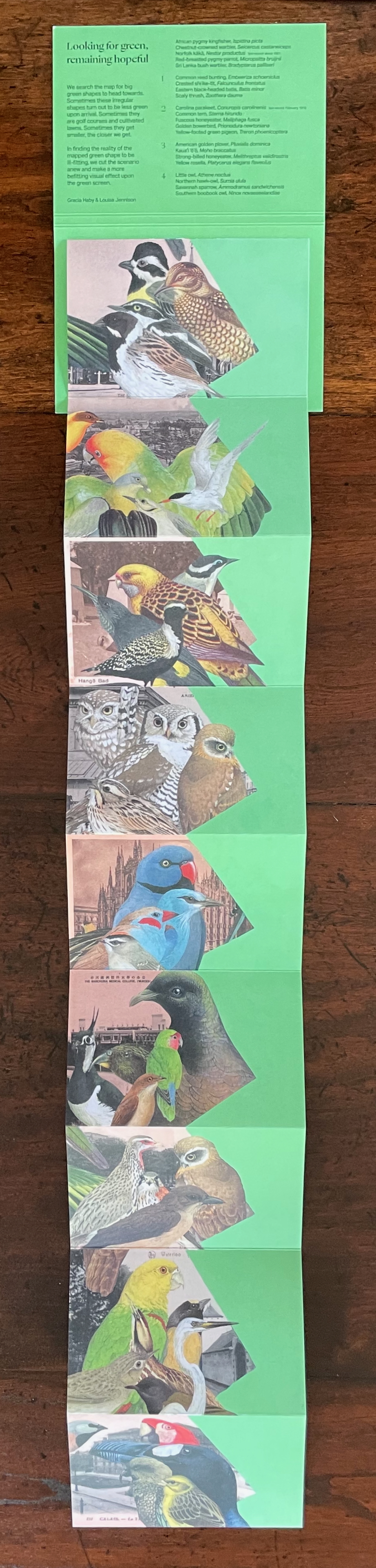
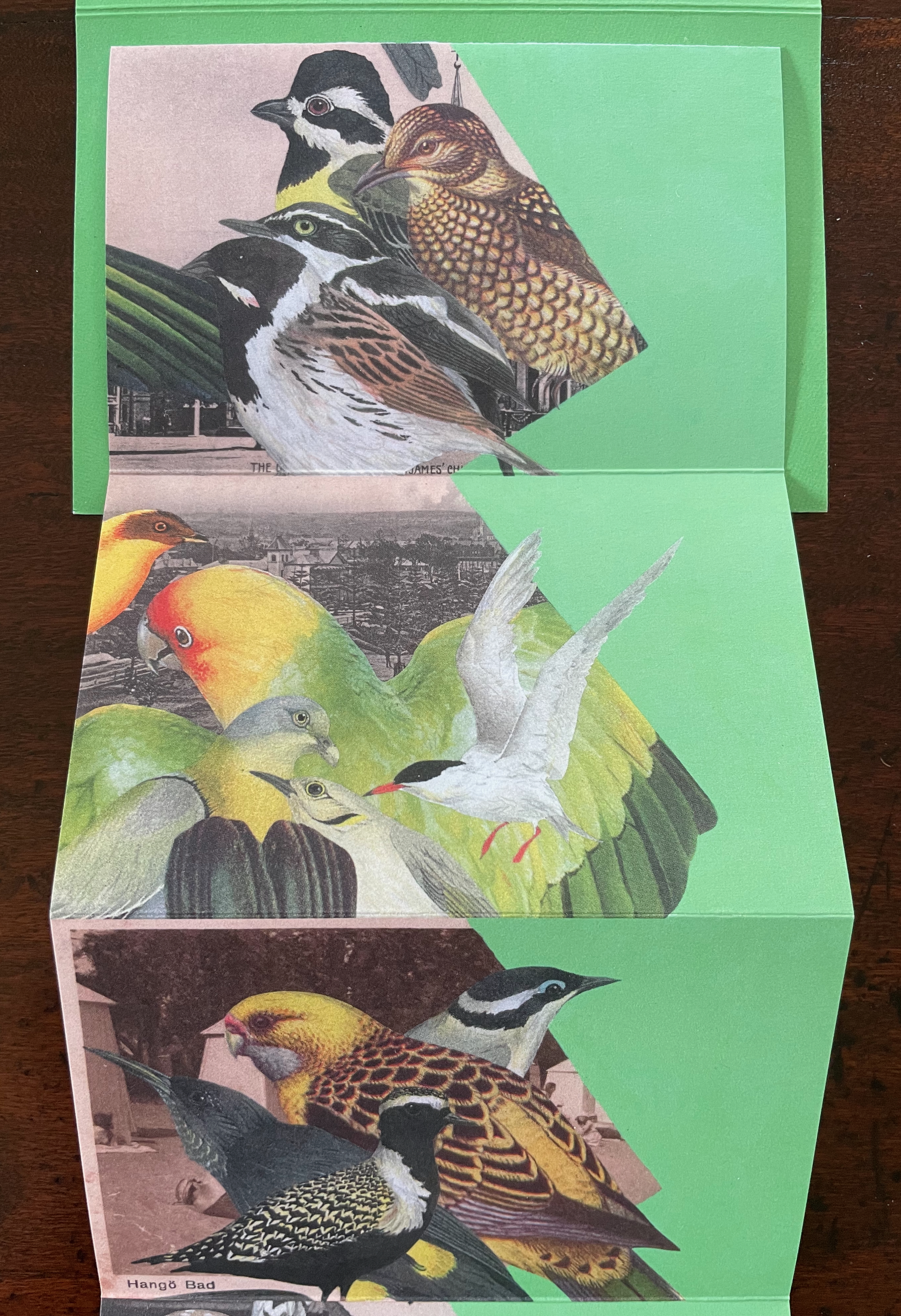
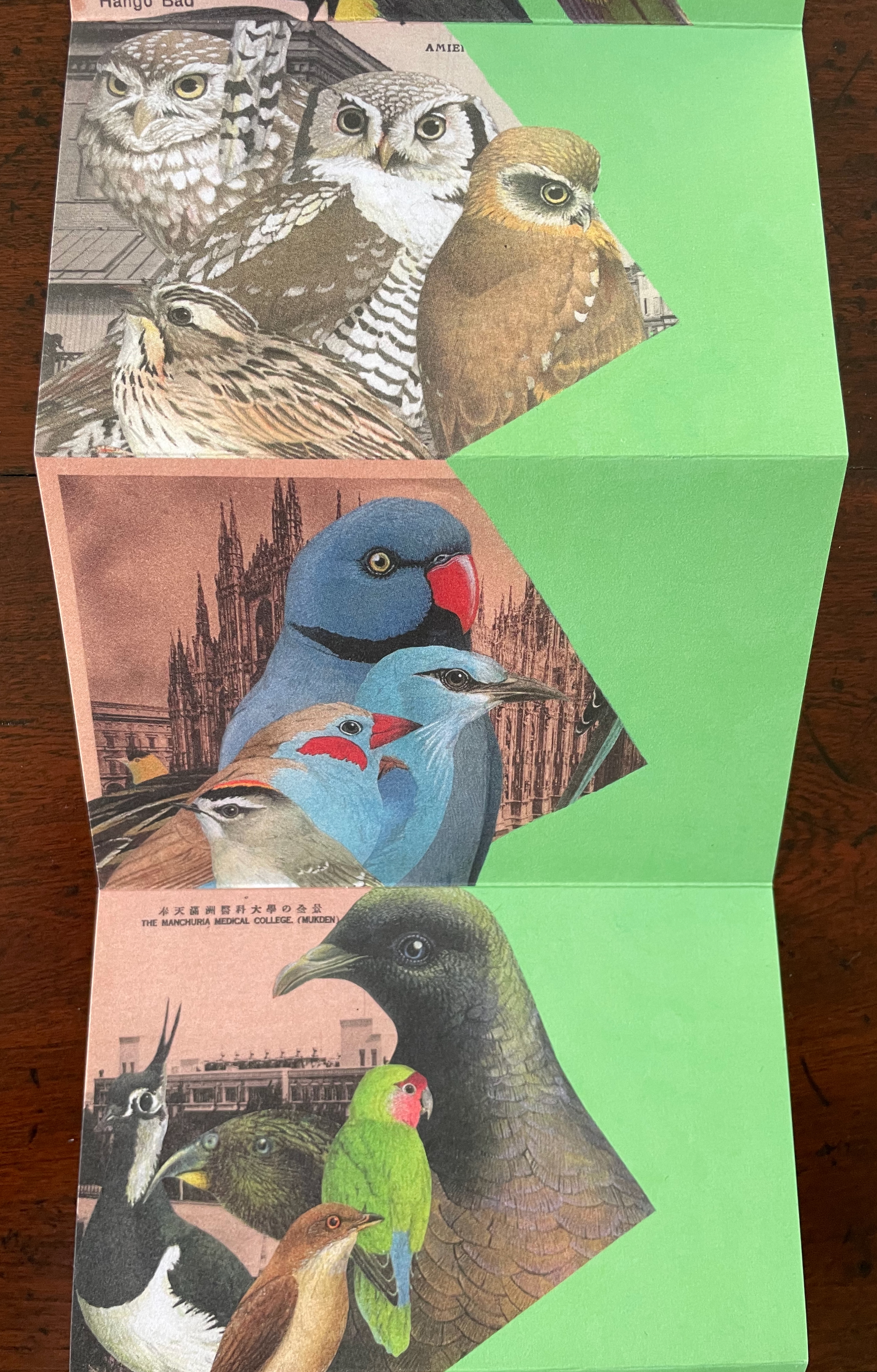
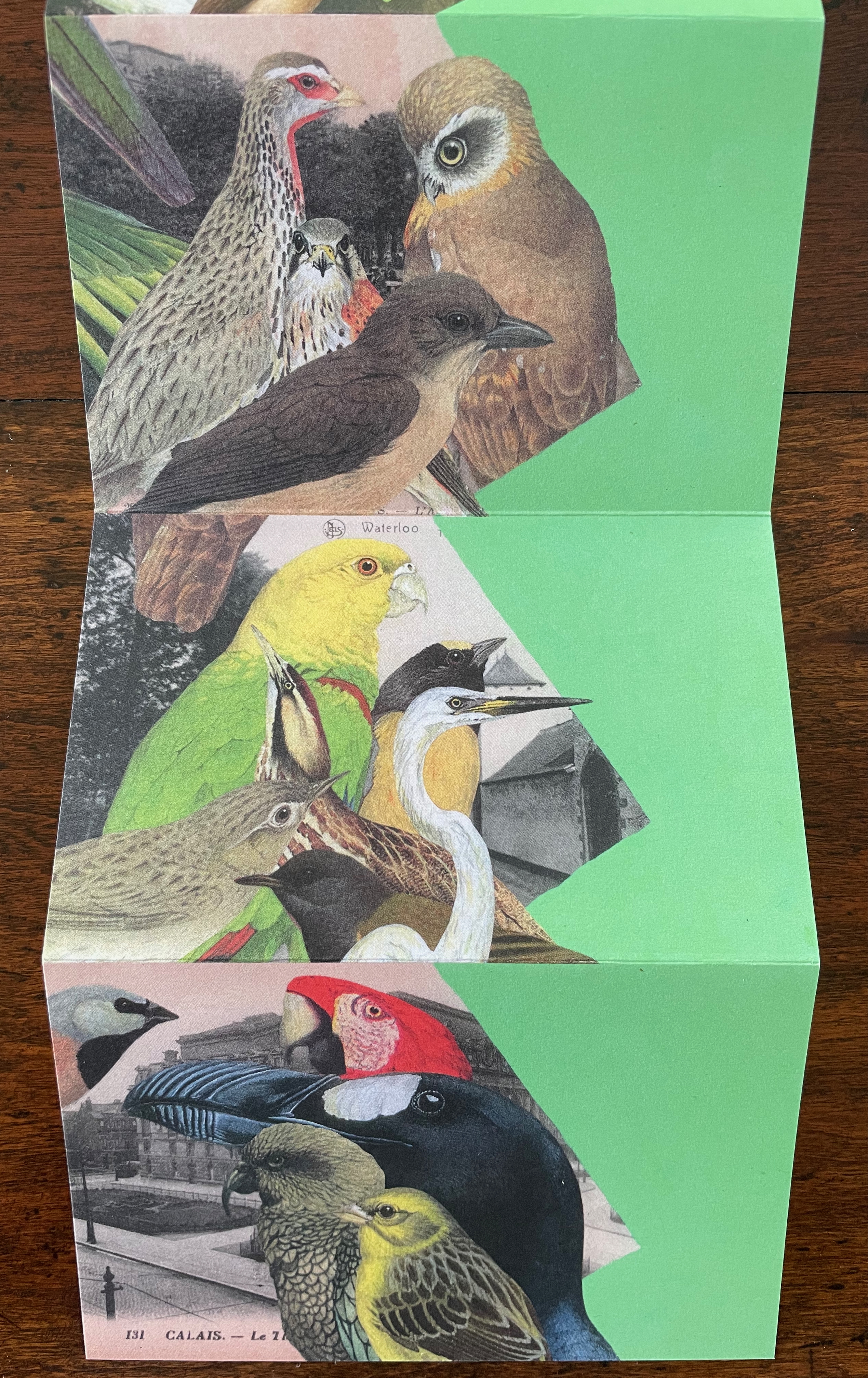
World Book Night’s 2024 theme was “in praise of birds”. Using old postcards from various locations and cut outs collected over the years, Gracia Haby and Louise Jennison selected 45 birds to arrange in this vertical collage in response. The Indigo Digital CMYK used on ecoStar 100 gsm for the body and ecoStar 300 gsm for the cover delivers the vibrant avian colors against a chroma-key-like green screen background. The choice of the green screen effect has layers of significance. One layer is its obvious echo of the “green” choice of 100% recycled paper. Another, not so obvious, requires the textual explanation from the covers:
A green screen enables video makers to fill in the background or environment behind actors after filming. Haby & Jennison’s mimicry of it says that we need to provide these avian actors with more befitting environments than those in the sepia and gray toned backgrounds. Against the minatory background, the exuberant “motley assortment of birds” points in signposts to the “potential environment” left to be filled in on the green screen.
Despite its format, this is not a perforated pack of postcards to be detached and dispatched. You want to see and keep it all at once, as prompted by the vertical zigzagging against the green screen. But you will want also to examine it panel by panel, as prompted by the key on the covers and the detail of the images. In doing so, you sense the celebration and take the warning that this conference of birds being celebrated may disperse into extinction as has happened with the Norfolk kākā (last recorded sighting, about 1851), Carolina parakeet (last recorded sighting, February 1918), Newton’s parakeet (last recorded sighting, 14 August 1875), Bonon wood-pigeon (last recorded sighting, 15 September 1889), and Great Auk (last recorded sighting, 3 June 1844).
Bilateral Symmetry (2024)
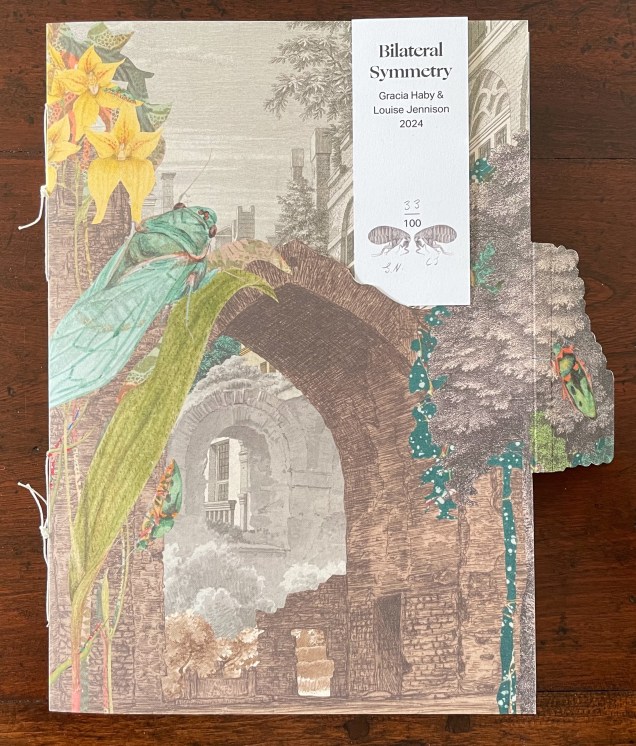
Bilateral Symmetry(2024) Gracia Haby & Louise Jennison Self-enclosing barn-fold artist’s book with tab-and-slot closure, pamphlet stitched, and pop-up components. H240 x W174 mm. [24] pages. Edition of 100. Acquired from the artists, 21 February 2026. Photos: Books On Books Collection.
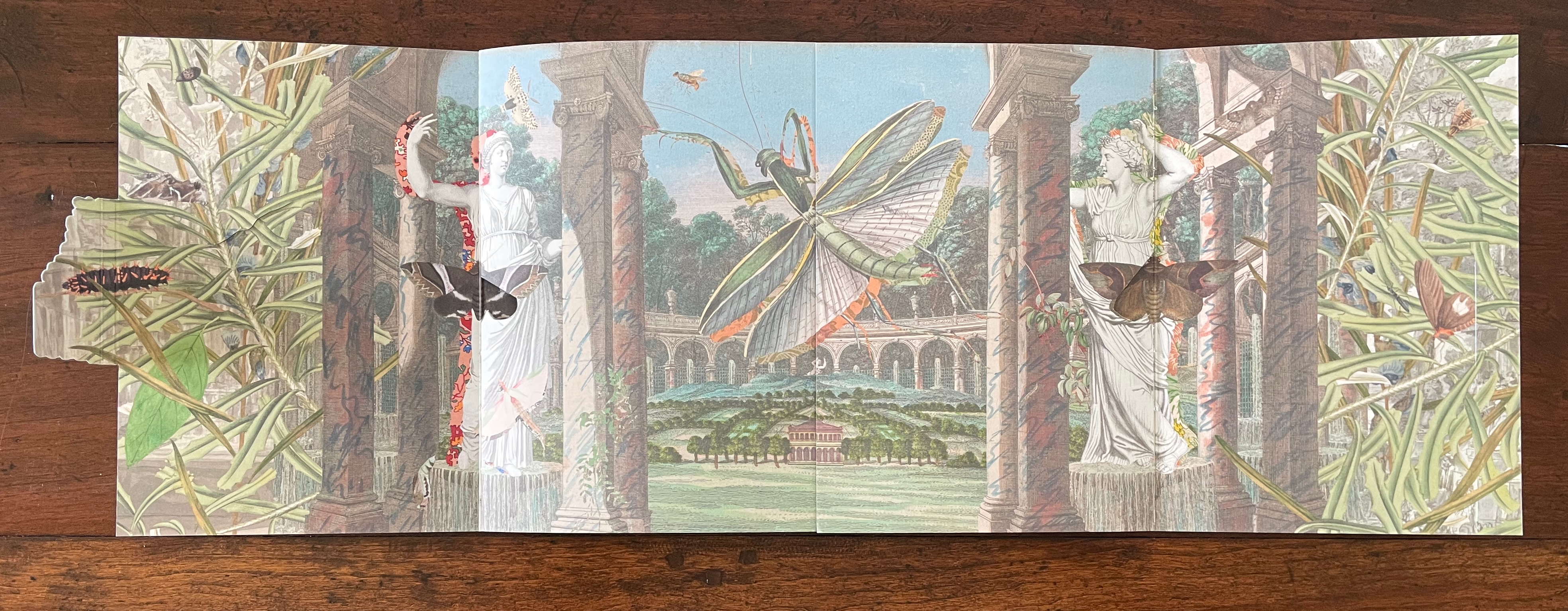
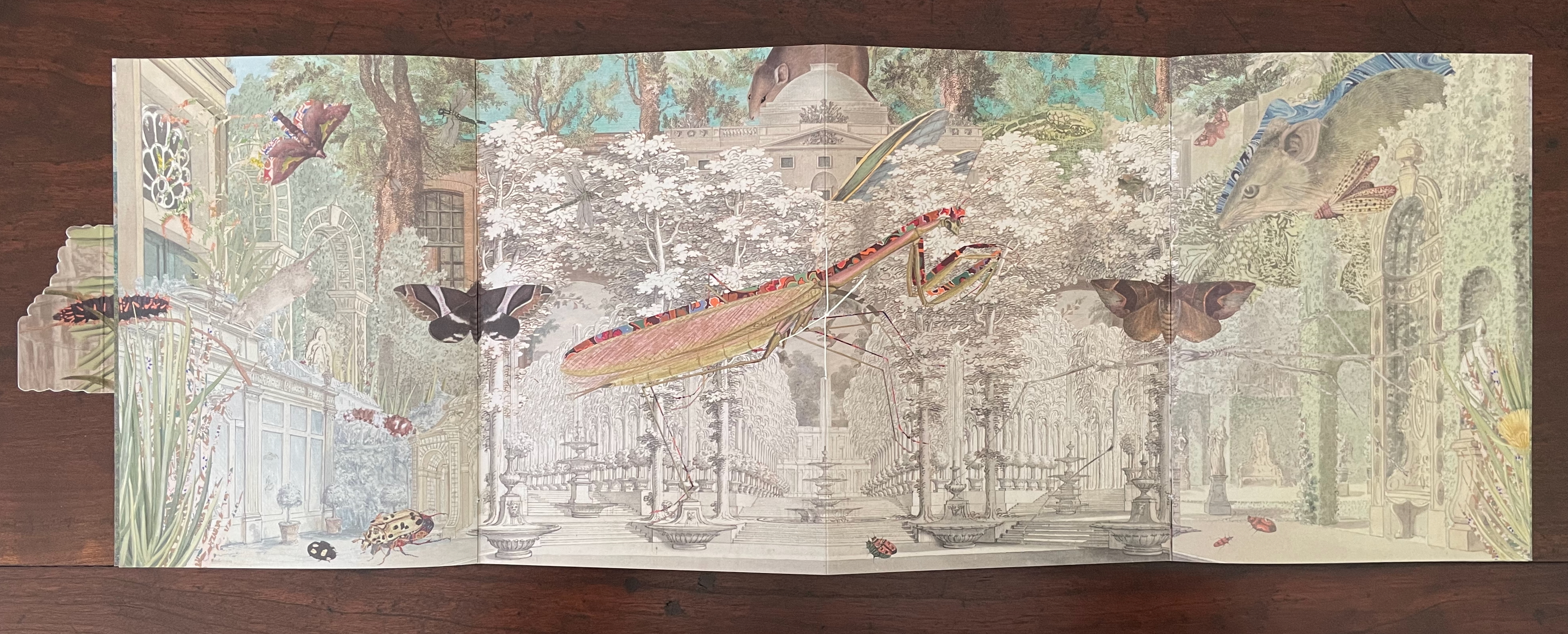
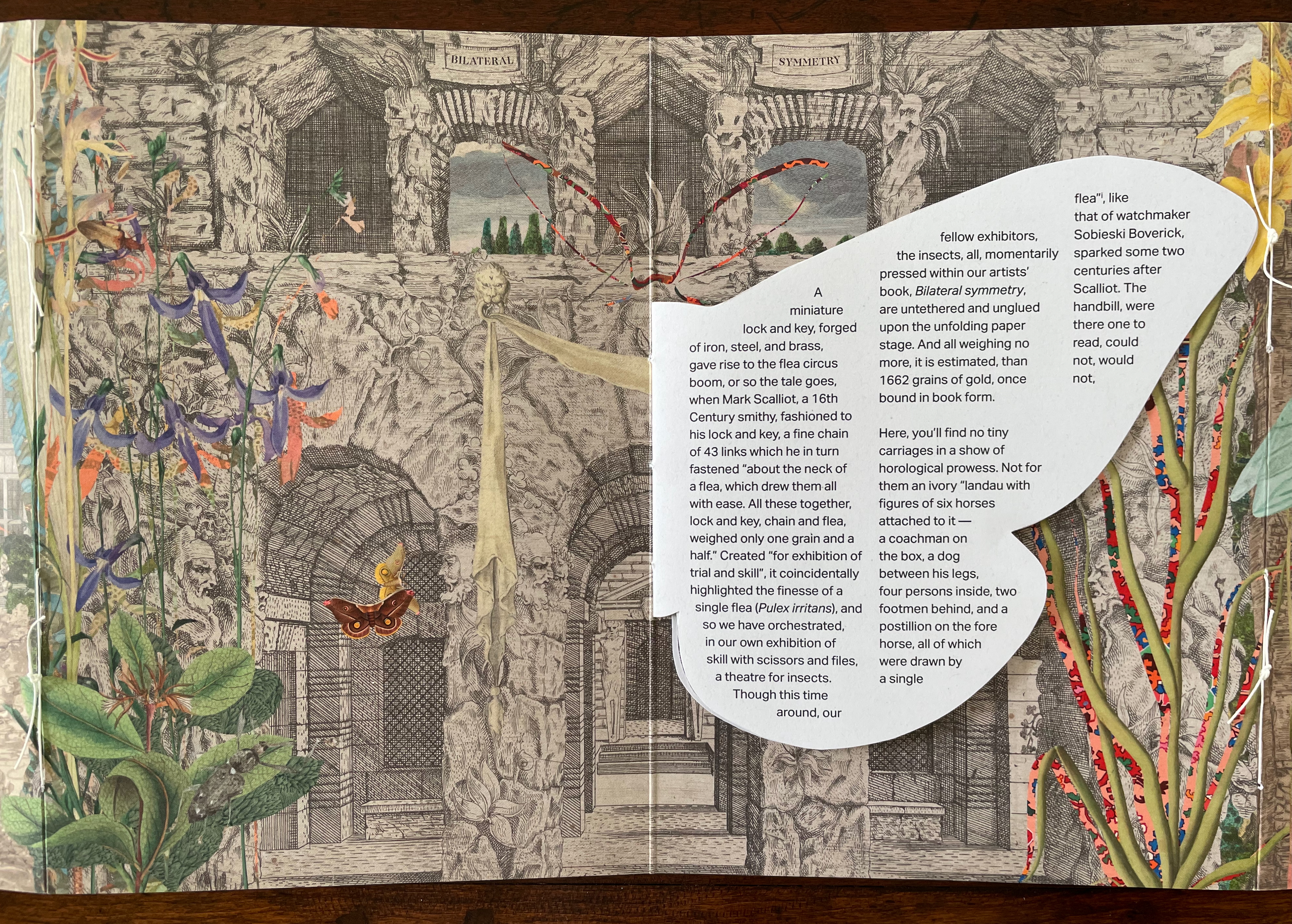
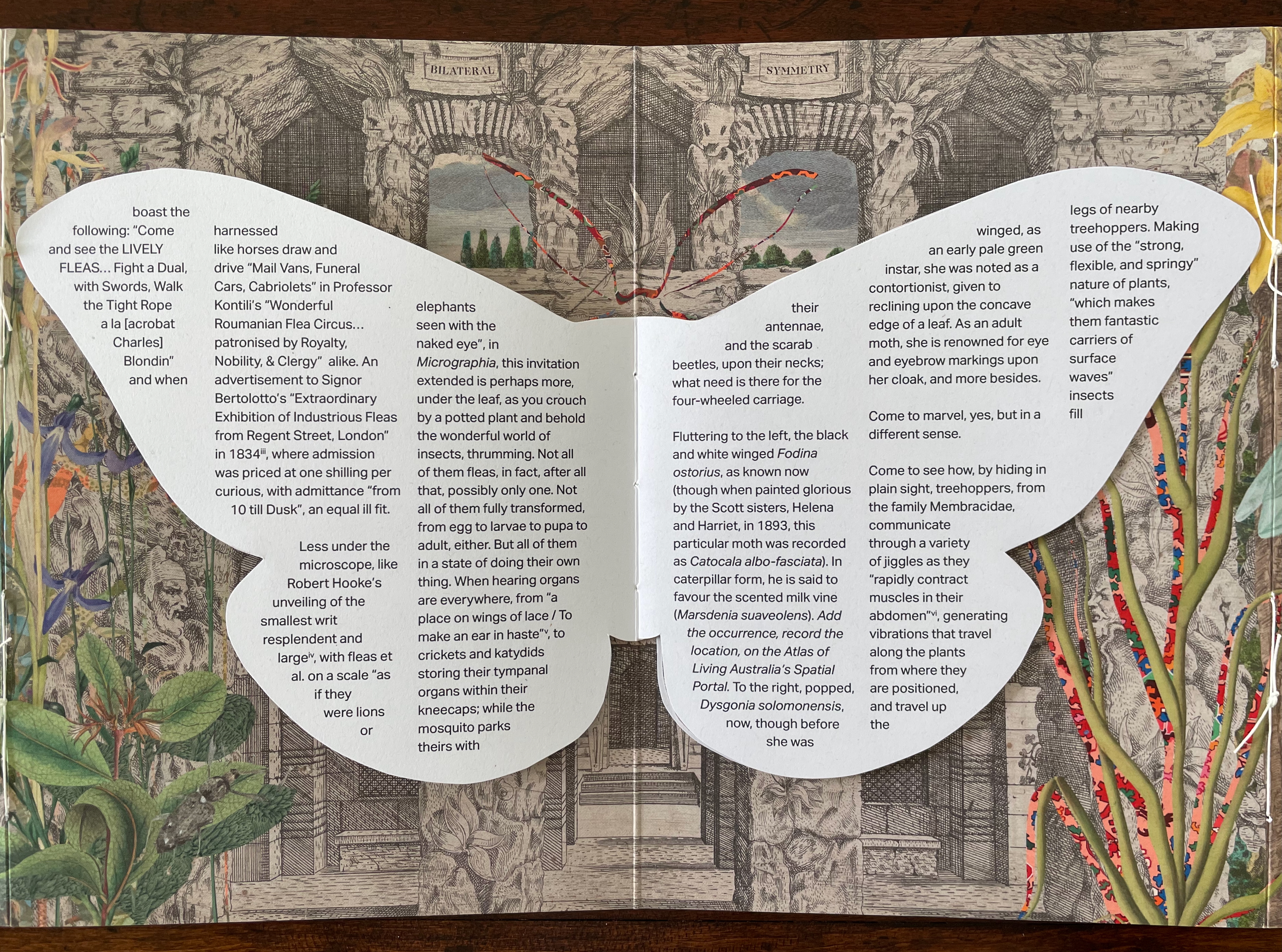
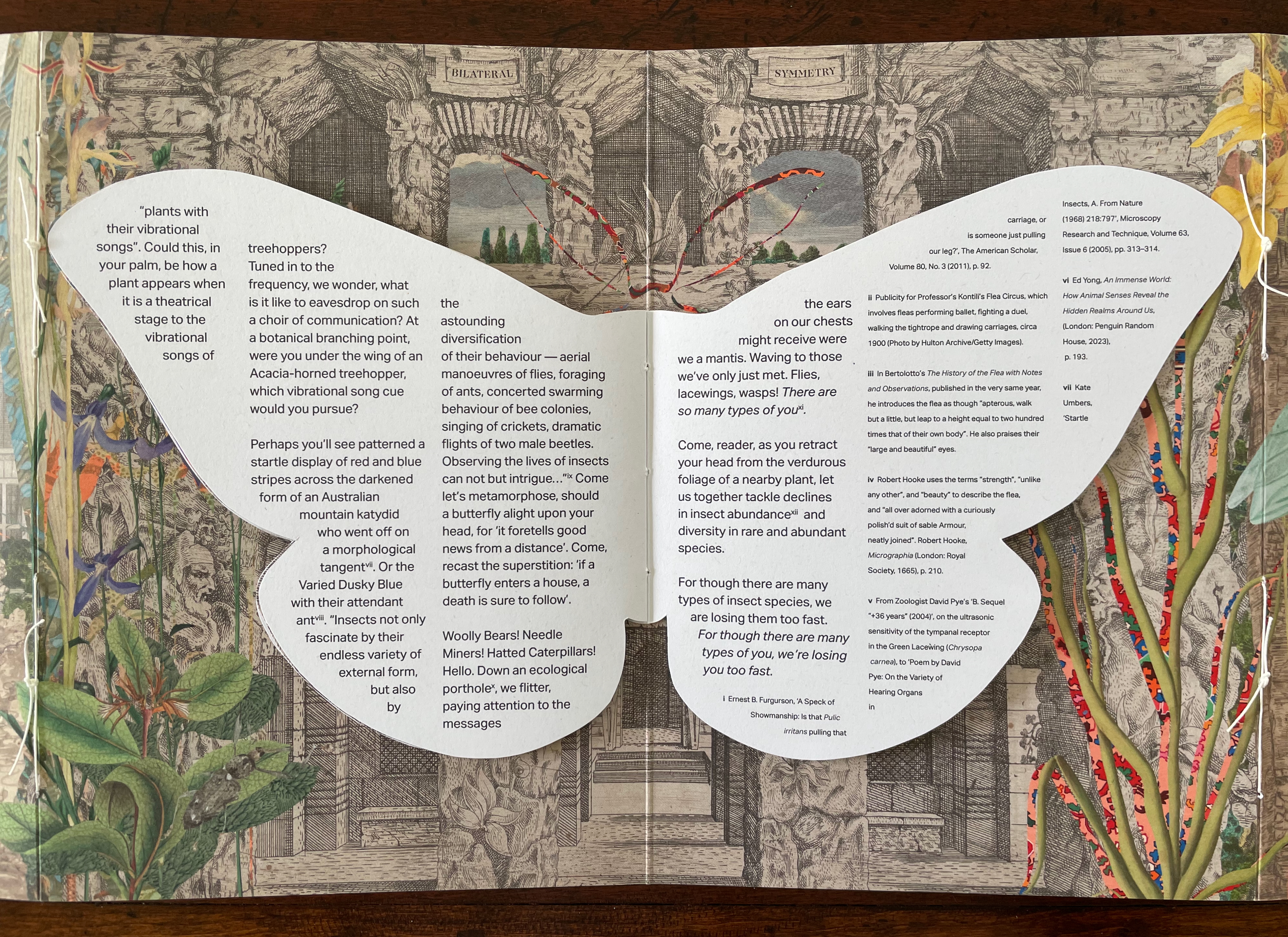
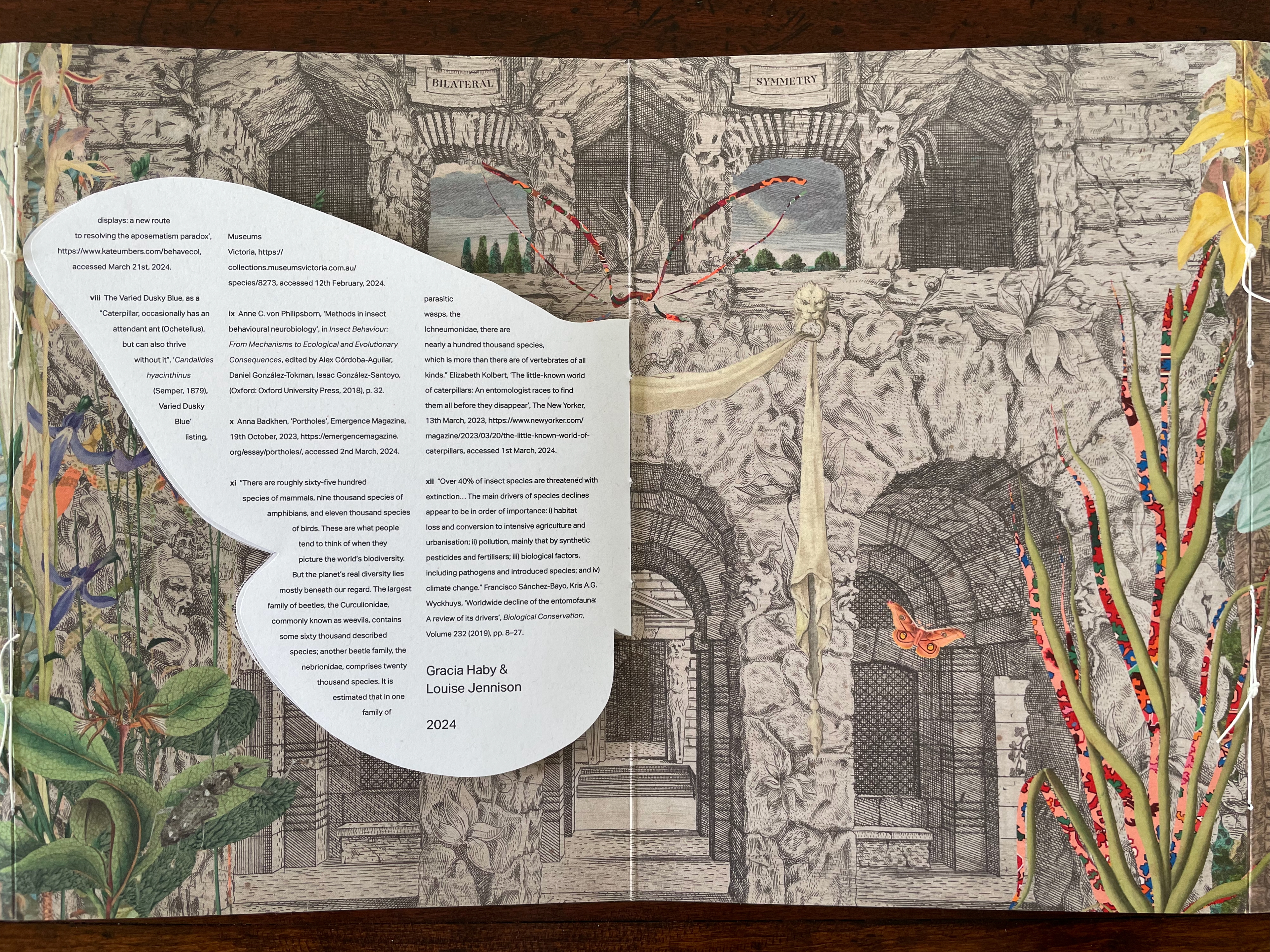
Bilateral Symmetry (2024) is the most successful of the four of artist’s books in the collection. Every element supports its exploration of perception and bilateral symmetry: the sewing, the barn-fold structure, cut outs and pop-ups, the page spreads and alignment, the choice of imagery from the natural world and architecture, and presentation of text across moth-shaped pages.
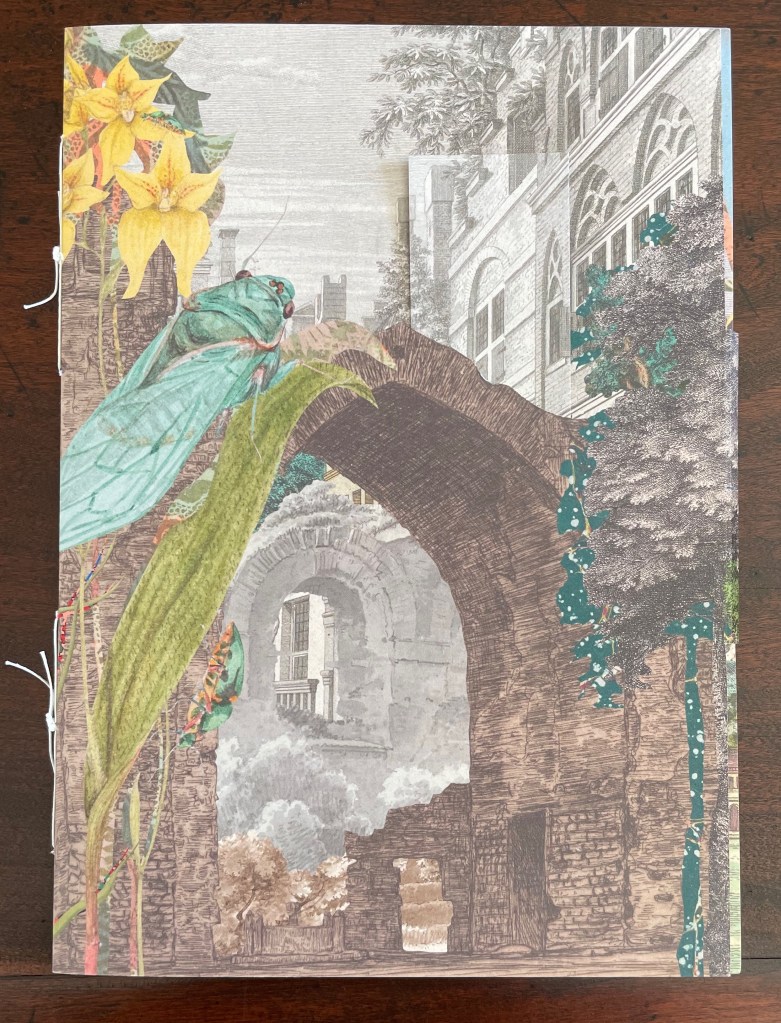
From the start, it combines surprising trompe l’oeil with startling juxtapositions. On the front cover, a bookmark aligns with the architecture behind a ruined arch overseen by a giant lacewing perched on a tree-size plant leaf.
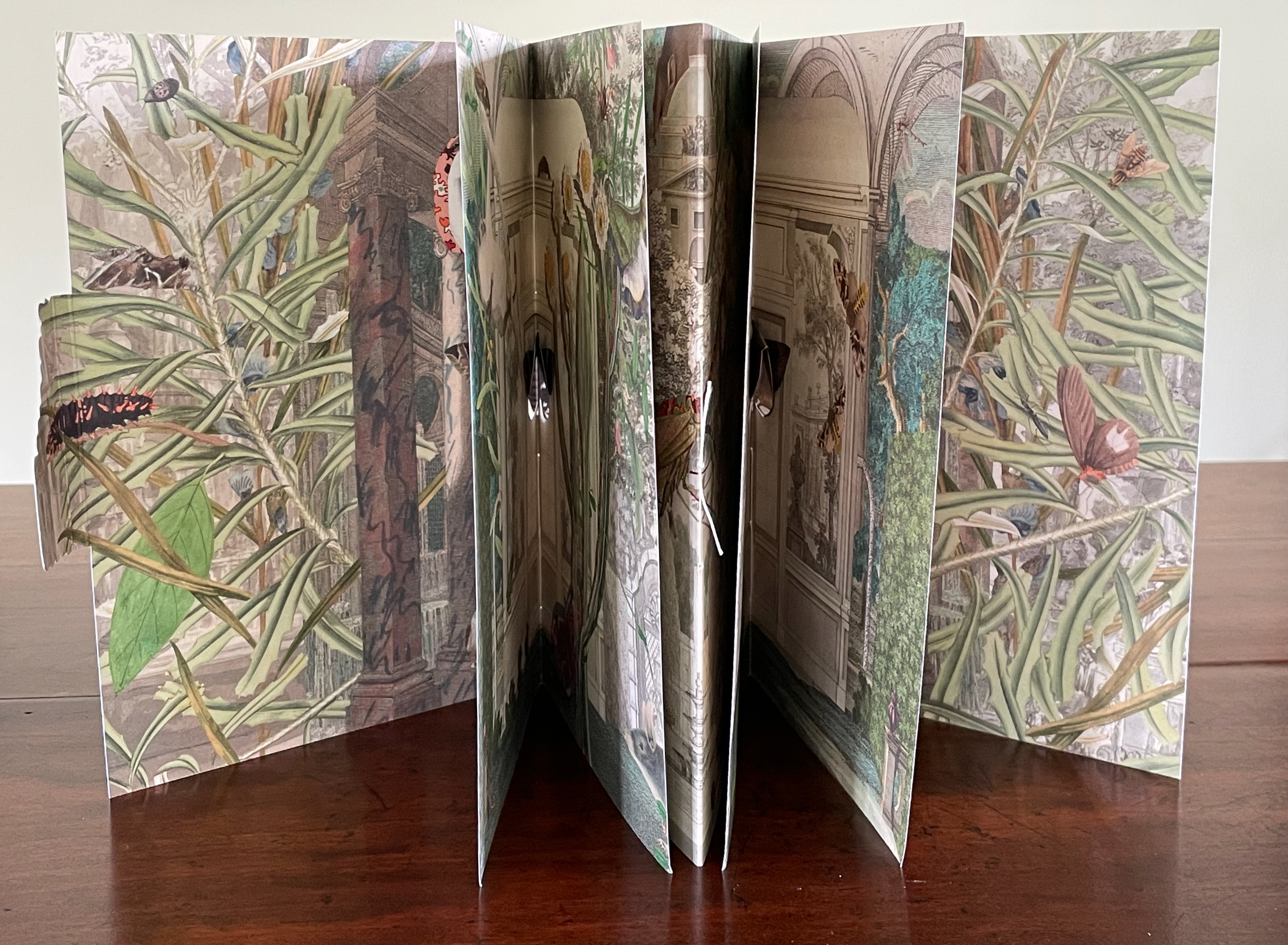
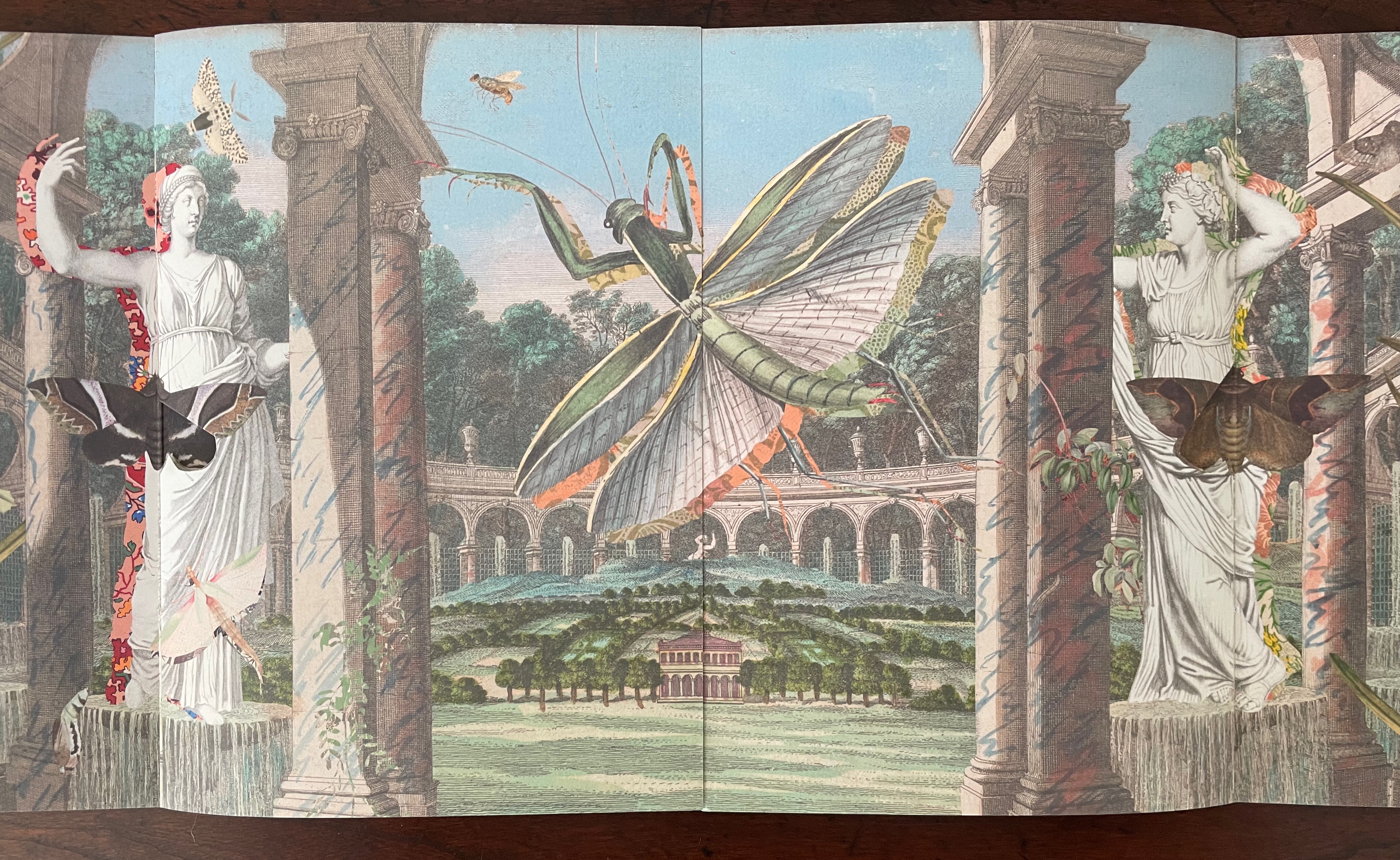
Opening the barn-fold book reveals a new set of perspectival surprises. Inside, there are two booklets facing each other. The edge of the recto page of the booklet on the left aligns with the edge of the verso page of the booklet on the right to form an image across a four-page spread. Between the two foregrounded columns and statues, we see a neatly divided and aligned building in a small formal landscape. Beyond the building and landscape, an arcade with statuary curves symmetrically to the left and to the right. In fact, the arcade extends in a circle that comes around to the columns and statues through which we are looking. But the proportions are impossible or, at least, surreal. Of course, the huge dragonfly, also neatly split by the pages meeting in the center, offers a strange perspective especially alongside the collage of other insects. Even the marbled columns offer peculiarities. Some are rounded, some are squared, some start square at the foot but end rounded at the capital. And the statuary, collaged with insects, are shadowed with bright marbled patterns.
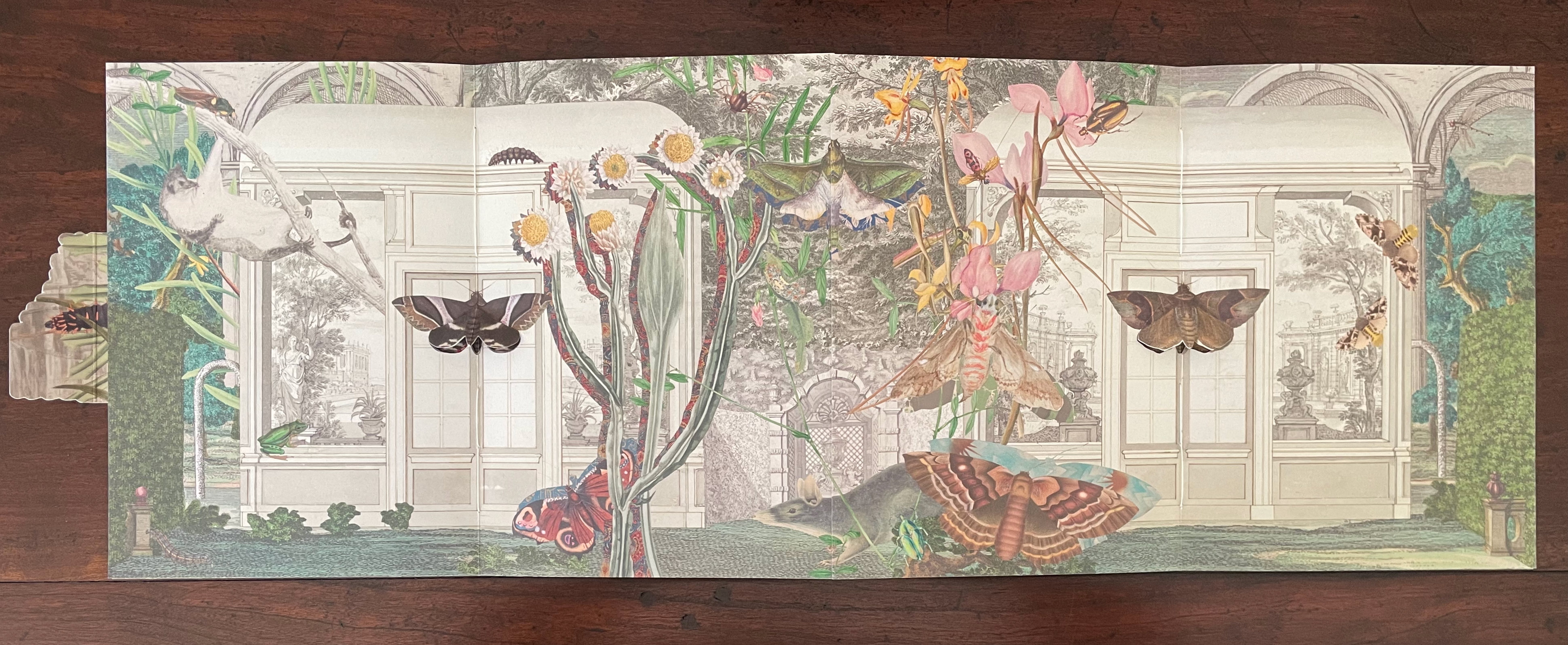
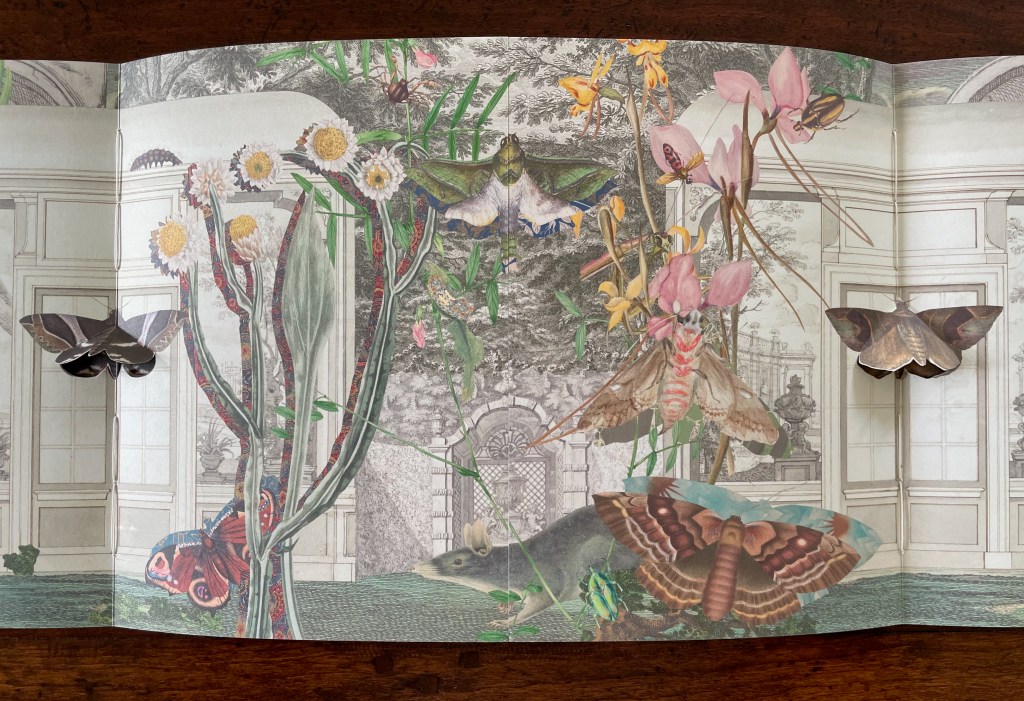
With the turn to the next set of facing spreads, the two statues and view through the arcade disappear, yet the moths that were posed against them remain as lepidopteral pop-ups against double doors in the middle of seemingly detached greenhouse walls. On the left, a flying squirrel attributed to Louisa Atkinson (ca. 1849-72) hangs from a branch intruding through an open arch in the wall. Diversity and trompe l’oeil strain at the work’s bilateral symmetry.
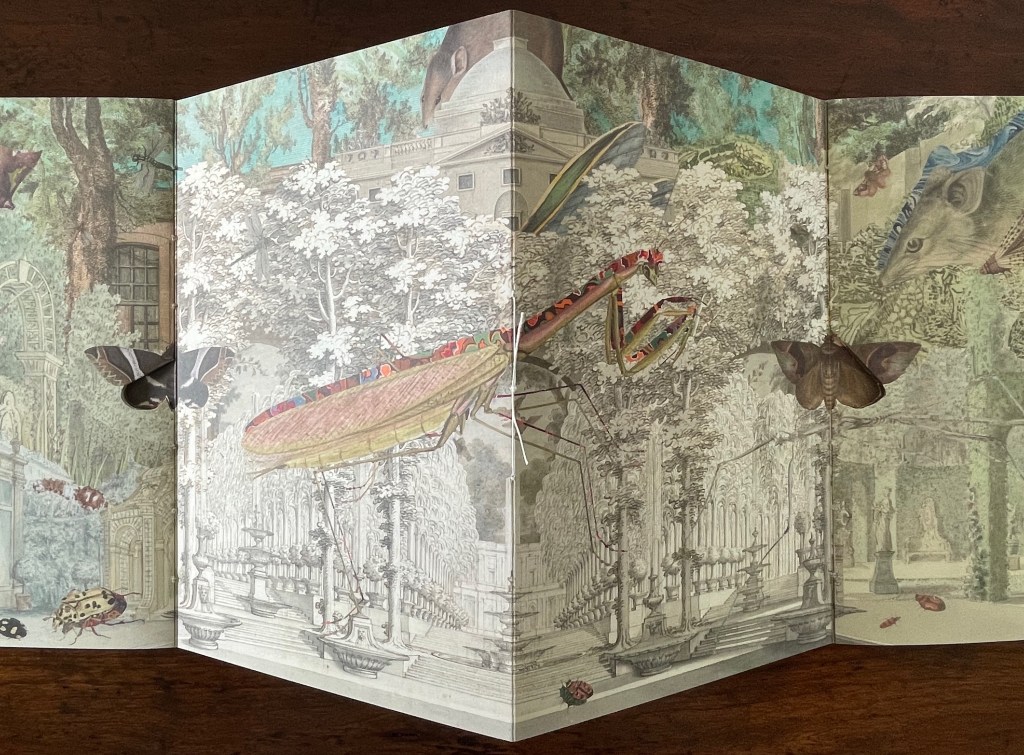
The final spread on this side of the book displays further distortions challenging our perception — even of bilateral symmetry but somehow nevertheless underscoring the theme. The Scotts’ pop-up moths, each centered a booklet’s spine, are flanked by Atkinson‘s far too small ringtailed oppossum on the left and by Gerard Kreft‘s far too large water rat to the right, peering down on the scene. The huge mantis in the center hangs mid air against the formal tree lined garden abnormally far in the background. The garden is perspectivally more distant than the domed edifice behind it, and an impossibly large rodent peeps over it. Although the central rodent and mantis are not symmetrically divided, and although the scenes to the left and right of the spine are not symmetrical, the central spine bisects the garden and dome precisely. Likewise the left and right spines bisect the Scotts’ moths precisely, underscoring the theme of bilateral symmetry. Meanwhile, the spreads have reiterated the point about the variety and diversity of insects, flora, and mammals.
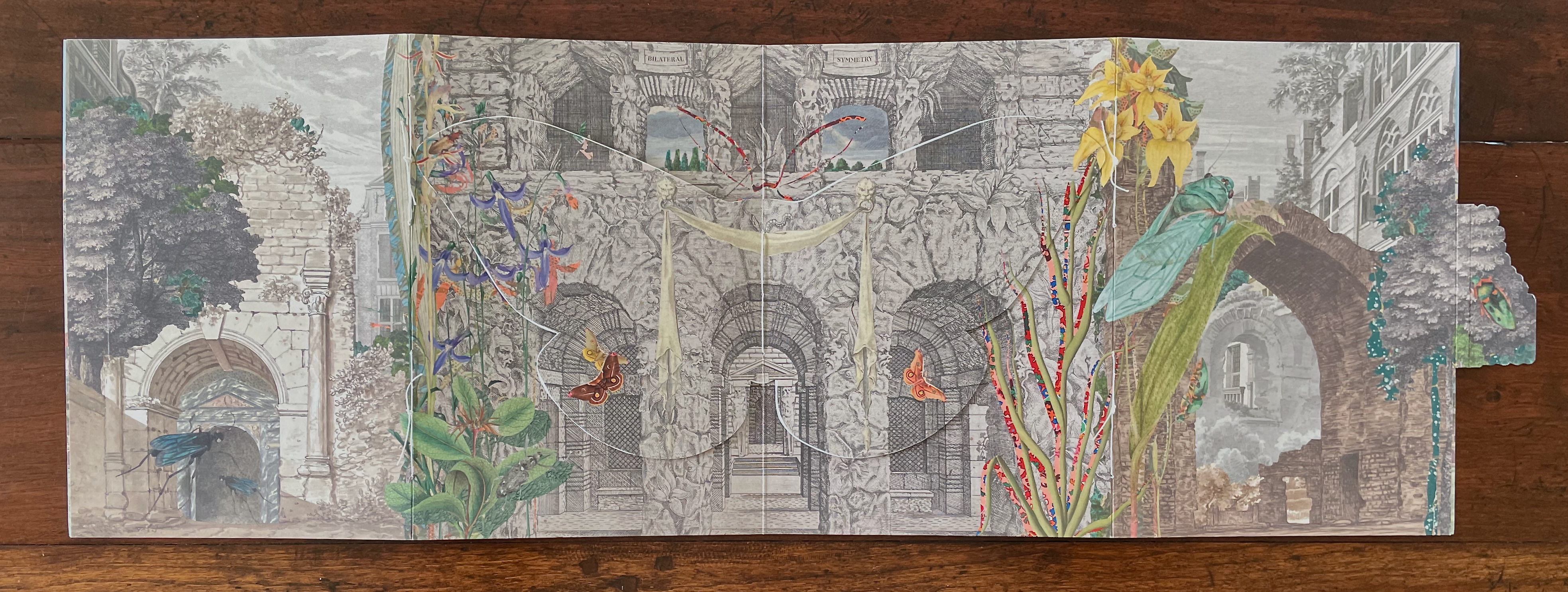
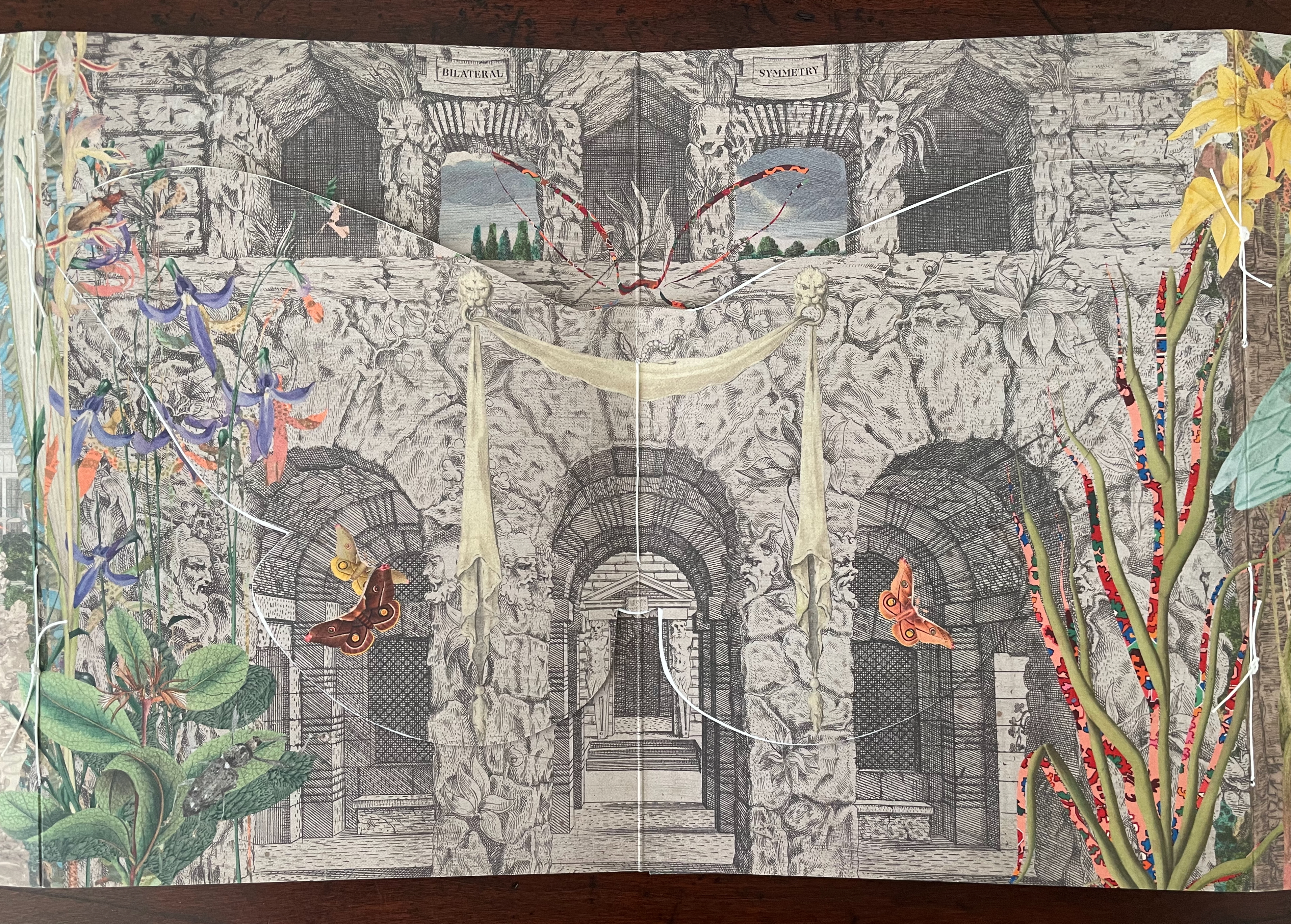
On the reverse side of the book, between the splayed-out back and front covers of the two booklets, a cut out moth with wings spread disappears in trompe l’oeil fashion into the facade against which it has alighted. Above the moth, the two-word title of the book appears on two engraved banners hanging over the two parallel open archways centered between two shuttered archways. Two Harriet Scott Emperor Gum moths hover in the two archways shown on the lower lobes of the cut out moth’s wings. (Did I mention how every element supports the exploration of bilateral symmetry?)
The book’s text appears on the reverse side of the cut out moth’s wings. As you turn to the first wing/page of text or turn to the last wing/page, you may notice how the two Emperor Gum moths have “jumped” from the cut out’s wings to the background underneath each wing. A sort of slow motion persistence of vision, it is another perceptual trick alongside the trompe l’oeil of the cut out moth.
The first paragraph of text picks up on this theme of visual legerdemain by recalling the first flea circus impresario Mark Scalliot. That is a rhetorical means of introducing Bilateral Symmetry as a “theatre for insects” and posing the depicted insects as “fellow exhibitors”, which in turn is a rhetorical sleight of hand by which Haby and Jennison place themselves and the insects on an equal footing as performers and artists. The equation elevates the insects from the hucksterism of the flea circus — “Not for them an ivory “landau with figures of six horses attached to it ….” and, in the next paragraph, even raises these performers over Robert Hooke’s fleas as large as “elephants seen with the naked eye”. The exhibitors of Bilateral Symmetry invite you to better Hooke’s microscope by crouching “by a potted plant and behold[ing] the wonderful world of insects, thrumming”.
Leaning into entomomorphism, the artists invite us “[d]own an ecological porthole [to] flitter, paying attention to the messages the ears on our chests might receive were we a mantis”. Familiar by now with the artists’ message, we know this leads to the ecological observation of declining diversity, but up to this point, their artistry has been primarily about visual perception. This is not to gainsay the message, but as important as the message is, their marvelous handling of the media (the archival sources, the innovative book structure, and the collage) and reorienting of our perspective do more than simply make us receptive to it. Only in its final two paragraphs does the text exhort the reader to care and do something about the decline in insect diversity. The paragraphs preceding them conjure a world of insect perception and behavior that is as surreal as the whimsical perceptual distortions of the collage. The collage may include insects registered as endangered, but the text does not identify them. If text and collage were to have included endangered insects such as the Angled Tiger butterfly, Beautiful Petaltail dragonfly, Illidge’s Ant-blue (Butterfly), Queen Alexandra’s Birdwing Butterfly, Fan-winged Katydids, or Zaprochilus ninae (Bush crickets), might we have arrived at the same exhortation on our own?
With its blend of architectural ruins and artificial landscaping with oversized and undersized insects at various stages of metamorphosis, Bilateral Symmetry urges a shift of perspective in our perception of nature and our interconnectedness. With its structural embodiment of bilateral symmetry and diversity, it offers a rich example of the perceptual and perspectival shift it urges.
Further Reading
“Carol Barton“. 10 August 2024. Books On Books Collection.
“Caren Florance“. 30 April 2026. Books On Books Collection. In particular, see L OO P (2019).
“Ernst Huebner“. 21 July 2023. Books On Books Collection.
“Willow Legge“. 16 February 2021. Books On Books Collection.
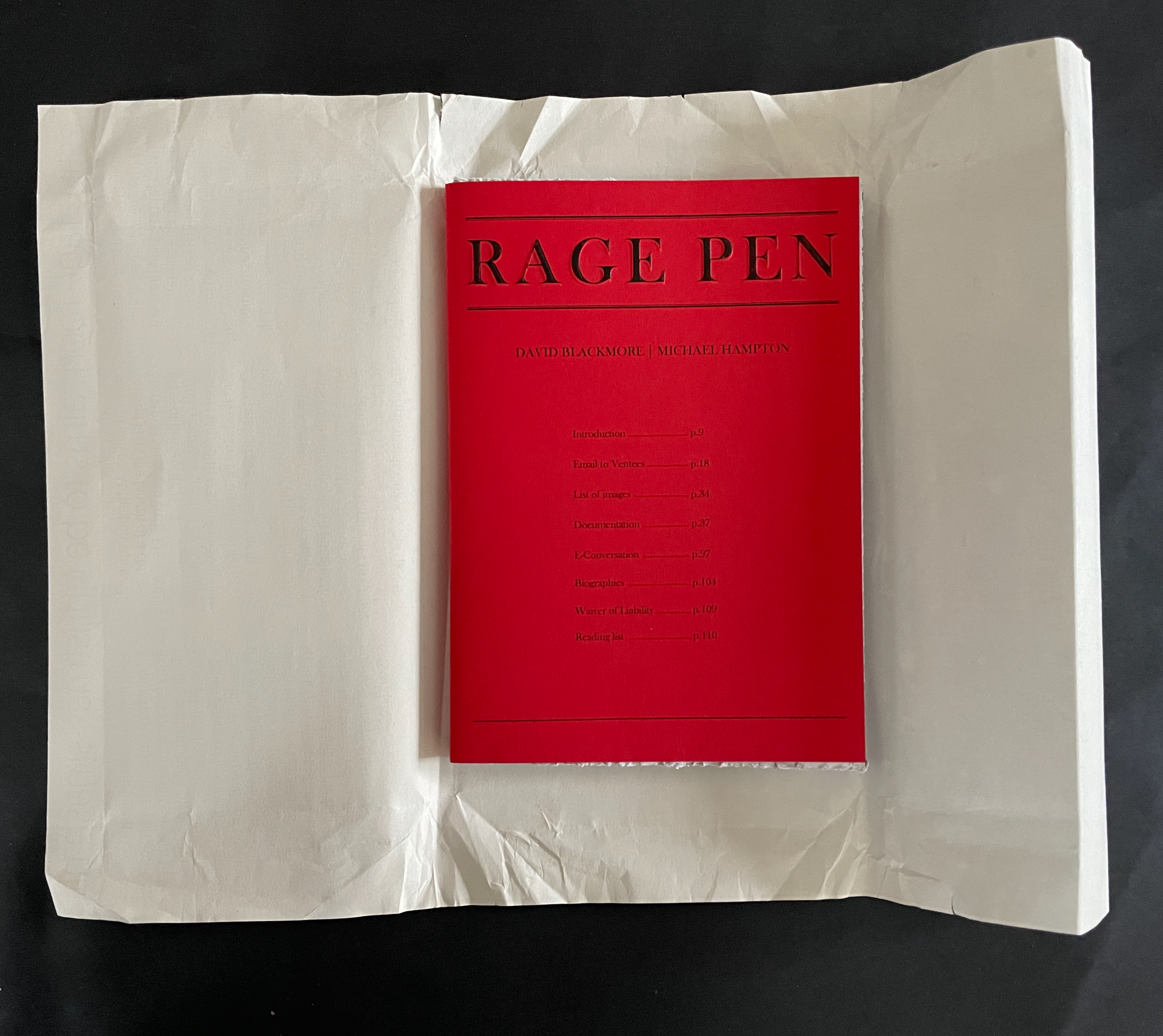
RAGE PEN (2025) David Blackmore and Michael Hampton Soft cover, mitre sawn head and foot, perforated fore-edge. H210 x W148 mm. [108] pages. Edition of 100. Acquired from Folium, 13 November 2025. Photos: Books On Books Collection.
Folium, the publisher, describes RAGE PEN as “developed from a relational piece of the same name held at Chisenhale Studios 2017/18”. Per the Museum of Modern Art, relational aesthetics is
A mode of art practice that establishes spaces, situations, or environments for a variety of social interactions. In essence, the social space or interaction becomes the work of art itself. The term was popularized by French critic and curator Nicholas Bourriaud in 1998.
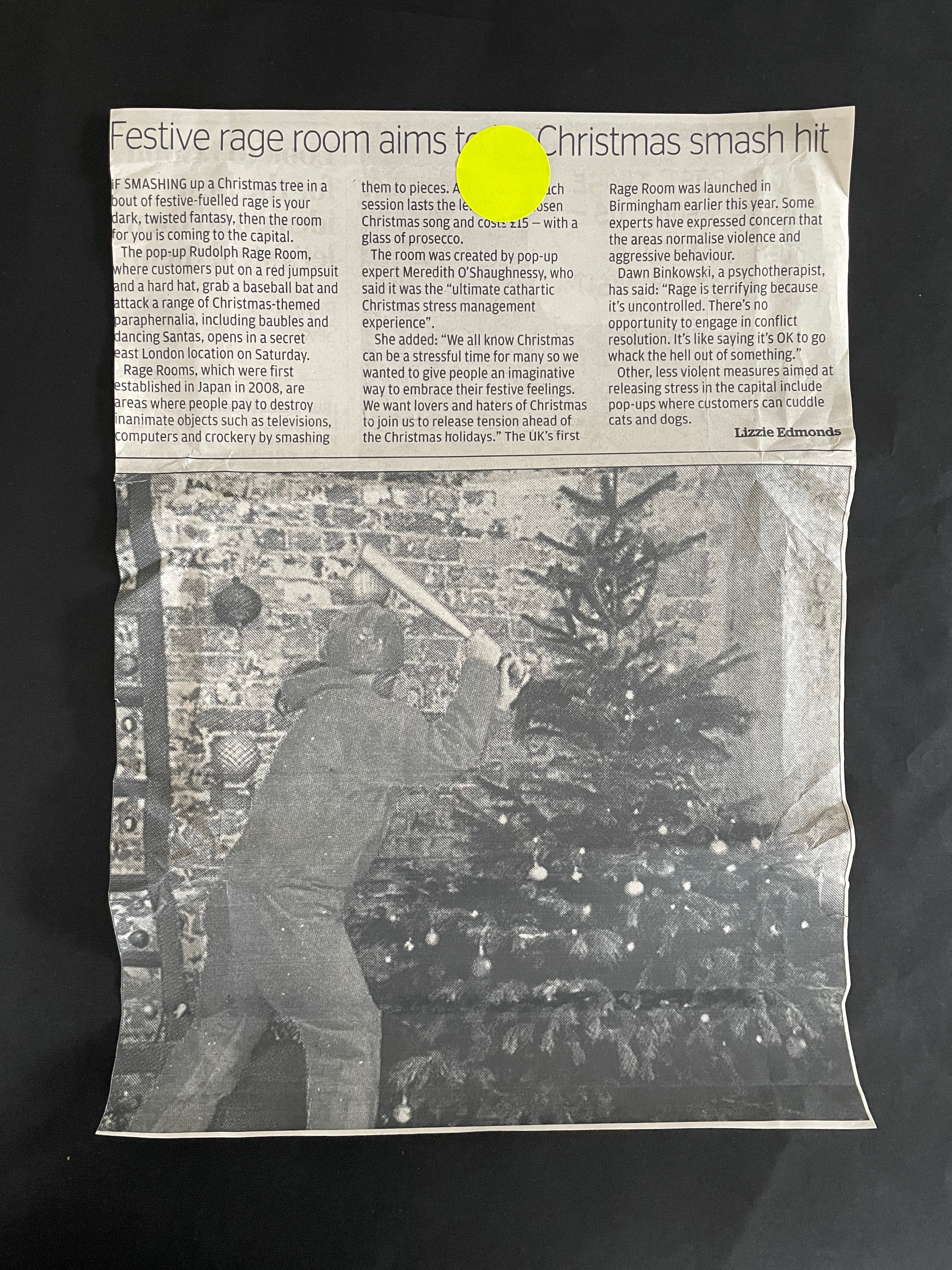
RAGE PEN‘s environment was a safe rage room equipped with a variety of handheld tools. Anonymous members of the public, or “ventees”, were invited to name an object that had caused them frustration, don protective equipment, and enter the shuttered room to smash said objects. The interactions filmed and photographed by David Blackmore formed the images in RAGE PEN the book. Holding the book with its mitre-sawn top and bottom edges and its perforated, still-sealed fore-edges, we might suspect that we are being invited into our very own private relational aesthetic piece.