Books On Books Collection – Leonard Everett Fisher

With 260 illustrated books to his name and 90 of them authored by him, Leonard Everett Fisher would have been remiss not to have contributed works to the category of alphabets and artists’ books.

Alphabet Art (1978)

Alphabet Art: Thirteen ABCs from Around the World (1978)
Leonard Everett Fisher
Dustjacket. Casebound, one-eighth cloth and paper over board. Doublures. Sewn binding. H287 x W225 mm. 64 pages. Acquired from 2VBooks, 28 August 2022.
Photos: Books On Books Collection.

Leonard Everett Fisher offers thirteen non-English languages — Arabic, Cherokee, Chinese, Cyrillic, Eskimo, Gaelic, German, Greek, Hebrew, Japanese, Sanskrit, Thai and Tibetan — each with an illustrative image alongside a page of background text followed by a double-page spread of hand-drawn characters of the writing system. Unlike Tommy Thompson’s The ABC of Our Alphabet (1952) and William Dugan’s How Our Alphabet Grew (1972), Fisher’s book does not focus on the development of the Latin alphabet, but unusually aims instead to interest the children’s market in the variety of non-Latin alphabets. In this, it is a precursor to Sam Winston’s One & Everything (2022).

The book has no bibliography or indication of sources, and the background text’s few slightly off-center assertions (e.g., that the Chinese writing system is a syllabary) create a slight unease about the accuracy of the character sets. Nevertheless, for calligraphic inspiration, the double-page presentation of consistent hand-drawn character sets delivers strong impressions of the differences in the look and feel among the languages’ writing systems.

The ABC Exhibit (1991)

The ABC Exhibit (1991)
Leonard Everett Fisher
Dustjacket. Casebound, one-eighth cloth and paper over board. Doublures. Sewn binding. H287 x W225 mm. 32 pages. Acquired from Books End, 28 August 2022.
Photos: Books On Books Collection.

The ABC Exhibit emphasizes image more than letter or text. Forgoing other usual features of a children’s alphabet book (such as presenting upper and lowercase letters), the book steers more toward an artist’s book or catalogue of the artist’s style of illustration and art. The colophon even specifies that the original artwork was prepared as acrylics on board. While the image of the elephant and several others can be easily imagined in a children’s book, the rendering of the Brooklyn Bridge in fog stands out as do a sailboat in motion and a still life of oranges.

The book features around the 24′ mark in this interview with the Hennepin County Library in 1991.

Further Reading

Abecedaries I (in progress)“. Books On Books Collection. 31 March 2020.

William Dugan“. 10 July 2023. Books On Books Collection. Children’s reference.

Stephen T. Johnson“. Books On Books Collection. 30 November 2021.

Tommy Thompson“. 21 August 2022. Books On Books Collection. Reference.

Sam Winston“. 18 May 2023. Books On Books Collection. Children’s book.
Books On Books Collection – Tommy Thompson

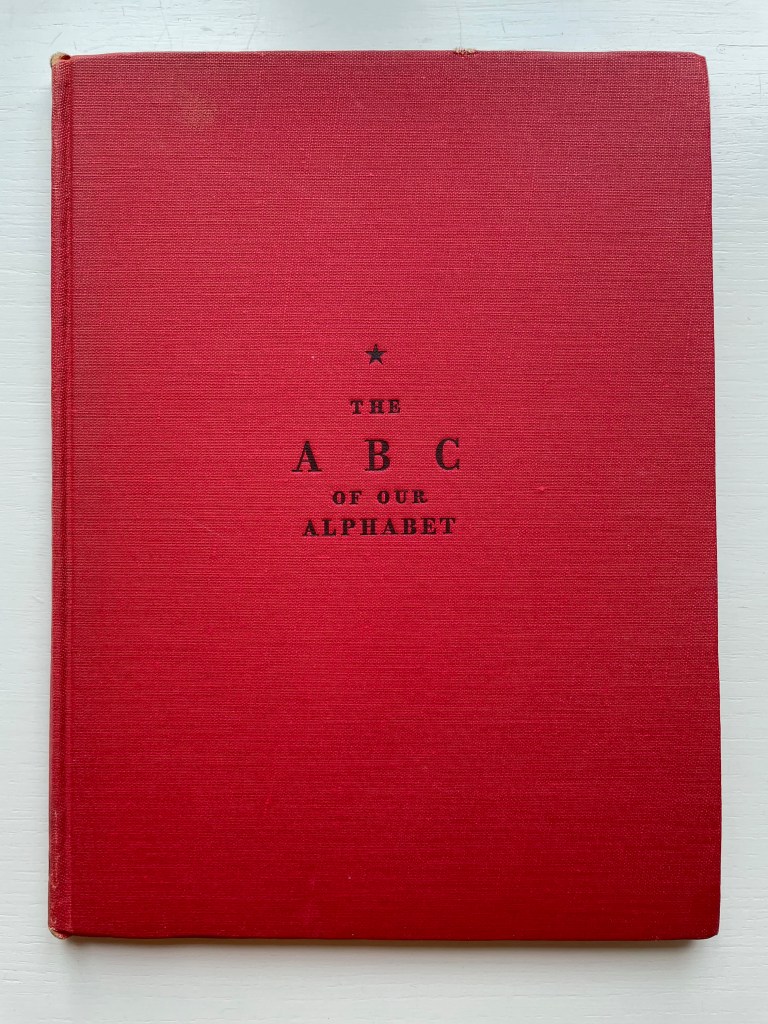
The ABC of Our Alphabet (1952)

The ABC of Our Alphabet: A primer of the lineal history of our present-day letters (1952)
Tommy Thompson
Casebound with doublures showing map of locations of alphabet development.
Acquired from St Luke’s Hospice, Sheffield, 6 August 2022. Photos: Books On Books Collection.

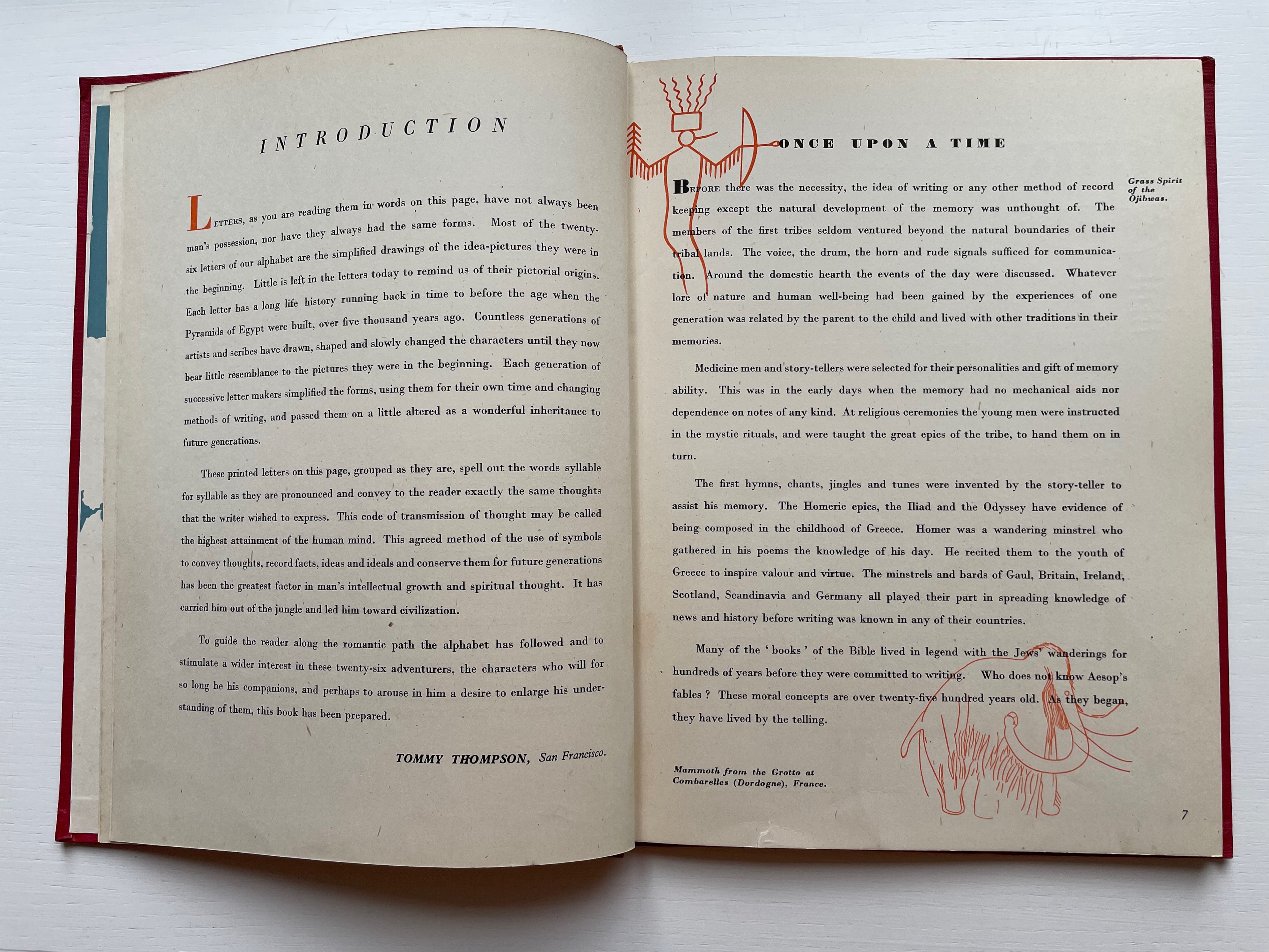
First appearing in 1942, Samuel Winfield (Tommy) Thompson’s somewhat forgotten children’s introduction to the history of the alphabet occupies an interesting position in that line of work that includes Oscar Ogg’s The 26 Letters (1964), Tiphaine Samoyault’s Alphabetical Order (1998), Renzo Rossi’s The Revolution of the Alphabet (2009) and Don Robb’s Ox, House, Stick (2010). For a collector of children’s alphabet books and alphabet-related artists’ books, the decision whether to acquire it balances on its interior design and content.

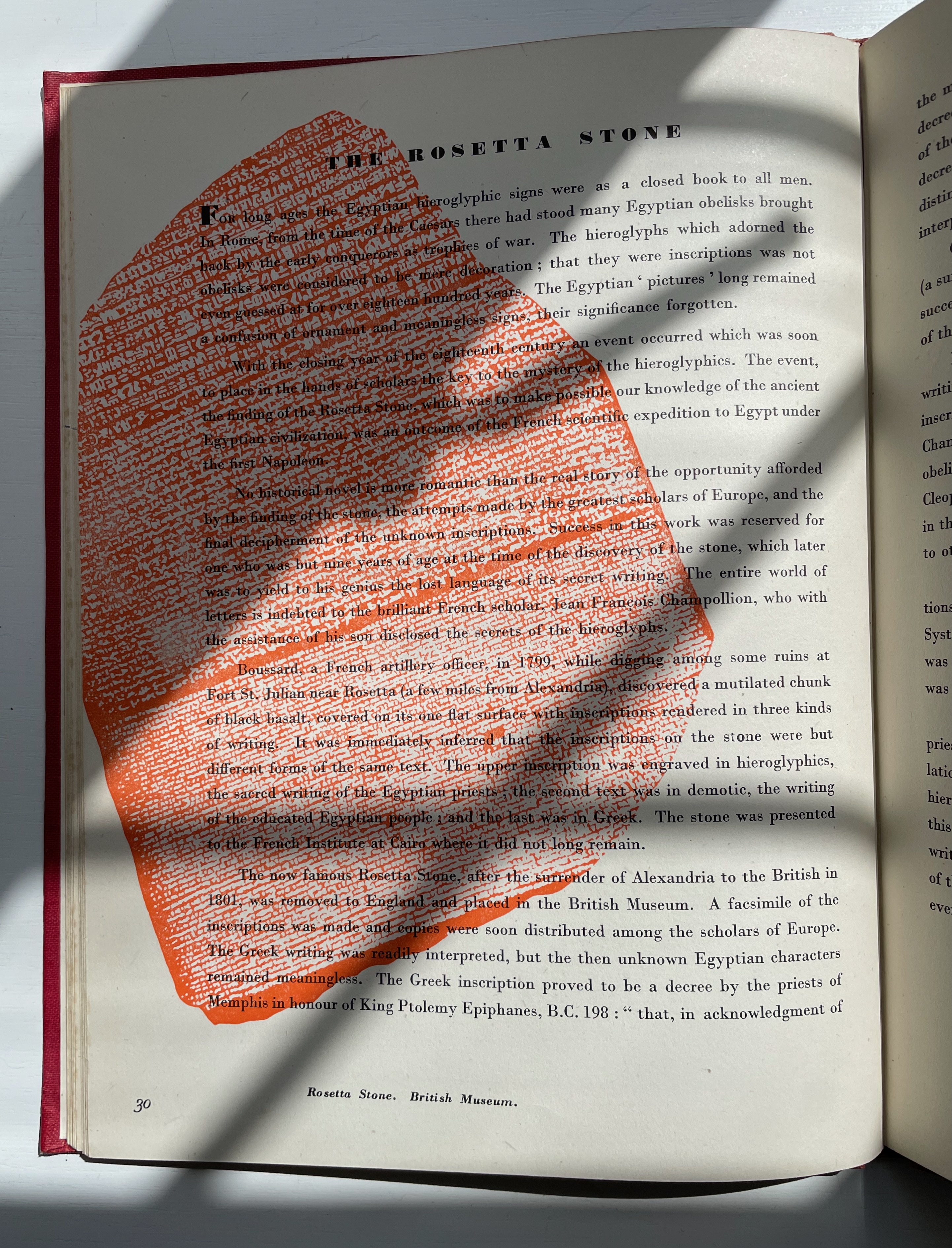
With its overlay of second-color illustrations on the text, Thompson’s book makes for an interesting forerunner to Lyn Davies’ fine press A is for Ox. Thompson falls prey to instances of illegibility from the technique, but both enjoy instances of brilliant juxtaposition of word and redrawn images.

Two-color illustration overlaying text. Right: Davies. Left: Thompson.

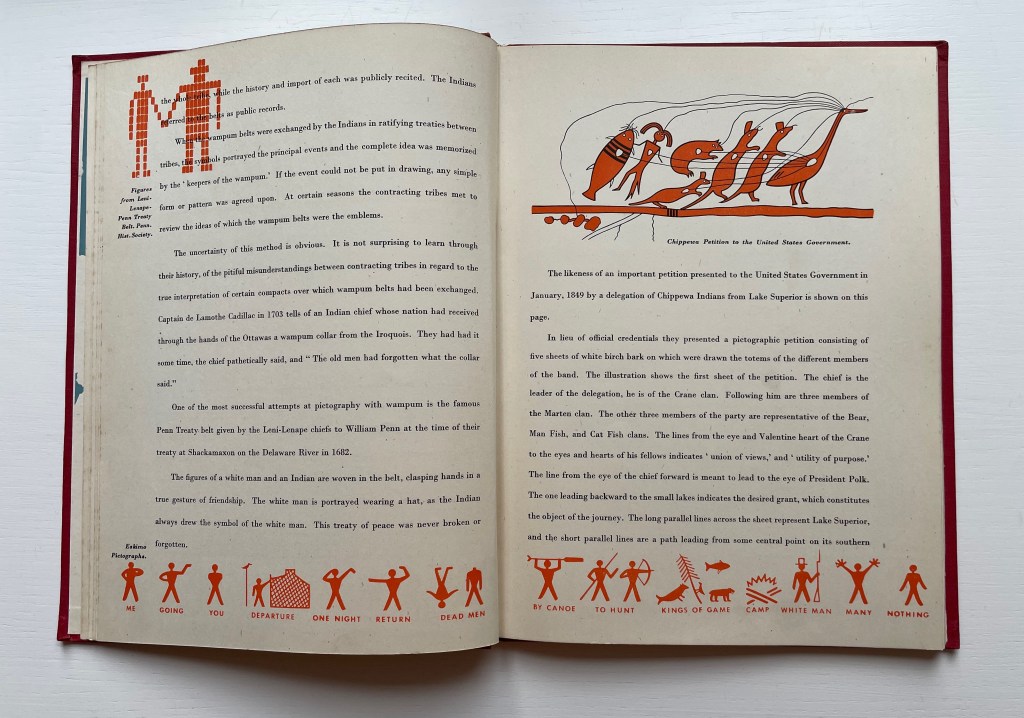
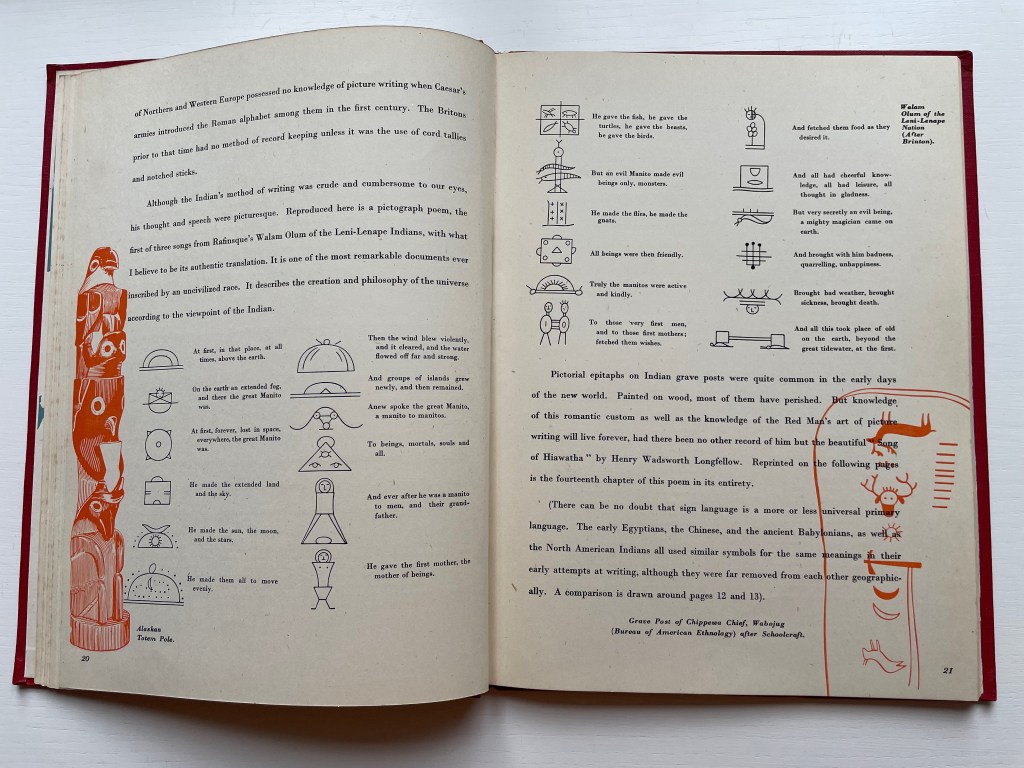
Among the primers of alphabet history, Thompson’s also stands out for the attention it gives to North American Indian pictorial writing. Rather than the usual Eurocentric sources, the Leni-Lenape, Dakota and Sioux Nations provide the bulk of examples of the method. The enlightened perspective, however, is undercut by a strain of cultural and historical supremacy apparent in several passages and, in particular, the perpetuation of the Walum Olum hoax and inclusion of a chapter from Longfellow’s Song of Hiawatha to stand in for the absence of any similar memorialization of painted grave posts. Although Thompson is point blank on how “the invasion of the white man” prevented the growth and development of this method of writing, consider this passage describing the Leni-Lenape Penn Treaty of 1682 that was woven with perforated shell beads (wampum):

The figures of a white man and an Indian are woven in the belt, clasping hands in a true gesture of friendship. The white man is portrayed wearing a hat, as the Indian always drew the symbol of the white man. This treaty of peace was never broken or forgotten.

Except that, in the 1860s, most of the Leni-Lenape Nation was forcibly displaced to Oklahoma.

It was not until the 1990s that the so-called Leni-Lenape cosmographical poems of Walum Olum were proven to be fake, but suspicions were strong in the 1930s. All this is compounded as the book laments the ephemerality of the “Walum Olum poems” and the custom of pictorial grave posts:

Pictorial epitaphs on Indian grave posts were quite common in the early days of the new world. But knowledge of this romantic custom as well as the knowledge of the Red Man’s art of picture writing will live forever, had there been no other record of him but the beautiful “Song of Hiawatha” by Henry Wadsworth Longfellow.

Thompson’s design skills and his side note of claim to fame as reportedly the first recipient of royalties for typeface design (Thompson Quill Script) nudged the balance toward acquisition. Maybe perversely the annoying cultural dissonance also nudged the balance in that direction. The book’s presence provides the opportunity to compare it line for line with the other primers and look harder for the signs of the cultural blinkers we are wearing now. Also, with authentic pictorial cosmography available from the Navajo (Diné) Nation and with new archaeological finds from the Middle East (see below for both), perhaps it is time for a new primer against which to compare Thompson and the rest.

Further Reading

Abecedaries I (in progress)“. Books On Books Collection.

Lyn Davies“. 7 August 2022. Books On Books Collection.

Grant, Richard. September 2021. “In the Land of the Ancient Ones“. Smithsonian Magazine. Accessed 20 August 2022.

A review of the film Canyon del Muerto about one of the first female archaeologists, Ann Axtell Morris. What has this to do with Thompson’s book? An ironic coincidence. Morris worked for the archaeologist Sylvanus G. Morley on his Yucatán expedition. Thompson cites Morley in his bibliography. With her husband, fellow archaeologist Earl Morris, and their Navajo team, Ann Morris went on to open the Canyon del Muerto to the discoveries that led to insights into the Ancestral Puebloans, the source of Navajo cosmography. Other than papers coauthored with Earl, Ann’s accounts could only find outlet as juvenile publications. While Sylvanus and Earl may have been the combined inspiration for Indiana Jones, Ann offers the status of artist, first female archaeologist and subject of a current movie as a role model to celebrate with a sidebar in a new history of writing.

Morris, Ann Axtell. 1931. Digging in Yucatan: Archaeological Explorations in 1924. Garden City, NY: Doubleday, Doran & Co.

_______________. 1934. Digging in the Southwest. Garden City, NY: Doubleday, Doran & Co.

Naveh, Joseph. 1975. Origins of the alphabet. London: Cassell.

Oestreicher, David M. 1994. Unmasking the Walum Olum: A 19th-century Hoax. South Orange, N.J.: Archaeological Society of New Jersey.

Ogg, Oscar. 1964. The 26 Letters. New York: T.Y. Crowell.

Robb, Don, and Anne Smith. 2010. Ox, House, Stick: The History of our Alphabet. Watertown, MA: Charlesbridge.

Rossi, Renzo. 2009. The revolution of the alphabet. New York: Marshall Cavendish Benchmark.

Sacks, David. 2003. Language visible unraveling the mystery of the alphabet from A to Z. New York: Broadway Books.

Samoyault, Tiphaine. 1998. Alphabetical Order: How the Alphabet Began. New York: Viking.

Shaw, Gary. 15 April 2021. “Ancient ABCs: The alphabet’s ‘missing link’ discovered in Israel“. The Art Newspaper.