Books On Books Collection – Tupoka Ogette

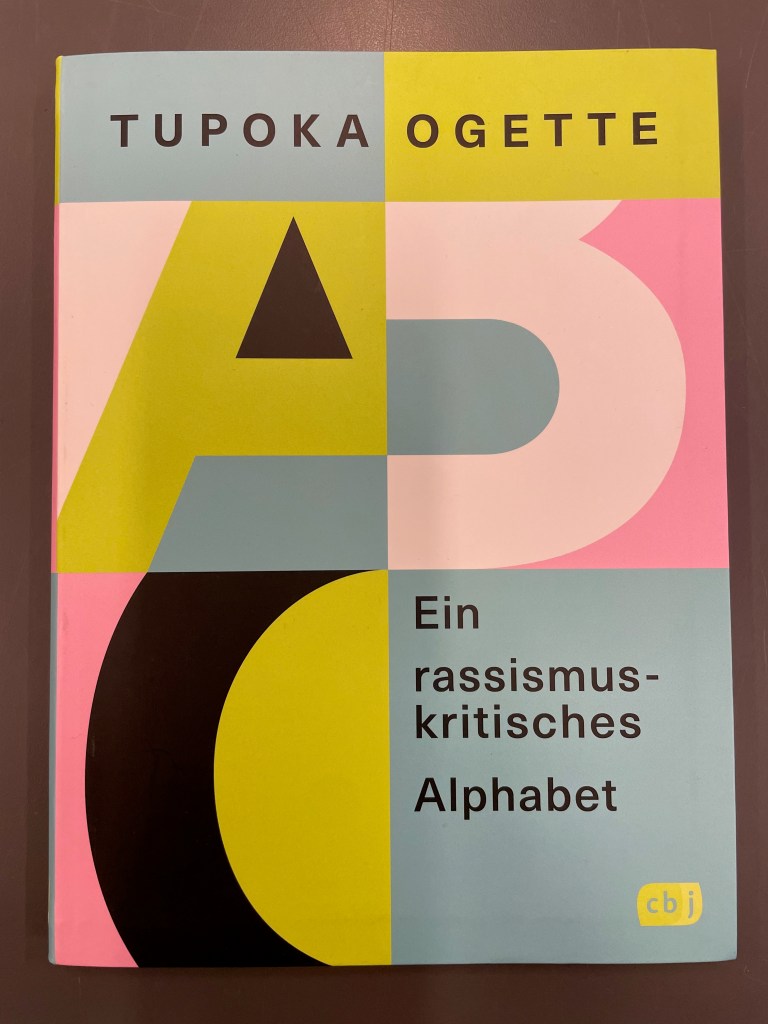
Ein rassismuskritisches Alphabet (2022)

Ein rassismuskritisches Alphabet
(2022)
Tupoka Ogette
Softcover, perfect bound with endbands. H215 x W160 mm. 124 pages. Acquired from Great Book Prices, 1 March 2023.
Photos: Books On Books Collection.

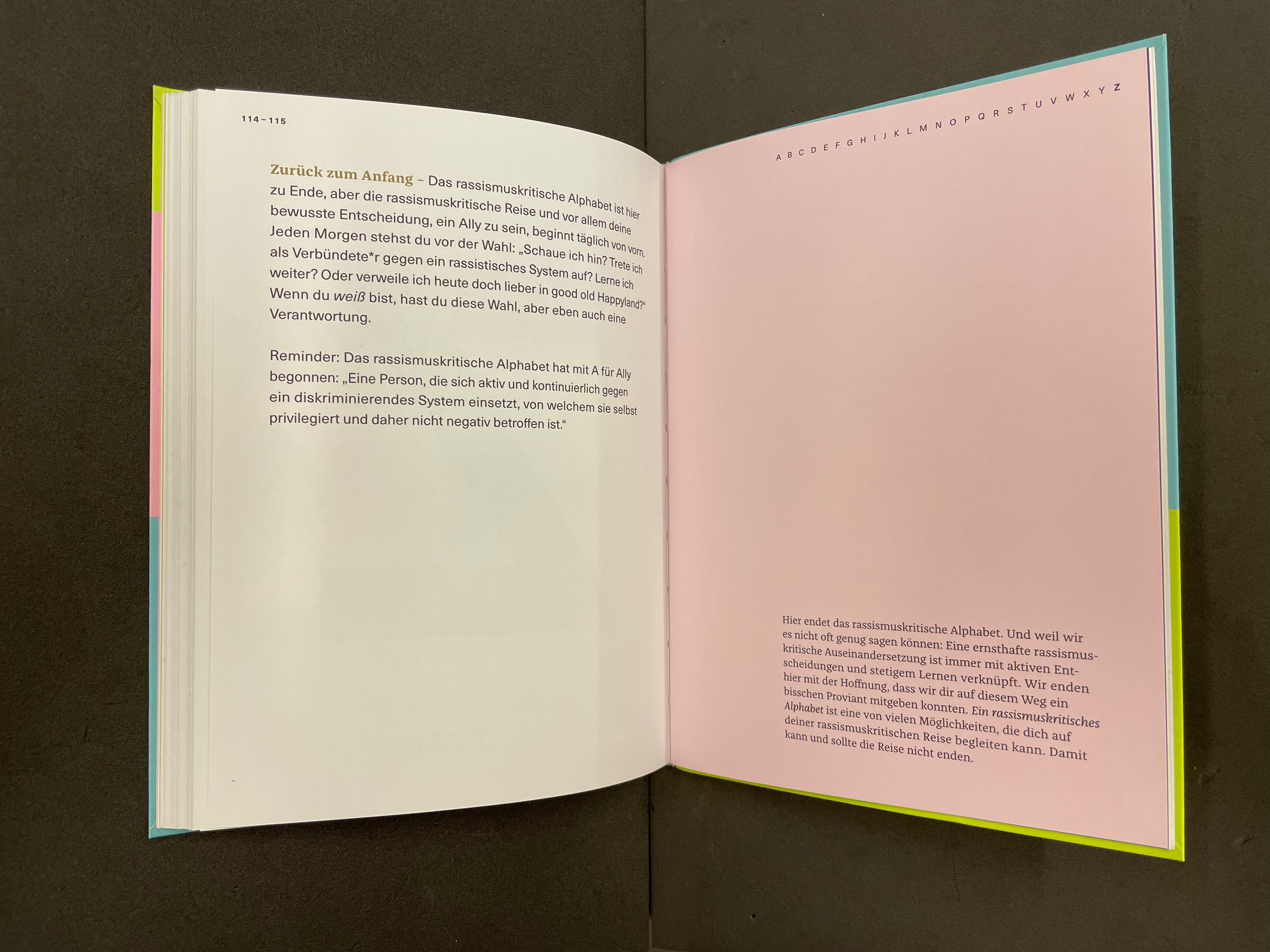
The title of Tupoka Ogette’s book translates literally as “A Racism-critical Alphabet”, but “An Anti-Racist Alphabet” seems more idiomatic. More than an alphabet book, it is a workbook arising from her consultancy for companies, organizations and associations wanting to understand how racism manifests itself and how to address it. Given the consultancy’s focus on German-speaking countries, the book relates tightly to the firm’s workshops, podcasts, etc., so it is not too surprising that it hasn’t been translated into English yet.

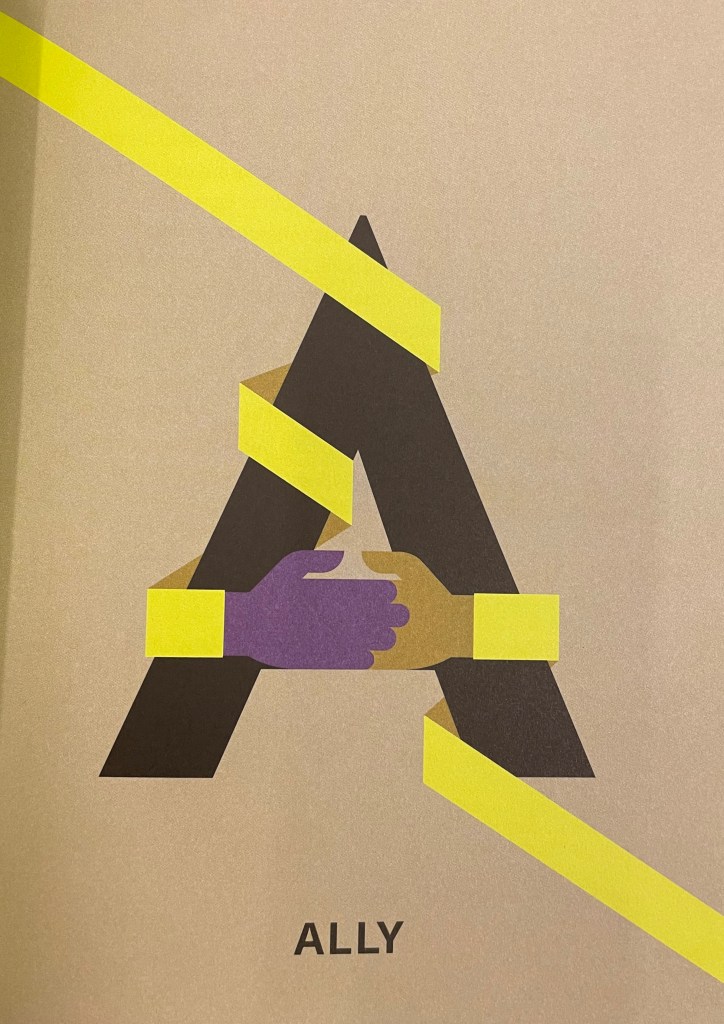
The depth of the problem in English-speaking countries, however, results in most of the terms’ being in the English language: terms like “Ally”, “Blackfacing”, “Colorism”, “Derailing”, “Emotional Tax”, “Gaslighting”, “Happyland”, “Jim Crow”, “Liberation”, “Othering”, “Queer”, “Race-based Traumatic Stress”, “Tokenism”, “White Gaze” and “Yellowfacing”. Add to those terms such cognates as Kolonialismus, N-wort and Xenophobie and it is almost a shock that the text is not in English.
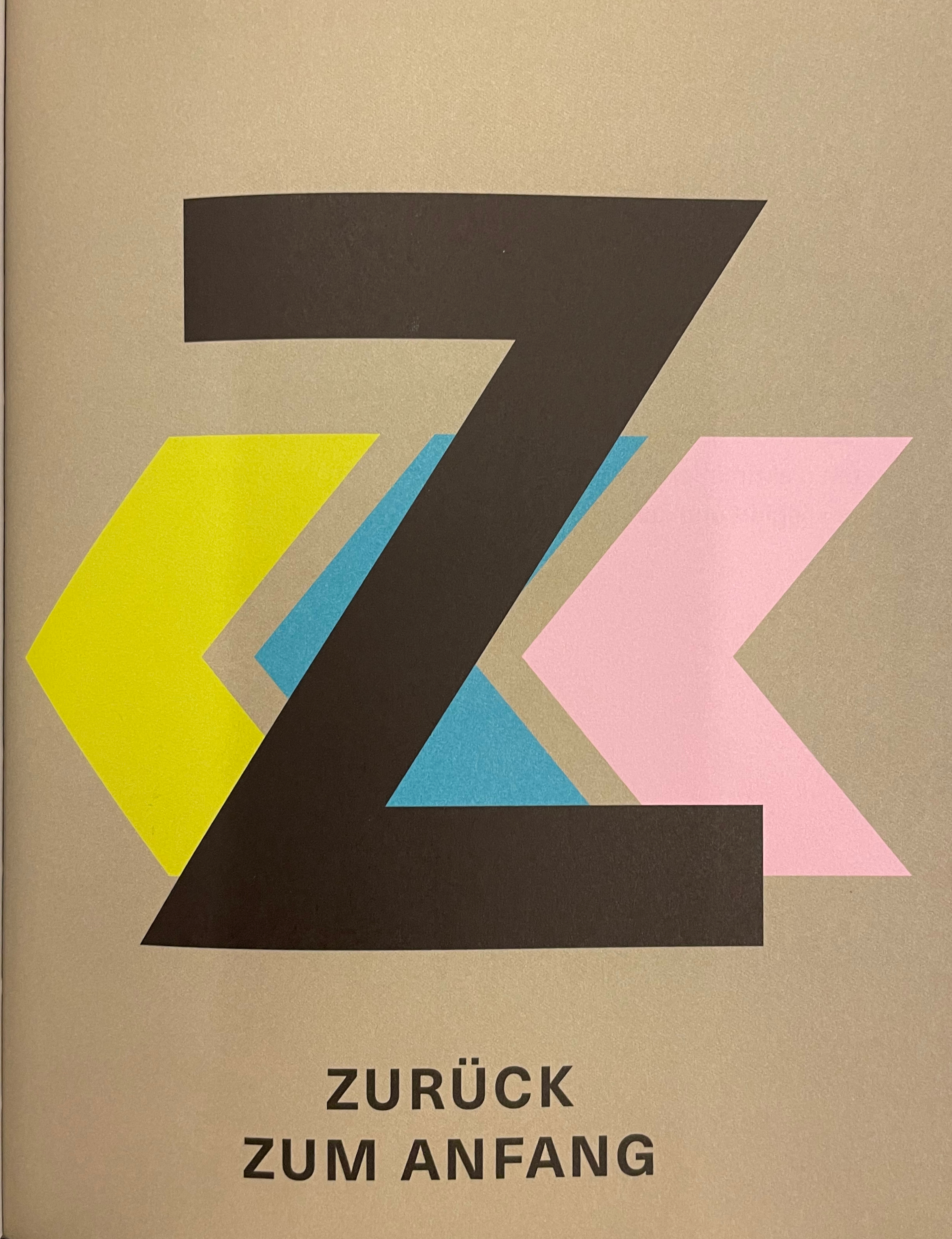
Zurück zum Anfang (“Back to the Beginning”).
“The anti-racist alphabet ends here, but the anti-racist journey, and especially your conscious decision to be an Ally, begins anew every day. Every morning you face the choice: Am I looking? Do I stand up as an ally against a racist system? Do I continue to learn? Or do I stay in good old Happyland today? If you are White, you have that choice, but you also have a responsibility.
Reminder: A person who actively and continuously stands up against a discriminatory system of which he himself is privileged and therefore not negatively affected.” P. 115.

The book’s interior display pages are striking and reminiscent of Ursula Hochuli-Gamma’s 26 farbige Buchstaben (1986) / “26 Colored Letters“, but the cover and text design are very much in the vein of professional trade books for the German market. Adapting the design for the English-language market might present more of a challenge than adapting the text.

Further Reading

Abecedaries I (in progress)“. Books On Books Collection.

Tia Blassingame“. 17 August 2022. Books On Books Collection.

Wendy Ewald“. 15 May 2023. Books On Books Collection.

Ursula Hochuli-Gamma“. 18 November 2022. Books On Books Collection.

Arial Robinson“. 15 May 2023. Books On Books Collection.

Clarissa Sligh“. 2 September 2020. Books On Books Collection.

Kendi, Ibram X. 2019. How to Be an Antiracist. London: Bodley Head.
Books On Books Collection – Wendy Ewald

Wendy Ewald: American Alphabets (2005)

American Alphabets (2005)
Wendy Ewald
Casebound with white headbands and colored doublures. H305 x W260 mm. 168 pages. Acquired from Judd Books, 17 September 2022.
Photos of book: Books On Books Collection. Displayed with artist’s permission.

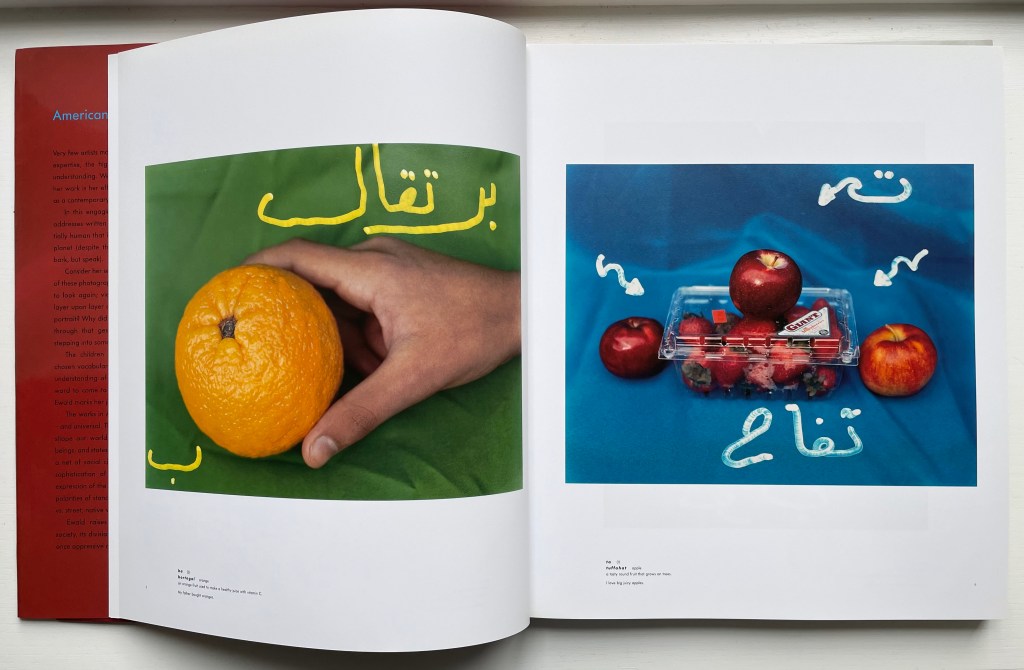
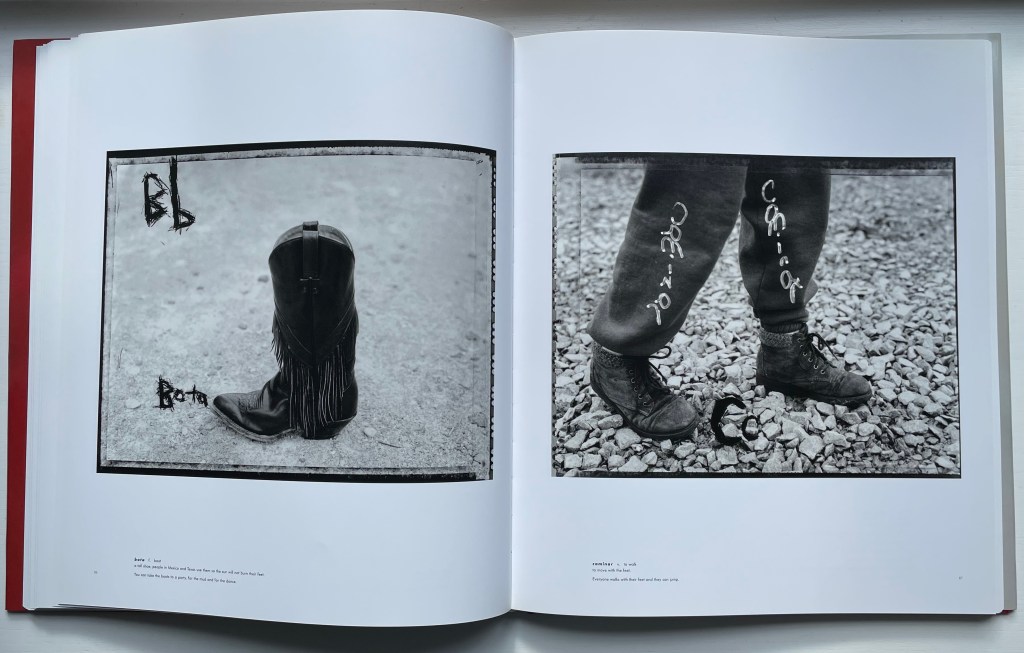
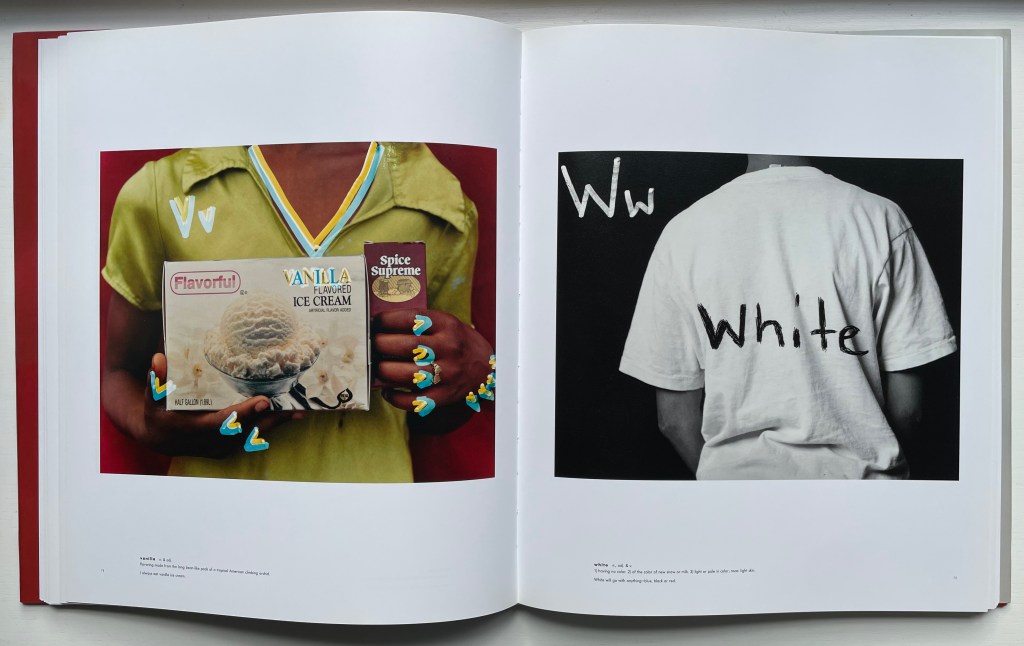
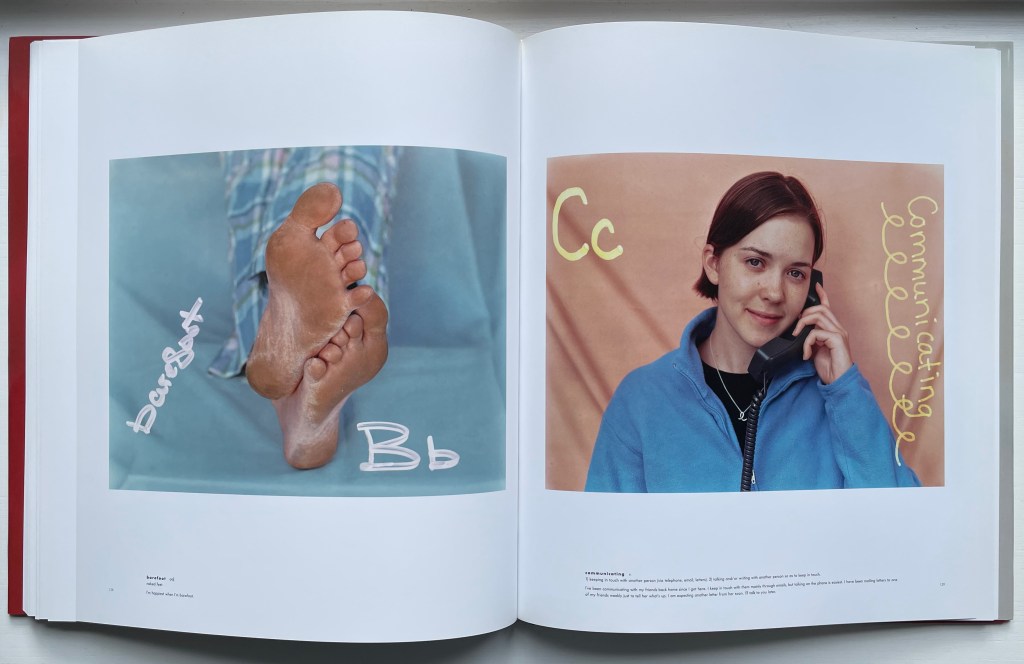
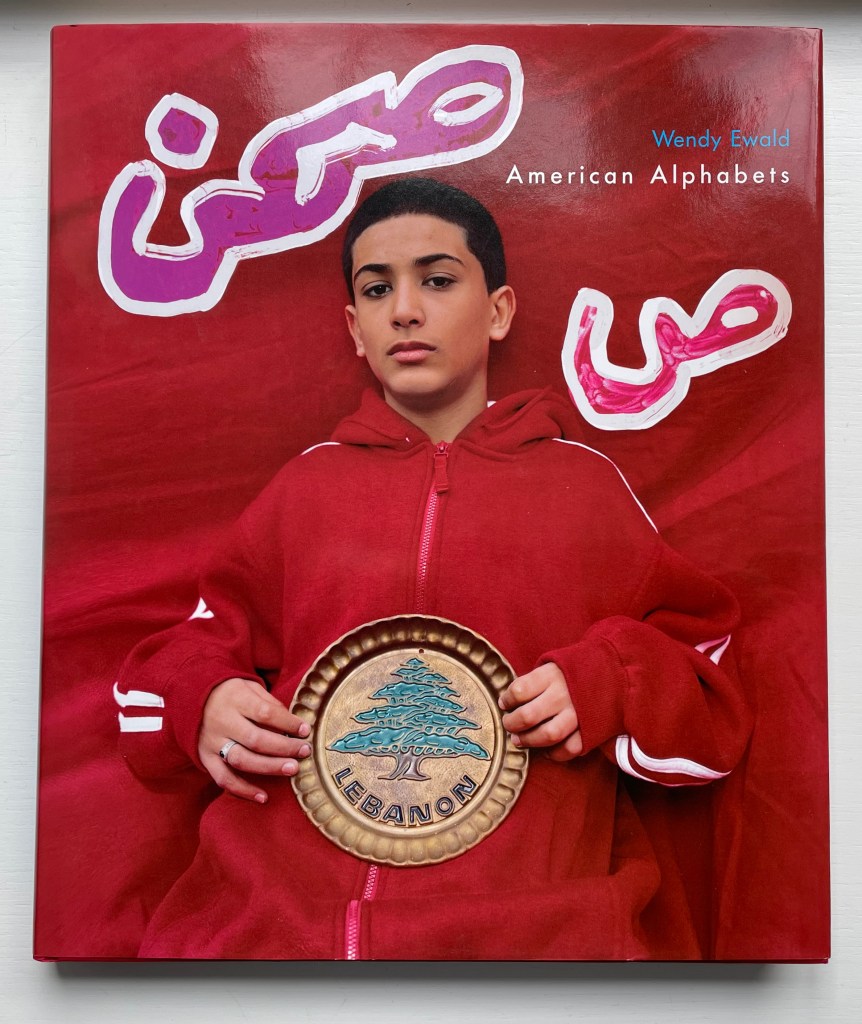
As seen throughout the Books On Books Collection, book art is more often than not a collaborative effort — even if only in the final stages of printing and binding. Ewald’s works, however, depend from the start on collaboration with her subjects — the children. Another recurrent aspect — perhaps the core aspect — in book art is the interaction of the visual and verbal. So, too, in Ewald’s art. In American Alphabets, she brings the collaborative and visual/verbal aspects of book art together at the elemental level of the alphabet. It is the children who pick the letters, words and their illustrative objects to be photographed. In the book’s “Afterword”, Ewald writes:

Like most everyone I know, I first encountered written language in children’s alphabet primers. Looking back, I now see that the words and visual examples used to represent letters reinforced the world view of the middle-class white girl I happened to be. … Putting together these various alphabets — each of them at once American and foreign — taught me a lot about written language, especially about how we have come to take this sophisticated and fundamental medium for granted. … The shape of letters mimicked the objects for which they were named. The letter R, for example, came from the Egyptian hieroglyphic for head or chief: resh. … When Woroud, one of my students from Queens, chose the word raas, or “head,” to represent the letter R, it seemed natural enough. I was startled, though, when she insisted that her head be photographed in profile, just as in the drawing of the ancient letter.

An abiding aim of Ewald’s art is to elicit or allow her collaborators’ voices and world views to create communities that overcome differences by celebrating differences. The reduced, screen-bound images here do not do justice to her four alphabets in one volume or her portraiture and photographic artistry. They may, however, convey the breadth and racial inclusivity of her vision. Arab-American, Latinx-American, White American and Black American are the American alphabets that Ewald aims to capture in this volume.

Another of Ewald’s projects ripe for an artist’s book — or rather artists’ book — is Black Self/White Self (1994-1997). Imagine the book she might create from her young collaborators’ efforts if they were brought to Penland, Women’s Studio Workshop or Art Metropole. Here is the North Carolina-based project in her own words:

When I began working in Durham’s inner city, more and more of the white population had moved to the suburbs and the public schools became segregated along city-county lines. Proposals to merge the school systems were stymied by objections from both sides.

In 1994, after the Durham school systems were finally merged, I designed a collaborative project that looked directly at the issue of race. I asked children to write about themselves, then to write another version, this time imagining themselves as members of another race.

This was greeted first with silence, then laughter, and finally with an enthusiastic barrage of questions.

Once the children had completed their written portraits, I photographed them posing as their “black” and “white” selves, using props they had brought from home. I gave them the large-format negatives to alter or write on, in keeping with ideas from their written portraits, so they could further describe the characters they had imagined themselves to be.

Extraordinary.

Further Reading

Abecedaries I (in progress)“. Books On Books Collection.

Tia Blassingame“. 17 August 2022. Books On Books Collection.

Global Afrikan Congress“. 15 May 2023. Books On Books Collection.

Tupoka Ogette“. 15 May 2023. Books On Books Collection

Arial Robinson“. 15 May 2023. Books On Books Collection.

Ewald, Wendy. 2002. The Best Part of Me : Children Talk About Their Bodies in Pictures and Words.Boston: Little Brown. Fifteen subjects decide what part of their bodies will be photographed and then described in their own words.

Ewald, Wendy, Adam D Weinberg and Urs Stahel. 2000. Secret Games : Collaborative Works with Children 1969-1999. Zurich: Scalo.

Books On Books Collection – Arial Robinson

The Modern Day Black Alphabet (2020)

The Modern Day Black Alphabet (2020)
Arial Robinson
Casebound. Paper over boards. H290 x W220 mm. 64 pages. Acquired from Amazon, 24 June 2021.
Photos of the book: Books On Books Collection. Displayed with artist’s permission.

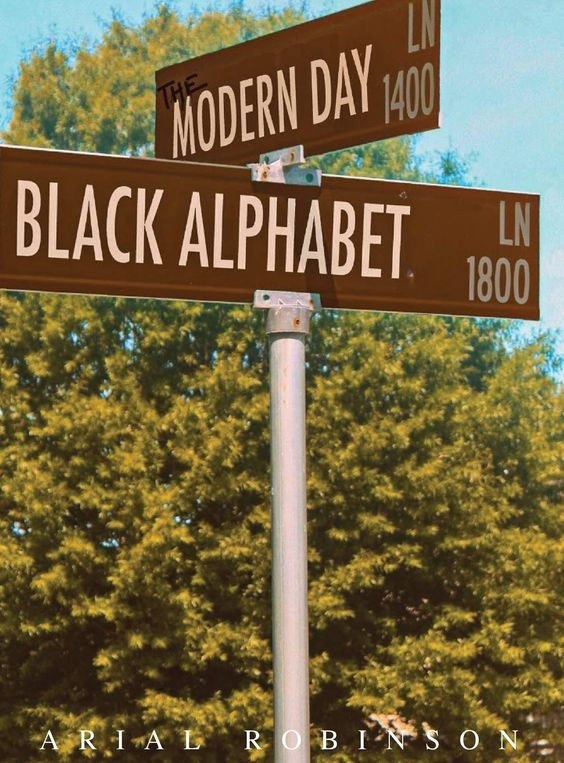
Arial Robinson is a multidisciplinary artist based in North Carolina. Her photography captures the air, sky, suburban streets and heat of the state, and her book captures its Black community in a way that pushes through any “White gaze” that it encounters.

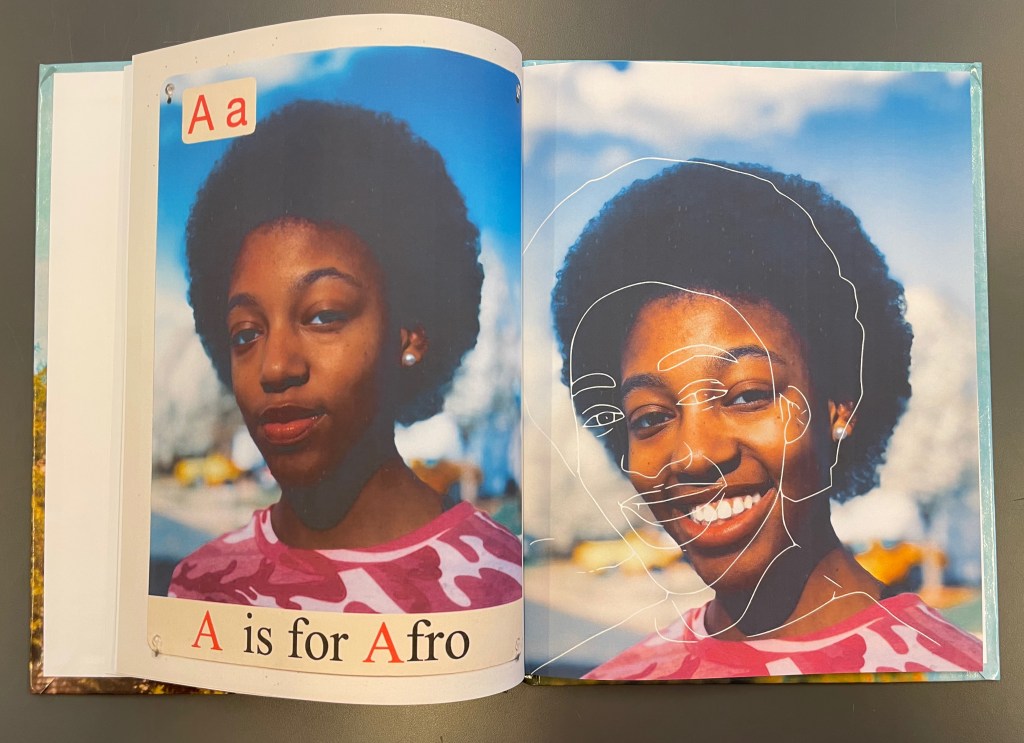
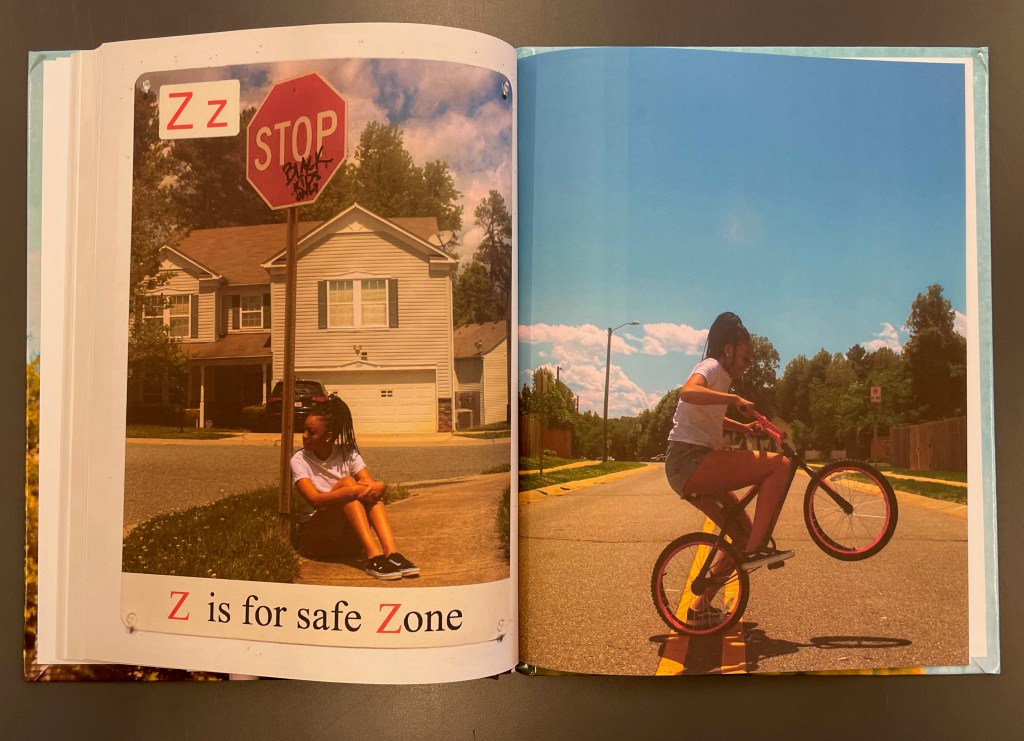
Letter A’s pair of looks — one coolly appraising its viewer and the other warmly smiling but outlined off center in white ink — begins the push with subtlety. The dual images of “Z is for safe Zone”– addressing the viewer with a Stop sign graffitied “Black Kids Only” and a young girl forming a letter Z with her bike, occupying the whole street under a Carolina blue sky — end it more directly.

Between A and Z, The Modern Day Black Alphabet primarily addresses young Black readers, celebrates them eating a popsicle, studying, cooking or drinking from a spigot and takes pride in taking care of appearances — especially hair and dress. Throughout, most of the double-page spreads have an edginess. Sometimes it’s an edgy, out-loud humor, as in “O is for Outside” with its can of “air freshener” labeled “You Smell like Outside”. Sometimes it’s the loud-quiet edginess of “X is for eXcellence” which juxtaposes a pile of certificates of accomplishment with a black-jacketed self-portrait and lapel pin that reads “We Call BS”. Always it’s the edginess of an artist in control of technique, material and vision directing her gaze on herself and her world.

Further Reading

Abecedaries I (in progress)“. Books On Books Collection.

Tia Blassingame“. 17 August 2022. Books On Books Collection.

Wendy Ewald“. 15 May 2023. Books On Books Collection.

Ursula Hochuli-Gamma“. 18 November 2022. Books On Books Collection.

Tupoka Ogette“. 15 May 2023. Books On Books Collection.

Clarissa Sligh“. 2 September 2020. Books On Books Collection.

Allah, Saladin. 21 February 2021. “Animation Series: The Modern Day Black Alphabet“. Accessed 1 April 2023.

Books On Books Collection – ABC in Dixie

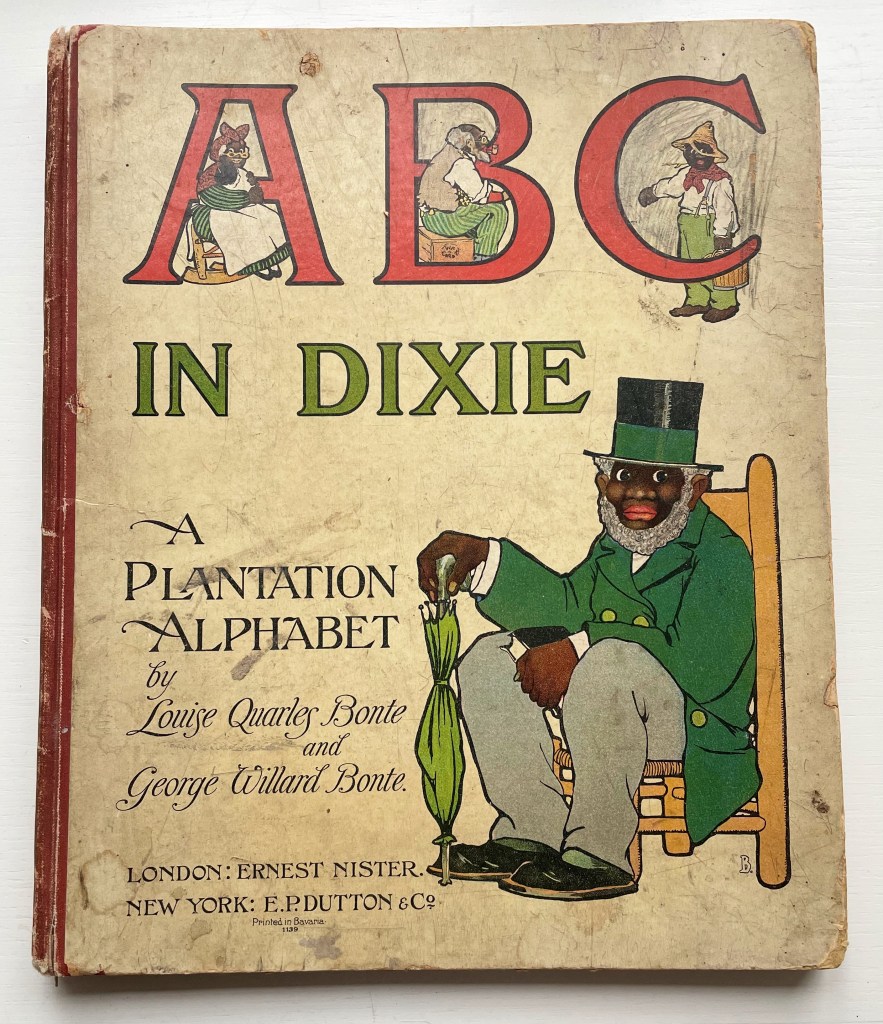
ABC in Dixie: A Plantation Alphabet (ca. 1900)

We see the world through our letters. Horn-books with their Christian catechisms. Moralizing Victorian alphabet books.

George Willard Bonte from Cincinnati, Ohio and Marie Louise Quarles from Richmond, Virginia were both born in 1873. When they were four years old, Republican Rutherford B. Hayes cut a deal with southern Democrats to remove federal troops from the Reconstruction South, which tipped the balance in the Electoral College, made him president and ushered in the Jim Crow Era that would see the Civil Rights Act of 1875 declared unconstitutional, new state-level constitutions and voting laws designed to disenfranchise Blacks, the Plessy v. Ferguson decision establishing the “separate but equal” doctrine as constitutional and Woodrow Wilson’s institutionalizing of segregation in the federal civil service. Fifteen Blacks were lynched in Ohio between 1877 and 1950; eighty-four in Virginia for the same period (Equal Justice Initiative). Sometime between 1900 and before 1908, the Bontes, who were married in 1902, published ABC in Dixie: A Plantation Alphabet with the firm Ernest Nister.

Ernest Nister had established his eponymous printing company in Nuremburg, Germany in 1877 and launched his London-based publishing company under the management of Robert Ellice Mack in 1888. Nister ranks with other German innovators of movable books such as Lothar Meggendorfer and Raphael Tuck. He came up with multiple versions of the dissolving-picture book in which the pull of a tab would transform one image into another. He also excelled at applying chromolithography to his books. Nister’s and Mack’s world view would seem mostly reflected in their titles: A Rabbit’s Tale, The Dandy Lion, The Animals’ Trip to Sea, Peeps into Fairyland, Surprising Pictures, Playtime Surprises and More Pleasant Surprises.

ABC in Dixie might seem surprising for a publisher with such a world view. Of course not so surprising for White Americans raised in the Jim Crow era. To whom this copy of the book belonged is unknown. Its cover’s colored-in letter C suggests that it reached at least one child — most likely White. Why was the page opposite “N is fer Noah …” violently torn out? Did a child named Olive take offense at the lines on its reverse?

“O is fer Olive
who looks like she’s white.
She brushes de
missus’ hair
mo’nin’ en night”.

The illustrator’s “light-skinned” caricature speaks volumes to the engrained racism laughingly passed along to young readers. But they were v0lumes no one at Nister’s firm read. Nister’s must have thought it was on to a winner and followed up with a series of postcards based on the book. The one for Valentine’s Day drew on the publisher’s movable book devices and included rolling eyes. Following in the footsteps of W.H. Heinemann with William Nicholson’s Alphabet (1897) and An Almanac of Twelve Sports (1897), Nister’s also signed up George Bonte for The Coon Calendar for 1905.

Why have a work like this in the Books On Books Collection? For its chromolithography? Yes. For its connection with Ernest Nister? And yes. But the full answer is to be found in another collector’s viewpoint. In 2012, now retired professor of sociology David Pilgrim established the Jim Crow Museum of Racist Memorabilia at Ferris State University in Michigan. The museum presents over 10,000 objects of hate that were part of growing up Black in the Jim Crow era. It exists to “use items of intolerance to teach tolerance”. Pilgrim’s 2005 essay explaining how the museum came to be and how it works is powerful. It needs to be. Jim Crow 2.0 is with us. The museum’s voice is still needed against ongoing violence, book-banning, voter suppression driven by legislatures and Supreme Court decisions and anti-immigrant measures taken around the world.

ABC in Dixie is here for its representation of how alphabets construct a world view. It is also here to be confronted with other world views. Rather than being coddled among rosy-cheeked children’s books — as it once was in Ernest Nister’s catalogue — ABC in Dixie sits here to be discomfited by American Alphabets (2005) by Wendy Ewald, Mourning/Warning (2015) by Tia Blassingame, Transforming Hate (2016) by Clarissa Sligh, R is for Reparations (2019) by the Global Afrikan Congress, The Modern Day Black Alphabet (2020) by Arial Robinson and Ein rassismuskritisches Alphabet (An Anti-Racist Alphabet) (2022) by Tupoka Ogette. By way of apology, if these other world views are seen alongside that of ABC in Dixie, maybe the arc of history can be bent a bit further toward justice a bit sooner.

Further Reading

Abecedaries I (in progress)“. Books On Books Collection.

Tia Blassingame“. 17 August 2022. Books On Books Collection.

Wendy Ewald“. Books On Books Collection.

Global Afrikan Congress“. Books On Books Collection.

Tupoka Ogette“. Books On Books Collection.

Arial Robinson“. Books On Books Collection.

Clarissa Sligh“. Books On Books Collection.

Lester, Neal. 14 March 2022. “Black Children’s Lives Matter: Representational Violence against Black Children“. Humanities11(2), 41; 

Nister, Ernest. 1980. Magic Windows : An Antique Revolving Picture Book. London: Collins. Originally published by Nister in 1895.

Nister, Ernest. 1992. Keepsake Carousel : Dimensional Reproductions of Antique Art. Manchester: World International Publishing.

Pilgrim, David. 20o5. “The Garbage Man: Why I Collect Racist Objects“. Jim Crow Museum of Racist Memorabilia.Ferris State University, Big Rapids, Michigan. Accessed 1 May 2023.

University of North Texas Libraries. 2000. “Ernest Nister” in Pop-up and Movable Books Exhibit. University of North Texas. Accessed 1 May 2023.

Books On Books Collection – Yevhen Berdnikov

While working on the “Alphabets Alive!” exhibition with the Bodleian to open in July 2023, I came across this project site page by Yevhen Berdnikov, a calligrapher based in Kyiv, Ukraine.

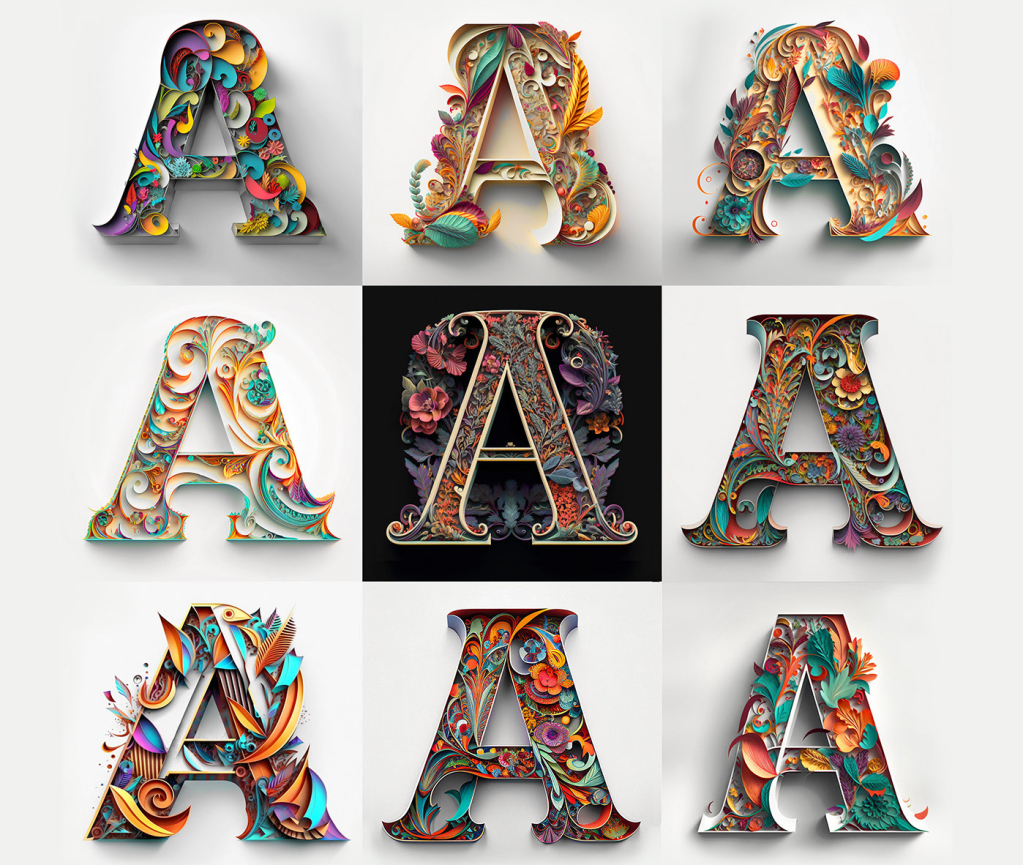
Since “Alphabets Alive!” would primarily concern the creative relationship of artists’ books with alphabets and other writing systems, an AI-generated rendition of the alphabet (humankind’s second-greatest invention, language being the first) was a natural for inclusion. Given the short notice, the artist’s lack of bookmaking experience and — oh yes — the ongoing Russian invasion of Ukraine and attacks on Kyiv, a book was out of the question. Still, with one of the exhibition’s display cases being devoted to artists’ books driven by calligraphy and another to ones driven by color, some way of including these letter images prompted by Yevhen Berdnikov and generated by the text-to-image AI Midjourney from the company of the same name begged to be found.

Paper Cut Alphabet (2023)

Paper Cut Alphabet (2023)
Yevhen Berdnikov
Poster. H x W. Acquired from Yevhen Berdnikov, 8 March 2023.
Images courtesy of Yevhen Berdnikov and reproduced with permission.

When the digital file for the poster first arrived, the treatment of letter Z was a surprise. Even without its current caption, the implication of the treatment was obvious to anyone who knew Berdnikov’s nationality and had seen news images of Russian tanks and military vehicles with Z painted on them. An AI-generated letter Z exists in the Paper Cut Alphabet Project’s files, but, in preparing the poster for a public exhibition, Berdnikov could not bring himself to prompt the AI to generate a symbol that had become intolerable and particularly loathsome on the anniversary of the invasion.

Chance is a well-known muse to many artists. Midjourney, the application, requires an extensive amount of “prompting” — detailed text describing the image it will create. As Berdnikov notes above, the same text can generate different results, which implies an element of randomization at work in the application. But how could a randomizing function yield a meaningful absence of image in response to prompting text? How could machine learning enable Midjourney on its own to compile this version of the alphabet without that particular and human creative intervention?

Even while acknowledging his intervention in Paper Cut Alphabet, Berdnikov insists that he is not the artist, but isn’t his use of Midjourney analogous to Vermeer’s presumed use of a camera obscura to achieve the detail and perspective we see in his paintings? If he did use that technology, does it warrant calling his paintings “device-generated”? Even so, this viewer “feels” the human artists behind View of Houses in Delft (c. 1658) and Paper Cut Alphabet (2023).

Berdnikov’s comments above and his demurrer at being named the “artist” of Paper Cut Alphabet reflect an inquisitive, open and thoughtful mind. Whatever its undetermined implications, the result of his wielding this new artist’s tool is decidedly art.

Further Reading

Abecedaries I (in progress)“. Books On Books Collection.

Kees Baart, Dick Berendes, Henk Francino and Gerard Post van der Molen“. 2 November 2022. Books On Books Collection.

Yevhen Berdnikov“. 4 May 2023. Books On Books Collection.

Bård Ionson“. 9 July 20223. Books On Books Collection.

Karen Roehr“. 26 December 2022. Books On Books Collection.

Connie Stricks“. 9 July 20223. Books On Books Collection.

Ashley Thayer“. 26 December 2022. Books On Books Collection.

Andrew White Tuer“. 26 December 2022. Books On Books Collection.

Bodleian Libraries. 7 July 2023. “Alphabets Alive! 19 July 2023 – 21 January 2024, Treasury, Weston Library“. Accessed 7 July 2023.

Du Sautoy, Marcus. 2019. The Creativity Code : Art and Innovation in the Age of AI. Cambridge Massachusetts: Belknap Press of Harvard University Press.

Miller, Arthur I. 2019. The Artist in the Machine : Inside the New World of Machine-Created Art , Literature and Music. Cambridge Massachusetts: MIT Press.

Tarasenko, Oleg, and Saulė Tolstych. 14 March 2023. “Widespread Anger Ensues Online Over This Viral Instagram Account Whose Photo Portraits Are Discovered To Be Generated By Midjourney“. Bored Panda. Accessed 18 April 2023.

Whiddingdon, Richard.  17 April 2023. “A Photographer Submitted an A.I.-Generated Image to a Prestigious Art Competition to Be ‘Cheeky.’ It Won a Top Prize Anyway“. Artnet News. Accessed 17 April 2023..