Books On Books Collection – Marie Dern

William Caslon’s Typographic ABC (1991)
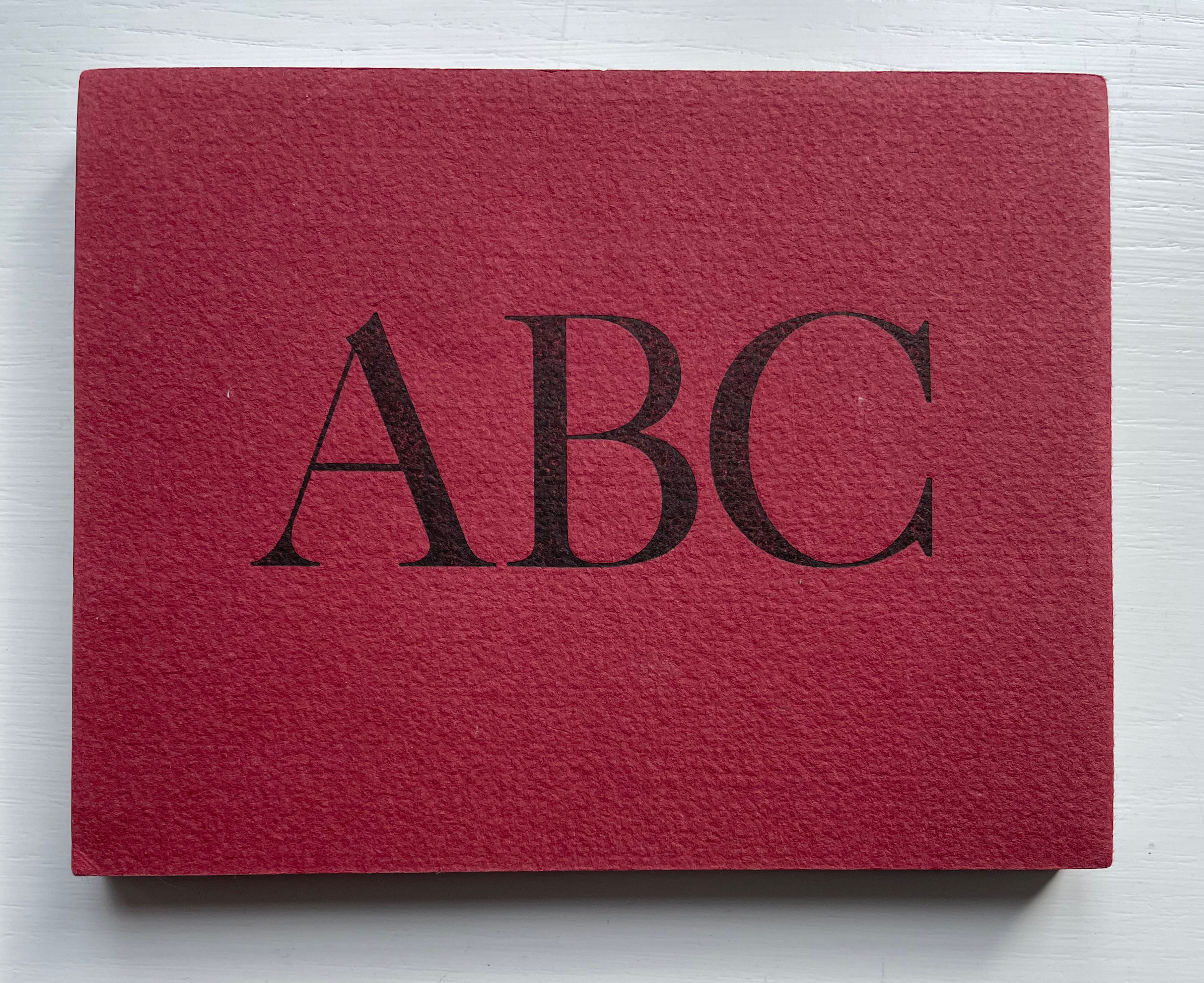
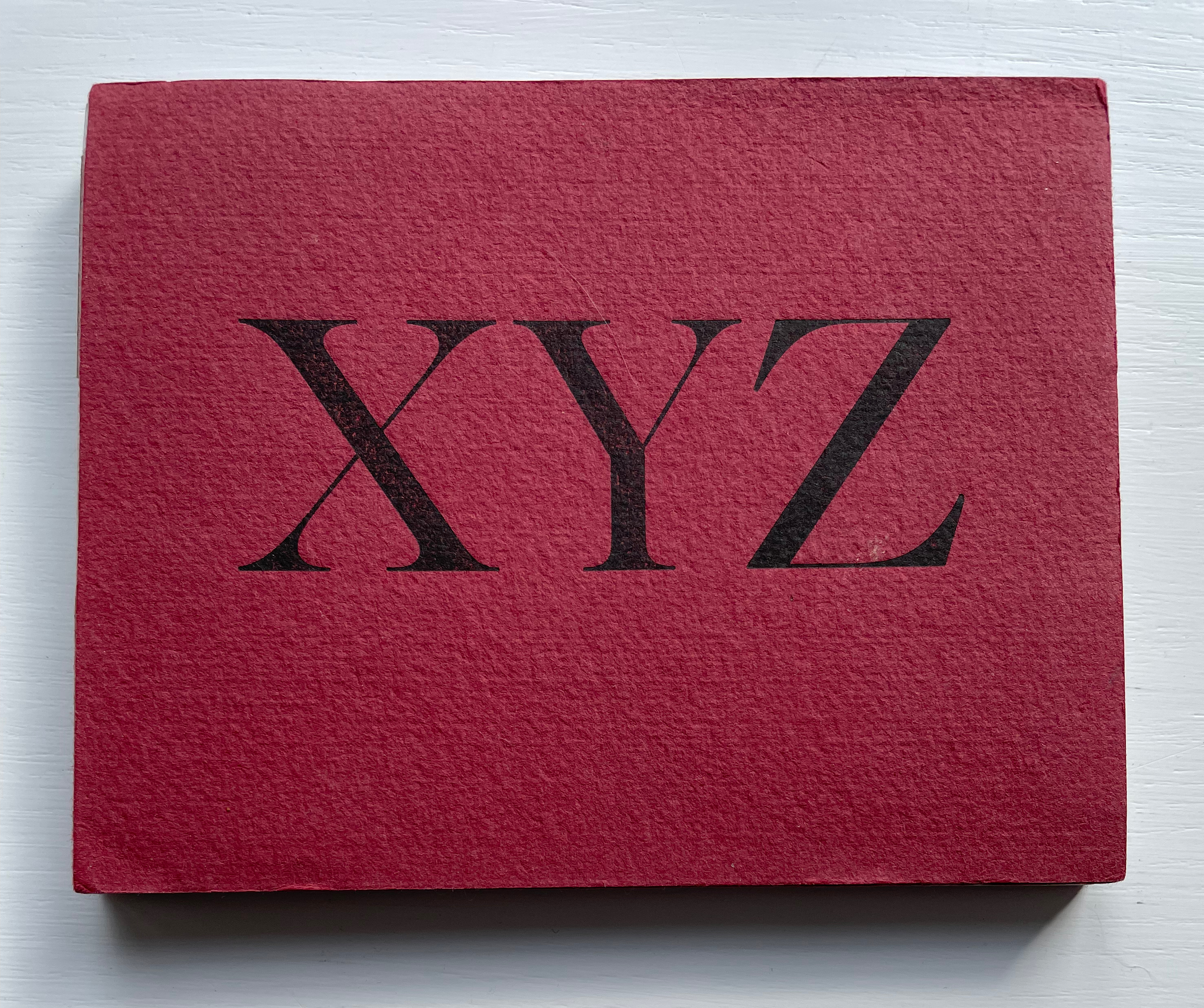
William Caslon’s Typographic ABC (1991)
Marie Dern
Double-sided leporello. H11 x W14 mm. 28 panels. Edition of 55, of which this is #1. Acquired from Bromer’s, 5 February 2023.
Photos: Books On Books Collection.

One of the most common precursors to the codex, the leporello, accordion or concertina structure suits this celebration of what is considered the first original English typeface, designed by William Caslon (1692–1766), used to set both the Declaration of Independence and the U.S. Constitution, and so dominant a font since the 18th century that it prompted its own dicta: “When in doubt, use Caslon”. In Marie Dern’s hands, though, the accordion structure is anything but common. Rather than zigzag folding a long strip of paper, she has attached her panels to two parallel strips of linen tape and left just enough space between the pairs of panels to have the hinged leporello fold down into a precise oblong shape.

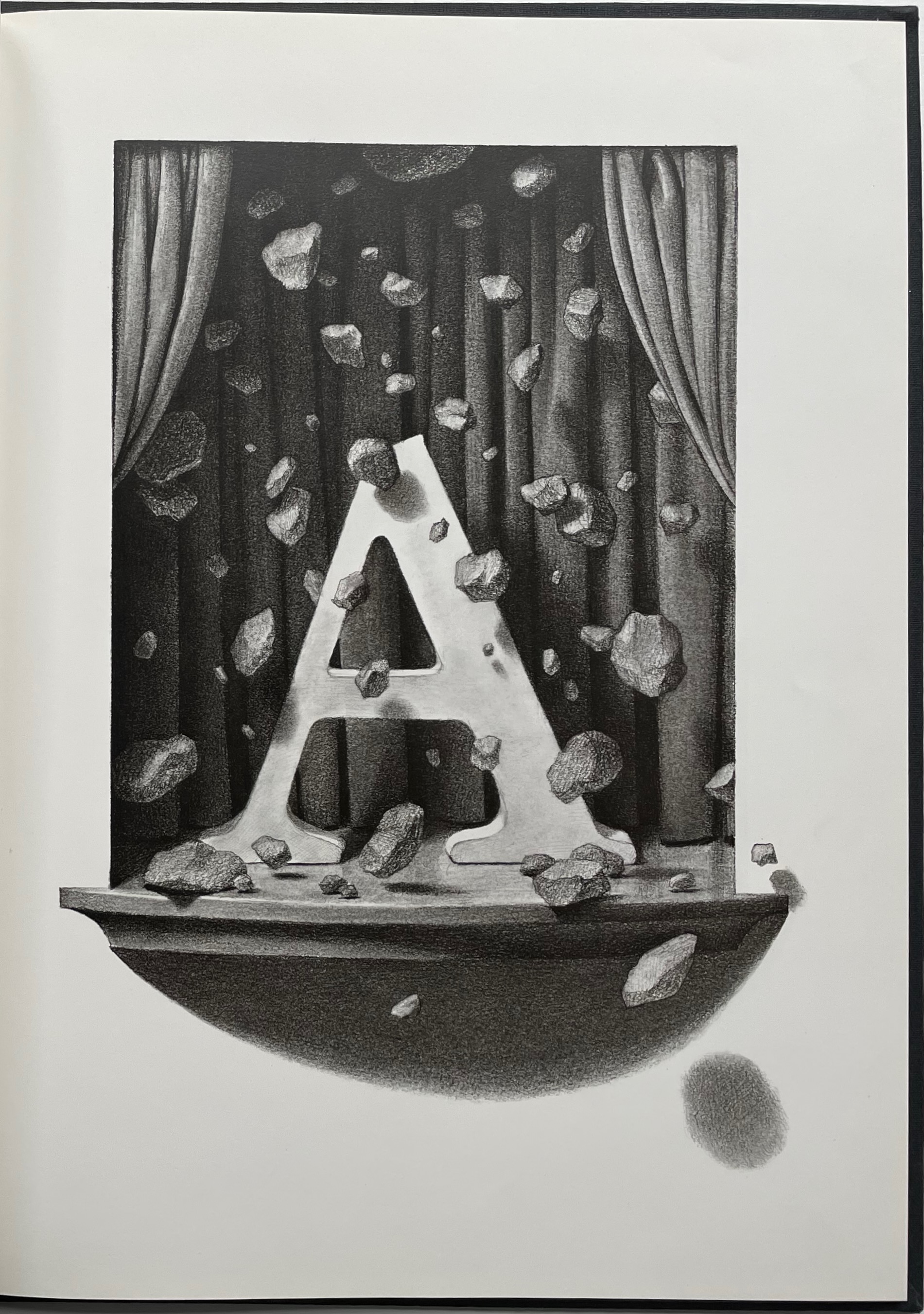
Caslon has featured in such outstanding books as Oliver Byrne’s The First Six Books of the Elements of Euclid: In Which Coloured Diagrams and Symbols Are Used Instead of Letters (1847), nearly an artist’s book in its own right. Dern might have been more immediately inspired, however, by Chris Van Allsburg’s whimsical children’s book The Z was Zapped: A Play in Twenty-six Acts, Performed by the Caslon Players (1987). From the start, bending the alphabet full circle to the ampersand, Dern’s own whimsy extends beyond the letters themselves.
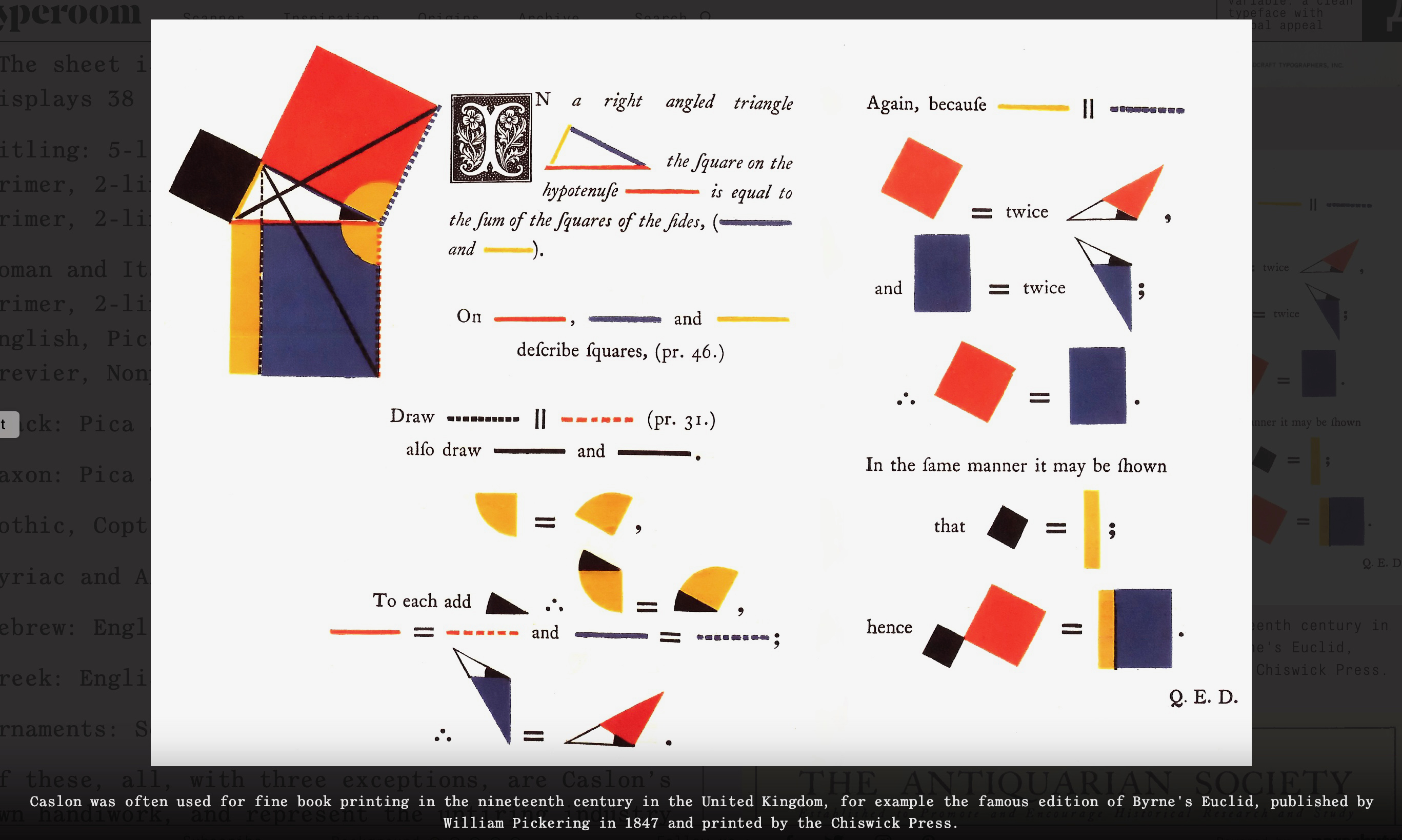
L: from Byrne’s The First Six Books. Typeroom, 23 January 2020. Accessed 8 March 2023.
R: from Van Allsburg’s The Z was Zapped. Photo: Books On Books Collection.
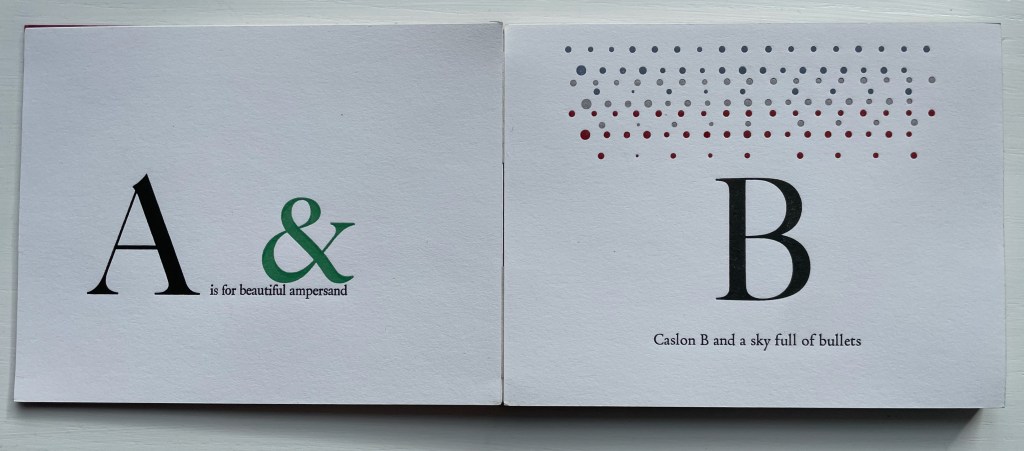
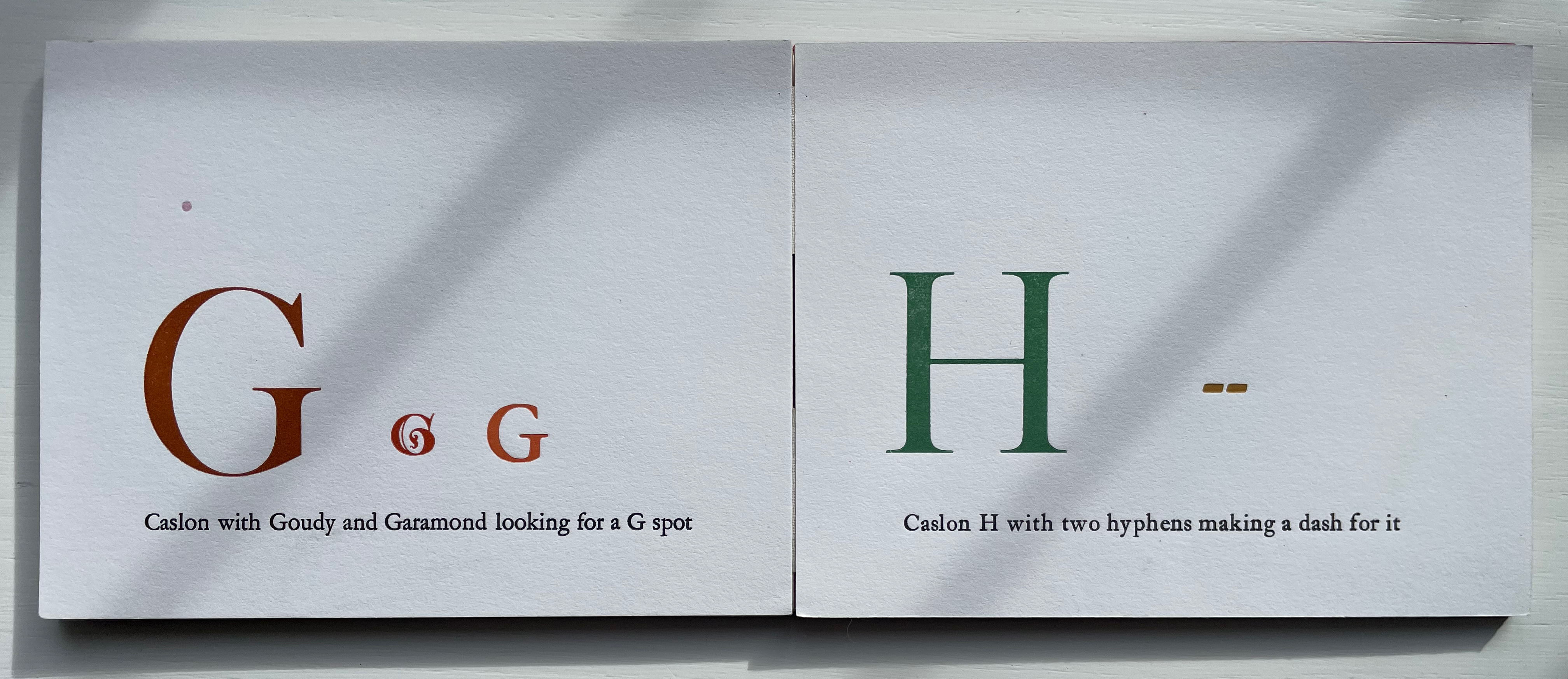
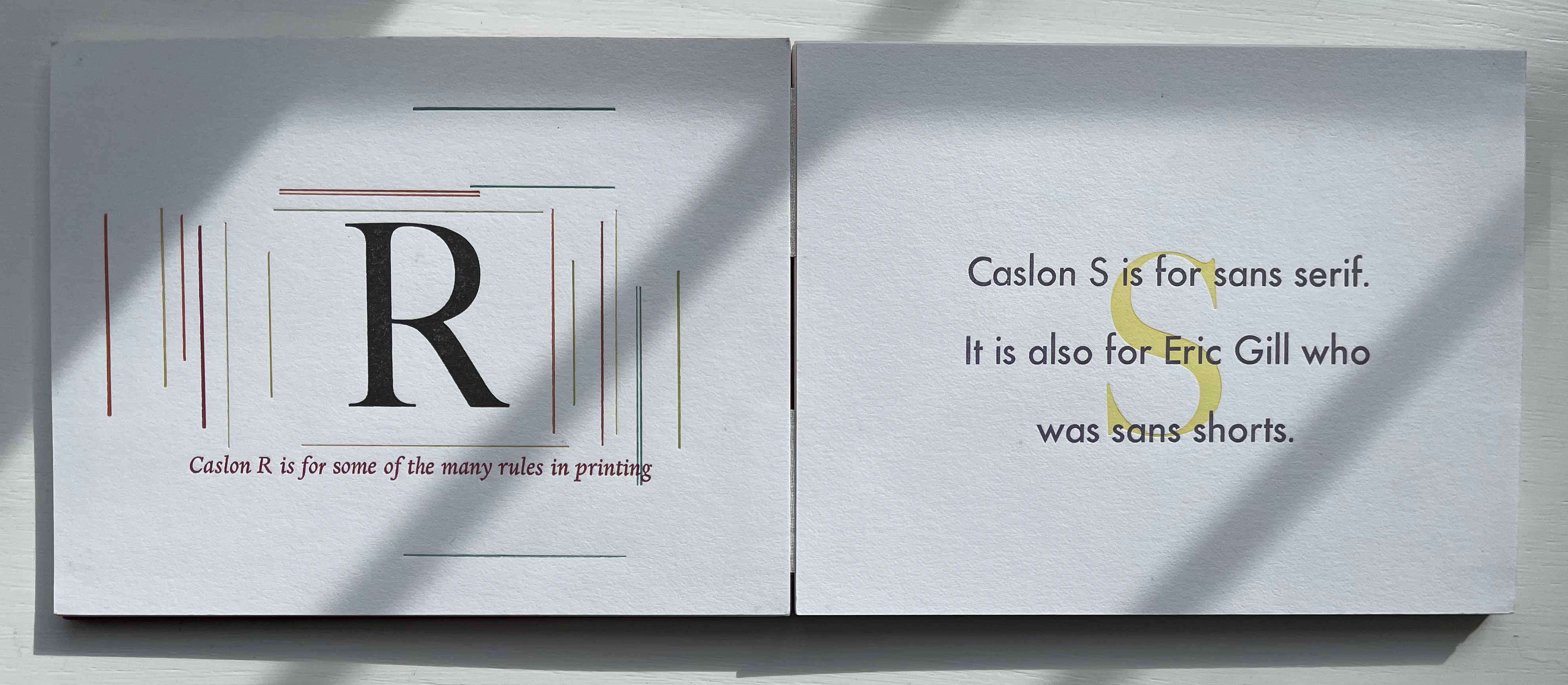
Given its age and dignity, Caslon attracted a fair amount of rock throwing from designers (especially in the 20th century). While Dern may have her own whimsical fun with Caslon, she doesn’t let the rock-throwers off scot free. Her Caslon’s G puts Frederic Goudy on notice that size does matter, and the Caslon S reminds Eric Gill of the emperor’s new clothes.
Other alphabetical typeface celebrations in the Books On Books Collection include Nicolas McDowall’s A Bodoni Charade (1995), Roberto de Vicq de Cumptich’s Bembo’s Zoo (2000) and Sharon Werner & Sharon Forss’ Alphabeasties and Other Amazing Types (2009).

Further Reading

Abecedaries I (in progress)“. Books On Books Collection.

Roberto de Vicq de Cumptich“. 12 February 2021. Books On Books Collection.

Sharon Werner & Sharon Forss“. 20 December 2022. Books On Books Collection.

Nicolas McDowall”. 10 December 2022. Books On Books Collection.

Nicholas Rougeux“. 19 November 2022. Books On Books Collection.

Chris Van Allsburg“. 12 December 2022. Books On Books Collection.

Byrne, Oliver, and William Pickering. 1847. The First Six Books of the Elements of Euclid: In Which Coloured Diagrams and Symbols Are Used Instead of Letters. London: W. Pickering.

Morison Stanley. 1997. Letter Forms : Typographic and Scriptorial : Two Essays on Their Classification History and Bibliography. Point Roberts WA: Hartley & Marks. See pp. 27-28 for the first stones cast in 1937.

Morison, Stanley. 1999. A Tally of Types New ed. [3rd ed.] ed. Boston: D.R. Godine. Caslon is not even included in Morison’s “tally” of seventeen typefaces. It appears on pages 24-27 in his introduction “revised & amplified” by Phyllis M. Handover. Even there they enlist Bruce Rogers, Emery Walker and William Morris to chuck additional rocks in Caslon’s direction on pages 37-38.

Books On Books Collection – Felice Feliciano

Alphabetum Romanum (c. 1460)

Alphabetum Romanum: The Letterforms of Felice Feliciano
Felice Feliciano (c. 1460)
Jason Dewinetz, drafting/printing (2010) and Mark Cockram, bookbinding (2022)
Boxed and casebound, sewn. Box: 222 x 172 x 30 mm. Book: 202 x 155 mm. 82 pages. Sheets acquired from designer/publisher. Binding acquired from designer book binder.
Photos: Books On Books Collection.

One of the pleasures of collecting alphabet-related works and living close to Oxford University is the opportunity to place new work next to older ones. An added pleasure in this case is seeing a new work made newer by a designer bookbinder.

As the foreword and afterword to this work explain, Jason Dewinetz’s redrawing of Felice Feliciano’s letterforms (c. 1460) was in fact prompted by two 20th century responses to Feliciano’s original: the first being Giovanni Mardersteig’s edition in 1960 at Editiones Officinae Bodoni and the second, also overseen by Mardersteig, being the facsimile edition issued by Jaca Book Codici over 1985-87 and separately by Belser Verlag in 1985. The Bodleian Library has both the Officinae Bodoni and Belser editions. An opportunity too good to miss and one worth sharing.

Left: Dewinetz edition. Center: Feliciano’s original in the Vatican facsimile. Right: Officinae Bodoni edition. Photo: Books On Books.

Dewinetz does not reproduce Feliciano’s commentary. His aim is to focus attention entirely on the letters. Although he has restricted his re-presentation of the letters to the recto page (whereas in Feliciano’s original, the letters after A occupy the verso and recto), he is too clever a designer not to find a way to capture the one instance in which Feliciano’s letter drawing and double-page spread interact entertainingly.

For the opening of Paul F. Gehl’s foreword, Dewinetz captures the dramatic flourish of Feliciano’s Q,
whose tail crosses the double-page spread in his original. See below. Photos: Books On Books.

From the Vatican facsimile, Feliciano’s double-page spread with Q and S. Photo: Books On Books.

What happened to the letter R? Feliciano must have felt the need to give it its own double-page spread to show off a variation in coloring and tails. Like Mardersteig, Dewinetz gives the Rs each their own page. Unlike Mardersteig (and Feliciano), he places the Rs in correct alphabetical order.

Feliciano’s letter Rs from the Vatican facsimile. Photo: Books On Books.

Dewinetz’s re-drawing Q,R,R,S. Photo: Books On Books Collection.

Mardersteig follows Feliciano’s disrupted alphabetical order, but for Q and S to keep to a design that places each letter on a recto page facing a schematic drawing on the verso, Mardersteig has to forego the center-crossing tail of the Q and place S on a separate insert leaf.

Mardersteig’s QSRR sequence in the Ediciones Officinae Bodoni edition. Photo: Books On Books.

As a designer bookbinder, Mark Cockram has a deft eye and touch as he looks for and executes the designs inspired by the text. He could not resist Dewinetz’s cropped Q from the foreword by Paul F. Gehl. Taking his Q (as it were) however from the Goudy display font, he gives it a deserved prominence, stamped in black, on the double-trayed box’s spine. The choice of a different font reminds me of Eric Gill’s quip: “letter designing is still an occupation worthy of the enthusiasm of rational beings, and, though a Q which were all queue & no Q would be ‘past a joke’, it is difficult to say exactly where a tail should end”.

Left photo: Courtesy of Mark Cockram. Right photo: Books On Books Collection.

Apparently it was a tail of which Cockram could not let go. Further echoing Dewinetz’s cropping, truncated letter forms peek through the Palimpsest Parchment with which the book itself is bound (flat back). They are laserprinted on hand colored papers, colors inspired by those used in the book. Cockram also echoes the book’s color “ghosting” on the box by layering blank strips of hand colored papers beneath the cloth during the making process. The color-echoes between box and book continue with the box’s interior.

Photos: Books On Books Collection.

The handsome bindings of the Vatican facsimile and Mardersteig edition have stood up to their library existence. In muted tones and gilt, they speak to the design esthetics of a different era.

Vatican facsimile binding

Officinae Bodoni edition binding

When the Dewinetz/Cockram edition joins the Vatican facsimile and Officinae Bodoni edition at the Bodleian, students of lettering, type design, bookmaking and bookbinding and their history will have a feast of an opportunity to compare and contrast.

Further Reading

Abecedaries I (in progress)“. Books On Books Collection.

Gill, Eric. 1931. An essay on typography. London: Sheed & Ward.

Feliciano, Felice, & Mardersteig, Giovanni. 1985. Alphabetum romanum: Vat. Lat. 6852 : Aus der Bibliotheca Apostolica Vaticana (Codices e Vaticanis selecti ; v. 70). Zürich: Belser Verlag.

Feliciano, Felice, Mardersteig, G., & Ferrari, O. 1960. Alphabetum Romanum (Ital. ed.] ed., Biblioteca apostolica vaticana. Mss. (Cod. Vat. 6852)). Verona: Officinae Bodoni.