Books On Books – Jo Hamill

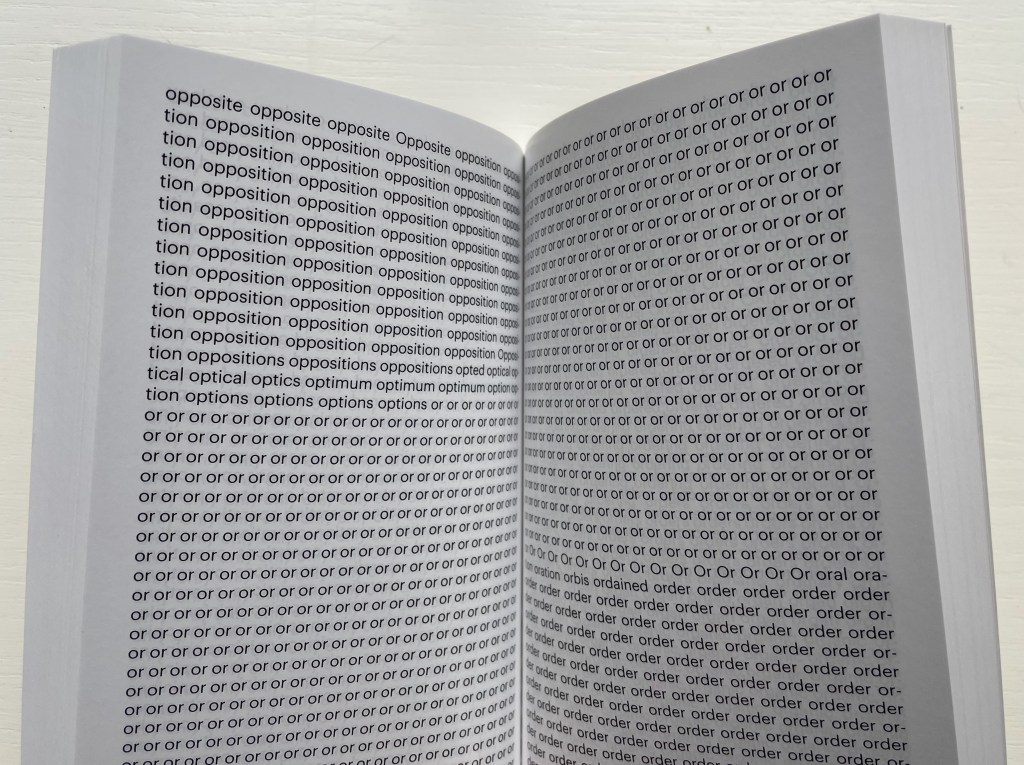
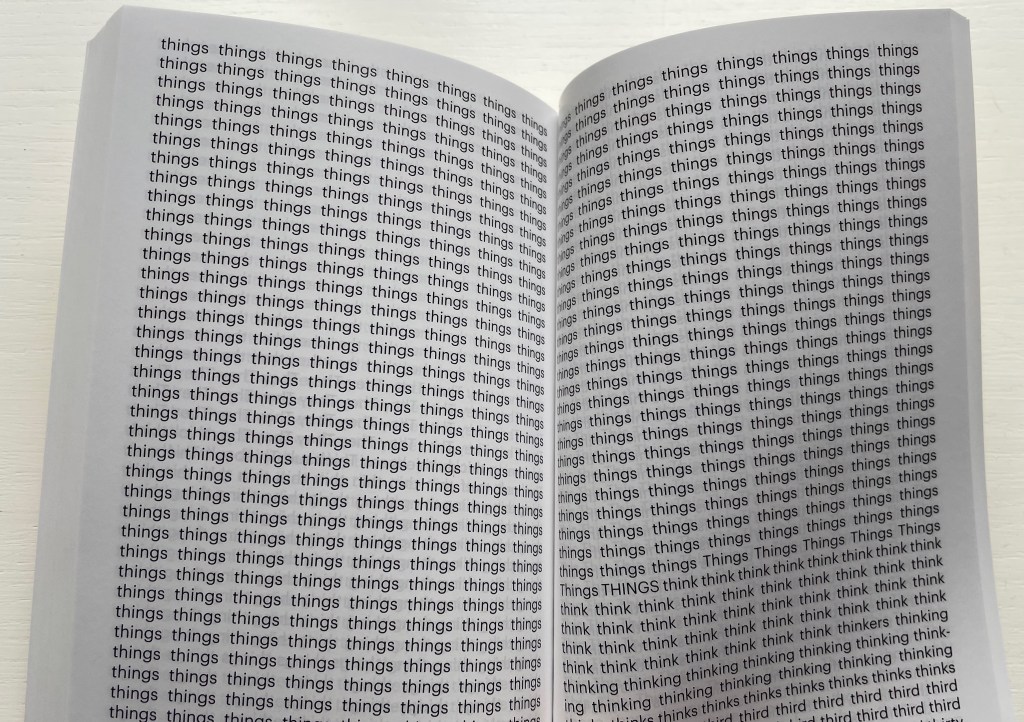
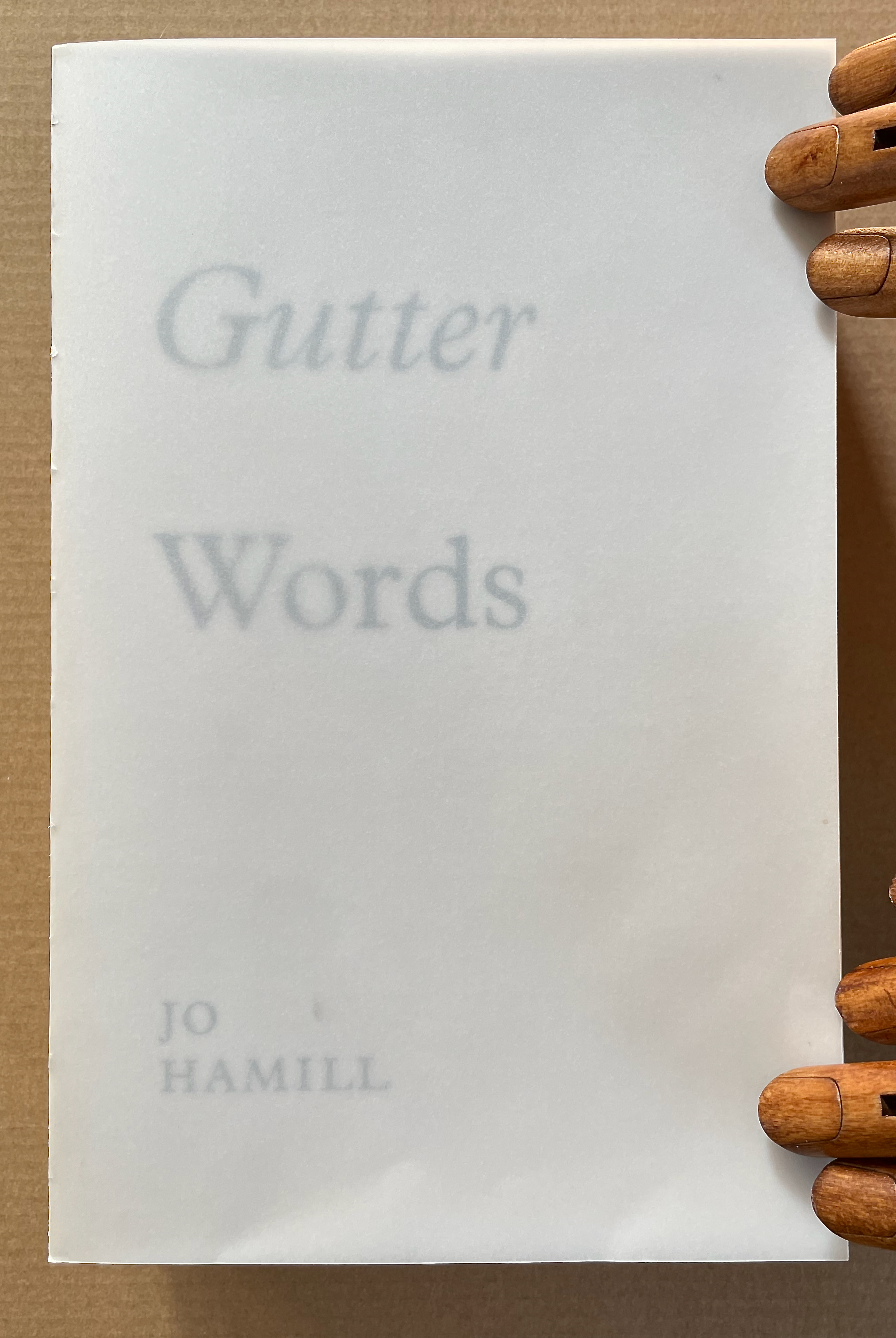
Working with an edition of James Joyce’s Ulysses, Hamill systematically obliterated the words of Joyce but carefully retained those words positioned closest to the gutter – the technical term used to describe the central margin of a bound page. The retained fragments form two extended columns that continue for 933 pages. Notable here is how design and typographic terminology is so entrenched in bodily references. Header, footer, body-copy, the arm of a “K”, the crotch of a “Y”, the foot of a “T”, the ear of a “G”, the shoulder of an “R” and so on. As is the architectural scaffolding of Joyce’s schema which underpins the structure of Ulysses, kidney, genitals, heart, lungs, oesophagus, Brain, Blood, Ear. etc. Lawrence Weiner refers to language as material for construction, the act of deletion in Gutter Words exposes the architectural scaffolding that holds words in place. Voids are physical spaces to be read and words become unanchored, set adrift in an uncertain space. The architectural qualities of this physical space will be exposed, Gutter Words will be devoid of the accoutrements associated with a “book” such as cover, boards, end papers, dust jacket and will retain only the innards, an unprotected text block.–Publisher’s website

Gutter Words (2019)
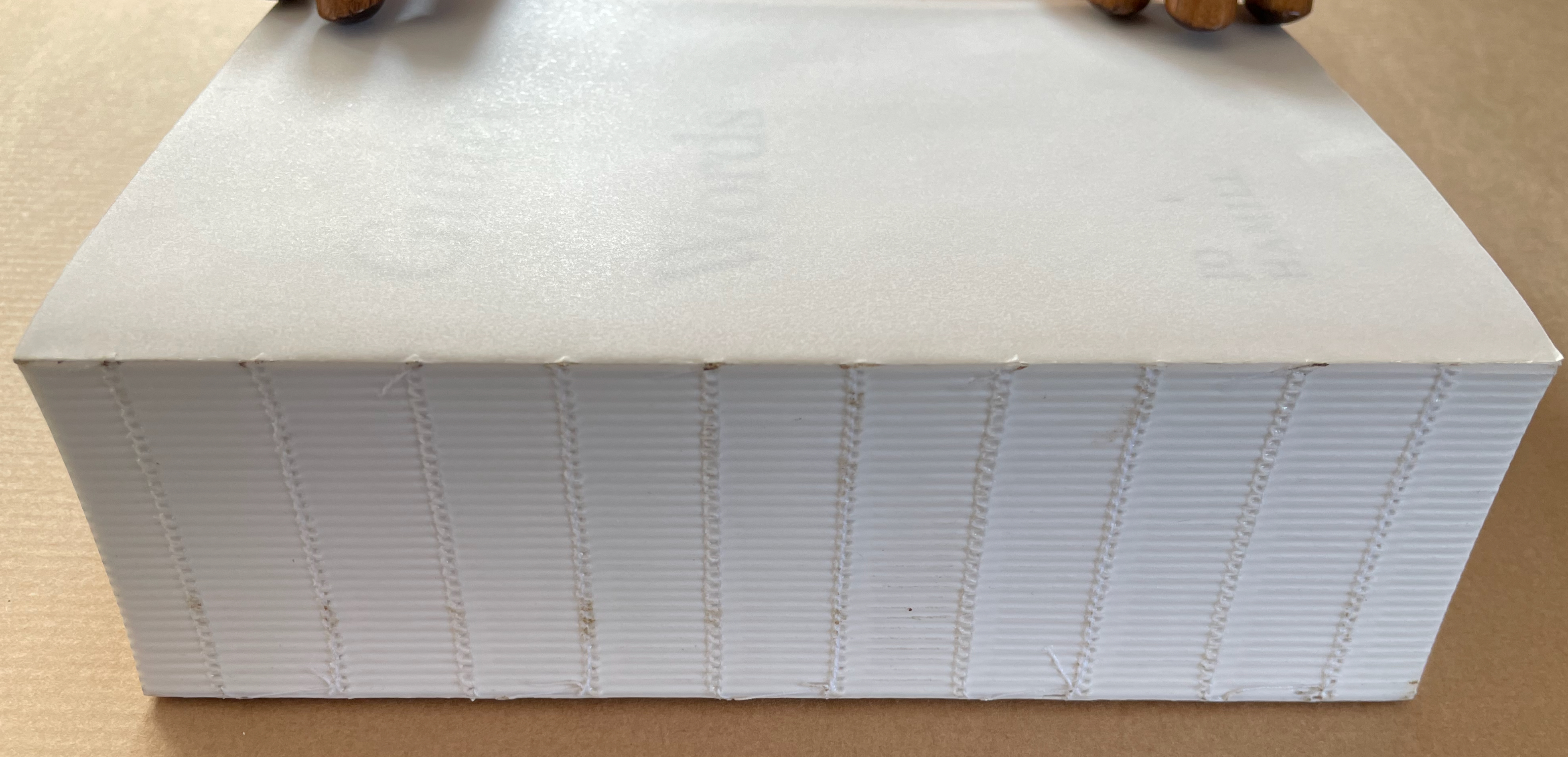
A close-up view of the edge of a thick, white book with a textured spine. The book is partially open, resting on a brown surface, with two wooden hands on top.

Gutter Words (2019)
Jo Hamill
Softcover, exposed spine. H197 x W128 x D60 mm. 956 pages. Acquired from Gill Partington, 20 June 2023.
Photos: Books On Books Collection.

Artists’ books can run the risk of being a “one-trick pony” or a toddler’s newly learned knock-knock joke. Once seen, the trick succumbs rapidly to the law of diminishing returns. A dozen times heard, the joke verges on parental abuse. Conceptualist Simon Popper’s 2006 alphabetized version of James Joyce’s Ulysses (1922) falls into that camp, albeit a stunning one. There may be some ongoing amusement in perceiving the shift from letter to letter and the subsequent alteration of the visual pattern, or in spotting the singular invented words and considering the alphabetization as a comment on James Joyce’s play with language, or in contemplating it in comparison with similar efforts. Like Mikko Kuorinki’s 2012 alphabetized version of Foucault The Order of Things (1970) that cheekily challenges Michel Foucault’s theory of how we perceive social order. Or the alpha and omega of Tauba Auerbach’s BbeehHilloTy or the Alphabetized Bible (2006); well maybe not the alpha, since Silvio Lorusso and Rory Macbeth got there first with theirs in 1997, nor the omega, since Peter Harkins followed up with his 2013 Well-Sorted Version (WSV), algorithmically generated. Apparently, one-up-manship is inevitable. Even Gutter Words has its gatecrasher: John Morgan’s Usylessly (2021) with a pair of essays, not just one. But once the joke is “got”, how rewarding is it to return to it again and again. Is there more to it?

Continue reading
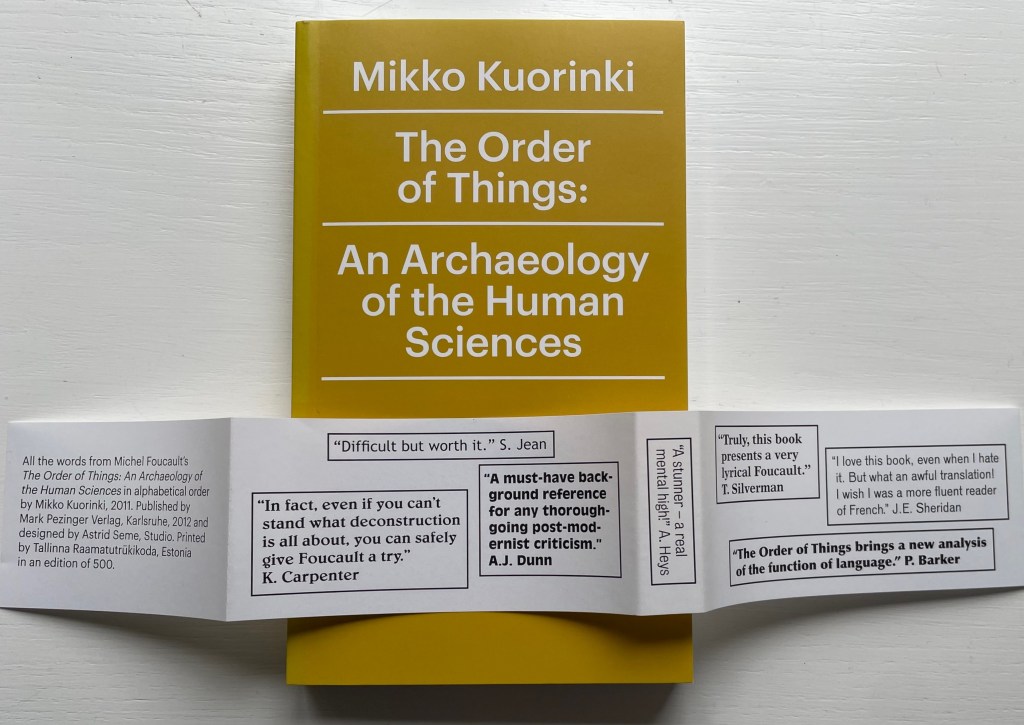
Books On Books Collection – Mikko Kuorinki

The Order of Things:
An Archaeology of the Human Sciences

(2011)

The Order of Things: An Archaeology of the Human Sciences (2011)
Mikko Kuorinki and Michel Foucault
Paperback, perfect bound. H175 x W105 mm. 432 unnumbered pages. Edition of 500. Acquired from XYZ Books, 18 September 2022.
Photos: Books On Books Collection. Displayed with artist’s permission.

Kuorinki’s alphabetical ordering/disordering of one of the sacred texts for literary theorists — Michel Foucault’s 1967 Les Mots et Les Choses: Une Archéologie des Sciences Humaines in its later English translation — rises above that too-frequent result in book art and conceptual art: the one-trick pony. Kuorinki accomplishes this by his choice of appropriation, his choice to use a translation of it and his choice of the alphabet and book art as technique and material.

The alphabet’s arbitrariness and the codical illusion of order and fixity make them the ideal artistic tools with which to make an artwork responding to Foucault’s sweeping treatise on the contingency of knowledge and language. The hefty, tightly bound block of paper and its cover title evoke the memories of anticipation on first picking up any book promising a vision of the order of things. But this book does not even offer a contextualizing preface, an orderly table of contents, chapters, page numbers or index.

When a text becomes canonical — a sort of common expression — how else to respond to it as a visual artist than “to take the mickey”? Of course, as the book’s bellyband tips us off, Kuorinki’s The Order of Things is a joke. And of course, on further reflection, it is serious.

In creating his artist’s book, did Kuorinki know the term calque — the literal, word-for-word translation that becomes a common expression in the borrowing language as in the English it goes without saying from the French ça va sans dire or the English word-hoard from the Anglo-Saxon wordhord? If so, it goes without saying that his work of book art is a calque itself — a literal, word-for-word translation of une alphabétisation of Foucault’s word-hoard for Les Mots et Les Ordres. And if granted its appropriation of the status of calque as a means of appropriating Foucault’s canonical text, Kuorinki’s The Order of Things is a pony of many different colors and tricks. Or to visit another attraction in the fun fair, hasn’t Kuorinki turned Foucault’s sacred text into an artifactual carnival of mirrors?

Further Reading/Viewing

Küng, Moritz. 3 July 2020. Artists’ Books Clips por Moritz Küng. Episode 06 Alphabet Books. Accessed 18 September 2022.

Popper Simon and James Joyce. 2006. The ABC of Ulysses. Belgium: Die Keure.

Videen Hana. 2022. The Wordhord : Daily Life in Old English. Princeton: Princeton University Press.