RAGE PEN (2025)
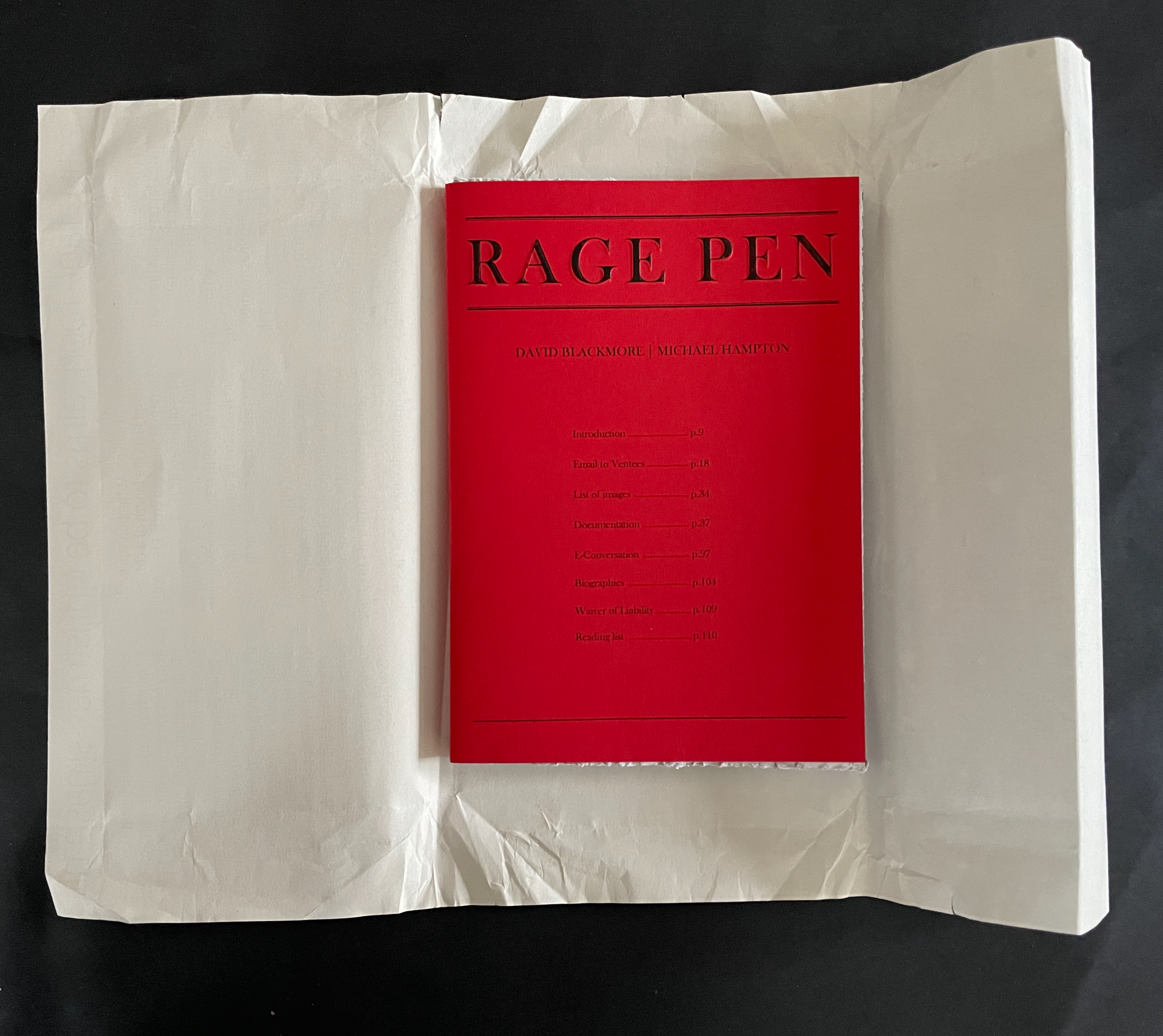
RAGE PEN (2025)
David Blackmore and Michael Hampton
Soft cover, mitre sawn head and foot, perforated fore-edge. H210 x W148 mm. [108] pages. Edition of 100. Acquired from Folium, 13 November 2025.
Photos: Books On Books Collection.
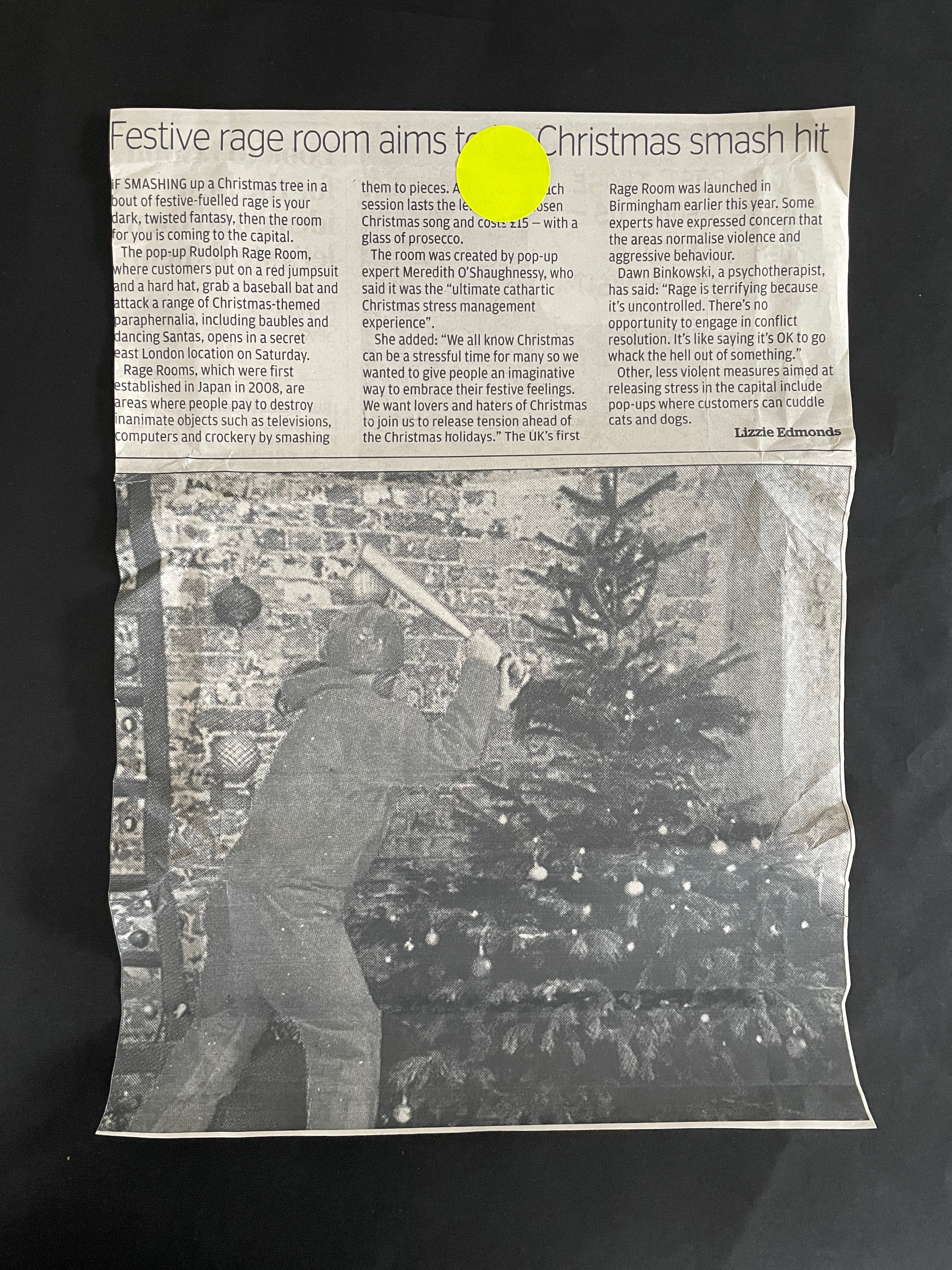
Folium, the publisher, describes RAGE PEN as “developed from a relational piece of the same name held at Chisenhale Studios 2017/18”. Per the Museum of Modern Art, relational aesthetics is
A mode of art practice that establishes spaces, situations, or environments for a variety of social interactions. In essence, the social space or interaction becomes the work of art itself. The term was popularized by French critic and curator Nicholas Bourriaud in 1998.
RAGE PEN‘s environment was a safe rage room equipped with a variety of handheld tools. Anonymous members of the public, or “ventees”, were invited to name an object that had caused them frustration, don protective equipment, and enter the shuttered room to smash said objects. The interactions filmed and photographed by David Blackmore formed the images in RAGE PEN the book. Holding the book with its mitre-sawn top and bottom edges and its perforated, still-sealed fore-edges, we might suspect that we are being invited into our very own private relational aesthetic piece.
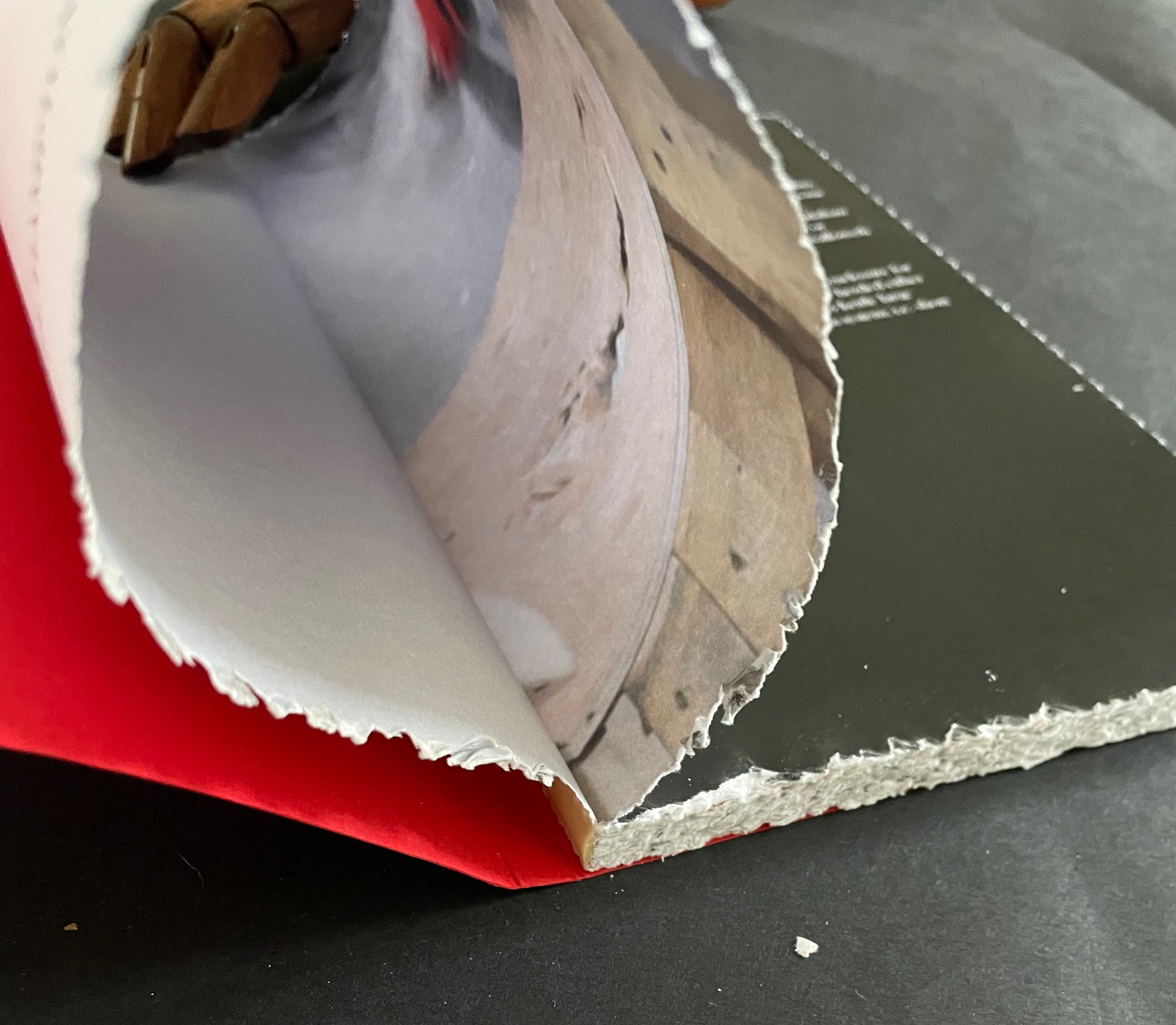
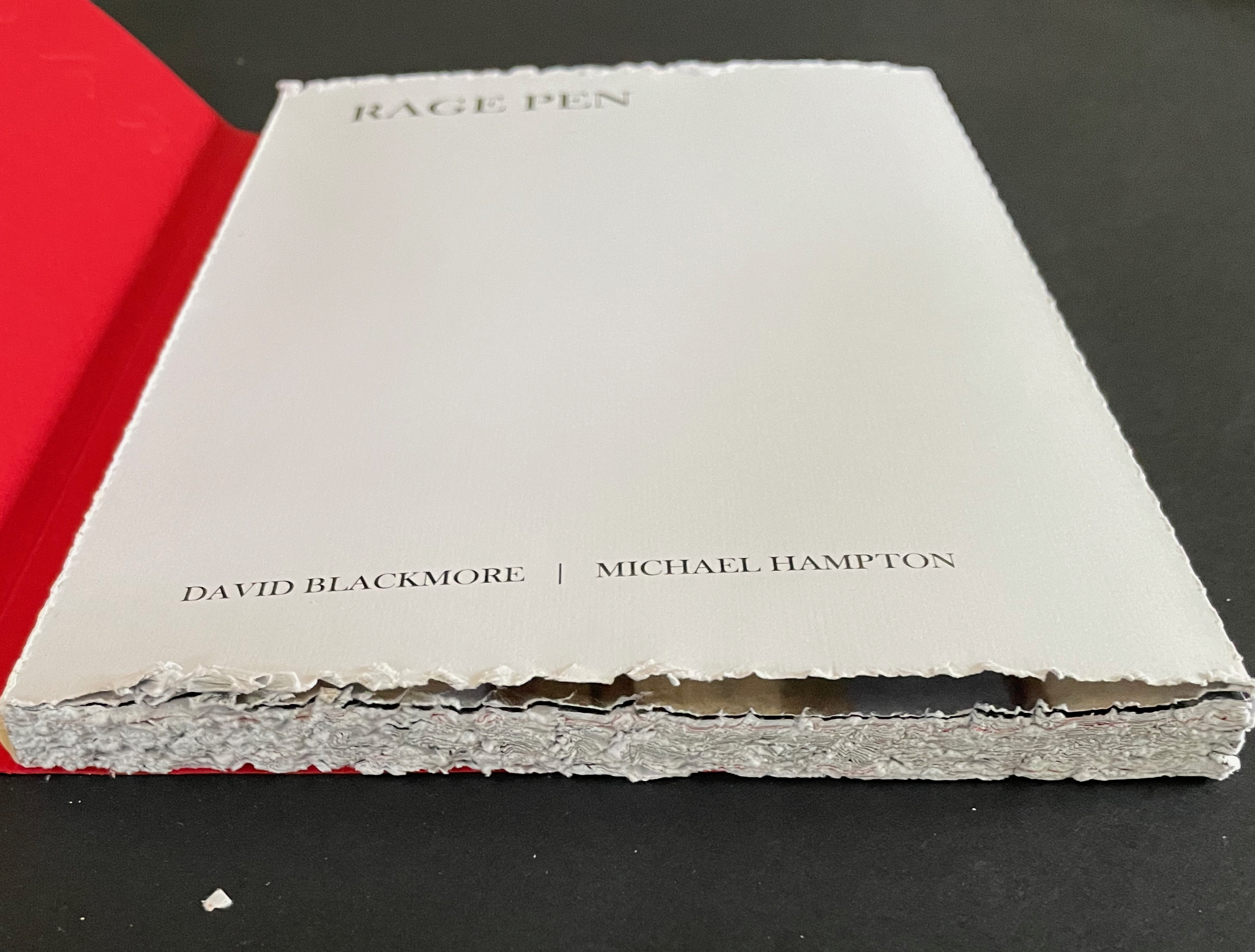
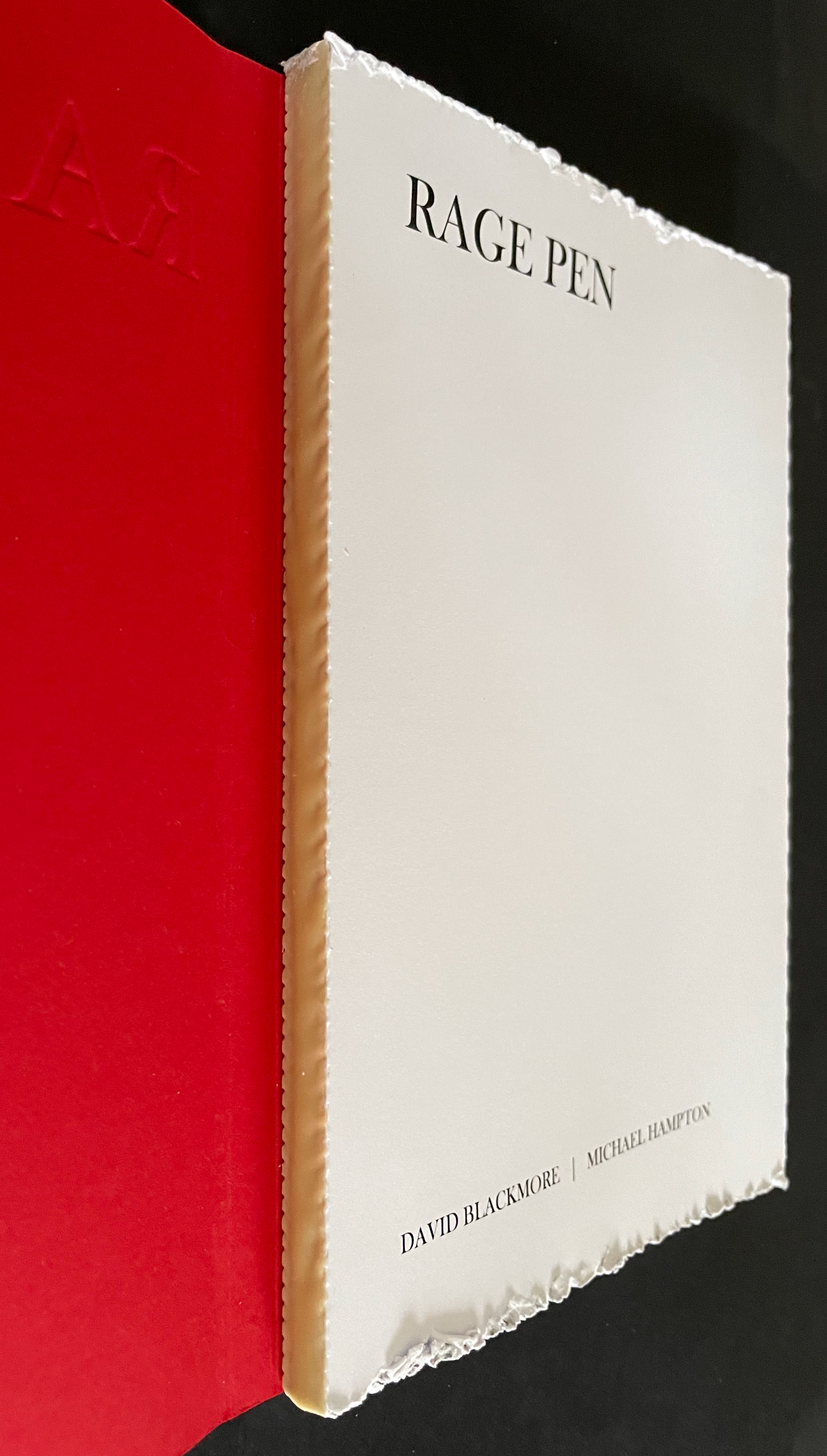
For example, to read the second and third pages of the Introduction, you have to cut the perforated fore-edge holding them together. You might notice that they aren’t numbered; they would be respectively pages 10 and 11 if they were.
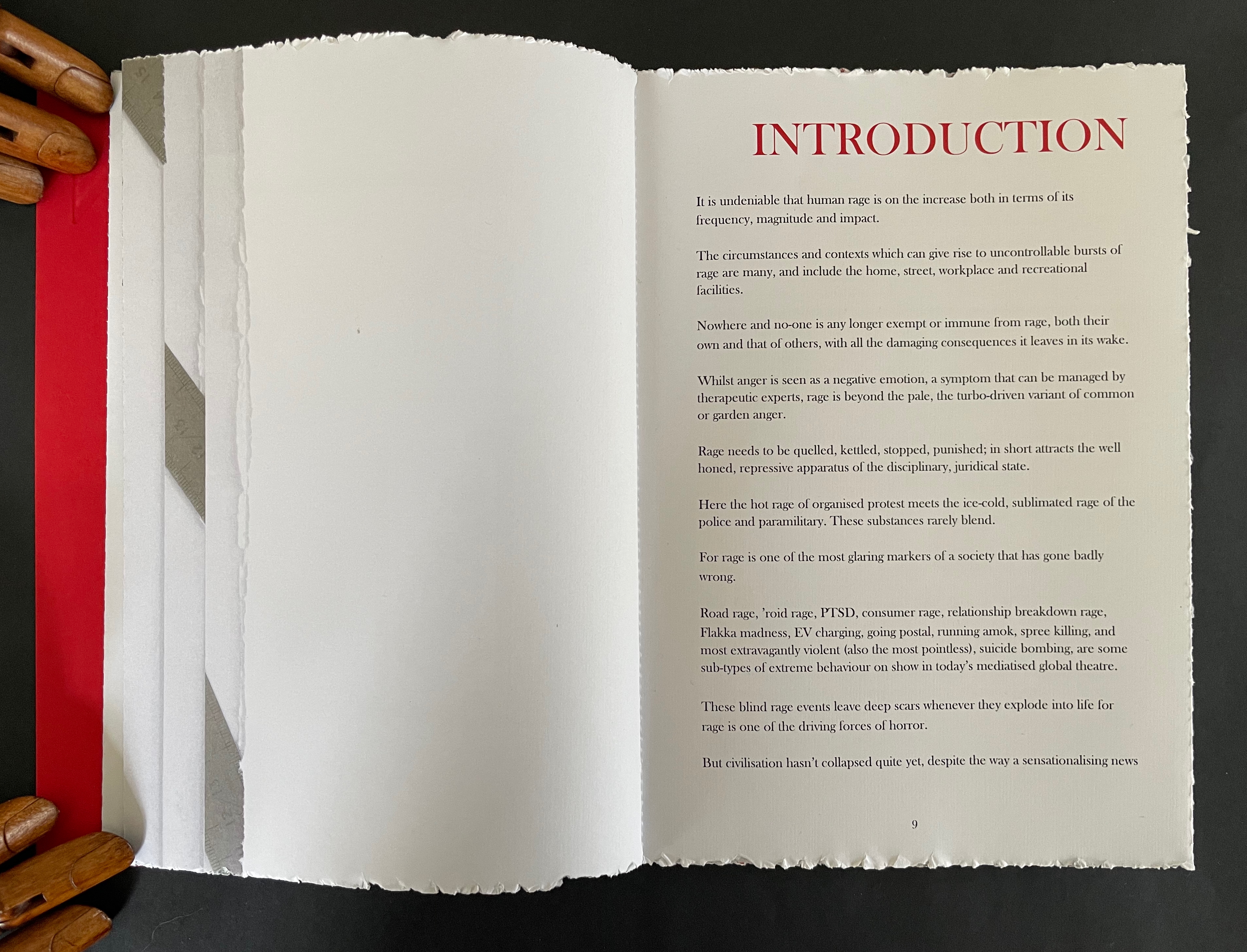
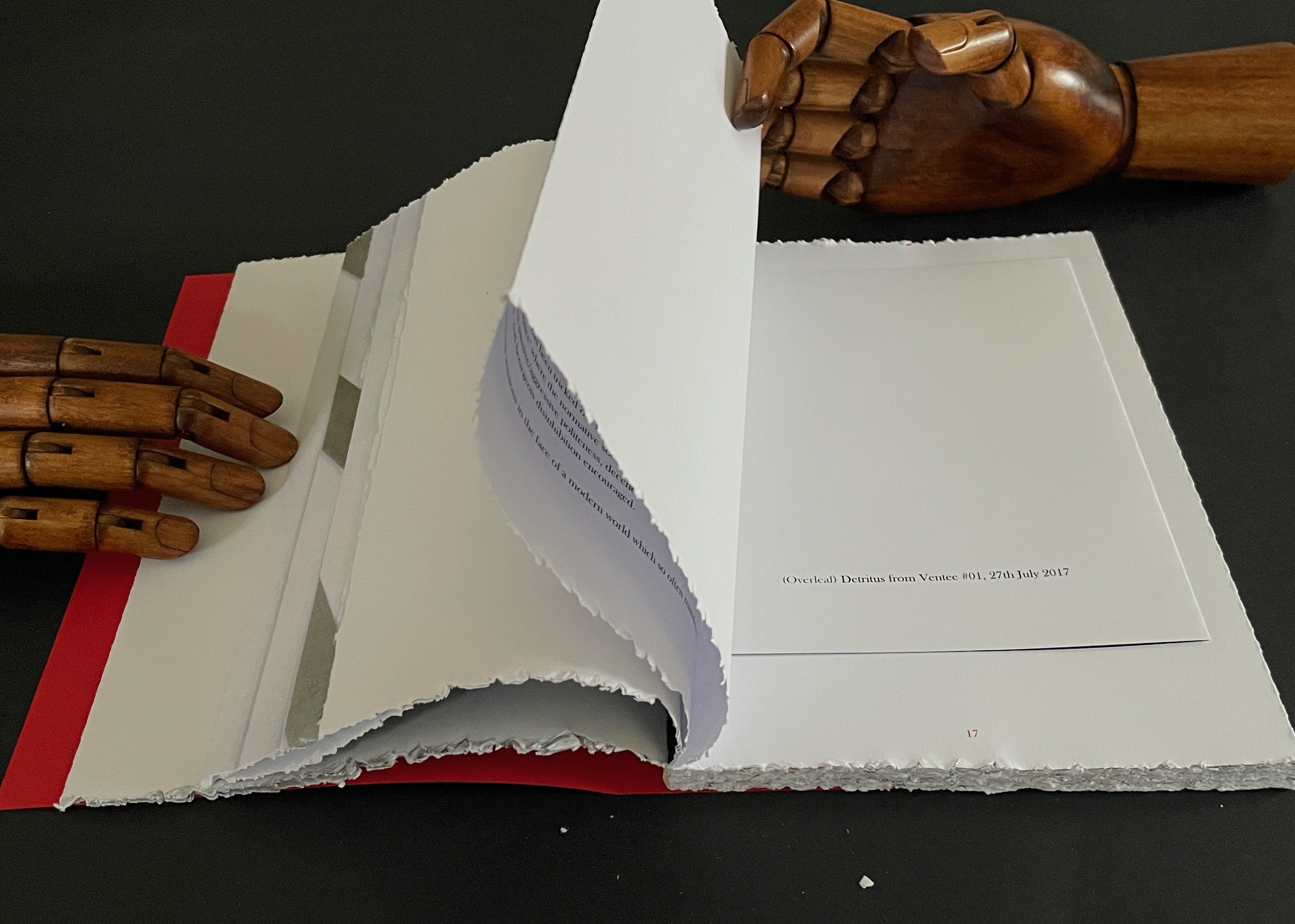
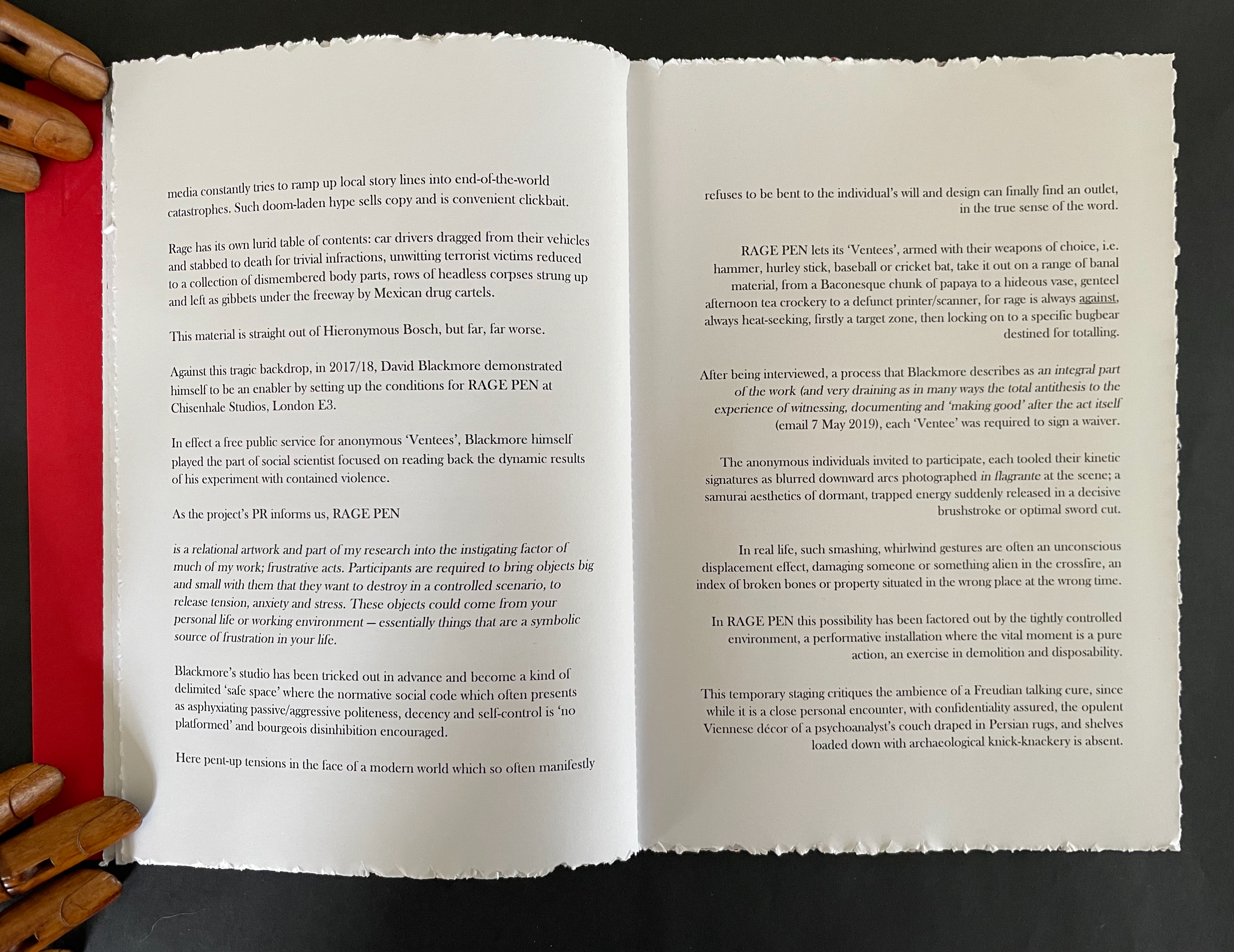
Having finished reading and turning unnumbered page 11, you find a folded folio, which, when unfolded and turned, reveals page 17, the end of the Introduction. Together with the blank page after unnumbered page 11, the folded folio accounts, of course, for the unnumbered pages 12-16. The appeal/frustration of cutting the perforated folios and keeping track of the page count might wane, and the satisfying rage/pleasure of cutting open the perforated pages may wax. But beware.
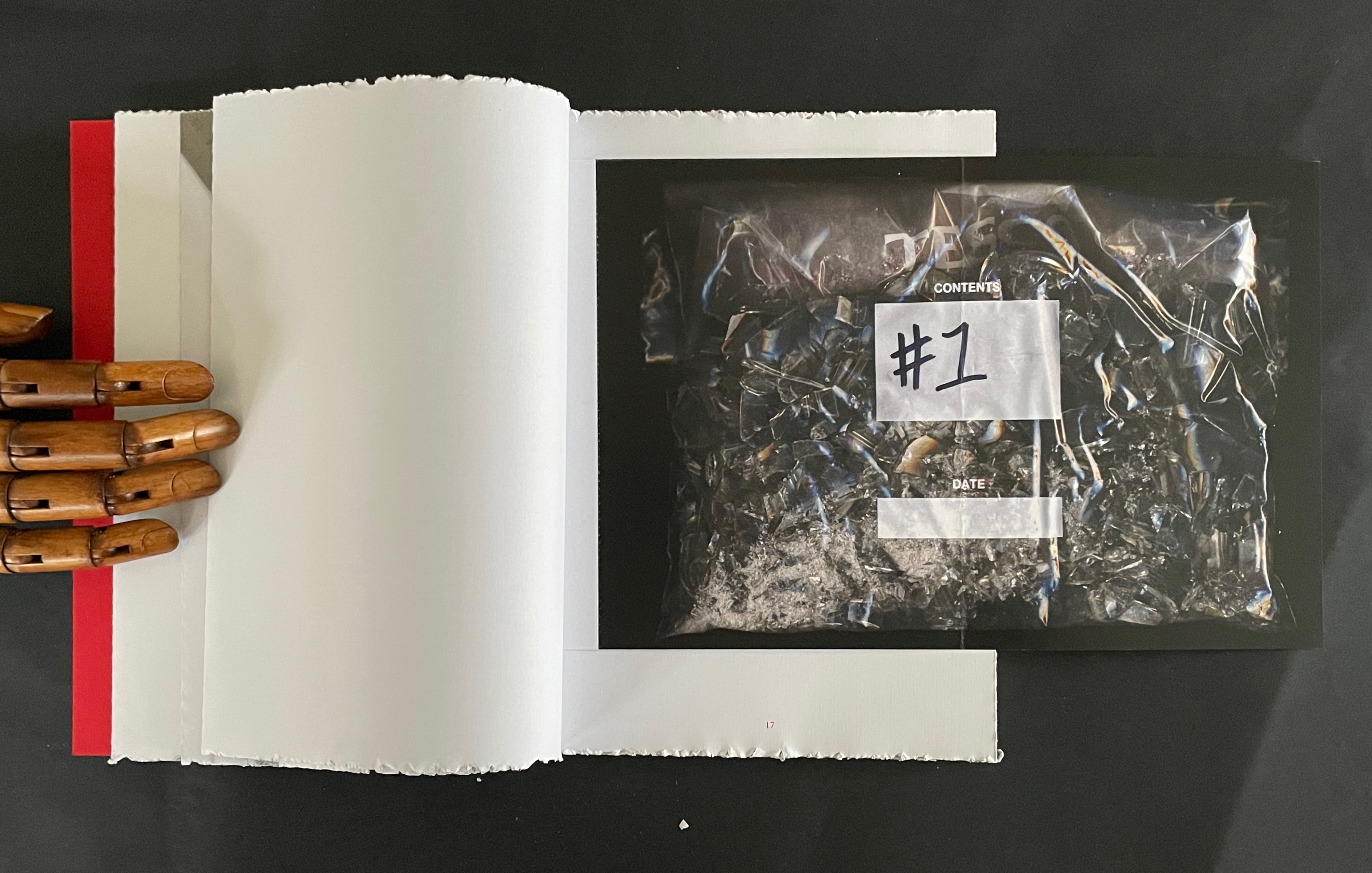
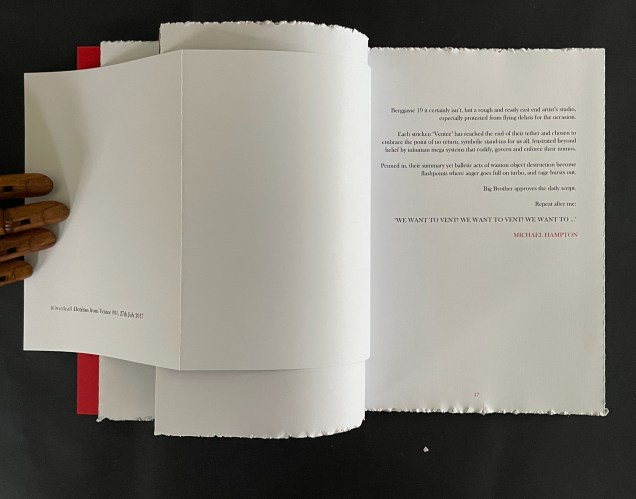
However rote-driven, frustrated, or adventurous you may be feeling, it is best to bow out the uncut pages and look outside and inside them before cutting. Outside, you will find double-page spreads that you will lose if exercising the paper knife, metal ruler or bone folder. Below, shown across a recto-to-verso spread, are the studio doors through which the invited “ventees” entered. As readers, we are invited to open the doors to RAGE PEN by slitting the perforated fore-edge, by which we will lose the image of the closed double doors. Likewise we will also lose the image of one of the ventees wielding a sledge-hammer across the double-page spread inside the studio doors’ spread.
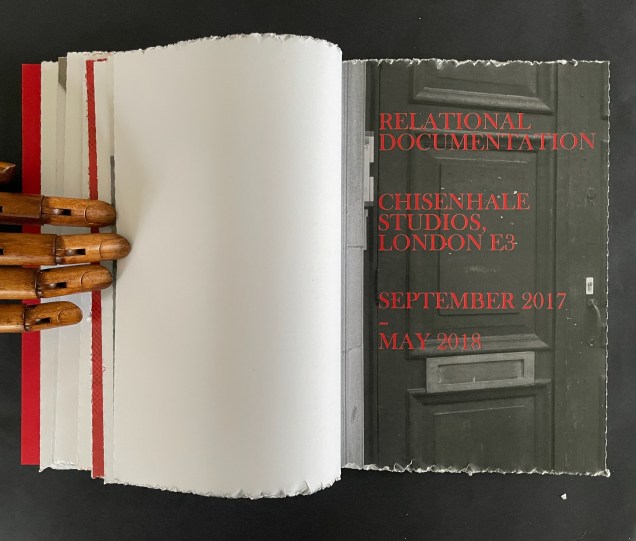
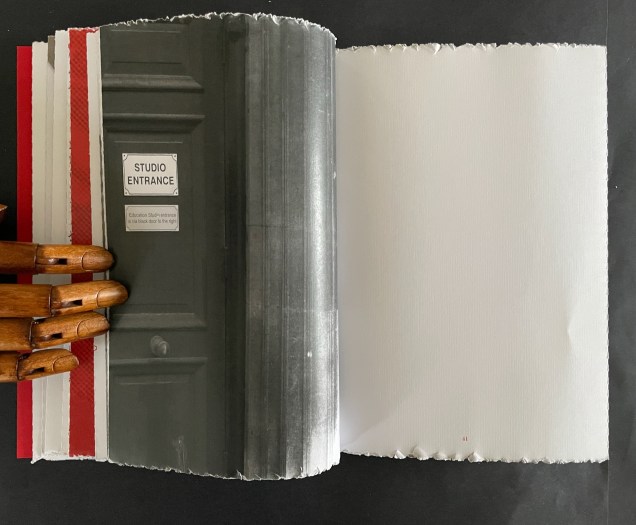
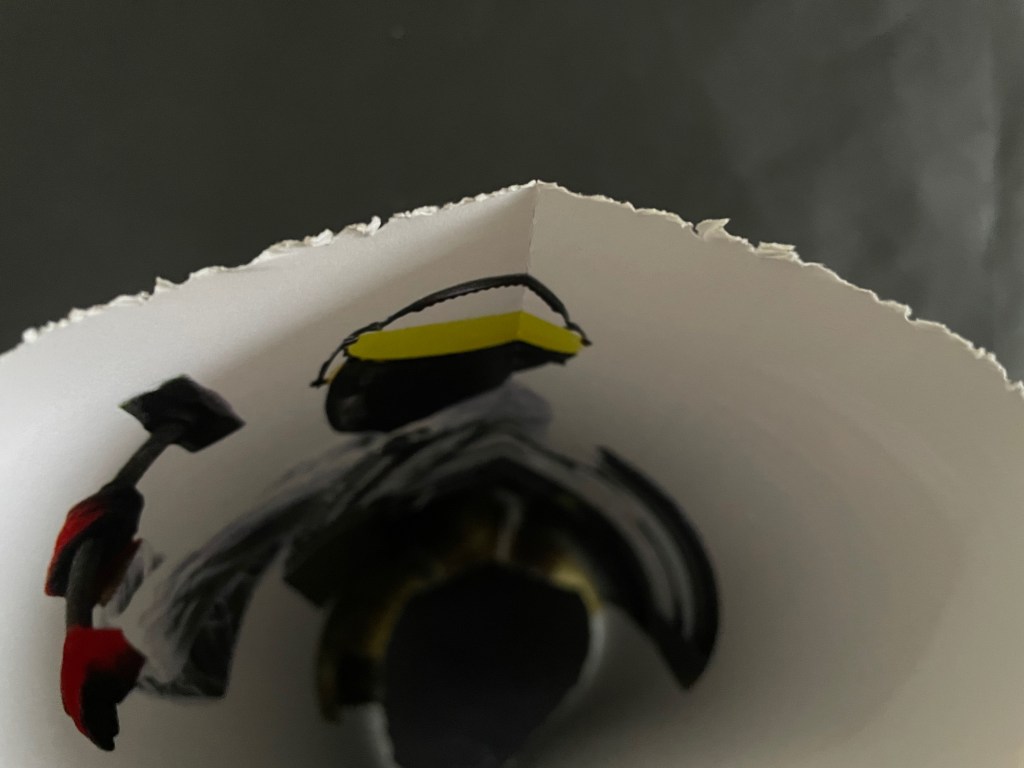
The publisher describes RAGE PEN as an interactive photobook. The term “artists’ book” is closer to the mark. Like most artist’s books, RAGE PEN becomes an artwork that “interrogates” its subject by interrogating itself as a mode of art. It explores the phenomenon of rage not only through the photographs of the staged relational piece but also through invoking our frustration as we destroy one photo spread to get to another photo spread only to find that that we have destroyed that spread as well. And if we don’t cut all the fore-edges, it still lands us with the double frustration of not being able to see clearly those inner double-page spreads and not having the ephemeral work we would have have been left with if we had cut all the fore-edges. This is as complete a challenge to our fetishization of the book object, its design, binding, and concept as any artist’s book has ever mounted.
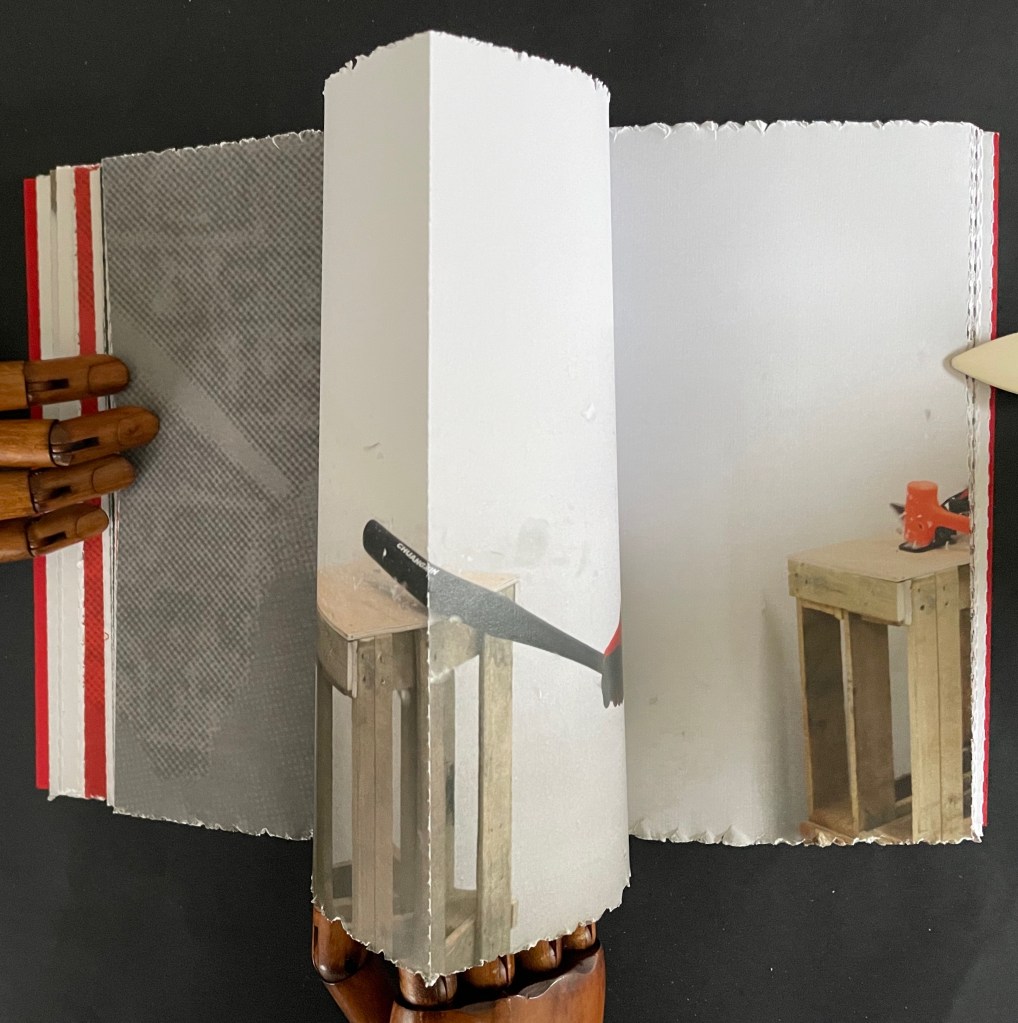
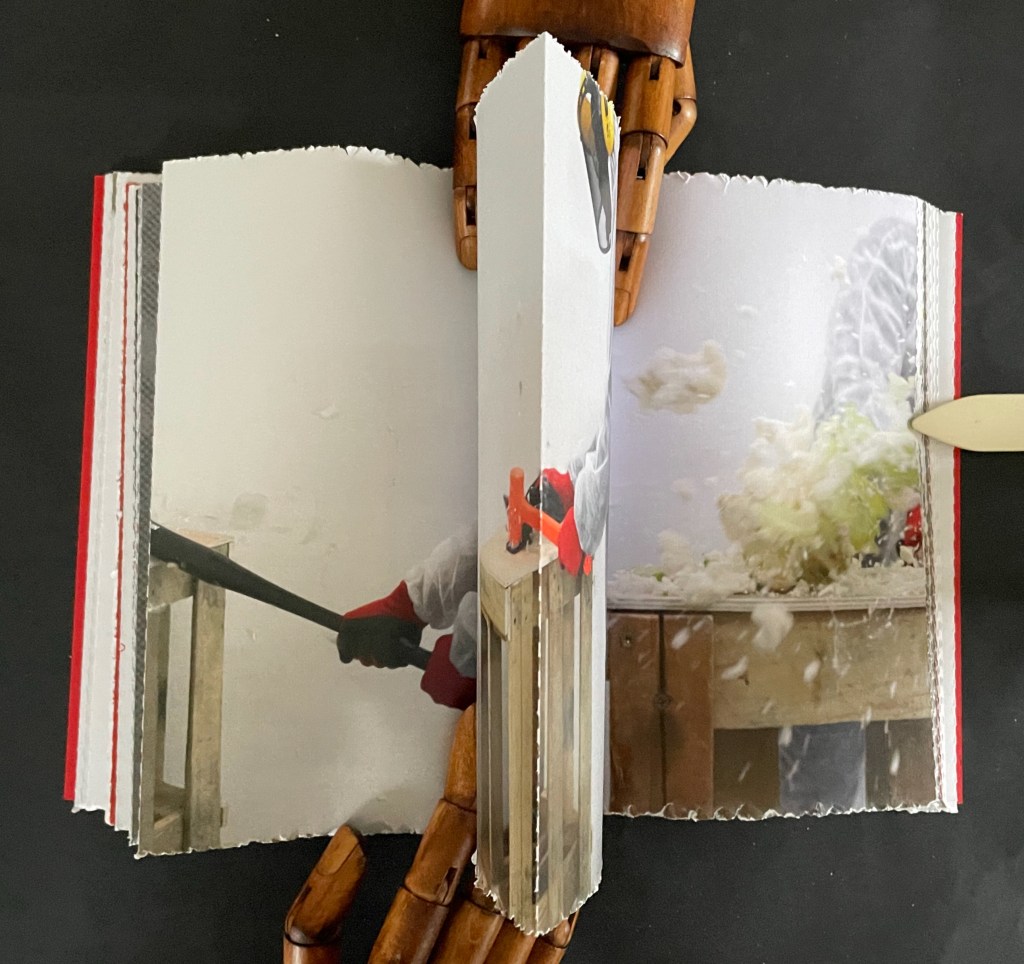
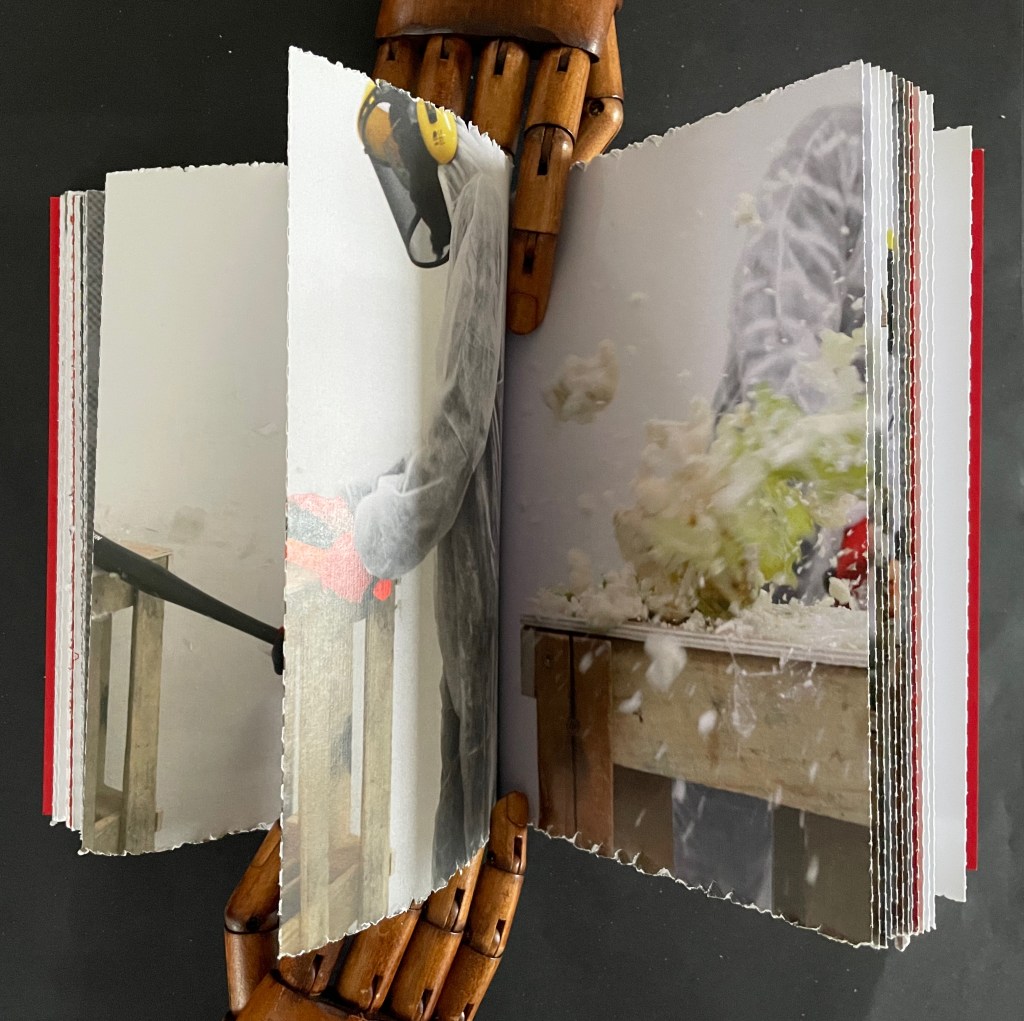
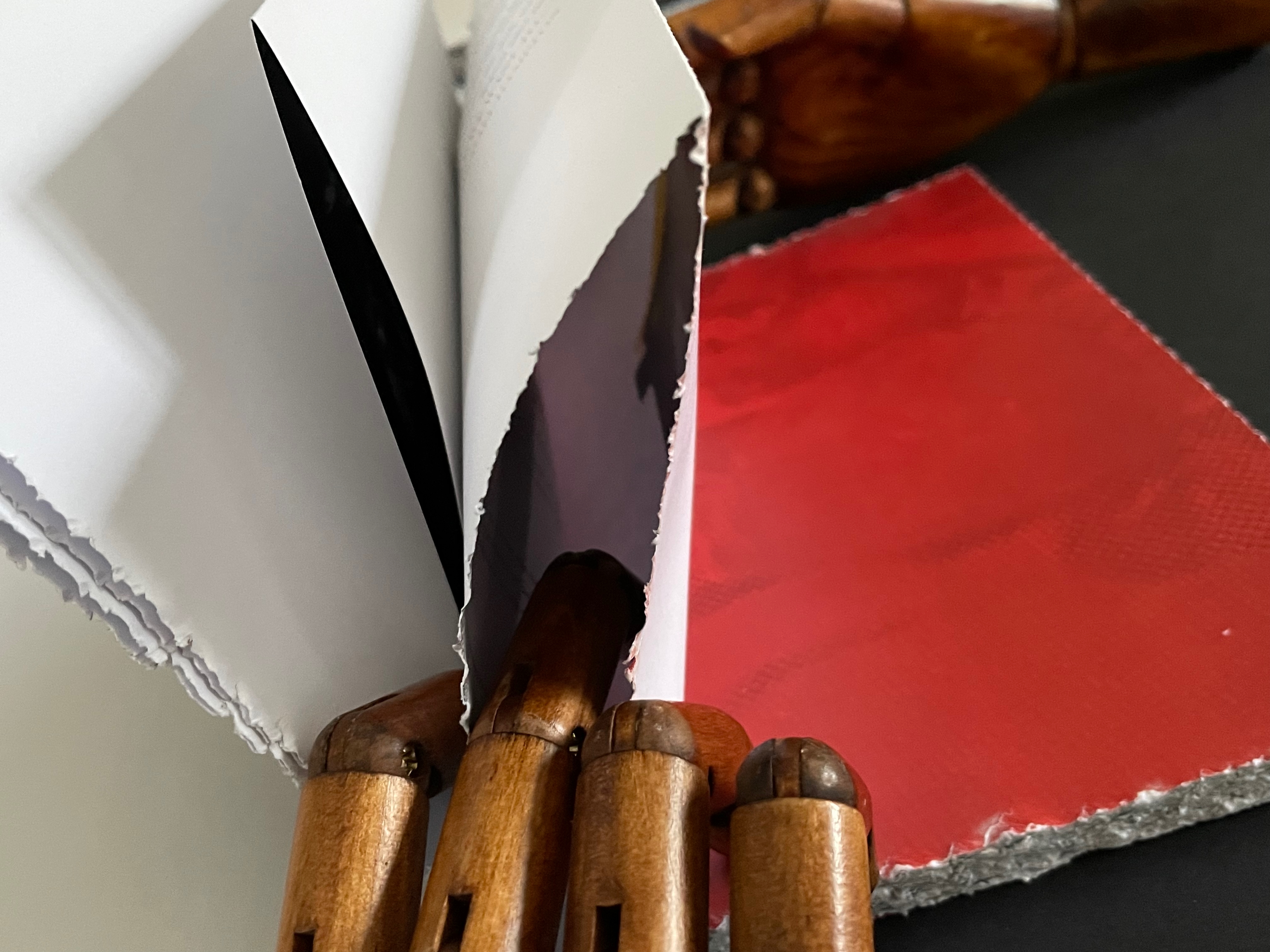
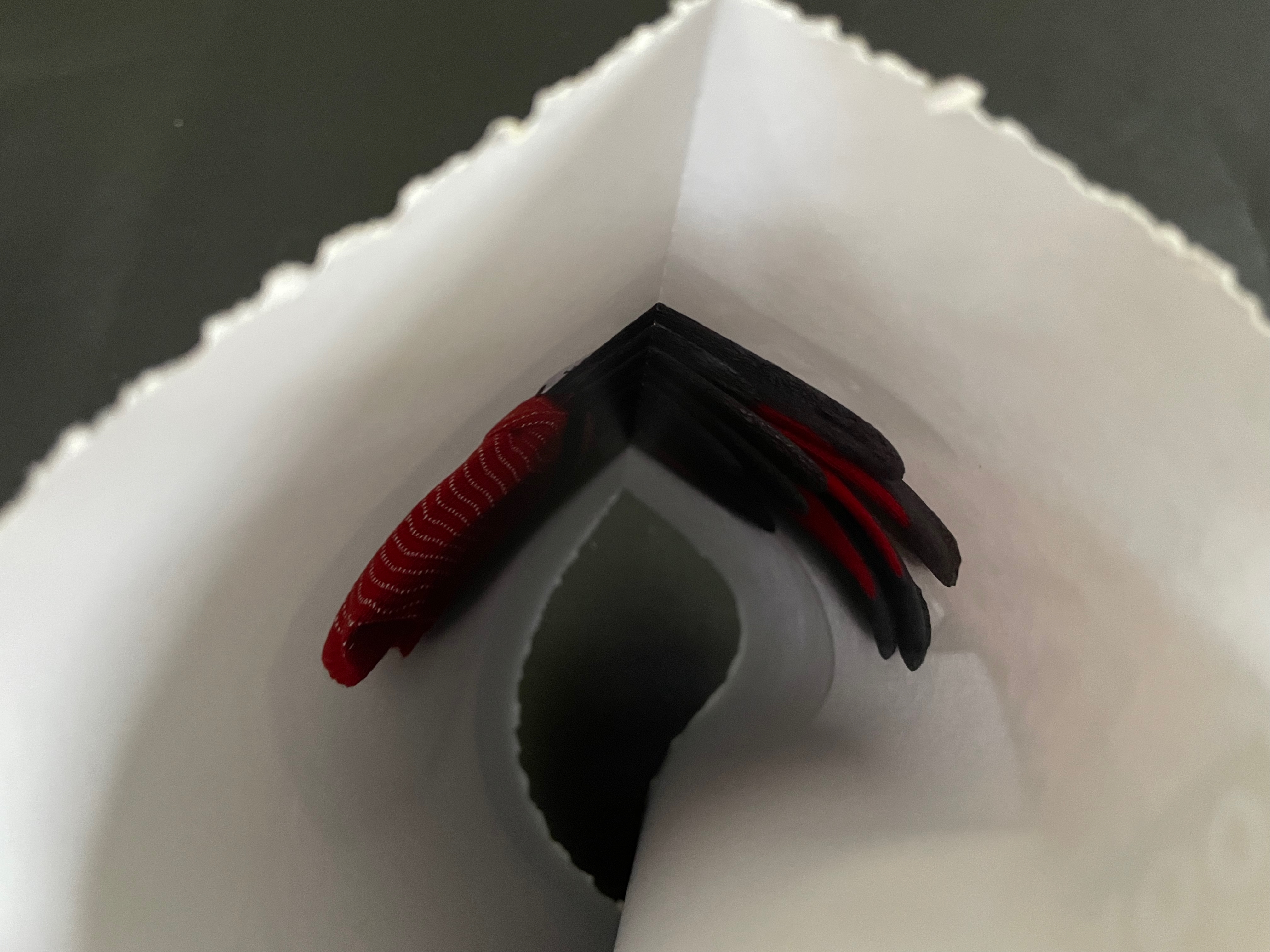
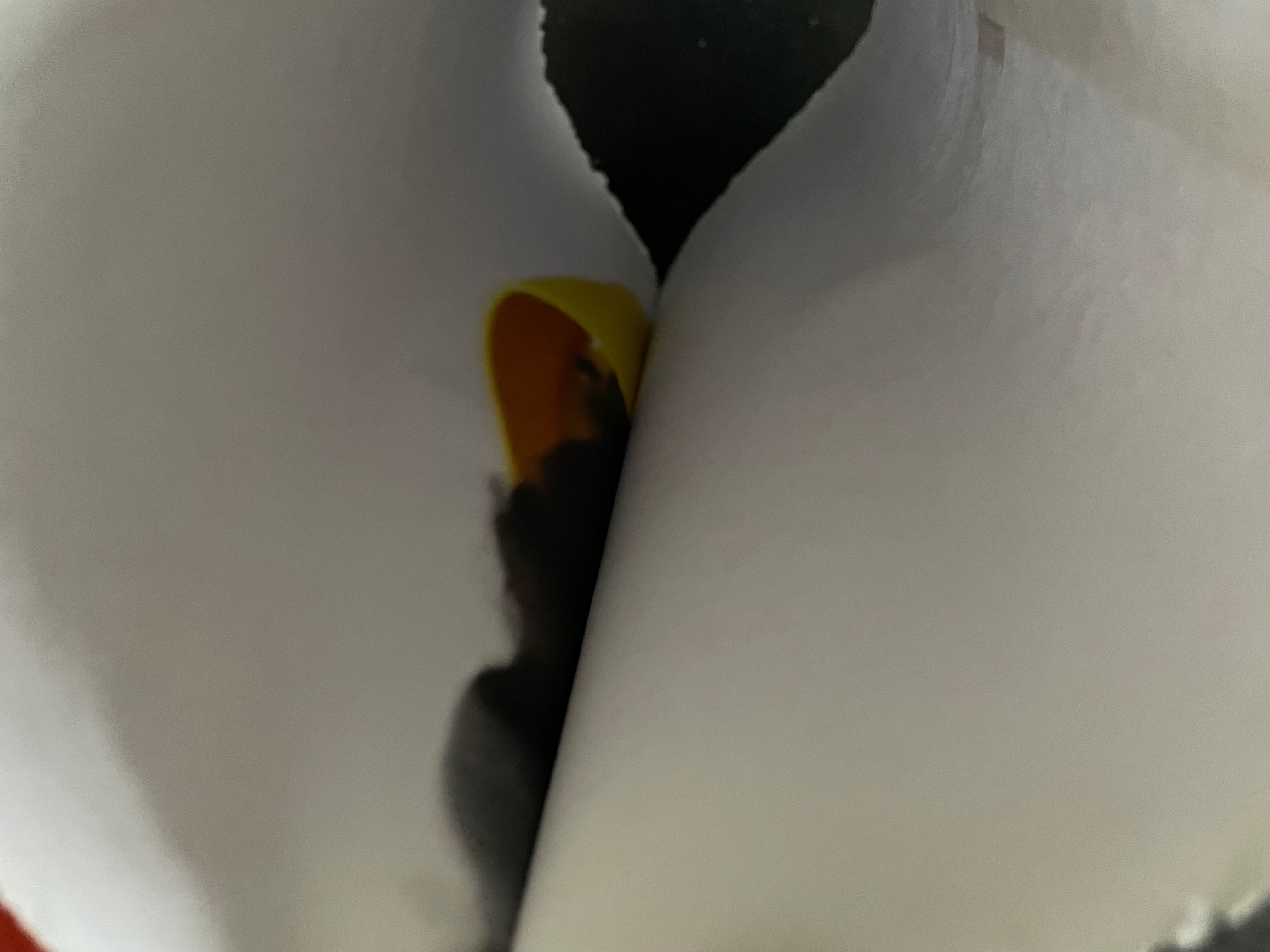
If Sven Spieker and MIT Press decide to issue a new edition of the anthology Destruction, which explores how “self-destructing artwork extinguishes art’s fixity as arrested form and ushers in the ephemeral and contingent open work”, RAGE PEN deserves a place in it.
“Hampton & Co. — exercises in parabibliography 28 March – 2 May 2026”
From the Tension Gallery announcement:
So what is parabibliography it might well be asked? By questioning the integrity of the codex as artefact and placing it under pressure, manifold treatments and formats emerge beyond the book per se, be it defamiliarised bibliographic curiosities or monstrosities presented as a bizarre archive.
From a 3-D Arte Povera take on Dosteyevsky’s Notes from Underground, to a cut up Robinson Crusoe, from a combustible HB of Zane Grey’s Wildfire (with a wick), to a doll’s house size copy of The Times, and from an assemblage mythologising Duchamp’s sister to a dodo skull reliquary; a store room where books lose coherence and become unreadable.
Hampton’s notion of “parabibliography” has an affinity with Brian Davis’ notion of archival poetics, whose examples “not only exploit the material and expressive possibilities of the book as object, they function as physical sites for compiling and organizing heterogeneous collections of textual artifacts for narrative and other expressive purposes”. Davis expands the heterogeneity to include “reproduced photographs, paintings, drawings, handwriting, newspaper clippings, x-rays, maps, diagrams, charts, and other kinds of … ephemera”. While there is that affinity, there is another via the influence of the altered book tradition to which the gallery announcement alludes and titles such as After Latham II make clear. Dieter Roth is another likely influence if one peruses the catalogue Souvenirs and considers the Hampton’s collaborative works like RAGE PEN and Paleodrafts.
Here are just a few favorite examples from the visit:
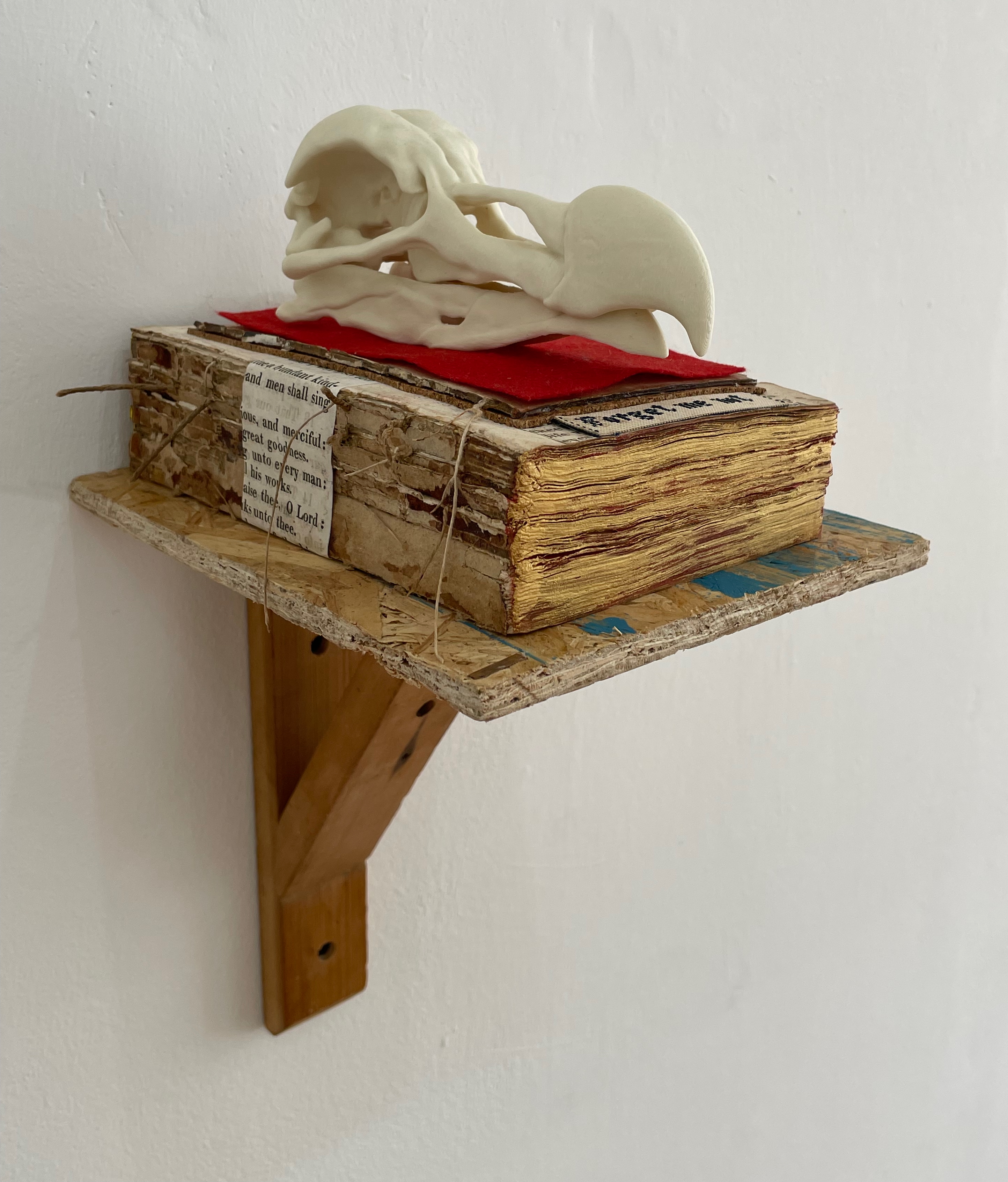
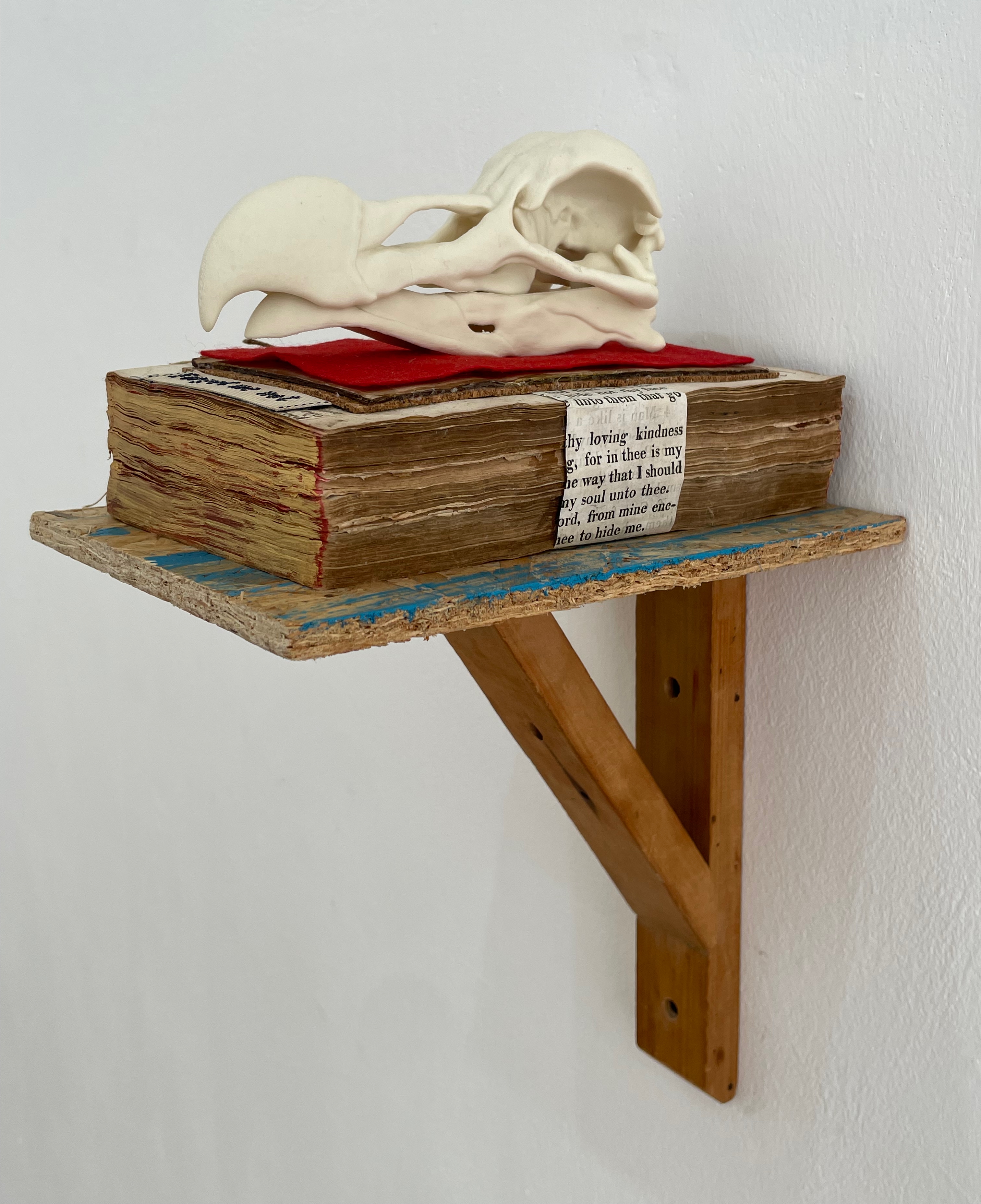
So Much for Theology (2026) biblical remnants | 3-D printed PLA replica dodo skull | bookmark motto | red felt | custom made shelf
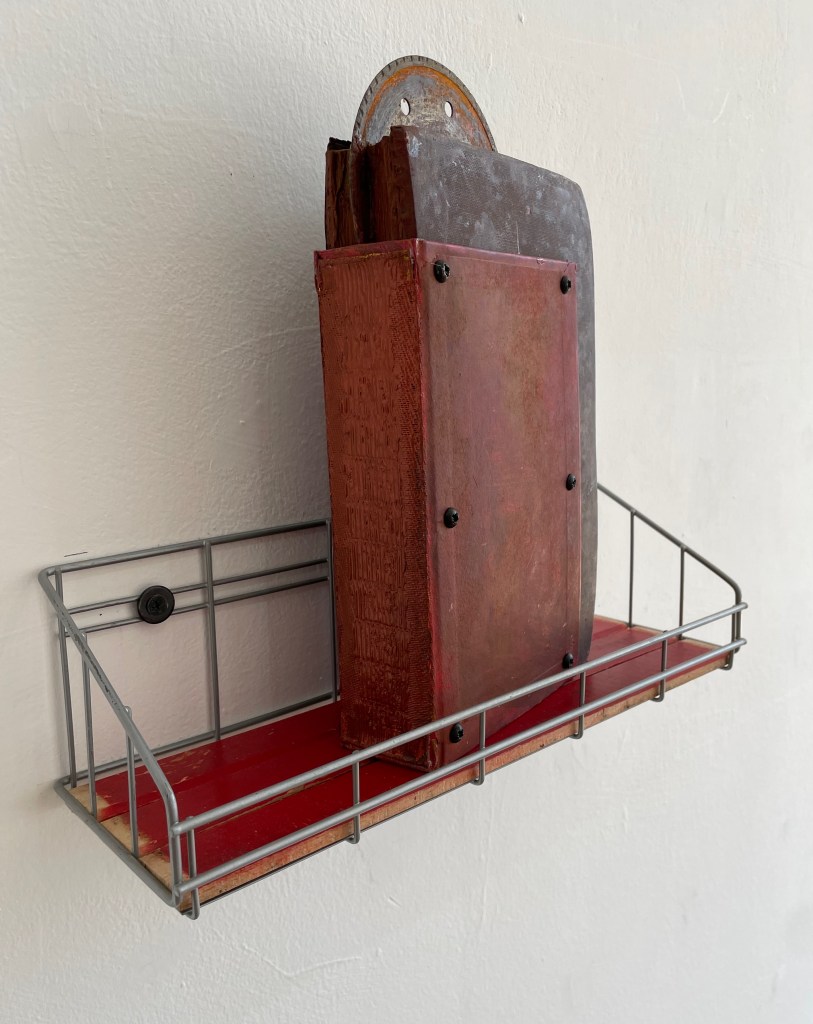
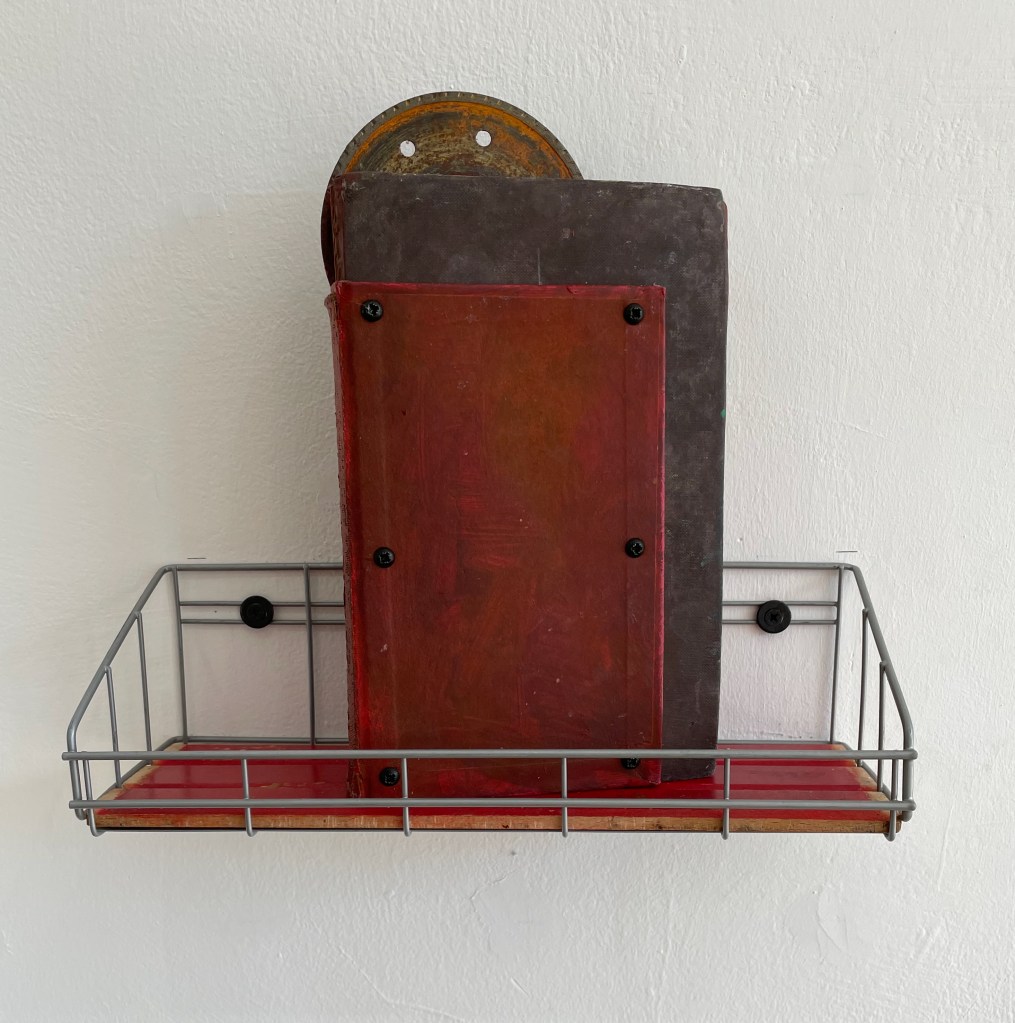
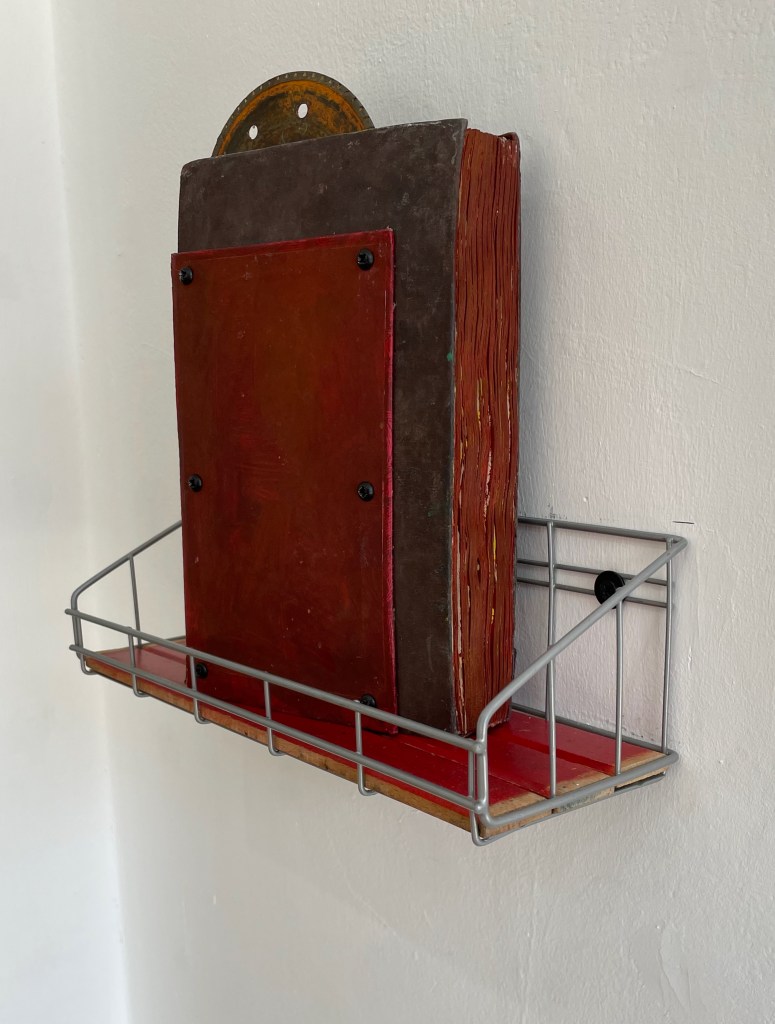
After Latham II (2022) ex book | acrylic paint | cutting disc | screws | customized shelf
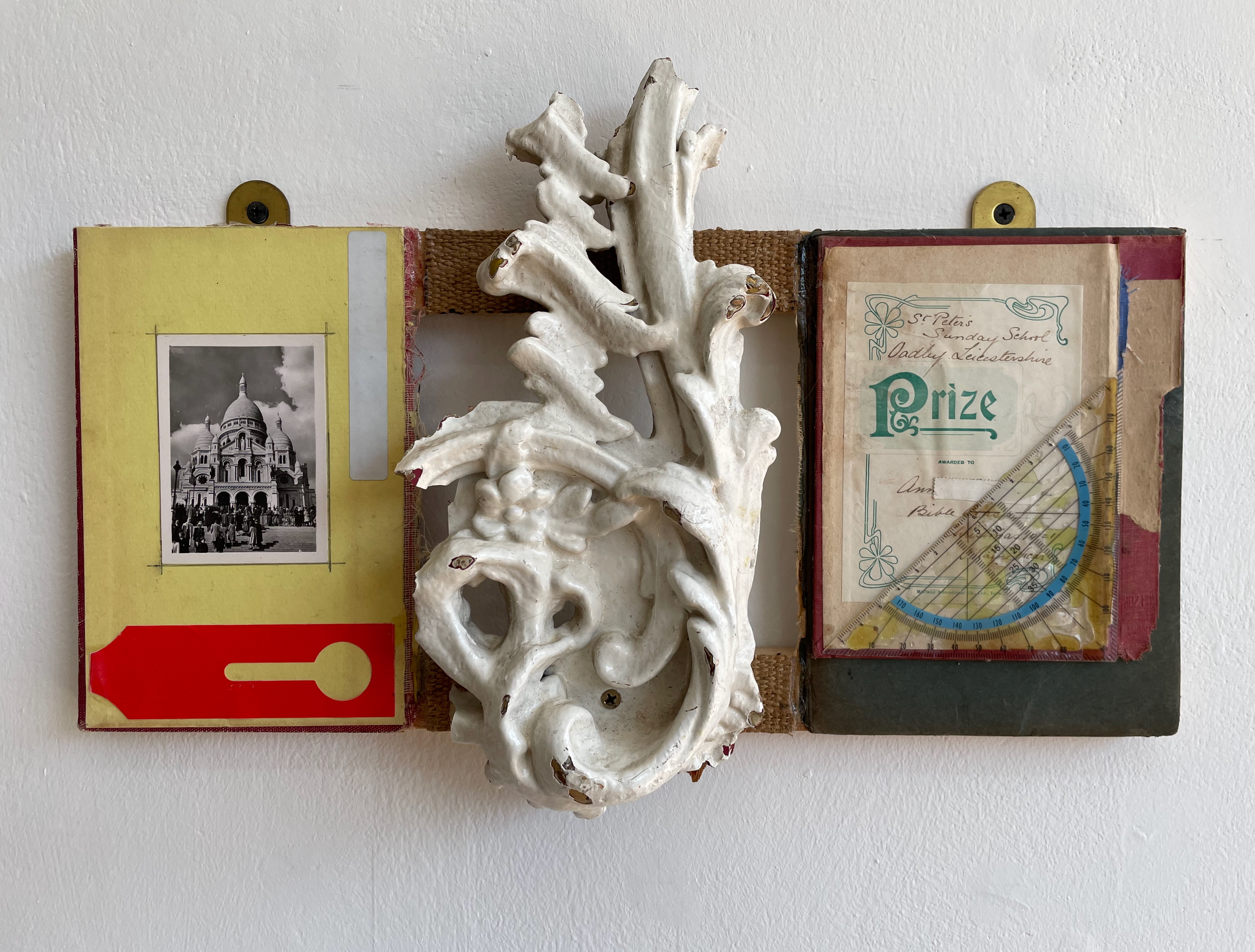
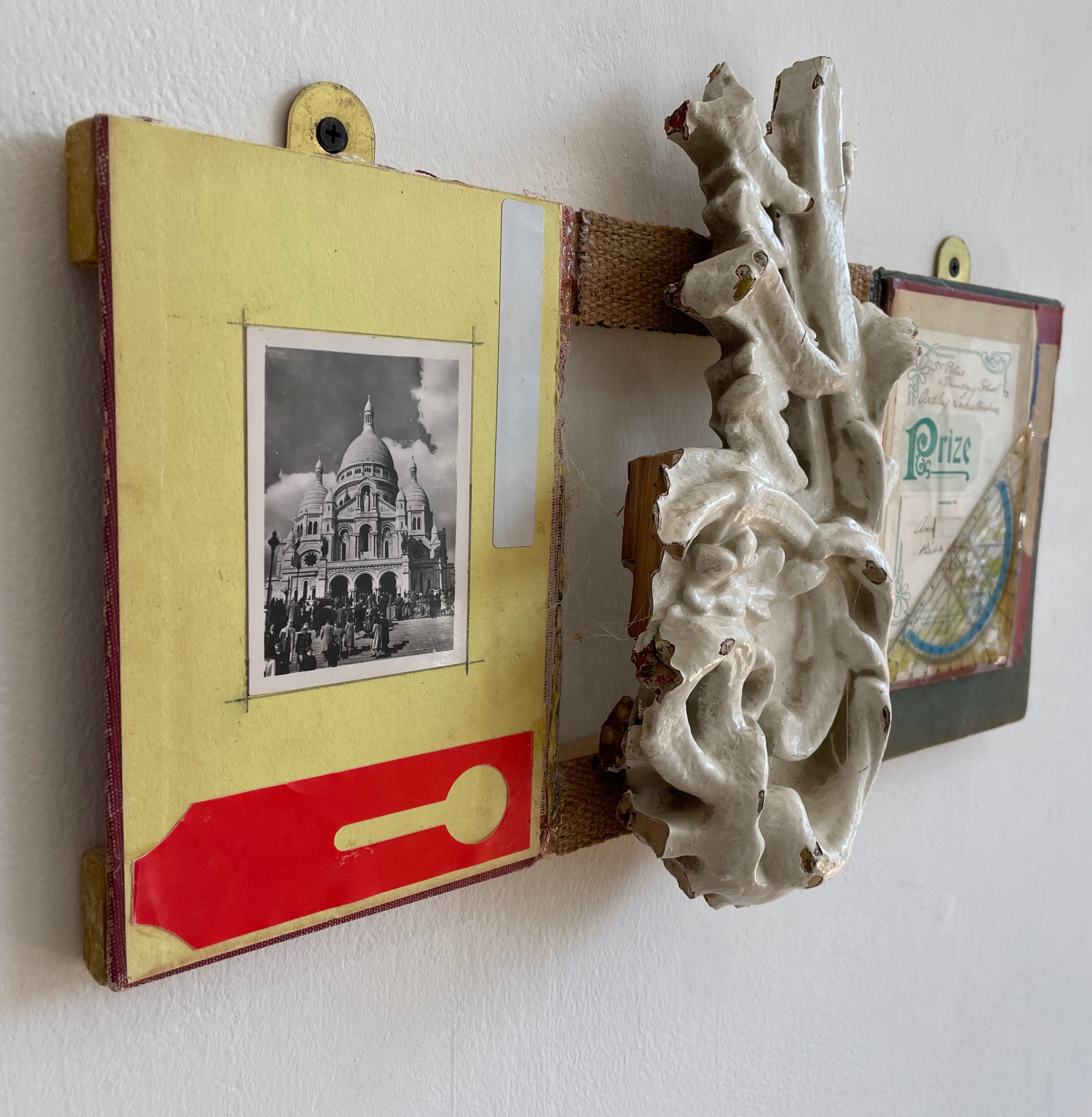
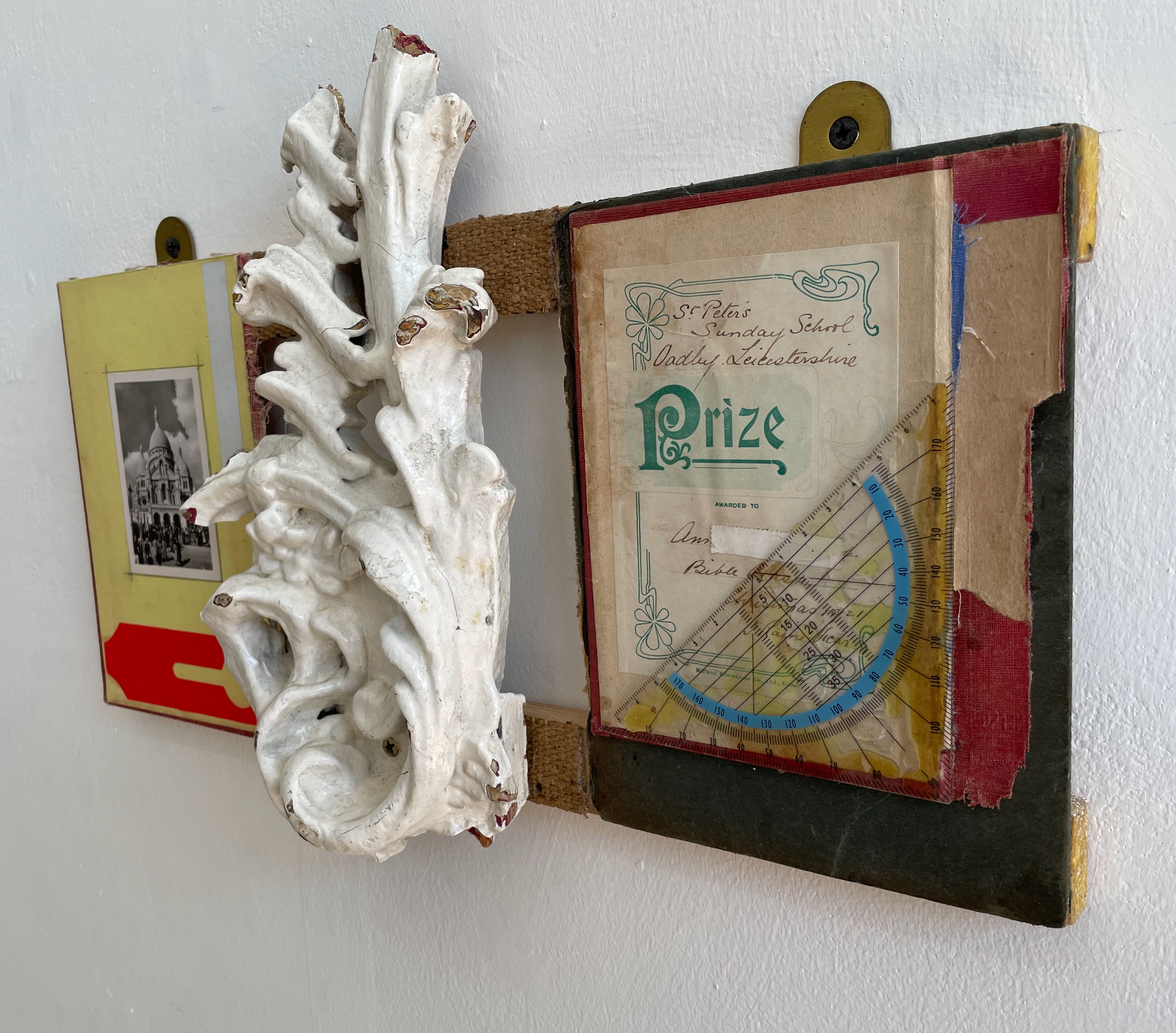
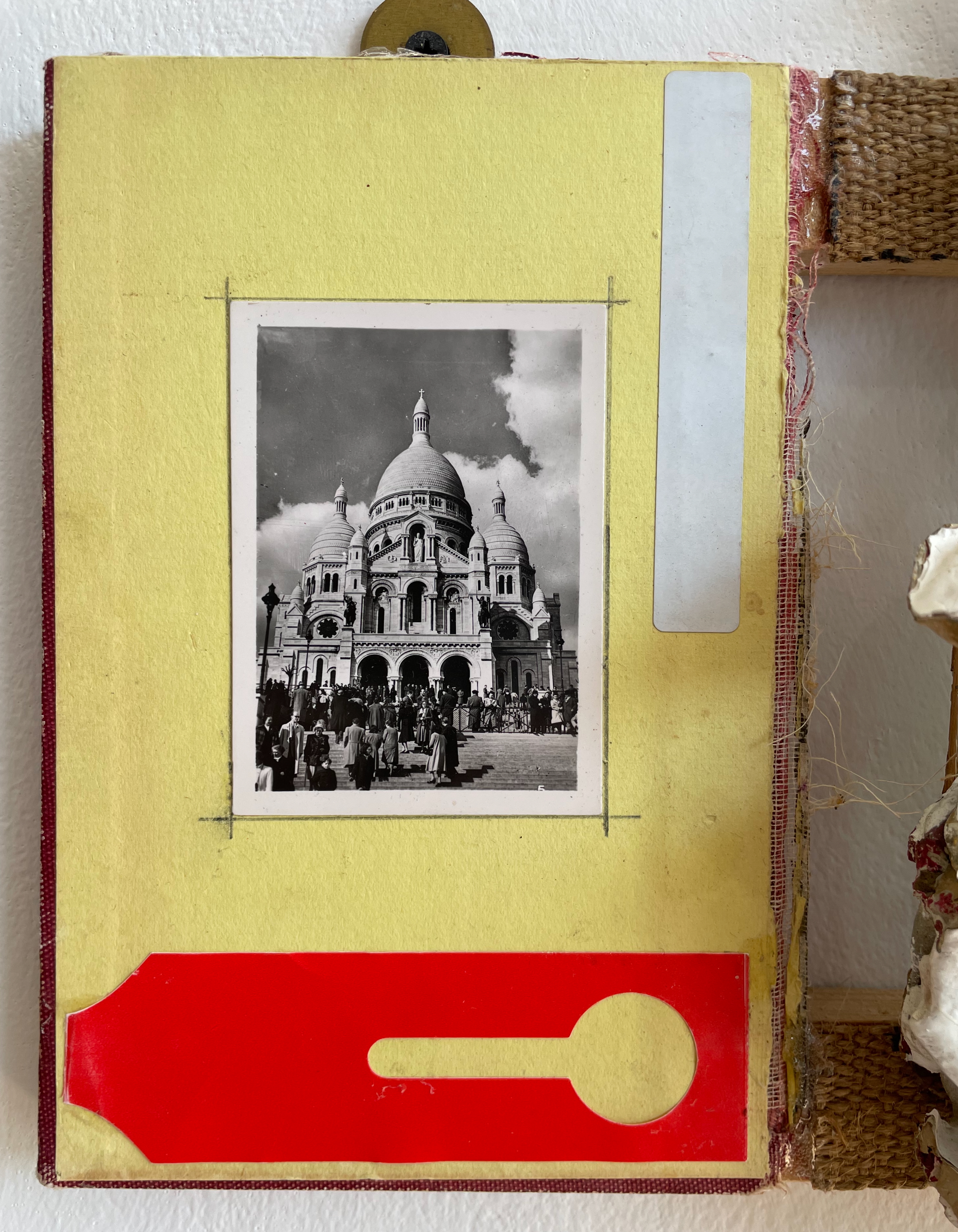
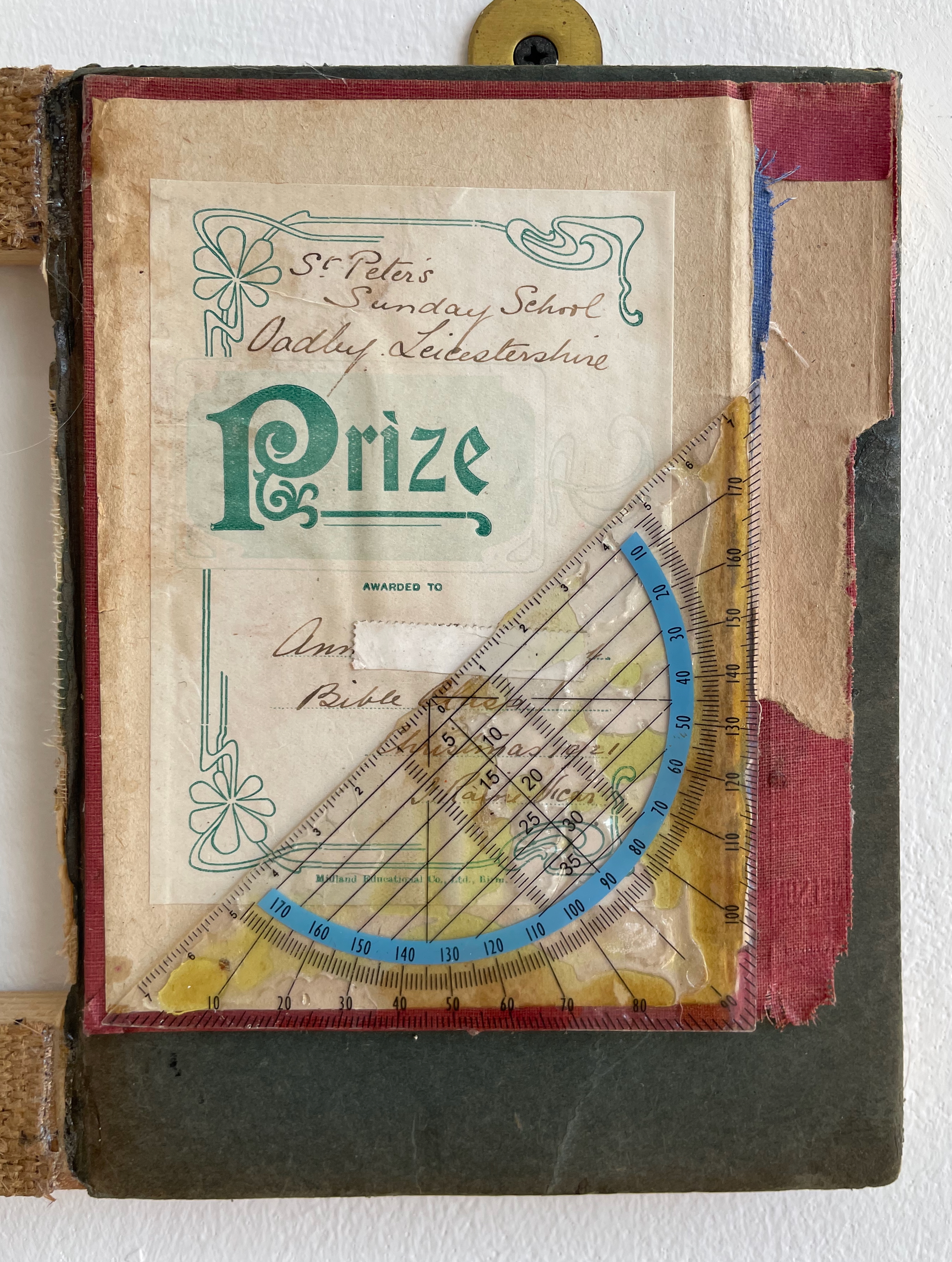
Suzanne’s Dream (2025) vintage book remnants | plastic set square | wooden “rococo” moulding | hessian | advertising signage
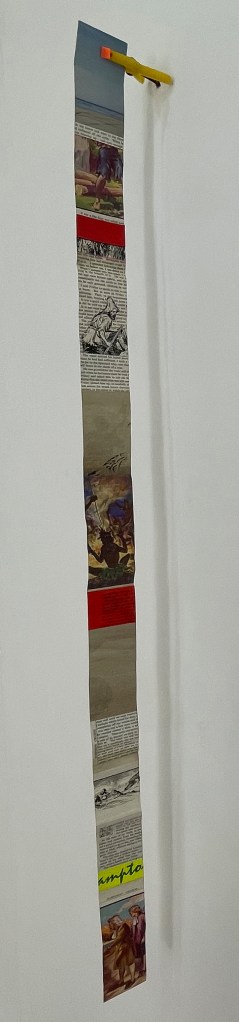
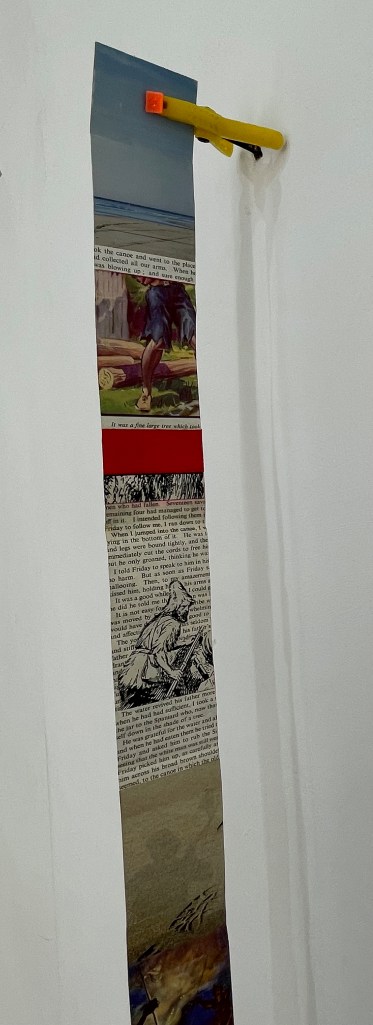
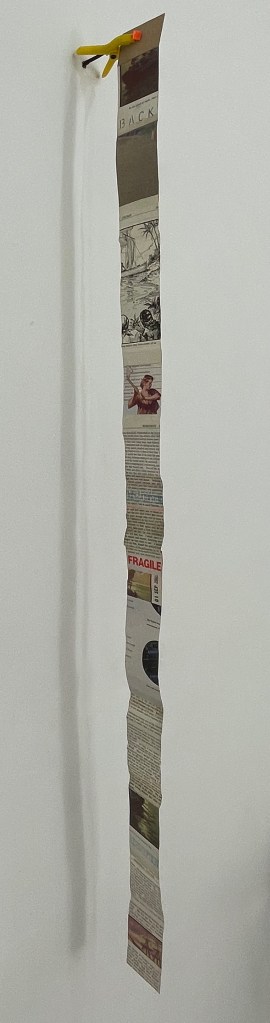
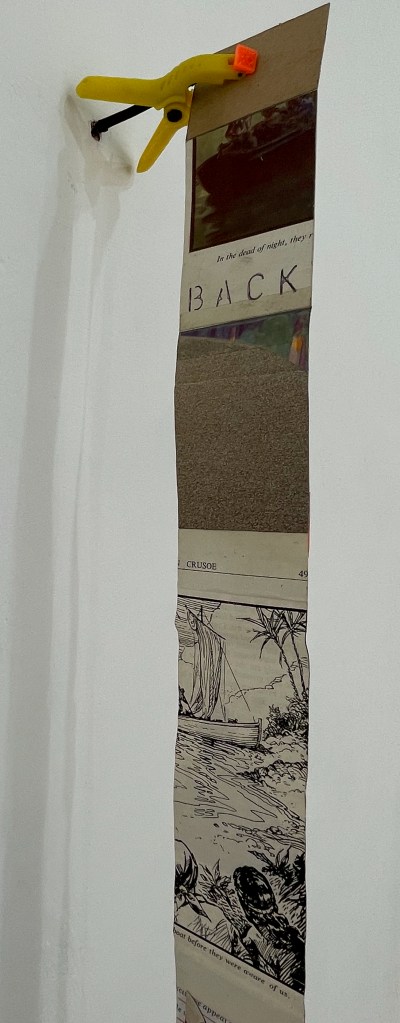
Crusoe Cut-Up (c.2008) printed text crops | decoupage | perspex | cardboard | stencilling
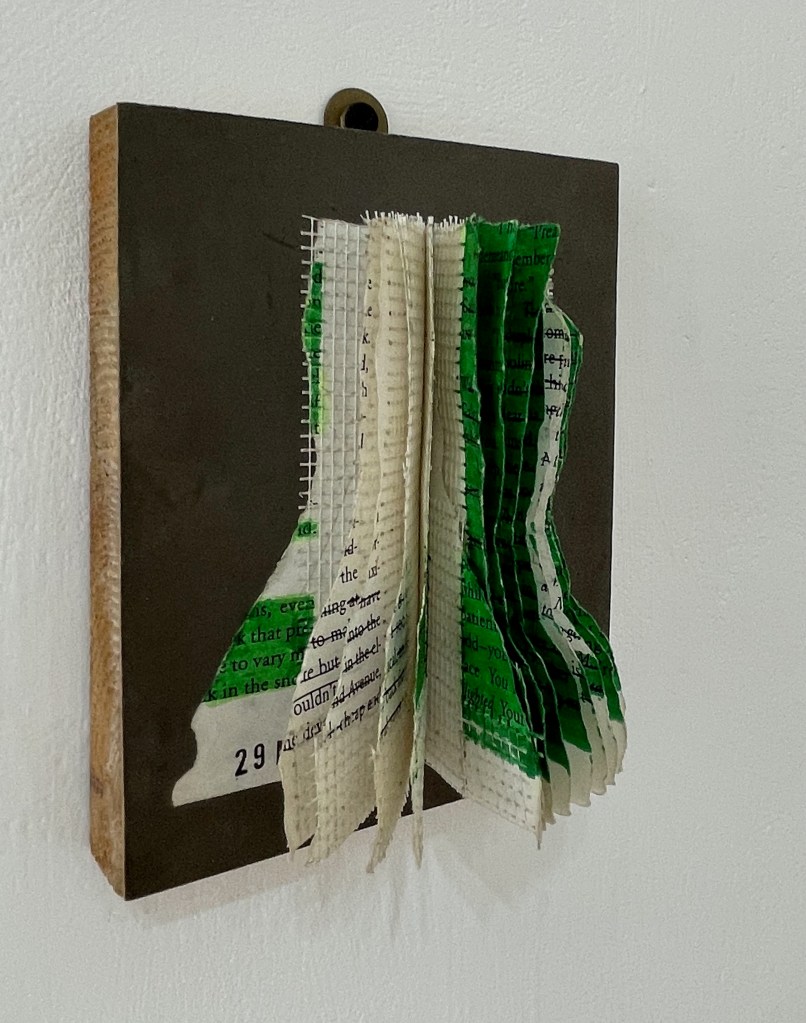
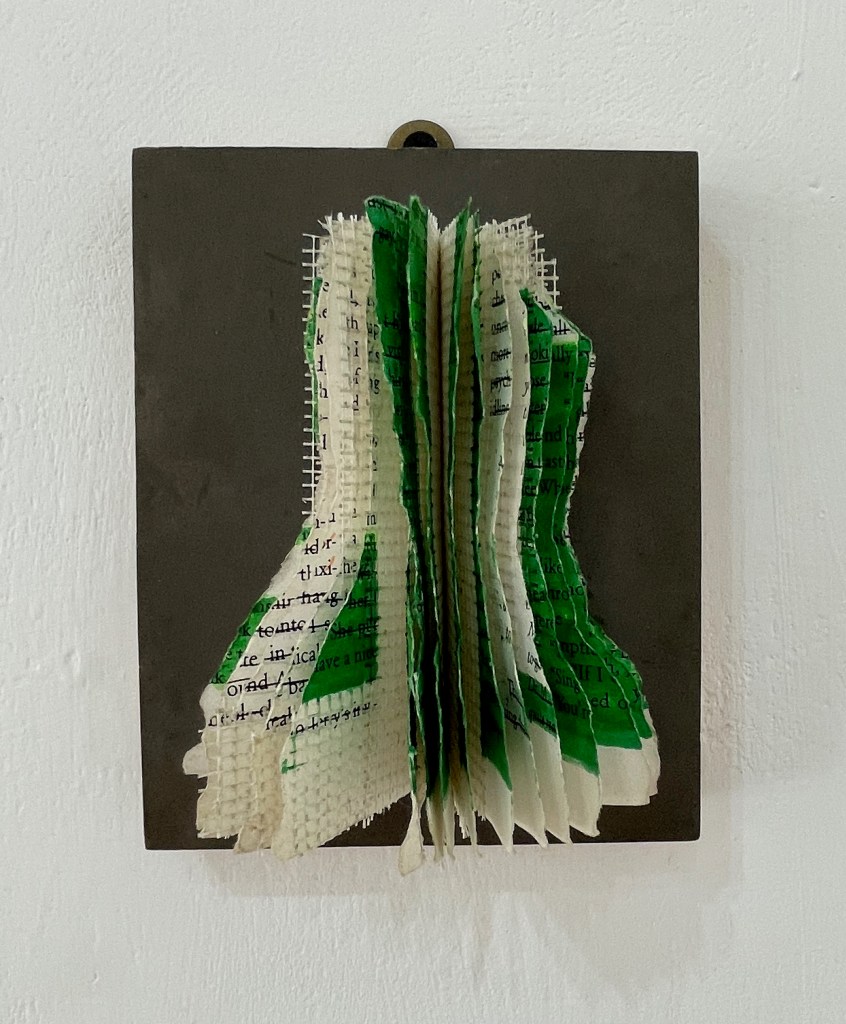
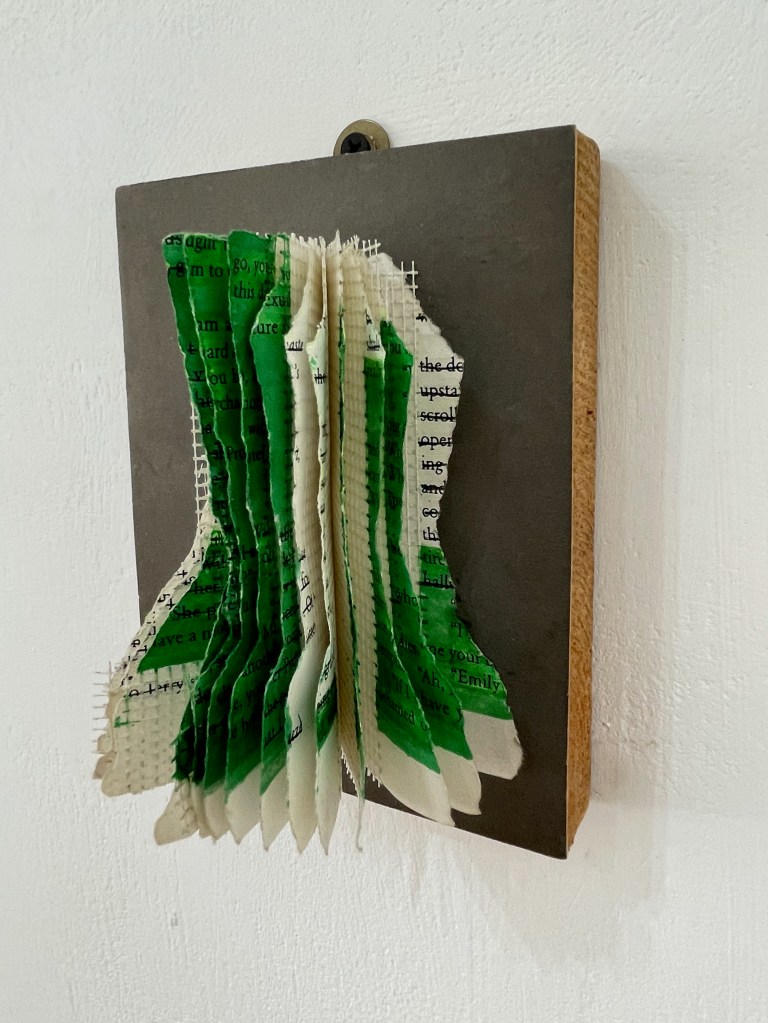
Bell End (redux 2026) torn pages | fibreglass mesh | argyle green Sharpie
410/411 (2025)
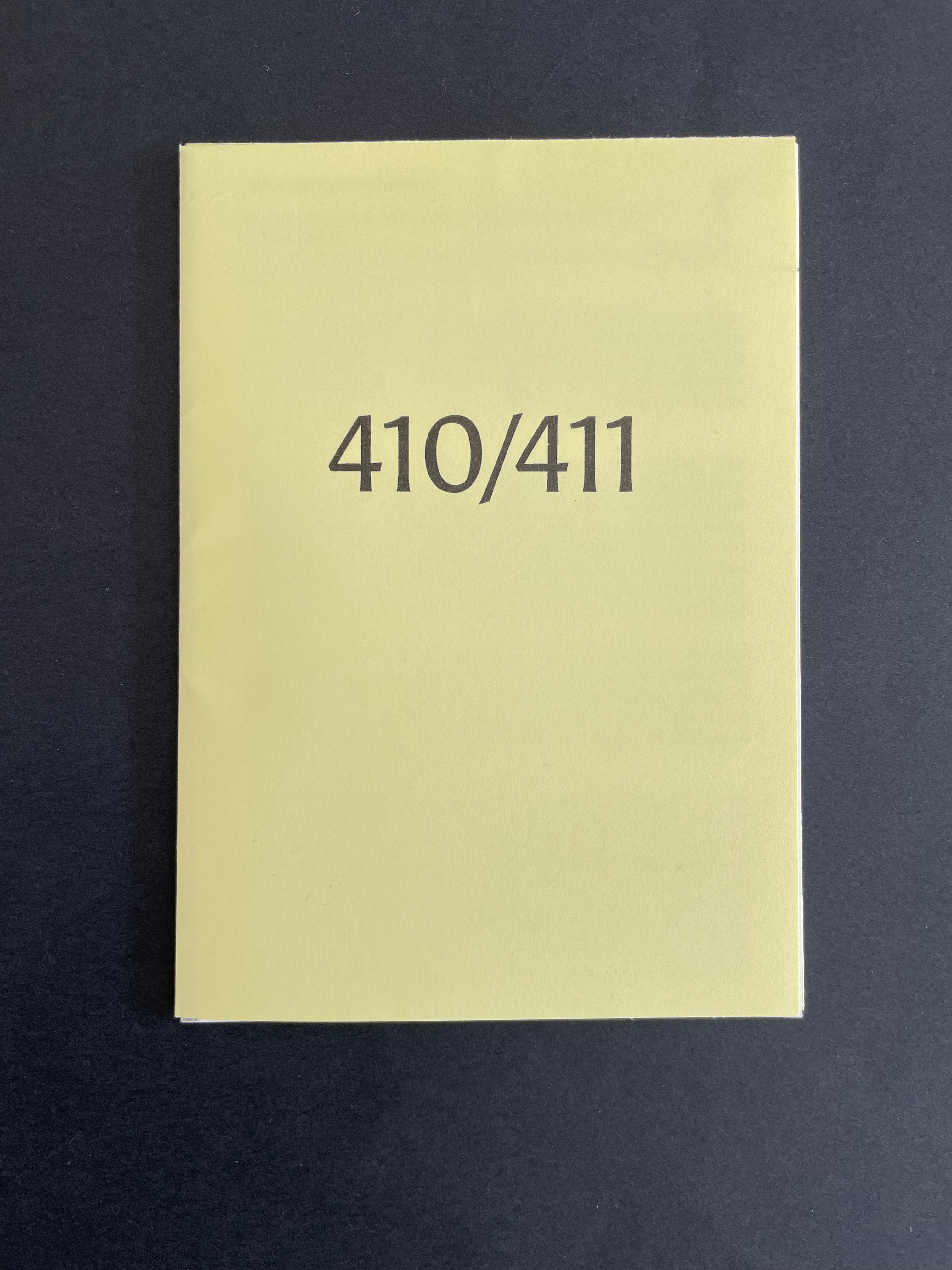
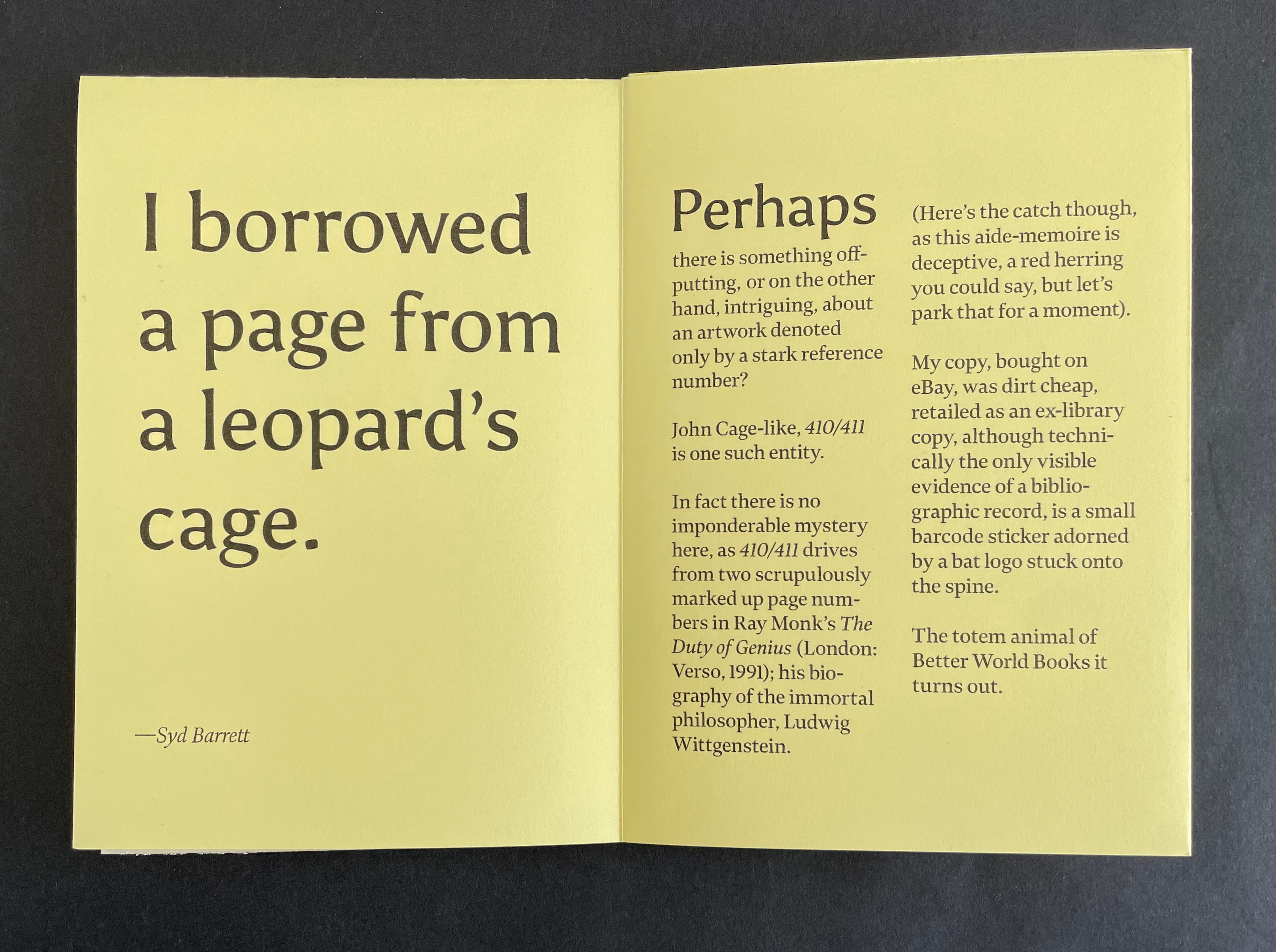
410/411 (2026)
Michael Hampton
Single-sheet, eight-panel, slit booklet with loose insert. H150 x W110 mm. Edition of 50. Acquired from Tension Gallery, 2 May 2026.
Photos: Books On Books Collection.
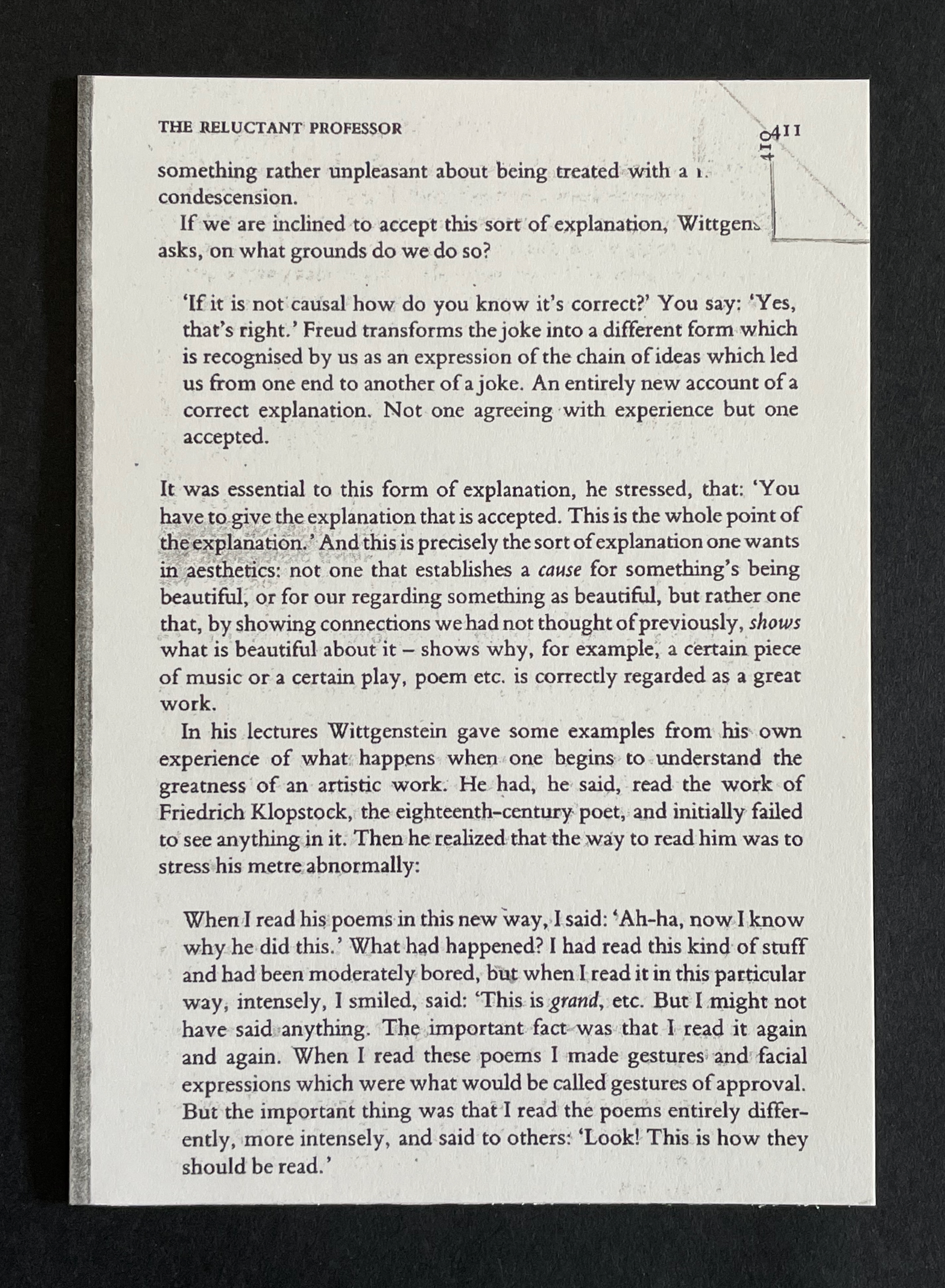
From its title self-referencing its topic of titular and bibliographical references to its ephemeral single-sheet structure and to its evidentiary insert, 410/411 captures the essence of parabibliography beautifully. No wonder it was offered for sale on the exhibition’s closing day.
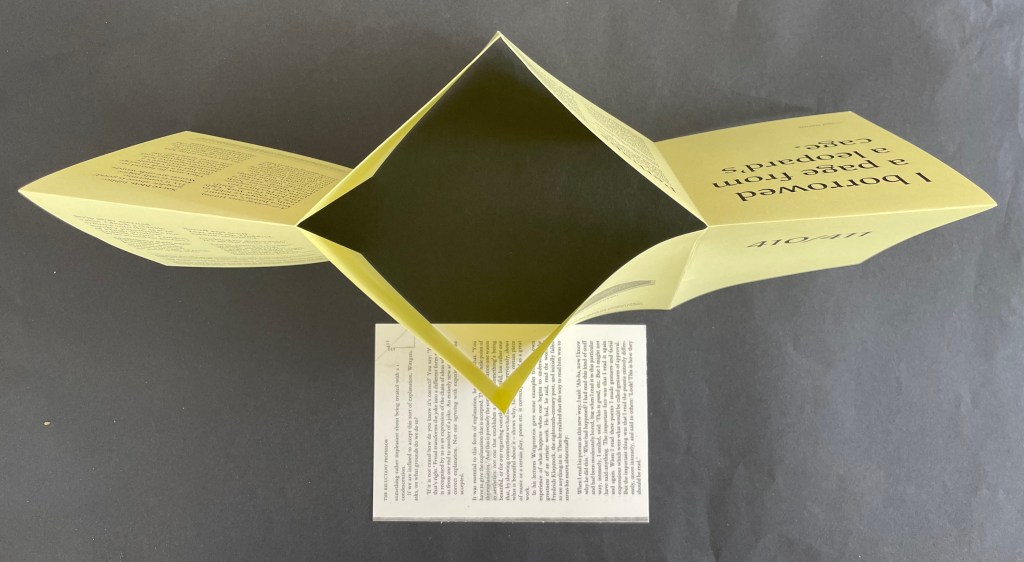
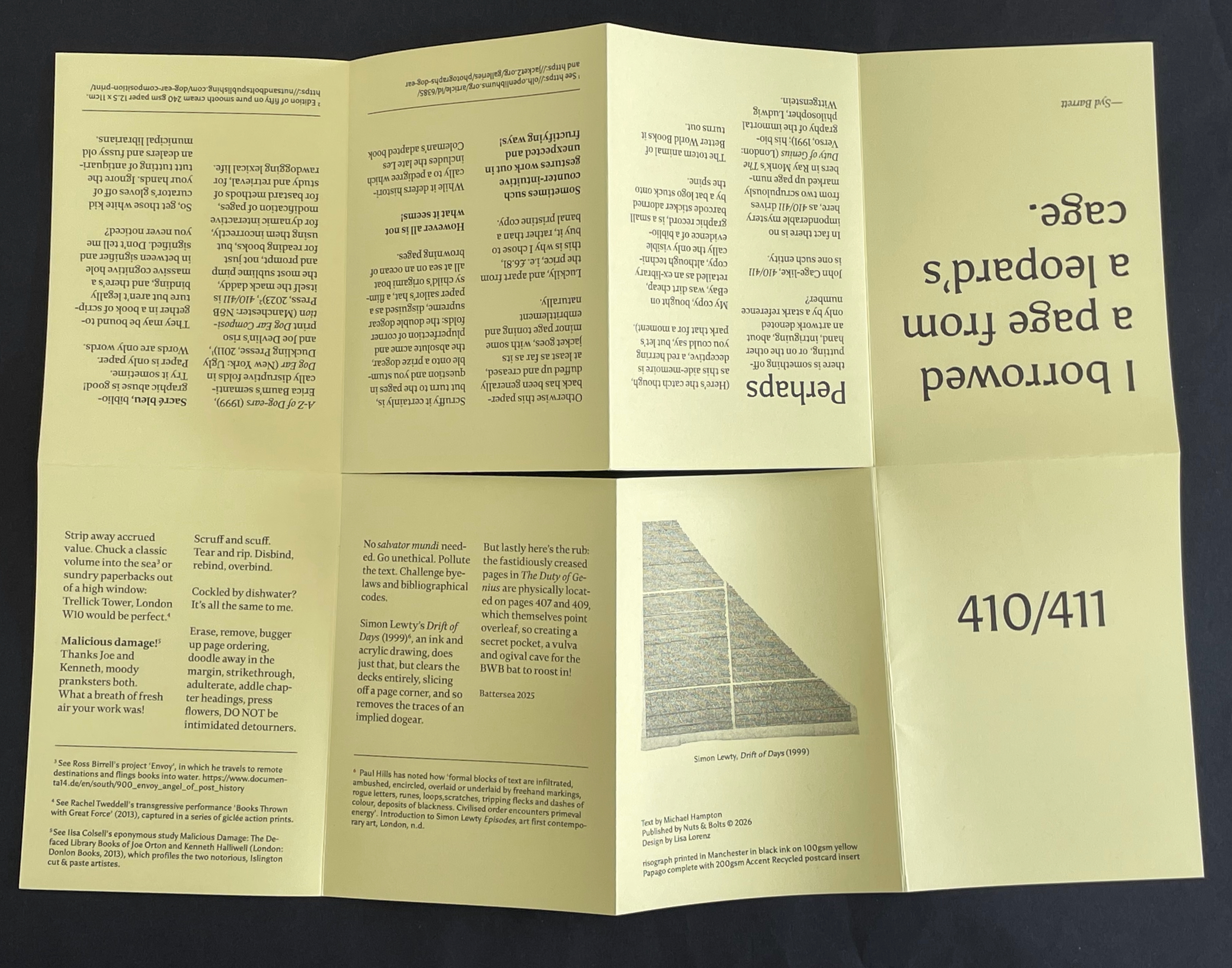
Hampton’s over-the-top explanation of this happenstance evidentiary insertion can be read in the image above, so I won’t spoil how it connects with the self-referential reference number of the title (nor spoil your frustration in twisting and turning your device). Feel free to rage or smile as you will.
Hampton’s critical thinking about artists’ books is also represented in The Artists’ Book : A New History (2011), Unshelfmarked : Reconceiving the Artists’ Book (2015), and Against Decorum (2022). Taken together with the works above, these books place Hampton in the company of Germano Celant, Simon Cutts, Johanna Drucker, and Mel Gooding.
Further Reading
Celant, Germano. 1972. Book as Artwork, 1960-72. London: Nigel Greenwood Inc. Ltd.
Cutts, Simon. 2007. Some Forms of Availability : Critical Passages on the Book and Publication. [New York, NY], [Cromford, Derbyshire]: Granary Books ; RGAP.
Davis, Brian. 2024. “Part One: The Rise of Multimodal Book-Archives“. College Book Art Association. Accessed 24 November 2025.
Drucker, Johanna. 2004. The Century of Artists’ Books. [Second edition]. New York City: Granary Books.
Gooding, Mel, and Bruce McLean. 2017. The Invisible Residency. Dundee: Cooper Gallery DJCAD and Knife Edge Press.
Hampton, Michael. 2011. The Artists’ Book : A New History. London: Banner Repeater.
Hampton, Michael. 2015. Unshelfmarked : Reconceiving the Artists’ Book. Devon: Uniformbooks.
Hampton, Michael. 2022. Against Decorum. York, UK: information as material.
Hampton, Michael. Dec-Jan 2008-09. “John Latham: Distress of a Dictionary“. Art Monthly, No. 322.
Sherman, Levi. 9 July 2026. “RAGE PEN“. Artists Book Reviews. Excellent review of the book.
Spieker, Sven, ed. 2017. Destruction. London, Cambridge, Massachusetts: Whitechapel Gallery ; The MIT Press.
Thomas, Greg. September 2024. “Book Marks“. Art Monthly, No. 479.

