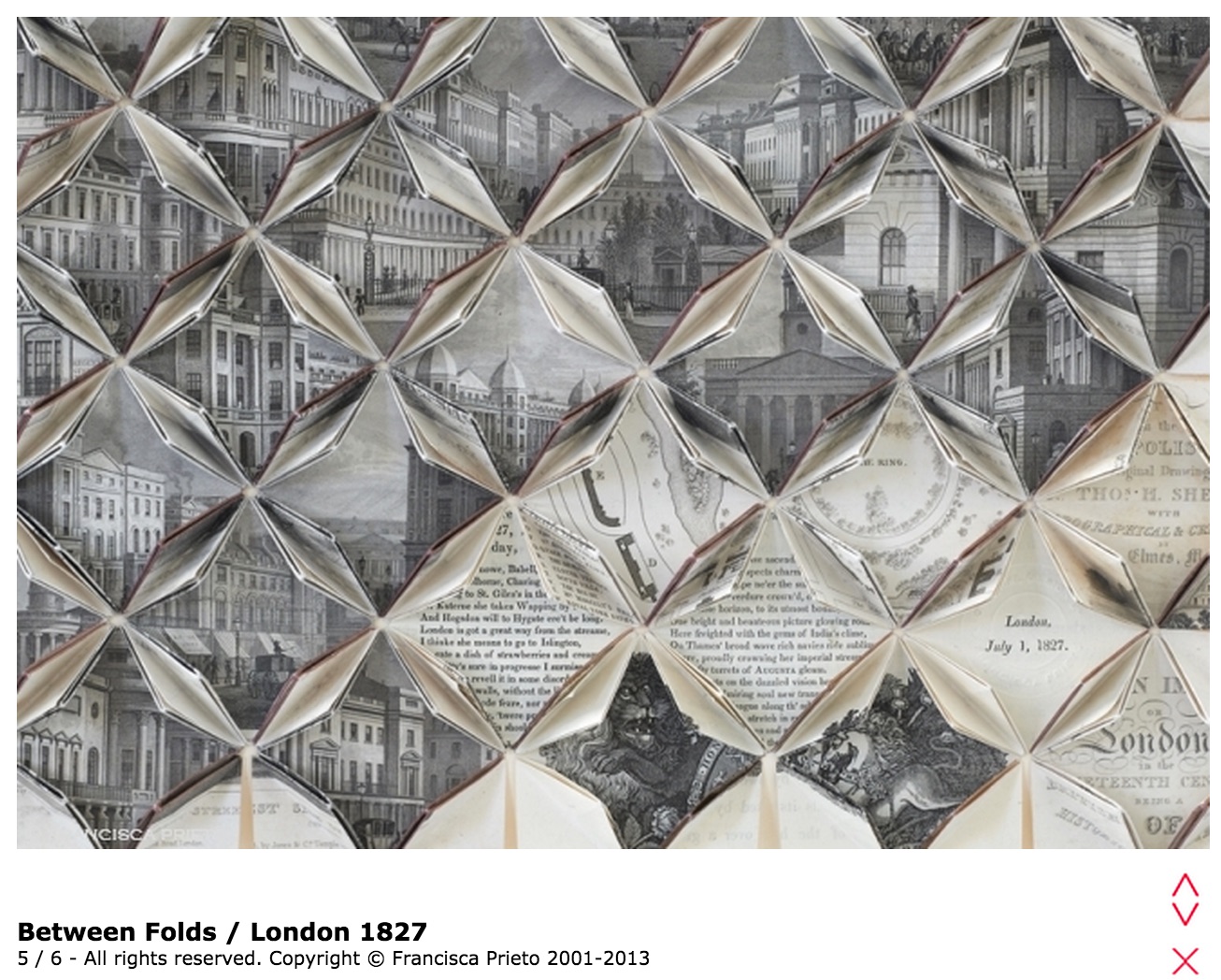
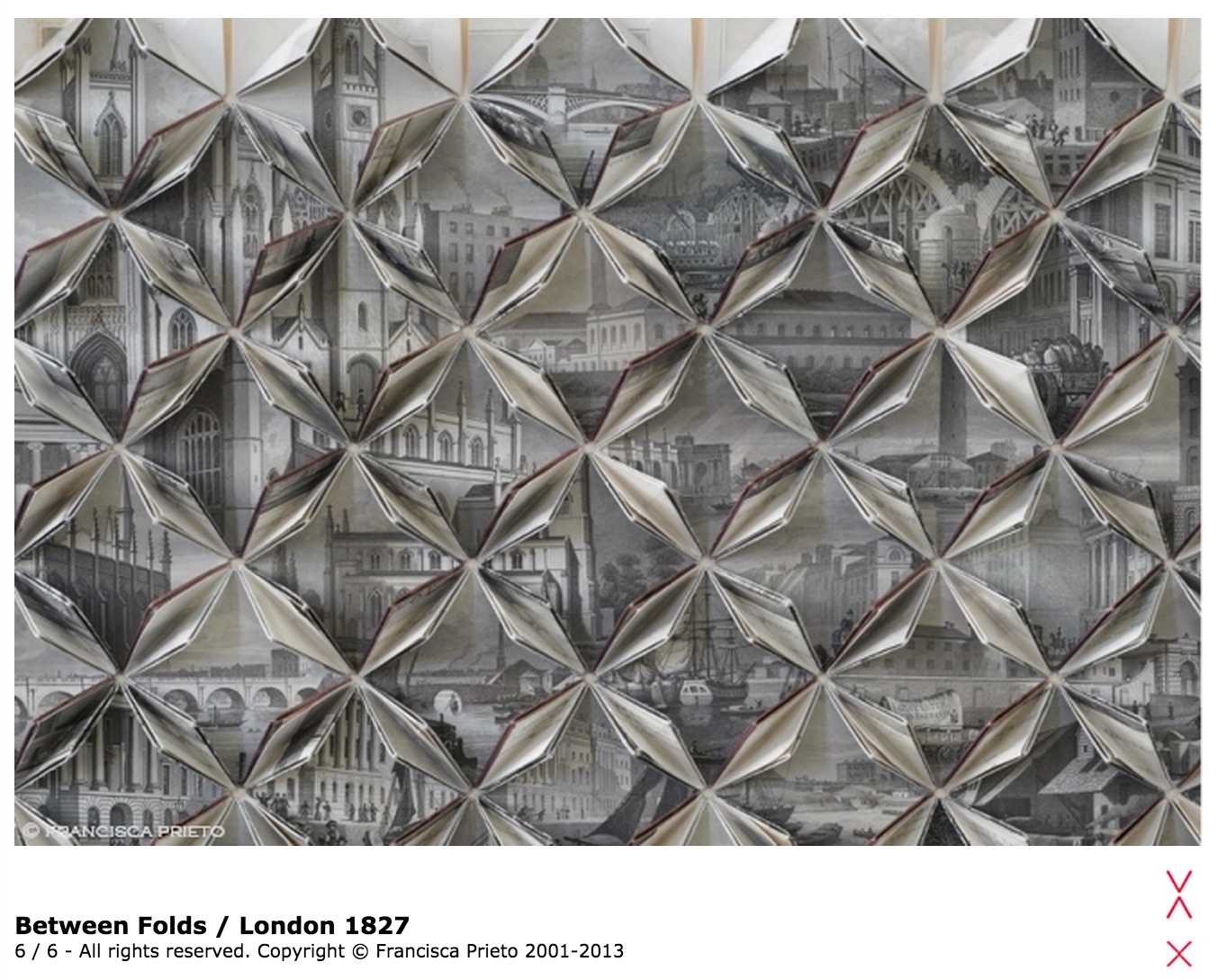
London 1827 takes us back in time, unfolding the nineteenth-century city before us. In a fluttering of pages we are cast among the grand stone of new buildings, under bridges, along the paths of Regents Park, up to a long-forgotten skyline – an elegant rising of church spires. — Francisca Prieto,Between Folds
In August 1827, William Blake’s family walked along these London streets in the cool of the buildings’ shadows to the site of an unmarked grave in Bunhill Fields in the Borough of Islington. If the mind’s eye lets the spectator step into those shadows, the metallic edging of the folds in this work recalls Blake’s invention of relief etching on copper plate to enable the “Illuminated Printing” of his “Illuminated Books”. Where the eye passes Lincoln’s Inn Fields, Blake’s apprenticeship springs to mind — for 50 guineas to an architectural prints engraver (James Basire, 1730–1802) for the tasks of polishing the plates, sharpening the gravers, preparing the surfaces for the acid, guiding the graver’s bite through the copper and, eventually, creating the sketches for the plates in Richard Gough’s Sepulchral Monuments in Great Britain.
Gradually becoming aware of Prieto’s painstaking mathematical precision and calculation to expose between the folds just the right text and illustrations from London and its Environs in the Nineteenth Century by Thomas H. Shepherd, published the month before Blake’s death, the flâneur of London 1827 might wonder whether Blake would have cast Prieto’s lot in with those of Newton, Locke and Bacon, his sterile scientific materialists. But no, Blake praised the unity of art and science:
“What is the Life of Man but Art & Science?” (Jerusalem, plate 77)
“Art & Science cannot exist but in minutely organized Particulars, and not in generalizing Demonstrations of the Rational Power.” (Jerusalem plate 55: line 62).
Prieto’s works consist of these “minutely organized Particulars” and, being so, they bring the viewer to “Life” and assert their place in the tradition of book art.
“There is art to be found in science books and science to be found in artist’s books.”
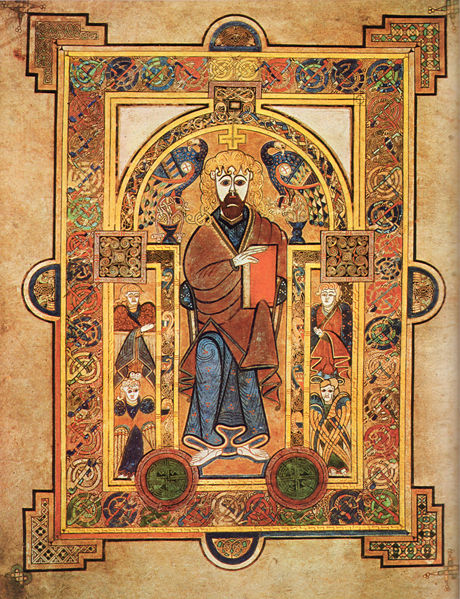
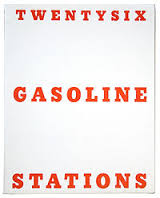
The Buffalo & Erie County Public Library has been kind enough to share the exhibit labels for its display held in March this year in the Grosvenor Rare Book Room. The section devoted to “Artist’s Book History” begins with the Book of Kells and runs to Ed Ruscha’s Twentysix Gasoline Stations.
Although many will claim that artist’s books began with William Blake in the 1700’s or so that would dismiss entirely all of the artistry that went into many lovely and ornate illuminated manuscripts that proceeded and somewhat overlapped the printed text in codex form. Whether painted in monastic scriptoria, as was the Book of Kells (c. 800), or by secular guild artists as were many others, the figures and/or flora are artworks to behold.
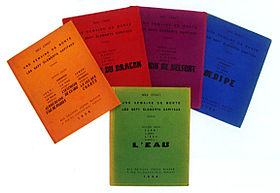
World Wars I & II brought many artist books associated with the Avant-Garde, Futurist and Surrealism Movements. Max Ernst’s Une Semaine de Bonté (1934).
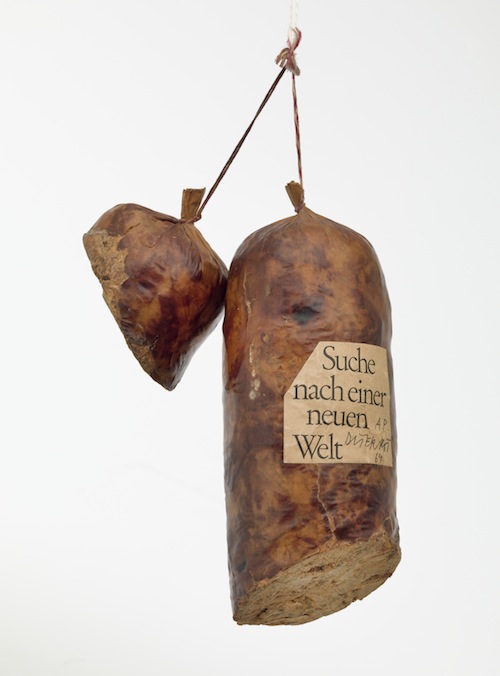
Dieter Roth, “Literature Sausage (Literaturwurst),” 1969, published 1961-70. Artist’s book of ground copy of Suche nach einer Neuen Welt by Robert F. Kennedy. Gelatin, lard, and spices in natural casing. Overall (approx.) 12 x 6 11/16 x 3 9/16 in. The Museum of Modern Art, New York. The Print Associates Fund in honor of Deborah Wye.
The second half of the nineteenth [sic] century brought Dieter Roth and Ed Ruscha’s works. Roth was a Swiss artist for whom the book was just one of his media. Paint, sculpture, installation work and more also provided means of artistic expression.
Ed Ruscha is an American pop artist whose focus is in paint, drawing, printmaking and photography. His Twentysix Gasoline Stations (1963) photographically captures gas stations in book form as Andy Warhol did Campbell soup cans on canvas. This artist’s book is considered an important milestone for the genre.
Ruscha’s book also figures in the exhibit section called “Artist’s Books and Bookworks Today” along with works by Julie Chen and Susan Allix as examples of the growing availability of collectible book art today.
Personal Paradigms, Julie Chen, 2004
Julie Chen founded Flying Fish Press in California through which she creates handmade “artists’ books with an emphasis on three-dimensional and movable book structures and fine letterpress printing” according to her web site. These books are frequently moveable and/or interactive in their design.
Egyptian Green, Susan Allix, 2003 “The texts in Egyptian Green are mainly drawn from travellers visiting or writing about Egypt. The earliest is a spell written inside an ancient coffin; later writers include Plutarch and Catullus, also Leonhart Rauwolff, who noted in 1672 that the water of the Nile was “perfectly green”, and Amelia Edwards on the precise colour of palm trees. There are two calligraphic pieces of Kufic script printed from the original blocks found in Cairo.”
British book artist Susan Allix also has her own (self-titled) press and she creates handmade books with a variety of fine papers and textures with letterpress printing, embossing and all manner of printmaking. Though some of her books convey a certain whimsy, the choice of materials, method of printing and crafts[wo]manship is the result of serious thought, planning and selection.
Other sections are devoted to historical examples of illustrated works of scientists such as Vesalius and Lamarck, which are well punctuated by the inclusion of Guy Laramée’s Grand Larousse, Brian Dettmer’s The Household Physicians and Doug Beube’s Fault Lines.
Grand Larousse, Guy Laramée, 2010
The Household Physicians, Brian Dettmer, 2008
Fault Lines, Doug Beube, 2003
Books altered and/or sculpted by artists to represent something other than the original readable text are known as bookworks and they are works of art. This type of art is not technically an artist’s book whereby a book is created. Altered/sculptural books take from a book that had already been created and turn it into art by cutting, folding and/or sculpting it into an art form. Although there are many examples of this type of work, perhaps the most inspiring artists’ works (some available in art galleries today) are those by contemporary and still-creating Canadian Guy Laramée, American Brian Dettmer and Toronto-born, schooled-(in part)-in-Rochester/Buffalo and now-living-in-New-York-City Doug Beube. The examples of their works shown are all pieces inspired by some aspect of science or subject of scientific study including geology, medicine and geography.
The theme of the exhibit deserves a catalogue. As the exhibit’s online announcement notes, “Today’s mutually exclusive idea of ‘left-brained’ and ‘right-brained’ activity discounts longer understood ideas that science is a creative pursuit—that there really is art to be found in science—and that creative artworks often have some scientific basis and/or inspiration.” One would do well to start with Harry Robin’s The Scientific Image: From Cave to Computer (1992) and Brian Ford’s Images of Science: A History of Scientific Illustration (1993) and take further inspiration from the Grosvenor Rare Book Room.




 Books On Books