Ebb and Flow (2023)
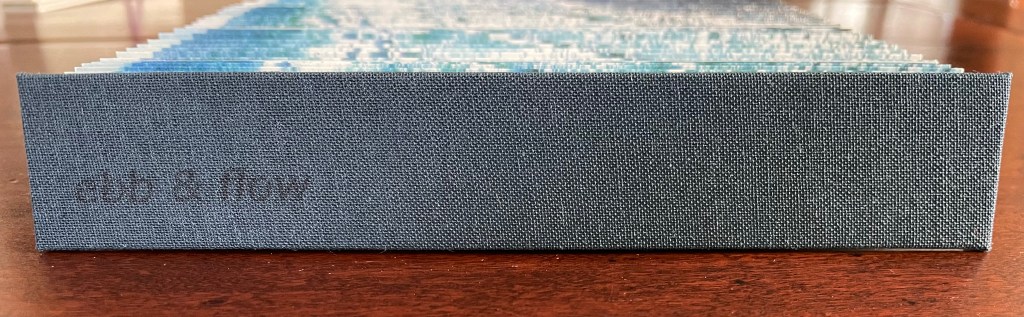
Ebb and Flow (2023)
Jane Cradock-Watson
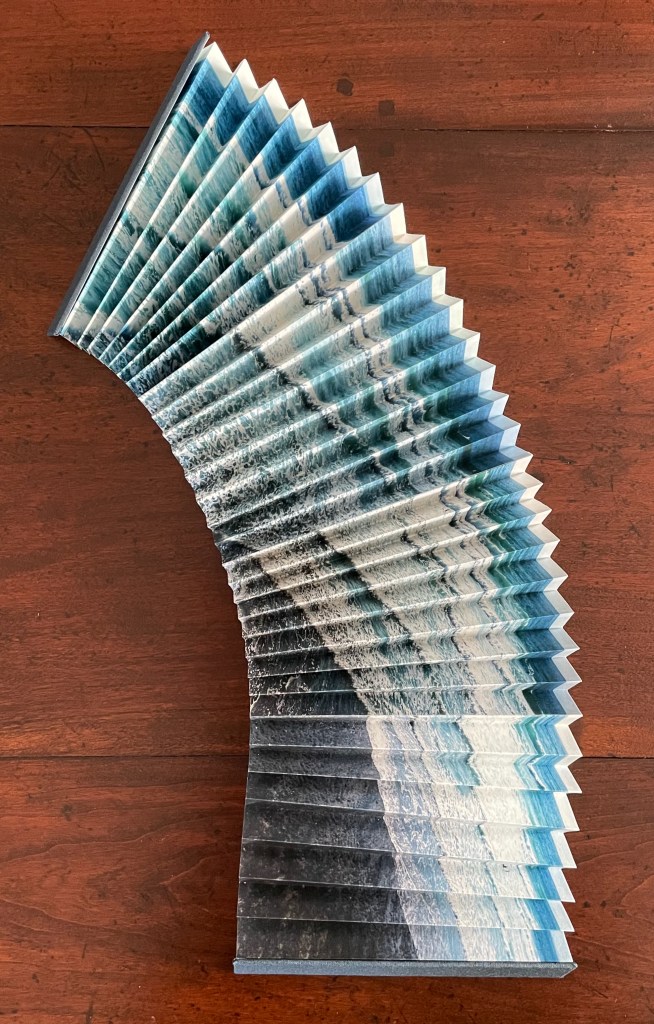
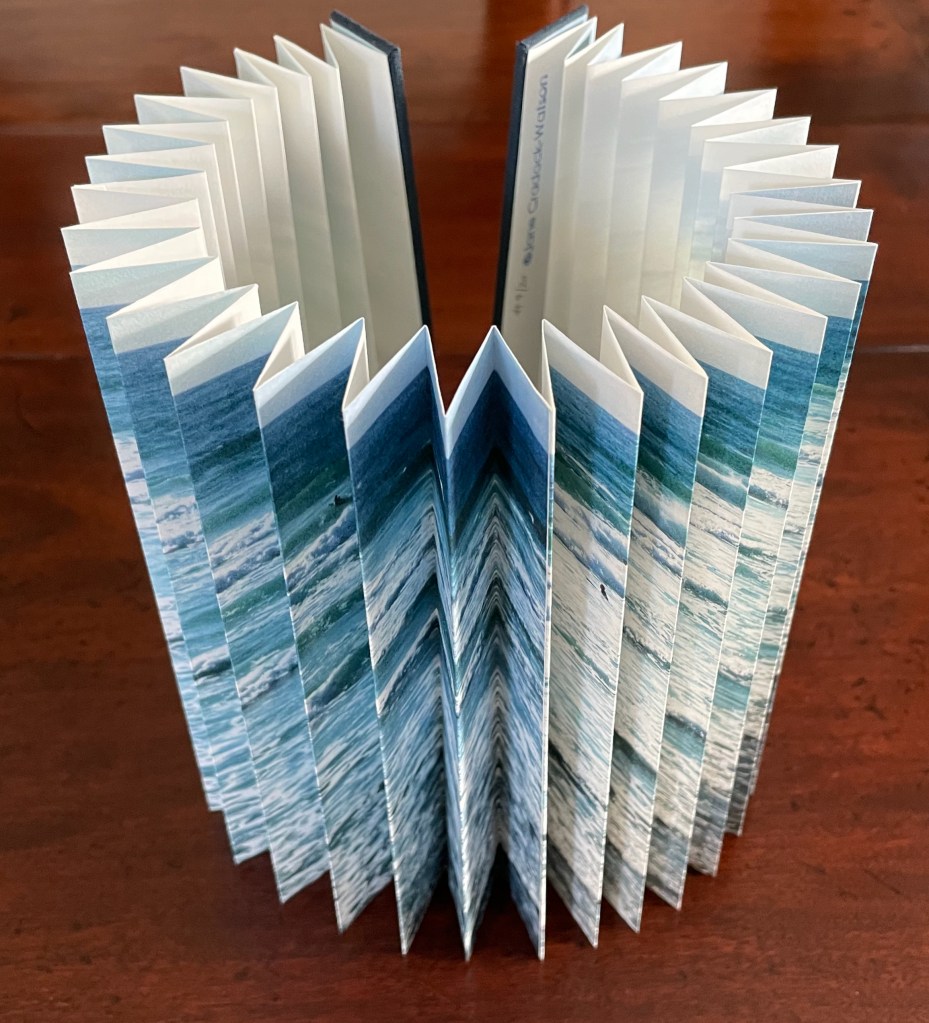
Concertina book with cloth hard bound covers. H155 x W27 mm (closed), W680 mm (open). 64 panels. Edition of 20. Acquired from the artist, 21 January 2024.
Photos: Books On Books Collection. Displayed with artist’s permission.
An exploration, both visually and physically, the ‘edge’ of the sea where it meets the land, with its continuous ebb and flow of the breaking waves, rhythmically rolling back and forth onto the sand. (Artist’s description)
With the binding and her photography in Ebb and Flow, Jane Cradock-Watson has sculpted and painted the sea’s edge. Four digital photographs printed on Zerkal paper have been spliced together between two cloth-covered boards. The flexibility and extent of the concertinaed paper create an undulating structure that turns seascape stills into mesmerising cinema.
For the work’s display in the “Making Waves” exhibition (2023) at the Upright Gallery in Edinburgh, a video of the work being manipulated was made and can be seen here.


Elmbridge Meadows (2016)
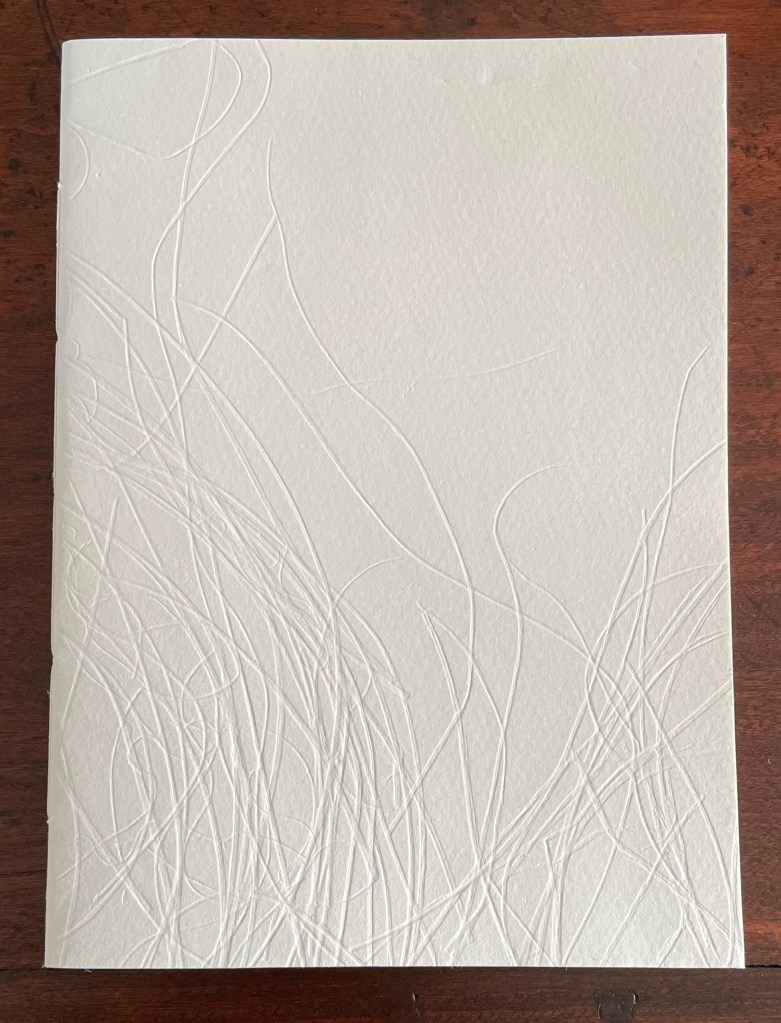


Elmbridge Meadows (2016)
Jane Cradock-Watson
Blind embossed soft cover of Somerset paper over signatures of Tosashi White Wove and Tosa Washi papers. H203 x W147 mm. [36] pages. Edition of 10, of which this is #7. Acquired from the artist, 21 January 2024.
Photos of the work: Books On Books Collection. Displayed with artist’s permission.
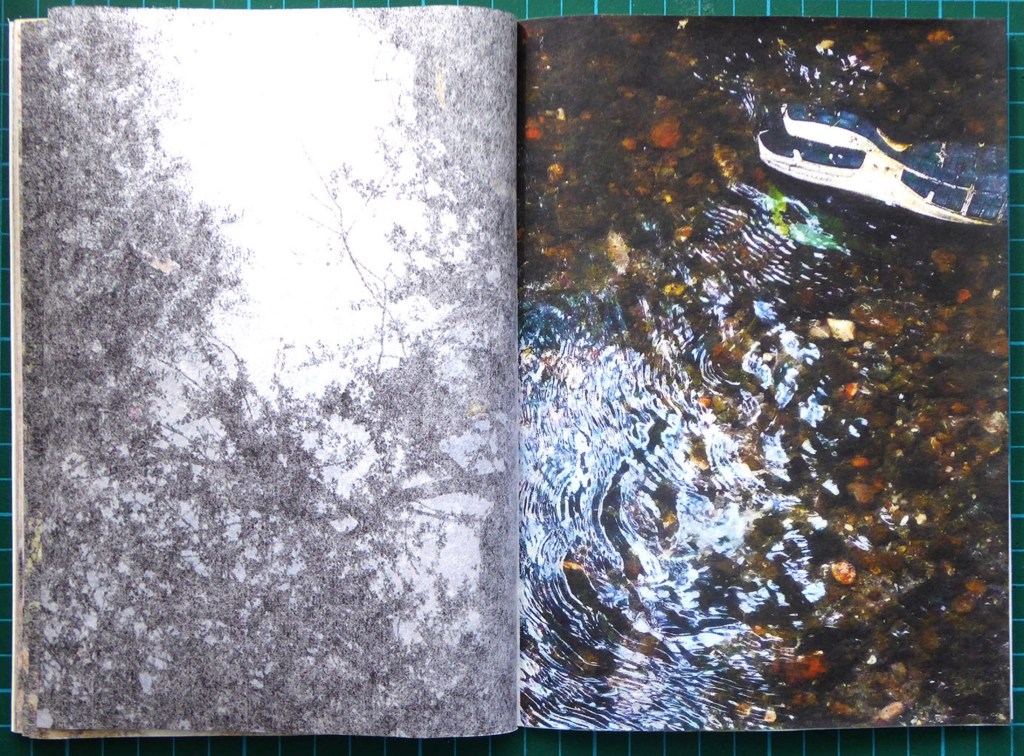
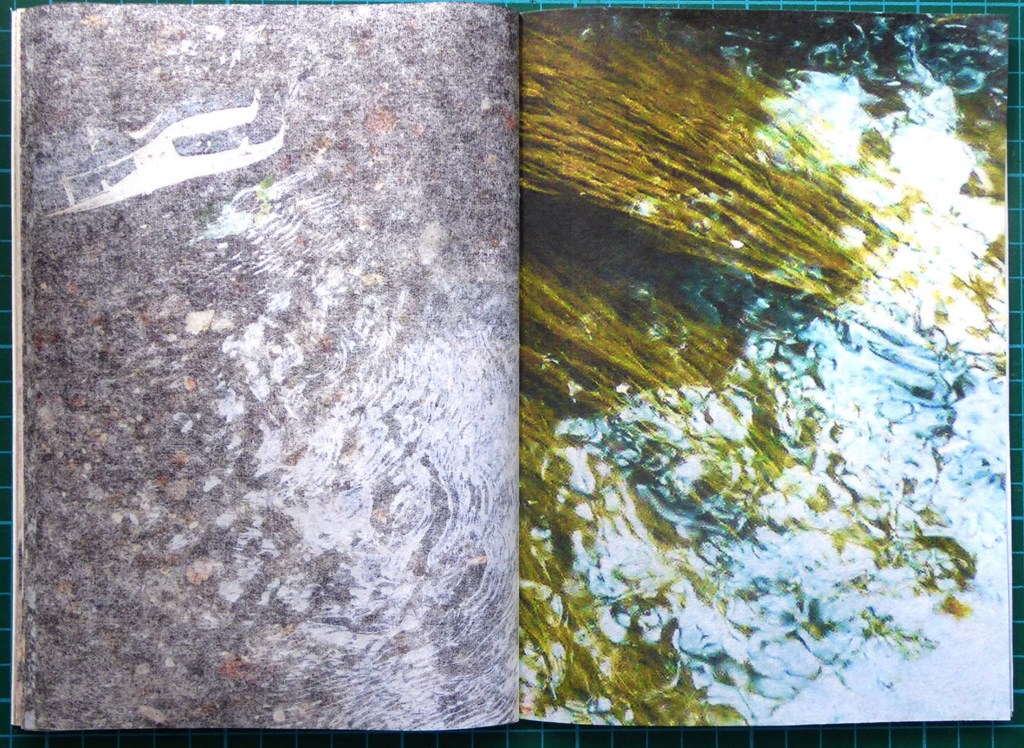
A visual exploration of the current day Elmbridge Meadows section of the Hogsmill River that flows through Surrey to the Thames. The book follows the flow of the river, its flora and fauna, including the slightly hidden man made intrusions to its riverside idyll, in the form of submerged mattresses, graffiti and discarded trainers, which now punctuate its flow and have become integrated into its physical environment. (Artist’s description)
Elmbridge Meadows may follow the flow of the water, but as the second of two books in a series entitled Looking for Ophelia – A Journey Along the Hogsmill River, it appears upstream, as it were, from the first book in the series. The first book is Six Acre Meadow, named after the site that John Everett Millais used for painting Ophelia (1851-52). Elmbridge Meadows is upstream from Six Acre Meadow on the Hogsmill River, which originates to the south in Ewell and runs north until it flows into the River Thames. So, moving upstream from Millais’ siting of Ophelia and toward Hogsmill’s source, are we looking for Ophelia’s tragic point of entry? Are we looking upstream into the past? Perhaps this is splitting Pre-Raphaelite hairs. From whichever site, Cradock-Watson would have us look through the translucent leaf of Washi paper, then turn the leaf to look into the water at the reflections on its surface and what lies beneath.
In Water and Dreams, the French philosopher Gaston Bachelard writes of poetry’s constant recourse to water for exercise of what he calls the “material imagination”. He finds so many that resonate with Queen Gertrude’s description of poor drowned Ophelia that he groups them together under the heading the “Ophelia Complex”. The inevitable literary linkage of sex and death ensues. By its series title, Elmbridge Meadows inherits this linkage, but in Cradock-Watson’s material imagination, it is transformed. Here is her description of Six Acre Meadow, which applies equally to Elmbridge Meadows:
Two different papers are used within the book, the most translucent to allow the ghost image of the artefacts / still lives of found objects to seep through to the reverse page and continue the narrative of object and place [underline added]. The tactile delicate paper echoing the vulnerability of both the dying figure of Ophelia and the local natural history of its setting, surrounded as it is now by suburban housing, increasing traffic and pollution. Nature is so evocative of the human condition. Themes of death and decay and the tensions between nature and the impact of mans presence are explored in the book, with the use of ghost images used to communicate the sense of one element being affected by another and the sudden feeling of isolation and darkness which can still be encountered in places.
“Narrative of object and place” is an apt phrase for Elmbridge Meadows and other wordless artists’ books such as Helen Douglas’s The Pond at Deuchar (2011), Marlene MacCallum’s Theme and Permutation (2012) or Shona Grant’s Land Lines (2018) and Tide Lines (2020). Although Johanna Drucker establishes the idea of “The Book as Sequence: Narrative and Non-Narrative” and that of “Book as Portfolio or Collection”, this concept of book as narrative expressed through object and place is not explored as such. Elmbridge Meadows and these other works offer compelling exhibits with which to build out a concept of the artist’s book as narrative of object and place. In Elmbridge Meadows, object and place are one — the river. By the selection of place and title for the work, the artist extends the narrative into the past. Driven by the river’s and time’s flow, the narrative unfolds by re-presenting the river as a sequence of images in which its surface and objects beneath it interact. The visual interactions of the selected papers’ surfaces signal and deepen this narrative of object and space. Further deepening also occurs at a tactile level with the blind embossing of the cover and texture of the papers — as if one is feeling the flow of Ophelia’s tresses, the river weeds, the ripples on the surface of the water, and reflections of detritus under the water on the surface of the turned page.


Long Beach Books (2013)
Long Beach Books (2013)
Jane Cradock-Watson
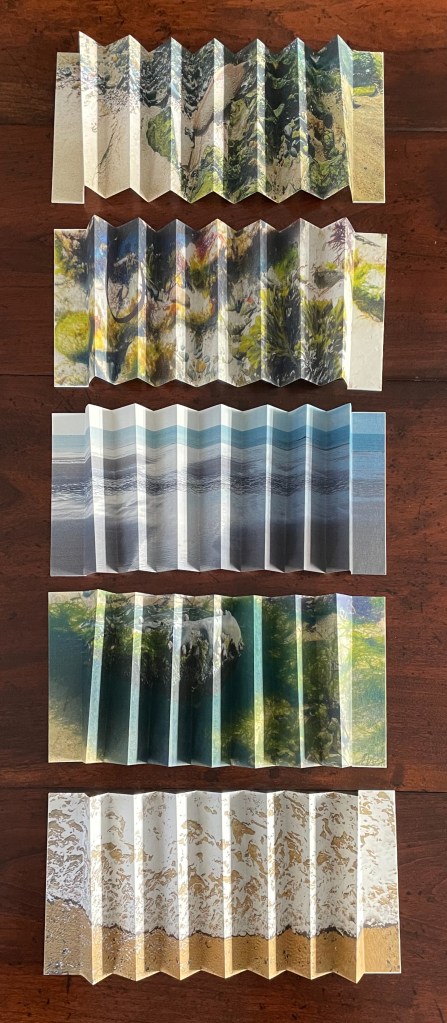
A series of five small concertina books, each H125 x W25 mm (closed) 390 mm (open). Acquired from the artist, 21 January 2024.
Photos of the work: Books On Books Collection and courtesy of the artist. Displayed with artist’s permission.


Like Elmbridge Meadows, the Long Beach Books are part of a series. Unlike Elmbridge Meadows, each small book in the series depends on the others to develop a “narrative of object and space”. Each book focuses on a different location and aspect of “Long Beach”. Within and across the images, there is no recurrent point of reference. Only the title of the series provides a register of place. Beyond that, the real recurrent points of reference — the registers that unify the work — are paradoxically a sameness and a difference: the sameness of book structure and the difference of papers. The sameness of structure lies in the precisely repeated concertina structure and is apparent from photographs of the five works. Not easily seen in the photography is the use of “a variety of papers to suit the subject matter and textural qualities of the subject” (artist’s statement). For example, the view of shimmering sand is printed on a crisp shiny paper; the view into tidal pools is printed on paper whose surface has a hazy or gauzy effect. Without each other for manual contrast and comparison, that leap of material imagination cannot be adequately appreciated. The sameness of structure and the leap of material imagination to align different aspects of the shoreline with a variety of papers establish Long Beach Books‘ narrative of object and space.
Further Reading
“Helen Douglas“. 24 February 2020. Books On Books Collection.
“Shona Grant (II)“. Books On Books Collection. (In progress)
“Marlene MacCallum“. 2 September 2019. Books On Books Collection.
Drucker, Johanna. 2004. The Century of Artists’ Books [Second edition] ed. New York City: Granary Books.
Farmer, Ian. December 2023. Making Waves. Edinburgh: Upright Gallery. Accessed 31 December 2023.
 Books On Books