Bookmarking Book Art — Nicholas Jones

img_5967The artist and his bookworks, Nicholas Jones from Melbourne, Australia.

Extract from “The World of the Book” by Des Cowley & Clare Williamson, pp 218

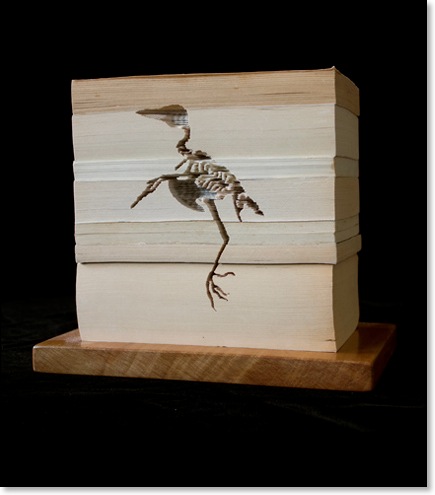
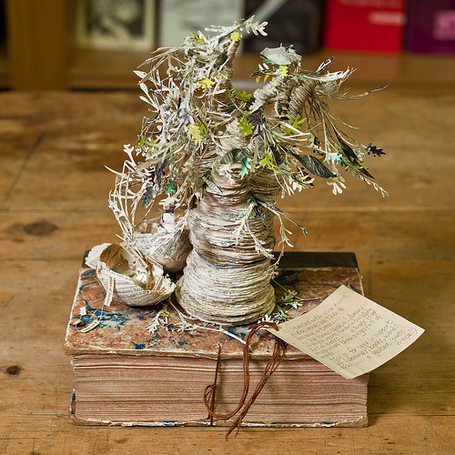
The beauty inherent in a book’s form has often been revealed by artists who change and modify books. Nicholas Jones’s altered books are made with surgical precision, as he rips, tears, cuts and folds them into new shapes. His work attempts to highlight the beauty of the book through a process of changing it.

Instead of considering the book as a vehicle for narrative or ideas, we are instead confronted by the abstract quality of the book’s shape. Its original text is almost irrelevant to the final sculptural form, except as a fragmented pattern that peers out from beneath the finished folds or cuts. Jones’s father is a surgeon, and it is the very implements of this trade- scalpel, surgeon’s needle- that he uses to alter books. The act of defacement is the process whereby Jones renews the physical form of the book, divesting it of its original intent and allowing the viewer to ‘read’ it in an entirely new way.

via Selected Writings.

Bookmarking Book Art — Julie Dodd (2013), updated (2017)

2504457-4
Can’t See the Trees for the Forest, Julie Dodd
© a-n The Artists Information Company. All rights reserved.

“Can’t See the Trees for the Forest” by Julie Dodd is an installation of book pages cut in the shape of trees and suspended from the ceiling.  The installation last appeared at the Bridewell in Liverpool. The oak trees in the back rank are clean and clearly readable while the firs in the front rank obscuring them are blackened.  Dodd’s art is art with a green message, protesting the replacement of England’s native trees with non-native quick-growing species.

“The process of installing this work was more important than the finished piece to me.  The indigenous trees although similar in shape, colour and content are all individual whilst the addition of the invasive fir trees obscuring the view left me wanting to tear them down to reveal the beauty behind.”  “Can’t See the Trees for the Forest,” Julie Dodd

Since the installation above in 2013, Dodd has mounted installations at the CODA Museum in Apeldoorn, the Beeldentuin Achter de Westduinen in Ouddoorp and the Liverpool Book Art Exhibition.

Out of Palms Way © Julie K. Dodd
Out of Palms Way
© Julie K. Dodd

On her site, Dodd writes of “Out of Palms Way”:

The clearing of large areas of forest, plantations and peat land in Indonesia, Malaysia and Africa is having a detrimental impact on our planet. This is happening in order to sustain the demand for the production of palm oil and is causing terrible environmental damage.

Coral Colony © Julie K. Dodd
Coral Colony
© Julie K. Dodd

“Coral Colony”, stripped back to basic shapes in paper and stripped of color in bleached paper, demonstrates the loss that is occurring in coral beds around the world as pollution and rising sea temperatures caused by climate change kill off the algae that gives the coral its hues.

Fungal Spores © Julie K. Dodd
Fungal Spores
© Julie K. Dodd
Fungal Spores © Julie K. Dodd
Fungal Spores
© Julie K. Dodd

Dodd writes:

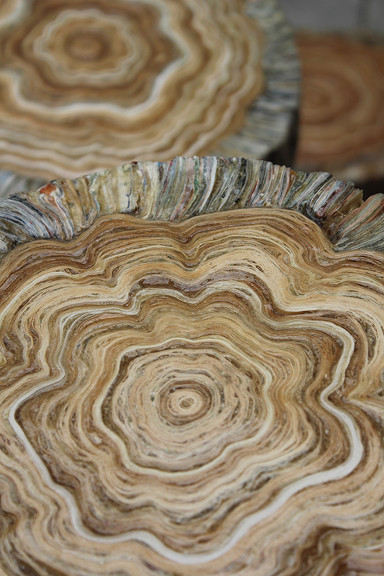
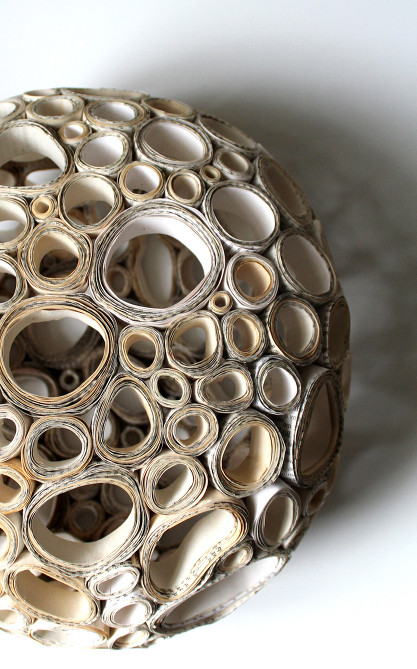
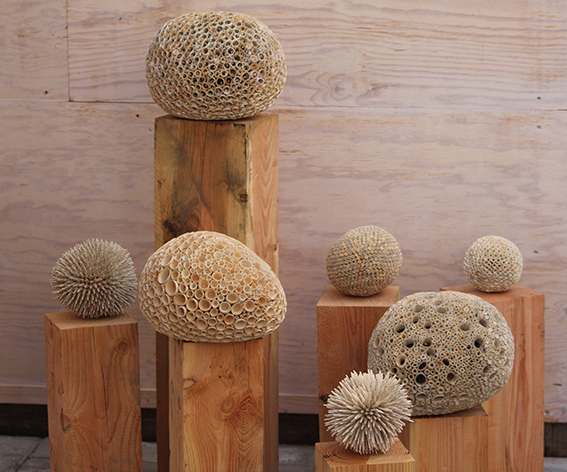
The fungal spores series is an ever changing project that sees new spores develop from the last through experimentation with different ways of rolling paper from old books.

 The project started after throwing away some books that hadn’t been stored properly over the winter in my studio which had left the books with that damp old book smell. Which led to researching images of fungal spores under the microscope.  

The destruction of the book will eventually produce many spores of various shapes and size to form a large installation.

“Fungal Spores” and the work depicted here place Dodd squarely in the tradition of environmental book art by artists such as Lucy Lippard, Basia Irland, Hans Haacke, Doug Beube, Ann Marie Kennedy, Maggie Puckett and Do Myoung Kim.

Bookmarking Book Art — Fore-edge Printing and Painting: Book Art and the Book Arts Revealed

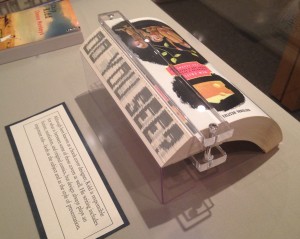
Chip Kidd’s novel The Cheese Monkeys, designed as well by him, sports a printed fore-edge. When the book is closed, the fore-edge is blank.  Fanned in one direction, it shows the sentence as seen in the photo below.

Chip Kidd, The Cheese Monkeys: A Novel in Two Semesters, 2008

Chip Kidd, The Cheese Monkeys: A Novel in Two Semesters, 2008, from the Chip Kidd Archives, on display Jan. 12 through April 24, 2015, in The Eberly Family Special Collections Library, Penn State University. Reproduced with permission of the Library

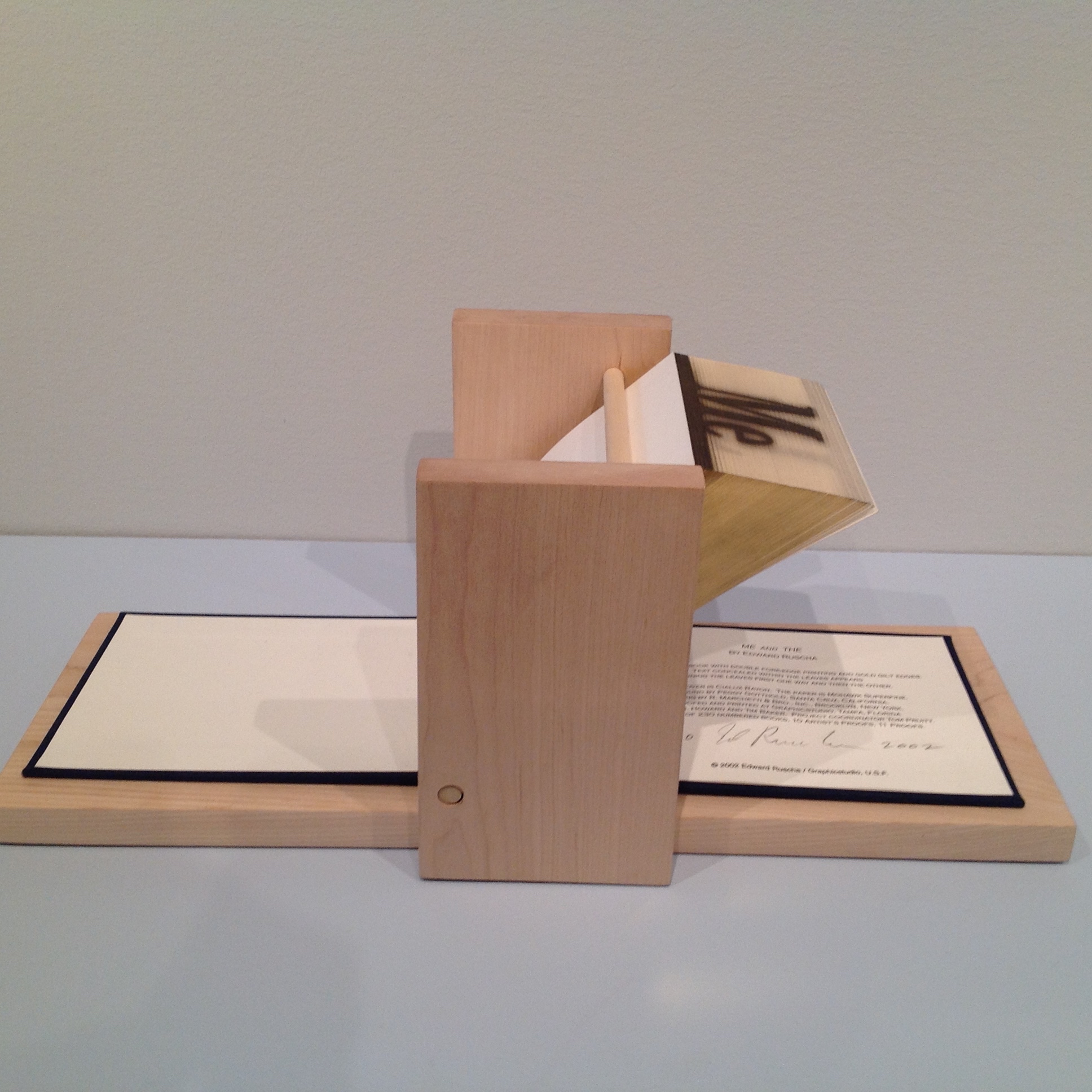
Fanned in the opposite direction, the fore-edge displays another phrase: “Good Is Dead”. The printing process is well described in a 2004 video by Graphics Studio|Institute for Research in Art, prepared about the making of Ed Ruscha’s fore-edge book Me and The.

Ed Ruscha, Me and The, 2002 Allan Chasanoff Collection, Yale University Art Gallery

Ed Ruscha, Me and The, 2002
Allan Chasanoff Collection, Yale University Art Gallery

This is similar to traditional fore-edge painting.  Much of what is worth knowing about fore-edge painting can be learned from Martin Frost’s QuickTime Movie-rich website, but if you are a fan of the Folger Shakespeare Library, its holdings yield some outstanding examples under the hand of Erin Blake.   

Double-fore-edge-painting-showing-half-of-each-painting

Jeff Weber’s book Annotated Dictionary of Fore-edge Painting Artists & Binders is probably the lengthiest treatment available on the subject. Hear him discuss his work here.  Weber, who commissioned artwork from Frost, Margaret Allport (Costa) and Clare Brooksbank, has a particularly well-written article at the International League of Antiquarian Booksellers’ site.     

Phillip J. Pirages, an antiquarian bookseller, provides an enlightening and entertaining talk on fore-edge painting of the 18th century and shows a superb example of the London binders Taylor & Hessey’s work — a two-volume set of the works of Alexander Pope, bound in red morocco leather and decorated on the fore-edges with scenes of Twickenham and Windsor.   

The point of this bookmark is not merely to share a curiosity but to use that narrow, hidden curiosity as an illustration of the boundaries of book art and the book arts.        

Updates

Thanks to Ann Kronenberg for this link to a 1940s film on the topic.

Thanks to Merike van Zanten of DoubleDutch-Design.com for this link from 4GIFS.com showing what appear to be biblical scenes painted on the fore-edge of a book.

Thanks to Peter Verheyen for this link to a history of decorating book edges with examples from the Maurits Sabbe Library and other Leuven and Belgian collections.

Weber, Carl. Fore-edge painting : a historical survey of a curious art in book decoration (Irvington-on-Hudson, New York: Harvey House, 1976.).

See also 21 July 2018 article on Martin Frost in The Times.

Bookmarking Book Art — Mandy Gunn

Wang 1
TEXT-ile The Unconcise Oxford Dictionary 2011                     © Mandy Gunn

Made of book pages, shredded and woven, cut and collaged,  the bookwork pictured is part of “an ongoing investigation between TEXT and TEXTILES.”    Gunn comments, “Text is usually explicit and obvious; textiles are understood in a more cultural, unstated way. By making Text into a Textile where only minute pieces of text render any meaning unmeaningful the boundaries between the two become blurred and the viewer has to look at the work differently.” (http://zoneonearts.com.au/2013-02-11-mandy-gunn.htm; accessed 12 May 2013).

Advancing in its investigation, Gunn’s work seems to be moving backwards in biographical time — the Oxford Dictionary   (hailing from her UK roots) to the Melbourne Yellow Pages (from her chosen new roots in Australia).

A work from 2010 called “Scroll” was made of hand shredded and woven Melbourne Yellow Pages.   The scroll is 10 metres in length and 60 cm wide draped over horizontal Perspex rods hung from the ceiling and cascades like a waterfall coming to rest on the floor.  The now meaningless text mingles with the colored inks of the ads and paper in a pixellated effect, blending the allusion to the pixellation of the computer screen with that to medium preceding the codex.


Bookmarking Book Art — Jody Alexander

EXPOSEDSPINES003
Exposed Spines © Jody Alexander

As with most book art (and almost all sculpture), Jody Alexander’s works celebrate the haptic so warmly that I wonder how an owner or viewer resists handling them.  And celebrating the book arts (Alexander makes her own paper in the Eastern style), surely these bookworks on display should be touched —like the books on the shelves of public libraries — until they take on the wear and patina of fine books.  Imagine the installation — call it “Touch This” — and what viewers would see and feel decades from now. A visit to her studio WishiWashi might come closest to this imagined event.

Alexander teaches at the San Francisco Center for the Book and blogs at Jalex Books Blog .  As of this posting (12 May 2013), however, the most recent entry for information on exhibits, classes and new artwork is 5 July 2012.

Update:

Erin Fletcher at Flash of the Hand has tracked down Jody Alexander for an interview (2 August 2013).

While reading the interview, you will begin to understand the depth of Jody’s commitment to her materials and characters. This exclusive connection is the cause for such a well-rounded body of work. Her dedication to teaching is just as exceptional, offering her skills to several venues both online and in person. Read the interview after the jump and come back each Monday during the month of August for more posts on Jody Alexander.

August // Book Artist of the Month: Jody Alexander

kqdv8gs2urrnhnk92ltowtl72ejkfbmt4t8yenimkbvvk0ktmf0xjctabnaljim91

The photo above comes from Alexander’s series SedimentalsThis series, which “takes the form of tea staining cotton to replicate the colors of aged and browned bookspines and swaddling or layering them to create a safe haven for these beautiful objects, enshrining them”, is an interesting instance of book art to which Garrett Stewart’s Bookwork: Medium to Object to Concept to Art applies. Check out Alexander’s site, read Stewart’s book and see if you agree.

MUSUBU Books and Art: Tokyo  California  Urawa Abstracts. Exhibition 12-24 September 2017 in Saitama, Japan; 17 April – 19 May 2018 in San Francisco, US. Co-organized with the Tokyo Bookbinding Club.

Online workshops with Jody Alexander. Accessed 19 September 2018.

Bookmarking Book Art – Ros Rixon

How to understand sculpture 5(1)
How to Understand Sculpture
Ros Rixon

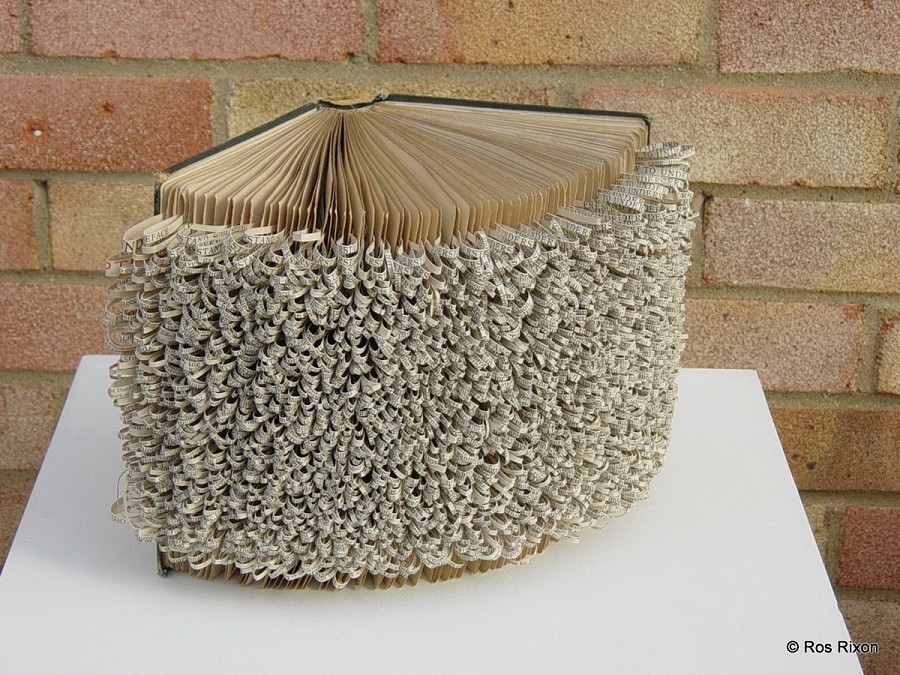
“… I suddenly found the information around me was evolving into the art.”  Statement, Ros Rixon, Oxford

Flint, Kate. “The Aesthetics of Book Destruction” in Smyth, Adam, and Gillian Partington, eds. 2015. Book destruction from the medieval to the contemporary. Basingstoke: Palgrave Macmillan. P. 183. This essay also resonates with Kat Buckley‘s essay on “ruin porn”.

Bookmarking Book Art — Kyle Kirkpatrick

kylekirkpatrick-fiction-landscapes1
Fiction Landscapes, Kyle Kirkpatrick
http://wsd-landscape.blogspot.co.uk/2012/01/reading-landscapes-by-kyle-kirkpatrick.html

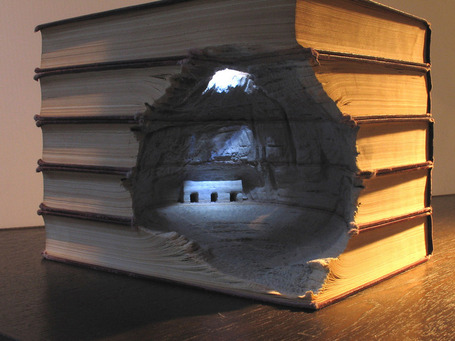
“Not long ago I visited the limestone and chalk cliffs on the North Norfolk coast. As I walked below them I remember constantly looking up to the top of the cliffs, overwhelmed and cautious of the overbearing layers of rock that towered above me. Placing myself in relation to the cliffs made me feel so insignificant, so small, and so fragile. I was unable to understand both their overwhelming scale and materiality….

Whilst drawn to natural landscape formations I am both overwhelmed and cautious in their presence. I find myself shrinking, hesitant to interact fully. I feel dwarfed, unable to understand the immense scale and materiality before me. My practice is an attempt to make sense of the natural landscape around me, to create my ideal.  I understand and resolve through making, responding to forms and growths found in the natural world.  I interpret by shrinking and condensing, implying forms by combining materials.”   Statement, Kyle Kirkpatrick

Kirkpatrick’s imagined landscape works by being carved from an archetypal monumental man-made object — a visual encyclopedia — taken out of context and  populated with human figurines dwarfed by the swirling, layered cutaway text.  What is he pushing us to see beyond what he presents before us?  That this human work of attempting to understand and make sense of the great world around us by capturing it in words and illustrated plates is a shrinking and condensing, an implication of forms by artifice?  That even though the landscape is man-made, it overwhelms us?


Bookmarking Book Art – Franziska, a typeface

The Fine Press Book Association’s inaugural Student Type Design Competition sprang from the hope that by building bridges between printers and young type designers we might end up creating new material resources for the fine press community.

A PDF document called the Making of Franziska – a hybrid text-face between slab and serif is available for downloading.  This document is quite well put together and provides a kind of tutorial on type design.

franziska-font_runge_03_text_04_freundliche-versalien

Bookmarking the Objectification of the Book

The book as object is not new.  Think of Les Très Riches Heures du Duc de Berry.

©Photo. R.M.N. / R.-G. Ojéda
January

What might be remarkable — or book-markable — is whether the surge in objectifying the book through sumptuous illumination, miniaturization or the creation of book art occurs at definitive moments of shifting media.  One-off illuminated manuscripts preceded the invention of moveable type, but was there a definable surge of them in the decades either side of 1450?

aud0017
img198

The Audubon double elephant folio books appeared in 1820 about the time of Frederick Koenig‘s invention of the steam-driven letterpress.

Are William Morris’s fine editions from Kelmscott Press in 1890 a datum in a surge of book objectification either side of Mergenthaler‘s invention of linotype in 1884?

1991_1016_996_V56_002.jpg_thumb
mergenthaler_linotype
images
fedex

Either side of September 1999 (the release of the Open eBook Publication Structure 1.0), we have the Miniature Book Society, founded in 1983 and, in 2003,  Michael Hawley’s Bhutan:

A Visual Odyssey across the Last Himalayan Kingdomthe world’s largest book according to Guinness.

Last week, the New York Times ran an article about Neale Albert‘s collection of miniature books.  Is this popular interest in unreadable books and the surge in altered and sculpted books an anxious reflection of another shift in media?

Related articles

Bookmark – The Implacability of Books

8048332174_e6067521c8_o
The Merchant Georg Gisze (1532) by Hans Holbein the Younger.

Author of The Things Things Say, Jonathan Lamb has trawled the Internet Archive to link us to 18th and early 19th century examples of the “it-narrative,” stories told from the perspective of a thing such as a watch, a coin or a mouse and generally comic and all-too human in the telling.  And yet, Lamb observes,

…  for a number of reasons this is seldom how [the it-narrative] deserves to be read. Whether it is owing to its origin and terminus in the narratives of slaves, or to its coincidence with the financial revolution and the growing unaccountability of mass human behaviour, or to the growing appetite for print ephemera, or to the end of feudal tenures and the resulting anomalies of personal portable property, or to the irreversible metamorphoses precipitated by the holocaust, ordinary things situated in banal circumstances develop a salience that has nothing to do with symbolism or hidden meaning. They are just there, eying their human adversaries, implacable and meditating affronts.

Lamb might have added another reason: the growth of the Internet, book art or bookwork and prediction of the printed book’s demise.  Until that demise, will our books, just there on their shelves above the lampshade late at night, sit “implacable and meditating affronts”?

Jonathan Lamb, The Implacability of Things at The Public Domain Review | Material World on 9th November 2012 at 11:01 am.