Depero Futurista: Imbullonato (the “Bolted Book”) (1927/2017)
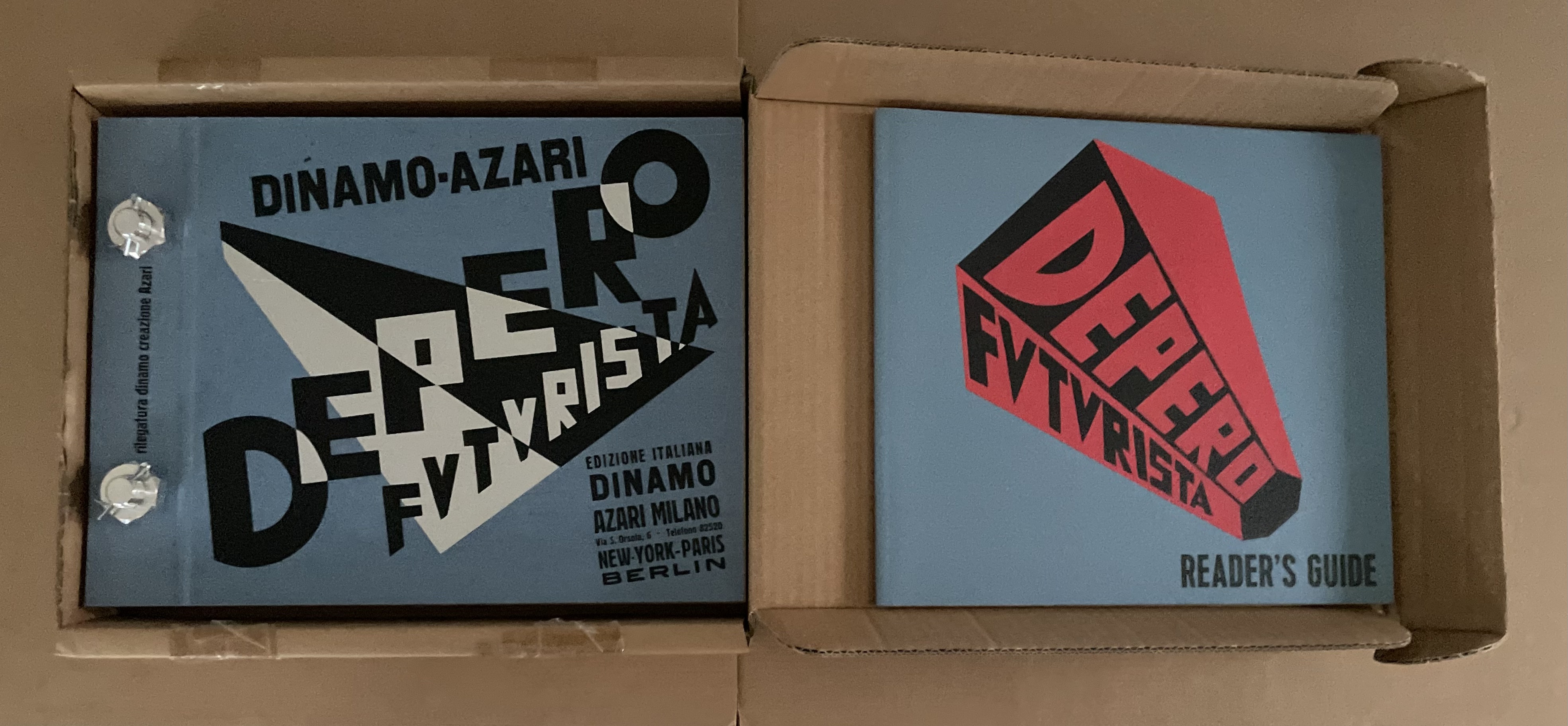
Depero Futurista: The Bolted Book (1927/2017) and Reader’s Guide (2017)
Fortunato Depero and Designers & Books (Steve Kroeter, editor-in chief)
Bolt-bound loose folios between textured, colored card stock. H242 x W320 mm. 240 pages. Edition of 2500, of which this is #. Purchased from Designers & Books, 18 October 2016. © 2018 Artists Rights Society (ARS), New York / SIAE, Rome.
Photos: Books On Books Collection.


Fortunato Depero’s Depero Futurista: Imbullonato (the “Bolted Book”) stands at the center of an uneasy off-rhyming of history. Where Depero and the avant-garde Futurists of the early 20th century rode the waves with Benito Mussolini and fascism, this 2016/17 facsimile edition of Depero Futurista coincided with the emergence of America’s “Tangerine Mussolini” and his MAGA movement.
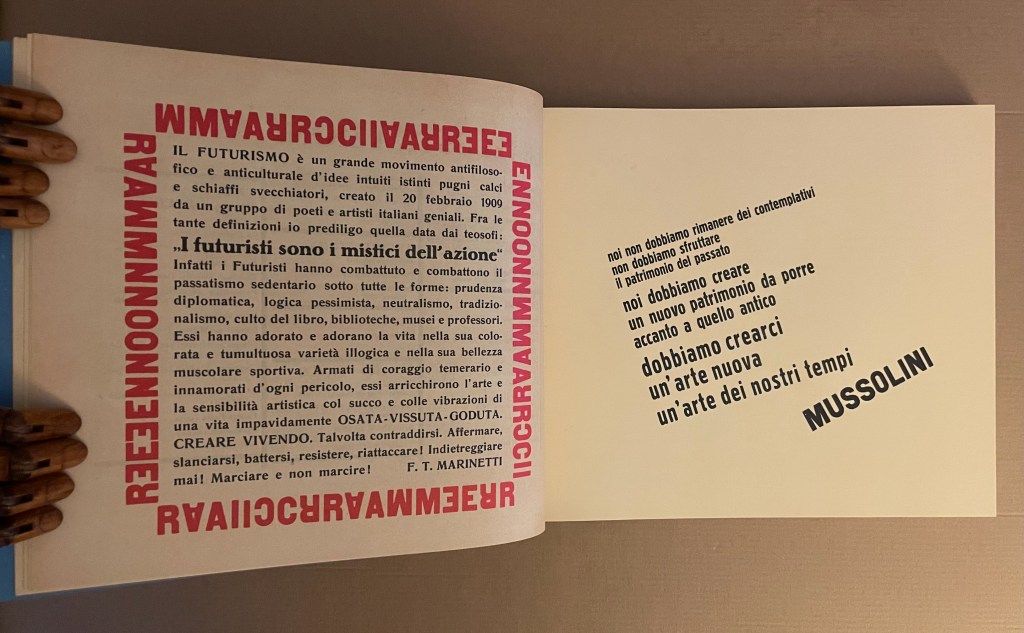
In 2024, the original and facsimile editions of Depero Futurista appeared in an exhibition at the American Academy in Rome just as Trump was elected as the first Convict-in-Chief. And five days before he was sworn in, the Estorick Collection of Modern Italian Art in London presented its copy of the original edition in an exhibition devoted to the poet Filippo Tommaso Marinetti, leader of the Futurist movement, good friend of Depero, and peripatetic pal to Mussolini.
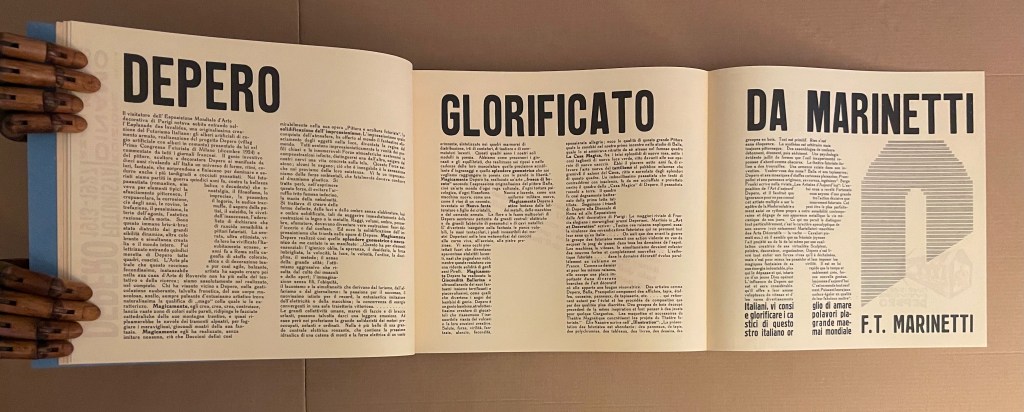
Depero Futurista’s peculiar off-rhymings in history prompt questions about the intersection of art and our social contract. How is it that fascism weighs on Depero’s art but has not suffocated it, even when the association peeps out as it does in Imbullonato? How is it that communism weighs on El Lissitzky’s About Two Squares (1922) but has not buried it?
Günter Berghaus’ Futurism and Politics provides a nuanced view of Futurism, Marinetti, Depero and their links with fascism. Fabio Belloni traces the rise, fall and rise of Depero in his essay “The Critical Fortune and Artistic Recognition of the Work of Depero“, which appeared in the journal of the now defunct Center for Italian Modern Art. Gianluca Camillini’s 2020 doctoral thesis traces the disconnects and remaining connections with fascism in Depero Futurista after the 1924 break between Futurism and Mussolini.
Perhaps Depero’s case contrasts helpfully with that of Ezra Pound. Like Depero, Pound was an enthusiastic supporter of Mussolini. Pound coopted Marinetti’s and Depero’s Futurism into his and Wyndham Lewis’ Vorticism. Unlike Depero Futurista, however, Pound’s poetry — especially the Cantos –foregrounds that enthusiasm. The frequency of its appearance in Pound’s poetry and its ugliness weigh more heavily than the few mentions of Mussolini in Depero Futurista. Depero’s and Marinetti’s hero-worship appears mostly in their poetry and prose but without Pound’s anti-semitism. The connection with fascism that remains in Depero Futurista, however, appears in the bellicosity and glorification of war by this “book machine”.
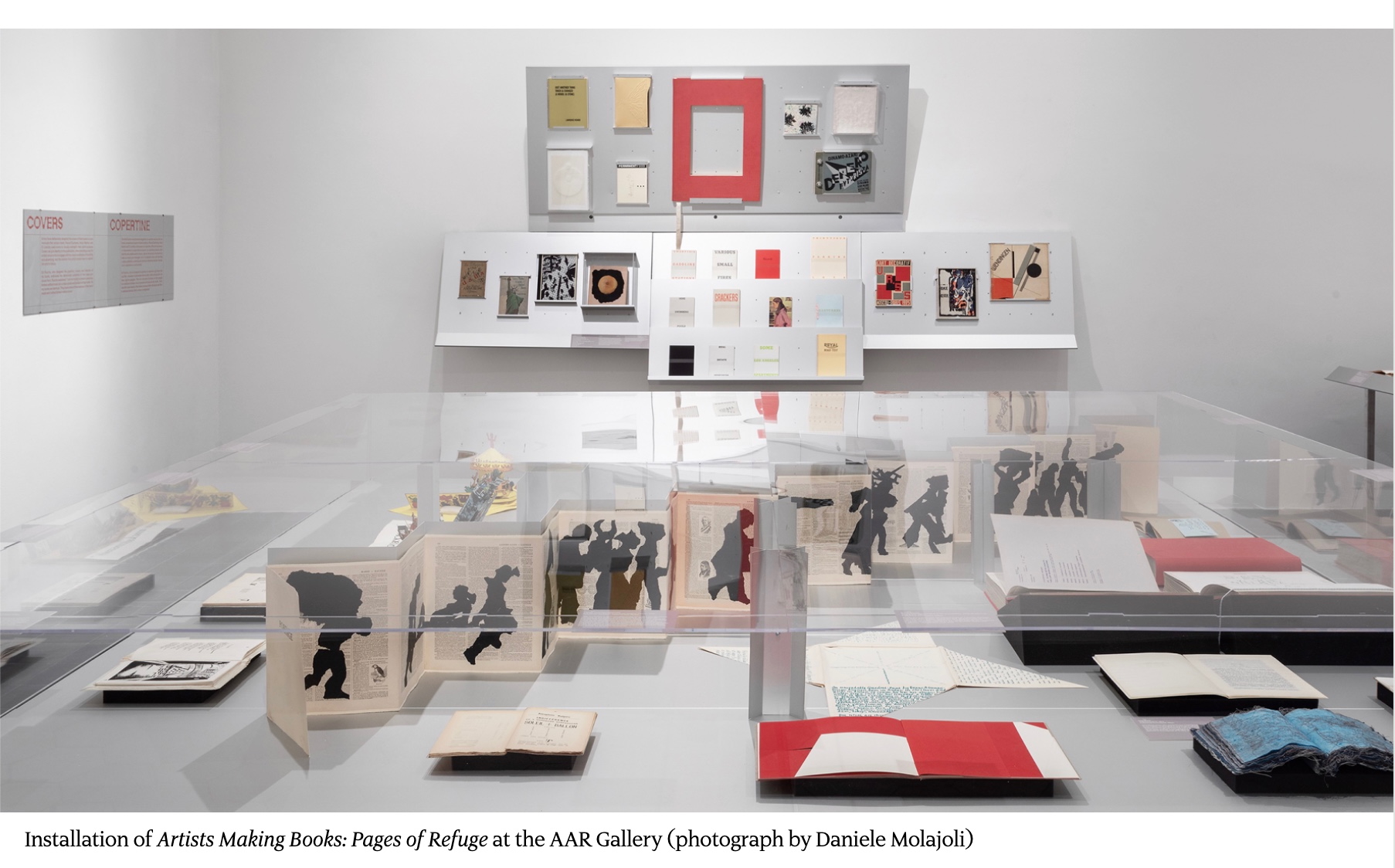
In the American Academy’s exhibition, Depero Futurista sits alongside the anti-racism of William Kentridge’s Portage (2000) and Kara Walker’s Five Poems Rainmaker (2002). How does (can?) art deliberately associated with fascist, statist or authoritarian movements rise above them to be celebrated and fruitfully juxtaposed with the works of today’s artists more associated with progressive causes?
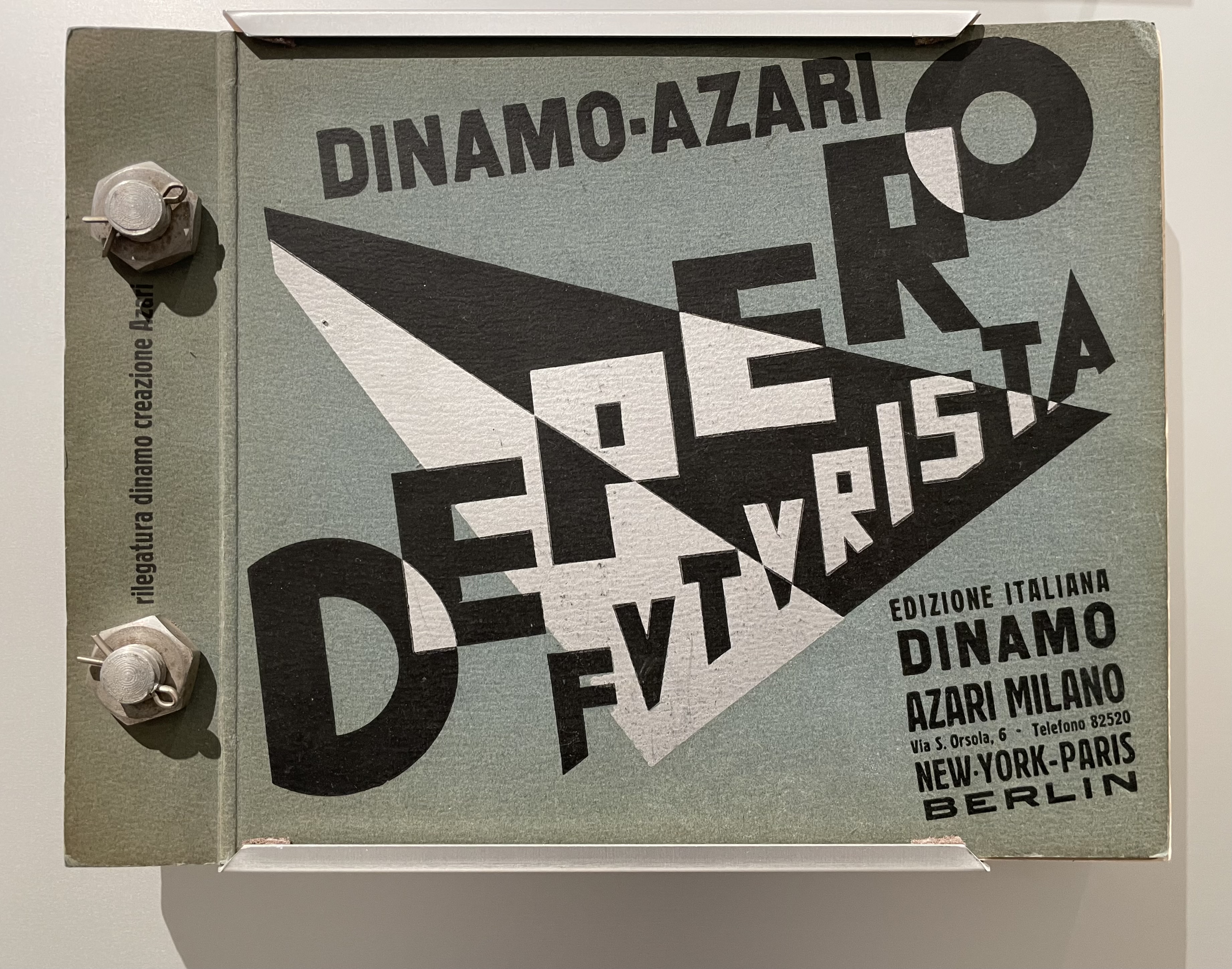
For the Books On Books Collection, Depero is also an important figure in the overlap of typography and the alphabet with architecture and the artist’s book. Depero defined typographic architecture as
that special architectural form suggested by typographie types which has been used with great efficacy in advertising artistic constructions, in pavilions, kiosks and advertising plastics of national and international exhibitions of decorative art and in industrial and commercial exhibitions. The painter Depero created, in 1927, the book pavilion of the Bestetti- Tumminelli and Treves publishing house at the international exhibition of decorative art at Monza, inspiring his work to this conception of typographie architecture.(p. 18)
And he reproduced an image of it in Depero Futurista.

From Depero Futurista: “Padiglione del Libro” (1927).
The book pavilion is not bellicose. It is bombastic as is much of what is in Imbullonato. The blast of its typography has much in common with that in Kurt Schwitters’ Die Scheuche Märchen (1925) and other artists’ works not associated with fascism, authoritarianism or statism. To focus on Imbullonato‘s innovation, technique, typography or cross-fertilization with architecture and compare and contrast them with that of other artists is not to forget its entanglements. In fact, the difficulty in focusing is a reminder of how art, too, can be bolted to the shameful.
Further Reading
“American Academy in Rome: Artists Making Books“. 11 December 2024. Bookmarking Book Art.
“Celebrating the 250th Anniversary of Steingruber’s “Architectural Alphabet”. 1 January 2023. Bookmarking Book Art.
“Kurt Schwitters“. 23 June 2024. Books On Books Collection.
Belloni, Fabio. January 2019. “The Critical Fortune and Artistic Recognition of the Work of Depero“. Italian Modern Art: Fortunato Depero. No. 1. New York: Center for Italian Modern Art.
Berghaus, Günter. 1996. Futurism and Politics: Between Anarchist Rebellion and Fascist Reaction, 1909–1944. Oxford: Berghahn Books.
Camillini, Gianluca. 2020. “Fortunato Depero and Depero futurista 1913–1927“. Dissertation thesis. Reading: University of Reading. “In the two reprints of Depero futurista 1913–1927 (1978 and 1987 by SPES Firenze), Luciano
Caruso also repeatedly writes ‘libromacchina imbullonato’ (bolted machine-book, Caruso, 1987, 36).” (p. 14).
Caruso, Luciano (ed.) and Fortunato Depero. 1987. Depero Futurista. Firenze: Studio per Edizioni Scelte Salembeni.
Caruso, Luciano (ed.) and Fortunato Depero. 1978. Fortunato Depero Futurista. Firenze: Studio per Edizioni Scelte Salembeni.
Depero, Fortunato, and Raffaella Lotteri. 1947. So I Think, so I Paint : Ideologies of an Italian Self-Made Painter. Trento [Italy]: Mutilati e Invalidi.
Lissitzky, El, and Patricia Railing. 1922. About 2 [Squares]. 1st MIT Press ed. Cambridge, Mass.: MIT Press.
Tsimourdagkas, Chrysostomos. 2014. Typotecture: Histories, Theories and Digital Futures of Typographic Elements in Architectural Design. Doctoral dissertation, Royal College of Art, London.

 Books On Books