Books On Books Collection – Jaro Springer

Gotische Alphabete (1897)
A brown book cover titled 'Gothische Alphabete' in gold lettering.

Gotische Alphabete (1897)
Jaro Springer
Casebound hardcover in leather with cover title and cover illustration in gold and blind embossing. H415 x W300 mm. 1 sheet, 8 pages, 3 sheets, 39 plates. Acquired from Antiquariat Braun, 14 November 2024.
Photos: Books On Books Collection.

Every history of letters or script begins with a scrawl. Someone somewhere at some time made a mark tied to an object tied to a sound — A is for Ox — and some others in the same place and time accepted that this handmade mark or shape could conjure up that object in the mind. Perhaps it seemed magical, perhaps it seemed mundane as they imagined that somehow meaning and reality inhered in that shape or sound, the connection just waiting to be discovered.

Regardless, the shapes of characters and their relationship to the sound or meaning they represent is arbitrary, a prehistorical and historical function of social convention, a collective making by individuals. Jaro Springer’s art historical specimen book reminds us of the fantastical visual elaborations to which 15th-16th century artists’ hands would put those “shapes for sounds” we call the alphabet.

Gotische Alphabete (1897) [Gothic Alphabets] showcases two specimens of anthropomorphic and zoomorphic alphabets of uppercase letters and one specimen of an architectonic alphabet of lowercase letters. It was Springer’s contribution to the International Chalcographical Society, formed for the study of the early history of engraving. The Society had over 160 subscribers in 1897. A professor of art history and assistant and custodian for the Berlin Kupferstichkabinett, Springer was one of its leading lights. In addition to his Gothic Alphabets, he managed to catalogue Albrecht Dürer, Hercules Seghers, Adriaen van Ostade, and Rembrandt as well as issue a facsimile of Holbein the Younger’s Die Totentanz before being killed in the First World War.

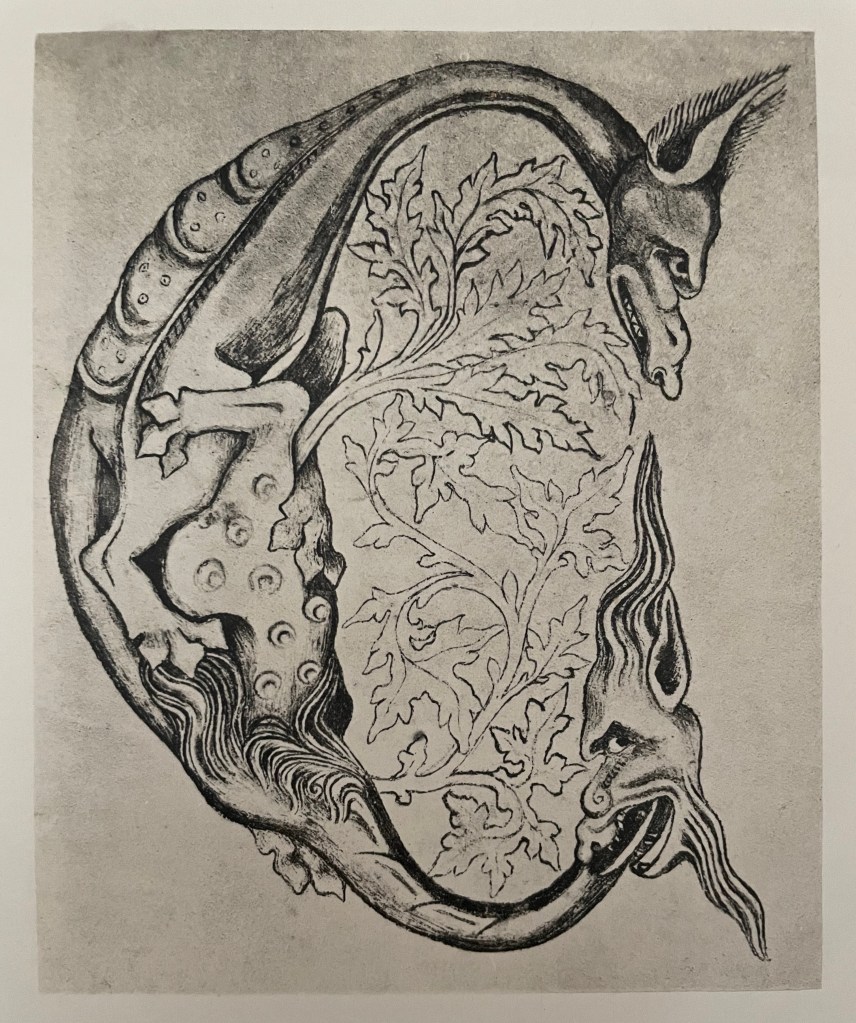
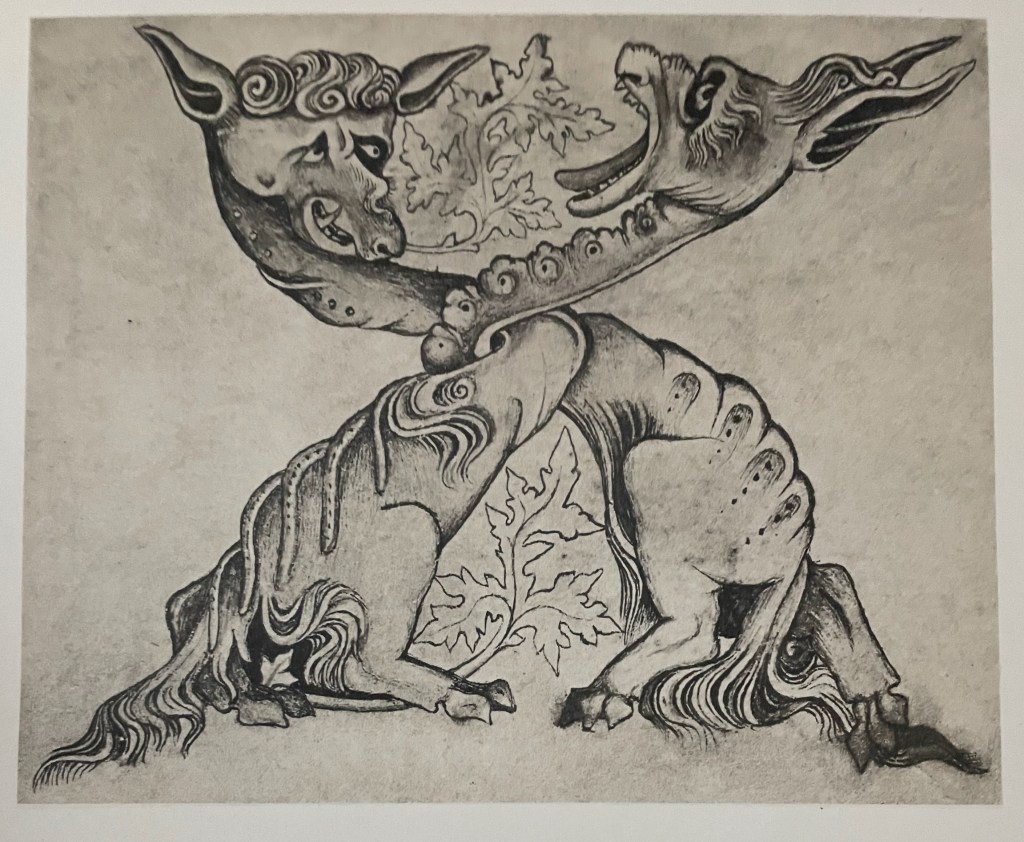
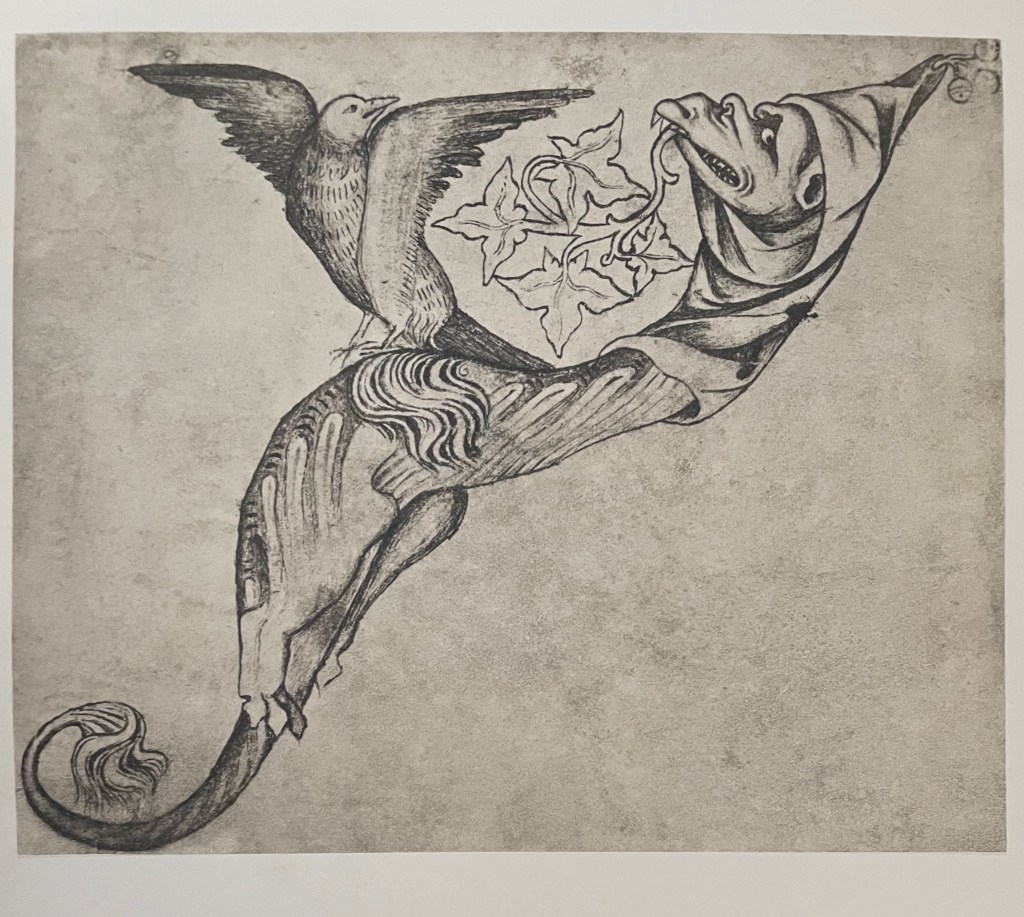
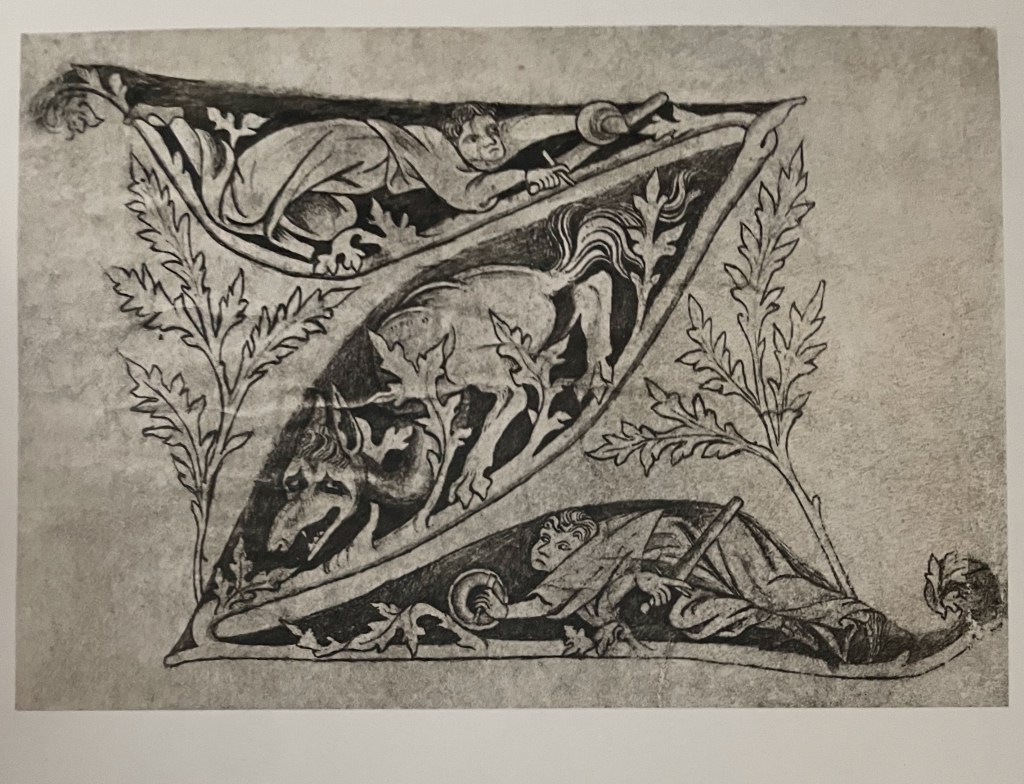
Springer claims his first specimen, dated around 1400, as the earliest figurative alphabet.* It has 23 letters (no J at this time, and V did triple duty for itself, U, and W). They were drawn with pen and ink and an India ink wash on four strips of parchment.
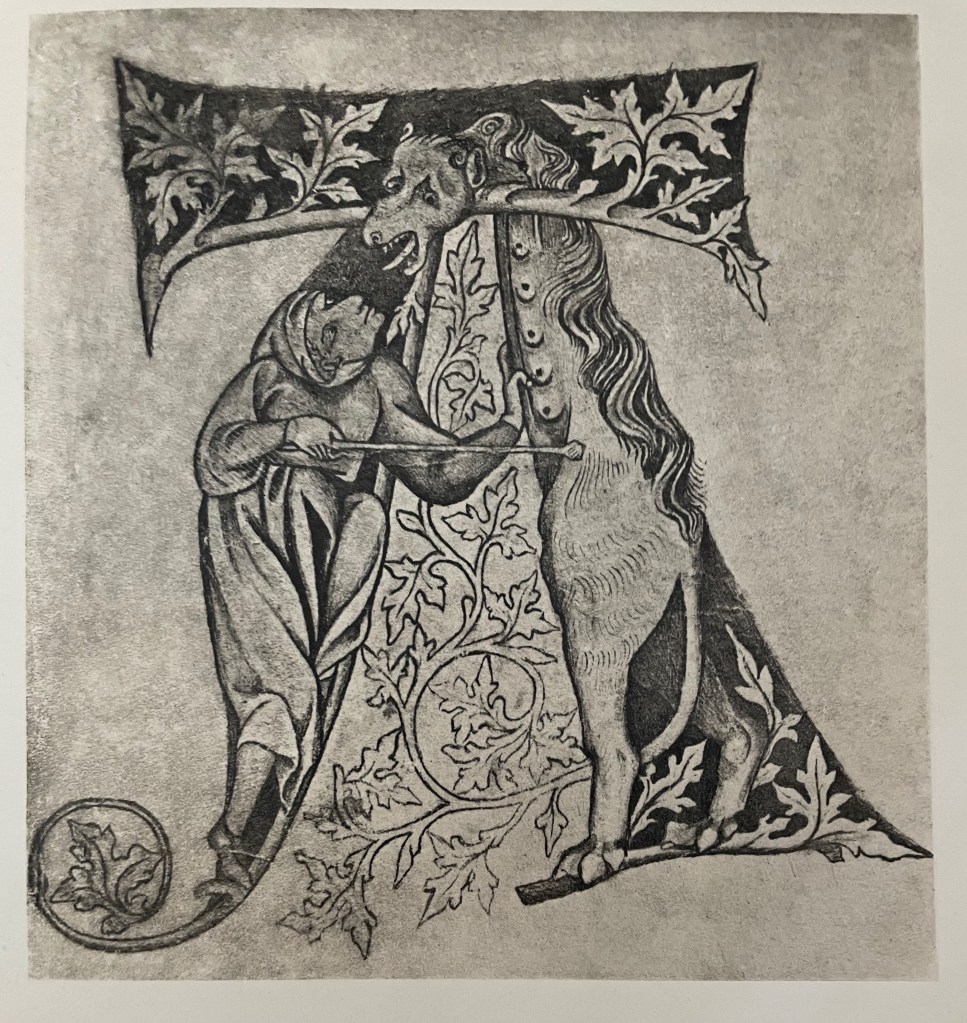
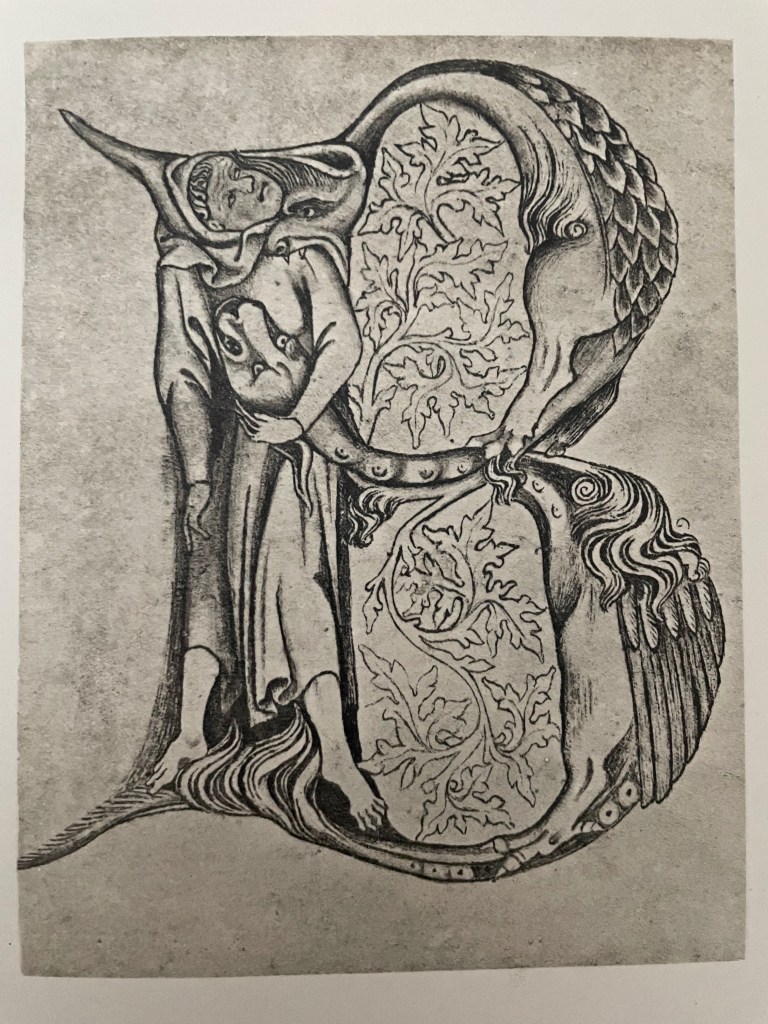
Figurative alphabet in pen drawings washed with India ink on parchment (c. 1400). Kupferstichkabinett, Berlin. Reproduced in Gotisches Alphabete.

Strangely the foliage filling the counterspaces frequently sprouts from the animals’ tails or tongues, never from the human figure, but then the latter are not fantastical except in their postures while the former are so in every respect. In those cases, the Gothic artist’s pen seems to have seized control of the drawing as if to foreshadow Paul Klee’s quip — “A line is a dot that went for a walk”.

The second specimen is a copper engraving of a woodcut version by the Master of the Banderoles (c. 1464).

A collection of intricate engravings forming the letters 'H', 'P', 'O', with detailed figures and scenes inside each letter.

Figurative A, B, C, G, H and I, woodcuts engraved in copper by the Master of the Banderoles (c. 1464). Basel Museum. Reproduced in Gotisches Alphabete.

Springer’s introduction to his specimen book identifies several other single letters and human alphabets: an armless man as the letter I in the 8th century Homilies of St. Augustine (not pictured), a demonic letter T in the Mortuary Scroll of St. Vital (not pictured in Springer) from the 12th century, and the letter Q from the alphabet by Master E.S. (1466-67).

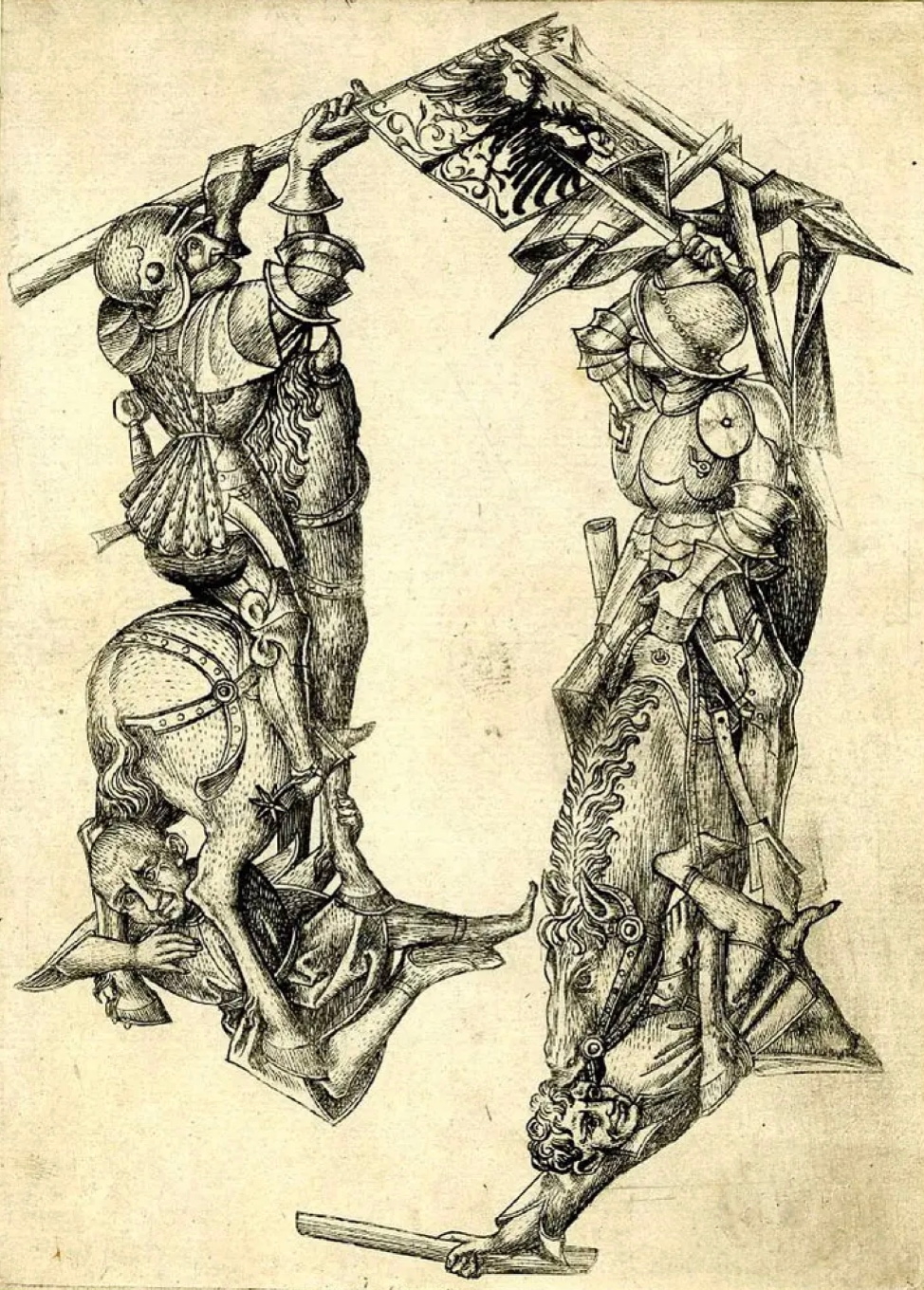
L: Letter T in “Titulus”, Rouleau mortuaire du B. Vital, abbé de Savigni: contenant 207 titres écrits en 1122 – 1123 dans différentes églises de France et d’Angleterre. R: Letter Q from alphabet of Master E.S., 1466.

It is curious though that so far no earlier complete human alphabets have shown up. After all, the idea of contorting the human body or bodies into the shapes of letters goes back to the 5th century Greek playwright Kallias. In his play known from fragments as the Alphabet Tragedy (although it sounds more of a comedy), he had his chorus and actors mime and dance the letters of the alphabet.** Joseph Kiermeier-Debre and Fritz Vogler’s Menschenalphabete (2001) offers the most extensive illustrated survey of human alphabets from 14th to 20th centuries.

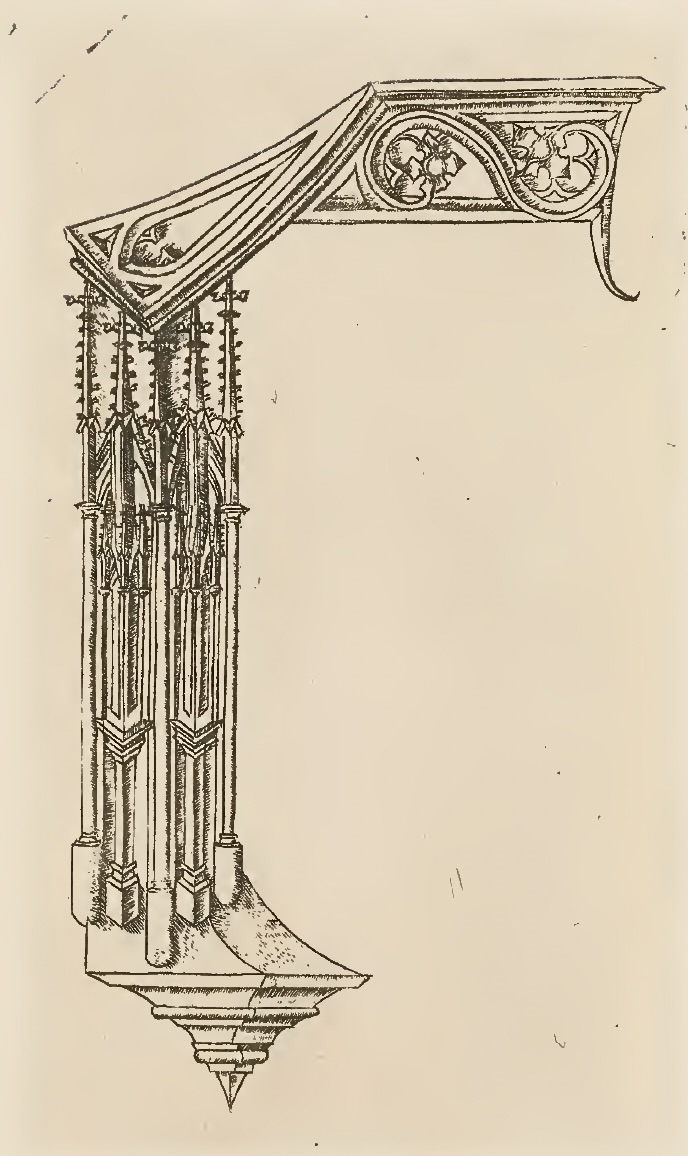
Springer’s third specimen is the first visual marriage of alphabet and architecture in the West. It shows up in the late 15th-century at the time of Gutenberg’s press. While Gutenberg’s workers were mixing lead and antimony, engravers were creating fantasy reliquaries, monstrances, retables, and chapel spaces. Springer located these engravings of miniscule letters by an unknown artist in Erlangen and Bologna.
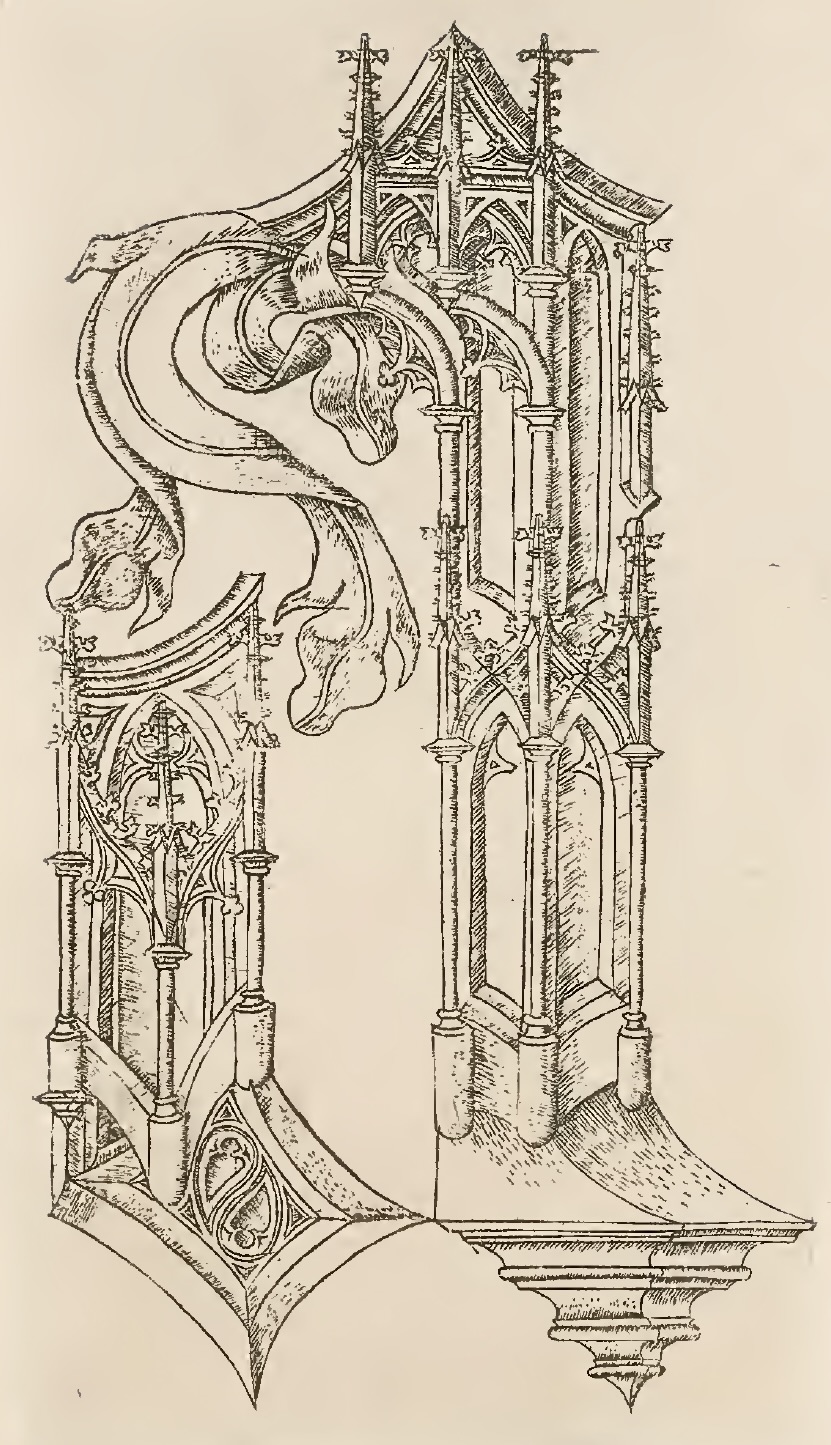
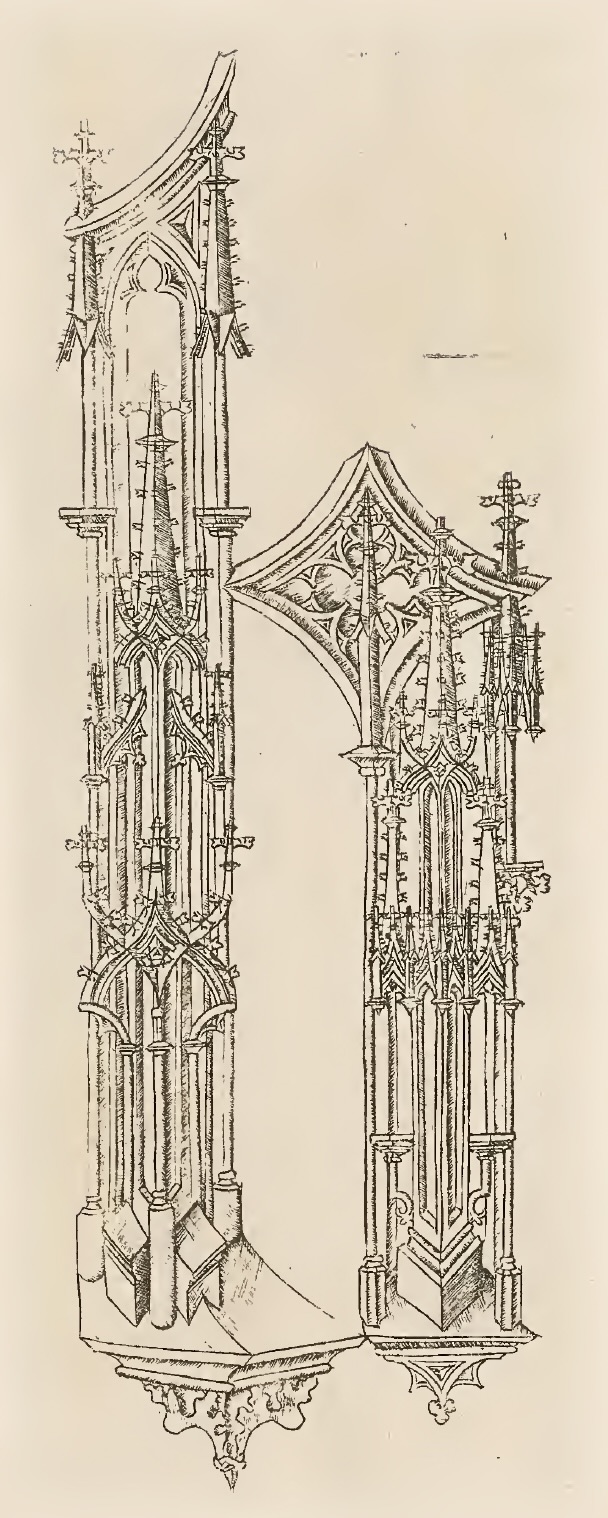
For more on this architectonic alphabet, see Erika Boeckeler’s “Building Meaning: The First Architectural Alphabet”, ch. 5, p. 176 in Blick and Gelfand (eds.). 2011. Push Me, Pull You: Imaginative and Emotional Interaction in Late Medieval and Renaissance Art.

This Gothic artist’s alphabet weds the strokes and shapes of miniscule letterforms with architectural features, echoing the surfaces of parchment and stone and the mark-making tools of quill and burin as well as hammer and chisel. His or her perspectival drawing elevates the letters into three dimensions. Not only that, he or she uses architectural features and finishings such as colonettes, baldachins, fabric and leafage to open up the letters’ strokes, repurposing the typographic bars, counters, ascenders, descenders and so on. Although these little edifices suggest interior spaces to inhabit, to look through or out of, or to use for shelving objects, their primary use would be decorative. And complexly rendered as they are, the letters, too, would be impractical for any extended legible or edifying text. 
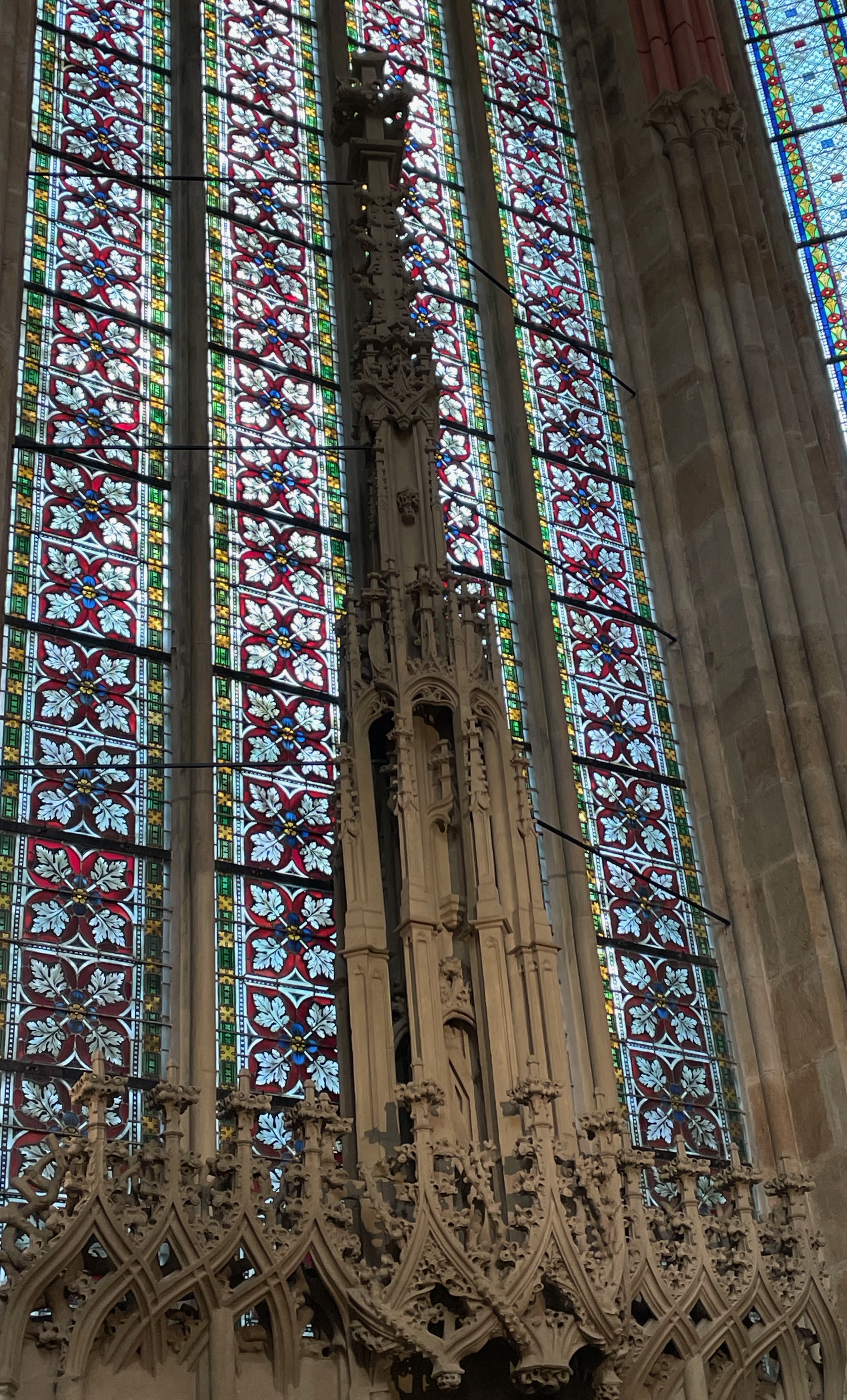
Intricate stonework displayed in front of colorful stained glass windows inside a cathedral.

Decorative architectural element in Meissen’s Gothic cathedral.

Boeckeler has pointed out that this first marriage of alphabet and architecture may have served as a memory aid or a prompt for religious meditation. Or perhaps it was just a playful exercise in lettering and architecture because the artist was delighted by how letters and architecture may act as metaphors for one another: letters being the building blocks of texts; architectural components being the linguistic elements of readable buildings.

Springer’s human and animal alphabets, on the one hand, and his architectural alphabet, on the other, signpost two well-developed themes in works of book art across the centuries. Demeude, Kiermeier-Debre & Vogel, and Lehmann-Haupt & Petteway have usefully documented the anthropomorphic and zoomorphic alphabets and commented in greater depth than Springer does. Boeckeler has also provided insights on human alphabets and, in particular, on Springer’s architectonic specimen. Kiermeier-Debre & Vogel, McEwen, Polano, and Tsimourdagkas have well-documented the recurrence of architectural alphabets following Springer’s Gothic artist.

Jaro Springer’s Gothic Alphabets plays the squeaky hinge in the Books On Books Collection, a reminder of the two recurrent themes and a reminder to look to tradition and the new in book art.

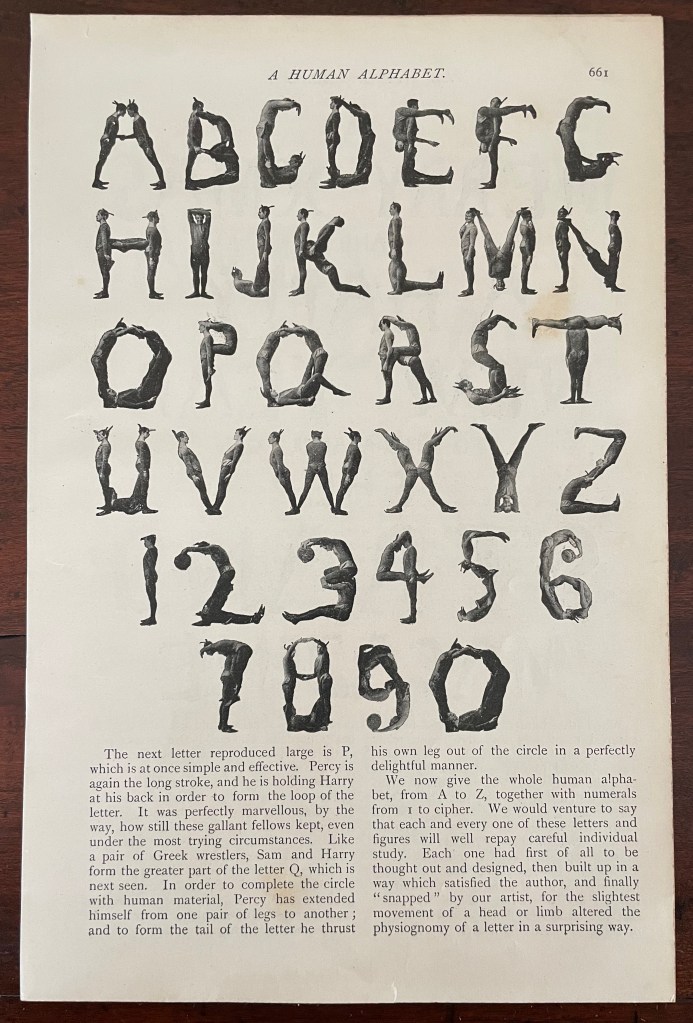
There are several human alphabets in the Books On Books Collection such as the music hall performance by The Three Delevines documented in The Strand Magazine (1897) , Vítězslav Nezval & Karl Teige’s Abeceda (1926), Anthon Beeke, Geert Kooiman & Ed van der Elsken’s Alphabet (1969), Rowland Scherman’s Love Letters (2008), the Pilobolus Dance Company’s Human Alphabet (2010), the Paulina Olowska Book (2013), Marie Lancelin’s Gestes Alphabétiques (2014), Douglas & Françoise Kirkland’s Physical Poetry Alphabet (2018), Richard Hell’s Uh by Ernie Stomach (2019), and Lisa Merkin’s Bodies Making Language (2021). All of these works except Lancelin’s and Merkin’s follow in Springer’s codex footsteps. Lancelin’s leporello follows the parchment strips of Springer’s first specimen, and Merkin’s wooden blocks echo the woodcuts of the Master of the Banderoles.
An illustration of a human alphabet featuring people posed to form letters A to Z and numbers 0 to 9.

The Three Delevines from W.G. Shepherd’s “The Human Alphabet”, The Strand Magazine, London.

One human alphabet outside the collection but worth seeking out is Barbara Crow’s An acrobatic alphabet (1986). Its characters’ contortions rival those of the Gothic alphabets and will prod another look into them for their humor. Although not a children’s book, Crow’s artist’s book is also a reminder to keep an eye on that domain where crossovers with artists’ books have become more and more frequent.

Likewise there are several architecture/alphabet-inspired works in the collection such as Geofroy Tory’s Champ Fleury (1529/1927), Johann David Steingruber’s Architectonisches Alphabet or Architectural Alphabet (1773), Lanore Cady’s Houses & Letters (1977), Paul Noble’s Nobson Newtown (1998), Jeffrey Morin and Steve Ferlauto’s Sacred Space (2003), Edward Andrew Zega & Bernd H. Dams’ An Architectural Alphabet : ABC (2008), Scott Teplin’s Alphabet City (2009), Federico Babina’s Archibet (2015), Nerma Prnjavorac Cridge’s Sarajevska Abeceda (2019), and Heather Hunter’s Alphabet Cityscape (2025).

*Demeude, Kiermeier-Debre, and Lehmann-Haupt give Giovanni dei Grassi’s alphabet the nod as the first figurative alphabet.

**See Steiner.

Further Reading

Alphabets Alive! – Body“. 19 July 2023. Books On Books Collection.

Federico Babina“. 23 April 2021. Books On Books Collection.

Anthon Beeke“. 21 June 2021. Books On Books Collection.

Lanore Cady“. 16 December 2022. Books On Books Collection.

Celebrating the 250th Anniversary of Steingruber’s Architectural Alphabet”.  1 January 2023. Books On Books Collection

Nerma Prnjavorac Cridge“. 14 February 2021. Books On Books Collection

Lyn Davies“. 7 August 2022. Books On Books Collection. Reference and fine print.

Heather Hunter“. In progress. Books On Books Collection

Lisa Merkin“. 24 February 2023. Books On Books Collection.

Jeffrey Morin & Steven Ferlauto“. 23 April 2021. Books On Books Collection.

Richard Niessen“. 20 April 2021. Books On Books Collection.

Paul Noble“. 23 April 2021. Books On Books Collection.

Tiphaine Samoyault“. 10 July 2023. Books On Books Collection. Illustrated children’s book.

Karel Teige & Vítězslav Nezval“. 16 July 2021. Books On Books Collection.

Scott Teplin“. 14 October 2025. Books On Books Collection.

Geofroy Tory“. 21 June 2021. Books On Books Collection.

Edward Andrew Zega & Bernd H. Dams“. 23 April 2021. Books On Books Collection.

Boeckeler, Erika. 2011. “Building Meaning: The First Architectural Alphabet”. In Blick, Sarah, and Laura Deborah Gelfand. 2011. Push Me, Pull You. Leiden: Brill.

Boeckeler, Erika Mary. 2017. Playful Letters : A Study in Early Modern Alphabetics. Iowa City: University of Iowa Press.

Delisle, L. ed., 1909. Rouleau mortuaire du B. Vital, abbé de Savigni: containing 207 titres écrits en 1122 – 1123 in different églises de France et d’Angleterre , Paris: Champion. Image: University of Heidelberg.

Demeude, Hugues. 1996. The animated alphabet. London: Thames and Hudson.

Honey, Andrew. 18 April 2024. “‘I dare say will please you when you see them’ – more ‘new’ wood-blocks of an old grotesque alphabet.The Bodleian Conveyor. Oxford: Oxford University.

Kiermeier-Debre, Joseph, and Fritz Franz Vogel. 2001. Menschenalphabete : Nackte Models, Wilde Typen, Modische Charaktere. Marburg: Jonas.

Lehmann-Haupt, Helmut, & Norman Petteway. “Human Alphabets”. In Nord, Max (ed).1958. Amor Librorum: Bibliographic and Other Essays, A Tribute to Abraham Horodisch on his 60th Birthday. Zürich: Safaho Foundation.

McEwen, Hugh. Polyglot Buildings. 12 January 2012. Issuu. Accessed 13 March 2021.

Polano, Sergio. January 2019. “Architectural Abecedari“, Casabella, 893, pp. 62-75 (Ital.) + 100-101 (Eng.). Milan.

Steiner Deborah. 2021. Choral Constructions in Greek Culture : The Idea of the Chorus in the Poetry Art and Social Practices of the Archaic and Early Classical Period. Cambridge: Cambridge University Press. See chapter 8 for the story on Kallias and dancing the alphabet.

Tsimourdagkas, Chrysostomos. 2014. Typotecture: Histories, Theories and Digital Futures of Typographic Elements in Architectural Design. Doctoral dissertation, Royal College of Art, London. Accessed 13 March 2021.

Ward, John Powell. 2004. The Spell of the Song : Letters, Meaning, and English Poetry. Madison, N.J.: Fairleigh Dickinson University Press.
Books On Books Collection – Paulus Franck

Schatzkammer Allerhand Versalien (1601/1995)

Schatzkammer Allerhand Versalien (1601/1995)
Paulus Franck
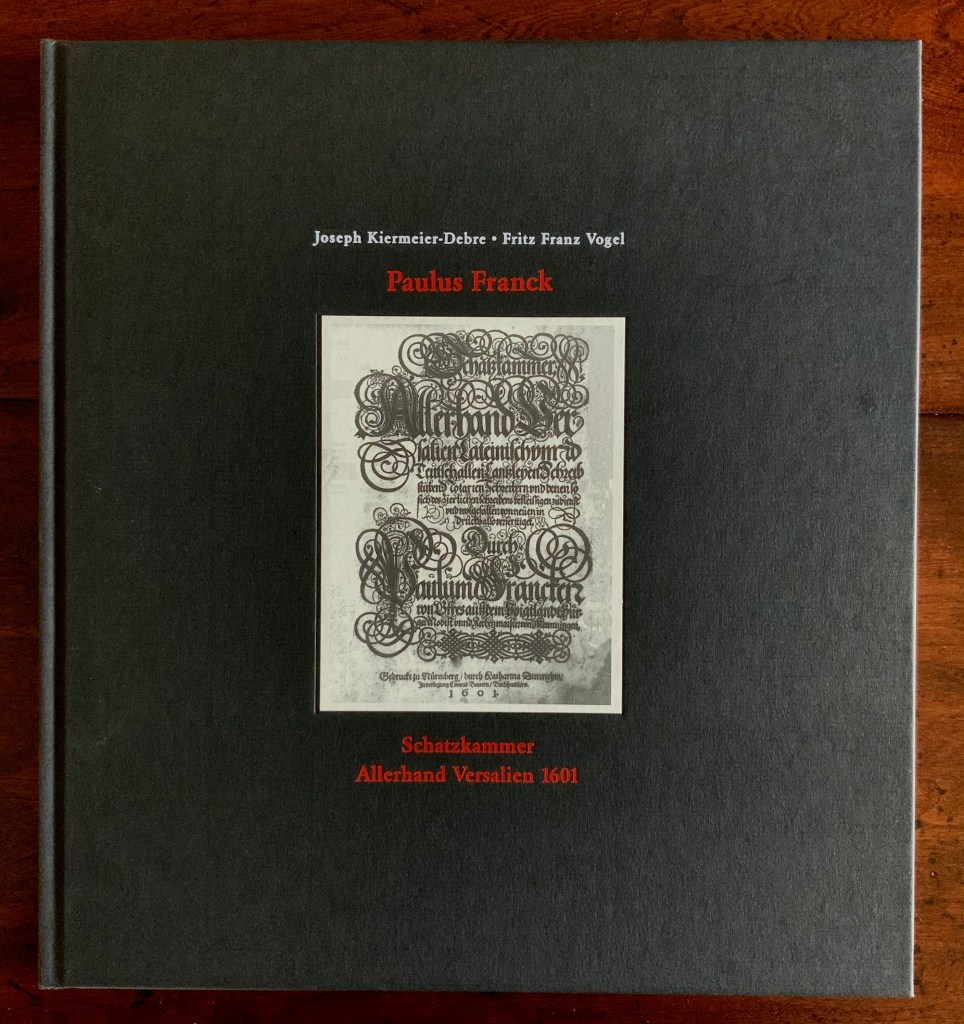
Facsimile edition created by Joseph Kiermeier-Debre and Fritz Franz Vogel as part of the boxed set Alphabets Buchstaben Calligraphy, published by Ravensburger Buchverlag (1998). Hardback. H275 x W255 mm, 80 pages. Acquired from Antiquariat Terrahe & Oswald, 14 March 2021. Photos: Books On Books Collection.

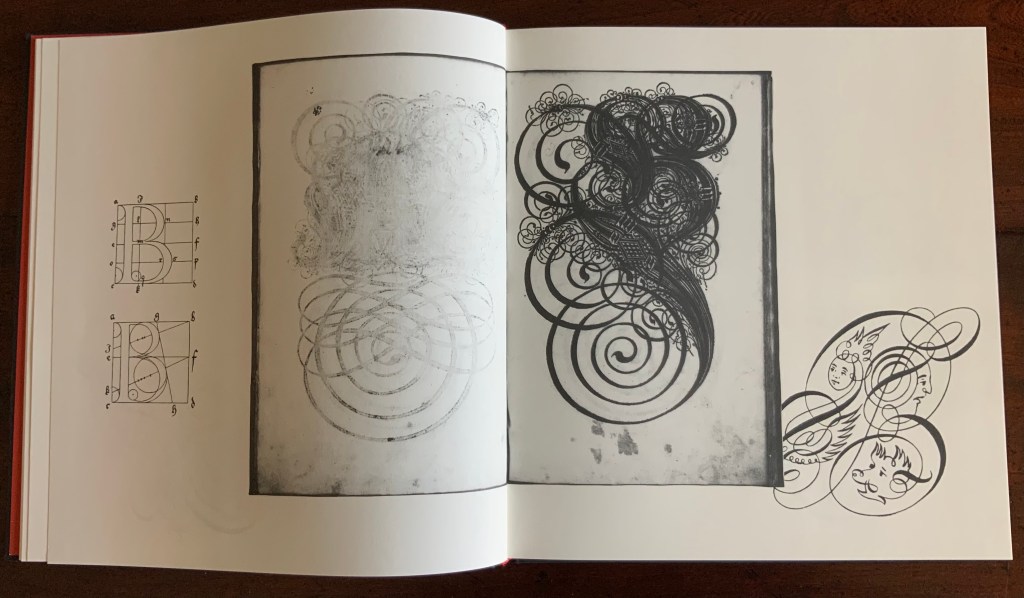
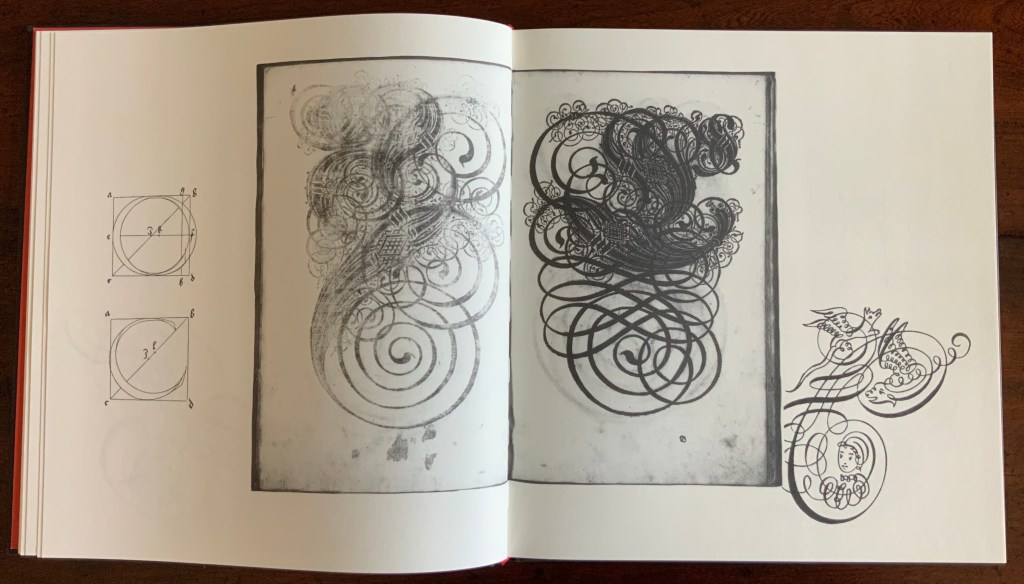
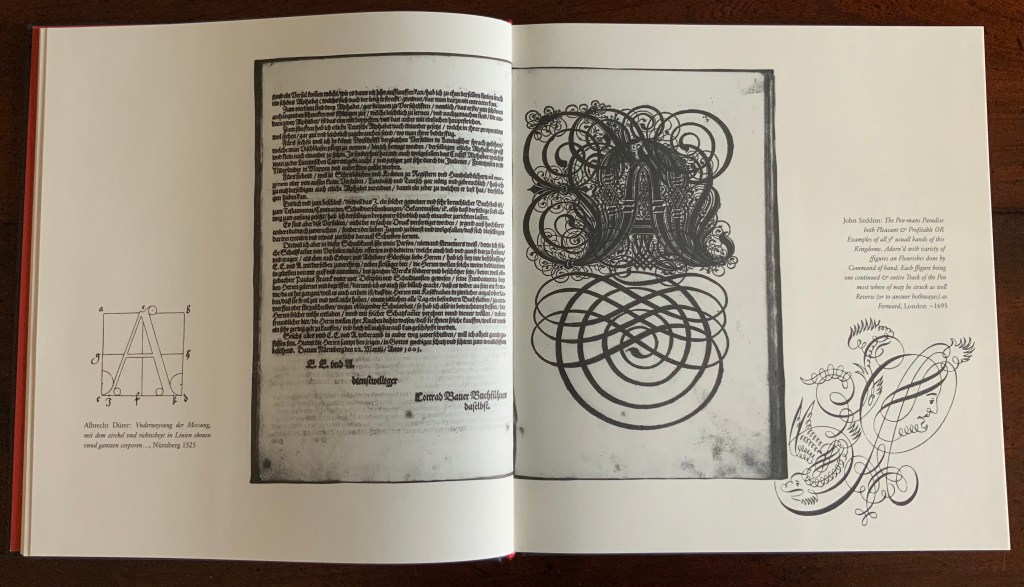
Little is known of Paulus Franck himself (although the editors reveal a Caravaggesque manslaughter charge in his home town of Memmingen), so the focus rests mainly on Schatzkammer, Allerhand Versalien Lateinisch vnnd Teutsch: allen Cantzleyen Schreibstuben Notaren Schreibern vnd denen so sich des zierlichen schreibens befleissigen zudienst vnd wolgefallen von neüen in Druckh also verferttiget (as the full title goes). The editors position Franck’s Treasury in the context of the phenomena of the writing master, penmanship and calligraphy from 1500 to 1800, even regaling the reader with tales of poor Franck’s castigation by Nuremberg’s calligraphic dynasty the Neudörffers. The editors neatly use the margins of their book to add to the historical context. Below, on the verso page, they have the geometrically controlled design of Albrecht Durer (1525), and on the recto, the exuberance of John Seddon (1695).

One element not extolled by the editors is the printing from woodcuts. The quality of the woodcuts can be better appreciated by looking at the scanned original available from the Bayerische Staats Bibliothek (BSB). Conveniently, the site BibliOdyssey has downloaded the letters and provided additional links. At his Type Design Information Page, Luc Devroye also reproduces Franck’s ornate letters from the 1601 manual as well as from a later volume produced by Paul Fürst (better known for his print “Der Doctor Schnabel von Rom“) and printed by Christoph Gerhard in 1655.

This facsimile of Franck’s Treasury makes up one of four volumes in a box set, edited by Joseph Kiermeier-Debre and Fritz Franz Vogel. The other three present works by Antonio Basoli, Johann Theodor de Bry and Johann David Steingruber. To see Franck’s continuing influence, visit the collection entry on Tauba Auerbach.

Further Reading

Tauba Auerbach“, Books On Books Collection, 23 March 2021.

Johann Theodor de Bry“, Books On Books Collection, 2021.

Jeffrey Morin“, Books On Books Collection, 23 April 2021.

Richard Niessen“, Books On Books Collection, 23 April 2021.

Paul Noble“, Books On Books Collection, 23 April 2021.

Devroye, Luc. n.d. “Paulus Franck“. Type Design Information Page. Accessed 20 March 2022.

Peacay. 17 December 2013. “Uppercase Treasure“, BibliOdyssey. Accessed 19 March 2022.


Books On Books Collection – Antonio & Giovanni Battista de Pian

Top row: A, C and E from Alphabetto Latino Schizzato a Bena da Antonio de Pian, reproduced in Antonio Basoli: Alfabeto Pittorico 1839, edited by Joseph Kiermeier-Debre and Fritz Franz Vogel, published as part of the boxed set Alphabets Buchstaben Calligraphy by Ravensburger Buchverlag (1998). Hardback, sewn. H275 x W255 mm, 144 pages. Acquired from Antiquariat Terrahe & Oswald, 14 March 2021.
Bottom row: A, C and E from Alphabetto Pittoresque (1842) by Giovanni Battista de Pian, reproduced in Ein Schmuckalphabet aus Wien“Alphabet Jewelry from Vienna” by Anton Durstmüller, published by Fachhochschule f. Druck (1973). Perfect bound with pages in Chinese fold. H245 x W220 mm, 72 pages. Acquired from Versandantiquariat K. Stellrecht, 22 March 2021.
Photos: Books On Books Collection.

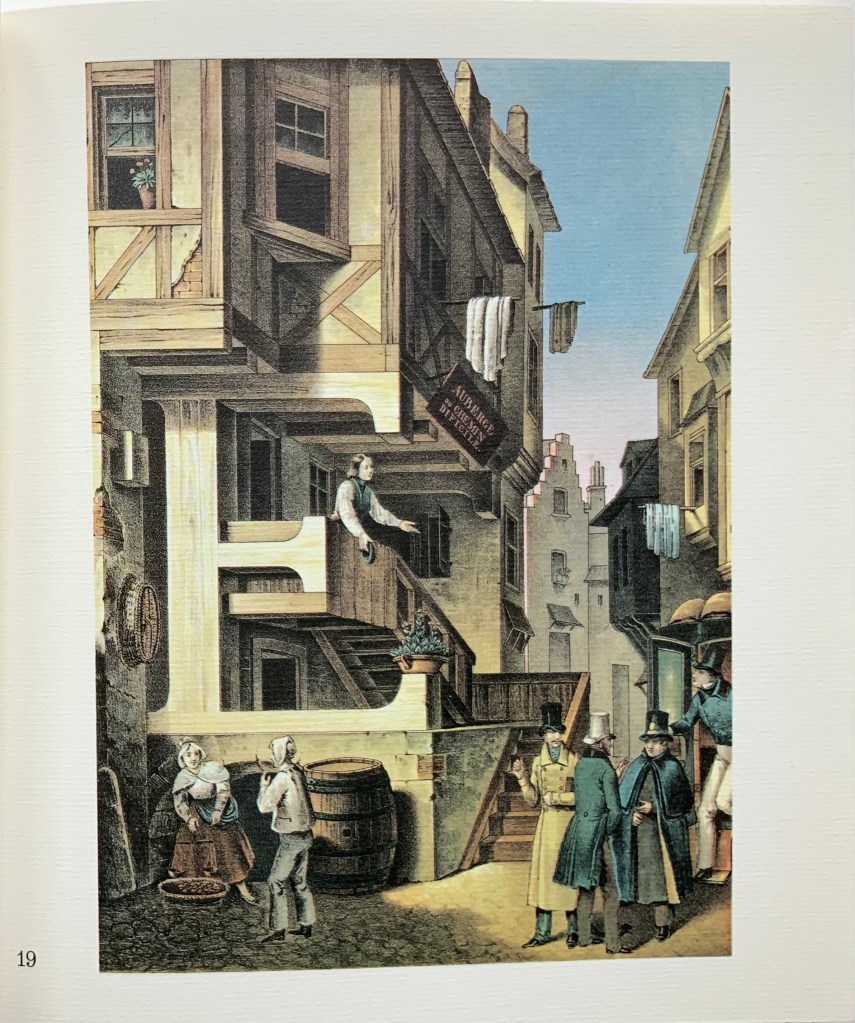
Father and son, Antonio de Pian (1784-1851) and Giovanni Battista de Pian (1813-57)) worked in Vienna during the 18th and 19th centuries. Born in Venice, Antonio came with his father to Vienna, where he became a court-appointed set designer and scene painter and was inducted by the Academy of Fine Arts in 1843. Giovanni Battista (or Jean Baptiste) was not as professionally or academically successful as his father, but his Alphabetto Pittoresque portfolio outshines his father’s Alphabetto Latino Schizzato a Bena and rivals the earlier Alfabeto Pittorico by Antonio Basoli, the elder Pian’s Bolognese contemporary, who was also an accomplished scenographer as well as an internationally honored academic. All three artists’ portfolios are scarce, and as they represent the next link in the chain of complete architectural alphabets that began with Johann David Steingruber’s Architectonisches Alphabeth in 1773, it is fortunate that the facsimile works produced by Durstmüller and Kiermeier-Debre/Vogel are available and accessible.

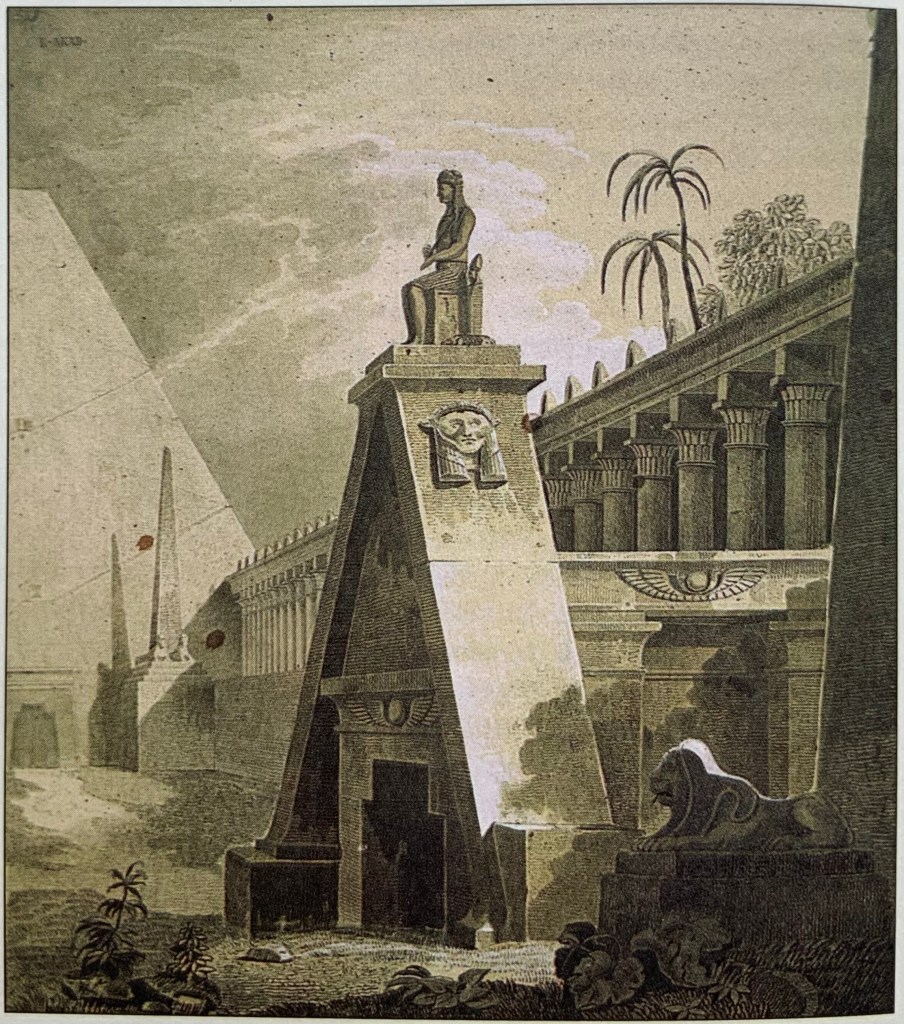
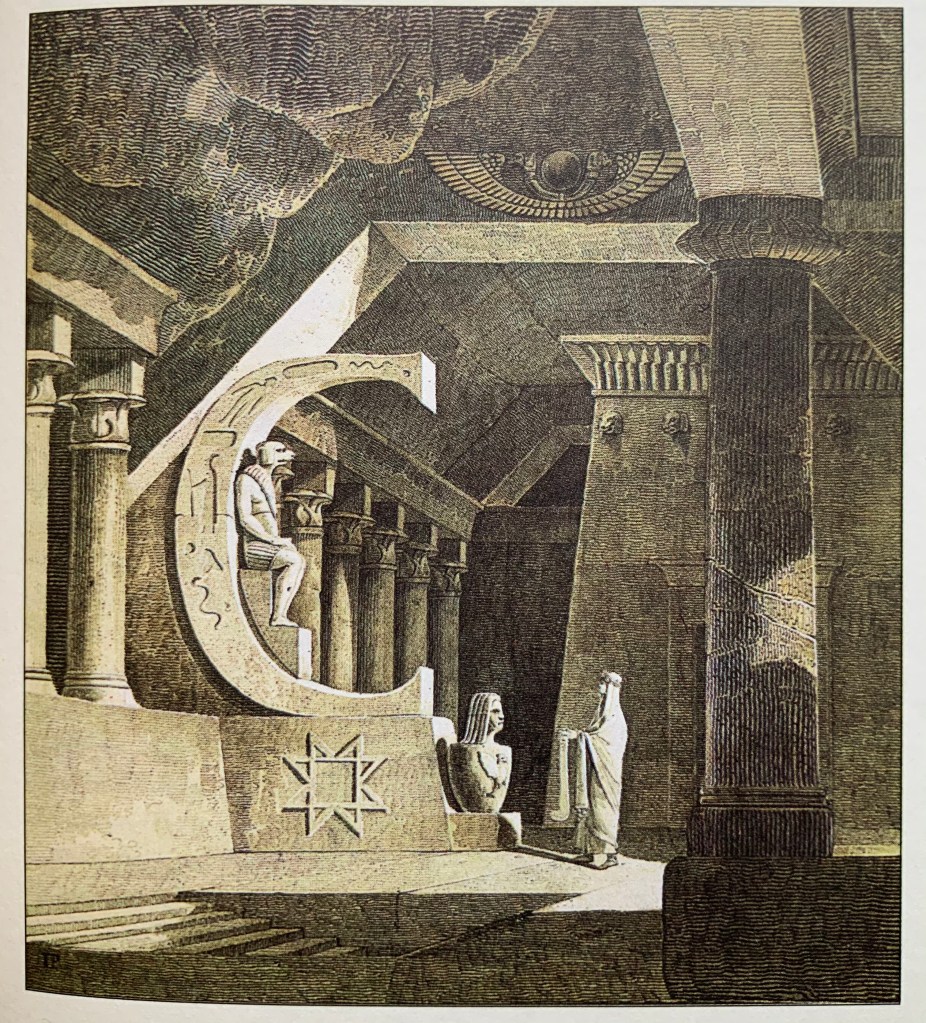
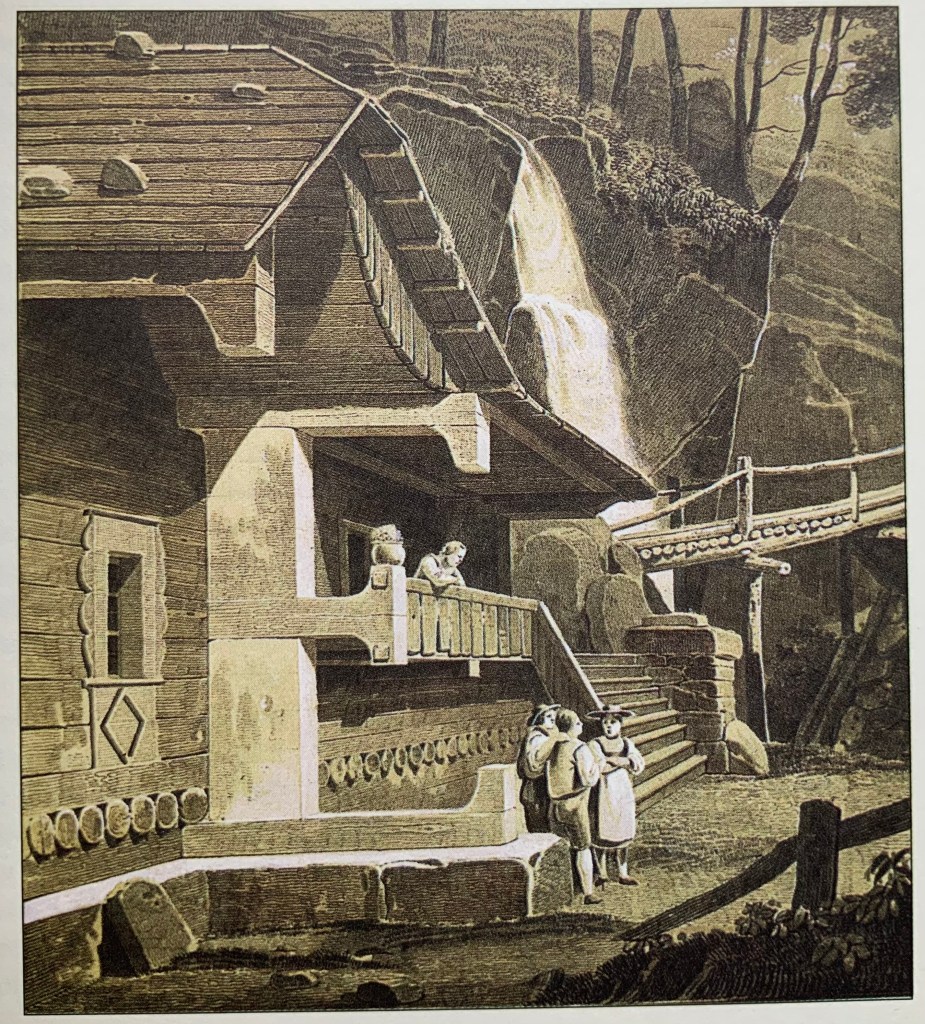
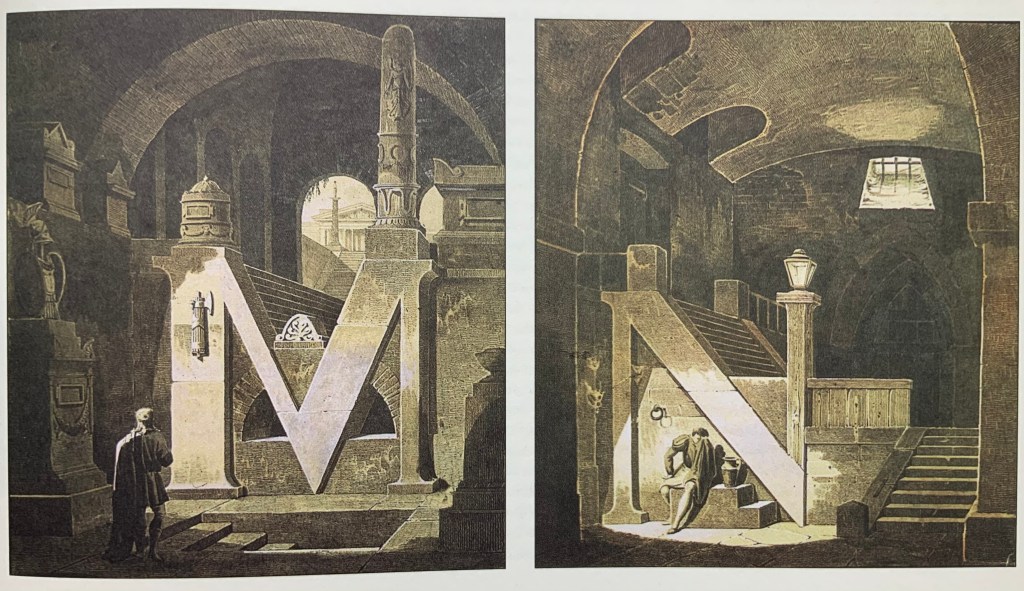
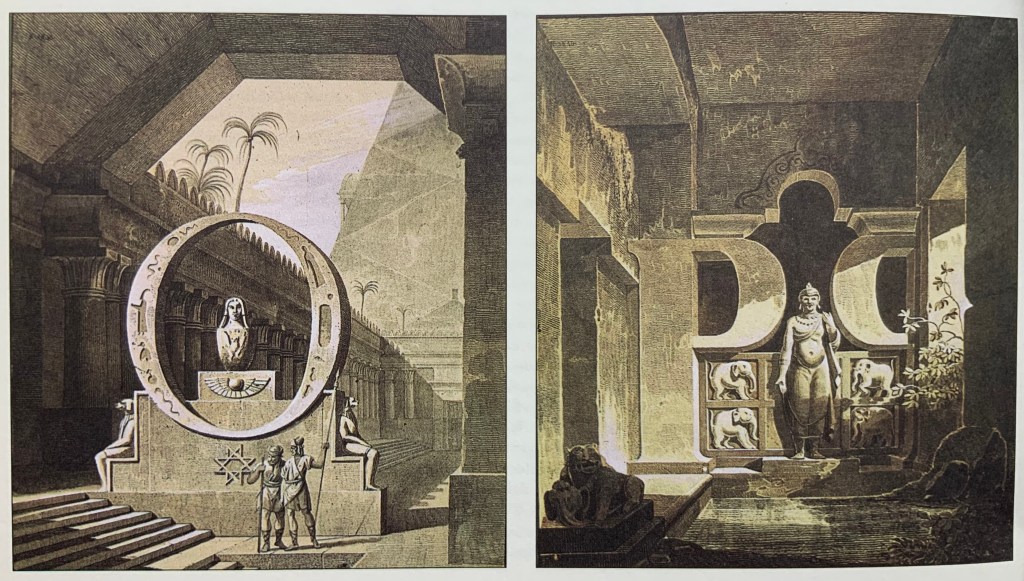
Antonio de Pian’s architectural alphabet portfolio is the rarest of the four. With its frontispiece/title page and twenty-two letters (B, D, J and W are missing), the only copy resides somewhere in Vienna. Fortunately, all of the twenty-two appear in the Basoli facsimile produced by Kiermeier-Debre/Vogel in 1998. The brown-tinted lithographs of the elder Pian’s portfolio echo not only the Basoli portfolio’s monochromatic character but also its emphases on Near or Middle Eastern or Oriental settings and on antiquity. As Kiermeier-Debre/Vogel point out, the dual emphasis was ushered in by Napoleon’s Egyptian campaign (1798-1801) and also showed itself in opera’s subject matter during Basoli’s and the Pians’ lifetimes. Twelve of Antonio’s scenes have settings in antiquity or the distant past, and seven in the Near or Middle East. Fifteen are based in Europe.

Letters M, N, O and P by Antonio de Pian

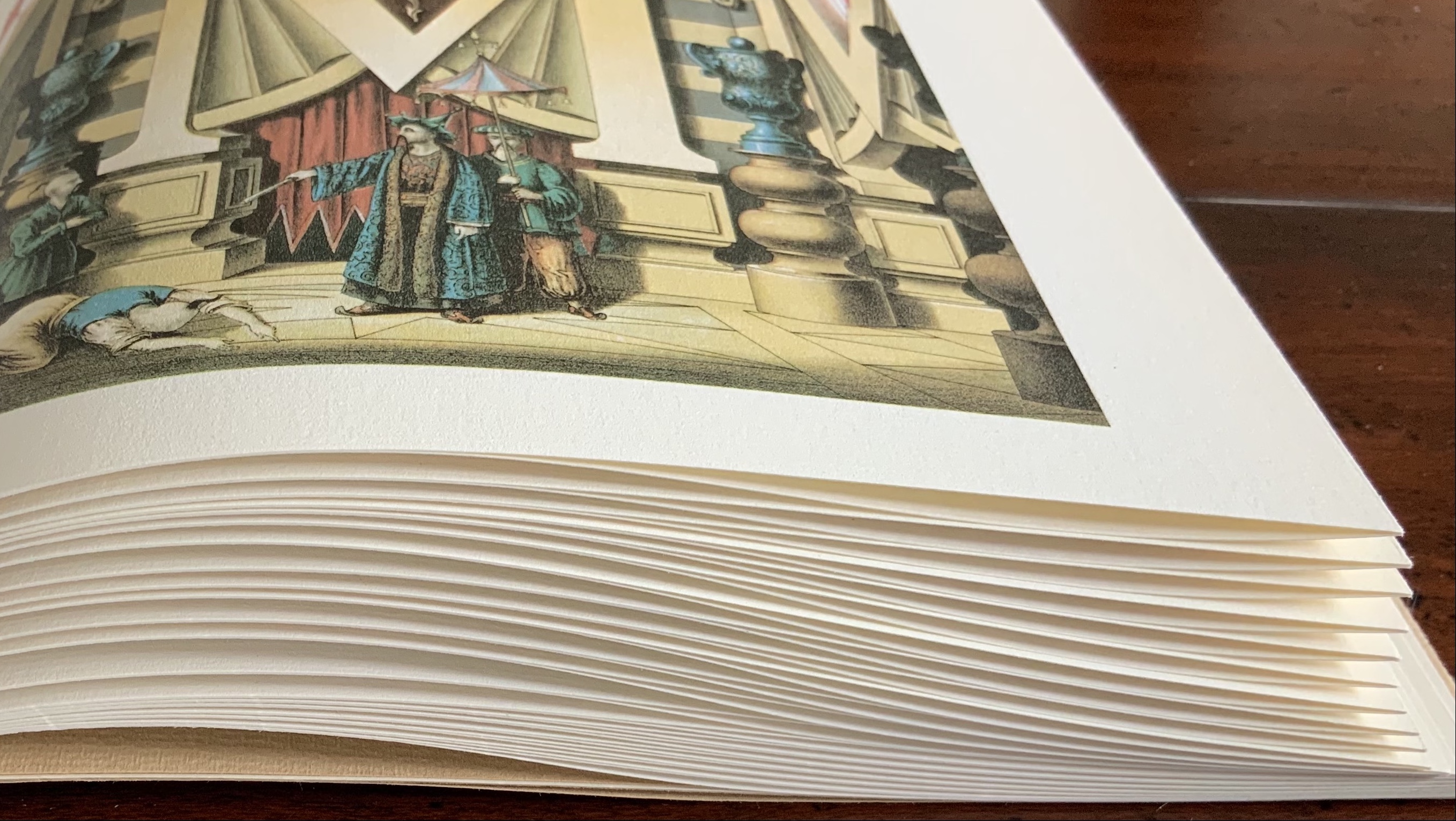
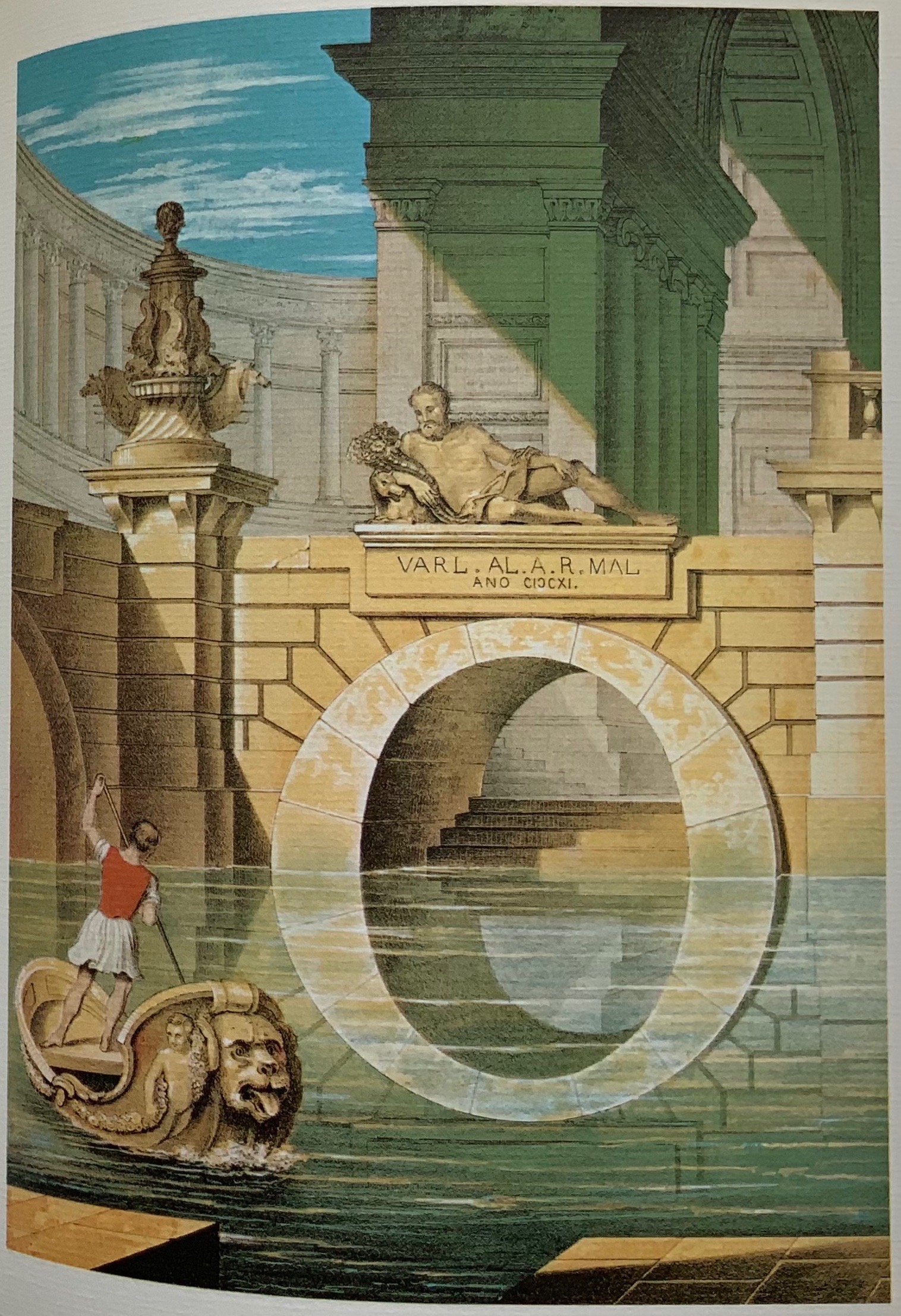
The original of Giovanni Battista’s portfolio is less rare, coming up for auction at five figures occasionally in the last few decades. It, too, appears in the Kiermeier-Dobre/Vogel’s Basoli volume but more prominently than his father’s. Anton Durstmüller’s earlier Ein Schmuckalphabet aus Wien/“Alphabet Jewelry from Vienna”(1973) showcases Giovanni’s portfolio. With its Chinese-fold leaves and laid paper, Durstmüller’s book matches and enhances the warmth and color of Giovanni’s invention and the chromolithographs by the Viennese lithographers Leopold Müller, Johann Höfelich, and M.R. Toma. Giovanni’s use of the arch’s reflection in the water to form the letter O, Pian places himself firmly in his father’s and Basoli’s company regardless of any lack of appointment or honors.

The Chinese fold of pages in the Durstmüller volume; the letter O by Giovanni Battista de Pian.

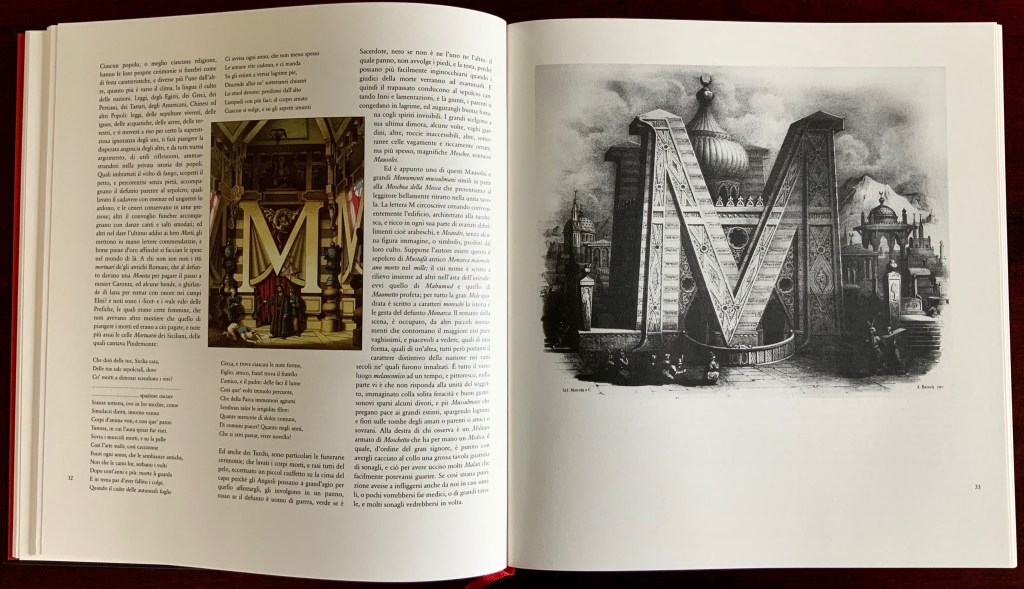
Sixteen of Giovanni’s scenes have European settings; eleven are Middle Eastern (he has an extra S). Of these, at least nine represent antiquity. From Basoli to the elder Pian and to the younger, there is the subtle shift in their scenes from the Classical to NeoClassical to Romantic styles, reflected in the diminishing emphasis on antiquity and growing emphasis on rustic European scenes. Typographically (or really calligraphically), the shift is less subtle. With almost every letter, Basoli used or tended toward a slab serif letter shape with blunt tips and sloping brackets. The Pians, however, leaned toward block serifs and sharply curving brackets, as seen in the letters A, C and E, above, and the letter M, below.

Kiermeier-Debre/Vogel’s side-by-side presentation of the letter M by Giovanni Battista de Pian and Antonio Basoli, respectively. Photo: Books On Books Collection.

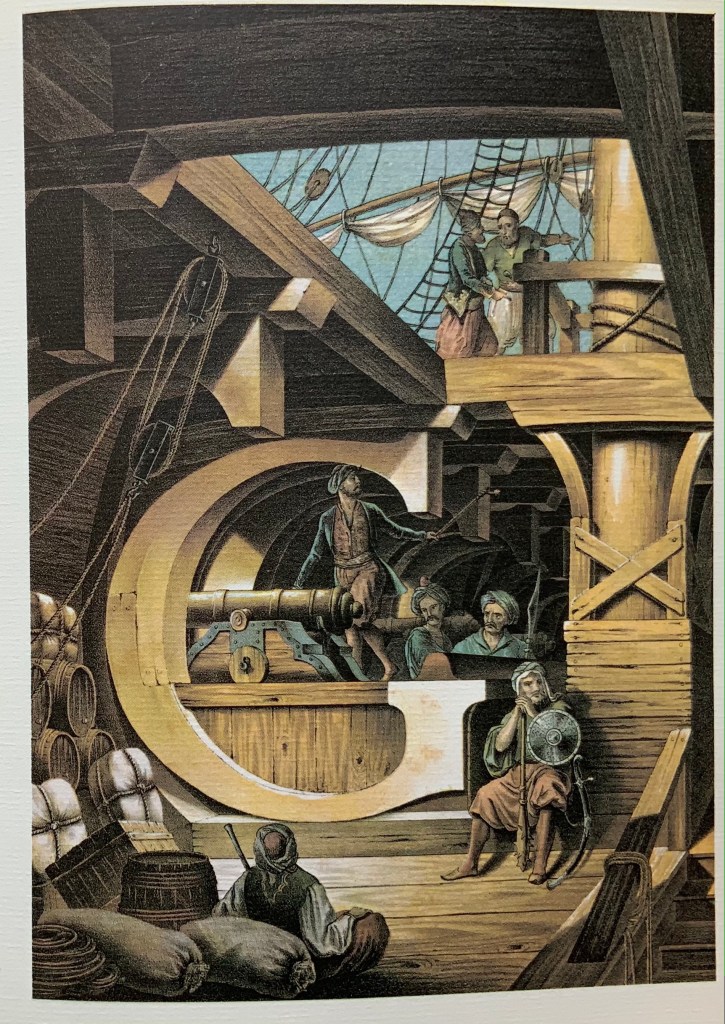
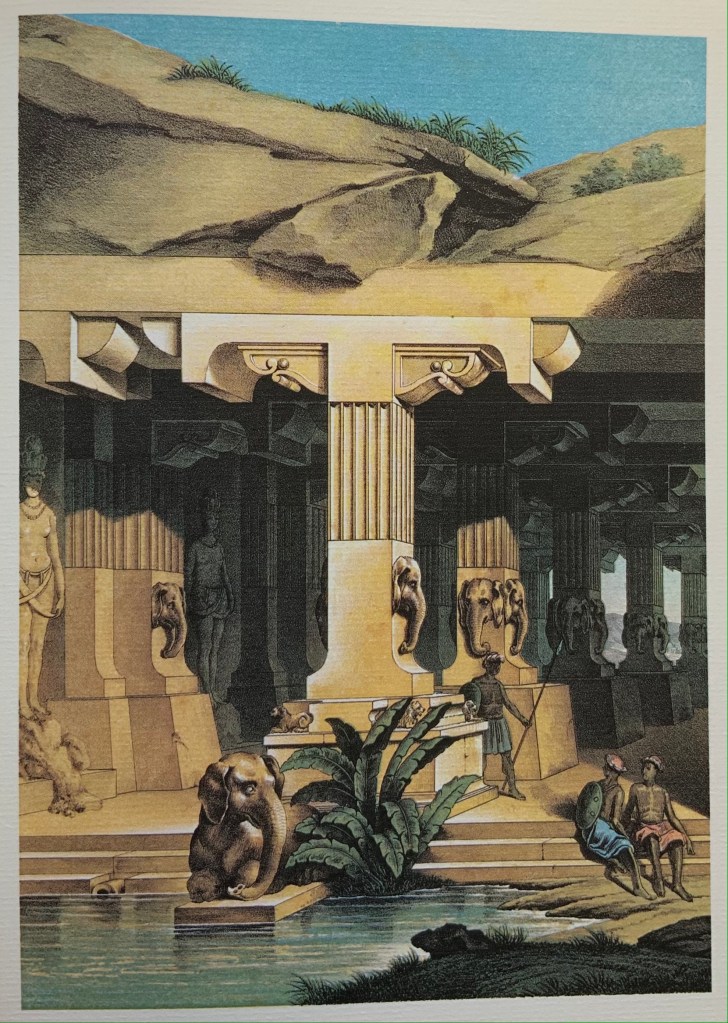
Basoli’s serifs do not vary with the scene’s region, which might have created anomalies but somehow that does not happen. Only with certain letters do the Pians vary their letters with the region. At the top here, the serifs in the elder Pian’s letters C and E reflect their different regional settings. Below, his two S’s, however, fail on this score. The block serif S belongs more with the antique Roman scene; the nearly sans serif S belongs more with the antique Egyptian scene. The more exotic the setting from a Western perspective, the more the block serifs present difficulties — as in Giovanni’s letter G (the Turkish pirates below decks appear fed up with it) and letter T (the Africans depicted are certainly looking askance at the architecture) below.

Basoli’s and the Pians’ use of slab serif letter shapes reflects both their theatrical profession and the period’s infatuation with the shape in advertising in newspapers and on posters. Slab serifs were called Egyptian serifs, not that those letter shapes appear anywhere in Egyptian antiquity, but neither do the Keith Haring-like figures on the flanking columns in Giovanni’s L scene. See Further Reading for the story of slab serifs and their moniker.

For more on the operatic and theatrical context in which Basoli and the Pians worked, see the entry for Antonio Basoli in the Books On Books Collection.

Further Reading

Abecedaries I (in progress)“, Books on Books Collection, 31 March 2020.

Architecture“, Books on Books Collection, 12 November 2018.

Federico Babina“, Books On Books Collection, 20 April 2021.

Antonio Basoli“, Books On Books Collection, 20 April 2021.

Jeffrey Morin“, Books On Books Collection, 20 April 2021.

Richard Niessen“, Books On Books Collection, 20 April 2021.

Paul Noble“, Books On Books Collection, 20 April 2021.

Johann David Steingruber“, Books On Books Collection, 2021.

Côme, Tony. “The Typotectural Suites“, The Palace of Typographic Masonry. Accessed 5 April 2021.

de Looze, Laurence. 2018. The Letter and the Cosmos: How the Alphabet Has Shaped the Western View of the World. Toronto: University of Toronto Press.

Loxley, Simon. 2011. Type: the secret history of letters. London: Tauris. Chapter 5.

Lupton, Ellen. 2014. Thinking with type: a critical guide for designers, writers, editors, & students. New York, NY: Princeton Architectural Press. Pp. 22-23.

Macken, Marian. 2018. Binding Space: The Book as Spatial Practice. London and New York: Routledge.

McEwen, Hugh. Polyglot Buildings. 12 January 2012. Issuu. Accessed 13 March 2021.

McNeil, Paul. 2017. The visual history of type. London: Laurence King. Pp. 108-09, 114-15, 120-21

Tsimourdagkas, Chrysostomos. 2014. Typotecture: Histories, Theories and Digital Futures of Typographic Elements in Architectural Design. Doctoral dissertation, Royal College of Art, London.

Books On Books Collection – Antonio Basoli

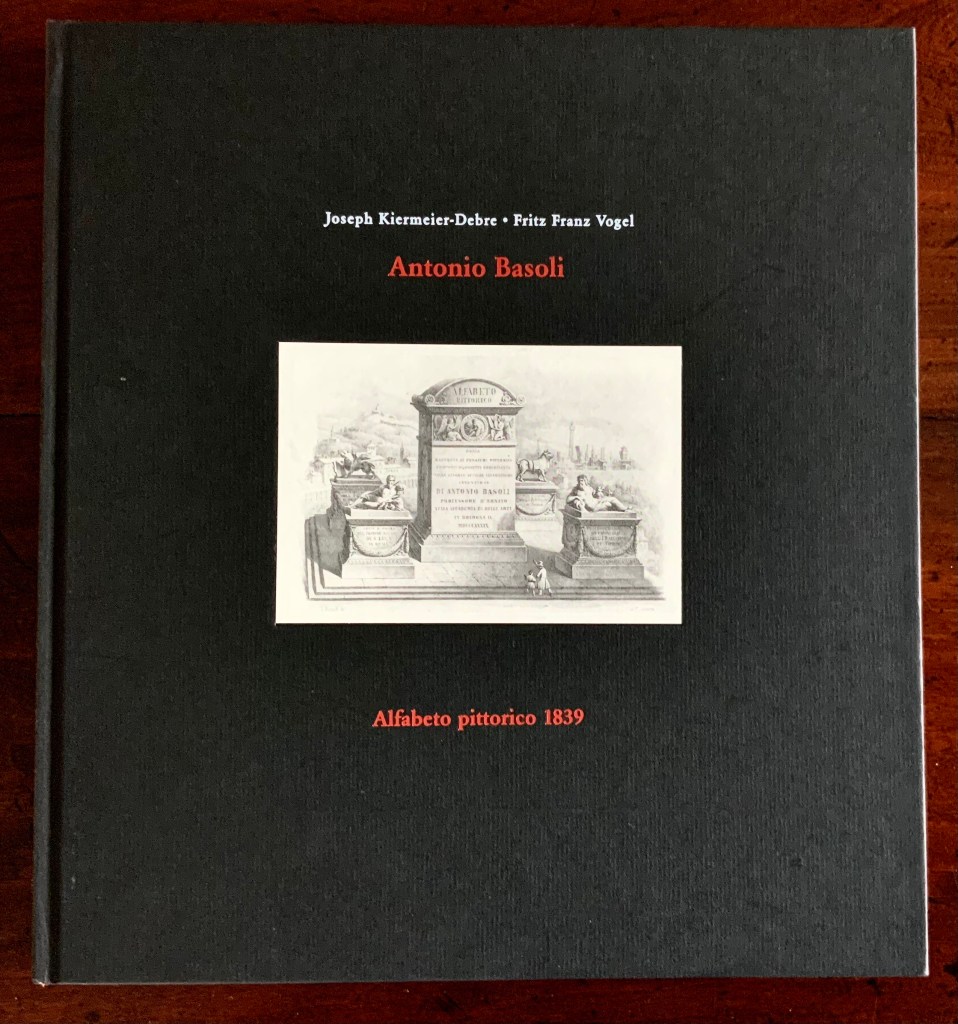
Alfabeto Pittorico, ossia raccolta di pensieri pittorici composti di oggetti comincianti dalle singole lettere alfabetiche (“Pictorial Alphabet, a collection of pictorial thoughts composed of objects beginning with the individual letters of the alphabet”) (1839/1998)
Antonio Basoli
Facsimile edition created by Joseph Kiermeier-Debre and Fritz Franz Vogel (1998) as part of the boxed set Alphabets Buchstaben Calligraphy, published by Ravensburger Buchverlag. H275 x W255 mm, 144 pages. Acquired from Antiquariat Terrahe & Oswald, 14 March 2021. Photos: Books On Books Collection.

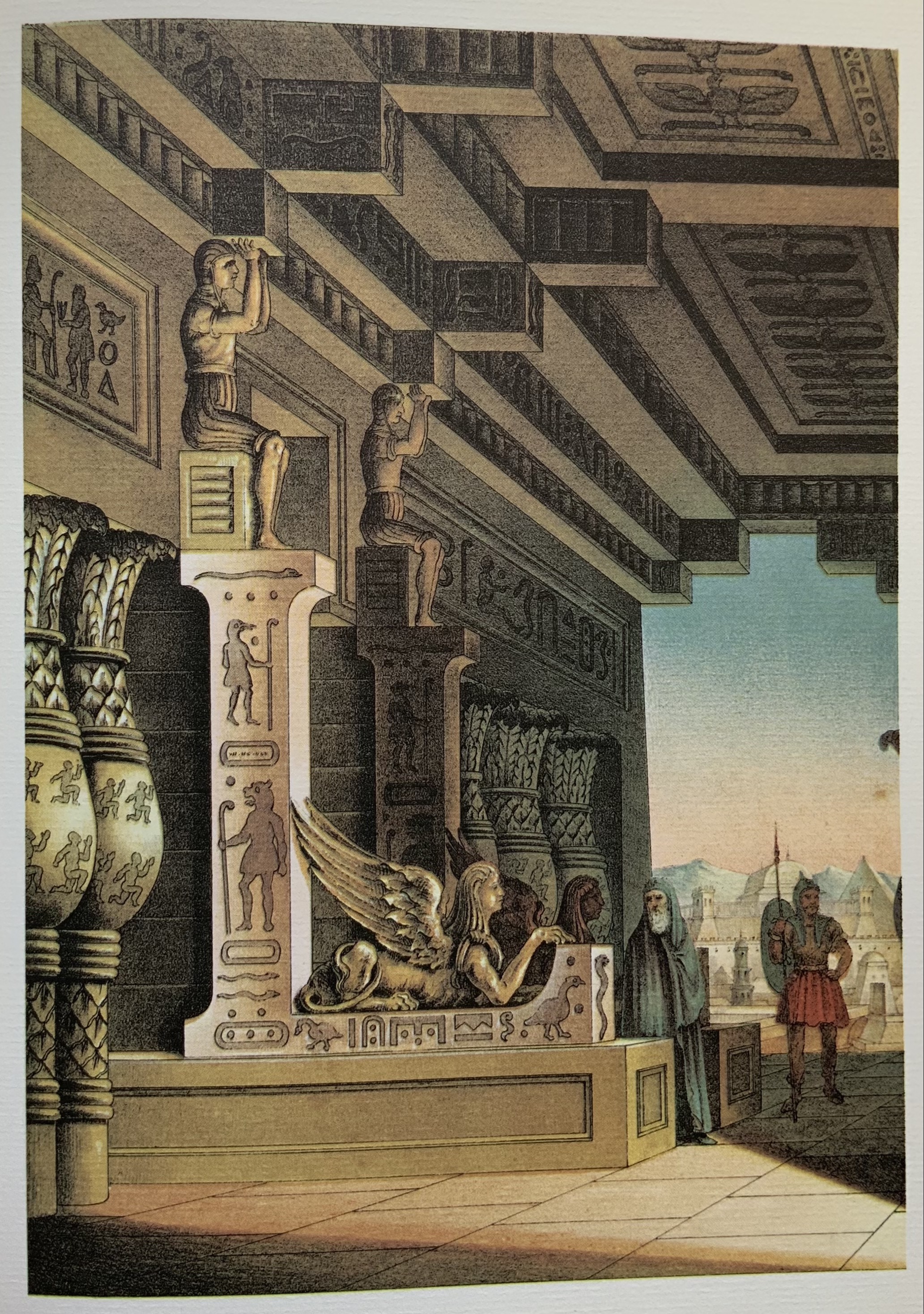
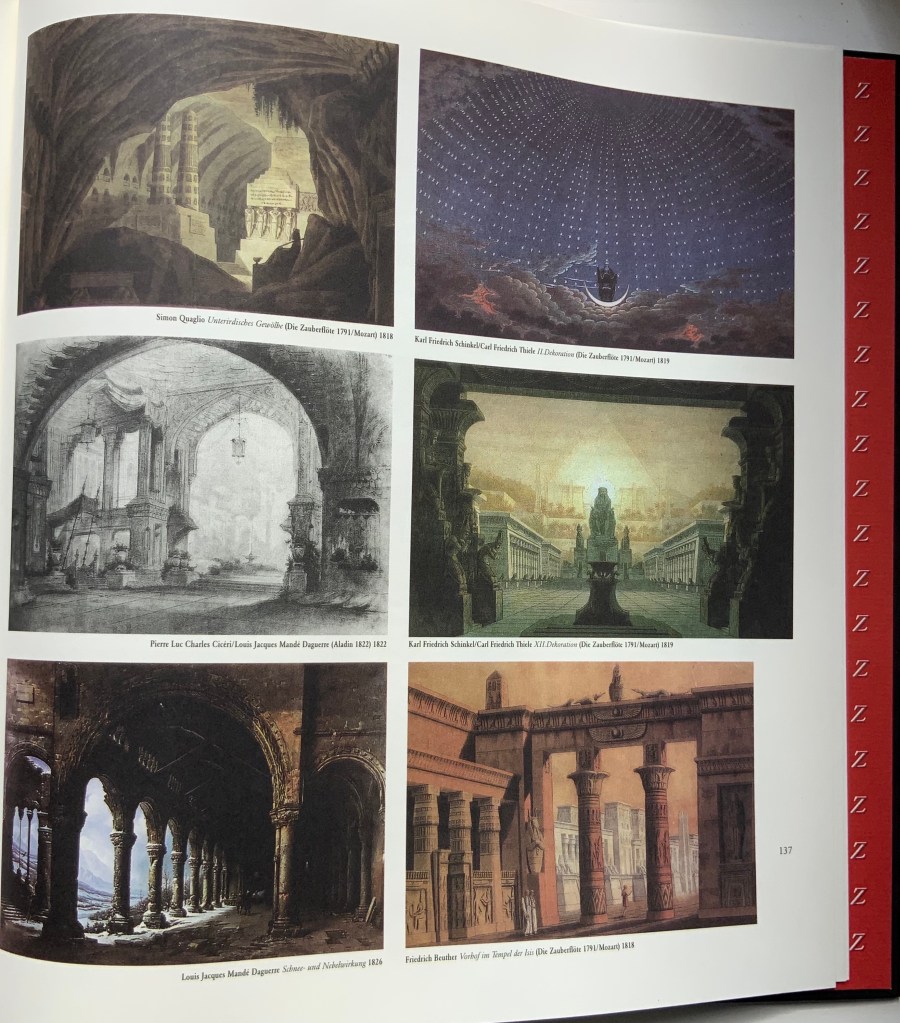
The Ravensburger Alfabeto pittorico is like a “Black Forest Cake” — a lot of ingredients. The recipe starts with Antonio Basoli’s design of monuments based on letters of the alphabet and his original Italian and French descriptions. To this, the chefs Joseph Kiermeier-Debre and Fritz Franz Vogel add German and English translations. Then, alongside Basoli’s inventions, they place reduced versions of Antonio and Giovanni Battista de Pian’s contemporaneous alphabetical/architectural fantasies. And sprinkled throughout, providing comparative context to Basoli’s career in Bologna as a professionally and academically recognized scenographer, there are dozens of reduced versions of lithographs of opera settings by the more renowned scenographers associated with Vienna, Milan, Venice, Naples and Munich. It is entirely a pudding in the spirit of Basoli.

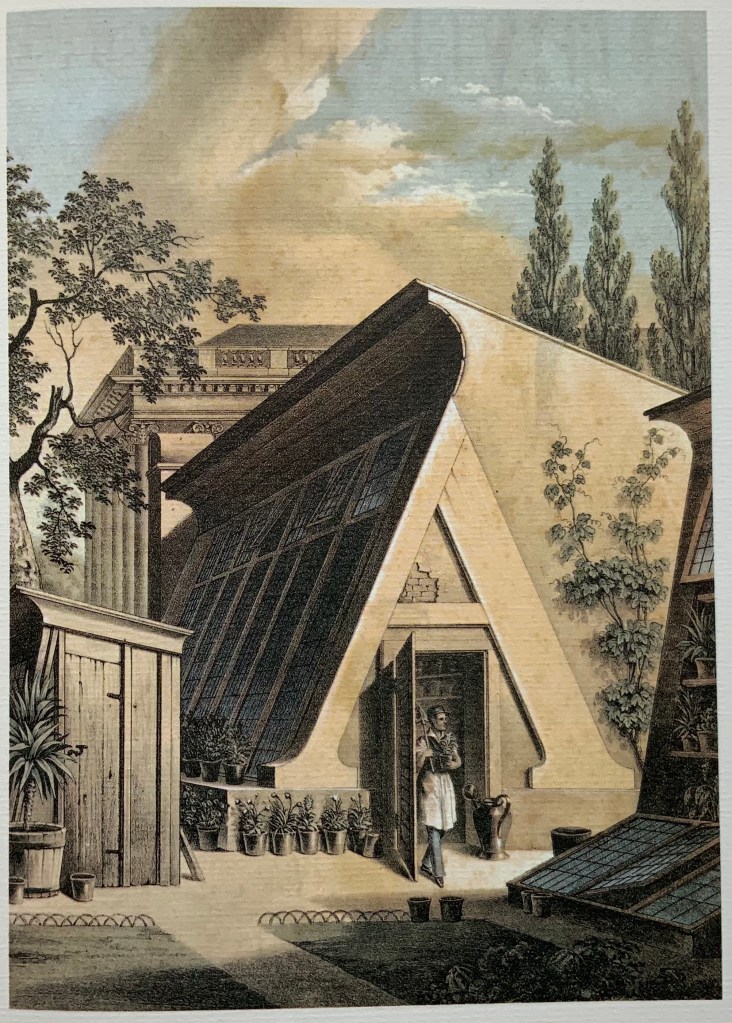
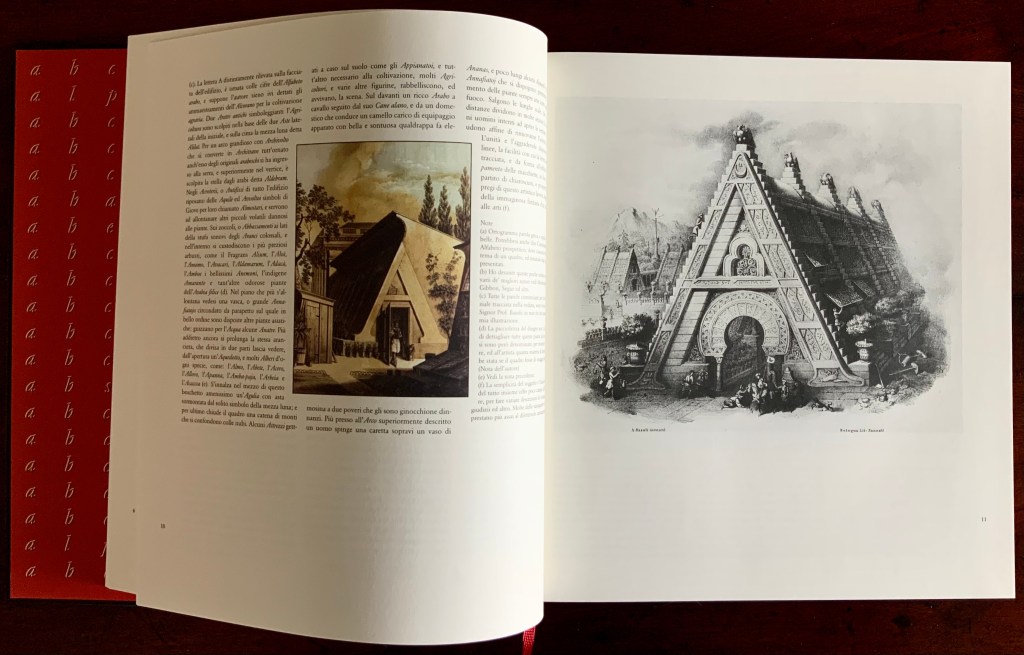
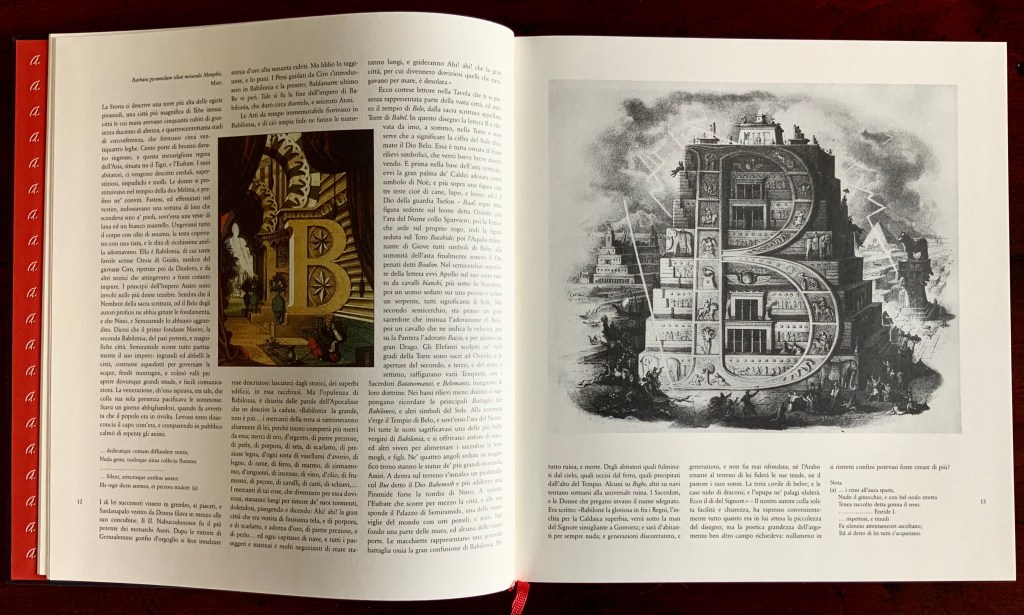
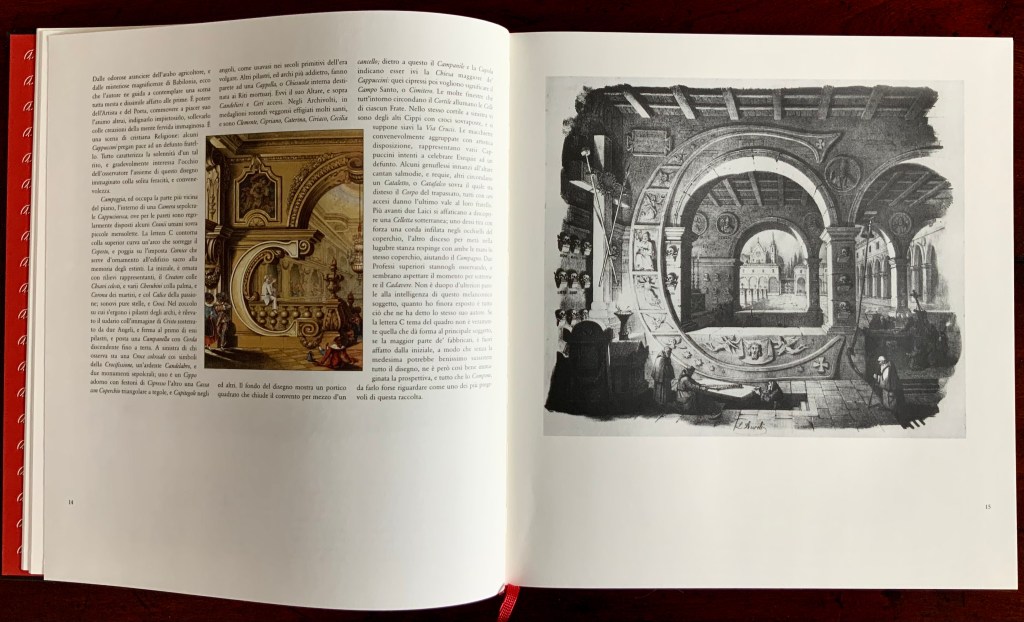
Basoli creates densely illustrated scenes based on each letter of the alphabet. For each view, his goal is to incorporate the letter structurally or ornamentally in a central building, which in the most successful attempts would begin with the letter. For instance, the large A-shaped building is an orangerie (as in arancia for oranges). B hints at the Tower of Babel and the destruction of the Babylonian empire. C stands for catafalque (or “crypt”) and the Capuchin monks attending to a burial.

Setting a further standard of success, the artist populates each scene with people, activities, objects and symbols that begin with the designated letter. Around the orangerie, agricultural attrezzi (“implements”) are strewn, stone aquile (“eagles”) perch on the building, alms are being distributed by a man in Arab dress, trees beginning with the letter A forest the background and pop up from pots, and the whole setting evokes Arabia according to the 19th-century perception of the region encompassing “Persia, Syria, Egypt and Ethiopia”.

As Kiermeier-Debre and Vogel point out in the preface and afterword, this scene and many others reflect the time’s preoccupation with the Orient and antiquity from the not-too-distant Napoleonic campaign in Egypt (1798-1801) that spawned the archaeological industry of Egyptology. They also reflect the scenography arising from a half century’s operas such as The Escape from the Seraglio(1782), The Caliph of Baghdad (1800), Abu Hassan (1811), Ciro in Babilonia (1812), L’Italiana in Algeri (1813), Il Turco in Italia (1814), Semiramis (1818), Maometto (1820) and Belsazar (1836). Drawing attention to the alphabetical scenes’ evidence of the wide range of Basoli’s cultural, historical, mythological and religious insights, Kiermeier-Debre and Vogel rightly conclude that the work is as much an encyclopedic pictorial dictionary as abecedary.

The author who provided the original commentary on Basoli’s scenes was G.C. Lossada, an art historian. He, too, notes Basoli’s erudition, but on the artistic success of each scene, he swings between acclamation and deprecation. Here is his concluding paragraph on the letter C:

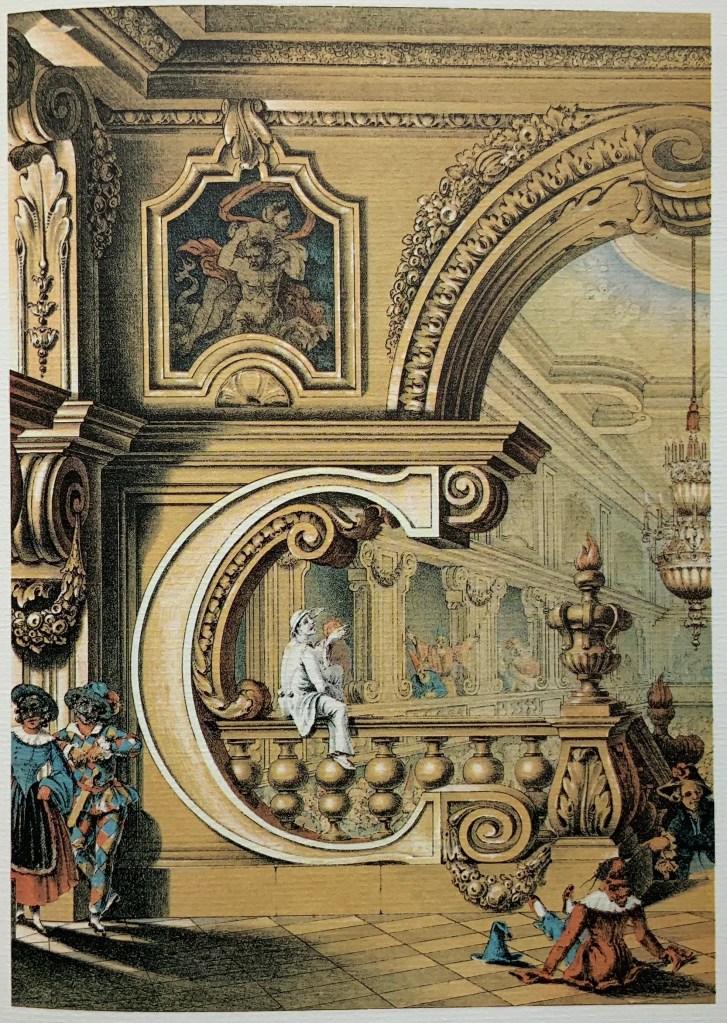
Despite the fact that the shape of the letter C, the theme of this picture, does not lend itself to the main object that is depicted, and the larger part of the building actually lies outside of the initial, such that the whole design could well exist without it, despite all this the perspectives and proportions are so well thought out that this picture can be acclaimed as one of the best in the collection. P. 110.

Equally balanced in their appraisal of Basoli, Kiermeier-Debre and Vogel rank him behind his contemporary scenographers such as Karl Friedrich Schinkel but rate his alphabetical architecture over that of Giovanni Battista de Pian. The latter may be a matter of color and taste. Even reduced, Pian’s scenes draw the eye over Basoli’s, and if the criteria for ranking include a consistency in integrating concept, subject, technique and material, Pian’s letters strain less in their achievement. The letter C certainly takes the cake for Pian.

Basoli does, however, gain a point over Pian with his concluding ampersand. As Lossada remarks, in recapitulating the alphabet and images emblematic of each letter, Basoli’s “&” is entirely a scenic etcetera. The ampersand can be viewed online with the complete alphabet, thanks to the Civic Museum of the Risorgimento in Bologna and also RMR Productions (video, 7 June 2014; accessed 5 April 2021). Neither replicates the clarity of the Ravensburger reproductions.

Further Reading

Abecedaries I (in progress)“, Books on Books Collection, 31 March 2020.

Architecture“, Books on Books Collection, 12 November 2018.

Federico Babina“, Books On Books Collection, 20 April 2021.

Giovanni Battista de Pian“, Books On Books Collection, 20 April 2021.

Jeffrey Morin“, Books On Books Collection, 20 April 2021.

Richard Niessen“, Books On Books Collection, 20 April 2021.

Paul Noble“, Books On Books Collection, 20 April 2021.

Johann David Steingruber“, Books On Books Collection, 20 2021.

Côme, Tony. “The Typotectural Suites“, The Palace of Typographic Masonry. Accessed 5 April 2021.

de Looze, Laurence. 2018. The Letter and the Cosmos: How the Alphabet Has Shaped the Western View of the World. Toronto: University of Toronto Press.

Macken, Marian. 2018. Binding Space: The Book as Spatial Practice. London and New York: Routledge.

McEwen, Hugh. Polyglot Buildings. 12 January 2012. Issuu. Accessed 13 March 2021.

Tsimourdagkas, Chrysostomos. 2014. Typotecture: Histories, Theories and Digital Futures of Typographic Elements in Architectural Design. Doctoral dissertation, Royal College of Art, London. Accessed 13 March 2021.

Books On Books Collection – Johann David Steingruber

Architectural Alphabet (1773/1972)

Architectural alphabet (1773/1972)
Johann David Steingruber
Casebound, sewn, headbands. H356 x W260 mm, 112 pages, including 33 facsimile prints. Published by Merrion Press, London. Edition of 425, of which this is #9. Acquired from Chevin Books, 24 July 2020. Photos: Books On Books Collection.

Several professional and academic architects and designers as well as academics from other disciplines have delved into the intersection of the alphabet and architecture. A few of them have also noted the intersection’s expansion to include artist books and fine press works. Since Johann David Steingruber’s effort in the 18th century, it has become quite a busy intersection.

Originally published in installments at Steingruber’s own expense, the volume opens with its gloriously long title in an “arch of contents”, the columns inscribed with thumbnail images of the letter buildings to come. Although the title page lists 1773 as the publication date, the last installment came in March 1774. In his lifetime, Steingruber published three other works, illustrated and described toward the end of this facsimile, but Architectonisches Alphabeth became his most famous — “postcard” famous.

Architectonisches Alphabeth: bestehend aus dreyßig Rissen wovon Jeder Buchstab nach seiner kenntlichen Anlage auf eine ansehnliche und geräumige Fürstliche Wohnung, dann auf alle Religionen, Schloß-Capellen und ein Buchstab gänzlich zu einen Closter, übrigens aber der mehreste Theil nach teutscher Landes-Art mit Einheiz-Stätte auf Oefen und nur theils mit Camins eingerichtet, wobey auch Nach den mehrest irregulairen Grund-Anlagen vielerley Arten der Haupt- und Neben-Stiegen vorgefallen, dergleichen sonsten in Architectonischen Rissen nicht gefunden werden, zu welchen auch Die Façaden mit merklich abwechslender Architectur aufgezogen sind.

Steingruber dedicated his Architectural Alphabet to Christian Friedrich Carl Alexander, Margrave of Brandenburg-Ansbach, and his first wife Frederica Carolina, not to be confused with the paying dedicatee of Bach’s Brandenburg Concertos, the Margrave of Brandenburg-Schwedt. By a baroque coincidence, however, the first Brandenburg concertos, the ones composed by Giuseppe Torelli but not really influencing Bach, were dedicated to the Margrave of Brandenburg-Ansbach, then George Friedrich II, Alexander’s great-uncle who employed Torelli as court composer. Like Torelli, Steingruber too had to be satisfied with his payment as an appointee — court and public surveyor, and later principal architect of the board of works — even though he went to the trouble of making sure that his employers’ monograms and their associated buildings appeared in the span above the roman arch.

Steingruber seemed unaware of other building designs from alphabetical foundations. This facsimile’s editor gently and genially fills in the missing context. John Thorpe (1565–1655?), an English architect, drew up a property based on his initials. Thomas Gobert (1625-90), a French architect, produced Traitté d’Architecture dedié à Louis XIV, a manuscript whose building plans spelled out “LOVIS LE GRAND”. Anton Glonner (1723–1801) designed a Jesuit church and college around the monogram “IHS”.

There was not much chance of these letter-shaped edifices’ being built. Nevertheless, Steingruber adds matter-of-fact descriptions to his elevations and plans, calling out heating, kitchen, toilet and servants’ arrangements as if conferring with a prospective client ready to commission one of these typographic palaces. Who would not want a serif with a view? Or conduct guests on a tour of the bowl, capline, crossbar, stem, stroke and tail of the property?

The main text appears to be set in Van Dijck (before Robin Nicholas’ revision between 1982 and 1989) and printed on a cream laid paper. The special earmarks of Van Dijck — the sloped apex of the A, the stepped center strokes of the W, the non-lining numerals and especially the downward stroke at the top of the 5 , the tilted lower bowl of the g, etc., identifiable in Morison’s A Tally of Types and Rookledge’s Classic International Type Finder — all seem to be present.

The laid paper is not only tactilely pleasant, it visually supports the clarity of the facsimile prints. Their sharpness outdoes what is achieved even with the zoom function applied to the freely available digital version, which can be seen in the interactive comparison below.

Kiermeier-Debre and Vogel edition (1995)

Architectonisches Alphabeth (1773/1995)
Johann David Steingruber
Facsimile edition prepared by Joseph Kiermeier-Debre and Fritz Franz Vogel. H356 x W260 mm, 80 pages. Acquired from Antiquariat Terrahe & Oswald, 14 March 2021.

In smaller dimensions, this edition does not present the prints in their full size. Partially making up for the deficit is the Munken Pure paper’s brightness, against which the Garamond Berthold typeface and photolithography work well. Also, the book includes French, German and English text as well as illustrations that broaden the context to the present. Alongside Steingruber’s elevations and plans, Kiermeier-Debre and Vogel have included several birds-eye views of inventive roofing of 20th-century architectural models inspired by Steingruber’s plans.

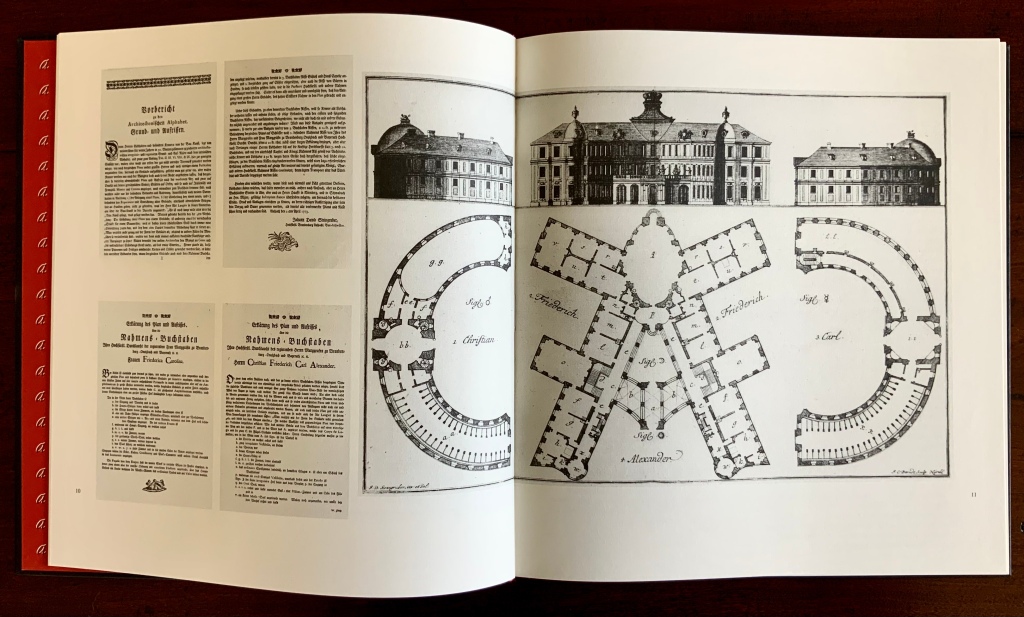
Christian Friedrich Carl Alexander’s monogram buildings reduced alongside reductions of Steingruber’s original foreword and explanations of Federica Carolina’s and Alexander’s buildings.

Not satisfied with some of his efforts, Steingruber offered second options; here, for the letter A, and later, for the letters M, Q, R and X.

Verso: Paula Barreiro’s roofing design for Steingruber’s letter B.

Verso: Helge Huber’s and Alexandra Krull’s roofing designs for Steingruber’s letter C.

In another instance of positioning Steingruber’s book in the history of alphabetic architecture (or architectural alphabets), the editors include a complete set of small reproductions of Thomas Gobert’s designs and elevations spelling out “LOVIS LE GRAND” from his manuscript mentioned above. Although created a century before, his drawings do not seem as stylistically distant from Steingruber’s as those of the 20th-century rooftop drafts do. Driving home their point that “the design of alphabetical buildings must not be based slavishly on a Baroque roman type or a classicist roman version”, the editors conclude by drawing attention to Takenobu Igarashi‘s 20th-century sculptural celebrations of the alphabet in aluminum, concrete, wood, chrome and gold.

Photo: Mike Sullivan, “Igarashi Alphabets“, Typetoken, 25 November 2013. Accessed 26 March 2021. Displayed with permission of the reviewer.

In print and online as well, new original and secondary works have continued to busy the intersection of the alphabet, architecture and artist books. Richard Niessen’s The Palace of Typographic Masonry (2018) and Sergio Polano’s “Architectural Abecedari” (2019) are two recent examples. And, as if to confirm the busying of the intersection, we have Takenobu Igarashi: A to Z (2020) in print and making up for the scarcity of Igarashi Alphabets (1987).

Further Reading

Abecedaries I (in progress)“, Books on Books Collection, 31 March 2020.

Architecture“, Books on Books Collection, 12 November 2018.

Federico Babina“, Books On Books Collection, 20 April 2021.

Antonio Basoli“, Books On Books Collection, 20 April 2021.

Antonio & Giovanni Battista de Pian“, Books On Books Collection, 20 April 2021.

Jeffrey Morin“, Books On Books Collection, 20 April 2021.

Richard Niessen“, Books On Books Collection, 20 April 2021.

Paul Noble“, Books On Books Collection, 20 April 2021.

de Looze, Laurence. 2018. The Letter and the Cosmos: How the Alphabet Has Shaped the Western View of the World. Toronto: University of Toronto Press.

Igarashi, Takenobu. 1987. Igarashi alphabets. Zurich: ABC.
Macken, Marian. 2018. Binding Space: The Book as Spatial Practice. London and New York: Routledge.

McEwen, Hugh. Polyglot Buildings. 12 January 2012. Issuu. Accessed 13 March 2021.

Morison, Stanley, and Brooke Crutchley. 1999. A tally of types: with additions by several hands. Boston: D. R. Godine.

Nomiyama, Sakura, and Takenobu Igarashi. 2019. Takenobu Igarashi: A to Z. London: Thames and Hudson.

Perfect, Christopher, and Gordon Rookledge. 2004. Rookledge’s classic international typefinder: the essential handbook of typeface recognition and selection. London: L. King Publishing.

Polano, Sergio. January 2019. “Architectural Abecedari“, Casabella, 893, pp. 62-75 + 100-101 (eng.). Milan.

Tsimourdagkas, Chrysostomos. 2014. Typotecture: Histories, Theories and Digital Futures of Typographic Elements in Architectural Design. Doctoral dissertation, Royal College of Art, London. Accessed 13 March 2021.