Bartleby the Scrivener: A Story of Wall Street (1995)

Herman Melville, Bartleby the Scrivener: A Tale of Wall Street, 1853. Indulgence Press, 1995.
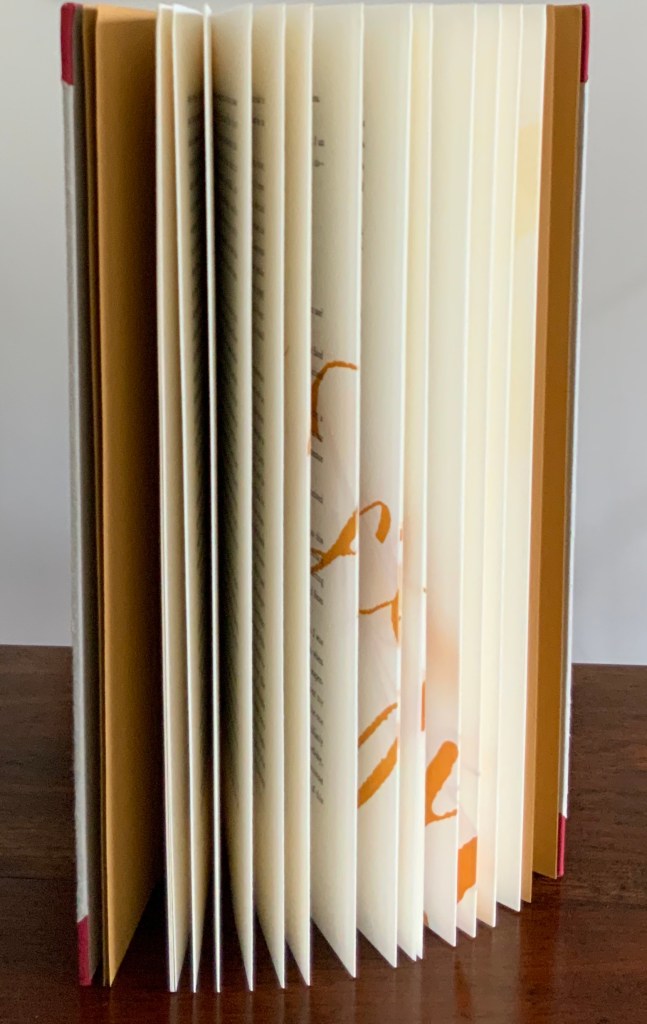
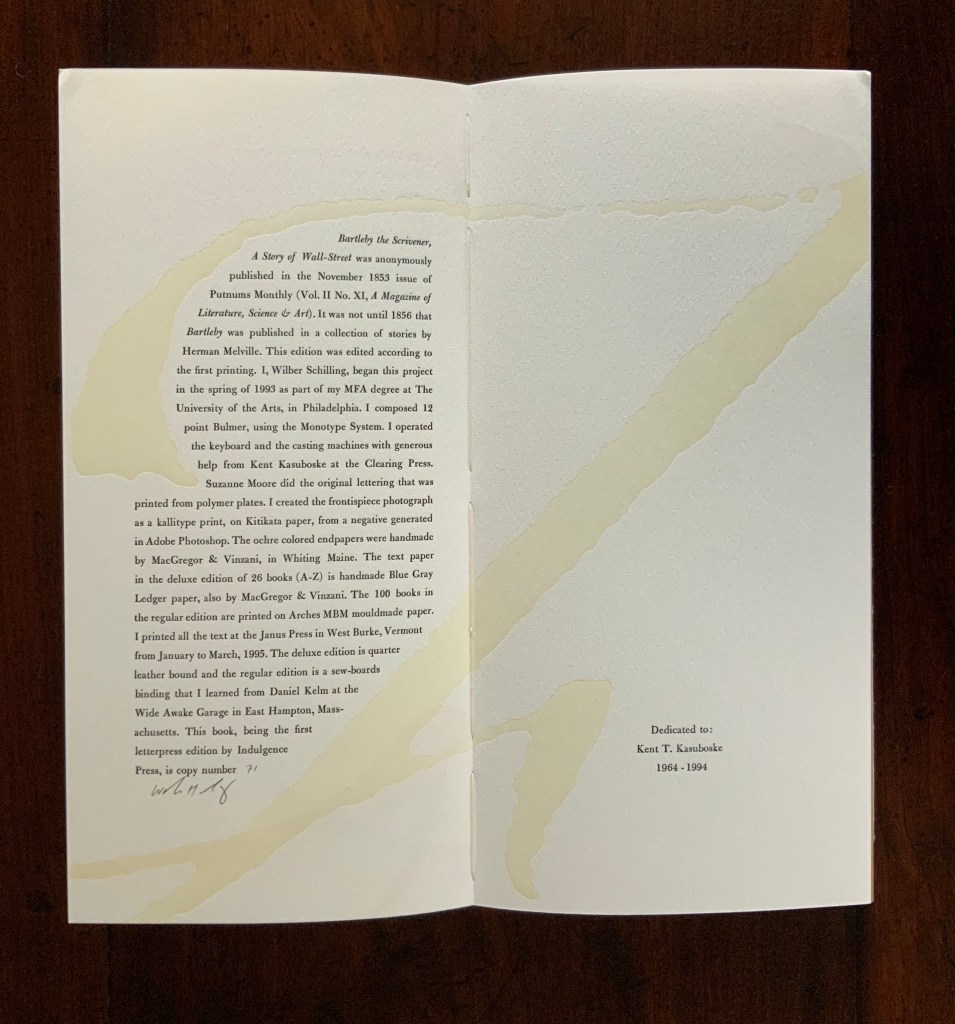
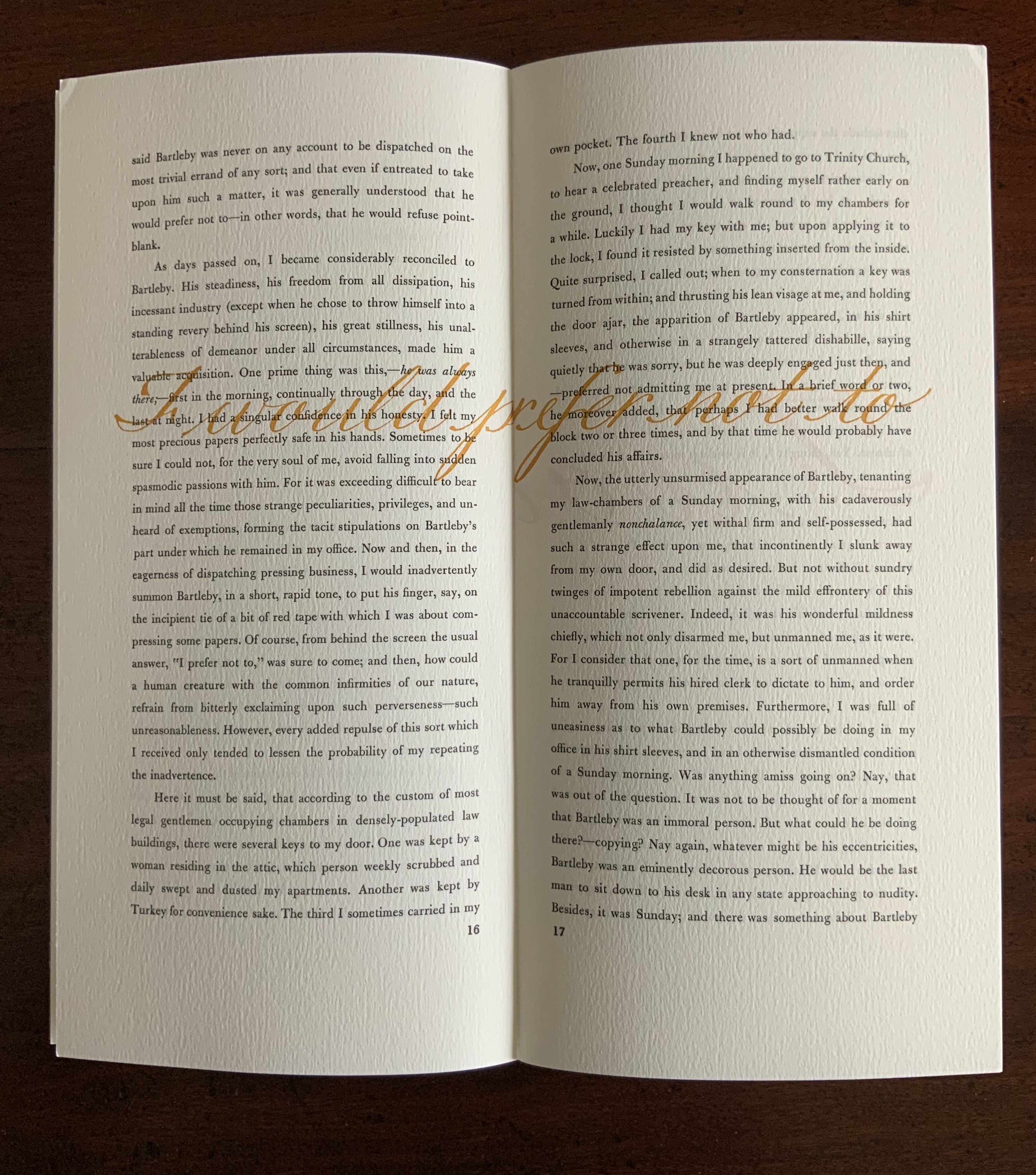
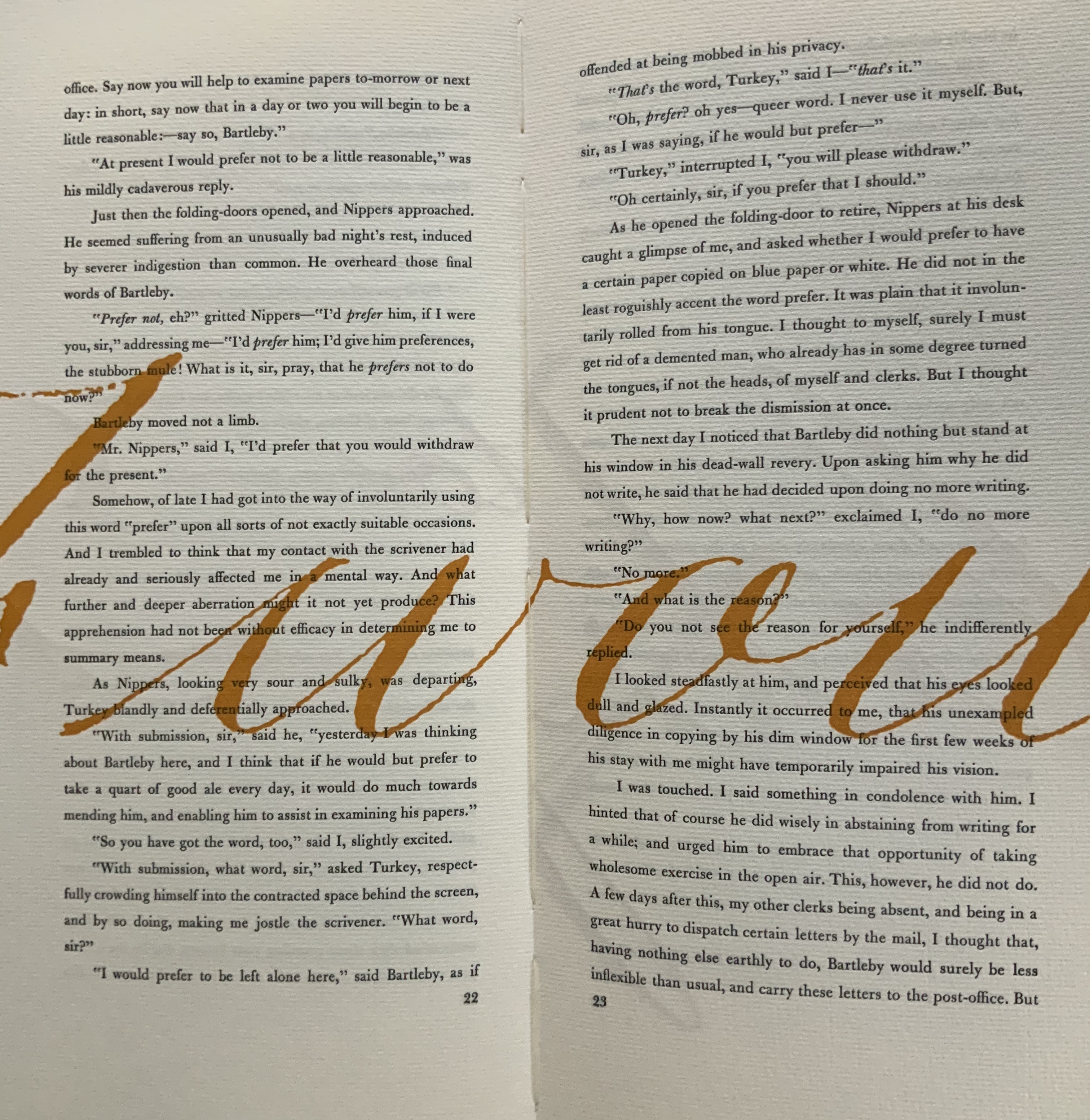
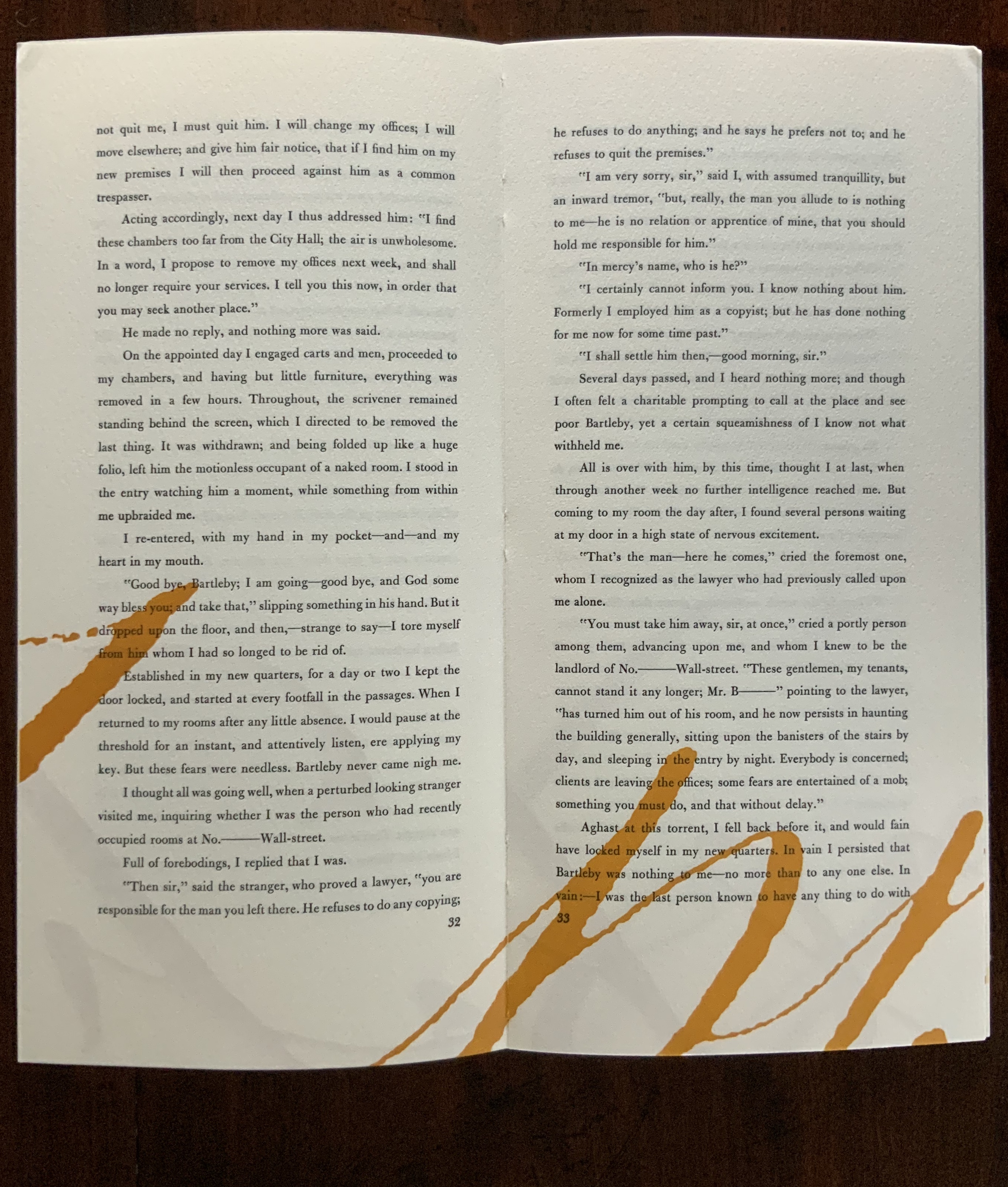
Type composed in 12 point Bulmer on the Monotype System and printed by Wilber Schilling on Arches MBM mould made paper at Janus Press. Calligraphy by Suzanne Moore. Ochre-coloured endpapers handmade by MacGregor & Vinzani.
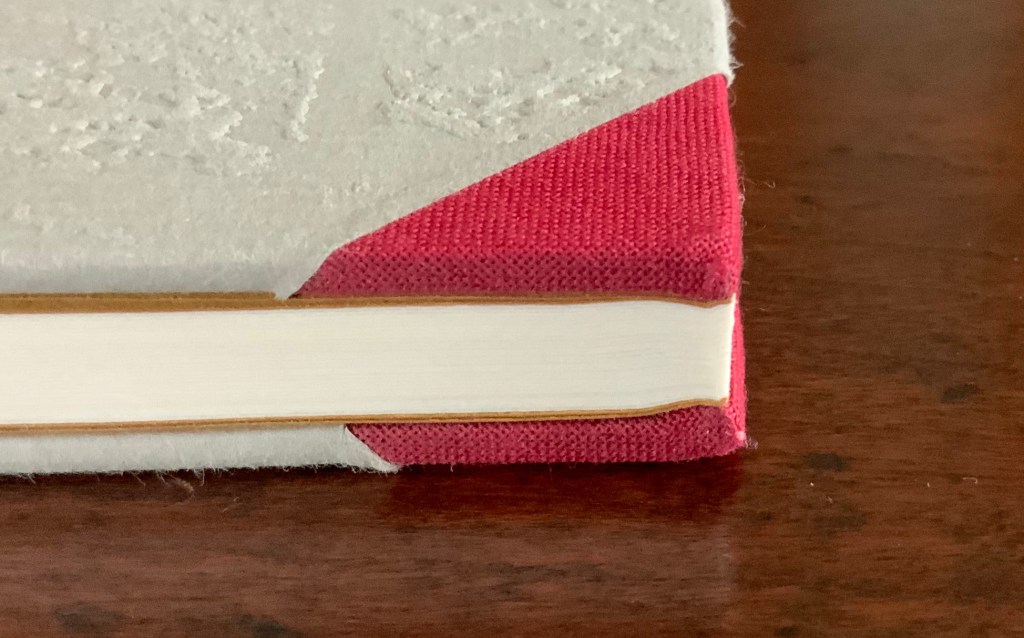
Wilber Schilling created the frontispiece photo as a Kallitype print from a negative generated in Adobe Photoshop. The binding, also by Schilling, is cloth over sewn boards and, over the cloth, an embossed print of details from the frontispiece photo.
Edition of 100 of which this is #71. H320 x W158 x D14 mm. Acquired from Indulgence Press, 17 December 2015.





Further Reading
“Suzanne Moore“. 14 January 2020. Books On Books Collection.
“Wilber Schilling“. 23 November 2015. Bookmarking Book Art.
Adamson, Chris T. 11 August 2014. “Bartleby, the Scrivener: A Story of Wall Street, by Herman Melville, Indulgence Press (1995)”. Books and Vines. Accessed 14 January 2020.
Buchta, Wolfgang. 2011. Bartleby the scrivener: A Story of Wall-Street. Vienna. Lithographies, coloured aluminum prints, aquatint, black slipcase. 9.5 x 6.3 inch, 120p. Ed. of 30.
Chen, Julie. 2013. 500 Handmade Books. Volume 2. New York: Lark. Pp. 59 (Half Life / Full Life), 402 (Arthur & Barbara).
Jury, David, and Peter Rutledge Koch (eds.) 2013. Book Art Object 2 : Second Catalogue of the Codex Foundation Biennial International Book Exhibition and Symposium, Berkeley, 2011. Berkeley, CA; Stanford, CA: Codex Foundation; Stanford University Libraries. Pp. 258 (Arthur & Barbara), 260 (Panthers).
Jury, David, and Peter Rutledge Koch (eds.) 2008. Book Art Object. Edited by David Jury. Berkeley, California: Codex Foundation. Pp. 198 (Where Do We Start?), 199 (Surplus Value Books #13).
Miller, Steve. 2008. 500 Handmade Books : Inspiring Interpretations of a Timeless Form. Edited by Suzanne J. E. Tourtillott. New York: Lark Crafts. Pp. 30 (Where Do We Start?), 51 (Bartleby the Scrivener: A Story of Wall Street).
 Consider Schilling’s Half-Life/Full-Life and its binding a variation on the accordion/flag structure of Hedi Kyle and Claire Van Vliet. The complexity of the form marries well with that of the intertwining, interleaving text and photos along the timelines of the Doomsday Clock and global warming.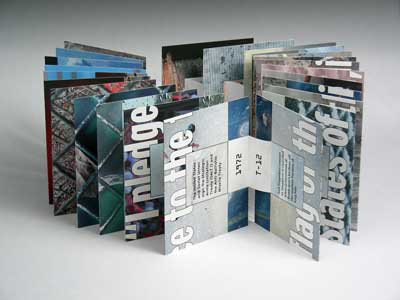

 Books On Books