Die Scheuche Märchen (1925/1965)

Die Scheuche Märchen (1925, 1965) [The Scare-Crow Fairy Tale]
Kurt Schwitters, Kate Steinitz and Theo van Doesberg. English translation by Robert Haas (enclosed, loose).
Miniature reprint of the 1925 edition. H123 x W154 mm. 12 pages. Acquired from Plain Tales Books, 12 July 2023.
Photos: Books On Books Collection.
The Schwitters-Steinitz Collection held at the National Gallery of Art Library identifies this work as a miniature reprint published in 1965 by Stockholm’s Gallery Samlaaren, owned by Agnes Widlund. The original, measuring H250 x W210 and also in red and blue on light brown paper, was published by Kurt Schwitters, Kate Steinitz and Theo van Doesberg under the imprint APOSS, which is a nonsense word, derived from “A for Active; P for Paradox; OS for Oppose Sentiment; and S for Sensitive” (Paley, p. 267). There have been several other editions, but this one is particularly satisfying for its inclusion of the loose typewritten translation by Robert Haas, who also translated Steinitz’s memoir/biography of Schwitters.

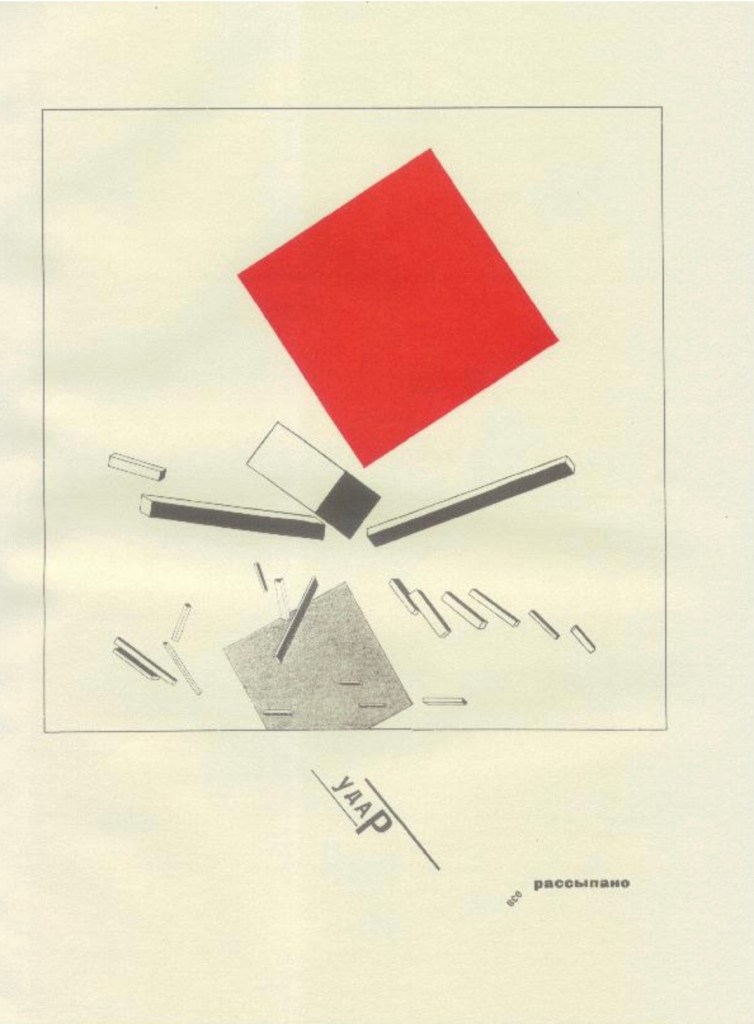
The Scare-Crow is the kind of “intelligent play” with type, images, layout and words to be expected in an artist’s book, and like El Lissitzky’s About 2 Squares (1922), it demonstrates the affinity that artists’ books have with children’s books. “Once upon at time …”

Once there was a scarecrow / He had a hat-chapeau / A tail-coat and a cane /And oh! Such a be-yoo-ti-ful / Scarf of lace
With the main character introduced, another character — a rooster –arrives, bringing the phonic fun of replicating the sound of Monsieur with the German spelling “Mosjö” and introducing a Latin declension to provide some onomatopoeic pecking.
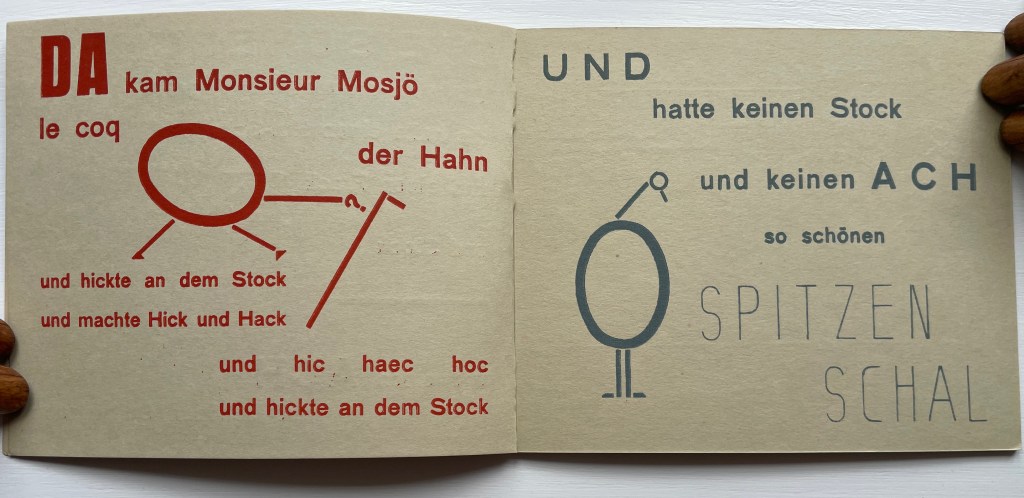
Then came Monsieur le Coq / The rooster, and he pecked / At the cane. He went hic hack / And hic haec hoc / He hicked and he pecked / At the cane // Now he had no cane / And no oh! Such a be-yoo-ti-ful / Scarf of lace
The playfulness becomes more elaborate. To reproduce the text’s “Pfui!”, the rooster’s head and beak form up — a red majuscule P and horizontal miniscule f — and issue the vowels u and i. Chicks run around with miniscule o’s for bodies and miniscule b’s or d’s or p’s for beaks. Lines and words jump out of alignment to enact the text and sounds.
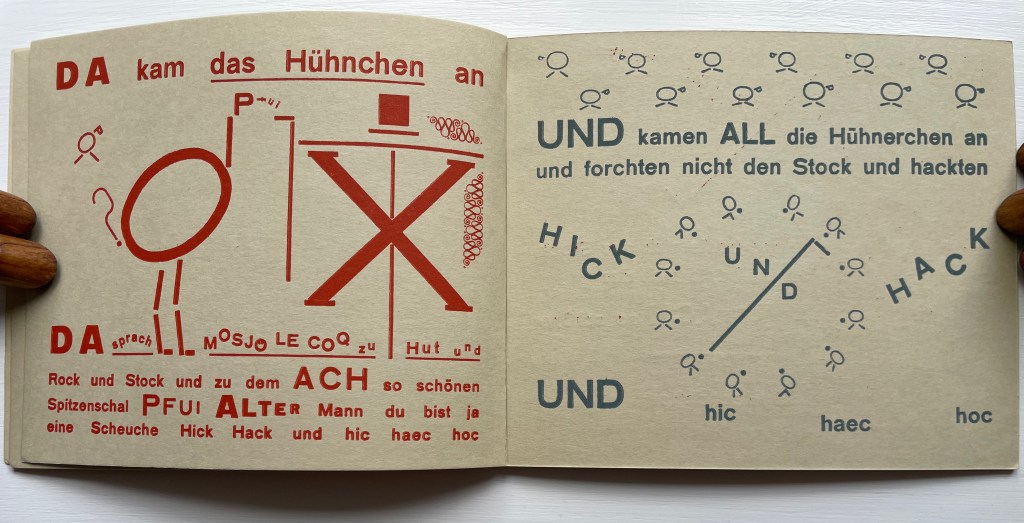
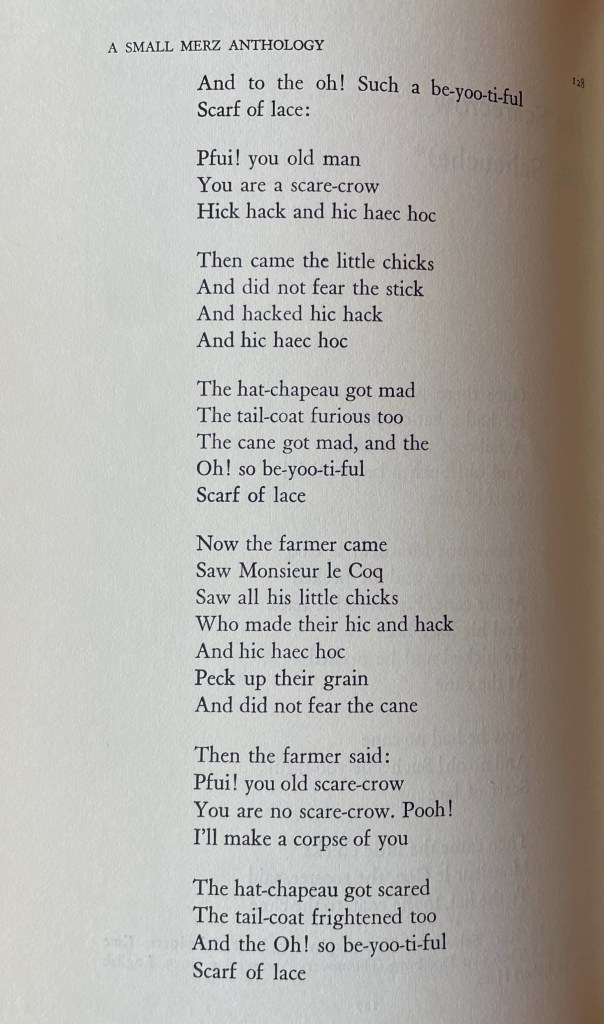
Then came the little chicks / Monsieur le Coq, the rooster, said / To the hat, to the coat, to the cane / And to the oh! Such a be-yoo-ti-ful / Scarf of lace: // Pfui! you old man / You are a scare crow / Hick hack and hic haec hoc / / Then came the little chicks / And did not fear the stick / And hacked hic hack / And hic haec hoc
As a German alphabet book of occupations might have it, “B is for Bauersmann [farmer]”, so of course, a majuscule B makes up his body and horizontal miniscule b’s make up his boots.
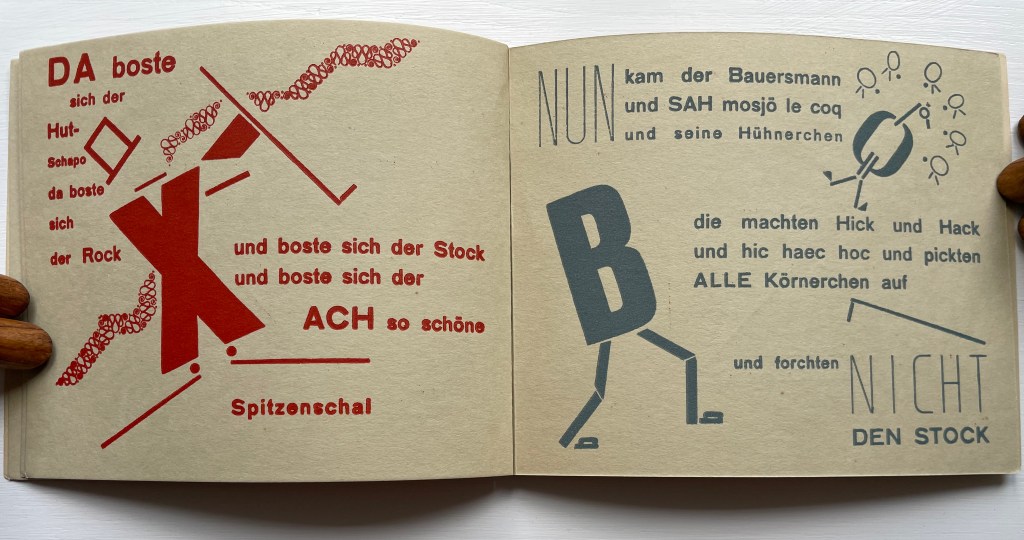
The hat-chapeau got mad / The tail-coat furious too / The cane got mad and the / Oh! so be-yoo-ti-ful / Scarf of lace // Now the farmer came / Saw Monsieur le Coq / Saw all his little chicks / Who made their hic and hack / And hic haec hoc / Peck up their grain / And did not fear the cane
The layout for the farmer’s scare-crow-frightening kick that tilts his body B, the lines of text, and the scare-crow itself recalls the way that El Lissitzky tilts his descriptive text and depicts his red and black squares crashing into earth and scattering everything.
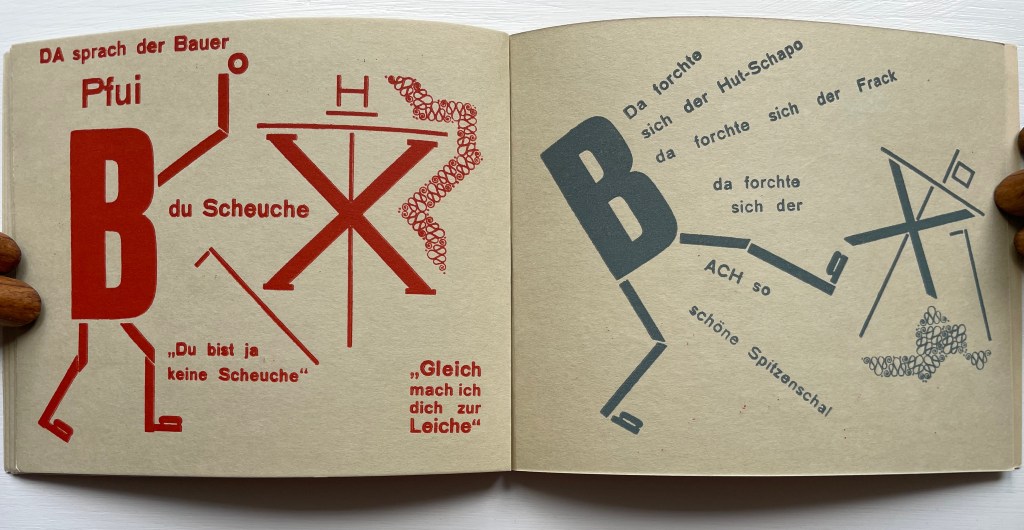
Then the farmer said: / Pfui! you old scare-crow / You are no scare-crow. Pooh! / I’ll make a corpse of you // The hat-chapeau got scared / The tail-coat frightened too / And the Oh! so be-yoo-ti-ful / Scarf of lace
A large block of typesetting furniture provides for the arrival of a fairy-tale “darkest night”.
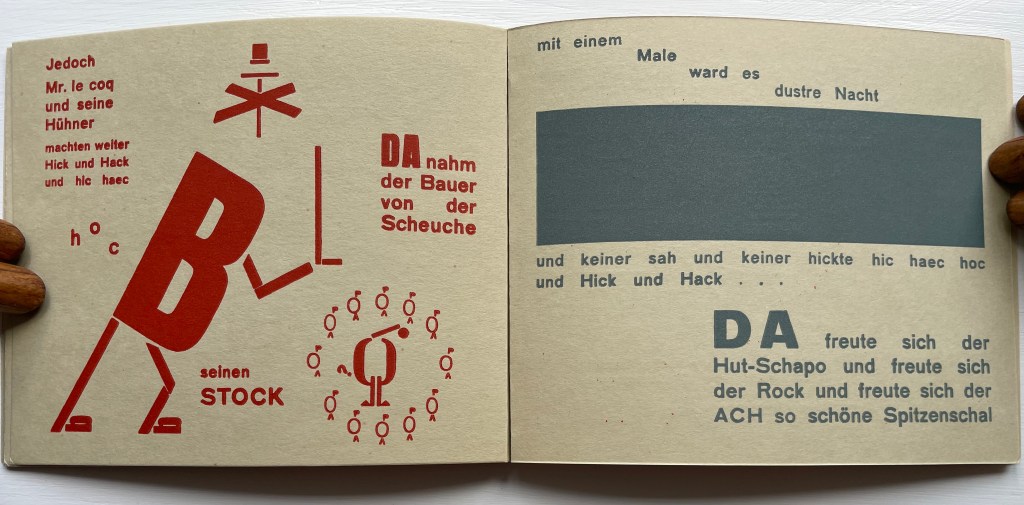
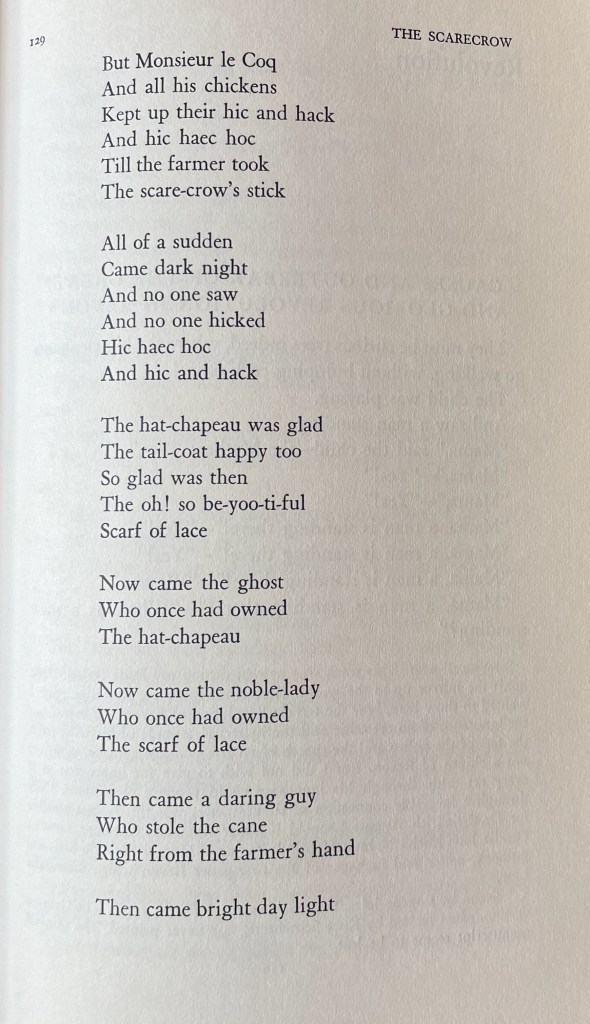
But Monsieur le Coq / And all his chickens / Kept up their hic and hack / And hic haec hoc / Till the farmer took / The scare-crow’s stick // All of a sudden / Came dark night / And no one saw / And no one hicked / Hic haec hoc / And hic and hack // The hat-chapeau was glad / The tail-coat happy too / So glad was then / the oh! so be-yoo-ti-ful / Scarf of lace
And then comes the deus ex machina of typographic ghosts and a bold, cheeky reduced-font boy, all crammed into one page, bringing the tale to its topsy-turvy “The End”, which is really morning, a new beginning.
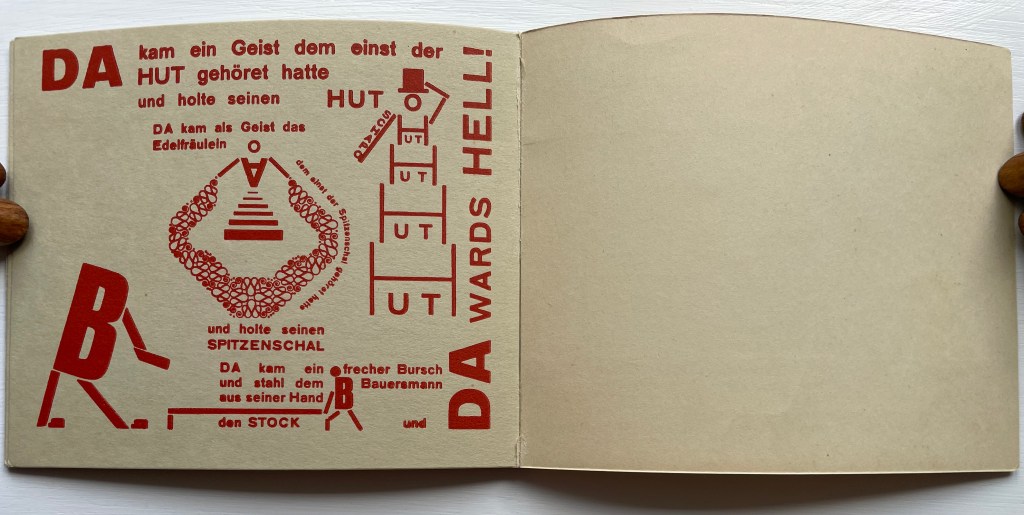
Now came the ghost / Who once had owned / The hat-chapeau // Now came the noble-lady / Who once had owned / The scarf of lace // Then came a daring guy / Who stole the cane / Right from the farmer’s hand // Then came bright day light. — Translation © Robert Haas
Nicholas Paley, cited at the start, illuminates The Scarecrow well while comparing it to El Lissitzky’s About 2 Squares. So does Sandra Beckett and, at greater length, she parses the typography, the layout, the sounds, and images of Die Scheuche. She places it as a major forerunner to the most innovative children’s picturebooks and artists’ books to come. The strong link between children’s books and artists’ books can also be found in several of the online vitrines in Alphabets Alive!, in particular Alphabeasties by Sharon Werner & Sharon Forss, Bembo’s Zoo by Robert de Cumptich de Vicq and Alphaboat by Michael Chesworth.
Further Reading
“Abecedaries I (in progress). Books On Books Collection.
“Michael Chesworth“. 22 December 2022. Books On Books Collection.
“Robert de Cumptich de Vicq“. 12 February 2021. Books On Books Collection.
“Sharon Werner & Sharon Forss“. 20 December 2022. Books On Books Collection.
Beckett, Sandra L. 2013. Crossover Picturebooks : A Genre for All Ages. London: Routledge. See pp. 25-29.
Bergius, Hanne. 2003. Dada Triumphs! : Dada Berlin, 1917-1923 : Artistry of Polarities : Montages, Metamechanics, Manifestations. Farmington Hills, MI; New Haven, CT: G.K. Hall ; Gale.
Bloch, Susan. 1973. “Introduction”. Bloch, Littman, Robert, and Arthur Cohen (eds.). The Book Stripped Bare : A Survey of Books by 20th Century Artists and Writers. an Exhibition of Books from the Arthur Cohen and Elaine Lustig Cohen Collection, Supplemented by the Howard L. and Muriel Weingrow Fine Arts Library of Hofstra University. N.Y: Emily Lowe Gallery. Included Die Scheuche in important juxtaposition with Mallarmé, Delaunay, Matisse, Kandinsky, Mirò and others.
Elderfield, John. November 1971. “The Early Work of Kurt Schwitters“. Art Forum.
Lissitzky, El, and Patricia Railing. 1991. About 2 Squares, 1st MIT Press ed. Cambridge, Mass: MIT Press.
Paley, Nicholas. 1991. “Experiments in Picture Book Design: Modern Artists Who Made Books for Children 1900-1985“. Children’s Literature Association Quarterly. Vol. 16, No. 4, pp. 264-69.
Schwitters-Steinitz Collection. Ed. 3. 2007. Washington D.C.: National Gallery of Art Library. Item 123. Widlund, Agnes, Stockholm / Letter, undated (1965?), 13 p., holograph, signed; postcard, Jan. 9, 1965; letter, Aug. 13, 1965, typescript, with holograph notes, signed. She was gallery owner? Friend of Schwitters. Published a miniatures ed. of Die Scheuche. Item 134. 6 copies of miniature reprint of Die Scheuche (Stockholm : Gallery Samlaaren, 1965), some inscribed by Steinitz and one with a holograph English translation by Steinitz of p. [1]-[4] and notes on the publication by Ilse Berg. [1] typescript carbon copy leaf with complete English translation. 1 envelope of tearsheets from this edition of Die Scheuche.
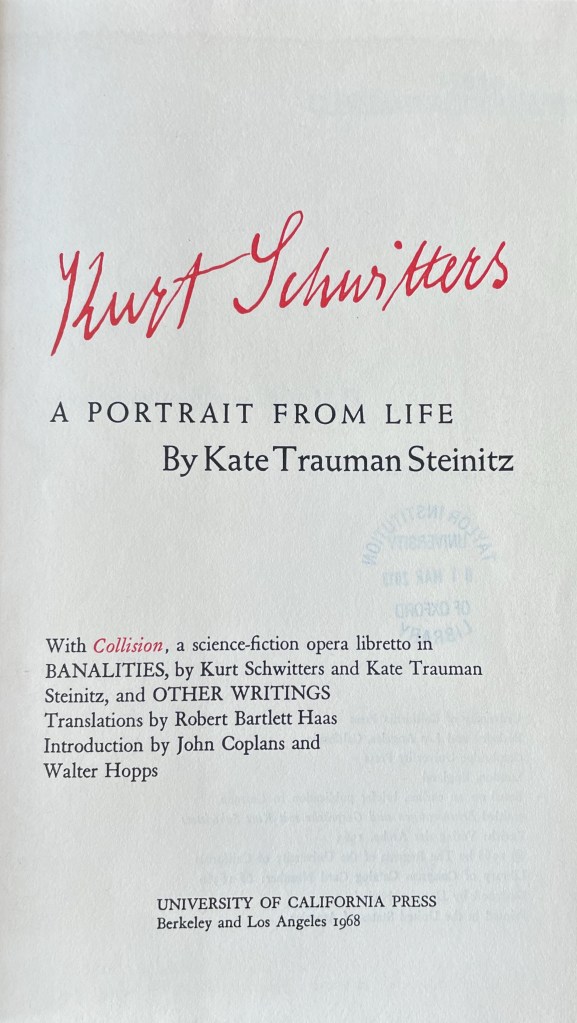
Steinitz, Kate Traumann; Kurt Schwitters; and Robert B. Haas (translator). 1968. Kurt Schwitters: A Portrait from Life. with Collision, a Science-Fiction Opera Libretto in Banalities. Berkeley: University of California Press.

 Books On Books
Wonderful post, Robert. Thanks.
Phil
>
LikeLike