This is a “back-dated update” of sorts to Alphabets Alive!, Ashley Rose Thayer, and Andrew White Tuer.
First, the back-dating. This comes from the delightfully annoying or annoyingly delightful belated discovery of Erik Kwakkel’s 2015 entry on the history of the horn-book “Book on a Stick” in Medievalbooks. Delightful and annoying to find the truly earliest appearance of a horn-book right under my nose in the Bodleian Libraries but too late to include it in the Alphabets Alive! exhibition at the Bodleian in 2023.
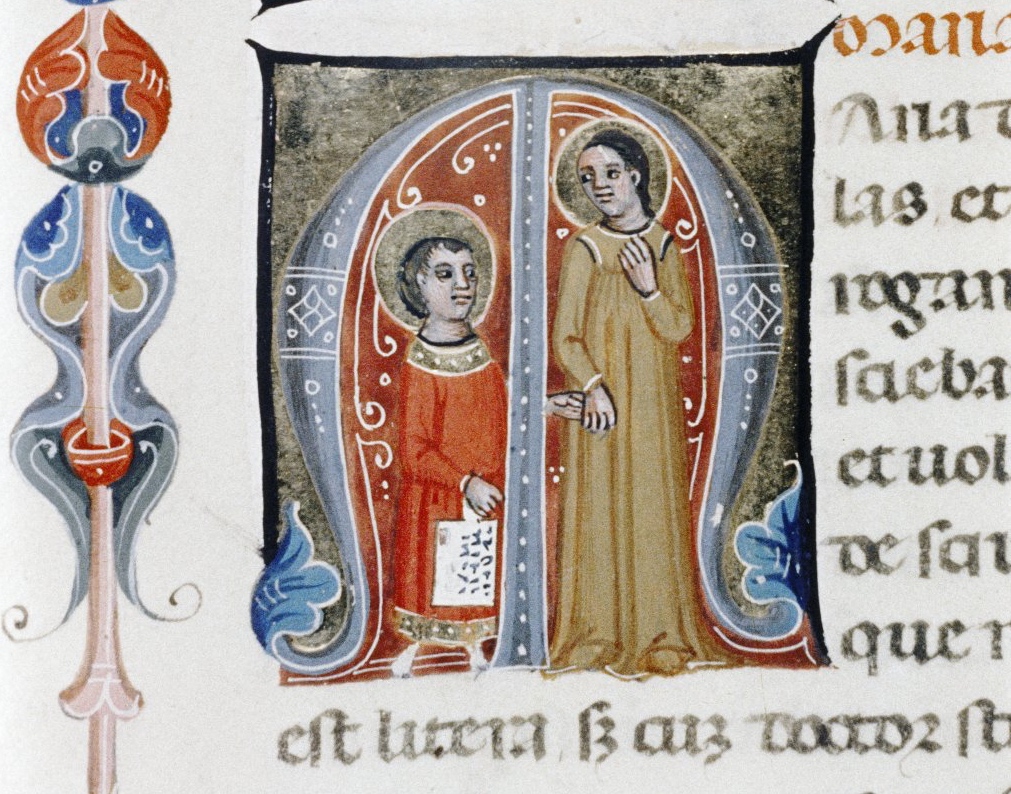
Vita gloriossime virginis Mariae atque venerabilis matris filii dei vivi veri et unici (unidentified work).Italian manuscript, Venice.
Oxford, Bodleian Library, Canon. Misc. 476 (14th century). Folio 047v.

Andrew White Tuer’s History of the Horn-Book (1897) came close with its dating of the horn-book’s first appearance as 1450, but as Kwakkel writes:
The image shows Christ being brought to school by his mother. He is bringing his “textbook” to class: a hornbook, which dangles from his wrist by a string, just like many of the later specimens did … Quite intriguingly, we are shown a real medieval snapshot of how children carried their hornbook to and at school. More importantly, it shows that the hornbook was indeed a medieval invention….While no actual hornbooks appear to survive from the medieval period, these visual representations show that educating young children was also the driving force behind the production of hornbooks in the age before print.
And for the updating, here is Ashley Thayer’s Mechanical Horn-book (2025) just arrived in the Books On Books Collection.
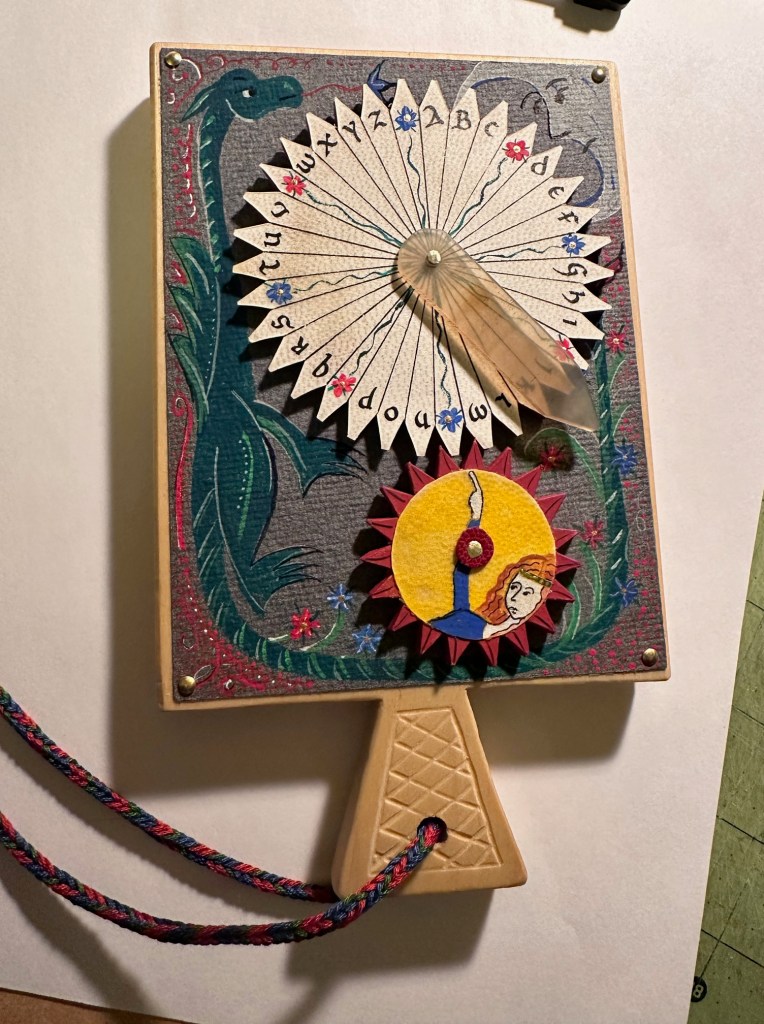
Mechanical Horn-book (2025)
Ashley Rose Thayer
Horn-book. On stand: H192 x W160 mm. Off stand: H192 x W115 mm. Unique. Acquired from the artist, 17 October 2025.
Photos: Courtesy of the artist. Books On Books Collection.
The paddle is made of pine wood, the gears of vellum-covered bookboard, the spinning “arm” of authentic cow horn, and the wrist loop of embroidery thread by a medieval finger loop braiding technique. On dark grey-blue Khadi paper, Thayer has painted a border of the moon, a berried floral garland, and a wyvern, the heraldic emblem associated with Wessex, the Anglo-Saxon kingdom from which Alfred the Great emerged in the 9th century. On the reverse, a cross of cut red leather with five inserts of calligraphed vellum alluding to Christ’s five wounds reflects the horn-book tradition of combining religion with learning the alphabet. It also makes this horn-book reflective of Alfred’s Anglo-Saxon and Christian background.
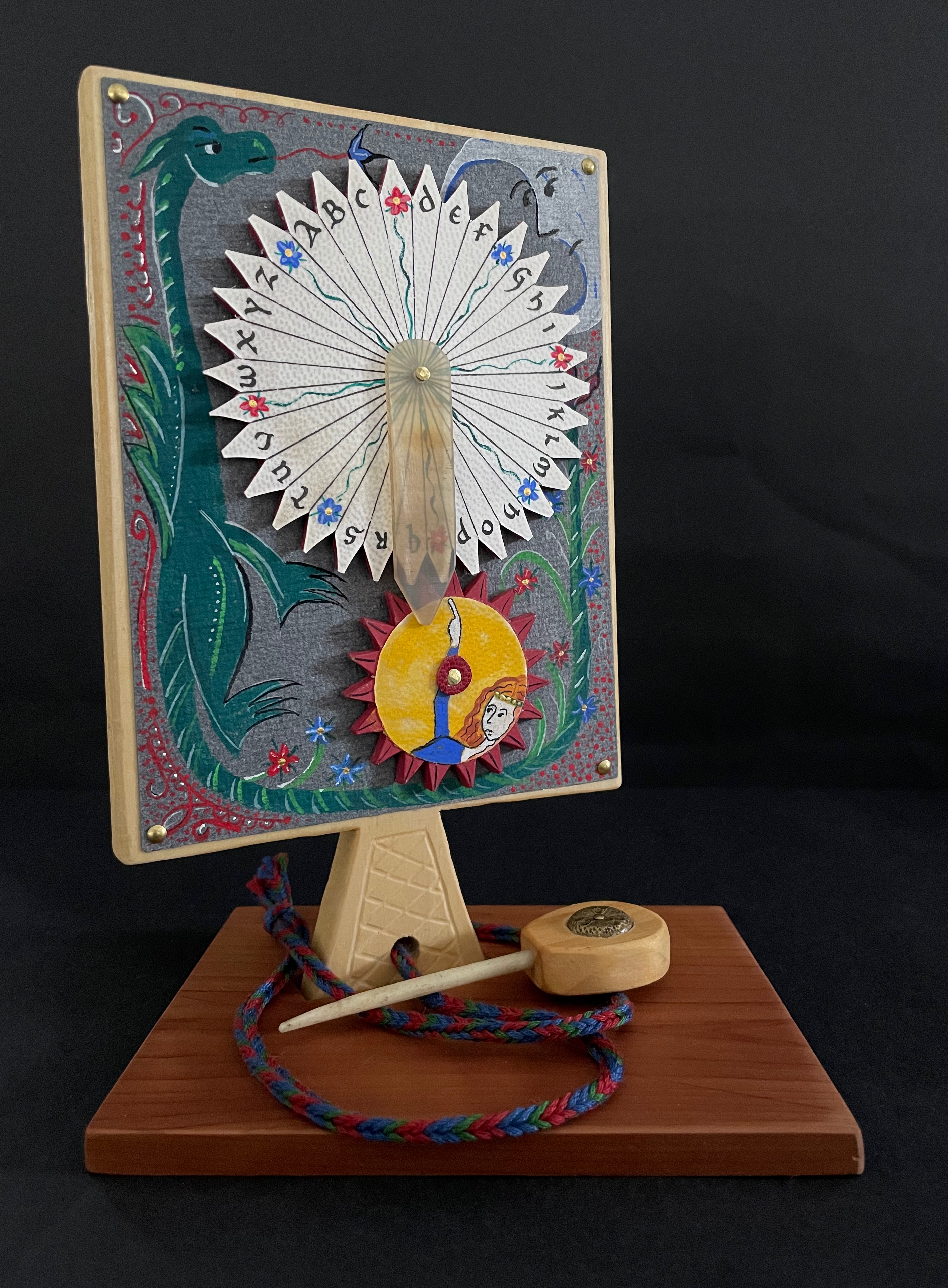
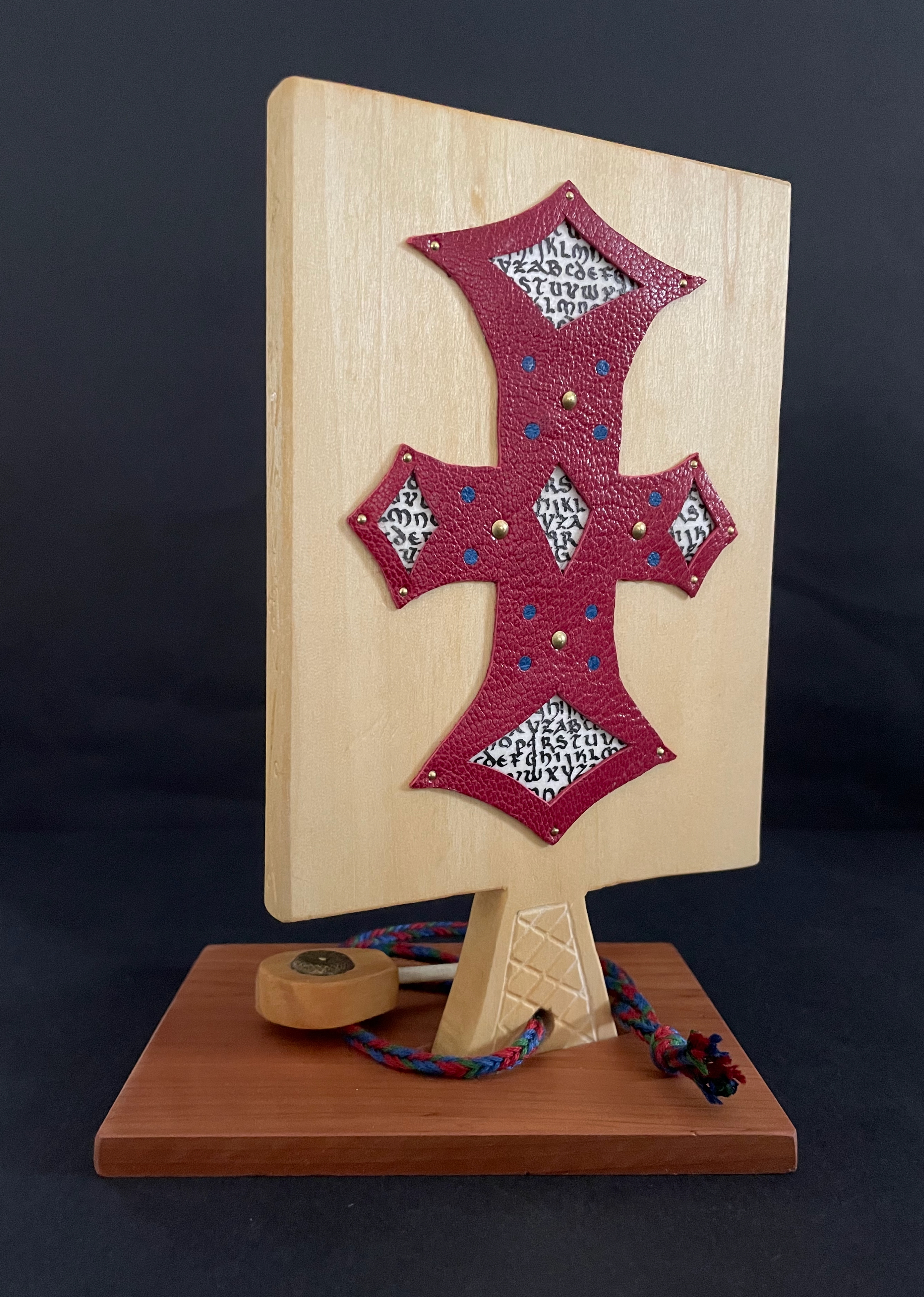
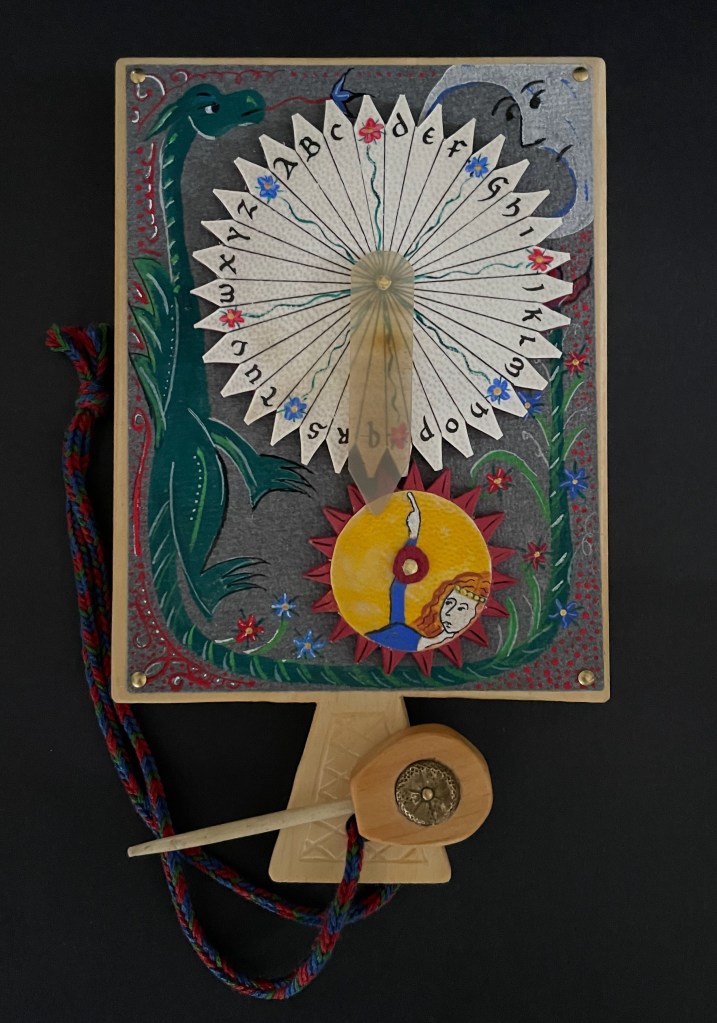
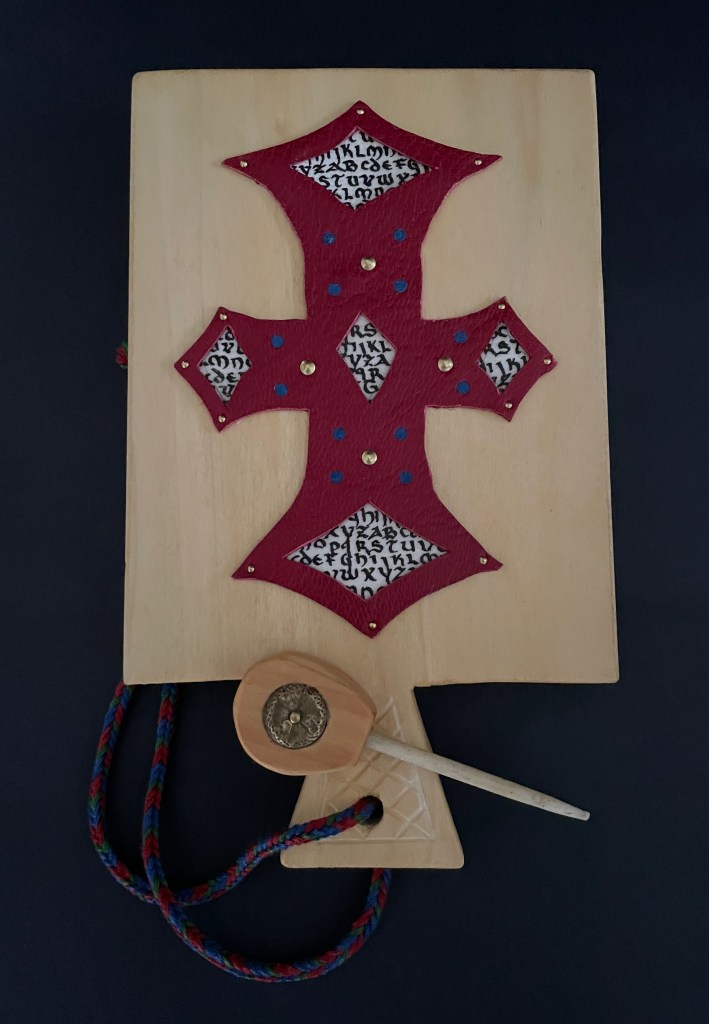
The pointer, called an aestel in Old English, is made from poplar wood, an antique button, and antique bone. Its inclusion isn’t simply functional. Appearing alongside the Wessex wyvern, it points to that famous aestel on display at the Ashmolean in Oxford: the Alfred Jewel.
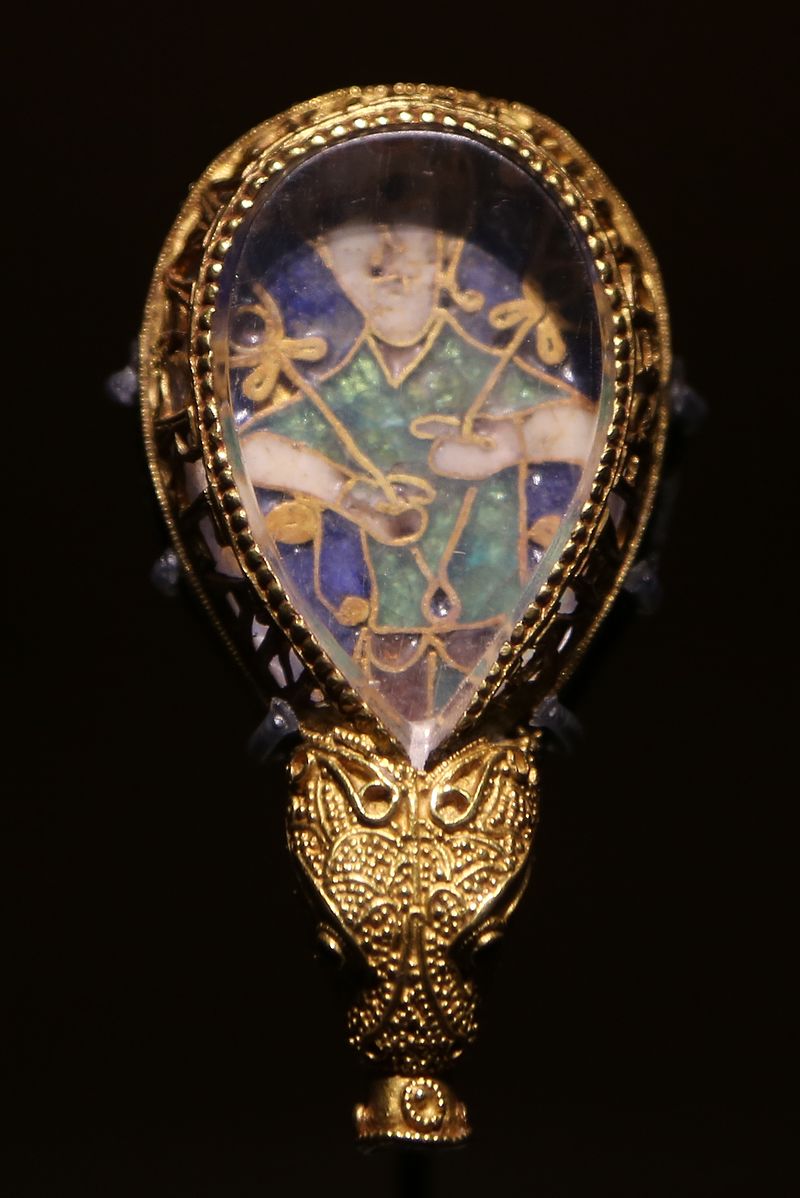
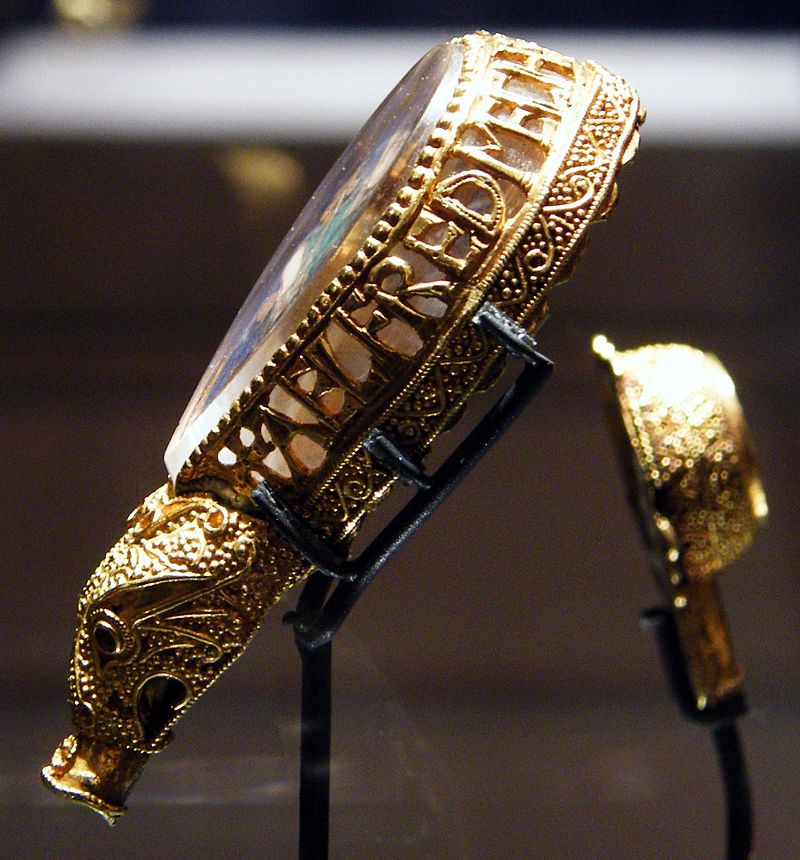
The Alfred Jewel, Ashmolean Museum, Oxford.
Photo taken from the front by Geni CC BY-SA 4.0. Photo taken from the side by Richard M Buck CC BY SA 3.0.
If there’s ever an Alphabets Alive! redivivus, Erik Kwakkel and Ashley Thayer have provided the pointers to the other treasures in Oxford that should be included.
Further Reading
“Alphabets Alive! – Criss-cross Row (Horn-books)“. 19 July 2023. Books On Books Collection.
“Ashley Rose Thayer “. 9 July 2023. Books On Books Collection.
“Movables Now and Then“. 31 August 2024. Bookmarking Book Art.
“Kevin M. Steele“. 18 July 2023. Books On Books Collection.
“Andrew White Tuer“. 26 December 2022. Books On Books Collection.
Kwakkel, Erik. 10 April 2015. “Book on a Stick“. Medievalbooks. Leiden. Accessed 10 November 2025.
 Books On Books