a METRICA n’aboolira (1968) JCT 1
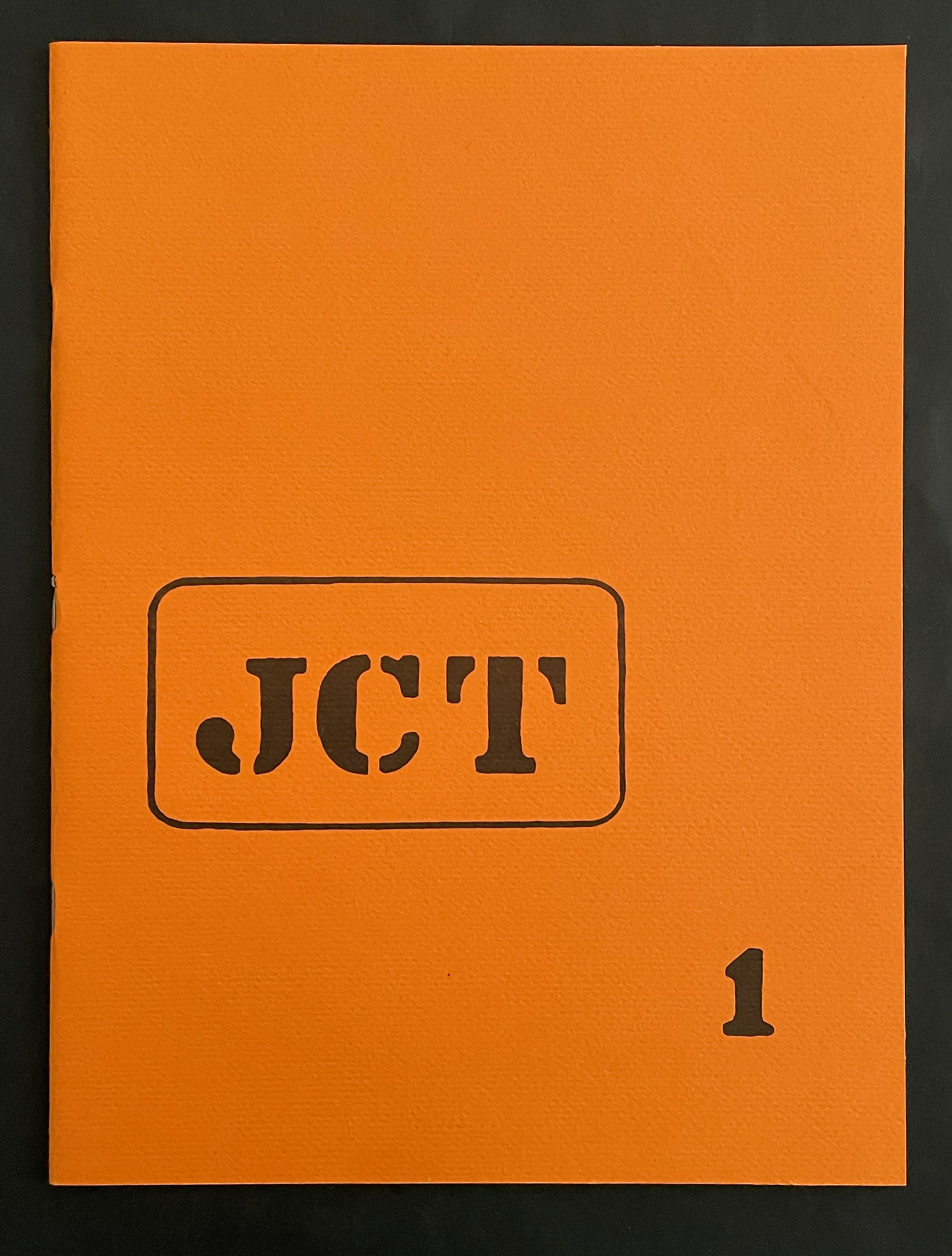
a METRICA n’aboolira JCT 1 (1968)
Mario Diacono
Booklet, saddle-stitched, staples. H259 x W190 mm. [32] pages. Edition of 199, of which this is #172. Acquired from Ars Libri Ltd, 18 February 2026.
Photos: Arengario and Books On Books Collection. Displayed with permission of the artist.
From Ars Libri Ltd. description:
Mario Diacono relates that the manuscript of a METRICA n’aboolira was made in 1968 as a unique work, with no plans for its future publication. His idea to issue it as a limited edition artist’s book (and equally, as the first number of his review “JCT”) arose in the late summer of 1969, following a stay in New York, where he was in contact with Vito Acconci, Joseph Kosuth, and members of Art & Language. On his return to California in September, Diacono delivered the manuscript to the San Francisco printer, Futura Press, including with it a colophon which was dated November 1969, based on the expectation that the edition would take two months to complete.
With the colophon offering 1968 or 1969, the title page picks 1968 and presents that as the date of publication. The date only matters in determining who came first with the idea of replacing Mallarmé’s text with solid blocks: Diacono or Marcel Broodthaers, whose three versions of Un Coup de Dés Jamais N’Abolira le Hasard: Image (on translucent paper, solid paper, and anodized aluminum) were published by Wide White Space in 1969.
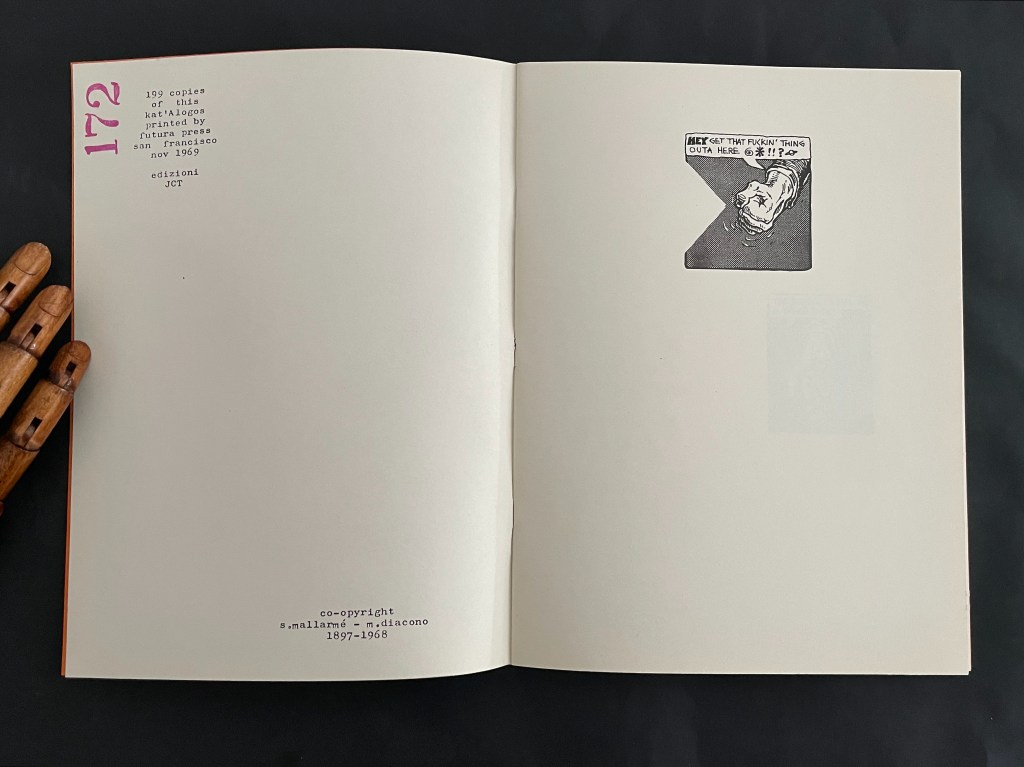
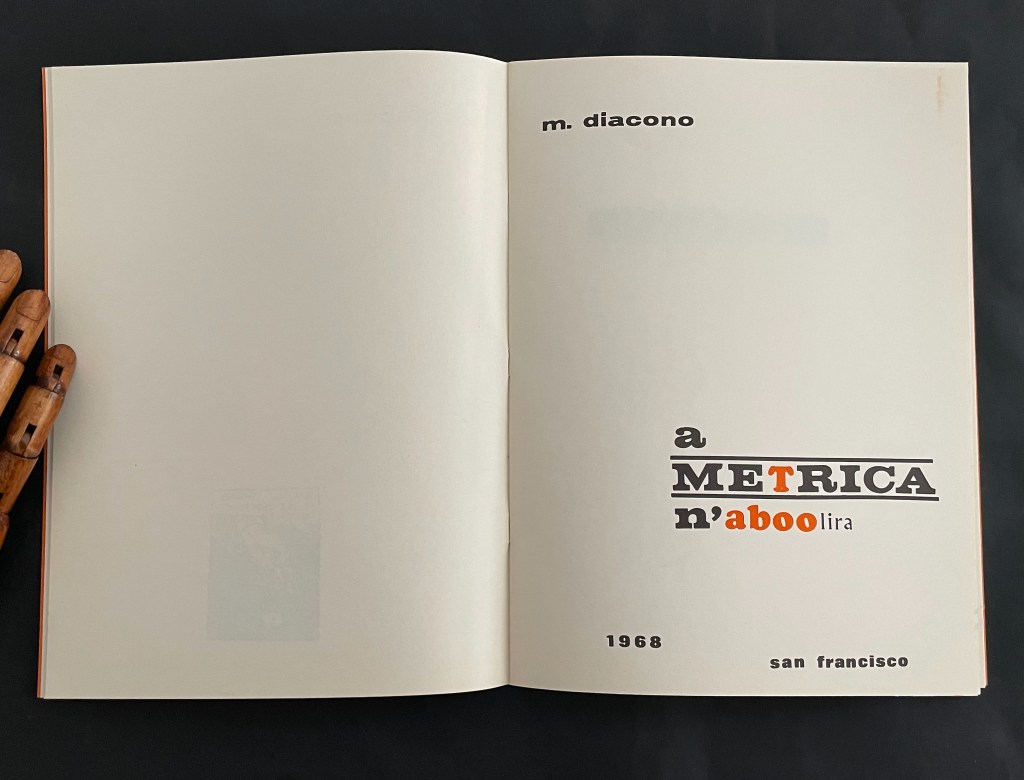
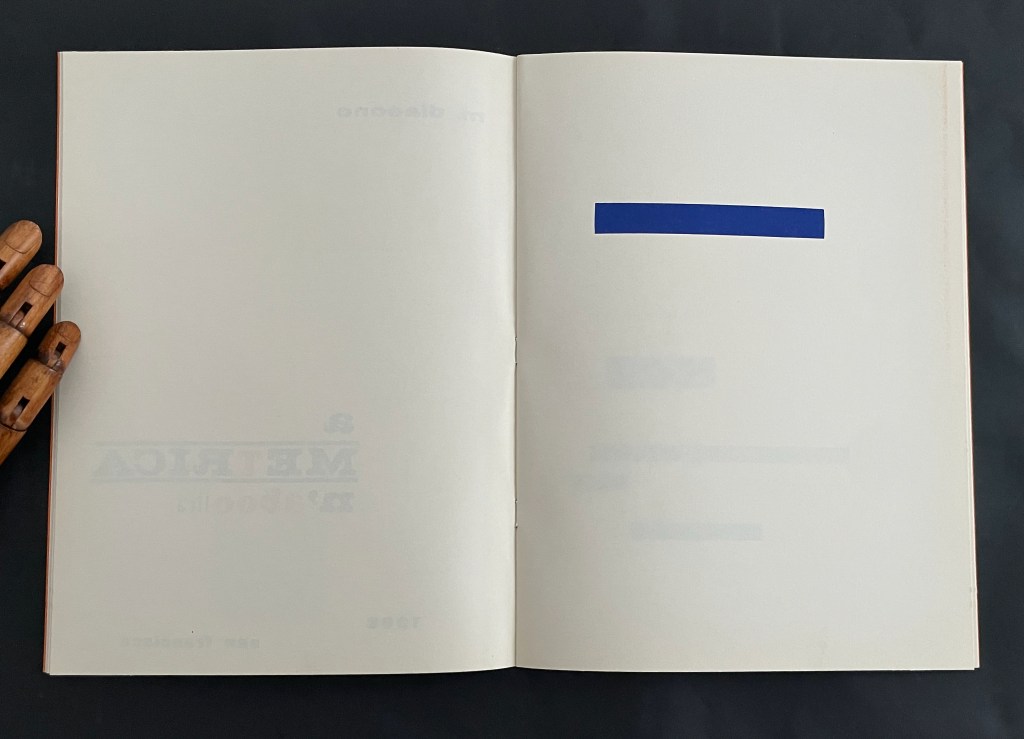
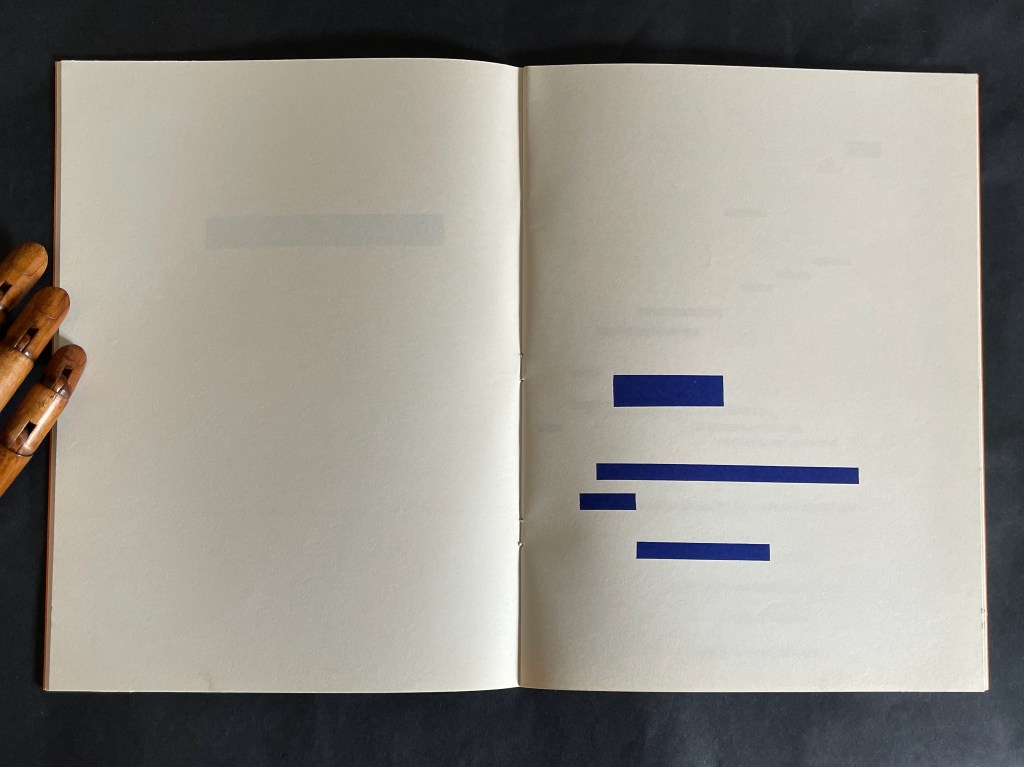
Besides being first out of the gate with an “homage by redaction” of Un Coup de Dés, Mario Diacono is perhaps the first hommageur to give a sociopolitical cast to the effort. In an interview in Ursula, Diacono comments
1968 was a year in which many things were abolished, or felt tempted to be abolished. Language was one of them, at least the traditional language of poetry, but also the language of ‘bourgeois/capitalist’ society. Berkeley is also present in the book through the reproduction of three frames from a cartoon in a local magazine, which functions as a kind of preface. The title alternates not only colors, black and orange, but also uppercase and lowercase letters. The wordplay in essence says: the absence of metrics, of language, will not abolish poetry. Neither will the American taboos.(Nickas, 2019).
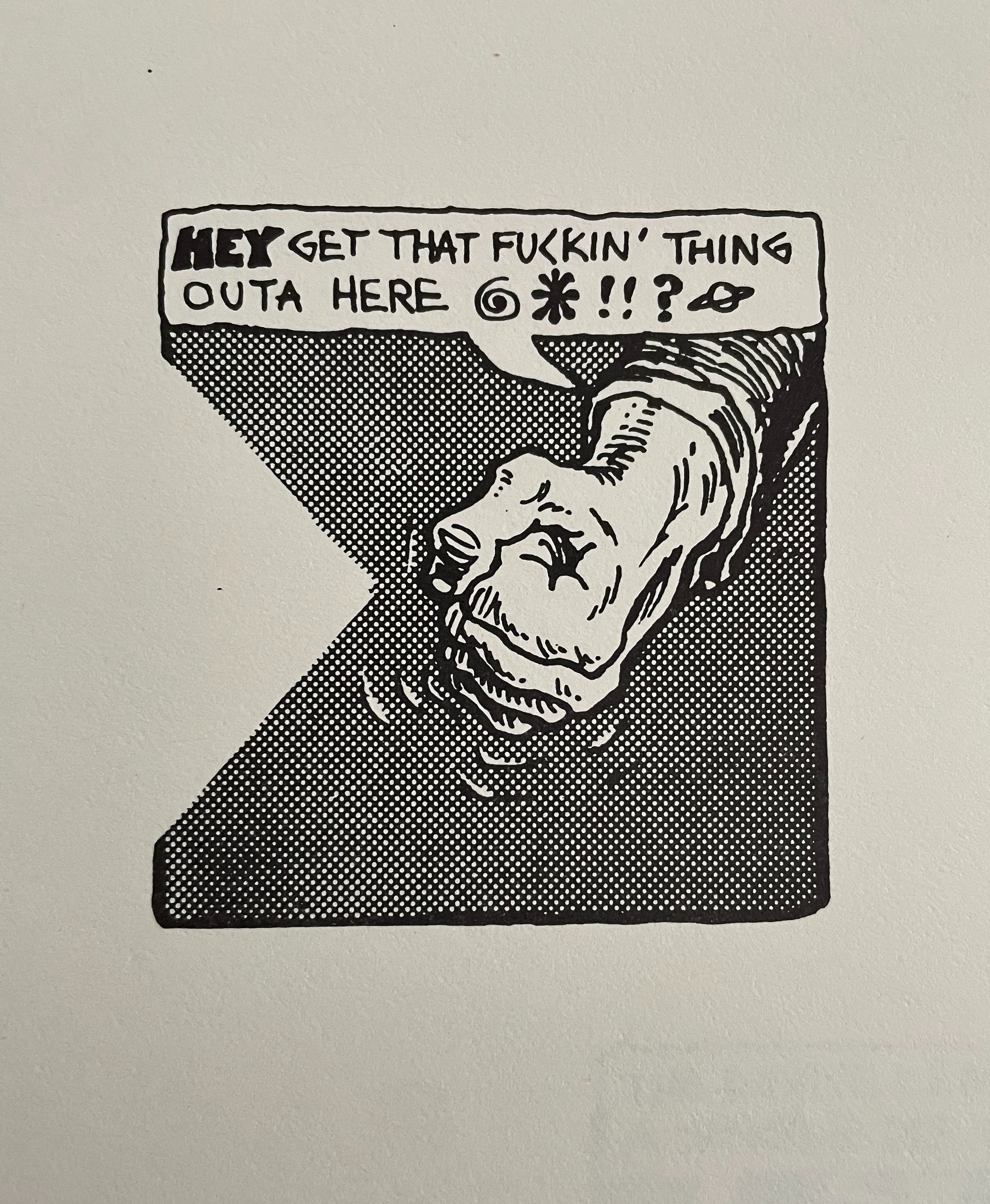
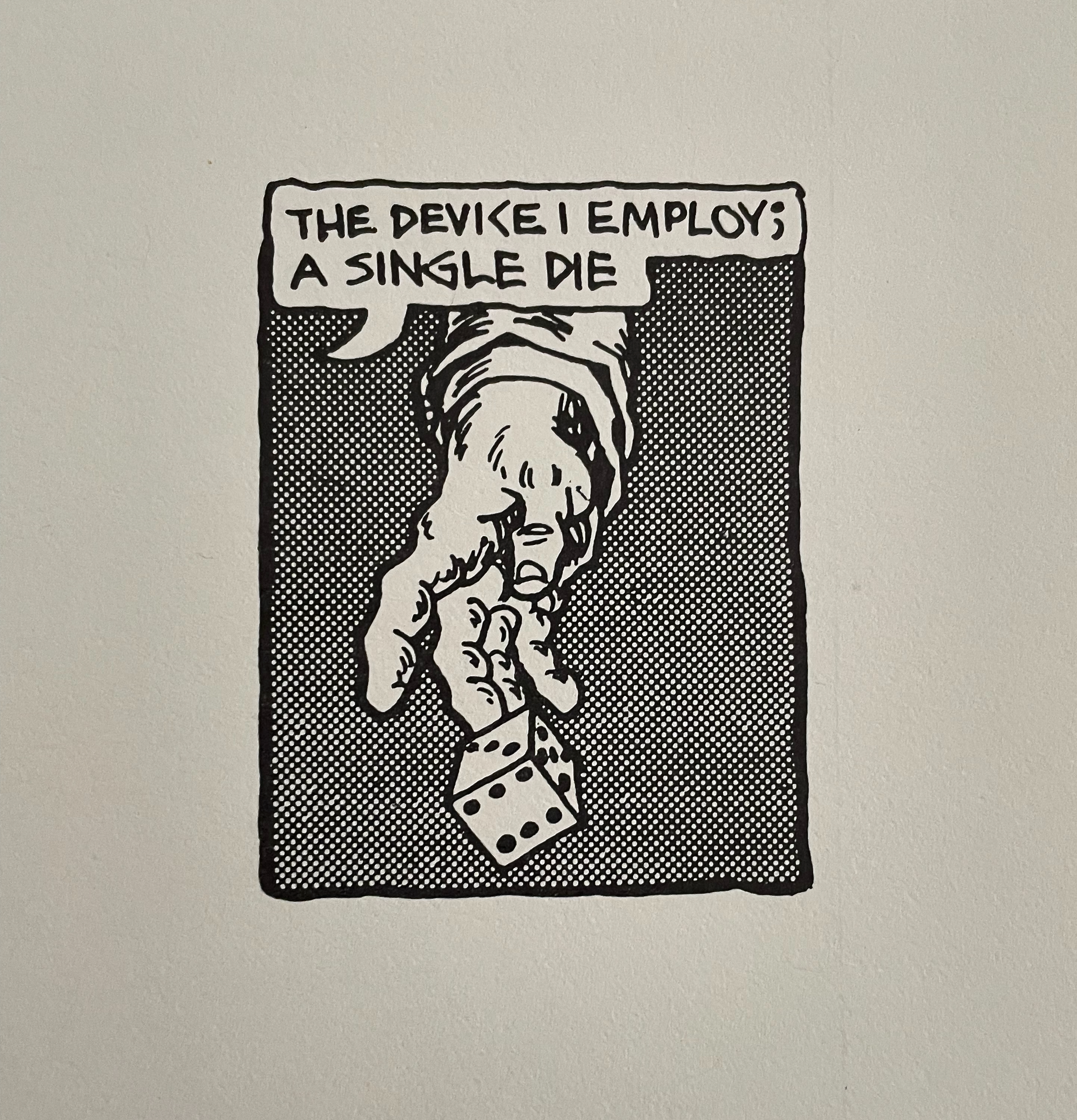
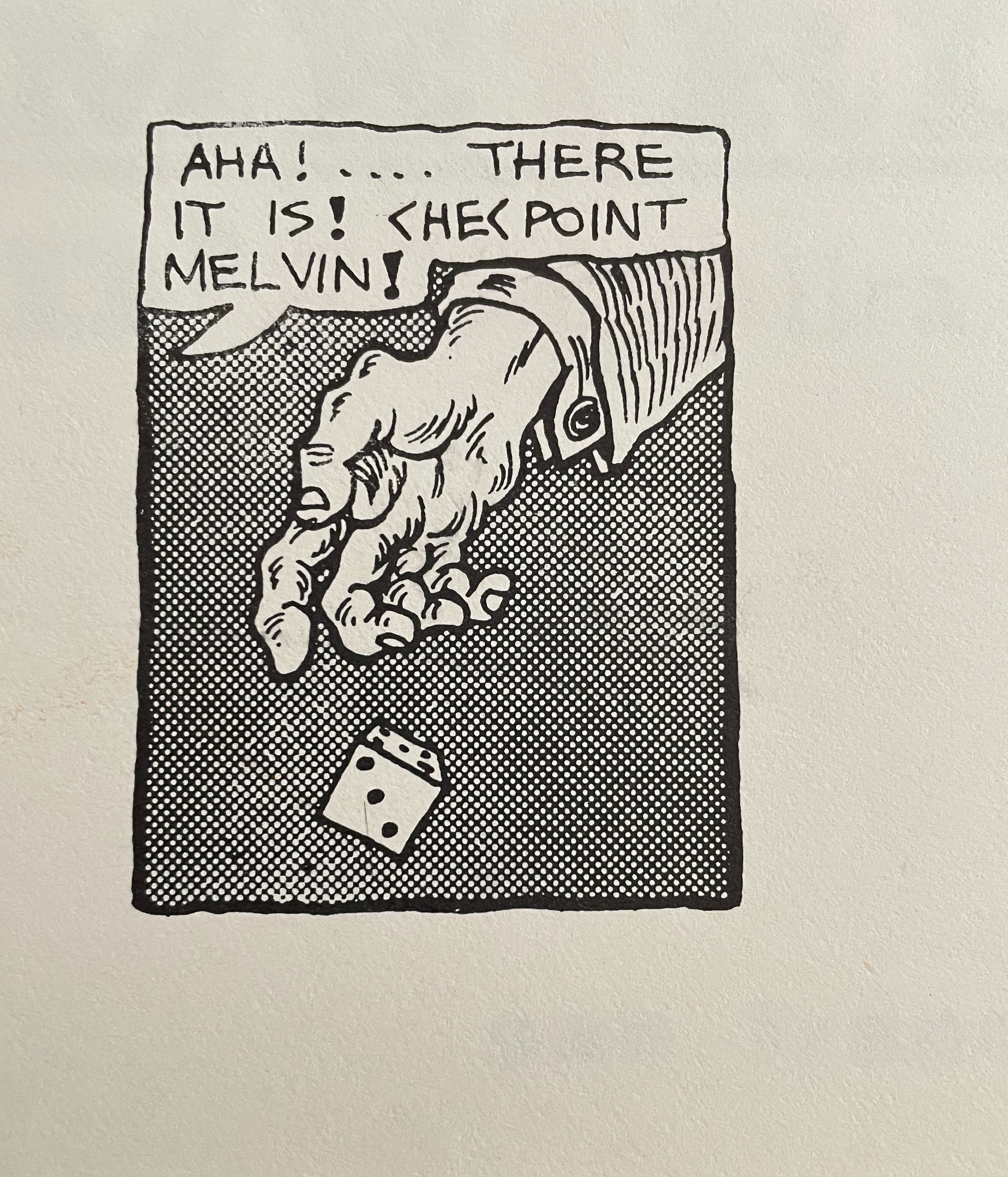
Those comments align with the element of “pop” art and the underground comic in this homage.
Later in the 1970s, Danièle Huillet and Jean-Marie Straub would pick up the thread of social critique by staging and filming a choral reading of the poem on the lawn of the Père Lachaise cemetery,
where there are the great memorials of the concentration camps: Ravensbrück, Auschwitz… it is in the corner of the cemetery where you can guess something about the city. Under this hill are buried the last members of the Paris Commune, who were shot in that same place. – Jean-Marie Straub
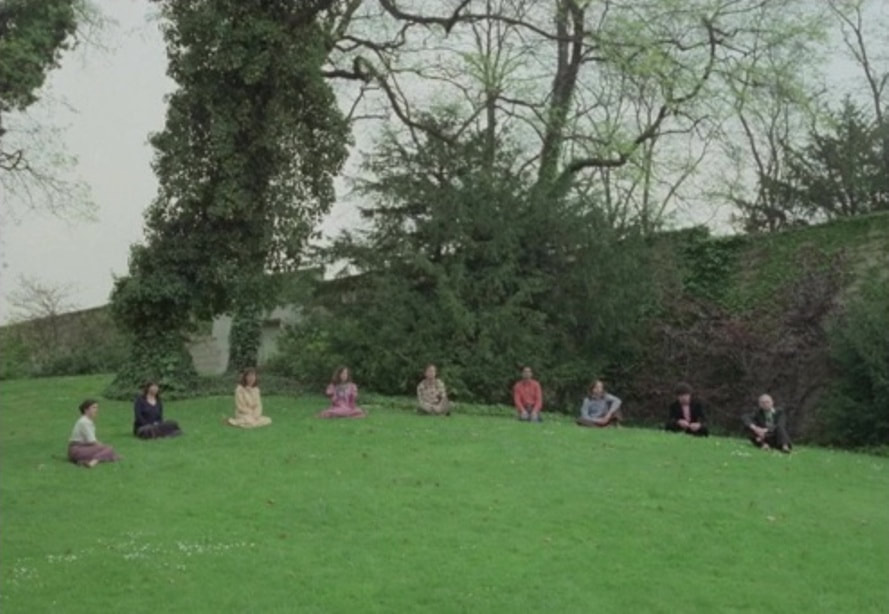
© BELVA Film. Image and permission to display, courtesy of Jean-Marie Straub et Danièlle Huillet: des films et leurs sites.
And then just after the turn of the next century, Didier Mutel extended the critique with his three-volume Four Speeches by George Walker Bush [together with] Four Speeches by Tony Blair [together with] Un Coup de Dés Jamais N’Abolira Le Hasard.
These three connected volumes explore graphic transpositioning from oral speeches to a visual representation. Though a new way to read/experience the speeches–to visualize their patterns–you can [still] not tell the truth from fiction. You can not tell what you are reading. “In the 3-part, 4 Speeches/Coup de Des, the images of audio waves are the same—but one purports to be a group of speeches by Bush 43 ; another, a group by Tony Blair; and the last—the real thing—is an unidentified man reading Mallarme’s “Un Coup de Dés Jamais N’Abolira Le Hasard”, that modern masterwork that launched a thousand artists’ books. The concept is trenchantly funny; the books are beautifully executed. [from the preface to Didier’s Manifesto by Tim Young]


© Didier Mutel. Photos: Books On Books, taken at the KB|nationale bibliotheek van Nederland, The Hague. Displayed with permission of Didier Mutel.
Like Huillet, Straub and Mutel, Diacono is trying to balance his socio-political drive with the visual and historical homage to Un Coup de Dés. Huillet/Straub’s performative vocalization delivers its message only through the visual of its location. Mutel delivers his message by muting the poem with its sonographic visualization and sleight-of-hand substitution for political speeches. a METRICA n’aboolira delivers its message by balancing the textual and the visual, reminding us that Mallarmé wanted Un Coup de Dés to be looked at as well as read.
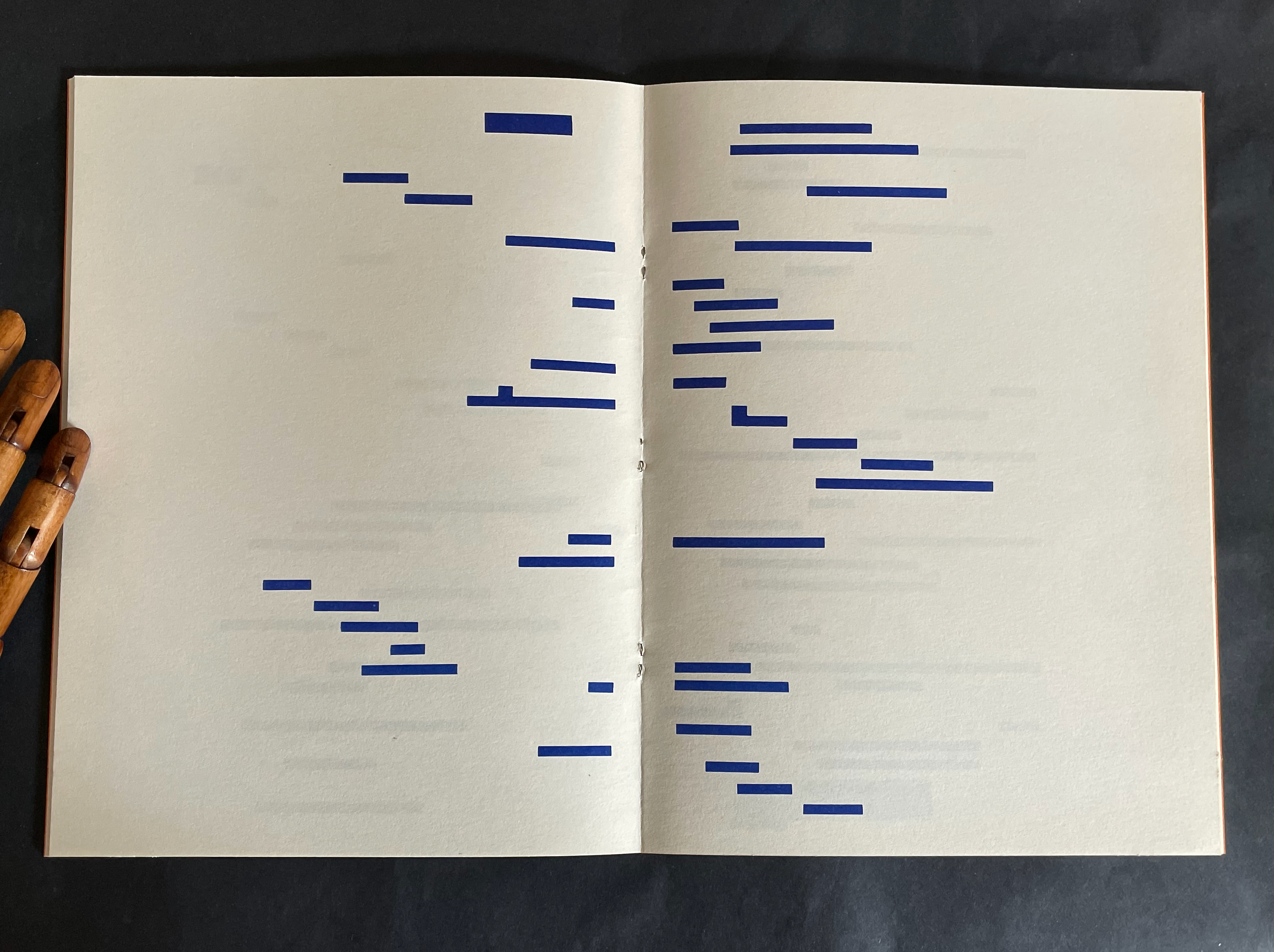
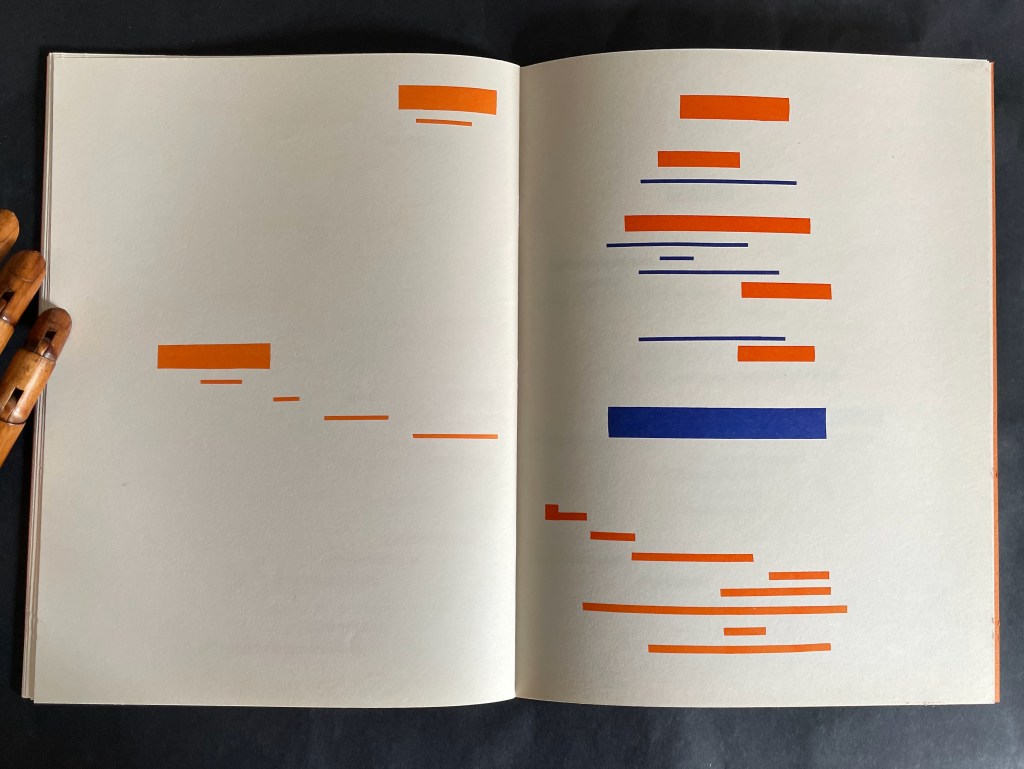
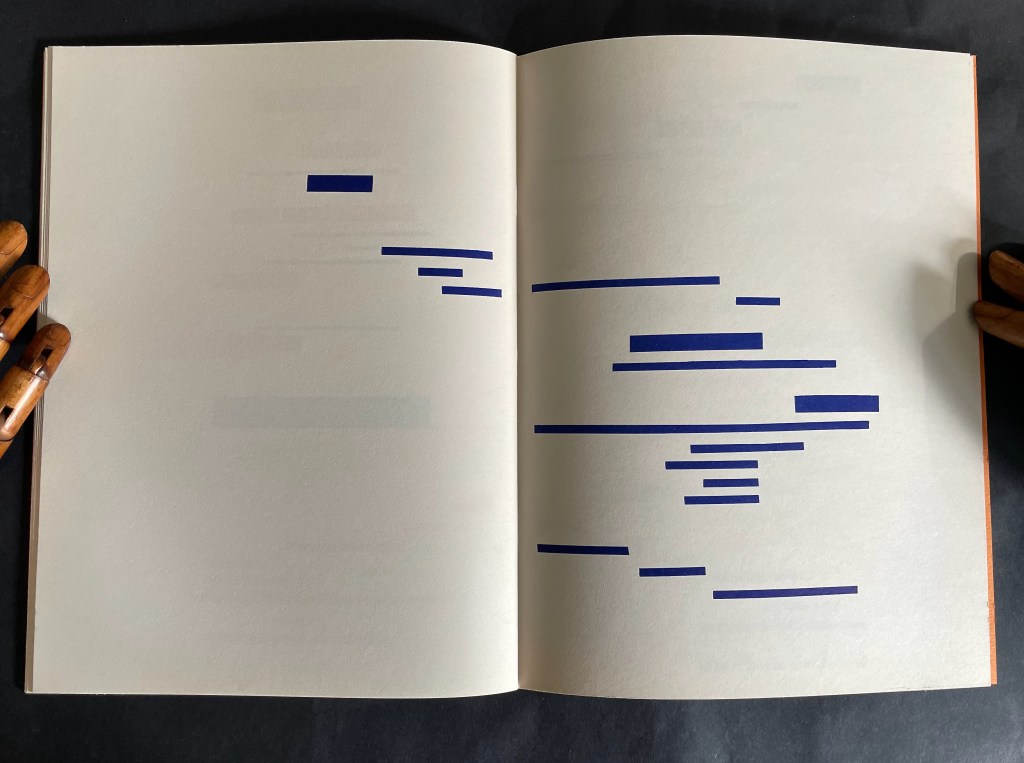
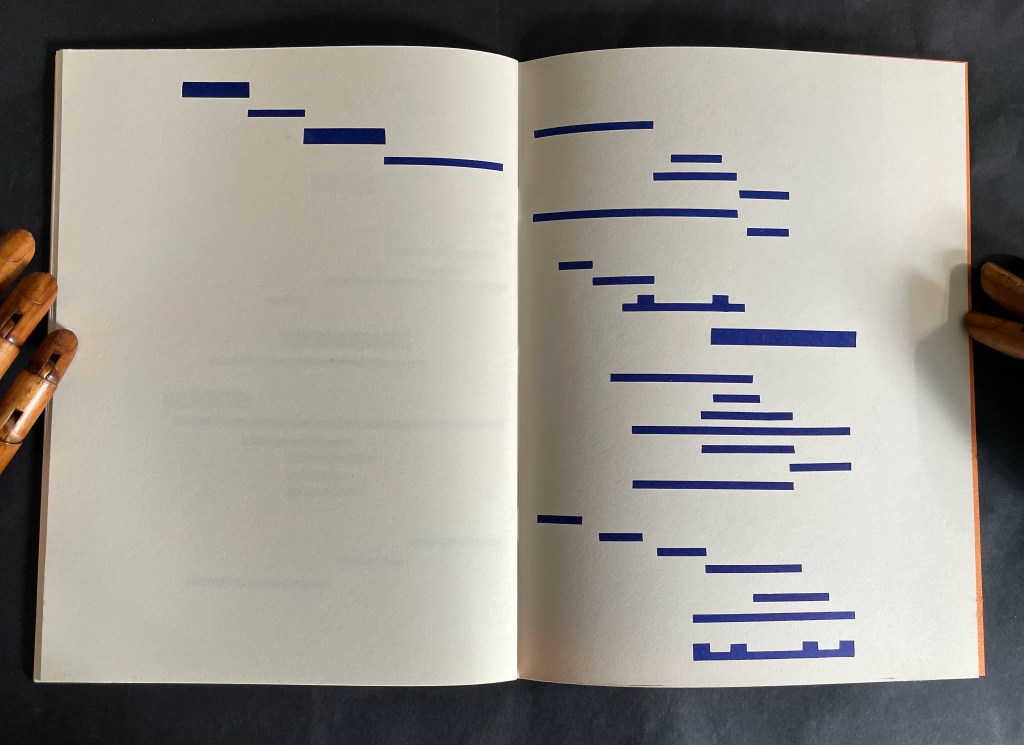
The entire work has been digitized here.
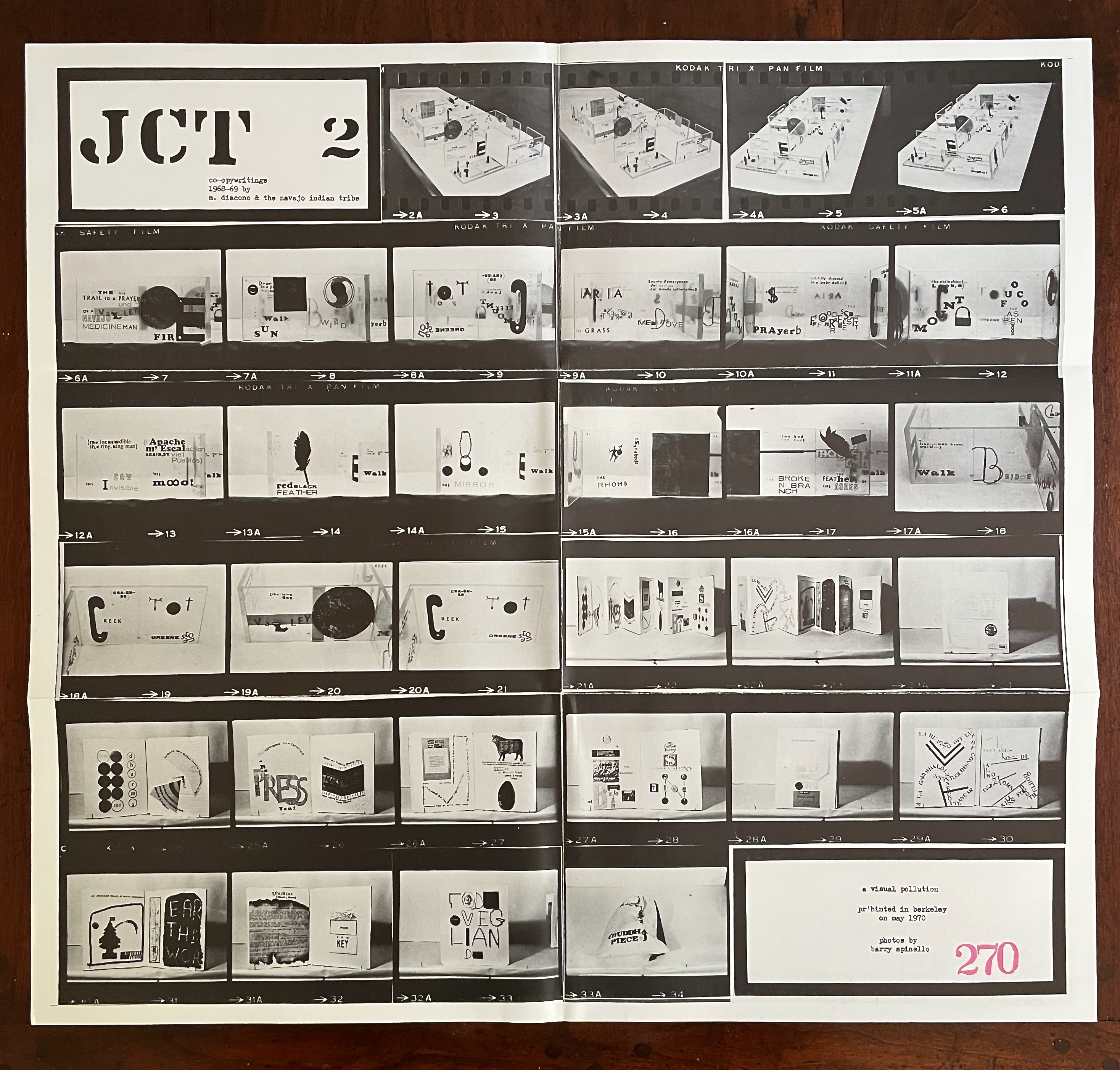
a visual pollution (1970) JCT 2
a visual pollution (1970) JCT 2
Mario Diacono & the Navajo Indian Tribe with photos by Barry Spinello
Broadside, illustrated with 32 photographs in six strips. H157 x W254 mm (closed), H472 x W503 mm (open). #270. Acquired from Ars Libri Ltd, 18 February 2026.
Photos: Books On Books Collection.
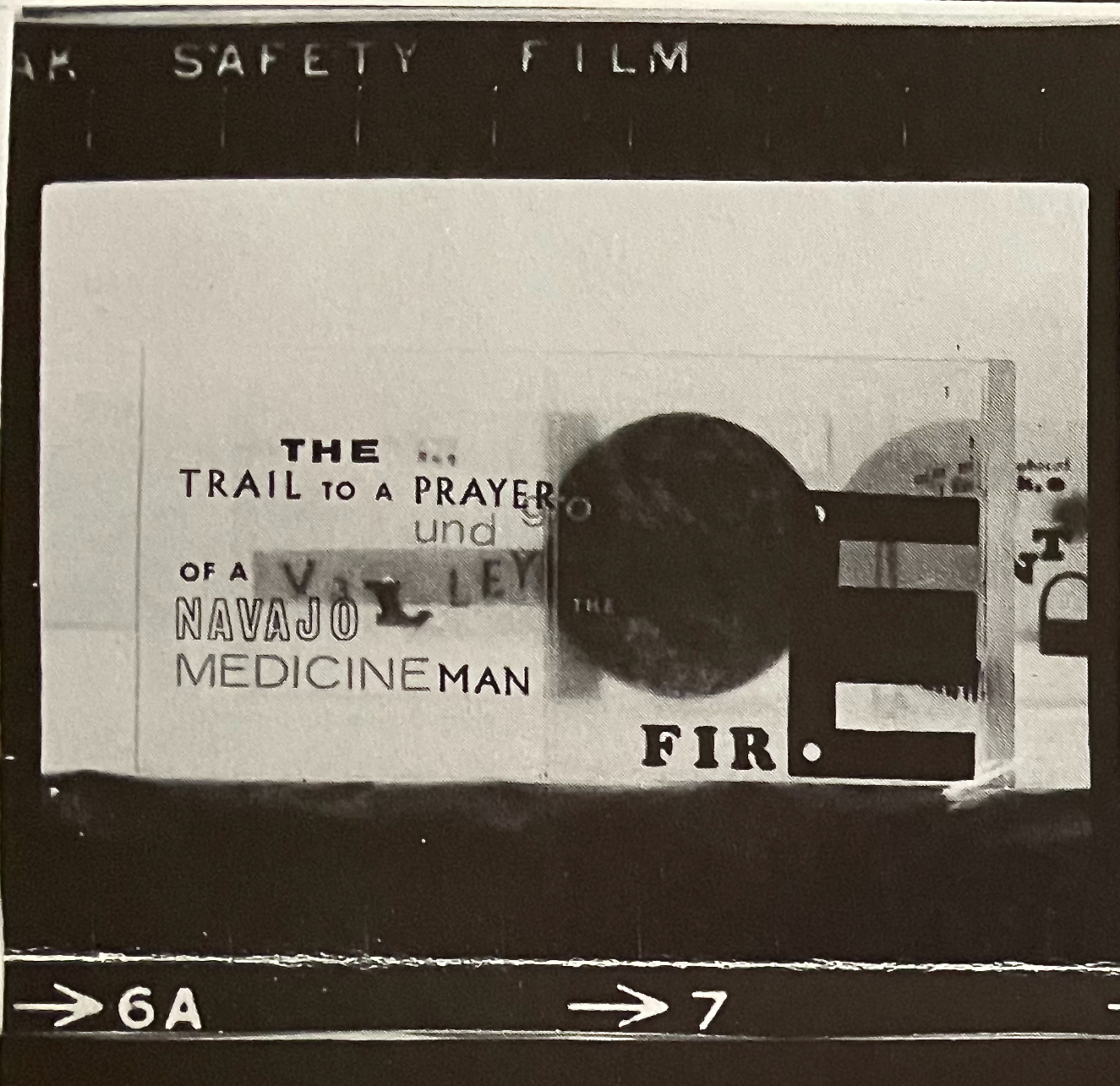
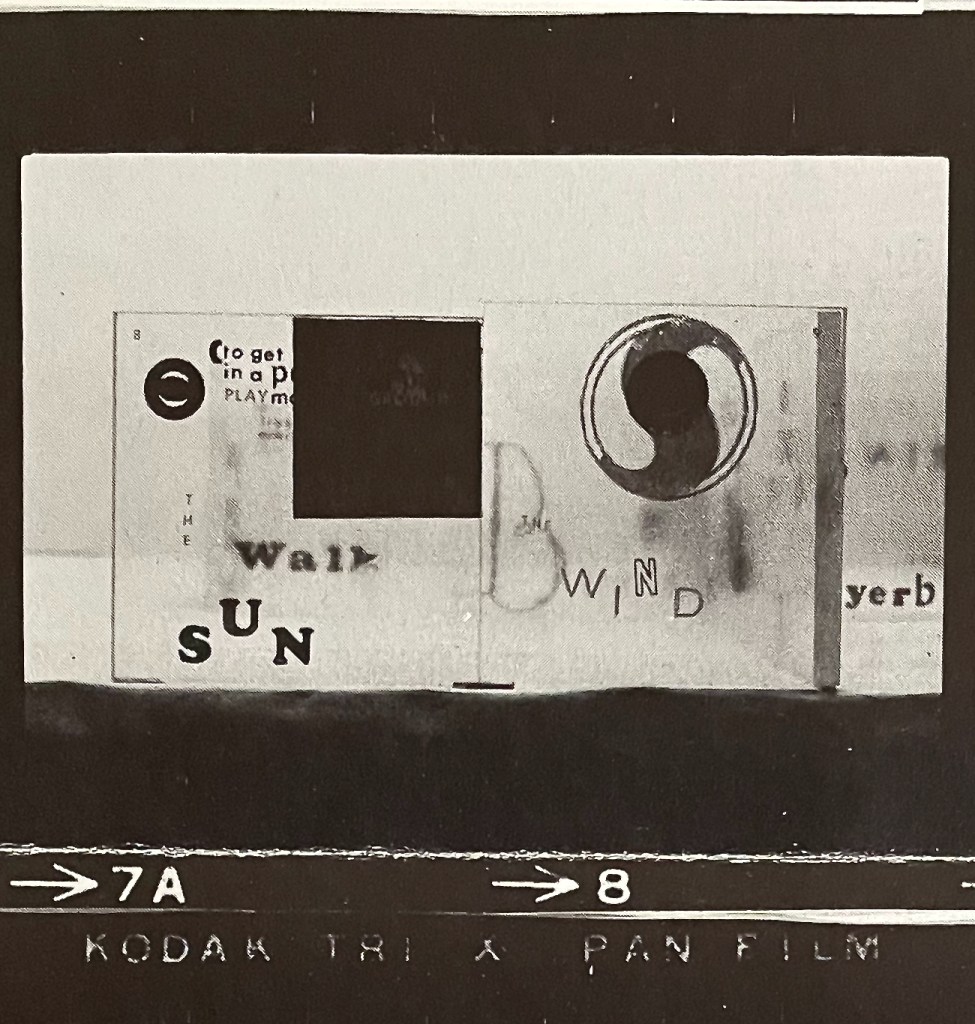
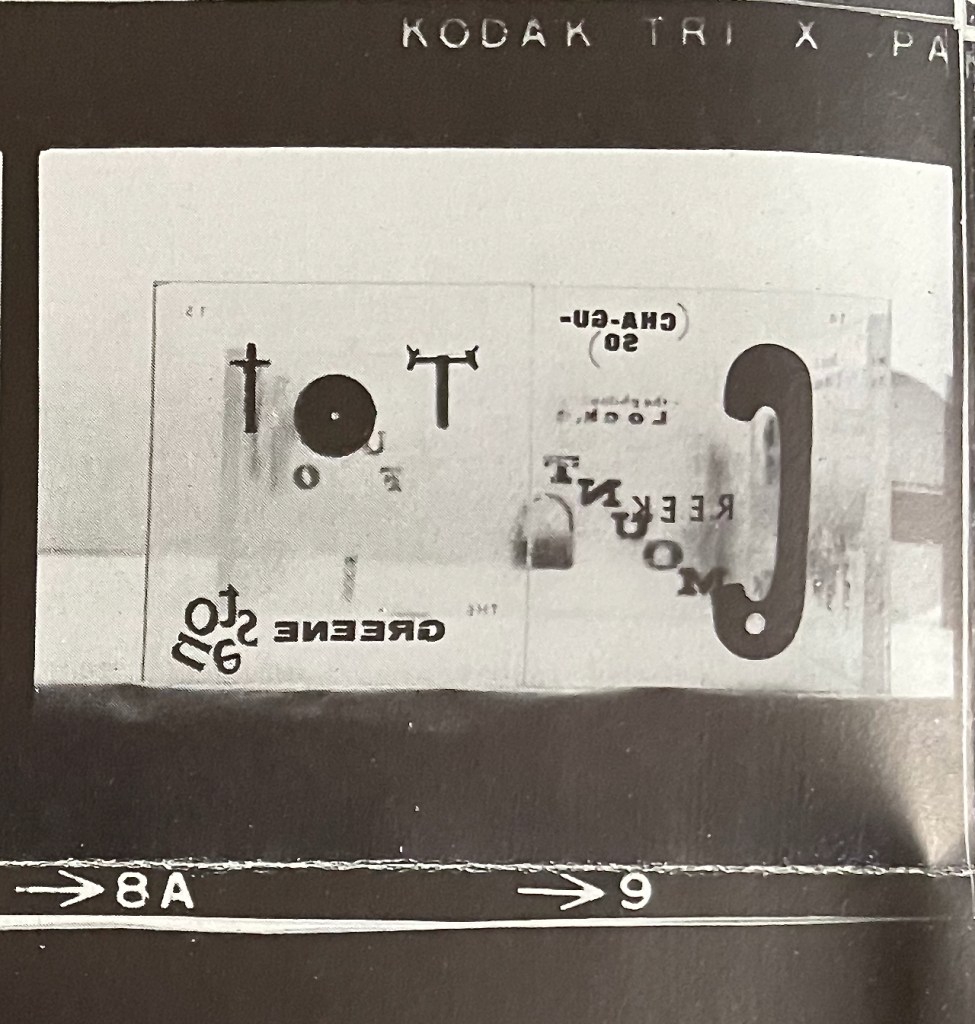
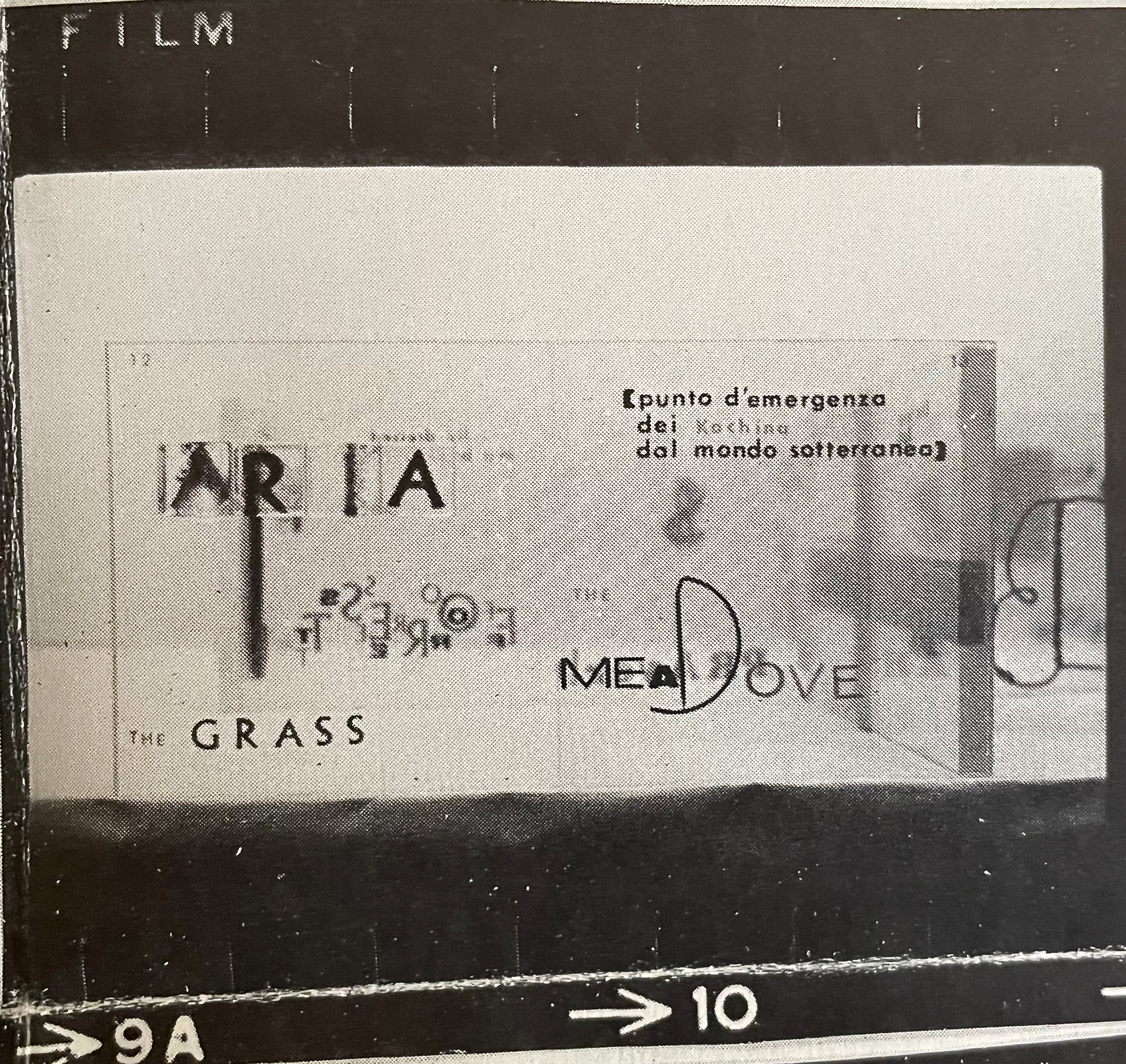
A broadside of books, or a photographic record of a display of three works of book art and some print works? On its surface, a visual pollution is a single sheet of paper displaying strips of Kodak film with frame numbers (2A to 34) appearing along the foot of the roll of film. The first four frames show photos of clear acetate blocks forming the Navajo ancestral emblem called the “Whirling Log” (tsil no’oli). On each block, double-page spreads have been printed containing phrases as text and images. In the fifteen frames that follow the first four, Diacono and Spinello give us close-ups of the acetate panels/pages. Page numbers can be seen in each spread’s upper left and right corners. The next eleven frames, starting with 21A/22, show two leporellos (one has eight panels, the other seven) with close-ups of the panels. The last two frames show two printed cards (or one double-sided one) in portrait and landscape orientations.
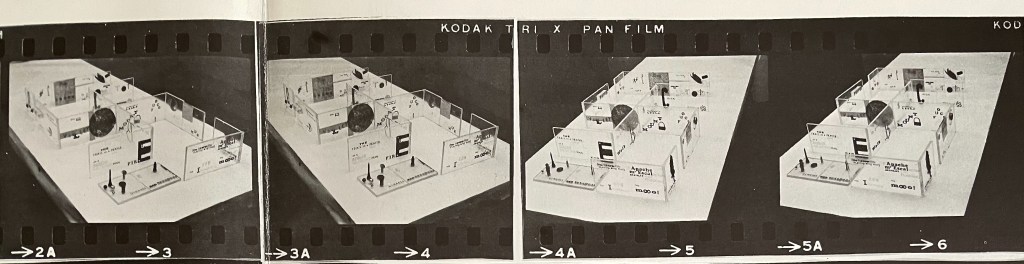
The first four frames, the arrangement of acetate blocks in the shape of the Navajo emblem “Whirling Log” (tsil no’oli). The Navajo Nation disavowed the totem in 1940 after its appropriation as the Nazi swastika.
In JCT 1, Diacono designated the work as “co-opywritings” of himself and Mallarmé. In JCT 2, the Navajo Indian tribes “join” Diacono. “Co-opywriting” is the perfect neologism to describe Diacono’s self-aware act of appropriation. There is no collaboration here; he has co-opted the French poet and the indigenous Americans. As an Italian and recent immigrant to the US, did his self-awareness extend to knowing that he was appropriating a disavowed emblem? “After the symbol was co-opted by the Nazi Party in Germany in 1920, the Navajo, Hopi, Apache, and Tohono O’odham tribes prohibited their communities’ use of the whirling logs motif by way of a 1940 intertribal proclamation. In the past few decades, Navajo people have begun to feature the motif in their weavings once again.” (Millicent Rogers Museum)
While it is nonsensical and inappropriate to assign authorship in this case to a tribe, the work’s title, the use of the tribal emblem, and the nature of the word mash-ups like (“U.S.A.lly dressed in a baby dollar“, “PRAyerb“, or “r’Apache m’Escalaction AGAIN,ST viet Pueblos) suggest that something other than appropriation is at play. It is far from the offensive “playing Indian” in which the Italian artist Eliseo Mattiacci engaged (Salza). Diacono’s art seems to spring from an anti-establishment and counter-culture base. His assault on words as “visual pollution” and the need to mash them up into “object-oriented writing” (Martini) may or may not have appealed to the Diné-speaking people and the Red Power Movement of the 60s and 70s. But there is no denying Diacono’s critical enthusiasm and energetic claims of solidarity.
Further Reading
“‘Un Coup de Dés Jamais N’Abolira l’Appropriation’— An Online Exhibition“. 1 May 2022. Bookmarking Book Art.
“Derek Beaulieu“. 19 June 2020. Books On Books Collection.
“Jorge Méndez Blake“. 16 September 2020. Bookmarking Book Art.
“Marcel Broodthaers“. 25 July 2026. Books On Books Collection.
“Sammy Engramer“. 1 June 2020. Books On Books Collection.
“Ernest Fraenkel”. 30 October 2021. Books On Books Collection.
“Alexandra Leykauf“. 1 October 2020. Books On Books Collection.
“Michel Lorand“. 19 June 2020. Books On Books Collection.
“Benjamin Lord“. 19 June 2020. Books On Books Collection.
“Guido Molinari“. 13 April 2020. Books On Books Collection.
“Michalis Pichler“. 19 August 2020. Books On Books Collection.
“Cerith Wyn Evans“. 16 April 2020. Books On Books Collection.
“Eric Zboya“. 1 June 2020. Books On Books Collection.
Boglione, Riccardo. 22 September 2010. “Dadi illeggibili. il Mallarme cancellato di Mario Diacono e Marcel Broodthaers“. The Free Library. Accessed 1 May 2020.
Caruso, Martina. 2023. “Native Americans in Visual Countercultures: Shaping Italianicity through Cultural Appropriation“. Römisches Jahrbuch der Bibliotheca Hertziana. 46.
Getty Research Institute. n.d. “Manuscript of A metrica n’aboolira“. ArchiveGrid. Accessed 15 April 2018.
Martini, Stelio Maria. N.d., “Untitled“. Fondazione Morella. Accessed 14 July 2026.
Nickas, Bob. 2019. “Bibliotheca Hermetica: Mario Diacono and the arts of alchemy“. Ursula, Winter No. 5.
Salza, Elena. 2013. “Mario Diacono. Tra avanguardia e nuova iconografia Italia-Stati Uniti, 1960-1984“. Dissertation. University Ca’Foscari, Venice, IT. Accessed 14 July 2026.

