See on Scoop.it – Books On Books

Yesterday, Claire Kelly caught up with Travis Alber. Today, Philip Jones of FutureBook, a digital blog from “The Bookseller,” caught up with Bob Stein. Social reading serendipity?
See on futurebook.net
See on Scoop.it – Books On Books
Yesterday, Claire Kelly caught up with Travis Alber. Today, Philip Jones of FutureBook, a digital blog from “The Bookseller,” caught up with Bob Stein. Social reading serendipity?
See on futurebook.net
See on Scoop.it – Books On Books
Travis Albers interviewed by Melville House’s Claire Kelly on social reading. Alongside Bob Stein (Institute for the Future of the Book), the founders of ReadMill and a handful of other “future-designers,” Albers and “ReadSocial” partner Aaron Miller have put a convincing case forward for how social reading touches a segment of the book’s DNA and how the book and our reading may evolve.
See on mhpbooks.com
See on Scoop.it – Books On Books
A book published earlier this year by an Argentine firm raises questions about the desirability of indelible ink and trackable data, writes James Bridle…
The title of Bridle’s item in “The Guardian” — or “The Groaniad” as it is fondly known for its ponchant [sic] for typos — is “Ebooks: do we really want our literature to last forever?” It’s hard to tell at first whether Bridle has his tongue partly in his cheek.
He introduces his theme with William Gibson’s collaboration with Dennis Ashbaugh — “Agrippa (a book of the dead)” — which is covered in the July 20 post below. Though he mentions the competition to reverse-engineer the cryptography that encrypted the poem on its floppy disk at the playing of its first reading, he doesn’t mention the site (http://agrippa.english.ucsb.edu/) dedicated to archiving the event of that first reading.
But as Bridle notes, the physical might have now accomplished the disappearing act the digital could not. He refers us to “El libro que no puede esperar|The Book That Can’t Wait,” which its publisher Eterna Cadencia just released in print with ink that disappears in two months. Bridle’s contrarian view to the negative press greeting this instance of print-performance-art is “the persistence of books is a myth in any case: … One of the advantages of ebooks might in fact be that they are easier to move on from, to delete, to forget, preventing us from getting bogged down in bad books and past selves, and, as Eterna Cadencia want us to do, move on and discover new things.”
That may be a clever Heraclitean spark — or Zen cone as “The Guardian” might have it — disguising a marketing ploy. But that very clamor for attention and the clamor of the self-publishing remind us of what is really at stake: time.
Our ebooks may be “reading us,” but perhaps we are the ephemera in this case. Long after we have ceased being tracked, some of those ebooks and books — like the illuminated manuscripts this March at the British Library’s exhibition “Royal Manuscripts: The Genius of Illumination” — will mark the human effort to prove the myth that our words and images will last.
See on www.guardian.co.uk
See on www.feltandwire.com [Search for this link on the Wayback Machine]
On her blog “Felt & Wire,” Alyson Kuhn shares her foray into the origins of the word “colophon.” [Search for this link on the Wayback Machine]
In ancient Greece, Ionia to be precise, the city Colophon stood on a summit. The colophon, the final page stating the title of the work, who made it, when it was made, how it was made, for whom it was made, etc., stands at the summit of the book, justifying its being named for that city. It is the maker’s signing off from the summit of the foregoing text. That “signing off” can be construed as the “finishing touch,” which might refer to the reputation of the Colophonian warriors for being the deciding factor in many a battle, hence the phrase of Erasmus ‘Colophonem adidi’ – ‘I have put a finishing touch to it.’
The name of Kuhn’s site — “Felt & Wire” — reflects her passion for paper. She tag-lines it as “Impressions from the Paper-Obsessed,” which explains why her entry does not go back as far as the first appearance of colophons on clay tablets — nor ahead as far as their regular appearance in websites (an example of which can be found here).
But there is a functional logic for going back as far as those biblical “colophons.” They are recurring phrases related to the “toledoth“passages that appear in the Genesis tablets. Toledoth is Hebrew for “generations” as in “These are the origins [or histories] of Noah,” which a convincing group of Hebraic scholars translate in the possessive. As in “The foregoing book relating these stories belongs to Noah” or “This is Noah signing off.” So the toledoth perform some of the same finishing functions as colophons.
There is also, according to the Edenics site, an etymological reason for going back to the Hebrew. The word “colophon” itself has its roots in the Hebrew word “Gimel-Lamed,” meaning “wave” and “a prominent man-made heap.”
Certainly many books fit that etymological definition (a prominent man-made heap) and deserve a colophon whether they have one or not!
Looking forward, though, it is endearing that so many websites bear the colophon device and, in doing so, raise the questions, “Should we think of these websites as books?” “How might the use of traditional parts of the book in websites or ebooks tell us what the book will be beyond the Age of e-Incunabula?”
From what better vantage than the colophon to look back for the origins of the book and forward for its future?

Pew Internet’s latest report on e-reading offers librarians ten valuable lessons on how they can increase the usage and demonstrate the value of their collections.
The 11th corollary — there are “herds” of ebook readers out there whose watering holes are here:
ReadCloud (an Australian site aimed at schools).
These are only five among several to watch. Most of these reader apps are available for the iPad, and even Amazon has introduced the facility to share annotations and comments via Twitter and Facebook in Kindle Fire 6.3.
There is also a new kid on the block: Zola, one to watch if only for its ambition to compete with Google Play and Amazon.
Now, if Overdrive were to enhance its recent acquisition Book.ish with this social reading facility, then …!
Caveat: Michael Kozlowski has this to say about the phenomenon: “In the end, social media in electronic books is severely lacking. … Having more embedded social functions in an e-reading indie app or mainstream company taking [it] to the next level will only help the industry grow and spurn [sic] more companies to offering competing or better options.”
And that’s where the 11th corollary comes in. Librarians might be able to make a difference — introducing (or following) their patrons into the social e-reader experience, making the global more local, sparking local reading groups and reading lists, providing a local human interaction in helping readers find books and answers about them.
If the companies mentioned have not already reached out to the library community and publishers to push this possible next step in the evolution of the book, perhaps the librarians should reach out to the social ebook readers and the publishers?
With static infographics gaining ever more popularity, this was inevitable:
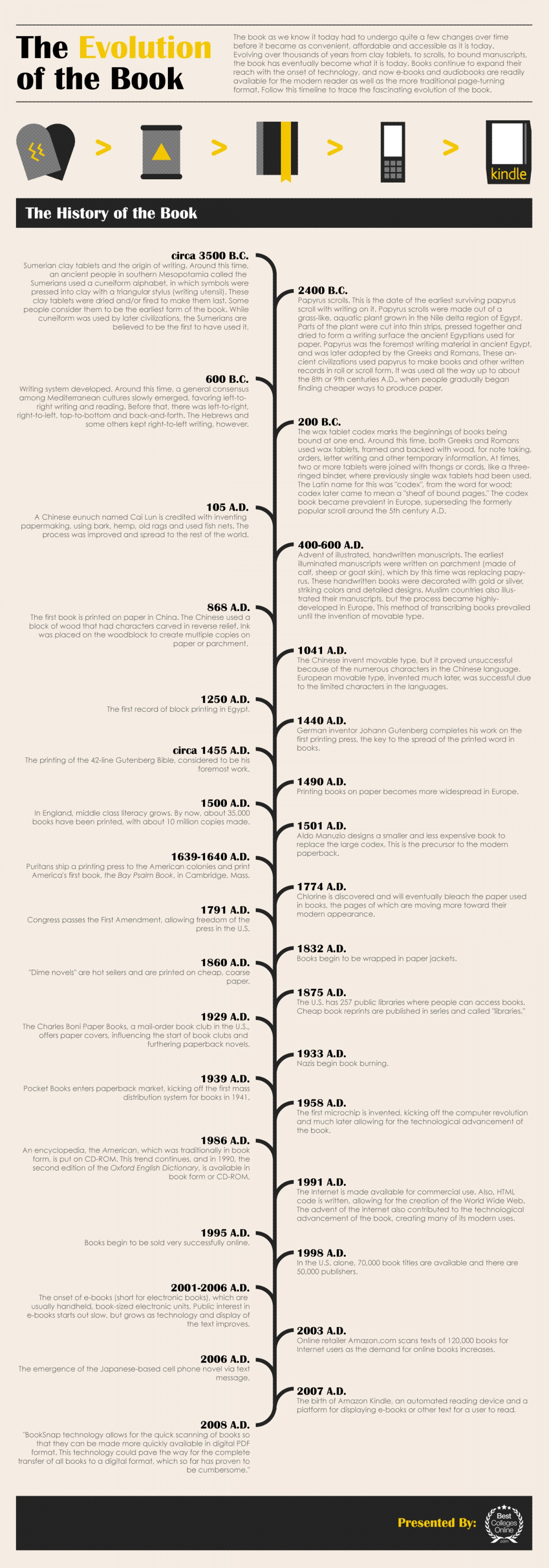
Anyone up for grafting on some branches to cover Queen Anne’s Statute (1710), the German forerunner of the mass-market paperback (1867), the introduction of the English modern paperback (1935), the introduction of standards (ISBN, EPUB), the start of the Google Print/Book Project (2004/2005), the month and year ebook sales overtook print sales at Amazon (May 2011), the appearance of the first book app … ?
Jeremy Norman’s From Cave Paintings to the Internet remains the invaluable resource for such timelines.
Updated 20140216

“The Book Industry Study Group (BISG), a leading U.S.-based trade association representing the entire book supply chain, announced today the publication of a new Policy Statement endorsing EPUB 3 as the accepted and preferred standard for representing, packaging, and encoding structured and semantically enhanced Web content — including XHTML, CSS, SVG, images, and other resources — for distribution in a single-file format.”
For the record and from the Library of Congress:
“The Open eBook Publication Structure or “OEB,” originally produced in 1999, was the precursor to EPUB. Version 1.0 of the Publication Structure was created in the winter, spring, and summer of 1999 by the Open eBook Authoring Group. Following the release of OEBPS 1.0, the Open eBook Forum (OeBF) was formally incorporated in January 2000. OEBPS Version 1.0.1 [OEBPS_1_0], a maintenance release, was brought out in July 2001. OEBPS Version 1.2 [OEBPS_1_2], incorporating new support for control by content providers over presentation along with other corrections and improvements, was released as a Recommended Specification in August 2002. EPUB 2 was initially standardized in 2007. EPUB 2.0.1 was approved in 2010. EPUB, Version 3, was approved as an IDPF Recommendation in October 2011. It is substantially different from EPUB, Version 2, both in using only a single form for textual content and in having support for audio, video, and scripted interactivity (through Javascript). No longer supported are the EPUB_2 formats for text content, one based on the Digital Talking Book [DTB_2005] format and a second form based on XHTML 1.1 compatible with OEBPS_1_2. A single new encoding for textual Content Documents is based on HTML5/XHTML and CSS3, despite the fact that both of these W3C standards are still works in progress. SVG is supported for graphics and it is possible to have an EPUB_3 document whose “pages” consists [sic] only of graphics, for example for a graphic novel. Several legacy features are deprecated. Some legacy structures may be included for compatibility of EPUB_3 documents with existing EPUB_2 readers. EPUB_3 readers are expected to render publications using version 2 and version 3.”
Coincidentally, Amazon UK reported today that it is now selling 114 Kindle ebooks for every 100 print books it sells.
The EPUB format is not natively readable on the Kindle device or in the Kindle application. Customers can add conversion apps easily to their devices to make EPUB readable on a Kindle, but as consumers seek the advantages of an industry standard, how will Amazon respond?
Added 20120806.
 As we are still in the Age of e-Incunabula, what better than a trip half way around the world to Japan to see one of the world’s largest collections of Western incunabula — and an excellent site to bookmark?
National Diet Library’s site refers to itself as an exhibition based on the book Inkyunabura no Sekai (The World of Incunabula) / written by Hiroharu Orita, compiled by the Library Research Institute of the National Diet Library. Tokyo: Japan Library Association, July 2000 (in Japanese).
The exhibition provides a timeline of incunabula from the second half of the 4th century when the shift to the codex occurred to 1980 when the British Library began entering data on its collection of incunabula into the ISTC. The site provides much more than this chronology. Images from the collection, statistics on the type fonts used, coverage of design and how the quires (sheets of paper folded, forerunner of book signatures and files in EPUB!) were arranged, and the binding process — all are covered straightforwardly and often in entertaining detail.
Look on this site and consider how far we have to go with our ebooks and apps! Added 20120725.
Feel free to suggest other timeline entries!
Previous:
Not as interactive as the Counterspace timeline for typography below, but certainly as densely informative, and this infographic extends to typography online. Added 20120719.
Another timeline, this one focused on bookbinding. Is .zip the binding for an ebook? Added 20120717.
On the heels of the question above comes an outstanding interactive infographic from Counterspace on a critical element of the book: typography. Added 20120710.
Yet another ebook timeline, and this one is broken down into interpretive categories, “The Age of Writing” and “The Network Era,” which is thought-provoking. Are we in “The Age of the Tablet“? Added 20120706.
INCIPIT (i.e., where the scoop started earlier in July):
In 1936, “Chronology of Books & Printing” appeared in its revised edition, published by Macmillan in New York. In 1996, Cor Knops picked up the torch and started a Book History Timeline from Sumerian clay tablets (he could have started with the caves at Lascaux!) through to 1997 with the first issue of “Biblio Magazine” but with little acknowledgment of ebooks. Now in 2012, looking back to 2002, we find this journalistic stab at a timeline for ebooks.
Forged together, the chronologies would have to include “As we may think” by Vannevar Bush in 1945, Ted Nelson’s coining of “hypertext” in 1963-65, the Apple Newton in 1993 (how many publishers and authors have kept track of the free downloads of their Newton ebooks?) and much more.
Another extension of the ebook timeline appears in this book by Marie Lebert, which fills in important gaps, misses others and offers more than a few overemphasized continental developments. Her timeline takes us through 2008, which means that the signal events in 2011/12 of ebooks sales’ outstripping those of print in certain months are still to be added.
Tom Abba and Baldur Bjarnason are writing a book — about “books, electronic textuality and materiality and is a manifesto of sorts.”
Some of it slips out intentionally in Abba’s blog. He comments on Touchpress’s app of Eliot’s “The Wasteland,” Flipboard’s setting of design trends and Visual Editions’ app version of Marc Saporta’s “Composition No. 1.” Here’s hoping that they also address Agrippa (a book of the dead), the work of art created by novelist William Gibson, artist Dennis Ashbaugh and publisher Kevin Begos Jr. in 1992. That’s right, futurists, 20 years ago.
Here’s a twist, or is it?
The Center for Book and Paper Arts at Columbia College Chicago issued a call for proposals yesterday (19 July) for projects that “provide concept(s) of how the digital work may be transformed into a physical book object – ….”
The premise behind the “award of two $10,000 commissions for new artworks for the iPad [which] will have physical counterparts that intersect, modulate, or inform the digital components of the artwork” is:
“Artists’ books claim all aspects of the book (format, typography, structure, etc.) as potentially expressive. As immersive hybrid experiences for the reader/viewer, these works expand the limits of what we traditionally think of as a book. Simultaneously, we consider that tablet-based mobile platforms are emerging as a dynamic arena for investigation of the notion of the book. Expanded Artists’ Books utilize the rich capabilities of the tablet platform to imagine new forms that a book might take, such as exploring how interactivity challenges the traditional closure of text or the performance of time.”
William Gibson’s novels leap to mind as examples of predictive fiction (fairly uncannily when you compare Google’s VR glasses to the Ono-Sendai Cyberspace Deck that allows characters in the Sprawl trilogy to enter and navigate “Cyberspace [that] consensual hallucination experienced daily by billions of legitimate operators, in every nation, by children being taught mathematical concepts. … A graphic representation of data abstracted from banks of every computer in the human system. Unthinkable complexity. Lines of light ranged in the nonspace of the mind, clusters and constellations of data. Like city lights, receding.” (Gibson 69)
So why not predictive book art to envision the future of the book?
Whose job is it to do this?
The “findability” function goes beyond the usual social media marketing of a book or ebook that most publishers have assigned to Marketing. It goes beyond the usual search engine optimization (SEO), although it is arguably a part of it.
It goes to discovering and notifying as many of the “sites of record” relevant to the book being published as possible, like the Repository of Primary Sources for new online archives. It goes to making the book as locatable an object as it can be, endowing it with “ambient findability.” See Peter Morville’s book of that title here and judge for yourself whether “endowing something with ambient findability” misconstrues what he is saying or how the Web works. Nevertheless, …
Superfluous as they are claimed to be becoming, should publishers leave findability to the librarians (until they become superfluous as well) or to the technorati?
As the book evolves, this “findability” function currently falls between the stools of Commissioning (where the editor discovers the author and pumps him or her not only for the ms but for connections leading to sales/marketing opportunities and further editorial opportunities), Editorial/Production (where the copyeditor, designer and production editor ensure that metadata is assigned and link-checks are run and the work is registered with the Library of Congress), Sales/Marketing (where marketeers scour the author’s questionnaire if it has arrived, create lists of mailing and emailing lists, compile the list of offline and online reviewers/bloggers and design the social media campaign and where a sales account manager with responsiblity for Amazon and other online accounts worries whether IT has included the work in the scheduled ONIX, EDI and customized catalog feeds) and Operations/Finance (where an accountant, analyst or inventory controller assigns the ISBN usually upon receipt of contract approval).
Who assigns and maintains the Digital Object Identifier (DOI) is a related beggarly question (whose job is it to have a clue that a DOI might be a good thing to assign to a book?).
So if you are self-publishing or publishing books/ebooks, who attends to the ambient findability of what you are publishing? As more and more books go online, isn’t this part of the new craft and art of the book?
By the way, I found Morville’s book one rainy Saturday afternoon while shelving books at the local Oxfam bookstore. I bought it instead of shelving it.
Today, two bookmarks for the price of one.
“The Book Less Library” by David A. Bell and “What Will Become of the Paper Book?” by Michael Agresta.
In his ruminative article, David Bell draws together the currently indigestible trends and events facing the library community: the economic crisis and rising costs, the shift from print to digital, the improvement in technology’s reliability and functionality disintermediating libraries and the decline of foot traffic in libraries, the academic ones especially.
Bell’s is truly a well-contrived essay. His survey builds to the presentation of a credible but nightmare scenario, whose credibility is enhanced by his carefully modulated tone up to that moment.
“The year is 2033 … the Third Great Recession has just struck. Although voters have finally turned the Tea Party out of office in Washington, the financial situation remains …. New York City in particular faces skyrocketing deficits as a result of the most recent Wall Street wipeout, and the bankruptcy of Goldman Chase. In City Hall, a newly elected mayor casts a covetous glance at the grand main branch of the New York Public Library. Think how much money the city could save by selling it, along with the thirty remaining branch libraries scattered throughout the five boroughs. After strenuous negotiations, the mayor announces a deal with Googlezon, under which the company will make fifty electronic copies of any book in its database available at any one time to city residents, for two-week free rentals on the reading device of their choice. Two years later, where the main branch library once stood, the mayor proudly cuts the ribbon at the opening of the Bryant Park Mall.”
Bell deftly punctuates his scenario with the question: “why should most libraries still own physical copies of out-of-copyright books—that is to say, for the most part, books printed before 1923” — especially twenty to thirty years from now when the digital divide has narrowed and another born-digital generation dominating the Sprawl accesses its media digitally?
As Bell tolls it: “The transformation is upon us. … [and] Ultimately, to survive, libraries will need to become part of the new, partly digital public sphere, attentive to its needs and rhythms, as well as to those of traditional learning and scholarship. The balance will be hard to strike, things will be lost, and the lovers of traditional scholarship will continue to issue their laments. But if we do not try to strike the balance, and move libraries into the new age—well, I’ll meet you to discuss the question in a few years at the Bryant Park Mall.”
Over on “Slate,” in “What Will Become of the Paper Book?”, Michael Agresta wanes where Bell waxes. While, like Bell, he extols the extras that ebooks and apps are bringing, he warns that the paper book may well become a luxury item available only to the well off or be unrecognizably remediated and synthesized into book art.
His example: German artist Dieter Roth’s “literaturwurst,” which presents the complete works of Georg Wilhelm Friedrich Hegel — all 20 volumes — ground up and used as a substitute for meat in a recipe for homemade sausage.
Well, perhaps Roth’s works will be displayed in the Bryant Park Mall, but let’s hope it is not near a deli.
 Books On Books