Bookmarking a Book Burning – I

Julian Baggini (Aeon) has posted a thoughtful piecejulian-baggini-burning-books on the need for an important cultural artifact to evolve — not just in its codex form but in its very essence — the encyclopedia.  One reader/viewer (there’s a video as well) commented:
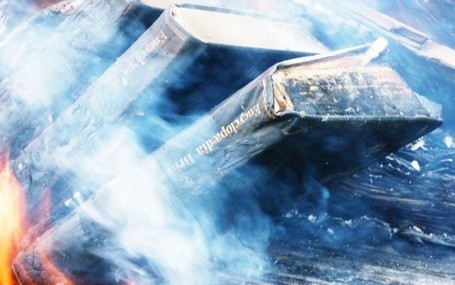
Which is worse? Burning books because they are now available in an electronic format? Or not having any physical books to burn, unless you steal them from a museum or collector?

Hold that thought (an “argument by false dichotomy”) and go to Baggini’s concluding paragraph:

I can’t help but mourn the passing of my set of Britannicas, but I do not mourn the passing of the institution. Encyclopædias have passed their use-by-date as fitting symbols for the esteem in which we hold culture and learning. The world is changing, and books, magazines and education have to change with it. Nostalgia for obsolete publications serves us only if we use it to remind us of the things we really value, and want to take forward into our own new world.

What if, though, the things we value and want to take forward into our new world are caught up in the “affordances” of such tangible institutions as the encyclopedia.  Maryanne Wolf hits this chord hard in Proust and the Squid when she worries about the effect of the Google universe on the nature of her children’s ability to read:

Reading is a neuronally and intellectually circuitous act, enriched as much by the unpredictable indirections of a reader’s inferences and thoughts as by the direct message from the eye to the text. … Will the constructive component at the heart of reading begin to change and potentially atrophy as we shift to computer-presented text, in which massive amounts of information appear instantaneously? … is there either sufficient time or sufficient motivation to process the information more inferentially, analytically and critically? … Or does the potential added information from hyperlinked text contribute to the development of the child’s thinking? …

I stray with these questions. But indeed we stray often when we read.  Far from being negative, this associative dimension is part of the generative quality at the heart of reading. … Charles Darwin saw in creation a similar principle, … ‘From so simple a beginning, endless forms most beautiful and most wonderful have been, and are being evolved.’  So it is with written language.  Biologically and intellectually, reading allows the species to go ‘beyond the information given’ to create endless thoughts most beautiful and wonderful.   We must not lose this essential quality in our present moment of historical transition to new ways of acquiring, processing and comprehending information. (pp. 16-17)

To go back to Baggini’s troubled reader/viewer, we will not burn books because we have them electronically.  As our different types of books evolve, some we will have electronically only and some we will have both in print and electronically.  We already have many digitised rare books and manuscripts in libraries, museums and collectors’ holdings.  Most people’s exposure to those works can only be electronic, and the more this is the case, the less the need to steal them.   But also the greater the need to understand and innovate to address the loss of tactility and the proprioceptive experience of “curling up with a good book.”  In alluding to Jerome Bruner’s collection of essays Beyond the Information Given, Wolf is reminding us (linking us?) to Bruner’s apt observation that Lev Vygotsky, the famous Soviet developmental psychologist, “was fond of an epigram from Bacon, “Nec manus, nisi intellectus, sibi permissus, multum valent” (Neither hand nor intellect left each to itself is worth much)” (247).   Perhaps neither print nor digital left each to itself is sufficient.

Bookmark for Marginalia and Note-taking

Annotation function in Utopiadocs.
Annotation function in Utopiadocs. Copyright © 2012 Lost Island Labs.
imgres
Nathaniel Hawthorne
Herman Melville
New York, NY; Salem, MA, 1846-1850. ©2012 The President and Fellows of Harvard College

Earlier this month, we saw the release of the Open Annotation Community Group’s specification of the Open Annotation Core Data Model, an interoperable framework for creating annotations that can be easily shared between platforms.  The work, directed by Robert Sanderson and Paolo Ciccarese, began in earnest about six months ago, although it was proceeded by longstanding efforts within and between the editors of the Annotation Ontology and the Open Annotation Collaboration.  Under the auspices of the W3C, the efforts merged into the Open Annotation Community Group (OACG).

The OACG model defines an annotation as “a set of connected resources, typically including a body and target, where the body is somehow about the target,” and the full model  “supports additional functionality, enabling semantic annotations, embedding content, selecting segments of resources, choosing the appropriate representation of a resource and providing styling hints for consuming clients.”    Public rollout events are scheduled for 9 April (Stanford University), 6 May (University of Maryland) and 24 June (University of Manchester).

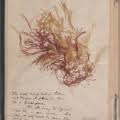
Back in November last year, while the Open Annotation Community Group (OACG) was thrashing through how to handle collections of annotations and other ontological issues, the Radcliffe Institute for Advanced Studies at Harvard University held a two-day symposium called “Take Note,”  marking the conclusion of a two-year project on the history and future of note-taking.  The project also resulted in a virtual exhibition of objects and works from the Harvard University Collections with notes ranging from a price list inscribed on a potsherd to a clothes list on papyrus found in an Egyptian garbage dump to Herman Melville’s annotations of his review copy of Hawthorne’s Mosses from an Old Manse (see image above).    The exhibition was curated by Greg AfinogenovAnn Blair and Leah Price, and interestingly, the OACG’s Paolo Ciccarese contributed to building the exhibition’s website.

So besides Paolo Ciccarese’s involvement, what’s the connection between these two events?   Perhaps the link is captured in three comments from the participants:

Bill Sherman, historian at the University of York and author of Used Books: Marking Readers in Renaissance England, commented to a reporter,  “We’re now in a moment where we’re leaving behind fewer traces of our reading than ever before…. We may have moved to the turning point where…we’ll have to find new ways to leave more behind.” And as Matthew Kirschenbaum has spelt out in Mechanisms, historians will have to learn new ways to decipher what is left behind.

David Weinberger, author of The Cluetrain Manifesto and long-time blogger, tweeted (according to the Harvard Gazette reporter), “”Collaborative notetaking via etherpad or GoogleDocs etc. is often a great way to go. Fascinating to participate in, too,’ during an afternoon presentation that explored digital annotation tools.”  Like Bob Stein, the co-founder of the FutureoftheBook.com, Weinberger is a champion of social reading and collaborative creativity.

Another participant told the Gazette’s reporter, “’I was struck by the request that we send our notes into Radcliffe because my reaction was, “You know, my notes are really none of your business. My notes are my private thoughts, my private collaborations.” Until I am dead, I don’t really need other people looking at them.'”  That last comment is particularly fetching:  one wonders whether William James and Herman Melville had such an eye on posterity as they scribbled their notes now on display across the Web.

As the book evolves and we annotate works in our ereaders (offline or online), how do we ensure that they persist, and whether offline or online, how do we handle how private or public those notes will be?

Earlier this month, Books on Books raised proprietorial questions about annotated ebooks in response to Nicholas Carr’s article “Used e-book, slightly foxed” sparked by the Amazon patent for selling pre-loved ebooks.  On his site, Carr responded with his own questions:

“[W]hat’s the relationship (legal and otherwise) between an e-book and the annotations added to it by its reader? Are the annotations attached to the particular copy of the e-book, and allowed to remain attached to it when it passes to a new reader, or do the annotations exist in a separate sphere — say, in a personal online database that is the property of the individual reader? … what right does the copyright holder (in particular, the author) hold over the way an e-book is presented? If annotations, or other metadata, in effect become part of the text, permanently or even temporarily, then does that represent a modification of the work that requires the consent of the author? You can’t publish an annotated print edition of a book under copyright without the copyright holder’s permission. Do different rules apply to an e-book?” (Carr’s questions elicited an interesting comment at Futureofthebook.com:  “perhaps the interdependence of print and screen books is inevitable….”)

In some respects, by digitizing and reproducing others’ property (appropriately acquired through bequests, gifts and so on), the Harvard University Collections’ virtual exhibition illustrates Carr’s questions and those of the symposia participants — even the comment from Future of the Book — in a beautifully “tangible” way.  Think upon it.


Bookmarking Book Art – Basia Irland

Basia Irland’s art project ICE BOOKS: receding/reseeding gives a formidably tangible and new meaning to “publishing as dissemination.”  As Irland describes the project on her site:

River water is frozen, carved into the form of a book, embedded with an ‘ecological language’ or ‘riparian’  consisting of local native seeds, and placed back into the stream. The seeds are released as the ice melts in the current…

Tome I

I carved a 250-pound book from clear ice and embedded it with a seed text of Mountain Maple (Acer spicatum), Columbine flowers (Aquilegia coerulea), and Colorado Blue Spruce (Picea pungens). Four people carried the heavy book out into the current of Boulder Creek.  As it rested between two large rocks, viewers cold see the water flowing under the ice.  Ice Books.   Accessed 17 February 2013 and 11 September 2014.

This is book art as performance art and conceptual art but with a twist: the performance yields results beyond the on-site viewers’ memories or any photography and video of the event replayed in galleries or museum installations.  Whether the seeds that float downstream in local rivers do take root is uncertain. As there is at least a chance that it will happen, it is more than the concept that counts.

“Performed” across 18 locations around the world, Irland’s project has been going since 2007. Fittingly the first performance began with Lucy R. Lippard’s Weather Report exhibition in 2007, but the concept has a rich heritage. With some further reading and the help of Peter Verheyen’s listserv BKARTS, I have tracked down some of that other “ramifying” or “ecologically political” book art.

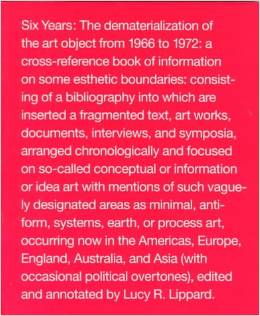
Lucy Lippard, Six Years
Lucy Lippard, Six Years (1997)

Starting with Lippard herself, there is Six Years, the 1973 seminal, long-subtitled work that drew attention to  Hans Haacke’s Wind in Water  (1967) and other conceptual and environmental art.  And then came Doug Beube’s pieces from the 80s and later such as Organic and The Chair of Censorship.  In the late 90s, we had Ann Marie Kennedy’s Plant Dreams. In 2010, Maggie Puckett’s “Thaw“.

And now, this conceptual book art has revolved back into books:

Pequeño Editoran Argentinian children’s book publisher, has published Tree Book Tree with ecologically friendly ink and acid-free paper embedded with jacaranda seeds. As the video explains, “Books come from trees. Today, a tree comes from a book.”

Tree Book Tree Published on 3 May 2015 The first book that can be planted after it is read. FCB Buenos Aires
Tree Book Tree, 2015
Video published on 3 May 2015
FCB Buenos Aires

The act of reading then planting the book echoes the twist in Irland’s performance and conceptual pieces. The book as read (the performance) resides in the memories of the readers, the concept (books are made of trees) resides in the mind, and downstream in time, a jacaranda blossoms overhead.
il_570xN.537080074_jfho


Compare also with the work of Jaz Graf.

Bookmarking Book Art – Guy Laramée

The form of the book, the book as technological artifact, each of the book arts (design and layout, typography, illustration, papermaking, imposition, printing, binding, preservation and restoration) and even the book as an objet d’art attract memes —  ideas, gestures, behaviors, methods, devices and practices that have spread from clay to scroll, from scroll to book, from book to ebook and perhaps from ebook to “cloud book.”

As we try to preserve – with clay counters in clay containers, with 0’s and 1’s stored on floating disks in tablets – we have assumed we are progressing.

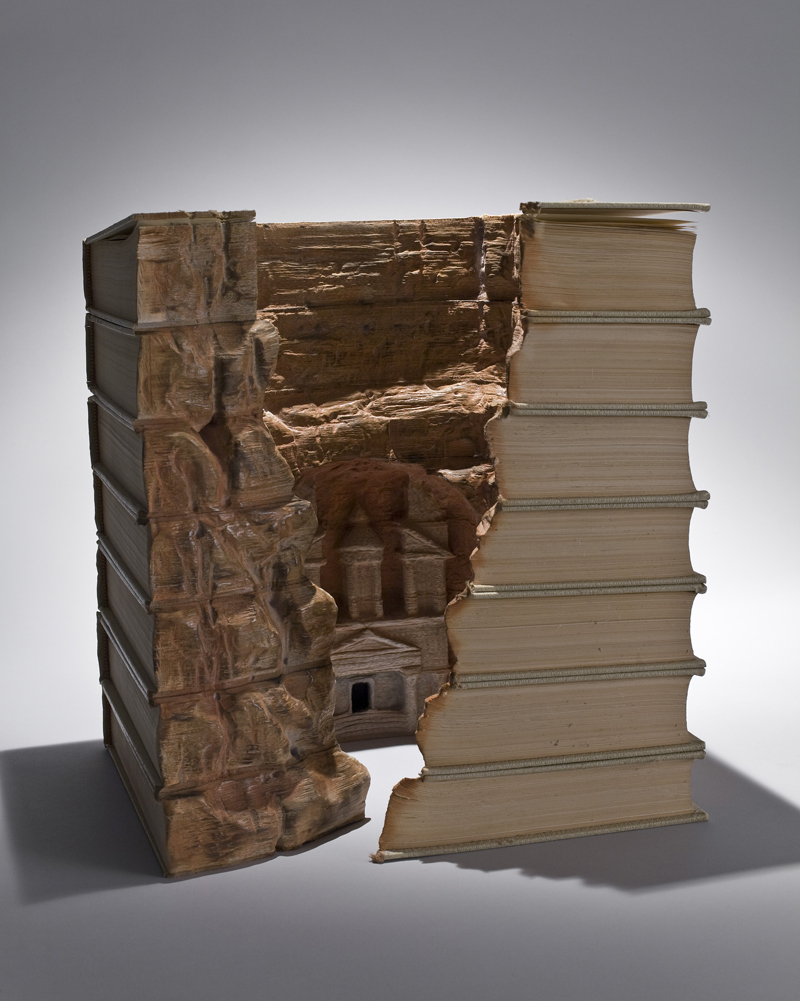
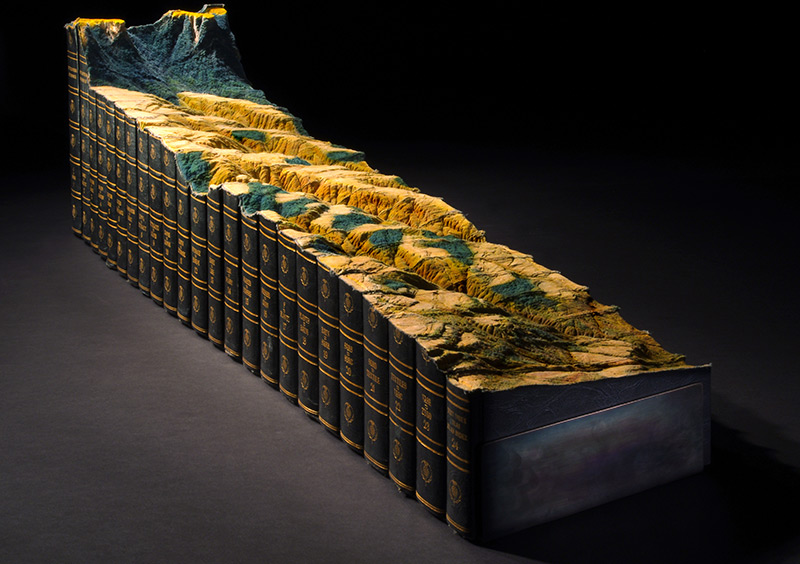
Guy Laramée is a book artist,  a subversive book artist.   His “artist statement” articulates the meme of erosion, entropy and the dissolution of culture and knowledge — what he calls the “cloud of unknowing.”

Copyright © Guy Laramee.

Artist Statement

The erosion of cultures – and of “culture” as a whole – is the theme that runs through the last 25 years of my artistic practice. Cultures emerge, become obsolete, and are replaced by new ones. With the vanishing of cultures, some people are displaced and destroyed. We are currently told that the paper book is bound to die. The library, as a place, is finished. One might ask so what? Do we really believe that “new technologies” will change anything concerning our existential dilemma, our human condition? And even if we could change the content of all the books on earth, would this change anything in relation to the domination of analytical knowledge over intuitive knowledge? What is it in ourselves that insists on grabbing, on casting the flow of experience into concepts?

When I was younger, I was very upset with the ideologies of progress. I wanted to destroy them by showing that we are still primitives. I had the profound intuition that as a species, we had not evolved that much. Now I see that our belief in progress stems from our fascination with the content of consciousness. Despite appearances, our current obsession for changing the forms in which we access culture is but a manifestation of this fascination.

My work, in 3D as well as in painting, originates from the very idea that ultimate knowledge could very well be an erosion instead of an accumulation. The title of one of my pieces is “ All Ideas Look Alike”. Contemporary art seems to have forgotten that there is an exterior to the intellect. I want to examine thinking, not only “what” we think, but “that” we think. 

So I carve landscapes out of books and I paint romantic landscapes. Mountains of disused knowledge return to what they really are: mountains. They erode a bit more and they become hills. Then they flatten and become fields where apparently nothing is happening. Piles of obsolete encyclopedias return to that which does not need to say anything, that which simply IS. Fogs and clouds erase everything we know, everything we think we are.

After 30 years of practice, the only thing I still wish my art to do is this: to project us into this thick “cloud of unknowing.”

ADIEU Guy Laramée Copyright 2013
ADIEU (2013)
Guy Laramée

Is that the book’s evolutionary destination – in the “cloud”?

Further reading

http://sculpting.wonderhowto.com/news/artist-carves-old-books-into-beautifully-painted-landscapes-0175708/?_scpsug=crawled_46008_f4679e90-cedb-11e6-bd01-f01fafd7b417#_scpsug=crawled_46008_f4679e90-cedb-11e6-bd01-f01fafd7b417

Magnificent New Carved Book Landscapes and Architecture by Guy Laramée

“Guy Laramée’s (previously) new series Onde Elles Moran (Where They Live) captures the mystique of the native birds of the Brazilian region Serra do Corvo Branco (Range of the White Raven) through both portrait and carved landscape.”

Bookmarking Book Art – Exhibit at the Grosvenor Rare Book Room

Bookmarking Book Art — Long-Bin Chen

Bookmarking Book Art — “Out of Print: Altered Books”, A Virtual Exhibition

Bookmarking Book Art – Update to “Rebound: Dissections and Excavations in Book Art”

Mihai, Cristian.  “Showcase: Guy Laramée“, Irevuo, 31 March 2018.

Bookmarking the Index

In 2003, at McGraw-Hill, we discovered something about making ebooks while working with Dr. Bill Detmer and Unbound Medicine to create Harrison’s On Hand.  Don’t start or present through the Table of Contents; start with the Index.

Ten years later and the lesson’s being rediscovered.  Read Hugh McGuire’s A Publisher’s Job Is to Provide a Good API for Books – Tools of Change for Publishing.


Are we over-thinking EPUB? – Tools of Change for Publishing

Are we over-thinking EPUB? – Tools of Change for Publishing.

The punning subtitle to this article indicates its subtext:  “The future of the book is inherently linked to the browser.”

Can Print and E-Books Coexist? Ceci n’est pas un signet!

grWJH

“So a video journalist goes into a bookstore …”  and finds little to report.  Beset by the BBC’s wallowing in non-events and the trivial, I am probably flailing out unfairly at the PBS’s “dog bites man” story or perhaps indigesting a bit of humbug this Christmas season.   MediaShift . VIDEO: Can Print and E-Books Coexist? | PBS.*

At least one commentator (gfrost; Gary Frost?), however, points out what video journalist Joshua Davis and his interviewees failed to explore:  “[M]issed is an inherent interdependence between print and screen books. An eerie complementary fit of the different affordances means that neither will flourish without the other.” Now there is a premise worth exploring, which Gary Frost does (see previous posting).

And what would Joshua Davis and his interviewees make of David Streitfield’s story in the NY Times that sales of e-reading devices seem to have reached a plateau?  “Even as prices fall, though, the dedicated e-reader is losing steam. The market peaked last year, with 23.2 million devices sold, IHS iSuppli said in a report this month. This year, sales will be 15 million. By 2016, the forecast is for seven million devices — as opposed to 340 million tablets, which allow for e-reading and so much more.”

Streitfield’s story actually begins with “the dog that didn’t bark”:  the prices for ebooks themselves have not fallen, despite the predicted result of the US Justice Department’s case against and settlements with six of the big publishers (five, now that two are merging).    For Frost’s premise that neither form — ebook or print — will flourish without the other, does that raise the question of whether either will decline without the other’s declining?   The rules of logic alone suggest otherwise, but consider Streitfield’s “more counterintuitive possibility … that the 2011 demise of Borders, the second-biggest chain, dealt a surprising blow to the e-book industry. Readers could no longer see what they wanted to go home and order.”

Perhaps the ebook and print are more intertwined than even Frost’s premise implies. Simba’s Jonathan Norris is quoted in Streitfield’s article:  “The print industry has been aiding and assisting the e-book industry since the beginning.”    Of course, someone needs to point this out with a cattle prod to the publishers withholding their ebooks from public and academic libraries.  The site TeachingDegree offers a succinct collection of data (PBS take notes) on the topic in a sort of dialectical digital poster.

Perhaps the whole story is just “human reads book” and is not worth a bookmark, but then where would have been the fun of finding out in punning

Magritte-pipe

with Magritte’s painting that the French for bookmark is either un signet (digital) or un marque-page (print), and in English we can make no distinction?

*In fairness to PBS, readers should take a look at the series “Beyond the Book 2012.”

Still, Frost’s Future of the Book goes far deeper.

(A general indifference?) Towards the Digital Divide

How might we explain the ascent, pervasiveness and popular appeal of digital art?

A few months ago, Greg Smith, a  Toronto-based artist, reviewed Claire Bishop’s “Digital Divide” (Art Forum, September 2012).  The review and Bishop’s article touch on a recurrent theme in Books On Books:  the materiality and immateriality of books.

http://www.scoop.it/t/books-on-books/p/2204574815/expanded-artists-books-envisioning-the-future-of-the-book

http://www.scoop.it/t/books-on-books/p/2540958720/a-bookmark-for-letters-outside-themselves

http://www.scoop.it/t/books-on-books/p/2276808444/ebooks-do-we-really-want-our-literature-to-last-for-ever

http://www.scoop.it/t/books-on-books/p/2204732117/bookmarking-a-forthcoming-title

http://www.scoop.it/t/books-on-books/p/2213422701/the-bookless-library-and-what-will-become-of-the-paper-book

http://www.scoop.it/t/books-on-books/p/2173038714/and-there-you-have-it-the-kindle-of-the-late-eighteenth-century-mike-kelly-amherst-college

http://www.scoop.it/t/books-on-books/p/2182994587/this-is-for-you-in-support-of-libraries-books-words-ideas

http://www.scoop.it/t/books-on-books/p/2123229496/to-see-a-world-in-a-grain-of-sand-or-tobacco-leaf

http://www.scoop.it/t/books-on-books/p/2082258113/post-artifact-books-and-publishing

http://www.scoop.it/t/books-on-books/p/2079452417/the-making-unmaking-and-remaking-of-books-guy-laramee-s-book-art

But the review and Bishop’s article resonate with some more recent and popular seismic tremors in the world of ebooks.  With all but Macmillan caving into the US Justice Department, we are still left wondering where and when the consumer benefits in cheaper ebooks will be handed out.  The prices on e-reading devices have plummeted, but in the world of ebooks, a slight unease about the inevitability of e-readers is creeping in as tablets and mini-tablets seize the imaginations of some with the loudest digital megaphones.  “Are e-reading devices doomed?”  And by extension – given that tablets are far more than ebook devices — “Is the trajectory for ebooks leveling off?”   While the post-Xmas sales analysis will be more assiduously examined for the “evidence” than the equally predictive gizzards of our Xmas fowls,  as Greg Smith paraphrases Julian Oliver, “the New Aesthetician”:   material or immaterial, “we should all just keep focused on making stuff.”

“How important are paper books?” | TeleRead

In his Teleread article (11 October 2012), Dan Eldridge picks up on Associate Professor Justin Hollander’s New York Times op-ed piece protesting Education Secretary Arne Duncan’s  comment before the National Press Club that “over the next few years, [paper] textbooks should be obsolete.”

What makes his comments on comments on a comment bookmark-worthy are the comments they provoked from Gary Frost, Emeritus Conservator at the University of Iowa Libraries and the author of Future of the Book: A Way Forward (Coralville, IA: Iowa Book Works, 2012):

“The current rush of changes in print and ebook uses is dramatic evidence of our close relationship with books. A flood of digital reading devices and hybrid software and hardware designs are emerging as the print book is augmented by screen delivery and associated cloud libraries, ebook collection building, automated index and searching, and screen learning. While all screen book simulations deviate from print conventions the hybrids that emerge reference each other and often resonate with each other.  This rapidly developing book production and consumption landscape is dynamic and unique in media history, or is it?

It’s pretty amazing that little attention is paid to the emerging composite of print and screen delivery of books.  I mean looking directly between them and at an emergent functionality of all books. There you can now perceive the interdependence of print and screen and the likelihood that neither will flourish without the other. . . .  Also involved are other forums, other than the forum of current technologies, their products and marketing. These other disciplines include academic book studies, cognitive science aspects of reading, book sustainability within libraries and many vectors of book arts.”

One might single out the infiltration of the book by “the social web” from the vector of current technologies that Frost insightfully identifies as necessary to explore this moment in the book’s/ebook’s evolution in which those who buy ebooks buy yet more print books.  The ability to annotate and share print books is gradually being replicated, prodded as it were by the phenomenon of the social web.

So here you have it: a comment on comments on comments on comments on a comment.

“Of the making of comments, there is no end.”

Undefining the book

“By accident of history, we have applied the same word to pop-up illustrations for children, lavish art and architecture hardcovers, compendiums of home cooking recipes, telephone directories, multi-volume encyclopaedias, historically significant works of literature and poetry, and fun and exciting works of entertainment and pop culture. What we call a ‘book’ has always been loosely inclusive. The only common element to these kinds of content is the object through which they’re distributed: paper, ink, thread, glue.”

So writes Simon Groth, “writer, editor, and reader of both pixels and ink,” who leads if:book Australia,  a think-tank that is part of the Queensland Writers Centre and linked with an international fellowship of organisations exploring book futures, including the Institute for the Future of the Book in New York,  if:book London, and if:lire in Paris.

Willow Pattern by Angela Slatter and others, written as part of if:book’s experimental publishing project, the 24-Hour Book, gives Groth the opportunity to introduce yet another collision in this long accident of history.   The online publishing platform Angela Slatter used to write Willow Pattern is called Pressbooks.   It retains and timestamps the complete text of every saved version of the story.   As Groth puts it, this book “is not just the completed volume, it’s also the entire publishing process, the nuts and bolts and the broad range of information that went into creating it.”  The common element of paper, ink, thread, glue is optional.   What we have is a database offering other options:  the online text with comments, data to explore “to find new threads between stories within the book,” and more.  For Slatter’s thoughts on the experience, click here.

The if:book enterprise has a record of throwing down challenging bookmarks for the evolution of the book.  This looks like another.