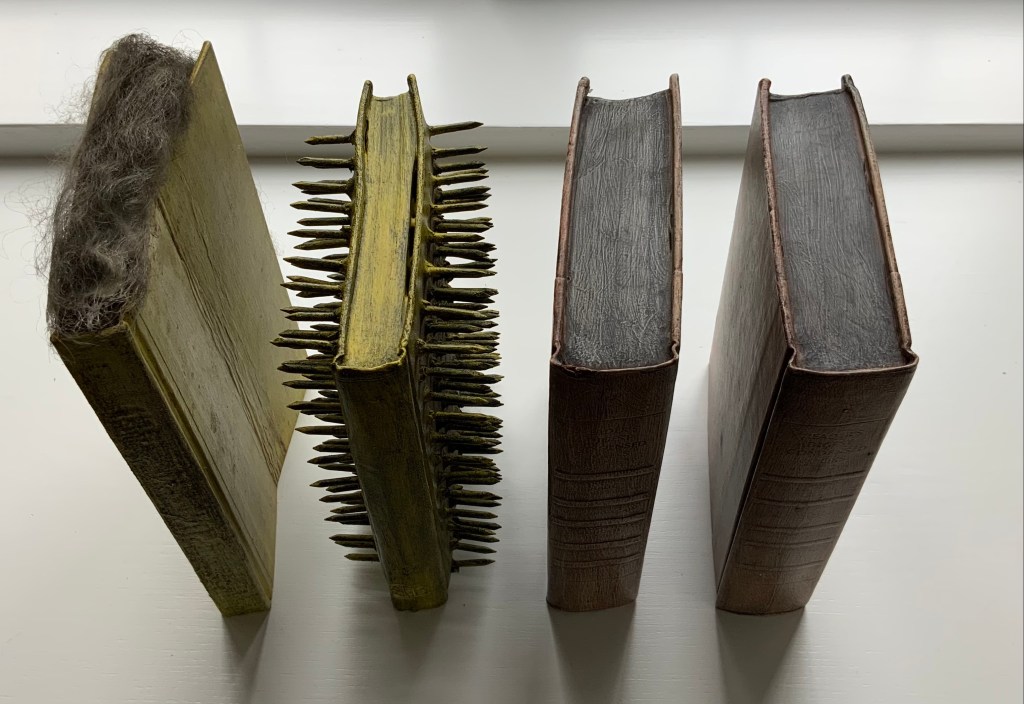
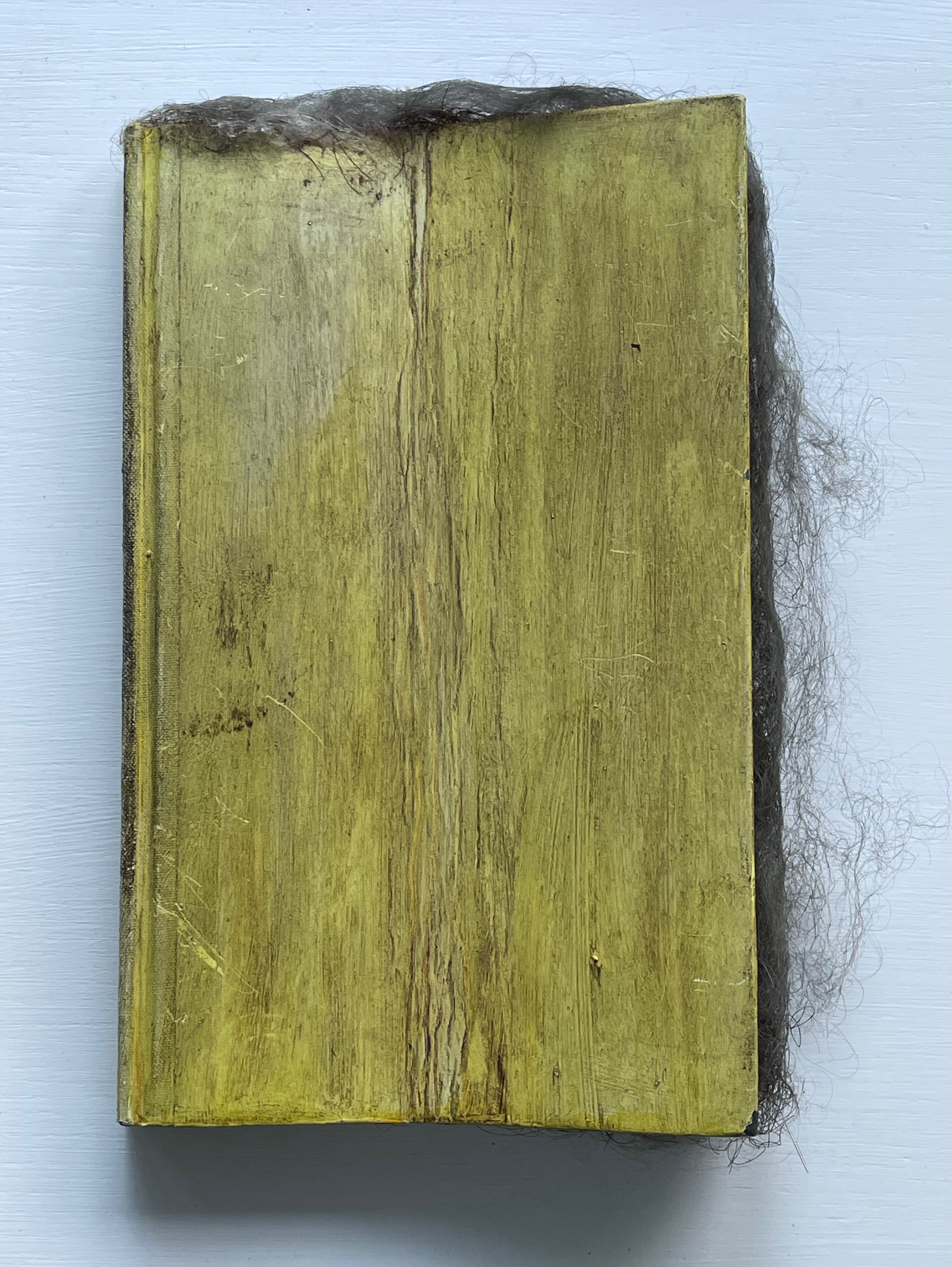
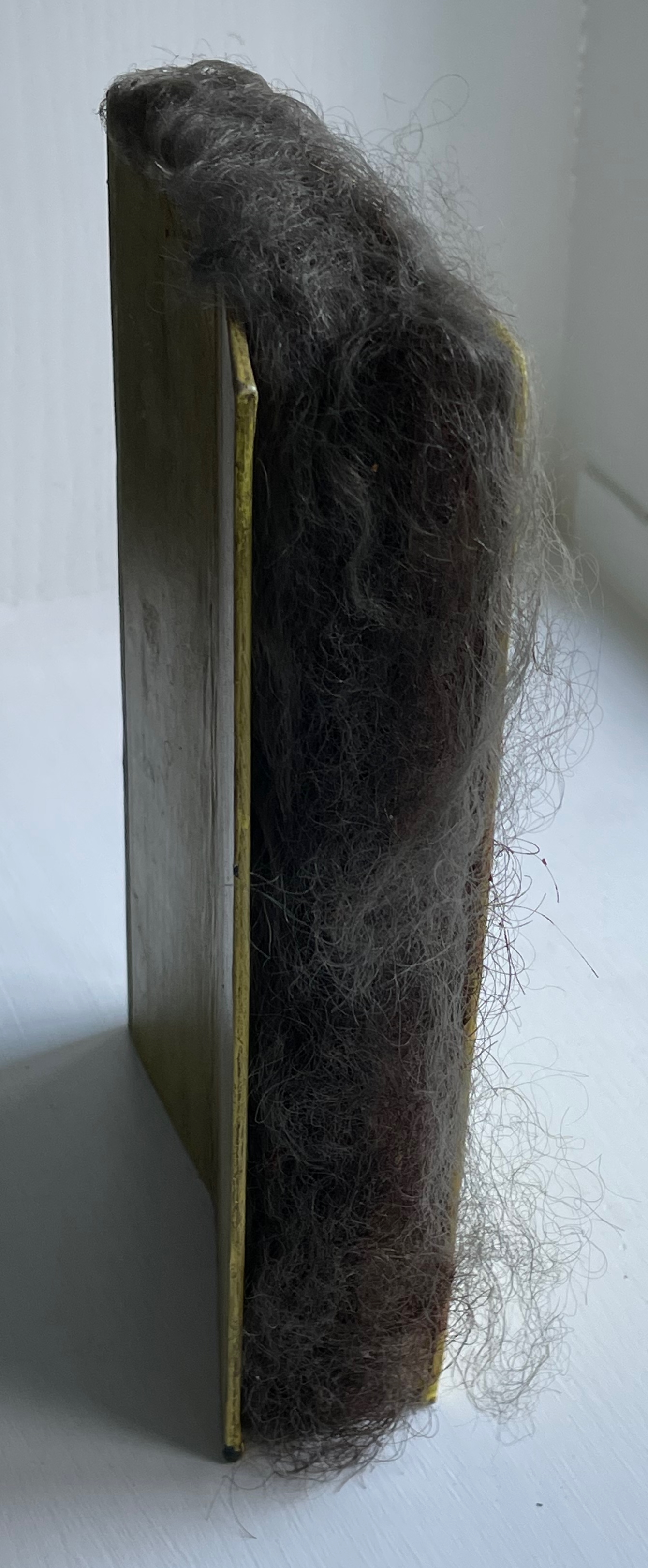
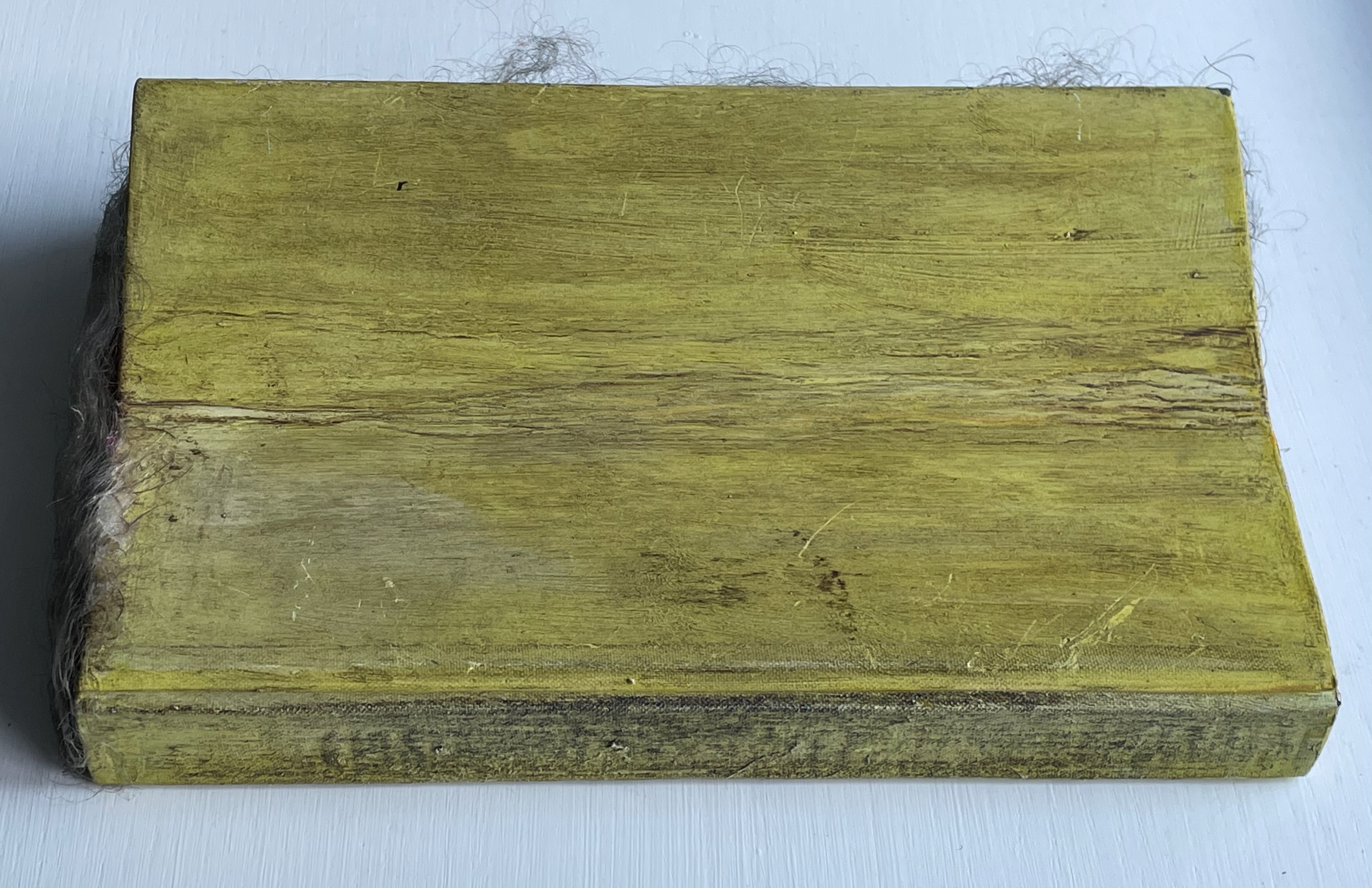
Beauty Book; The Life of Gandhi; Untitled (1973) Barton Lidice Beneš Mixed media book constructions. Acquired from Rago Arts and Auction Center, 23 March 2021; Allan Stone Gallery, New York; artist. Photos: Books On Books Collection.
Beauty Book (1973) Barton Lidice Beneš Altered book with human hair. H220 × W140 × D50 mm. Unique. Acquired from Rago Arts and Auction Center, 23 March 2021; Allan Stone Gallery, New York; artist. Photos: Books On Books Collection.
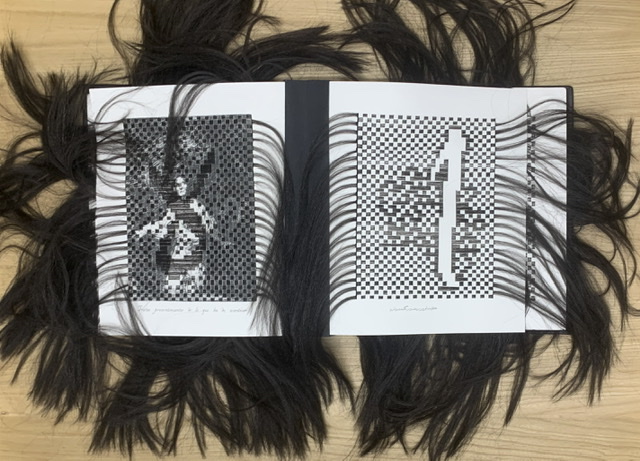
The Sleep of Reason (2023) Masoumeh Mohtadi Photo: Courtesy of the artist.
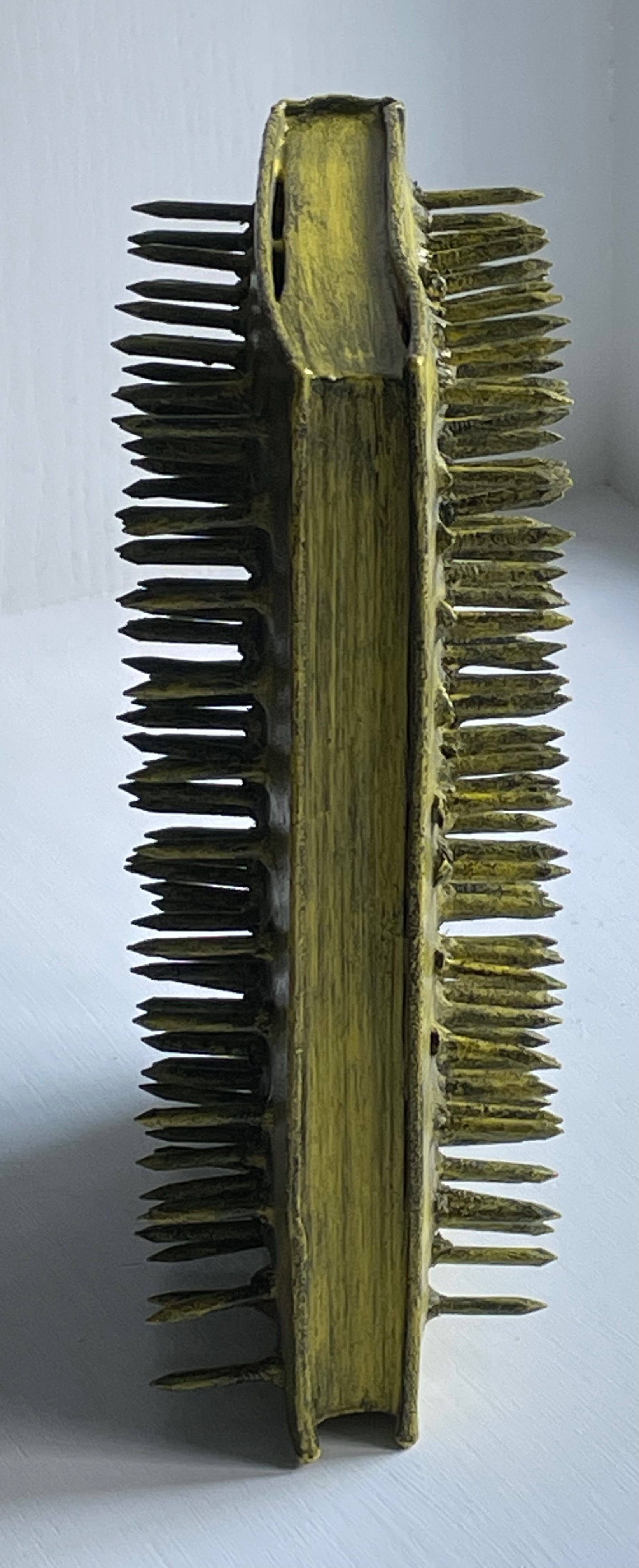
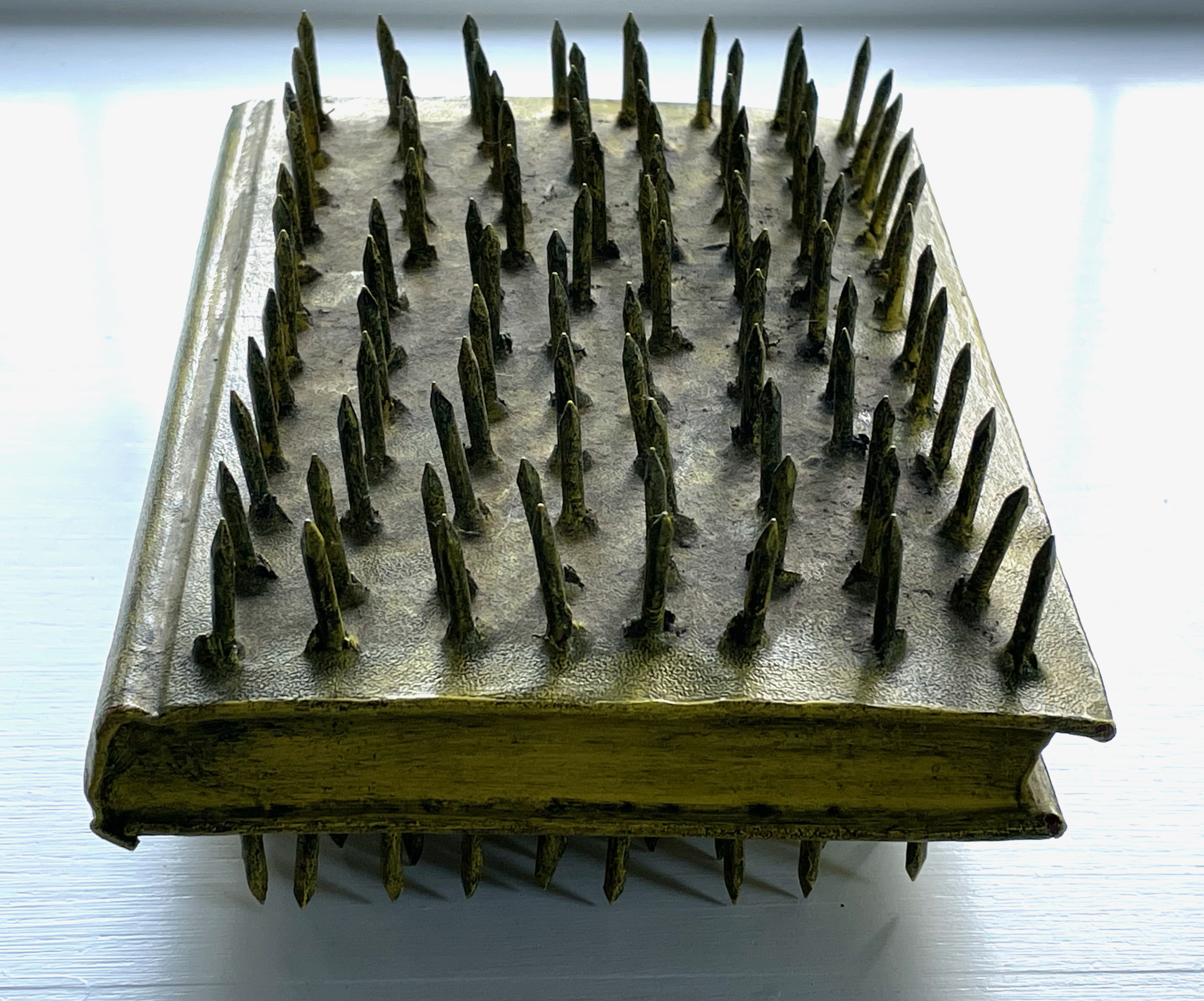
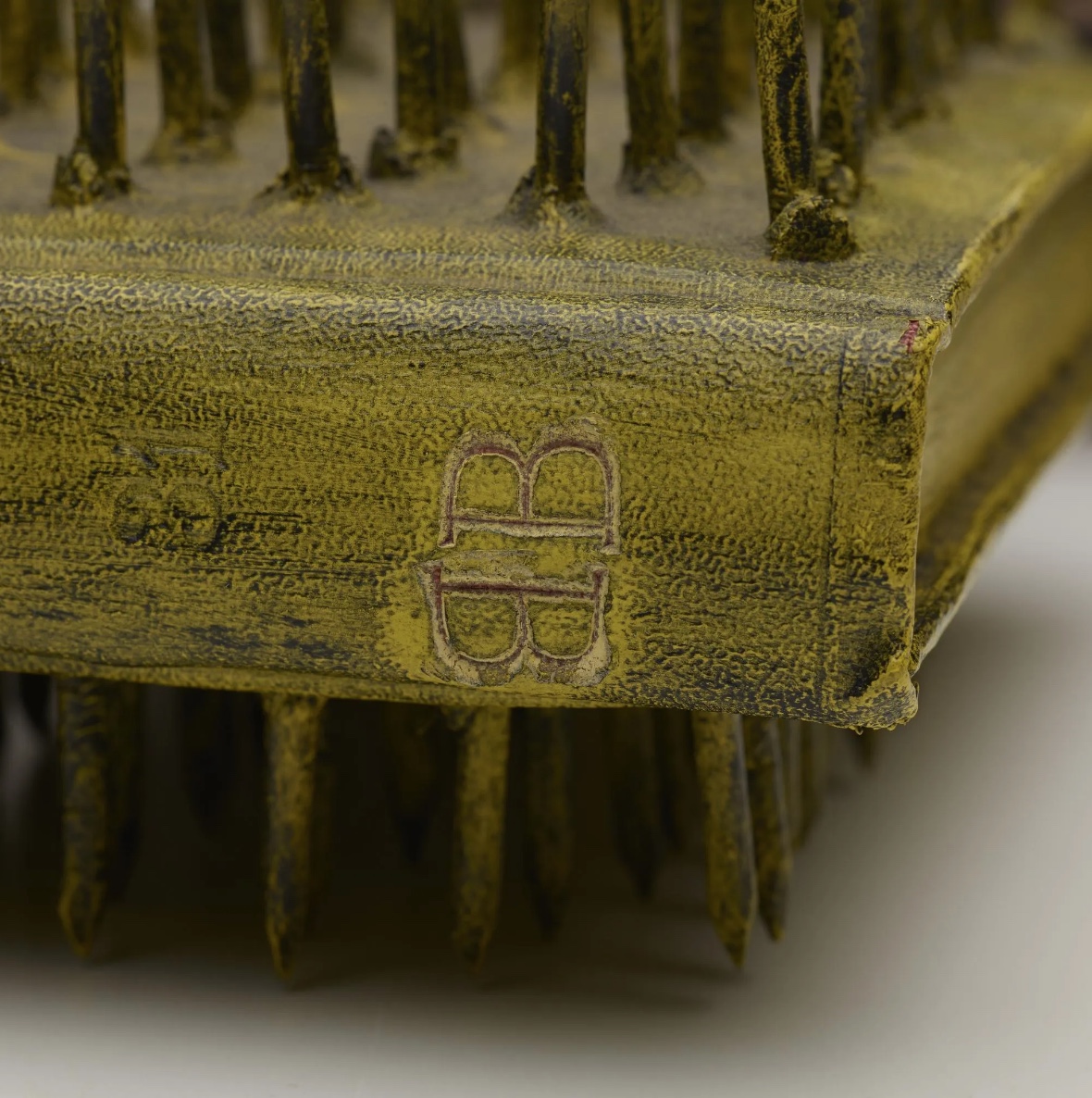
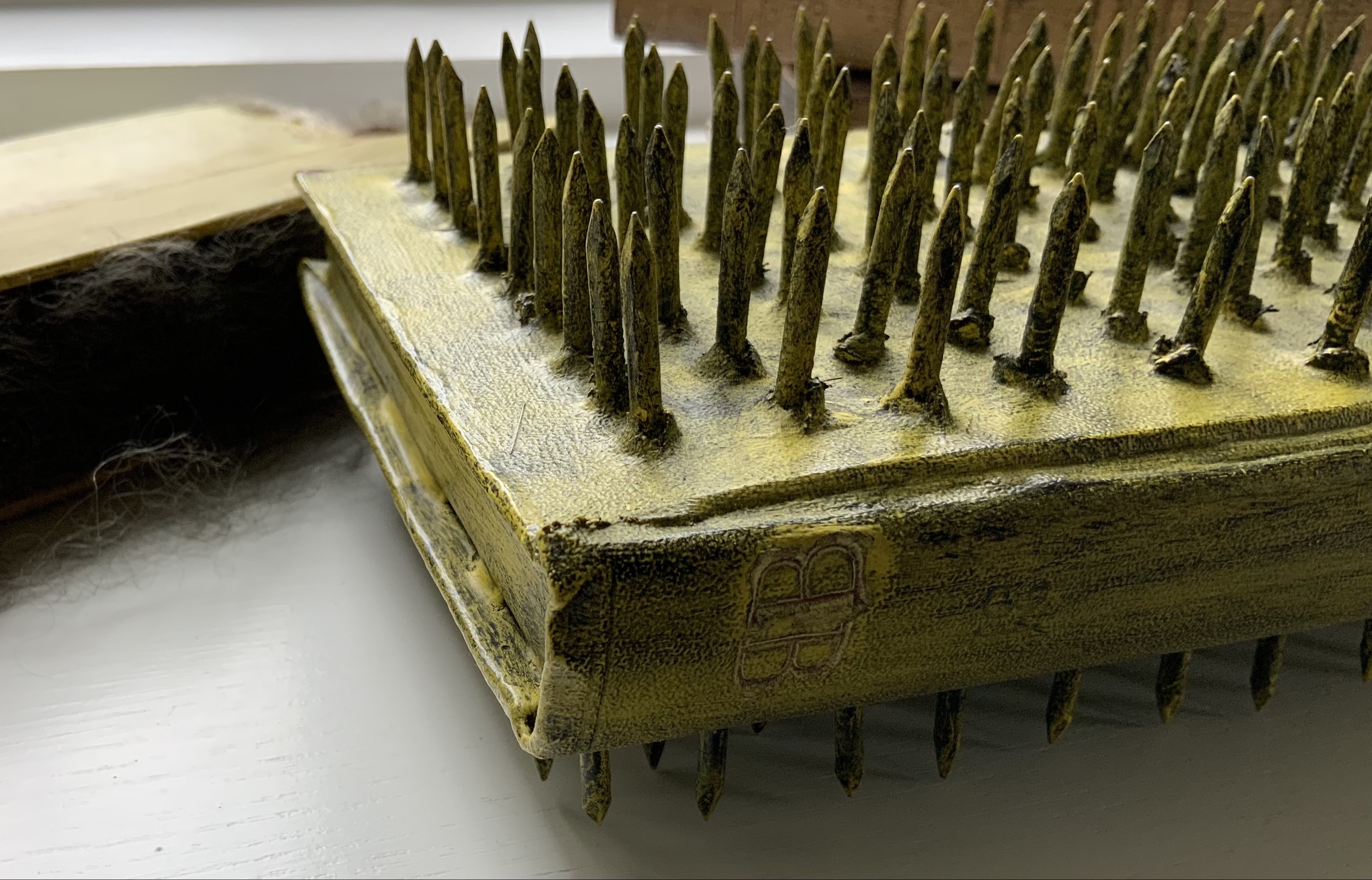
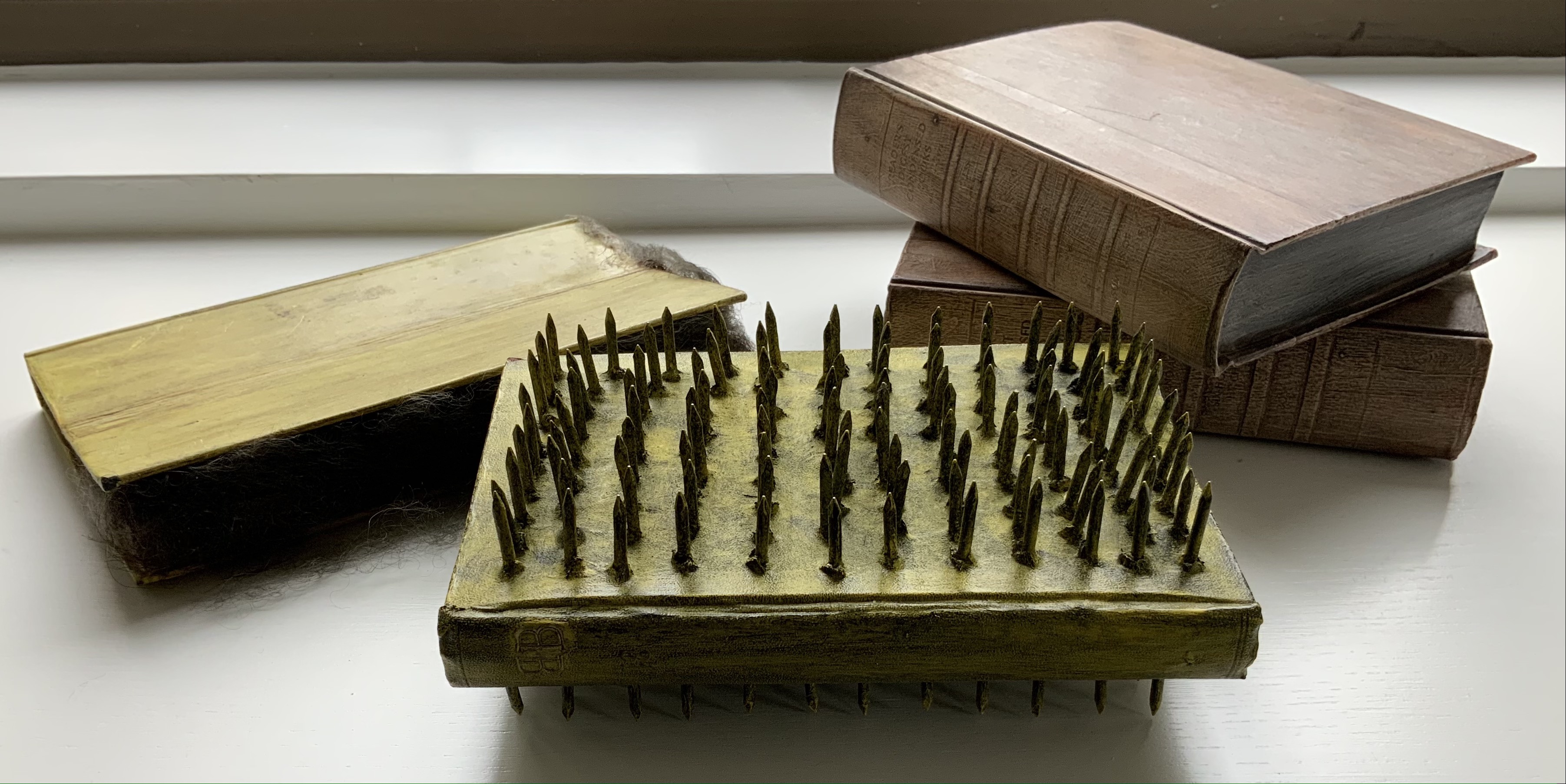
The Life of Gandhi Barton Lidice Beneš Altered book with embedded nails. H197 x W140 x D86 mm. Unique. Acquired from Rago Arts and Auction Center, 23 March 2021; Allan Stone Gallery, New York; artist. Photos: Books On Books Collection.
Beneš’ disrespectfully and adolescently entitled The Life of Gandhi may be the first artist’s book embedded with nails, although Lucas Samaras’ prickly Book 4 (1962) in the Museum of Modern Art might have provided inspiration. Later examples are Floating Concrete Octopus’s* Book of Nails (1992), Daniel Essig’s Book of Nails II (2003), Anne Maree Hunter’s Nailed (2005?), Sasha Meret’s Aggressive Book (2009), Werner Pfeiffer’s Difficult to Fit, Censored Nailbook, and Nailed Shut (ca. 2010-12), and manuel arturo abreu’s Kanga Book (2021). The frequency is considerably less than say treatments 0f Saint Sebastian in painting and sculpture, but the latter had centuries as a subject whereas the book nailed shut has only had decades.
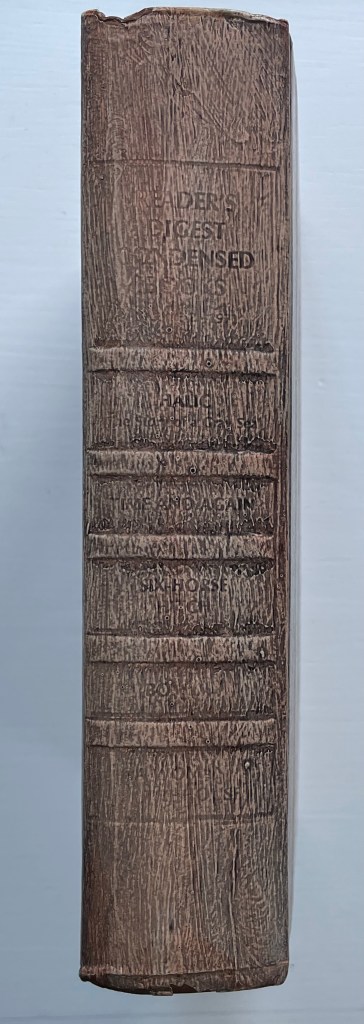
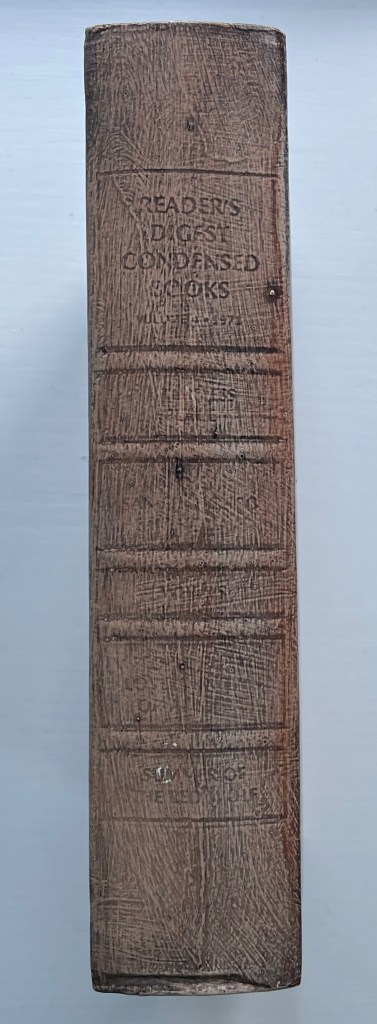
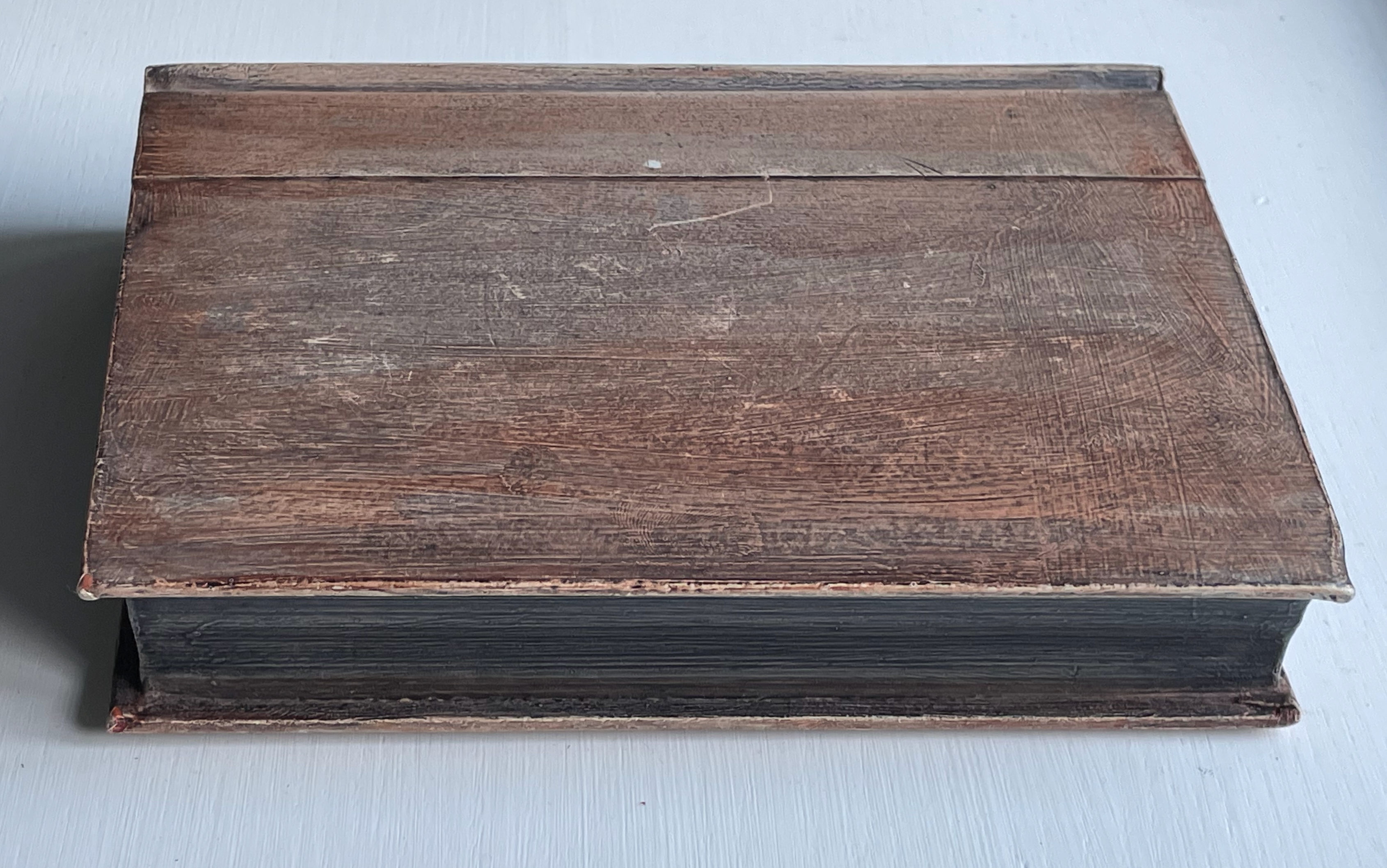
Untitled (1973) Barton Lidice Beneš Altered volumes of Reader’s Digest, sanded and varnished. Each H197 x W140 x D85. Unique. Acquired from Rago Arts and Auction Center, 23 March 2021; Allan Stone Gallery, New York; artist. Photos: Books On Books Collection.
With his two Untitled volumes, Beneš may again lay claim to another first-of-its-kind in this category among artists’ books. Two volumes from the Reader’s Digest Condensed Books series have had their component titles almost completely sanded off. They have been sealed and varnished to constitute a work more naturally called Untitled than any other work of art assigned that ubiquitous title.
These works of book art and his 1970s mail art interactions with Aart van Barneveld and Ulises Carrión secured Beneš’ position among the Fluxus and neo-Dadaist crowd. His later AIDS-related art such as the Lethal Weapon series (199o’s), made with his infected blood, may dominate his legacy, but these three works of book art sculpture place him alongside John Latham and Dieter Roth as an original and vanguard book artist.
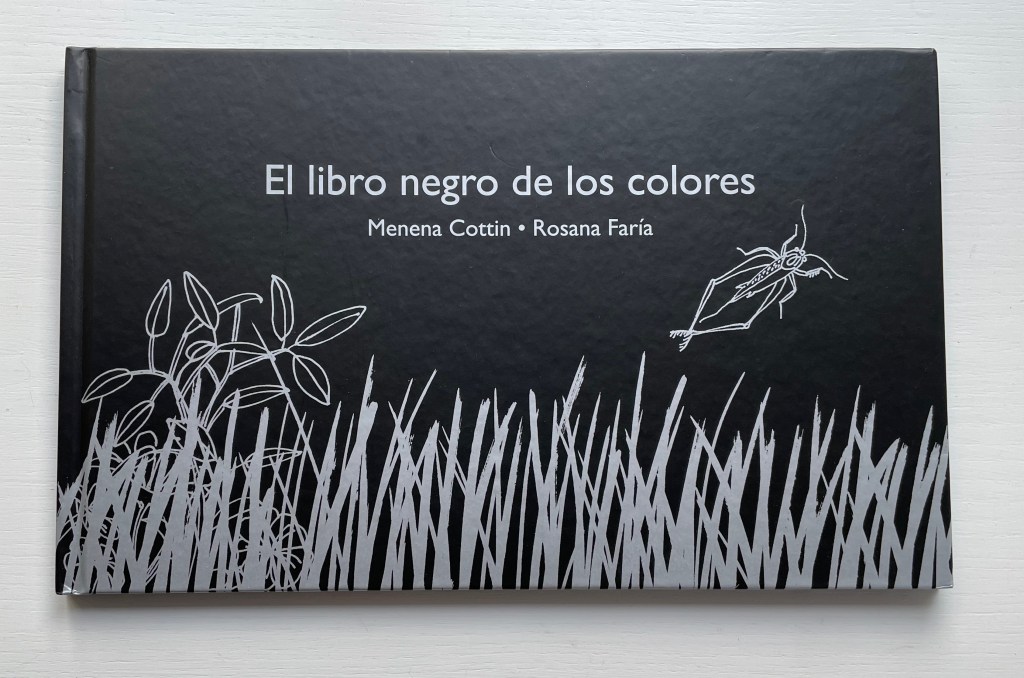
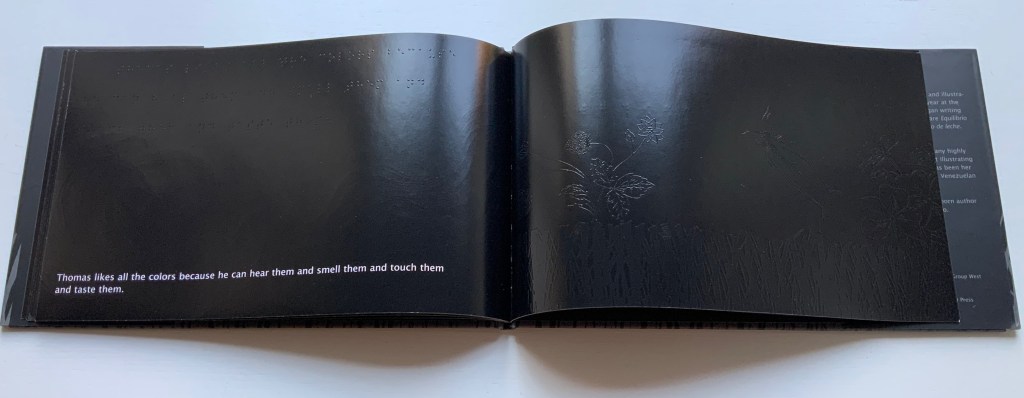
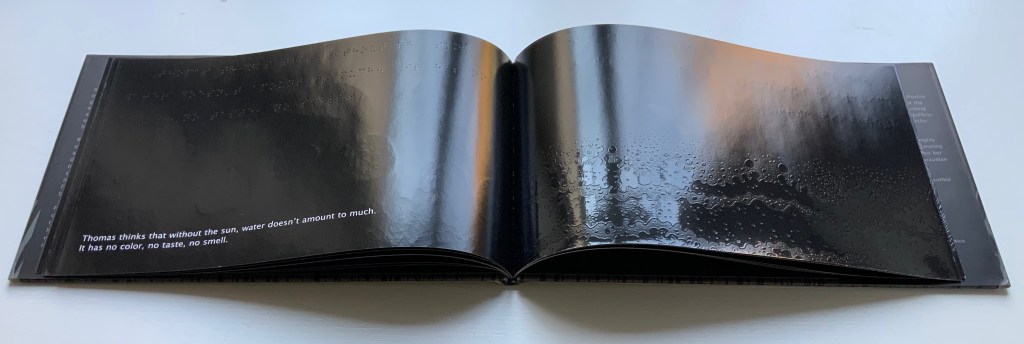
Menena Cottin refers to her works as “concept books”, and there are multiple concepts at work in The Black Book of Colors. Generically, it is a children’s book introducing the reader to colors — but by the absence of color. In white on black, it addresses sighted readers. In Braille, it addresses unsighted readers. With Thomas, who “likes all the colors because he can hear them and smell them and touch and taste them”, the book introduces to sighted and unsighted readers who are not synesthetic the concept of synesthesia and, through it, a new sense of empathy and imagination. The sighted encounter someone with a sensory anomaly, not a disadvantage. In the company of their imagined unsighted co-readers, the sighted may come to empathize with those with sensory differences. The unsighted encounter someone whose sensory anomaly is an advantage. especially as the book favors their own heightened sense of touch.
Thomas says that yellow tastes like mustard, but is as soft as a baby chick’s feathers.
Thomas likes all the colors because he can hear them and smell them and touch and taste them.
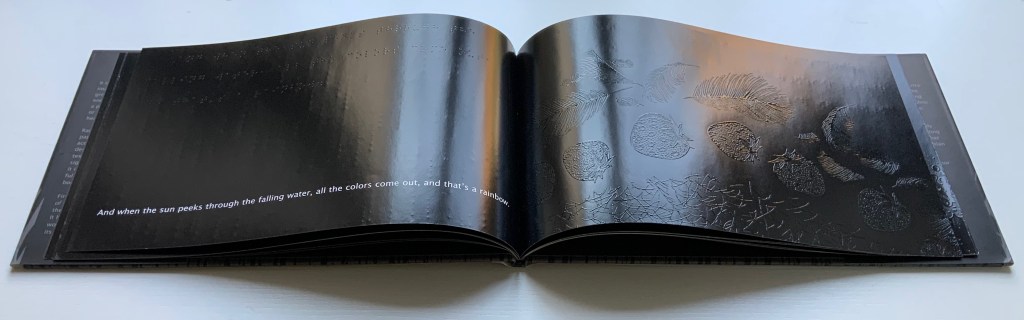
Breaking boundaries in ways similar to those employed by book artists, Cottin manipulates character and narration, also the picturebook’s genres of color recognition and letter recognition (Braille in this case) as well as some of the basic elements of the book (layout, printing in reverse-out and debossed printing). In one of the most sophisticated examples of this, double-page spreads fuse concepts by turning a rainbow into a gathering of raised images of the synaesthetic objects with which colors have already been associated in the book (chick’s feathers, strawberries, leaves).
And when the sun peeks through the falling water, all the colors come out, and that’s a rainbow.
The Black Book uses synesthesia to go beyond the color recognition genre to introduce more complex concepts: the nature of light and water’s lack of color, taste and smell. This stepping outside the genre is another example of the boundary-breaking that artists’ books often perform.
Thomas thinks that without the sun, water doesn’t amount to much. It has no color, no taste, no smell.
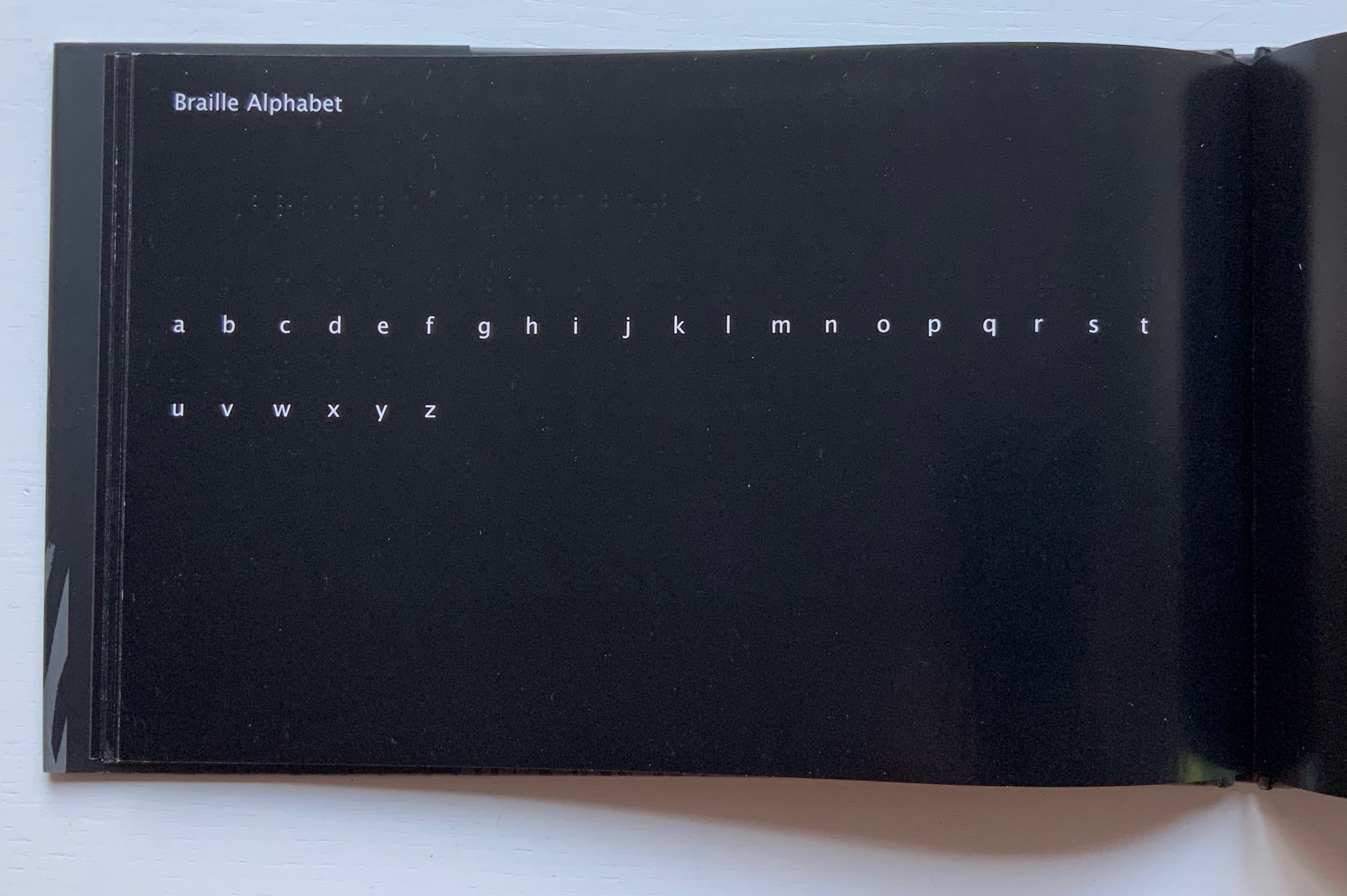
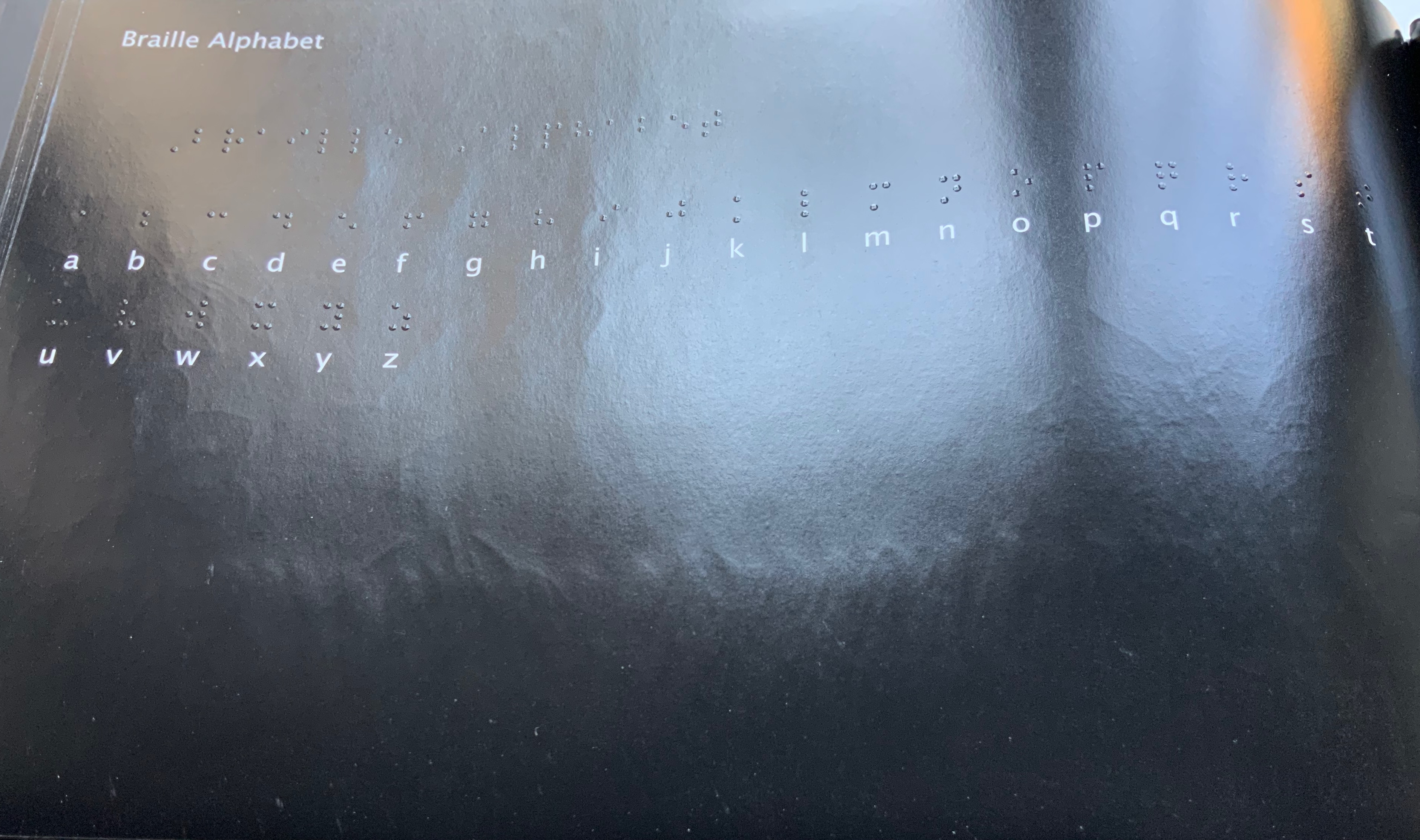
The book ends by asserting its membership in the alphabet book genre by presenting the alphabet in lowercase white on black and in Braille. Across from this verso page, there is no set of raised images on the recto page as there has been so far throughout the book. Knowing from touch that this is the end of the book and noting the absence of any image, sighted and unsighted readers might find this coda a prompt to return to the beginning and “re-read” the images with a greater reliance on touch.
Other books in the Books On Books Collection worth comparing with The Black Book of Colors are
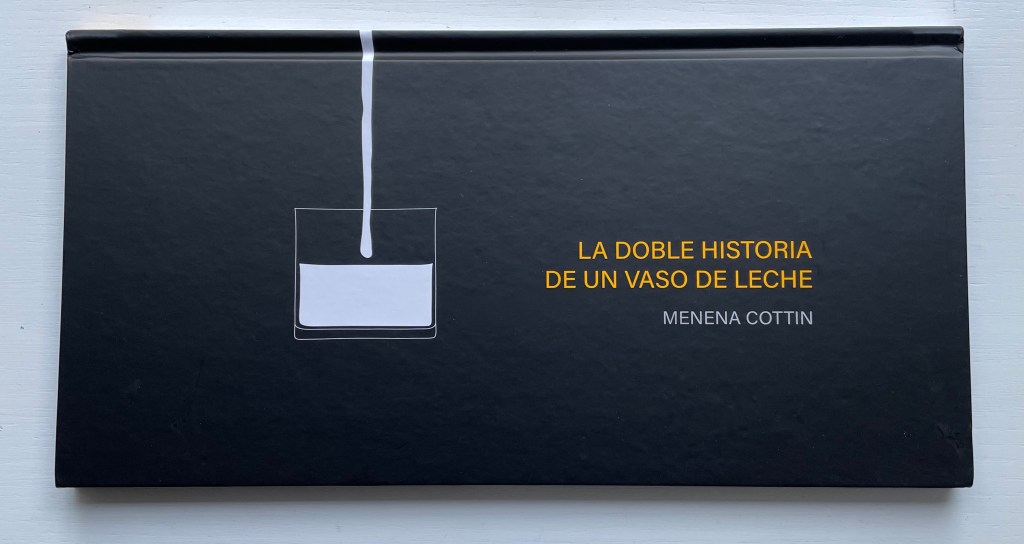
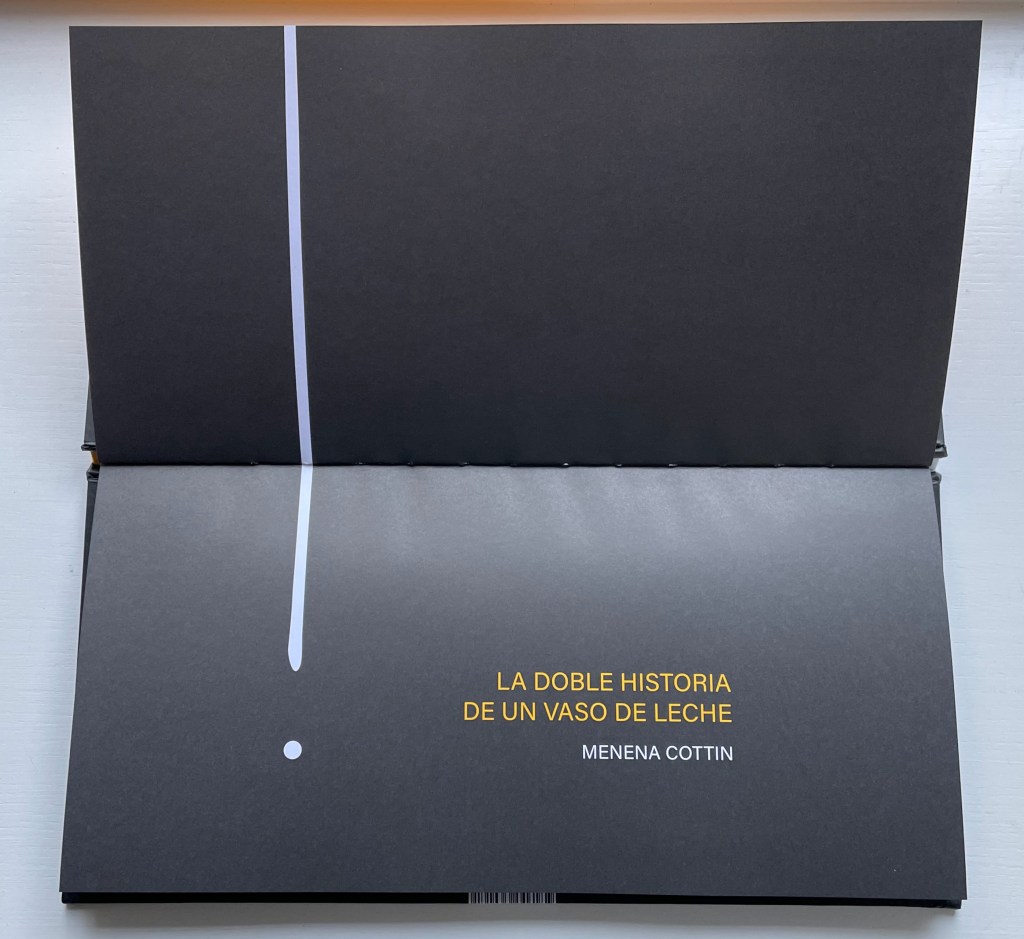
La Doble Historia de un Vaso de Leche(2019) Menena Cottin Casebound landscape, paper over boards, with orange-yellow doublures, sewn. H160 x W310 mm. 24 unnumbered pages. Acquired from the artist, 2022. Photos: Books On Books Collection.
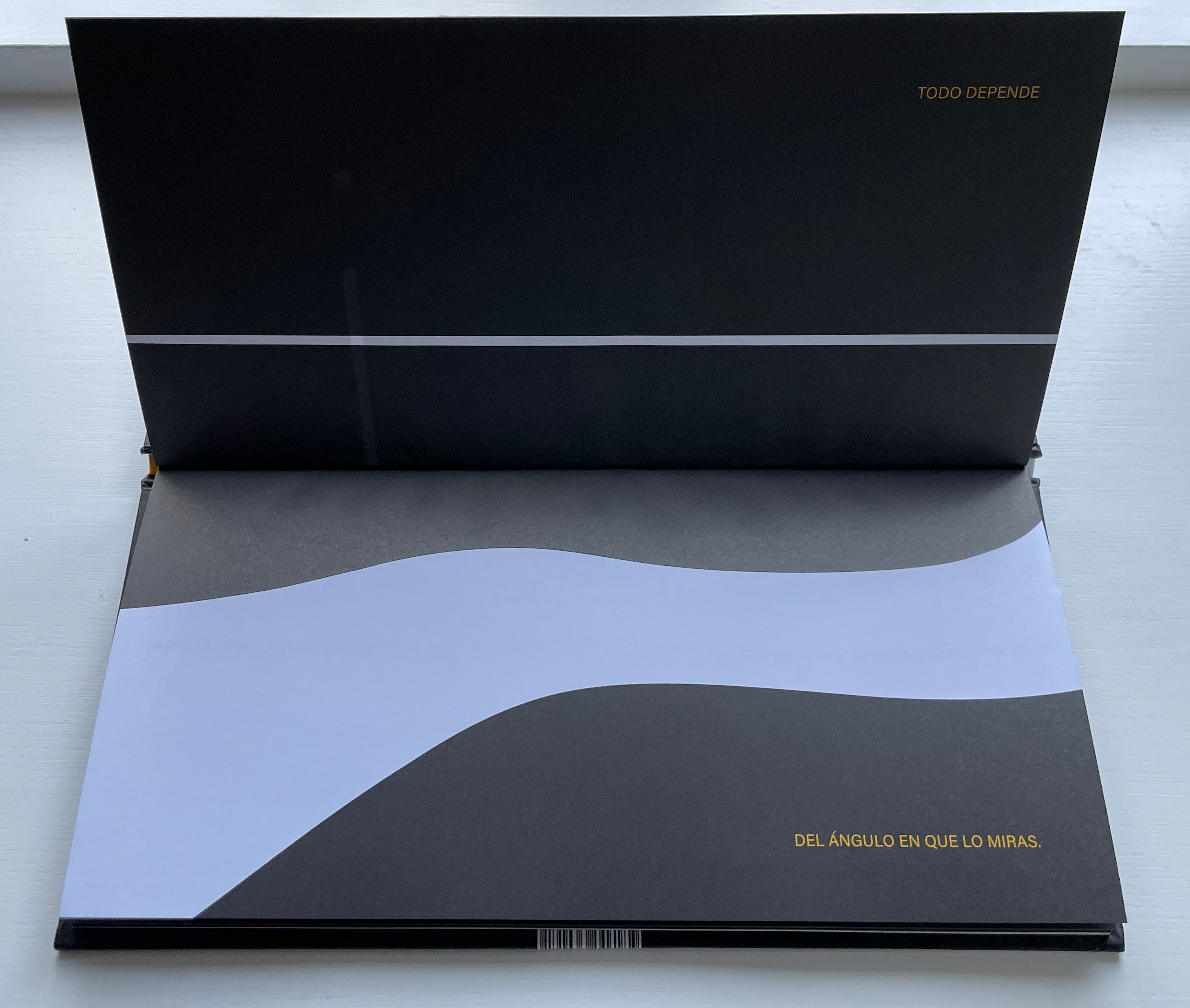
The Double Story of a Glass of Milk opens and closes with a line that echoes the start of William Carlos Williams’ “The Red Wheelbarrow” but is at once more straightforward and just as surprising — as the visual story spills out.
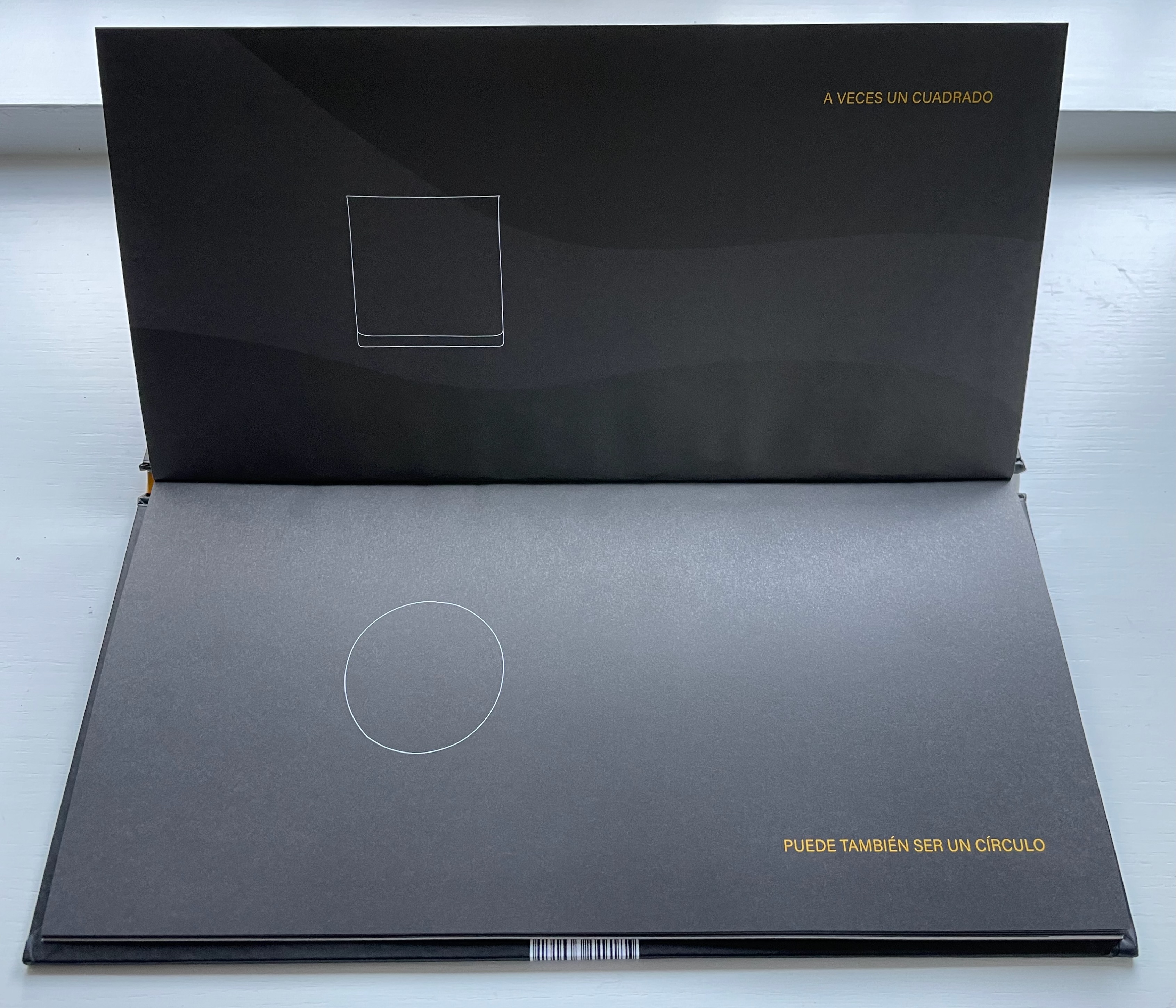
Todo depende del ángulo en que lo miras. A veces un cuadrado puede también ser un circulo y una larga linéa luce como un punto y algo que está solo a medias parece que está lleno. Un mismo cuerpo tiene diferentes caras per a veces te confunde mostrándote una misma forma. Solo si miras a su alrededor descubres que … eso que de frente parece tan discreto desde arriba luce muy escandaloso. Todo depende del ángulo en que lo miras.
“Everything depends on the angle from which you look at it. Sometimes a square can also be a circle and a long line looks like a dot and something only half full looks full. The same body has different faces but sometimes it confuses you by showing you a different shape. Only if you look you discover that … what from the side looks so innocent looks shocking from above. Everything depends on the angle from which you look at it.”
Equilibrio (2019)
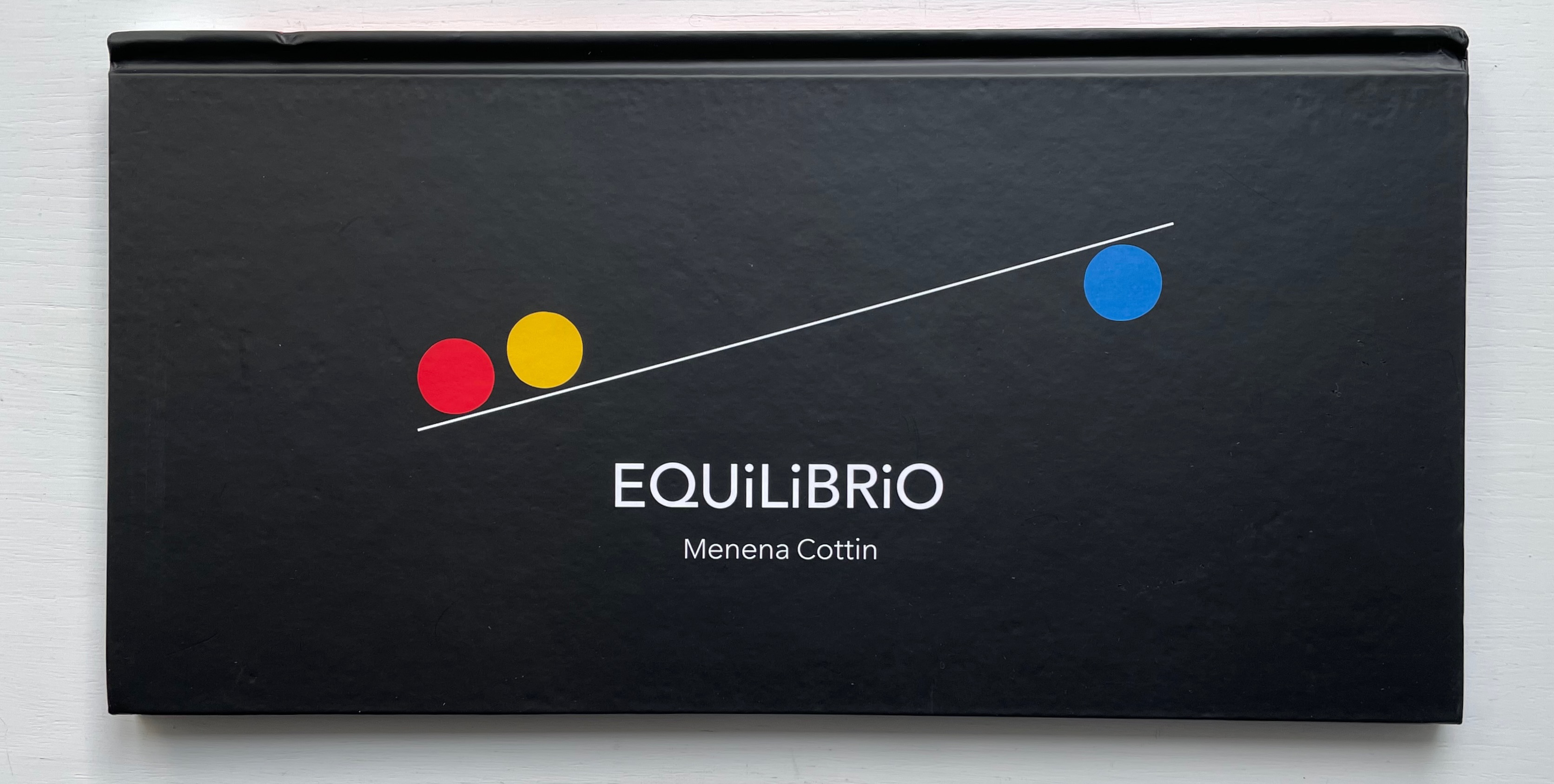
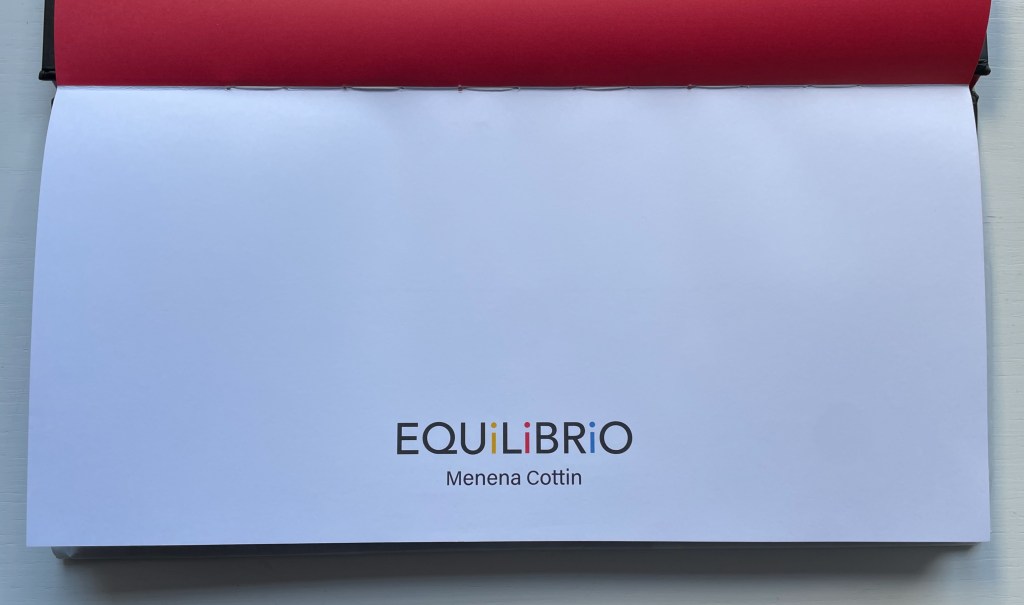
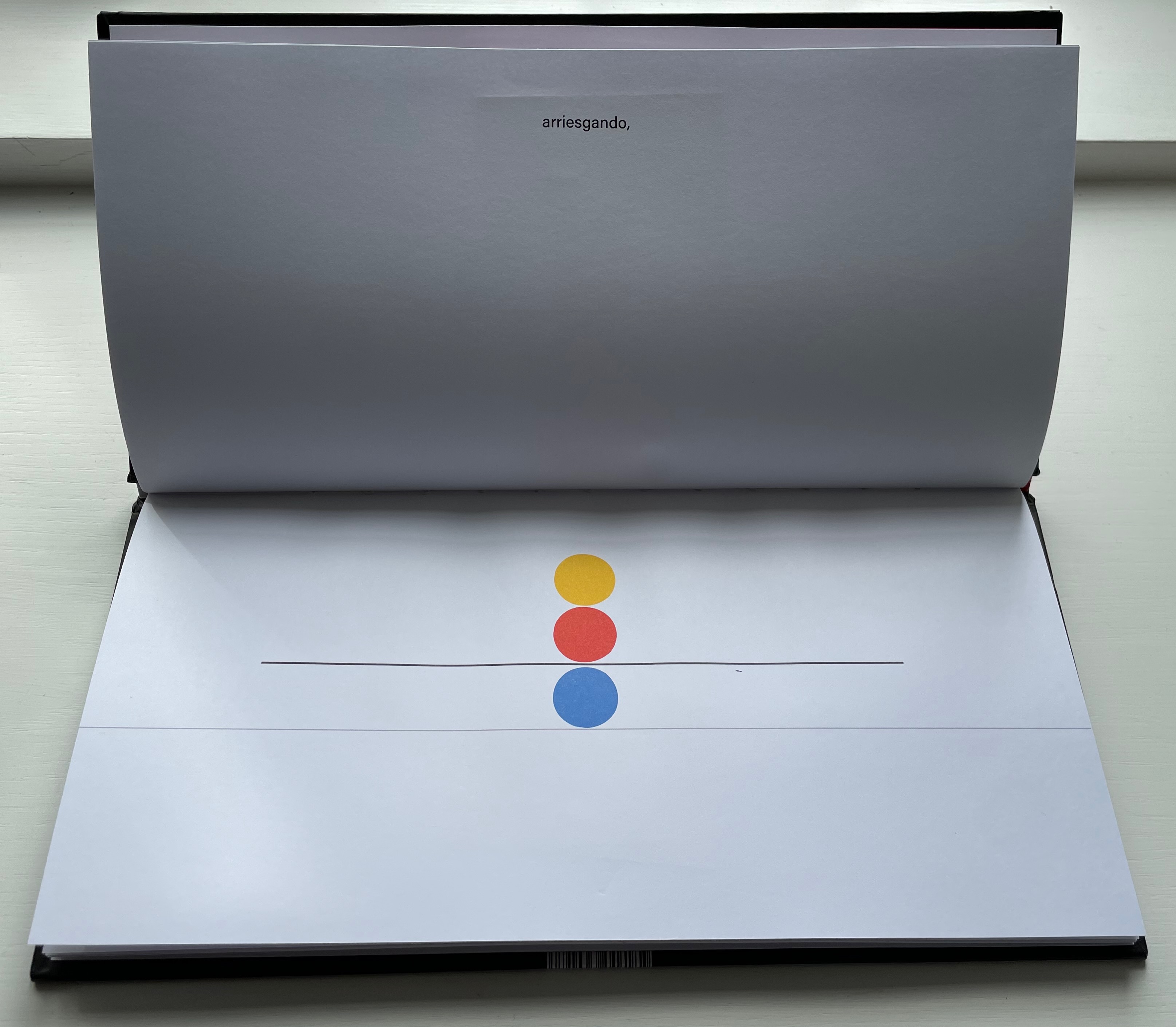
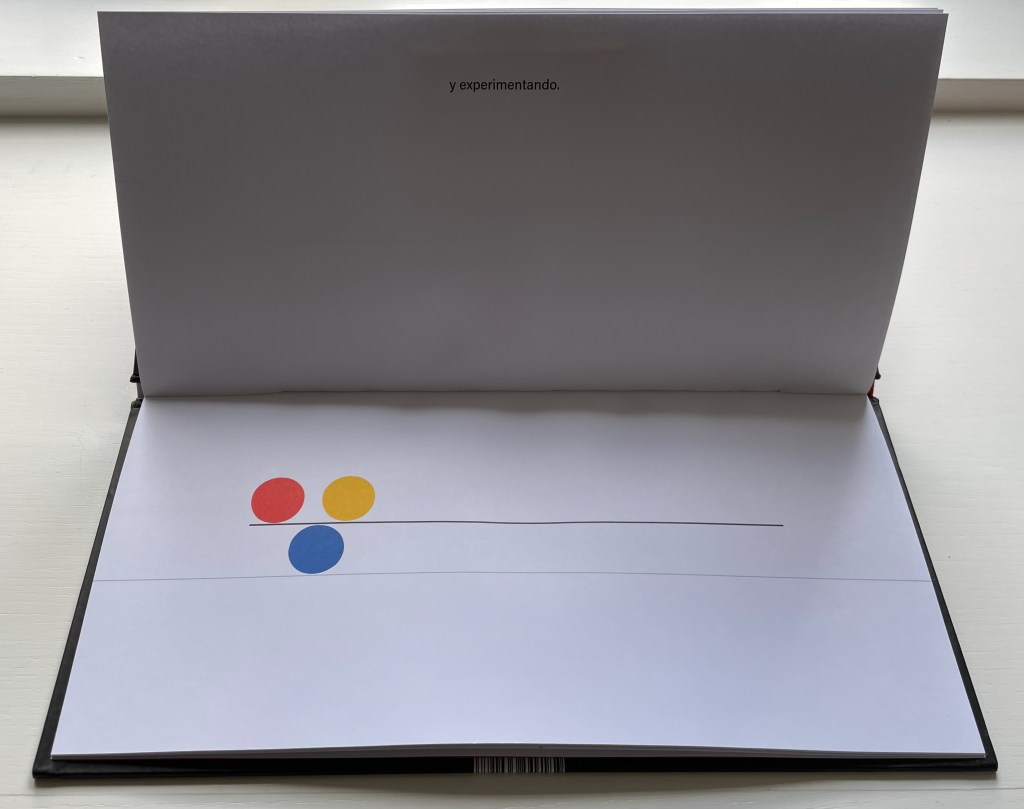
Equilibrio(2019) Menena Cottin Casebound landscape, paper over boards, with red doublures, sewn. H160 x W310 mm. 25 unnumbered pages, last page on inside of flyleaf. Acquired from the artist, 23 August 2022. Photos: Books On Books Collection. Displayed with the author’s permission.
The three colored balls on the cover give their colors to the three i’s in Equilibrio on the title page, announcing the statement to come: El equilibrio es cuestión de balance (“Equilibrium is a question of balance”).
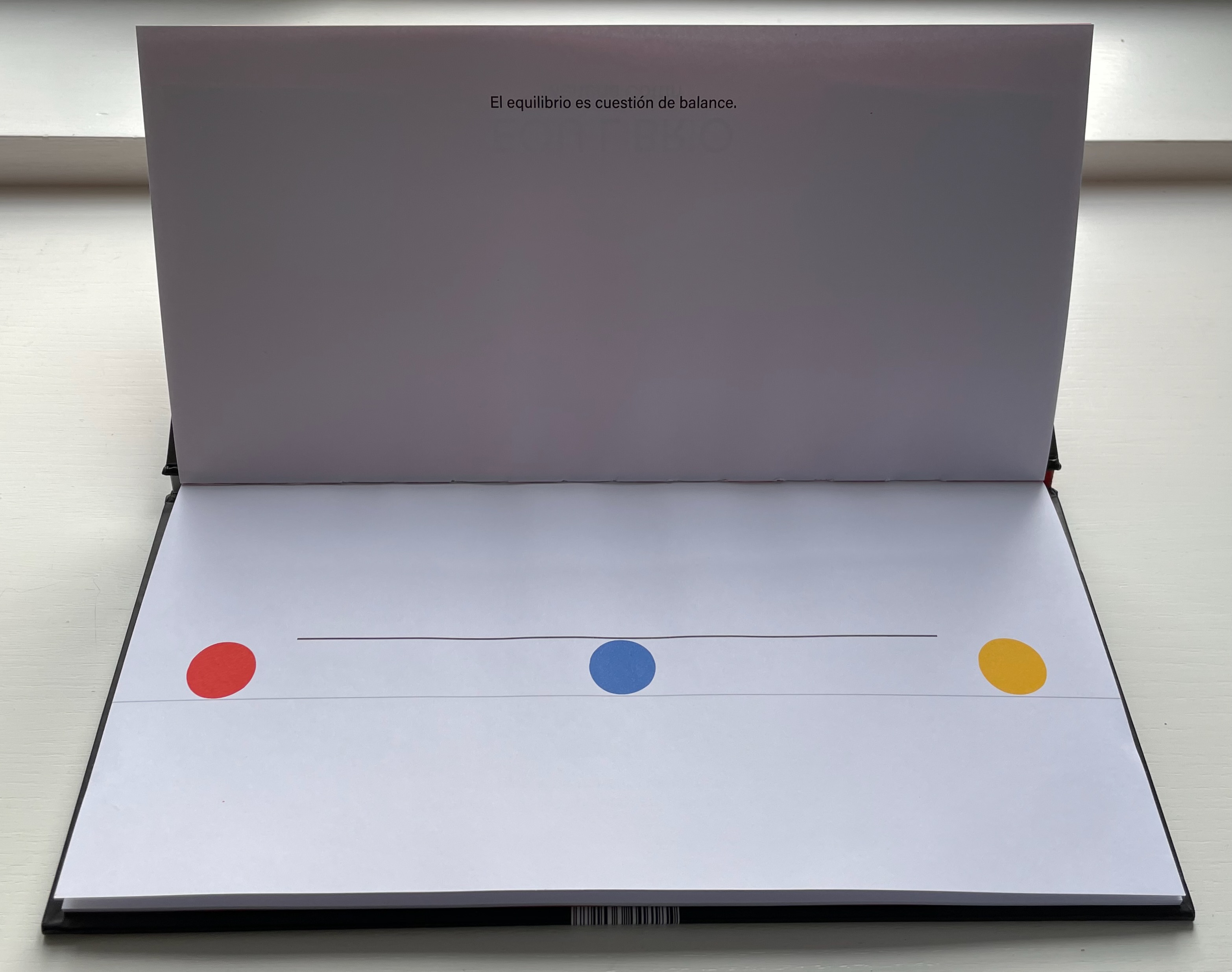
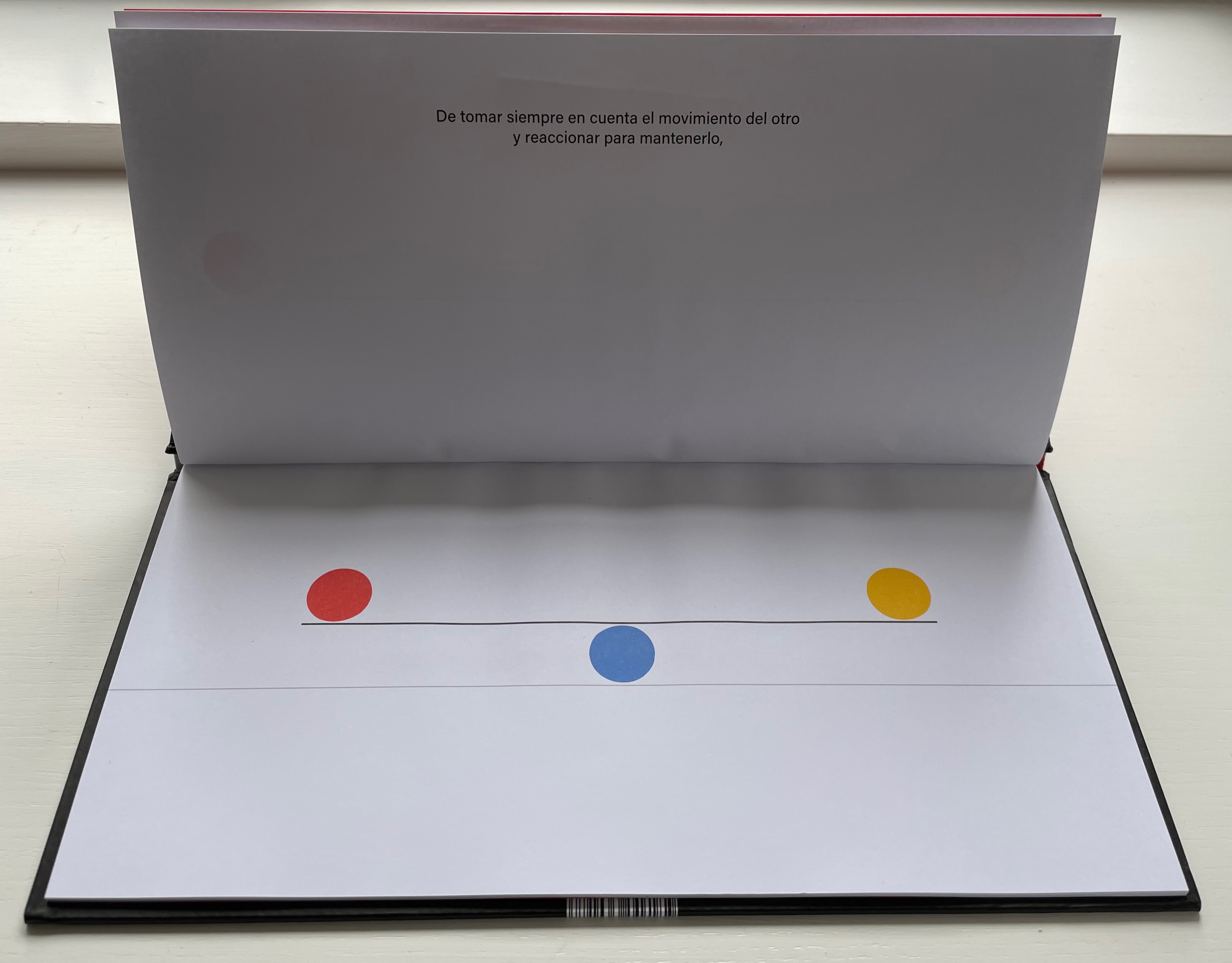
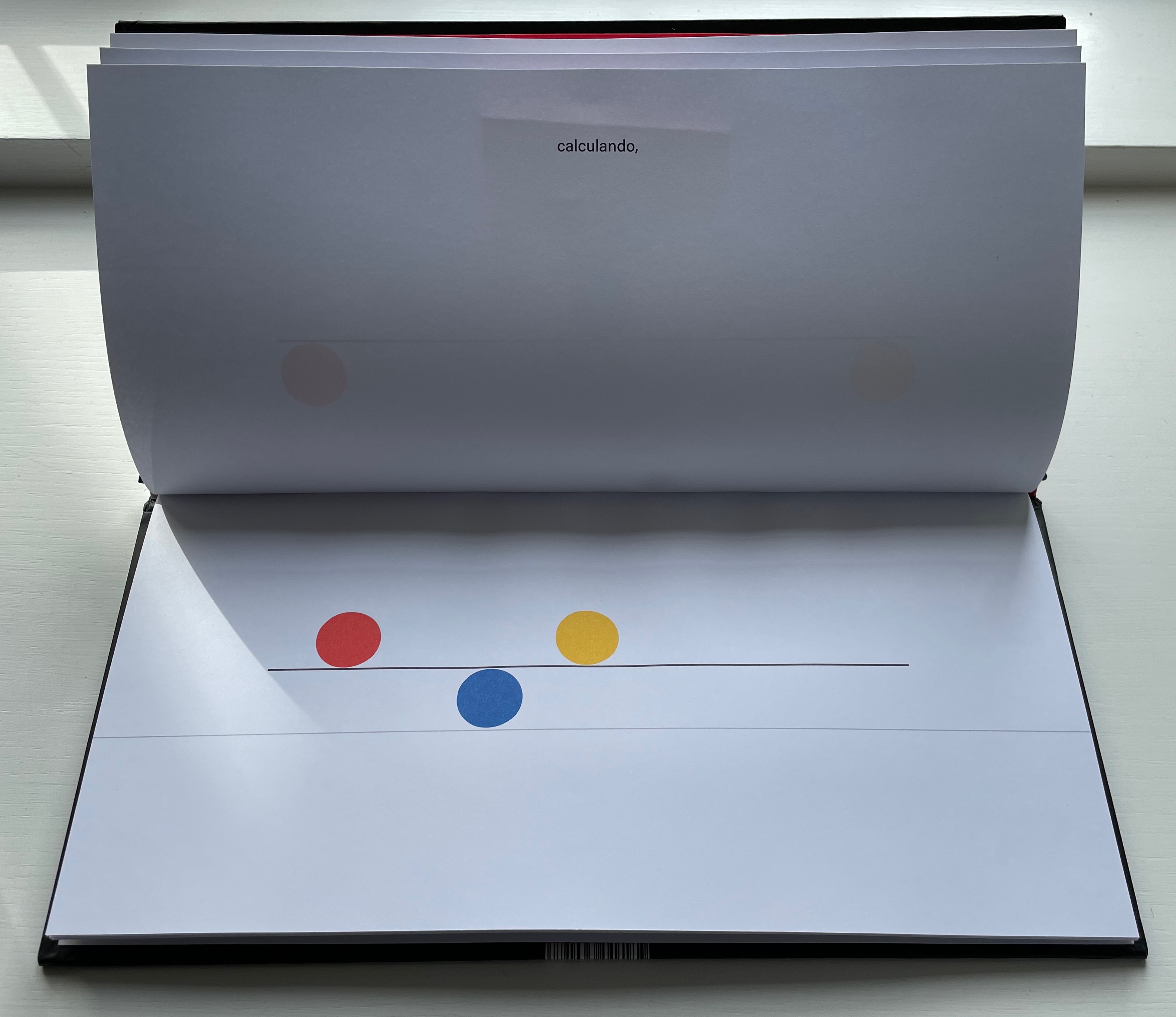
El equilibrio es cuestión de balance. De tomar siempre en cuenta el movimiento del otro y reaccionar para mantenerlo, calculando, arriesgando, y experimentado. Algunos se ponen a jugar sin pensar en las consecuencias entonces se rompe el equilibrio y cada quien hace lo que quiere … pero luego sienten deseos de regresar y cada quien busca su lugar.
“Equilbrium is a question of balance. Of always taking into account the movement of the other and reacting to maintain it, calculating, risking, and experimenting. Some people start to play without thinking about the consequences, then the balance is broken and everyone does what they want … but then they feel the desire to return and everyone looks for their place.”.
As in The Black Book of Colors, there is more than one concept at play, the lesson of equilibrium coming with lessons in community and relationships.
El Tiempo (2018)
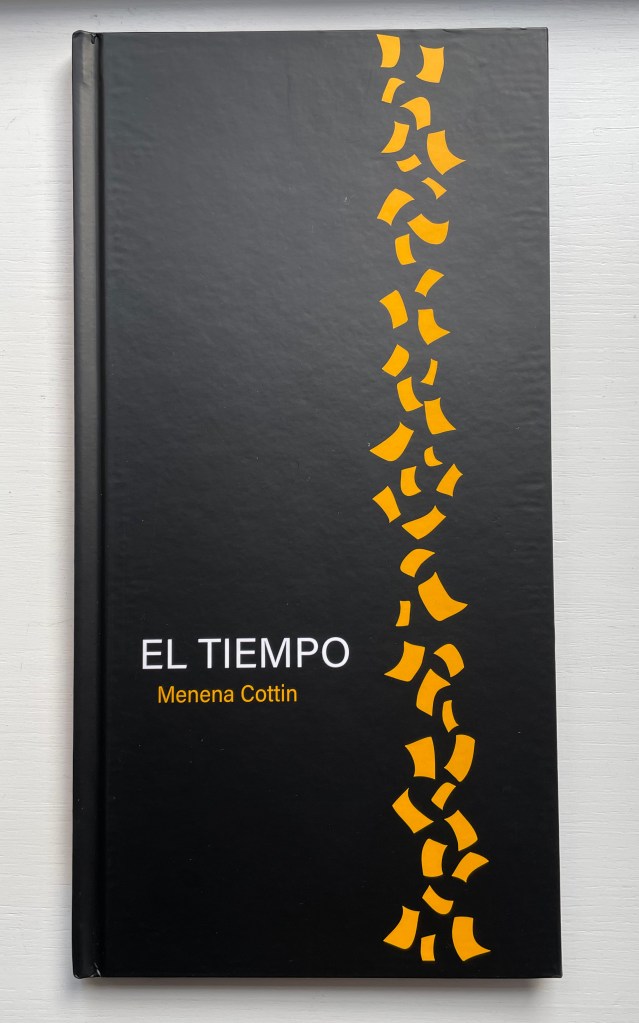
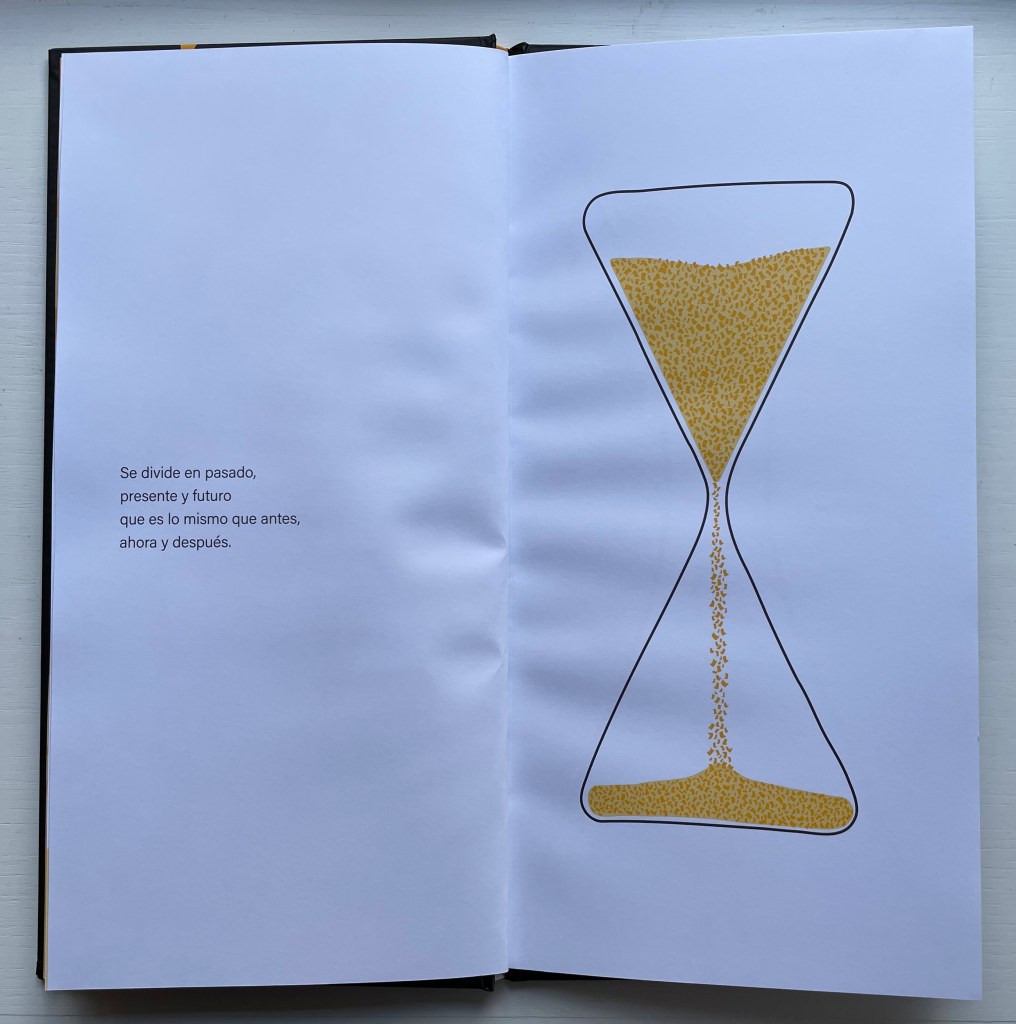
El Tiempo (2018) Menena Cottin Casebound portrait, paper over boards, with orange-yellow doublure at front, orange-yellow/black at back, sewn. H310 x W160 mm. 24 unnumbered pages. Acquired from the artist, 23 August 2022. Photos: Books On Books Collection. Displayed with author’s permission.
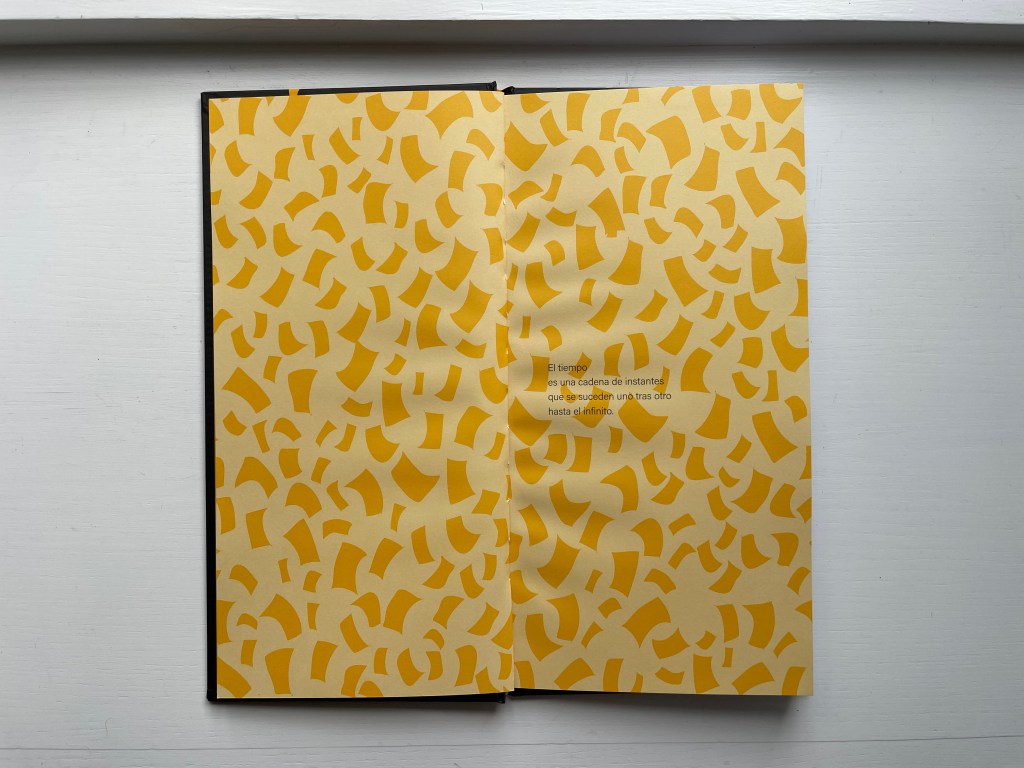
Cottin introduces the concept of Time with two metaphors — one verbal, one visual.
Verbally: El tiempo es una cadena de instantes que se suceden uno tras otro hasta el infinito. [Time is a chain of instants one following another until infinity.] Visually: Instants of time are like pages, pages from a diary.
Even in an hour glass, the instants of time are golden pages — Se divide en pasado, presente y futuro que es lo mismo que antes, ahora y después. — [dividing the past, present and future which is the same as before, now and after].
When the future runs out, that is of course when the pages run out, visually and tactilely.
Ana con A, Otto con O (2015)
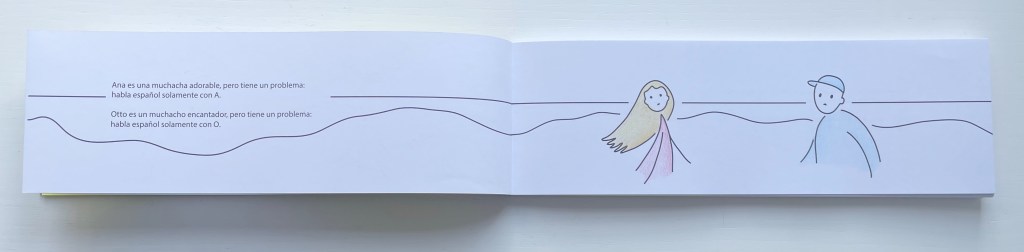
Ana con A, Otto con O (2015) [Ana with an A, Otto with an O] Menena Cottin Bradel binding with cloth spine, paper over boards, yellow doublures, leaves in Chinese fold. H85 x W260 mm. 42 unnumbered pages. Acquired from the artist, 23 August 2022. Photos: Books On Books Collection. Displayed with author’s permission.
With this little book, Menena Cottin has secured a place among the Oulipians. Where Georges Perec wrote a novel without the letter E, Cottin has written and created an artist’s book in which the characters have a somewhat opposite challenge.
Ana es una muchacha adorable, pero tiene un problema: habla español solamente con A. Otto es un muchacho encantado, pero tiene un problema: habla español solamente con O. Un domingo por la mañana, en isla de Margarita, Ana sale a caminar por la playa. Otto sale a caminar por la playa. De repente, Ana se tropieza con alguien … –Aah! –Oh!
[Ana is a lovely girl, but she has a problem: she speaks Spanish only with words that have an A. Otto is a lovely boy, but he has a problem: he speaks Spanish only with words that have an O. One Sunday morning, on Margarita Island, Ana goes for a walk on the beach. Otto goes for a walk on the beach. Suddenly, Ana bumps into someone … –Aah! –Oh!]
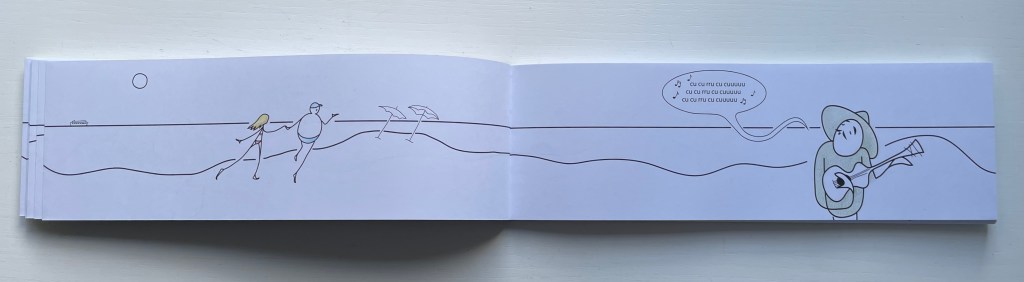
When they make small talk about the weather, Ana says, Clara mañana [Clear tomorrow] with which Otto agrees, Con sol [With sun]. Ana tries again with a leading Gran playa, la mar calmada … agradar andar acá. [Great beach, calm sea… it’s nice to walk here.], but Otto can only come up with ¡Como, no! [Of course!].
Eventually Otto catches on and proposes they go for a swim. After, as they walk along the beach being serenaded by a guitar-playing singer whose nonsense refrain is with syllables that have only U, Otto invites Ana to lunch at the beachside restaurant El Pez [The Fish]. There they meet the friendly waiter Pepe, who likewise has a problem: he speaks Spanish only with words that have an E. When their meal ends and Otto sees the bill, he grows pale, suspiciously throws himself to the ground, cries out he’s been poisoned, and then runs off with Pepe in pursuit of payment. Poor Ana wanders back down the beach, but bumps into another character, more handsomely drawn and simpatico: Allan with an A. Colorín colorado, as the Spanish say [And that’s the end of this story], but not until the last page where the character who has been lounging in a beach chair all along now stands, revealing her name on her chair — Iris — and holding a sign that reads Fin.
The rule-abiding dialogue strings the reader along as effectively as the horizon line that runs from page to page over the Chinese folded folios from the beginning to the end. It is a design feature that will be much easier to reproduce than will a translation into English or any other non-Romance language that is as delightful as — or as “consonant” with — Ana, Pepe, Iris, Otto and the singer singing
Las Letras (2008/2018)
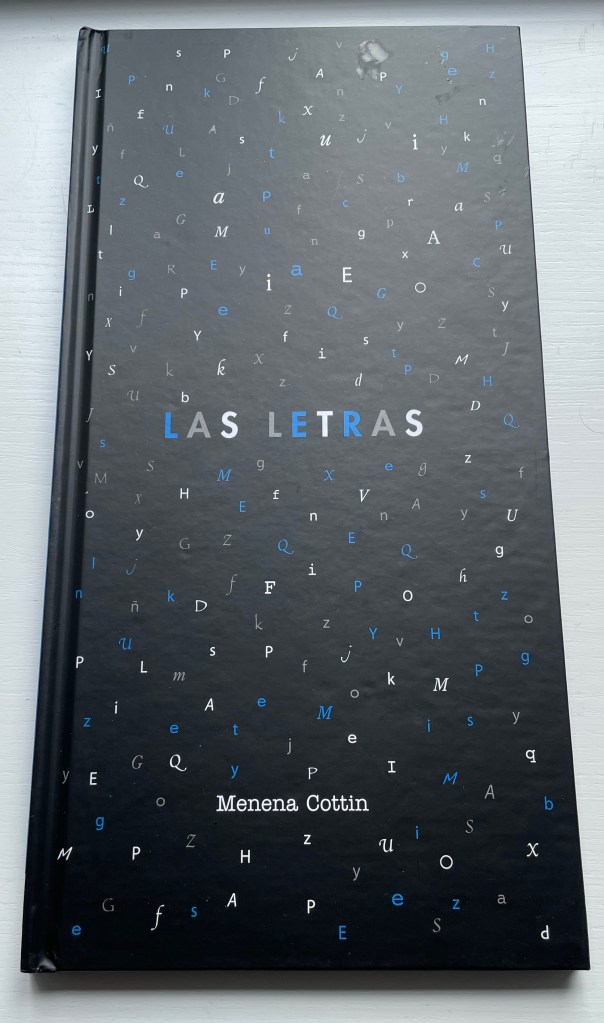
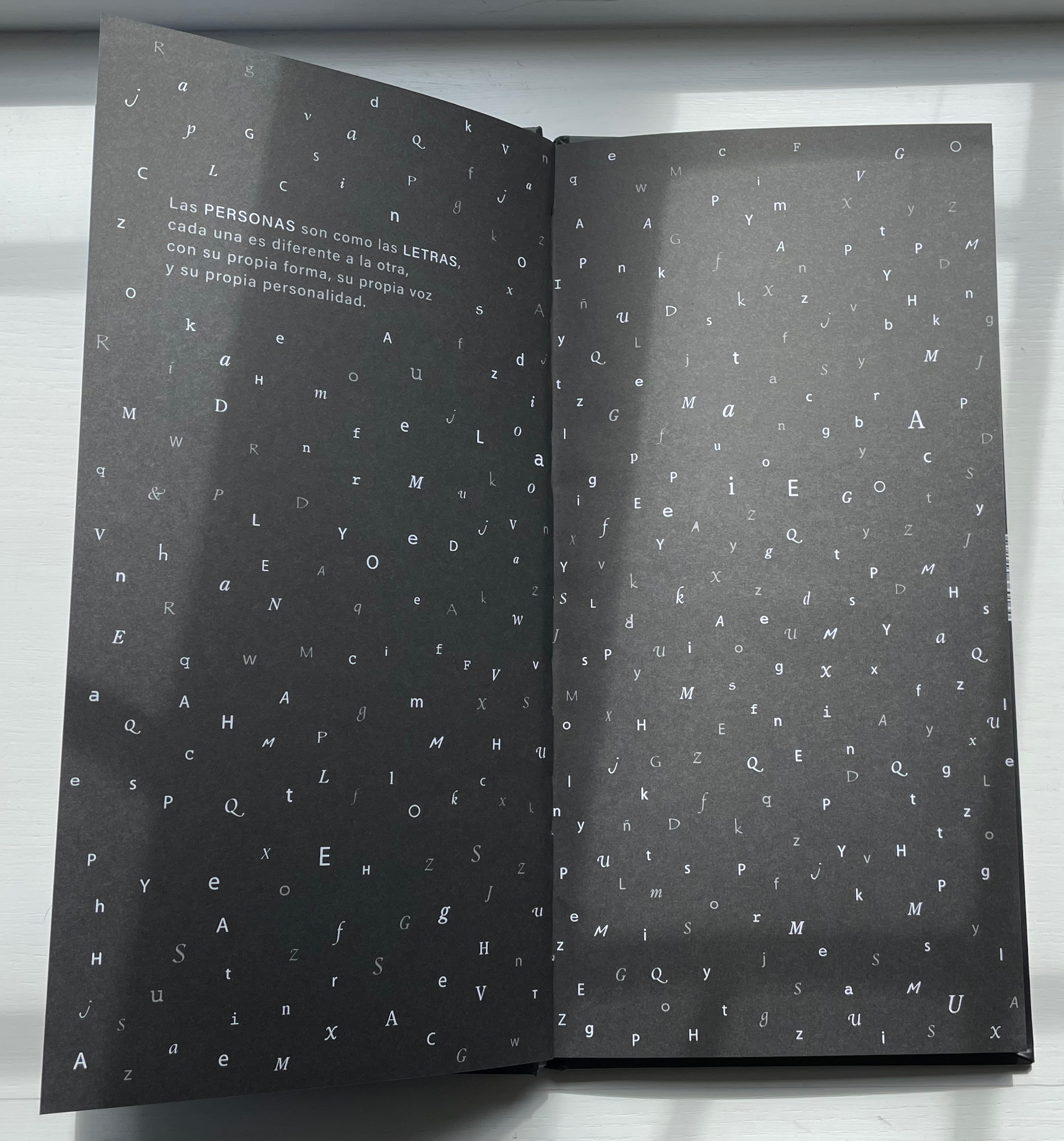
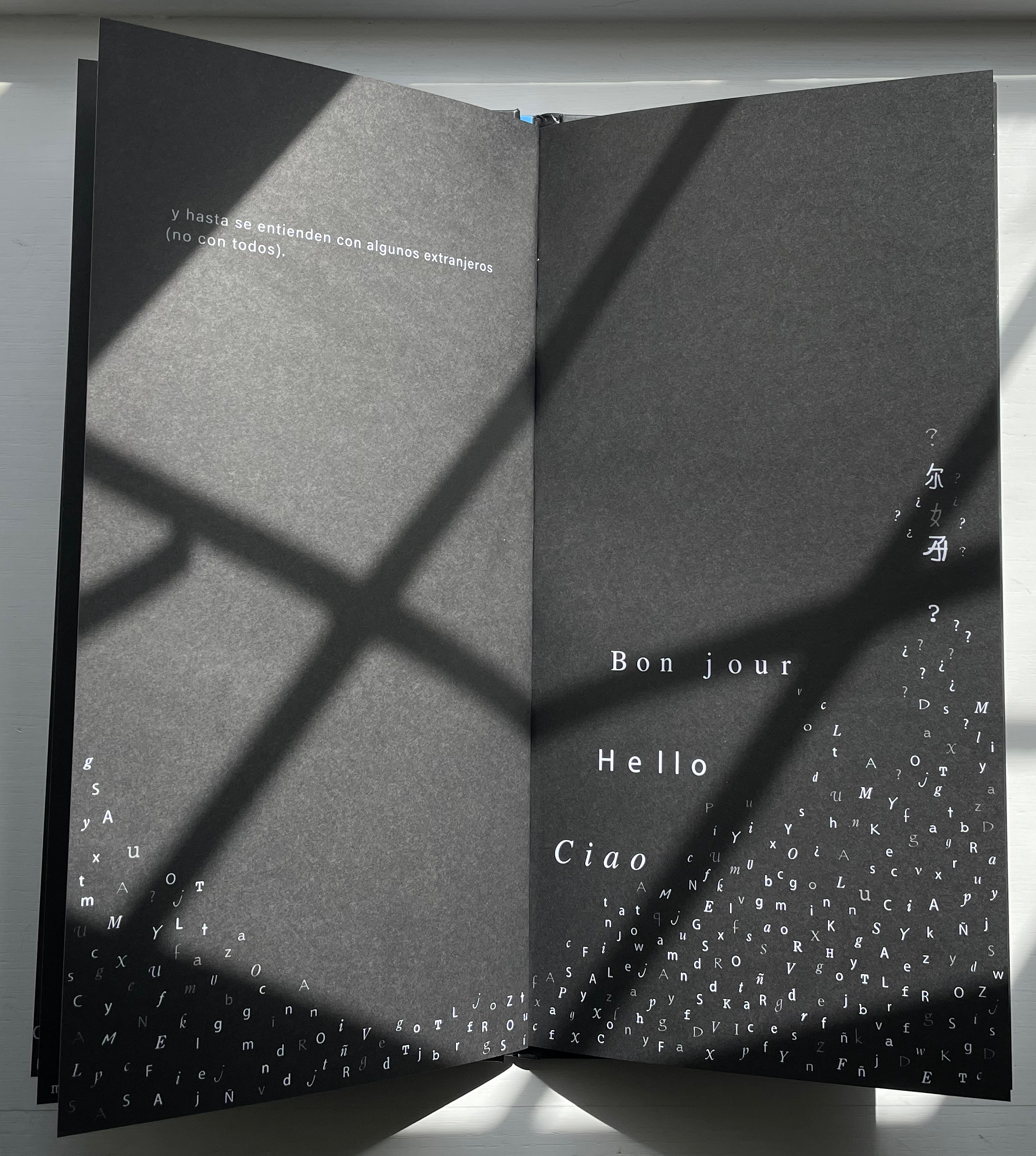
Las Letras (2018) [Letters] Menena Cottin Casebound portrait, illustrated paper over boards, endpapers. H200 x W205 mm. 24 unnumbered. Acquired from the artist, 23 August 2022. Photos: Books On Books Collection. Displayed with author’s permission.
Las Letras has appeared in two editions (2008 and 2018). There are slight grammatical differences, but the meaning remains unchanged. As in Equilbrio, where Cottin finds in an abstract concept a metaphor for interdependence in human relationships, in Las Letras Cottin finds a metaphor for tolerance and communication in the alphabet. Even letters themselves celebrate our differences.
Las personas son como las letras, cada una es diferente a la otra, con su propia forma, su propia forma, su propia voz y su personalidad. Pueden ser gordas, flacas, sencillas o complicados. Algunas son muy populares y se les ve por todas partes, en cambio, a las más tímidas les gusta salir poco. …
[People are like letters, each one is different from the other, with its own form, its own shape, its own voice and its own personality. They can be fat, skinny, simple or complicated. Some are very popular and are seen everywhere, while the shyer ones don’t like to go out much. …]
Other children’s/artists’ books in the Books On Books Collection worth comparing with Las Letras are:
Nikolajeva, Maria, and Carole Scott. 2007. How picturebooks work. New York: Routledge Taylor & Francis Group.
Outlaw, Christopher. 17 April 2017. “FILBo 2017“. The Bogotá Post. Accessed 30 October 2011.
Scott, Carole. 2014. “Artists’ books, Altered books, and Picturebooks”. In: B. Kümmerling‐Meibauer, ed.,Picturebooks: Representation and Narration. London, New York: Routledge.
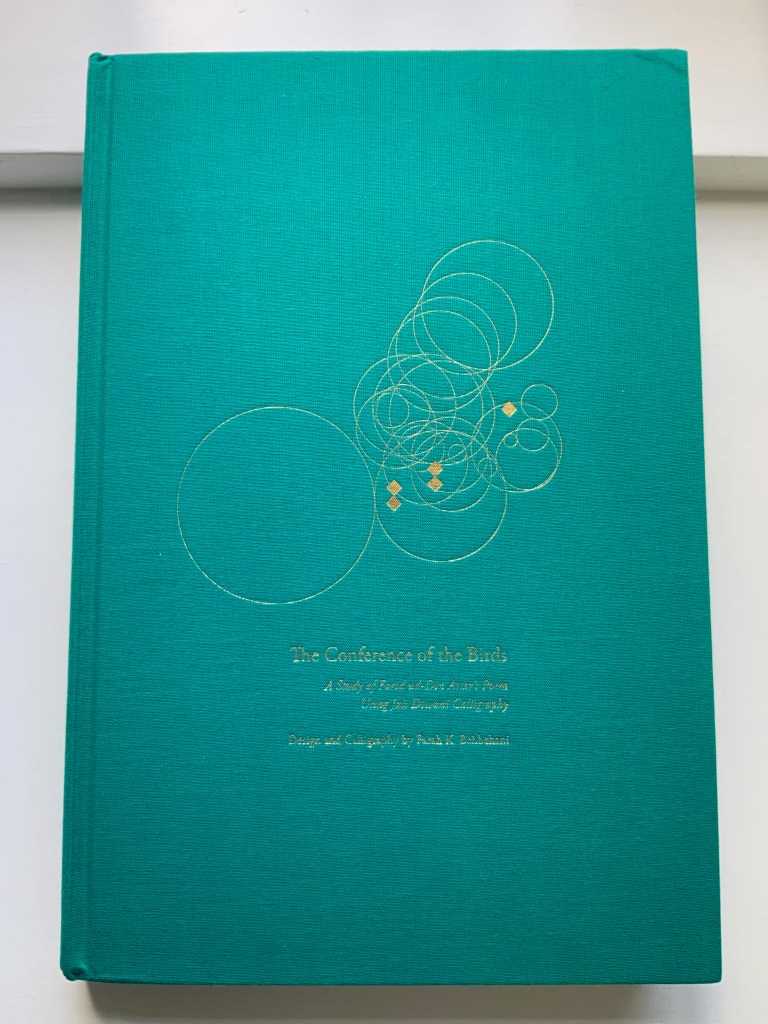
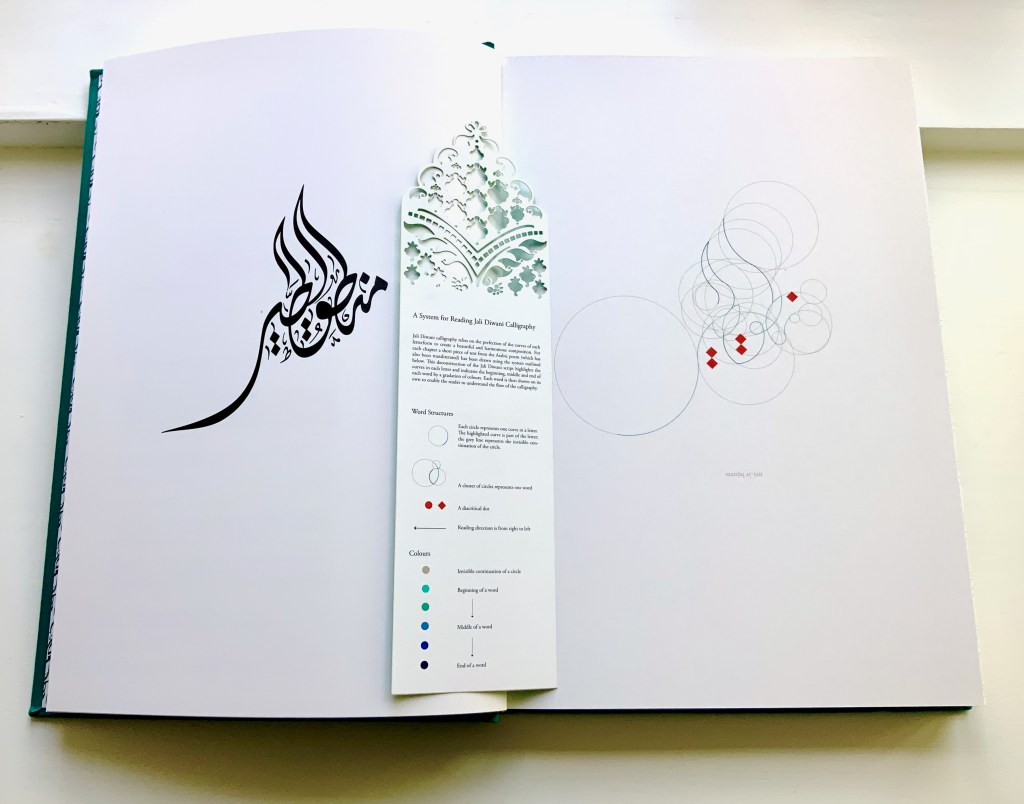
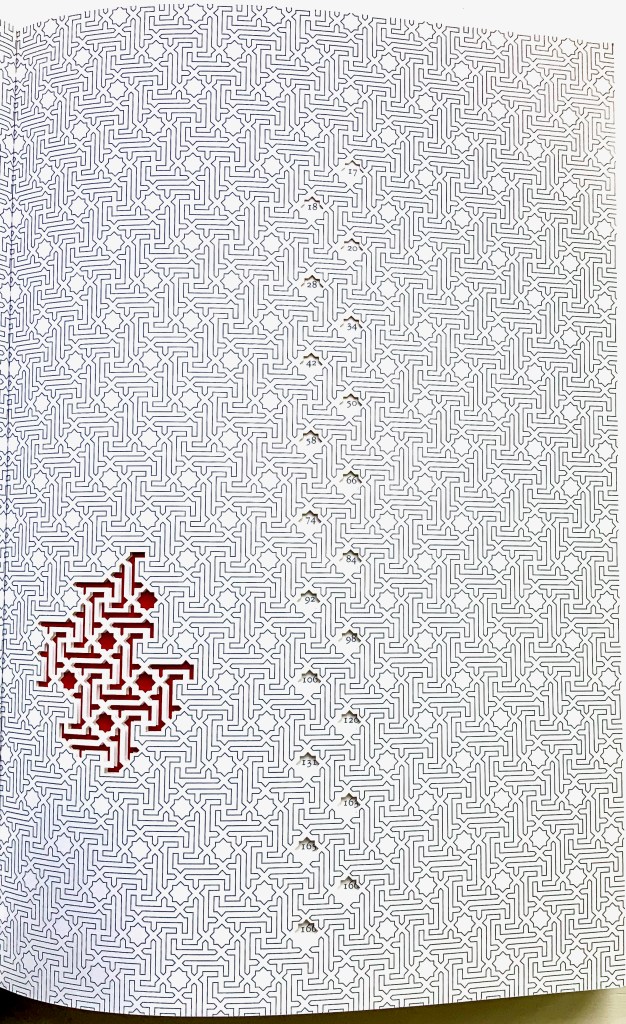
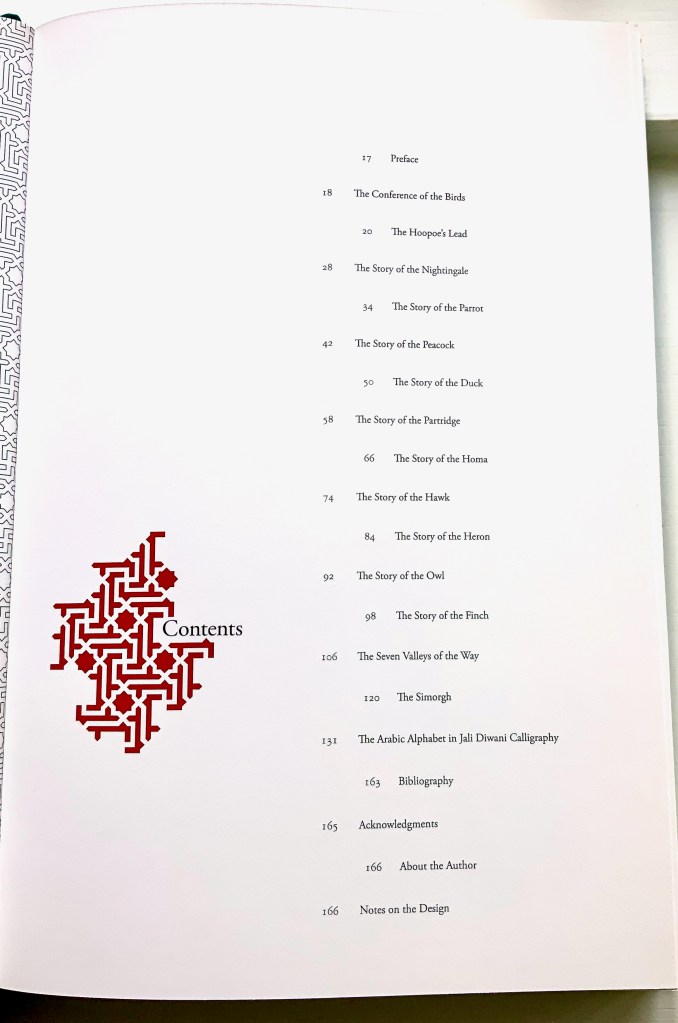
The Conference of the Birds (2009) Farah K. Behbehani and Farid ud-Din Attar. Casebound cloth over boards, stamped in gold foil. H340. 166 pages (56 of them foldouts). Acquired from Saba Books, 5 June 2022. Photos: Books On Books Collection. Displayed with permission of the artist.
The Conference of the Birds is a twelfth-century Sufi allegorical poem by Farid ud-Din Attar. A gathering of the world’s birds, each representing a different aspect of human nature, debate who should be king of all the birds. Led by the Hoopoe, they agree to seek the advice of the mythological being – the Simorgh. After an arduous and winnowing journey, thirty of them arrive at the home of the Simorgh to find a surprising answer.
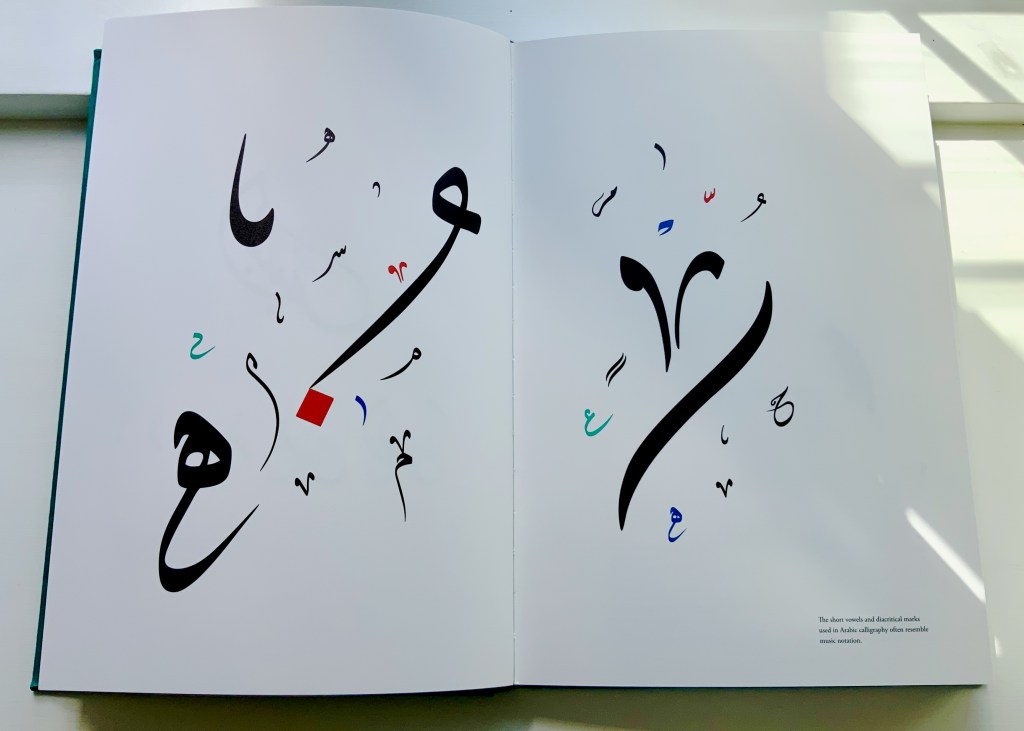
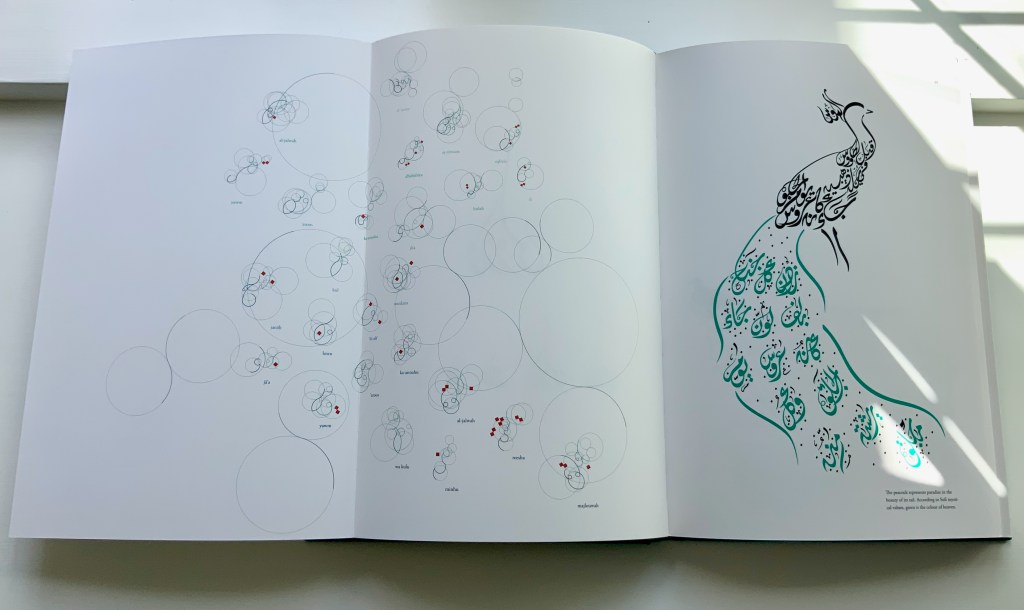
Farah Behbehani has selected thirteen of Attar’s stories and interpreted them within a journey-like creation of her own in the calligraphic style called Jali Diwani. As with many enlightening journeys, the destination is the journey itself — learning to read Jali Diwani calligraphy and, thereby, celebrate the beauty of the tale and its telling.
A passage from the story starts each chapter, and an image of the bird whose story it is is rendered in Jali Diwali. A tasseled bookmark provides the key to following the stroke-by-stroke illustration of how to read a representative line from the Arabic version of the story (a literal English translation is provided).
This book’s features (56 foldouts, embossing, gold foil, die-cut pages and that unusual bookmark) place it outside the mainstream output of its traditional commercial publisher Thames & Hudson and is as close to being an artist’s book from such a source as could be imagined. It is certainly available only through rare book dealers and occasionally by auction.
Behbehani’s Conference of the Birds fits in the Books On Books Collection alongside Golnar Adili’s Baabaa Aab Daad (2020), Islam Aly’s 28 Letters (2013), Masoumeh Mohtadi’s Blindness (2020) and Rana Abou Rjeily’s Cultural Connectives. Disregard any implication that these works represent a single aesthetic. The artists hail from different countries and draw on different traditions. Yet each work reaches across the cultural divide between the Near East and the West. Reaching across does not mean eliminating the differences. Consider Behbehani’s work in relation to Brian Goggins ‘ Language of the Birds (2006-2008), a site-specific sculptural light installation for a public plaza in San Francisco; Anselm Kiefer’s Für Fulcanelli – die Sprache der Vögel (2013), a massive sculpture of leaden bird wings and books; and the delicate but weighty cages in Bird Language(2003) by Xu Bing.
If anything draws all of these works together, it is the chord that language and image strike across time and cultures.
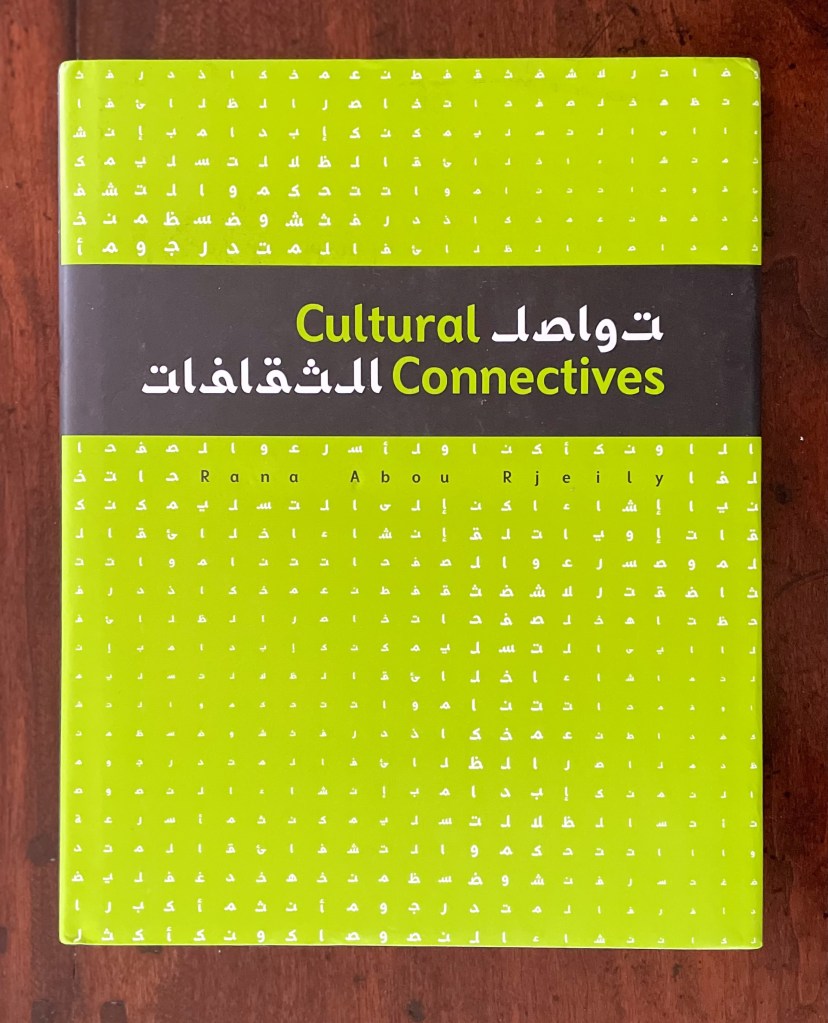
Rana Abou Rjeily’s is not the only attempt to adapt Arabic to the printing press as Cecil Hourani and Mourad Boutros note in their preface, but their praise for the book is all the more notable for Boutros’ being the creator with Arlette Boutros of Basic Arabic, a widely accepted typeface alongside Nasri Khattar’s Unified Arabic. Still more notable, however, are the ways in which Rjeily’s design and writing weave together multiple aims. One aim, of course, is to introduce Mirsaal, the typeface designed by the author to adapt the calligraphic styles of the Arabic alphabet to the printing press and still be used for the Latin alphabet. Another is to teach the Arabic alphabet to non-native speakers. And still another is to bridge Arabic and Western cultures. The aims are interwoven not only because Rjeily uses the first as the means to the others but because she invests all three into the design of the book.
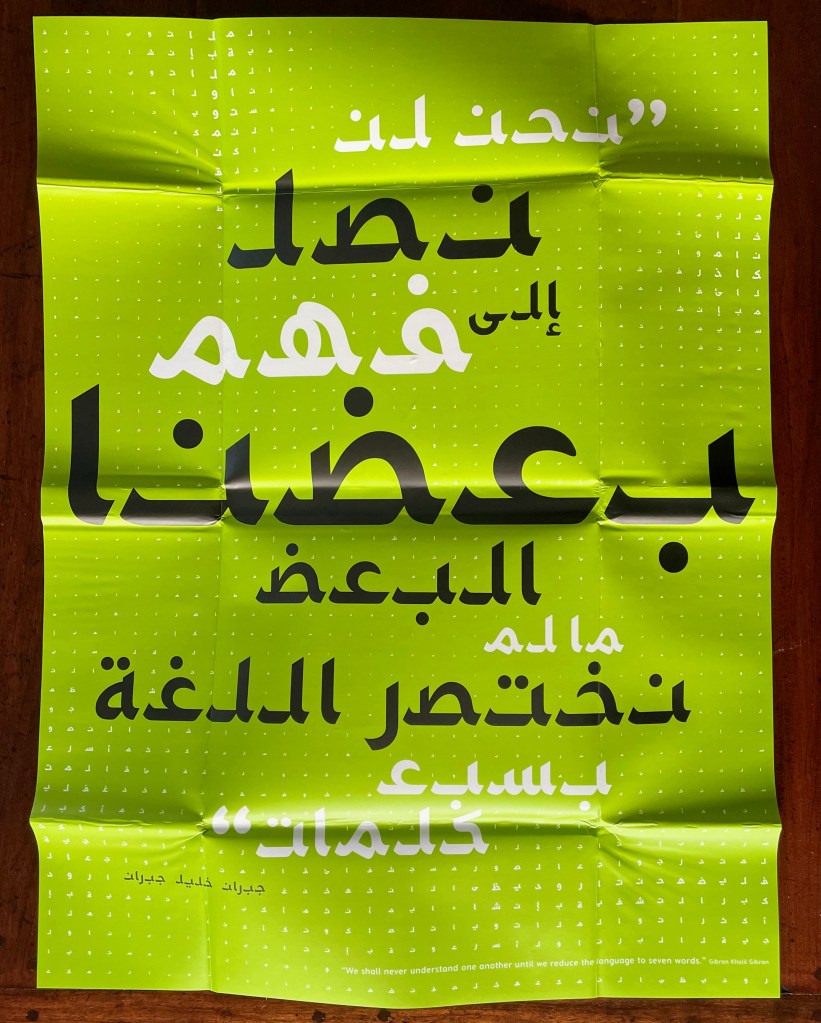
The dustjacket offers the most mechanical example of this investment. It unfolds into a poster display of the book’s epigraph from Gibran Khalil Gibran (set in Mirsaal, of course): “We shall never understand one another until we reduce the language to seven words”.
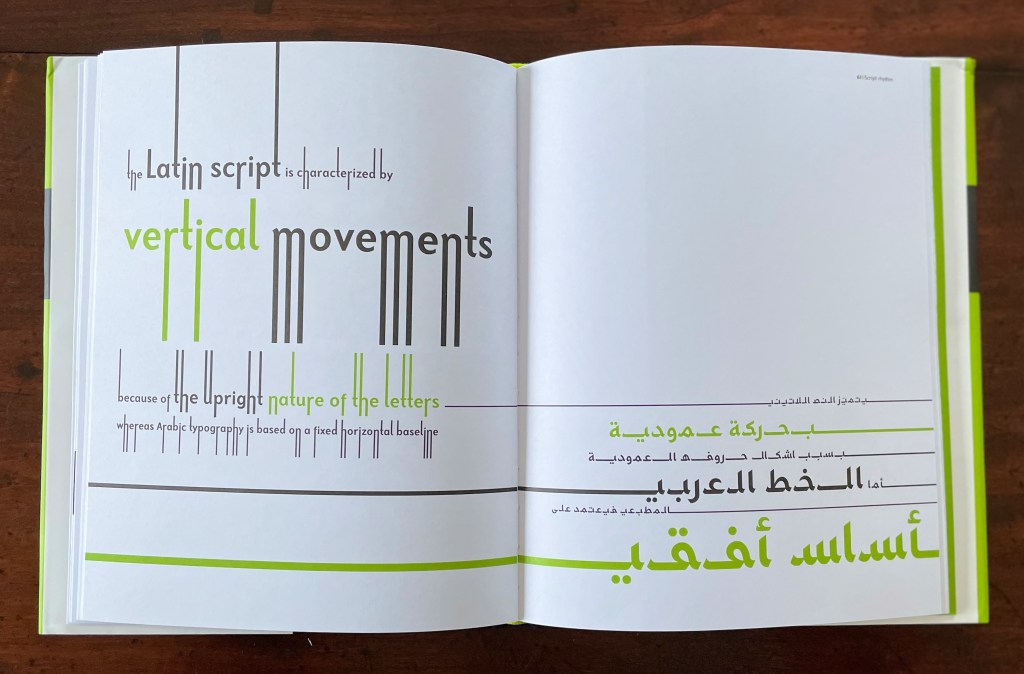
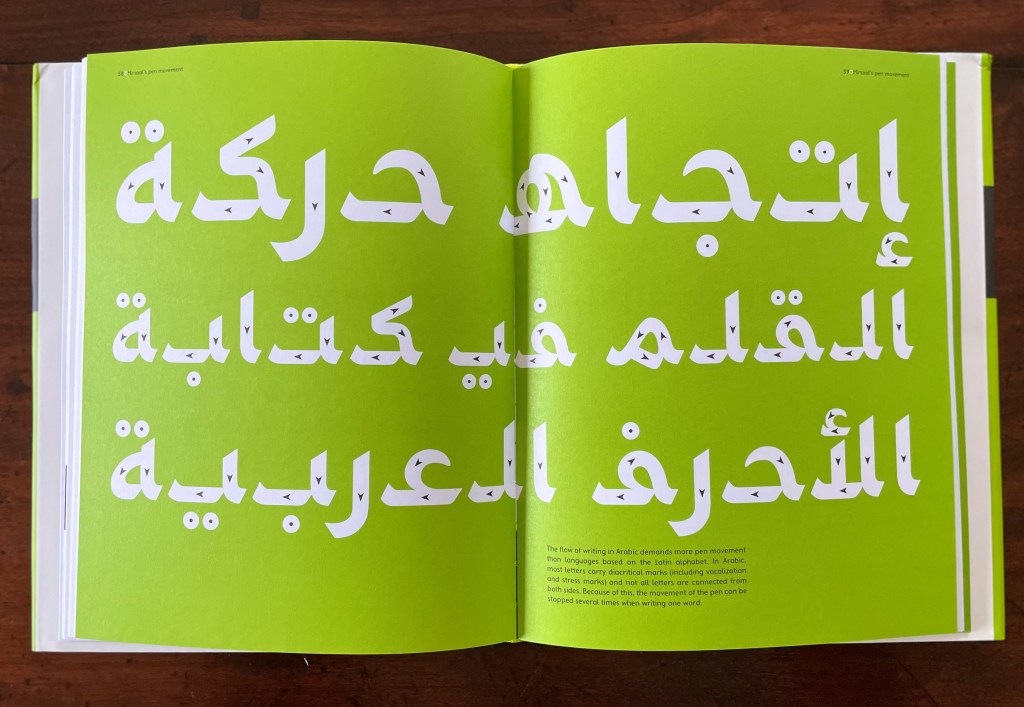
Mechanically more subtle than the dustjacket is Rjeily’s use of partial and full bleeds in the pages below — always in support of the meaning on the page. Using both vertical and horizontal bleeds, this double-page spread illustrates the Latin alphabet’s more vertical orientation compared to Arabic’s more horizontal orientation.
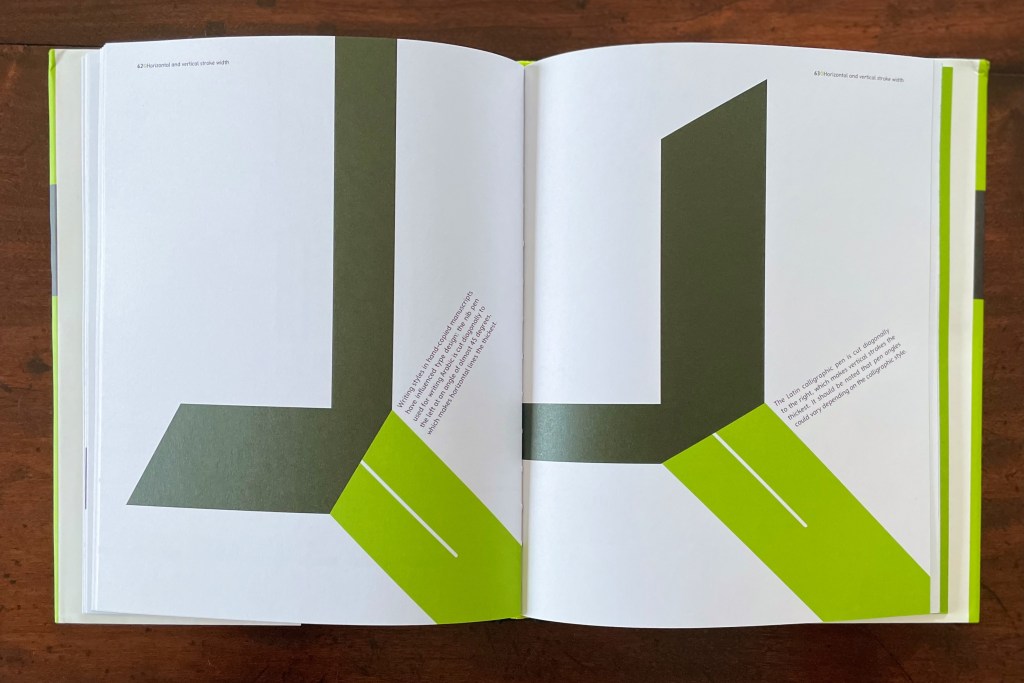
Rjeily keeps the material, haptic aspect of both Arabic and Latin close to hand with parallel pages like the following that highlight their alphabets’ differences but also assert the possibility of harmony through design. The same simple green and black color scheme, the same image of nib and mark, and the same angling of text on the page give a unified presentation of the difference in direction and angle of cuts for Arabic and Western nibs. Another physical aspect that Rjeily highlights is the ductus (the order and direction) of a pen strokes making up a letterform, which is arguably more important for Arabic because the flow of writing demands more pen movement.
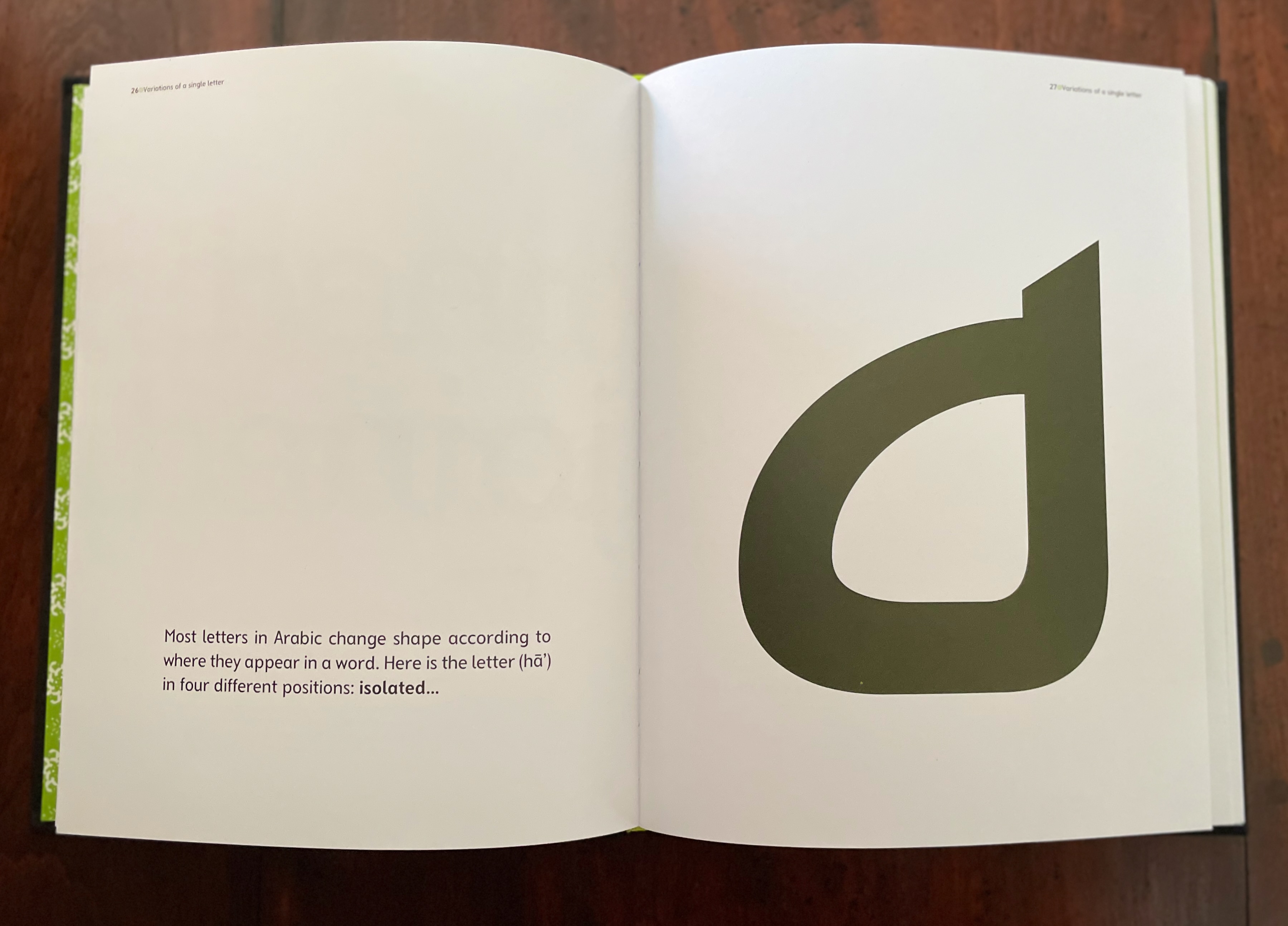
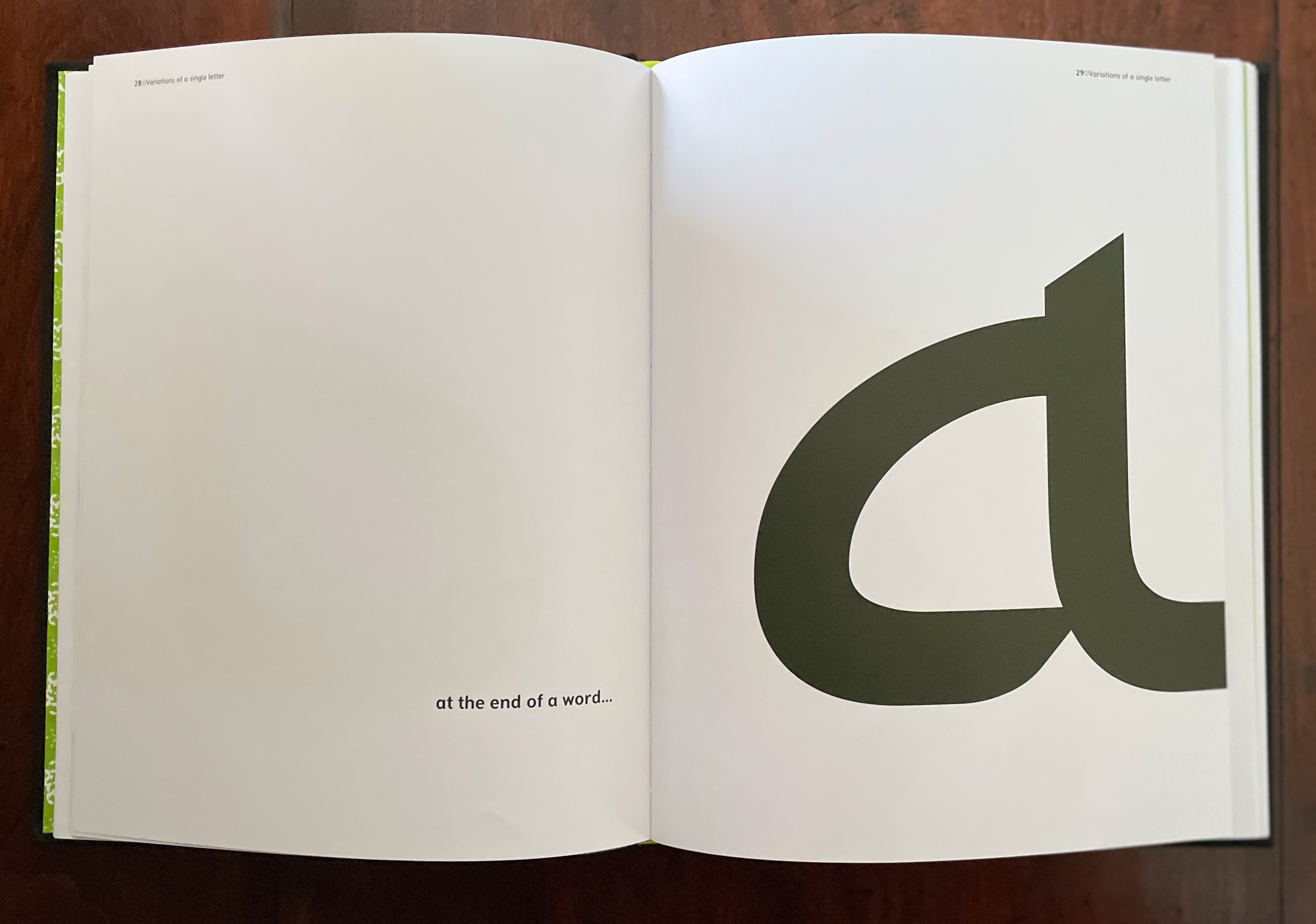
Other bold, oversized spreads drive home some of the false cognate forms such as 0 and the number 5 written in Arabic-Indic numerals, or the letter V and the number 7 in Arabic-Indic numerals. Others, in an almost children’s book style, present the unique characteristic of an Arabic letterform’s changing shape depending on its initial, medial or final position in a word — or its appearance in isolation. While teaching these differences and features of Arabic is a fundamental aim, always the differences are laying the groundwork or demonstrating what Mirsaal must deal with to bridge a calligraphic system to a typographic system of writing.
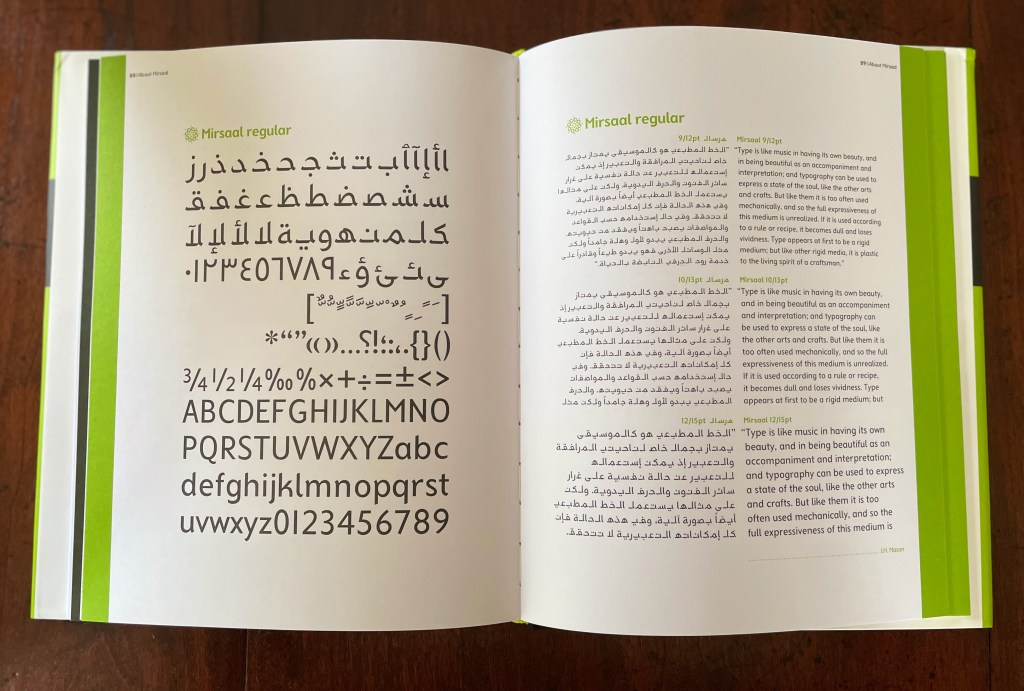
The final section presents the Mirsaal typeface in its various fonts (sizes and weights) in the manner of a traditional type specimen, using the very appropriate words of John Henry Mason (1875-1951) in Arabic and English:
Type is like music in having its own beauty, and in being beautiful as an accompaniment and interpretation ; and typography can be used to express a state of the soul, like the other arts and crafts. But like them it is too often used mechanically, and so the full expressiveness of this medium is unrealized. If it is used according to a rule or recipe, it becomes dull and loses vividness. Type appears at first to be a rigid medium; but like other rigid media, it is plastic to the living spirit of a craftsman. — J.H. Mason
Cultural Connectives is the useful reference work Rjeily intends. In achieving its several aims, it also provides both an accomplished example of the book arts and a means of insight into other works in the Books On Books Collection, such as Golnar Adili’s Baabaa Aab Daad (2020), Islam Aly’s 28 Letters (2013), Farah K. Behbehani’s The Conference of the Birds (2009) and Masoumeh Mohtadi’s Blindness (2020).
Further Reading
“Golnar Adili“. 24 November 2022. Books On Books Collection.
“Islam Aly“. 13 January 2020. Books On Books Collection.
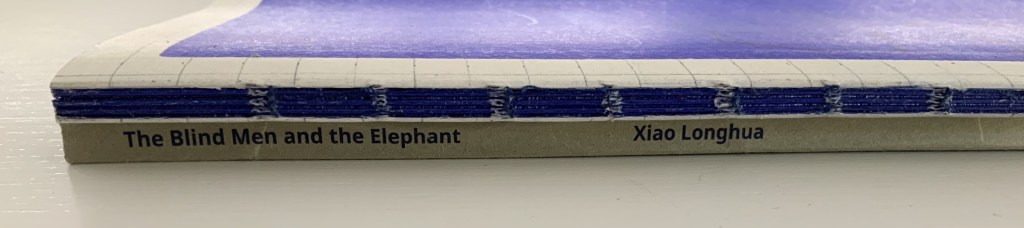
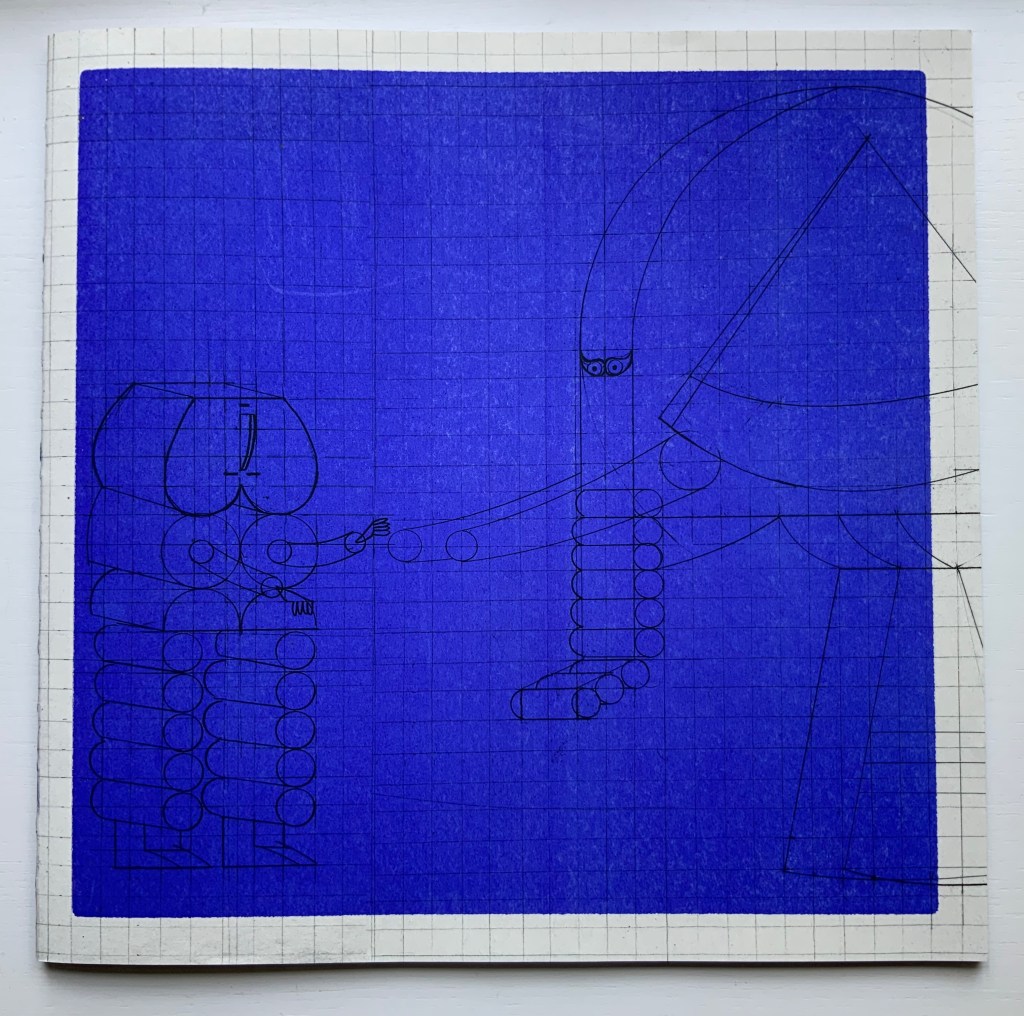
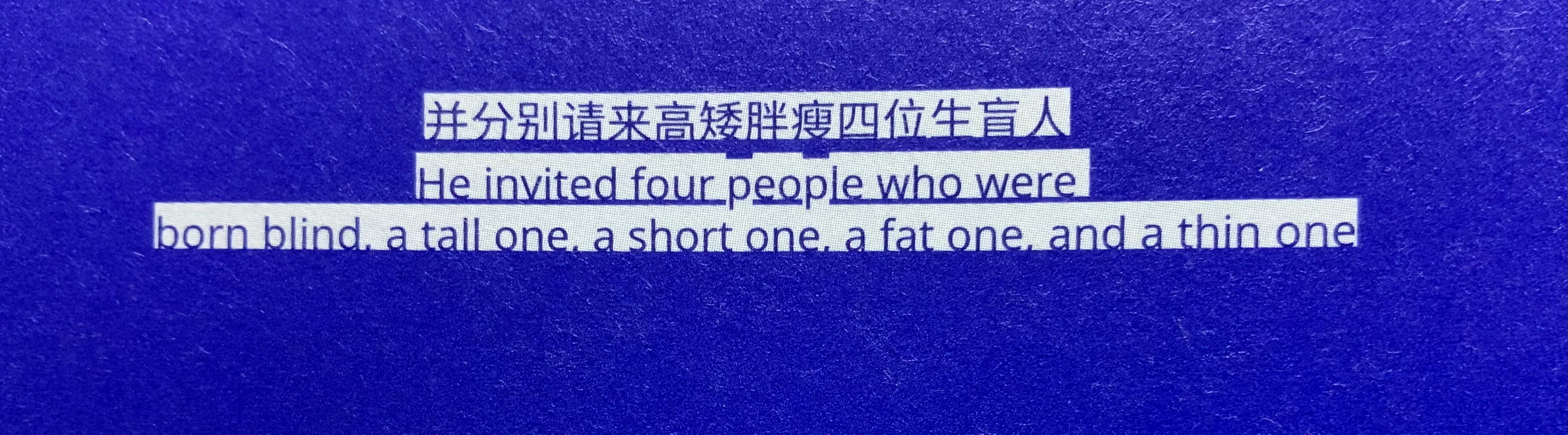
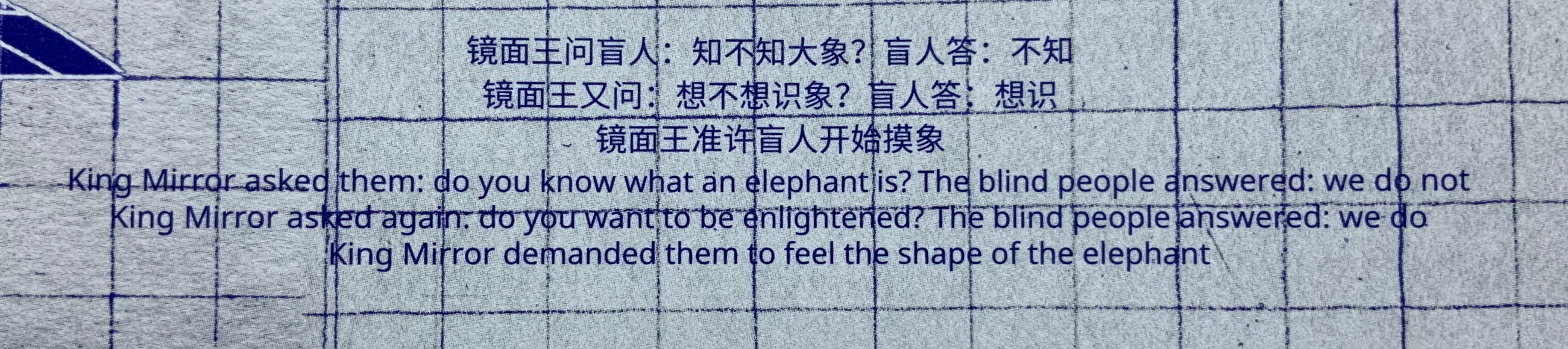
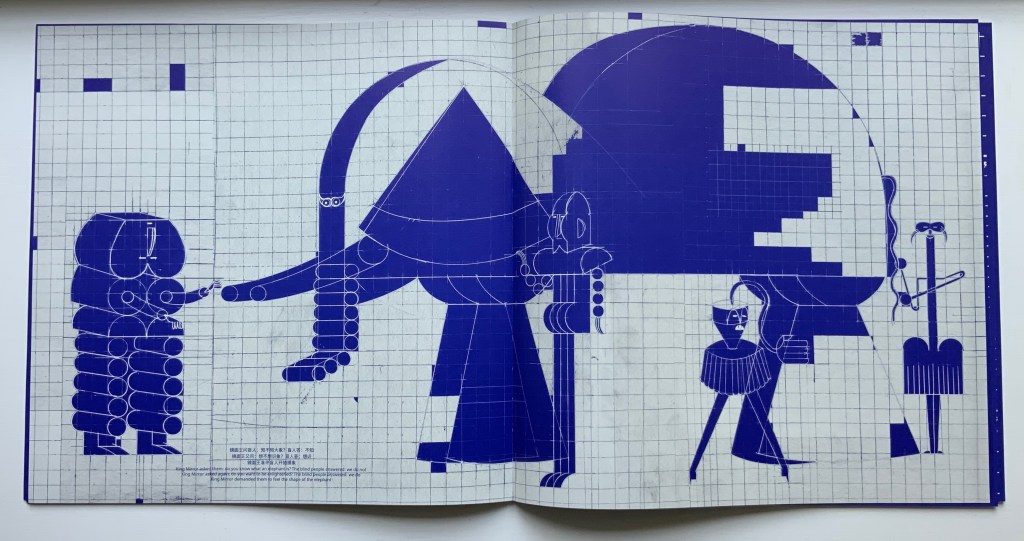
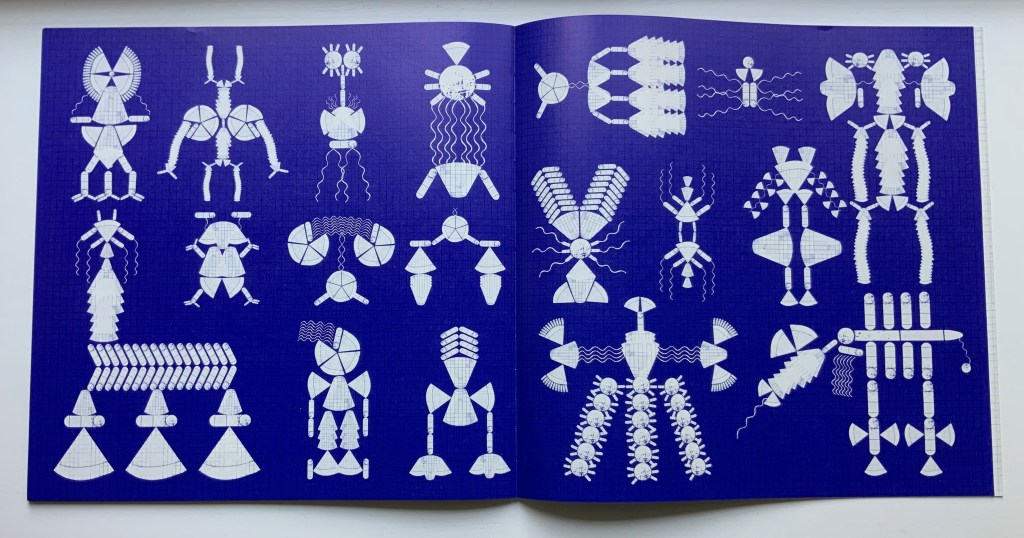
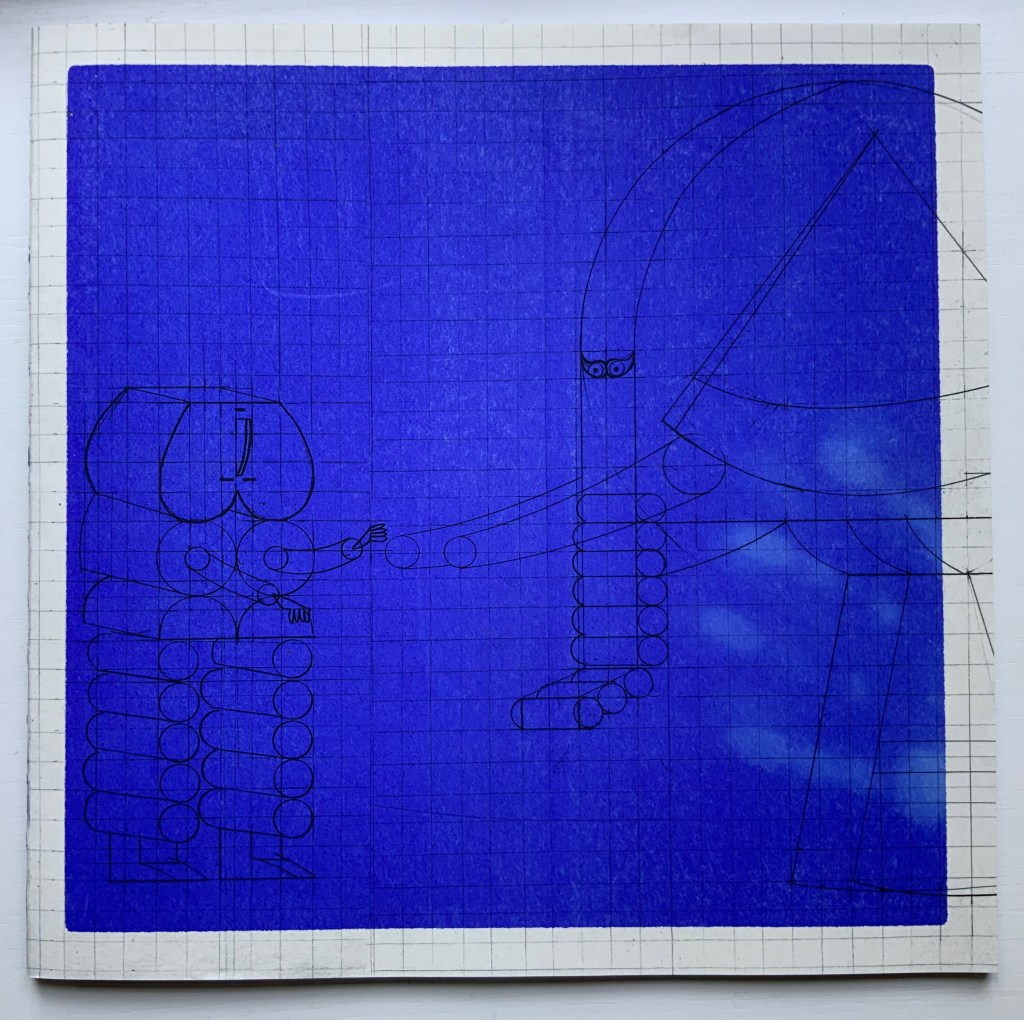
The Blind Men and the Elephant (2019) Xiao Long Hua Sleeved paperback, exposed sewn spine. Sleeve: 305 x 305 mm. Book: H303 x W305 mm. 52 pages. Edition of 500, of which this is #178. Acquired from Northing, 18 May 2022. Photos: Books On Books Collection.
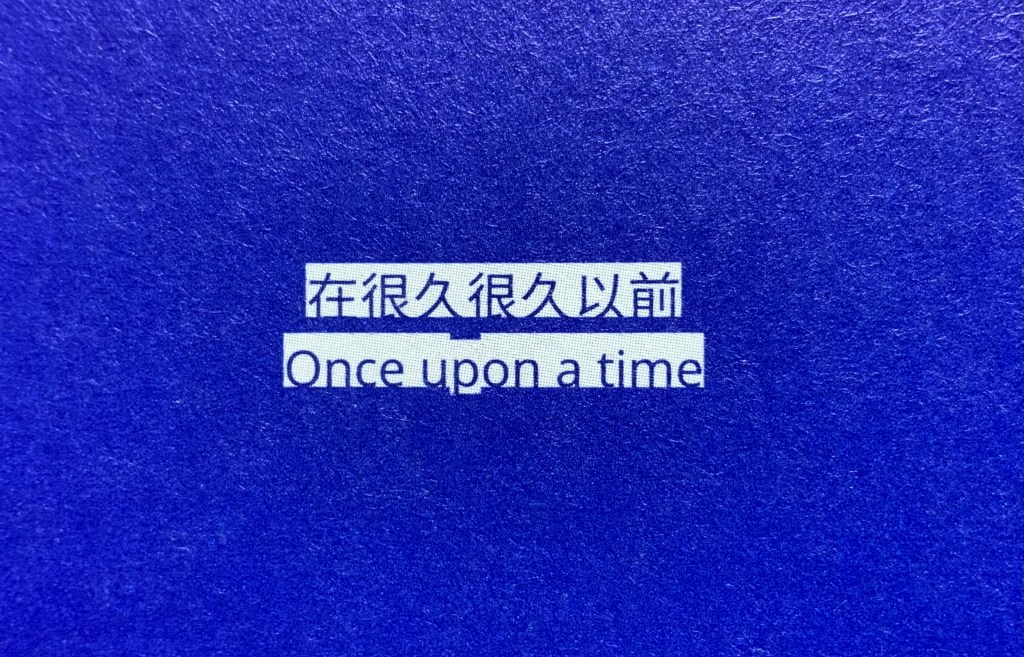
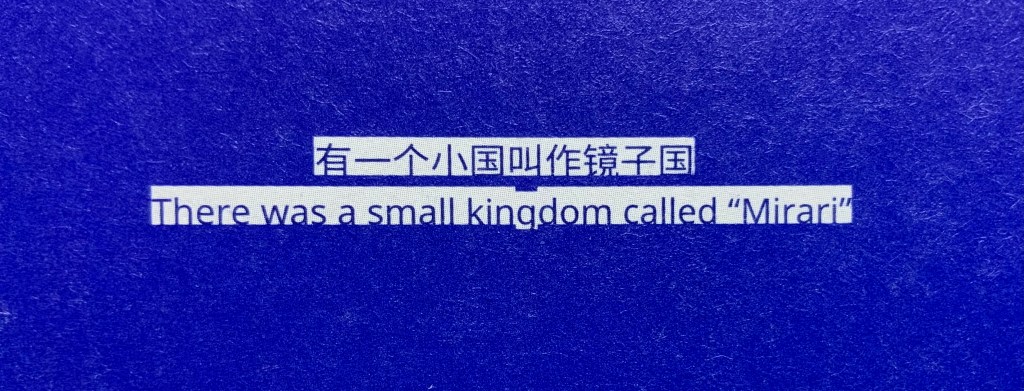
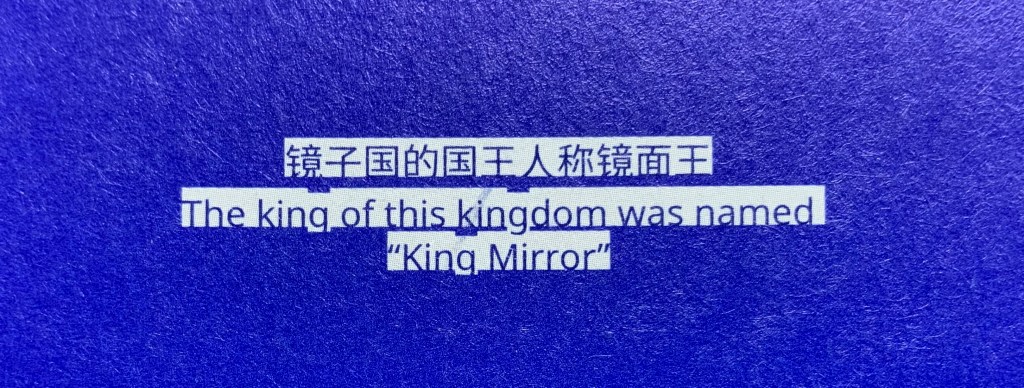
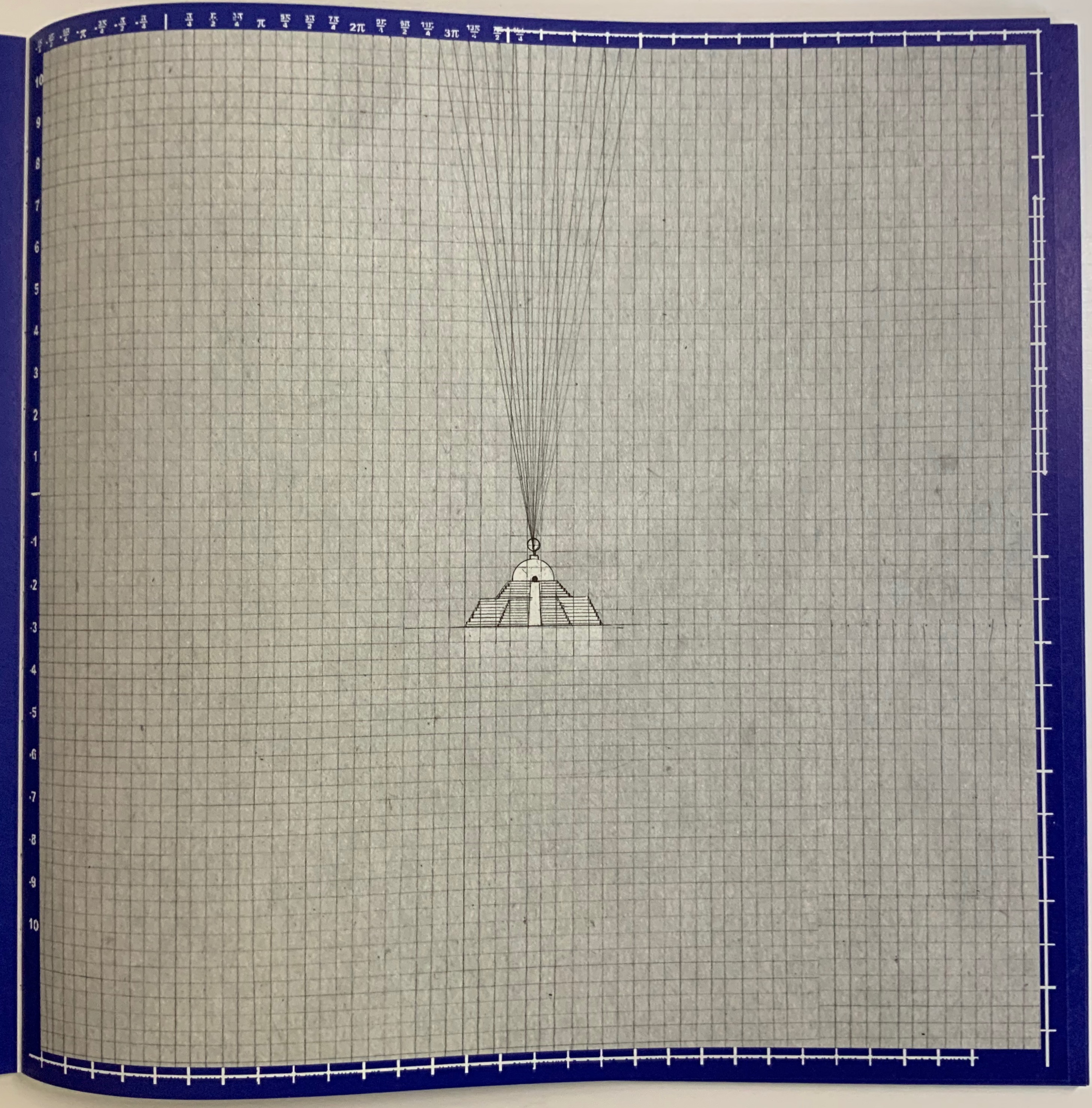
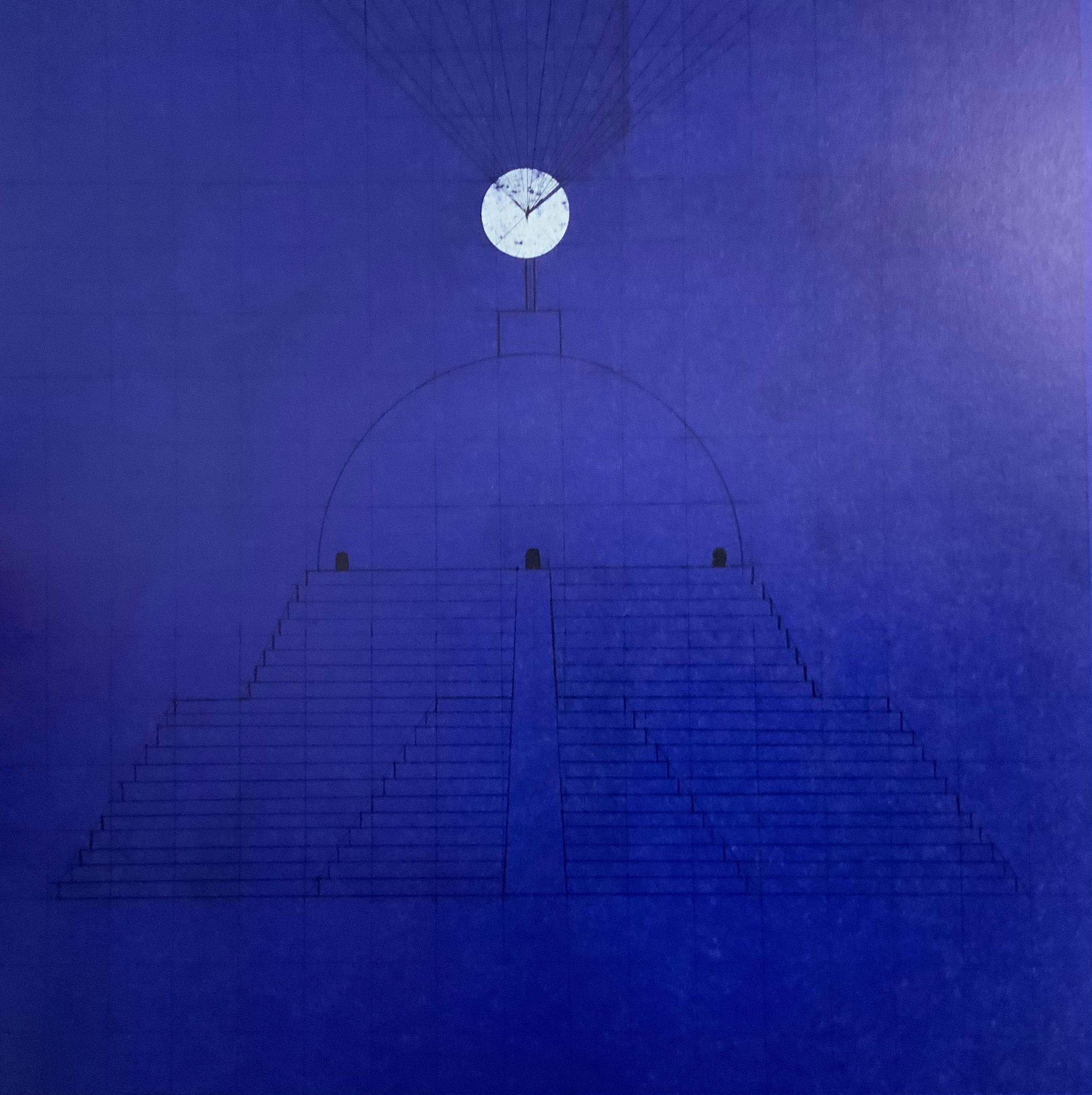
Working with binding designer Zhong Yu and tbook designer Lu Min of the “One and One Half Atelier”, Shanghai-based Xiao Long Hua has found a sympathetic outlet and form for his creative vision. His first work with them is The Blind Men and the Elephant, a variation on the parable in the Buddhist sutra Tittha Sutta. It takes place in the kingdom “Mirari”, ruled by King Mirror.
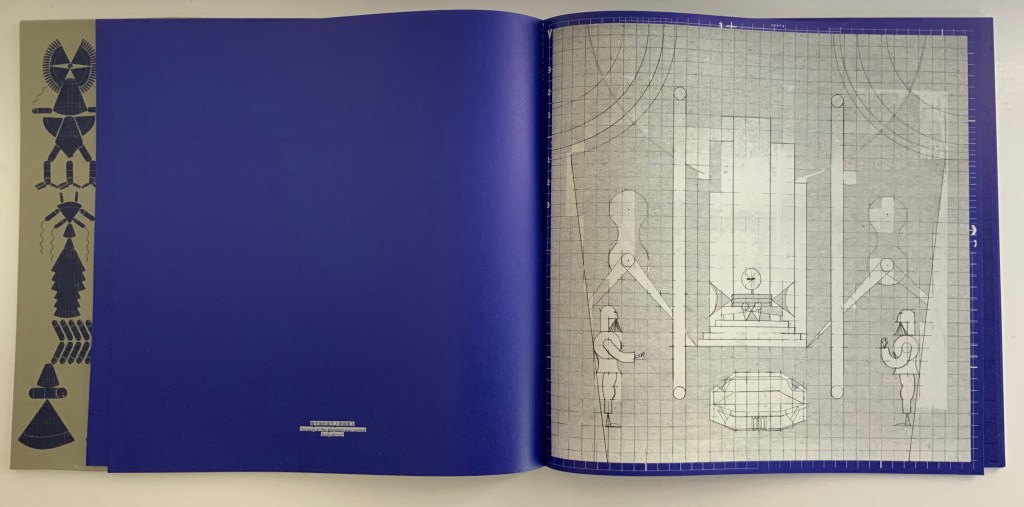
Selection from One and One Half Atelier. Photos: Books On Books Collection.
As in the more traditional version, the blind men report the elephant to be of different shapes, but in this version, those shapes reflect those of the blind men themselves. Throughout the book, a blueprint grid in the background of the dark blue and light gray page serves to emphasize the geometric shapes of the characters and images and to reflect, with its reductiveness, each blind man’s rigid view of the elephant’s nature. And up to this point of the blind men’s report, the grid has been bounded intermittently by coordinate markers, some numerical, some in letters and some in Chinese characters.
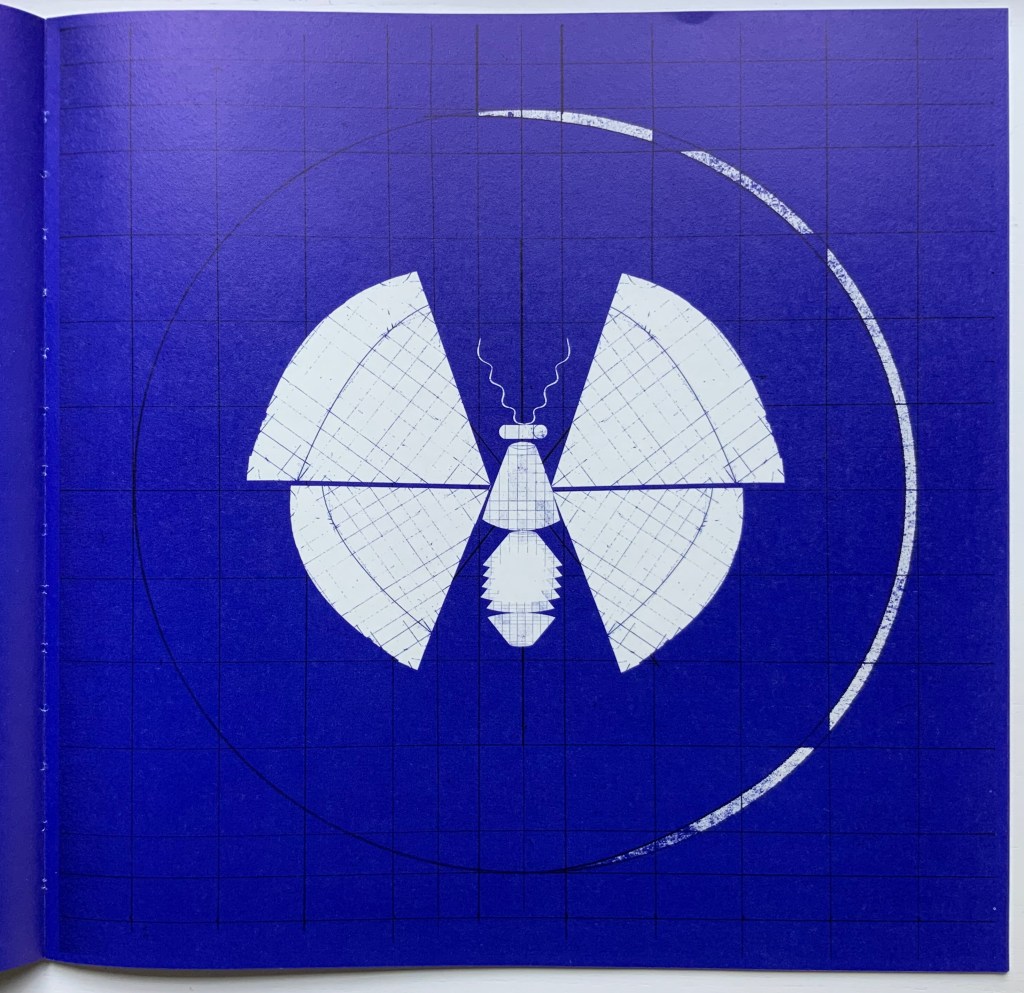
Xiao Long Hua places the different shapes the blind men perceive into the mind of the king, where they become a butterfly and then transform endlessly and kaleidoscopically into other figures represented across a series of pages printed dark blue. This variation on the theme comes from the Miao (Hmong) creation song Butterfly Mother or Mother Butterfly.
The final colorless two pages consist of cut-outs inviting the readers’ hands to create more strange figures along with the king’s mind. This element of touch recurs on the cover, which on closing the reader will find is covered in fingerprints. The cover’s ink is thermochromatic, fading away under the warmth of touch, returning as it cools and waiting for our next blind touch.
Selection from One and One Half Atelier edition. Photos: Books On Books Collection.
The publishing house Qianxun Neverend has issued a shorter trade edition of The Blind Men and the Elephant. Although a thermochromatic cover proved to be too expensive, an equally interesting design feature animates the cover’s image of the butterfly transforming into the multiple figures in the king’s mind.
Prior to The Blind Men and the Elephant, Xiao Long Hua engaged primarily in illustrations, scroll painting, installation works and sculpture, some of which can be seen on his Tumblr blog. For his latest work with the One and One Half Atelier, The Great Migration, the Atelier’s site announced a multimedia installation. A comment about this work sheds light on The Blind Men and the Elephant as well; he writes, “…I want to paint a magnificent picture of the Great Migration to express those spaces and memories that are fading away, I try to blur the forms between people, animals and objects. “
Other works in the Books On Books Collection to compare with The Blind Men and the Elephant include
“I AM SEEKING TO UNEARTH A SOLUTION BEYOND THE CONVENTIONAL SYSTEM OF LANGUAGE FOR MAKING CONNECTIONS.” Masoumeh Mohtadi
Blindness (2020)
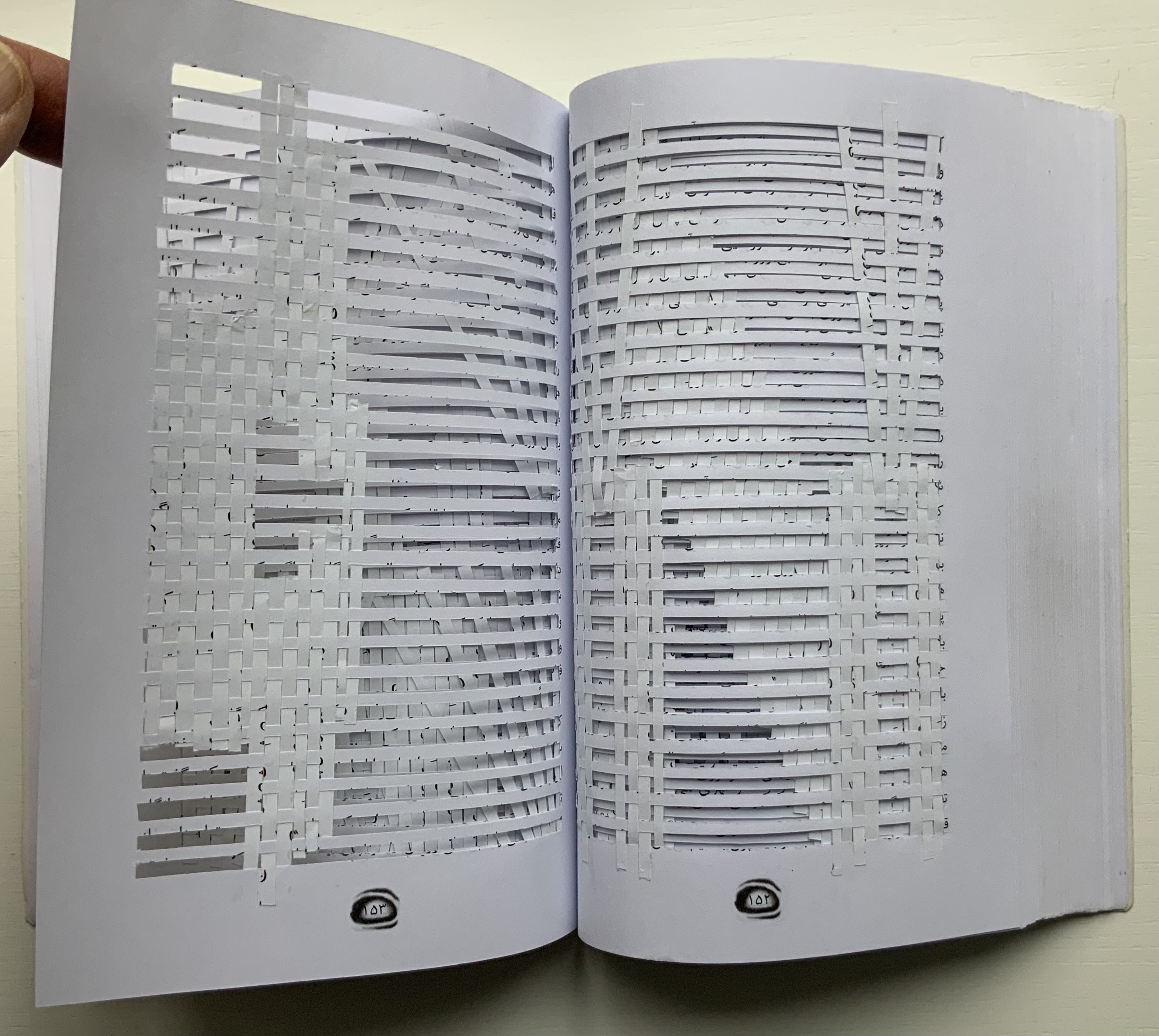
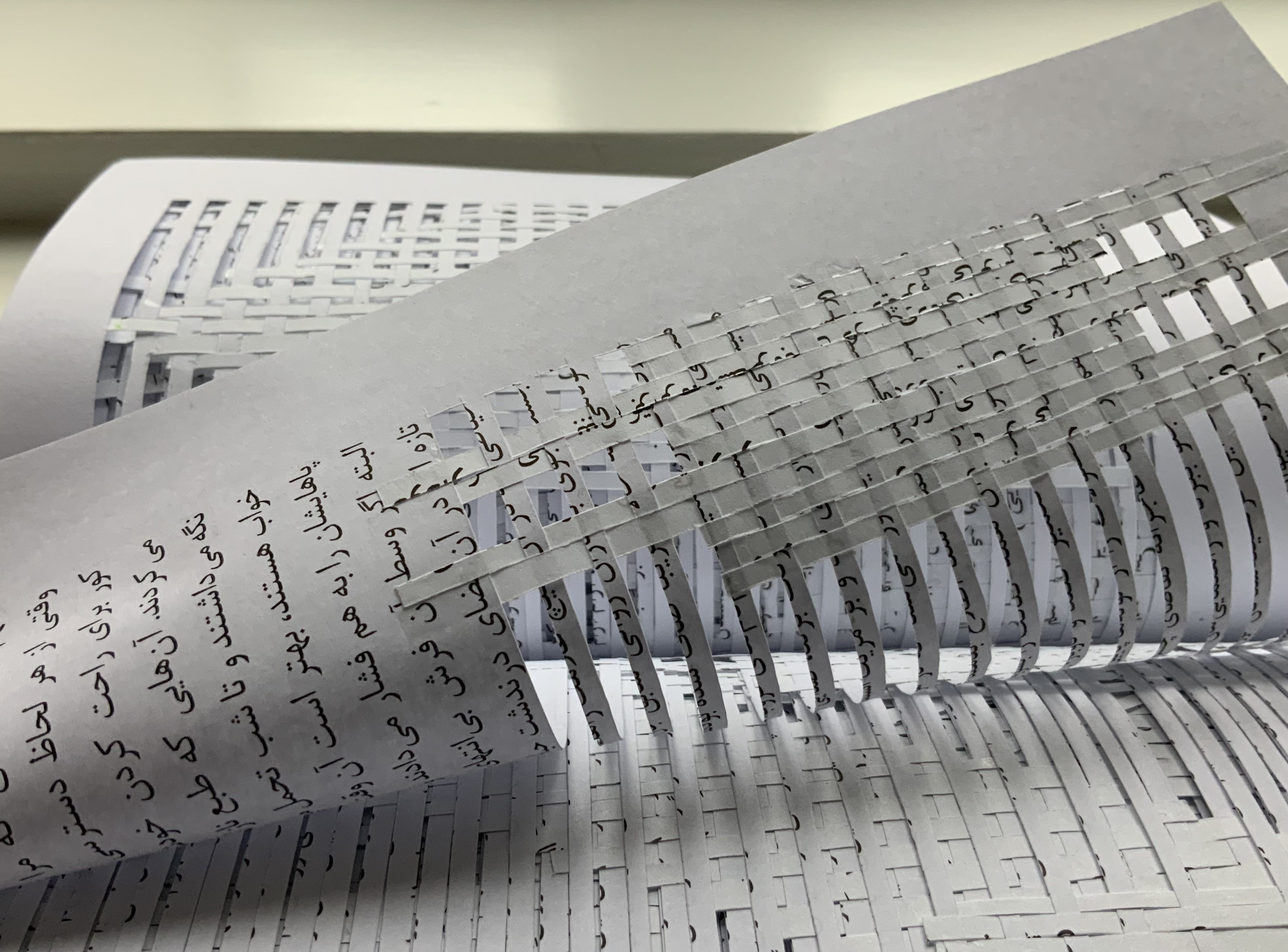
Blindness (2020) Masoumeh Mohtadi Altered paperback, Persian/Farsi translation of Blindness by José Saramago. H210 x W145 x D20 mm, ۳۱۸ (318) pages. Unique. Acquired from Bavan Gallery, 9 January 2021.
As would be expected, the binding of this Persian trade paperback is on the right, but its front cover and copyright page promise the unexpected. Excising lines of text from every page in the book, Mohtadi then physically reweaves Saramago’s gripping tale of a pandemic of sudden blindness into illegibility, varied patterns and heightened tactility.
The flimsiness of the pages slows their turning. As does their frequent catching at one another as they turn. In the slow turning, different woven patterns appear — some suddenly, some gradually. Some patterns bring to mind the streets and cityscape the novel’s characters can no longer see. Some, the hospital warrens the quarantined inhabit. Some, the tradition of carpet weaving.
The excised and woven pages inflate the book as if it had been read and re-read. Closed, it compresses in the hand, feels airy and weighty at the same time; opened, it pricks at the fingers, casts shadow and light and drags the eyes to surface and depth simultaneously.
Mohtadi’s cutting, weaving, pasting and patterning appropriates Saramago’s novel in a thoroughly integral way. And for a Western reader, the Persian translation and script introduce another layer between text and mind that challenges perception and enhances appreciation of this work of book art. She succeeds in connecting.
Blindness (2017)
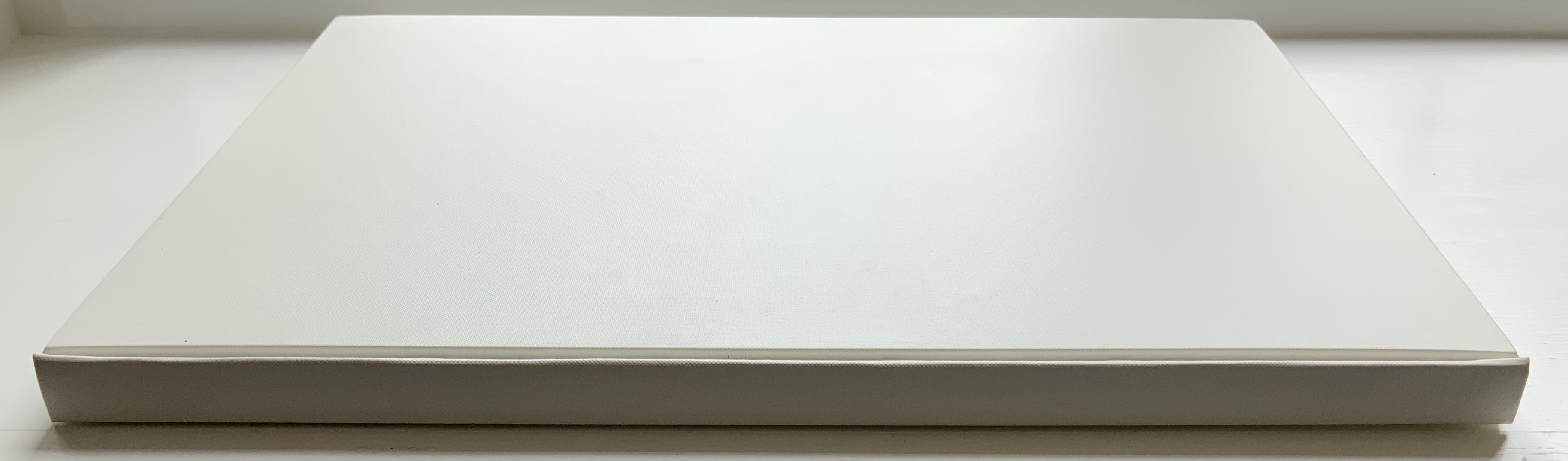
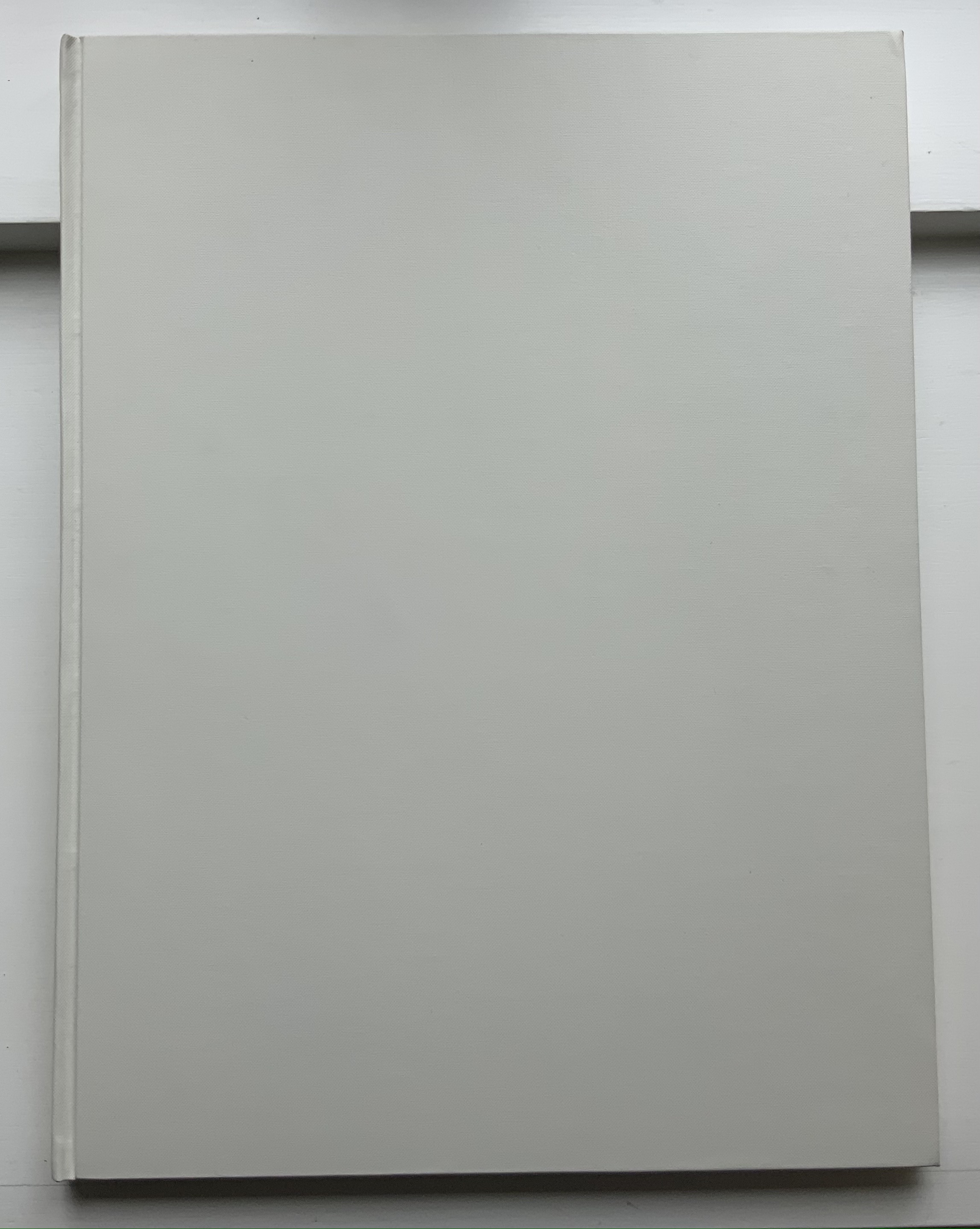
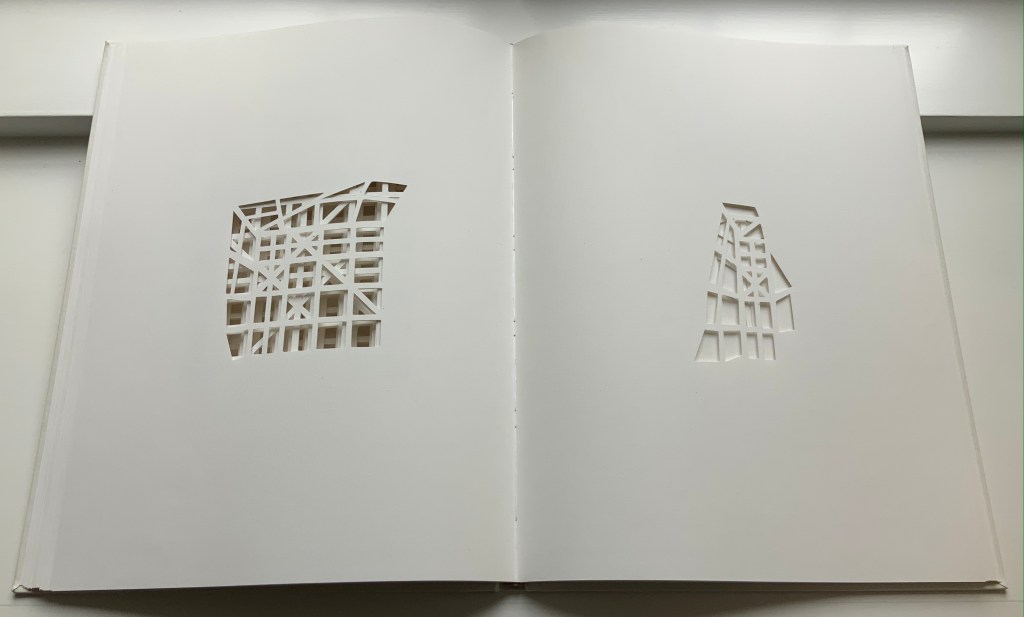
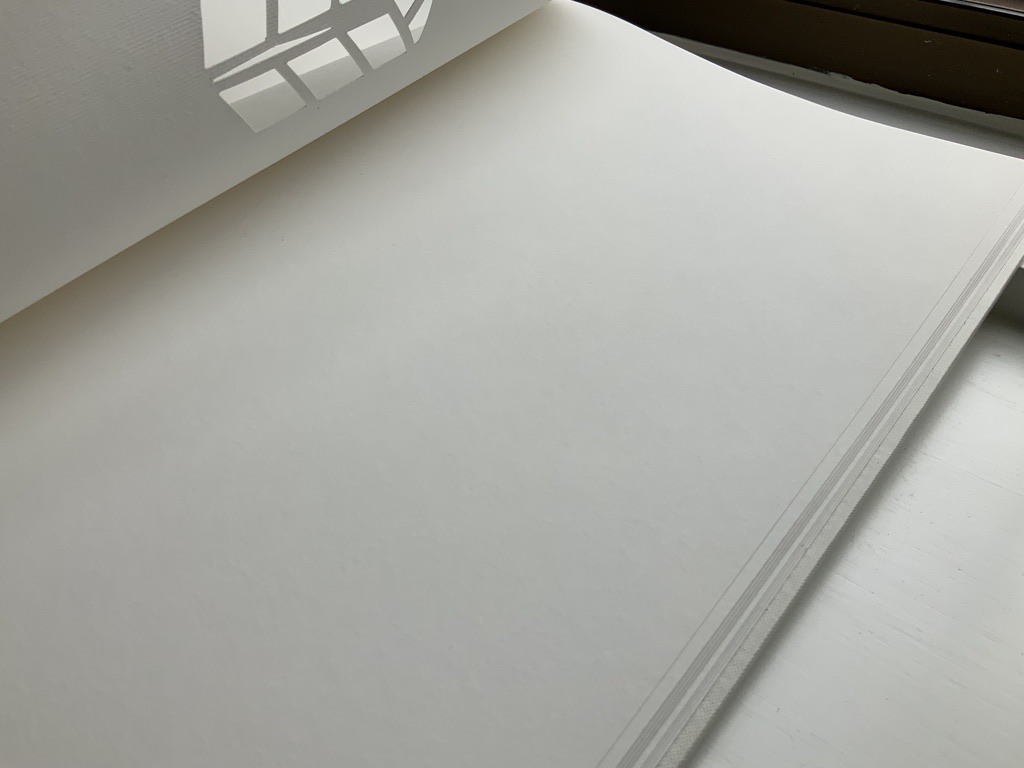
Blindness (2017) Masoumeh Mohtadi Artist’s book. H400 x 300 x 36 mm. Unique. Purchased from NY Center for Book Arts, 15 March 2021. Photos: Books On Books Collection.
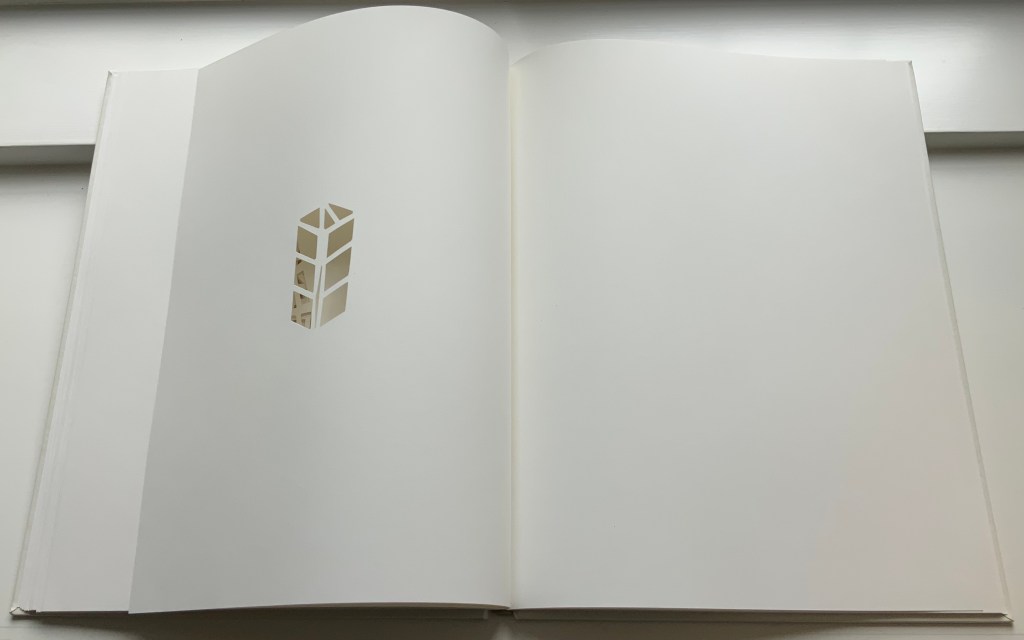
This larger format work conveys the artist’s reaction to Saramago’s Blindness in a completely different manner. Text is absent, replaced by tangible excisions that vary from leaf to leaf, but overlapping as they do, the excisions have a visual effect.























 Books On Books