4 p. and 33mm (2013)
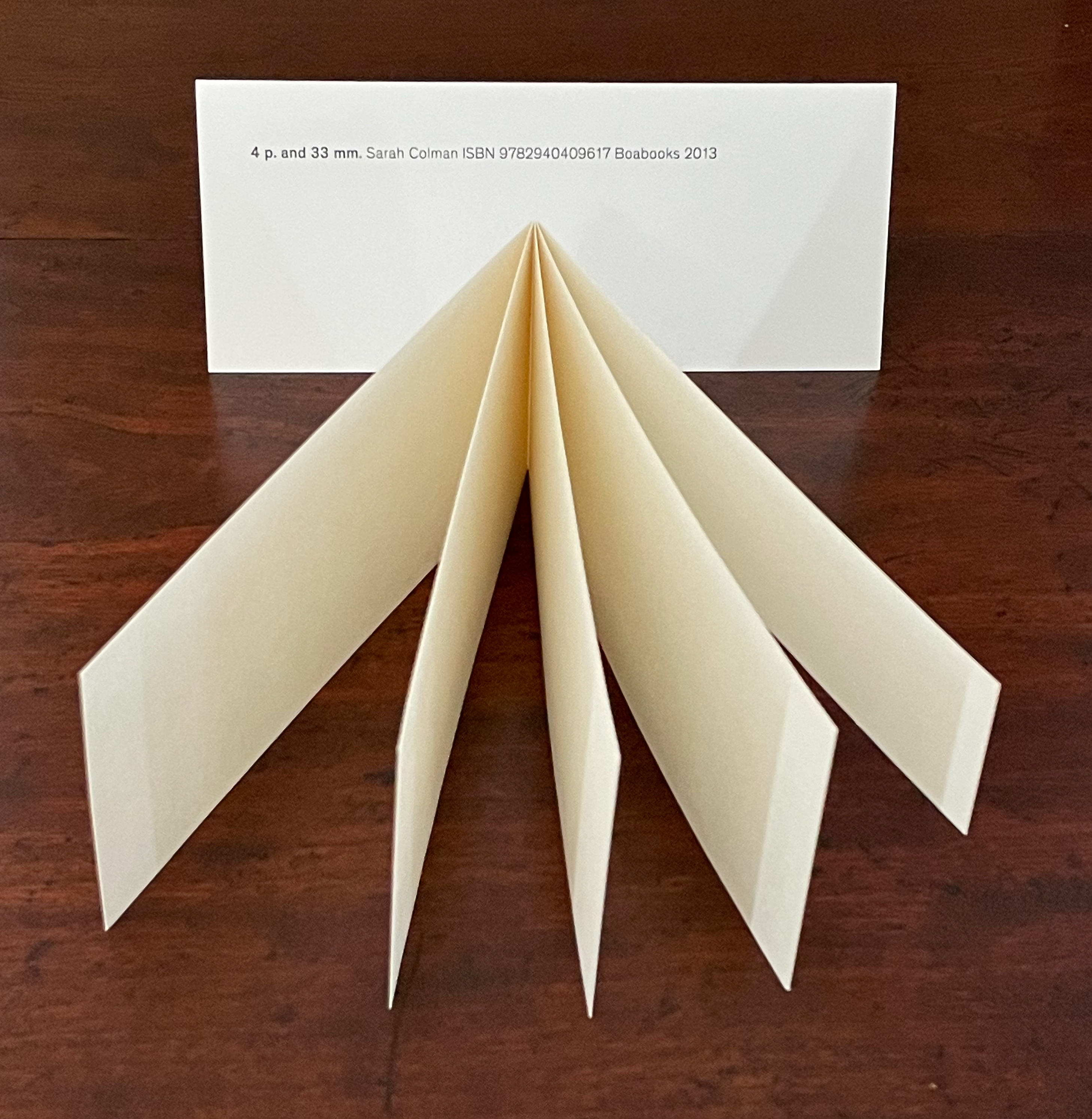
4 p. and 33mm (2013)
Sarah Colman
Card folder with title, author, publisher. Perfect binding of 4.33 folios. H66 x W148 mm [10] pages. Acquired from the artist, 1 August 2026.
Photos: Books On Books Collection.
Colman’s 4 p. and 33 mm. was on display in the exhibition a minima at the Wittockiana in Brussels. If the work ‘s title directs us to consider first the four full folios and then the folio trimmed to half their size, then the item is displayed upside down in the image below. Observant visitors may have noticed it. Western books read from left to right.
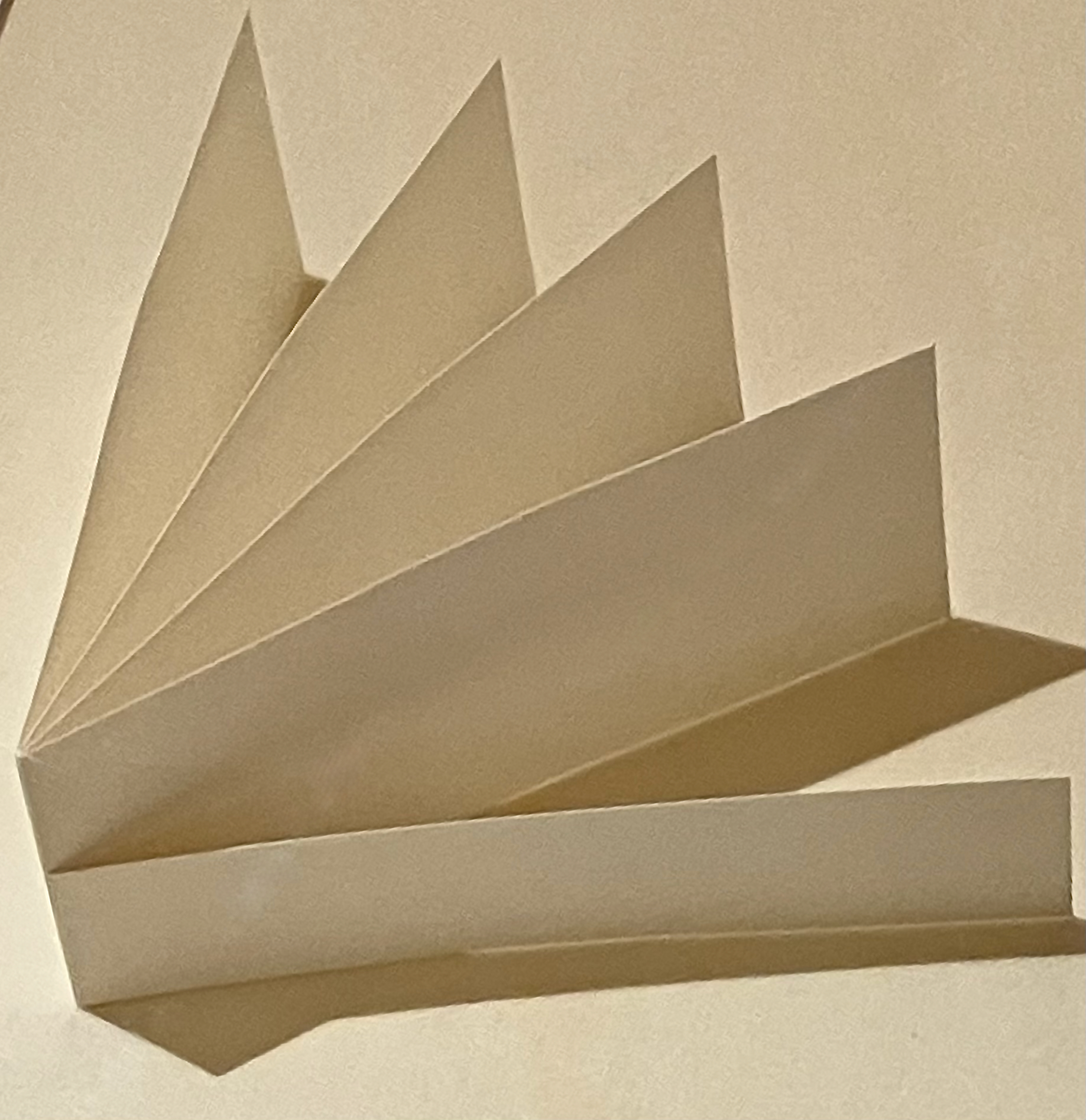
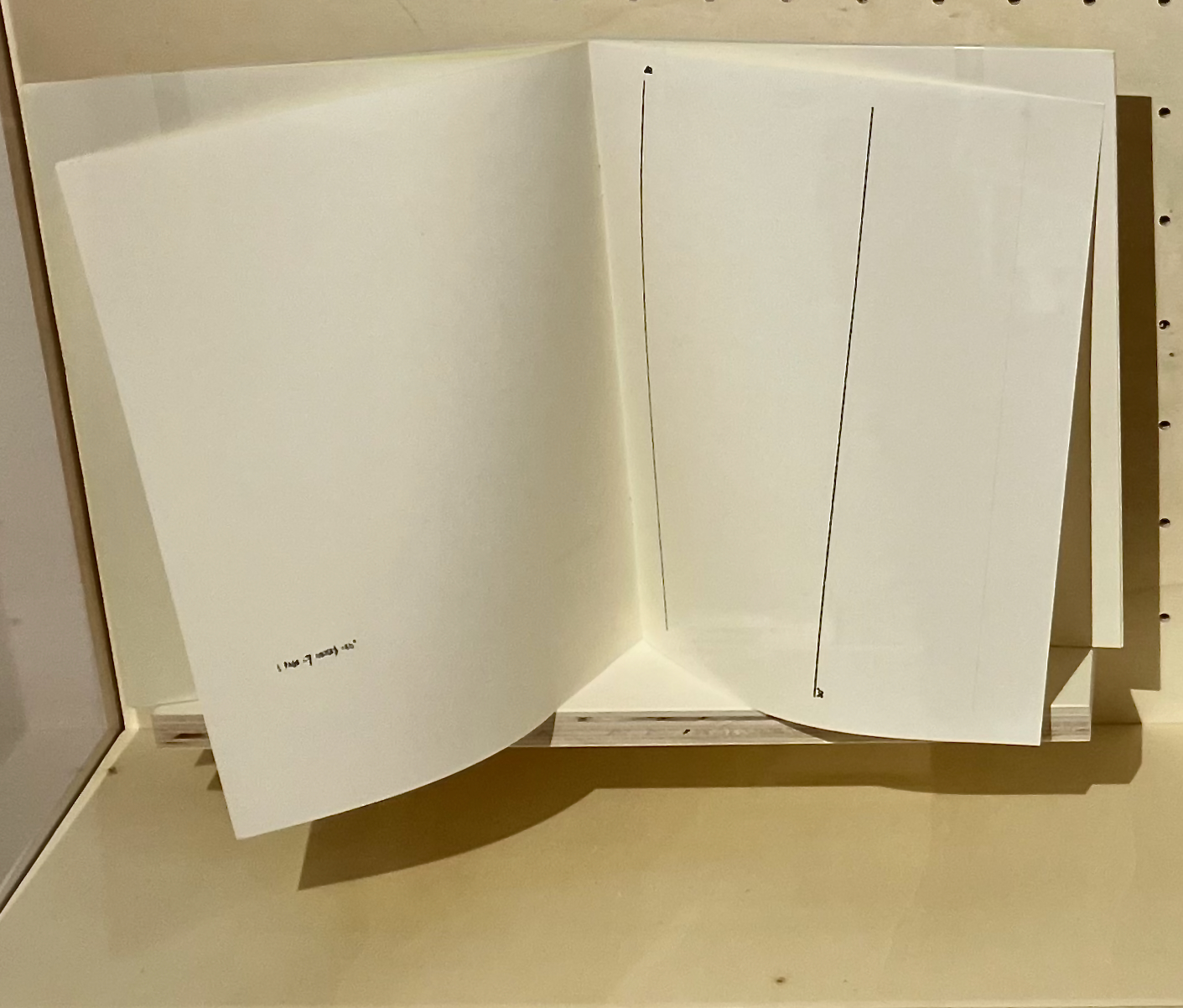
Left: 4 p. and 33 mm. (2013). Sarah Colman. Geneva: Boabooks. Right: 4’33” (1993). John Cage. New York: Peters No. 6777a.
Being able to manipulate this work drives home the right orientation. First come the 4 pages that measure 66 mm and then the page that measures 33 mm. Of course, it ends hanging in air — just as Cage’s composition leaves the audience hanging as it ends after 4 minutes and 33 seconds.
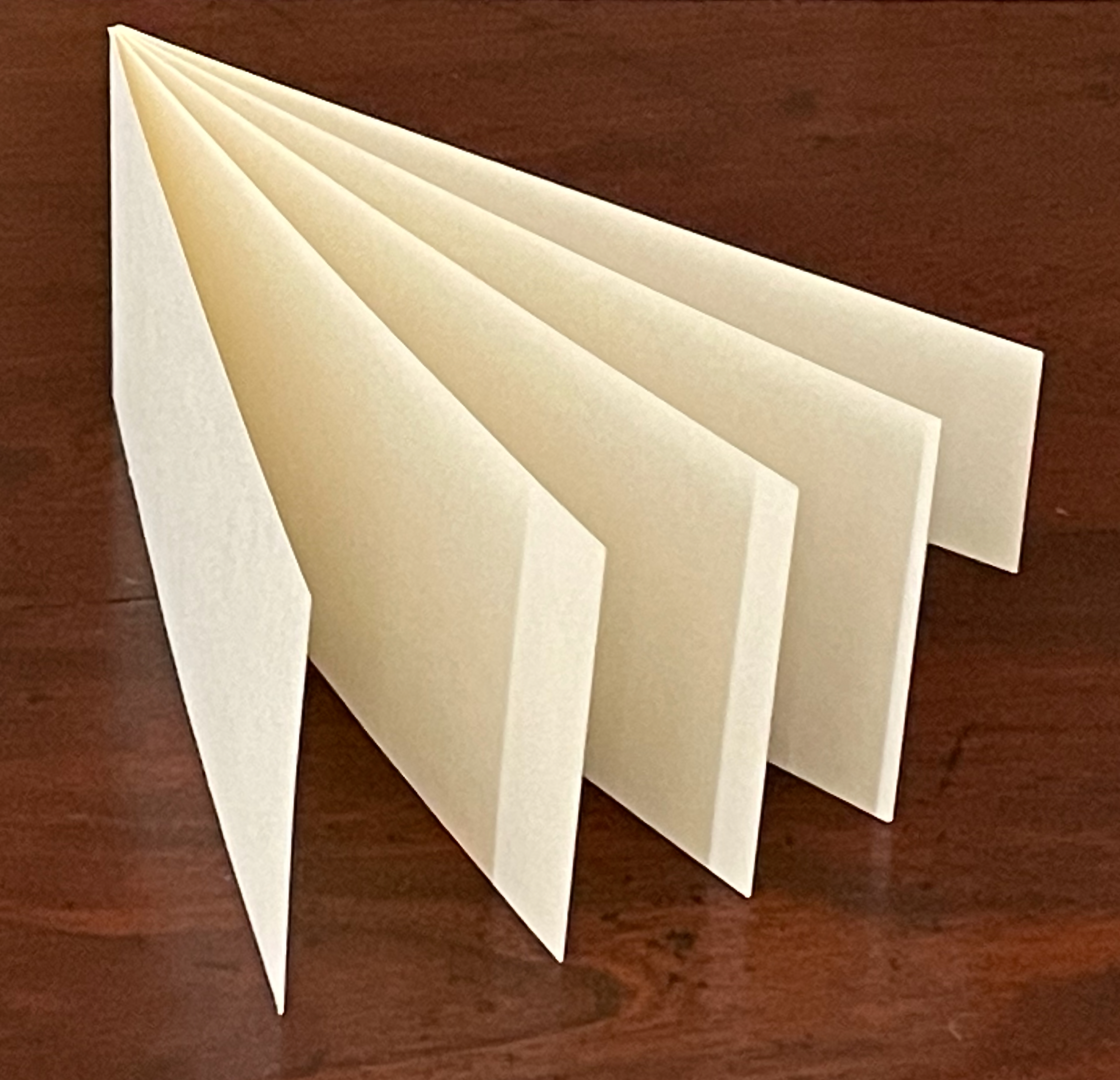
In other words, Colman has turned Cage’s temporal art into spatial art. Given the performance origin of the next work, though, it’s not hard to imagine an invitation from Colman to watch her open 4 p. and 33 mm., place it atop a piano, and then close it at the conclusion of 4 minutes and 33 seconds.
Semiotics of the Studio (2015)
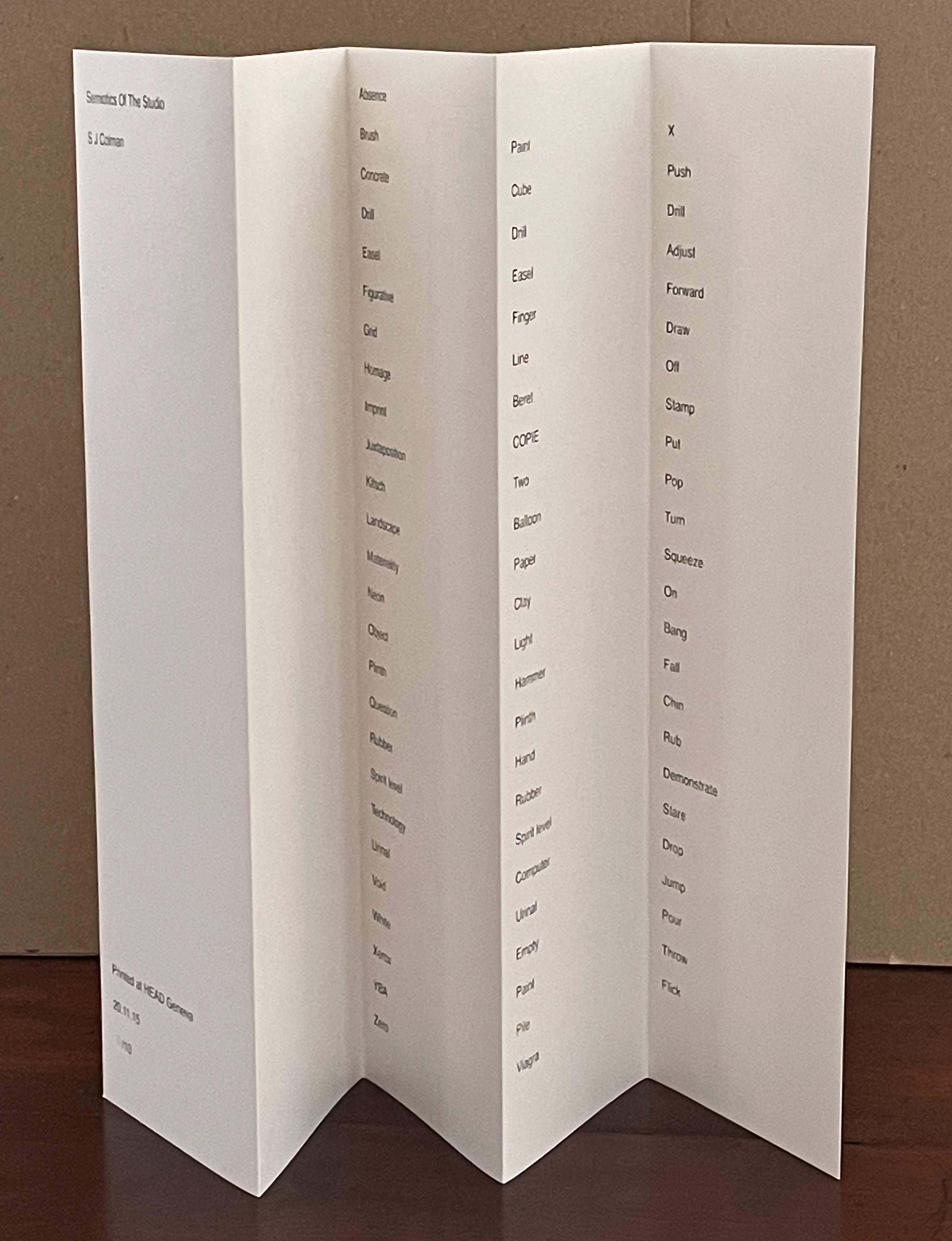
Semiotics of the Studio (2015)
Sarah Colman
Leporello H300 x W85 mm (closed), up to W425 mm (open). Five panels. Edition of 10, of which this is #10. Acquired from the artist, 1 August 2026.
Photos: Books On Books Collection.
First, here is Martha Rosler’s Semiotics of the Kitchen (1975).
Like 4p. and 33mm, the Semiotics of the Studio translates a different medium into that of an artist’s book and very much insists on being experienced on its own terms.
Laid flat or standing, Semiotics of the Studio presents itself as an accordion book, but the order of reading its text is not as straightforward (or downward) as the first panel’s alphabetical order suggests. The alphabetical order in panel 1 becomes a red herring in panel 2. With “Cube”, “Drill”, “Easel”, and “Finger”, Panel 2 resumes an alphabetical order only to abandon it, and in panel 3, there are no alphabetical pairs or triples at all.
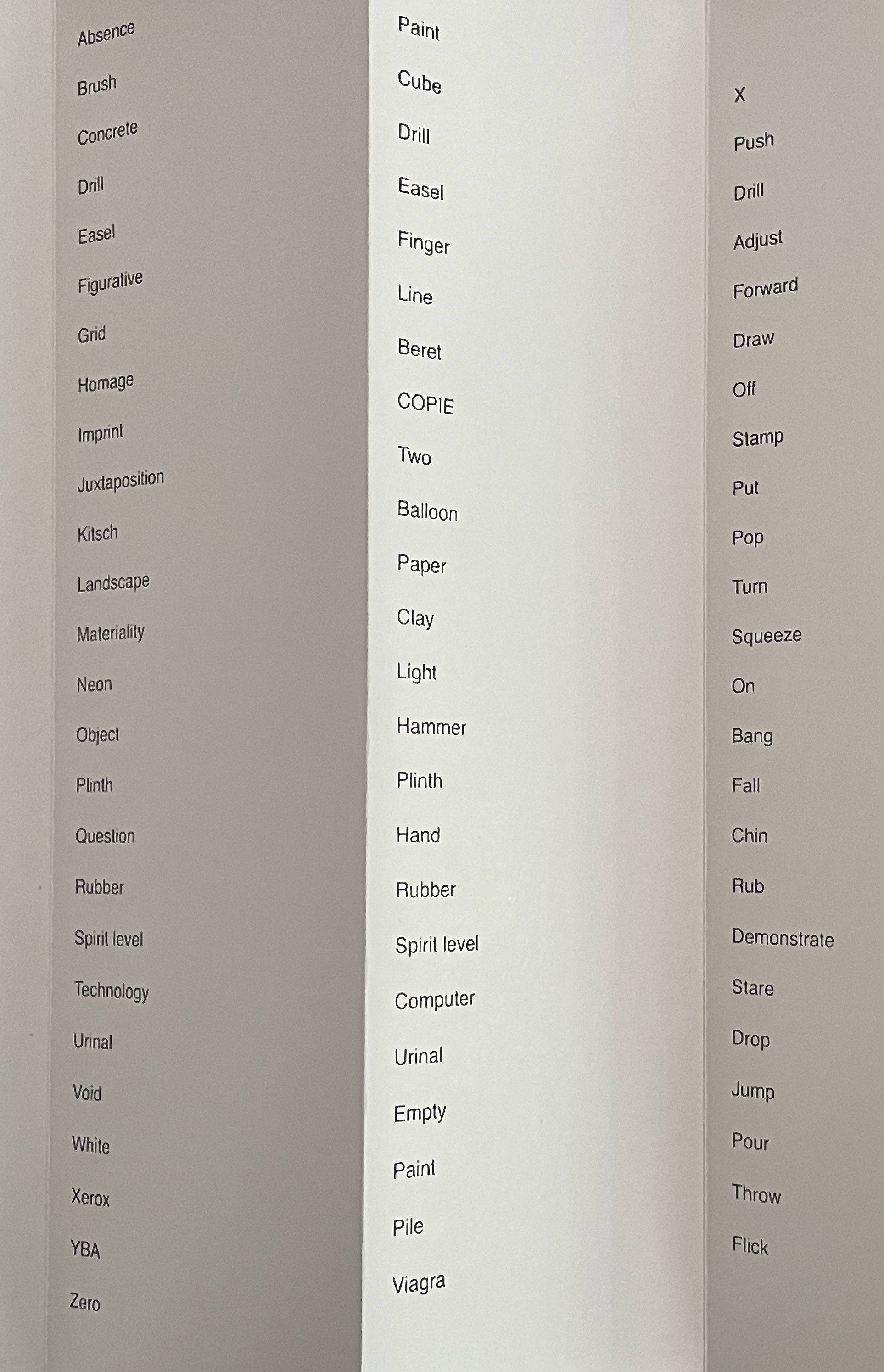
Perhaps we should read from left to right across the three panels instead of down. Is the blank space at the top of the third panel showing us the product of “Absence” in the first panel and “Paint” in the second panel? But wait, maybe we should read backwards from “Paint” in the second panel to “Brush” in the first; after all, further down, we have “”Juxtaposition” in panel 1, then “Two” in panel 2, and “Put” in panel 3, suggesting that we put two in juxtaposition.
Just below that, if we put “Kitsch” and “Balloon” together with “Pop”, do we have a dig at Jeff Koons? And much further down, is the juxtaposition of “Urinal”, “Urinal”, and “Drop” taking the piss with Duchamp?
What about “Object”, “Hammer”, and “Bang”? If we are trying to figure out sentences from this, Subject, Verb, and Object seem to jump about. We need to put “Chin” (panel 3) on “Hand” (panel 2), and “Question” (panel 1) what is going on.
Another puzzle is that some words are repeated across from each other in panels 1 and 2. “Drill”, “Easel”, “Plinth”, “Rubber”, “Spirit Level”, and “Urinal”, as we have seen. Sometimes, panel 2 gives an example for the word in panel 1 (e.g., “Computer” for “Technology”). Sometimes, the words are descriptive or synonyms of one another (e.g., “Neon” and “Light” and “Void” and “Empty”, respectively).
Closer inspection reveals that the three columns of words do not precisely align horizontally. They cascade. “Absence” is slightly higher than “Paint”, “Paint” is slightly higher than “X”, and so on. Moreover, panel 1 has 26 words, panel 2 has 22, and panel 3 has 23. So perhaps we should be looking for sense in multiple directions, which is pretty much where semiotics as a discipline has landed.
Context, too, matters. Colman reaps the benefit of Martha Rosler’s kitchen setting for her subversive purposes. While Colman is in the studio, which suggests that her exploration of semiotics is one of creative process, she also slips in terms that challenge the clichés and politics of art, terms like “Beret”, “Kitsch”, and “Viagra”. It’s the artist’s book equivalent of donning the aprons and maintaining a deadpan delivery in the video.
By putting art words to work in a work of art — especially in the form of an artist’s book — Semiotics of the Studio “interrogates” itself and its subject.
Further Reading
“The New Concrete: Visual Poetry in the 21st Century“. 17 September 2018. Bookmarking Book Art.
“The Wittockiana, Museum of Book Arts and Bookbinding in Brussels“. 1 August 2026. Bookmarking Book Art.
“Moritz Küng (ed.)“. 30 November 2025. Books On Books Collection.
“Julie Johnstone“. 4 June 2020. Books On Books Collection.
“Antoine Lefebvre Editions“. 28 September 2020. Books On Books Collection.
“Julien Nédélec“. 19 June 2025. Books On Books Collection.
“Robin Price“. 7 July 2020. Books On Books Collection.

