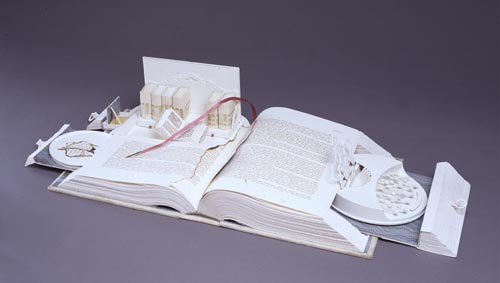
Drawn, Cut & Layered Werner Pfeiffer Plastic box containing illustrated pop-ups.Acquired from Toledo Museum of Art, 5 Jun 2017. Photos: Books On Books Collection.
Werner Pfeiffer’s playfulness finds its way into viewers’ hands with this offering from his Toledo Museum of Art exhibition in 2015. His archives are housed at Vassar College.
With its structures and photographic representation of Pfeiffer’s other works of paper engineering, Drawn, Cut & Layered demonstrates his breadth in that sub-domain of book art. Not detectable in the box, though, are Pfeiffer’s white altered book objects, which formed the 2010 exhibition at Cornell University, entitled censor, villain, provocateur, experimenter, and demonstrates his scope in the sub-domain of altered books.
In kind, they were preceded by Barton Lidicé Beneš‘ The Life of Gandhi and Beauty Book (both 1973), M.L. Van Nice‘s Swiss Army Book (1990) Irwin Susskind‘s Book Faced Down – Embedded in Plaster (1999). In kind and whiteness, they were followed by Jonathan Callan‘s Zurbarán’s Color Plates (2011), Michael Mandiberg‘s Print Wikipedia (2015), and Lorenzo Perrone‘s Kintsugi(2018).
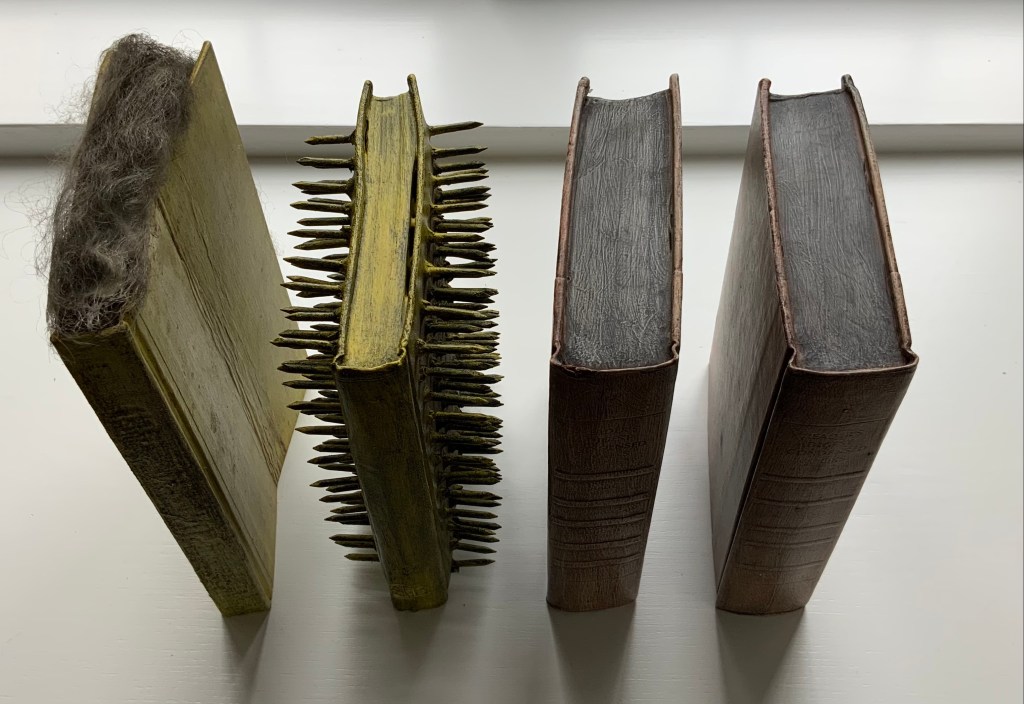
Beauty Book; The Life of Gandhi; Untitled (1973) Barton Lidice Beneš Mixed media book constructions. Acquired from Rago Arts and Auction Center, 23 March 2021; Allan Stone Gallery, New York; artist. Photos: Books On Books Collection.
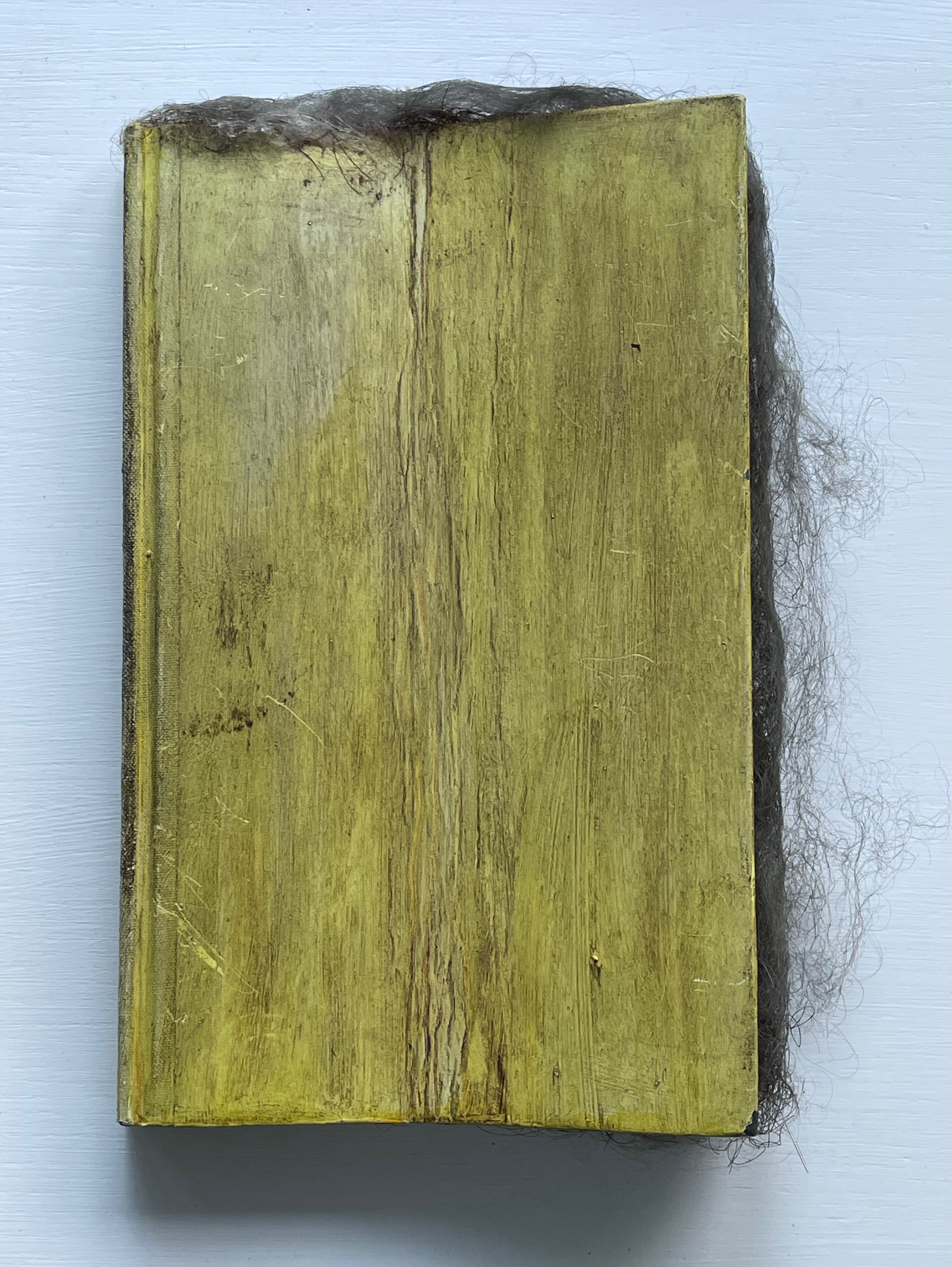
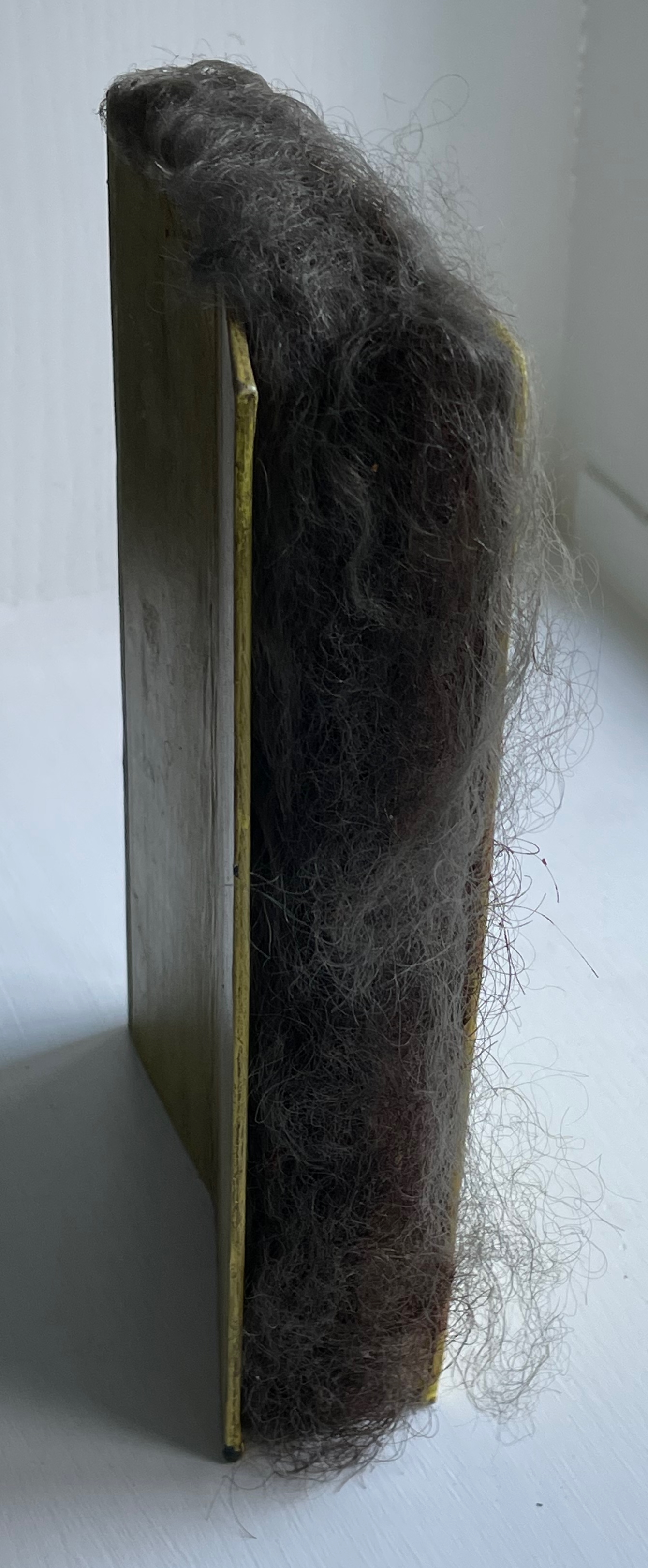
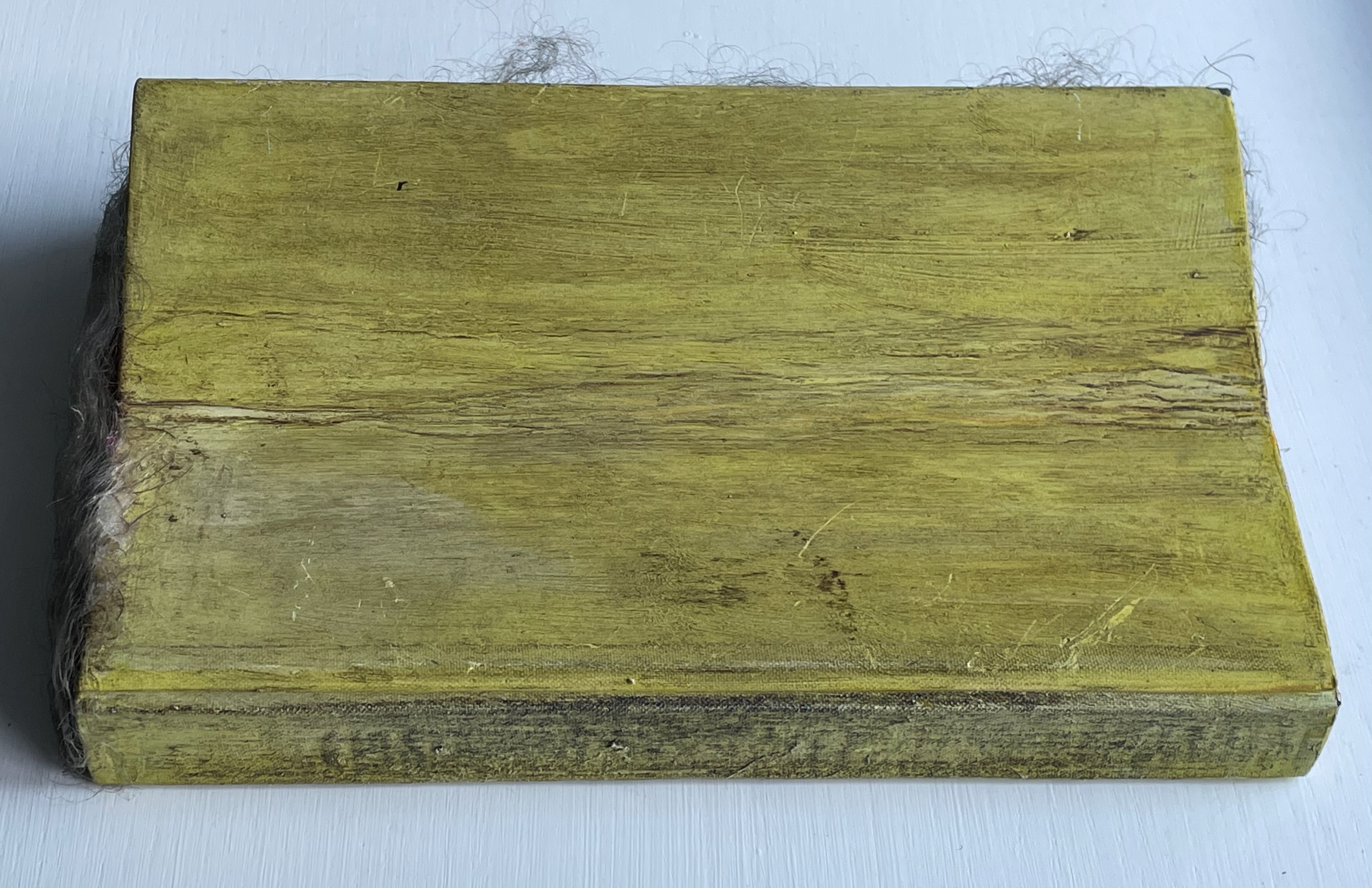
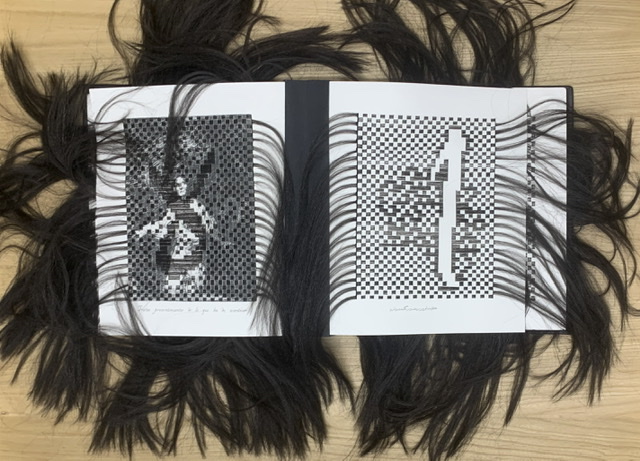
Beauty Book (1973) Barton Lidice Beneš Altered book with human hair. H220 × W140 × D50 mm. Unique. Acquired from Rago Arts and Auction Center, 23 March 2021; Allan Stone Gallery, New York; artist. Photos: Books On Books Collection.
The Sleep of Reason (2023) Masoumeh Mohtadi Photo: Courtesy of the artist.
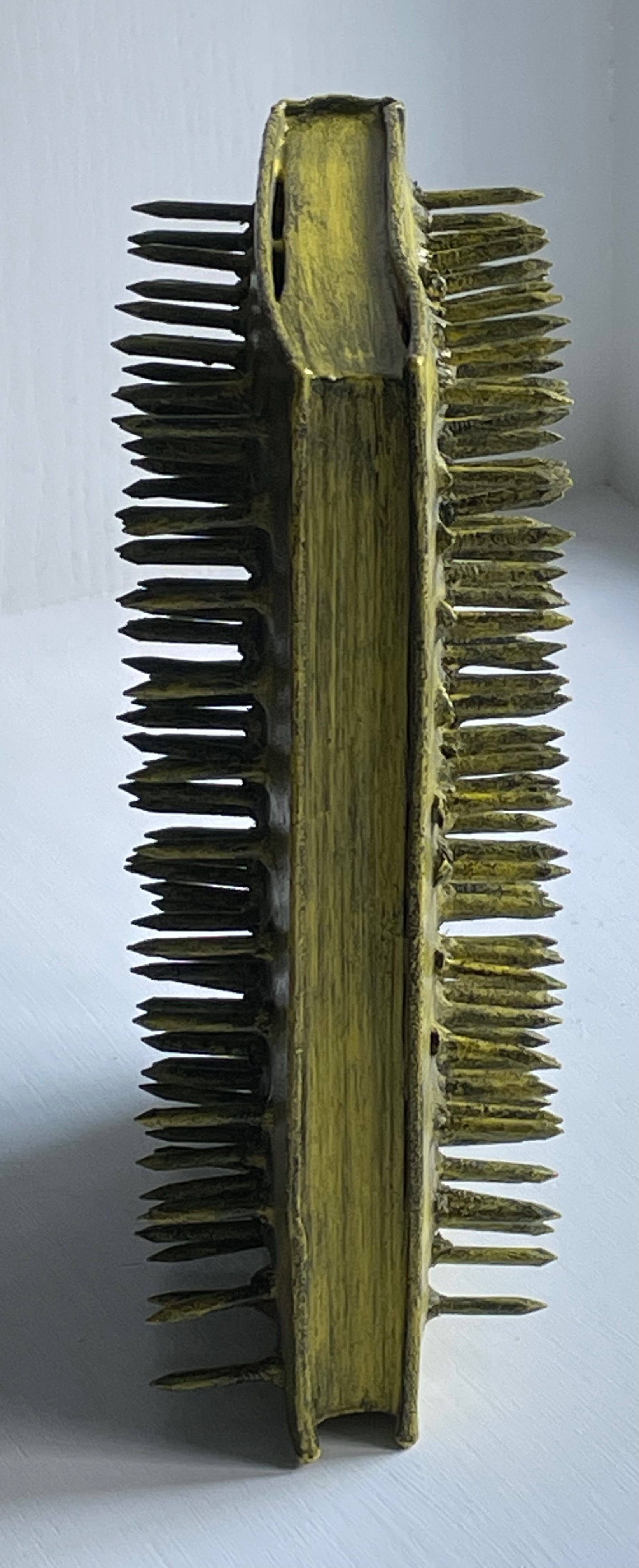
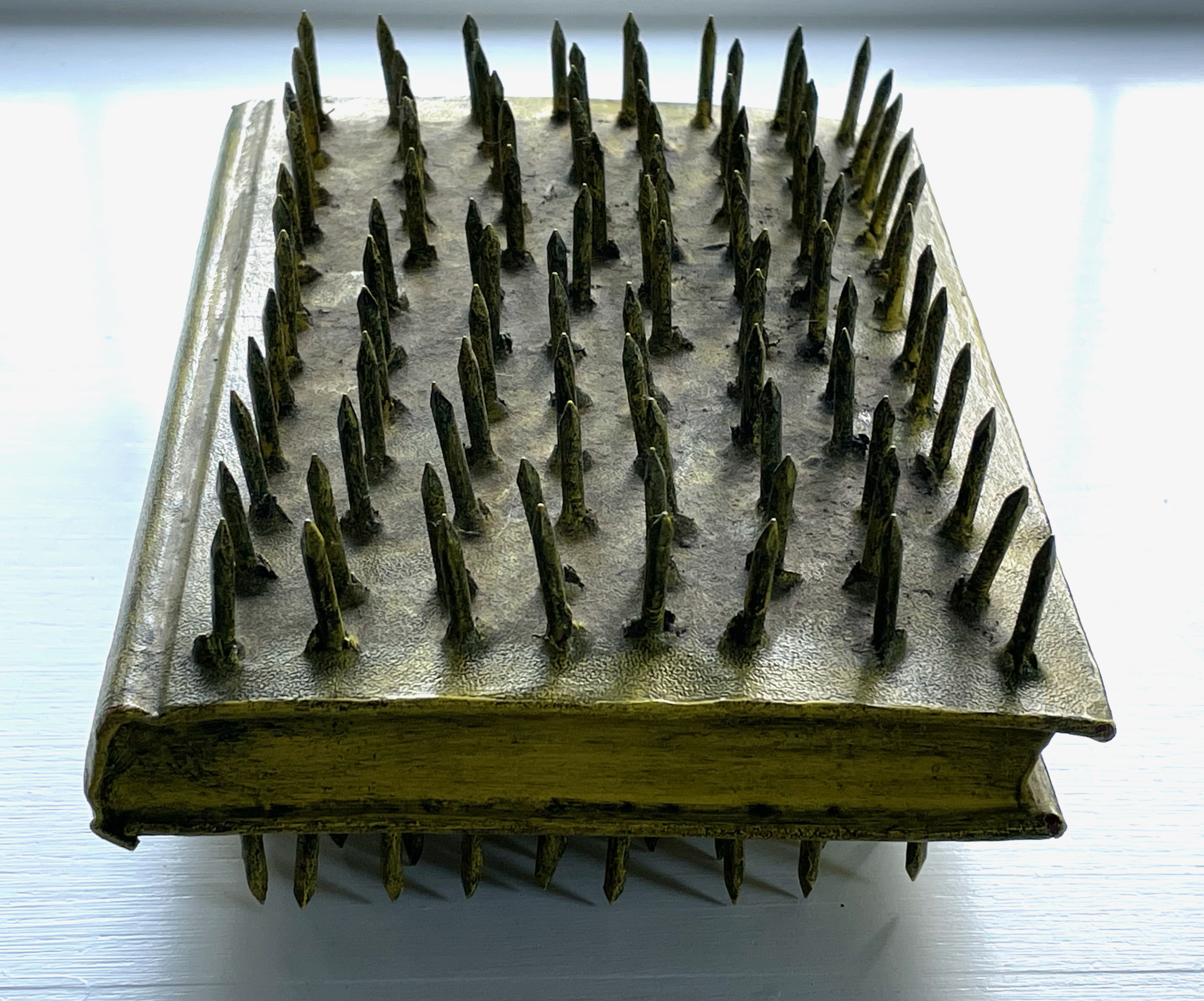
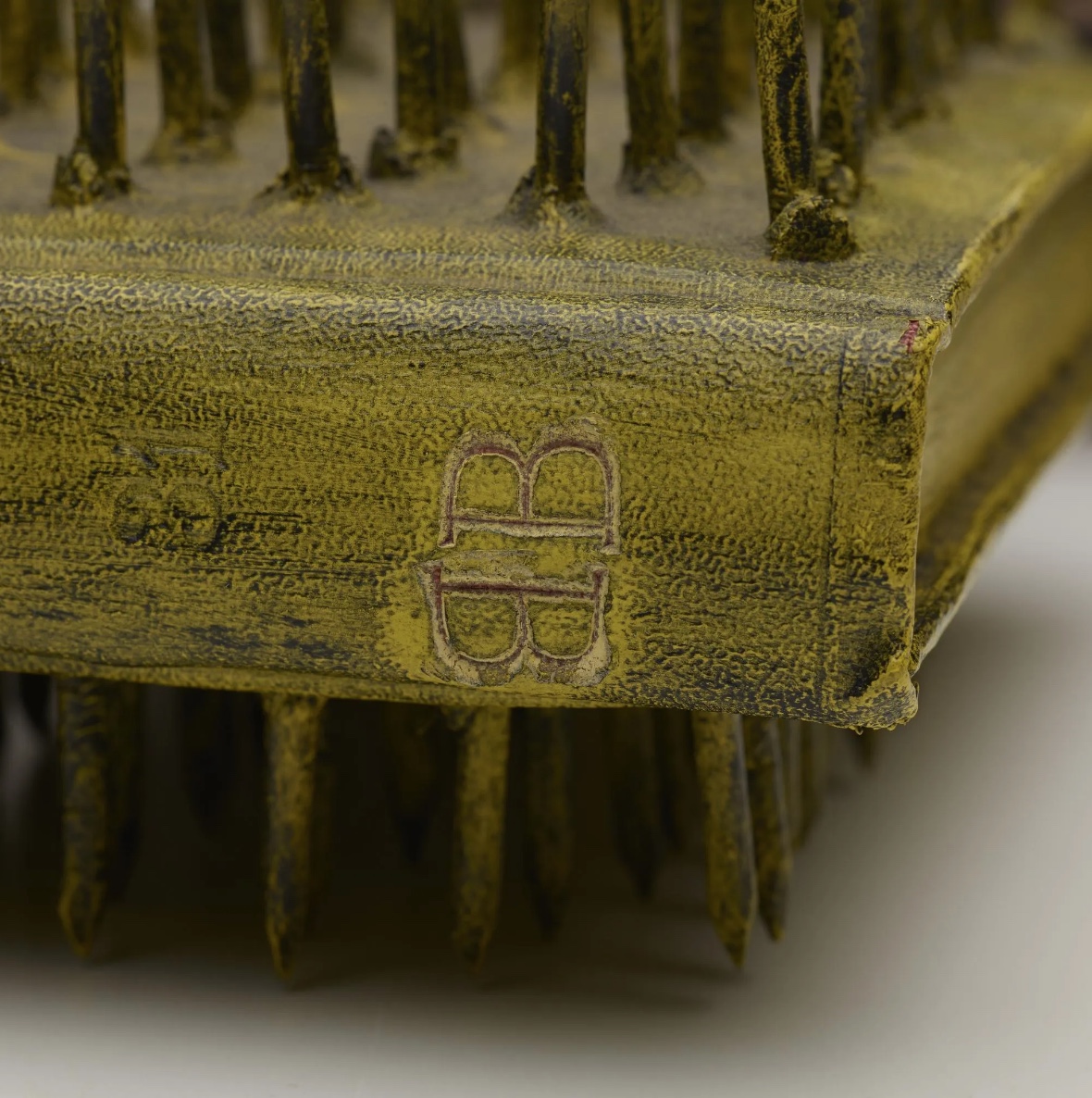
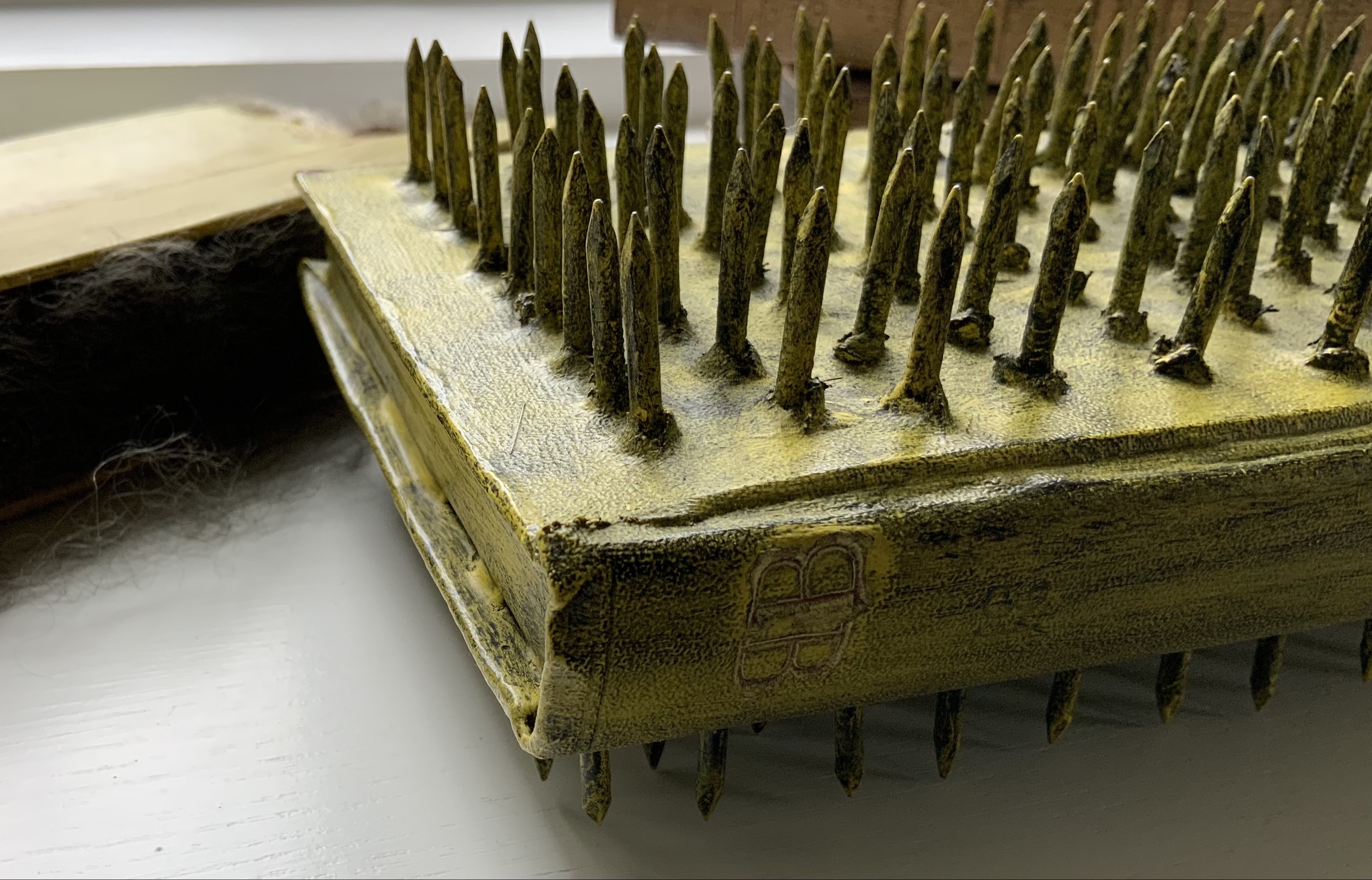
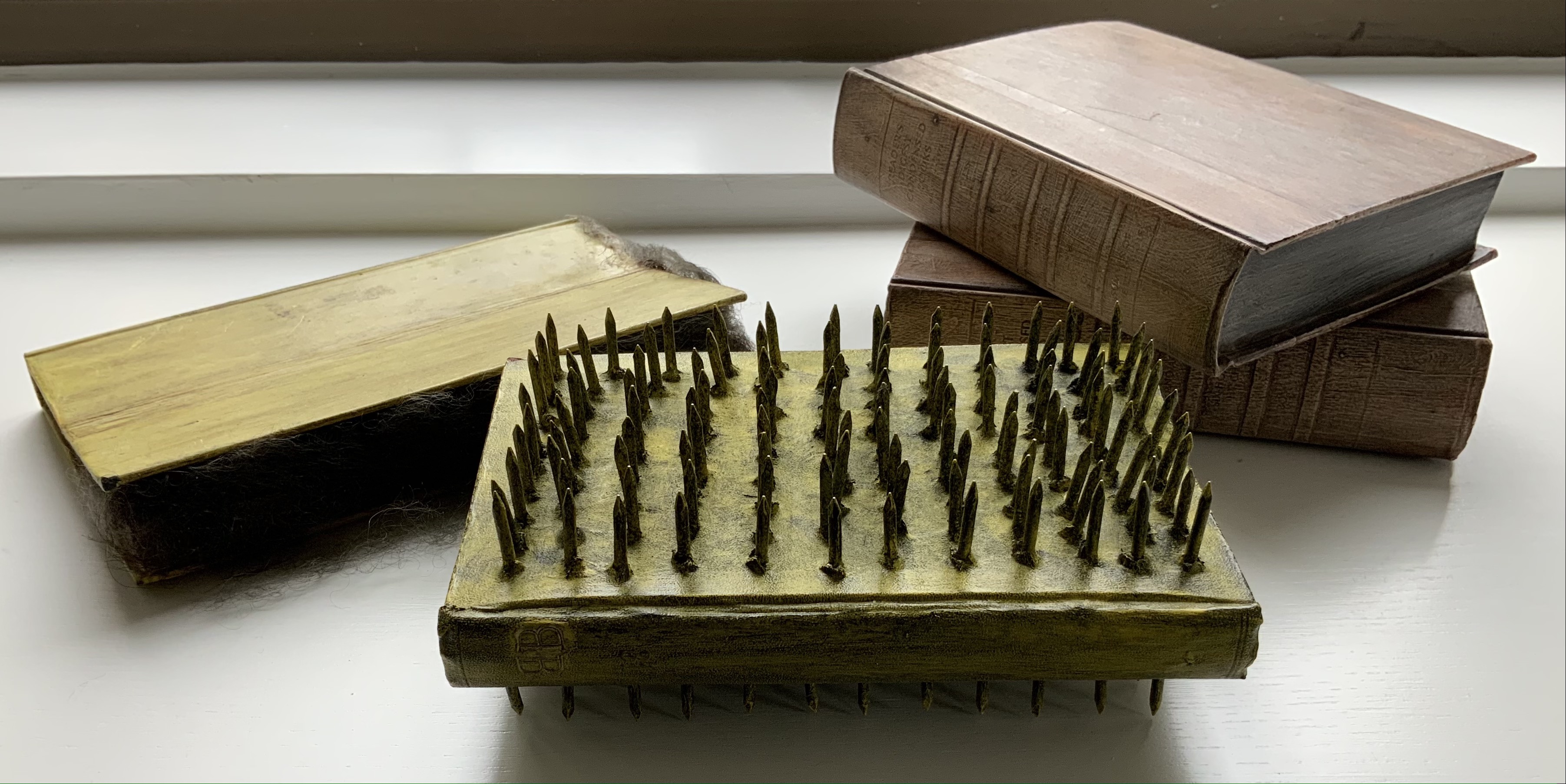
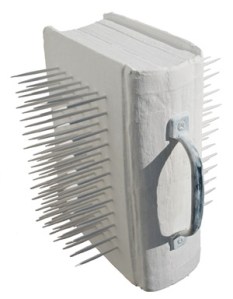
The Life of Gandhi Barton Lidice Beneš Altered book with embedded nails. H197 x W140 x D86 mm. Unique. Acquired from Rago Arts and Auction Center, 23 March 2021; Allan Stone Gallery, New York; artist. Photos: Books On Books Collection.
Beneš’ disrespectfully and adolescently entitled The Life of Gandhi may be the first artist’s book embedded with nails, although Lucas Samaras’ prickly Book 4 (1962) in the Museum of Modern Art might have provided inspiration. Later examples are Floating Concrete Octopus’s* Book of Nails (1992), Daniel Essig’s Book of Nails II (2003), Anne Maree Hunter’s Nailed (2005?), Sasha Meret’s Aggressive Book (2009), Werner Pfeiffer’s Difficult to Fit, Censored Nailbook, and Nailed Shut (ca. 2010-12), and manuel arturo abreu’s Kanga Book (2021). The frequency is considerably less than say treatments 0f Saint Sebastian in painting and sculpture, but the latter had centuries as a subject whereas the book nailed shut has only had decades.
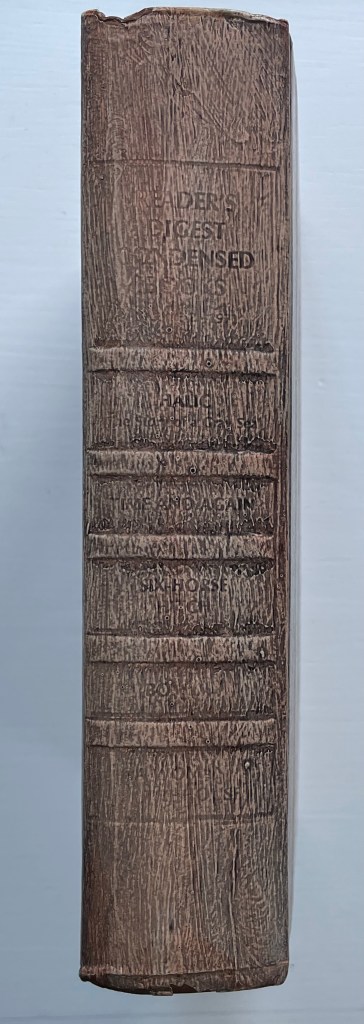
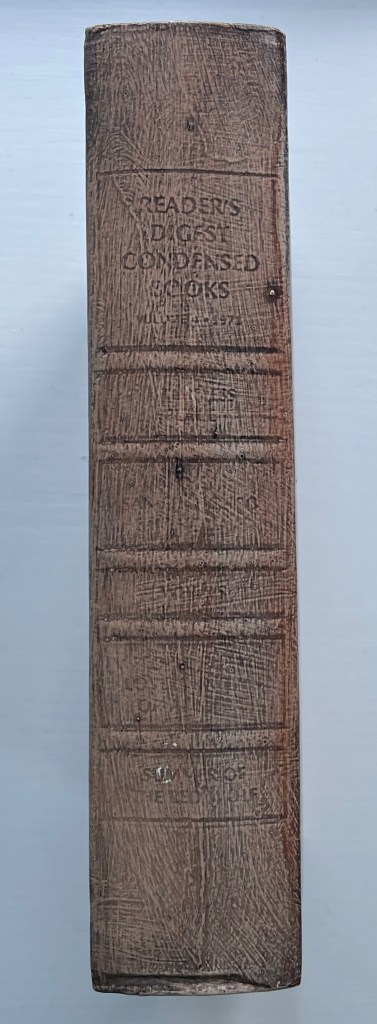
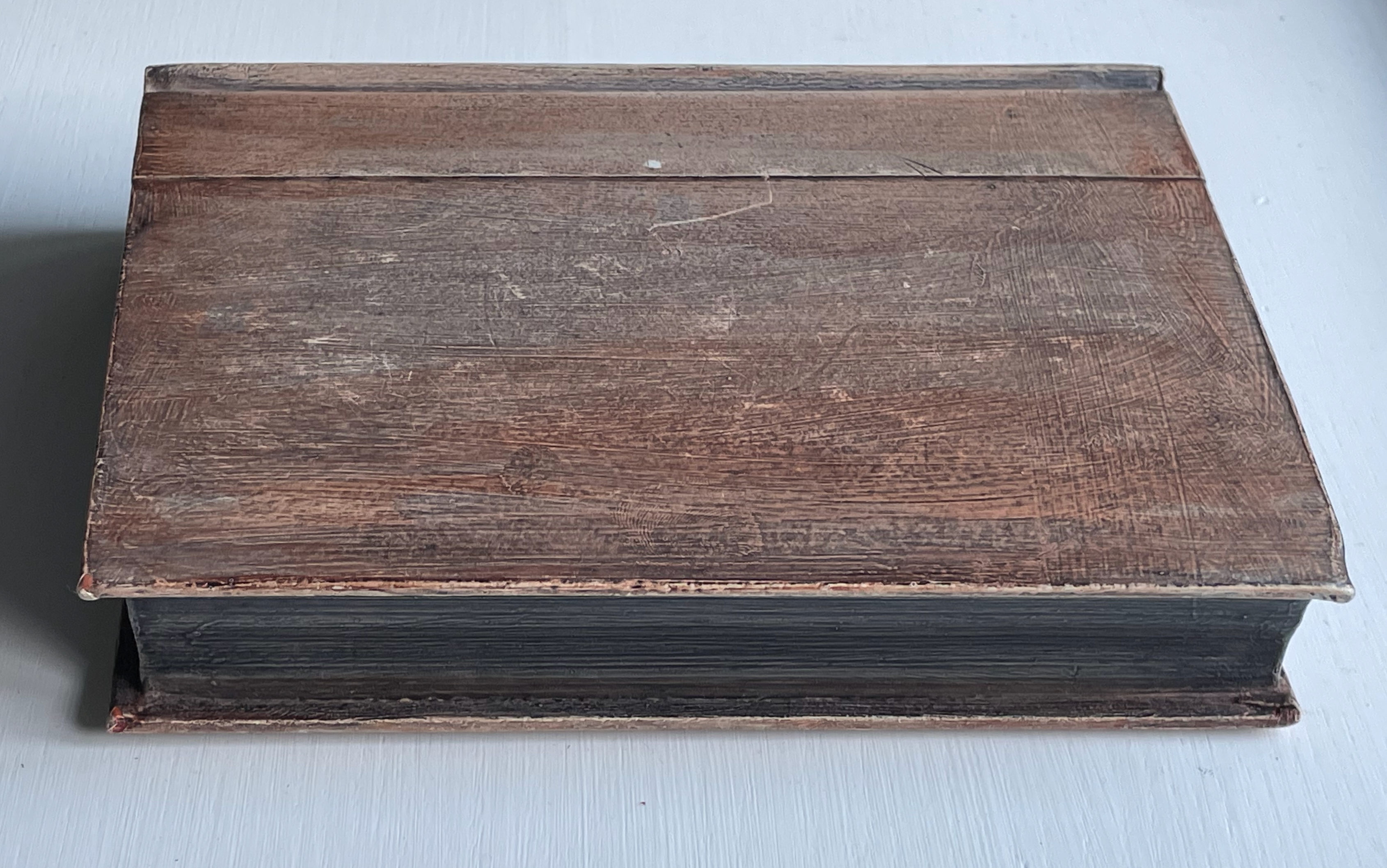
Untitled (1973) Barton Lidice Beneš Altered volumes of Reader’s Digest, sanded and varnished. Each H197 x W140 x D85. Unique. Acquired from Rago Arts and Auction Center, 23 March 2021; Allan Stone Gallery, New York; artist. Photos: Books On Books Collection.
With his two Untitled volumes, Beneš may again lay claim to another first-of-its-kind in this category among artists’ books. Two volumes from the Reader’s Digest Condensed Books series have had their component titles almost completely sanded off. They have been sealed and varnished to constitute a work more naturally called Untitled than any other work of art assigned that ubiquitous title.
These works of book art and his 1970s mail art interactions with Aart van Barneveld and Ulises Carrión secured Beneš’ position among the Fluxus and neo-Dadaist crowd. His later AIDS-related art such as the Lethal Weapon series (199o’s), made with his infected blood, may dominate his legacy, but these three works of book art sculpture place him alongside John Latham and Dieter Roth as an original and vanguard book artist.
Rotch Library offers a small but growing collection of contemporary artists’ books. The collection focuses on artists’ books published from the 20th century to the present and explores a range of techniques and technologies employed by the books’ creators.
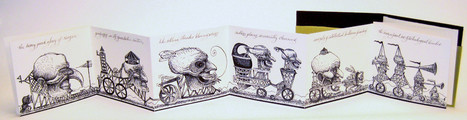
Yellow Submarine? Monty Python? Heath Robinson? Rube Goldberg? Hieronymus Bosch? Albrecht Durer? Quentin Massys? Whatever the influence, David M. Moyer has created choice work under The Red Howler Press. MIT has chosen well.
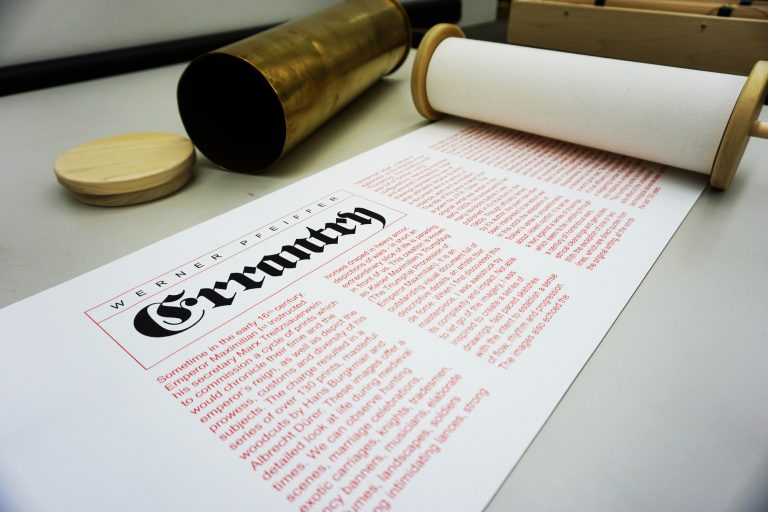
Errantry (2008) Werner Pfeiffer
Errantry, a 27-foot scroll housed in a howitzer shell casing, is inspired by Der Triumphzug Kaiser Maximilians or The Triumphal Procession of the Emperor Maximilian (1515), a series of 130 woodcuts by Hans Burgkmair the Elder (1473-1531) and others, about which Pfeiffer comments: “One of the dominant features in this document is the militant nature of many of the characters depicted, as well as their posture in parading their arms on horse, by carriage or on foot.” The text in Errantry draws from a poem of the same name in J.R.R. Tolkien’s Middle Earth mythology. The source poem, composed by Bilbo Baggins, describes one of his quest adventures in the usual self-aggrandizing yet self-pitying tone. As a model for Pfeiffer’s text, it makes the digitally printed images of war all the more horrible.
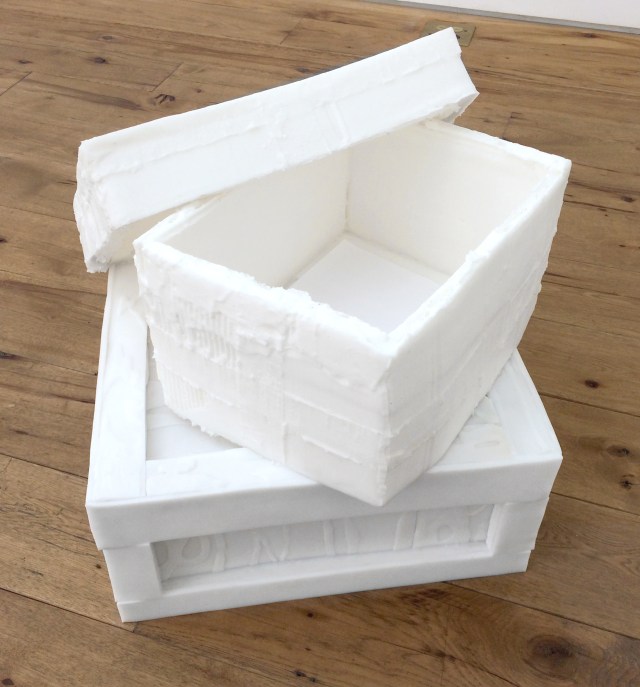
Cardboard Box (White) for Invisible Text, “Called Back,” Epitaph for Emily Dickinson Jeanne Silverthorne, 2017 Platinum silicone rubber, acid free paper, archival invisible ink 9 x 17 x 13 inches / 23 x 43 x 33 cm Edition 1/3 with 1 A.P
Dare you see a soul at the white heat? Then crouch within the door. Red is the fire’s common tint; But when the vivid ore Has sated flame’s conditions, Its quivering substance plays Without a color but the light Of unanointed blaze. Least village boasts its blacksmith, Whose anvil’s even din Stands symbol for the finer forge That soundless tugs within, Refining these impatient ores With hammer and with blaze, Until the designated light Repudiate the forge. – Emily Dickinson, Part One, Life, XXXIII
MARC STRAUS, the contemporary art gallery in the Lower East Side of New York, opened “an exhibition of white paintings and sculptures by an international selection of artists” on 3 June 2017. It runs through 3 July, and its title The White Heat comes from the first line of Dickinson’s poem above.
Books on Books offers this “white book report” on book art not included to put attendees in the mood for their experience of the works in white by artists such as
Damien Hirst
Nicole Eisenman
Enrico Castellani
Robert Barry
Fernanda Gomes
Antonio Santin
Jeanne Silverthorne
Joan Levison and others.
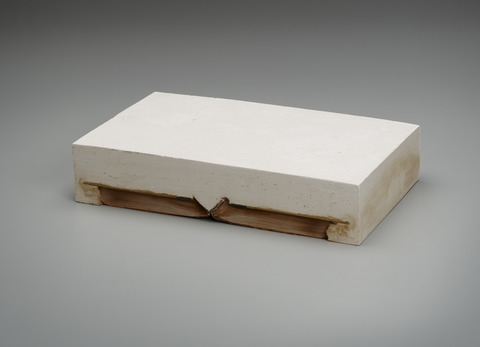
Book Faced Down – Embedded in Plaster, 1999 Found cook book and plaster block Irwin Susskind, born 1935 34.6 x 20.9 x 6.5 cm (13 5/8 x 8 1/4 x 2 9/16 in.) The Allan Chasanoff, B.A. 1961, Book Art Collection, curated with Doug Beube
Irwin Susskind‘s “Book Faced Down” is an example of the technique of mixed media – a stark white plaster block facing down the objectified cookbook – to create book art. A piece of sheet cake, a cutting board?
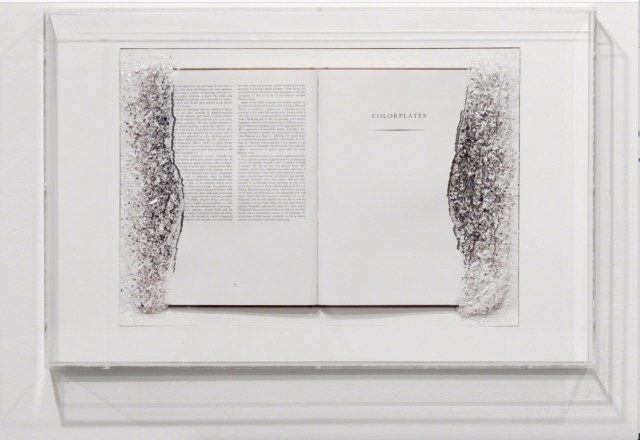
Zurbarán’s Color Plates, 2011 Jonathan Callan Chiseled book in perspex 46.4 × 71.1 × 5.7 cm
Jonathan Callan‘s piece denies viewers the colorful still lifes of Francisco de Zurbarán and leaves them with this drained-of-color, chiselled double-page spread of a book on the artist.
Work of Linear – Actions, 2000 Noriko Ambe
Where Callan chisels away from the edges inward, Noriko Ambe carves from the inside almost to the edges in her work above.
Absence, 2004 J. Meejin Yoon
As the Straus exhibition notes, “In Chinese cultures, White is associated with Death.” In J. Meejin Yoon’s book Absence, the absence of color in a solid white block of thick stock cardboard pages and the “text” of one pinhole and two identical squares die-cut into each of its 120 pages – one for each story of New York’s Twin Towers including the antenna mast – lead the reader down through the missing buildings to the final page where the footprint of the absent structures ends in a die cut of the entire site of the World Trade Center.
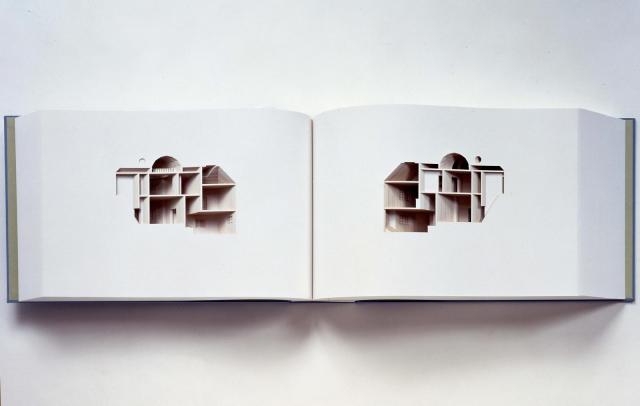
Your House, 2006 Olafur Eliasson Teixeira de Freitas, Lisboa, Portugal
Your House, 2006 Olafur Eliasson
Olafur Eliasson seems to have followed Yoon’s technical approach in Your House, 2006, although the effects are far more intricate.
Coral Colony, 2017 in progress Julie K. Dodd
Untitled Julie K. Dodd
Echoing Yoon’s somber note, Julie K. Dodd‘s paper and book art often dwell on environmental issues, such as the death of a coral colony above and the contours of the natural landscape versus manmade as shown in Untitled.
The Great Gathering, VII The Time is Now, 2016 Chris Ruston Photo credit: Chris Matthews
A more hopeful note is struck in the whiteness of Chris Ruston’s final “ammonite” book in the series The Great Gathering, inspired by Darwin’s On the Origin of Species. The mirror under the maker’s tools and the made thing implicate the viewer here and now in an optimistic ongoing evolutionary process of making and remaking.
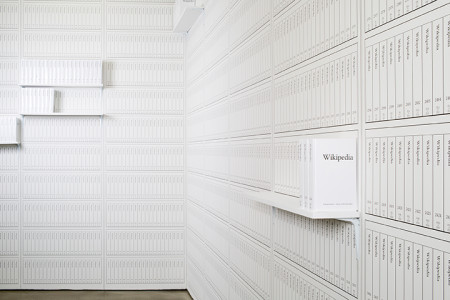
Michael Mandiberg, Print Wikipedia, 2015 Exhibition “From Aaaaa! to ZZZap!” by the Denny Gallery, 261 Broome Street in New York City, 18 June through 11 July, 2015.
Where the white of Yoon’s and Dodd’s works evokes absence and the white of Ruston’s work evokes the blank invitation to singular creativity, Michael Mandiberg‘s installation of multiples, Print Wikipedia, evokes the plenitude of white noise that is our online lives.
Swiss Army Book, 1990 M. L. Van Nice Gift of Lois Pollard Price National Museum of Women in the Arts
And just as technologically allusive, M.L. Van Nice‘s Swiss Army Book poses (tongue in cheek?) the single volume as somehow able to capture, store and transmit knowledge in ways it need not, albeit the meaning of the whiteness here is a bit elusive.
Legal Process Narrative, 1996 Werner Pfeiffer Law Library, University of Connecticut at Storrs
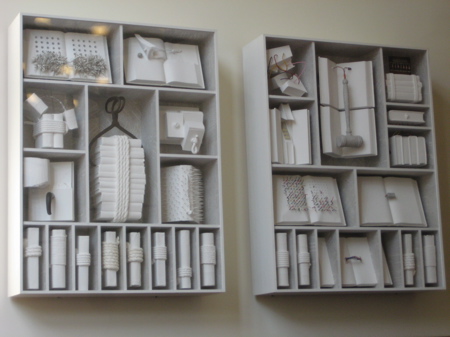
Werner Pfeiffer’s works constitute an extensive treatment in white. The installation at UConn Storrs represents a small proportion of the works shown in retrospectives in the last ten years at Bucknell, Cornell and the Toledo (Ohio) Museum of Art. Pfeiffer’s works touch on censorship, and from his Cornell exhibition, he explains:
The objects I create are made with real books. They are not casts, nor are they sculpted imitations. At its core each piece has bound, printed pages. Glued together and painstakingly covered with gesso, they are silenced and sealed for good. I practice this destruction, this obvious censorship, simply as metaphor. It is to visualize, to demonstrate, to provoke. For these acts of violence are not about the damage done to stacks of paper, to books. The objects are about the harm inflicted on the human spirit. The ropes, the nails, the clamps, the hooks and knifes are real as well. They are symbols of pain, of torture, of suppression which are inevitably brought on by the censor’s act.
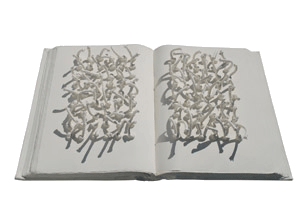
Knotty Story Werner Pfeiffer
Difficult to Fit Werner Pfeiffer
With the advent of ebooks, Pfeiffer celebrates the tangibility of the book with his white gessoed book objects and their punning titles as well as origami-like works such as Zig-Zag.
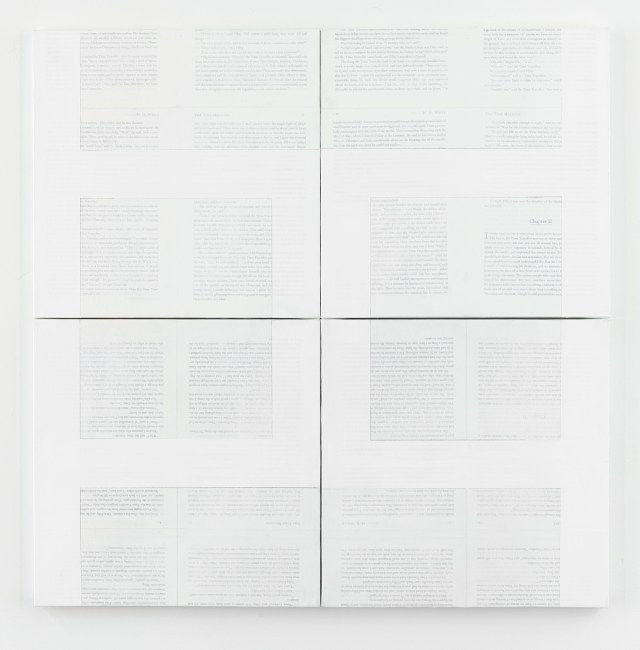
But back to the white works of art at the MARC STRAUSS gallery. Book art is not entirely neglected. Following in their tradition since 1984, Tim Rollins and K.O.S. (“Kids of Survival”) pondered, discussed and “jammed” on 1895 novella by H.G. Wells to produce THE TIME MACHINE (after H.G.Wells), which is included in the exhibition.
THE TIME MACHINE (after H.G. Wells) Tim Rollins and K.O.S., 2013 Matte acrylic, pencil, book pages on canvas 4 parts, each: 12 x 12 inches / 30.5 x 30.5 cm Overall: 24 x 24 inches / 61 x 61 cm Courtesy Studio K.O.S. and Lehmann Maupin, New York and Hong Kong.
According to the artists, “We believe that every total work of art is a time machine – a synthesis of a living past and present located in an object that can only be completed by the social experience of a viewer in the future. The total work of art exists in the invisible fourth dimension of space/time and it is this notion that unites the works in the exhibition. We paint on historic texts in the present so that they can haunt our futures.”
Suitably prepared? Jump in your time machine and head over to 299 Grand Street, on the Lower East Side in New York, and immerse yourself in “The White Heat“.
Werner Pfeiffer, Zig Zag, 2010 Laid into drop spine case: One folded sheet (20 x 20 cm.) which unfolds into a paper structure with various panels containing text printed in red and black, including instructions for use of the work. “The structure used in this book is a combination of two accordion folds. Both are first creased, then each segment is cut halfway through at the center and finally the two strips are merged together where the cuts have been made.” Limited edition of 60 copies.
“The book is one of the most powerful weapons ever invented.” — Werner Pfeiffer, Book-Objects & Artist Books, online exhibition, Cornell University Library’s Division of Rare and Manuscript Collections.
Anselm Kiefer, Der Rhein, 1982-2013 Collages of woodcuts on canvas with acrylic and shellac in a leporello structure.
“The book, the idea of a book or the image of a book, is a symbol of learning, of transmitting knowledge … I make my own books to find my way through the old stories.” — Anselm Kiefer, publication entry for Brünhilde schläft, in Toledo Museum of Art Masterworks (Toledo, 2009).
Like Anselm Kiefer, though eight years older, Werner Pfeiffer grew up in the shadow of Nazi Germany. The works of both artists are rooted in the book and its peculiar place in that culture. Pfeiffer’s book-objects consist of deconstructed, dismantled library discards that are reassembled with glue and coated in gesso. “Gagged and tormented” (with nails, screws, rope and various physical distortions), the works are “symbols of pain, of torture, of suppression which are inevitably brought on by the censor’s act”, the real remnants of which Pfeiffer recalls from his earliest childhood.
Pfeiffer’s artist books on the other hand run the gamut of foldouts, scrolls, flexagons, walk-in environments and rely on traditional bookmaking craft: handset type, letterpress printing, sophisticated binding as well as original print techniques such as wood cuts or linoleum blocks and etchings on archival papers. The emotional range of Pfeiffer’s art is also wide — humorous, playful, piquant, simultaneously angry and sorrowful, concerned. The overriding concerns are straightforwardly explained in the text to the online Cornell University exhibition.
The first schoolbooks I can remember, leftovers from the previous regime, were heavily “edited.” They were books with words and sentences blackened out. Chapters were deleted; entire pages were missing. This was information declared unsuitable for a post-war generation, a generation who six months earlier had been practically obliterated by the events now deemed unfit to be read about. Part of what they had lived through, their own history, had been blocked out, hidden behind those black marks.
Measured by the perceived fears an innocently bound codex seems capable of instilling, the book is one of the most powerful weapons ever invented. And yet we find ourselves at a threshold where its power and influence seem to be waning.
… As in the past, we find at the core of our current socio-political realignment the process of communication…. The new cultural footprint is a set of digits and their application, made possible by the microchip and the speed of electricity….
My book-objects have their origin partly in this ambiguous realm, a period of change as radical as it is dramatic. Superimposed over this perceived uncertainty is my personal concern about censorship. By making books which are deliberately mute I try to raise questions. Words are lost; they are no longer important. The books take on new forms; they become provocative statements. No longer instruments for reading they become sculptures, they become Book-Objects.
As with all superior sculpture, Pfeiffer’s works make the hands twitch to touch and manipulate them. In a few exhibitions, that interaction has even been encouraged. There is something inherently haptic about his book art (for example, Zig Zag and Abracadabra) and his book-objects (for example, Drawing Blood), which can be enjoyed vicariously in these videos: Youtube 1, Youtube 2, Youtube 3 and Youtube 4.
Kiefer’s materials are more varied, more monumental than Pfeiffer’s, and his concerns are decidedly not straightforward. Considering his sprawling studio complex at Barjac, in southeastern France, and its towers and installations, to say that Kiefer’s oeuvre extends beyond book art is an understatement. But for Books on Books, his most moving works — even those in which the book’s material presence is greatly subordinate — remain tethered to book art. The ache to touch Kiefer’s art, however, is different from what you feel with Pfeiffer’s. What little playfulness there may be in some of Kiefer’s earliest pieces is overshadowed by monumental works evoking an urge and dread at the same time.
You feel it walking up the stairs in the Royal Academy, looking up and seeing the sculpture Für Fulcanelli – die Sprache der Vögel, its great wings of beaten lead spread and rising above you. Between the wings, the body is made of a stack of elephant and double elephant folio books lying flat (or rather gathered folios made of lead like the wings). Interleaved with the closed and open books are rusted metal folding chairs with wooden seats and backs, the kind found in city parks. Thick metal wedges that appear to be wood are inserted at various points to balance out the angular, tilting pile. Separate and lying before this huge bird is a carved wooden snake, elongated and heading right to left as you view the work. The pages of the books curl and fold and roll up as if sodden or aflame. Some are rusted. The bottom-most book has lead binder boards, water stained and looking like marbled paper. Not all of them have binding boards, but all are spineless. You want to touch but know that if you do, your fingers will come away with some alchemical residue of history that will not come off and may burn the skin.
Pfeiffer’s works from a major exhibition in 2011 at Cornell remain on view online. Another major exhibition followed in 2012 at Vassar College. A new exhibition is scheduled for February 2015 in Toledo, Ohio. More about it in The Blade.
A major retrospective of Kiefer’s art at the Royal Academy of Art concluded in December 2014, coinciding with an hour-long BBC program. An interview with the artist and several podcasts are available on the RA’s site, and the rich and extensive exhibition catalogue provides articles exploring the complex themes of Kiefer’s art.















 Books On Books