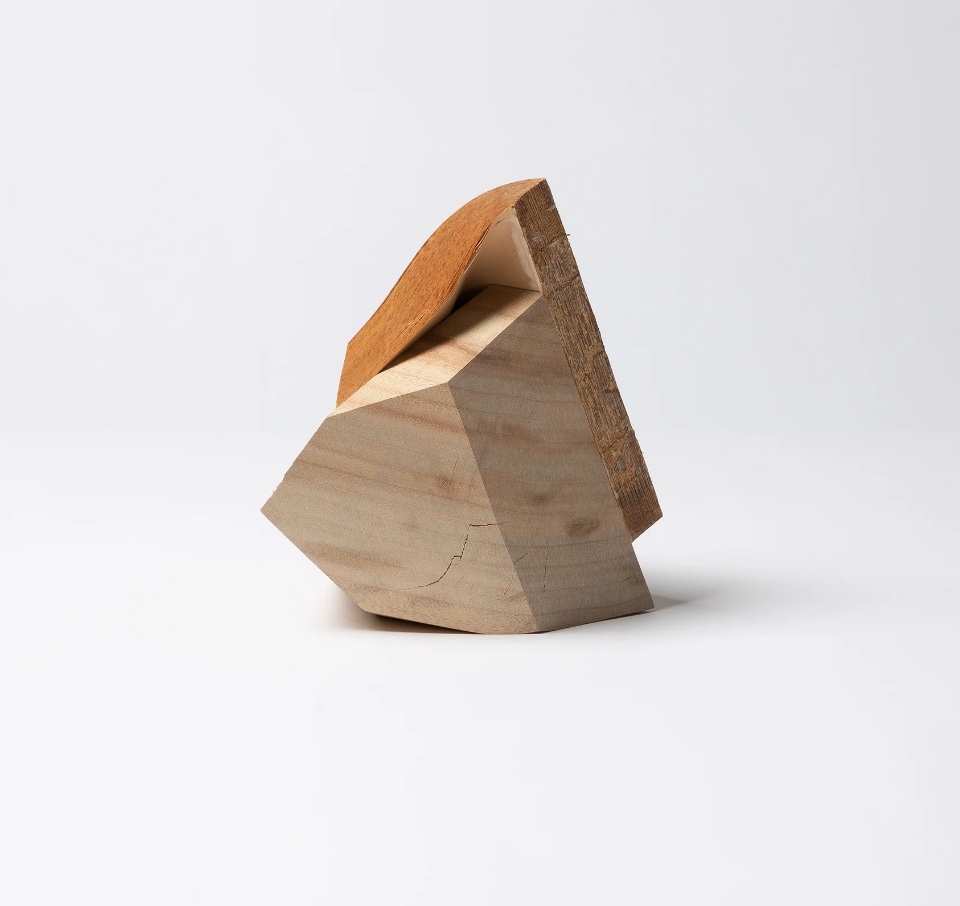
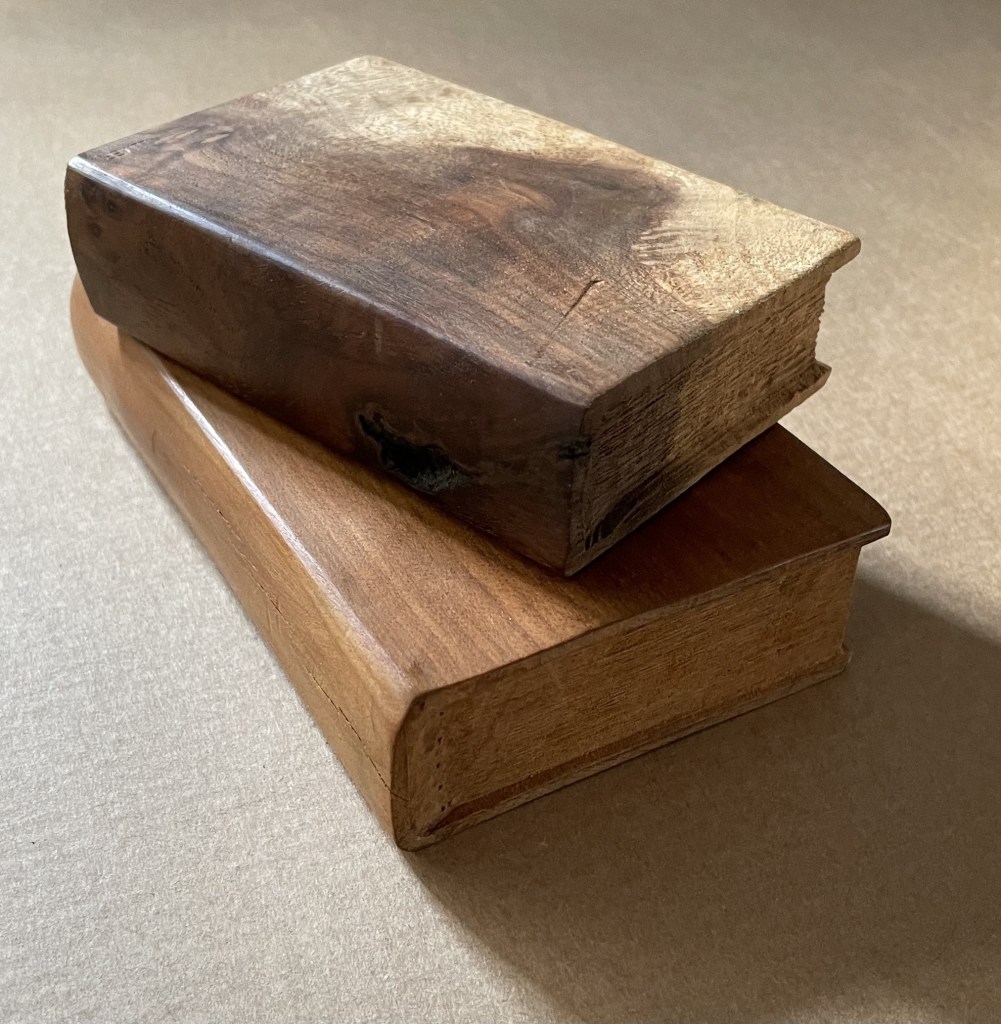
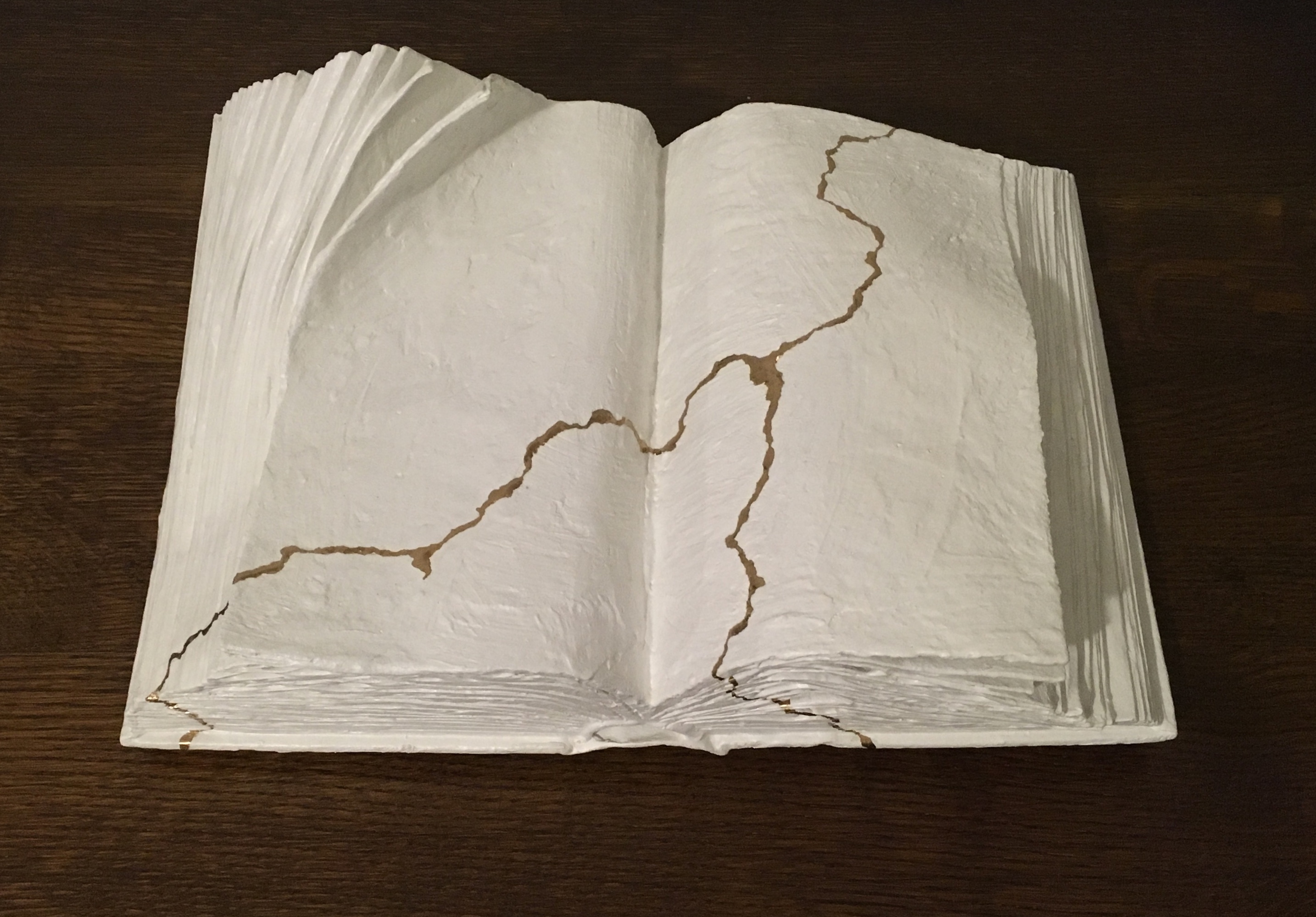
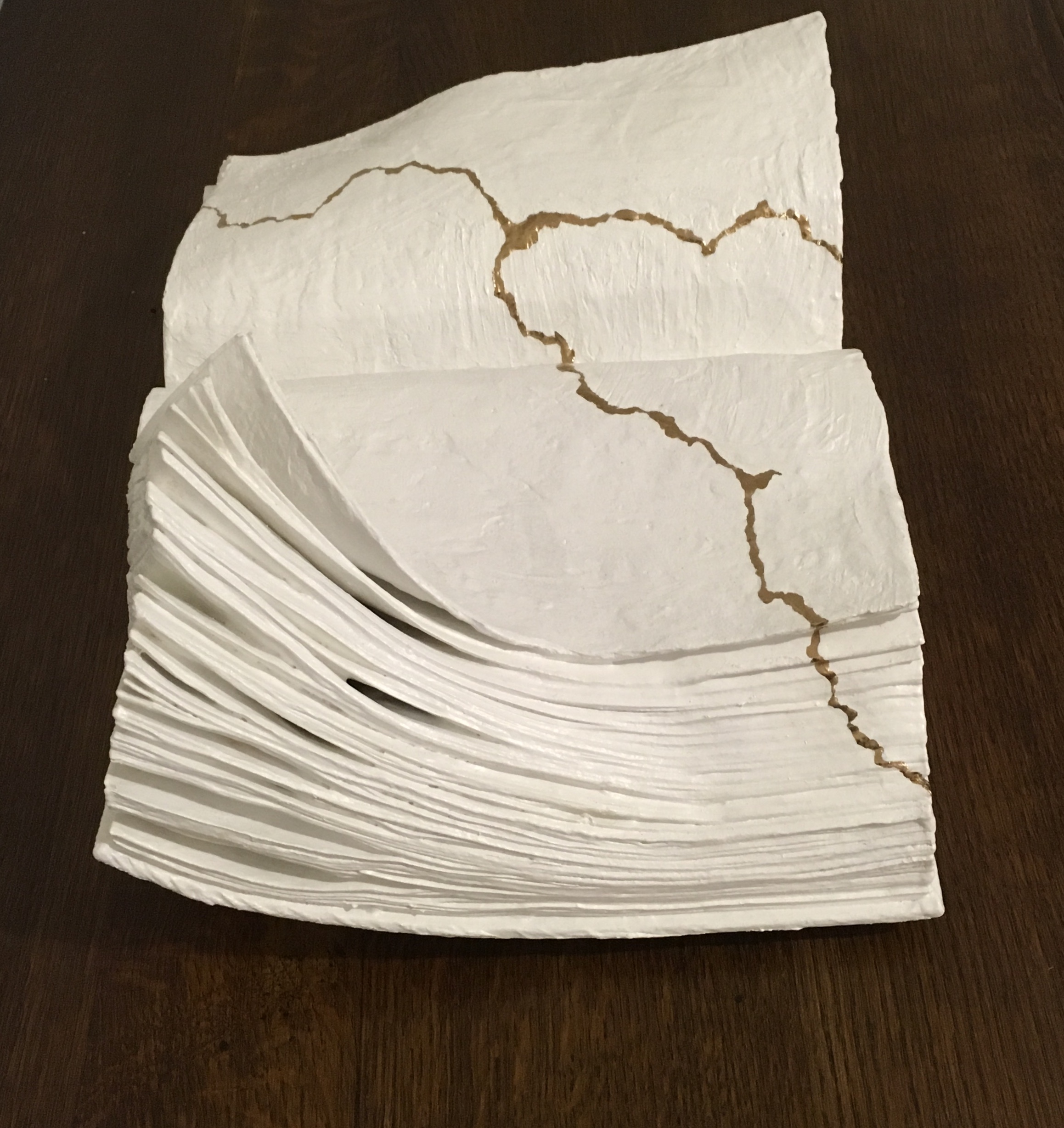
Silent Book, vol. 11 (2023) Ryuta Iida Altered book, camphor tree stump, and glue. H210 × W170 × D190 mm. Unique. Acquired from Fragile Books (Tokyo), 20 August 2024. Photos: Above, courtesy of Fragile Books; below, Books On Books Collection.
The cover, door, table of contents, numbering, text, and endnotes are all filled with a series of information. I thought to stop and crystallize all the functions of the “book,” … I decided to crystallize it. It took the time to go through the hands of people, the old book that finally reached me, sealed on a pedestal, it is now ripe for its next role. (Artist’s statement)
“Crystallized” is not the first word that comes to mind when viewing and handling this eleventh in Ryuta Iida’s series Silent Book. Perhaps it does for the angled planes of the cut block of camphor wood, but for the coverless codex, folded, draped, moulded, carved, and sculpted come closer. Two names that might not spring to mind (but should) are Giambologna (Jean Boulogne) and Gian Lorenzo Bernini. Like them, Iida offers us more than a single or primary vantage point from which to appreciate his work. Like Giambologna’s Abduction of a Sabine Woman (Loggia dei Lanzi, Florence) or Bernini’s Apollo and Daphne (Galleria Borghese, Rome) Silent Book must be circled and viewed in the round. The nine images below show the work turned right to left in stages.
Untitled(2015) Ivon Illmer Book-shaped wood sculpture. Top: Almond wood, H100 x W65 x D27 mm.Bottom: Poplar wood, H123 x W78 x D27 mm. Unique. Acquired from the artist, 10 October 2014. Photos: Books On Books.
From Ivon Illmer’s website: Books preserve history and stories. Each book has its own individual story. This ranges from loving treatment to neglect to ostracism and even burning. The arc almost inevitably stretches from the fate of the book to the fate of man. Everyone should let their imagination run wild when touching the book sculptures and invent their own story for each book. Touching is important, the haptic experience flatters the sense of touch. You “grasp” the beauty of the wood. Imagining the book sculptures in the raw piece of wood is the art. Each piece is unique in shape, structure and grain. Accessed 14 October 2024.
Illmer categorizes his work as “book sculpture / book art”. The carvings from various woods primarily celebrate the shape and tactility of the closed codex. The similitude of the exterior, right down to the fore, top and bottom edges, belies the inaccessibility of the interior.
Drawn, Cut & Layered Werner Pfeiffer Plastic box containing illustrated pop-ups.Acquired from Toledo Museum of Art, 5 Jun 2017. Photos: Books On Books Collection.
Werner Pfeiffer’s playfulness finds its way into viewers’ hands with this offering from his Toledo Museum of Art exhibition in 2015. His archives are housed at Vassar College.
With its structures and photographic representation of Pfeiffer’s other works of paper engineering, Drawn, Cut & Layered demonstrates his breadth in that sub-domain of book art. Not detectable in the box, though, are Pfeiffer’s white altered book objects, which formed the 2010 exhibition at Cornell University, entitled censor, villain, provocateur, experimenter, and demonstrates his scope in the sub-domain of altered books.
In kind, they were preceded by Barton Lidicé Beneš‘ The Life of Gandhi and Beauty Book (both 1973), M.L. Van Nice‘s Swiss Army Book (1990) Irwin Susskind‘s Book Faced Down – Embedded in Plaster (1999). In kind and whiteness, they were followed by Jonathan Callan‘s Zurbarán’s Color Plates (2011), Michael Mandiberg‘s Print Wikipedia (2015), and Lorenzo Perrone‘s Kintsugi(2018).
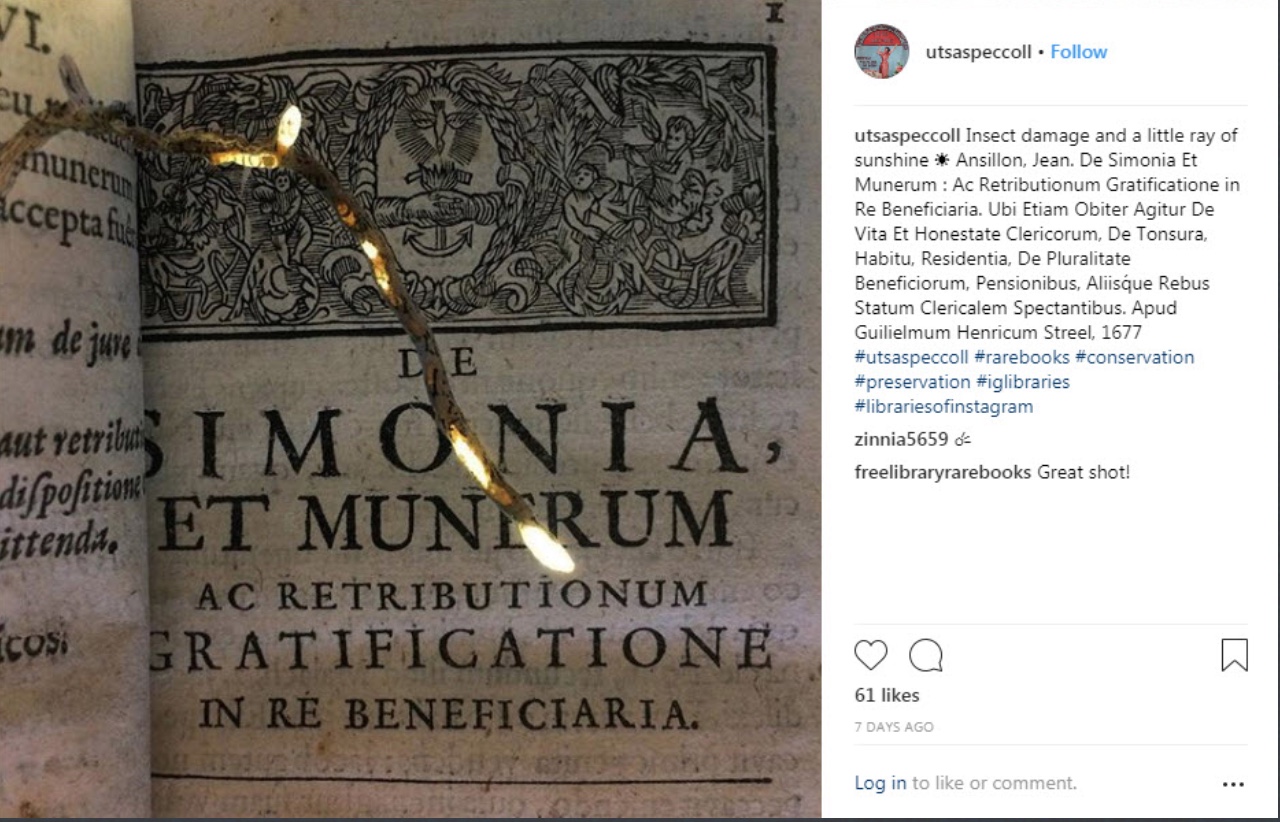
Photo: Agnieszka Czeblakow, University of Texas at San Antonio Special Collections
Staff in Special Collections at the University of San Antonio libraries caught this sudden slant of sunlight on insect-damaged pages. It makes a good start for a serendipitous trek across conservation, book history and book art.
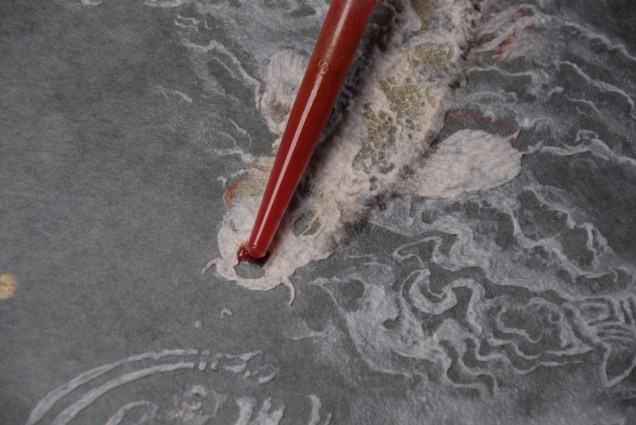
Those dry tunneled pages tear easily with turning, compounding the loss with further damage. To forestall such damage, the areas of loss could be filled page by page with Japanese paper (kozo or gampi) or with paper pulp. The Smithsonian’s book conservation lab illustrates the former method here:
The mending with Japanese paper reminds me of passages in A Degree of Mastery, where the author describes mending rare books with kozo paper under the eagle eye of the late Bill Anthony. The mending with paper pulp though recalls the painstaking art of Pat Gentenaar-Torley.
Working on pulp painting from the front to the back Photo credit: courtesy of Pat Gentenaar-Torley
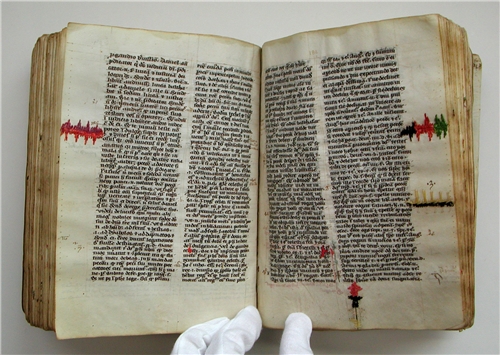
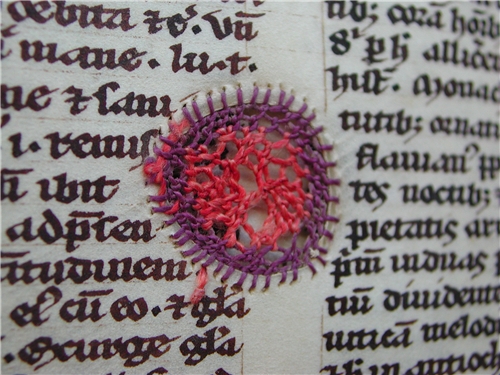
Three centuries before the paper in the San Antonio book was printed, bound and readied for damage in the centuries to follow, parchment — sturdier as it was — had its inherent flaws and elicited peculiar remedies for tears and loss. Erik Kwakkel’s site and books illustrate and celebrate several examples of what he calls “the beauty of the injured book”:
Dreamcatchers spring to mind. What were the thoughts caught in words now missing on these pages, words slipped from the dreamcatching pages? Our medieval “dreamcatcher” conservator seems to have in mind more than the principles of modern conservation — perhaps something more akin to kintsugi.
Kintsugi (or kintsukuroi) is a Japanese method for repairing broken ceramics with a special lacquer mixed with gold, silver, or platinum. The philosophy behind the technique is to recognize the history of the object and to incorporate the repair visibly into the new piece instead of disguising it.
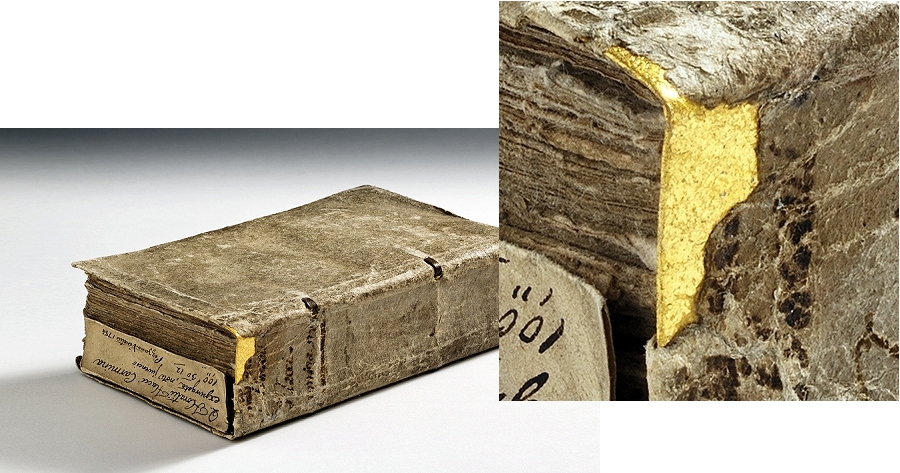
Several centuries later, confronted with an 18th century volume of Horace, UK bookbinder Kathy Abbott was similarly inspired. Her story is recounted in Flash of the Hand (13 December 2015) and Skin Deep (Spring 2017).
Q. Horatii Flacci Carmina Expurgata (1784) Conserved binding ‘Kintsugi’ style, 2011 Hand-dyed alum tawed thongs, hand-gilded hand-made paper Kathy Abbott Photo from Skin Deep (Spring 2017). Accessed 31 December 2018.
Whether this is “conservation binding” is a debated point. According to Jeff Peachey, it is “very creative repurposing of existing binding elements that add a new layer of meaning to old books, which is, I submit, more properly considered book arts” [Correspondence with Books On Books, 13 August 2018].
The extensive and well-documented work of Mark Cockram, book artist, master bookbinder and founder of Studio 5 Book Arts in London, bridges the debate. Cockram’s first venture with kintsugi occurred by accident, falling out of a separate, deliberate experiment to collaborate with nature — by burying books with the help of friends around the world and by submitting them to tanks of insects with the help of forensic entomologist Amoret Whitaker. Marc Webb (Park Light Pictures) captures Cockram’s original intent and results in this video created to accompany Cockram’s and nature’s works of art displayed at Pestival (2010). Cockram’s first kintsugi work, entitled Kintsugi (2013), came as a response to cracks appearing after freeze-drying the cover of one of sketchbooks buried in a garden in Bangkok.
Kintsugi (2013) Mark Cockram Unique. Buried book with 23.5 ct gold leaf inclusions. 15cm x 20cm. Courtesy of Maggs Brothers Ltd
So pleased with the outcome of the accident, Cockram produced Kintsugi 2 (2018).
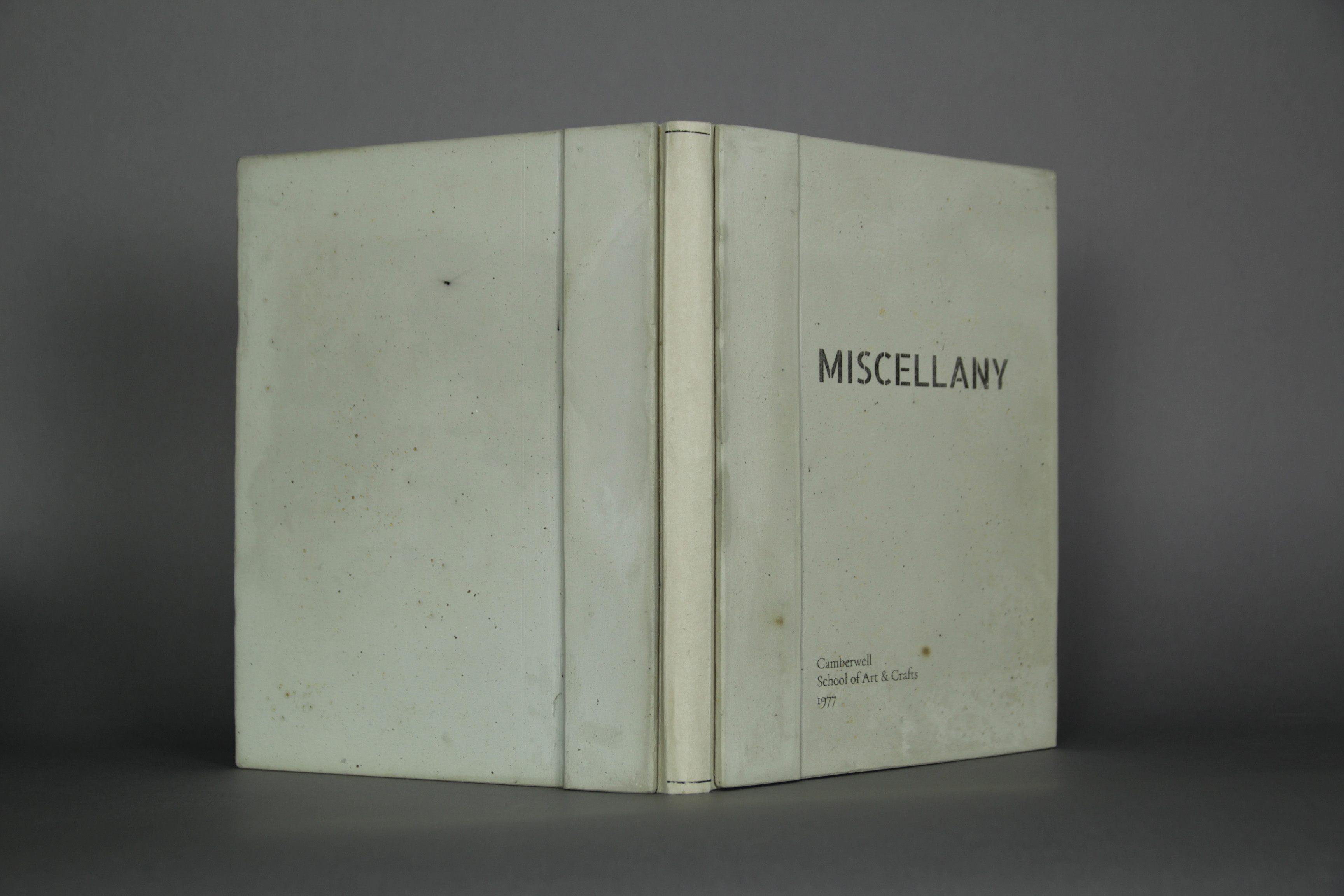
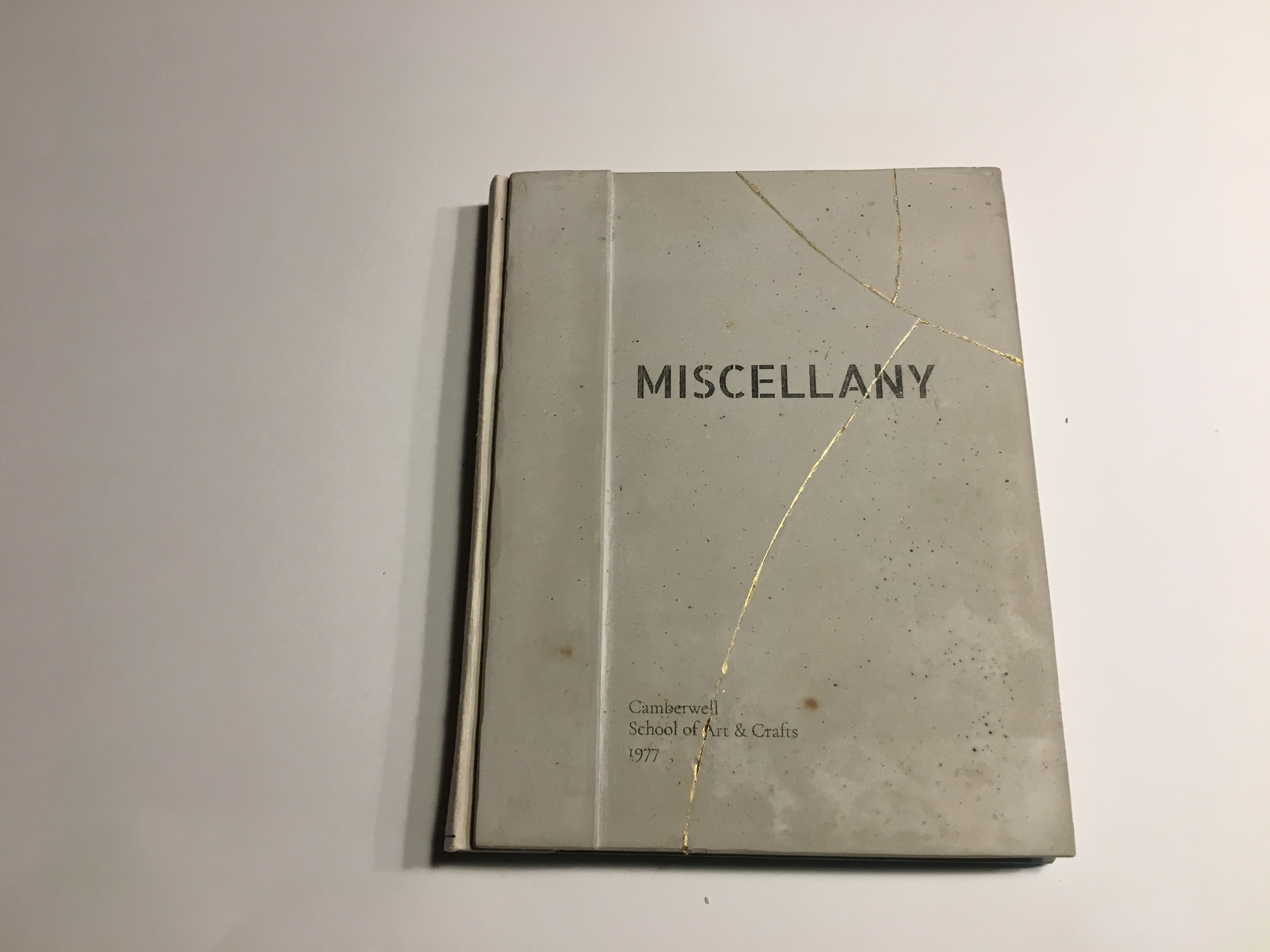
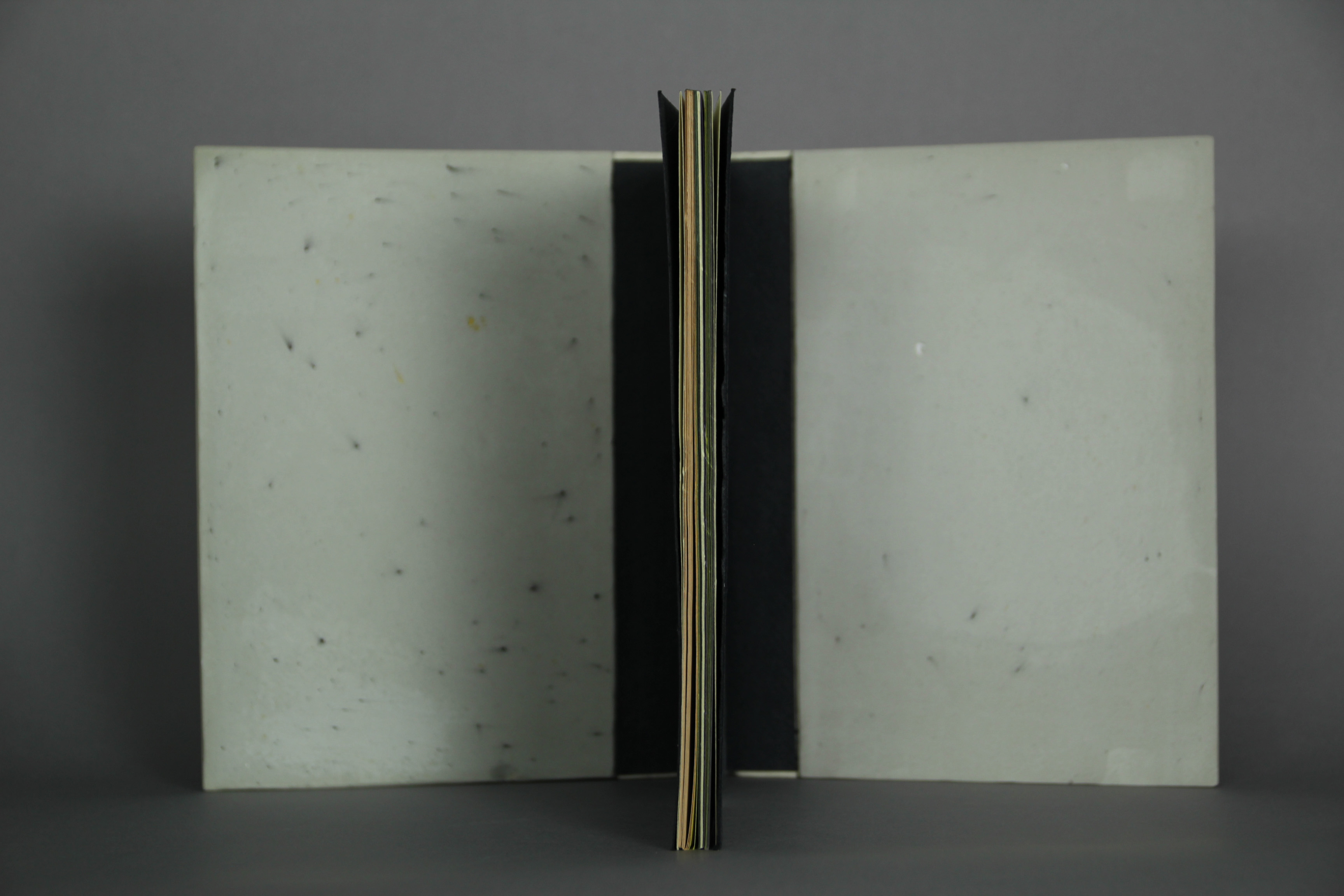
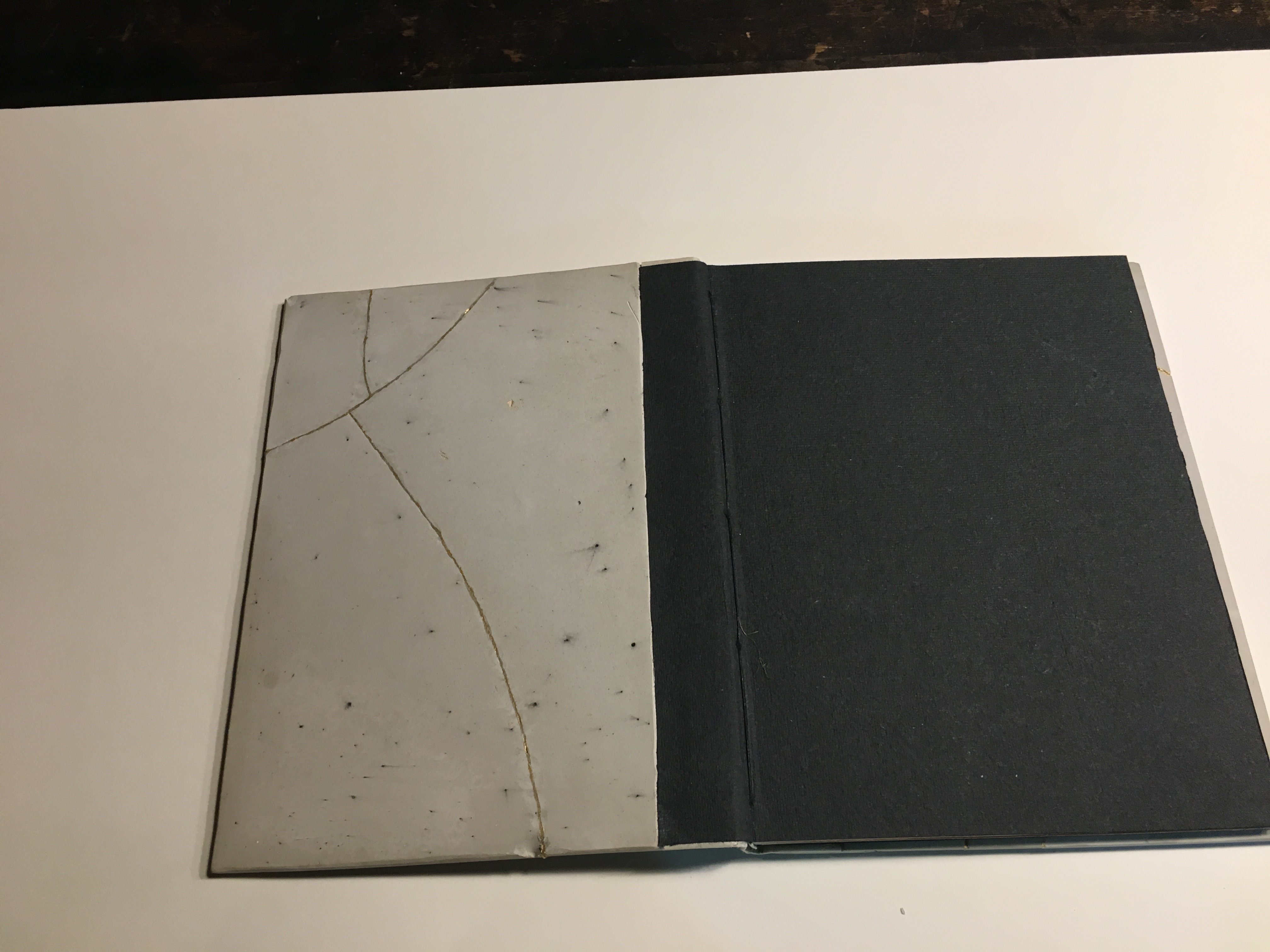
Another work of kintsugi-by-accident is Michele Emerick Brown‘s Miscellany, which began as an entry to the 2016 Guild of Book Workers’ binding exhibition. Sewn with a link stitch and of German paper case construction, it consists of printing examples from the bookbinding and restoration program at the Camberwell School of Art and Crafts, as it was known back in the 70s. Of more interest, its boards are made of Rockite (a concrete mix) and marble dust.
Miscellany (2018) Before breakage Michele Emerick Brown
After its not being accepted to the GBW exhibition, Brown writes,
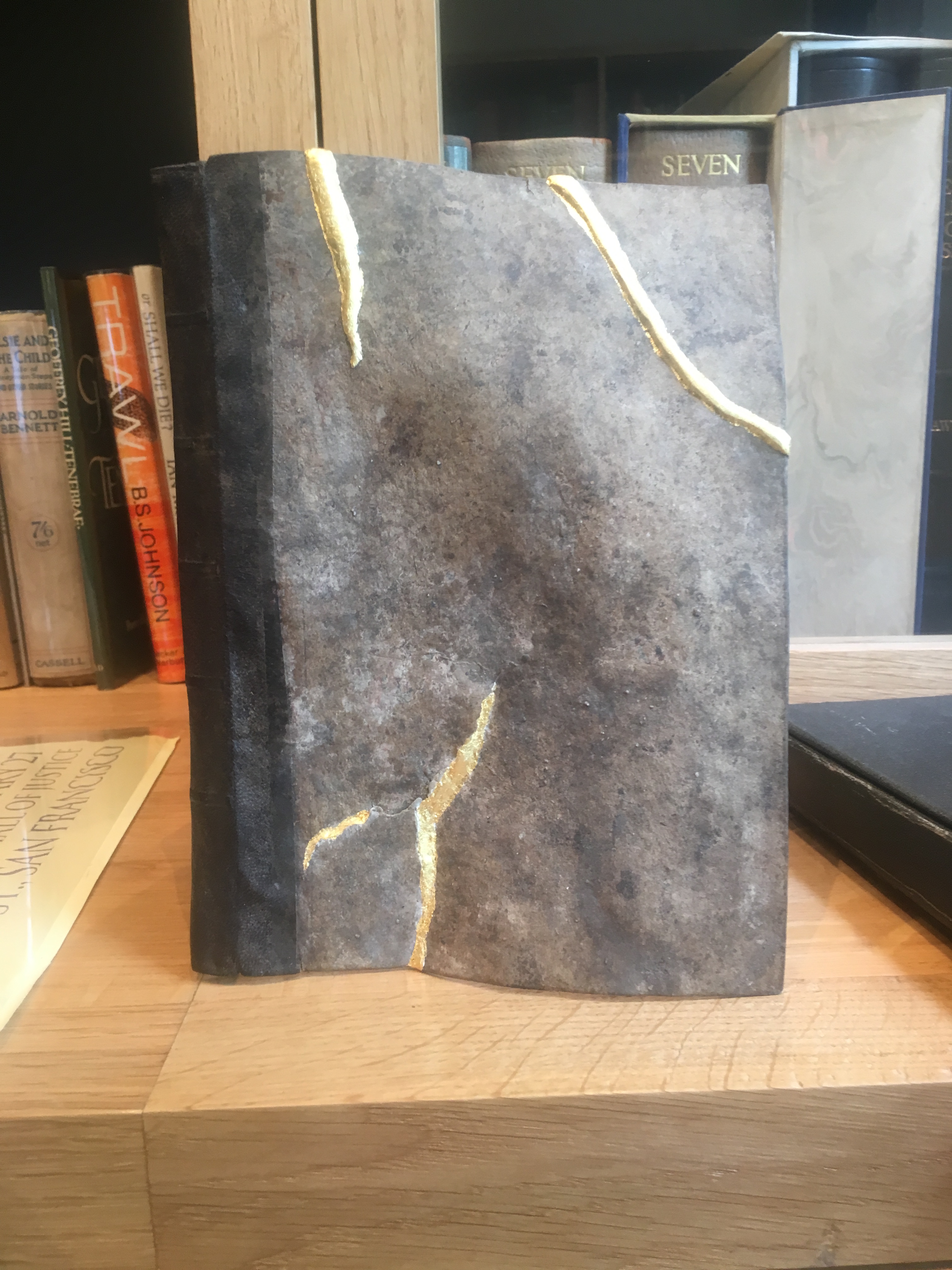
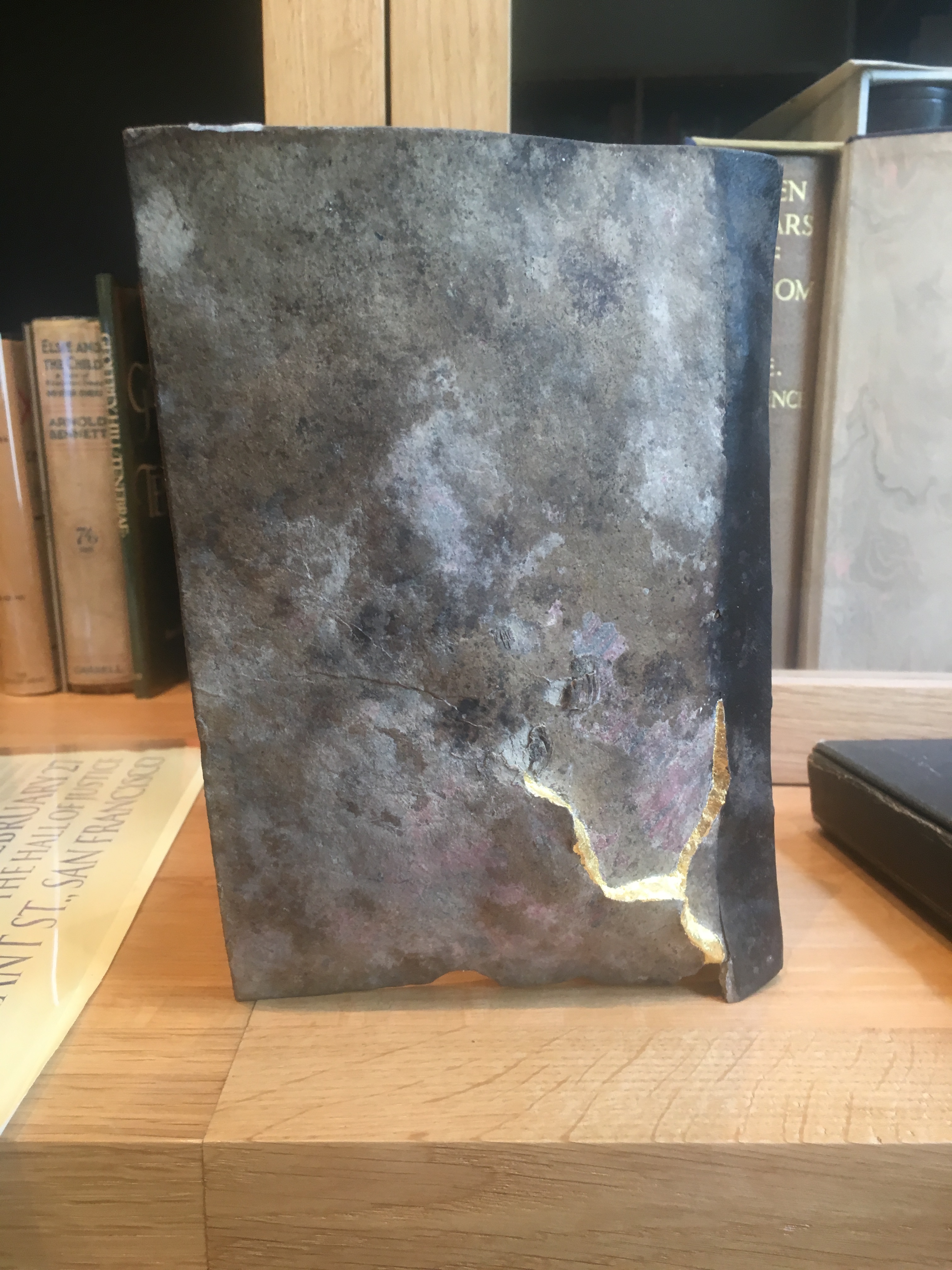
I decided to enter it in the Artistree exhibit. I have a cottage in NH and thought I’d drop it off the same week-end I was meeting some friends. I took it out of the bag to show them, turned, tripped and dropped the book. Each board broke in several pieces. Very traumatic. It seemed like this book wasn’t meant to be exhibited.
After a couple of weeks I decided to glue it back together using construction adhesive and thought I would use gold leaf to highlight the cracks. While I was thinking about how to do it (what kind of glaire to use etc), someone told me about kintsugi. I ended up using gold acrylic (Golden). I went ahead and submitted it and it was accepted.[Correspondence with Books On Books, ]
Miscellany (2018) After breakage and “kintsugi” repair Michele Emerick Brown
Miscellany (2018) Inside view of concrete boards “before” breakage Michele Emerick Brown
Miscellany (2018) Inside front cover after breakage and “kintsugi” repair Michele Emerick Brown
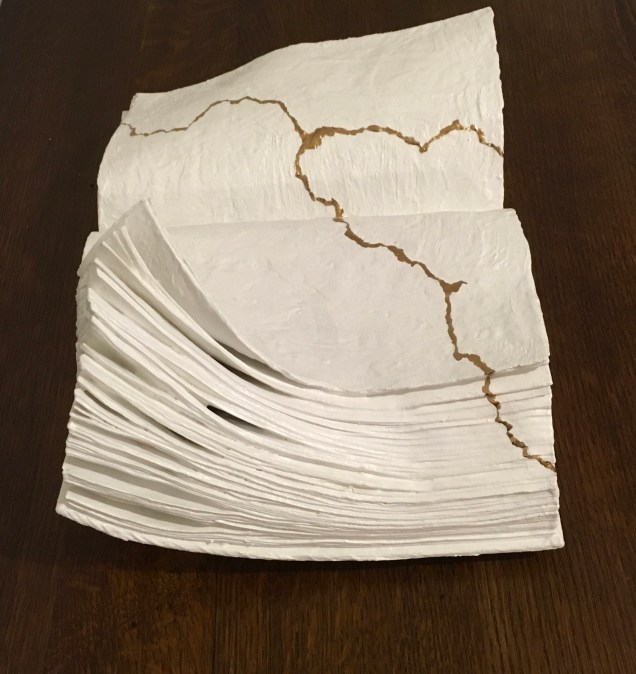
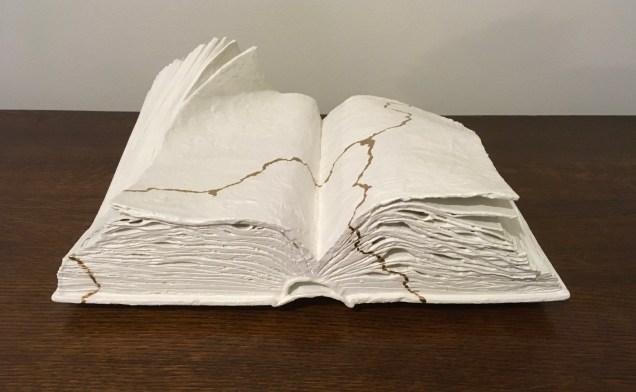
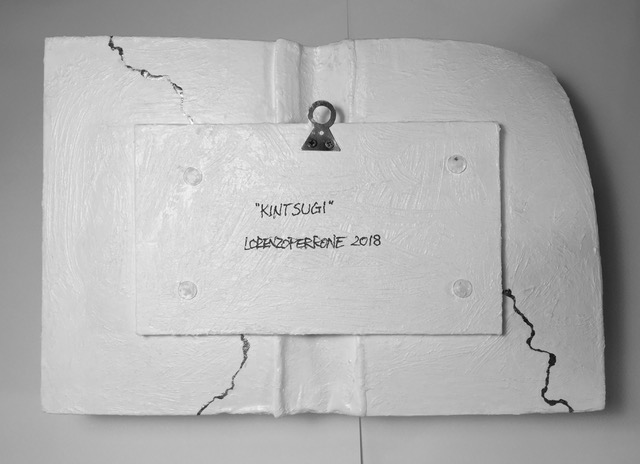
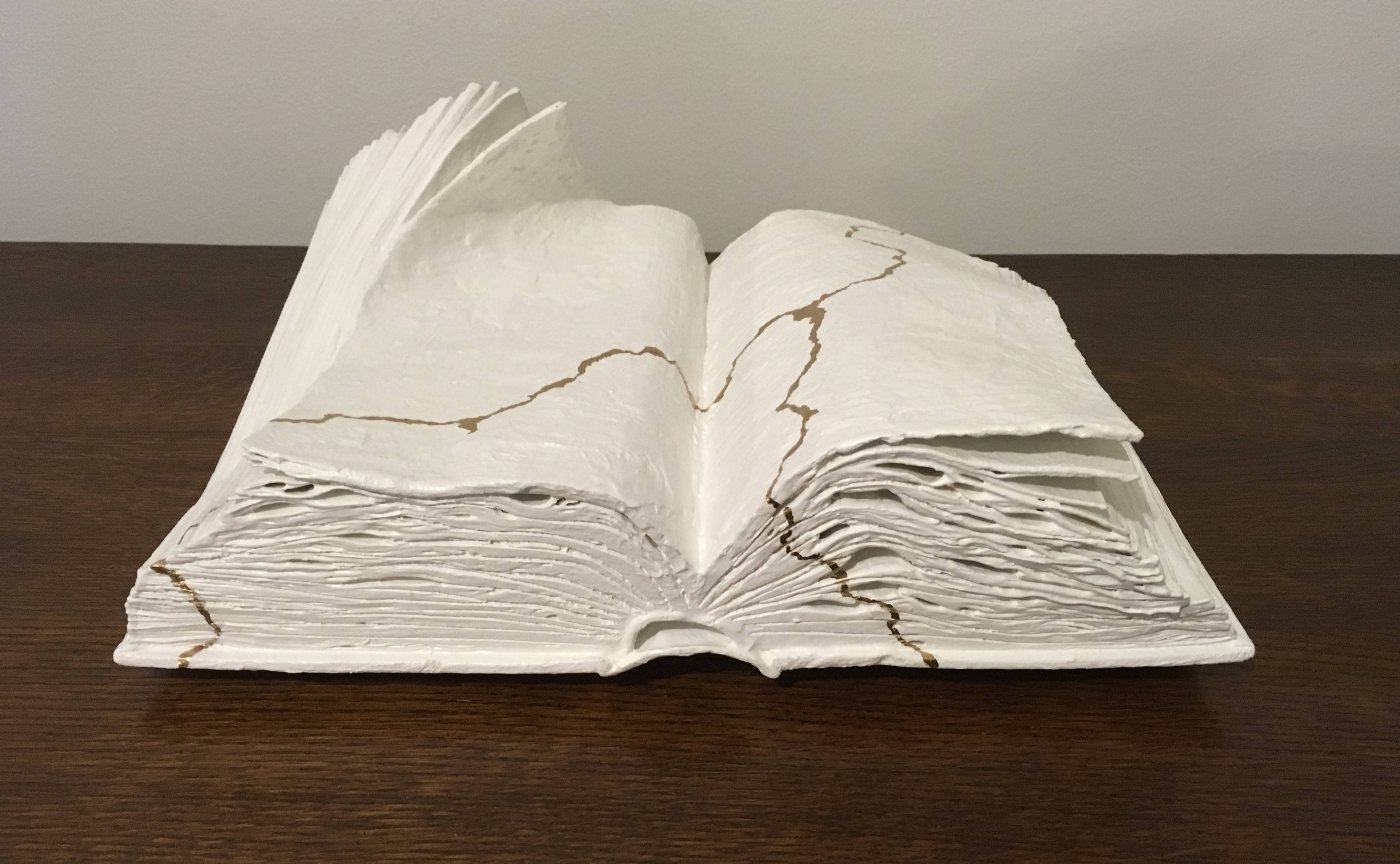
Another “kintsugi book artist” is Lorenzo Perrone. Much like Werner Pfeiffer, Perrone has focused on the book as unreadable object and, as his site called “Libribianchi” implies, almost completely white.
Kintsugi (2018) Lorenzo Perrone Mixed media: book, plaster, white and gold pigments 42x26x16cm
Evident from this video about Perrone and this one about Pfeiffer, Perrone’s work is more romantic in a literary sense. His recent adoption of bronze and installations adds an elemental, alchemical, even phenomenological feel to his oeuvre. As he puts it, “Before, water was enough to make paper malleable, now I need fire to make bronze compliant.” Despite the disappearance of text in Perrone’s works, they still perform that ekphrastic act of book art and send me back to re-read — this time Bachelard’s Water and Dreams and Fragments of a Poetics of Fire.
Like the pleasure of kintsugi, an increase of enjoyment in something elemental, something fusing the past with the present, the broken with the re-created and the head with the heart.