Land Forms and Air Currents (2014)
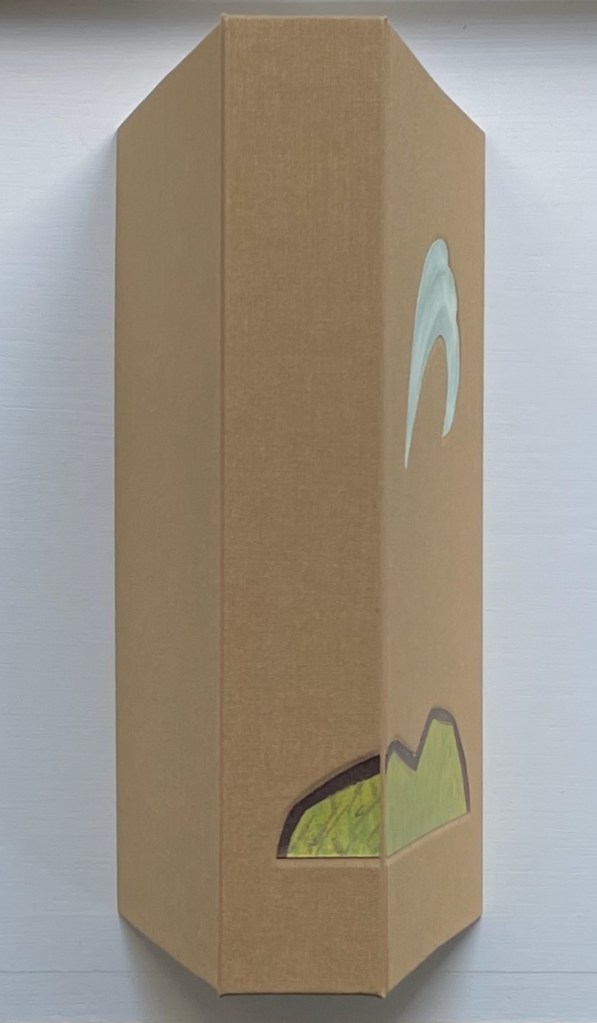

Land Forms and Air Currents (2014)
Carol Barton
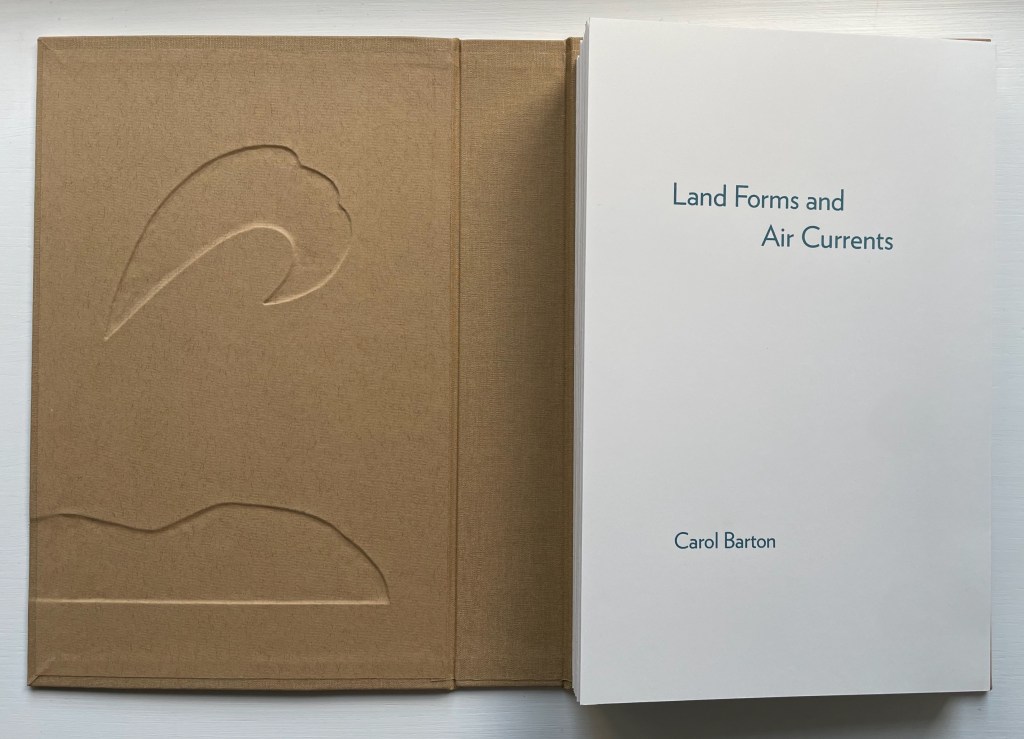
Leporello (with 11 pop-ups) fixed to inside cover of case, cloth over board, debossed with fitted, pastedown artwork on front cover and spine. Cover: H292 x W192 x D50 mm. Leporello: H275 x W175 mm. 37 panels. Edition of 25, of which this is #21. Acquired from the artist, 27 October 2023.
Photos: Books On Books Collection. Displayed with artist’s permission.
Carol Barton’s reputation for paper-engineering, supported by her well-received multi-volume The Pocket Paper Engineer, should not overshadow appreciation of her talents with watercolor and words. With its poems of free verse, scanned watercolors and pop-up structures all by the same author/artist, Land Forms and Air Currents (2014) qualifies as a champion of the Blakean tradition in artists’ books.

Land Forms and Air Currents showcases the interaction of her talents. The pop-ups enhance the trompe-l’oeil effect of the shadowed watercolors — and vice versa. On reaching the colophon above, the reader is primed to see a pop-up rather than the two watercolor images. The concluding text on the verso page is in effect a table of contents. Each of the words faintly printed in a column has appeared faintly printed along the fold of a two- or four-panel spread, either on the left hand or right hand edge. Below is “reverberation”, the first poem and spread.
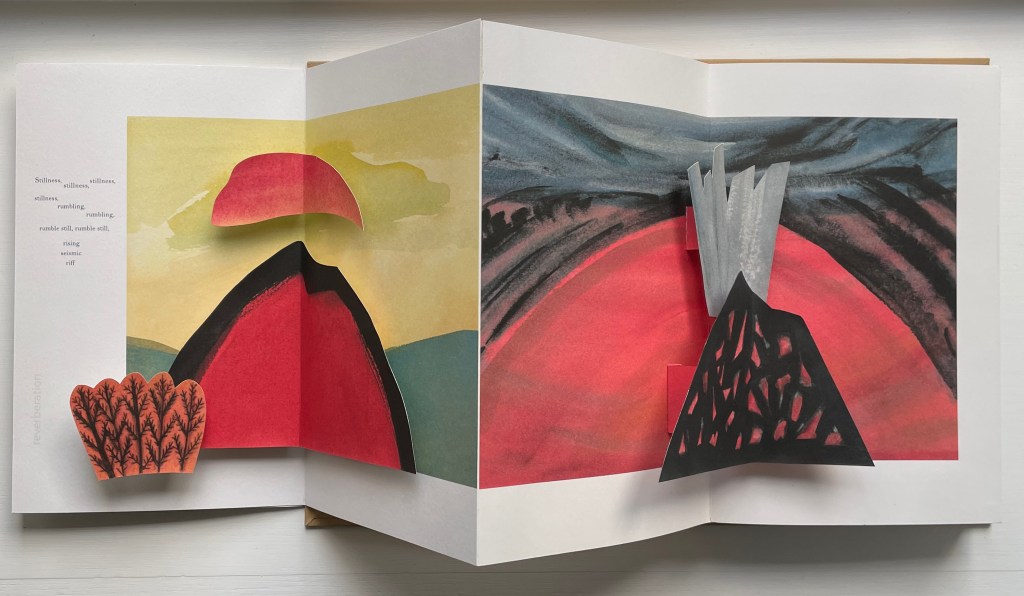
The text of “reverberation” is laid out like a concrete poem, representing a sense of stillness pressing or funneling downwards into the rumbling preamble of a volcanic eruption. Handling accordion panels the way a poet handles stanzas, Barton breaks visually, physically and sharply from the first two-panel stanza to the concluding and erupting two-panel stanza.
Below, however, in the next four-panel spread entitled “migration”, she handles the text, image and folds differently. Unaccompanied by any pop-up, the text spreads across two panels. Echoing the words, the image rolls and ascends over the next two panels with their two pop-ups to complete the four-panel spread.
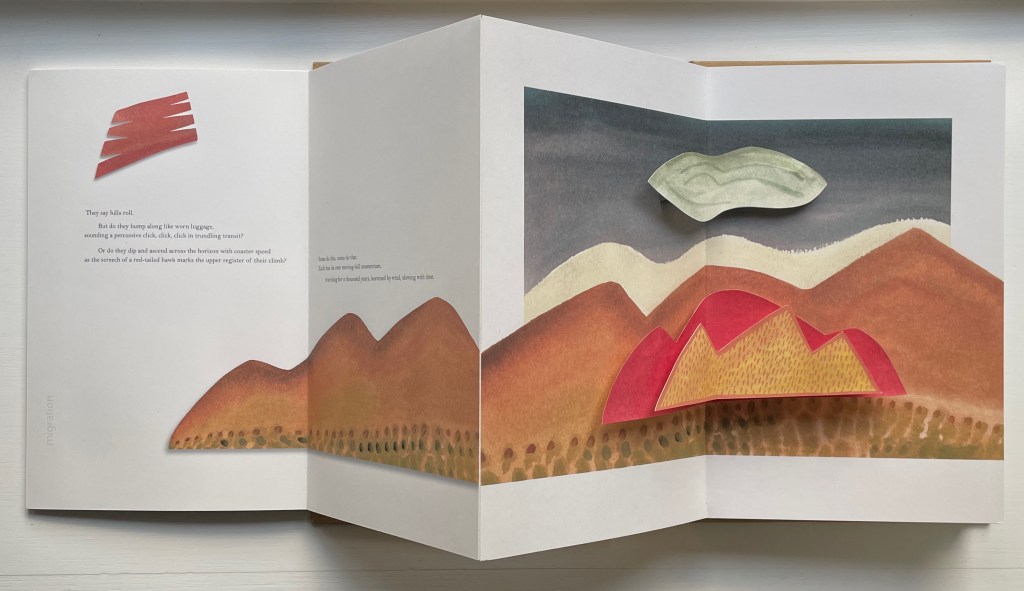
They say hills roll./ But do they bump along like worn luggage, / sounding a percussive click, click, click in trundling transit? / Or do they dip and ascend across the horizon with coaster speed / as the screech of a red-tailed hawk marks the upper register of their climb?
Some do this, some do that. / Each has its own moving-hill momentum, / traveling for a thousand years, hastened by wind, slowing with time.
Besides the colophon spread, “mediation” and “transformation” are the only poems limited to two panels. Both have pop-ups. The petrological language that they also have in common underscores the book’s inspiration from the sciences.
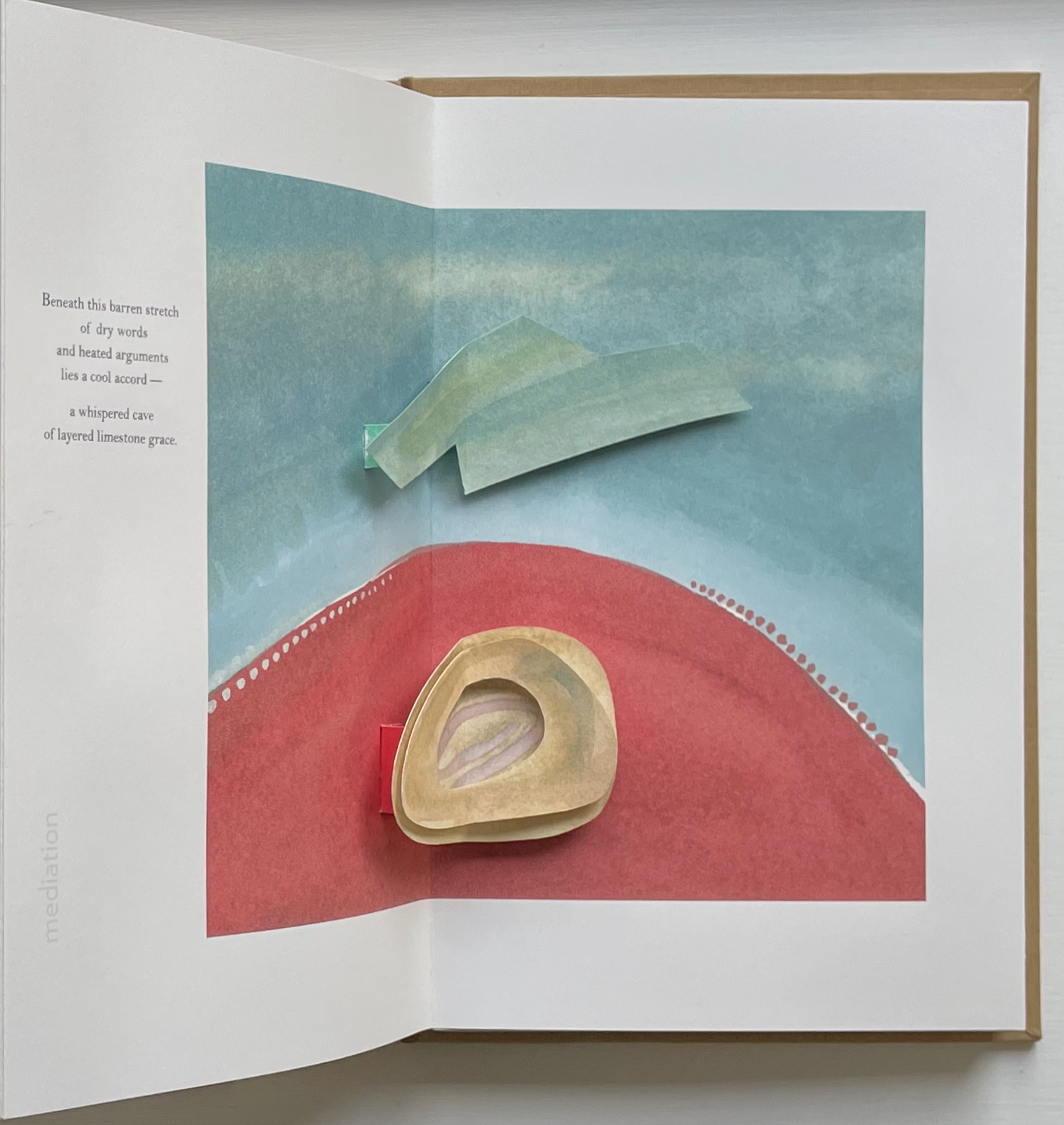
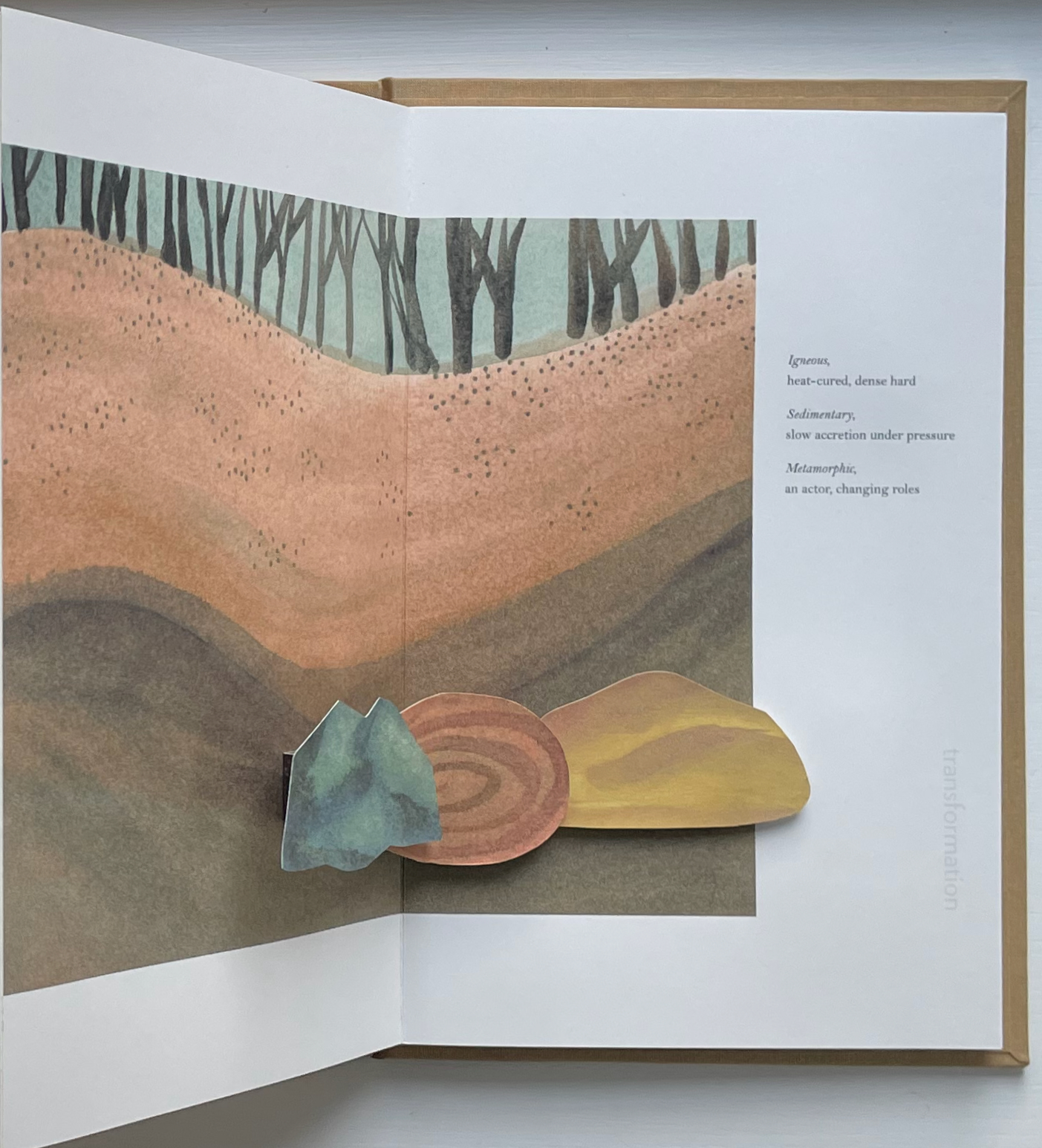
As the language of “mediation” also implies — “dry words” and “heated arguments” — Land Forms and Air Currents also has its ecological undercurrent. Verbally, the theme can be subtle. “Dry”, “heated” and “cool” apply descriptively to limestone as well as the human discord and impact above it.
Visually, the theme can be implied even more subtlely as in the following spreads.
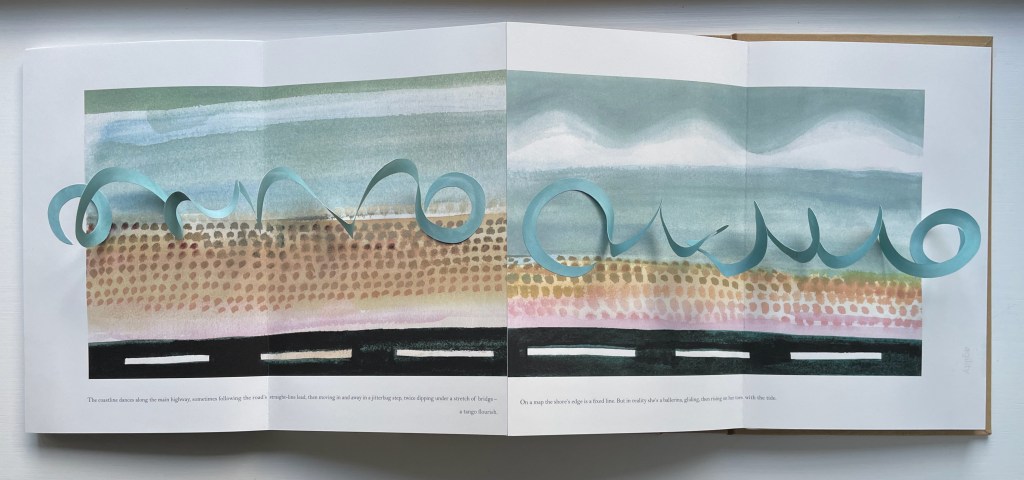
Although it first appears to be a continuous spread, the four panels are two distinct stanzas, which matters for what is communicated. In the first two panels, “The coastline dances along the main highway, sometimes following the road’s straight-line lead, then moving in and away in a jitterbug step, twice dipping under a stretch of bridge- / a tango flourish”. Barton has projected a happy human activity on the coastline that even avoids the more mundane, man-made reality of the highway. While the highway continues in alignment onto the next two-panel spread, the shoreline beyond it no longer aligns, and the lines of pop-up waves are separate, not continuous. It’s a different scene because the tide has come in. And while the dancing metaphor also continues in this spread, the text interrupts with another mundane man-made reality: “On a map the shore’s edge is a fixed line”. With these man-made constraints, readers may feel that they are being set up for a heavy ecological reality. Barton’s second stanza, however, cleverly pirouettes on that very word and concludes with a metaphoric reality that vaults the natural flow of the tide over anything man-made here: “But in reality she’s a ballerina, gliding, then rising on her toes with the tide.”
Science and the Artist’s Book (1995-96)
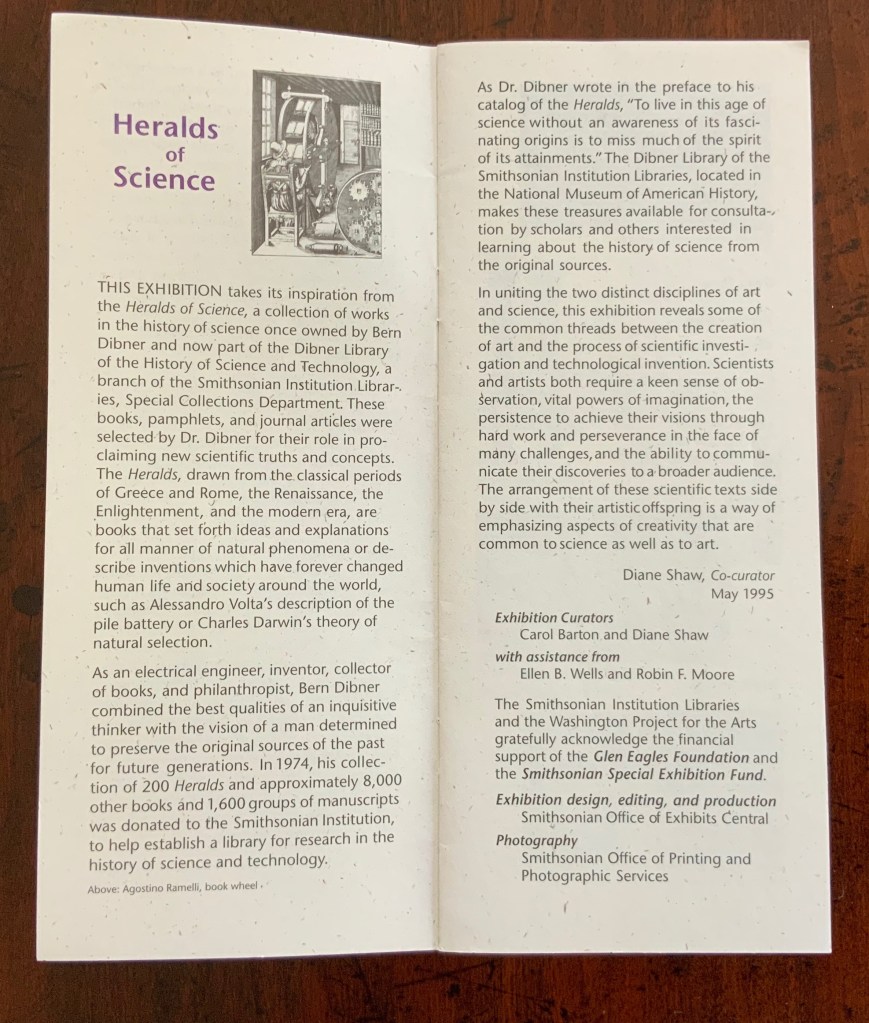
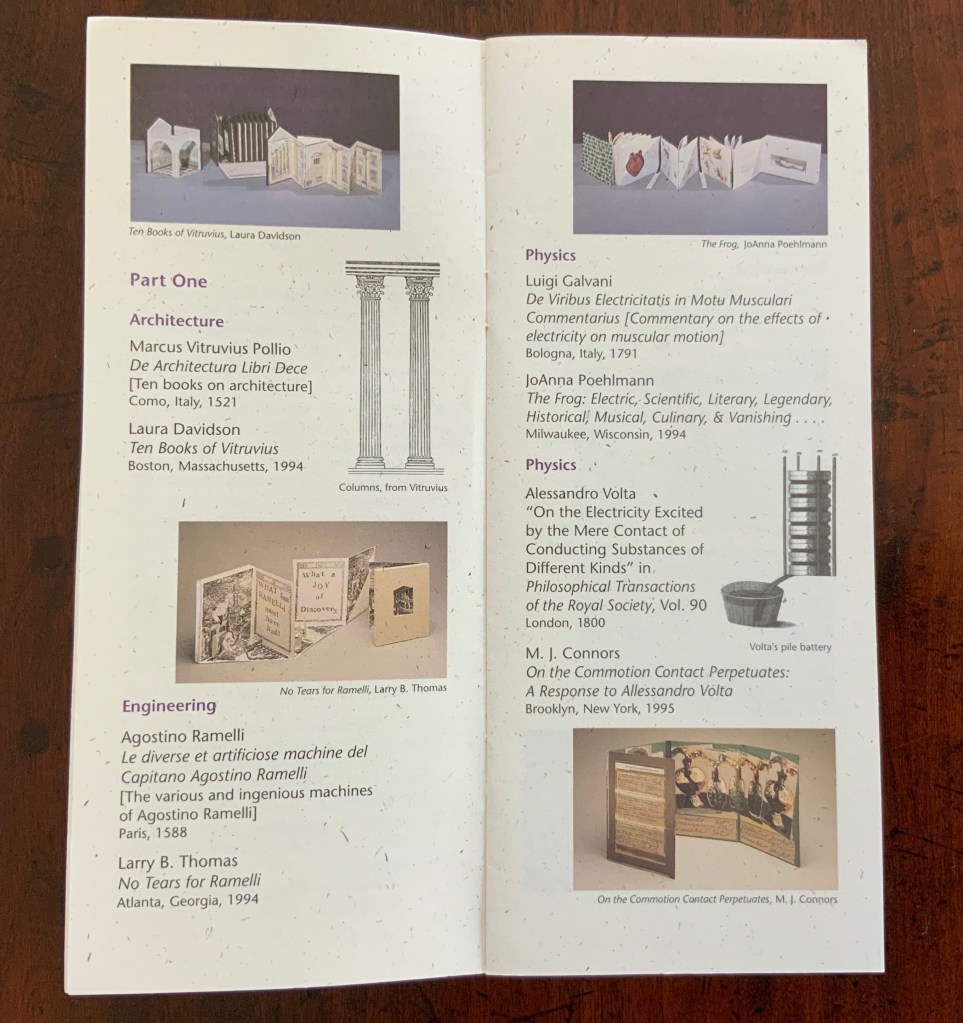
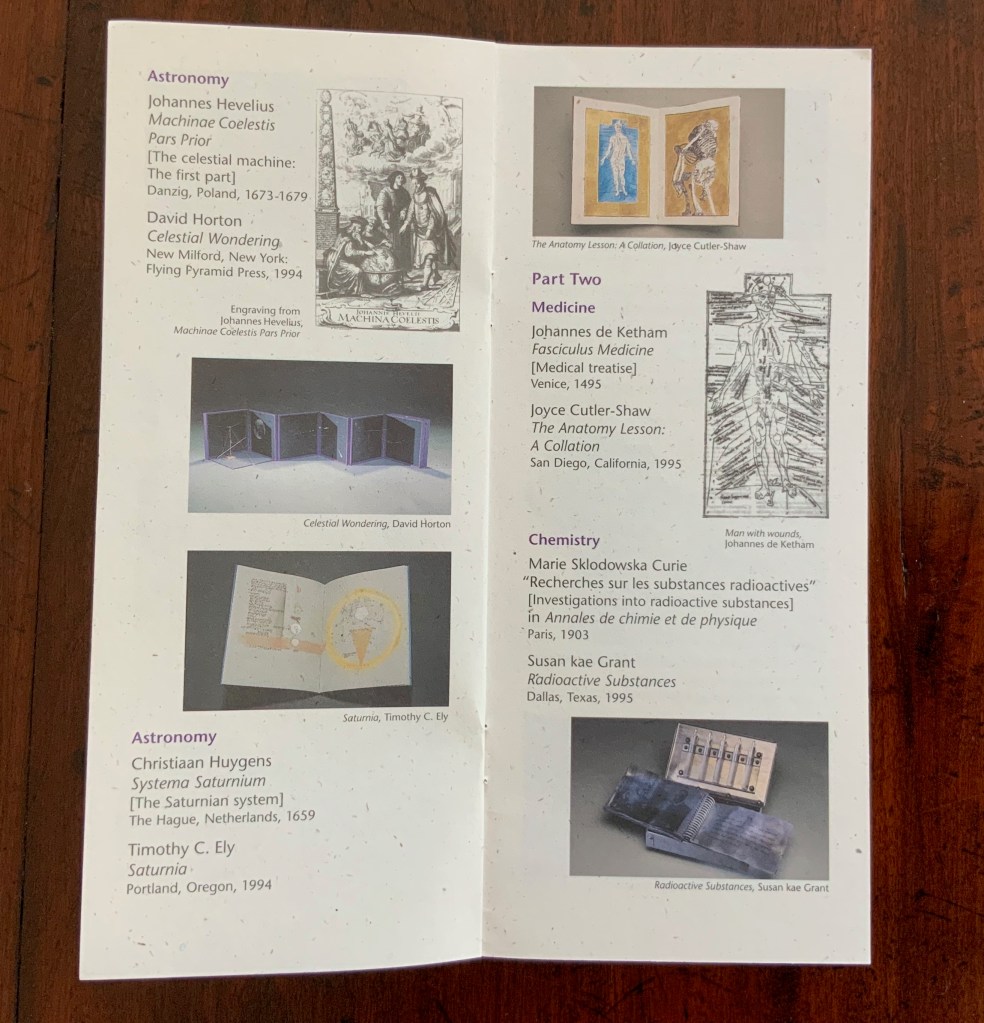
Science and the Artist’s Book (1995-96)
Carol Barton and Diane Shaw
Pamphlet. Saddle stitched pamphlet.H229 x W196 mm. [18] pages. Acquired from Randall House Rare Books (ABAA), 3 December 2018.
Photos: Books On Books Collection.
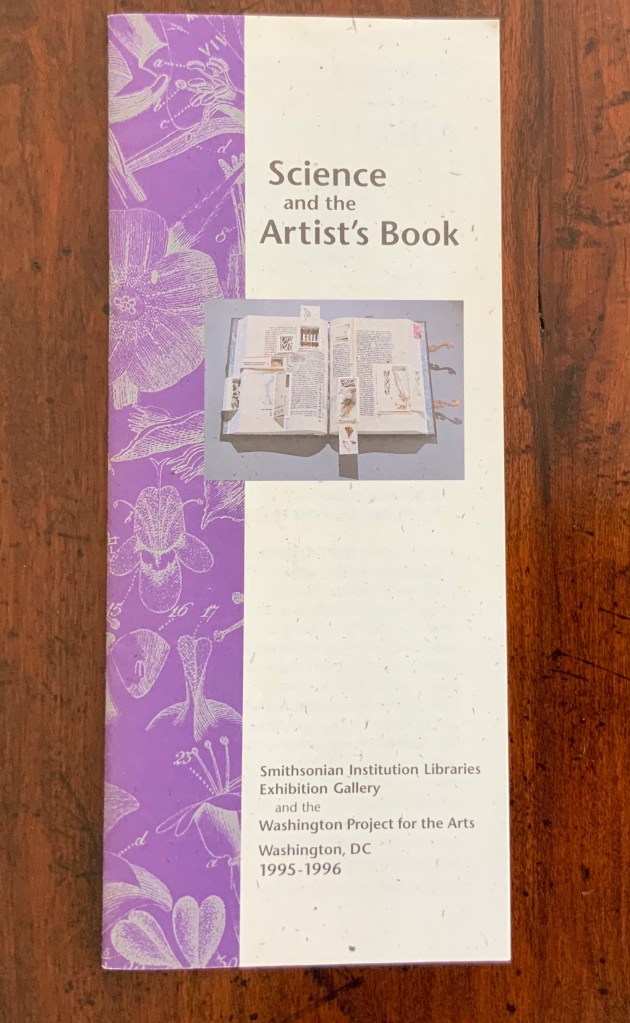
The inspiration from the sciences in Land Forms and Air Currents can be traced back to a landmark exhibition in book art that Barton co-curated with Diane Shaw. In its online version, this carefully curated, long-ago exhibition had an out-sized impact on the Books On Books Collection; so much so, that the chance to acquire a print copy of the brochure could not be ignored. Its roster of works and their artists became a wish list, and the exhibition’s theme guided the selection of many other science-related artists’ books:
Joyce Cutler-Shaw’s The Anatomy Lesson: A Collation (1995) led to acquiring her The Anatomy Lesson: Unveiling the Fasciculus Medicinae (2004), which led to its publisher Robin Price and the acquisition of her as you continue (2012).
Laura Davidson’s Ten Books of Vitruvius (1994) led to the acquisition of many architecture-related works as well her own Tool Alphabet (2004) when the collection began to focus on the relationship between the alphabet and artists’ books.
George Gessert’s Natural Selection (1994) in response to Darwin’s On the Origin of Species by Means of Natural Selection (1859) led to research for an essay on the influence of On the Origin on book artists, which yielded four additions to the collection: Stephen Collis and Jordan Scott’s Decomp (2013), Diane Stemper’s Universal Sample (2014), Simon Phillipson’s multi-colored variorum edition of On the Origin (2014) and Chris Ruston’s monumental The Great Gathering: Seven Books, Seven Moments in Time (2015),
Ed Hutchins’ Moving the Obstinate (1995) in response to Domenico Fontana’s Della trasportatione dell’ obelisco vaticano (1590) led to a collection of his ephemera as well as the inspiration to ensure representation of movable works within each of the themes of the collection.
Daniel E. Kelm’s Templum Elementorum [Sanctuary of the elements] (1995) and his participation in Joyce Cutler-Shaw’s The Anatomy Lesson egged on the acquisition of the latter as well as his own Neo Emblemata Nova (2005), which in turn led to watching for other artists’ books using the Möbius structure, for example, Susan Happersett’s The Happersett Accordion (2001) and Doug Beube’s Red Infinity #4 (2017).
Scott McCarney’s Diderot / Doubleday / Deconstruction (1994) in response to Diderot and d’Alembert’s Encyclopedie led trebly to his own alphabet constructions, Ken Botnick’s Diderot Project (2015) and Peter Malutzki’s Doctor Diderot’s & Mister d’Alembert’s Adventures in Wonderland & Through the Looking Glass (2018).
Karen Wirth’s Viewpoints (1995) in response to Robert Hooke’s Micrographia (1665) primed the acquisition of Erwin Huebner’s Micrographia Revisited (2017) and the appreciation of finding the JAB 42 edition of her Paper Architecture (2017), which enriched the collection’s focus on architecture.
Philip Zimmermann’s Elektromagnetism (1995) in response to William Gilbert’s De Magnete, Magneticisque Corporibus, et de Magno Magnete Tellure; Physiologia Nova (1600) made the acquisition of his High Tension (1993) and a half dozen of his other works a priority, especially those with an ecological theme.
Land Forms and Air Currents and Science and the Artist’s Books do much to erase the false dichotomy between scientific and artistic cultures. The landmark exhibition Science and the Artist’s Books has also done much to encourage artists’ books that reach back to remind us of their “past contemporaries”.
Further Reading, Listening and Viewing
Barton, Carol. 2014. Land Forms and Air Currents. Video.
Barton, Carol. 2005. The Pocket Paper Engineer, Volume I: Basic Forms: How to Make Pop-Ups Step-by-Step. Maryland: Popular Kinetics Press.
Barton, Carol. 2008. The Pocket Paper Engineer, Volume 2: Platforms and Props: How to Make Pop-Ups Step-by-Step. Maryland: Popular Kinetics Press.
Barton, Carol. 2012. The Pocket Paper Engineer, Volume 3: V-Folds. Maryland: Popular Kinetics Press.
Hiebert, Helen. 7 March 2023. “Episode 104: Carol Barton“. Paper Talk. Helen Hiebert Studio. Podcast interview.
Michaelis, Catherine Anne. 16 October 2021. “As the World Turns“. Artists’ Books Unshelved. Bainbridge Island Museum of Art. Video presentation of Land Forms and Air Currents.
Wasserman, Krystyna, ed. 2007. The Book as Art: Artists’ Books from the National Museum of Women in the Arts. New York: Princeton Architectural Press.
 Books On Books
Hello, I enjoy reading your newsletter and this one is close to my heart. Two of my artist books Tempus fugit and The Bernoulli Equation are in major collections around the world. Two videos have been made about the Bernoulli Equation, one by the Centre Pompidou in Paris and lately by Bainbridge Island Art Museum.
https://amandinenabarra.com/portfolio/tempus-fugit/
https://amandinenabarra.com/portfolio/bernoulli-equation/
My latest book which is more sculptural is about death which is medical/science and spiritual: https://amandinenabarra.com/portfolio/the-last-breath-artist-book/
Thank you for writing about our projects. I love to learn about other artist works.
Best wishes,
Amandine
>
LikeLike