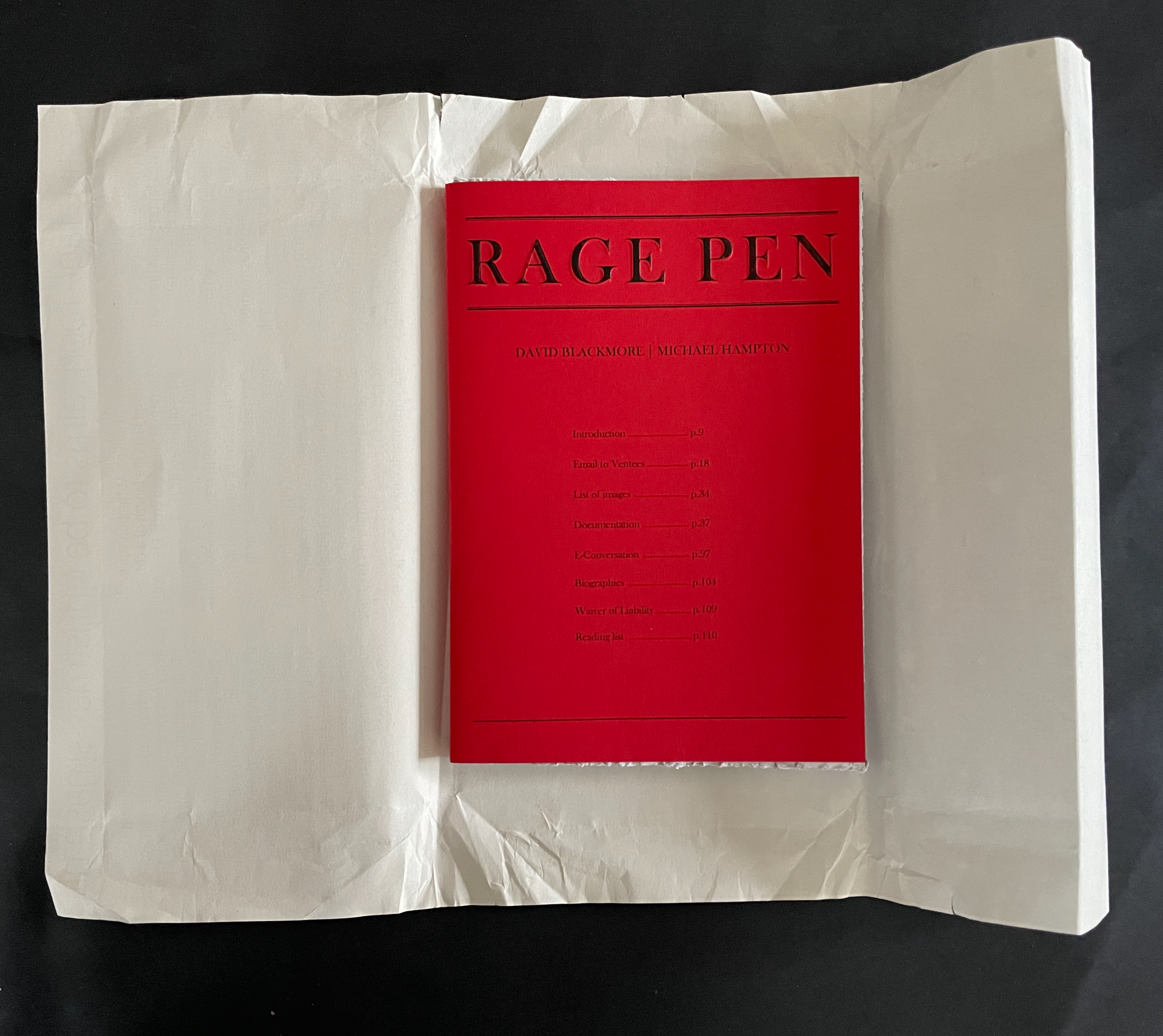
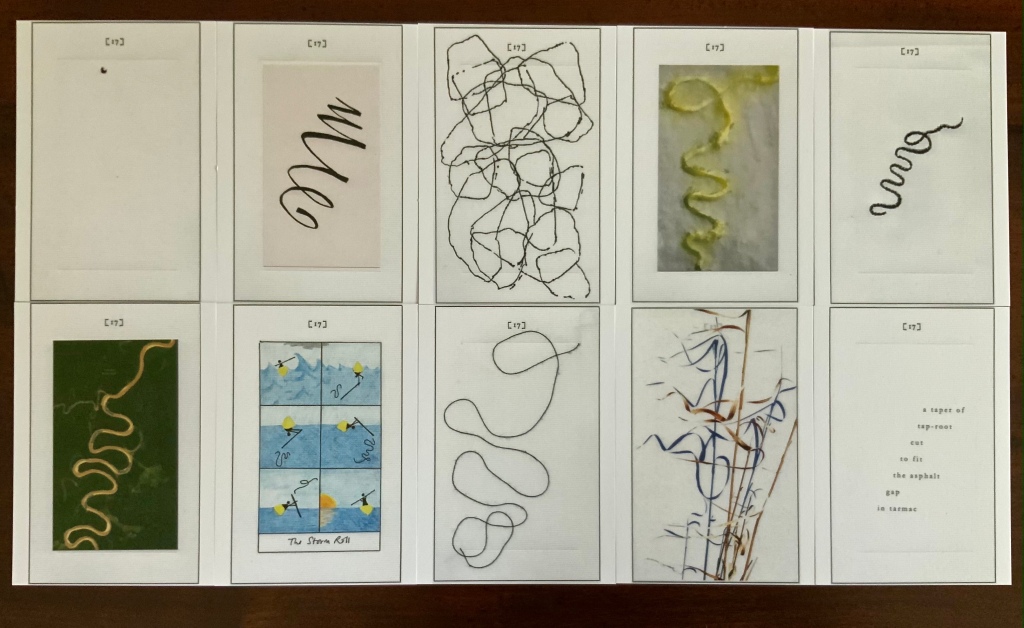
RAGE PEN (2025) David Blackmore and Michael Hampton Soft cover, mitre sawn head and foot, perforated fore-edge. H210 x W148 mm. [108] pages. Edition of 100. Acquired from Folium, 13 November 2025. Photos: Books On Books Collection.
Folium, the publisher, describes RAGE PEN as “developed from a relational piece of the same name held at Chisenhale Studios 2017/18”. Per the Museum of Modern Art, relational aesthetics is
A mode of art practice that establishes spaces, situations, or environments for a variety of social interactions. In essence, the social space or interaction becomes the work of art itself. The term was popularized by French critic and curator Nicholas Bourriaud in 1998.
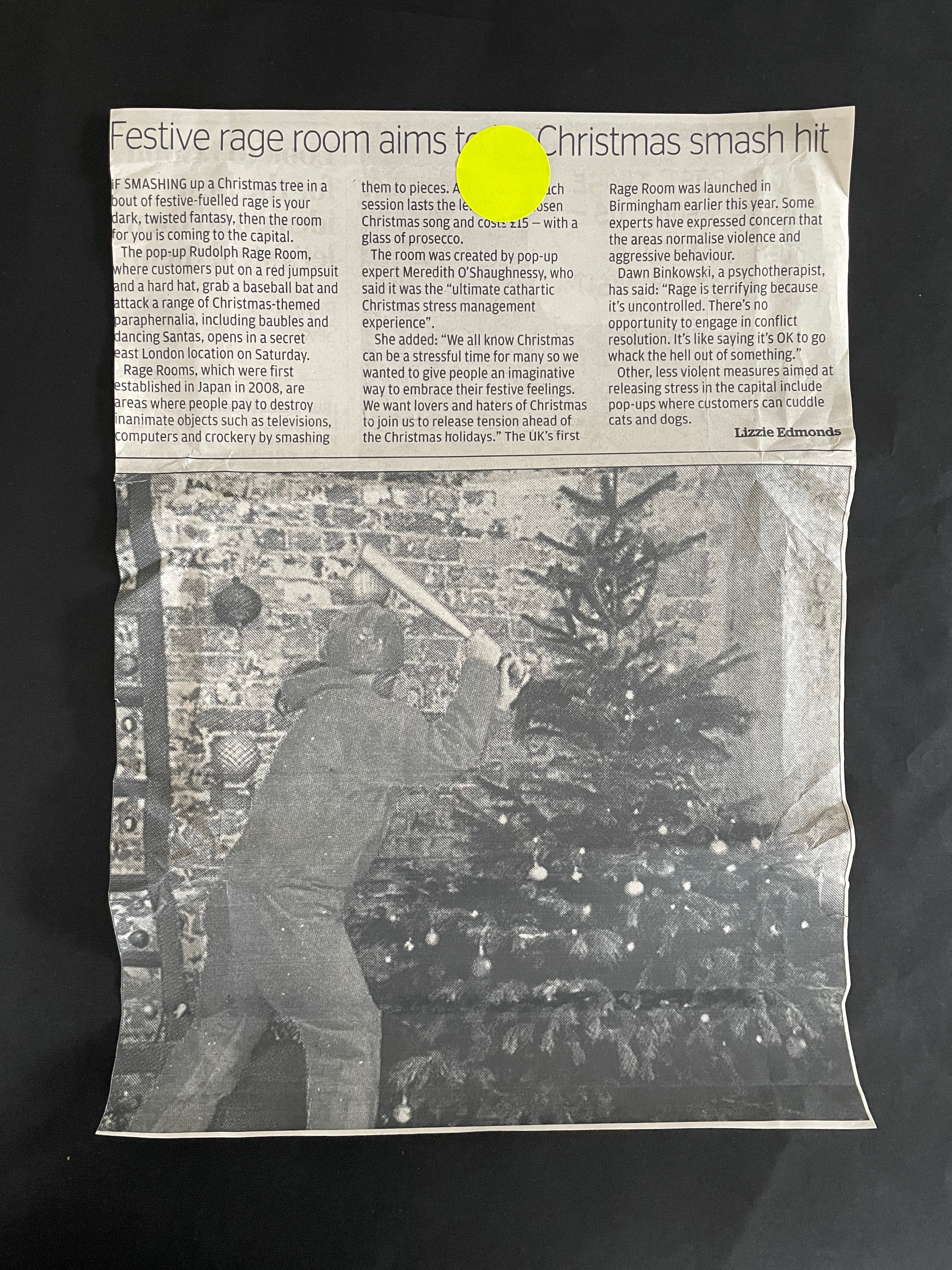
RAGE PEN‘s environment was a safe rage room equipped with a variety of handheld tools. Anonymous members of the public, or “ventees”, were invited to name an object that had caused them frustration, don protective equipment, and enter the shuttered room to smash said objects. The interactions filmed and photographed by David Blackmore formed the images in RAGE PEN the book. Holding the book with its mitre-sawn top and bottom edges and its perforated, still-sealed fore-edges, we might suspect that we are being invited into our very own private relational aesthetic piece.
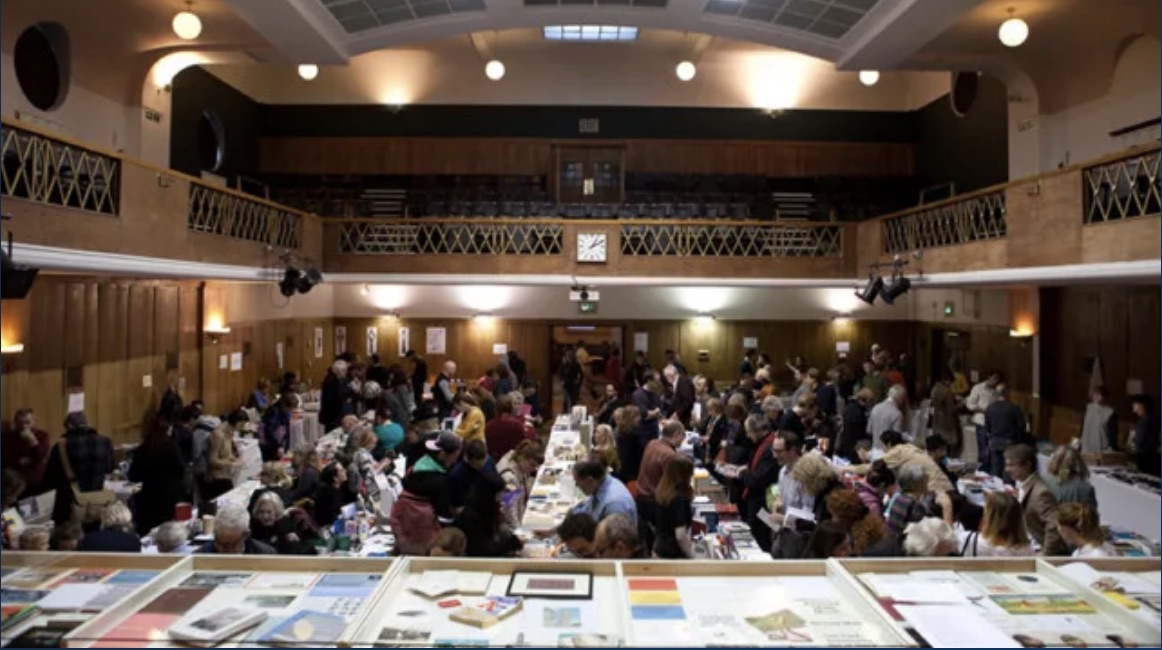
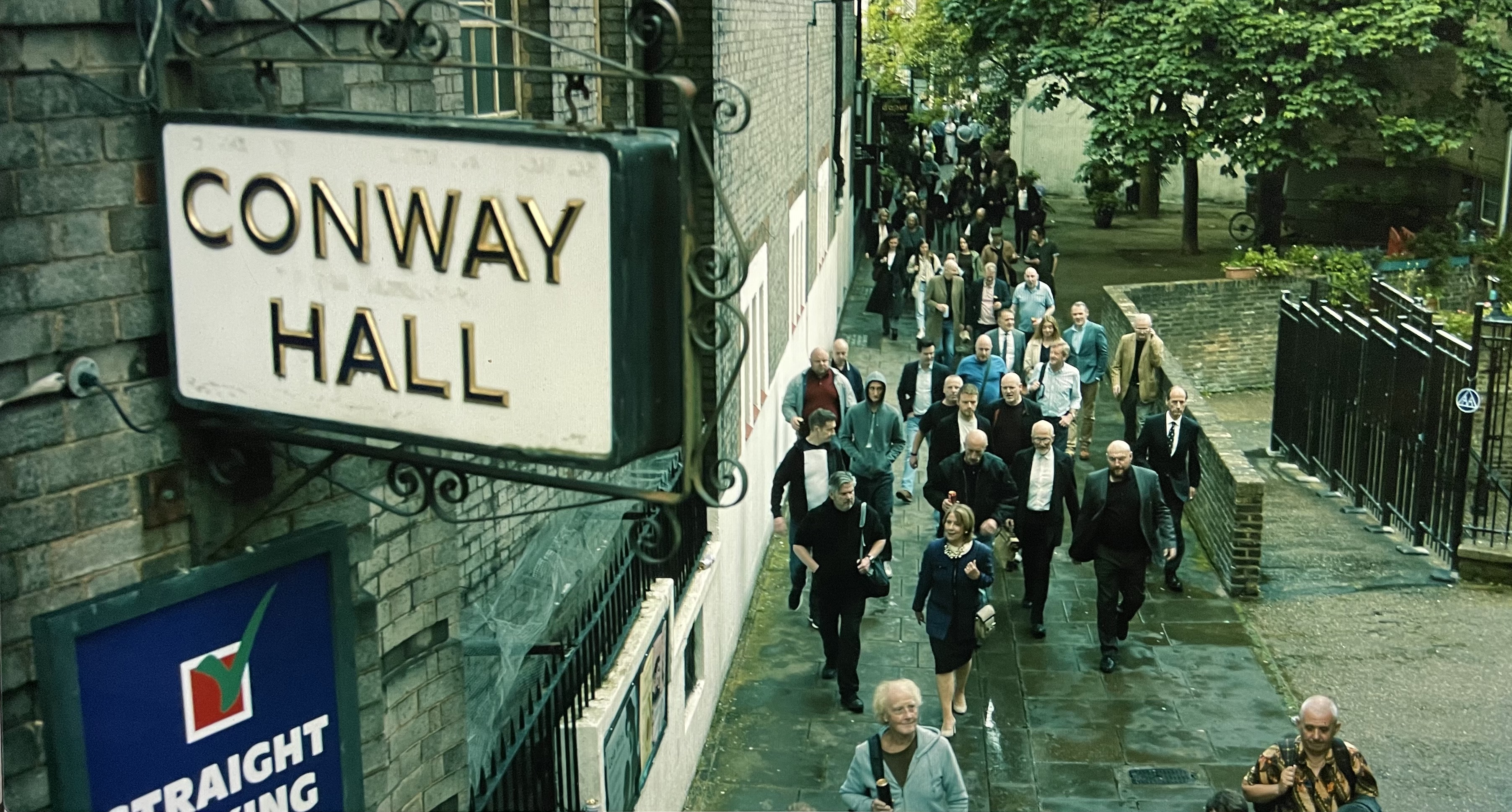
The hunt for Erica Van Horn’s Seven Lady Saintes has been long, but at last, in a glass case in Conway Hall at the Small Publishers Fair in London this year, there it was. Van Horn and Simon Cutts (co-founders of Coracle Press) have been a regular feature of the Small Publishers Fair since its first occurrence in 2002 at Royal Festival Hall.
Conway Hall, owned by the charity Conway Hall Ethical Society, first opened in 1929 and is named after Moncure Daniel Conway (1832-1907), an anti-slavery advocate and biographer of Thomas Paine. It has hosted the Fair since its second outing in 2003. In 2025, it had a cameo appearance in the spy drama series Slow Horses as the unlikely host for an ultra-right mayoral candidate’s campaign event. The setting provided the kind of sardonic humorous dig that Van Horn would appreciate (if she were a regular television viewer).
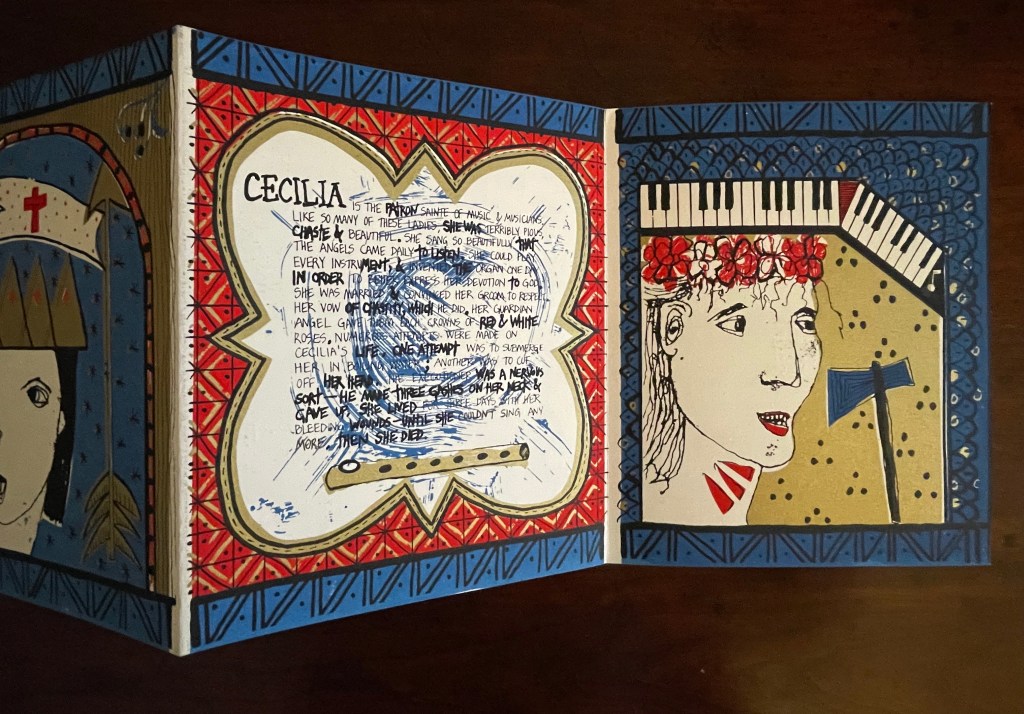
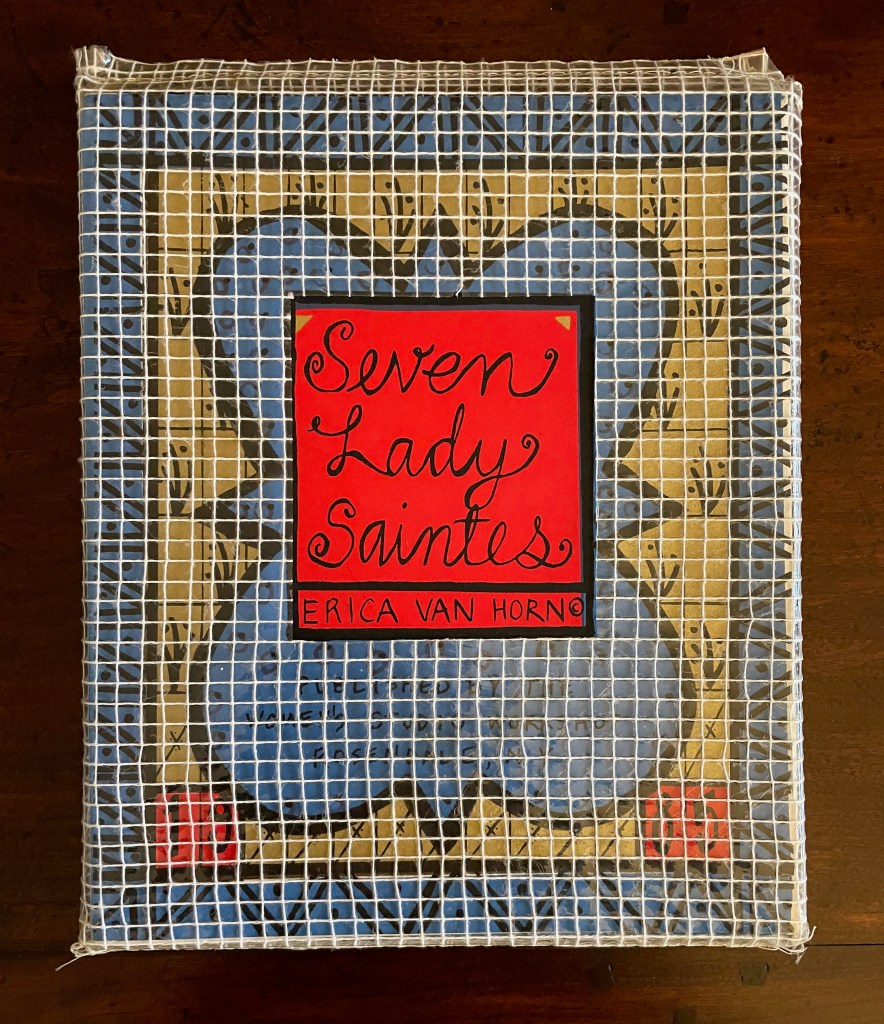
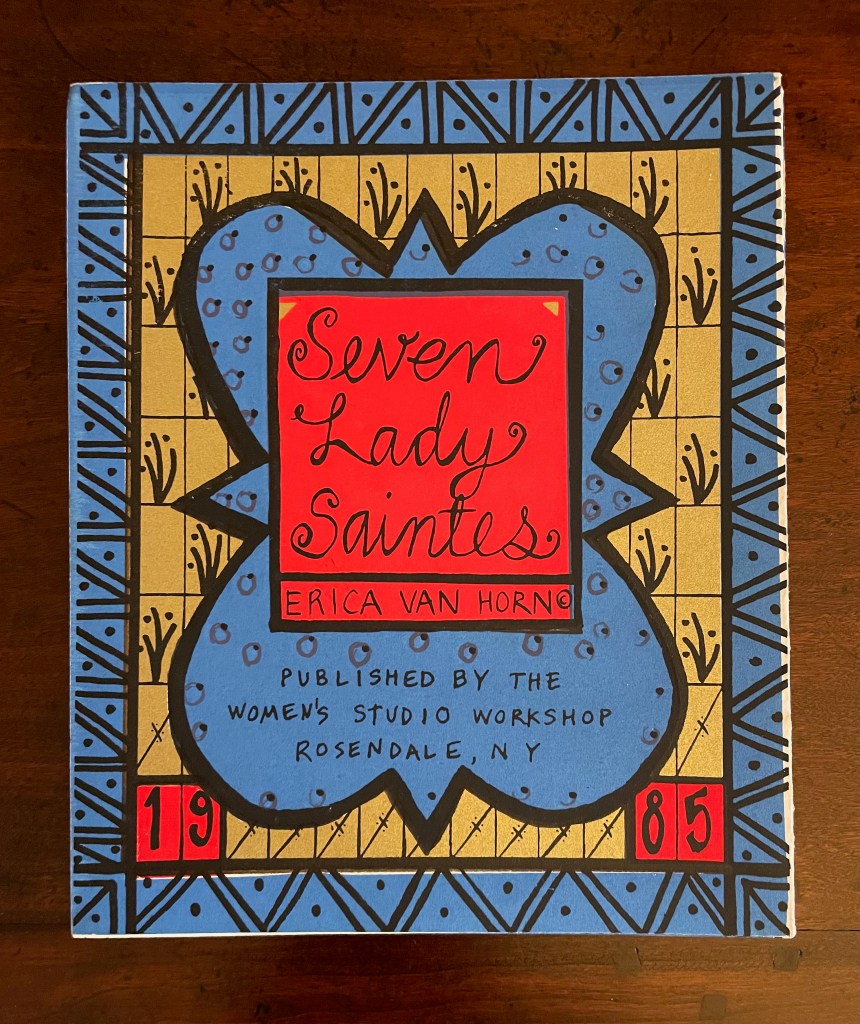
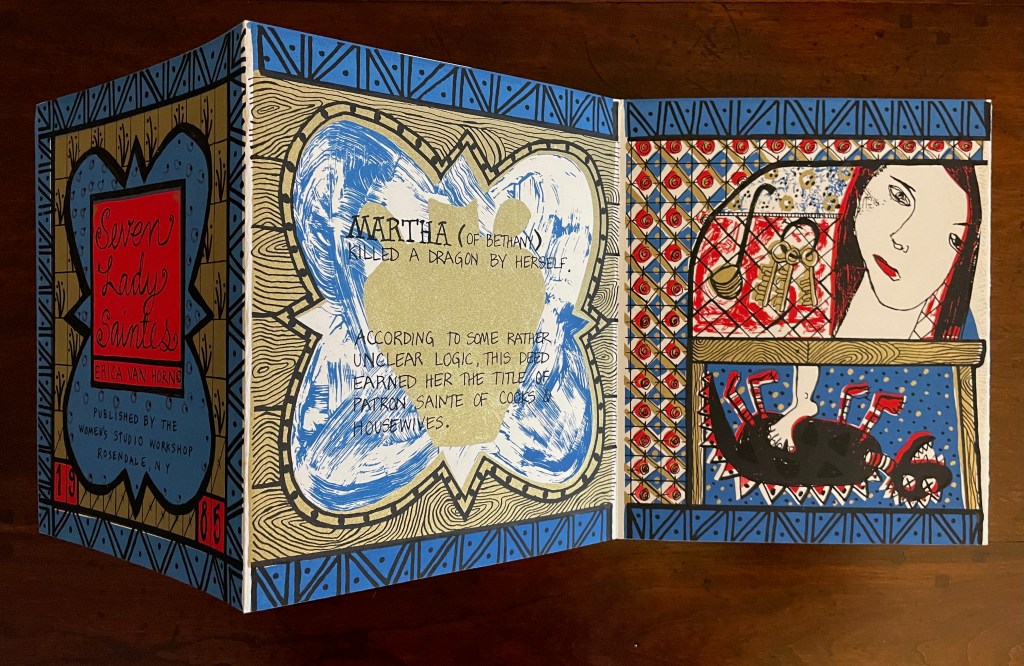
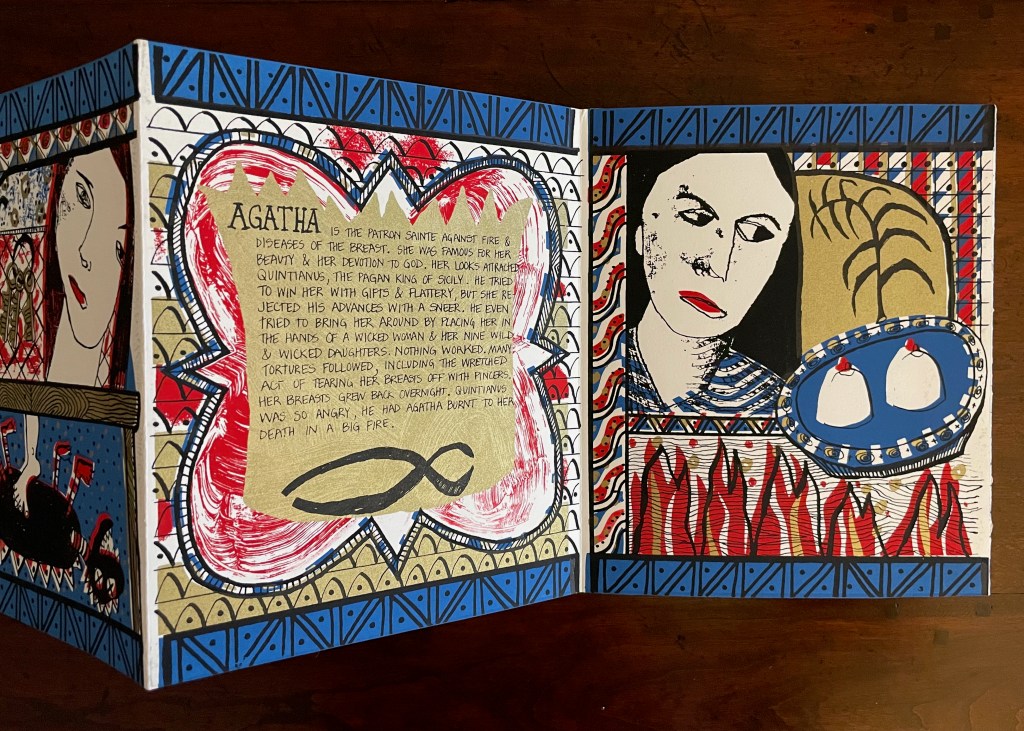
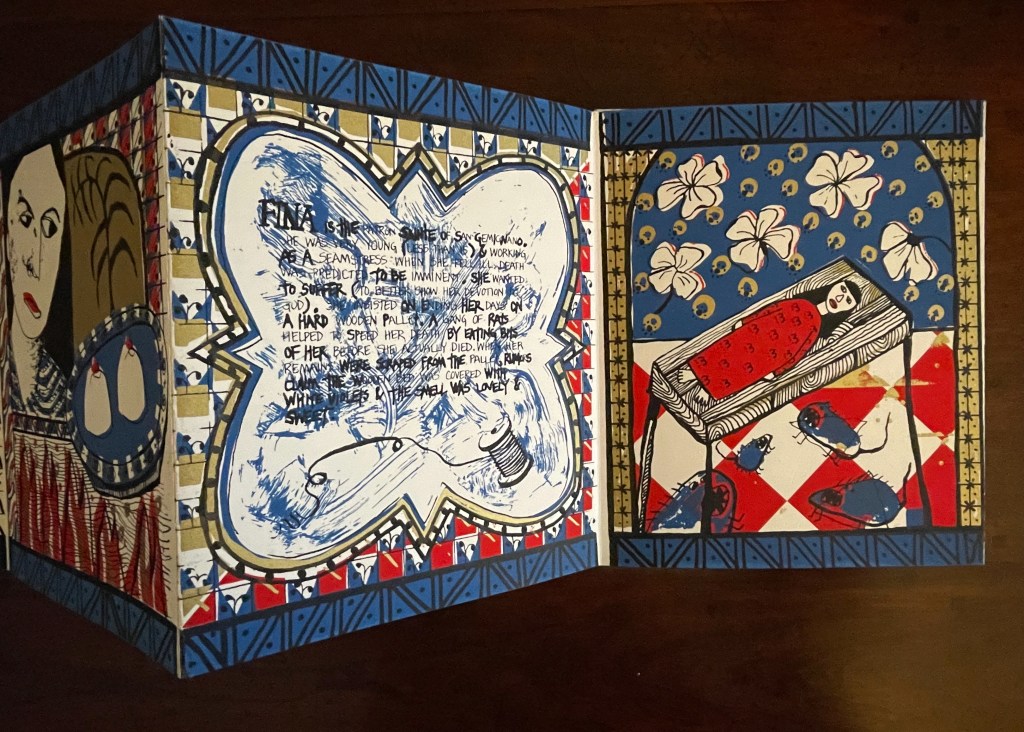
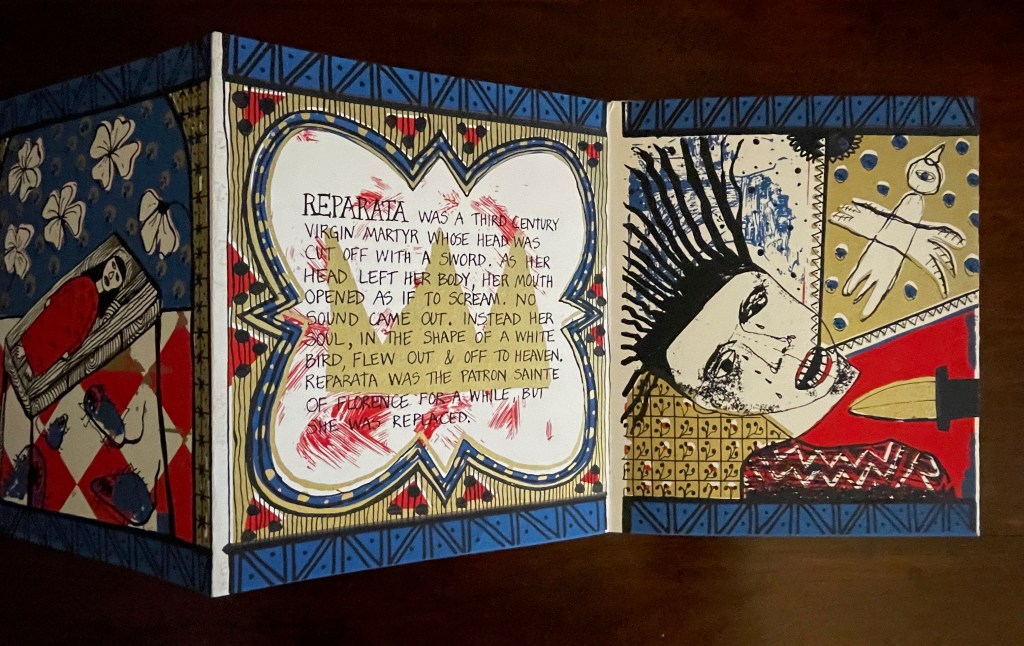
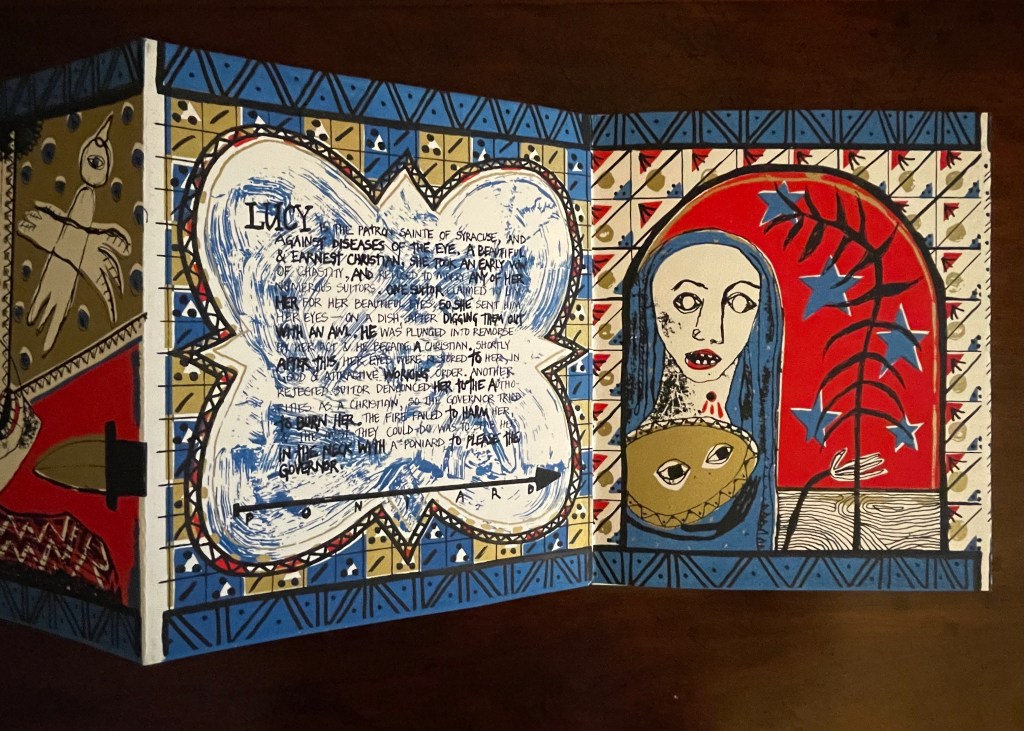
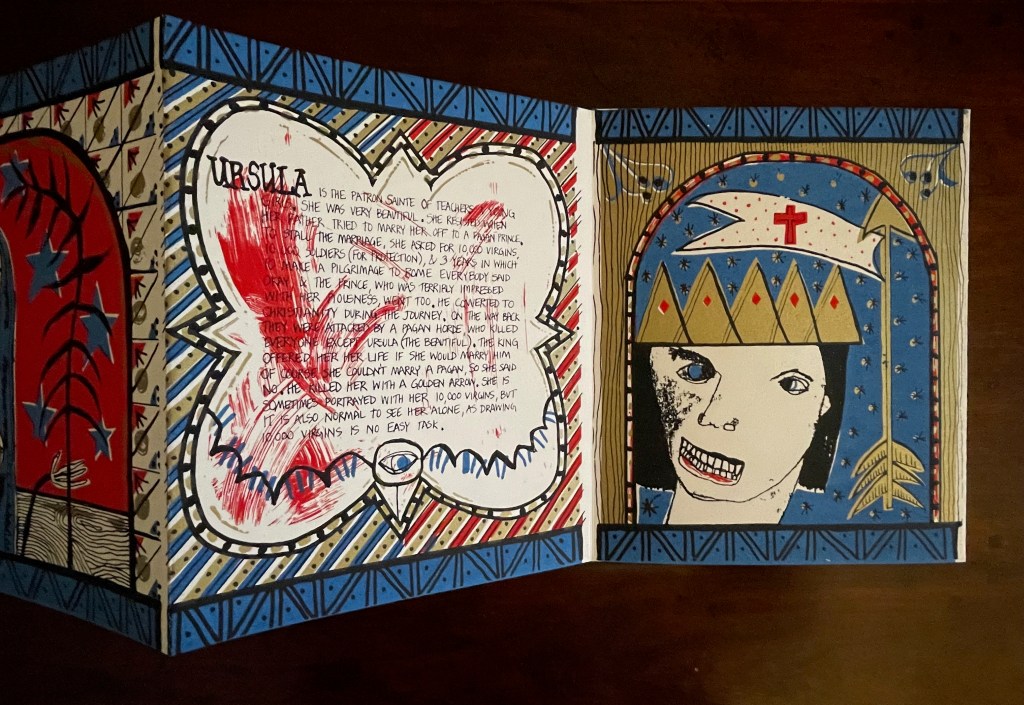
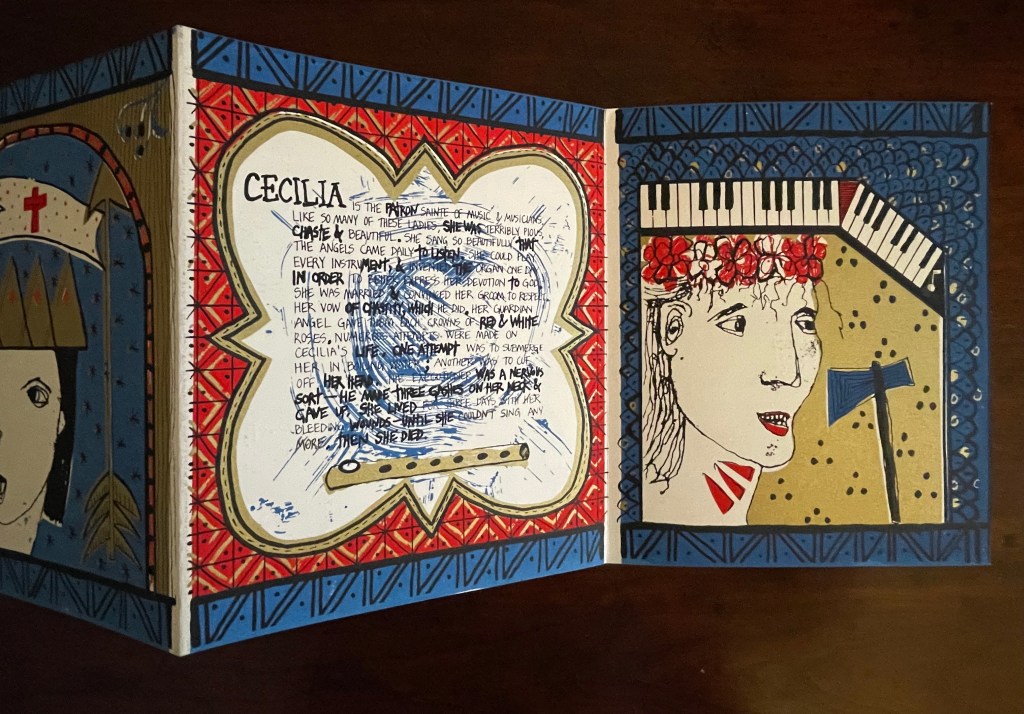
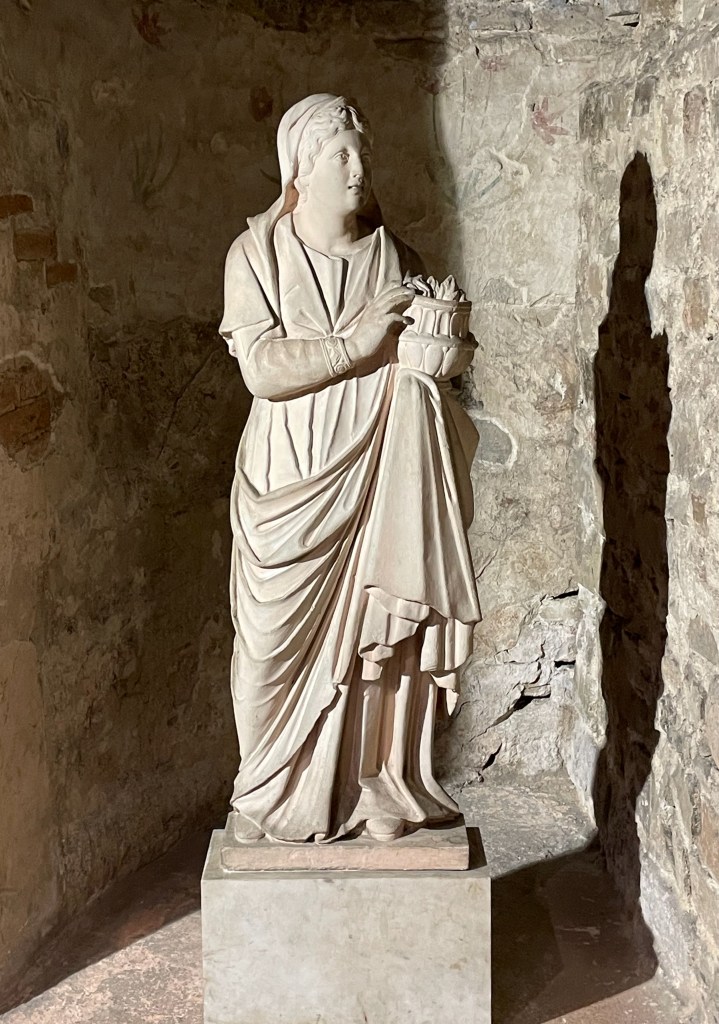
With stained-glass colors, Seven Lady Saintes splashes its own brand of sardonic humor across a stiff-card leporello produced in 1985 at the Women’s Studio Workshop Print Center in Rosendale, New York.
Seven Lady Saintes (1985)
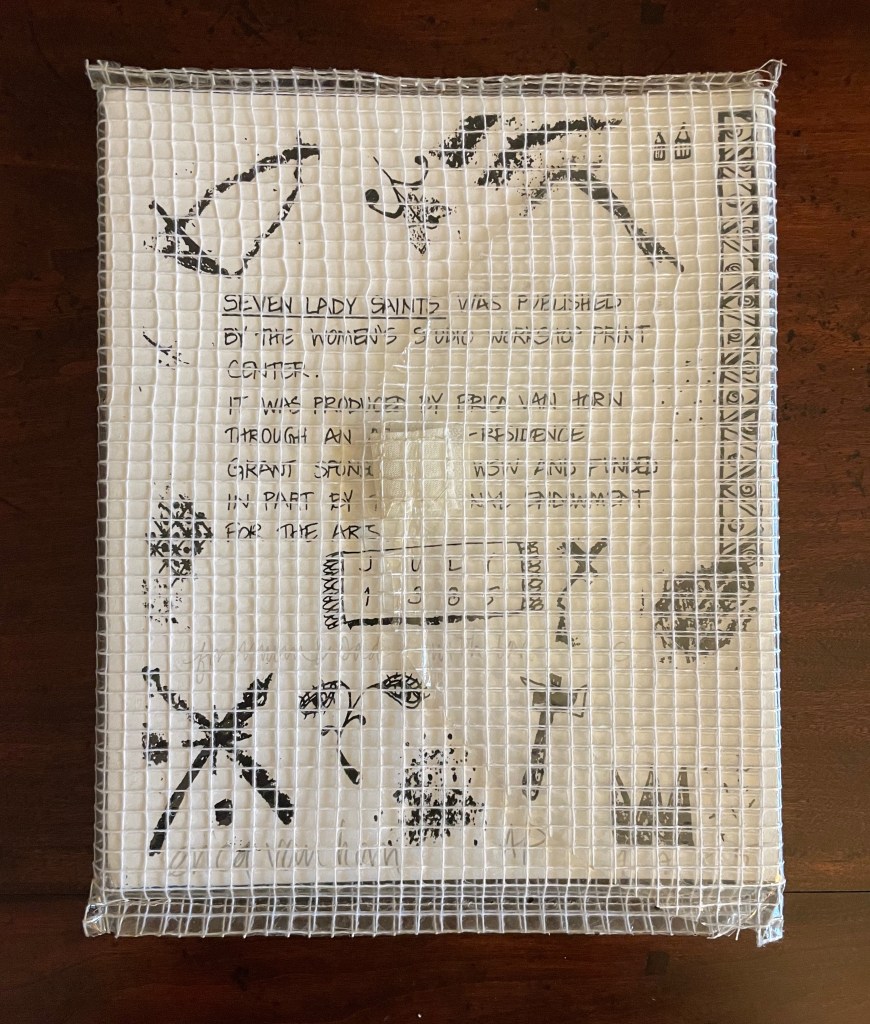
Seven Lady Saintes (1985) Erica Van Horn Clear plastic-coated white-thread envelope, self-covered leporello, watercolor paper. Envelope: H270 x W215 mm. Leporello: H250 x W205 mm (closed), W3040 mm (open). 16 panels, including covers. Edition of 90, artist’s proof. Acquired from the artist 1 November 2025. Photos: Books On Books Collection.
Van Horn uses a sophisticated child-like style of text and image to laugh slyly, wryly, and grimly at religion and patriarchy. Her summaries parody the descriptions in the handouts usually available in museums, convents, and churches or in the flood of hagiographies long on the market. The sophisticated-naivete of the drawing in Seven Lady Saintes appears in other works such as La ville aux dames (1983) and With or Without (2010). If the story of her plan for a series of four children’s books had turned out differently from the account in Scraps of an Aborted Collaboration (1994), we would have even more evidence of the influence of children’s books on many artists’ books that the Huberts propose in The Cutting Edge of Reading (1999).
Martha, patron sainte of cooks and housewives
Agatha, patron against fire and diseases of the breast
Fina, patron sainte of San Gemignano
Reparata, formerly patron sainte of Florence
Lucy, patron sainte of Syracuse and diseases of the eye
Ursula, patron sainte of teachers and young girls
Cecilia, patron sainte of music and musicians
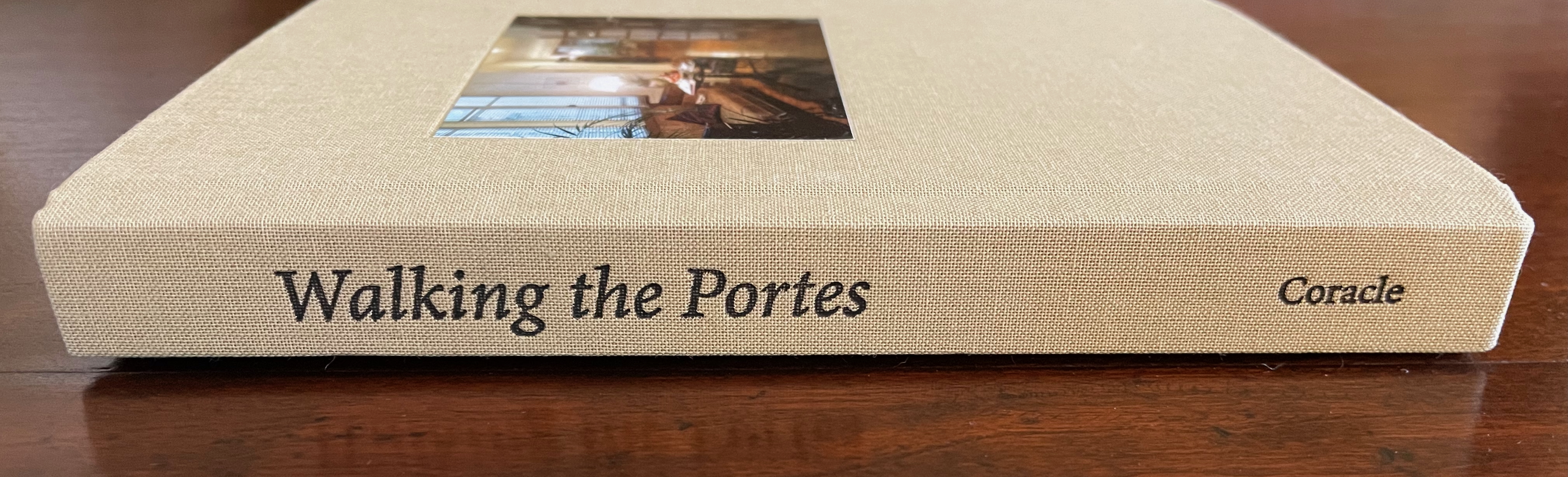
Walking the Portes (2025)
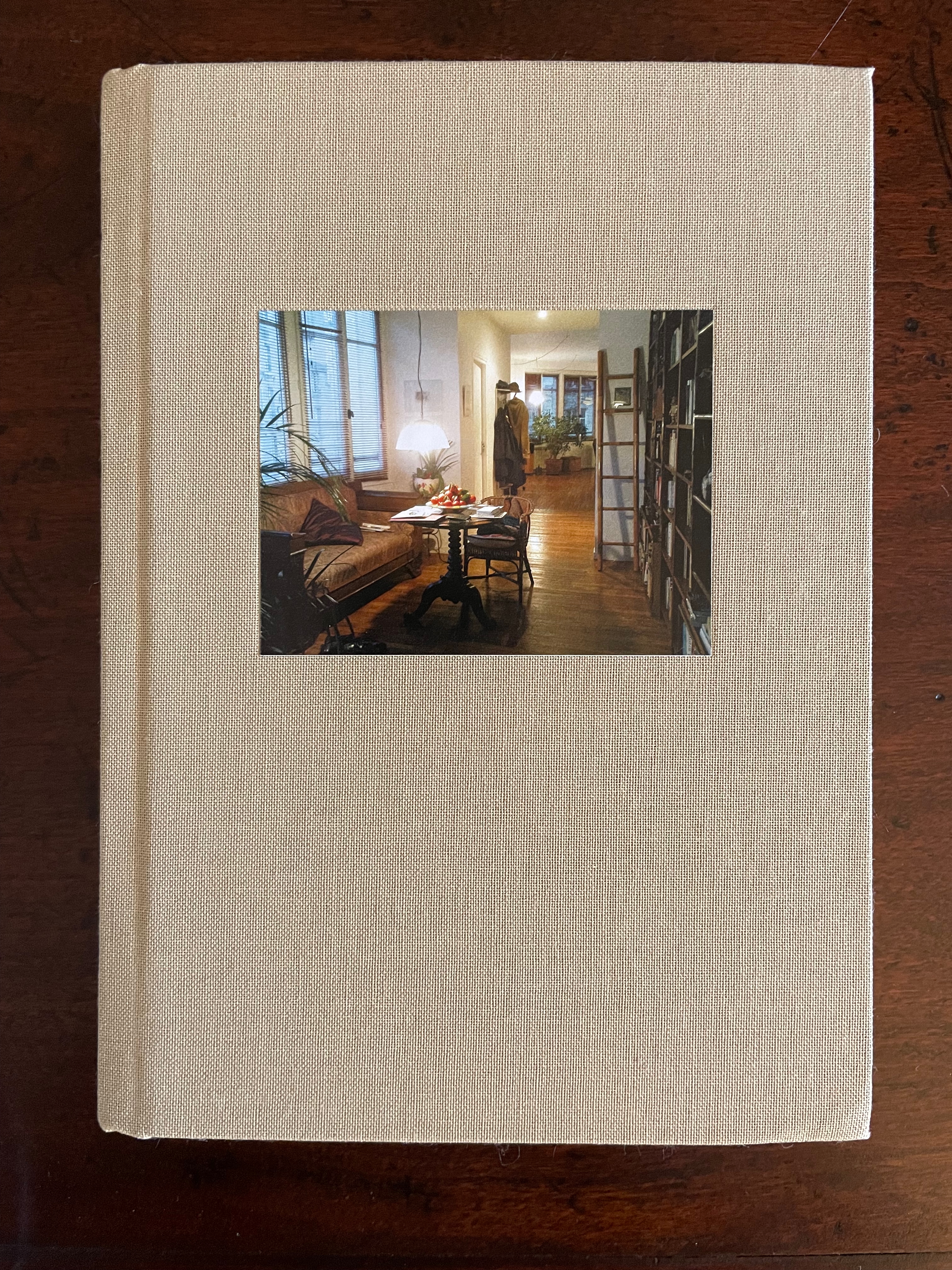
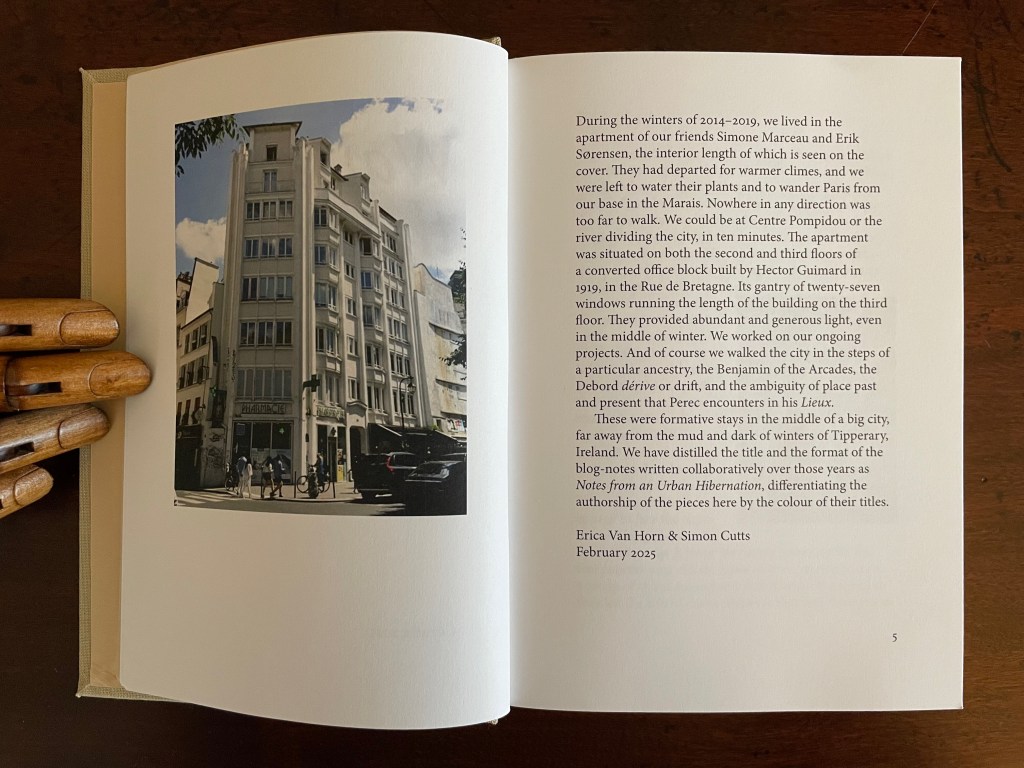
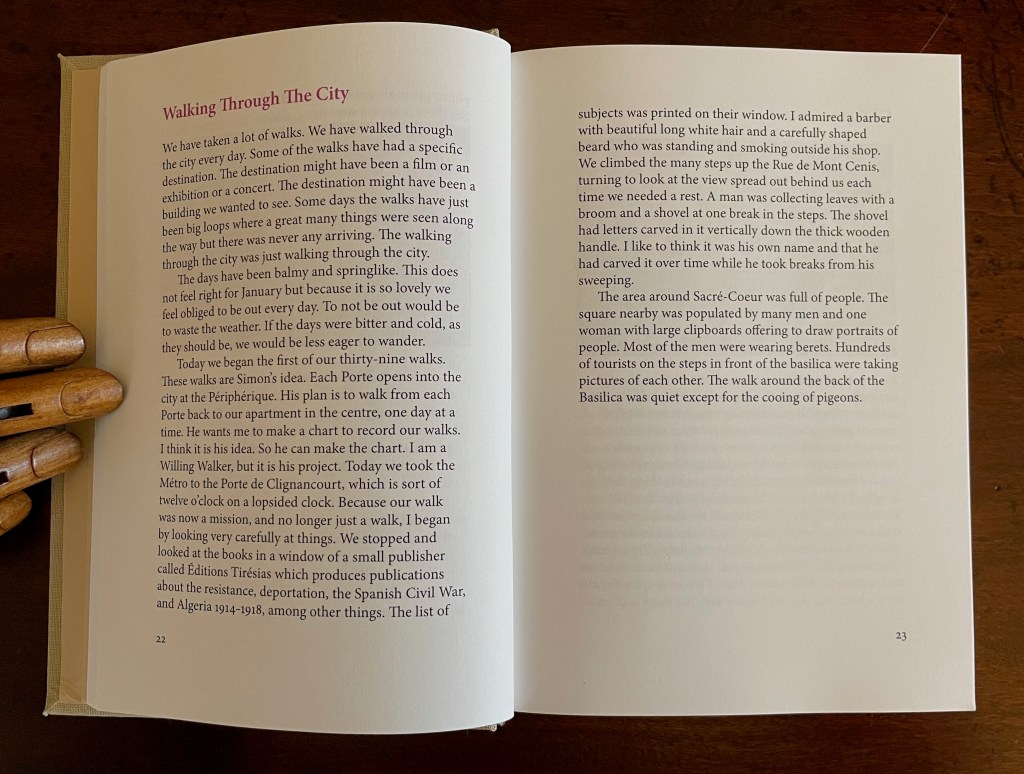
Walking the Portes: Winters in Paris 2014-2019 (2025) Simon Cutts and Erica Van Horn Casebound, book cloth over boards, blind stamped and inked spine, photo pastedown in recess on front cover, plain doublures. H182 x W132 mm. 216 pages. Edition of 300. Acquired from Books about Art, 15 September 2025. Photos: Books On Books Collection.
In the early 2000s, a series of hardbacks appeared called “Writer and the City”. John Banville covered Prague; Peter Carey, Sydney; Justin Cartwright, Oxford; Ruy Castro, Rio de Janeiro; David Leavitt, Florence; and Edmund White, Paris. White’s was the first, and it set the tone with its content and title: The Flâneur: A Stroll Through the Paradoxes of Paris. An enterprising paperback publisher might be enticed to reissue them and, allowing for a Parisian double-dip, to add Walking the Portes. Besides, I prefer Simon and Erica’s Paris to Edmund White’s, and Walking the Portes pairs better with Anne Moeglin-Delcroix’s Ambulo Ergo Sum (2015) anyway.
It is Simon’s plan to ride out to each of the entrances to Paris (the portes) and walk back to the apartment in the Marais. When it turns out that instead of twenty-one portes there are thirty-nine, Erica firmly responds accordingly:
In introducing Ambulo Ergo Sum, her extended essay on Hamish Fulton, Richard Long, and herman de vries, Moeglin-Delcroix writes:
The analysis of some artists’ books … should make it possible to show how the emphasis has been progressively placed no longer on landscape but on the search for the best means, differing according to the various artists, of rendering an experience in the strongest sense of the word: a lived experience of the world, a personal practice, that is to say, a deliberate way of being inthe world rather than before it. The walking body is the touchstone of this, because walking compels one to supersede the limits of a purely visual experience of nature to become the experience of the whole artist, with his body, in nature. (p. 6)
Whether Walking the Portes is an artists’ book or not, it does what Moeglin-Delcroix describes. It renders these artists’ lived experiences of Paris and their deliberate way of being in the world together.
Bates, Julie. 2023. “Erica Van Horn’s creative exercises“. Irish Studies Review, 31(1), 139–158. Interviewed Van Horn at the 2025 Small Publishers Fair, Conway Hall, London.
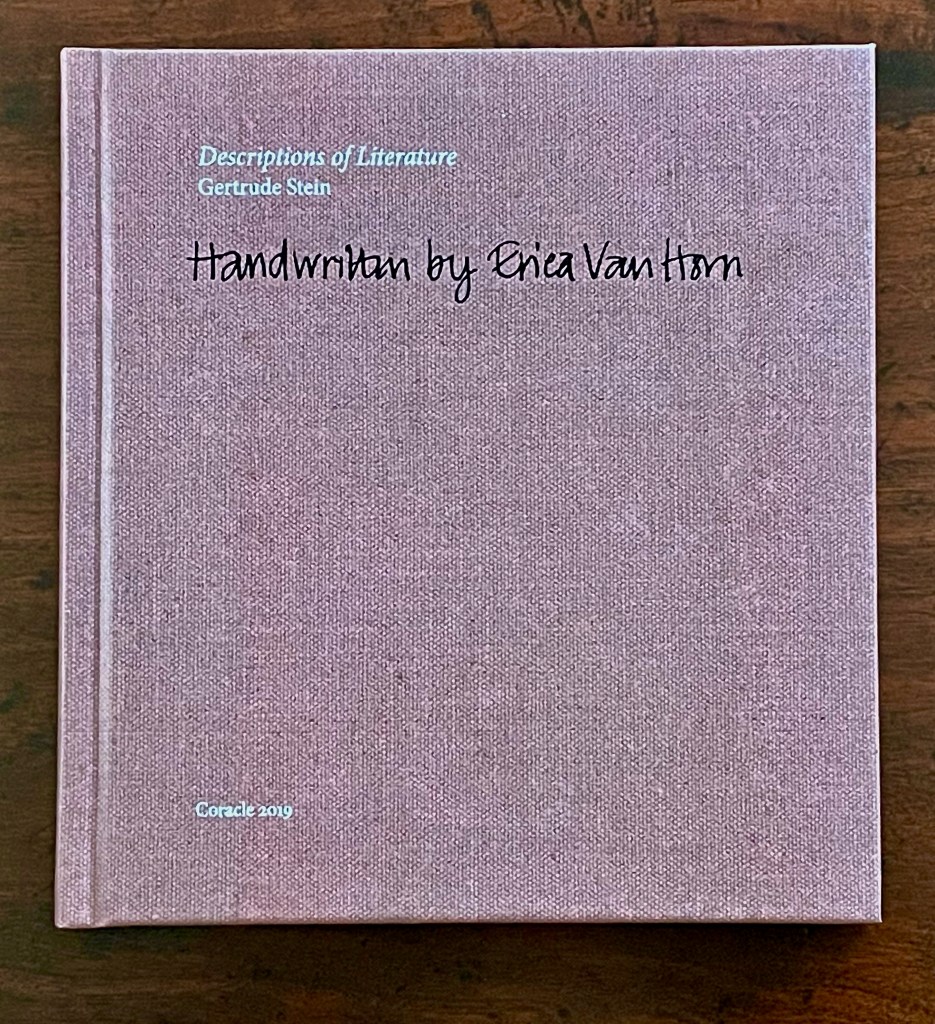
Descriptions of Literature by Gertrude Stein: Handwrittenby Erica Van Horn (2019)
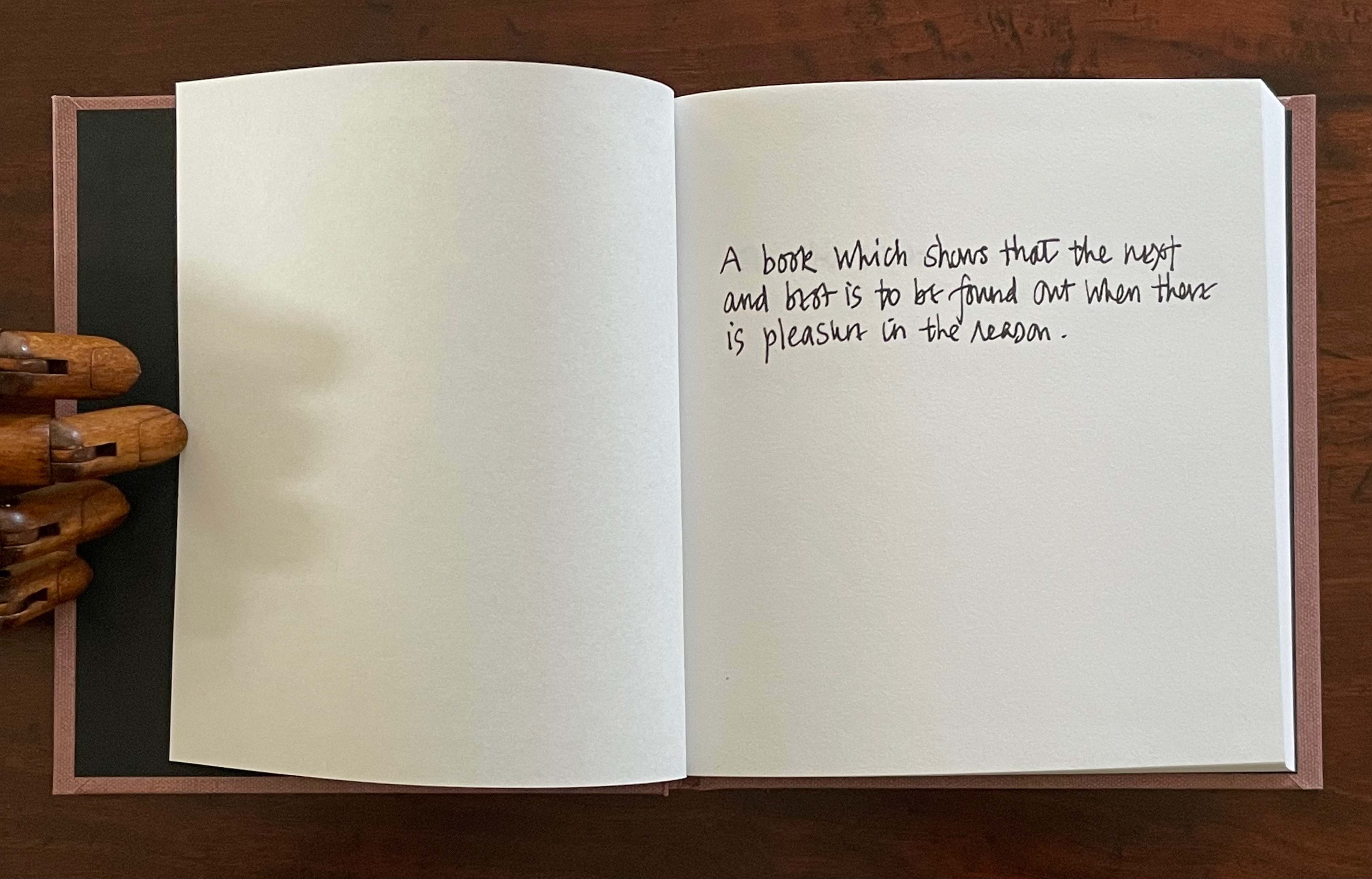
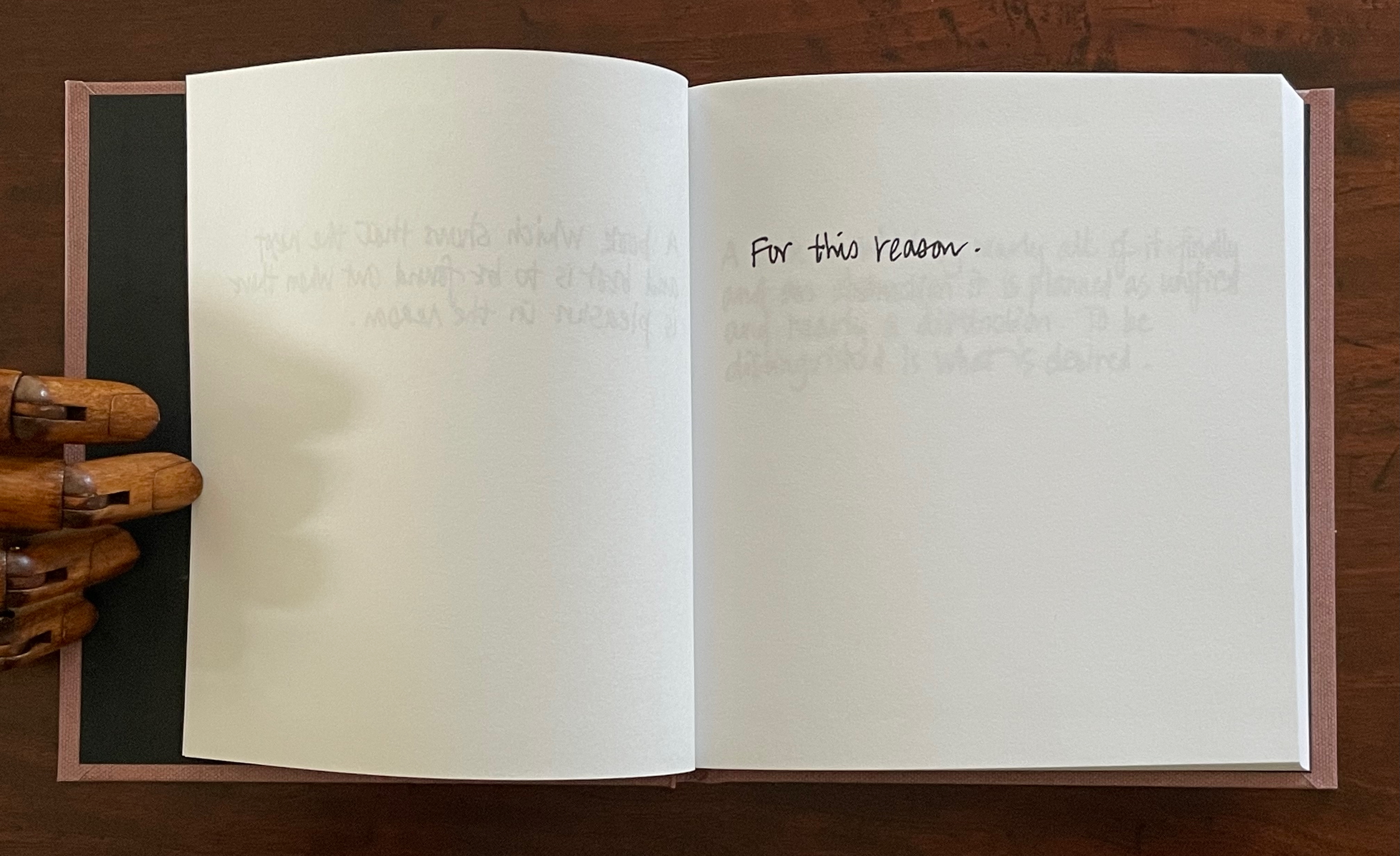
Descriptions of Literature by Gertrude Stein: Handwrittenby Erica Van Horn (2019) Erica Van Horn Limited edition (unknown quantity). H157 x W146 mm. [144] pages. Acquired from Books about Art, 2 July 2025. Photos: Books On Books Collection.
Appropriation has its reasons. Gertrude Stein’s description of literature with which Erica Van Horn begins her scribal appropriation of sixty-six of Stein’s exacting and elusive apothegms is particularly appropriate. In the brief afterword, Van Horn explains that she has always been proud of her handwriting and loves writing by hand. So, this book “shows that the next and best is to be found out when there is pleasure in the reason” as its next folio shows: Van Horn’s pleasure in the reason is her pleasure in the reason.
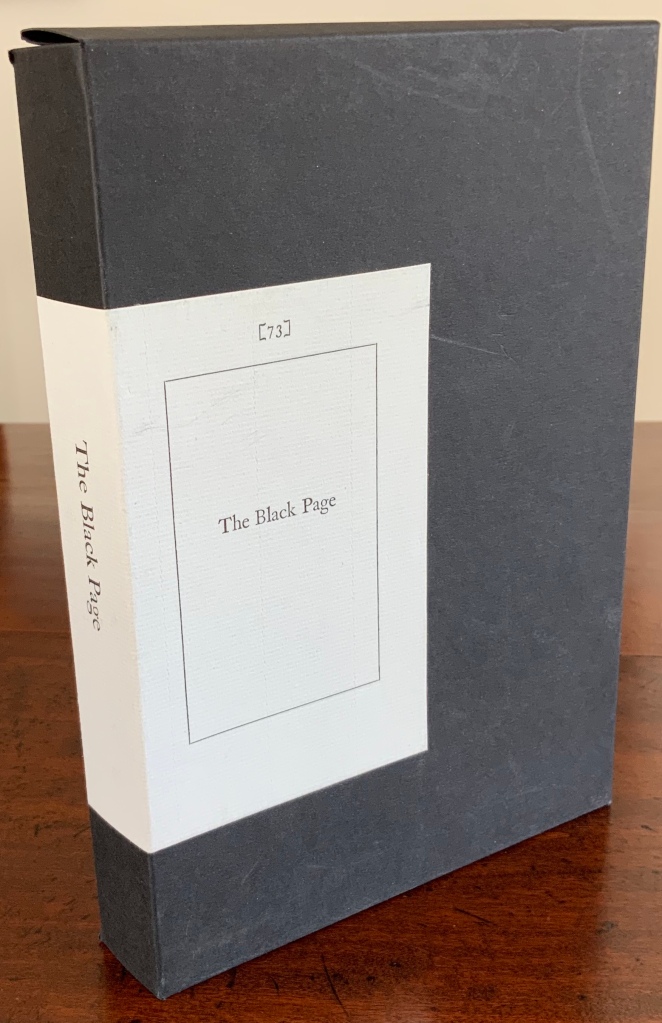
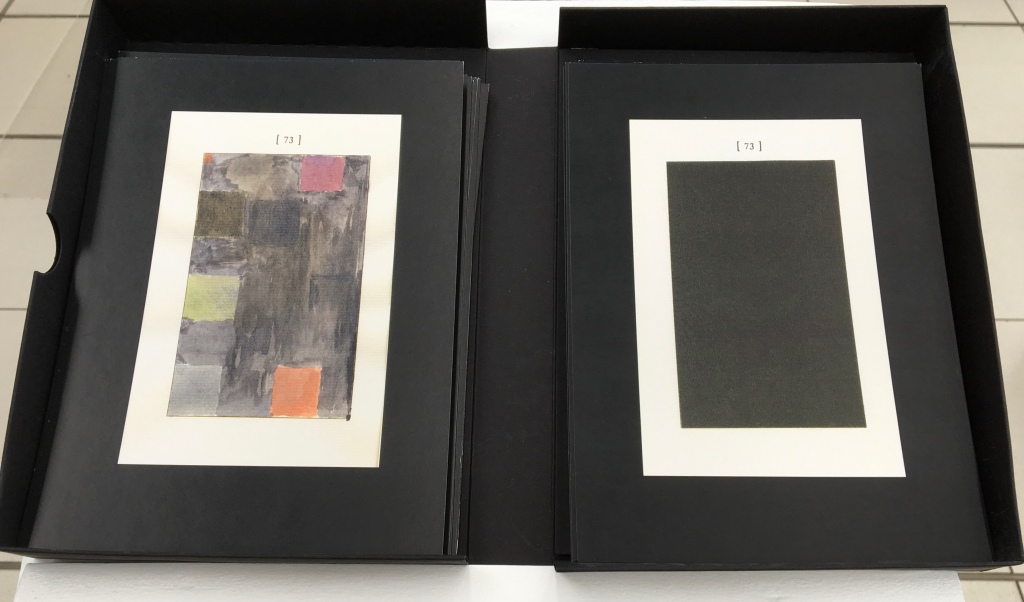
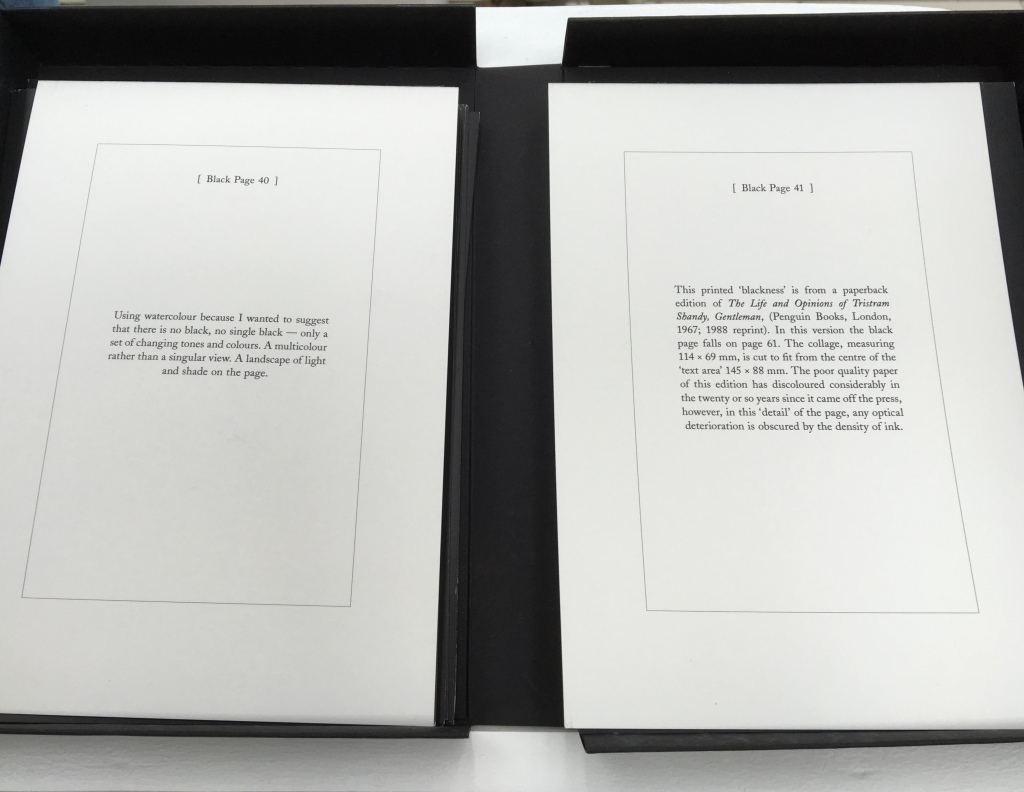
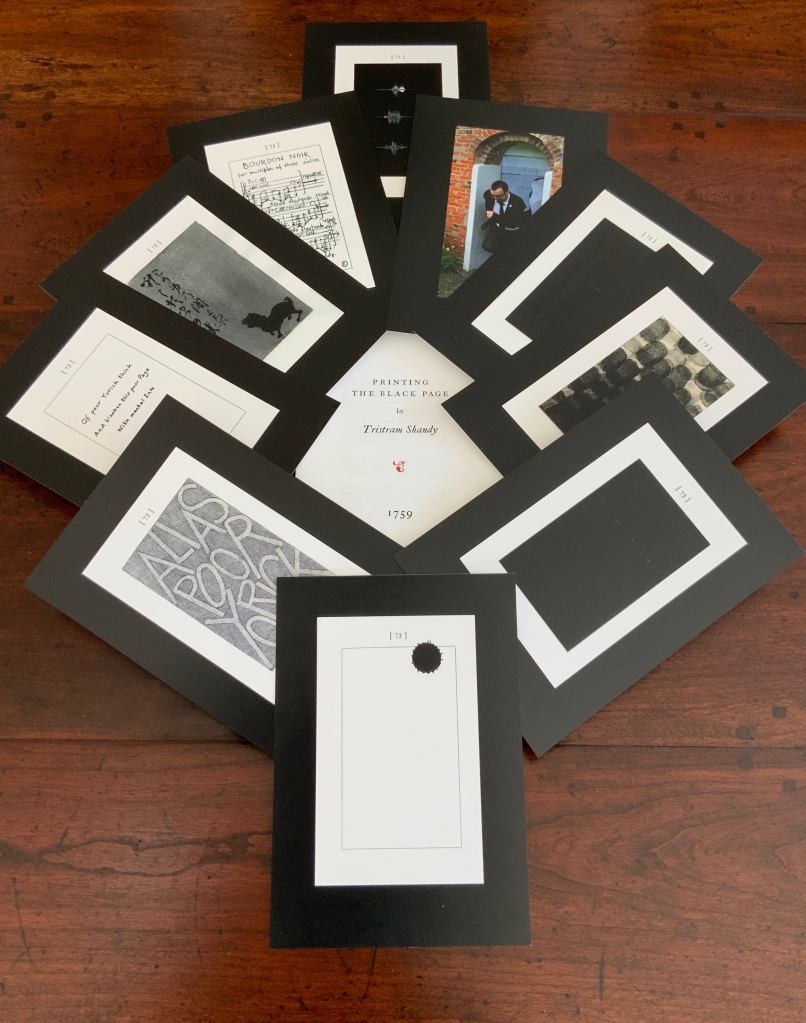
The Black Page Catalogue(2010) Coxwold, UK: Printed by Graham Moss (Incline Press) for The Laurence Sterne Trust. Contains 73 numbered leaves in a matte black card box (H235 x W168 mm). The leaves are glossy cards (210 x 148 mm) on which contributed texts and illustrations (chiefly colour) are printed; the reverse of each provides the contributor’s comments on the text or illustration and the “page” number. Also enclosed are a single-sheet folded pamphlet (“Printing the Black Page” by Graham Moss, Incline Press) and two cards, one of which is the invitation to the exhibition inspired by the ‘black page’, p. 73 of the first edition of The Life and Opinions of Tristram Shandy, Gentleman, held at Shandy Hall, Coxwold, North Yorkshire, 5 Sept.-31 Oct. 2009, and the other, sealed in an envelope, being the index of the contributors and their page numbers. Edition of 73. Acquired from the Trust. Photos: Books On Books Collection.
Collectors come up with the most ingenious reasons for acquiring things. In this case — along with astrological, numerological and other rational rationale — Rebecca Romney’s reminder that The Life and Opinions of Tristram Shandy, Gentleman is one of the earlier instances of book art led inevitably to my acquiring Shandy Hall’s The Black Page Catalogue. But it took time.
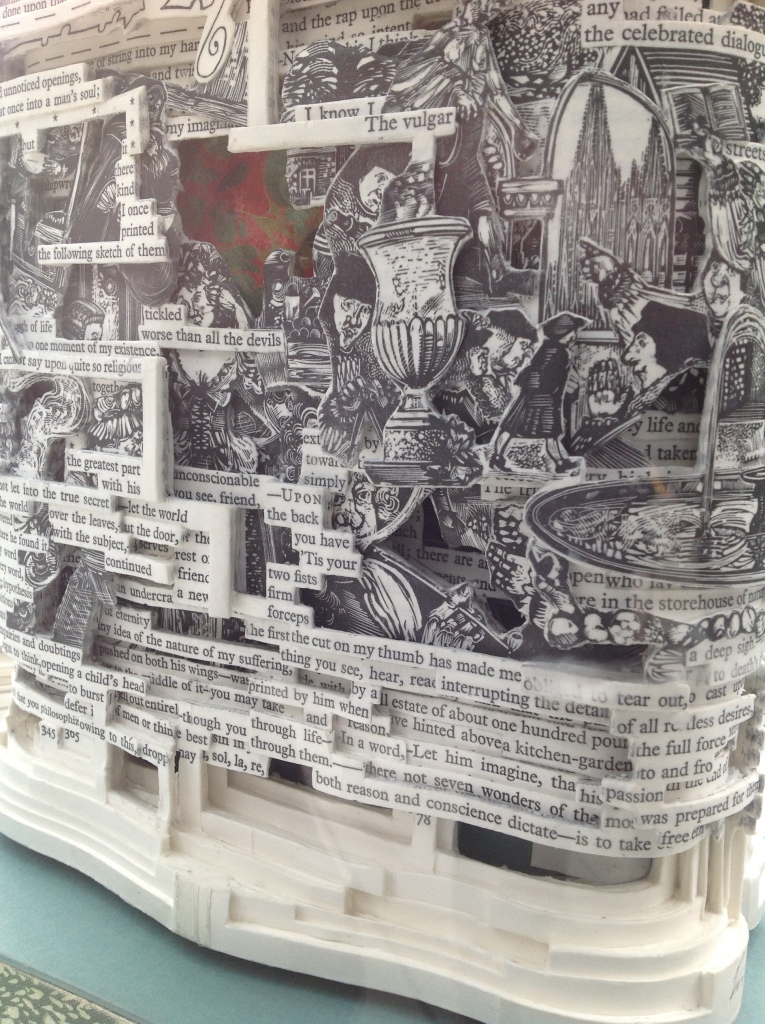
Several months after enjoying the Romney essay, I met Brian Dettmer in February 2015 by happenstance at a book art exhibition in New Haven, CT. As we chatted about past inspirations of book art, Tristram Shandy came up, so he told me of an upcoming event called “Turn the Page” in Norwich, UK, where I could more easily see some of his work — and one in particular having to do with Tristram Shandy. So in May 2015, I went.
Tristram Shandy (2014) Brian Dettmer Carved and varnished, two copies of the 2005 Folio Society edition of Tristram Shandy. H230 x W190 mm Commissioned by The Laurence Sterne Trust, Coxwold, UK. Photos: Books On Books Collection.
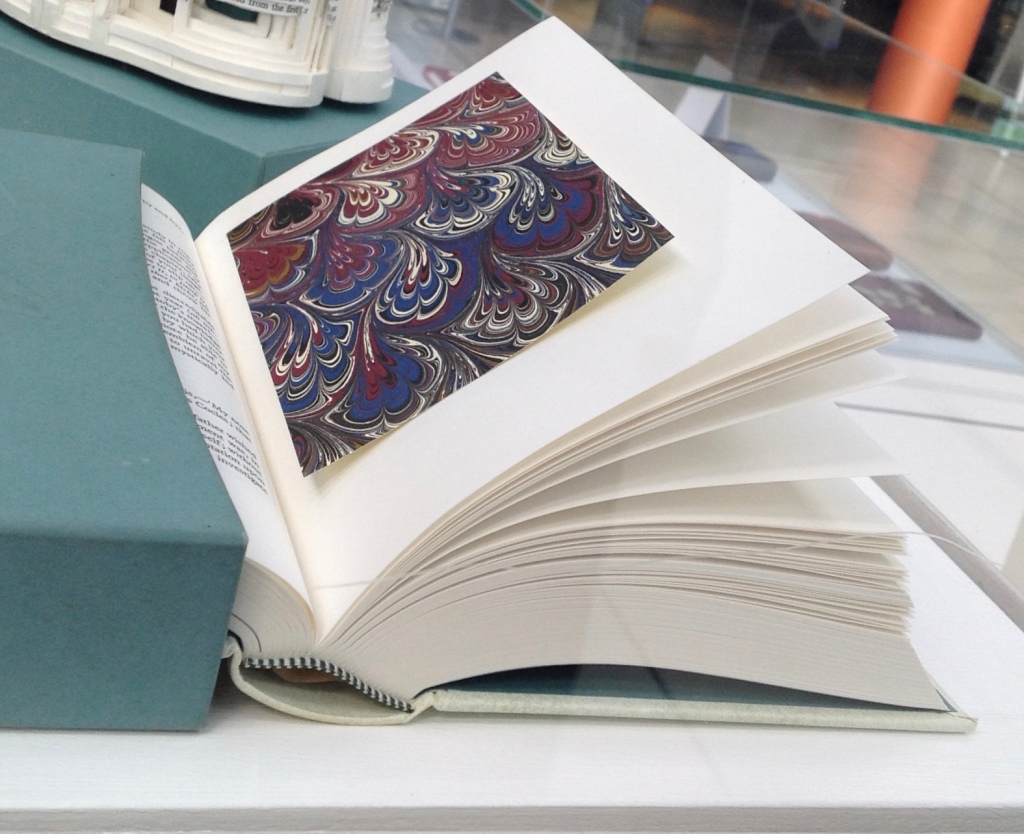
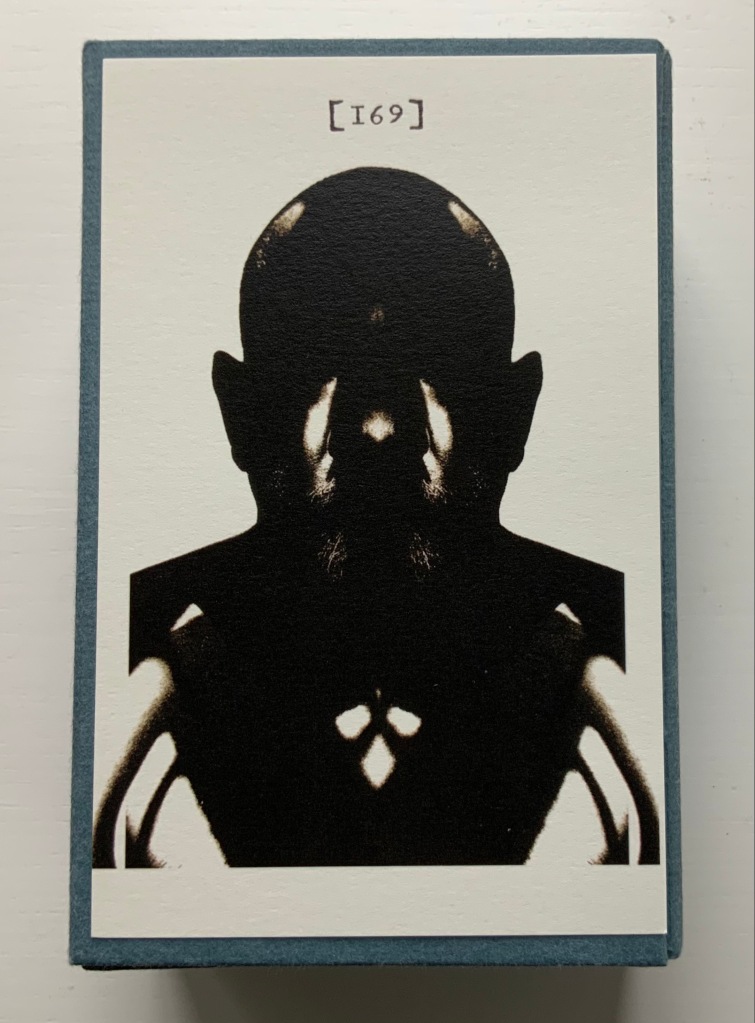
The marbled page, an “emblem of my work”, p. 169. The Life and Opinions of Tristram Shandy, Gentleman (1759) by Laurence Sterne Illustrated with wood engravings by John Lawrence. Set in ‘Monotype’ Plantin, printed by Cambridge University Press on Caxton Wove Paper. New York: Folio Society, 2005.
So a year passed. Another visit to “Turn the Page” was made. And as I was leaving, lo, a sign and small display came unto me:
Only a negligent collector would ignore such clear signs.
Parson-Yoricks-to-be can select their own favorites here.
Emblem of My Work (2013)
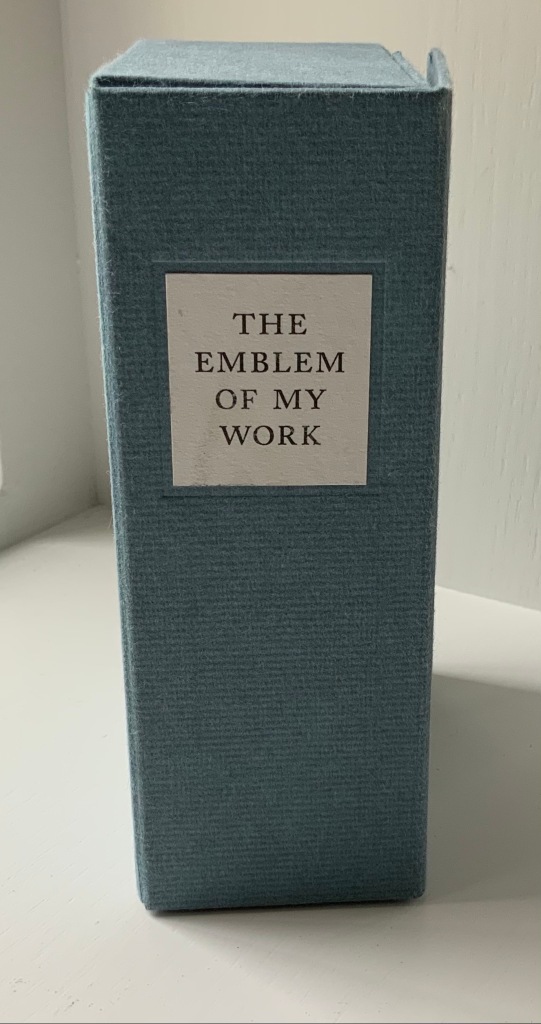
Emblem of My Work (2013) Coxwold, UK: The Laurence Sterne Trust. Consists of a 24-page booklet and 170 numbered cards in a hinged blue paper-covered box (H160 x W105 x D60 mm. The leaves of this catalogue are bright white cards (152 x 92 mm) on which the artwork is printed; the reverse of each provides the “page” number and the contributor’s comments on the art. The booklet provides alphabetical and numerically ordered indexes listing the contributors and their page numbers. Edition of 225, of which this is #79. Acquired from Shandy Hall, 1 October 2019. Photos: Books On Books Collection.
Volume III of Sterne’s work was the first to be handled by a publisher. Presumably the famous success of the first two self-published volumes helps to explain James Dodsley’s agreement to printing copies in which each page 169 and each page 170 showed uniquely marbled squares. Images from an original copy held at the British Library can be seen here. As Patrick Wildgust, director of Shandy Hall, explains in the booklet:
The central section of p. 169 was laid upon the marbled mixture in order that a coloured impression could be taken as cleanly as possible. This was left to dry and then reverse-folded so the other side of the paper could also receive its marbled impression. This side of the paper became page [170]. As a result, the marbled page in every copy of Vol. III is different — each impression being a unique handmade image. In the text opposite on p. 168, Sterne tells the reader that the marbled page is the “motly emblem of my work” — the page communicating visually that his work is endlessly variable, endlessly open to chance.
Two favorites — one for page [169], one for [170] — artists with other works in the Books On Books Collection. Left: Ken Campbell. Right: Eric Zboya.
Paint Her To Your Own Mind (2018) Coxwold, UK: The Laurence Sterne Trust. Contains 147 numbered leaves in a brown paper-covered box (174 x 124 mm). The leaves are bright white cards (145 x 105 mm) on which contributed texts and illustrations (chiefly colour) are printed; the reverse of each provides the contributor’s comments on the text or illustration and the “page” number. Also enclosed are a “title page” and “index leaf” listing the contributors and their page numbers. Edition of 200. Acquired from Shady Hall, 6 June 2018. Photos: Books On Books Collection.
Page 147 of Sterne’s sixth volume of Tristram Shandy is blank. On the preceding page, he metaphorically throws up his hands over any attempt to describe the most beautiful woman who has ever existed and exhorts the reader: “To conceive this right, —call for pen and ink—here’s paper ready to your hand, —Sit down, Sir, paint her to your own mind—as like your mistress as you can—as unlike your wife as your conscience will let you—‘tis all one to me—please your own fancy in it.” So, accordingly, Shandy Hall invited 147 artists/writers/composers to follow Sterne’s instruction to fill the blank page 147. From the 9th through 30th of September 2016, their efforts were displayed in the Shandy Hall Gallery, Coxwold, York.
The curious reader can choose his or her own favorites here.
The Flourish of Liberty (2019)
In Volume IX on p. 17, the reader reads Corporal Trim’s advice to Uncle Toby, who stands at the Widow Wadman’s threshold about to propose marriage:
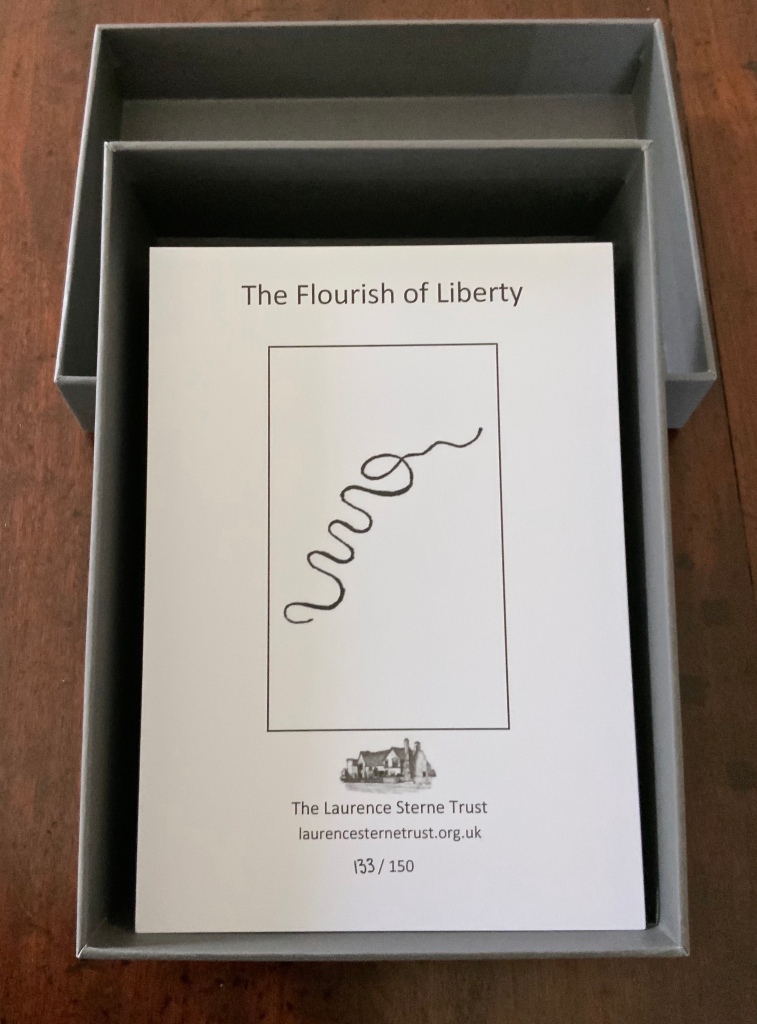
Nothing, continued the Corporal, can be so sad as confinement for life — or so sweet, an’ please your honour, as liberty. Nothing, Trim — said my Uncle Toby, musing — Whil’st a man is free — cried the corporal, giving a flourish with his stick thus —
The Flourish of Liberty (2019) Coxwold, UK: The Laurence Sterne Trust. Contains 103 numbered leaves in a gray paper-covered box (174 x 124 mm). The leaves are bright white cards (148 x 105 mm) on which contributed texts and illustrations (black and white, several in colour) are printed; the reverse of each provides the contributor’s comments on the text or illustration and the “page” number. Also enclosed are a “title page” and “index leaf” listing the contributors and their page numbers. Edition of 150, of which this is #133. Acquired from Shandy Hall, 26 October 2020. Photos: Books On Books Collection.
The rest of Corporal Trim’s flourishes flourish here.
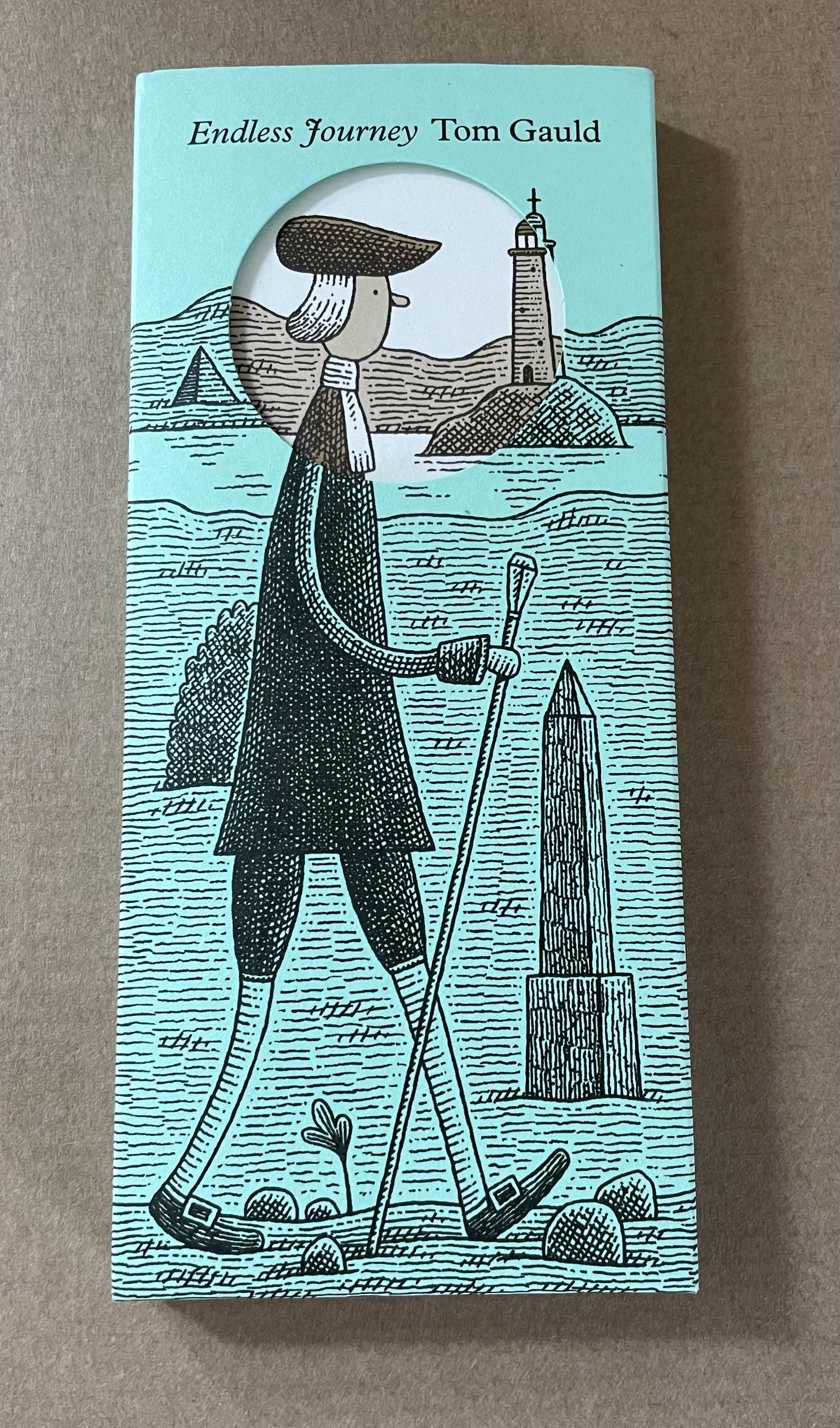
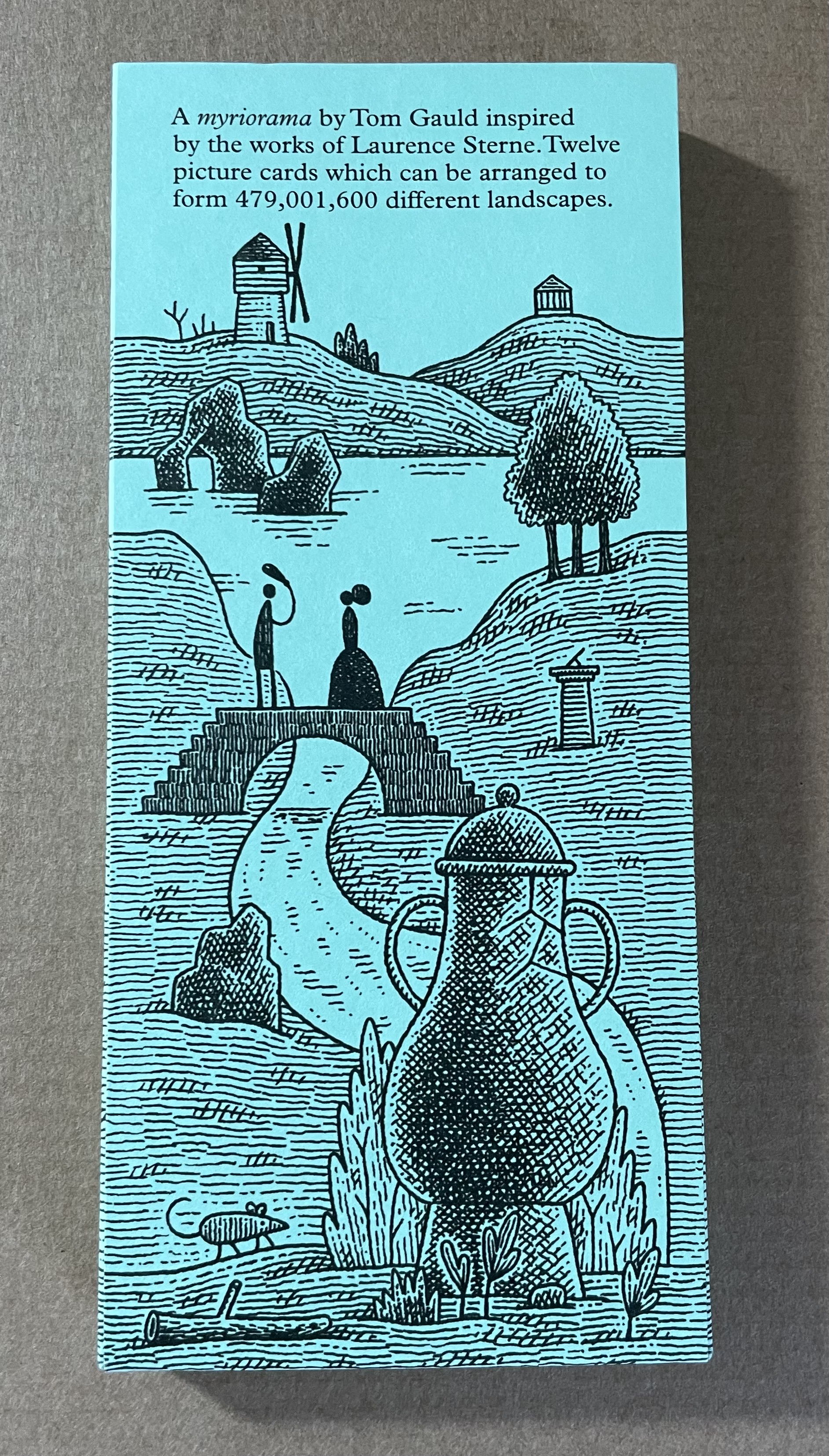
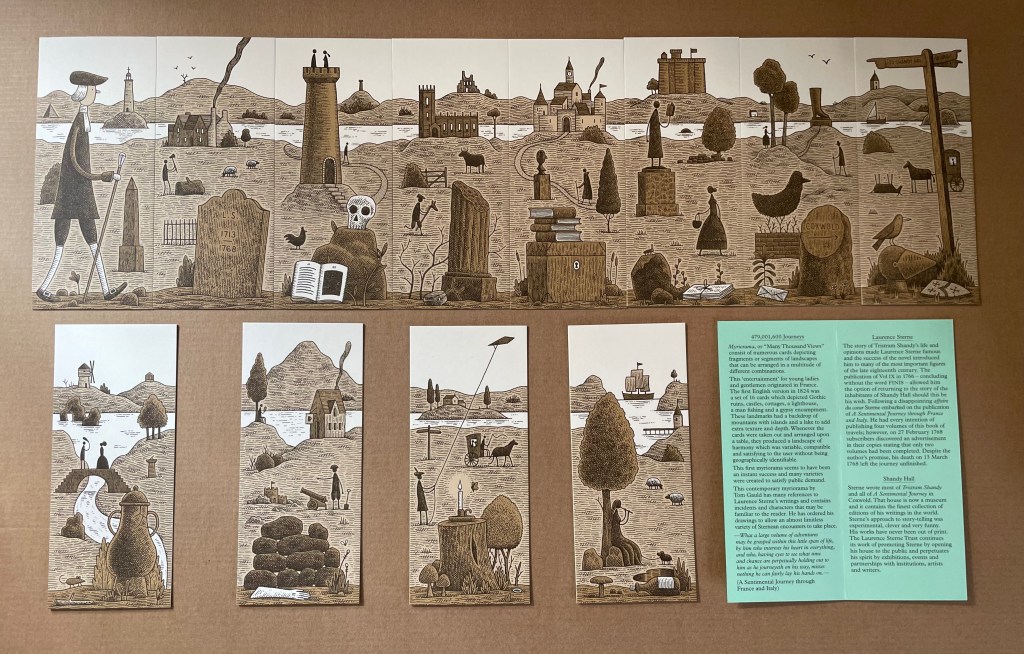
Endless Journey (2015)
Endless Journey (2015) Tom Gauld Printed slipcase, twelve cards, leaflet. H165 x W73 mm. Acquired from the Laurence Sterne Trust. Photos: Books On Books Collection.
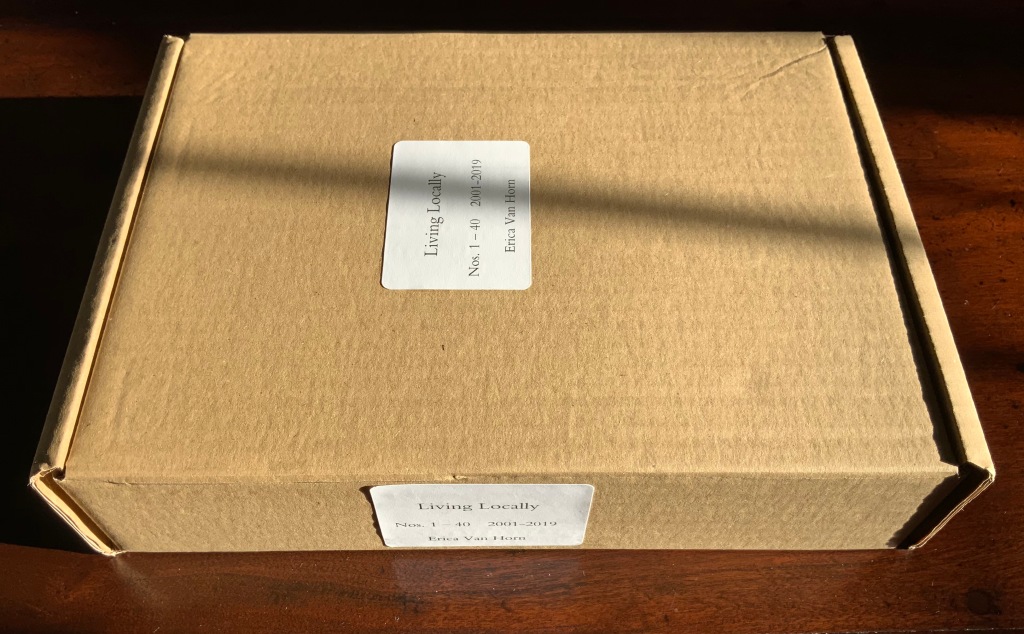
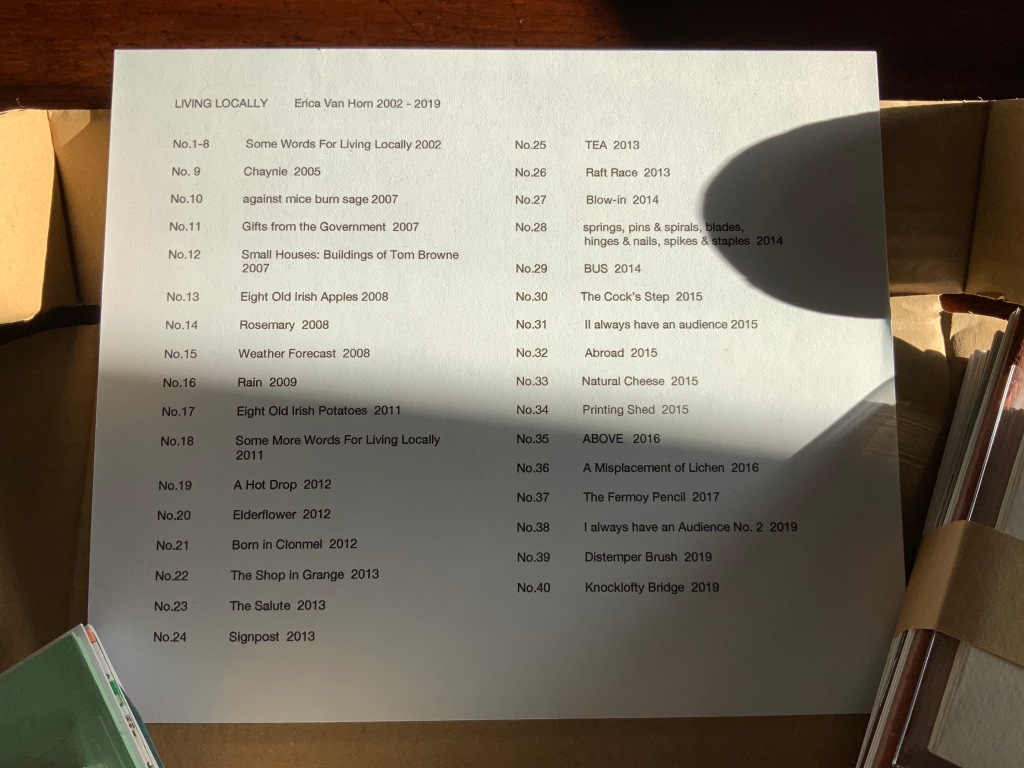
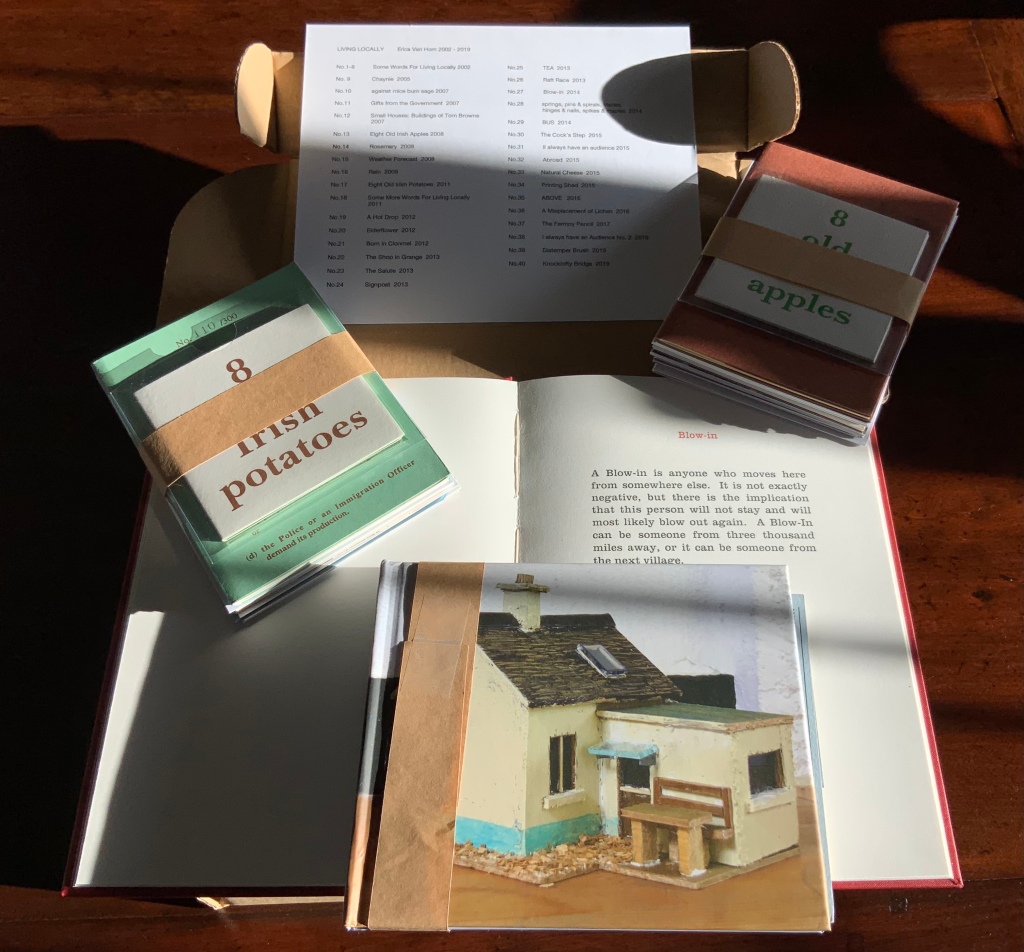
Living Locally, Nos. 1-40 (2002-2019) Erica Van Horn Tab-and-slot cardboard box, H270 x W190 x D60 mm, enclosing thirty-two items produced with various techniques and in various forms and structures (print, accordion, postcard, pamphlet, paperback, hardback). Acquired from Coracle Press, 16 December 2020. Photos: Books On Books Collection.
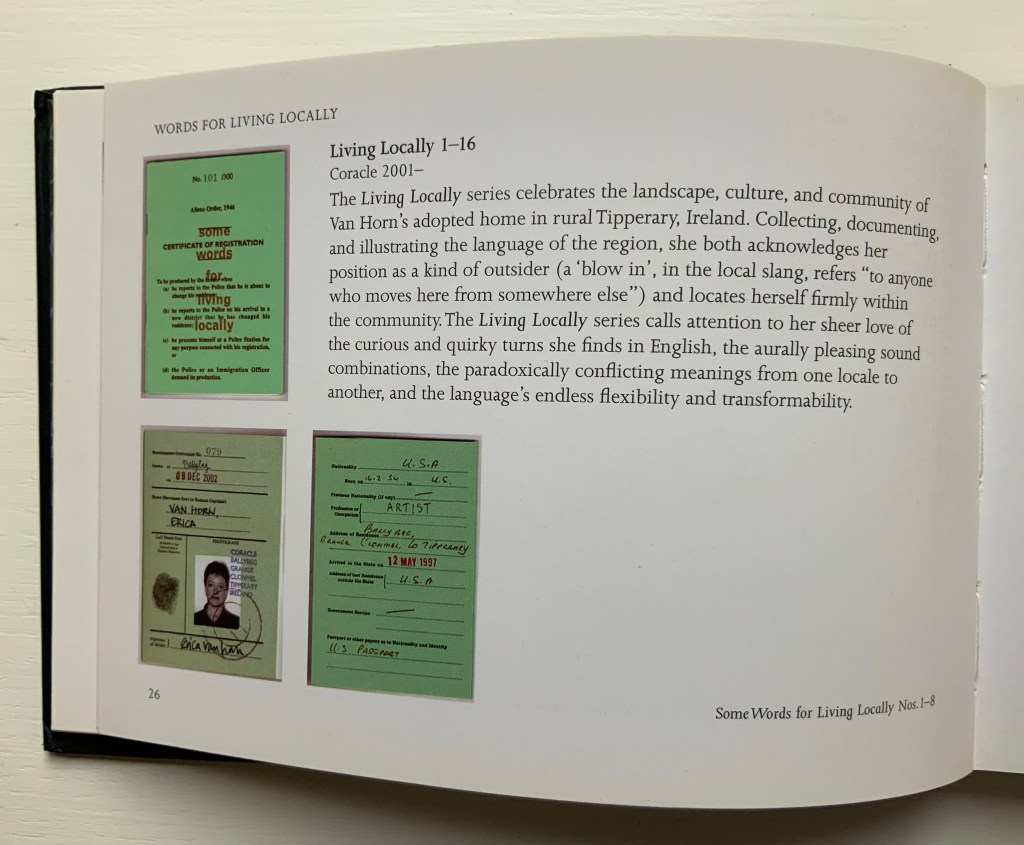
Since 1996, Erica Van Horn has lived and worked in Ballybeg, Grange, Clonmel, Co. Tipperary in Ireland with the poet, critic and artist Simon Cutts. Her Living Locally series, which has engendered an online blog and an edited collection, has also had this other incarnation closer to book art, four items of which first drew my attention to Van Horn’s work. In her book for Van Horn’s 2010 Yale exhibition, Nancy Kuhl places the series in a section that “illustrates the artist’s long fascination with the ways language both describes and creates community, even as it determines individual identity and shapes personal memory” (p. 9). Over the years, returning Van Horn’s four small items to display on shelves and discovering her earlier painted bookworks via The Book Made Art, I found Van Horn’s fascination with language expressing itself through graphics, binding and other physical forms of publication in such original ways that this cardboard treasure chest could no longer be resisted.
Some words for living locally (2002 ~)
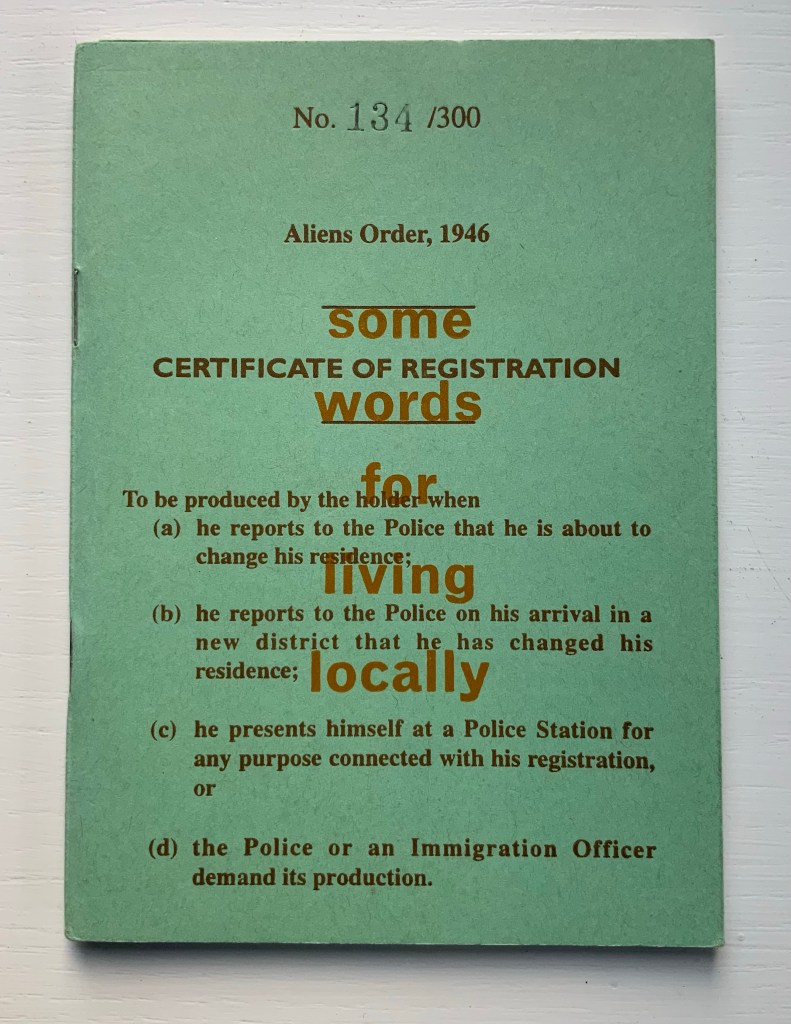
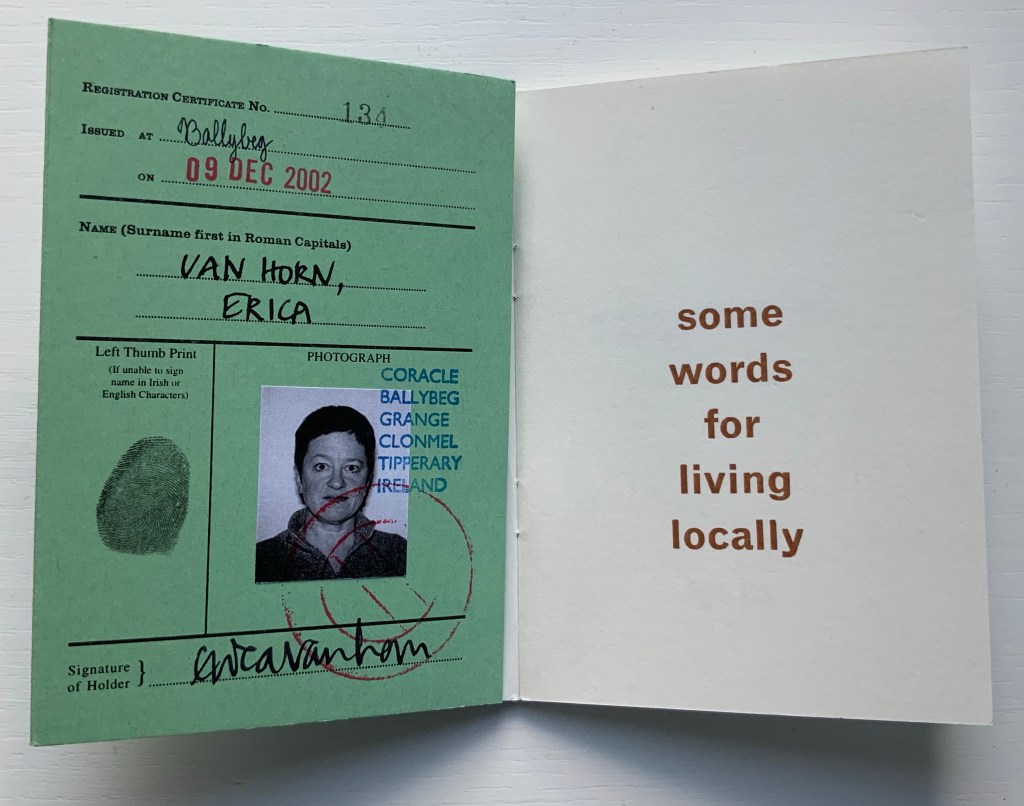
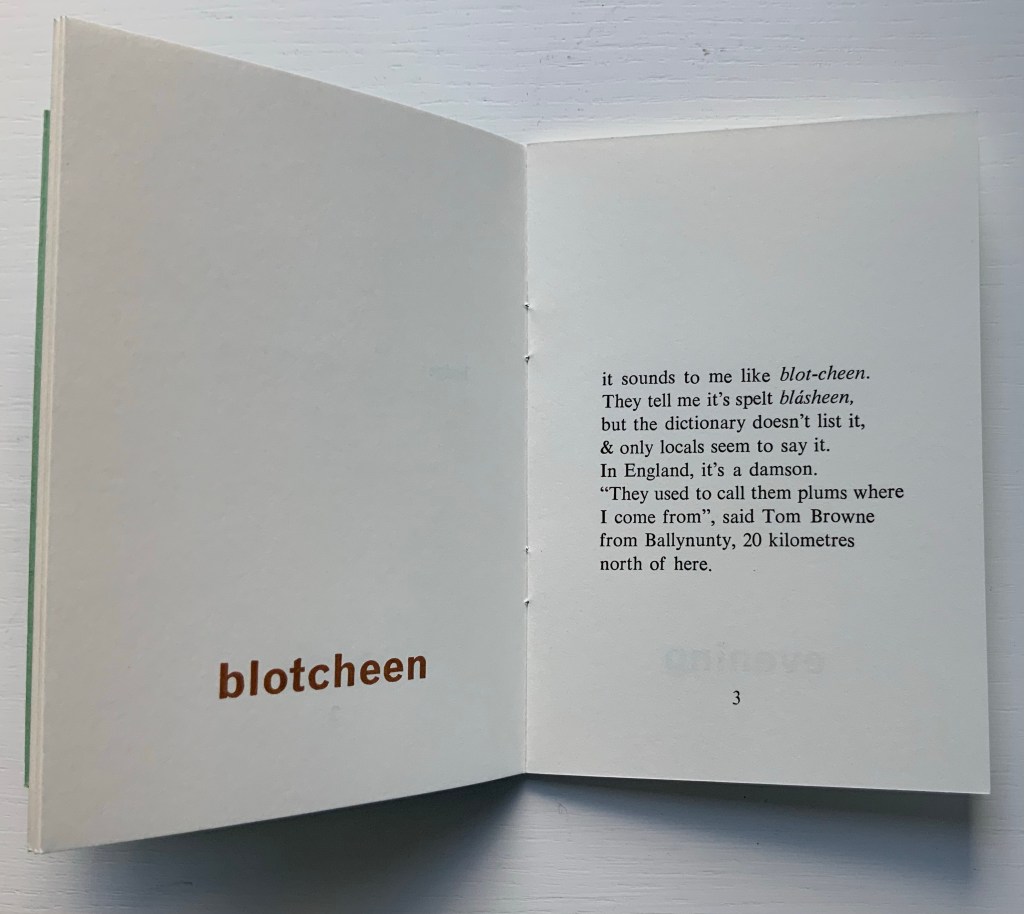
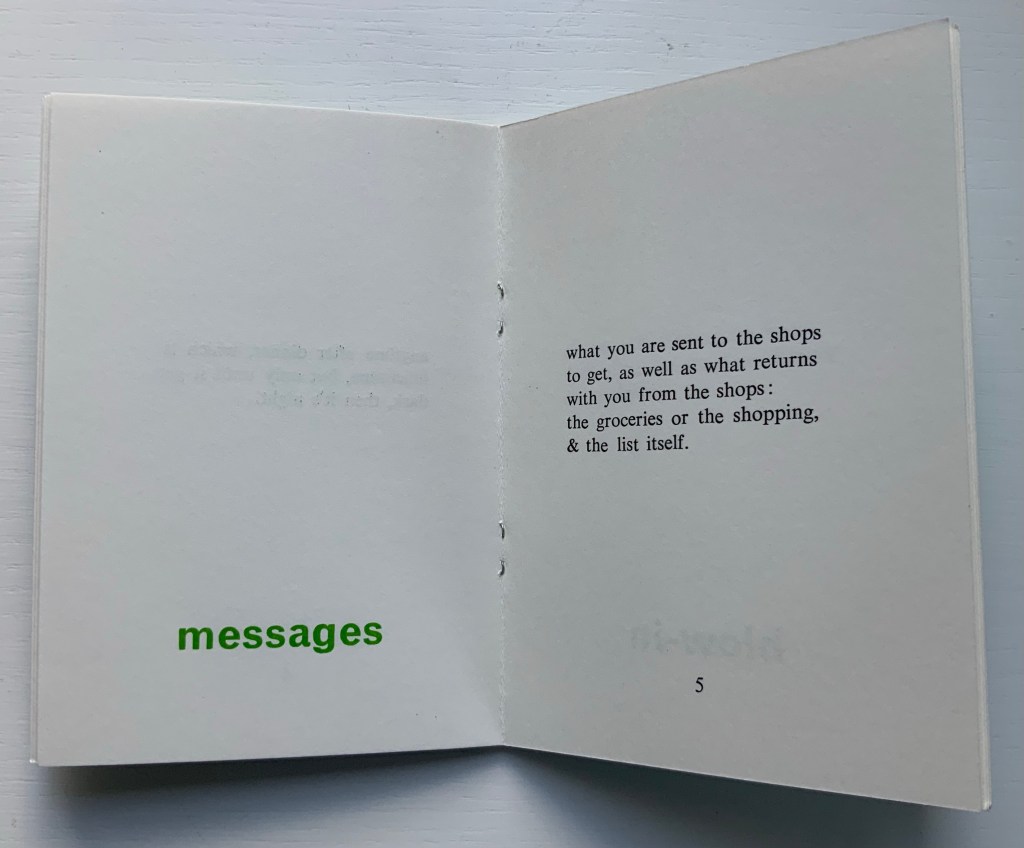
Some words for living locally, No. 1-8 (2002~) Erica Van Horn Booklet saddle-stitched with staples. H147 x W105 mm, 20 pages. Edition of 300, of which this is #134. Acquired from Coracle Press, 25 February 2015.Photos: Books On Books Collection, displayed with the artist’s permission.
The first work in Living Locally, Nos. 1-40, is this booklet, a copy of which was acquired for the collection in 2015. How is it that what might be simple reminders or observations in a notebook kept to help the writer understand the “locals” become art? For a start, there’s the cover: an altered copy of Van Horn’s Irish certificate of registration. The certificate’s front cover overprinted with the title, the registration number replaced with the copy and edition numbers — these set the stage, telling us that a certificate of registration is a necessary but not sufficient condition for living here. Some words are also required, so the title tells us. Inside the cover, a hallmark of a published work appears: the name of the publisher (Coracle) and place of publication. The photocopied passport photo continues the certificate metaphor, and the signature plays the dual role of registrant’s and author’s signature.
Although there are twenty pages in the booklet, only nine are numbered. Of the nine, only eight display an explanation or comment (in black serif type) facing an unnumbered page with the word under scrutiny (in colored sans serif type). These eight are the “No. 1-8” of the title as given officially in the work’s initial entry in WorldCat and in the complete series’ list.
The ninth numbered page and its facing page are blank. Perhaps in keeping with the registration booklet cover, space has been left for future stamping. Or their blankness might be explained by the preceding double-page spread offering the word or phrase “good-luck” and its explanation on the eighth numbered page:
a farewell expression almost the same as ‘see you later’. Goodbye is final, therefore rarely used.
Perhaps the artist is implying that, “blow-in” though she may be as the locals describe anyone not born of local generations, she is not saying goodbye and plans to record further words for living locally.
8 old Irish apples and 8 old Irish potatoes (2011)
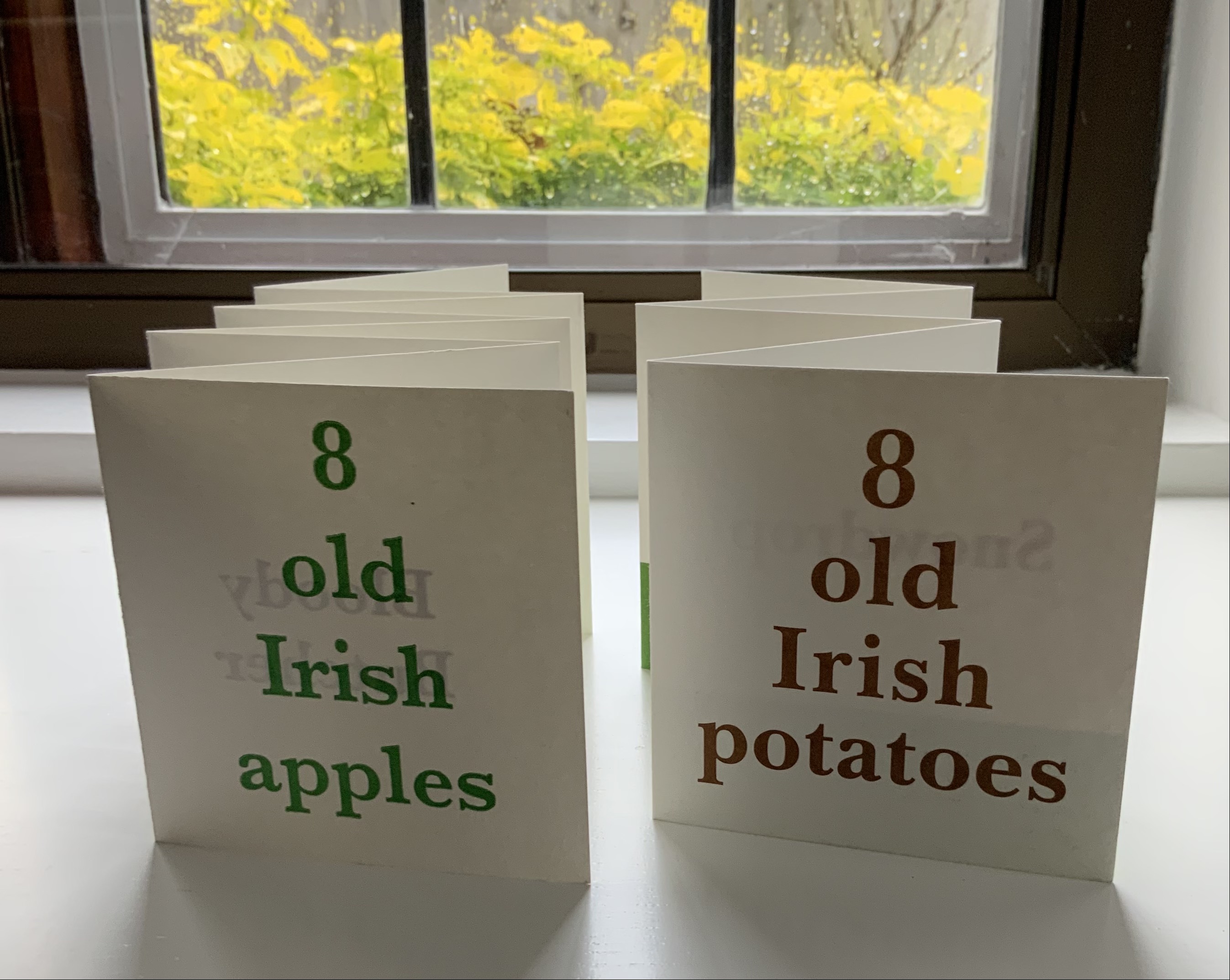
8 old Irish apples (2008) and 8 old Irish potatoes (2011) Erica Van Horn & Simon Cutts Concertinas: apples in eight sections (single-sided) and potatoes in five sections (double-sided). Both: H90 x W90 mm (closed), W720 mm (apples open), W450 mm (potatoes open). Editions of 500. Acquired from Coracle Press, 25 February 2015. Photos: Books On Books Collection, displayed with the artist’s permission.
These are No. 13 and No. 17 of the Living Locally series. On first sight, the two accordion booklets in their acetate sleeves seem to promise images of apples and potatoes. Removed from their sleeves, they deliver on the promise but in typographic and metaphorical ways. There’s a reveling in the pleasure of type impressed on the stiff card surface and of the descriptive or mnemonic names of the pommes and pommes de terre (for example, “Bloody Butcher” and “Yellow Pitcher” for the apples and “Flourball” and “Snowdrop” for the potatoes). Images of fruit and veg would be superfluous.
Born in Clonmel (2011)
Born in Clonmel (2011) Erica Van Horn Booklet saddle-stitched with thread. H142 x W104, 20 pages. Acquired from Coracle Press, 25 February 2015. Photos: Books On Books Collection, displayed with the artist’s permission.
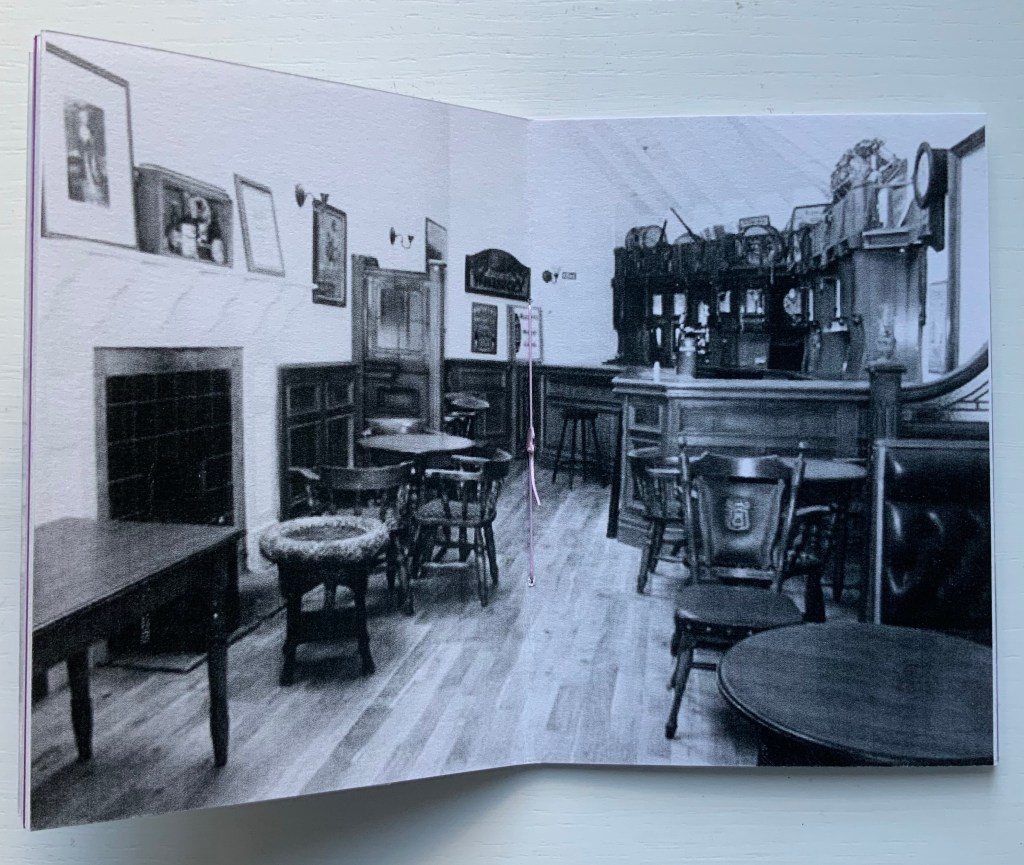
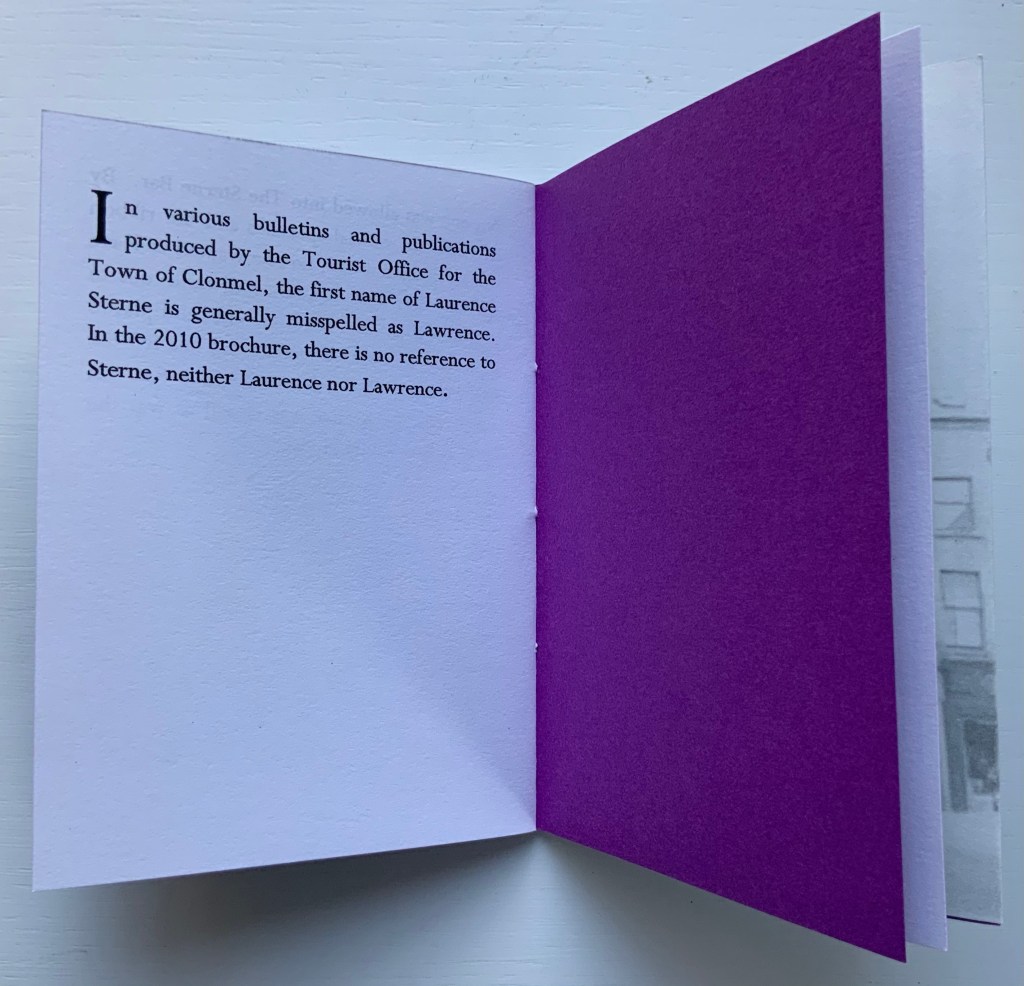
This is #21 in the Living Locally series. Van Horn visited Shandy Hall in 2008. On returning to Ireland, as she explains, she undertook this bit of “living locally” to find out what Clonmel had made and was making of its famous literary son Laurence Sterne. The booklet’s central photo of the Sterne Pub that no longer exists — in the hotel that no longer exists — in Clonmel rises past wryness in the context of the inevitable reader’s snort to which the tale of its non-use on dedication day gives rise. Van Horn’s plain, matter-of-fact observations and graphics would appeal to the original combiner of deadpan text and image in The Life and Opinions of Tristram Shandy, Gentleman — a forerunner of book art.
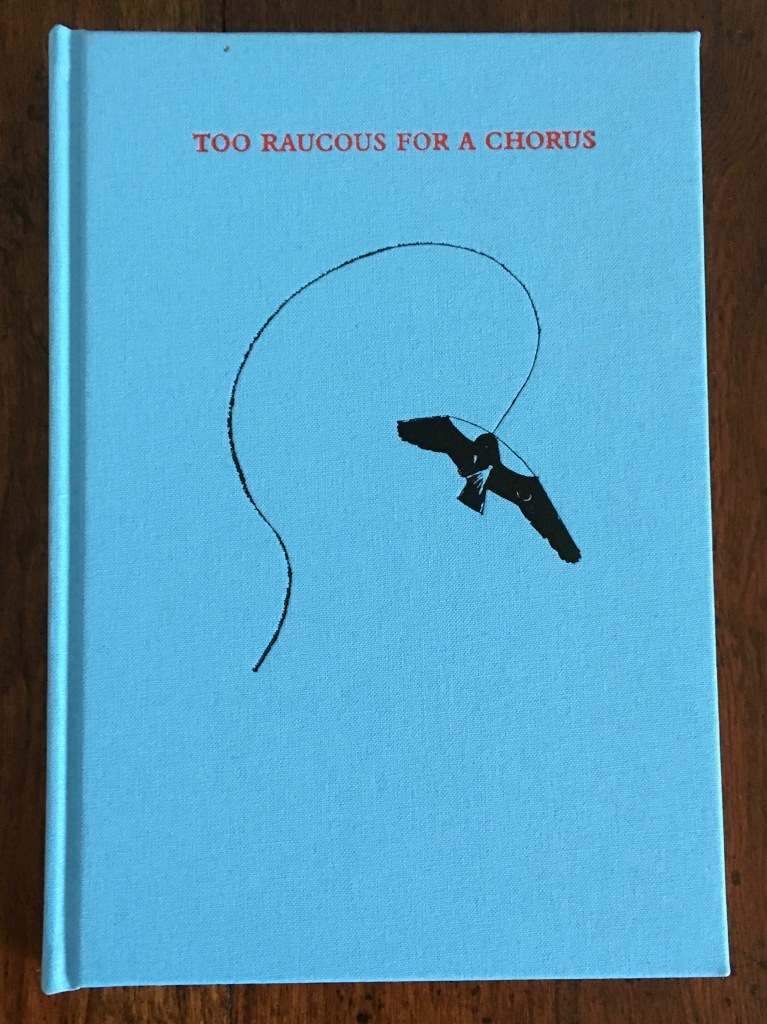
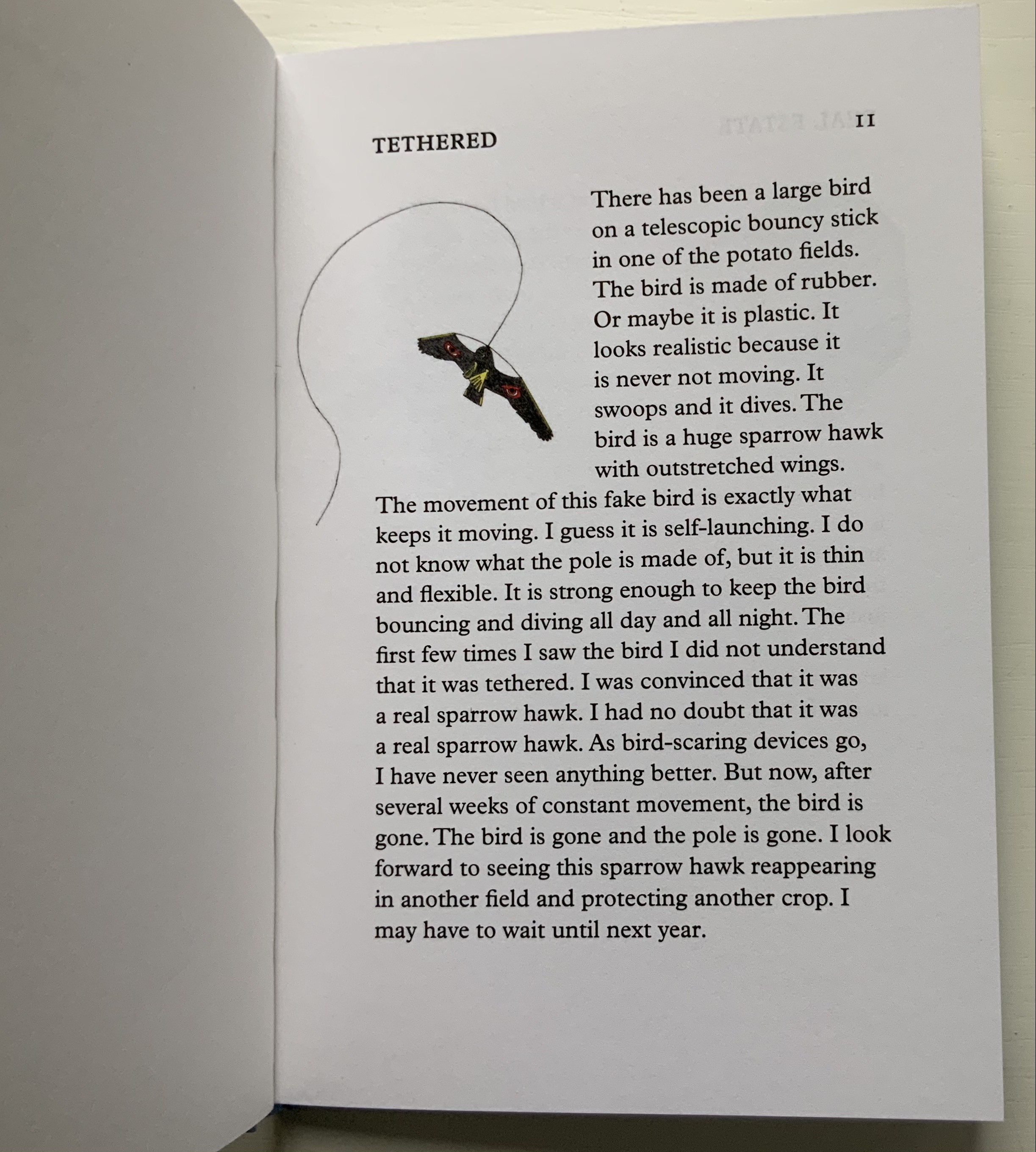
Imagine if Henry David Thoreau had had the sense to be born a woman and transported in space and time to consider Irish village and countryside life of the late 20th and early 21st centuries. With wry and gentle humor, he might have written something approaching Too Raucous for a Chorus. Van Horn is a natural and generous collaborator, which manifests itself not only in her works with Cutts but in Coracle Press works such as this. Other artists and writers with whom she has worked include John Bevis, Harry Gilonis, Thomas Meyer and Eiji Watanabe.
Still, as Too Raucous and Living Locally demonstrate, her enduring collaboration is with language and the world around her.
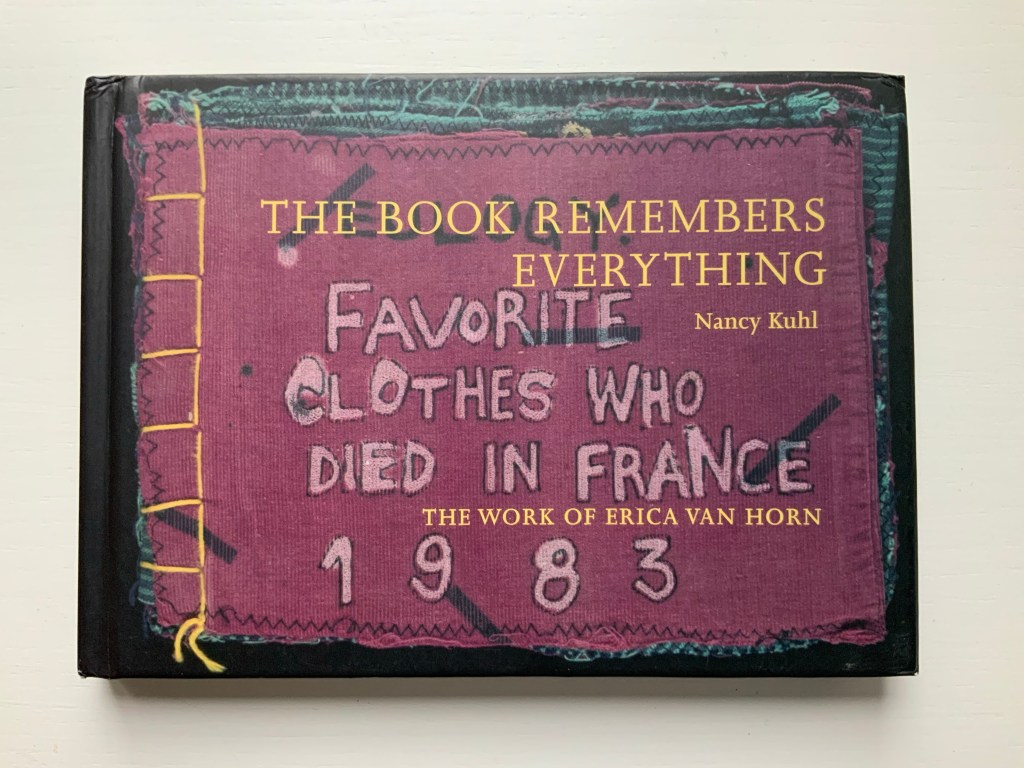
Kuhl, Nancy. The Book Remembers Everything: The Work of Erica Van Horn(Clonmel: Coracle Press, 2010). Until the acquisition of Seven Lady Saintes (1985), this book was the only means in the collection by which to gain a sense of Van Horn’s more painterly bookworks such as La Ville aux dames (“second state”) (1983), which appeared in the 1986 Chicago exhibition “The Book Made Art”, annotated here.