Bookmarking Book Art – A Good Book

What is “A Good Book“?

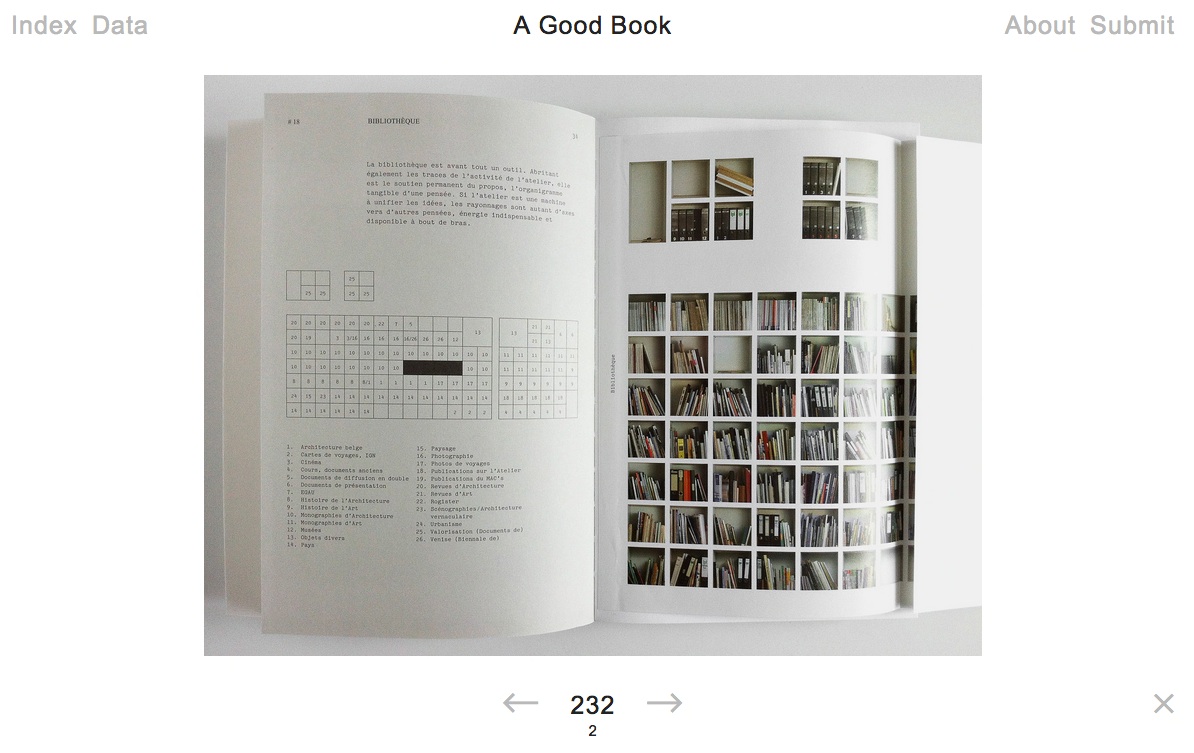
A hard question? A trick question? Yes and no. Since 2011, Bernd Kuchenbeiser, the Munich-based book designer, has been attempting an answer. He began by posting entries to a database on Twitter. With the demise of Twitter’s gallery function, Kuchenbeiser migrated the diary-like collection of photos and comments to A Good Book site with help from Simon Zirkunow. Below is a screenshot of part of the 232nd entry.

A Good Book
Screenshot of Méthodes, cover designed by Manuela Dechamps Otamendi, Entry #232 in A Good Book.

Until recently, the entries were Kuchenbeiser’s alone. The entries started on a daily basis, but as with many diary projects, the execution flagged. With 349 entries of his own (plus 3 from friends), he is now inviting entries from far and wide. Notice “Submit” in the upper righthand corner of the screenshot. Behind it lie the instructions and requirements for submission. Kuchenbeiser’s own entries are often brief, but his choices and comments are interesting because Kuchenbeiser and his oeuvre are interesting. See Michael Cina’s interview with him in The New Graphic (15 August 2011). For this venture to reward constant revisiting beyond that interest, however, Kuchenbeiser wisely holds potential contributors to the following standard:

Here’s what you need in order to submit a book:

– A short description of your book or the aspect that makes it ‘good’. From 140 characters to a maximum of 560, including spaces.

– The bibliographic details: author, title, year of publication, publisher, designer (if known). A questionnaire is already set up within the email that opens when you click ‘Submit now’.

– One to five photos of your book (at least 1400 pixels wide for landscape format and 1200 pixels high for portrait format).

Think of Pinterest or Flickr with serious feeling and intellectual rigor behind them. Kuchenbeiser’s design work and his own words exude that feeling:

Books have personalities. They can be our companions and friends. A good book doesn’t deserve to languish on a bookshelf; it wants to be opened, read, savoured, displayed, recommended. That’s why this website exists.

This site is like a message in a bottle hoping to be discovered. It will work only if it manages to generate communication.

The London Centre for Book Arts must have picked up the bottle from one of the Thames overswellings last week and placed a notice on its home page about the website. Although Kuchenbeiser does not promote it as such, if A Good Book thrives, it could generate a rich database worth semantic analysis for the book art and book arts community. All materials on A Good Book are being made available for noncommercial and educational use only.

Bernd Kuchenbeiser Projects, Schwanthalerstraße 7780336 München (Germany)

Bookmark – Education for the Future of Publishing

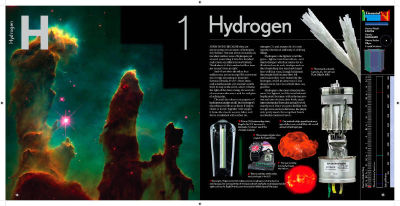
The Elements, Theodore Gray

When it comes to acquiring skills and professional training in book publishing, from the early days of the printing press onwards, learning by doing has been book publishing’s order of the day.  Consider the following interview exchange between Mac Slocum (Tools of Change) and Theodore Gray (The Elements):

.

MS: What skills — or people with those skills — must be incorporated into the editorial process to produce something like the iPad/iPhone editions?

TG: Specifically in the case of “The Elements,” the skills required were writing, commercial-style stills photography, Objective-C programming, and a whole, whole lot of Mathematica programming to create the design and layout tool and image processing software we used to create all the media assets that went into the ebook.

Other ebooks might well require different skills. My next one, for example, is going to include a lot more video, so we’re gearing up to produce high-grade stereo 3D video. That’s one of the challenges in producing interesting ebooks: You need a wider range of skills than to produce a conventional print book.

Starting out in book publishing late in the last century, a novice would have consulted Marshall Lee’s Bookmaking and the Chicago Manual of Style to learn the basics of design, editorial and production.  If it were Trade publishing that beckoned, a familiarity with A. Scott Berg’s biography of Maxwell Perkins (“Editor of Genius”) would have been likely.

Maxwell Perkins, half-length portrait, seated ...
Maxwell Perkins, half-length portrait, seated at desk, facing slightly right / World Telegram & Sun photo by Al Ravenna. (Photo credit: Wikipedia)

If scholarly book publishing, then Harman’s The Thesis and the Book, Turabian’s A Manual for Writers and maybe Bailey’s The Art & Science of Book Publishing.

But as with the acquisition of print publishing skills through learning by commissioning, designing, editing, printing, marketing and selling, the acquisition of the skills required for ebook publishing could use a hand up from appropriate resources.   People like Joshua Tallent, Joel Friedlander, Liz Castro, Craig Mod, Matthew Diener are those resources — either by example or authoring — and novices today would do well to start bookmarking their output.

For notes on the availability of formal training and career conditions in publishing, see Thad McIlroy’s The Future of Publishing.

Related sources:

“Joshua Tallent of Ebook Architects on the State of Digital Publishing,” Bill Crawford, Publishing Perspectives

“Understanding Fonts & Typography,” Joel Friedlander, The Book Designer

html, xhtml, and css: 6th edition, Elizabeth Castro

“Our Future Book,” Craig Mod

“Resources,” Matthew Diener, David Blatner and Anne-Marie Concepcion, ePUBSecrets

The Chicago Manual of Style Online

English: Image of the cover of the 1906, 1st E...
English: Image of the cover of the 1906, 1st Edition of the Chicago Manual of Style (Photo credit: Wikipedia)