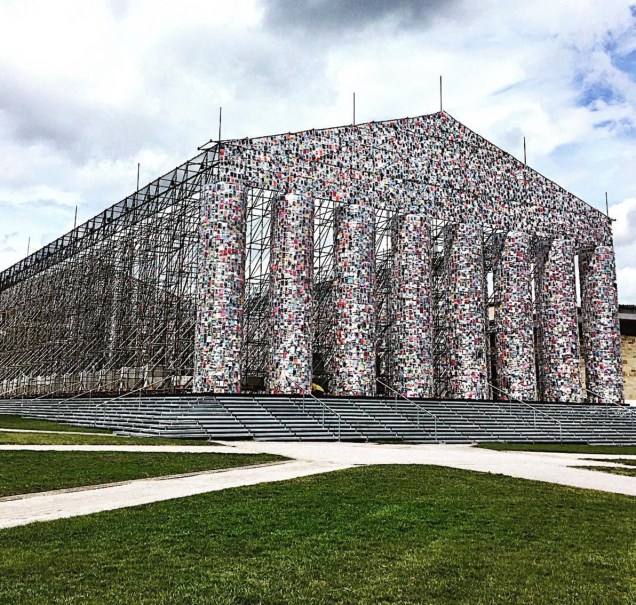
The Parthenon of Books, 1983/2017 Marta Minujín Kassel, Germany
In her note in BookRiot, Nikki Steele takes Brian Dettmer’s TED talk remark that books are created to relate to our human scale and builds on it elegantly, if all too briefly, by bringing together the installation works “Literature versus Traffic”, “Scanner”, “Book Cell”, “Singularity”, “Biographies” and “Contemporaries”. She’s not the first to provide a Pinterest– or Flickr-style burst of “ooh, look at this”, but unlike her predecessors, she makes the point worth pondering: this art that is not on a human scale evokes wonder and awe.
This challenges and expands on Dettmer’s point that people are disturbed by book art because we think of the book as a body, a living thing. As John Milton said, “As good almost kill a man as kill a good book: who kills a man kills a reasonable creature, God’s image; but he who destroys a good book kills reason itself”. That was in the context of book licensing laws that led to the confiscation and destruction of unlicensed books. Still, Milton would probably react as angrily to individual works of book art, and he might view the installations as if they were on the scale of the massacre of the Waldensians in the Piedmont.
Dettmer’s justification of book art that books “also have the potential to continue to grow and to continue to become new things”, that “books really are alive”, leaves us still squirming on the hook when Steele asks, “what happens when artists explode the scale and take books much, much larger?”. If you think cutting up or destroying a book is sacrilegious, what is your reaction to the 10,000 splayed in the streets of Melbourne by Luzinterruptus or the equal number cast by Alicia Martín into frozen defenestrations in Madrid and elsewhere in Spain or the even greater number in Marta Minujín’s The Parthenon of Books, installed for documenta in Kassel, Germany?
Miltonic eruption? Or Steele-ish delight, awe and love of the art?
Let’s raise the stakes and confusion. What if the books used in the single-volume work and installations were the Koran, the Bible or the Torah? Art and ethics are rarely happy bedfellows. Is there such a thing as “responsible art” that does not run afoul of the principle of the creative spirit or the integrity of art? Is art wholly without cultural, ethical or social contextual obligations?
This is why I like book art. It provokes just by coming into being. Its existence and appreciation are hard won.
Werner Pfeiffer, Zig Zag, 2010 Laid into drop spine case: One folded sheet (20 x 20 cm.) which unfolds into a paper structure with various panels containing text printed in red and black, including instructions for use of the work. “The structure used in this book is a combination of two accordion folds. Both are first creased, then each segment is cut halfway through at the center and finally the two strips are merged together where the cuts have been made.” Limited edition of 60 copies.
“The book is one of the most powerful weapons ever invented.” — Werner Pfeiffer, Book-Objects & Artist Books, online exhibition, Cornell University Library’s Division of Rare and Manuscript Collections.
Anselm Kiefer, Der Rhein, 1982-2013 Collages of woodcuts on canvas with acrylic and shellac in a leporello structure.
“The book, the idea of a book or the image of a book, is a symbol of learning, of transmitting knowledge … I make my own books to find my way through the old stories.” — Anselm Kiefer, publication entry for Brünhilde schläft, in Toledo Museum of Art Masterworks (Toledo, 2009).
Like Anselm Kiefer, though eight years older, Werner Pfeiffer grew up in the shadow of Nazi Germany. The works of both artists are rooted in the book and its peculiar place in that culture. Pfeiffer’s book-objects consist of deconstructed, dismantled library discards that are reassembled with glue and coated in gesso. “Gagged and tormented” (with nails, screws, rope and various physical distortions), the works are “symbols of pain, of torture, of suppression which are inevitably brought on by the censor’s act”, the real remnants of which Pfeiffer recalls from his earliest childhood.
Pfeiffer’s artist books on the other hand run the gamut of foldouts, scrolls, flexagons, walk-in environments and rely on traditional bookmaking craft: handset type, letterpress printing, sophisticated binding as well as original print techniques such as wood cuts or linoleum blocks and etchings on archival papers. The emotional range of Pfeiffer’s art is also wide — humorous, playful, piquant, simultaneously angry and sorrowful, concerned. The overriding concerns are straightforwardly explained in the text to the online Cornell University exhibition.
The first schoolbooks I can remember, leftovers from the previous regime, were heavily “edited.” They were books with words and sentences blackened out. Chapters were deleted; entire pages were missing. This was information declared unsuitable for a post-war generation, a generation who six months earlier had been practically obliterated by the events now deemed unfit to be read about. Part of what they had lived through, their own history, had been blocked out, hidden behind those black marks.
Measured by the perceived fears an innocently bound codex seems capable of instilling, the book is one of the most powerful weapons ever invented. And yet we find ourselves at a threshold where its power and influence seem to be waning.
… As in the past, we find at the core of our current socio-political realignment the process of communication…. The new cultural footprint is a set of digits and their application, made possible by the microchip and the speed of electricity….
My book-objects have their origin partly in this ambiguous realm, a period of change as radical as it is dramatic. Superimposed over this perceived uncertainty is my personal concern about censorship. By making books which are deliberately mute I try to raise questions. Words are lost; they are no longer important. The books take on new forms; they become provocative statements. No longer instruments for reading they become sculptures, they become Book-Objects.
As with all superior sculpture, Pfeiffer’s works make the hands twitch to touch and manipulate them. In a few exhibitions, that interaction has even been encouraged. There is something inherently haptic about his book art (for example, Zig Zag and Abracadabra) and his book-objects (for example, Drawing Blood), which can be enjoyed vicariously in these videos: Youtube 1, Youtube 2, Youtube 3 and Youtube 4.
Kiefer’s materials are more varied, more monumental than Pfeiffer’s, and his concerns are decidedly not straightforward. Considering his sprawling studio complex at Barjac, in southeastern France, and its towers and installations, to say that Kiefer’s oeuvre extends beyond book art is an understatement. But for Books on Books, his most moving works — even those in which the book’s material presence is greatly subordinate — remain tethered to book art. The ache to touch Kiefer’s art, however, is different from what you feel with Pfeiffer’s. What little playfulness there may be in some of Kiefer’s earliest pieces is overshadowed by monumental works evoking an urge and dread at the same time.
You feel it walking up the stairs in the Royal Academy, looking up and seeing the sculpture Für Fulcanelli – die Sprache der Vögel, its great wings of beaten lead spread and rising above you. Between the wings, the body is made of a stack of elephant and double elephant folio books lying flat (or rather gathered folios made of lead like the wings). Interleaved with the closed and open books are rusted metal folding chairs with wooden seats and backs, the kind found in city parks. Thick metal wedges that appear to be wood are inserted at various points to balance out the angular, tilting pile. Separate and lying before this huge bird is a carved wooden snake, elongated and heading right to left as you view the work. The pages of the books curl and fold and roll up as if sodden or aflame. Some are rusted. The bottom-most book has lead binder boards, water stained and looking like marbled paper. Not all of them have binding boards, but all are spineless. You want to touch but know that if you do, your fingers will come away with some alchemical residue of history that will not come off and may burn the skin.
Pfeiffer’s works from a major exhibition in 2011 at Cornell remain on view online. Another major exhibition followed in 2012 at Vassar College. A new exhibition is scheduled for February 2015 in Toledo, Ohio. More about it in The Blade.
A major retrospective of Kiefer’s art at the Royal Academy of Art concluded in December 2014, coinciding with an hour-long BBC program. An interview with the artist and several podcasts are available on the RA’s site, and the rich and extensive exhibition catalogue provides articles exploring the complex themes of Kiefer’s art.


 Books On Books