Books On Books Collection – The Horn-book

This is a “back-dated update” of sorts to Alphabets Alive!, Ashley Rose Thayer, and Andrew White Tuer.

First, the back-dating. This comes from the delightfully annoying or annoyingly delightful belated discovery of Erik Kwakkel’s 2015 entry on the history of the horn-book “Book on a Stick” in Medievalbooks. Delightful and annoying to find the truly earliest appearance of a horn-book right under my nose in the Bodleian Libraries but too late to include it in the Alphabets Alive! exhibition at the Bodleian in 2023.
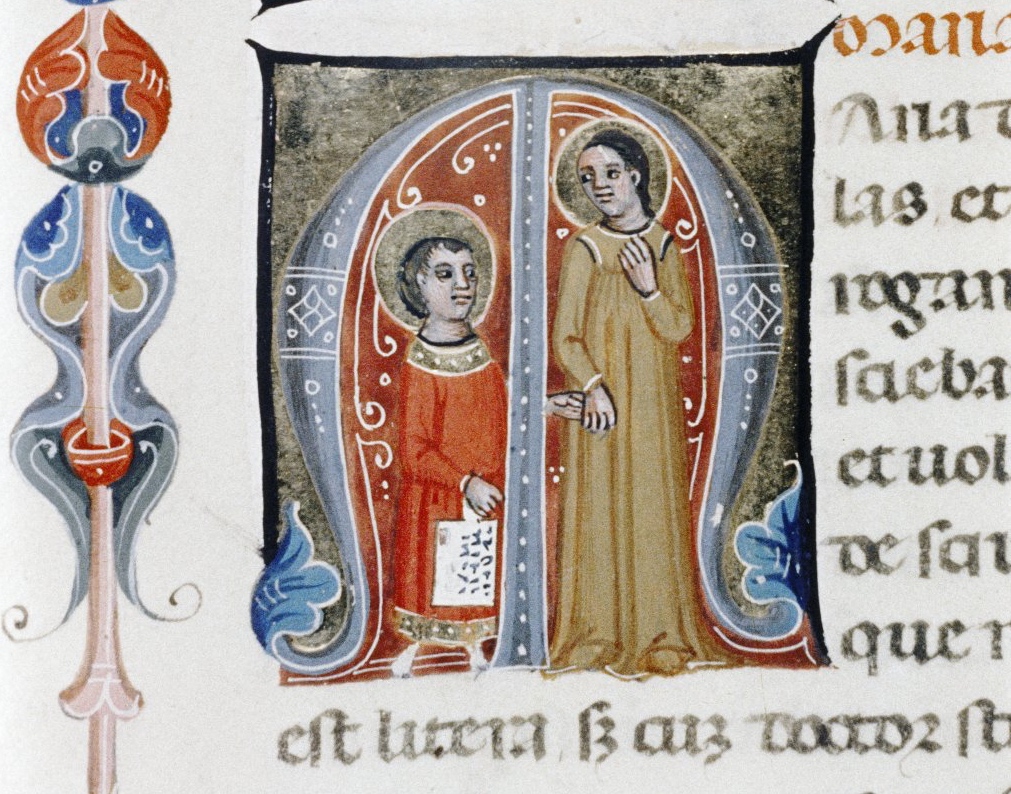
Oxford, Bodleian Library, Canon. Misc. 476 (14th century).

Vita gloriossime virginis Mariae atque venerabilis matris filii dei vivi veri et unici (unidentified work).Italian manuscript, Venice.
Oxford, Bodleian Library, Canon. Misc. 476 (14th century). Folio 047v.

Detail of Fig. 0.

Detail

Andrew White Tuer’s History of the Horn-Book (1897) came close with its dating of the horn-book’s first appearance as 1450, but as Kwakkel writes:

The image shows Christ being brought to school by his mother. He is bringing his “textbook” to class: a hornbook, which dangles from his wrist by a string, just like many of the later specimens did … Quite intriguingly, we are shown a real medieval snapshot of how children carried their hornbook to and at school. More importantly, it shows that the hornbook was indeed a medieval invention….While no actual hornbooks appear to survive from the medieval period, these visual representations show that educating young children was also the driving force behind the production of hornbooks in the age before print.

And for the updating, here is Ashley Thayer’s Mechanical Horn-book (2025) just arrived in the Books On Books Collection.
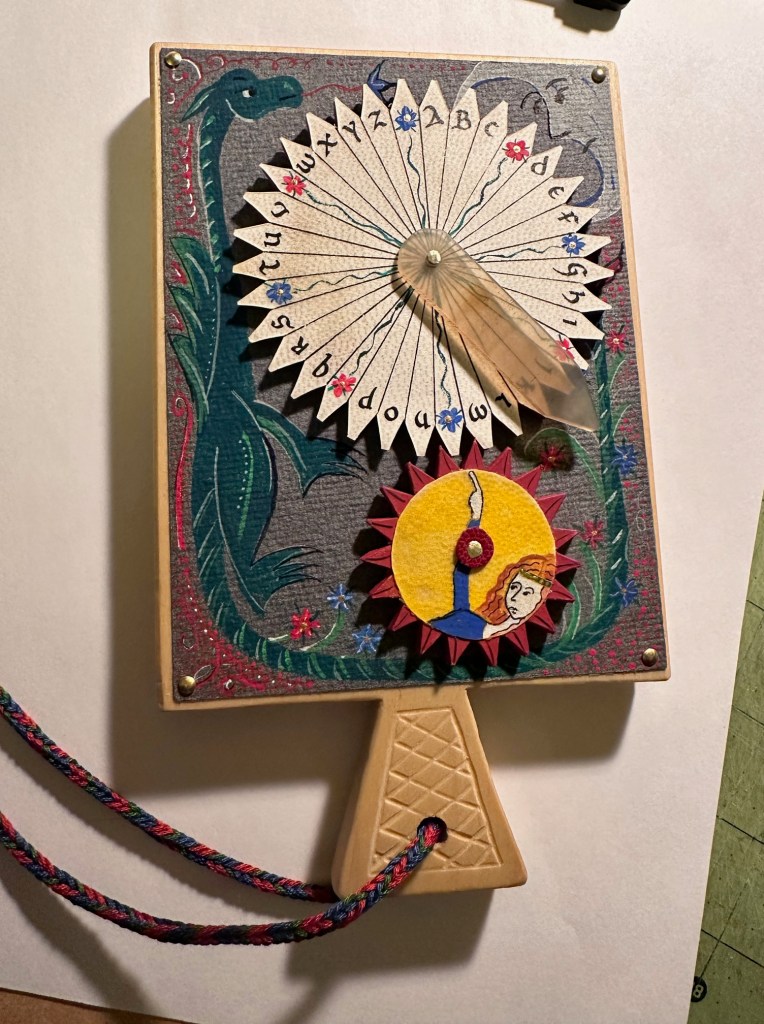
Mechanical Horn-book (2025)
Ashley Rose Thayer
Horn-book. On stand: H192 x W160 mm. Off stand: H192 x W115 mm. Unique. Acquired from the artist, 17 October 2025.
Photos: Courtesy of the artist. Books On Books Collection.

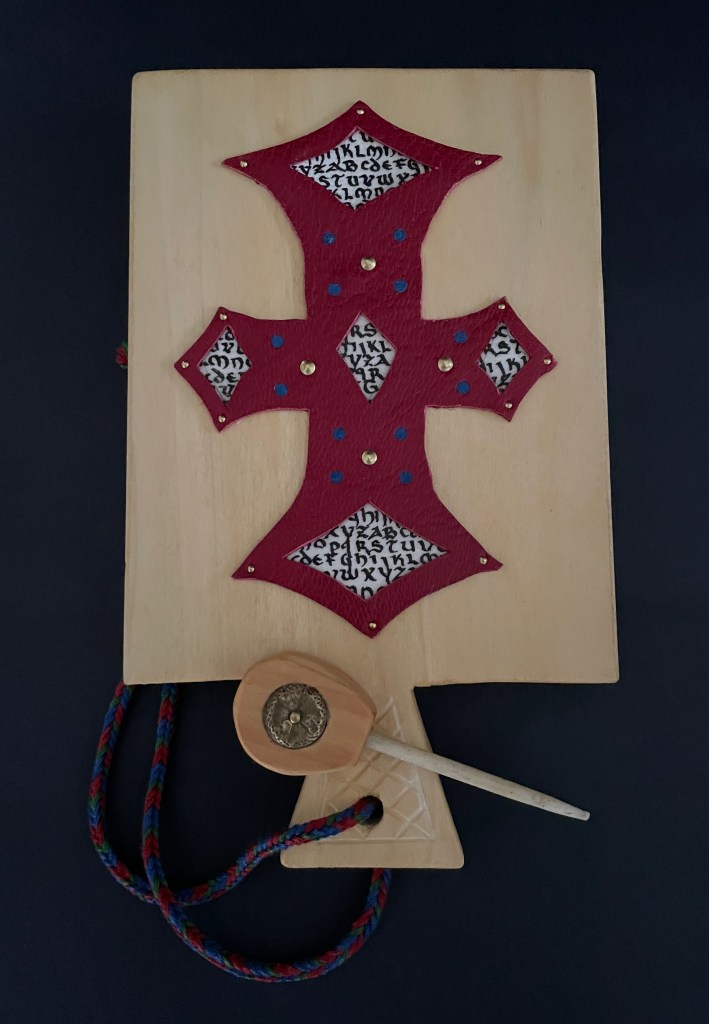
The paddle is made of pine wood, the gears of vellum-covered bookboard, the spinning “arm” of authentic cow horn, and the wrist loop of embroidery thread by a medieval finger loop braiding technique. On dark grey-blue Khadi paper, Thayer has painted a border of the moon, a berried floral garland, and a wyvern, the heraldic emblem associated with Wessex, the Anglo-Saxon kingdom from which Alfred the Great emerged in the 9th century. On the reverse, a cross of cut red leather with five inserts of calligraphed vellum alluding to Christ’s five wounds reflects the horn-book tradition of combining religion with learning the alphabet. It also makes this horn-book reflective of Alfred’s Anglo-Saxon and Christian background.
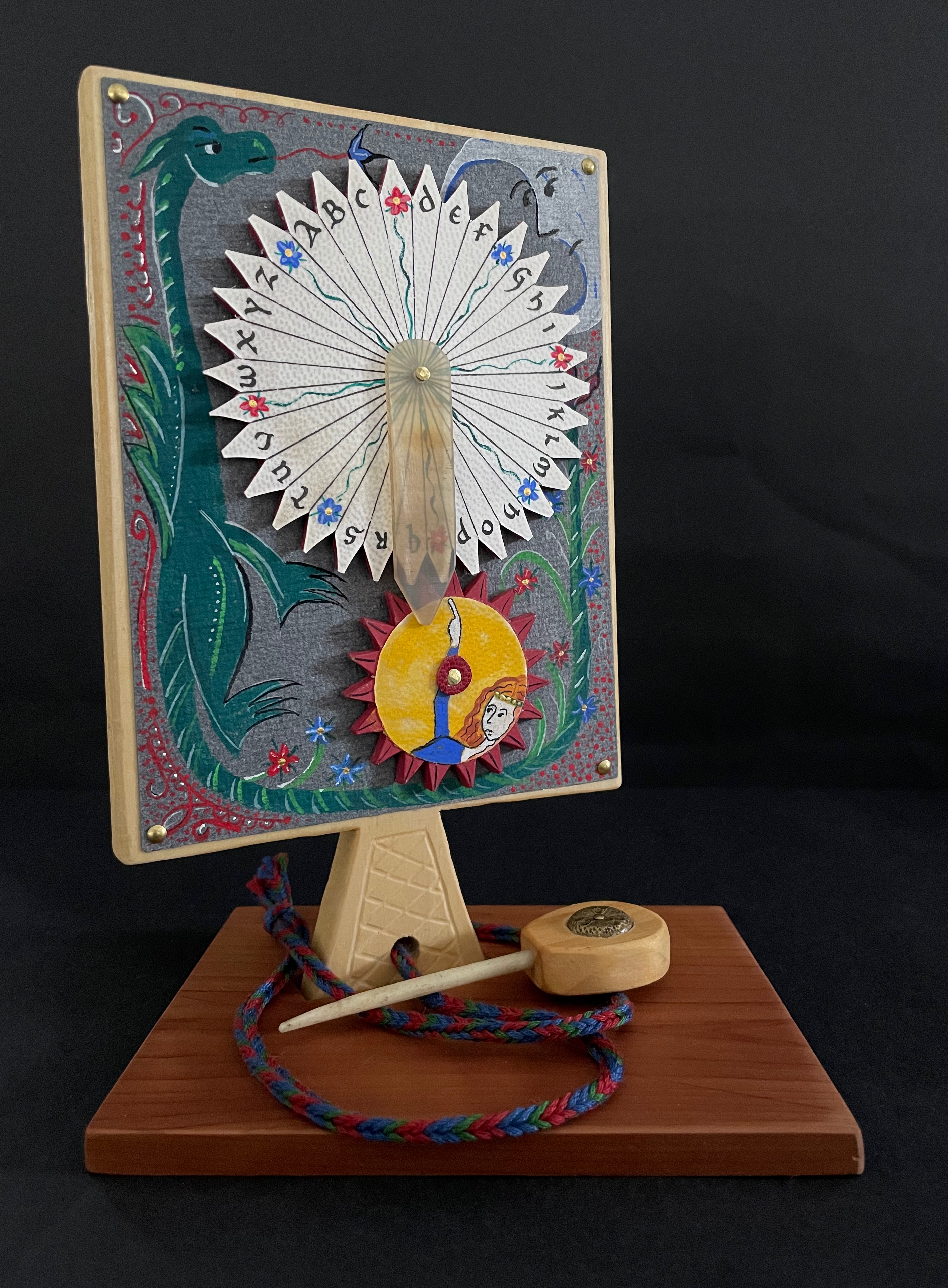
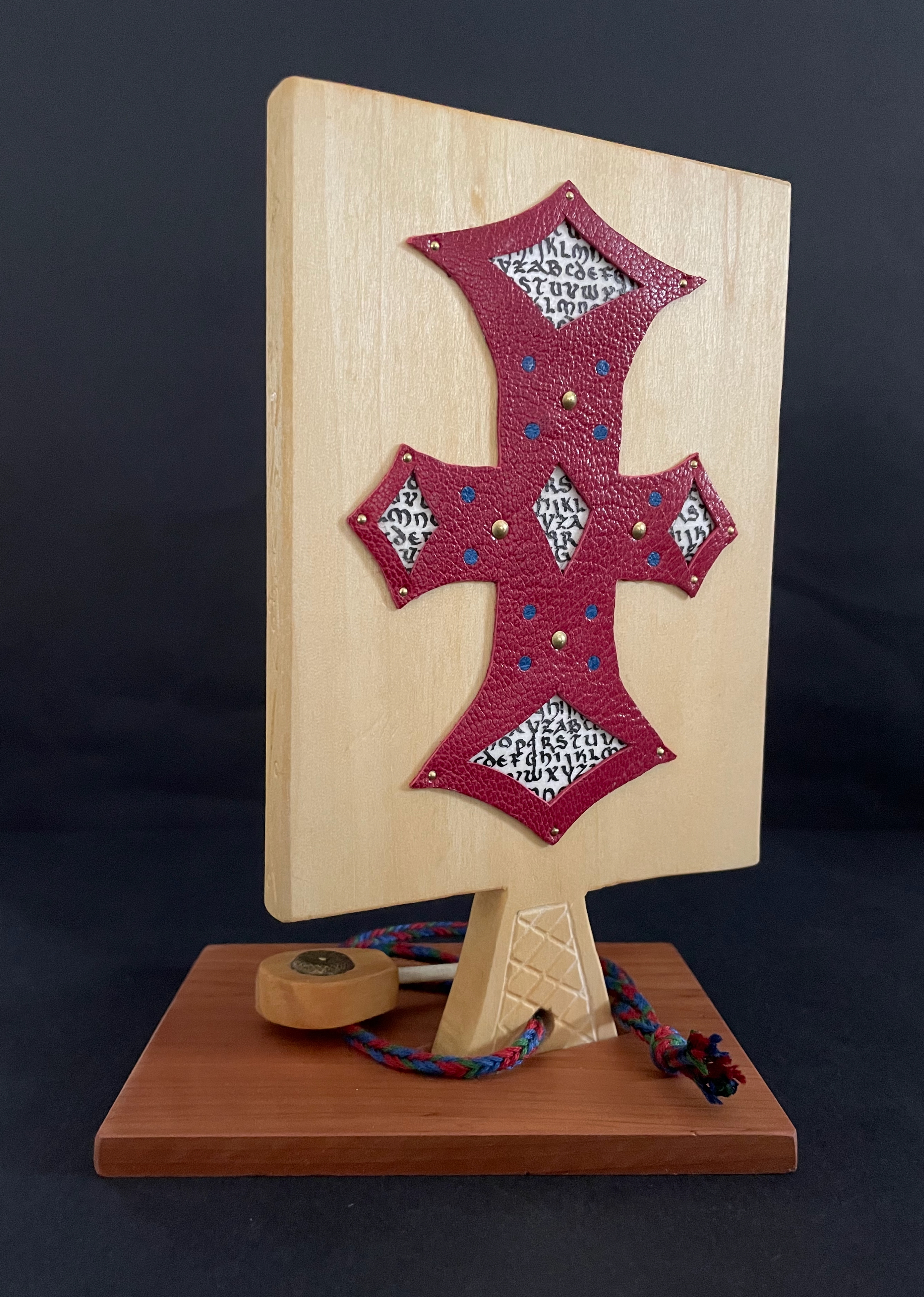
The pointer, called an aestel in Old English, is made from poplar wood, an antique button, and antique bone. Its inclusion isn’t simply functional. Appearing alongside the Wessex wyvern, it points to that famous aestel on display at the Ashmolean in Oxford: the Alfred Jewel.

The Alfred Jewel, Ashmolean Museum, Oxford.
Photo taken from the front by Geni CC BY-SA 4.0. Photo taken from the side by Richard M Buck CC BY SA 3.0.

If there’s ever an Alphabets Alive! redivivus, Erik Kwakkel and Ashley Thayer have provided the pointers to the other treasures in Oxford that should be included.

Further Reading

Alphabets Alive! – Criss-cross Row (Horn-books)“. 19 July 2023. Books On Books Collection.

Ashley Rose Thayer “. 9 July 2023. Books On Books Collection.

Movables Now and Then“. 31 August 2024. Bookmarking Book Art.

Kevin M. Steele“. 18 July 2023. Books On Books Collection.

Andrew White Tuer“. 26 December 2022. Books On Books Collection.

Kwakkel, Erik. 10 April 2015. “Book on a Stick“. Medievalbooks. Leiden. Accessed 10 November 2025.

Books On Books Collection – Ashley Rose Thayer

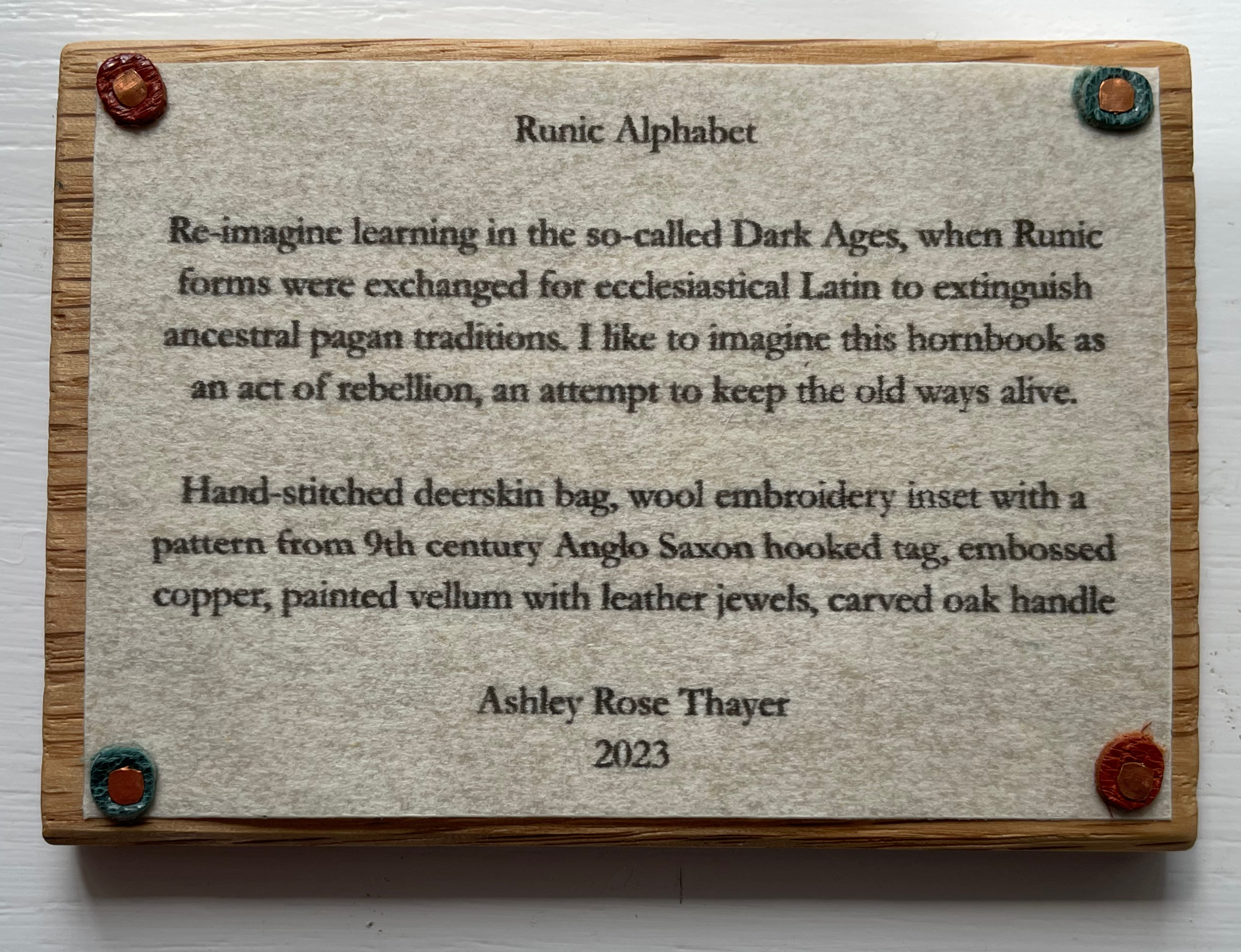
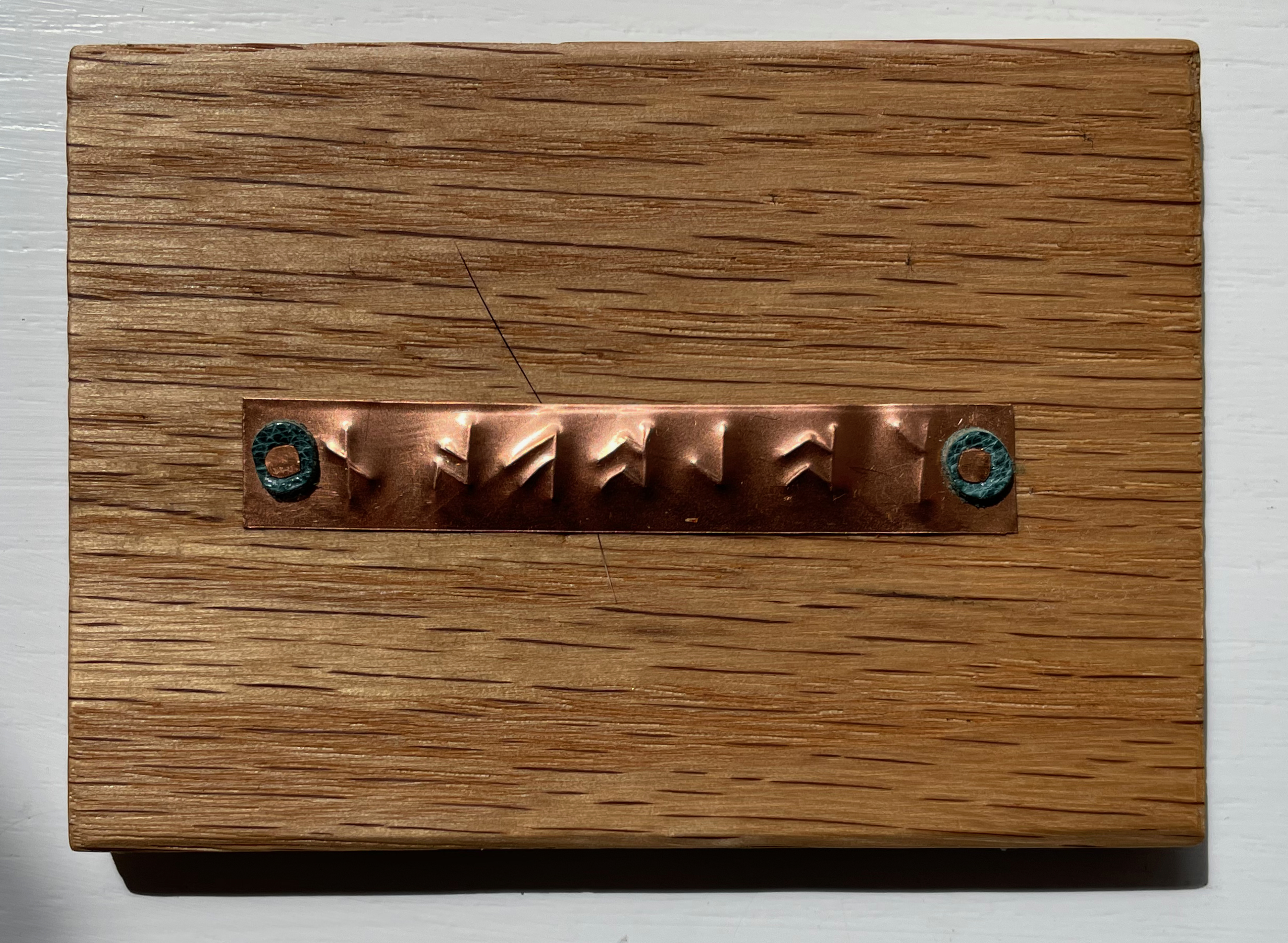
Runic Alphabet (2023)

Runic Alphabet (2023)
Ashley Rose Thayer
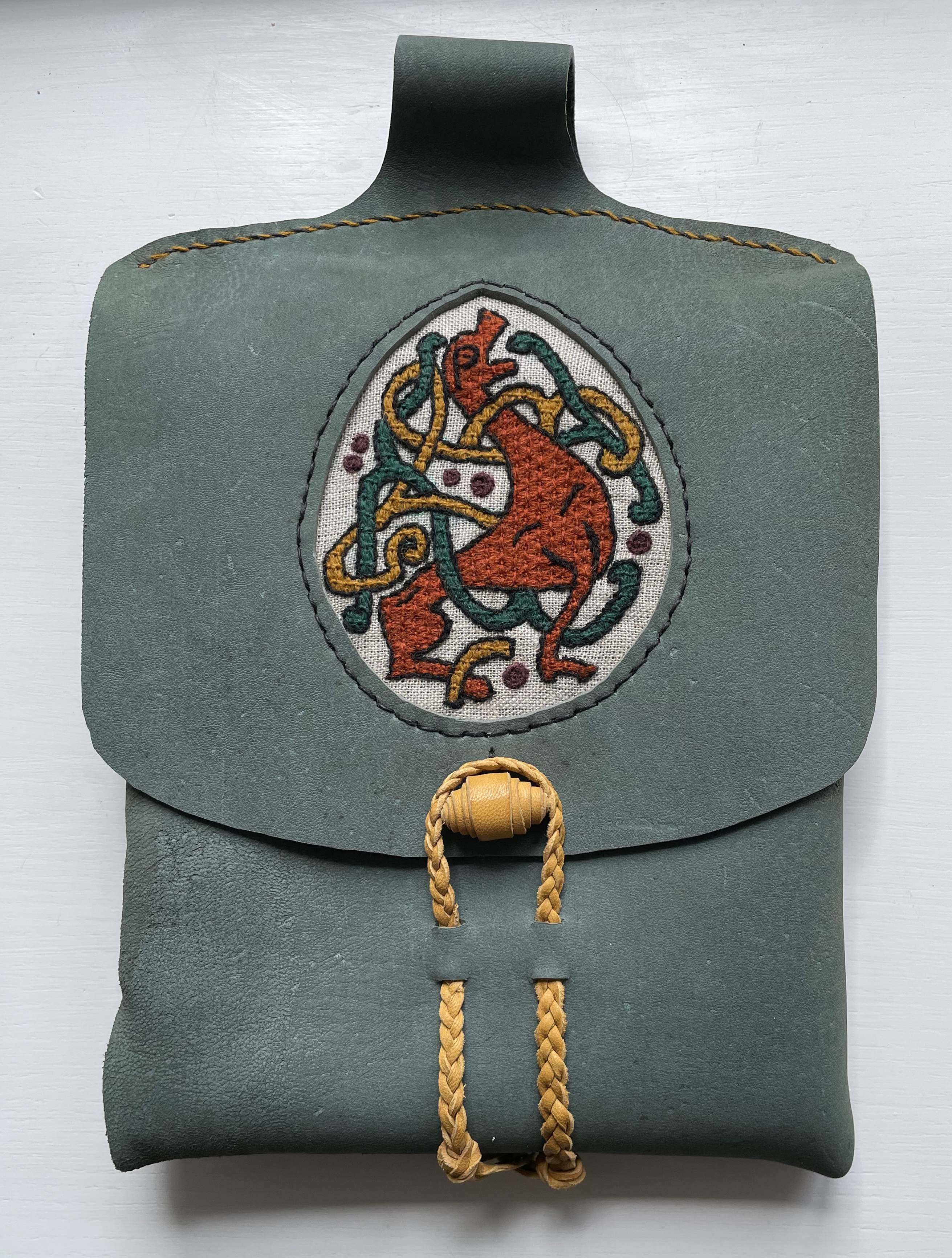
Bag (H290 x W195 x D30 mm) enclosing horn-book (H177 x W167 mm) and colophon plaque (H63 x W88 mm). Unique edition. Acquired from the artist, 26 June 2023.
Photos: Books On Books Collection. Displayed with artist’s permission.

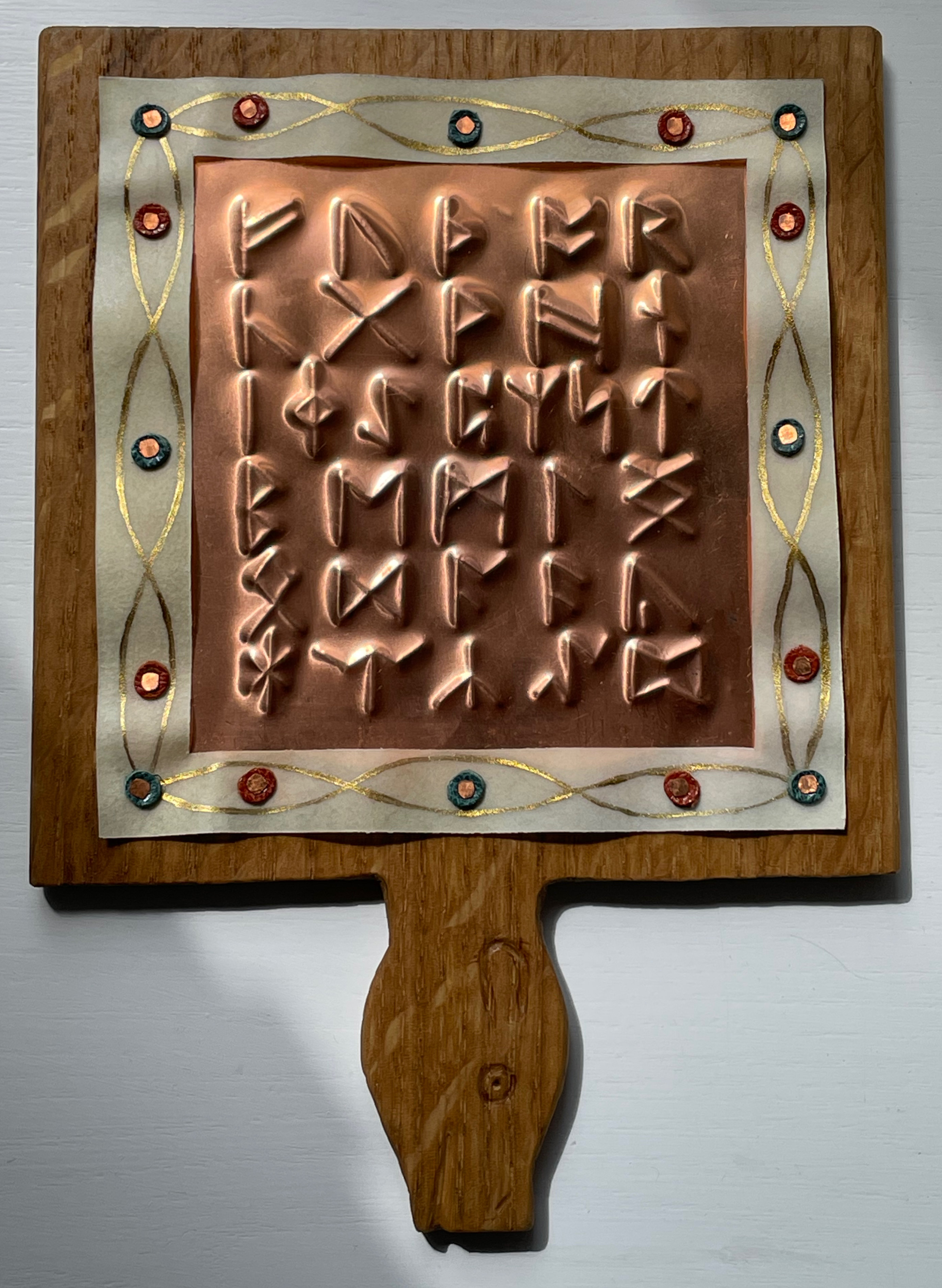
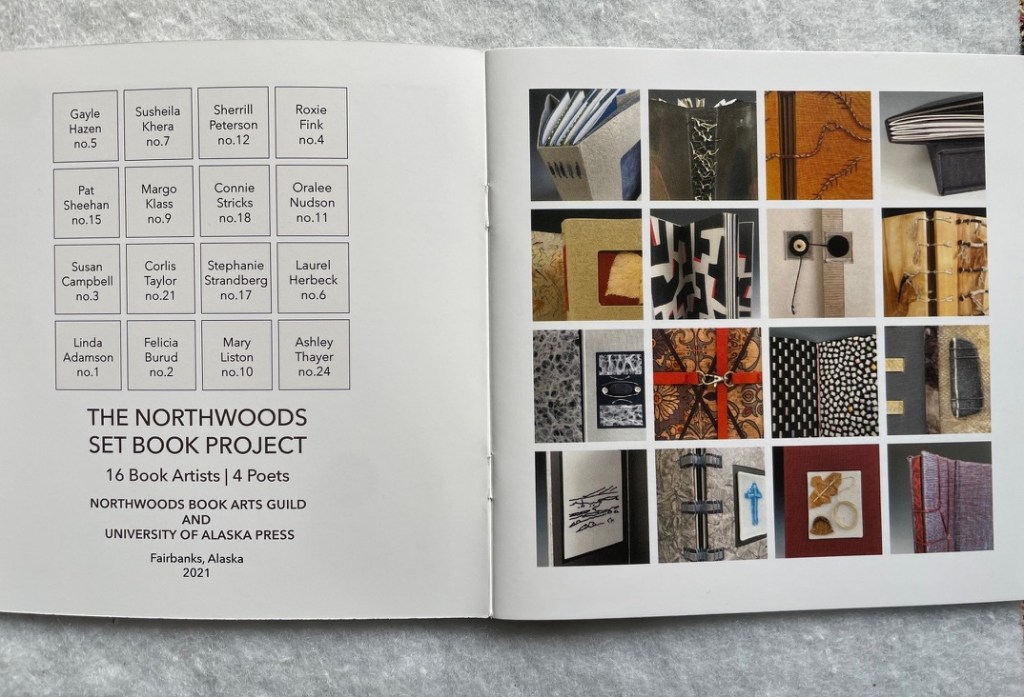
Through her affiliation with the Northwoods Book Arts Guild, Ashley Thayer organized a challenge to reinterpret the horn-book. Several spectacular and inventive works emerged, and at this writing, an exhibition is being organized. The Bodleian “Alphabets Alive!” exhibition (19 July 2023 – 13 January 2024) was lucky enough to acquire one of Thayer’s own efforts: Runic Alphabet. With this work, Thayer re-imagines the learning tool for the so-called Dark Ages. Runes eventually succumbed to the Roman alphabet as military and religious conquest extinguished pagan traditions. So, this horn-book is, in Thayer’s words, “an act of rebellion, an attempt to keep the old ways alive”.

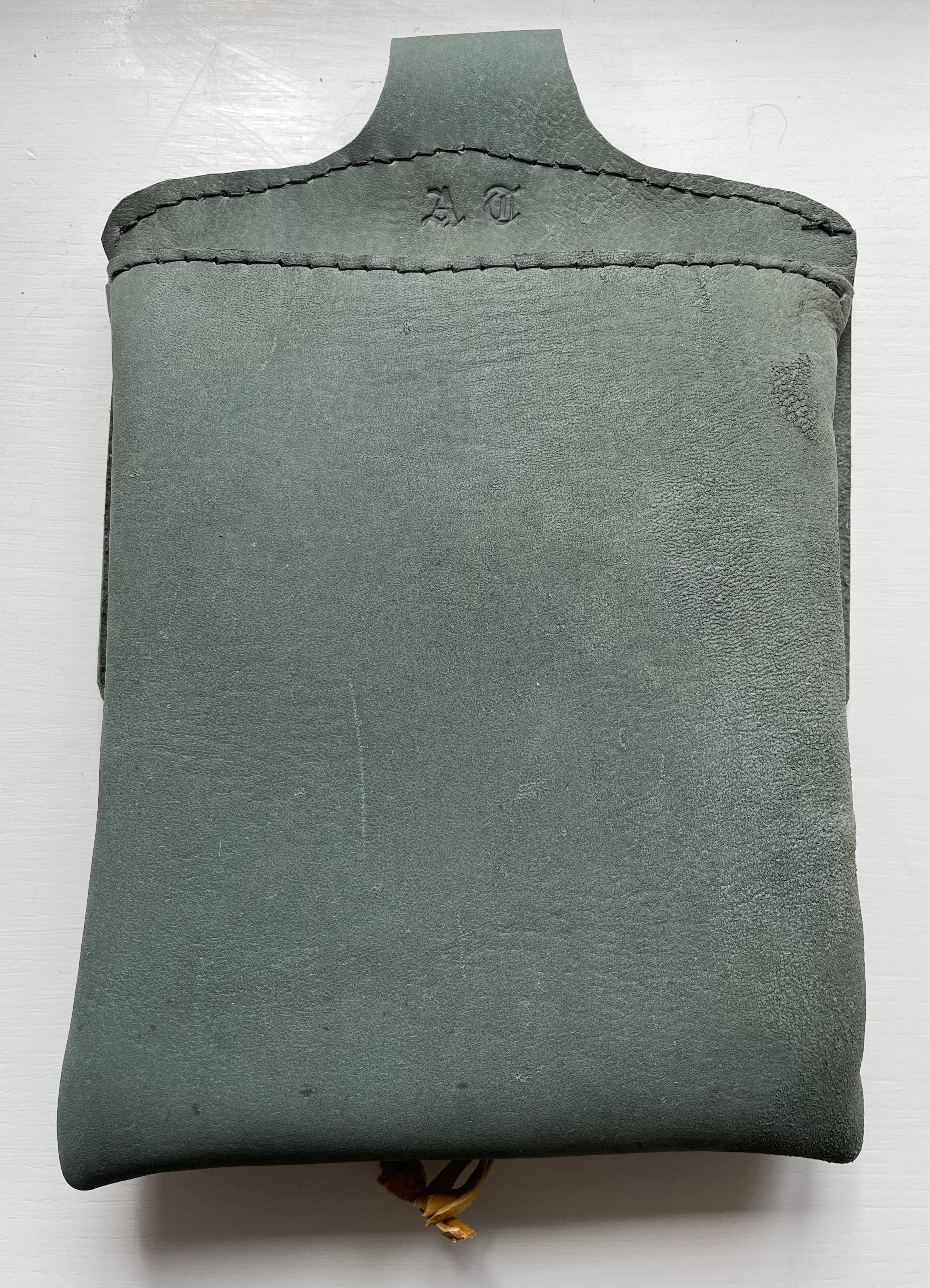
A hand-stitched deerskin bag with a wool embroidery inset of 9th century Anglo-Saxon pattern encloses the oak horn-book with a carved handle and faced with embossed copper and painted vellum with leather jewels. Also enclosed is a small oak plaque bearing the colophon.

The reverse side of the colophon bears the word “colophon” transliterated into embossed runes

Following the Northwoods Book Arts Guild project, Thayer progressed to another age with this next work.

Mechanical Horn-book (2025)

Mechanical Horn-book (2025)
Ashley Rose Thayer
Horn-book. On stand: H192 x W160 mm. Off stand: H192 x W115 mm. Unique. Acquired from the artist, 17 October 2025.
Photos: Courtesy of the artist. Books On Books Collection.

Mechanical Horn-book is an homage to the Anglo-Saxons of Old England. The paddle is made of pine wood, the gears of vellum-covered bookboard, the spinning “arm” of authentic cow horn, and the wrist loop of embroidery thread by a medieval finger loop braiding technique. On dark grey-blue Khadi paper, Thayer has painted a border of the moon, a berried floral garland, and a wyvern, the heraldic emblem associated with Wessex, the Anglo-Saxon kingdom from which Alfred the Great emerged in the 9th century. On the reverse, a cross of cut red leather with five inserts of calligraphed vellum alluding to Christ’s five wounds reflects the horn-book tradition of combining religion with learning the alphabet. It also makes this horn-book reflective of Alfred’s Anglo-Saxon and Christian background.
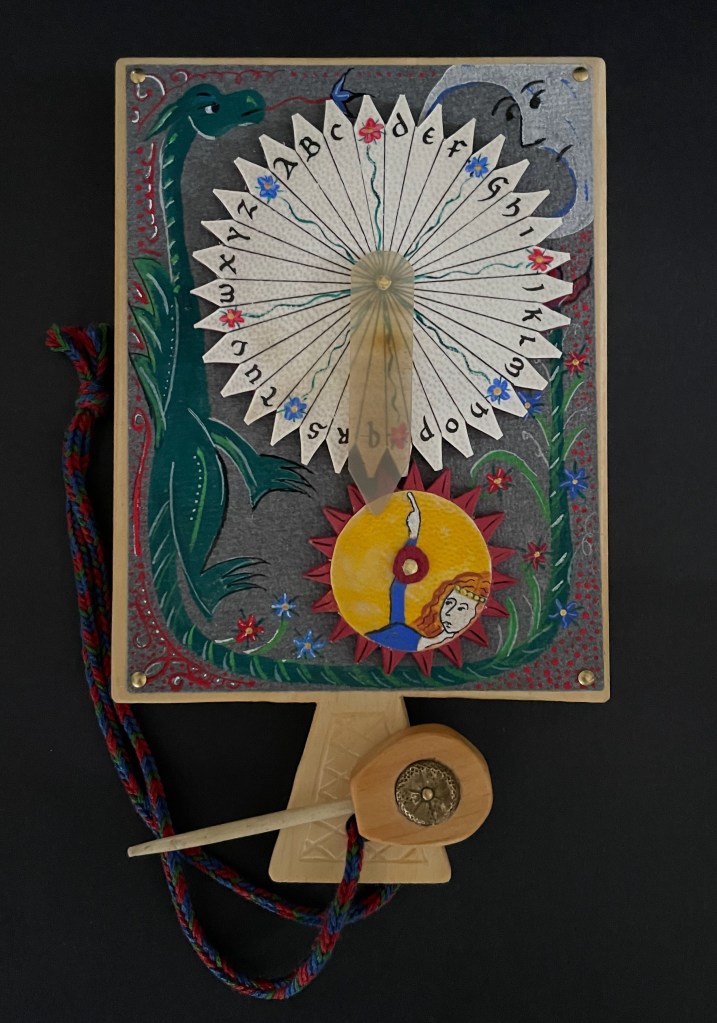
The pointer, called an aestel in Old English, is made from poplar wood, an antique button, and antique bone. Its inclusion isn’t simply functional. Appearing alongside the Wessex wyvern, it points to that famous aestel on display at the Ashmolean in Oxford: the Alfred Jewel.
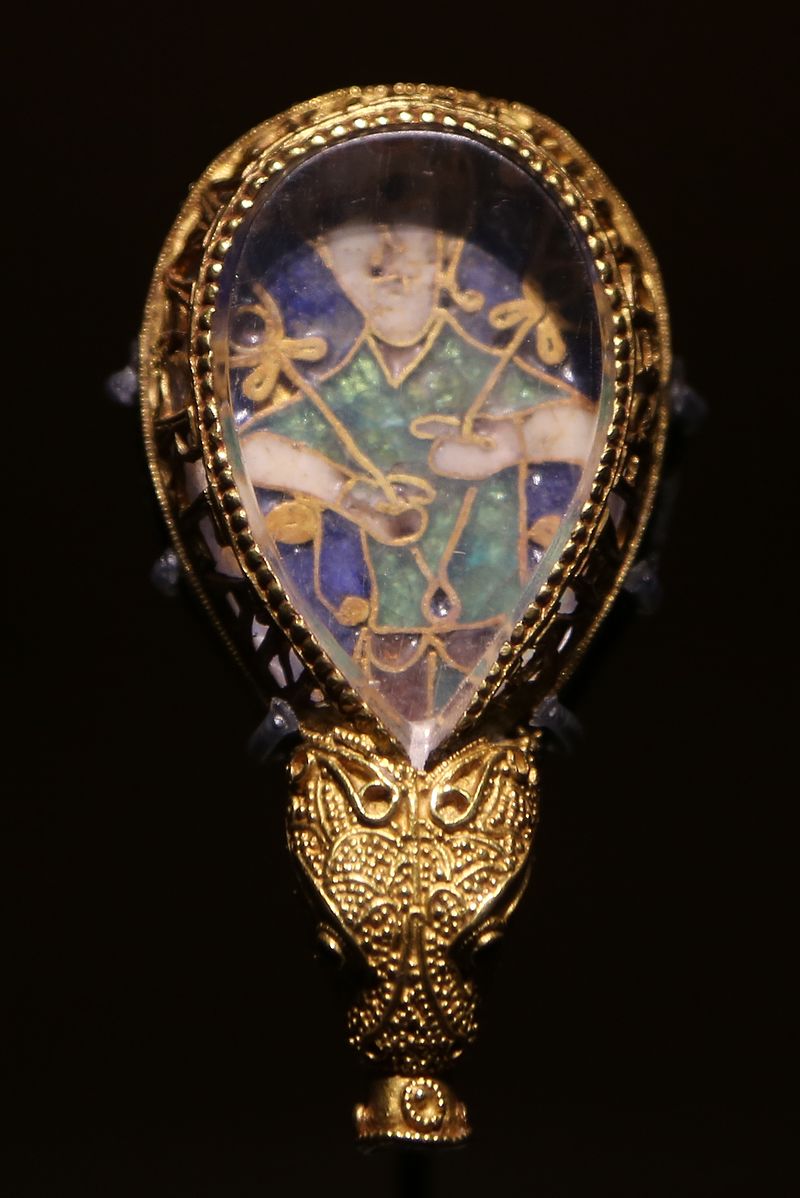
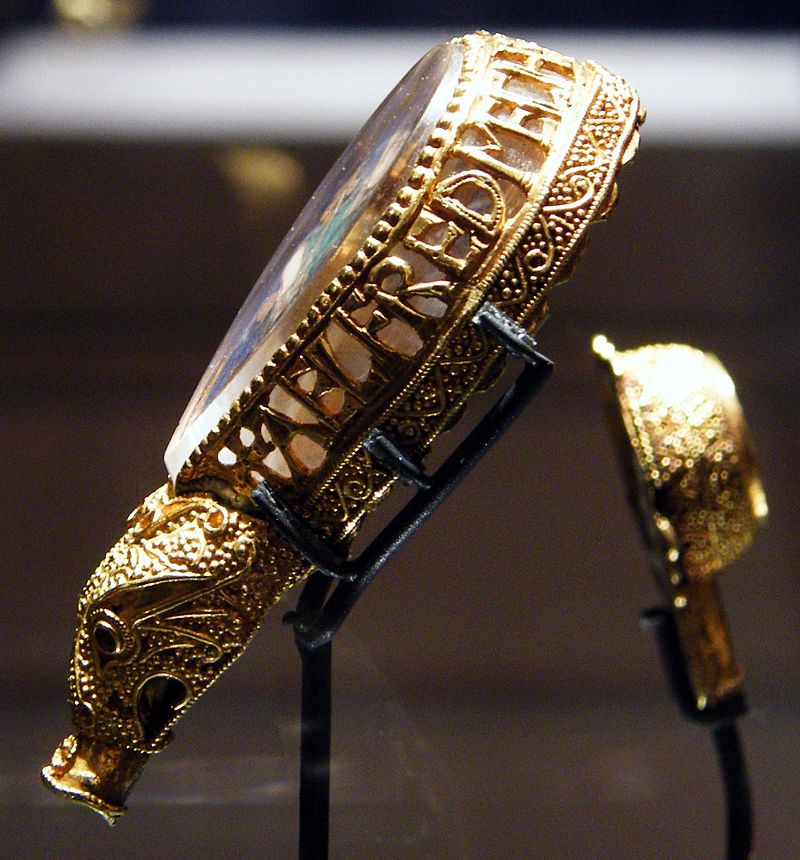
The Alfred Jewel, Ashmolean Museum, Oxford.
Photo taken from the front by Geni CC BY-SA 4.0. Photo taken from the side by Richard M Buck CC BY SA 3.0.

Further Reading

Abecedaries I (in progress)“. Books On Books Collection.

Alphabets Alive! – Criss-cross Row (Horn-books)“. 19 July 2023. Books On Books Collection.

Kees Baart, Dick Berendes, Henk Francino and Gerard Post van der Molen“. 2 November 2022. Books On Books Collection.

Brynja Baldursdottír“. 10 March 2023. Books On Books Collection.

The Horn-book“. 12 November 2025. Books On Books Collection.

Bård Ionson“. 9 July 20223. Books On Books Collection.

Margo Klass“. 9 July 2023. Books On Books Collection.

Karen Roehr“. 26 December 2022. Books On Books Collection.

Connie Stricks“. 9 July 20223. Books On Books Collection.

Andrew White Tuer“. 26 December 2022. Books On Books Collection.

Bodleian Libraries. 7 July 2023. “Alphabets Alive! 19 July 2023 – 21 January 2024, Treasury, Weston Library“. Accessed 7 July 2023.

Looijenga, Tineke. 2003. Texts & Contexts of the Oldest Runic Inscriptions. Leiden: BRILL, 2003.

Osborn Marijane and Stella Longland. 1982. Rune Games. London: Routledge & Kegan Paul.

Books On Books Collection – Margo Klass

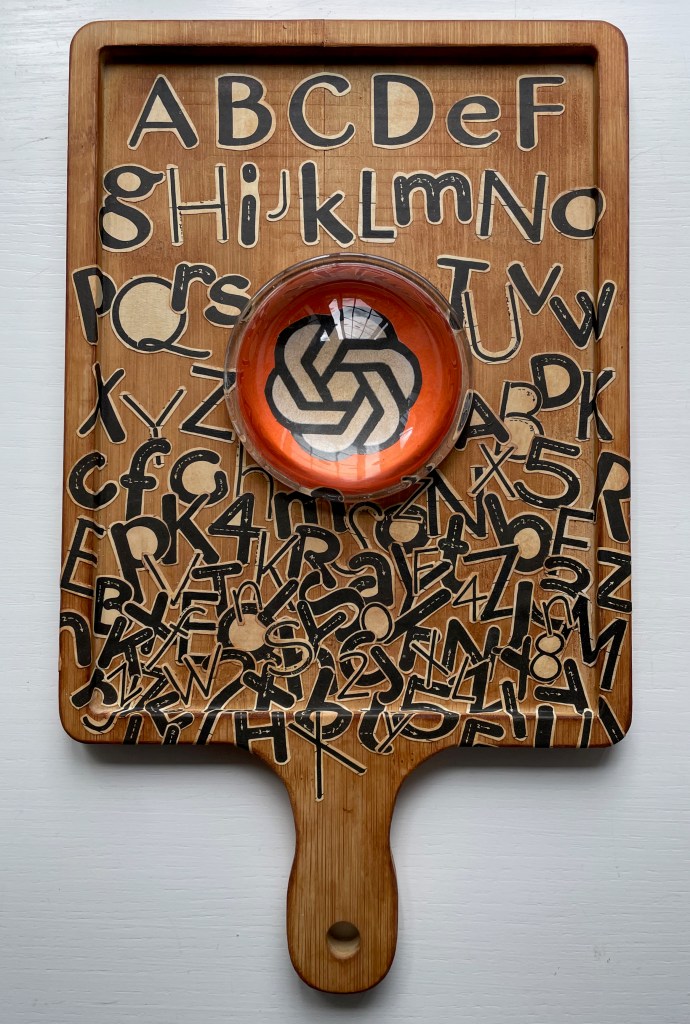
Takeover (2023)

Takeover (2023)
Margo Klass
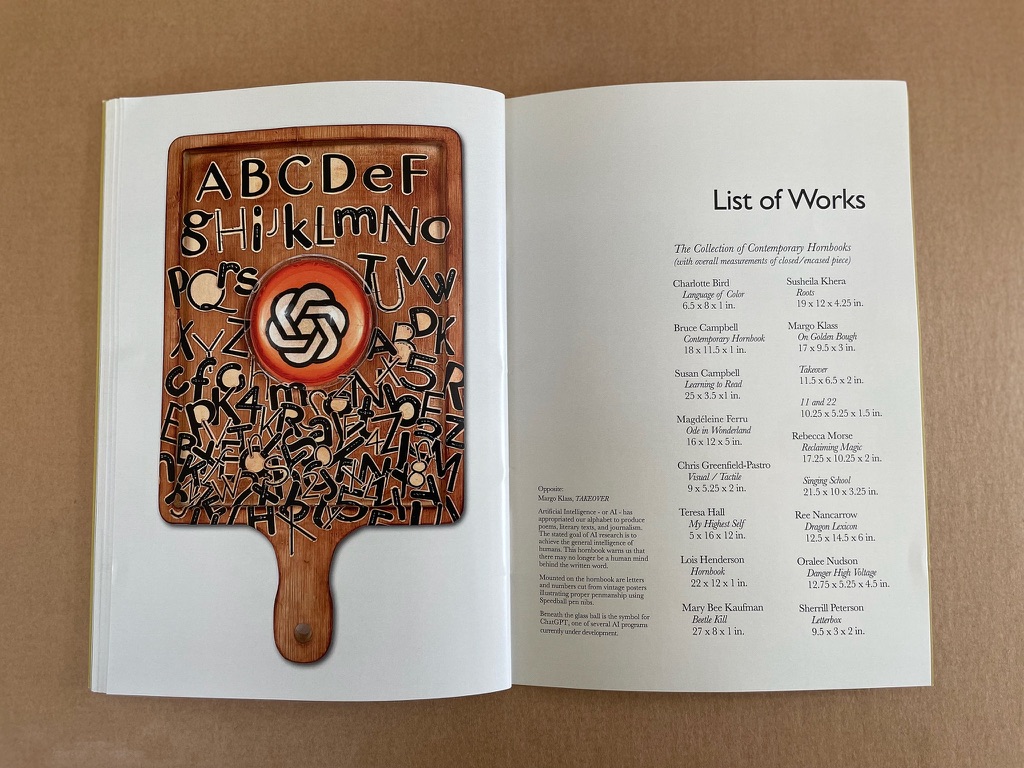
Cut-out vintage poster letters and numbers mounted on horn-book shaped tray. ChatGPT symbol covered by glass magnifying dome. H290 x W170 x D35 mm. Unique edition. Acquired from the artist, 26 June 2023.
Photos: Books On Books Collection. Displayed with permission of the artist.

In her response to the Northwoods Books Arts Guild challenge organized by Ashley Thayer, Margo Klass created this horn-book shaped tray on which cutout vintage letters and numbers are breaking out of order, spilling over the sides of the tray, sliding around the glass dome magnifying ChaptGPT, and settling in a heap at the handle-end of the horn-book. Klass has resurrected this centuries-old tool of learning to register a warning:

“Artificial intelligence – or AI – has appropriated our alphabet to artificially produce poems, literary texts, and journalism. Already exhibiting a high level of test-taking ability, the stated goal of AI research is to achieve the general intelligence of humans. This contemporary hornbook structure warns us that behind the written word may no longer be a human mind. Mounted on the hornbook are letters and numbers cut from vintage posters illustrating proper penmanship using Speedball pen nibs. These illustrations, familiar to me from an early interest in calligraphy, came to me from Sue McHenry by way of Ron Inouye. Beneath the glass gazing ball is the symbol of ChatGPT, one of several AI programs currently under development.” — From the colophon on the reverse of horn-book.

OpenAI‘s ChatGPT (Chat Generative Pre-Trained Transformer) uses natural language processing to generate conversational dialogue and other forms of written content. Its roots go back as far as Friar Bacon’s 13th-century brazen head and more recently to Joseph Weizenbaum’s ELIZA, the 1960s AI psychotherapist at MIT that attempted to pass the Turing test (Alan Turing’s “imitation game” for testing a machine’s ability to show human-like behavior). Other works of book art that spell out cautions concerning AI include Karen Roehr’s Horn Book for Contemporary Times (2012) and Connie Stricks’ A Cuneiform Hornbook (2023).

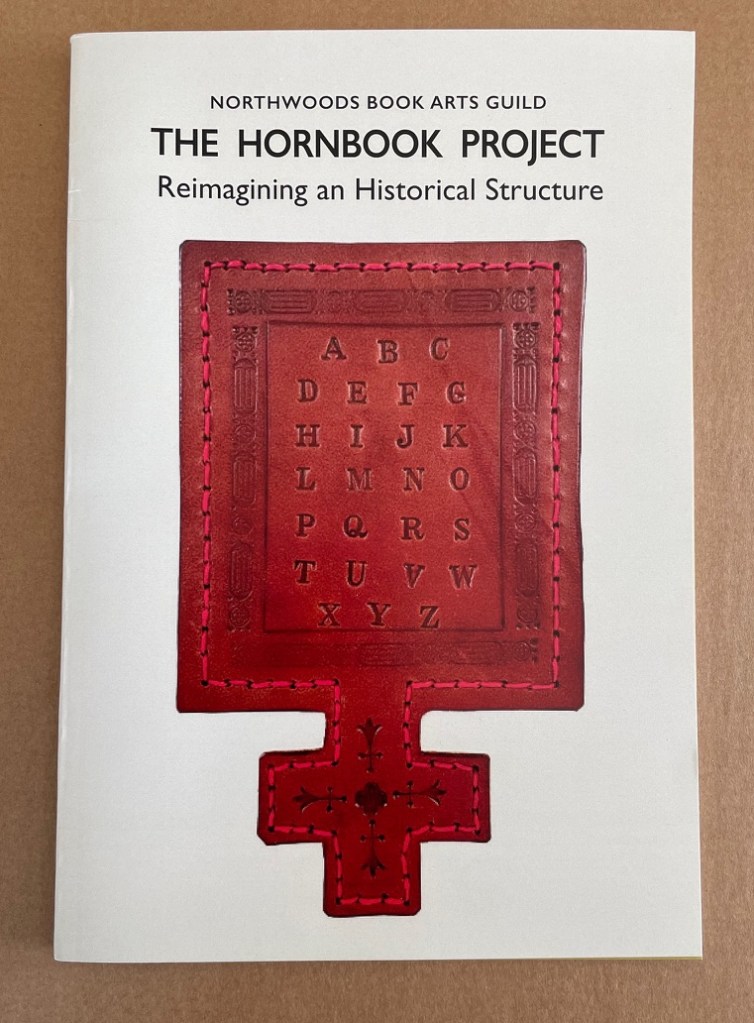
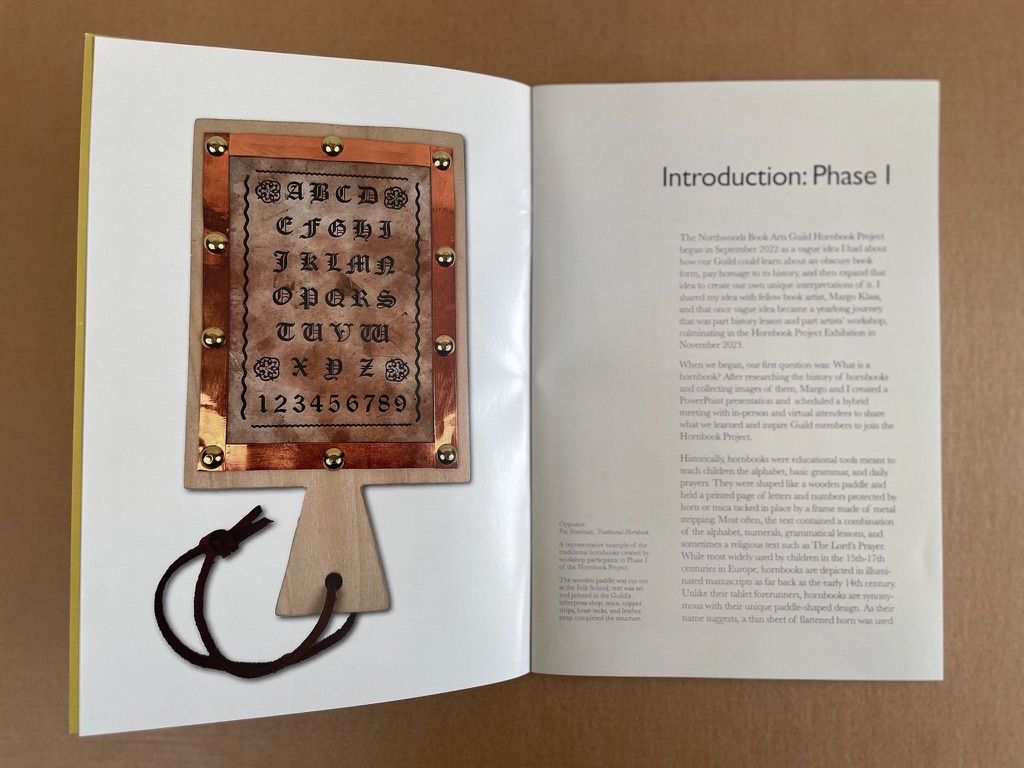
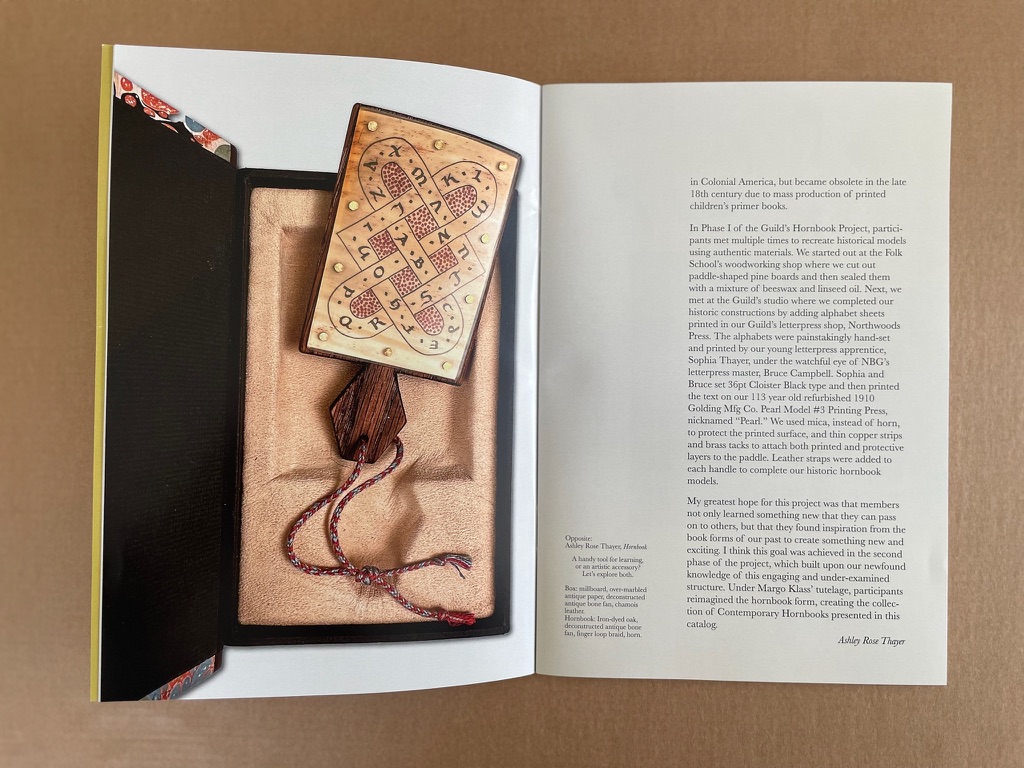
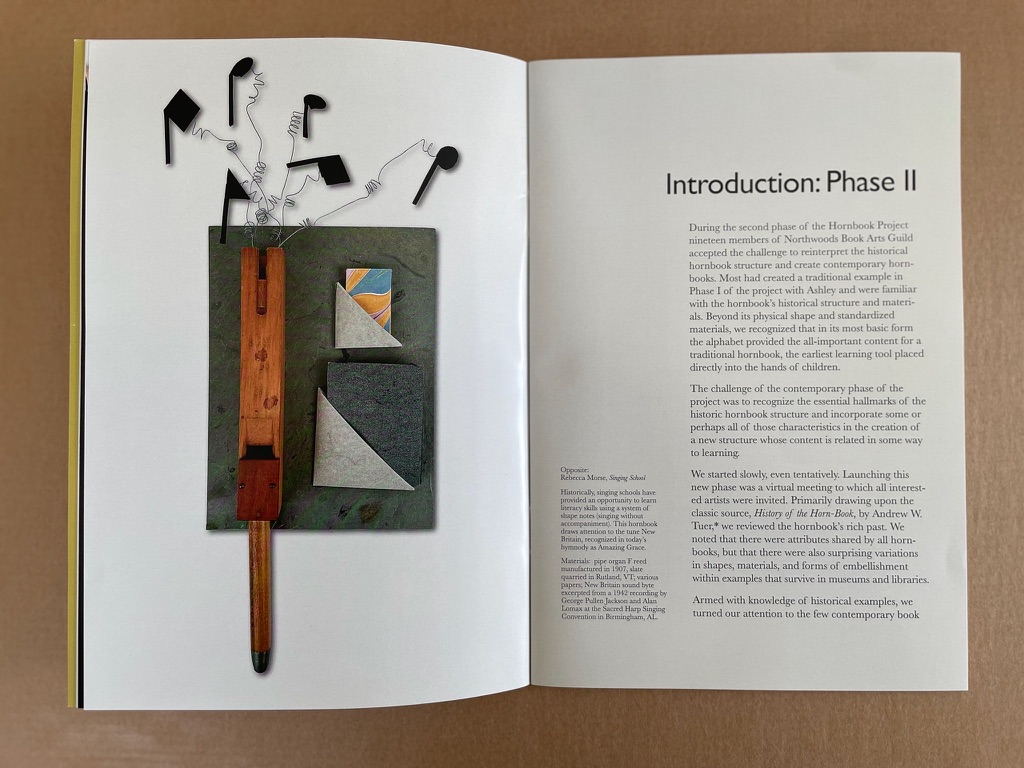
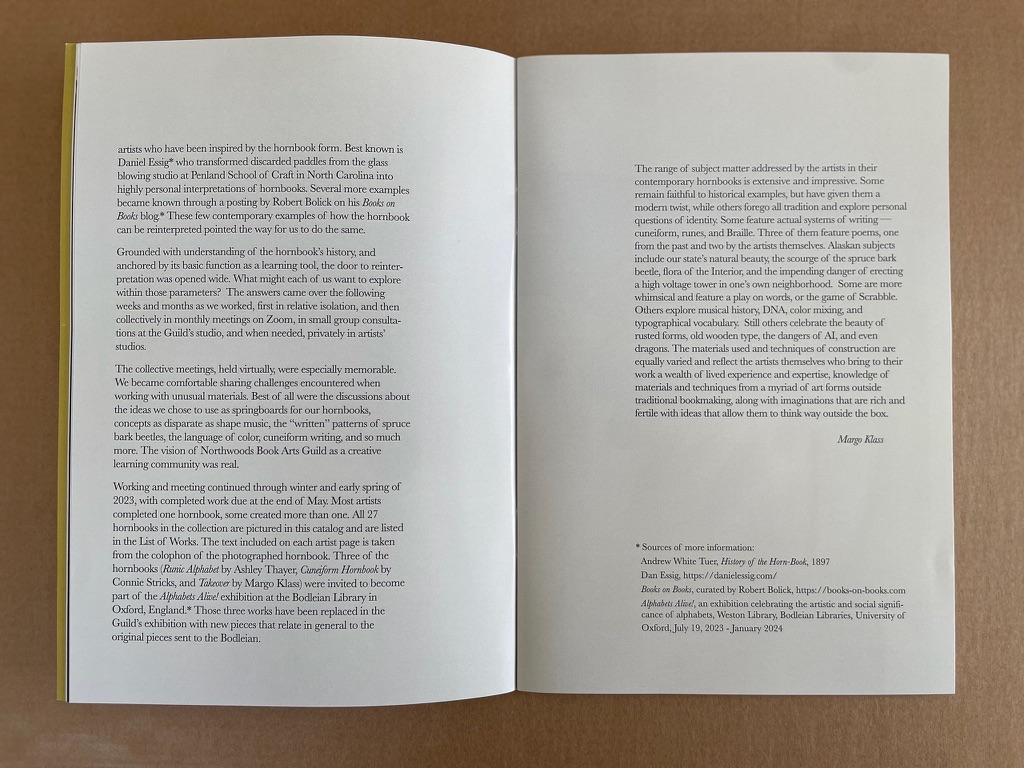
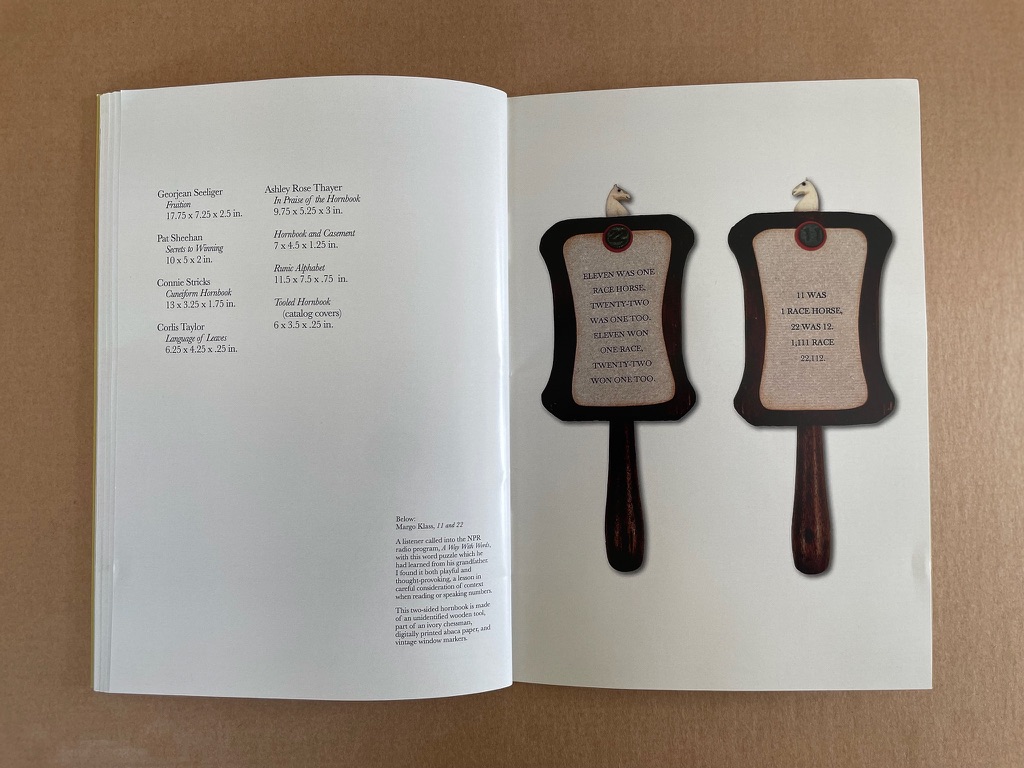
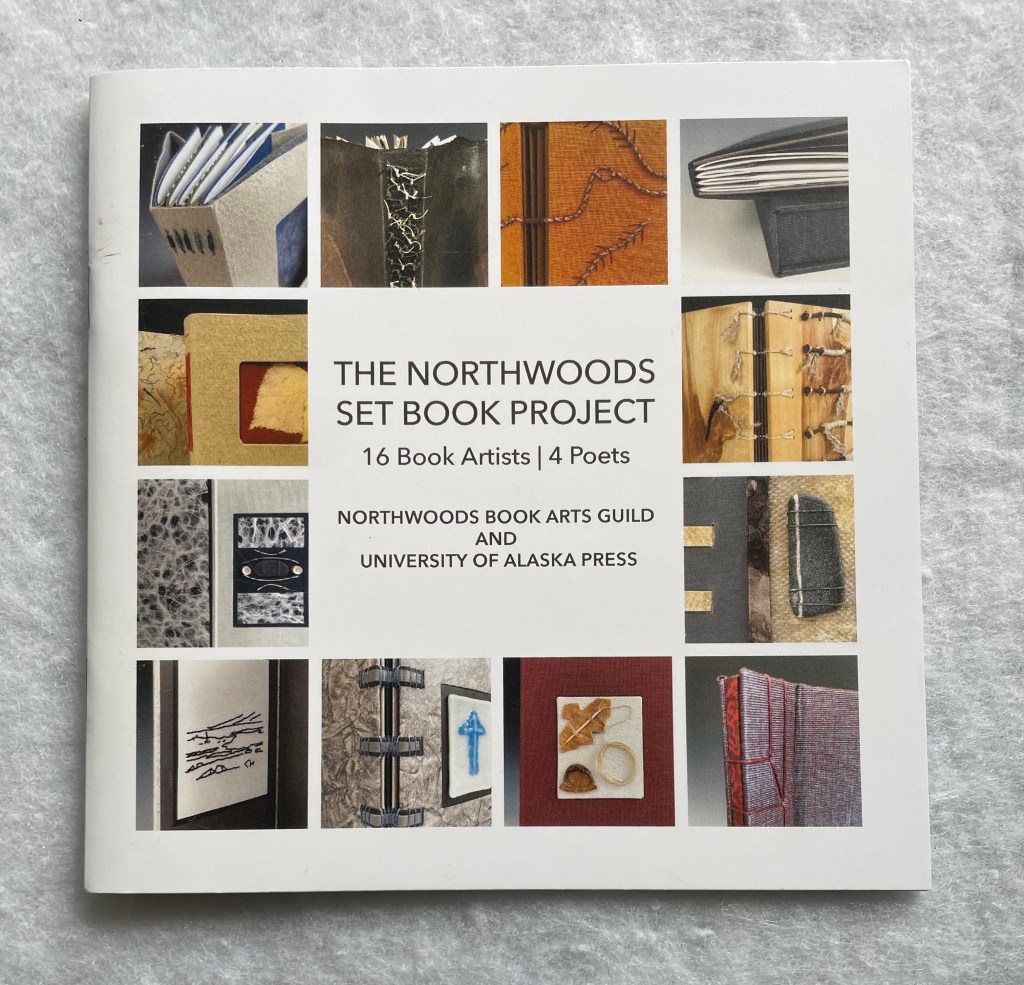
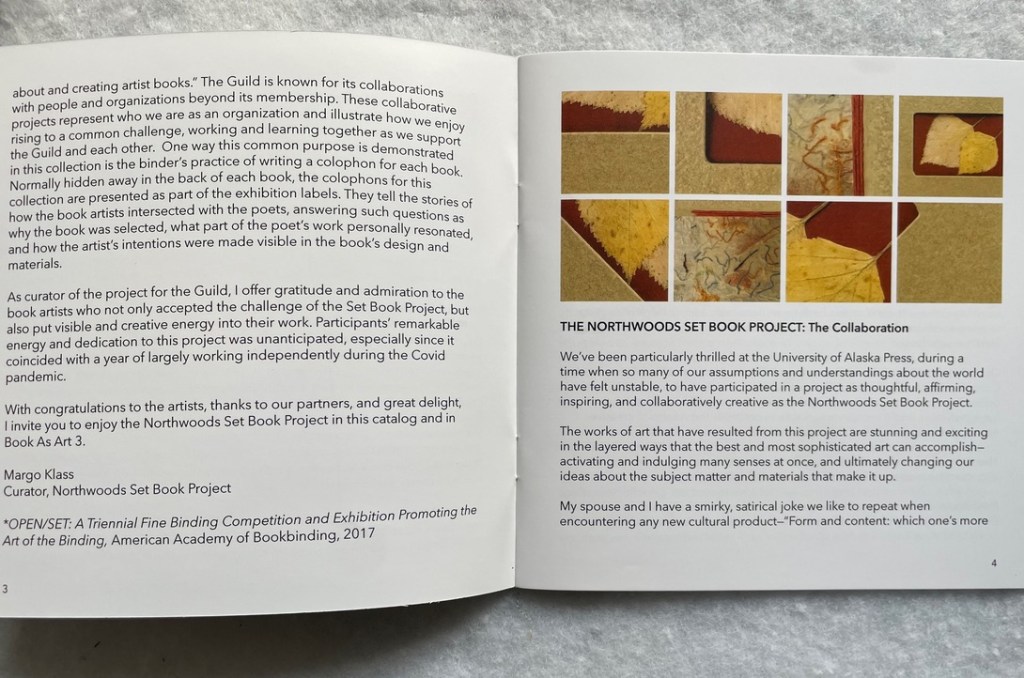
The Hornbook Project (2021)

The Hornbook Project (2021)
Northwoods Book Arts Guild
Booklet saddle stitched with staples. 153 x 153 mm. 30 pages (including inside covers). Acquired from Margo Klass, 2023.
Photos: Books On Books Collection.

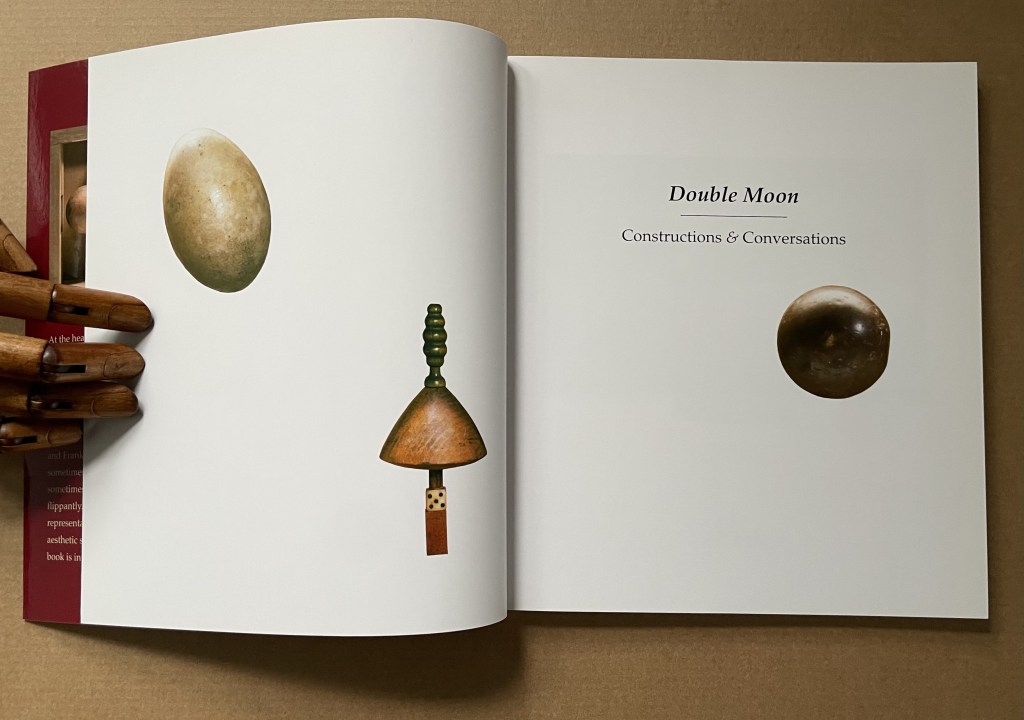
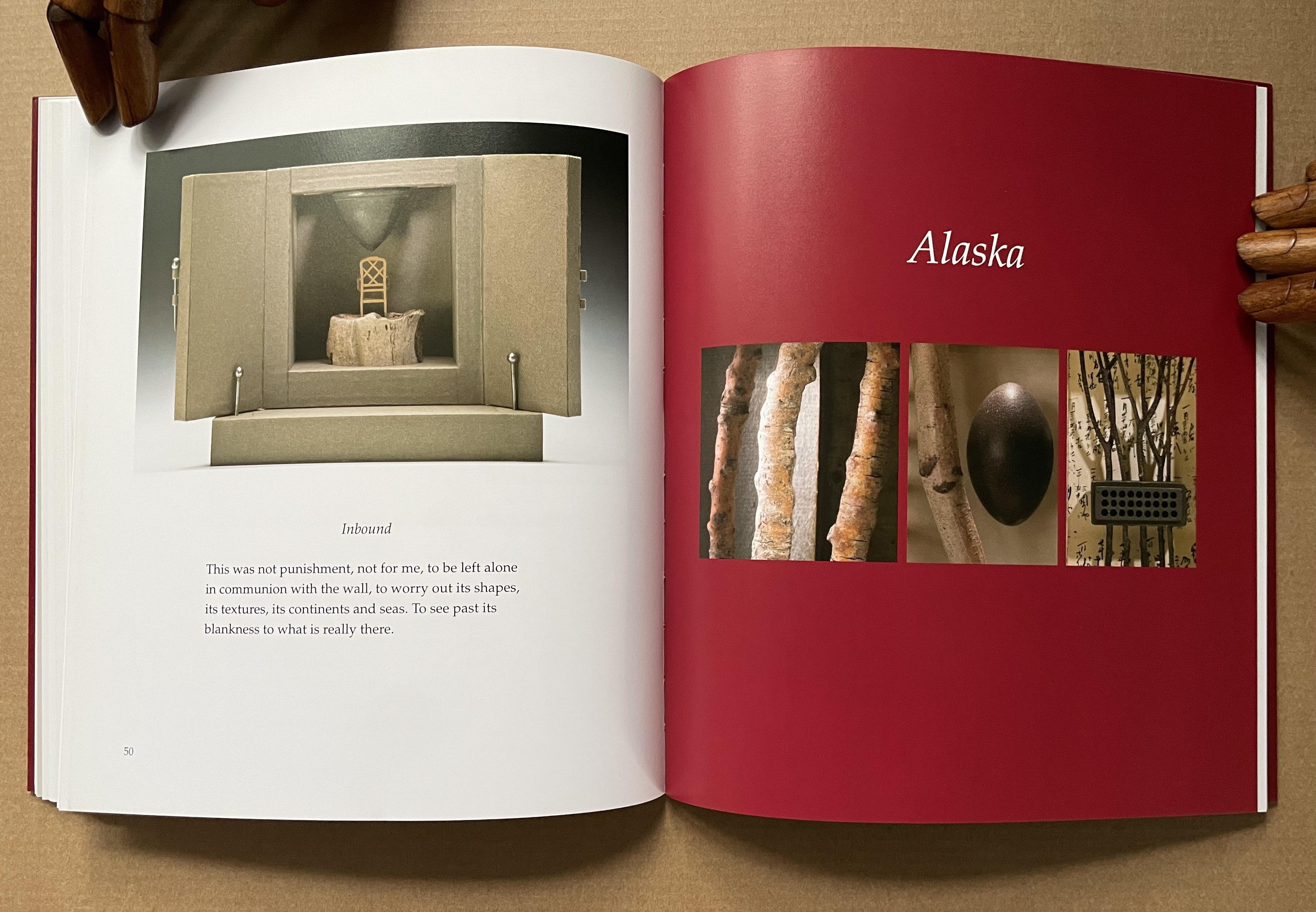
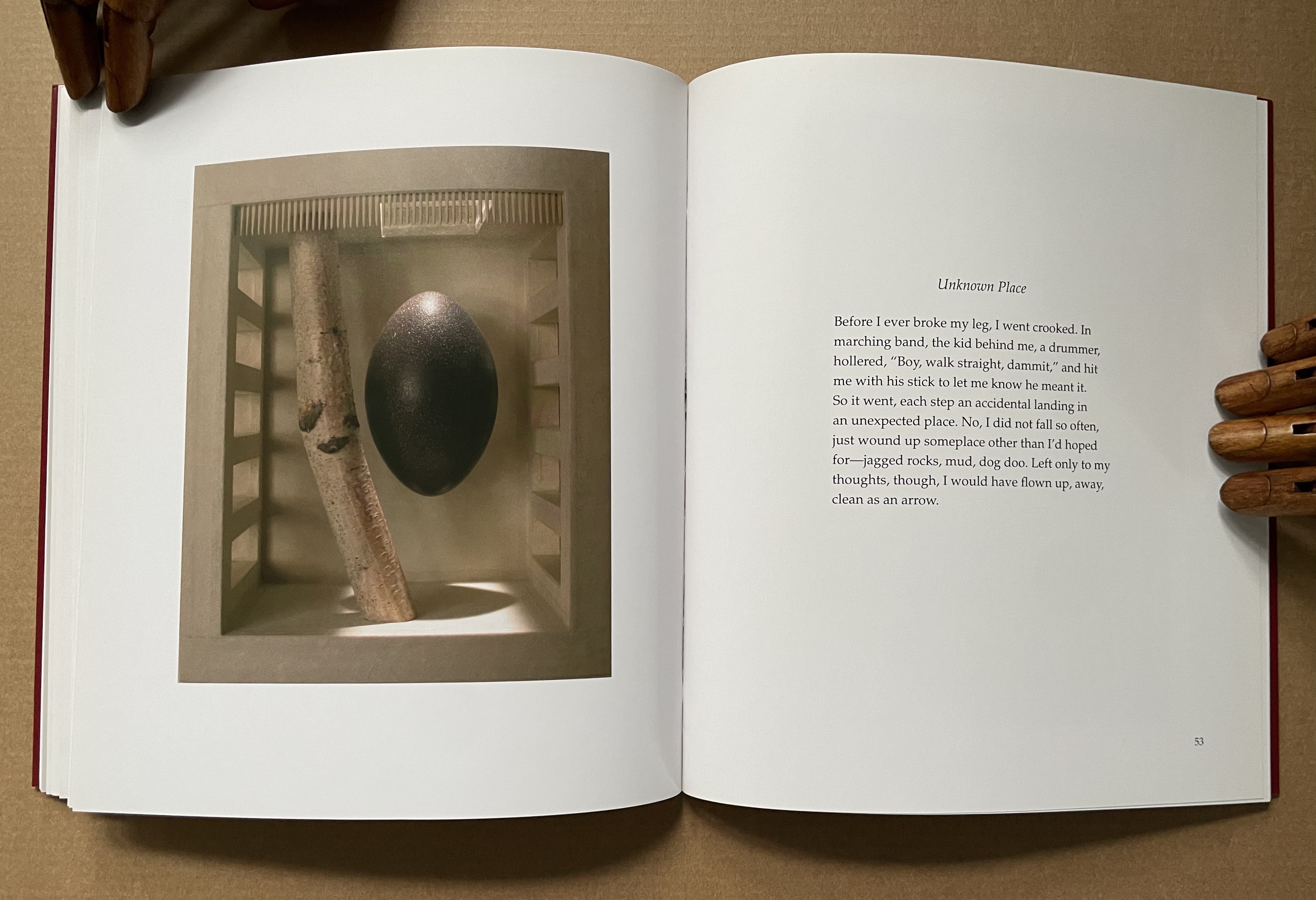
Double Moon (2009)

Double Moon (2009)
Margo Klass
Perfect bound cased in full-color cover with deep flaps, doublures. H215 x W197 mm. 84 pages. Acquired from Margo Klass, 7 November 2022.
Photos: Books On Books Collection.

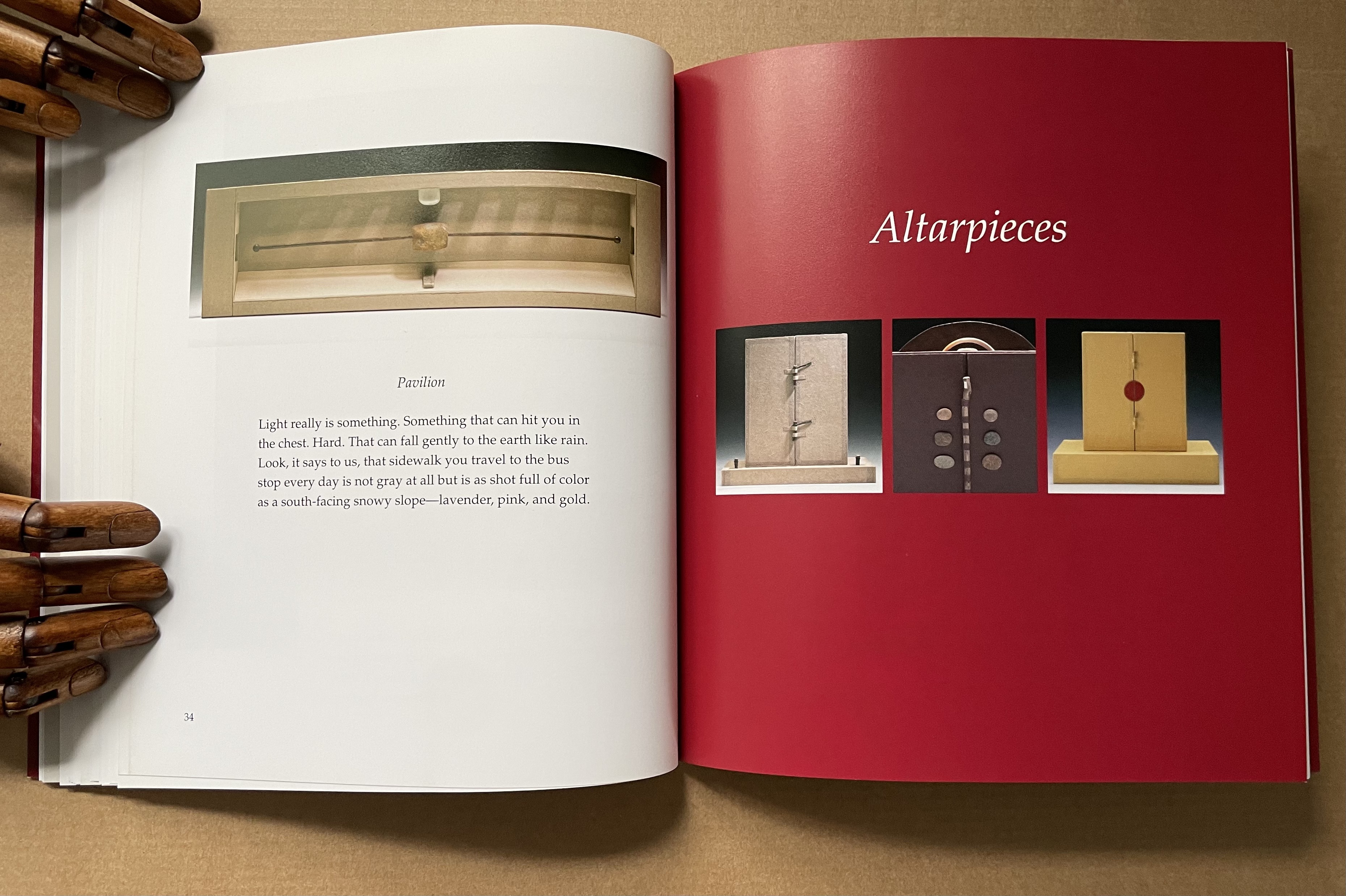
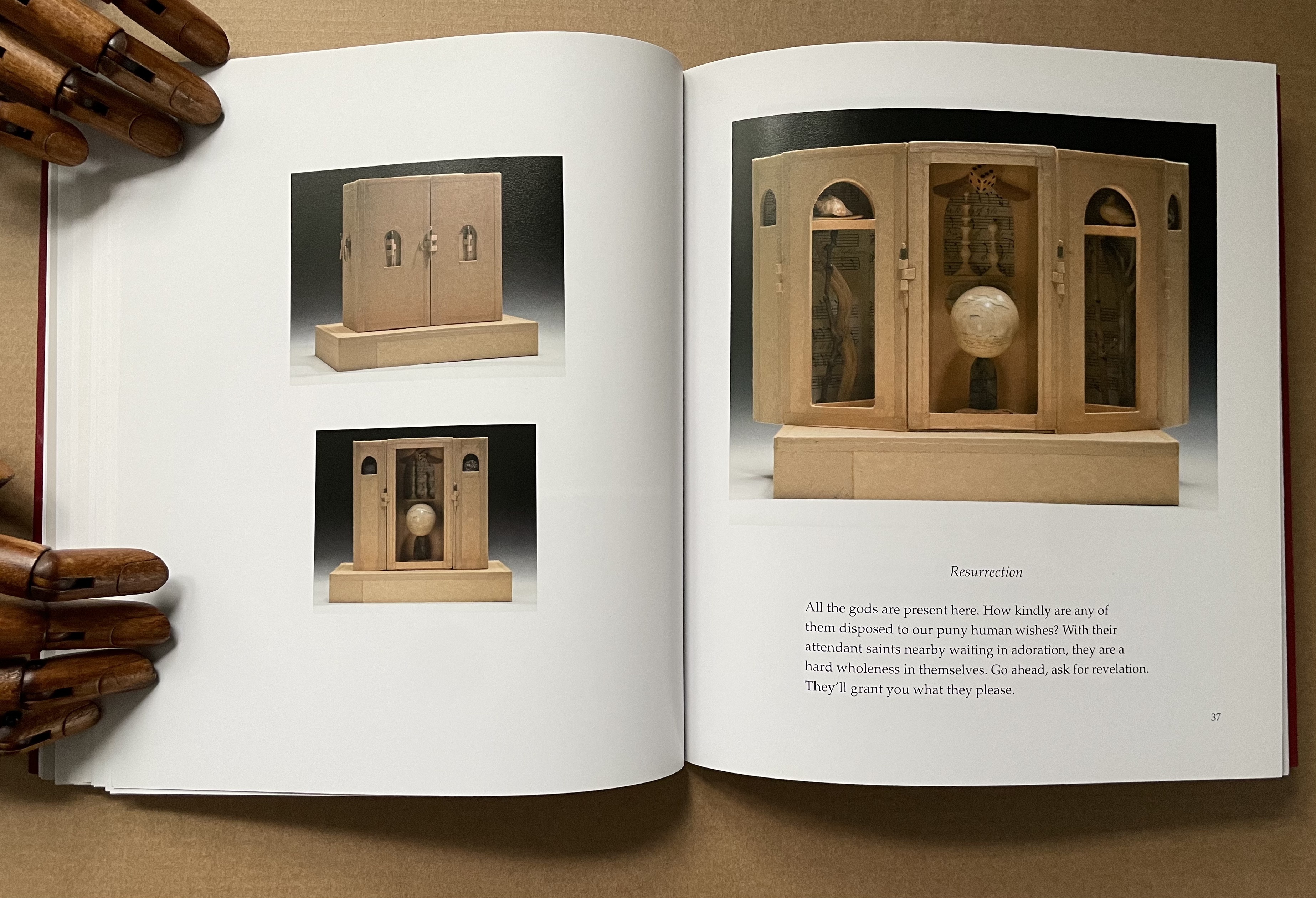
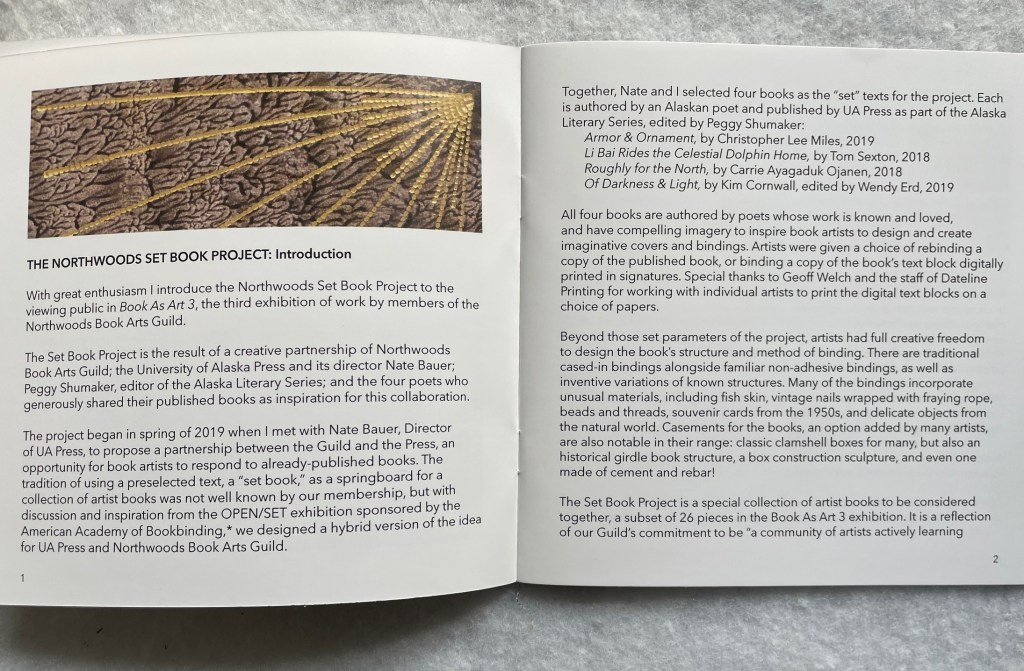
Northwoods Set Book Project (2021)

Northwoods Set Book Project (2021)
Northwoods Book Arts Guild and Margo Klass
Booklet saddle stitched with staples. 153 x 153 mm. 30 pages including inside covers. Acquired from Margo Klass, 2023.
Photos: Books On Books Collection.

Further Reading

Abecedaries I (in progress)“. Books On Books Collection.

Kees Baart, Dick Berendes, Henk Francino and Gerard Post van der Molen“. 2 November 2022. Books On Books Collection.

Yevhen Berdnikov“. 4 May 2023. Books On Books Collection.

Bård Ionson“. 9 July 20223. Books On Books Collection.

Karen Roehr“. 26 December 2022. Books On Books Collection.

Connie Stricks“. 9 July 20223. Books On Books Collection.

Ashley Thayer“. 26 December 2022. Books On Books Collection.

Andrew White Tuer“. 26 December 2022. Books On Books Collection.

Bodleian Libraries. 7 July 2023. “Alphabets Alive! 19 July 2023 – 21 January 2024, Treasury, Weston Library“. Accessed 7 July 2023.