Hollie Berry has two brief posts on book art at Book Arts at The Open Press (BA@TOP), a supportive community of book artists in Chattanooga, Tennessee, for whom The Open Press provides access to printmaking, book arts, and letterpress classes, workshops and equipment. Her first post offers as examples of the breadth of book art: Dan Essig, Sandy Webster, Brian Dettmer and Maddy Rosenberg. A good start, if light on installation book artists (say Alicia Martín).
The Open Press is 225 miles from Elizabethton, TN, where Wallace Stevens wrote “Anecdote of the Jar” in 1918 and which is only 67 miles from Asheville Bookworks in West Asheville, NC, where Landon Godfrey hosts Vandercooked Poetry Nights dispatching listeners into the mountain air clutching poems printed on broadsheets from the resident Vandercook Press, on which the authority Paul Moxon lectured in March this year at The Open Press, 199 miles away by the backroads across the Appalachians. …”And round it was, upon a hill.”
“Previously on …” Say the phrase and most listeners’ brains switch to a favorite channel and television series. It is part of our vernacular. It instantly evokes a compound state of remembering and anticipating.
Myriapod Productions embodies that state of mind in its animated alphabet-book film series Mysteries of Vernacular. Each book for each letter is an old yellowed or gray hardback whose pages turn by themselves to reveal silhouette figures that glide across the pages, accordioned illustrations from other works or carvings reminiscent of the book sculptures of Doug Beube, Brian Dettmer and Odires Mlászho – with each vernacular word and definition emerging from an old library card pocket or from beneath a flap or cutout on the page.
The treatment of the letter Wis particularly apropos to this compound artwork. W is for “window”, which we are informed by Graham James (the narrator) is an example of the Old Norse technique of word invention called kenning. Kenning is the joining of two things (or rather two words for two different things) to designate a third thing: such as whale + road = whale-road = sea. Window is originally an Old Norse kenning word: windauga = vind (wind) + auga (eye). The book in the animation is Mikhail Sholokhov‘s The Don Flows Home to the Sea, a Nobel-prize-winning window on the life of the Don Cossacks during the Russian Revolution.
The book for the letter A (for “assassin”) is Karl Menninger‘s Love against Hate, whose theme of love’s shaping our instinctual aggressiveness suggests an ironic bent and wry, punning sense of humor in Jessica Oreck and her Myriapod team. The letter C for “clue” traces back to the ball of yarn (clew) that Ariadne gave Theseus to help him find his way out of the maze after killing the Minotaur, which is explained with an animation of George Bernard Shaw‘s The Intelligent Woman’s Guide to Socialism and Capitalism. C is also for “clever”.
D for “dynamite” plays out on the pages of A Number of Things, a satiric novel of Irish and British manners by Honor (Lilbush Wingfield) Tracy. Tracy became the fuse to a stick of dynamite planted by Bevis Hillier in his rival A.N. Wilson‘s biography of Sir John Betjeman. Hillier concocted a letter from Betjeman purporting to reveal an affair between Tracy and the Oxford don. Not only was the letter a hoax, but Hillier embedded an acrostic that spelled out “A N Wilson is a shit”.
Of course, X for “x-ray” is illuminated with George Iles‘ Little Masterpieces of Science, and naturally, Z for “zero” is accounted for with Teach Yourself Calculus. But this soupçon of humor runs out with H (what has “hearse” to do with Bernard Jaffe‘s story of chemistry?) and G (what has “gorgeous” to do with James Russell Lowell?) and F (what has “fizzle” to do with Mark Twain‘s Life on the Mississippi, although one can imagine his delight with the word’s etymological kinship with flatulence?).
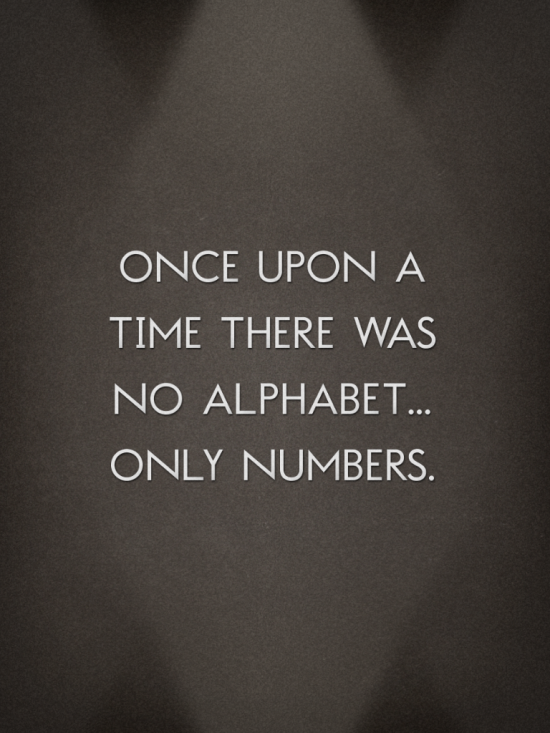
Each letter, definition, chapter, volume, episode (?) of Mysteries of Vernacular elicits affection for, if not outright love of, words and language. Perhaps that is not just down to Oreck’s and team’s skill, humor and cleverness. After all, for most of us, the alphabet-book is our childhood entrée not only to letters and words but any aspect of the internal and external world we fancy. Just for ages 3-5, our bookstores and libraries have the ABCs of Asthma, Bible Verse, Colors, Dinosaurs, Engineering, Feelings, Golf, Halloween, Ice Cream, Jobs, Kangaroos, Love, Math Riddles, Nature, Origami, Pigs, Questions, Rocks, Sounds, Touch, Under the Sea, Vanishing (endangered species), Wildlife, Yoga and Zoos. And for the more app-minded, there is also Moonbot Studio‘s contribution to the ABCs: The Numberlys.
Screenshot from The Numberlys William Joyce, Moonbot Studios, 2012
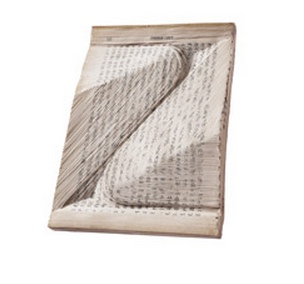
Myriapod starts with the advantage of this long, long “previously on …” in our hearts and minds. In exploiting its advantage, Mysteries of Vernacular takes us on a gentle rootle round the attic and cellar of our language and social history. The tradition of the abecedary and the disciplines of history and etymology offer a natural canvas on which Myriapod’s animation projects numerous techniques of book art. The intaglio carving reminds us not only of Beube, Dettmer and Mlászho but more so of Nerhol (the collaboration persona of Ryuta Iida and Yoshihisa Tanaka) and the work entitled Oratorical Type.
Oratorical Type by Nerhol (Ryuta Iida and Yoshihisa Tanaka)Oratorical Type by Nerhol (Ryuta Iida and Yoshihisa Tanaka)
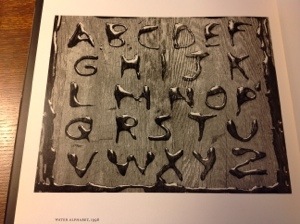
The Mysteries’ wooden desktop framing recalls Abelardo Morell‘s A Book of Books.
Water Alphabet, 1998 Abelardo Morell
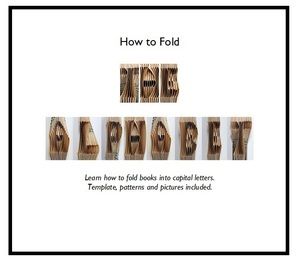
The animated book folds are enchanting (although they might have but do not aspire to the level of origami achieved by artists and craftworkers like Heather Eddy).
The Alphabet Tutorial Heather Eddy, 2013little letters Heather Eddy, 2013
More extensively used and in keeping with the more two-dimensional feel of Mysteries is the technique of papercutting (as distinct from carving) on display with the letter W. The technique dates to the Tang Dynasty (618 -906 AD) but, in this context, harks back more recently to Victorian silhouette artistry.
Victorian Silhouette Abecedary
The series of 26 episodes so rich in content and technique is addictive. You will find yourself, as with any well-done abecedary, wishing for more letters in the alphabet. Although there is a vast vocabulary of other vernacular awaiting treatment, at a production cost of $80,000 per episode, it is likely those words will wait a long time. So we are left with having to remember our anticipation. Not all anticipation is more often enjoyed in itself rather than its resolution. You have 26 windows of opportunity to learn in Mysteries of Vernacular.
“There is art to be found in science books and science to be found in artist’s books.”
The Buffalo & Erie County Public Library has been kind enough to share the exhibit labels for its display held in March this year in the Grosvenor Rare Book Room. The section devoted to “Artist’s Book History” begins with the Book of Kells and runs to Ed Ruscha’s Twentysix Gasoline Stations.
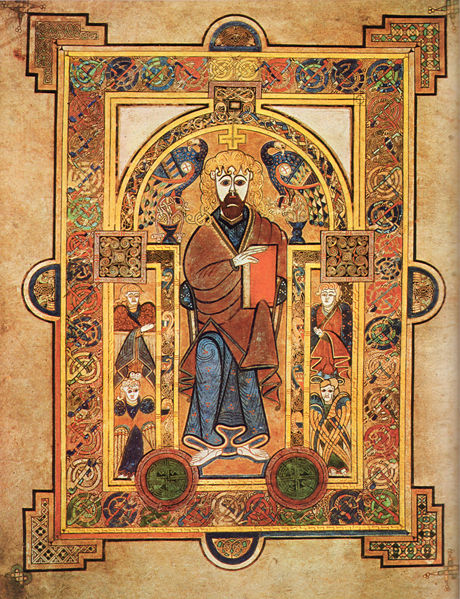
Although many will claim that artist’s books began with William Blake in the 1700’s or so that would dismiss entirely all of the artistry that went into many lovely and ornate illuminated manuscripts that proceeded and somewhat overlapped the printed text in codex form. Whether painted in monastic scriptoria, as was the Book of Kells (c. 800), or by secular guild artists as were many others, the figures and/or flora are artworks to behold.
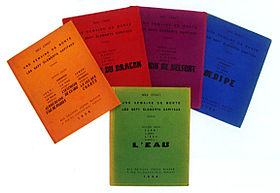
World Wars I & II brought many artist books associated with the Avant-Garde, Futurist and Surrealism Movements. Max Ernst’s Une Semaine de Bonté (1934).
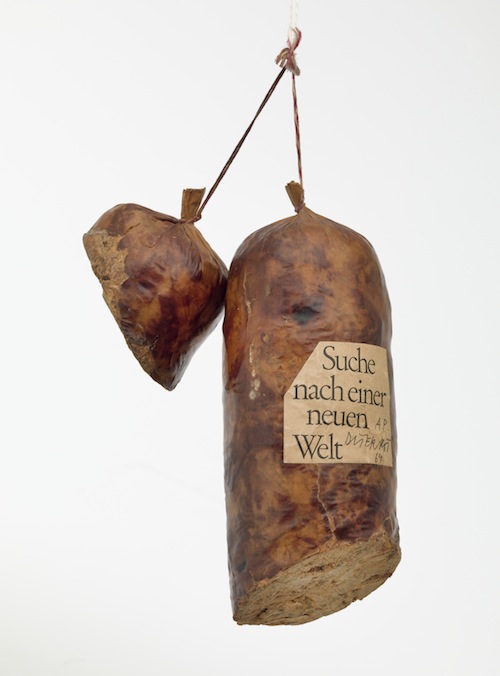
Dieter Roth, “Literature Sausage (Literaturwurst),” 1969, published 1961-70. Artist’s book of ground copy of Suche nach einer Neuen Welt by Robert F. Kennedy. Gelatin, lard, and spices in natural casing. Overall (approx.) 12 x 6 11/16 x 3 9/16 in. The Museum of Modern Art, New York. The Print Associates Fund in honor of Deborah Wye.
The second half of the nineteenth [sic] century brought Dieter Roth and Ed Ruscha’s works. Roth was a Swiss artist for whom the book was just one of his media. Paint, sculpture, installation work and more also provided means of artistic expression.
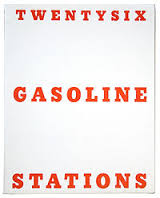
Ed Ruscha is an American pop artist whose focus is in paint, drawing, printmaking and photography. His Twentysix Gasoline Stations (1963) photographically captures gas stations in book form as Andy Warhol did Campbell soup cans on canvas. This artist’s book is considered an important milestone for the genre.
Ruscha’s book also figures in the exhibit section called “Artist’s Books and Bookworks Today” along with works by Julie Chen and Susan Allix as examples of the growing availability of collectible book art today.
Personal Paradigms, Julie Chen, 2004
Julie Chen founded Flying Fish Press in California through which she creates handmade “artists’ books with an emphasis on three-dimensional and movable book structures and fine letterpress printing” according to her web site. These books are frequently moveable and/or interactive in their design.
Egyptian Green, Susan Allix, 2003 “The texts in Egyptian Green are mainly drawn from travellers visiting or writing about Egypt. The earliest is a spell written inside an ancient coffin; later writers include Plutarch and Catullus, also Leonhart Rauwolff, who noted in 1672 that the water of the Nile was “perfectly green”, and Amelia Edwards on the precise colour of palm trees. There are two calligraphic pieces of Kufic script printed from the original blocks found in Cairo.”
British book artist Susan Allix also has her own (self-titled) press and she creates handmade books with a variety of fine papers and textures with letterpress printing, embossing and all manner of printmaking. Though some of her books convey a certain whimsy, the choice of materials, method of printing and crafts[wo]manship is the result of serious thought, planning and selection.
Other sections are devoted to historical examples of illustrated works of scientists such as Vesalius and Lamarck, which are well punctuated by the inclusion of Guy Laramée’s Grand Larousse, Brian Dettmer’s The Household Physicians and Doug Beube’s Fault Lines.
Grand Larousse, Guy Laramée, 2010
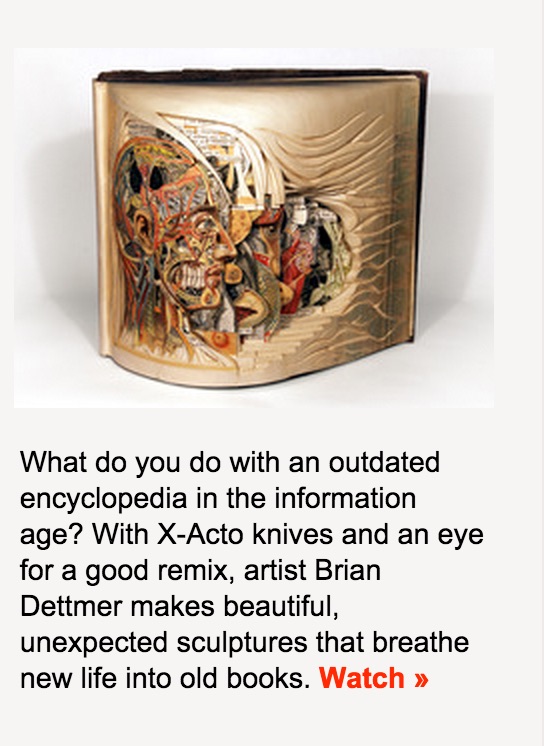
The Household Physicians, Brian Dettmer, 2008
Fault Lines, Doug Beube, 2003
Books altered and/or sculpted by artists to represent something other than the original readable text are known as bookworks and they are works of art. This type of art is not technically an artist’s book whereby a book is created. Altered/sculptural books take from a book that had already been created and turn it into art by cutting, folding and/or sculpting it into an art form. Although there are many examples of this type of work, perhaps the most inspiring artists’ works (some available in art galleries today) are those by contemporary and still-creating Canadian Guy Laramée, American Brian Dettmer and Toronto-born, schooled-(in part)-in-Rochester/Buffalo and now-living-in-New-York-City Doug Beube. The examples of their works shown are all pieces inspired by some aspect of science or subject of scientific study including geology, medicine and geography.
The theme of the exhibit deserves a catalogue. As the exhibit’s online announcement notes, “Today’s mutually exclusive idea of ‘left-brained’ and ‘right-brained’ activity discounts longer understood ideas that science is a creative pursuit—that there really is art to be found in science—and that creative artworks often have some scientific basis and/or inspiration.” One would do well to start with Harry Robin’s The Scientific Image: From Cave to Computer (1992) and Brian Ford’s Images of Science: A History of Scientific Illustration (1993) and take further inspiration from the Grosvenor Rare Book Room.
Watch Brian Dettmer’s delightful TED talk here. More about his work and his contemporaries follows:
Three book artists previously featured here at BooksOnBooks — Doug Beube, Brian Dettmer and GuyLaramée — were showcased in this exhibition curated by Karen Ann Myers at the Halsey Institute of Contemporary Art at the College of Charleston, South Carolina. Two other artists — Long-Bin Chen and Francesca Pastine — complete the show. The exhibition ran from 23 May through 6 July 2013.
Increasingly, contemporary artists have been exploring the interplay among the function, structure, and format of books. Rebound: Dissections and Excavations in Book Art brings together the work of five mixed-media artists from around the world who, using books as a point of departure, sculpt, scrape, bend, and carve to create astonishing compositions. Doug Beube, Long-Bin Chen, Brian Dettmer, Guy Laramée, and Francesca Pastine transform various types of literature and/or printed books through sculptural intervention. Despite the individual and exclusive perspective of each artist, there are remarkable connections in the themes and ideas they respectively mourn and celebrate. The fascinating range of examples, as diverse as books themselves, offers eloquent proof that—despite or because of the advance of digital media for sources of information—the book’s legacy as a carrier of ideas and communication is being expanded today.
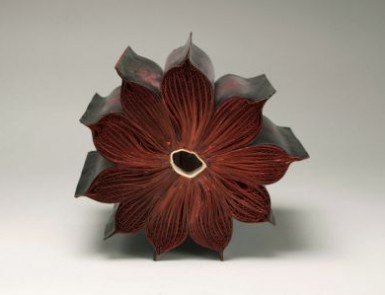
Featured Image: Jacqueline Rush Lee, Anthologia, 2008, altered book
Behind each name is a link to each book artist’s site or gallery bio. Consider it a virtual exhibition, but check out the dates of the real-world exhibitions announced on many of the sites.
 Hollie Berry has two brief posts on book art at Book Arts at The Open Press (BA@TOP), a supportive community of book artists in Chattanooga, Tennessee, for whom The Open Press provides access to printmaking, book arts, and letterpress classes, workshops and equipment. Her first post offers as examples of the breadth of book art: Dan Essig, Sandy Webster, Brian Dettmer and Maddy Rosenberg. A good start, if light on installation book artists (say Alicia Martín).





 Books On Books