Bookmarking Book Art — Doug Beube

Doug Beube’s works exude the influence of his studies with Keith A. Smith and Gary Frost, craftsmen and scholars whose work has been referenced here.  Eleven years ago, in an interview with Judith Hoffberg in UmbrellaVol 25, No 3-4 (2002), Beube speaks of experiencing

the whole book as an entity in itself, which can’t be done by reading line by line. The book’s not made to do that. Readers experience the totality of the book by building up linear movement, word-byword, sentence by sentence, etc. and I’m interested in the book as a simultaneous experience.

The experience of the wholeness of the book plays off the major theme of Smith’s The New Structure of the Visual Book and The New Text in the Book Format: “Composing the book, as well as the pictures it contains, creates pacing in turning pages. Just as poetry and cinema are conceived in time, so is a book.”  Both Smith and Beube are interested in the structure of the book, “the mechanical aspects of the book as  a technology, and how it functions as a container of  information,” as Beube puts it.  

But where Beube is “trying to solve the problem of experiencing the content of the book as a visual phenomenon, layering it and transforming it into a visual object,” Smith pushes the traditional form of the book to enhance the book experience that “Events depicted in writing unfold through time in space, alongside the physical act of turning pages.”

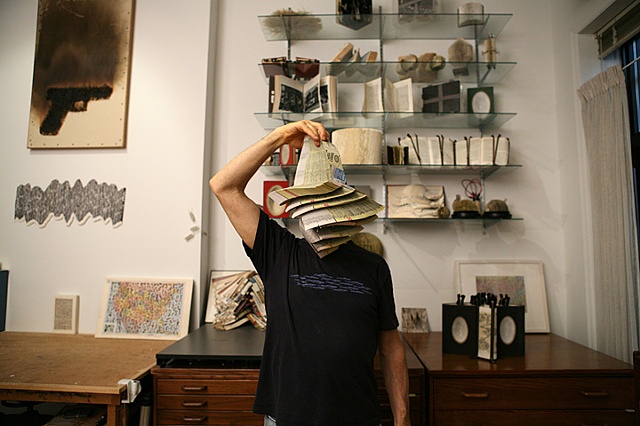
Although Gary Frost’s influence on Beube’s deep-seated inspiration from the history of the book can be seen in the first two examples below, Beube’s more acerbic view of our digital world in Facebook, the third example, is where they part company.  Frost is still seeking the possibility of an ongoing link between the print and the digital:  “The circumstance of mixed delivery options for books reveals a surprisingly complementary and interdependent relation of affordances and a third stance going forward. We advocate for the interdependence of paper and screen books; neither will flourish without the other.”   Beube’s twisted phonebook dangled before his face in Facebook “both acknowledges and satirizes the intended community of computer users.”

Beube divides his bookworks into methodological categories — Fold, Gouge and Cut:

City by Doug Beube

Inspired by a phrase from the Hindu scriptures, the Vedas, in 1989 I began folding the pages of books in on themselves. The phrase goes, “Curving back upon myself, I create again and again.”

via Doug Beube – Fold.

"Reading

Using various power tools I selectively removed parts of the cover, pages, and content, for example, by grinding them away. The underlying pages revealed themselves, as hidden depictions interacting with top layers, interrupting what might have been an undisturbed reading of text and image now viewed as an altered book.

via Doug Beube – Gouge.

"Facebook2009altered

Theoretically and physically I ‘excavate’ the book, as a phenomenological endeavor, creating hypertexts, as if the text block itself is an archaeological site. When I appropriate books, their words are sometimes readable, their shapes are sometimes recognizable, but in every case they are transformed into objects that are visual and speak volumes.

via Doug Beube – Cut.

See also

Bookmarking Book Art – Doug Beube | @scoopit http://sco.lt/9Jn1tp

Bookmarking Book Art — Doug Beube | @scoopit http://sco.lt/8Dp5UH

Bookmarking Book Art — Rebound – An exhibition at the Halsey Institute of Contemporary Art | @scoopit http://sco.lt/5rNMkz

Bookmarking Book Art — Paul Forte | @scoopit http://sco.lt/58SMoz
Bookmarking Book Art — “Out of Print: Altered Books”, A Virtual Exhibition

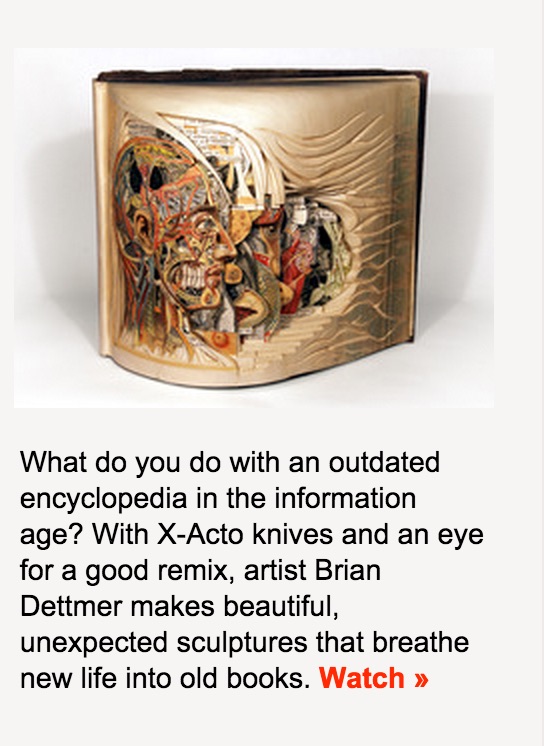
In November 2012, the Bakersfield Museum of Art exhibited “Out of Print: Altered Books“, the book as a sculptural object. Ten contemporary artists, some of whose works have been bookmarked here, participated:   Doug Beube, Alex Queral, Jacqueline Rush Lee, Mike Stilkey, Jim Rosenau, Guy Laramee, Cara Barer, Robert The, Brian Dettmer and Mary Ellen Bartley.

Anthologia-2-385x295-1
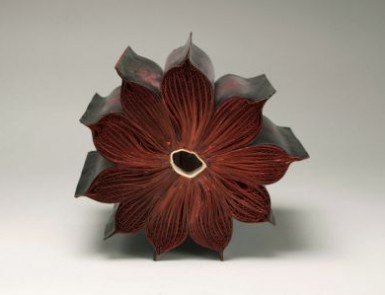
Featured Image: Jacqueline Rush Lee, Anthologia, 2008, altered book

Behind each name is a link to each book artist’s site or gallery bio.  Consider it a virtual exhibition, but check out the dates of the real-world exhibitions announced on many of the sites.

Bookmarking Book Art – Basia Irland

Basia Irland’s art project ICE BOOKS: receding/reseeding gives a formidably tangible and new meaning to “publishing as dissemination.”  As Irland describes the project on her site:

River water is frozen, carved into the form of a book, embedded with an ‘ecological language’ or ‘riparian’  consisting of local native seeds, and placed back into the stream. The seeds are released as the ice melts in the current…

Tome I

I carved a 250-pound book from clear ice and embedded it with a seed text of Mountain Maple (Acer spicatum), Columbine flowers (Aquilegia coerulea), and Colorado Blue Spruce (Picea pungens). Four people carried the heavy book out into the current of Boulder Creek.  As it rested between two large rocks, viewers cold see the water flowing under the ice.  Ice Books.   Accessed 17 February 2013 and 11 September 2014.

This is book art as performance art and conceptual art but with a twist: the performance yields results beyond the on-site viewers’ memories or any photography and video of the event replayed in galleries or museum installations.  Whether the seeds that float downstream in local rivers do take root is uncertain. As there is at least a chance that it will happen, it is more than the concept that counts.

“Performed” across 18 locations around the world, Irland’s project has been going since 2007. Fittingly the first performance began with Lucy R. Lippard’s Weather Report exhibition in 2007, but the concept has a rich heritage. With some further reading and the help of Peter Verheyen’s listserv BKARTS, I have tracked down some of that other “ramifying” or “ecologically political” book art.

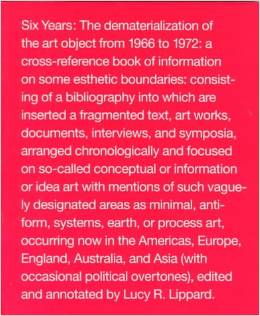
Lucy Lippard, Six Years
Lucy Lippard, Six Years (1997)

Starting with Lippard herself, there is Six Years, the 1973 seminal, long-subtitled work that drew attention to  Hans Haacke’s Wind in Water  (1967) and other conceptual and environmental art.  And then came Doug Beube’s pieces from the 80s and later such as Organic and The Chair of Censorship.  In the late 90s, we had Ann Marie Kennedy’s Plant Dreams. In 2010, Maggie Puckett’s “Thaw“.

And now, this conceptual book art has revolved back into books:

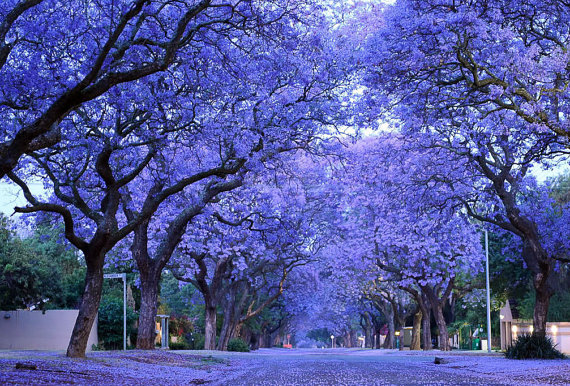
Pequeño Editoran Argentinian children’s book publisher, has published Tree Book Tree with ecologically friendly ink and acid-free paper embedded with jacaranda seeds. As the video explains, “Books come from trees. Today, a tree comes from a book.”

Tree Book Tree Published on 3 May 2015 The first book that can be planted after it is read. FCB Buenos Aires
Tree Book Tree, 2015
Video published on 3 May 2015
FCB Buenos Aires

The act of reading then planting the book echoes the twist in Irland’s performance and conceptual pieces. The book as read (the performance) resides in the memories of the readers, the concept (books are made of trees) resides in the mind, and downstream in time, a jacaranda blossoms overhead.
il_570xN.537080074_jfho


Compare also with the work of Jaz Graf.