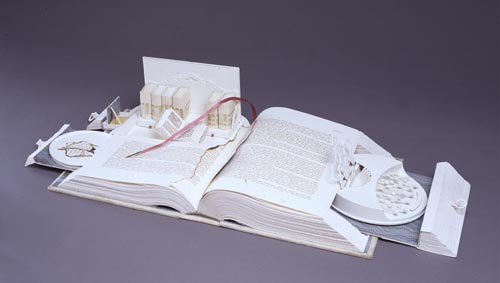
Drawn, Cut & Layered Werner Pfeiffer Plastic box containing illustrated pop-ups.Acquired from Toledo Museum of Art, 5 Jun 2017. Photos: Books On Books Collection.
Werner Pfeiffer’s playfulness finds its way into viewers’ hands with this offering from his Toledo Museum of Art exhibition in 2015. His archives are housed at Vassar College.
With its structures and photographic representation of Pfeiffer’s other works of paper engineering, Drawn, Cut & Layered demonstrates his breadth in that sub-domain of book art. Not detectable in the box, though, are Pfeiffer’s white altered book objects, which formed the 2010 exhibition at Cornell University, entitled censor, villain, provocateur, experimenter, and demonstrates his scope in the sub-domain of altered books.
In kind, they were preceded by Barton Lidicé Beneš‘ The Life of Gandhi and Beauty Book (both 1973), M.L. Van Nice‘s Swiss Army Book (1990) Irwin Susskind‘s Book Faced Down – Embedded in Plaster (1999). In kind and whiteness, they were followed by Jonathan Callan‘s Zurbarán’s Color Plates (2011), Michael Mandiberg‘s Print Wikipedia (2015), and Lorenzo Perrone‘s Kintsugi(2018).
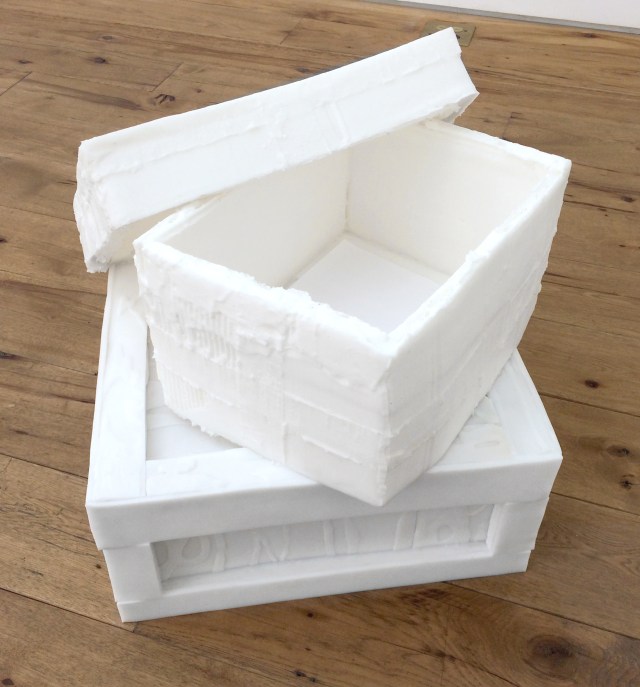
Cardboard Box (White) for Invisible Text, “Called Back,” Epitaph for Emily Dickinson Jeanne Silverthorne, 2017 Platinum silicone rubber, acid free paper, archival invisible ink 9 x 17 x 13 inches / 23 x 43 x 33 cm Edition 1/3 with 1 A.P
Dare you see a soul at the white heat? Then crouch within the door. Red is the fire’s common tint; But when the vivid ore Has sated flame’s conditions, Its quivering substance plays Without a color but the light Of unanointed blaze. Least village boasts its blacksmith, Whose anvil’s even din Stands symbol for the finer forge That soundless tugs within, Refining these impatient ores With hammer and with blaze, Until the designated light Repudiate the forge. – Emily Dickinson, Part One, Life, XXXIII
MARC STRAUS, the contemporary art gallery in the Lower East Side of New York, opened “an exhibition of white paintings and sculptures by an international selection of artists” on 3 June 2017. It runs through 3 July, and its title The White Heat comes from the first line of Dickinson’s poem above.
Books on Books offers this “white book report” on book art not included to put attendees in the mood for their experience of the works in white by artists such as
Damien Hirst
Nicole Eisenman
Enrico Castellani
Robert Barry
Fernanda Gomes
Antonio Santin
Jeanne Silverthorne
Joan Levison and others.
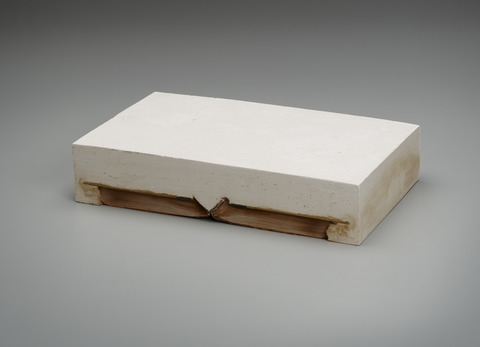
Book Faced Down – Embedded in Plaster, 1999 Found cook book and plaster block Irwin Susskind, born 1935 34.6 x 20.9 x 6.5 cm (13 5/8 x 8 1/4 x 2 9/16 in.) The Allan Chasanoff, B.A. 1961, Book Art Collection, curated with Doug Beube
Irwin Susskind‘s “Book Faced Down” is an example of the technique of mixed media – a stark white plaster block facing down the objectified cookbook – to create book art. A piece of sheet cake, a cutting board?
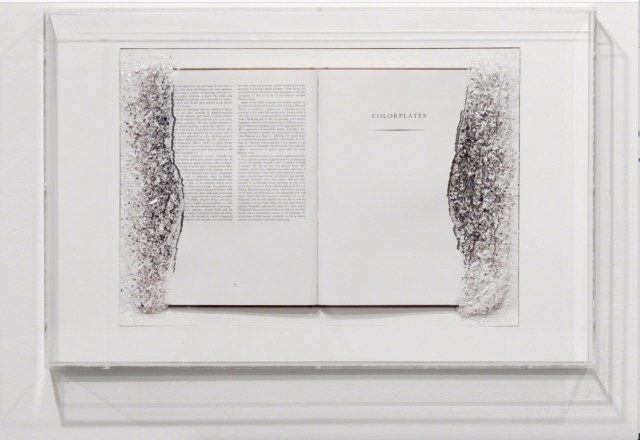
Zurbarán’s Color Plates, 2011 Jonathan Callan Chiseled book in perspex 46.4 × 71.1 × 5.7 cm
Jonathan Callan‘s piece denies viewers the colorful still lifes of Francisco de Zurbarán and leaves them with this drained-of-color, chiselled double-page spread of a book on the artist.
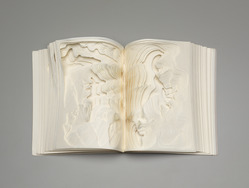
Work of Linear – Actions, 2000 Noriko Ambe
Where Callan chisels away from the edges inward, Noriko Ambe carves from the inside almost to the edges in her work above.
Absence, 2004 J. Meejin Yoon
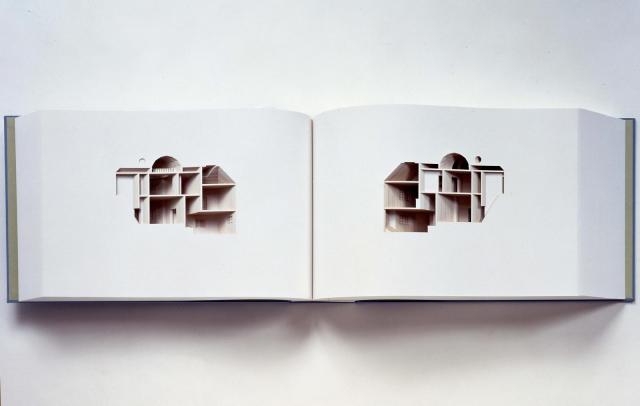
As the Straus exhibition notes, “In Chinese cultures, White is associated with Death.” In J. Meejin Yoon’s book Absence, the absence of color in a solid white block of thick stock cardboard pages and the “text” of one pinhole and two identical squares die-cut into each of its 120 pages – one for each story of New York’s Twin Towers including the antenna mast – lead the reader down through the missing buildings to the final page where the footprint of the absent structures ends in a die cut of the entire site of the World Trade Center.
Your House, 2006 Olafur Eliasson Teixeira de Freitas, Lisboa, Portugal
Your House, 2006 Olafur Eliasson
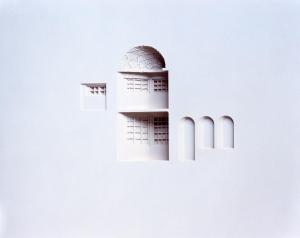
Olafur Eliasson seems to have followed Yoon’s technical approach in Your House, 2006, although the effects are far more intricate.
Coral Colony, 2017 in progress Julie K. Dodd
Untitled Julie K. Dodd
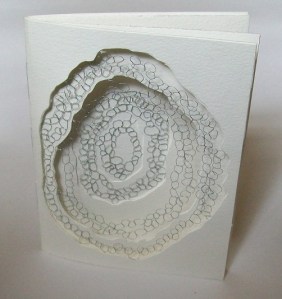
Echoing Yoon’s somber note, Julie K. Dodd‘s paper and book art often dwell on environmental issues, such as the death of a coral colony above and the contours of the natural landscape versus manmade as shown in Untitled.
The Great Gathering, VII The Time is Now, 2016 Chris Ruston Photo credit: Chris Matthews
A more hopeful note is struck in the whiteness of Chris Ruston’s final “ammonite” book in the series The Great Gathering, inspired by Darwin’s On the Origin of Species. The mirror under the maker’s tools and the made thing implicate the viewer here and now in an optimistic ongoing evolutionary process of making and remaking.
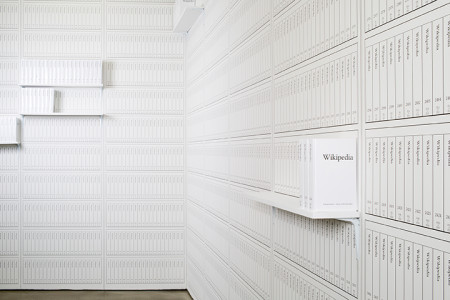
Michael Mandiberg, Print Wikipedia, 2015 Exhibition “From Aaaaa! to ZZZap!” by the Denny Gallery, 261 Broome Street in New York City, 18 June through 11 July, 2015.
Where the white of Yoon’s and Dodd’s works evokes absence and the white of Ruston’s work evokes the blank invitation to singular creativity, Michael Mandiberg‘s installation of multiples, Print Wikipedia, evokes the plenitude of white noise that is our online lives.
Swiss Army Book, 1990 M. L. Van Nice Gift of Lois Pollard Price National Museum of Women in the Arts
And just as technologically allusive, M.L. Van Nice‘s Swiss Army Book poses (tongue in cheek?) the single volume as somehow able to capture, store and transmit knowledge in ways it need not, albeit the meaning of the whiteness here is a bit elusive.
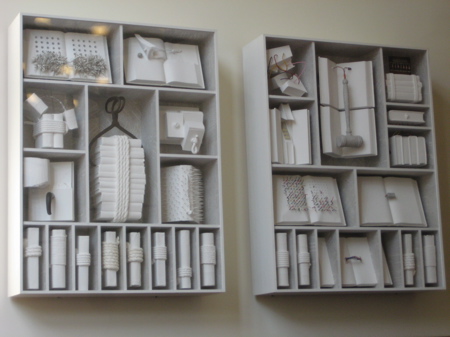
Legal Process Narrative, 1996 Werner Pfeiffer Law Library, University of Connecticut at Storrs
Werner Pfeiffer’s works constitute an extensive treatment in white. The installation at UConn Storrs represents a small proportion of the works shown in retrospectives in the last ten years at Bucknell, Cornell and the Toledo (Ohio) Museum of Art. Pfeiffer’s works touch on censorship, and from his Cornell exhibition, he explains:
The objects I create are made with real books. They are not casts, nor are they sculpted imitations. At its core each piece has bound, printed pages. Glued together and painstakingly covered with gesso, they are silenced and sealed for good. I practice this destruction, this obvious censorship, simply as metaphor. It is to visualize, to demonstrate, to provoke. For these acts of violence are not about the damage done to stacks of paper, to books. The objects are about the harm inflicted on the human spirit. The ropes, the nails, the clamps, the hooks and knifes are real as well. They are symbols of pain, of torture, of suppression which are inevitably brought on by the censor’s act.
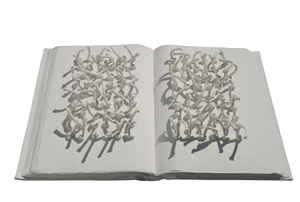
Knotty Story Werner Pfeiffer
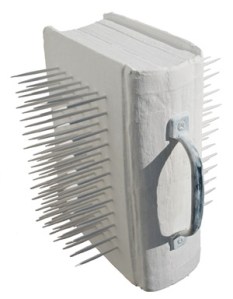
Difficult to Fit Werner Pfeiffer
With the advent of ebooks, Pfeiffer celebrates the tangibility of the book with his white gessoed book objects and their punning titles as well as origami-like works such as Zig-Zag.
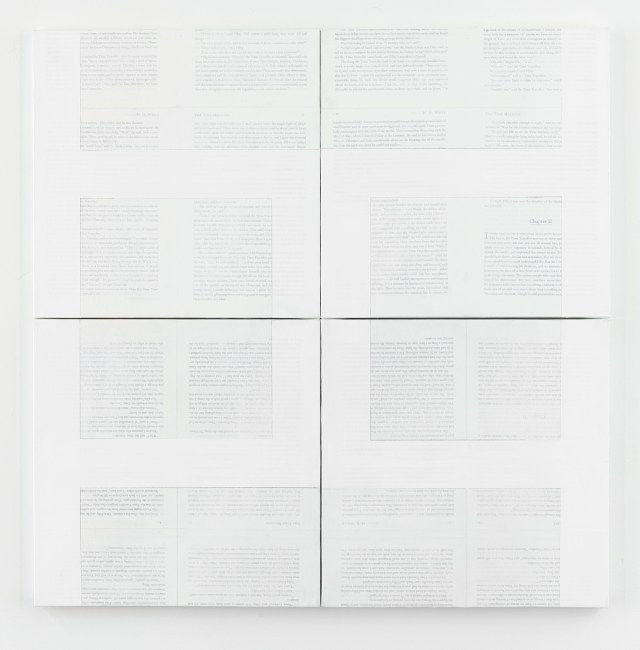
But back to the white works of art at the MARC STRAUSS gallery. Book art is not entirely neglected. Following in their tradition since 1984, Tim Rollins and K.O.S. (“Kids of Survival”) pondered, discussed and “jammed” on 1895 novella by H.G. Wells to produce THE TIME MACHINE (after H.G.Wells), which is included in the exhibition.
THE TIME MACHINE (after H.G. Wells) Tim Rollins and K.O.S., 2013 Matte acrylic, pencil, book pages on canvas 4 parts, each: 12 x 12 inches / 30.5 x 30.5 cm Overall: 24 x 24 inches / 61 x 61 cm Courtesy Studio K.O.S. and Lehmann Maupin, New York and Hong Kong.
According to the artists, “We believe that every total work of art is a time machine – a synthesis of a living past and present located in an object that can only be completed by the social experience of a viewer in the future. The total work of art exists in the invisible fourth dimension of space/time and it is this notion that unites the works in the exhibition. We paint on historic texts in the present so that they can haunt our futures.”
Suitably prepared? Jump in your time machine and head over to 299 Grand Street, on the Lower East Side in New York, and immerse yourself in “The White Heat“.
Paul Forte has assembled a display of his own bookworks and those of Doug Beube, Claire Dannenbaum, Donna Ruff, Jacqueline Rush Lee and Irwin Susskind for the Hera Gallery, Wakefield, RI, June 15 to July 13.
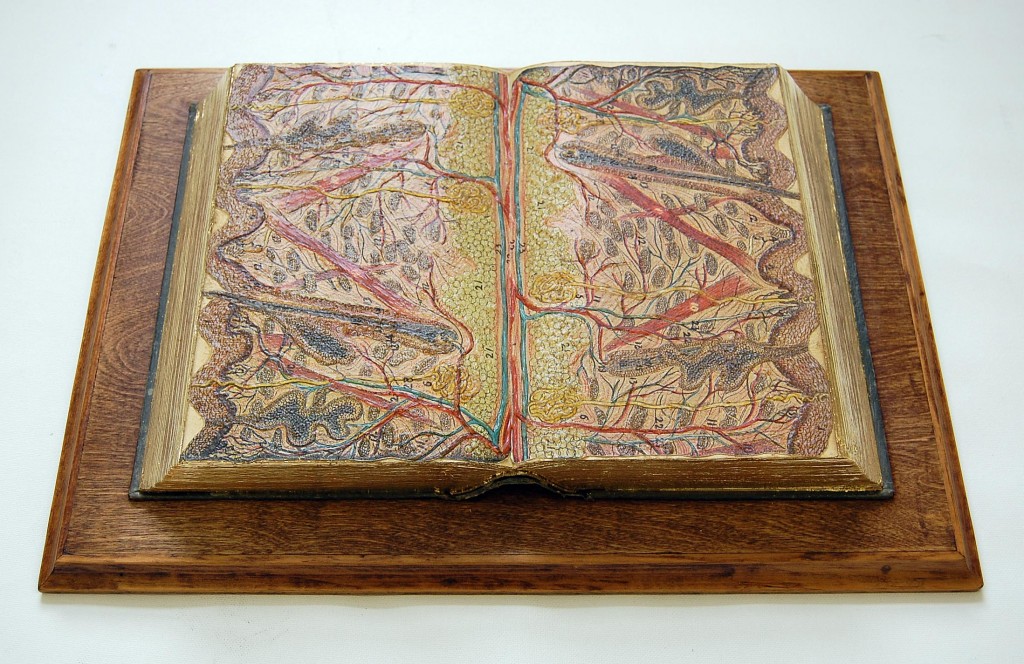
“Liber Dermis (Skin Book),” Paul Forte, 2008 Medical illustrations (human skin cross section) on sealed medical book, mounted on wood, 17 1/2 x 12 1/2 x 3/4 inches
Douglas Glover’s Numéro Cinq provides an excellent venue for Forte’s introduction to this exhibition and additional photographs of items with artists’ statements. If you cannot go to Rhode Island, visit Numéro Cinq.
Photograph of Hera Gallery’s exterior (Photo credit: Wikipedia)






 Books On Books