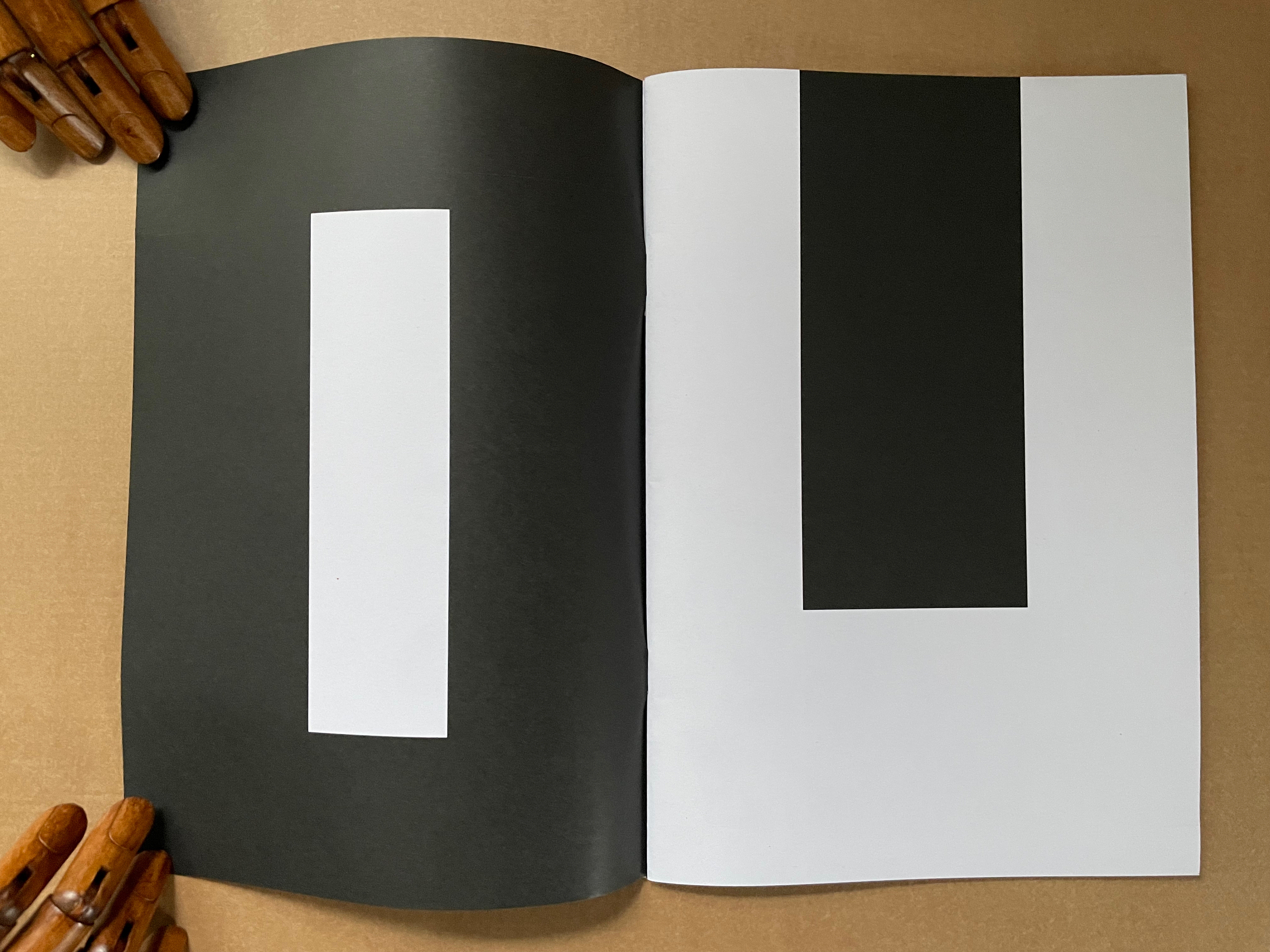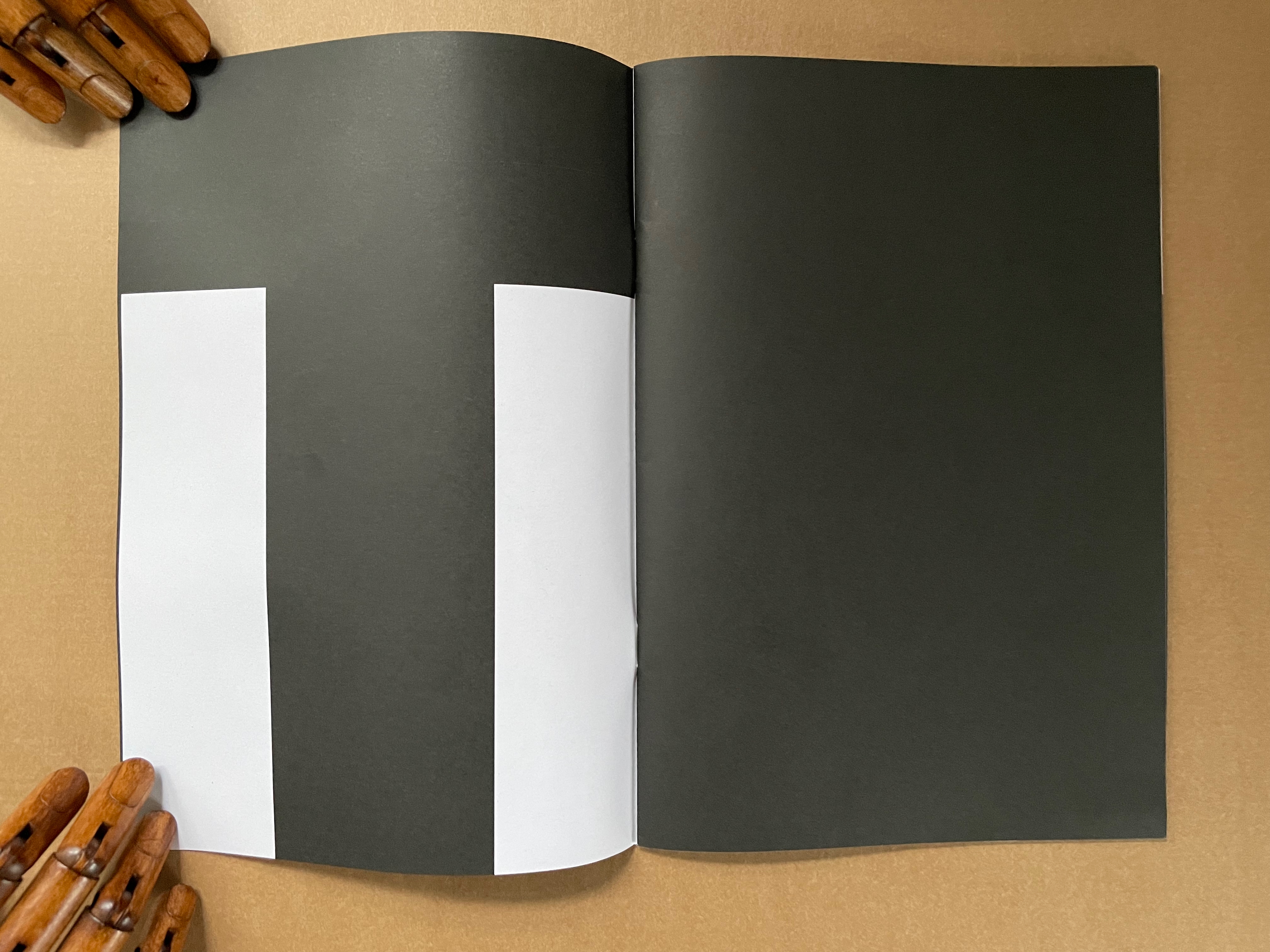
Books On Books Collection – Chisato Tamabayashi (II)

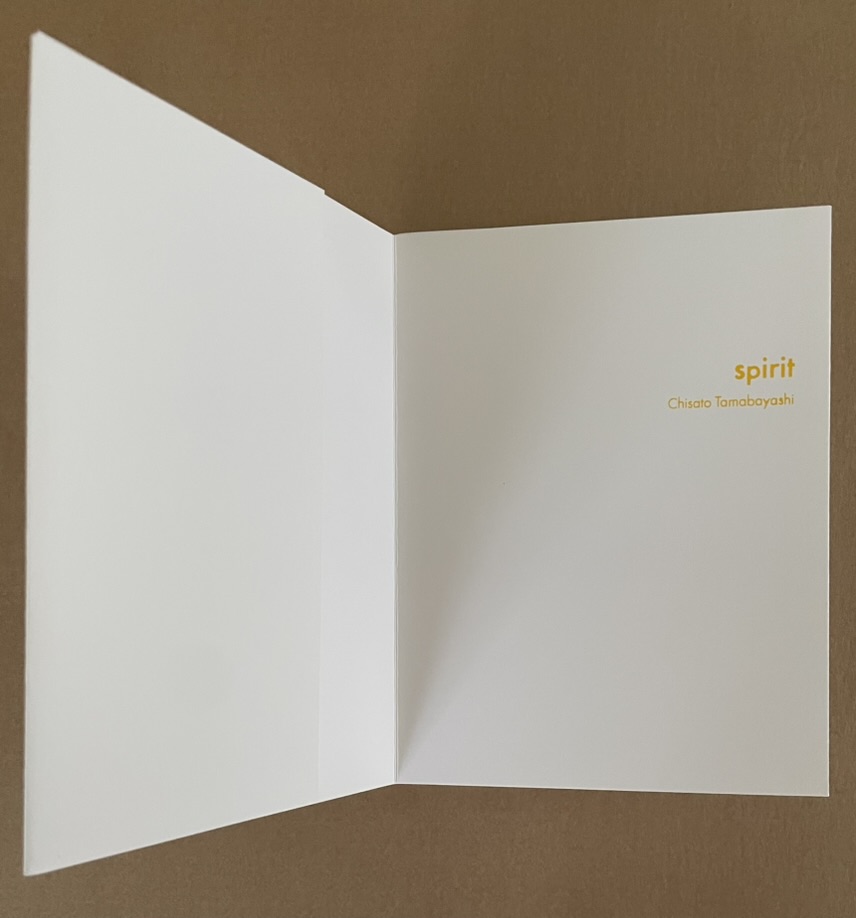
Spirit (2024)

Spirit (2024)
Chisato Tamabayashi
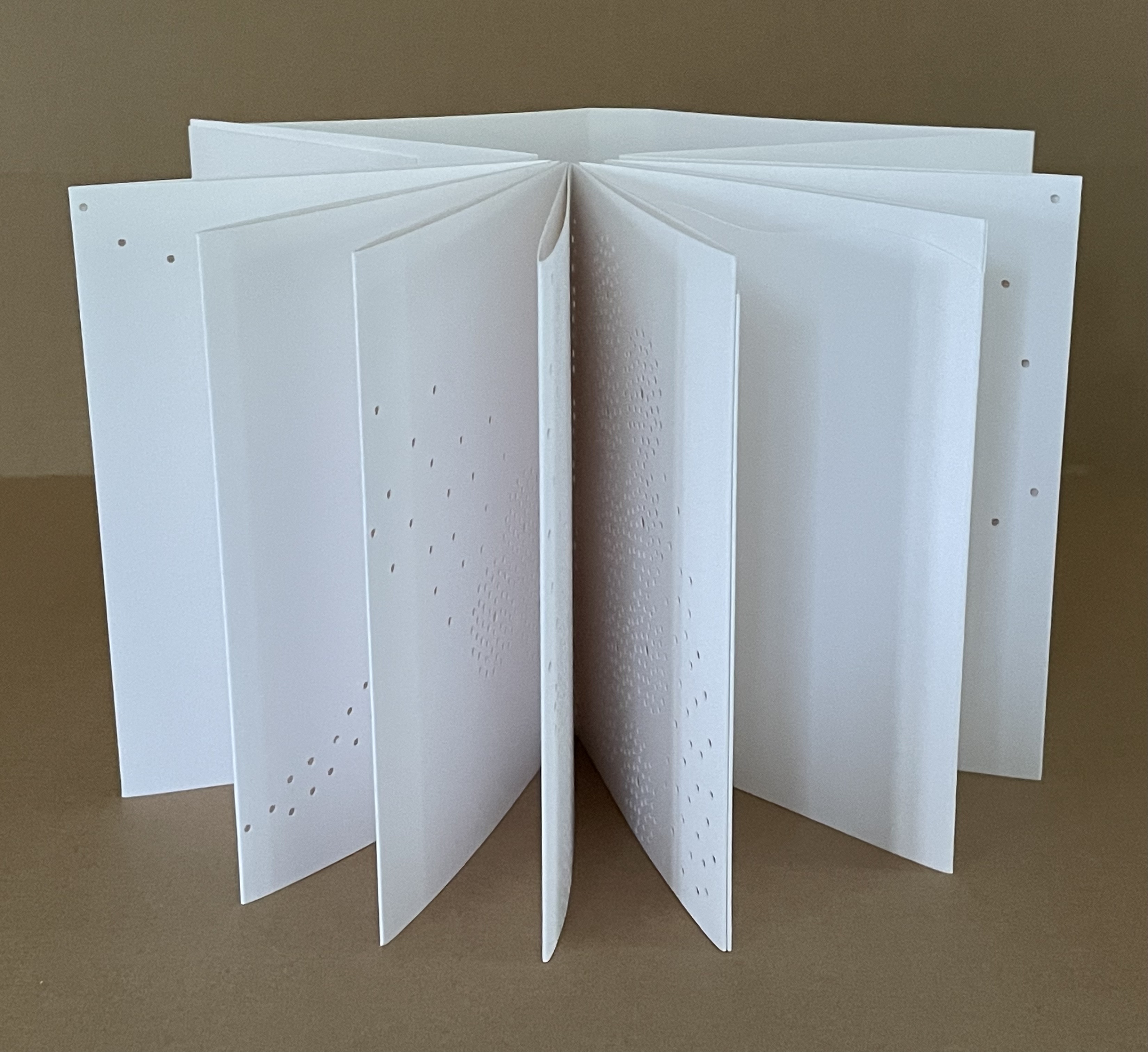
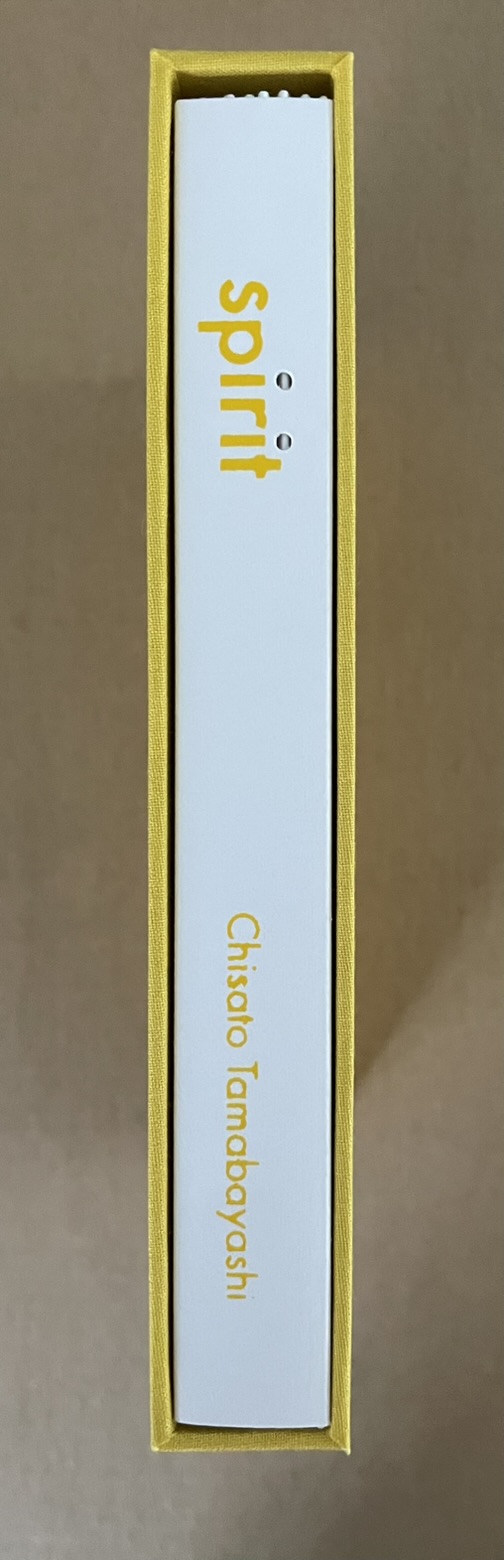
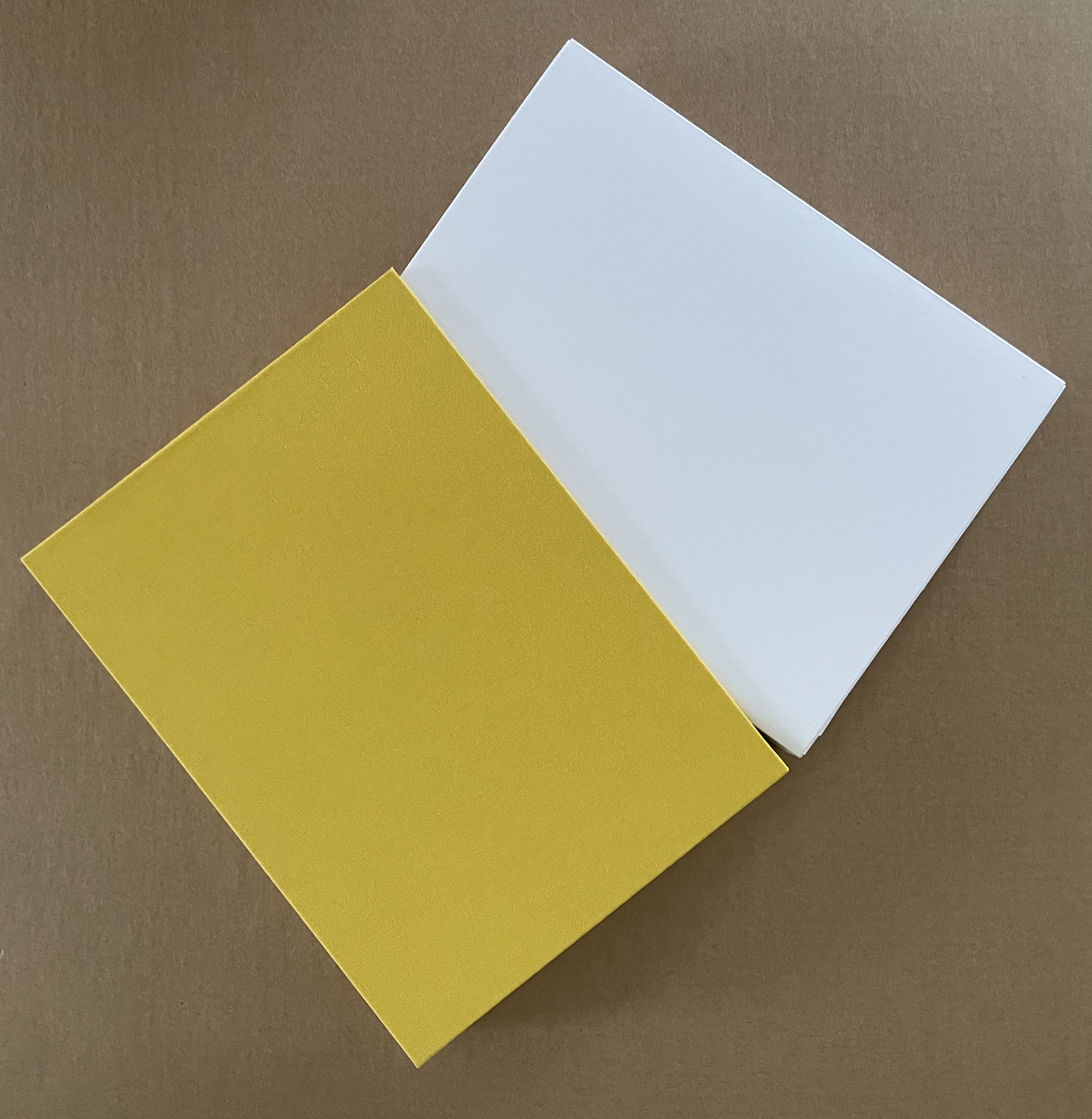
Yellow cloth-covered slipcase. Leporello of 8 panels and enclosing cover. Slipcase: H168 x W129 x D24 mm. Book: H160 x W120 mm (closed); W2100 mm. 16 panels (excluding enclosing cover). Edition of 60, of which this is #2. Acquired from Chisato Tamabayashi, 5 November 2024. Photos: Books On Books Collection.

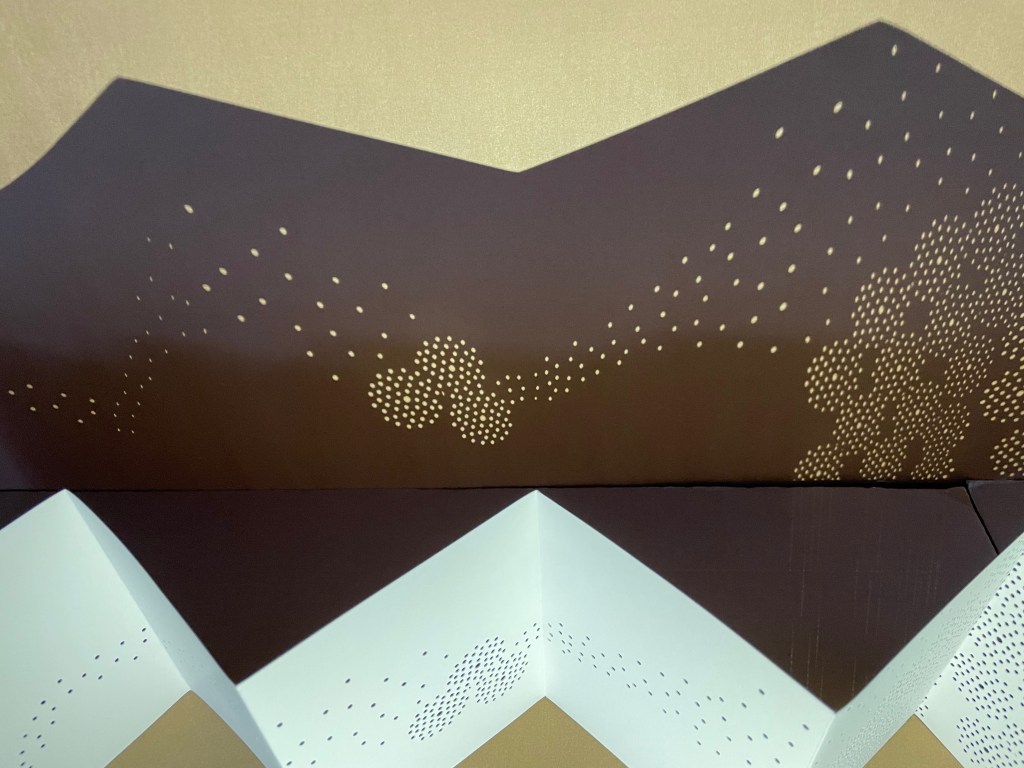
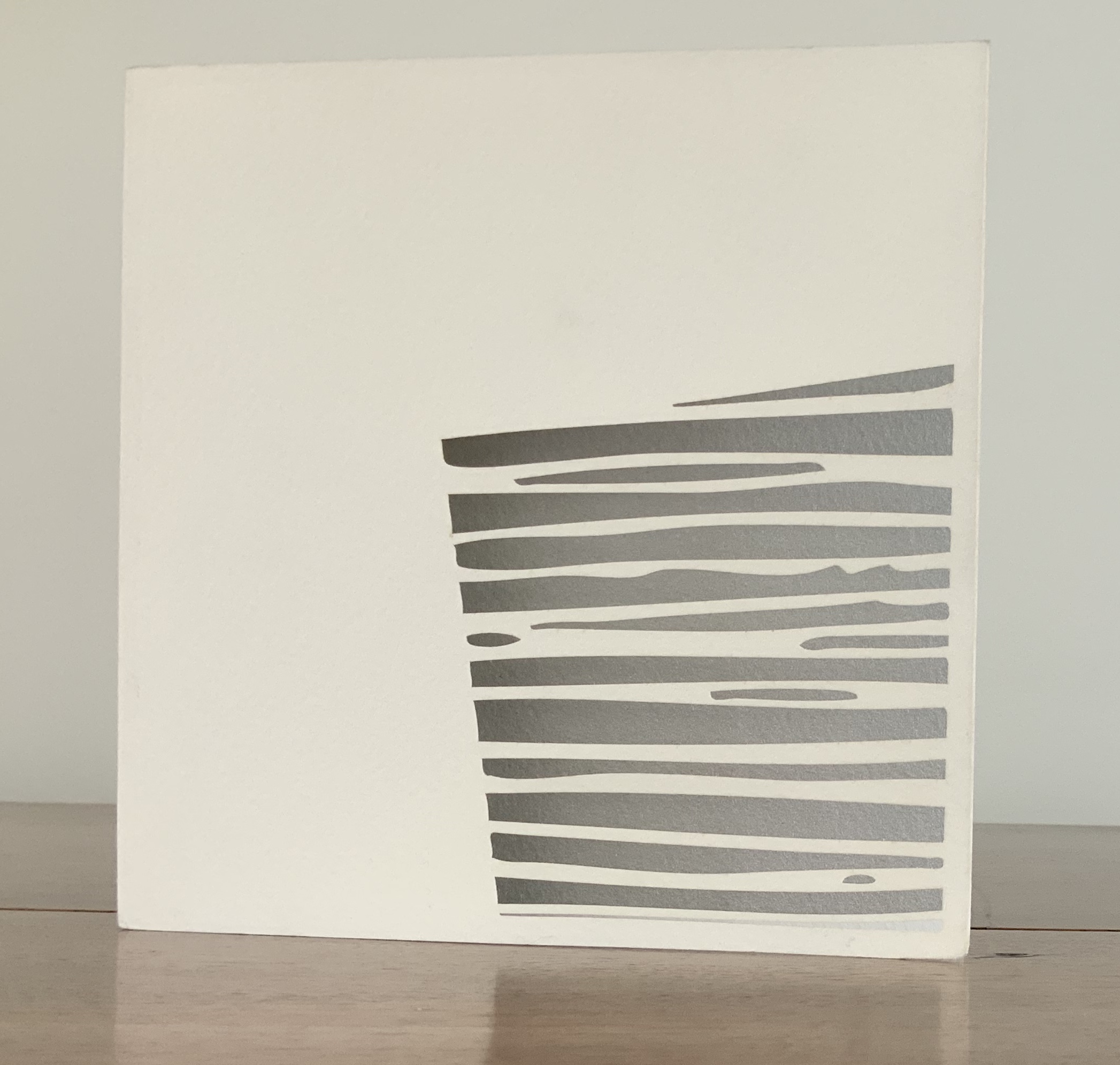
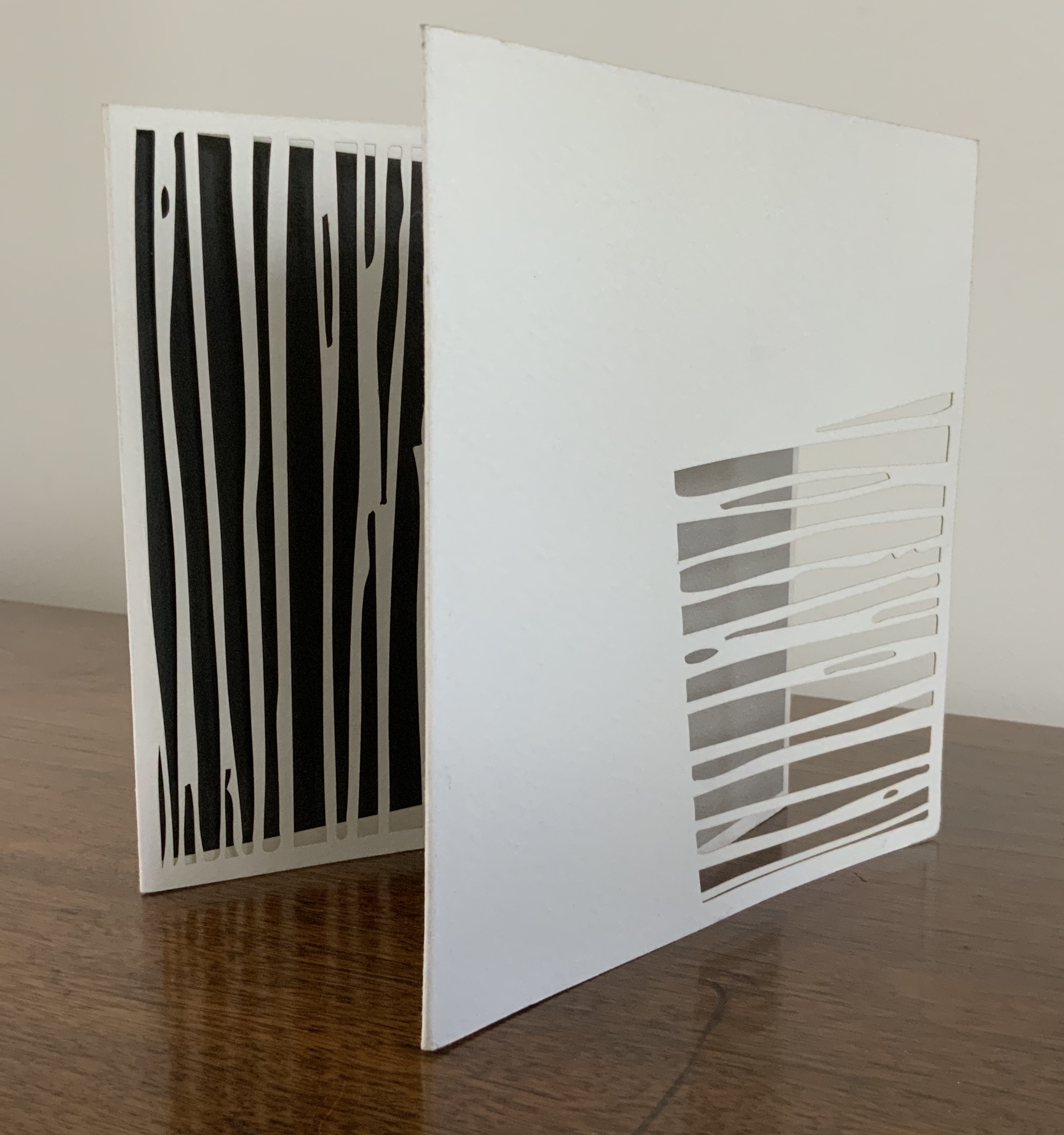
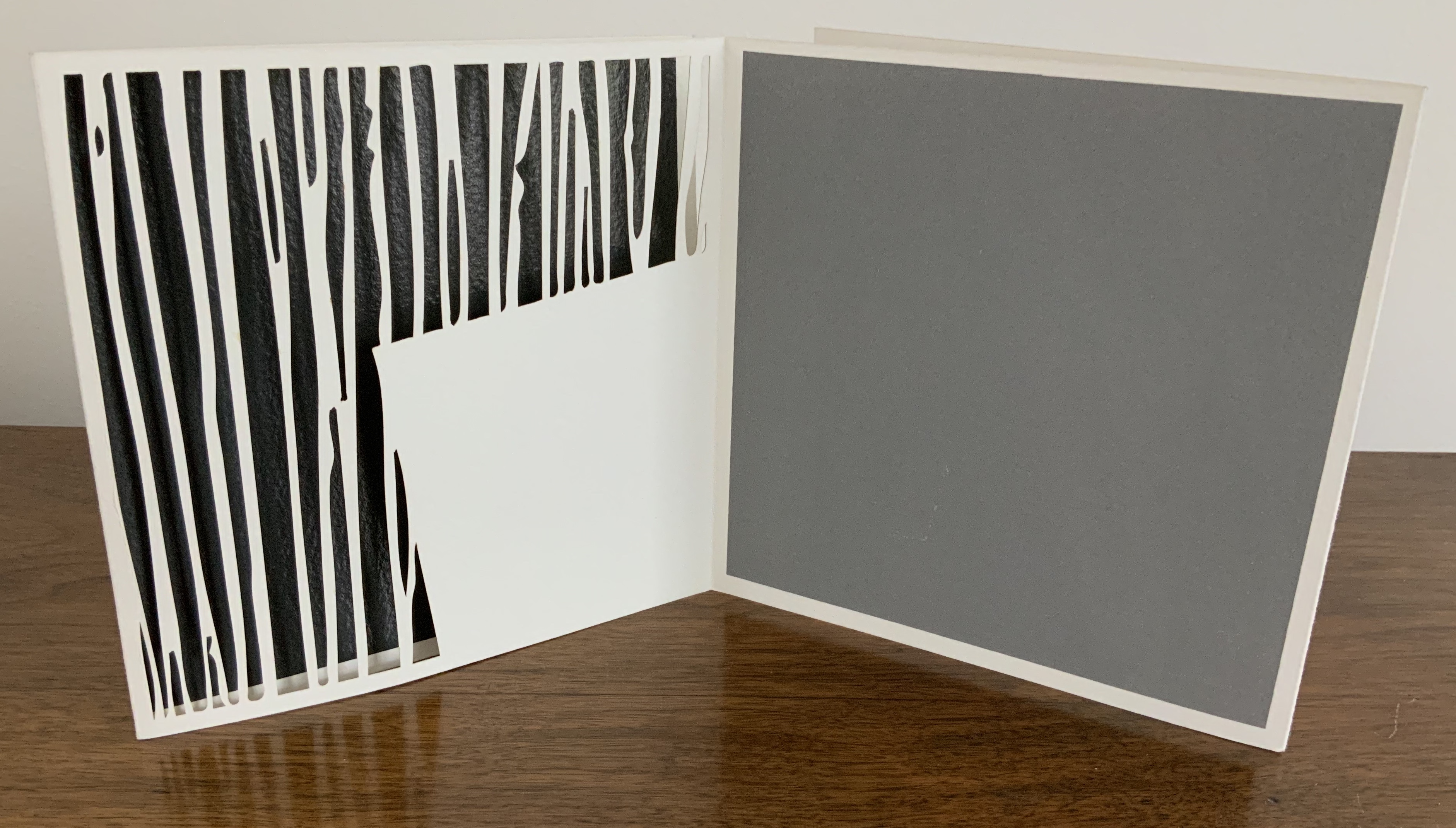
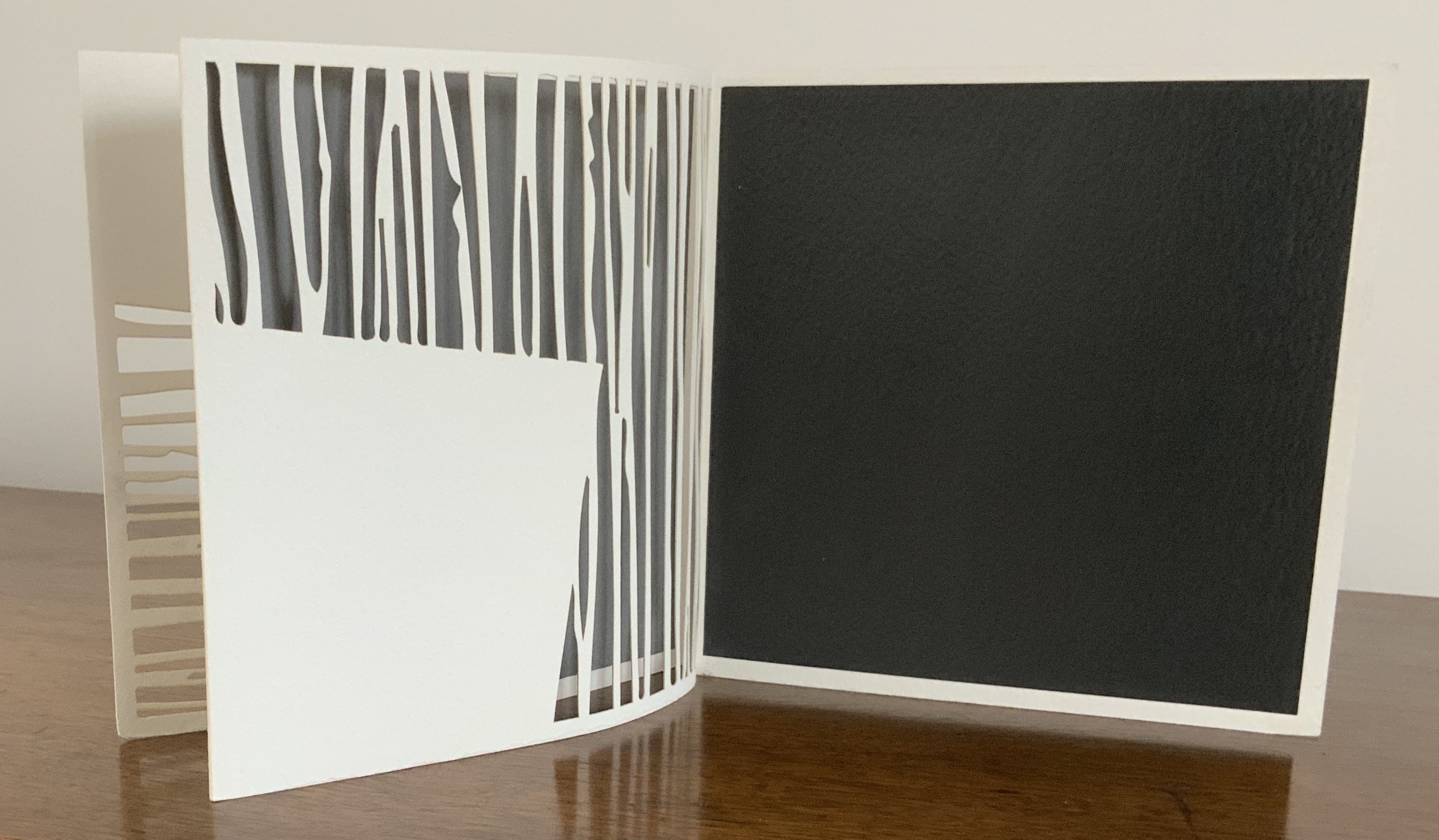
Chisato Tamabayashi’s leporello Spirit departs from her usual paper-engineering techniques. It relies on hole punching, paper sculpture, and display with light. Her crossover in techniques will remind close observers of Katsumi Komagata’s movement from Little Tree/Petit arbre (2008) to「Ichigu」(2015).

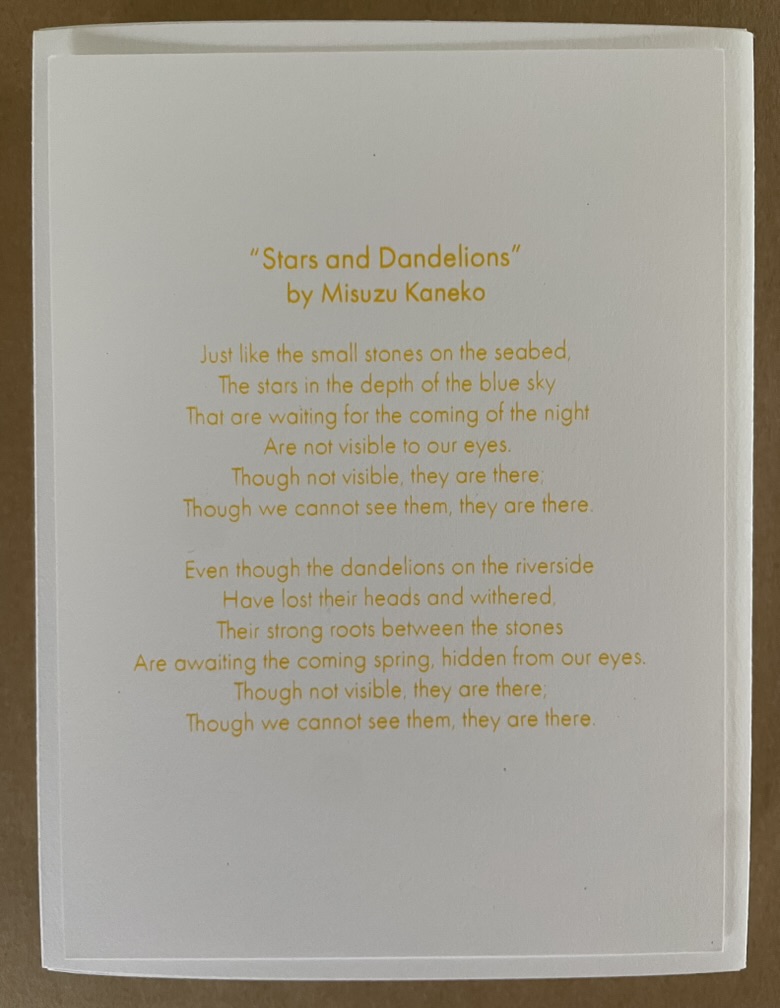
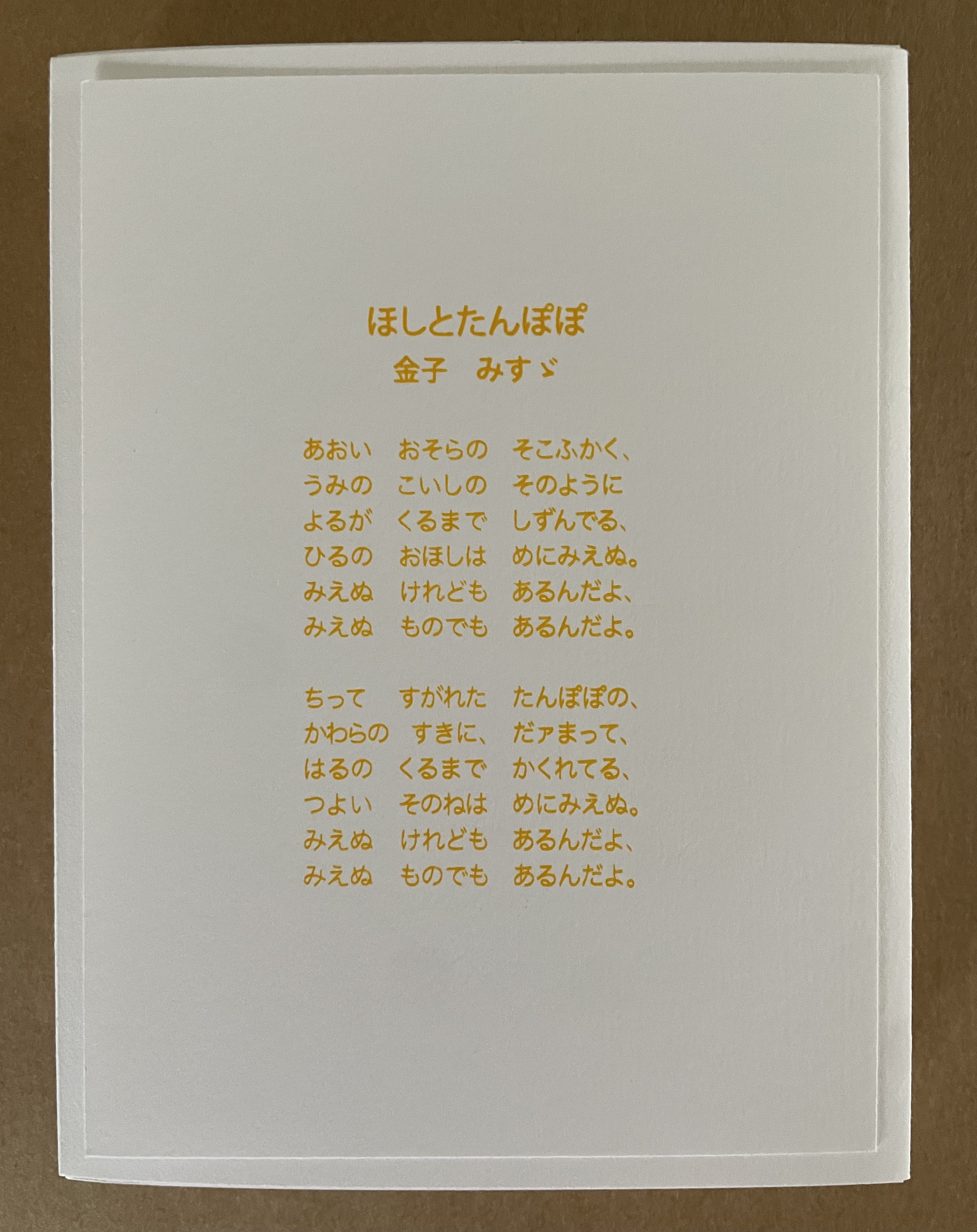
Spirit is accompanied by the 20th century poet Misuzu Kaneko‘s poem “Stars and Dandelions” (in English and Japanese) from which Tamabayashi has taken her inspiration.
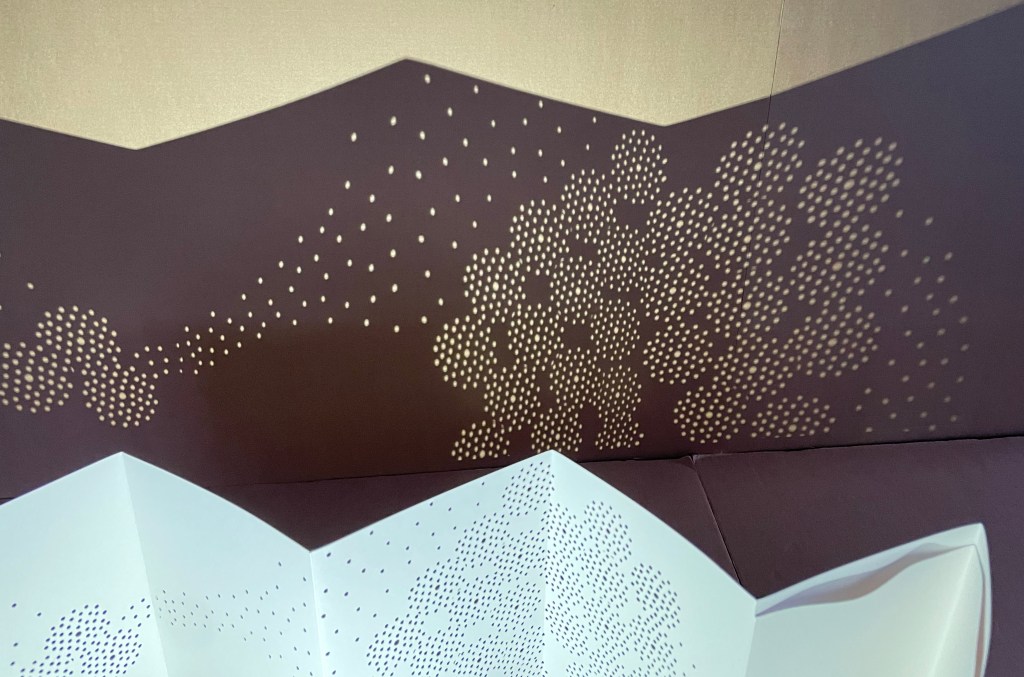
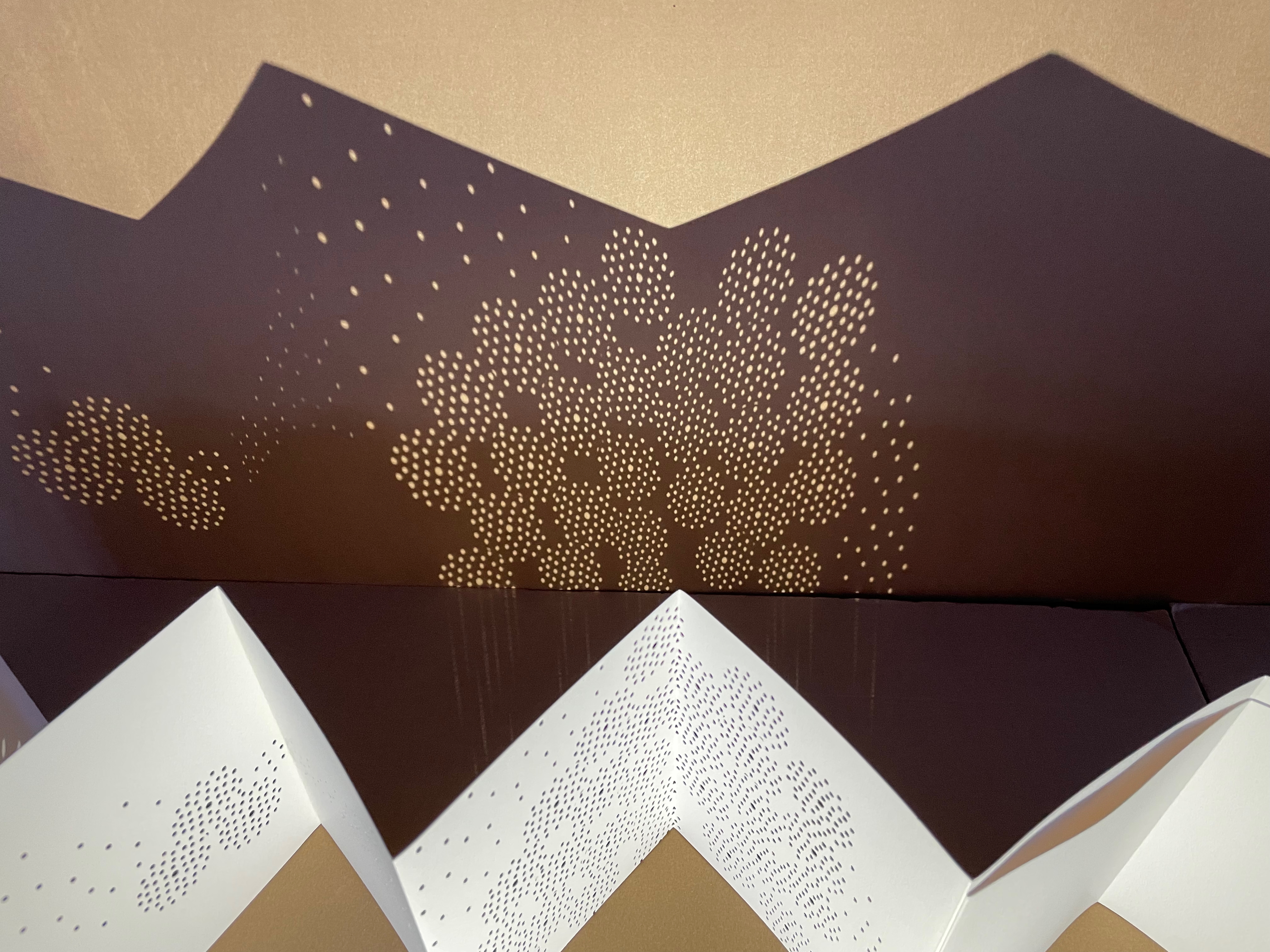
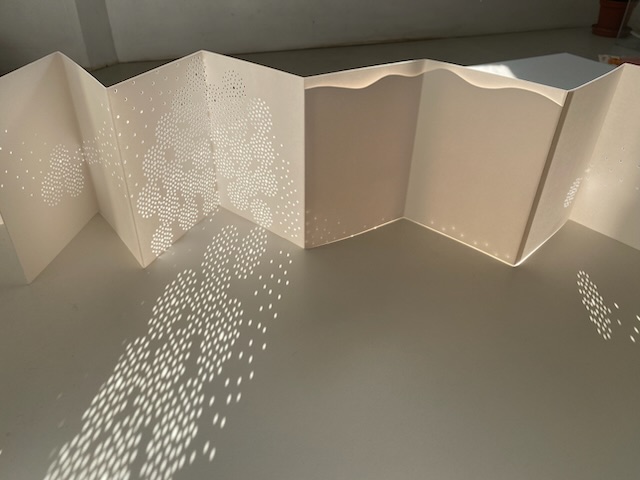
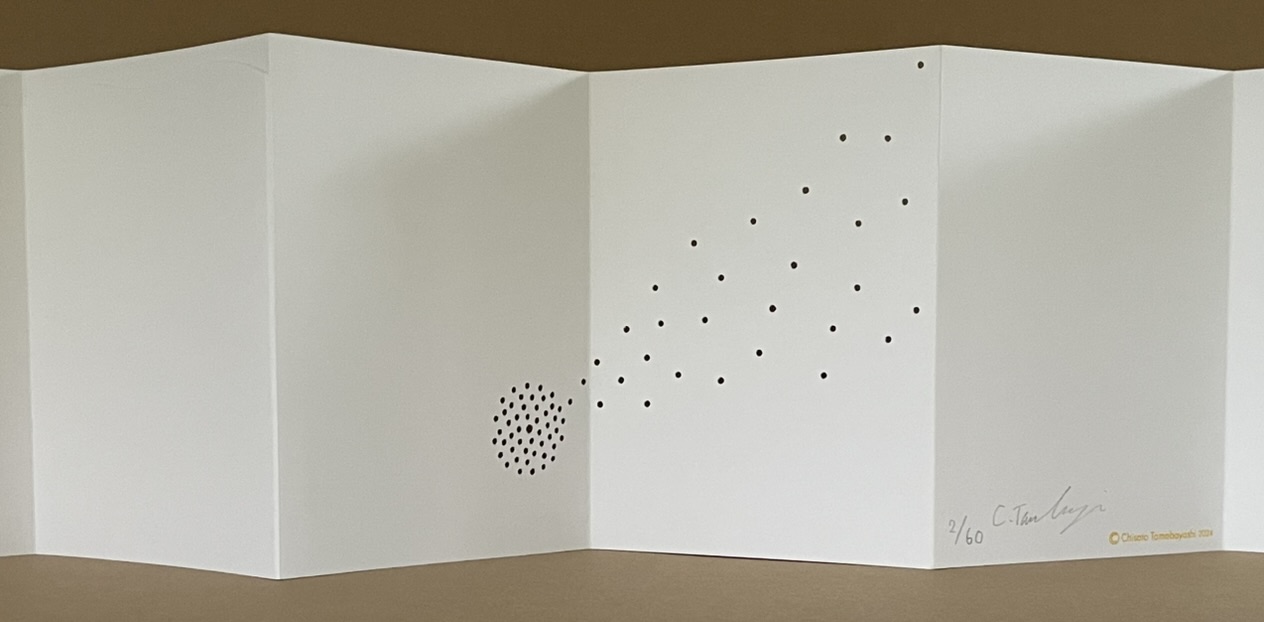
Viewed standing or lying flat, the leporello’s arranged holes echo the seeds leaving the dandelion heads bare in the second stanza of the poem.

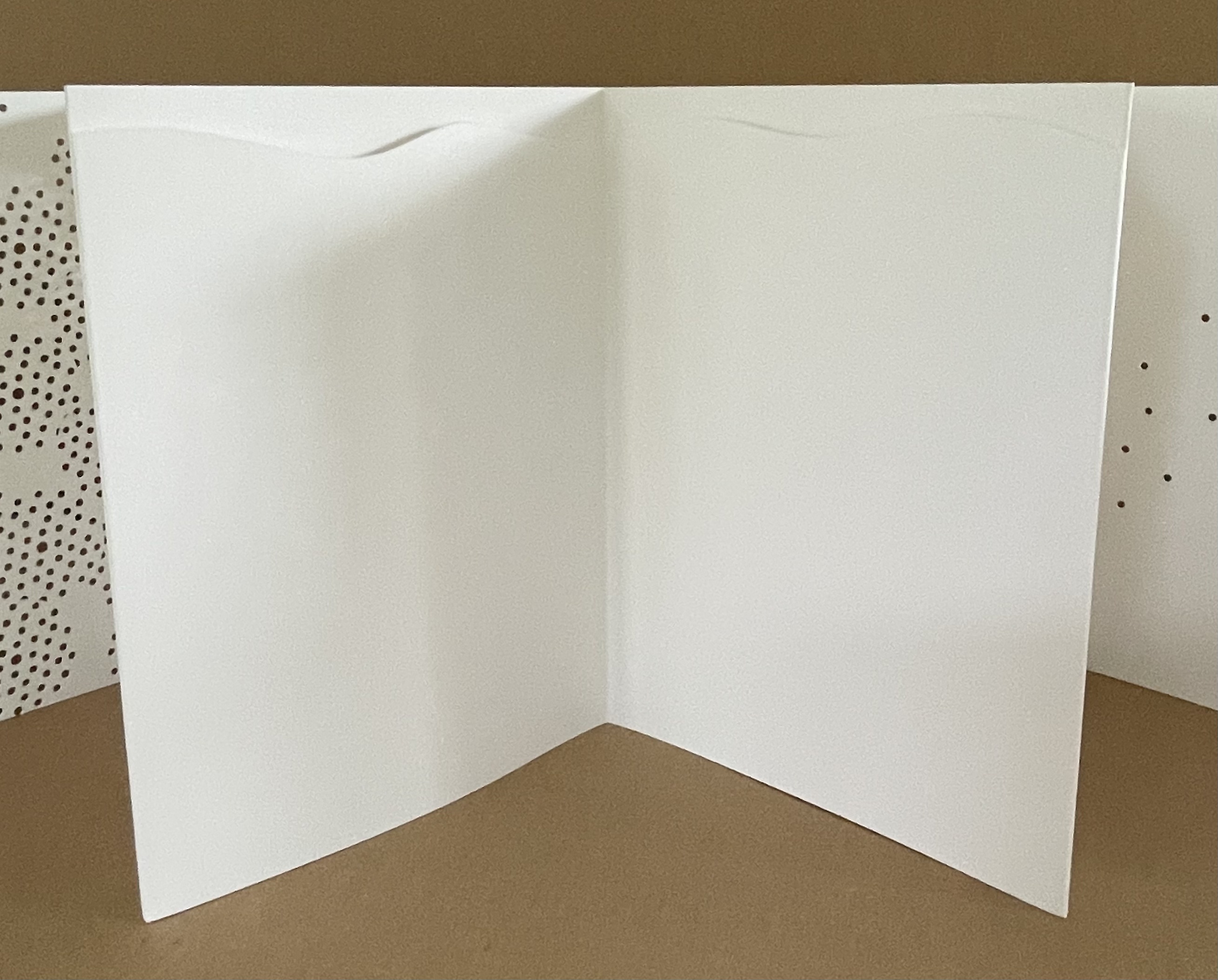
Just before the last spread of imagery, the upper edge takes on the shape of the ocean surface beneath which the stones mentioned in the first stanza lie.
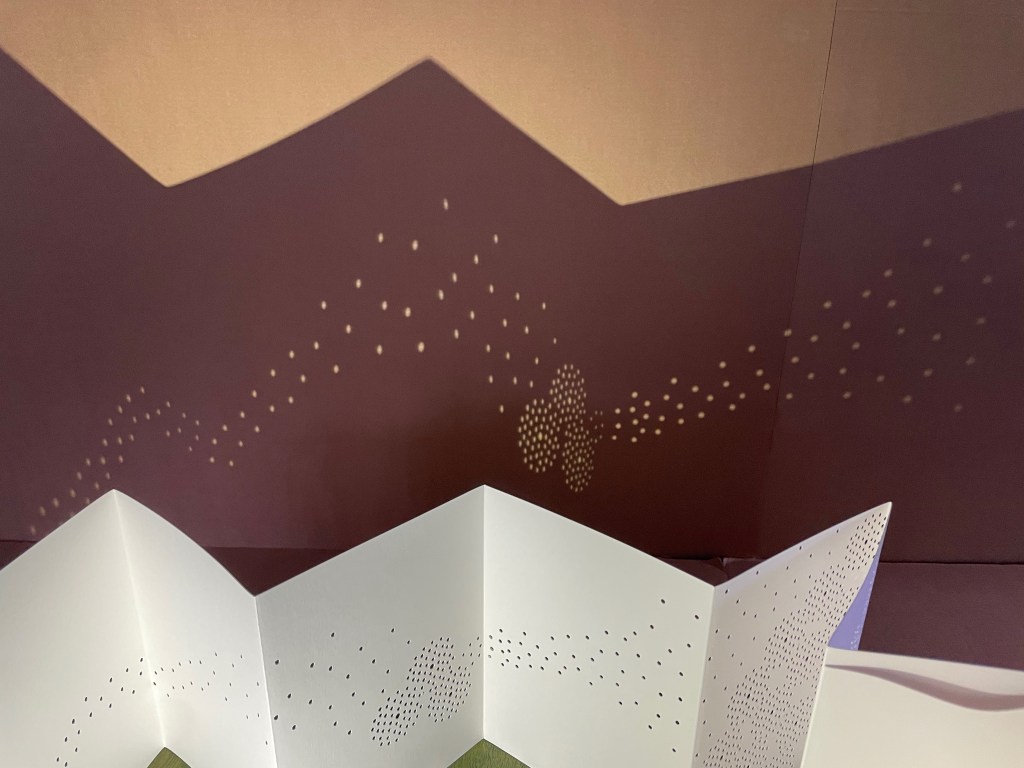
A projection to the background echoes the stars from the first stanza of the poem.
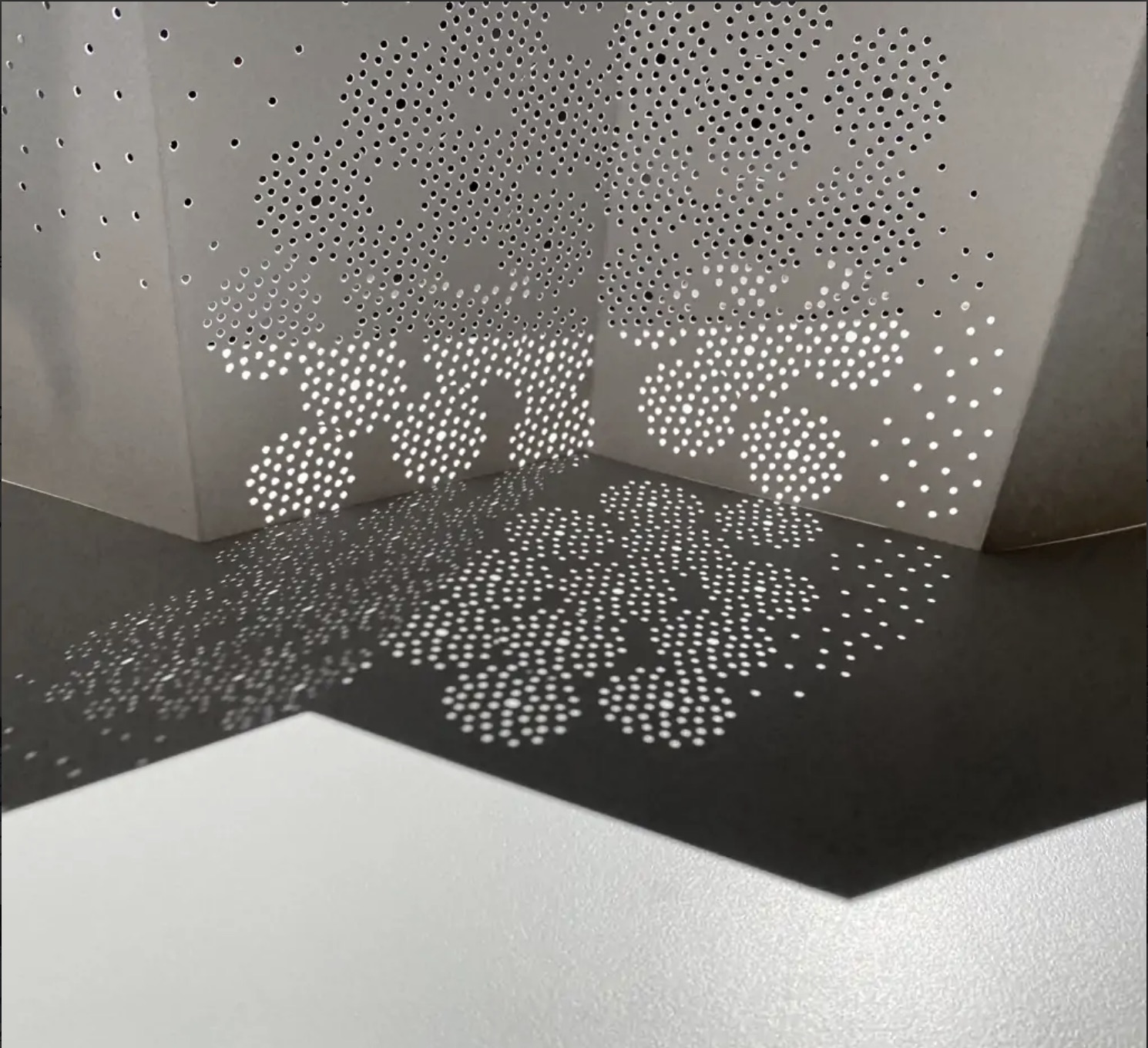
A projection to the foreground echoes the stones on the seabed from first stanza of the poem. Photos: Courtesy of the artist.

Like Misuzu Kaneko’s poetry, Chisato Tamabayashi’s artwork appeals to children and adults, underscoring the link between children’s books and artists’ books explored so well by the Huberts in The Cutting Edge of Reading, Johanna Drucker in “Artists’ Books and Picture Books”, and Sandra Beckett in Crossover Picturebooks.

Tamabayashi’s and Komagata’s handling of holes, paper engineering, and display with light should be considered alongside the efforts of the book and paper artists’ explored in the second issue of Inscription as well as those of Eleonora Cumer and Jenny Smith.

Further Reading

Inscription 2 on Holes“. 29 May 2022. Books On Books Collection.

Katsumi Komagata (I)“. 22 March 2020. Books On Books Collection.

Eleonora Cumer“. 6 September 2019. Books On Books Collection.

Jenny Smith“. 31 July 2017. Books On Books Collection.

Chisato Tamabayashi (I)“. 27 August 2024. Books On Books Collection.

Beckett, Sandra L. 2013. Crossover Picturebooks : A Genre for All Ages. London: Routledge.

Drucker, Johanna. 2017. “Artists’ Books and Picture Books: Generative Dialogues” in The Routledge Companion to Picturebooks, edited by Bettina Kümmerling-Meibauer. London: Taylor & Francis Group.

Hubert, Renée Riese and Judd D. Hubert. The Cutting Edge of Reading: Artists’ Books. New York: Granary Books, 1999.
Books On Books Collection – Julien Nédélec

Because he works with so many different materials, it is hard to classify Julien Nédélec as an artist: A polyfabricant? With language play being a more or less constant theme: A polywright? His website labels him a plasticien, the perfect French word that captures more of the media in which he works than its usual translation “visual artist” does. In Zéro2, Antoine Marchand writes:

Everything, with him, is subject to manipulation, appropriation, and diversion, at times in the most trivial and basic way imaginable. His work is based on permanent mischief, a desire to destabilize the viewer, and be forever creating a slight discrepancy, which barely ruffles the reading of the work—well removed from the showiness of many present-day productions. He bypasses the daily round and takes us towards somewhere else that is not that far away, but all the more joyful. … What should incidentally be underscored in this young artist’s praxis is his ability to move from one medium to another, without the slightest bother or apprehension. It is impossible to pigeonhole Julien Nédélec’s praxis in any one particular medium.

Several of his works have been hosted on the Greek island of Anafi by the Association Phenomenon and the Collection Kerenidis Pepe, whose website also notes that his

practice can take many forms, from sculpture to drawing, through books and photography, with a predilection for the paper, that he uses not only as a support, but also as a material that he bends, cuts, colors, stacks or crumples. His works are the result of linguistic and formal games that reveal the artist’s fascination with the potentialities of language, with a malice that places him as an heir apparent of the Oulipo, while his taste for geometric and serial shapes brings him closer to the tradition of minimalism.

With paper as a favorite medium, there are a handful of artist’s book among the many other forms. Taken together, his artist’s books almost make up an anthology of homage to book artists from the 1960s to the present. He also belongs to the school of appropriators embracing forerunners like Bruce Nauman, Richard Prince, and Richard Pettibone and contemporaries like Michalis Pichler, Antoine Lefebvre, and Jérémie Bennequin, all of whom have embraced the self-reflexive artist’s book as an appropriate medium for appropriation. No wonder Galaad Prigent’s Zédélé Éditions, the French publisher that hosts Anne Moeglin-Delcroix and Clive Phillpot’s Reprint Series of artists’ books, is so fond of his bookworks.

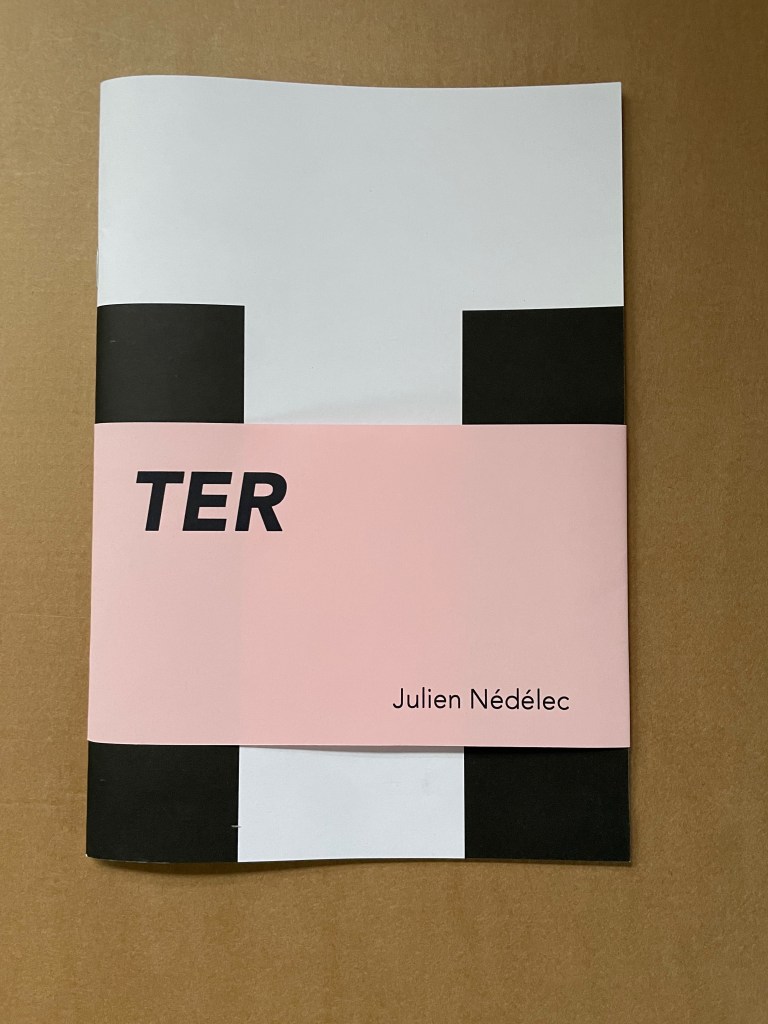
TER (2021)

TER (2021)
Julien Nédélec
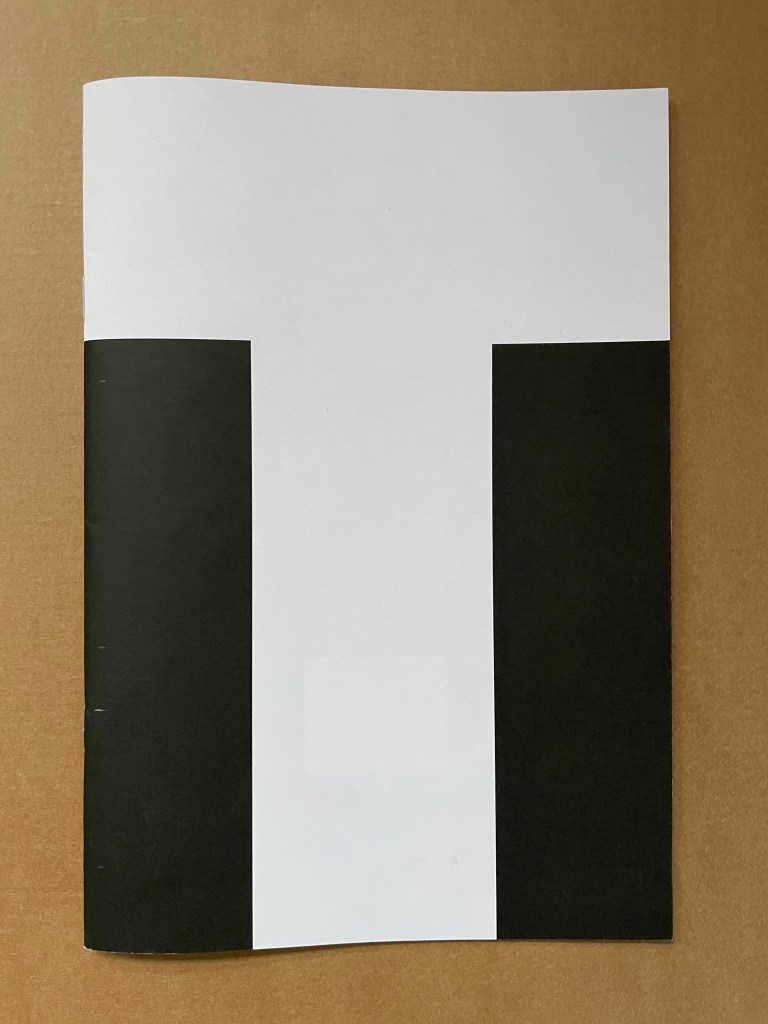
Softcover, saddle stitch with staples. H240 W165 mm. [36] pages. Acquired from Zédélé Éditions, 21 September 2024.
Photos: Books On Books Collection. Displayed with the artist’s permission.

“Tout”

The sentences to be deciphered from these full-page-bleed letters are Tout a été redit. Tout a été refait, which, in English, would be “Everything has been said. Everything has been done.” But it also has the echoes of a French children’s song, “Tout ce que je fais“:

Continue reading

Books On Books Collection – Jenny Smith

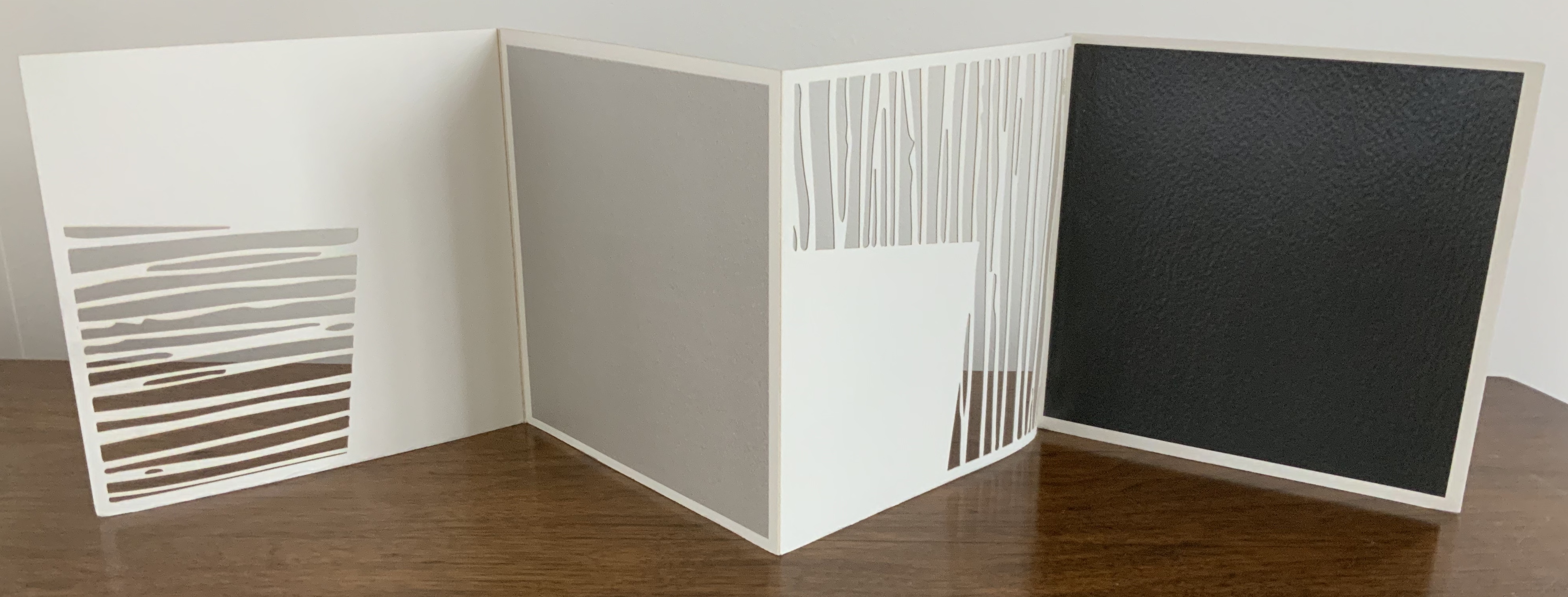
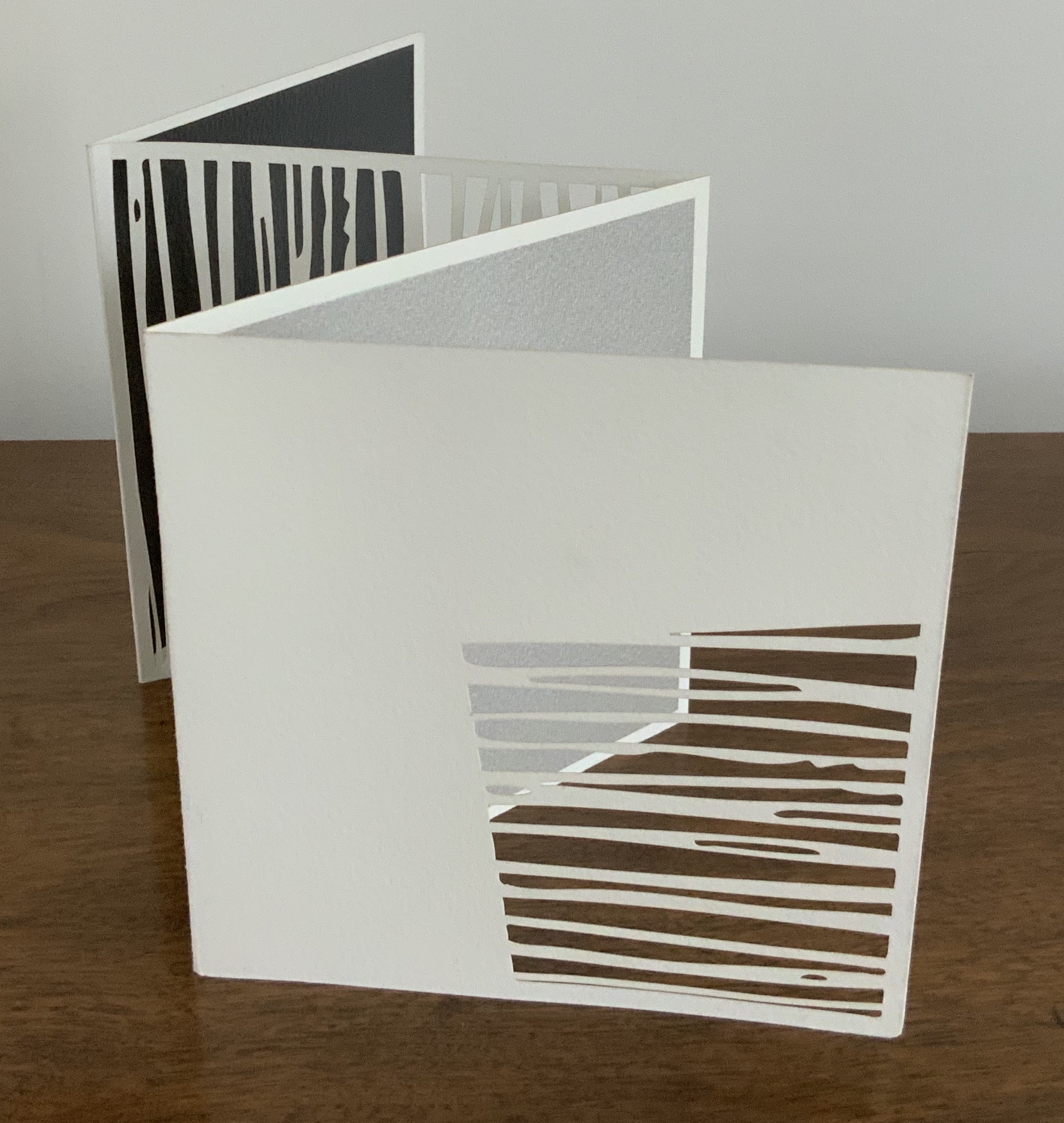
Untitled (2006)

Untitled (2006)
Jenny Smith
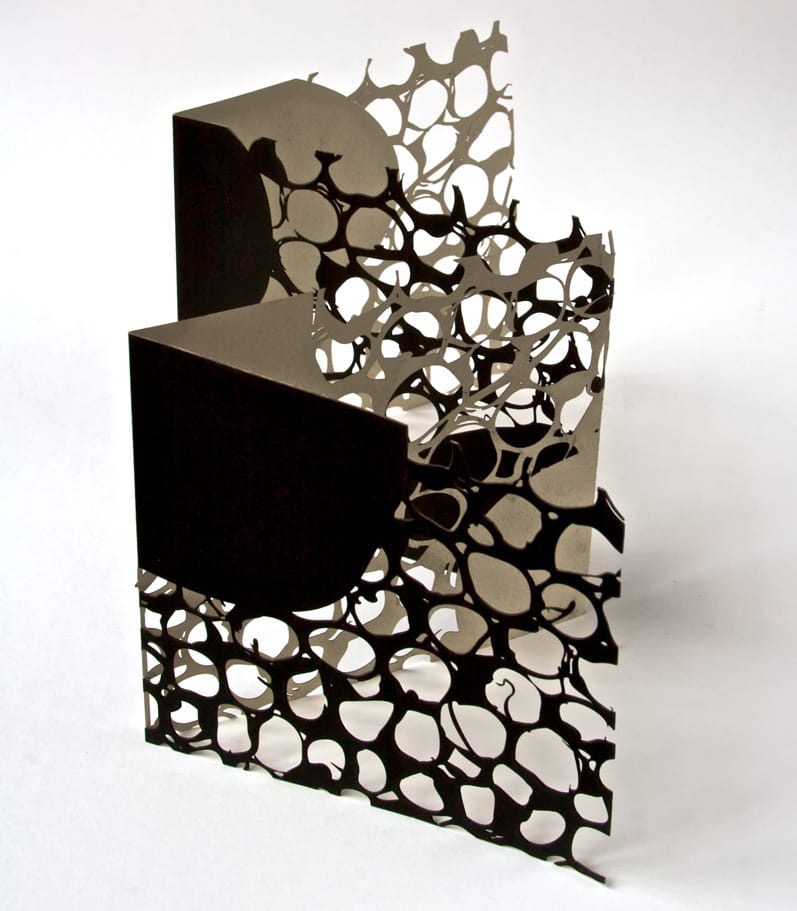
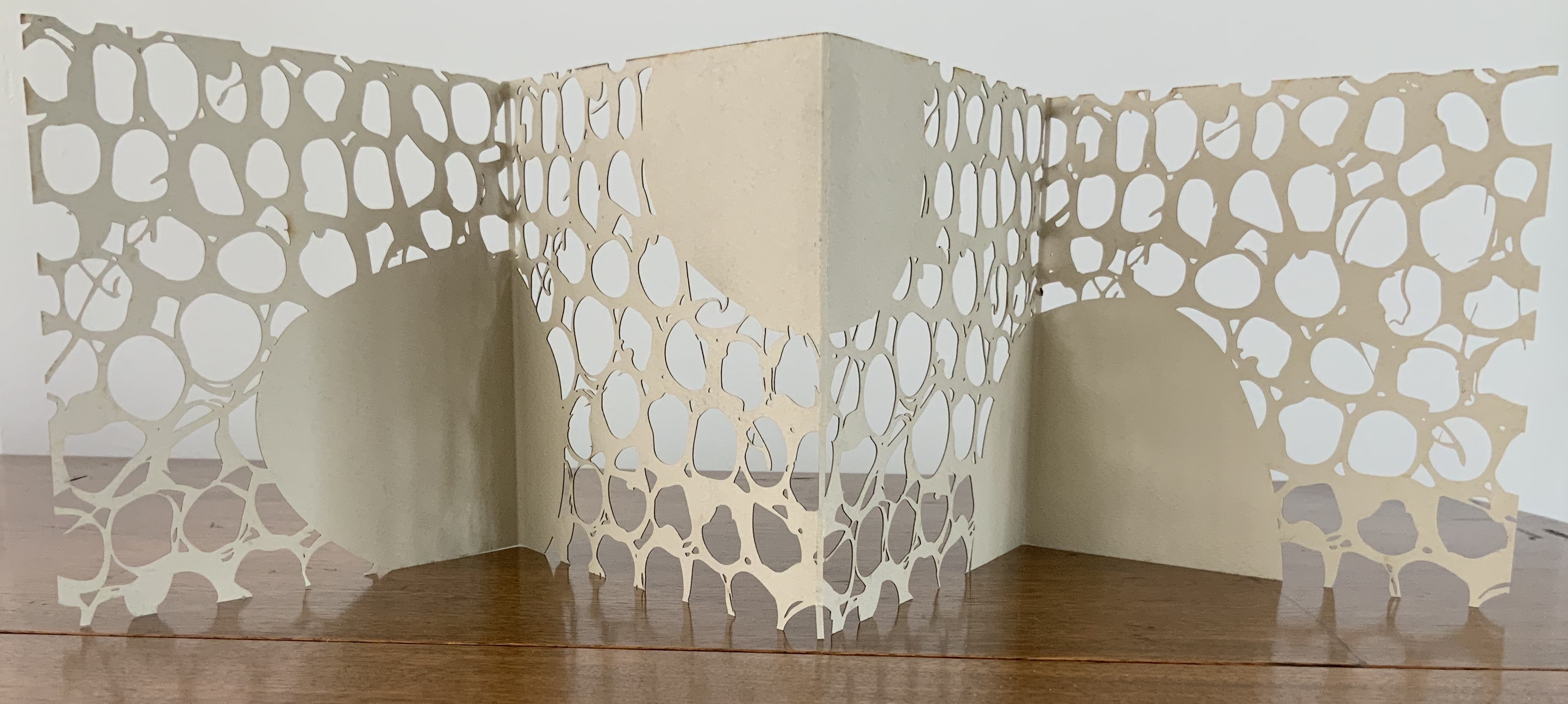
Matte-beige slot-and-tab case containing eight-panel leporello, four panels lasercut and three screenprint. Case: 167 x 167 mm; Book: 165 x 165 mm.
Edition of 25 of which this is #21. Acquired from the artist, 31 July 2017. Photo: Courtesy of the artist.

Photos: Books On Books Collection.

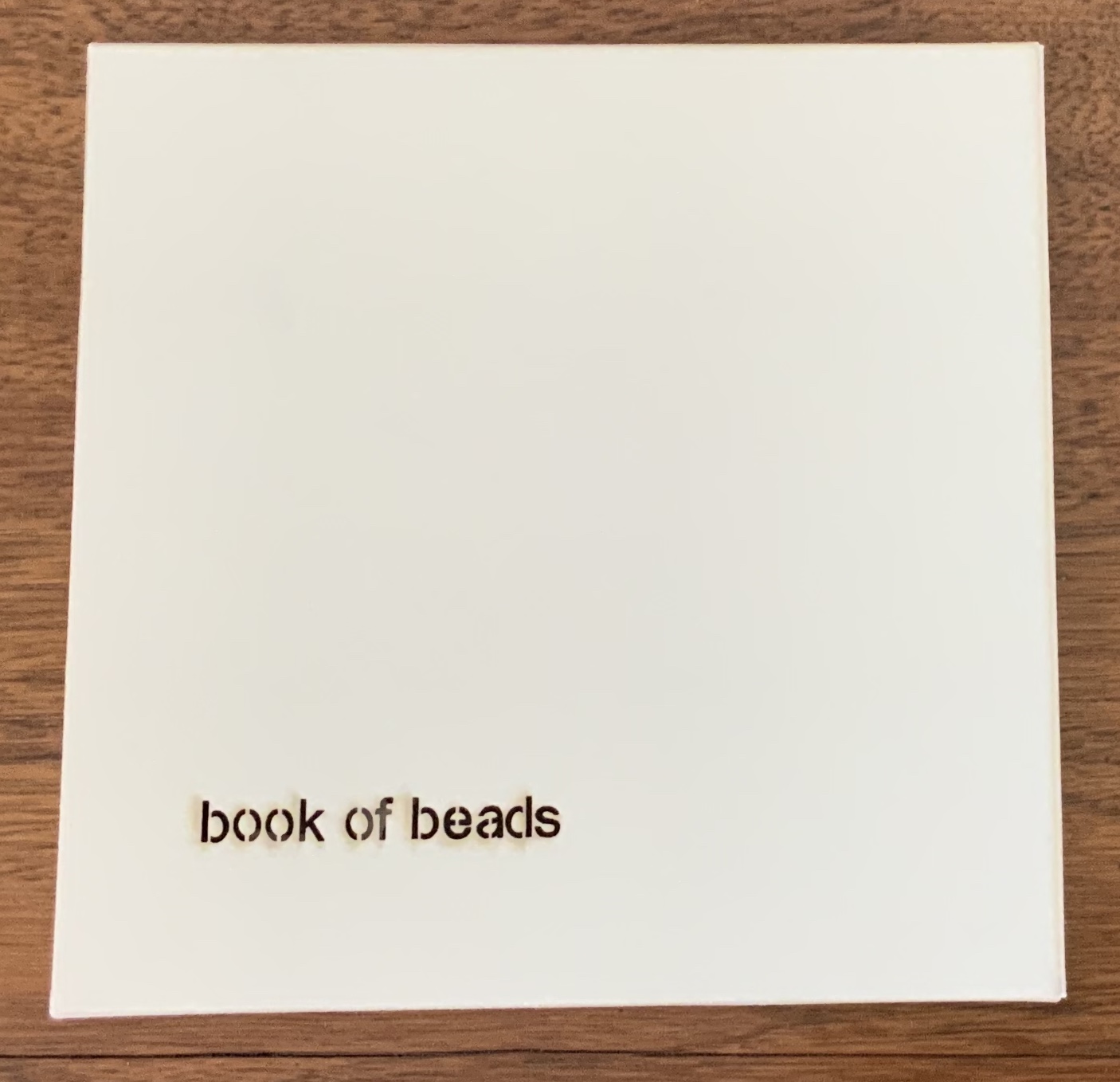
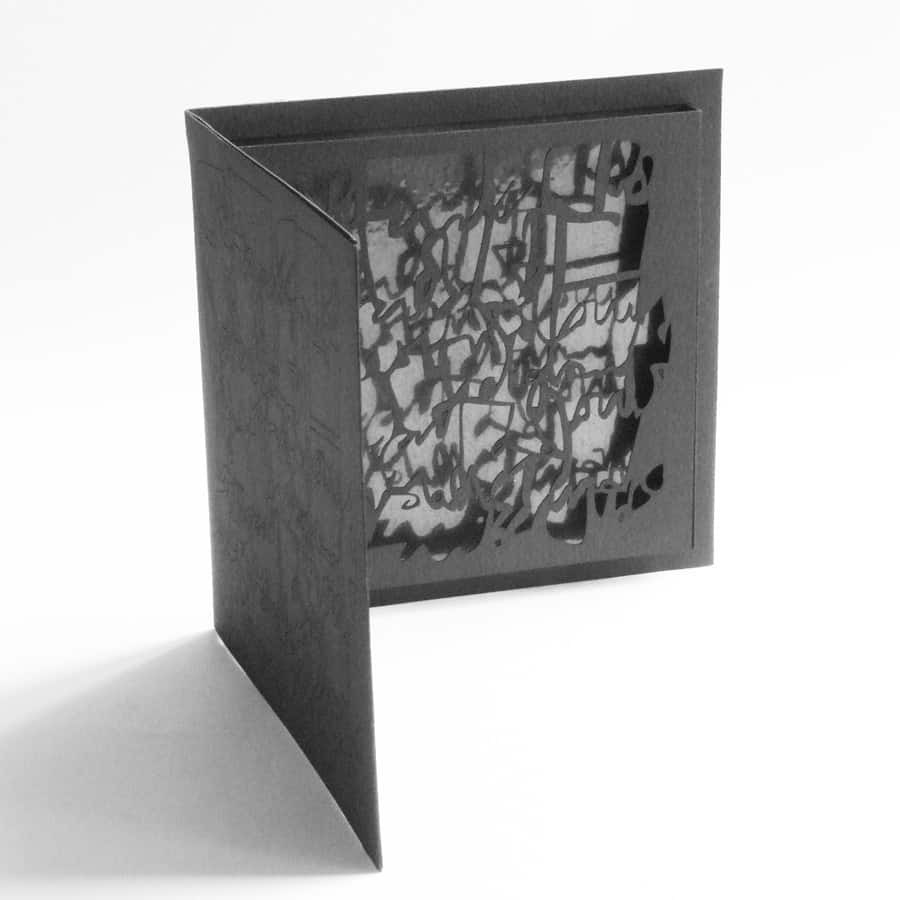
Book of Beads (2008)

Book of Beads (2008)
Jenny Smith
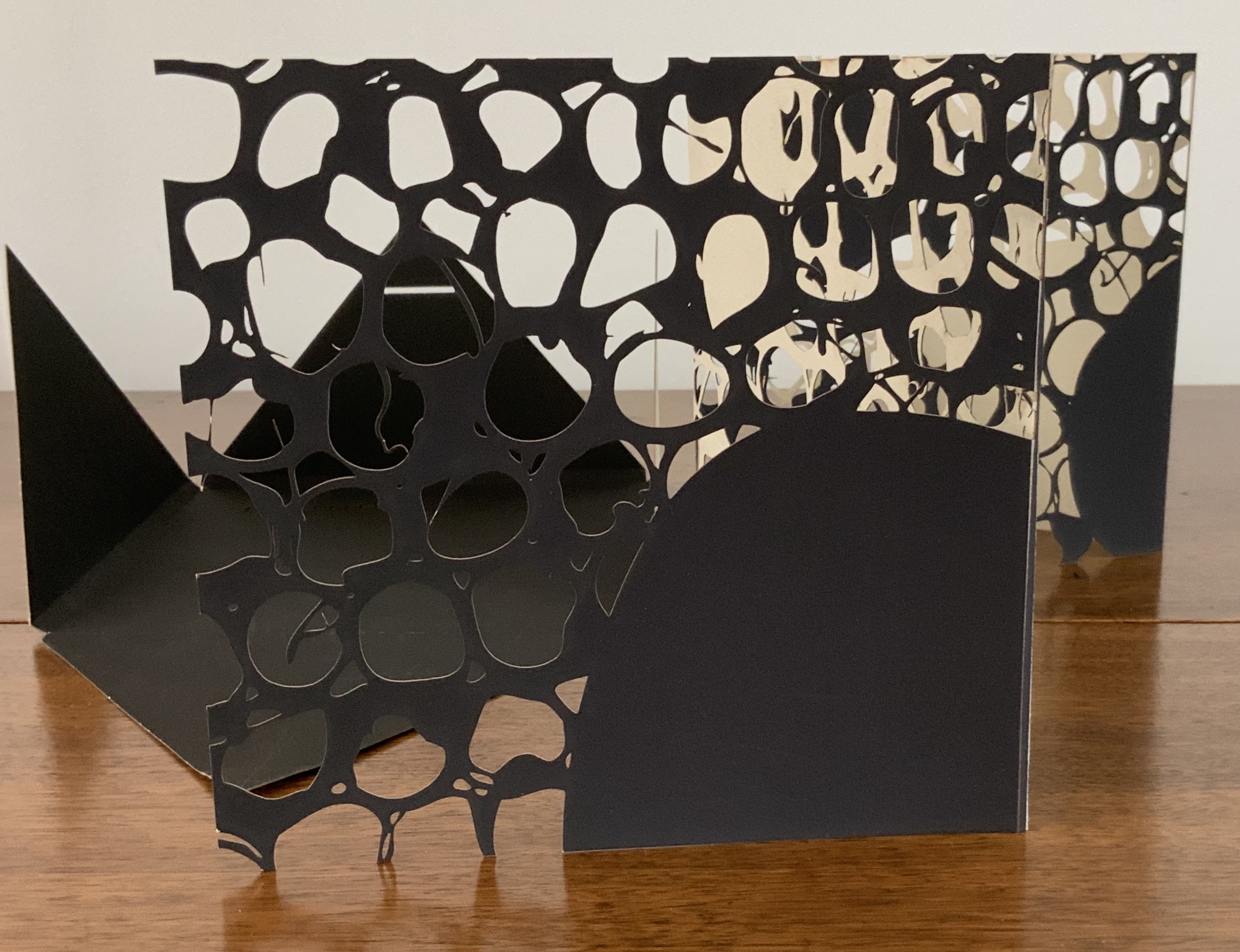
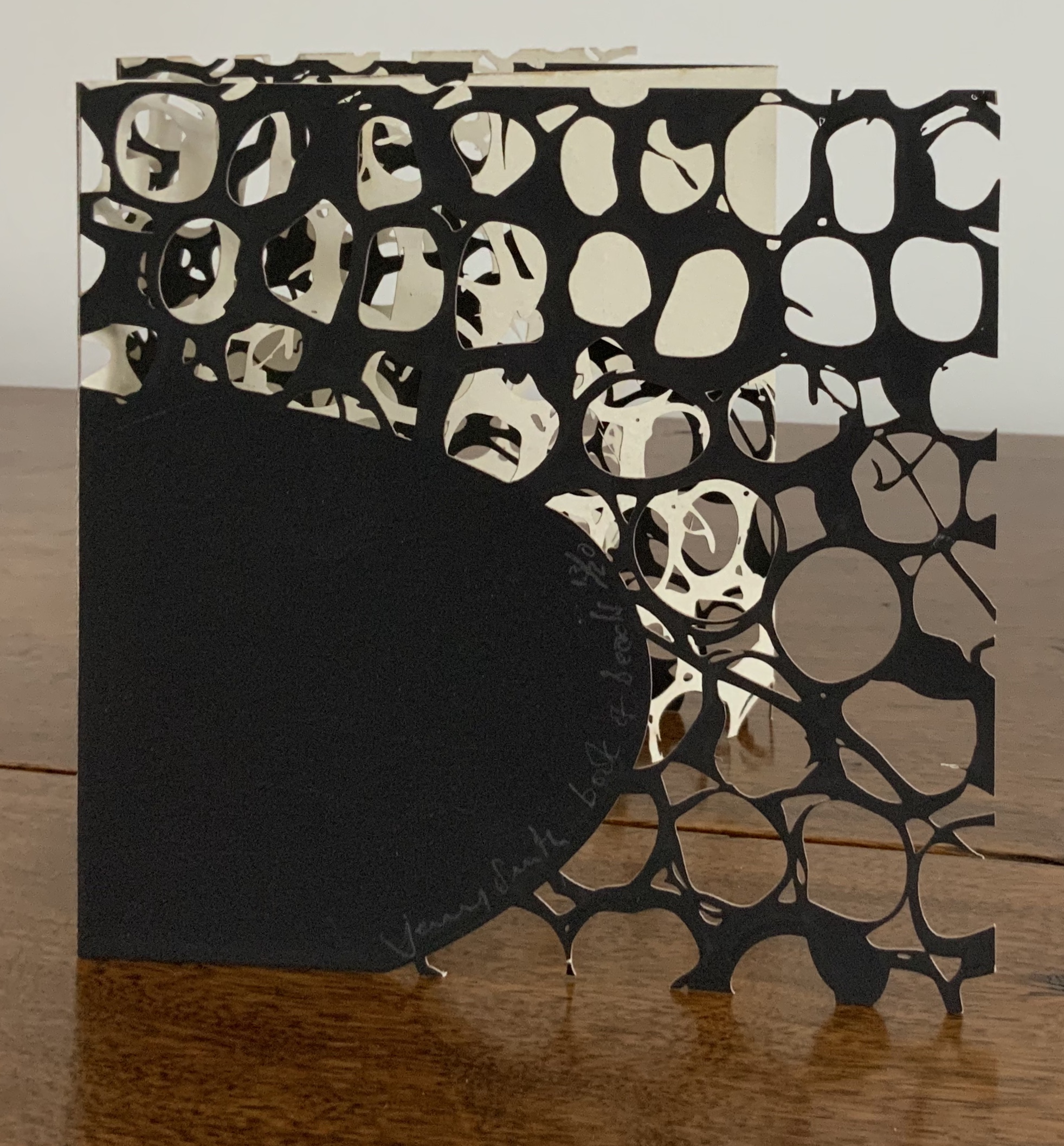
Case of beige matte-finish, screenprint black interior, title lasercut: 165 x 165 mm;
Book in accordion-fold, eight panels lasercut, taupe on one side, screenprint black on other, 160 x 160 mm
Edition of 20 of which this is #13. Acquired from the artist, 31 July 2017. Photo: Courtesy of the artist.

Photos: Books On Books Collection.

The interlocking views of panels through panels foreshadow a work by Katumi Komagata:Ichigu(2015). The fine tendrils in the cutting may remind some of works by Béatrice Coron or Merrill Shatzman.

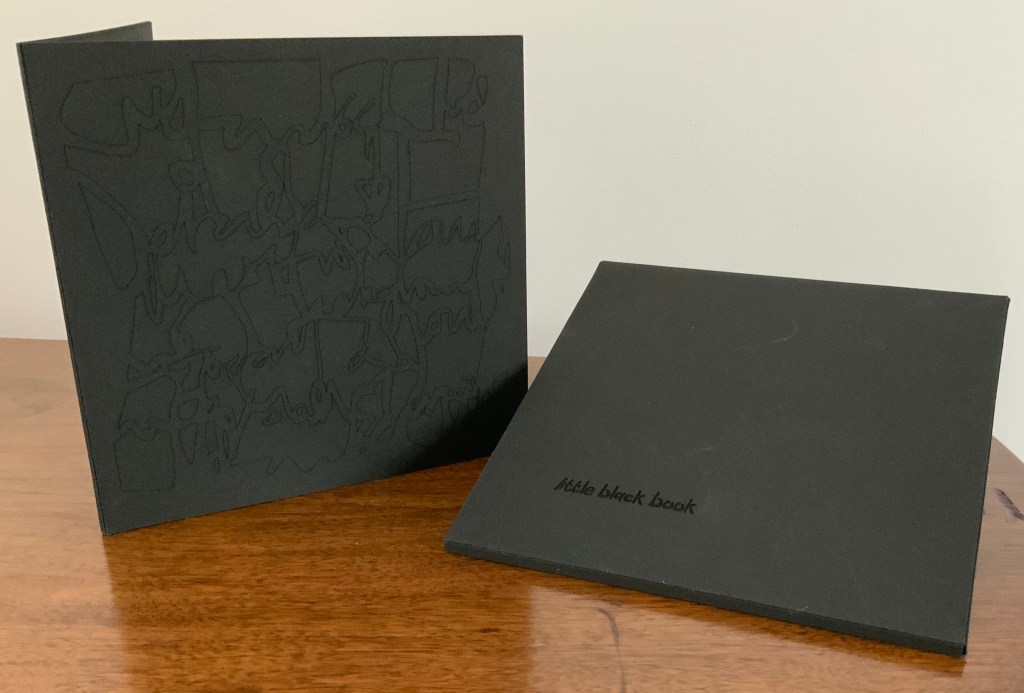
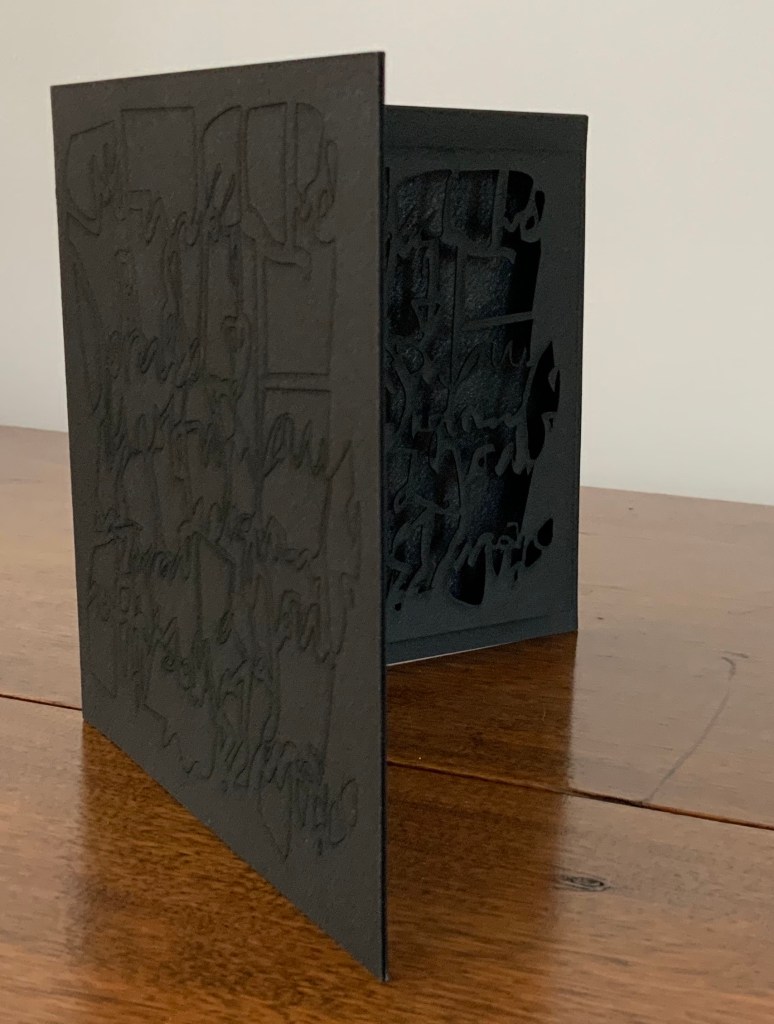
Little Black Book (2009)

Little Black Book (2009)
Jenny Smith
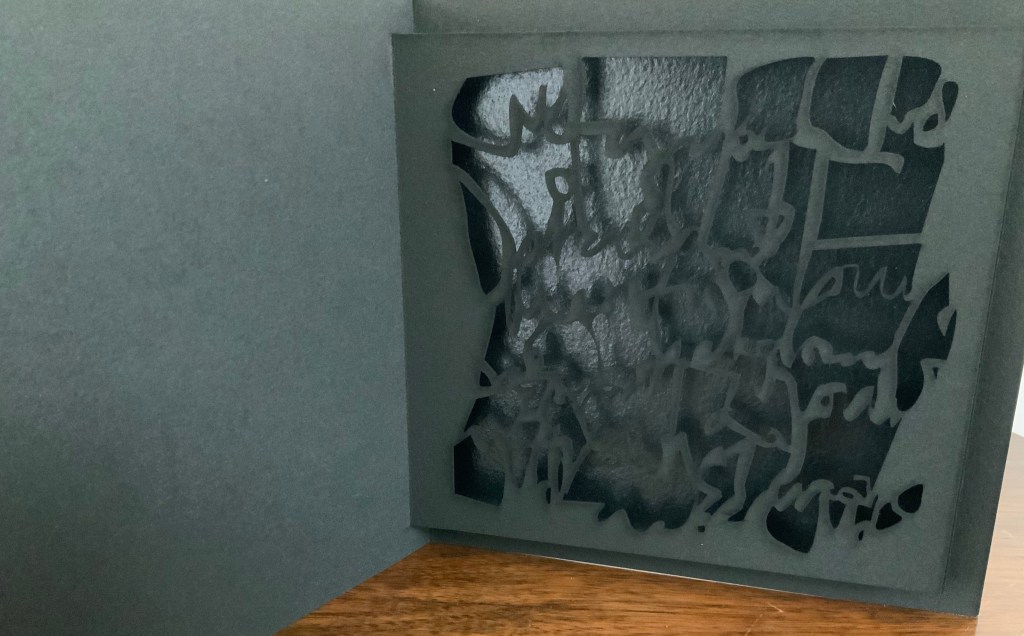
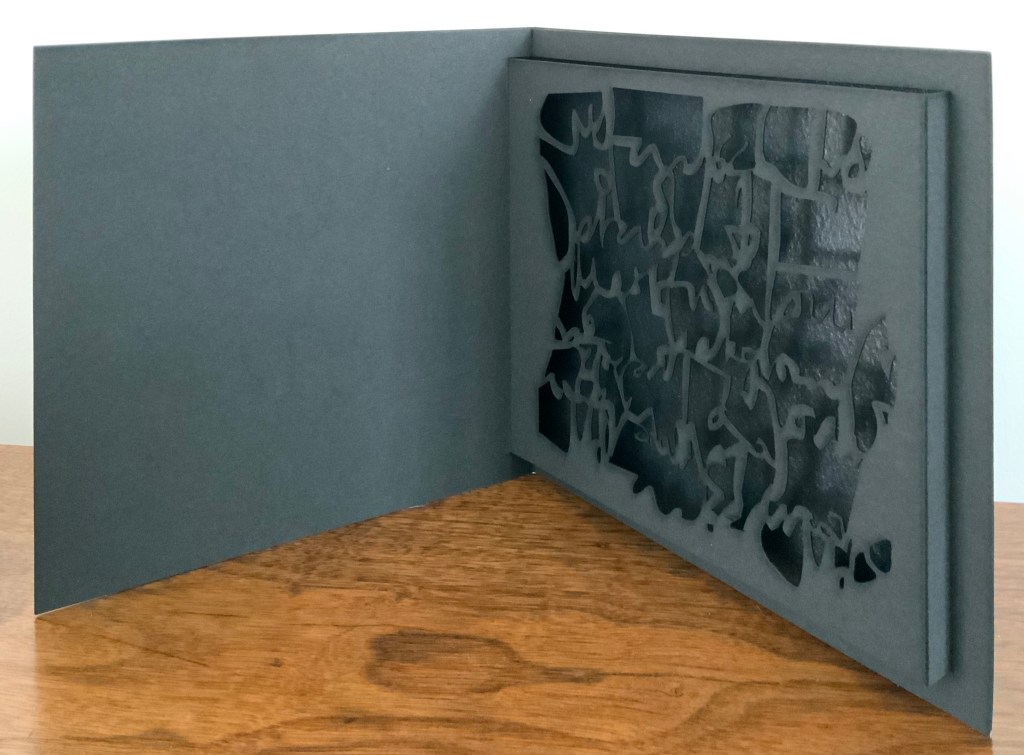
Matte-black slot-and-tab case containing matte-black single fold booklet; cover engraved with an abstract, calligraphic design that is cut out inside on the pop-up page and reappears in shadow against a gloss black screenprint insert behind the pop-up page. 
Case: 167 x 167 mm; Book: 160 x 160 mm; Pop-up page: H140 x W150 mm.
Edition of 20, of which this is #14. Acquired from the artist, 31 July 2017. Photo: Courtesy of the artist.

Photos: Books On Books Collection.


Little Black Book exemplifies Smith’s exploration of writing as a form of drawing, which also often finds expression in site-specific work such as What is the most important decision you have made? (2013) in Cupar, Fife, Scotland, and What is Shadow? and What is Freedom? (2016) in the same vicinity.

The grassy nature of the 2013 installation and its engagement with children may remind the reader/viewer of Water on the Border (1994) by Helen Douglas and Telfer Stokes. For some, the interaction of cage and words in the 2016 installation may recall Bird Language (2003) by Xu Bing.

Further Reading

Medicinal Art”, Studio Pavilion, 19 September 2019. Accessed 2 May 2020.

Blakeley, Deborah. “Jenny Smith, Edinburgh, Scotland”, Zone One Arts, 1 November 2015. Accessed 2 May 2020.