Reading Dick and Jane with Me (1989)
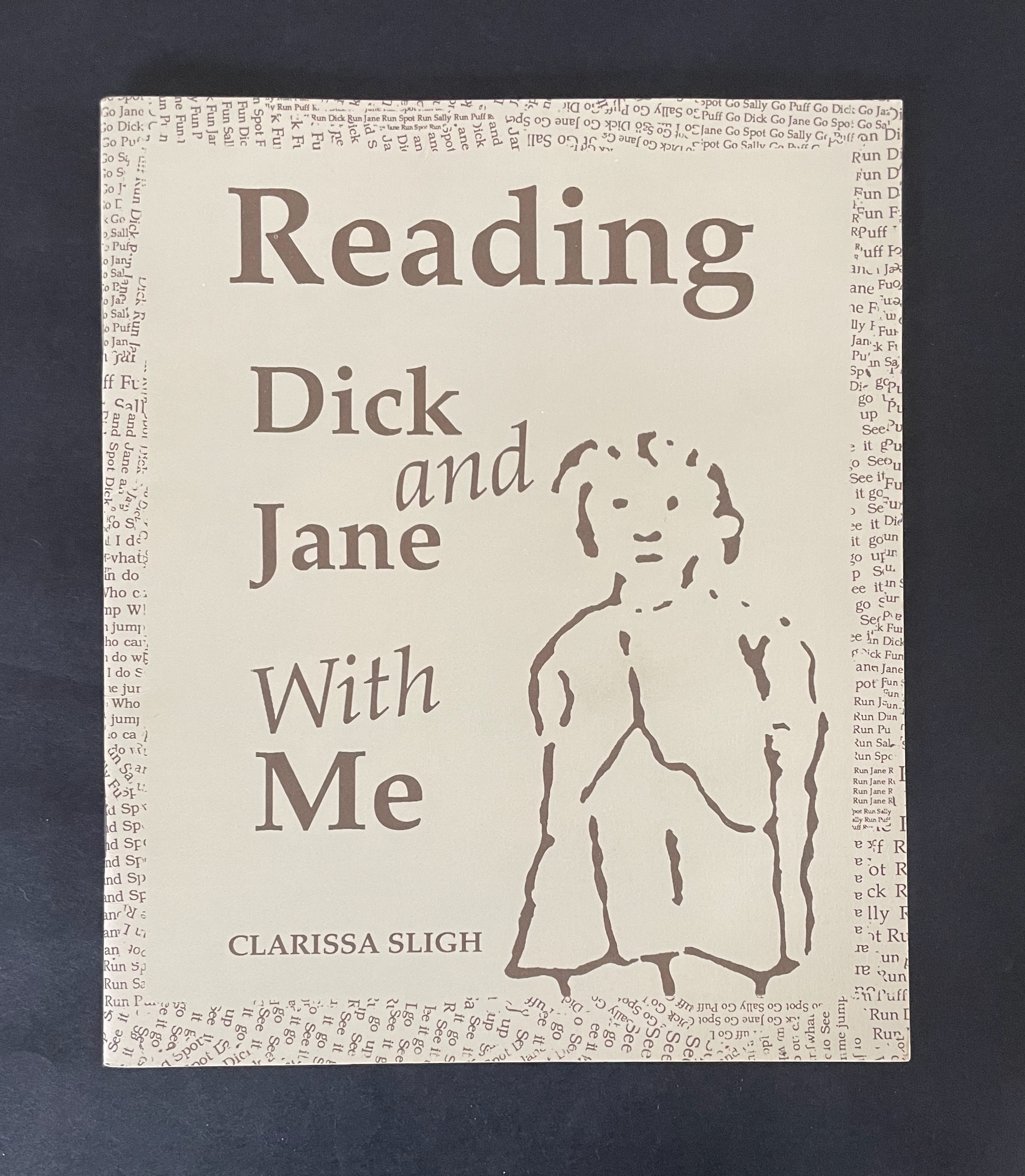
Reading Dick and Jane with Me (1989)
Clarissa Sligh
Saddle-stitched booklet, staples. H212 x W177 mm. [24] pages. Acquired from Marta Zlotnick, 6 October 2025.
Photos: Books On Books Collection.
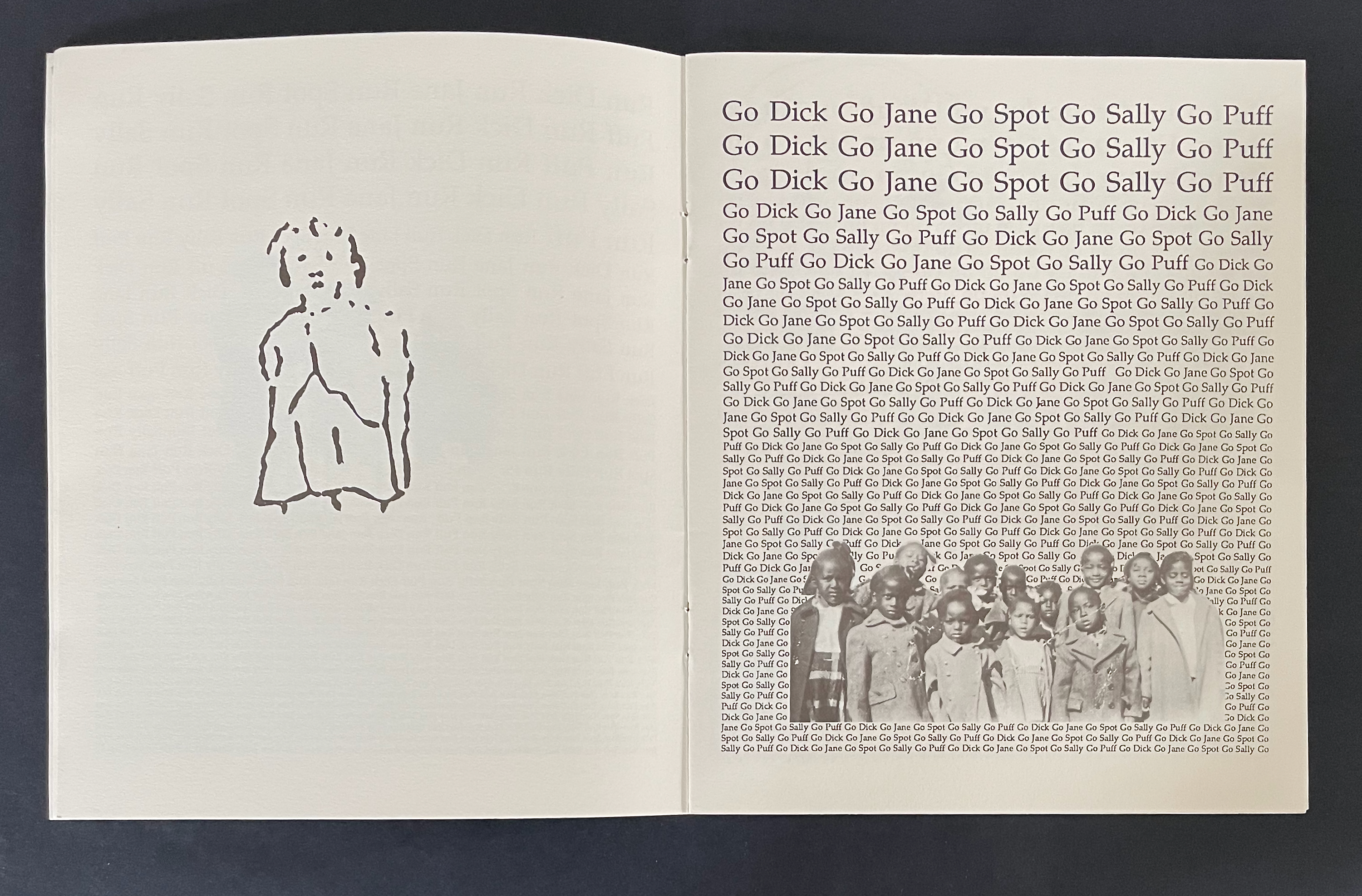
This is a painful artist’s book. In the repetitive style of the 1950s “Dick and Jane” beginning readers’ book, the child in the artist carries on a one-way conversation with children from those books. Dick, Jane, and Sally are white and upper middle class. They live in a suburban setting with their dog Spot and cat Puff, and the text of their lives is interpersed with “Fun”, “Fun”, “Fun”. They run and play, and tell the reader to “Look Look See us play”. Dick demands, “See me jump” and asks, “Who can jump Who can do what I do”. Sally insists on how pretty and white Puff is.
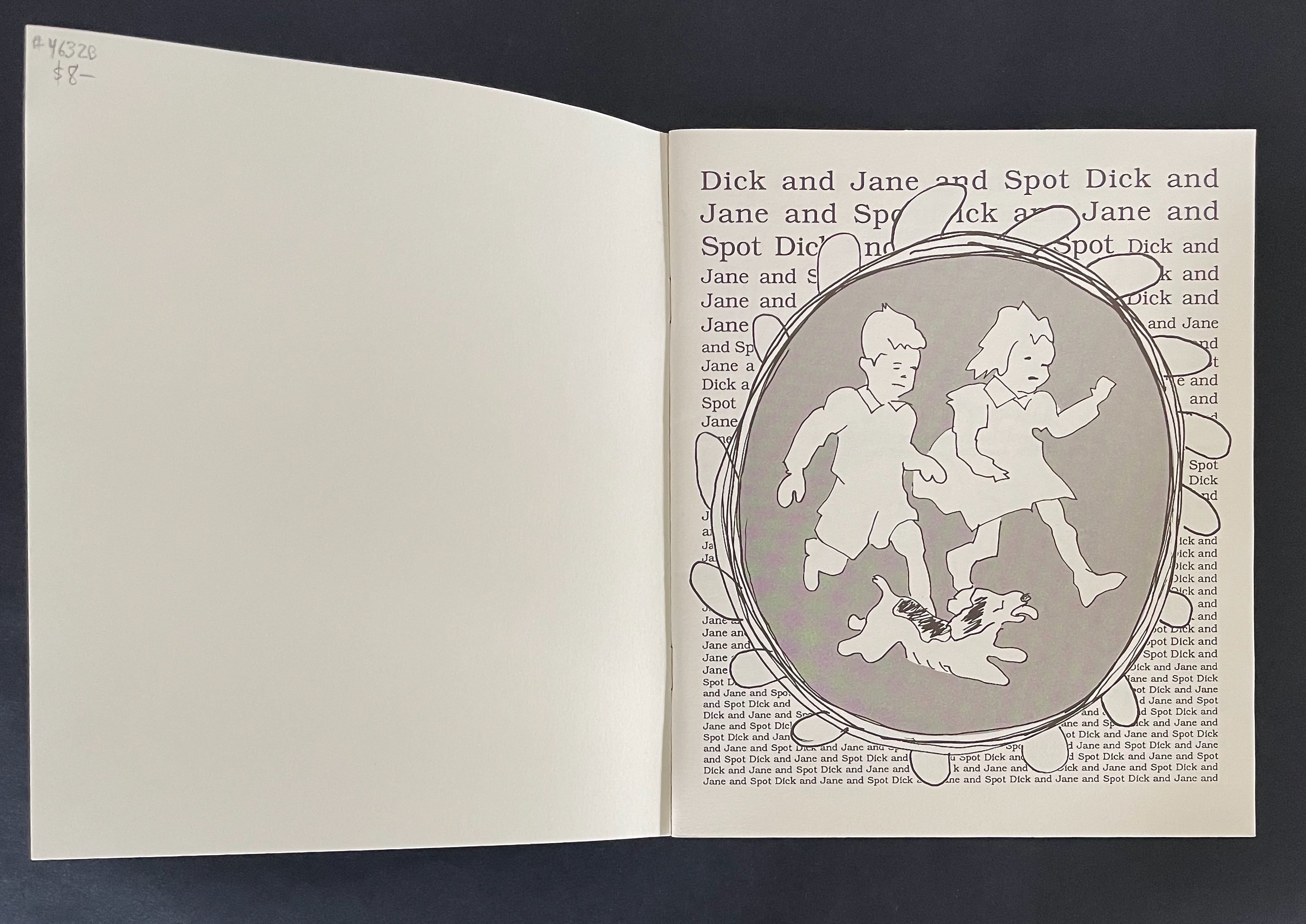
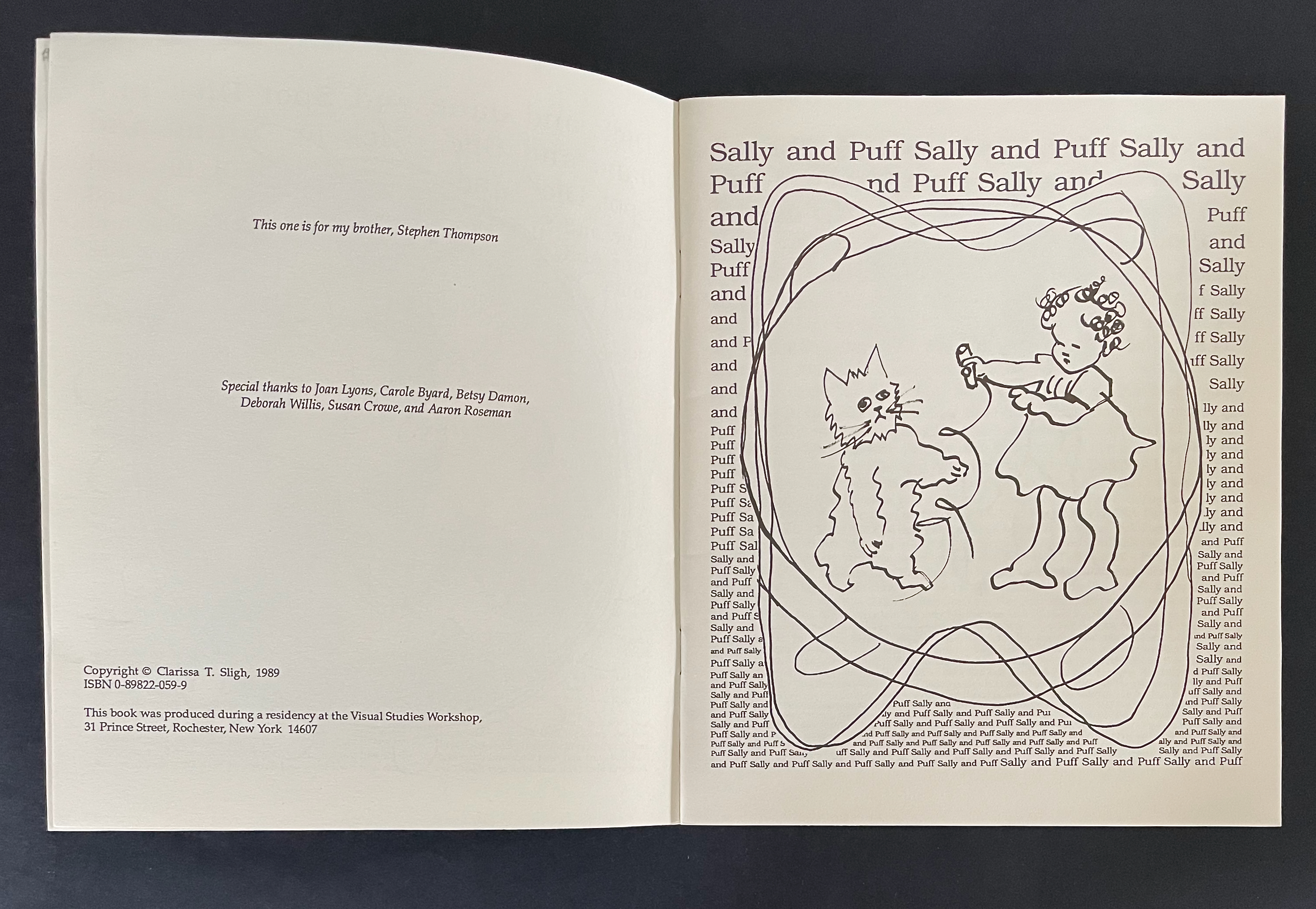
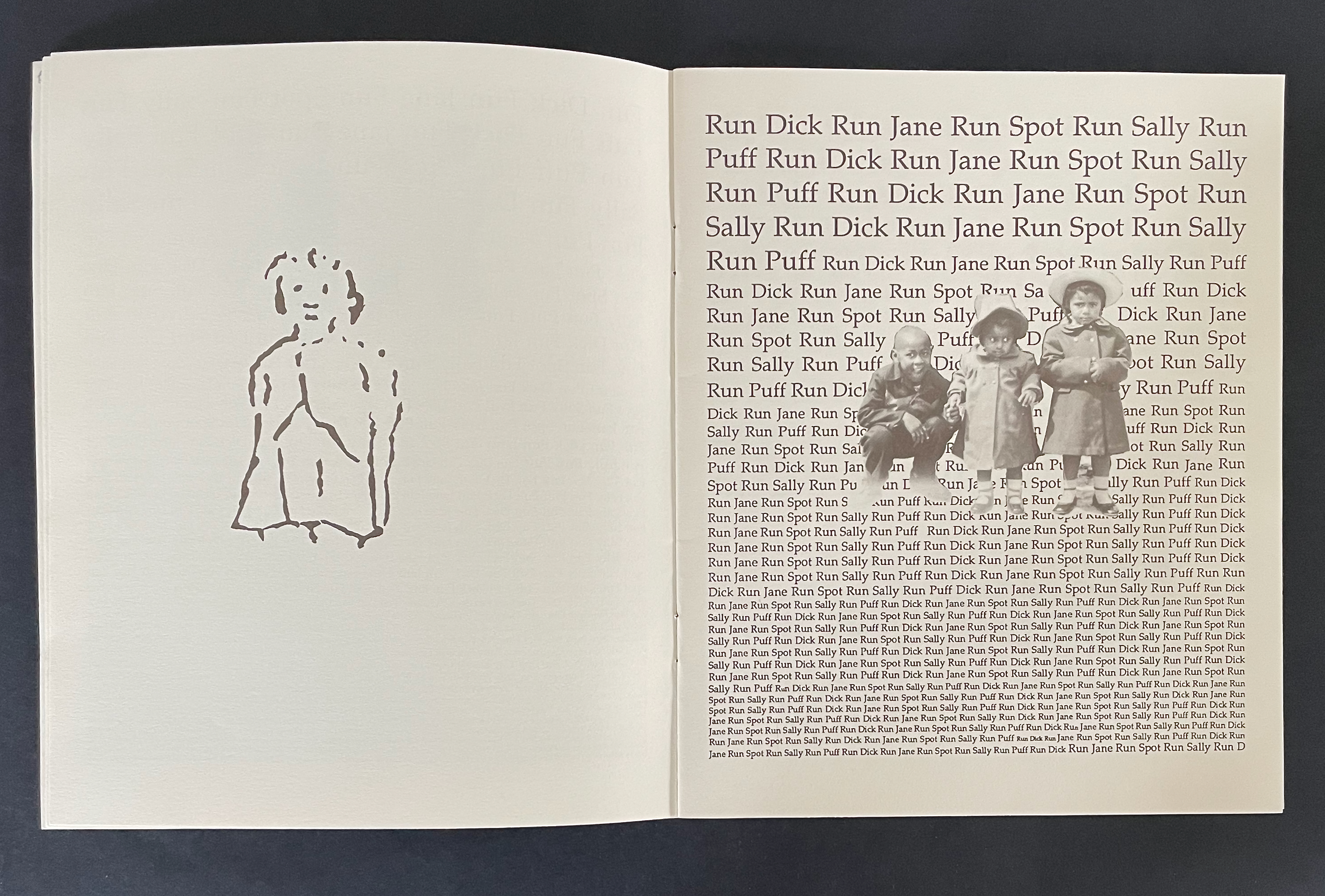
Alongside her redrawn versions of Dick, Jane, Sally, and their pets, the artist sketches in a cartoon self portrait and pastes in old photos of herself, siblings, and friends. For the first few pages, these images respond mutely to the “Dick and Jane” repetitions.
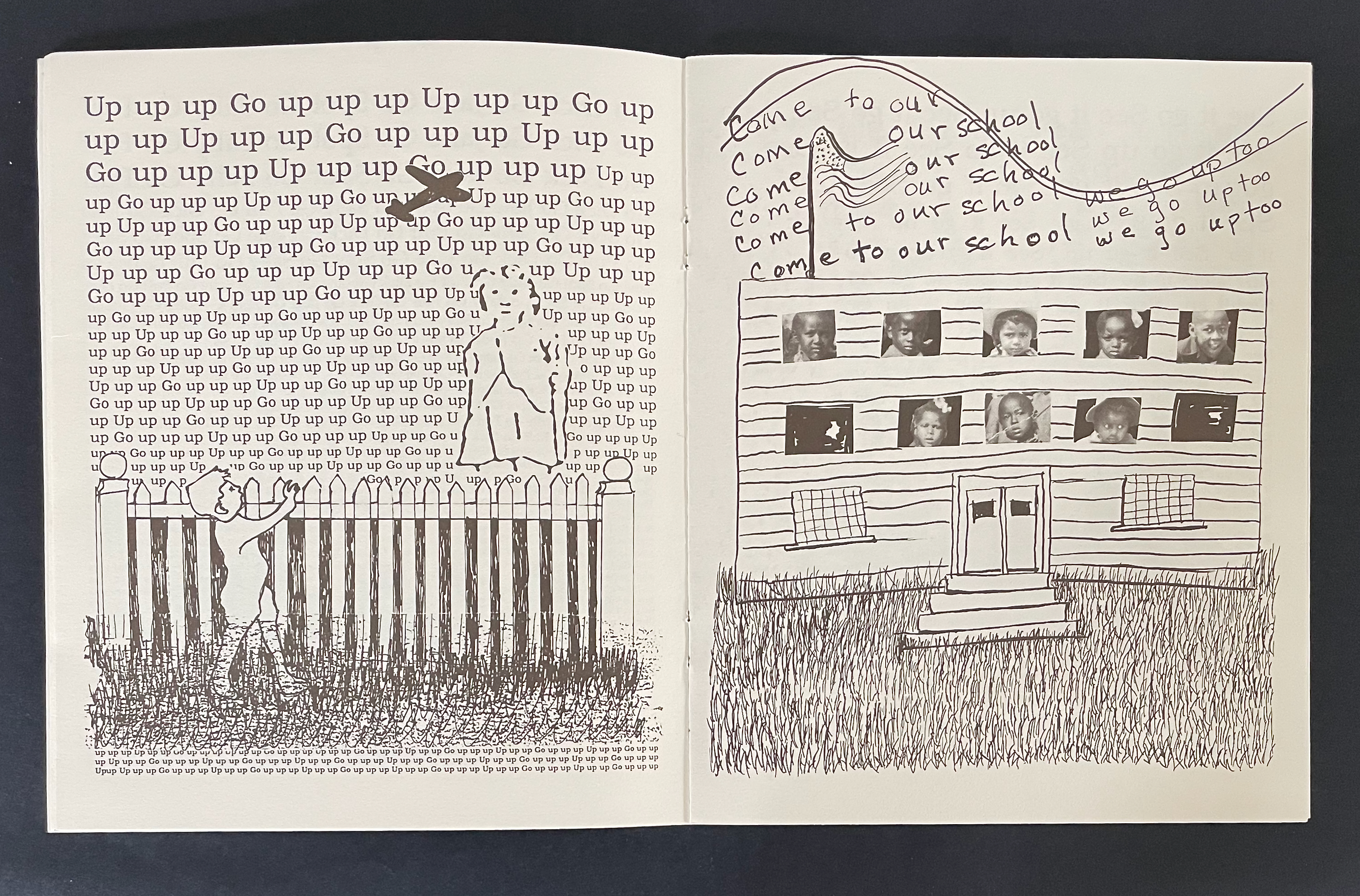
Facing the page below where a white picket fence separates the artist from Dick, she and her friends respond in a scrawled script (in contrast to Dick’s typeset exhortations to “Go up up up”). They invite Dick and the reader to “come to our school” where they “go up too”.
In the next spread, surrounded by imperatives to “See it go” and “See it go up”, Sally frowns and appears troubled by the encroachment of scrawls over the gutter and into her typeset page. On the facing recto page, the artist and friends stutter as they read the typeset lines: “We read See. it. go. see. it. go. up.” Maybe Sally is troubled by the words between the lines:
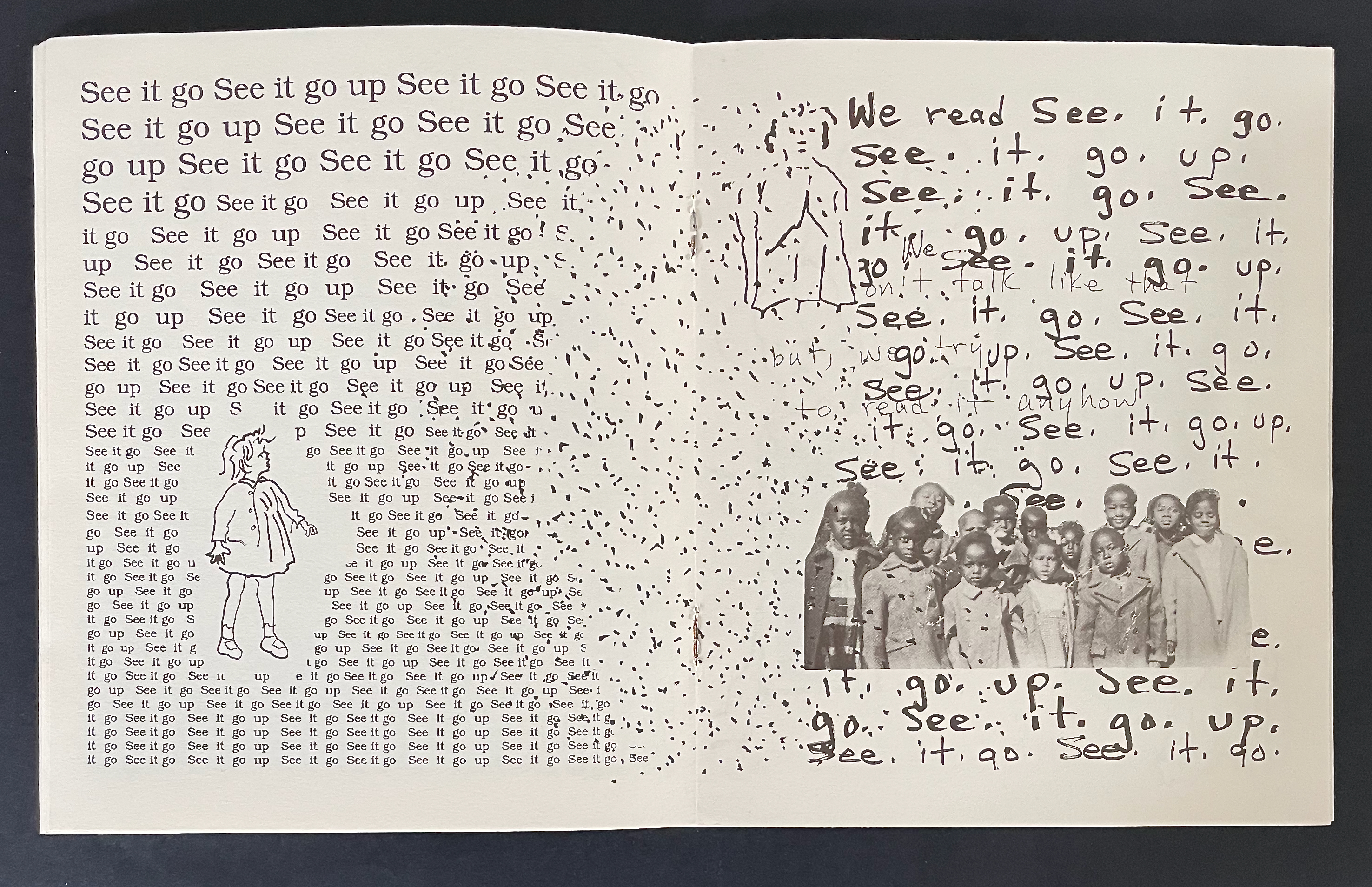
Between the lines: “We don’t talk like that but we try to read it anyhow”.
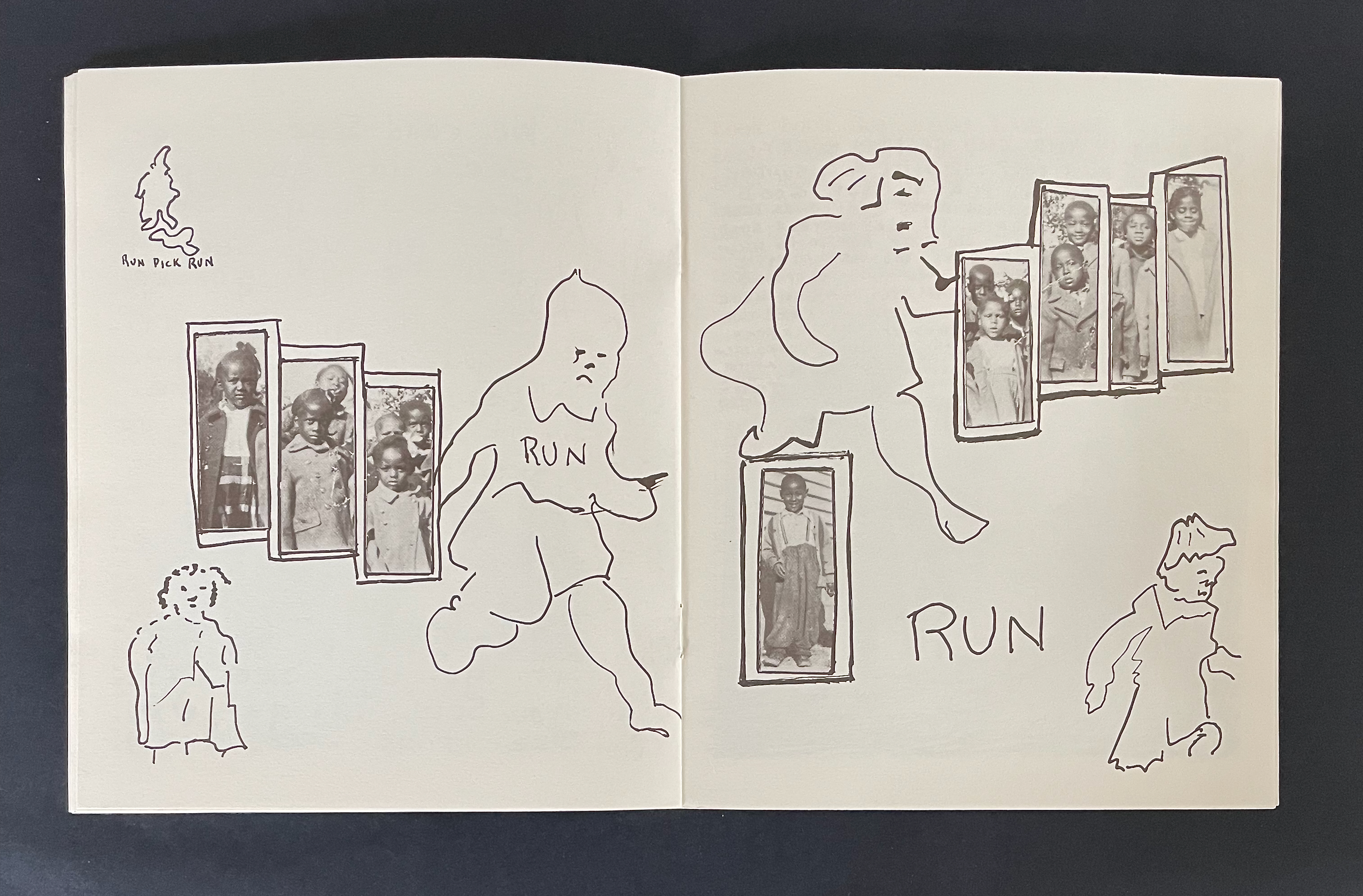
At this point, when the artist and her friends read “Run Dick Run”, the book takes a darker turn for us the readers — if we are reading with the child artist. Dick and Sally run across the double-page spread. Even though they are more roughly sketched than before and even though Dick wears a Ku Klux Klan hood, we know it is them. As the scrawled imperative RUN RUN RUN grows across the spread to its largest size, Dick’s mask slips aside. If you the reader are white, and if you understand that the scrawled (not typeset) command is in the artist’s voice, and if you are reading with the child who stands self-portrayed in the lower left hand corner and with the children in the photographs, maybe now you see what they see between the lines in Dick and Jane’s world.
From here on, the child artist addresses Dick and Jane (white society) more directly. She signals her “encroachment” by taking over the verso page with all of her scrawl and places Dick, Jane, and Sally within the drawn pages of their book in the foreground of the recto page. For the first time, her self-portrait is shaded as she stands in the background of the shaded Dick and Jane book.
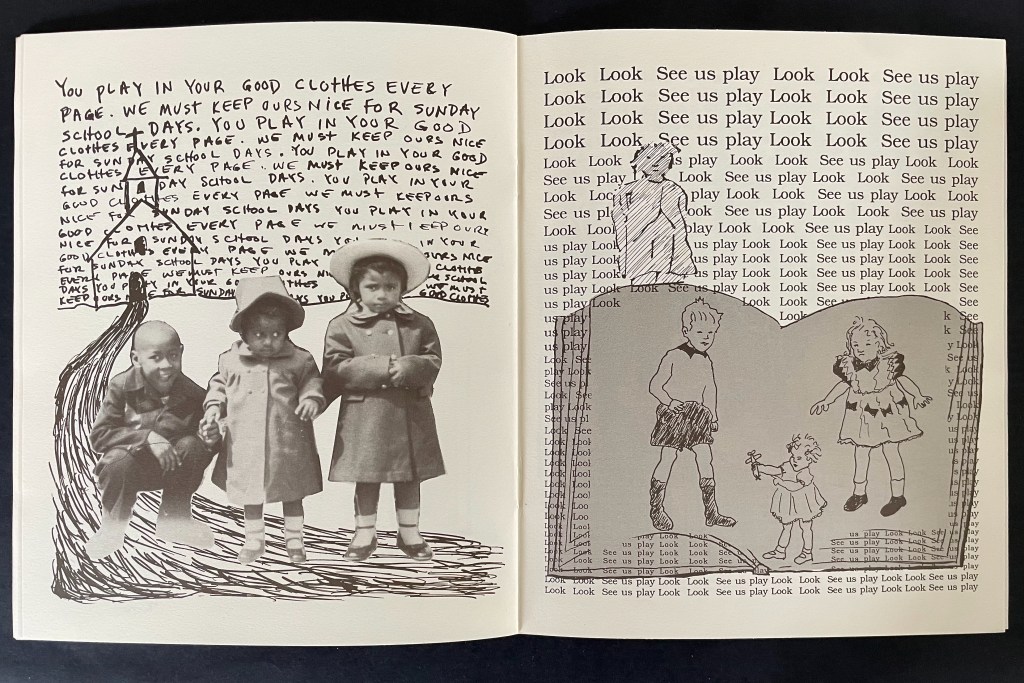
As she explains how she and her friends differ from Dick and Jane (not likely to be listening, embedded as they are in their book), the child artist’s voice is soft but insistent in its “Dick and Jane” style repetition. For the first time, her self-portrait appears larger than the white child, and she is on the same side of the picket fence.
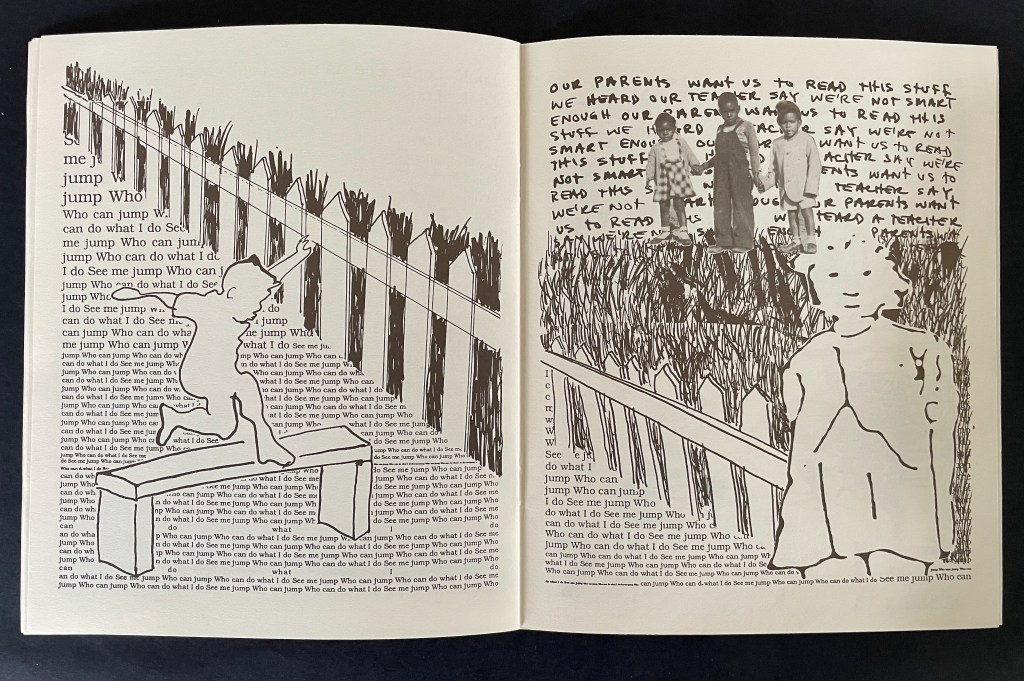
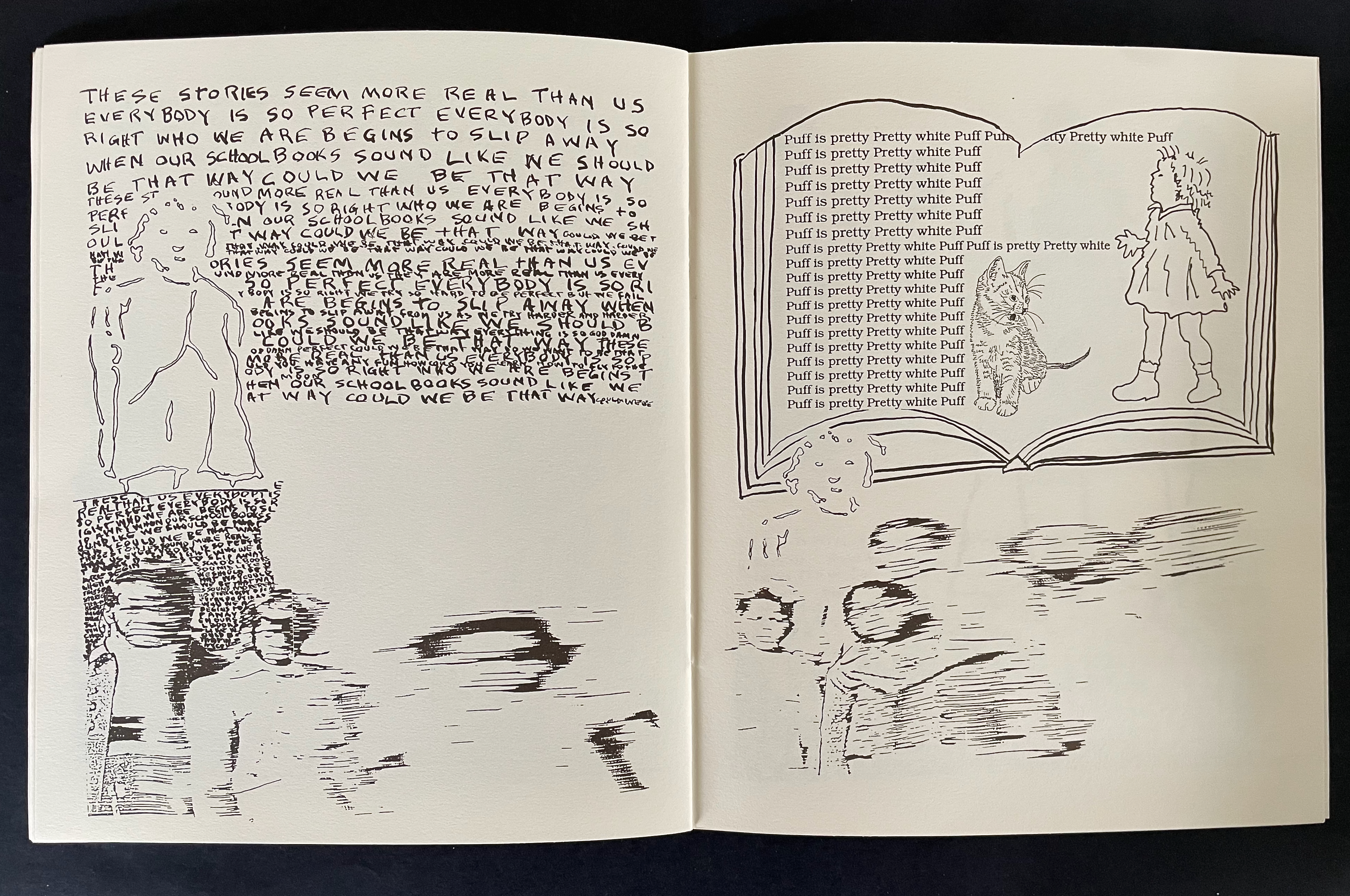
In the next spread, the impact of these “Dick and Jane” stories on her and her friends is spelled out and drawn to heartbreaking effect. Sally and “Pretty white Puff” stand in sharply drawn and typeset contrast to the erasure, the slipping away, of the self-portrait and the photograph. Even the book you hold in your hands and its hand scrawled text are smearing away in the lower left corner.
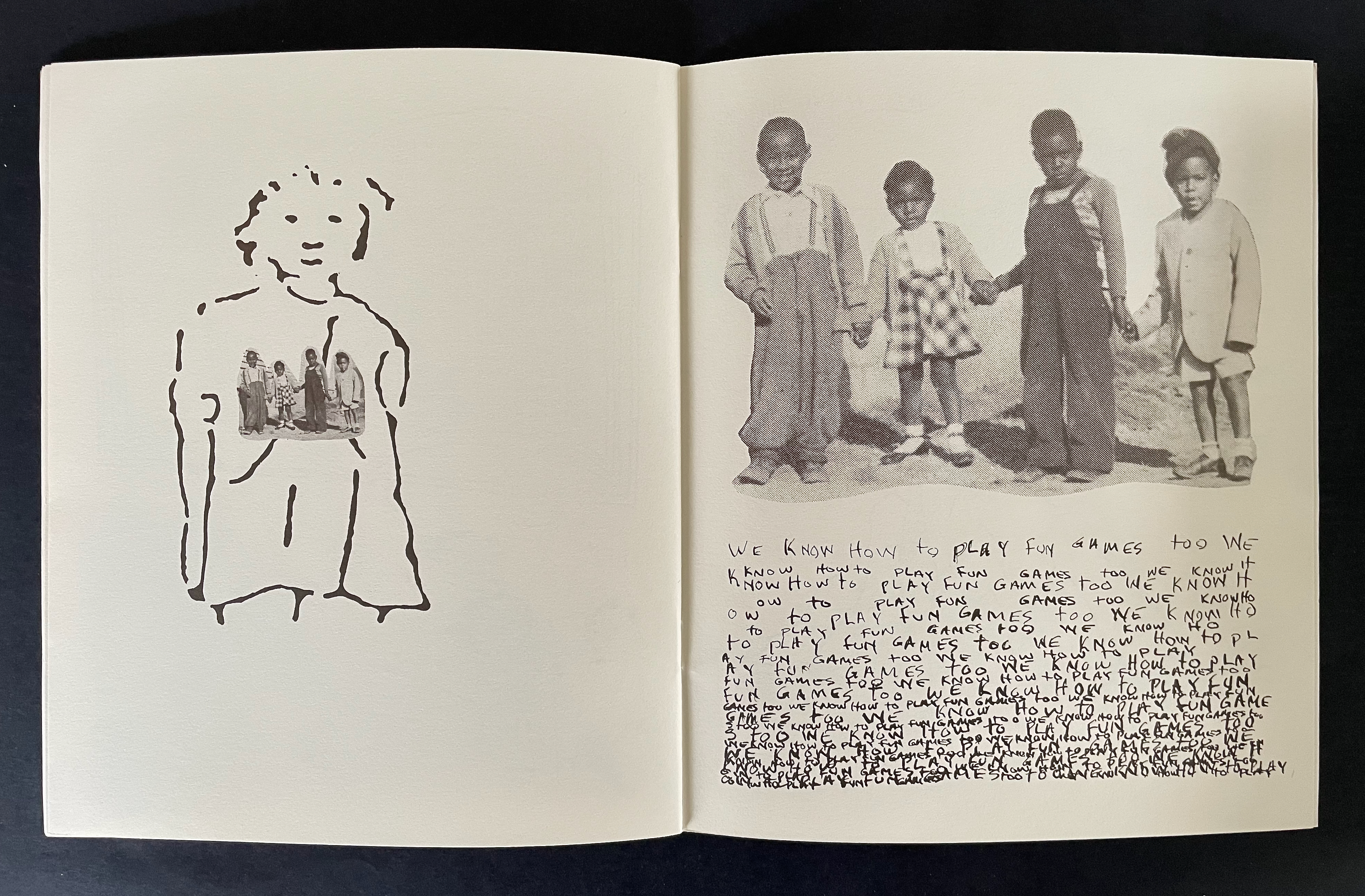
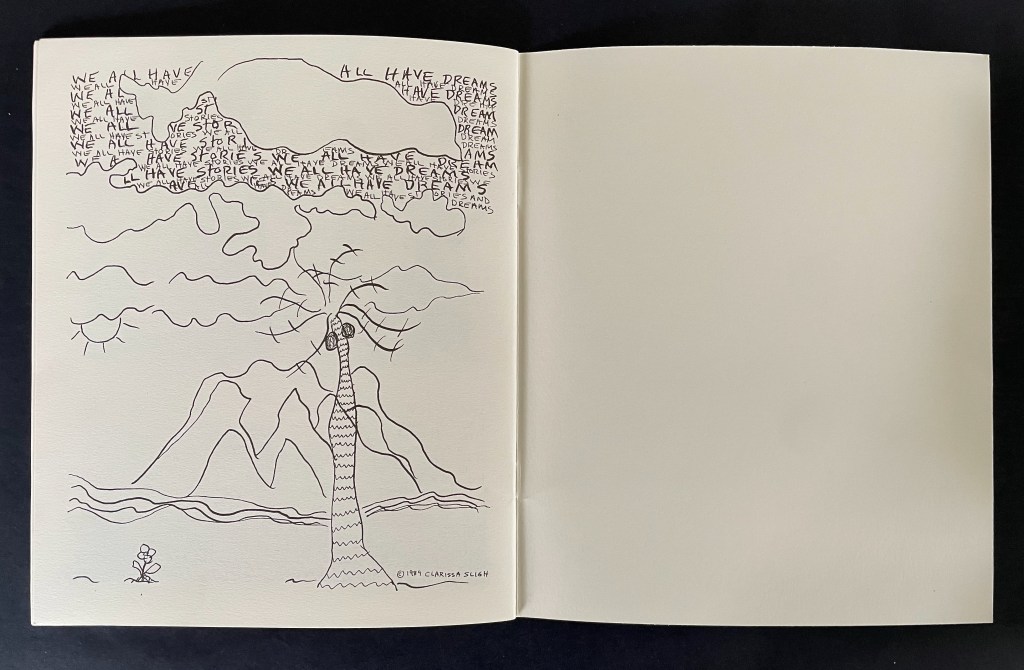
The artist’s voice is soft but, like the “Dick and Jane” style, insistent. In text and image, the message is heartfelt.
Reading Dick and Jane with Me also had an exhibition life, which Sligh describes on her website:
These cyanotype prints, 40 x 30 inches, 1990-2013, originated from artwork made for my artist’s book Reading Dick and Jane With Me while in residency at Visual Studies Workshop in 1989. The size of the original collage and the book page was about 8 ½ x 7 inches. During that residency at VSW, before the days of Photoshop, I learned to shoot the artwork onto film, strip and spot the films and make metal plates for the offset press printing of the book.
With the encouragement of Joan Lyons, the VSW Press director, I also used the large process camera to shoot and develop large negatives from the artwork. After returning home, I built a large light table, contact printed the negatives and processed them in my bathtub. The prints are sent to various exhibition sites. Viewers draw and mark on the prints in response to my image and text narratives. This process is done repeatedly until the prints are fully covered with marks and sketches left by the public.
The process continues. — Sligh website, accessed 17 July 2026.
As of this writing — in the time of Jim Crow 2.0, brutalization of children of color, and vicious beliefs in replacement theory and empathy as sin — Reading Dick and Jane With Me continues to insist — Read Dick. Read Jane. Read Sally. Read.
Further Reading
“Tia Blassingame”. 17 August 2020. Books On Books Collection.
“Global Afrikan Congress“. 15 May 2023. Books On Books Collection.
“Sarah Matthews“. 15 February 2025.Books On Books Collection.
“Arial Robinson“. 15 May 2023. Books On Books Collection.
“Ruth E. Rogers“. 17 November 2025.Books On Books Collection.
“Clariss Sligh (I)“. 2 September 2020. Books On Books Collection.
“Clarissa Sligh (II). 4 June 2025. Books On Books Collection.
“Carrie Mae Weems“. 14 February 2025. Books On Books Collection.
“Kara Walker“. 9 January 2026. Books On Books Collection.
Adrian, Kathleen D. 1998. “The Decentralization of Subject in African American Feminist Photography: Constructing Identity based on Representation and Race in the Work of Lorna Simpson, Carrie Mae Weems and Clarissa Sligh“. disClosure: A Journal of Social Theory. 7:3.
Gabor, Nora. 18 February 2021. “Black History and Experiences through Book Arts“. The Full Text: News about library resources and services. Chicago, IL: DePaul University. Accessed 22 January 2024.
Gleek, Charlie. 2019. “Centuries of Black Artists’ Books“. Presented at “Black Bibliographia: Print/Culture/Art” conference at the Center for Material Culture Studies, University of Delaware, 27 April 2019, pp. 7-8. Accessed 20 July 2020.
Hubert, Renée Riese, and Judd David Hubert. 1998. The Cutting Edge of Reading : Artists’ Books. New York: Granary Books: 212-16.
Lawrence, Carol. 6 June 2019. “Clarissa Sligh: Living A Life, the Personal and the Political“. Women’s Studio Workshop. Accessed 22 August 2020.
Sligh, Clarissa. 23 October 2020. “Clarissa Sligh Lecture at Mills College.” Mills Art and Visual Culture. Accessed 22 August 2020.
Sligh, Clarissa. 2019. “Witnessing through Artist’s Books“. Exhibition, 3 October – 14 December 2019. New York: Center for Book Arts.
Sligh, Clarissa. 1992. “Witness to Dissent: It Wasn’t Little Rock”. IKON #12/13: 110-15.
Sligh, Clarissa. 1990. “On Being An American Black Student“, Heresies 25: A Feminist Publication on Art and Politics. 7:1:25.
Sligh, Clarissa. 1 July 2006. Interview with Steve Miller, Book Arts Podcasts, School of Library Information and Sciences, University of Alabama. Accessed 20 July 2020.
Stanley, Tiffany. 21 August 2025. “Is empathy a sin? Some conservative Christians argue it can be“. NPR. Accessed 26 July 2026.

