Working with an edition of James Joyce’s Ulysses, Hamill systematically obliterated the words of Joyce but carefully retained those words positioned closest to the gutter – the technical term used to describe the central margin of a bound page. The retained fragments form two extended columns that continue for 933 pages. Notable here is how design and typographic terminology is so entrenched in bodily references. Header, footer, body-copy, the arm of a “K”, the crotch of a “Y”, the foot of a “T”, the ear of a “G”, the shoulder of an “R” and so on. As is the architectural scaffolding of Joyce’s schema which underpins the structure of Ulysses, kidney, genitals, heart, lungs, oesophagus, Brain, Blood, Ear. etc. Lawrence Weiner refers to language as material for construction, the act of deletion in Gutter Words exposes the architectural scaffolding that holds words in place. Voids are physical spaces to be read and words become unanchored, set adrift in an uncertain space. The architectural qualities of this physical space will be exposed, Gutter Words will be devoid of the accoutrements associated with a “book” such as cover, boards, end papers, dust jacket and will retain only the innards, an unprotected text block.–Publisher’s website
Gutter Words (2019)
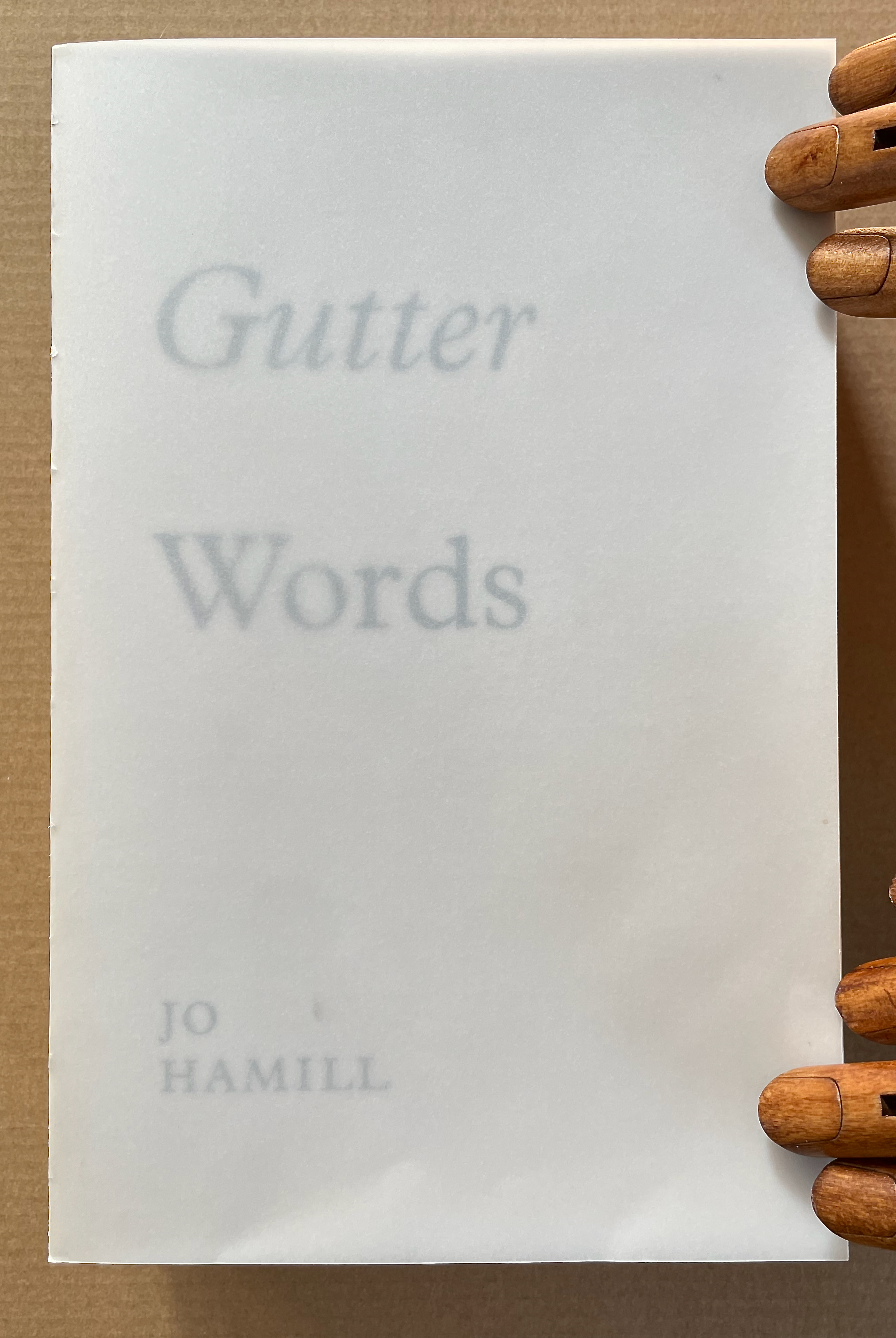
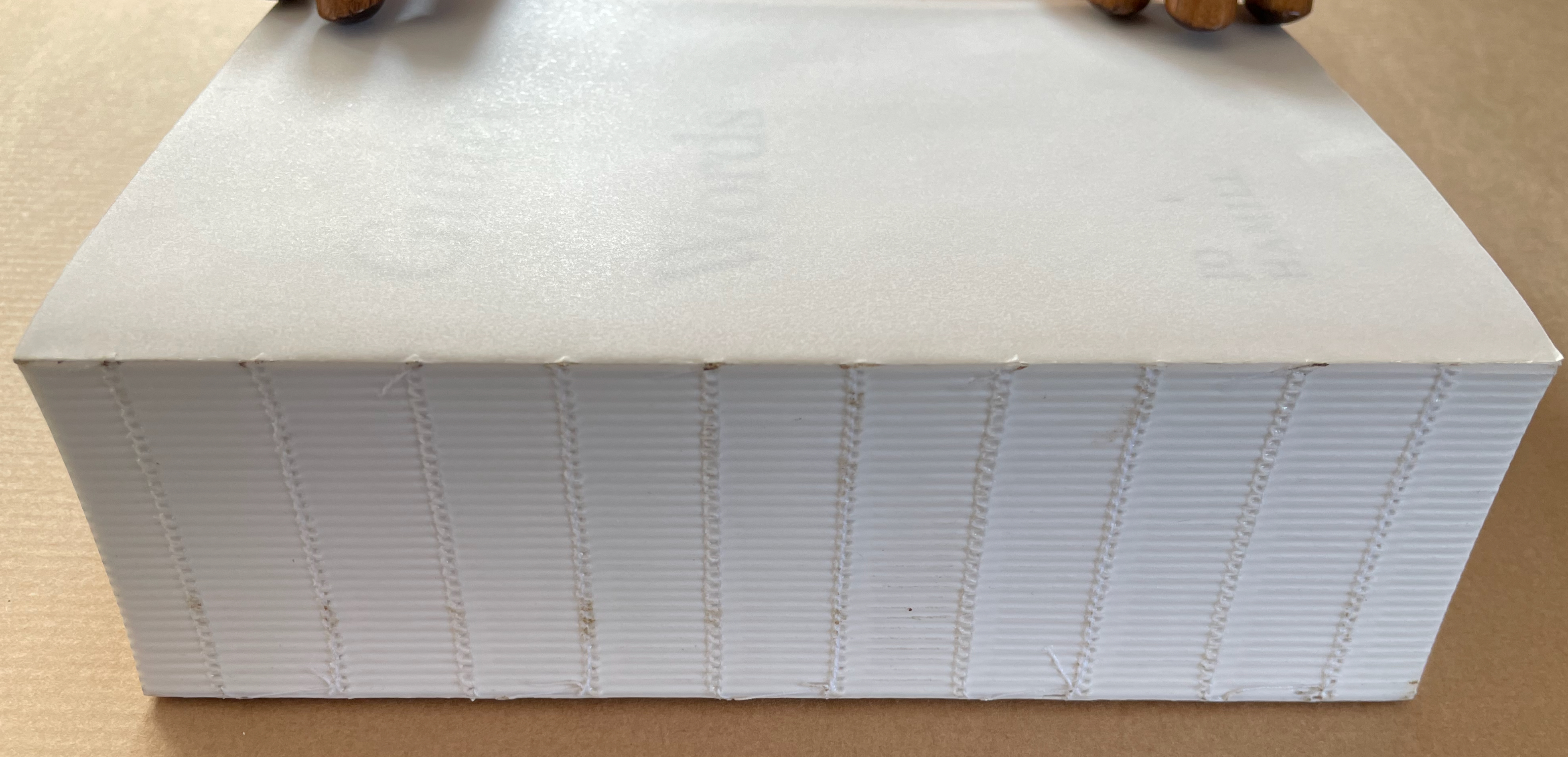
Gutter Words (2019)
Jo Hamill
Softcover, exposed spine. H197 x W128 x D60 mm. 956 pages. Acquired from Gill Partington, 20 June 2023.
Photos: Books On Books Collection.
Artists’ books can run the risk of being a “one-trick pony” or a toddler’s newly learned knock-knock joke. Once seen, the trick succumbs rapidly to the law of diminishing returns. A dozen times heard, the joke verges on parental abuse. Conceptualist Simon Popper’s 2006 alphabetized version of James Joyce’s Ulysses (1922) falls into that camp, albeit a stunning one. There may be some ongoing amusement in perceiving the shift from letter to letter and the subsequent alteration of the visual pattern, or in spotting the singular invented words and considering the alphabetization as a comment on James Joyce’s play with language, or in contemplating it in comparison with similar efforts. Like Mikko Kuorinki’s 2012 alphabetized version of Foucault The Order of Things (1970) that cheekily challenges Michel Foucault’s theory of how we perceive social order. Or the alpha and omega of Tauba Auerbach’s BbeehHilloTy or the Alphabetized Bible (2006); well maybe not the alpha, since Silvio Lorusso and Rory Macbeth got there first with theirs in 1997, nor the omega, since Peter Harkins followed up with his 2013 Well-Sorted Version (WSV), algorithmically generated. Apparently, one-up-manship is inevitable. Even Gutter Words has its gatecrasher: John Morgan’s Usylessly (2021) with a pair of essays, not just one. But once the joke is “got”, how rewarding is it to return to it again and again. Is there more to it?
So where does Jo Hamill’s Gutter Words (2019) fall in this camp? The double entendre of the title is the primary joke as explained by the publisher’s description, which also draws attention to the other structural embellishments of the joke — the absence of the cover and the exposed spine. So our pony has taken the “bit” of the trick and run with it, or our toddler has discovered a knock-knock joke that puns on knockers. Or is there more to Gutter Words?
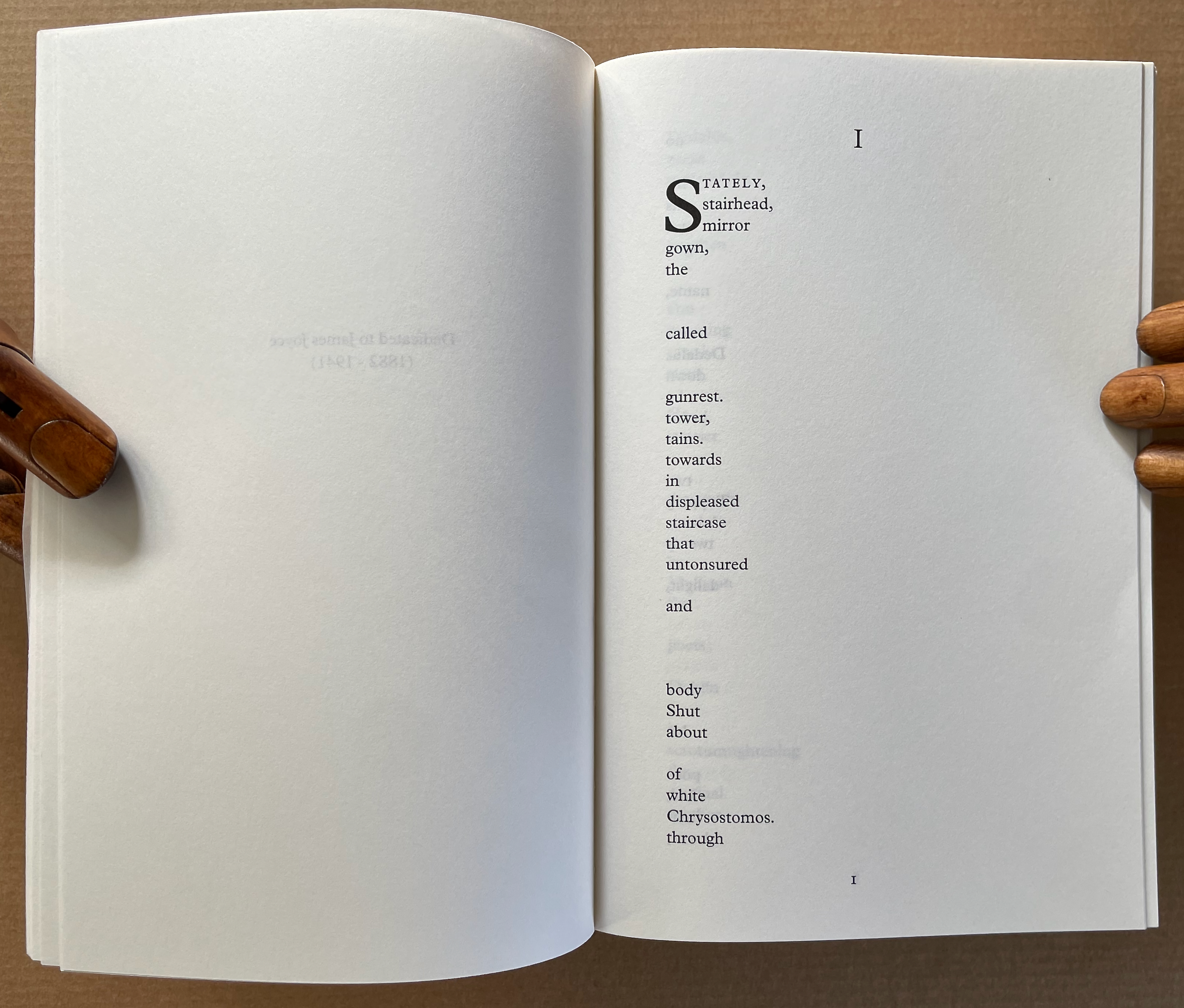
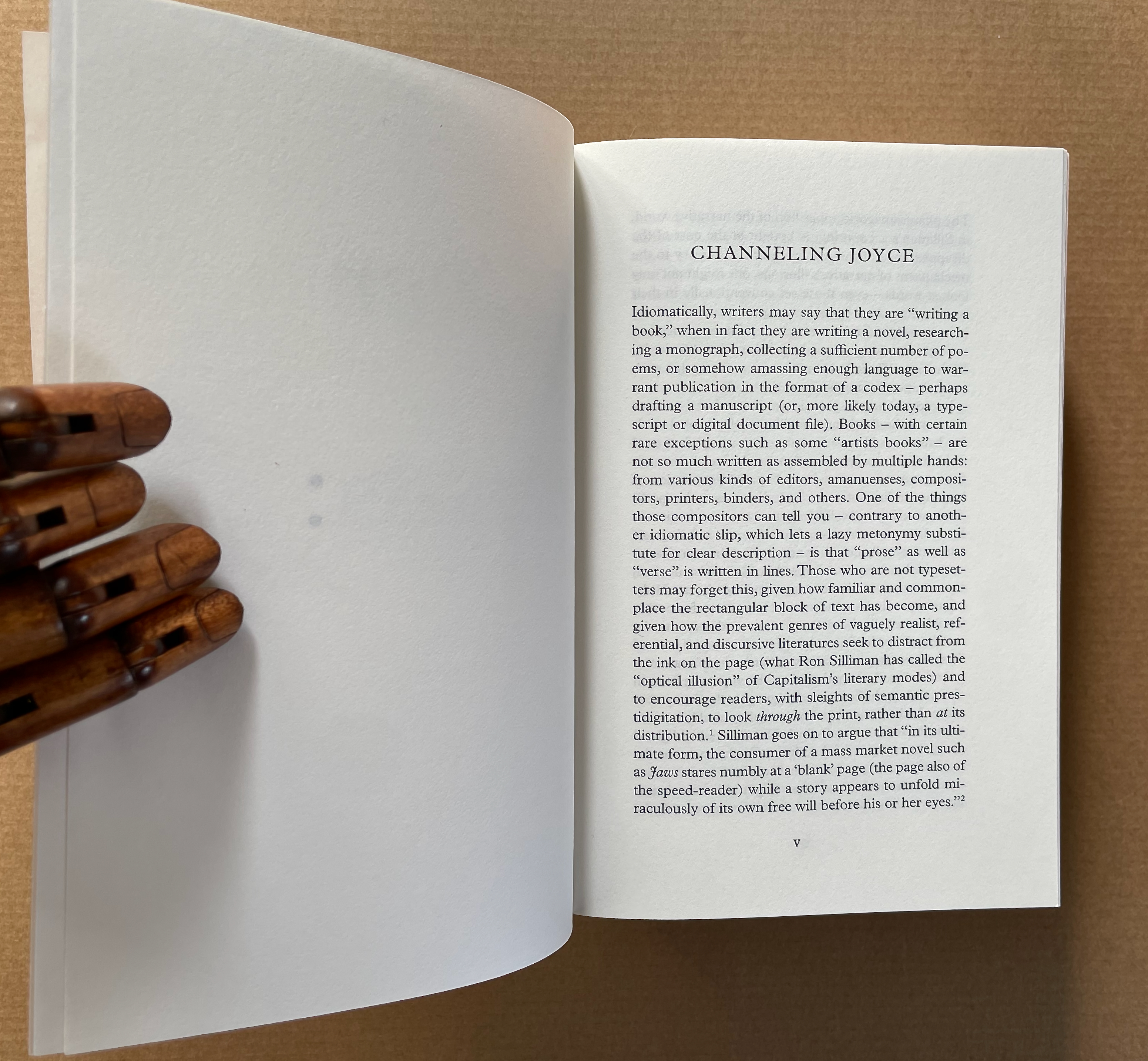
Craig Dworkin’s introductory essay goes some way to make the case that Hamill’s book is not a “one-trick pony”. Clearly attuned to the complete contents of Ulysses, Dworkin seems easily to find haiku-like occurrences in the gutter and the curiously apt wordstacks that cast a sudden light on features and themes of Ulysses. His key insight though is to place Hamill’s effort in the context of Joyce’s language enterprise and that of the avant-garde and Dadaists. Alluding to Tristan Tzara’s scissoring instructions in his “Pour faire un poème dadaïste [How to Make a Dadaist Poem]”, Dworkin writes, “With its ‘razor/ edge’ scissoring, accordingly, one might read Gutter Words as a forced introduction between the two Modernist modes pioneered in war-time Zürich.” The introduction is “forced” because, despite living in Zurich at the same time, Joyce did not meet Tristan Tzara and the Dadaists, and the two Modernist modes were quite distinct.
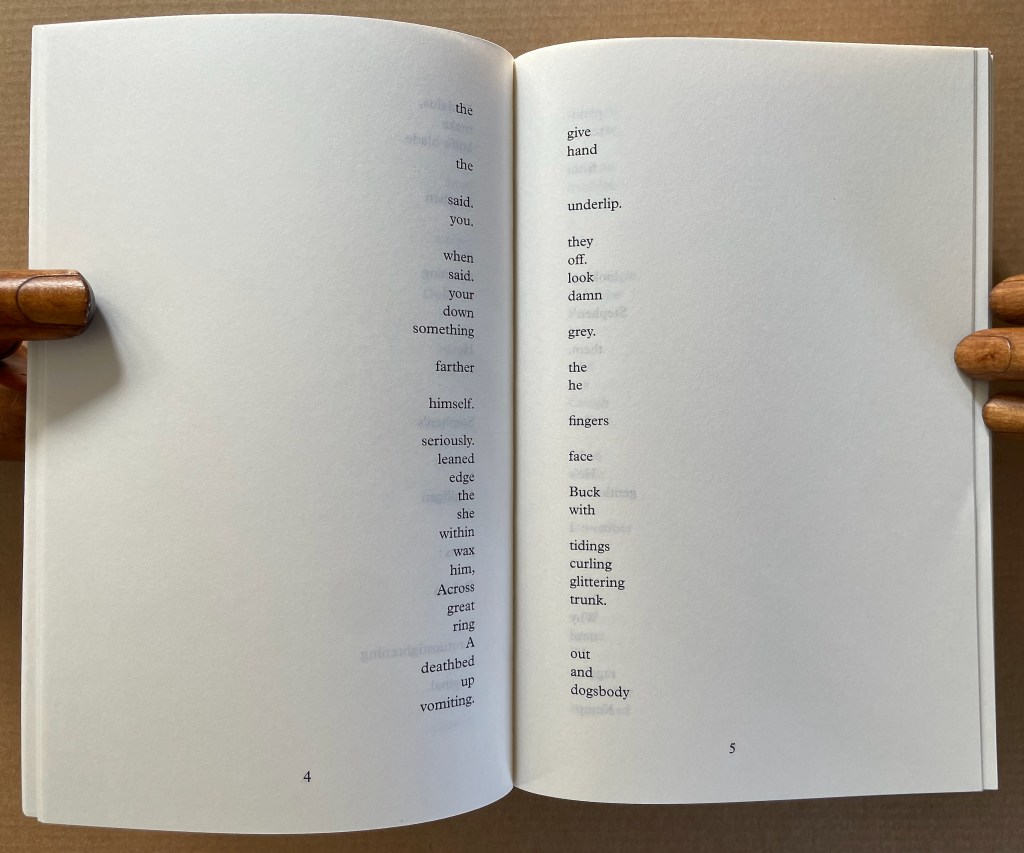
Dworkin’s preface teaches us how to take pleasure in Gutter Words, but how well does Hamill’s work stand on its own as an artist’s book if our pleasure in it depends on how well we are able to bring Ulysses and its literary historical context to bear while reading Gutter Words? Do we need Ulysses in hand to engage with Gutter Words?
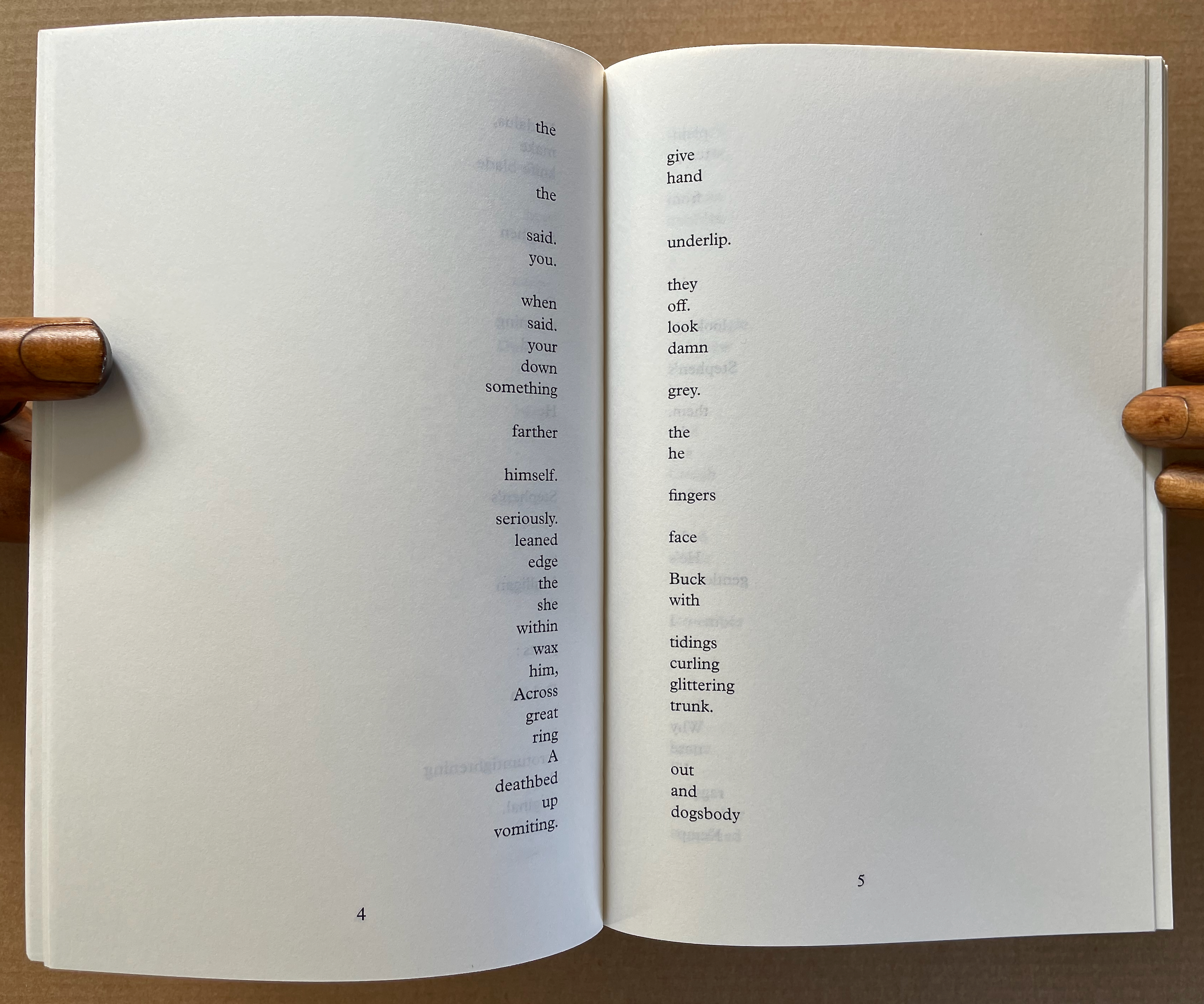
Several pages into Hamill’s work, the structural idea of a book’s gutter begins to impinge almost regardless of the stacked words’ sense; they could almost be redacted with black ink. Then, several more pages into the book, the blanks begin to impinge, not to have their missing words restored but to be seen as flags or walls or sheets of white. Several more pages still into the book, and the search for sense in the stacked words returns. Where something haiku-like occurs or where some Joycean phrase emerges, the search becomes more urgent. We might even find ourselves reading across the gutter to find something. Where the search fails, we might find ourselves wondering about the missing words, or falling back on a blurry-eyed impression of the edged blank channel formed by the justified words on either side of the gutter. We might consider the painstaking effort to expose it.
Depending on the level of symptoms of withdrawal from Tik Tok, X-Twitter, or doomscrolling, we may bounce among giving up or turning to a copy of Joyce’s Ulysses to find our inner Dworkin or giving in to the psychophysicotherapeutical experience of book art. Wherever you land, Gutter Words is not a one-trick pony, but how well it stands on its own depends on the reader.
Further Reading
“Mikki Kuorinki“. 21 October 2022. Books On Books Collection.
“Notes on “Inverse Ekphrasis” as a way into book art“. 16 June 2022. Bookmarking Book Art.
Dworkin, Craig Douglas. 2003. Reading the Illegible. Evanston, Ill.: Northwestern University Press.

