Books On Books Collection – Ryuta Iida

Silent Book, vol. 11
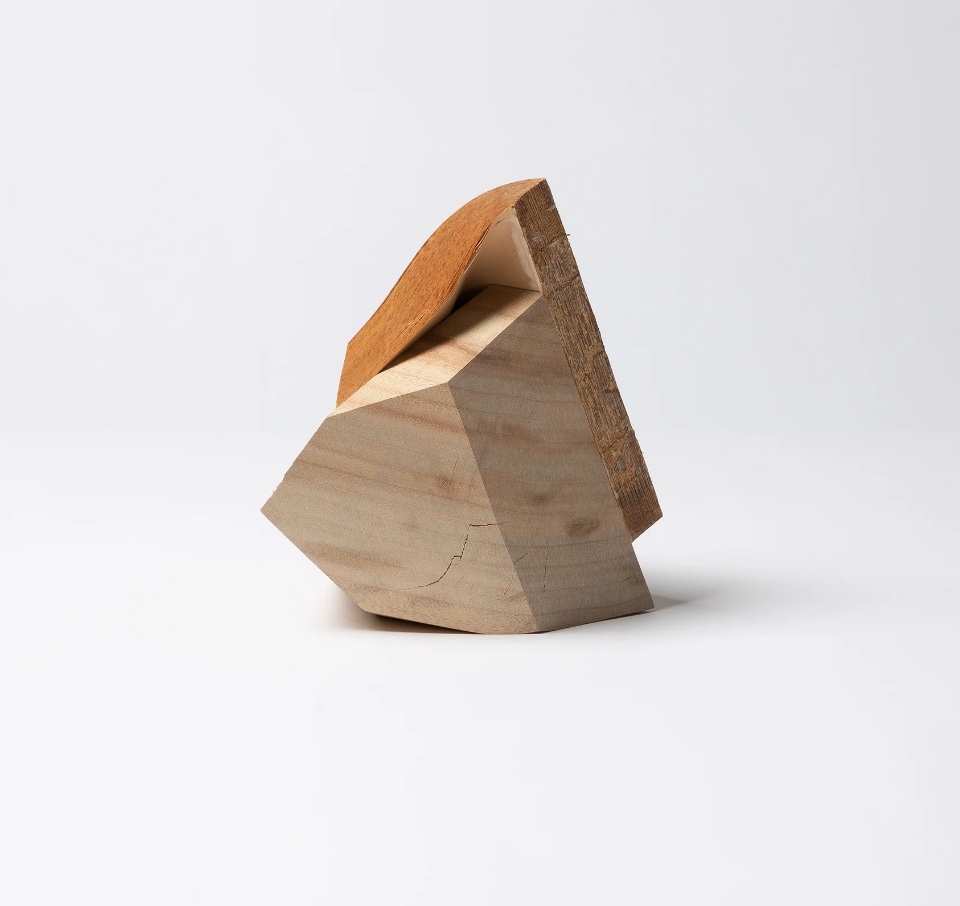
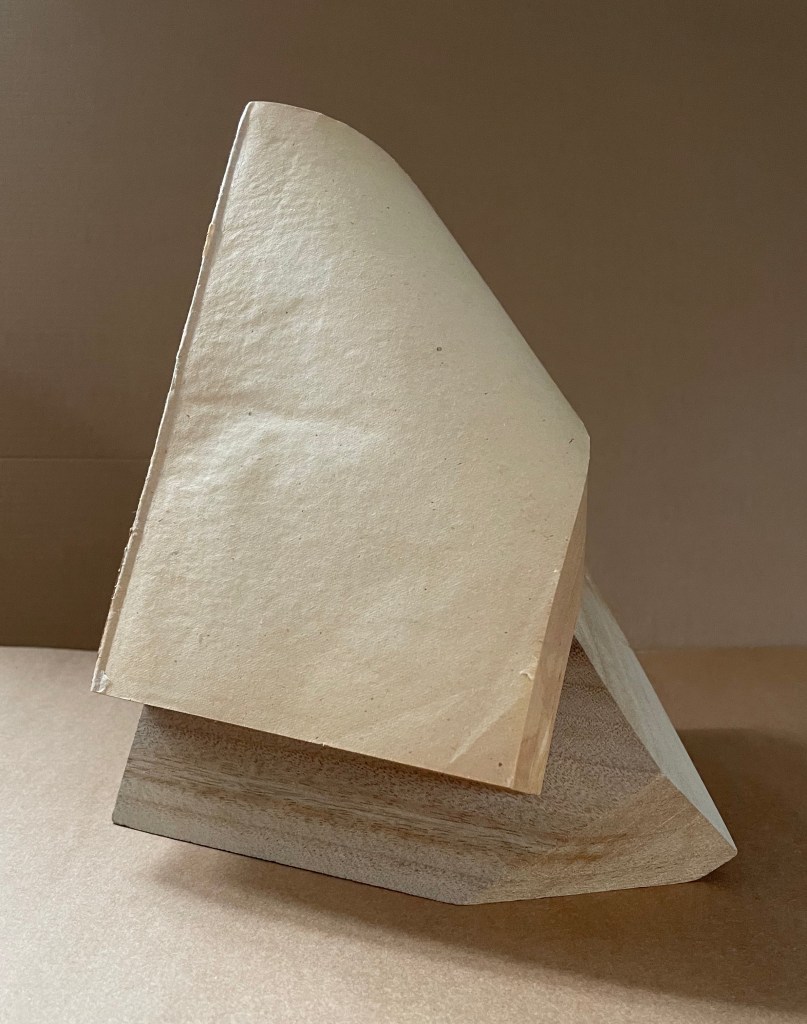
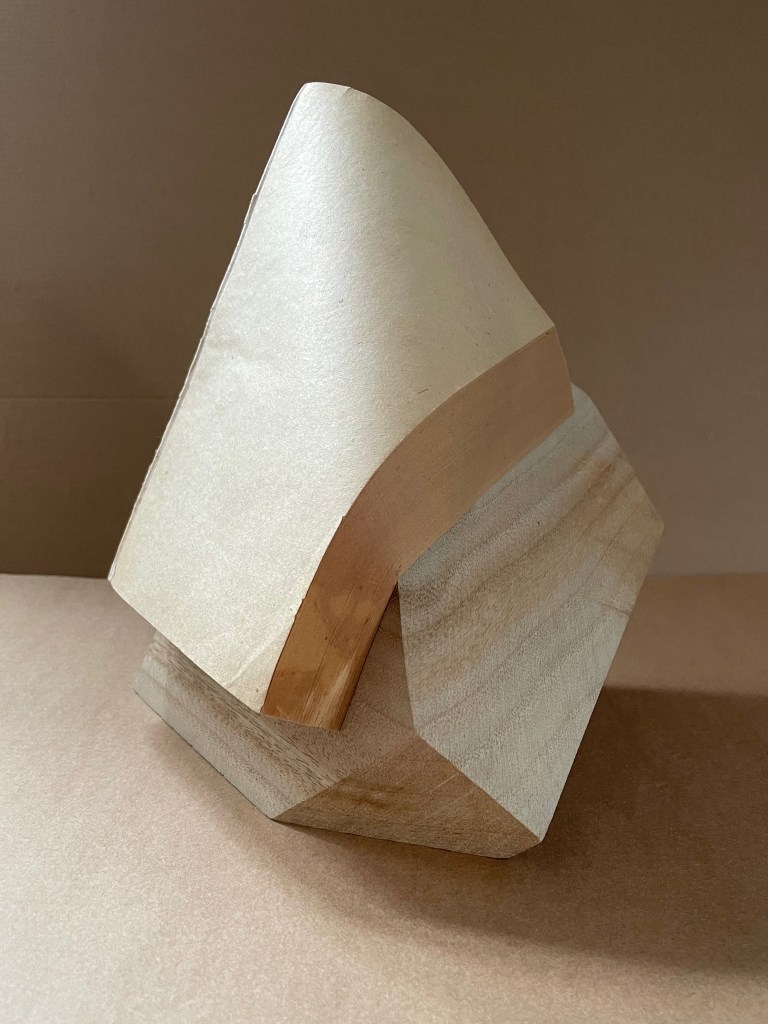
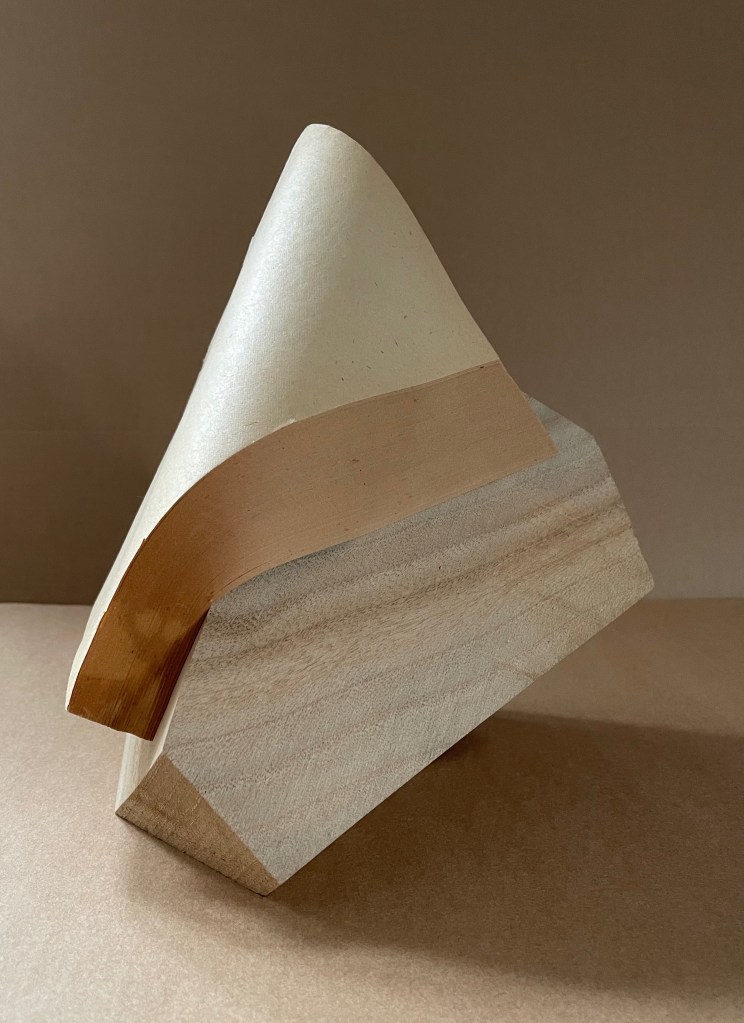
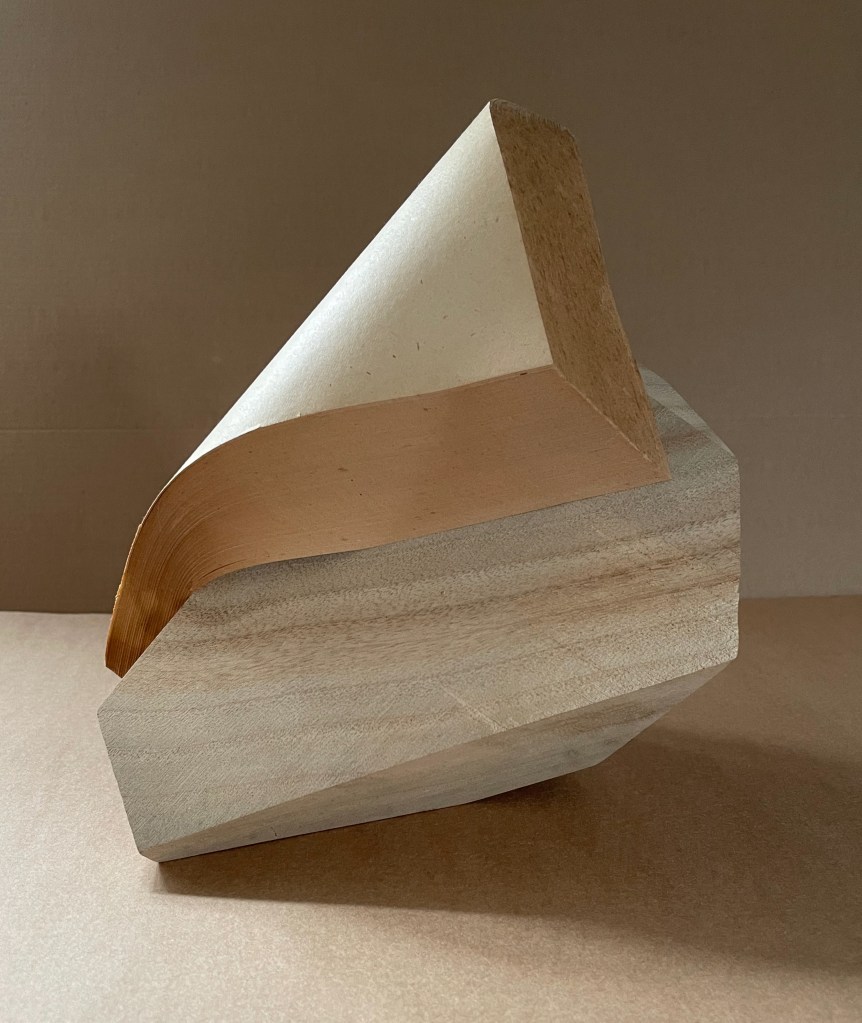
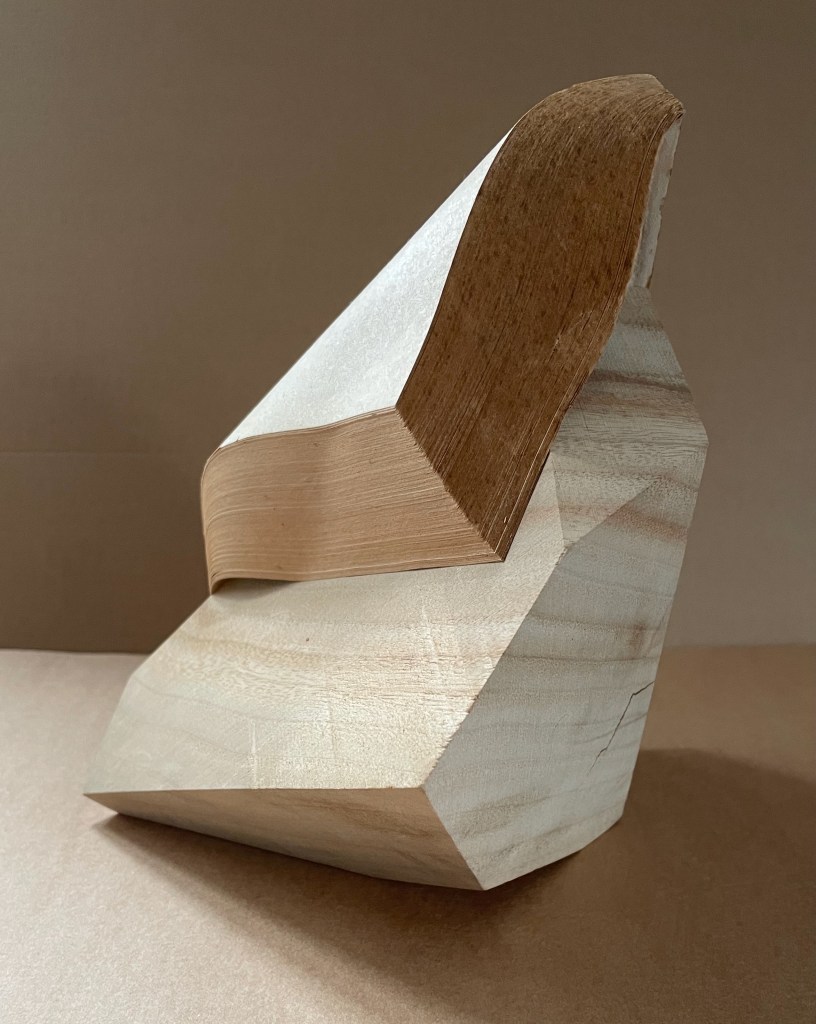
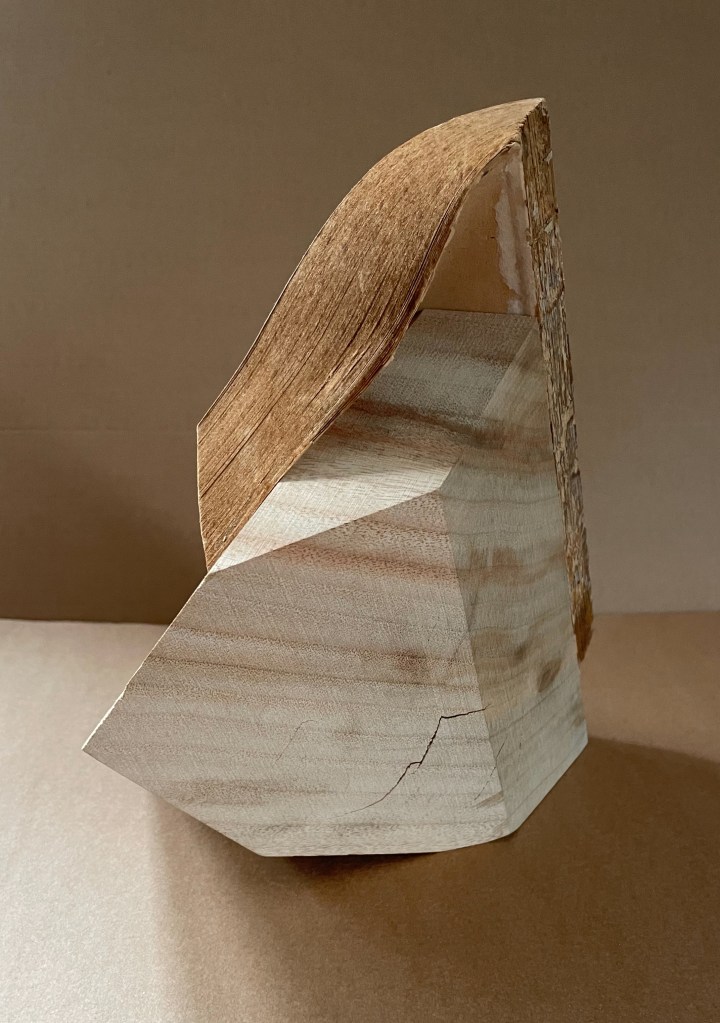
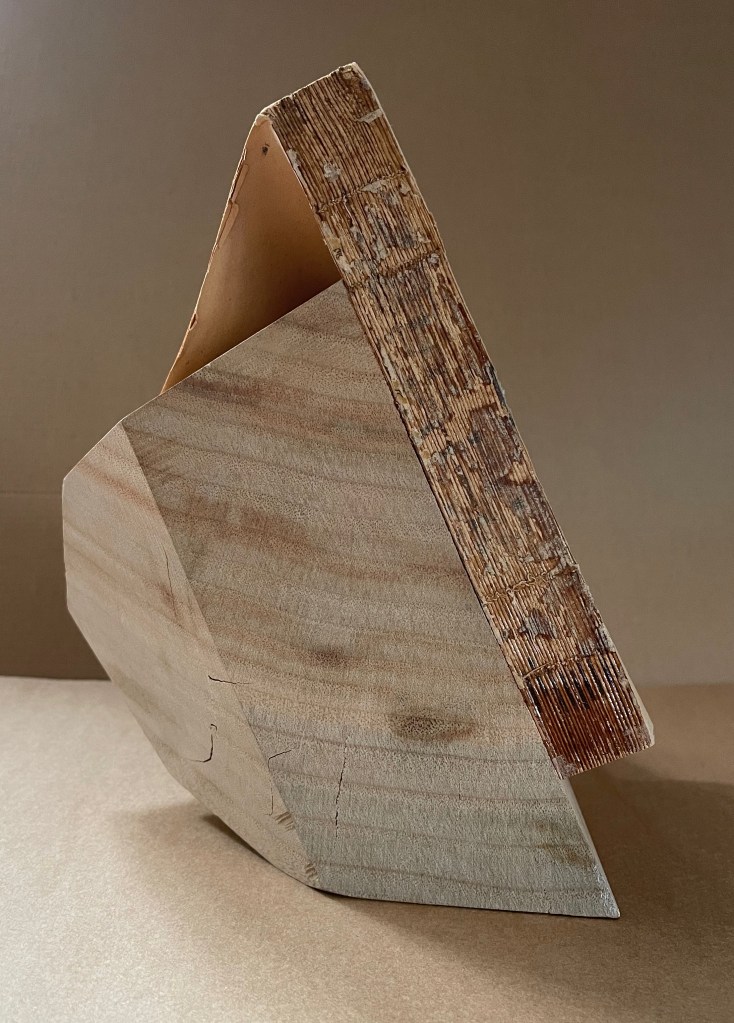
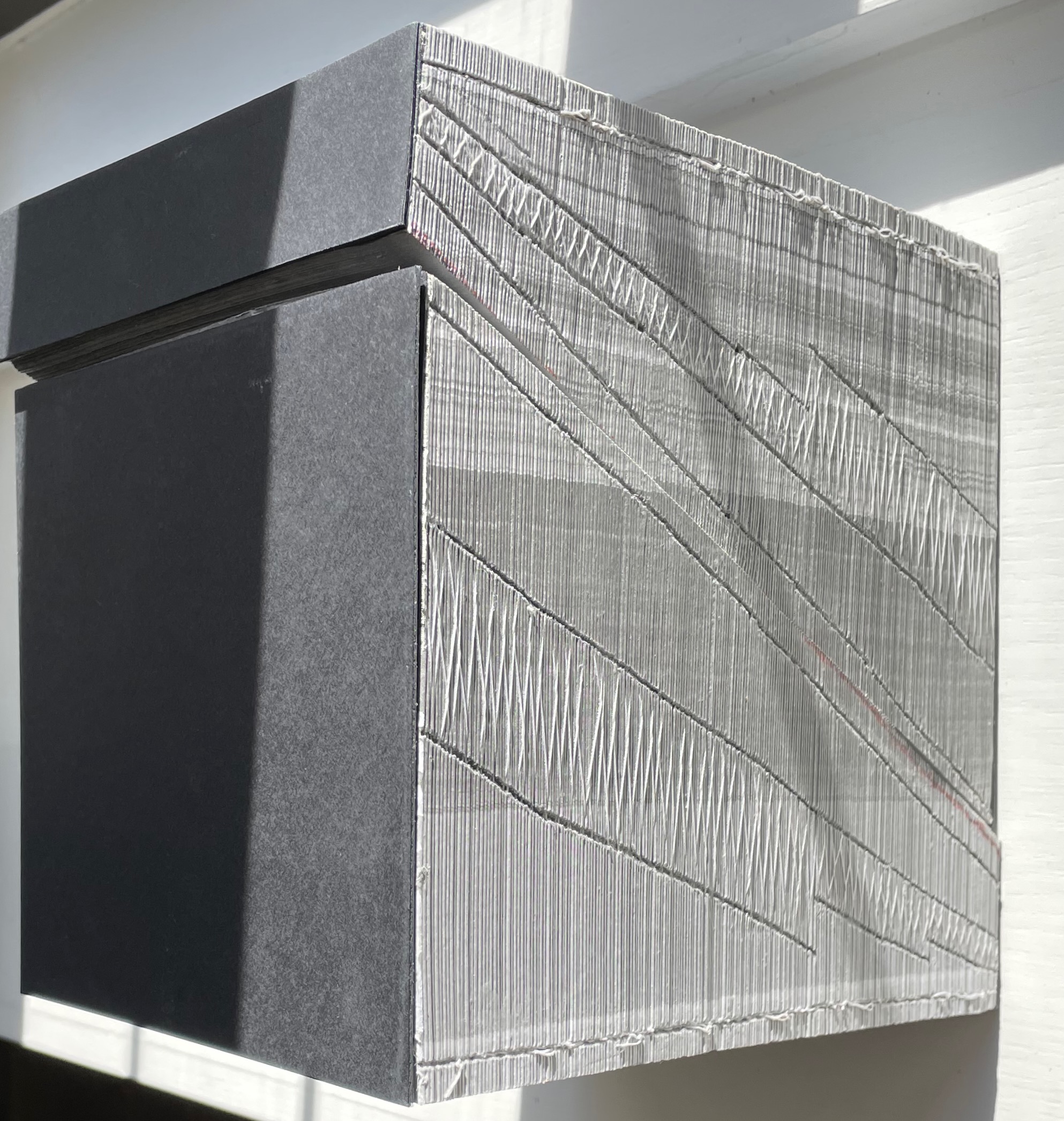
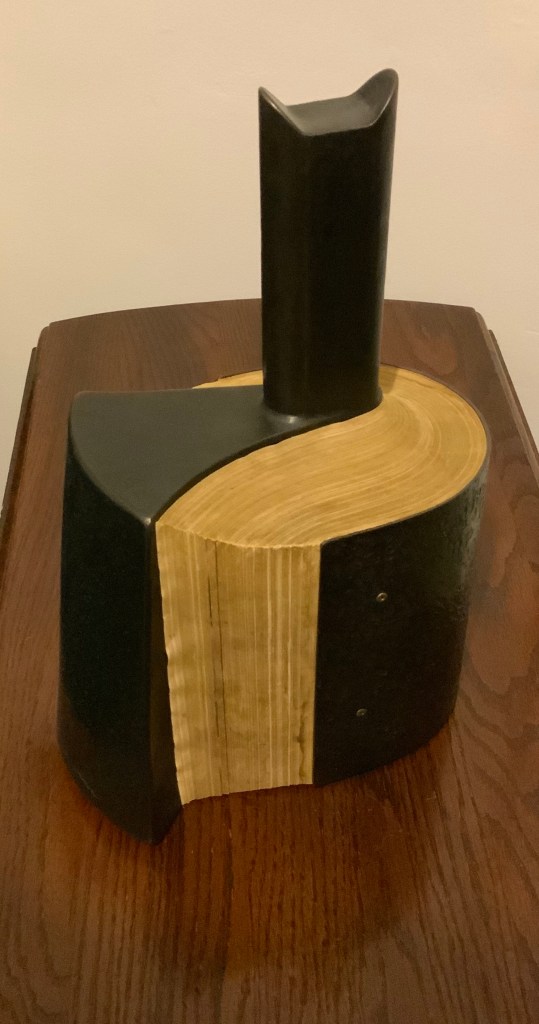
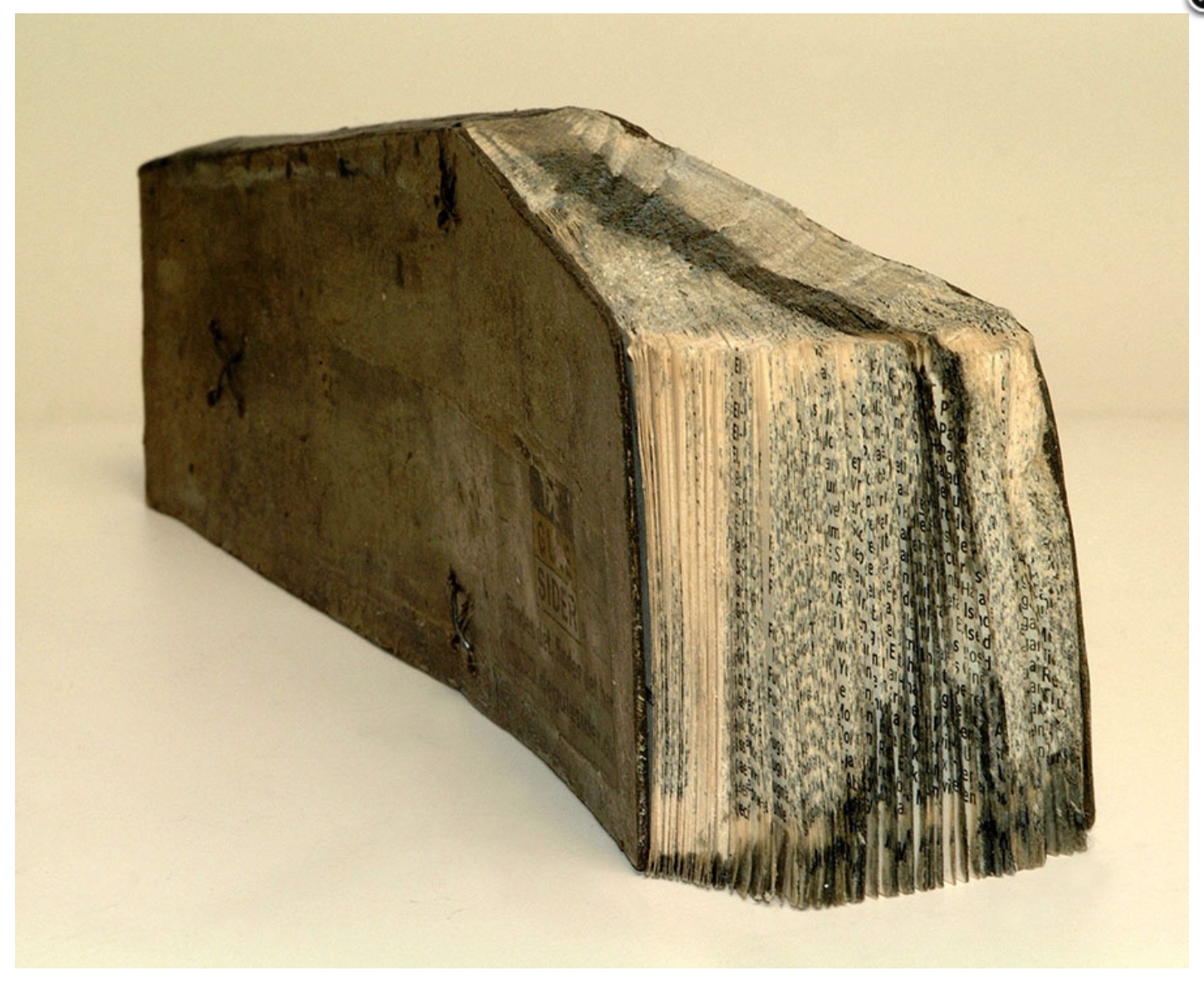
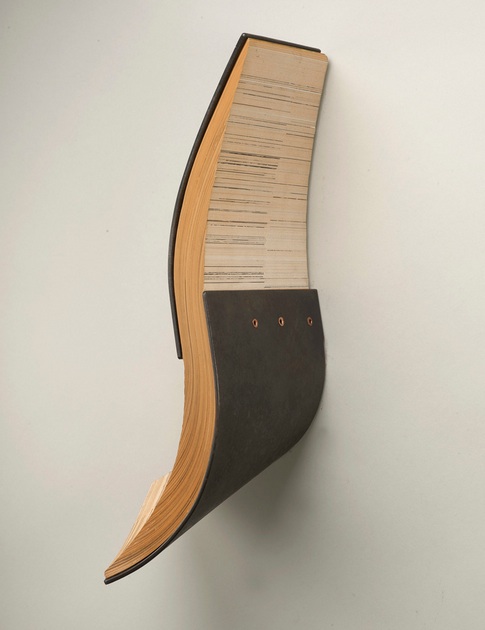
Artistic wooden sculpture resembling a geometrically abstract book, featuring angular planes and a smooth finish.

Silent Book, vol. 11 (2023)
Ryuta Iida
Altered book, camphor tree stump, and glue. H210 × W170 × D190 mm. Unique. Acquired from Fragile Books (Tokyo), 20 August 2024.
Photos: Above, courtesy of Fragile Books; below, Books On Books Collection.

The cover, door, table of contents, numbering, text, and endnotes are all filled with a series of information. I thought to stop and crystallize all the functions of the “book,” … I decided to crystallize it. It took the time to go through the hands of people, the old book that finally reached me, sealed on a pedestal, it is now ripe for its next role. (Artist’s statement)

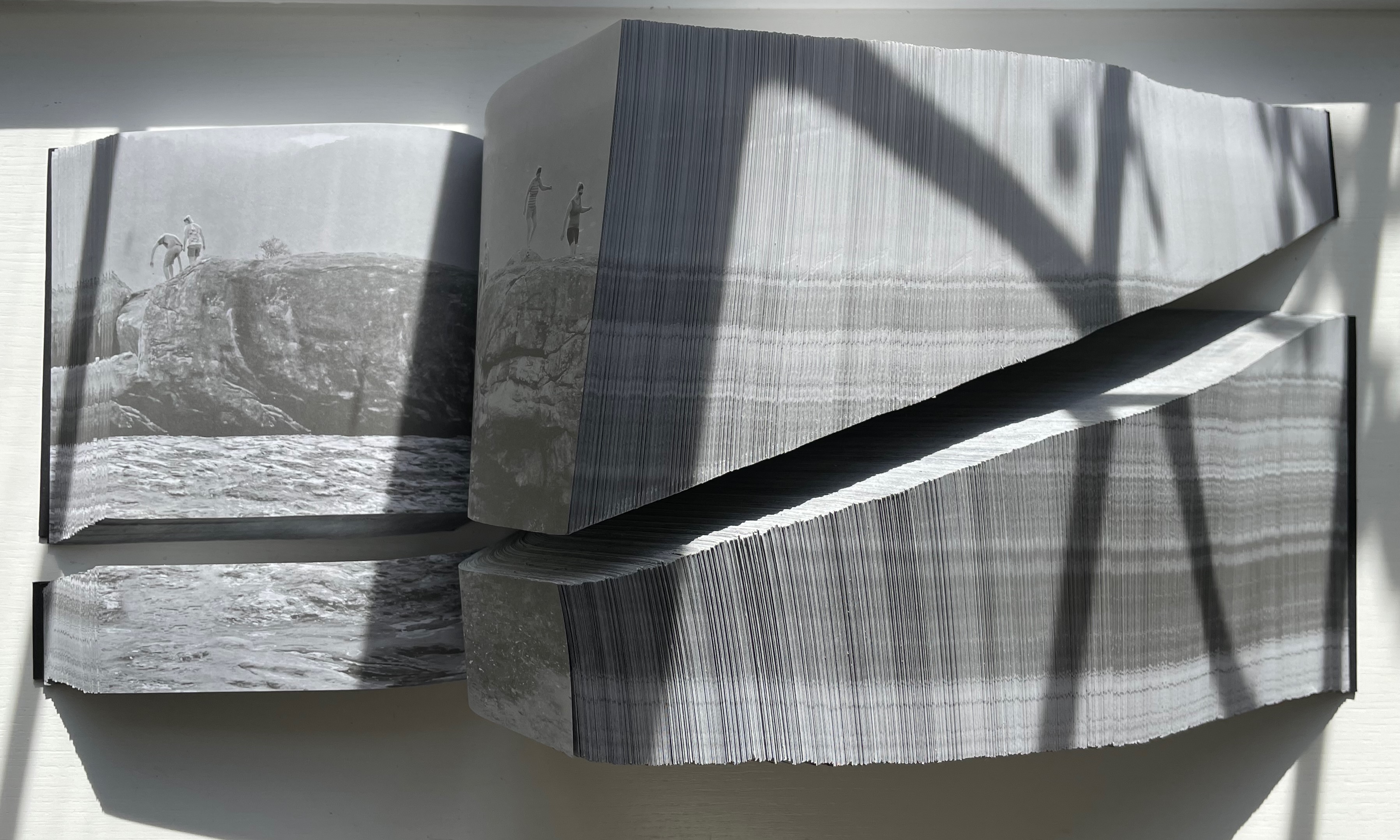
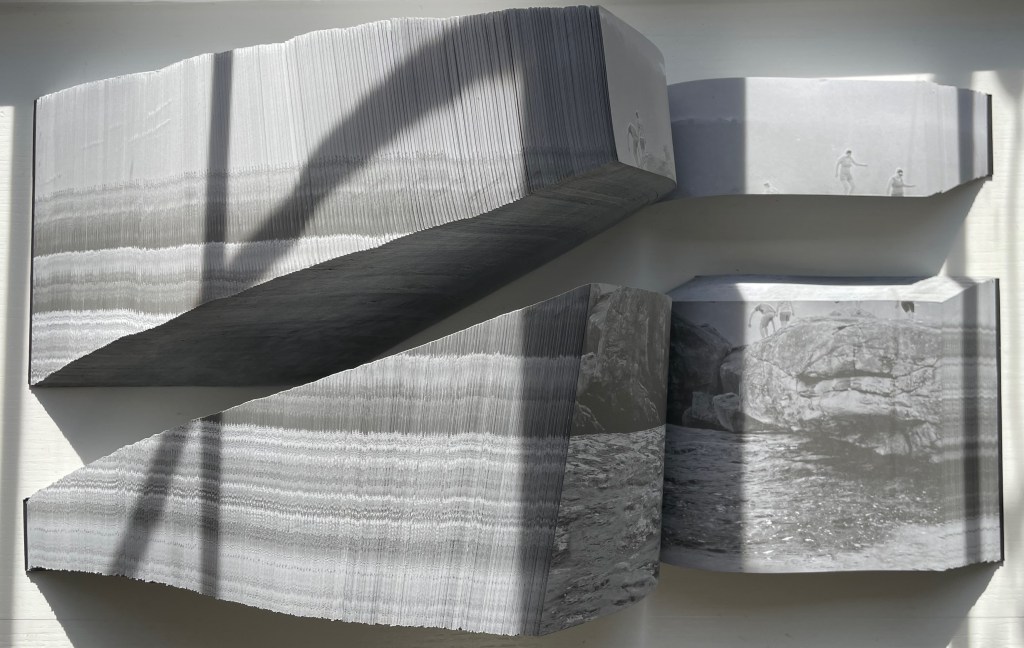
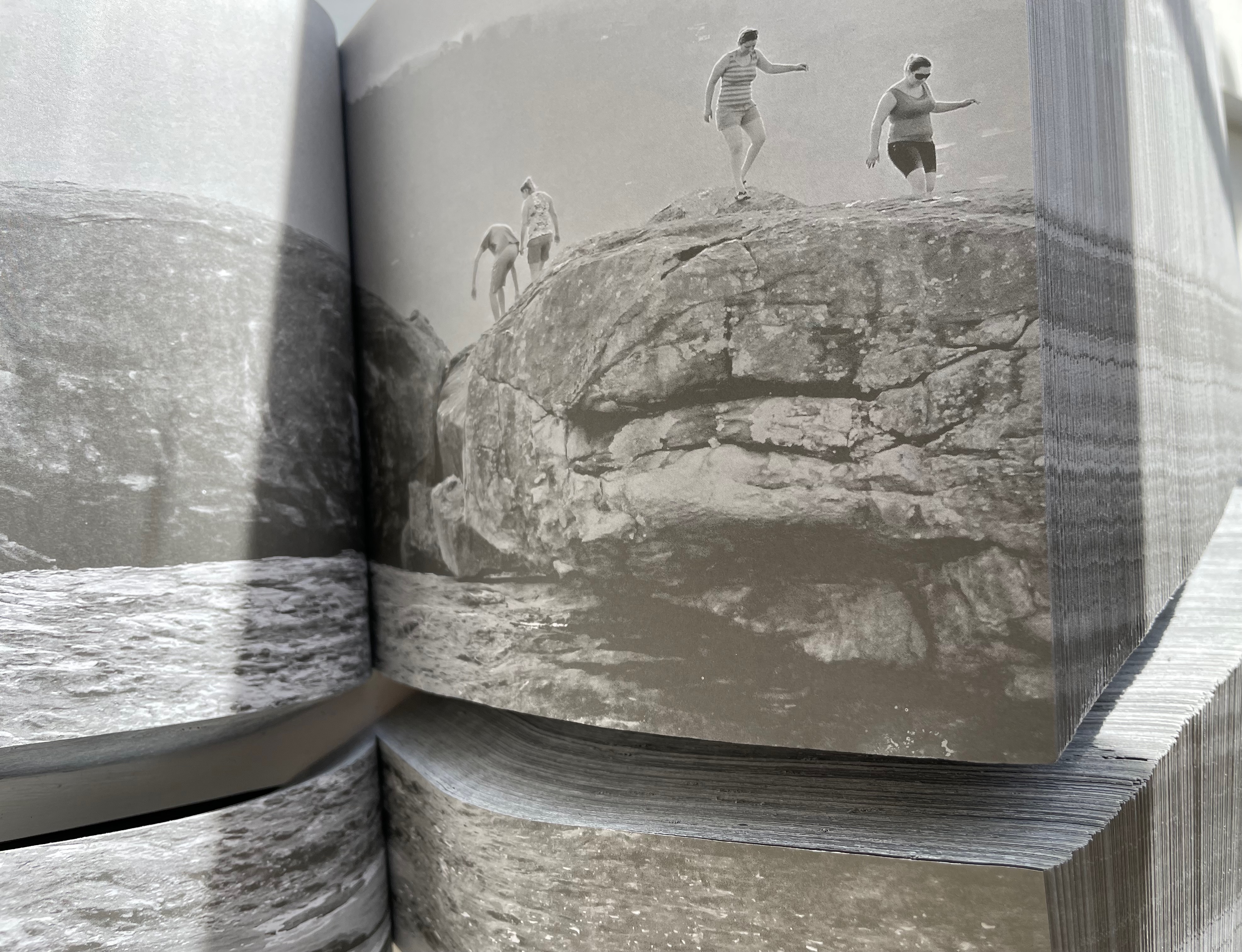
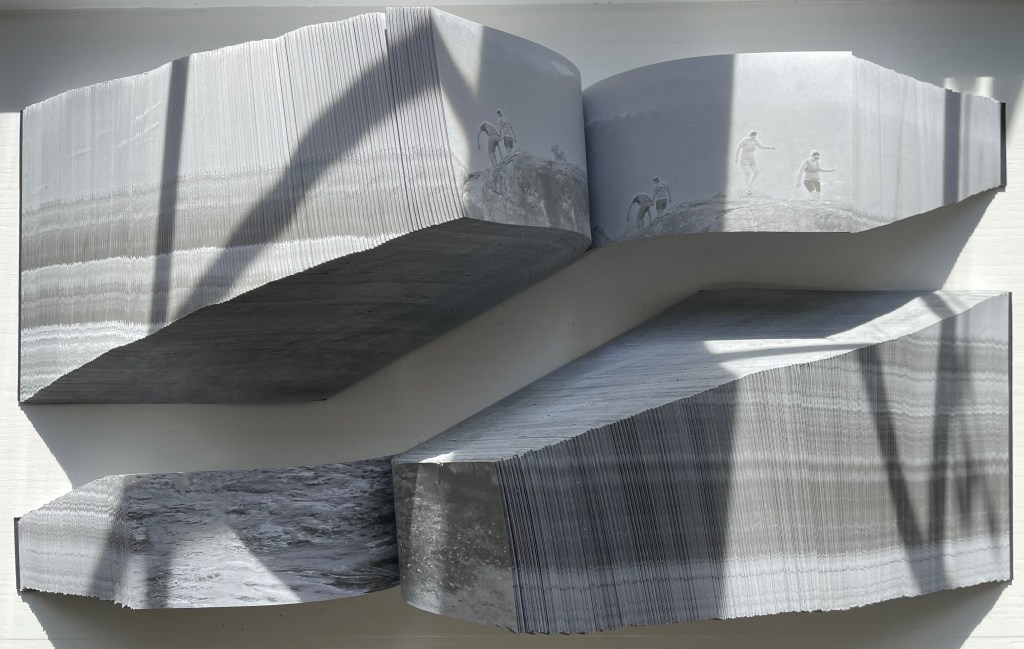
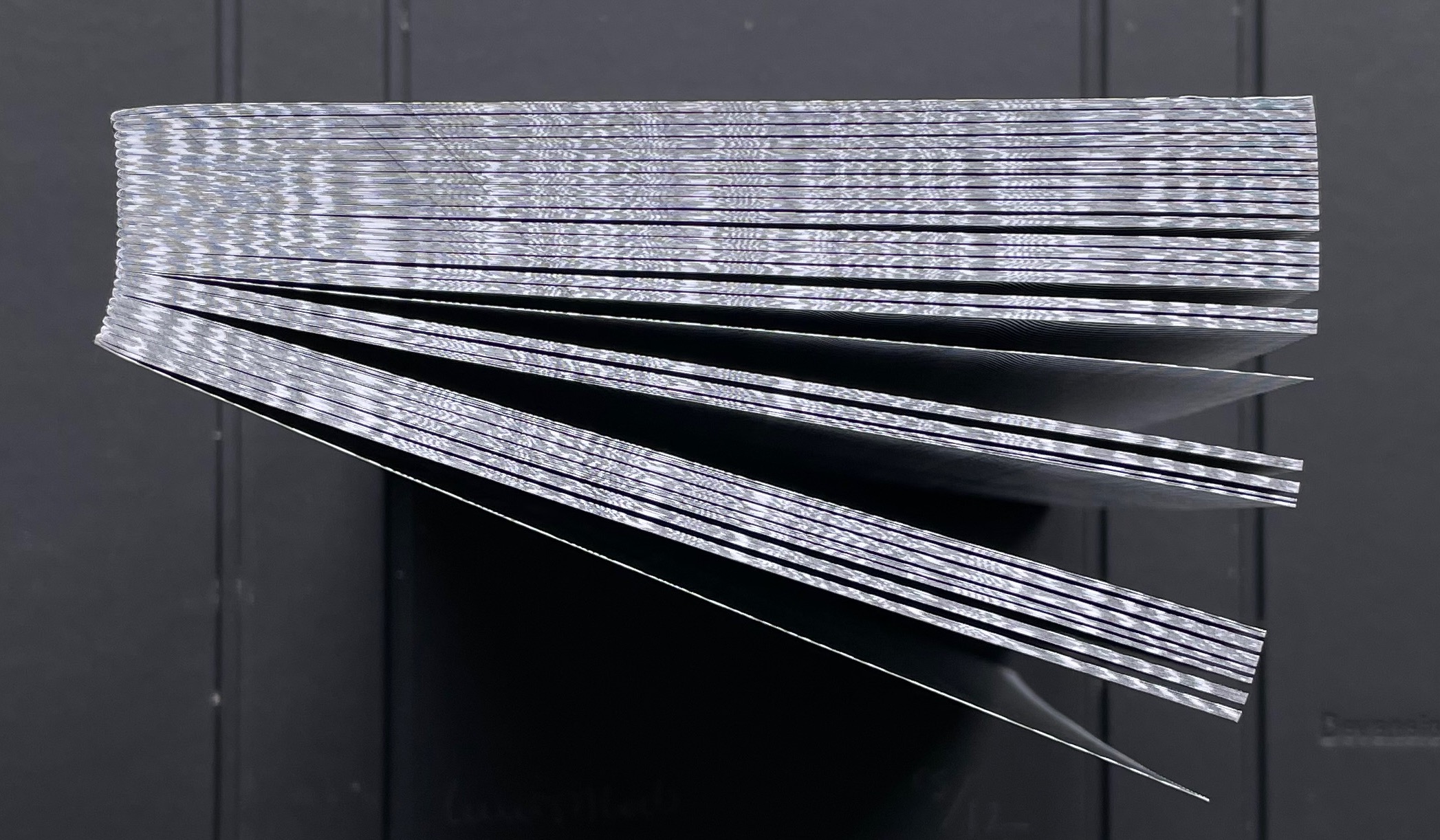
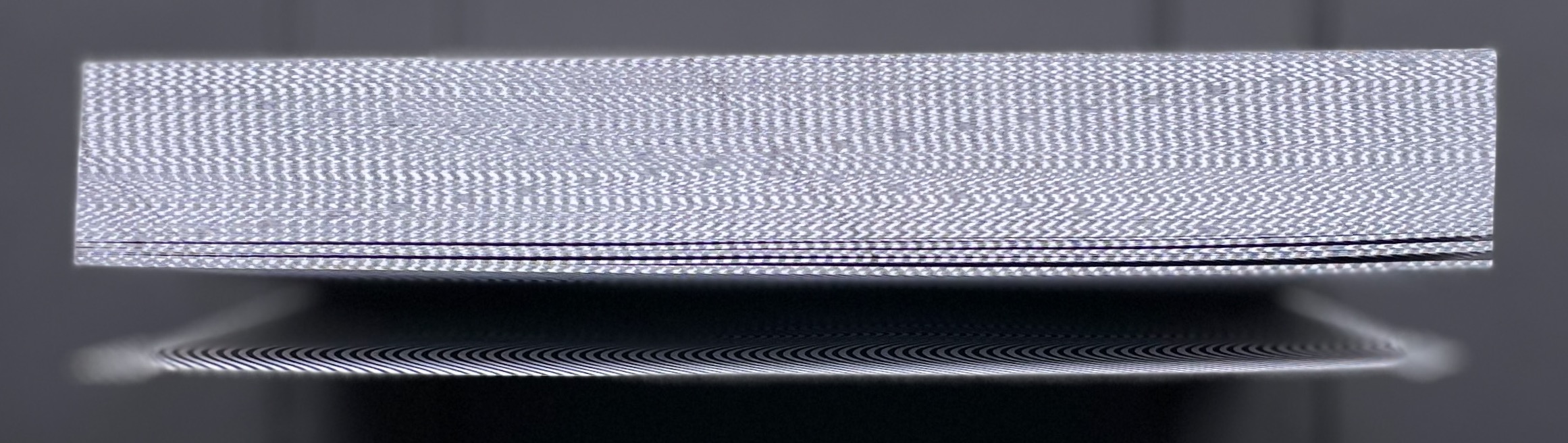
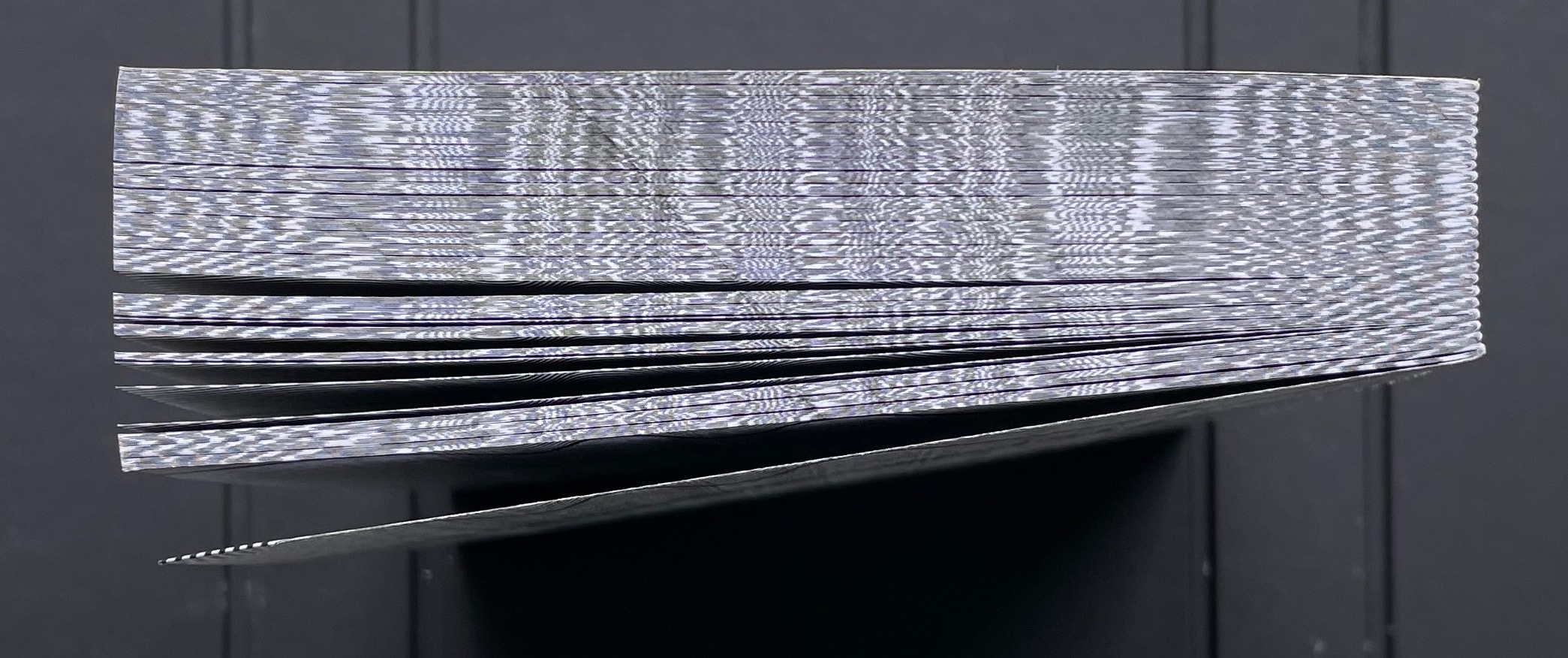
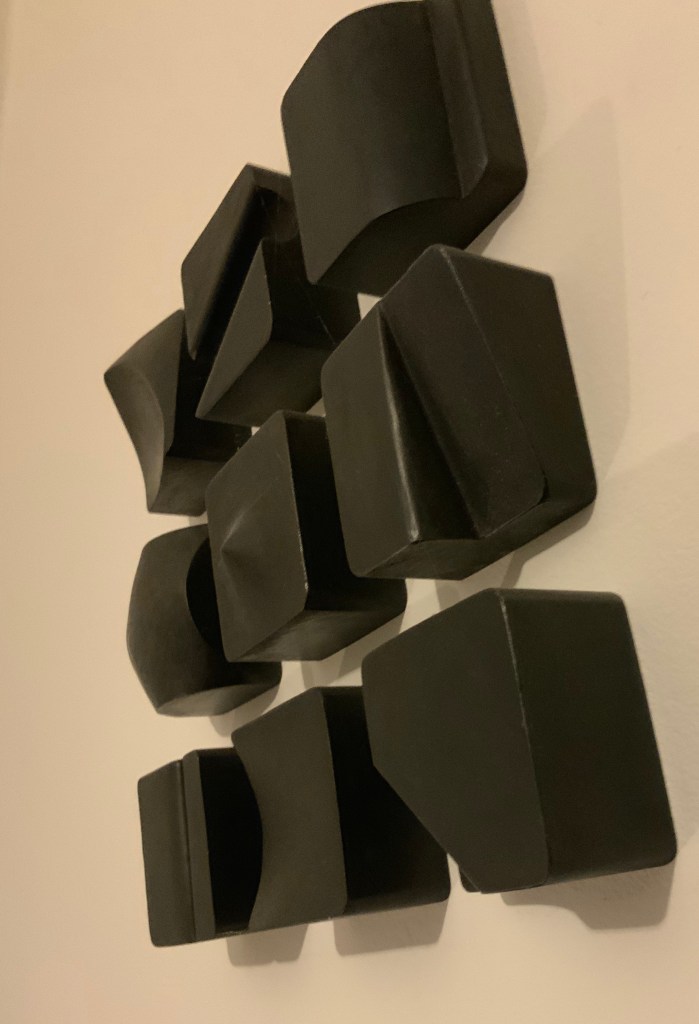
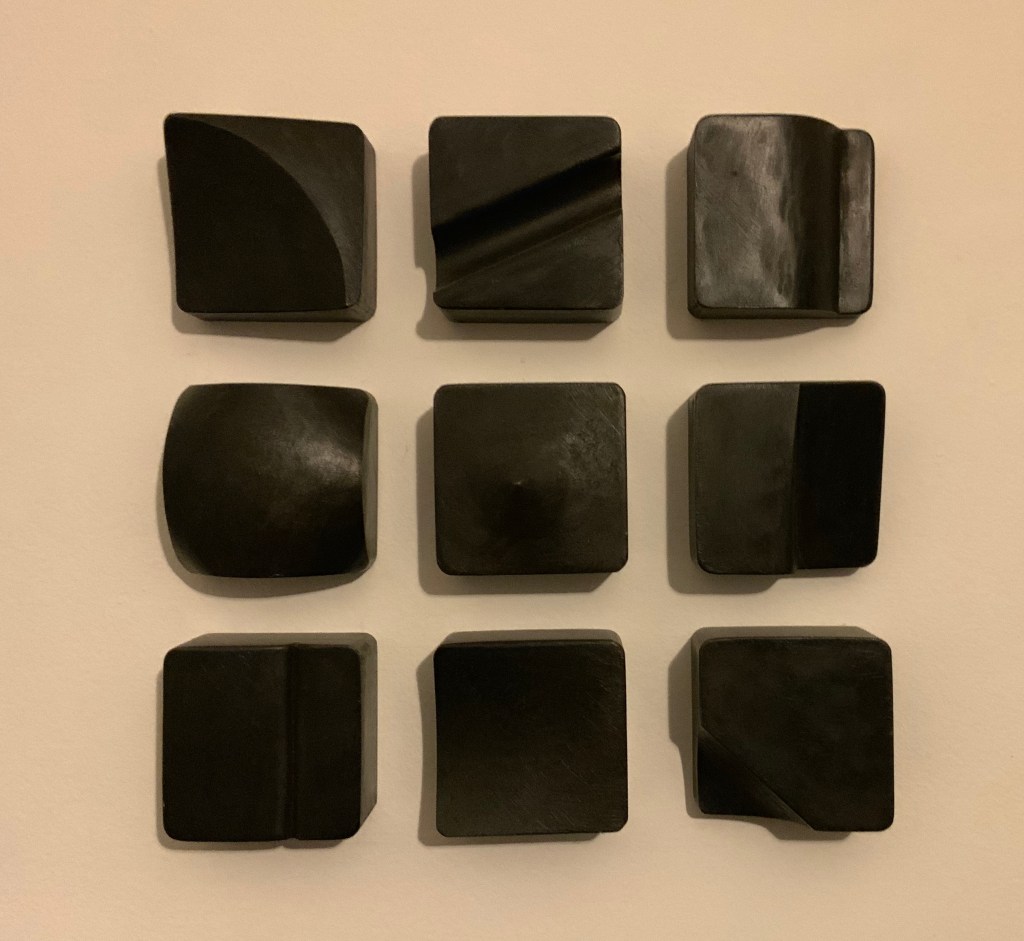
“Crystallized” is not the first word that comes to mind when viewing and handling this eleventh in Ryuta Iida’s series Silent Book. Perhaps it does for the angled planes of the cut block of camphor wood, but for the coverless codex, folded, draped, moulded, carved, and sculpted come closer. Two names that might not spring to mind (but should) are Giambologna (Jean Boulogne) and Gian Lorenzo Bernini. Like them, Iida offers us more than a single or primary vantage point from which to appreciate his work. Like Giambologna’s Abduction of a Sabine Woman (Loggia dei Lanzi, Florence) or Bernini’s Apollo and Daphne (Galleria Borghese, Rome) Silent Book must be circled and viewed in the round. The nine images below show the work turned right to left in stages.
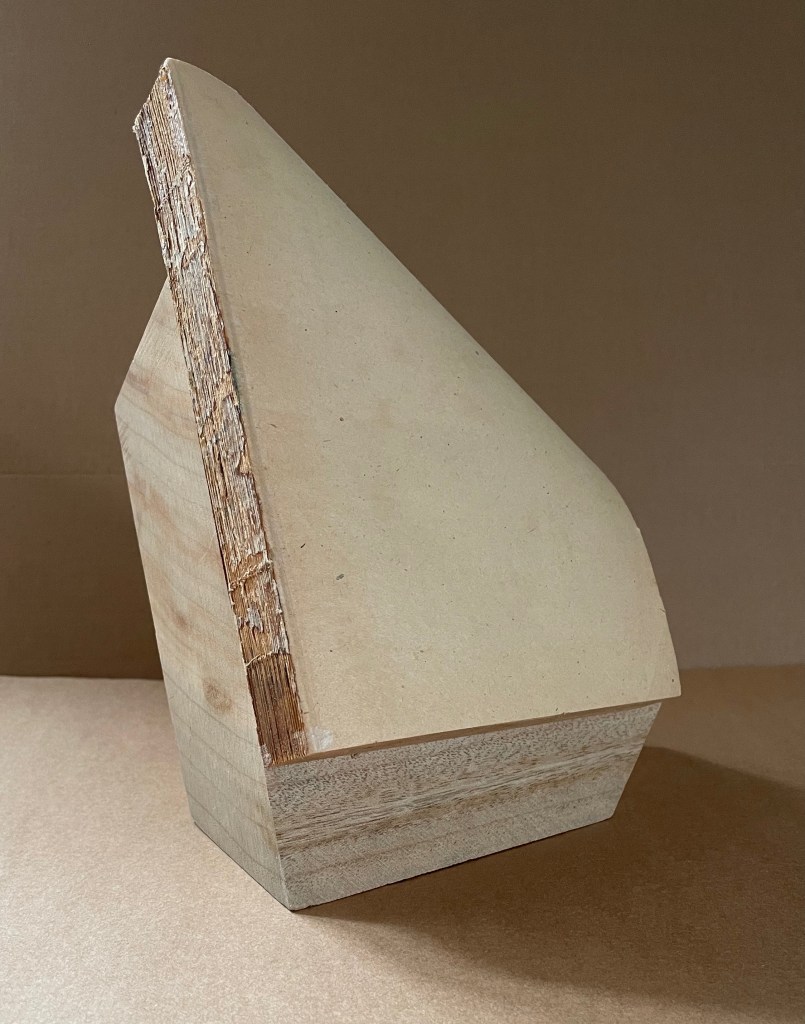
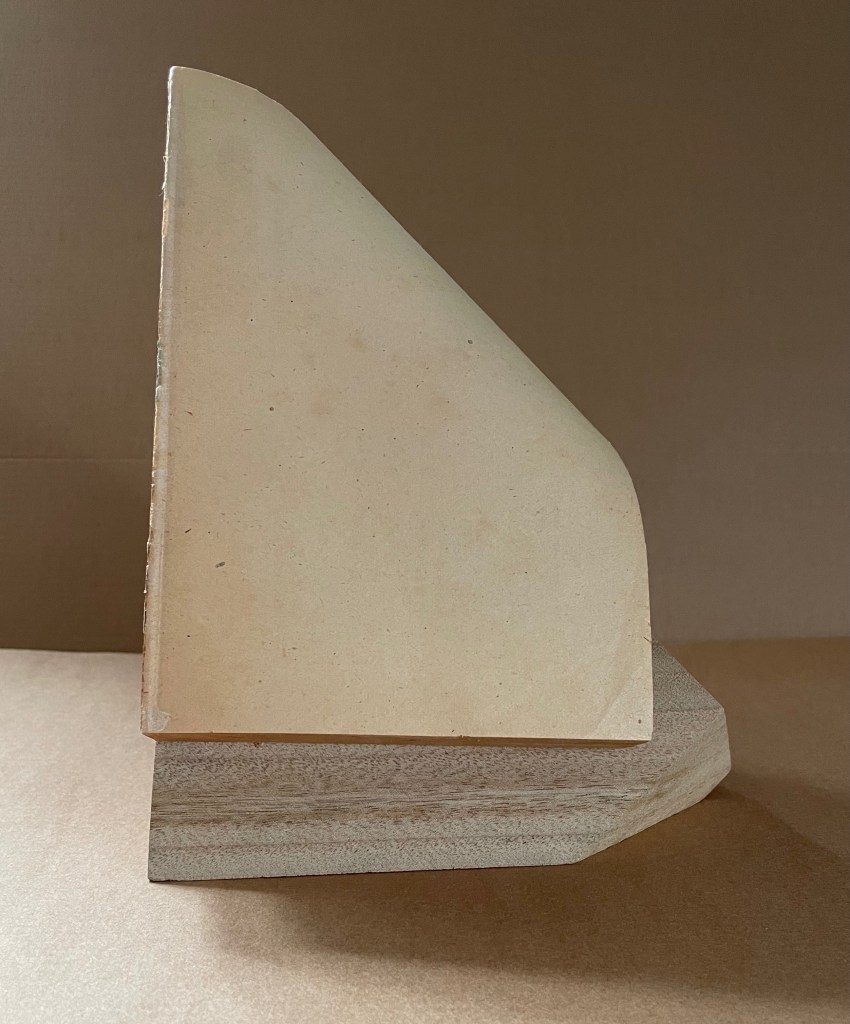
Far as Silent Book is from the figurative, violent, and ornate features of the 16th and 17th century masterpieces, it still harbors its own complexities of line, shadow, texture, and form. There is a volume of dynamics between and among them that belies the work’s title. Note how the layers of pages echo the wood’s grain, and how the color and texture of the page surface contrasts with those of the book’s top edge, and how that contrast reverberates with the shifting colors of the wood. Iida has moulded and sealed the book block so that the top edge curves to a point in a duet with the cut angles of the wood block.
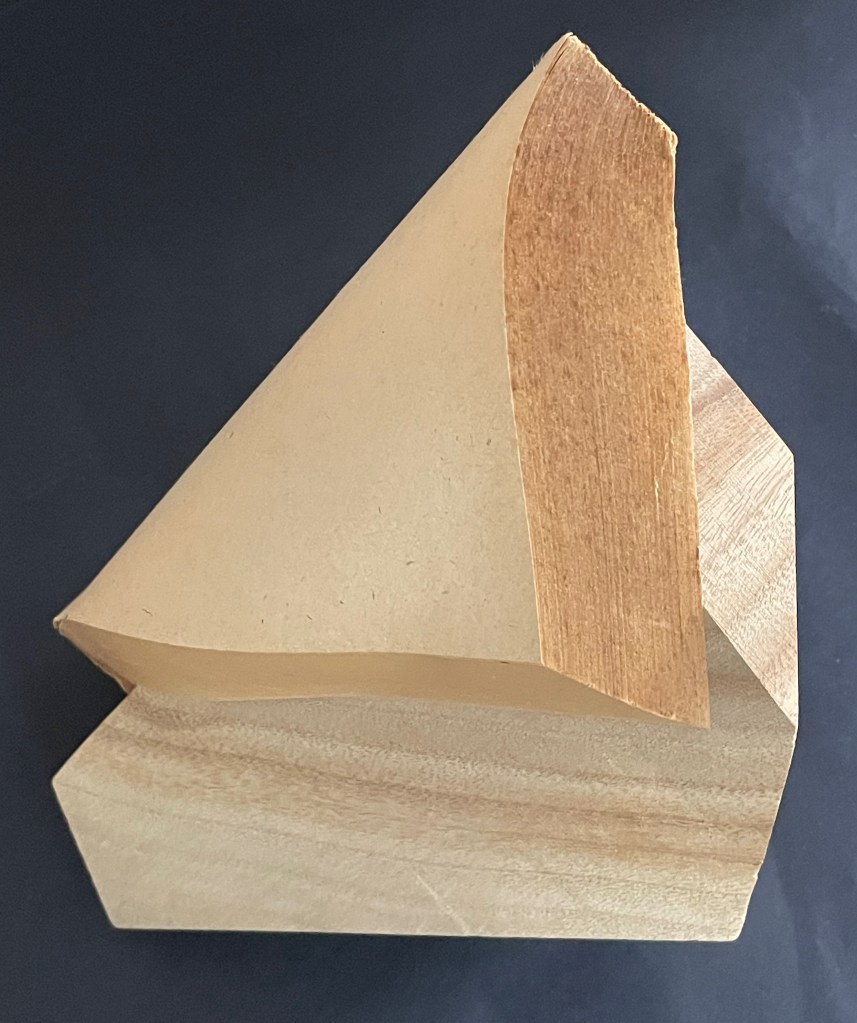
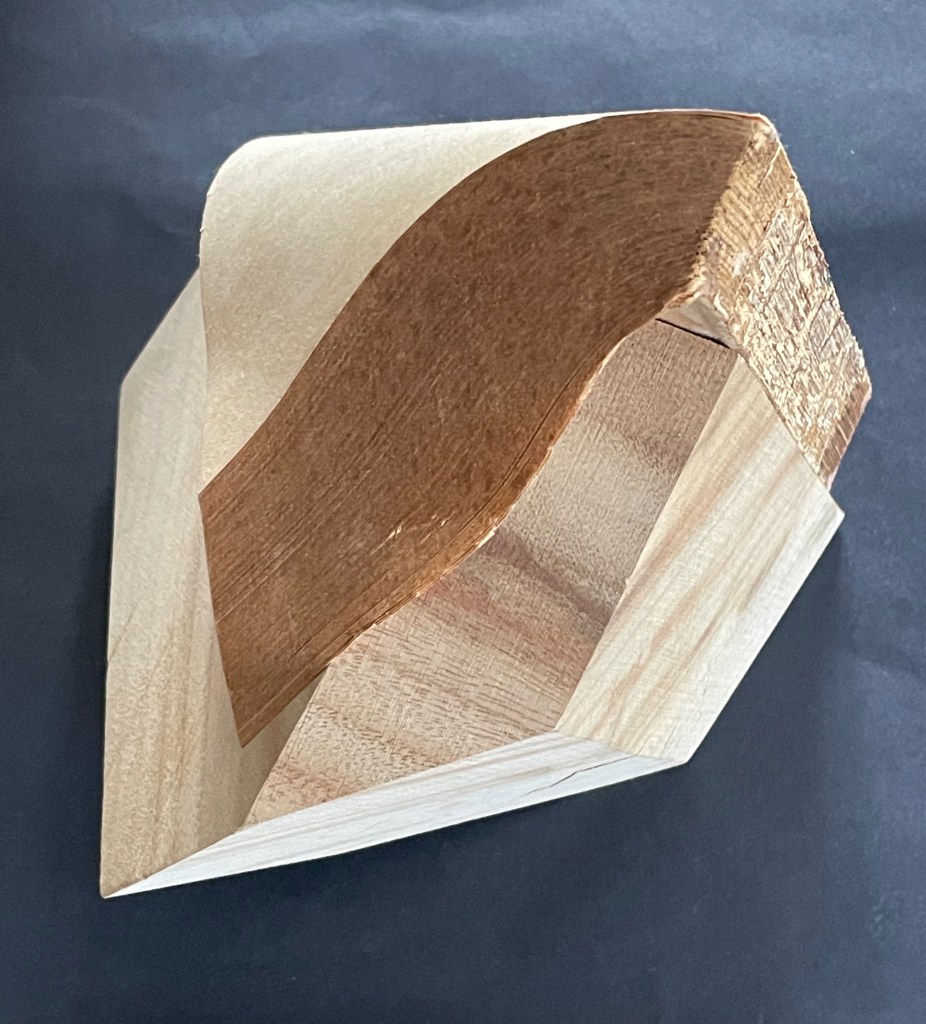
Silent Book has many kin in the world of book art, works that make the content of a ready-made volume inaccessible and make something anew from the material object. Too often this sub-genre has been dismissed as a fetishization of the book. This overlooks how Silent Book and its kin make us think about the book as a material for making art and as a source of metaphors, and we overlook what the individual artworks are. By sealing away the content of a book, giving the book block a sinuous shape, and fusing it with a carved block of wood, Iida invites us to look afresh.

In the Books On Books Collection, several other works share this play of inaccessibility with tangibility: Barton Lidice Beneš’s Untitled (1973), Andrew Hayes’ Offset (2013), Jacqueline Rush Lee’s The First Cut and Silenda (both 2015), Doug Beube’s Red Infinity #4 (2017), Lorenzo Perrone’s Kintsugi (2018), and Chris Perry’s 217 Ripples: Sediment (2020). Of these, Offset seems closest to Silent Book. Comparison can increase appreciation of each and their sub-genre.

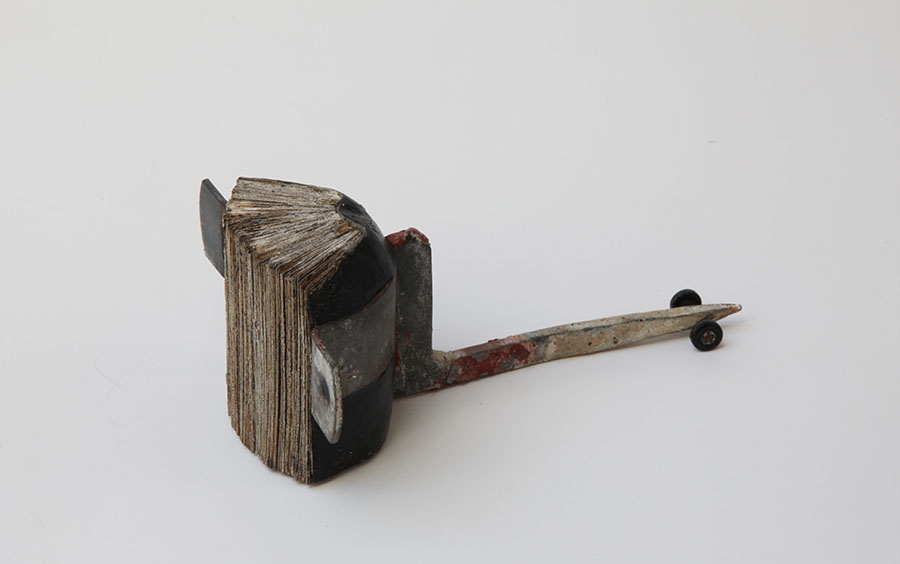
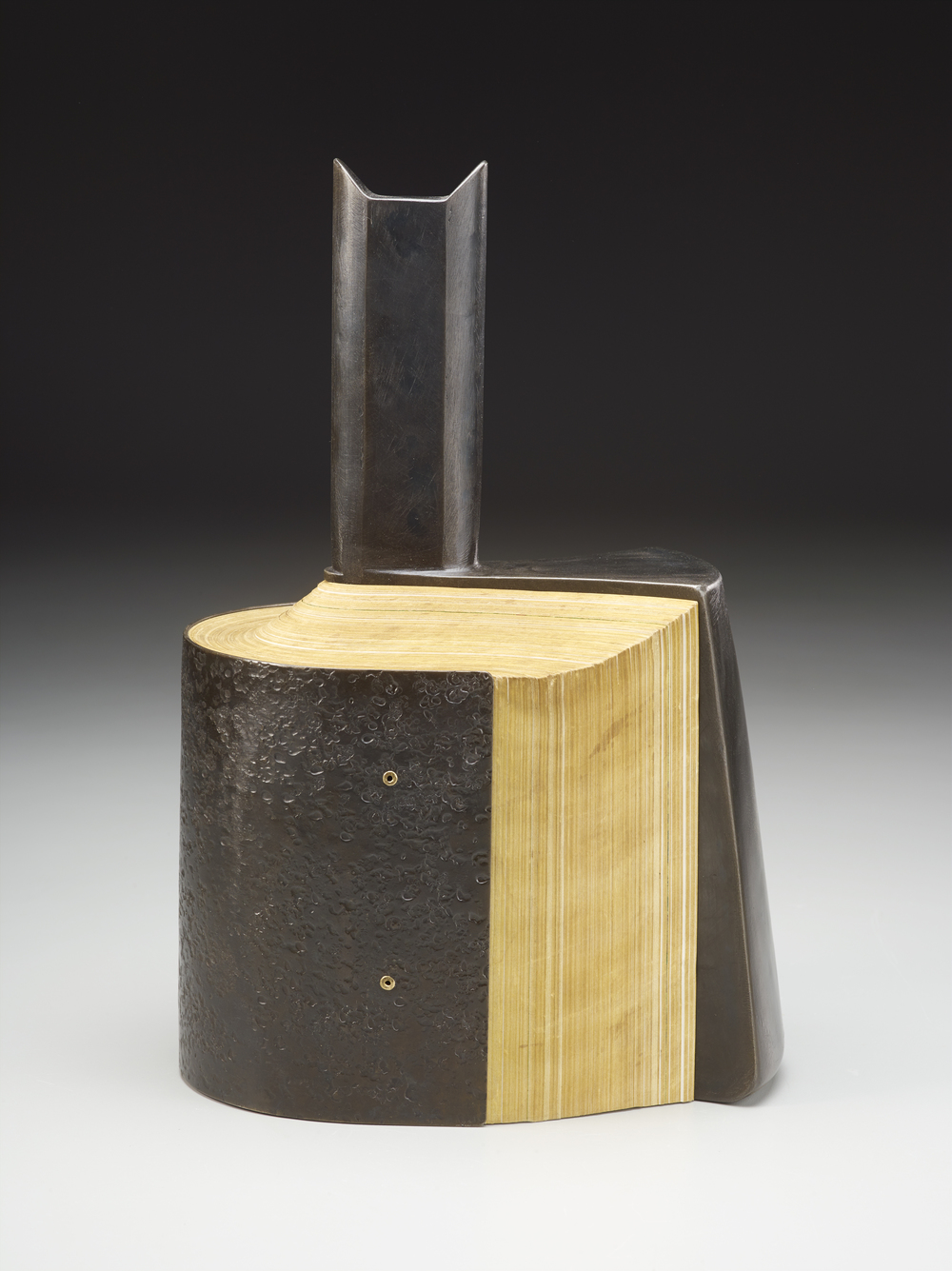
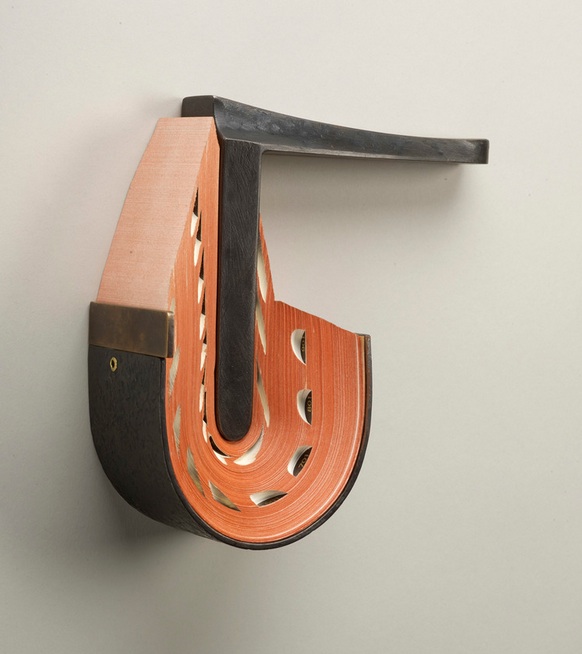
Both Hayes and Iida have managed to elicit a sense of action and motion from their materials. From one view of Offset, metal embraces the body of the book; from another, the book pushes the metal apart. From one side of Silent Book, the upward-angled block of wood supports the coverless codex folding over and slipping down its pedestal; from another, the book drapes a protective arm over the sideways-angled block.
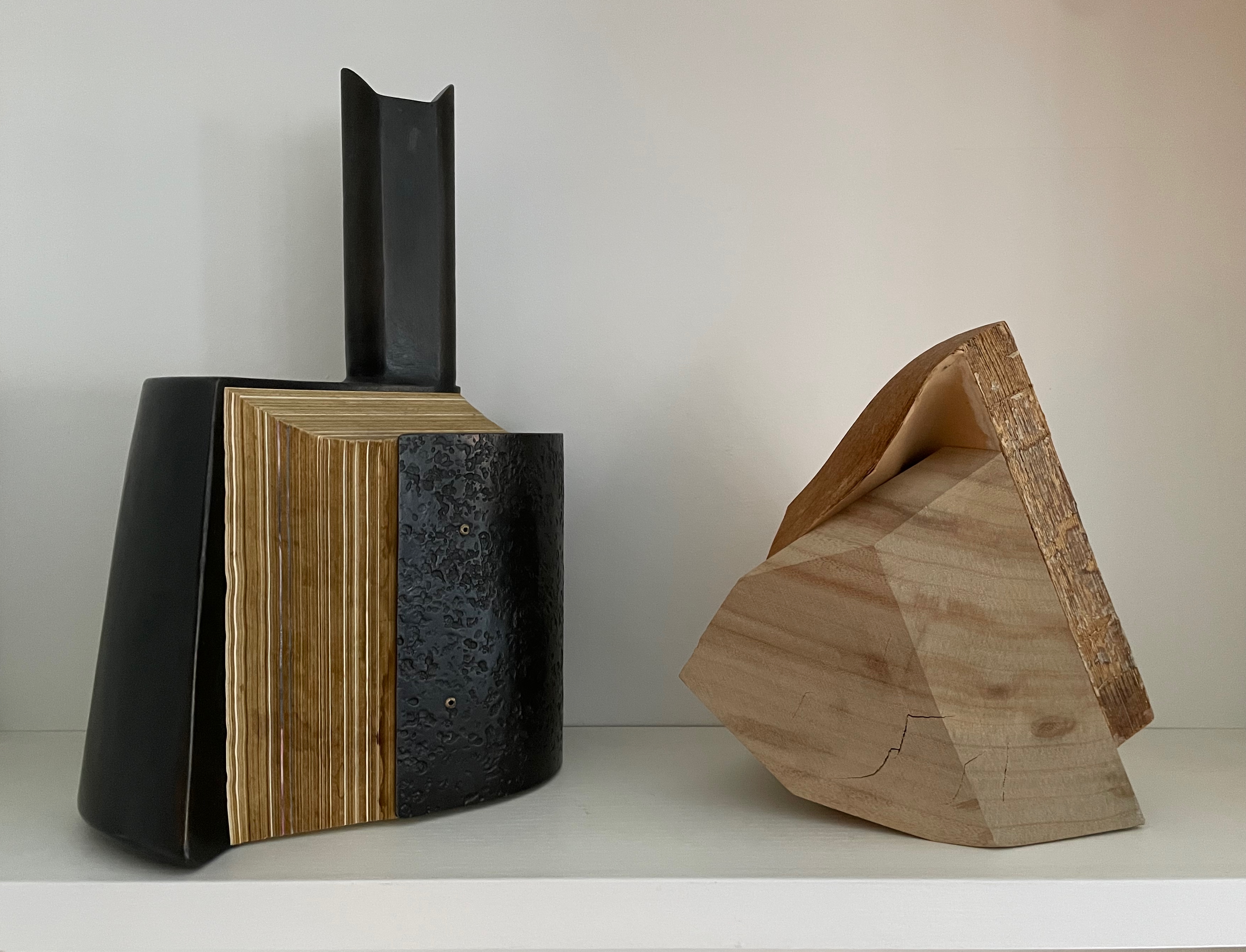
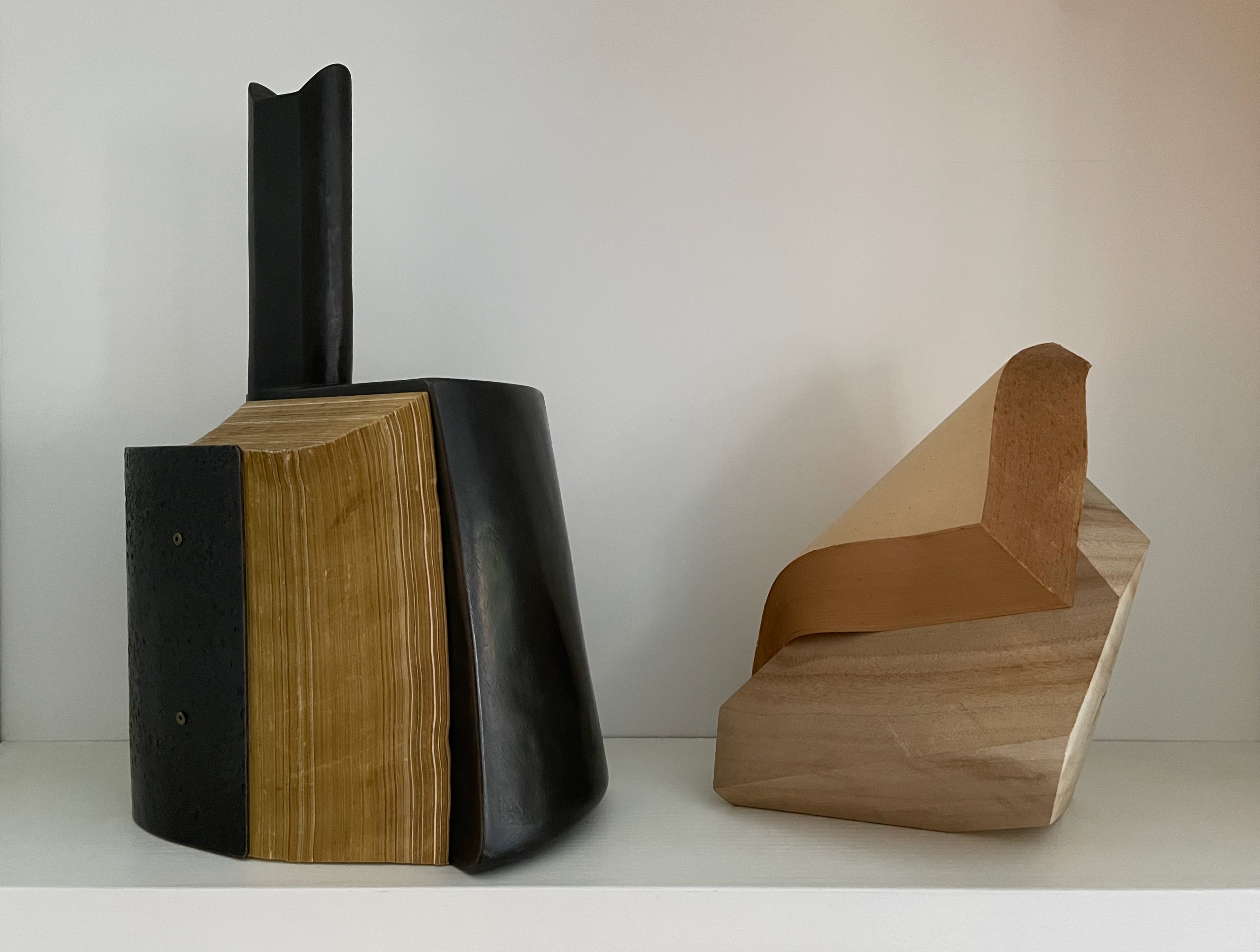
Views of Offset (2013) by Andrew Hayes and Silent Book (2023)

The titling of the two works raises appreciable similarities and differences. Offset suggests the printing method of the same name, which does involve metal plates. The overall shape, however, suggests some strange assemblage of early letterpress components: the bulbous ink balls (or dabbers) with their handles, the torque bar, and the metal furniture locks. The offset position of the piece’s “handle” also reflects the title. What can’t be appreciated from the images is that Offset wobbles if touched in the slightest.
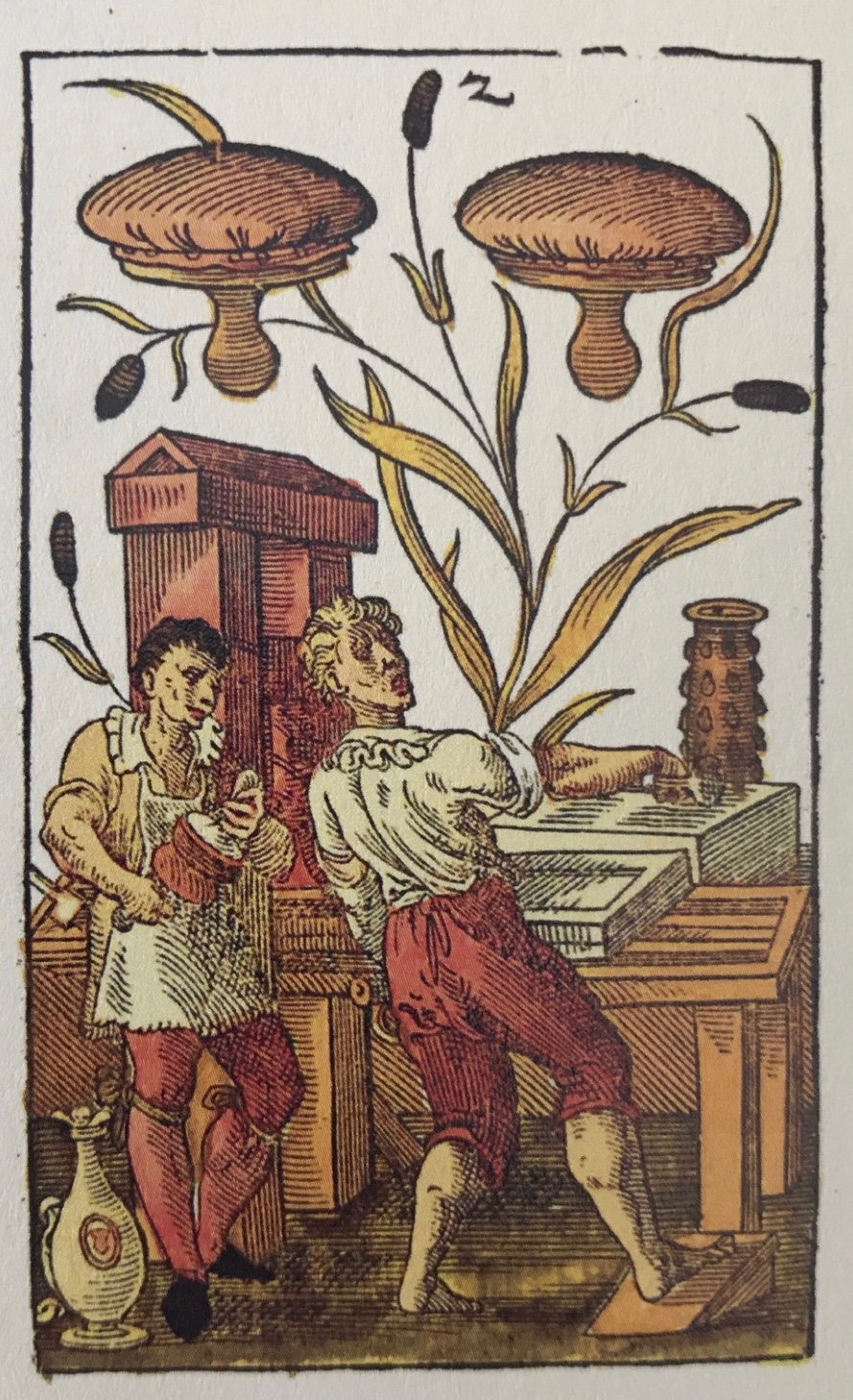
A vintage illustrated print showing two men engaged in a printing process, featuring a press and decorative plants above them.

“The two of printer’s dabbers” from Jost Amman’s 1588 deck of cards.
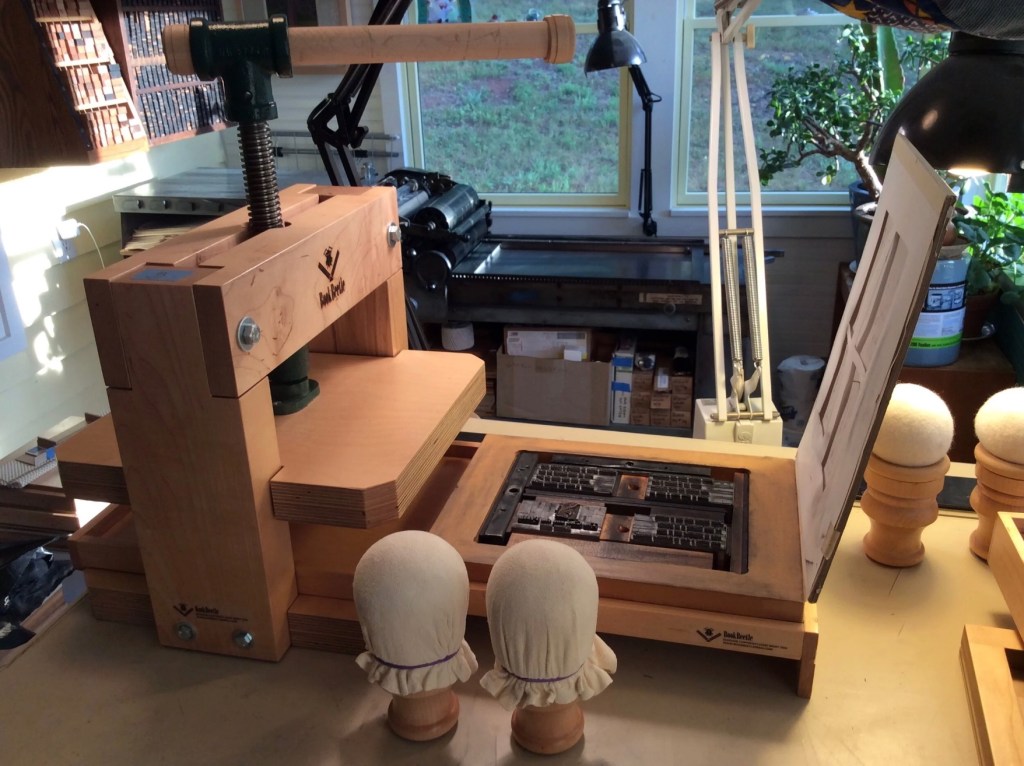
A wooden book press positioned on a workspace, featuring a large handle, a platform for printing materials, and two covered objects resembling human figures, with natural light illuminating the scene.

The BookBeetle Press, a portable screw press designed and built by Josef Beery. Reproduced with permission of Beery.

The title of Silent Book refers, of course, to the book block’s being sealed, an obvious visual/verbal pun. None of its information passes the lips of its pages. Like Offset, however, the title is also oblique. Although the derivation of the word book from the Old German Buche (meaning “beech”) is a debatable assumption, it’s widely accepted enough to allow that the block of wood is also a silent book.

Now imagine the substitution of a large block of pink bubble gum for the book material in Offset and Silent Book. Not a block of gum in the shape of a book, but an oversized, unchewed block of gum. Something very different to chew on now, isn’t it? The ways in which book artists manipulate the material and metaphor of the book vary every bit as much as the ways in which painters, sculptors, and other artists vary their techniques, materials, and subjects. Even within the slice of book art that focuses on physical inaccessibility, such as Marcel Broodthaers’ Pense-Bête (1964), Wolf Vostell’s Betonbuch (1971), Jonathan Callan’s Rational Snow (2002), Anselm Kiefer’s Untitled (Constellation Book) (2004), Hanne Stochholm Exe’s Remake (2015), and Neil Nenner and Avihai Mizrahi’s Cover Story (2017), the variety abounds. Ryuta Iida’s series Silent Book is a resounding reminder.

Further Reading

Barton Lidice Beneš“. 21 December 2025. Books On Books Collection.

Doug Beube“. 21 April 2020. Books On Books Collection.

Hanne Stochholm Exe“. 29 September 2018. Bookmarking Book Art.

Ximena Pérez Grobet“. 7 July 2021. Books On Books Collection.

Andrew Hayes“. 4 September 2019. Books On Books Collection.

Ivon Illmer“. 22 December 2025. Books On Books Collection.

Guy Laramée“. 18 September 2019. Books On Books Collection.

Lucia Mindlin Loeb“. 28 November 2022. Books On Books Collection.

Jacqueline Rush Lee“. 8 October 2019. Books On Books Collection.

Neil Nenner and Avihai Mizrahi, see “Hanne Stochholm Exe“.

Lorenzo Perrone“. 8 September 2019. Books On Books Collection.

Chris Perry“. In process. Books On Books Collection.

Beery, Josef. 15 September 2021. “Inking Without A Roller…“. BookBeetle Press.

Küng, Moritz (ed.). 2023. Blank. Raw. Illegible … : Artists’ Books as Statements (1960-2022). Köln: Verlag der Buchhandlung Walther und Franz König.

Peachey, Jeff. 14 July 2020. “Printer’s Ink Balls: Before the Roller or Brayer“. Peachey Conservation.

Books On Books Collection – Lucia Mindlin Loeb

A photographer since 1991, Brazilian Lucia Mindlin Loeb turned to the book as the surface and form for her art. Works such as Livro sobre Livros (“Book about Books“), Entre páginas (“Between Pages”) and Biblioteca (“Library“) speak to an academic fascination with the structural elements of the book — especially its volume, edges, pages and spine. Along with Memória fotográfica (“Photographic memory”), they explore what photography and the book can tell us about time, space, memory, the world we see and a familial experience of it. The works below from the Books On Books Collection show only a fraction of how far beyond the photobook Loeb has gone.

Abismo (2012)

Abismo (2012)
Lucia Mindlin Loeb
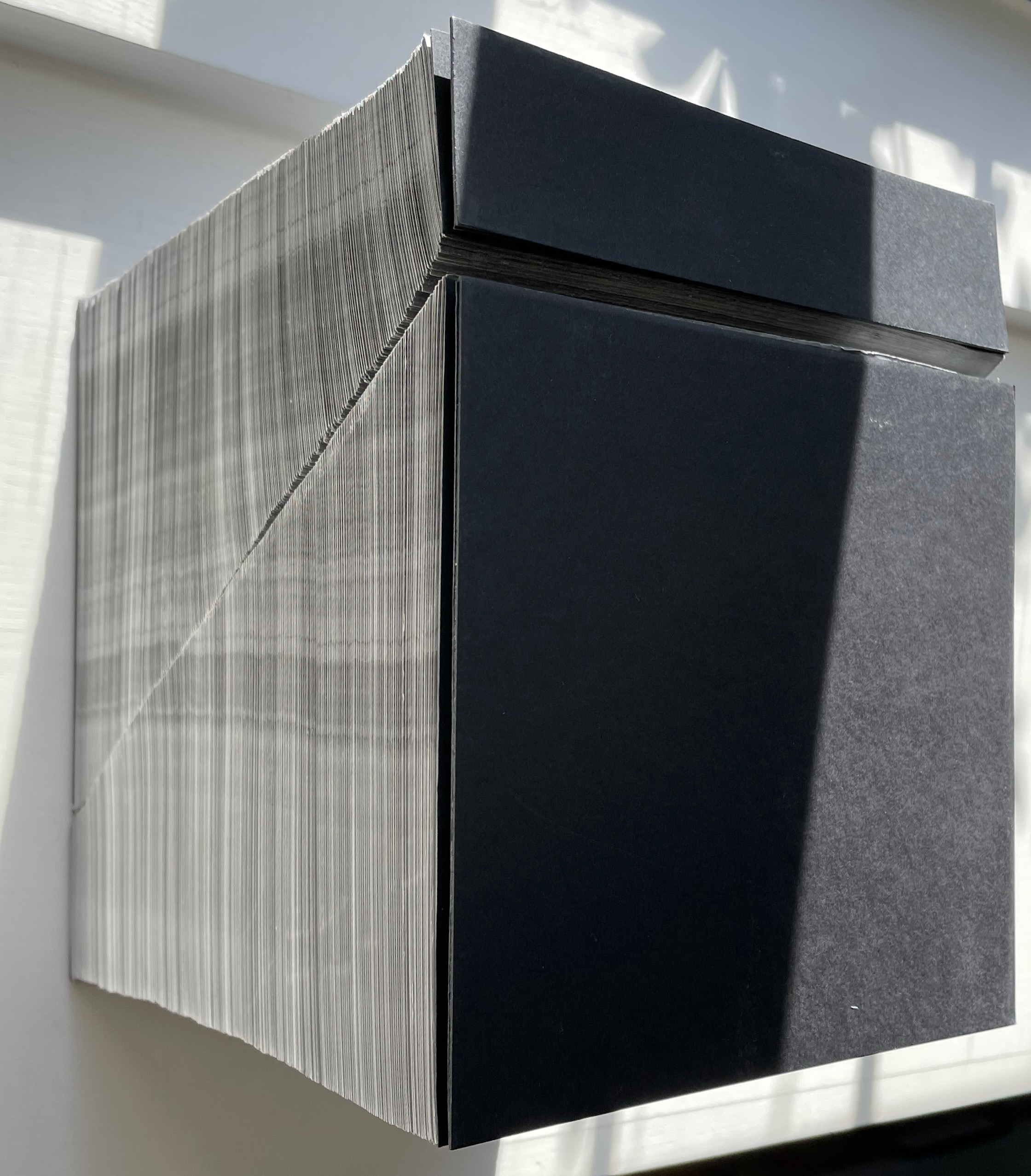
Front and back card covers on a sewn, exposed-spine book block cut diagonally into two volumes, each housed in a custom archival box.
H210 x W210 x D175 cm. Edition of 5 and 2 artist’s proofs, of which this is A/P #2. Acquired from the artist, 5 October 2022.
Photos: Books On Books Collection.

Fore-edge view (L) and spine view (R) of the cut halves resting against each other.

Close up of spine.

With the two halves open and positioned properly, their parallel opening and page turning soon creates a disorientation. The top half thickens and narrows, while the bottom half thickens and deepens.
Below, a close-up view of the abyss and the cliffwalkers evokes a sense of precariousness and vertigo.

Few books allow views of double-page spreads simultaneously from two different places in the book, and varying the position of the two halves can widen the abyss.

The brief clip below conveys more of the disorienting effects that “reading” this work offers. Perhaps the same feelings the cliffwalkers experienced.

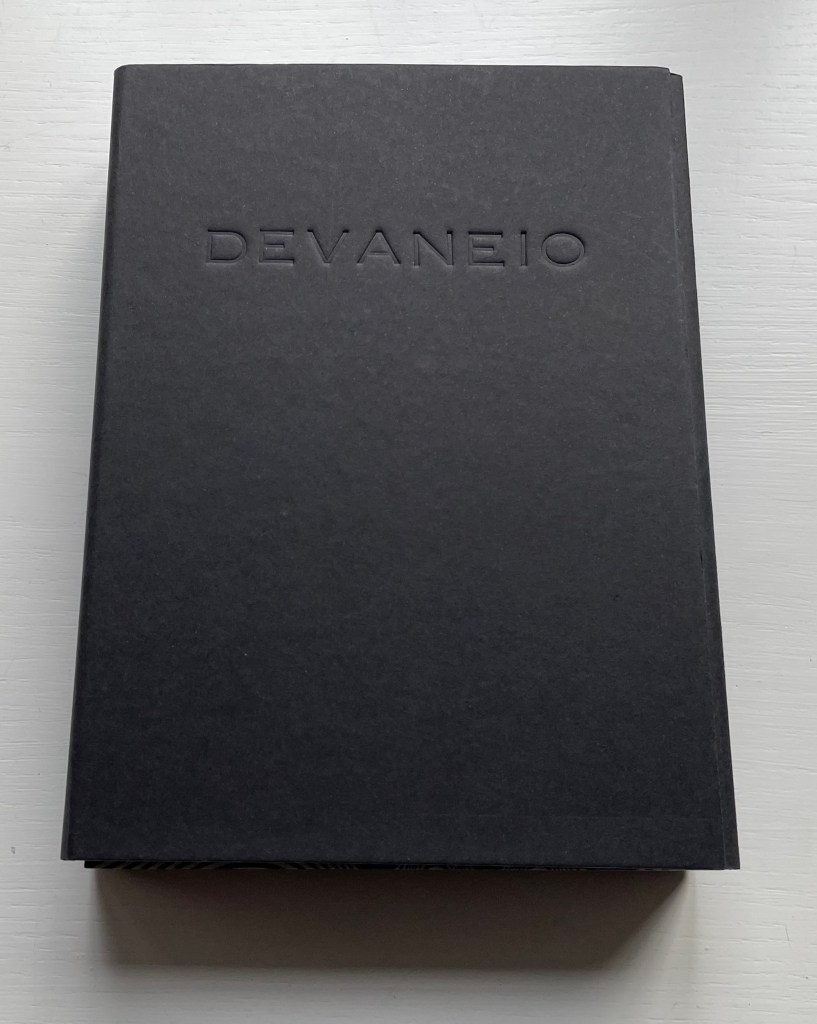
Devaneio (2015)

Devaneio (2015)
Lucia Mindlin Loeb
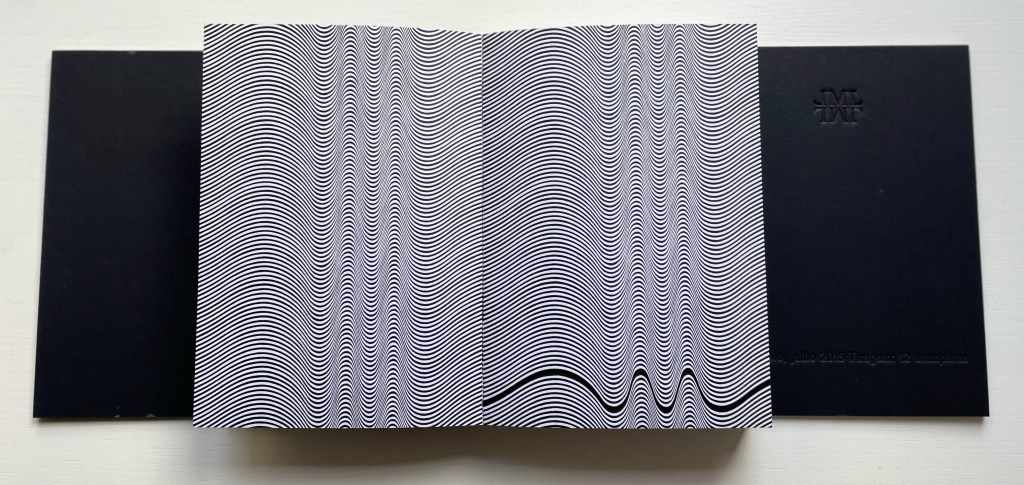
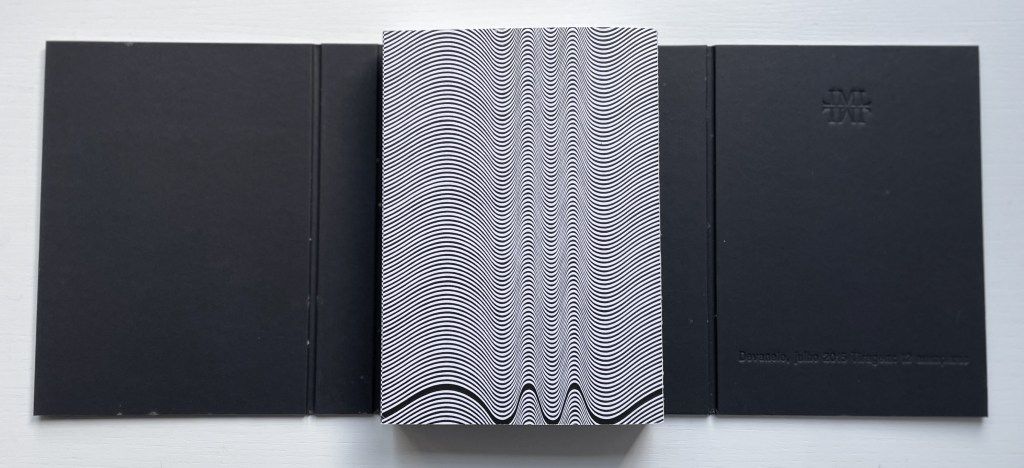
Exposed spine book block, handsewn and glued, loose in trifold case. H180 x W130 x D3 mm. 384 pages. Edition of 12, of which this is #5. Acquired from the artist, 5 October 2022.
Photos: Books On Books Collection.


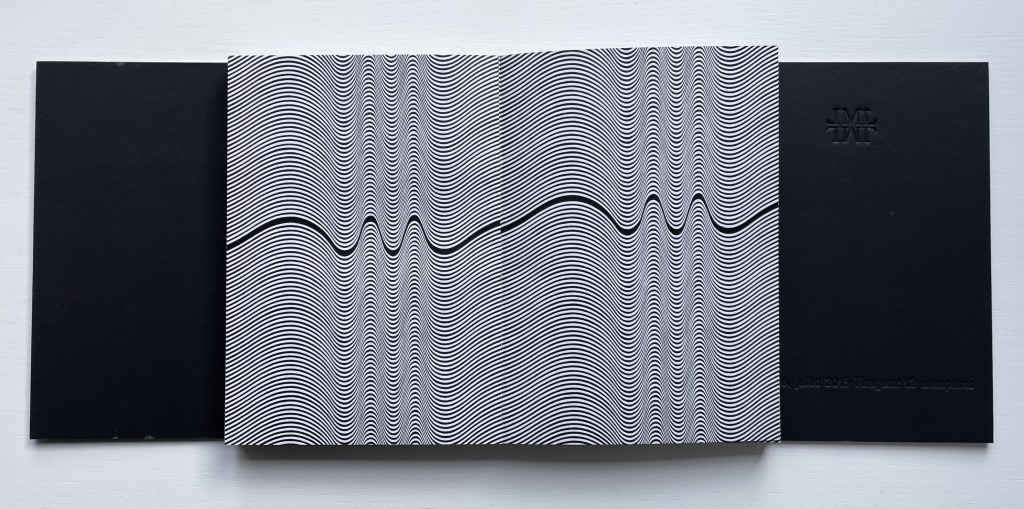
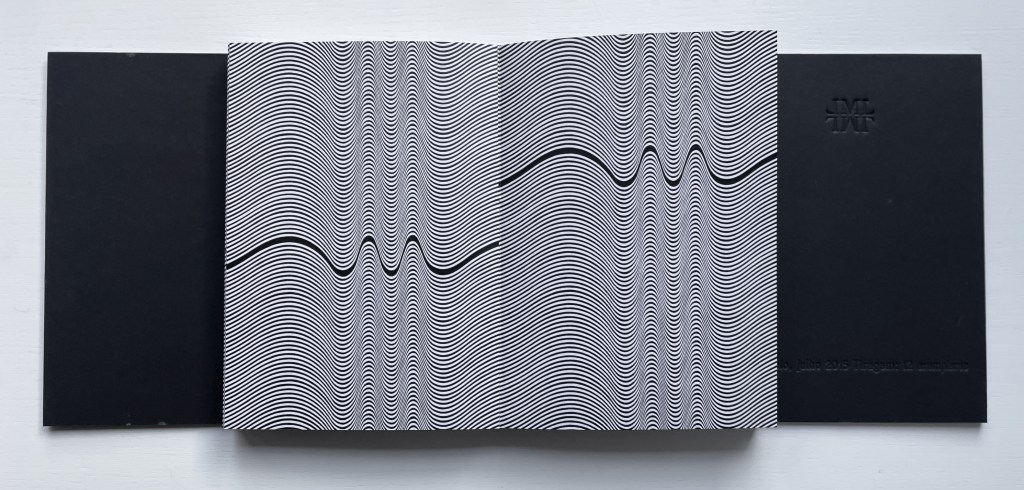
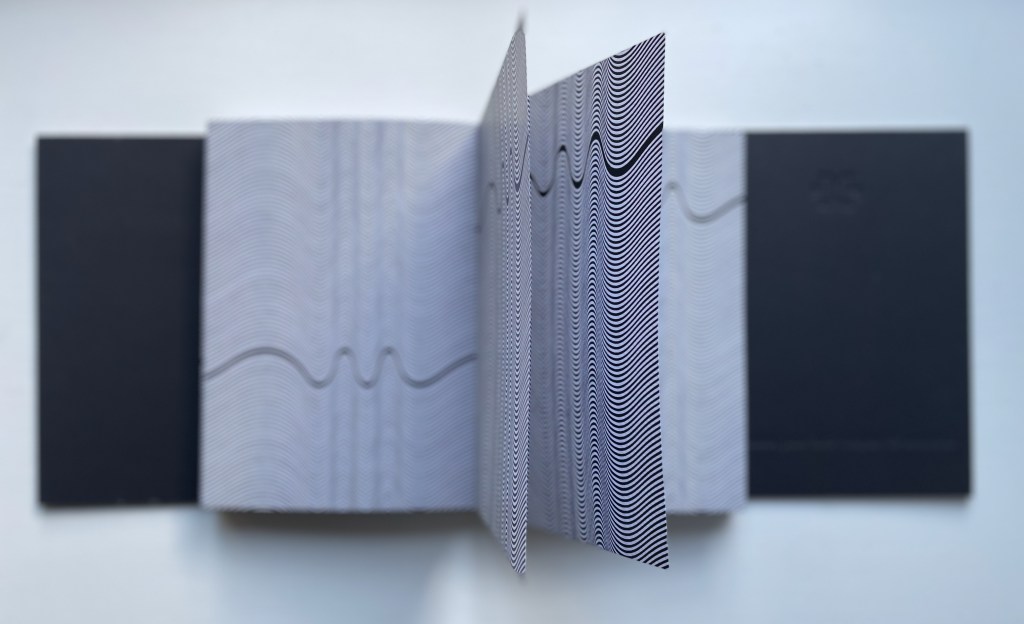
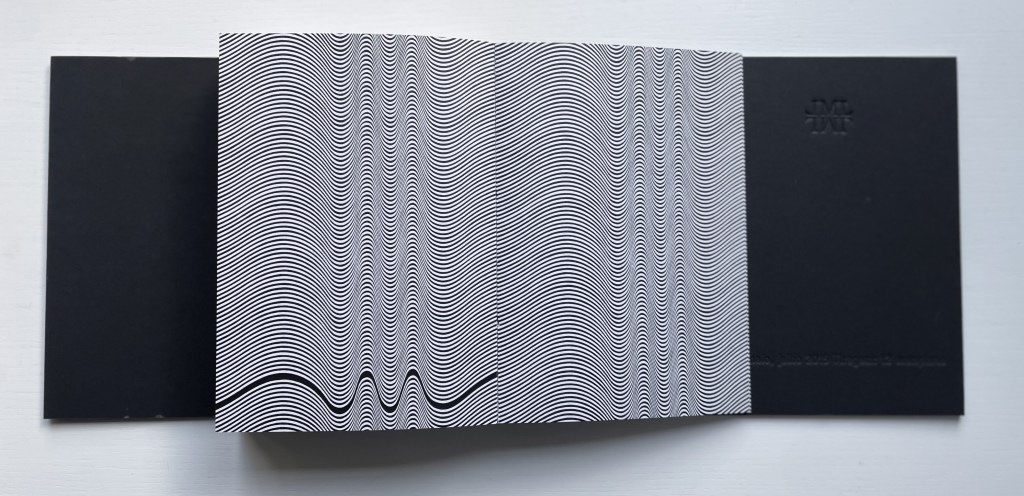
Devaneio means “daydream”, which is certainly elicited by the thick black line undulating over the hills and valleys optically created by the thinner lines parallel to each other and the thicker line. Over the first seventeen pages, the thick line appears only at the bottom of the recto page, but almost imperceptibly rises up the page.

First recto page

Seventeenth recto page

As the seventeenth recto page turns, another thick line begins its descent seemingly from outside the top edge of the eighteenth verso page. From here on, in their respective downward and upward movements, the thick lines on the verso and recto pages appear headed for convergence. The stroboscopic effect of the background of tightly packed thinner lines enhances this appearance of downward and upward motion. Although they converge, the thick lines skip over any direct intersection and continue their journeys toward the bottom edge of the verso page and top edge of the recto page.

The thick line on the verso page makes its appearance.

The lines begin to converge,

but do not intersect.

The lines diverge, the verso continuing downwards and the recto, upwards.

As the daydream begins to end, the upward bound thick line has almost disappeared at the top of its recto page. As the page turns, only the downward bound thick line remains to finish its journey at the bottom of the last verso page, the last page of the book. Of course, the the thick line’s end position on the last verso page is the same as its start position on the first recto page.

The upward bound thick line almost gone on the recto page.

The thick line has gone from the recto page.

The thick line at rest on the last verso page.

The crossover of the verso and recto thick lines can be observed on the book’s fore edge, and the thinner lines’ stroboscopic effect shows up even on the top and bottom edges.

Memória de Você (2011)

Memória de Você (2011)
Lucia Mindlin Loeb
Spiral bound harlequinade. H205 x W145 mm. 32 pages. Edition of 500. Acquired from the artist, 5 October 2022.
Video: © Lucia Mindlin Loeb. Photos: Books On Books Collection. Displayed with permission of the artist.

Devised by Robert Sayer (1756), “harlequinade” was a form of children’s book. Also called a “metamorphosis” or “turn-up” book, its pages were cut horizontally so that their parts could turn independently of one another and generate amusing mix-and-mismatch images. Book artists such as Emily Martin have seized on the form to great satirical effect.

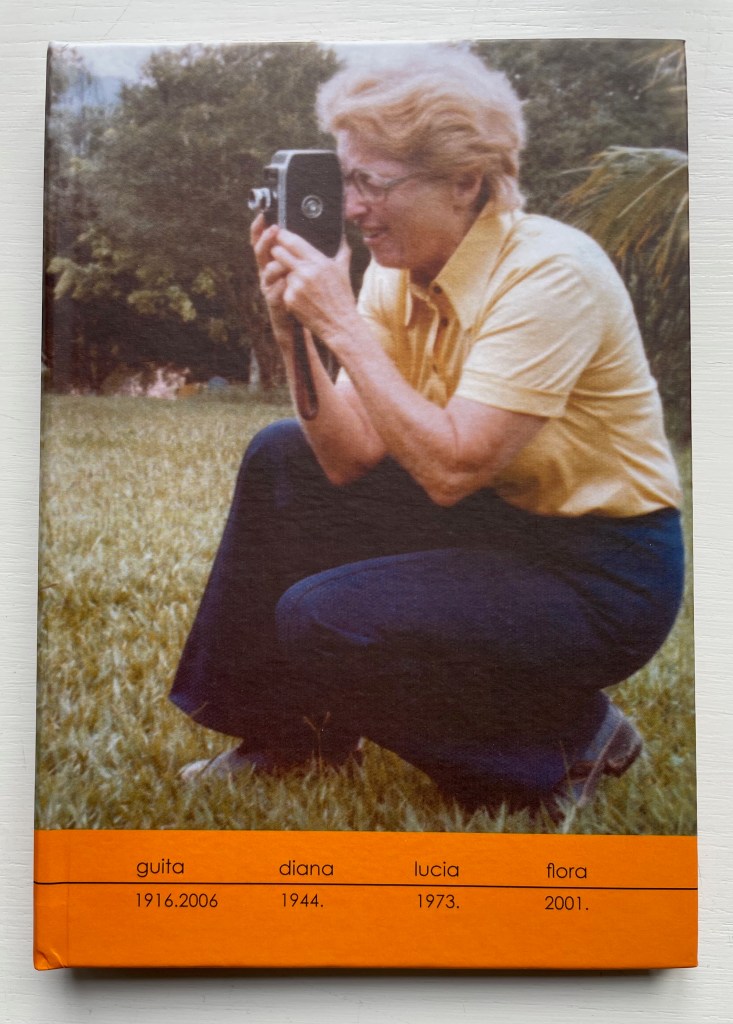
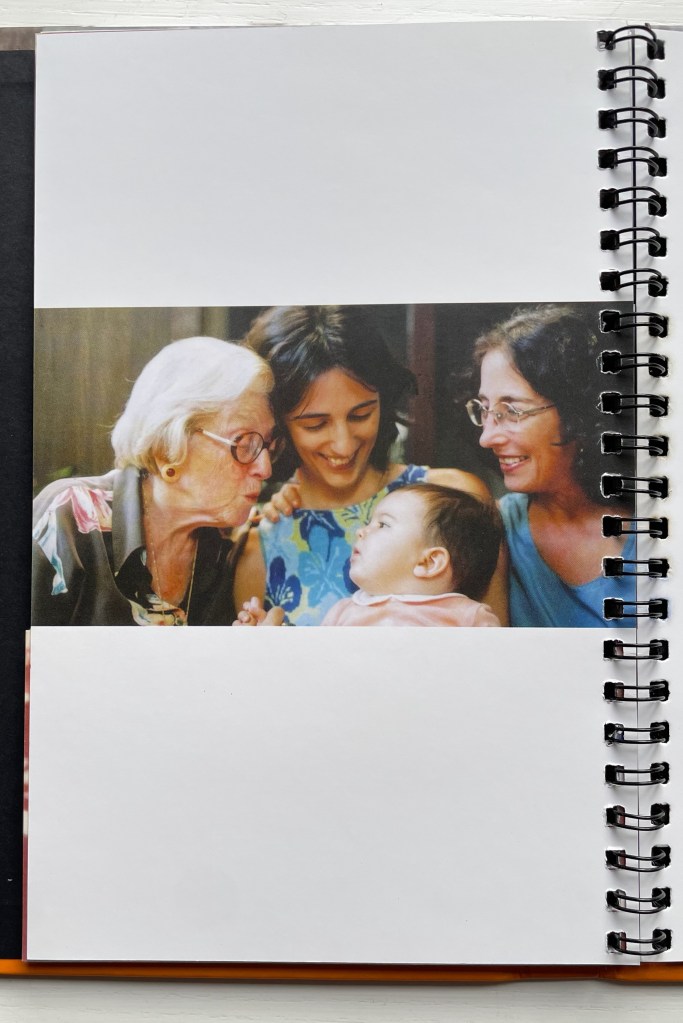
Loeb’s “Memories of You” maintains the form’s comic nature but blends it with the forms of the photobook and family photograph album to deliver a whimsical and sentimental celebration of four generations. Loeb plays her title’s deliberate ambiguity out with the form’s interchange of resemblances in faces, poses and costumes and lifts her work out of mere sentimentality. The video below provides a better view of the work than would photos of the book.

The sculptural mastery in Loeb’s works makes for intriguing and enjoyable comparison with that of Doug Beube, Andrew Hayes and Guy Laramée in the Books On Books Collection, while the photographic mastery calls up Scott Kernan, Marlene MacCallum and Michael Snow for similar revisits.

Further Reading

Doug Beube“. 21 April 2020. Books On Books Collection.

Andrew Hayes“. 4 September 2019. Books On Books Collection.

Guy Laramée“. 18 September 2019. Books On Books Collection.

Scott Kernan“. 22 February 2019. Books On Books Collection.

Marlene MacCallum“. 2 September 2019. Books On Books Collection.

Emily Martin“. 22 November 2018. Bookmarking Book Art.

Michael Snow“. 3 March 2021. Books On Books Collection.

Borsuk, Amaranth. 10 October 2018. “The Book as Recombinant Structure: A Century of Art and Experimental Books“. The Writing Platform.

McLeish, Simon. 27 May 2008. “Harlequinades“. The Conveyor. Bodleian Libraries Centre for the Study of the Book. Accessed 28 October 2022.

Books On Book Collection – Andrew Hayes

Offset (2013)

Offset (2013)
Andrew Hayes
Steel, book pages, and brass
13” x 9” x 5”
Unique. Acquired February 2014.

Photos: Books On Books Collection

Plane Study (2017)

Plane Study (2017)
Andrew Hayes
Formed and fabricated steel
11” x 11” x 2.5″

Photos: Books On Books Collection

Further Reading

in medias res … Andrew Hayes”, Books On Books, 6 May 2015.

David, Rachel. Meta-Formations: Experiments and Rituals (New Orlean, LA: Red Metal, 2019).

Townsend, Eileen. “‘Tributaries: Andrew Hayes’ at the Metal Museum”, Memphis Flyer, 23 January 2014. Accessed 2 September 2019.

Young, Meghan. “Book page sculptures, Trendhunter, 9 August 2013. Accessed 2 September 2019.

Bookmarking Book Art – Hanne Stochholm Exe

Danish artist Hanne Stochholm Exe‘s “assemblages”, which garnered first prize in the 7th International Artist’s Book Triennial Vilnius 2015, have cousins far afield — geographically and chronologically.

Remake (2015) 
Hanne Stochholm Exe
Reproduced with permission of the artist
Talks (2005) 
Hanne Stochholm Exe
Reproduced with permission of the artist
Small Talk (2005)
Hanne Stochholm Exe
Reproduced with permission of the artist

Geographically, this merging of book and metal finds common cause in the US (see Andrew Hayes’ works) and Israel (see the work of Neil Nenner and Avihai Mizrahi, represented — as is Hayes — by the Seager/Gray Gallery).

Offset (2013)
Andrew Hayes
Cover Story #4 (2017)
Neil Nenner and Avihai Mizrahi

Chronologically, the hold that books and metal have had on one another reaches far past the moveable type of Gutenberg’s Bible and Master Baegun‘s earlier Jikji.

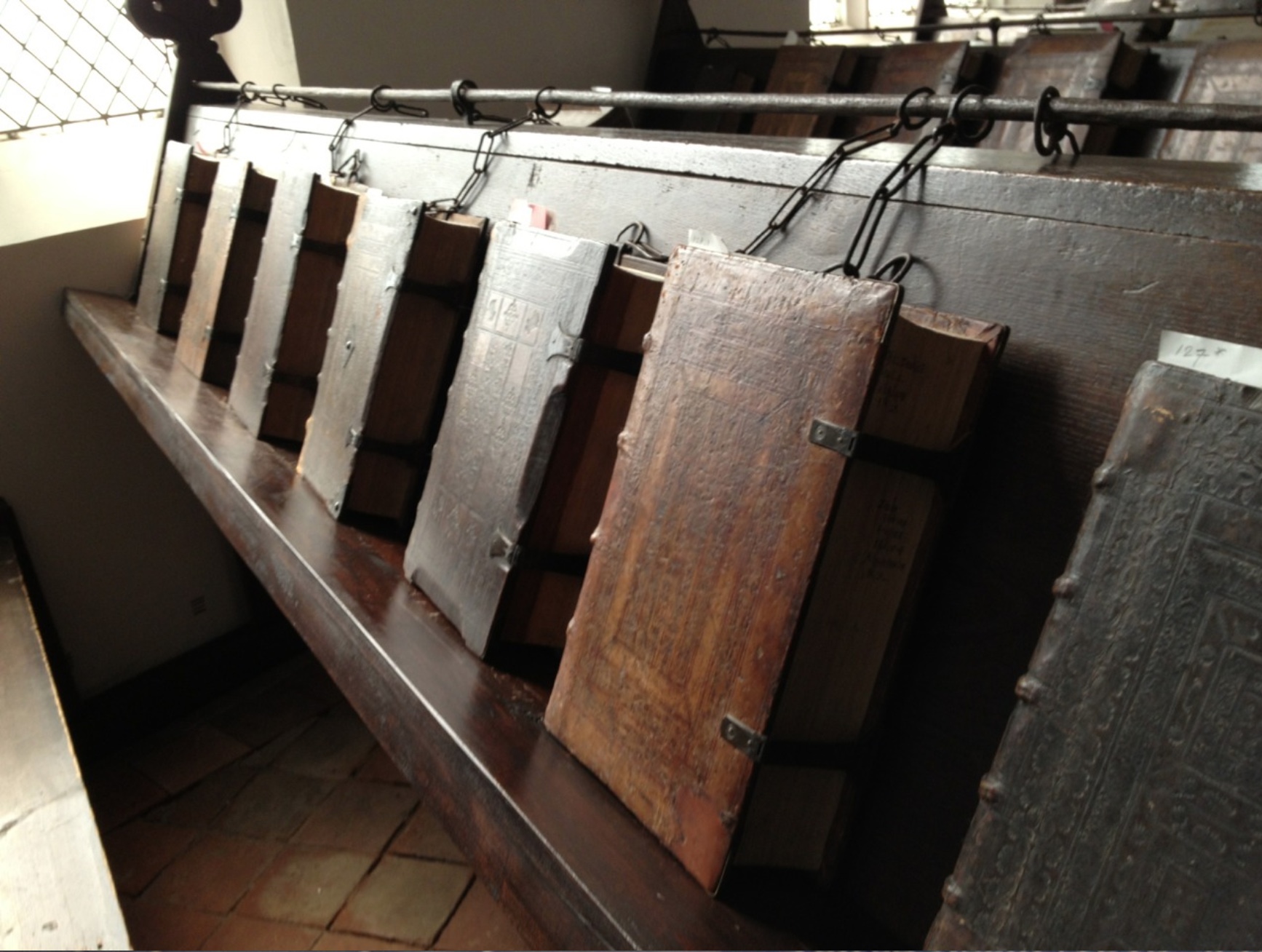
Those metal “feet” embedded in the front and back covers kept the bottom edges of upright books chained in lectern libraries from wearing out.

Of course, those 11th century metal fittings probably passed unnoticed by studious readers. Not so with these studious artists in the 21st century whose imaginations have seized on the contrast of materials to recast the book object as an art object.

Bookmarking Book Art – in medias res … Andrew Hayes

When Andrew Hayes told me it was e.e. cummings’ 100 poems he had found in the middle of the stacks of books awaiting a bookshelf he planned to build, I winced. Cummings has always been hard for me to figure. I was hoping for a more accessible book as a pretext to kick off our interview.

If you have not encountered one of these  interviews on Books On Books, I should explain. The idea is that the book artist selects a book from the middle of the home or studio bookshelf, opens it to the middle, and tells me the author, title and page number. After tracking down the book, I send off some questions and so the interview begins.

Stalagmites of books in the home of Andrew Hayes, book artist

It turned out that cummings was hard to access for Andrew as well. He wrote:

As I took the book from its place in the middle I had to take care, as you can see this is not the most efficient way to retrieve a book. I was able to carefully remove the book with out the top half toppling down, this time…

Just like extracting the meaning from the poem that just happened to be bookmarked in the middle of the cummings volume. The poem begins:

Just like extracting the meaning from the poem that just happened to be bookmarked in the middle of the cummings volume. The poem begins:

kind) 
YM&WC 

(of sort of) 

A soursweet bedtime

and ends:

iSt 

ep 

into the not 

merely immeasurable into 
the mightily alive the 
dear beautiful eternal night

Until Andrew carefully pulled out this volume bookmarked by his partner Kreh Mellick, he had not read it. “To be honest, I do not read as much as I would like, ….” Still, I wonder if, as his eyes moved through the broken-up layers of syntax and the juxtaposition of the “soursweet bedtime” story with “the mightily alive the/ dear beautiful eternal night”, he recognized something of his own?

The title of this piece is Hade. “Hade” is a geological term, like Placer and Lode (titles of these other striking sculptures).

Hade, Andrew Hayes Steel, book pages, and copper 16'' x 6'' x 3'' 2013 Reproduced with permission of the artist Photo credit: Steve Mann, Black Box Photography

Hade, 2013
Steel, book pages, and copper
16” x 6” x 3”
Reproduced with permission of the artist.
Photo credit: Steve Mann, Black Box Photography

Placer, 2013 Steel, book pages, and brass 10'' x 7'' x 9'' Reproduced with permission of the artist Photo credit: Steve Mann, Black Box Photography

Placer, 2013
Steel, book pages, and brass
10” x 7” x 9”
Reproduced with permission of the artist
Photo credit: Steve Mann, Black Box Photography

Hade refers to “the angle of inclination from the vertical of a vein (geology), fault, or lode”. In Hade the yellowed pages slip between the parenthesis of steel plates like the sense lode through the fractured syntax of e.e. cummings’ poem. This is book art for the sensualist, much as most of cummings’ better poems are words for the sensualist. It exudes appreciation and care for the material of which it is made. That comes through clearly in Andrew’s response to my question “As an artist whose work has an intimate relationship to ‘the book’, could you describe the effect this has on you when you are reading books in general?”:

… as I read a book I love watching it wear and change as I pass through the pages. I’m sure this happens with everyone’s books, but I love this transformation. I find it happens best in shoes and books. I have a hard time keeping my hands clean so my books take a beating, I almost don’t need a book marker because I can just turn to the first clean page. It is funny I don’t like to dog ear pages I feel like that is almost disrespectful in a way, but I just like seeing what happens to the book as it serves its function. … for me finding a book that has been seasoned is like finding two stories. I like figuring out who read the book before and reading the notes and things I find in the books I end up using for sculpture.

An e.e. cummings poem can amuse like a Rube Goldberg or Heath Robinson contraption, but always with a sting at the end.  Andrew clearly has a love of contraptions, words and paradox as well.

Lode, 2013 Steel and book pages 16'' x 7'' x 2.5'' Reproduced with permission of the artist Photo credit: Steve Mann, Black Box Photography

Lode, 2013
Steel and book pages
16” x 7” x 2.5”
Reproduced with permission of the artist.
Photo credit: Steve Mann, Black Box Photography

… as I read a book I love watching it wear and change as I pass through the pages. I’m sure this happens with everyone’s books, but I love this transformation. I find it happens best in shoes and books. I have a hard time keeping my hands clean so my books take a beating, I almost don’t need a book marker because I can just turn to the first clean page. It is funny I don’t like to dog ear pages I feel like that is almost disrespectful in a way, but I just like seeing what happens to the book as it serves its function. … for me finding a book that has been seasoned is like finding two stories. I like figuring out who read the book before and reading the notes and things I find in the books I end up using for sculpture.

An e.e. cummings poem can amuse like a Rube Goldberg or Heath Robinson contraption, but always with a sting at the end.  Andrew clearly has a love of contraptions, words and paradox as well.

Ballistae Steel and book pages 16'' x 8'' x 3'' 2013

Balastae, 2013
Steel and book pages
16” x 8” x 3”
Reproduced with permission of the artist
Photo credit: Steve Mann, Black Box Photography

“Balastae” is an ancient variant on “ballistae”– the oversized Roman crossbow,  comparable to a catapult or trebuchet. Its kinetic energy is captured here in the potential energy of the pages of words poised to fly over the steel. The contrast and tension between the kinetic and potential, between noun/verb and tool/rest, between paper and metal, characterize many of Andrew’s titles and works, for example, Kedge and Plow. My favorite works are Shift, Waver, Swarm and Kedge. The latter, in particular, captures the paradoxes in Andrew’s works; the word is noun and verb (transitive and intransitive) all in one: a nautical term for a light anchor, also the term for the act of warping a vessel and the term for moving a vessel by pulling on the anchor. Shift and Waver capture the kinetic energy of his works and beg to be circled and viewed from every angle like any of the dynamic figures of Giambologna.

Kedge Steel, book pages, and brass 9.5'' x 18'' x 9'' 2013 Reproduced with permission of the artist. Photo credit: Steve Mann, Black Box Photography

Kedge, 2013
Steel, book pages, and brass
9.5” x 18” x 9”
Reproduced with permission of the artist.
Photo credit: Steve Mann, Black Box Photography

Shift, 2013 Steel, book pages, and brass 11'' x 5'' x 2'' Reproduced with permission of the artist Photo credit: Steve Mann, Black Box Photography

Shift, 2013
Steel, book pages, and brass 11” x 5” x 2”
Reproduced with permission of the artist.
Photo credit: Steve Mann, Black Box Photography

Waver, 2013 Steel, book pages, and brass, 16'' x 9'' x 9'' Reproduced with permission of the artist. Photo credit: Steve Mann, Black Box Photography

Waver, 2013
Steel, book pages, and brass, 16” x 9” x 9”
Reproduced with permission of the artist.
Photo credit: Steve Mann, Black Box Photography

And Swarm – ah, yes – like swarming bees, words have gathered across the splayed edges of the pages, whirling up framed by brass-riveted metal. Swarm is one of the biologically allusive pieces along with Divaricate, reflecting how Andrew’s imagination ranges over the words, objects and concepts in so many domains:

Swarm, 2013 Steel, book pages, and brass 13'' x 14'' x 3'' Reproduced with permission of the artist. Photo credit: Steve Mann, Black Box Photography

Swarm, 2013
Steel, book pages, and brass
13” x 14” x 3”
Reproduced with permission of the artist.
Photo credit: Steve Mann, Black Box Photography

the architectural (Prohedria, Mullion), nautical (Helm, Kedge), agricultural (Harrow, Plow) and military (Sentry, Citadel) as well as others ripe for verbal and visual puns. Witty as well as sensual, there is almost something of the Metaphysical poets about his work. One such work of metaphysical visual and verbal punning is Wry. Definitions of the word invariably include “twisted”, “distorted”, “lopsided” and apply it to facial features such as “a wry grin” or “wry mouth”. Now take a look at Wry:

Wry, 2013 Steel, book pages, and brass 7'' x 8'' x 3'' Reproduced with permission of the artist. Photo credit: Steve Mann, Black Box Photography

Wry, 2013
Steel, book pages, and brass
7” x 8” x 3”
Reproduced with permission of the artist.
Photo credit: Steve Mann, Black Box Photography

Book art can easily fall off into mere craftwork. On the one hand, the book artist requires the freight that the book’s content and form carry, requires it somewhat analogously to the way Eric Gill required Hopton-Wood Stone for his sculpture. But the degree to which the freight weighs down the treatment, or the handling does not take the material beyond itself, that is the degree by which the work is closer to handicraft than to art. From the way that Andrew writes of his perspective on the freight that his found material carries with it, you can understand why each of his works — solid and dense as they are — translates the raw material beyond itself:

Book art can easily fall off into mere craftwork. On the one hand, the book artist requires the freight that the book’s content and form carry, requires it somewhat analogously to the way Eric Gill required Hopton-Wood Stone for his sculpture. But the degree to which the freight weighs down the treatment, or the handling does not take the material beyond itself, that is the degree by which the work is closer to handicraft than to art. From the way that Andrew writes of his perspective on the freight that his found material carries with it, you can understand why each of his works — solid and dense as they are — translates the raw material beyond itself:

When making work I take my love for the used book and search for pages that I can use in my sculpture. The book pages are a loaded found material. Other materials I use like steel that I find at the scrap yard come with built in history as well but it may not be as universal as the book pages. The books I am drawn to are usually worn or rich with color or deckled edges, but that is just the beginning. It is always a surprise when I cut the pages from their binding. This is when I try to find a way that I can compose the pages into a new shape in combination with steel.

To find a union of metal and the printed page as rich and tactile as that created by Andrew, we would have to hark back to the days of hot metal typesetting or farther still to the chained library. But, while the titles of Andrew’s works may evoke the historical or archaeological, the works themselves do not assume the printed book’s demise; they emphasize and celebrate the material of the book.

It is strange how these objects – books and scraps of metal that have their own individual logic and structural coherence, both material and semantic – become an object of art. In each – book or scrap steel – raw material has been amassed and wrought (words, paper, ink and cloth; or iron, carbon, manganese and nickel) to make a finished thing whose physicality inheres and obtrudes. The ways in which those raw materials are amassed and wrought into objects such as dictionaries or kitchen sinks create meaning and accumulate meanings by use and context. Then along comes Andrew Hayes. Drawing on his experience as a welder, his work as a student with fabricated steel and his time as a Fellow at the Penland School of Crafts in North Carolina, Andrew takes these found objects with their own logic and transforms them into this realm we call art.

Further Reading

Sara Baker, “Andrew Hayes – Artist”, American Style Magazine, November 2010, accessed 28 August 2013: http://www.americanstyle.com/2010/11/andrew-hayes/

Stacy Dacheux, “Sleek Sculpture Combines Metal with Pressed Book Pages”, Beautiful Decay, 7 August 2013, accessed 10 August 2013: http://beautifuldecay.com/2013/08/07/sleek-sculpture-combines-metal-with-pressed-book-pages/

Erin Fletcher, “Artist: Andrew Hayes”, Flash of the Hand, 20 August 2013, accessed 28 August 2013: http://www.herringbonebindery.com/blog/tag/andrew-hayes/

David Mendez, “Former Tucsonan Has a Warped Way of Using Old Books”, The Range, 9 August 2013, accessed 28 August 2013: http://www.tucsonweekly.com/TheRange/archives/2013/08/09/former-tucsonan- has-a-warped-way-of-using-old-books

Penland, “Focus on: Andrew Hayes”, The Penland Sketchbook, 15 August 2012, accessed 10 August 2013: http://www.penland.org/blog/2012/08/focus-on-andrew-hayes/#sthash.7JYFQ9sW.dpbs

Melissa Walter, “Interview #7 – Andrew Hayes”, Crafthaus, 8 October 2012, accessed 28 August 2013: http://crafthaus.ning.com/group/artist-interviews-where-are-you-going-where-have-y/forum/topics/interview-7-andrew-hayes

Matthew Wengard, “Art As Inspiration: Andrew Hayes”, A Fine Press, 16 August 2013, accessed 28 August 2013: http://afinepress.com/andrew-hayes/

L. Kent Wolgamott, “Lux exhibition ‘Strata’ turns books and metal into graceful sculpture”, Ground Zero, 17 August 2013, accessed 28 August 2013: http://journalstar.com/entertainment/visual-art/l-kent-wolgamott-%20lux-exhibition-strata-turns-books-and-metal/article_b92b4448-e298-53a3-a3f9-034db95d9d4f.html

Michael Yonan, “Toward a Fusion of Art History and Material Culture Studies”, West 86th: A Journal of Decorative Arts, Design History, and Material Culture, 20 September 2011, accessed 11 January 2014:http://www.west86th.bgc.bard.edu/articles/yonan.html#. Yonan notes the discomfort of art historians in addressing art as I have addressed Andrew Hayes’ work: ‘… fore- grounding the idea exalts art history into a philosophical endeavor, whereas emphasizing matter renders the discipline subject to what could be called “the fear of the tchotchke.” … the trinketization of art.’

Meghan Young, “Artist Andrew Hayes Manipulates Metal and Novels”, Trendhunter, 9 August 2013, accessed 10 August 2013: http://www.trendhunter.com/trends/andrew-hayes

Bookmarking Book Art – Andrew Hayes

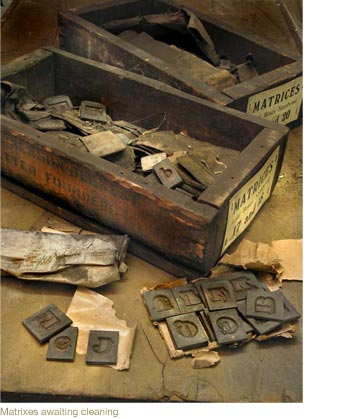
To find a union of metal and the printed page as rich and tactile as that created by Andrew Hayes, we have to hark back to the days of hot metal typesetting or farther still to the chained library.

image_awaiting_cleaning

Books chained in Zutphen

As a Core Fellow at Penland School of Crafts,  Andrew Hayes explored a variety of materials and technique, drawing on his experience in Portland, Oregon as a welder and his work with fabricated steel as a student at Northern Arizona University. At Penland, the book insinuated itself in this exploration, and his work today joins the rigidity of metal with the delicacy of the book page.

6a01543325a25d970c019104bae276970c-800wi
Placer
Steel, book pages, and brass
10” x 7” x 9”
Andrew Hayes, 2013

This codex is almost Dali-esque in its appearance.  Its title seems to allude to the thumb index, and the fluid shape that distorts the indexed pages is a paradoxical cast on that title.   As a work of art in the age of digital reproduction, it offers a slippery tale.

Further items:

in medias res … Andrew Hayes”, Books On Books, 6 May 2015.

David, Rachel. Meta-Formations: Experiments and Rituals (New Orlean, LA: Red Metal, 2019).

Townsend, Eileen. “‘Tributaries: Andrew Hayes’ at the Metal Museum”, Memphis Flyer, 23 January 2014. Accessed 2 September 2019.

Young, Meghan. “Book page sculptures, Trendhunter, 9 August 2013. Accessed 2 September 2019.

SeagerGray Gallery