The Fine Press Book Association’s inaugural Student Type Design Competition sprang from the hope that by building bridges between printers and young type designers we might end up creating new material resources for the fine press community.
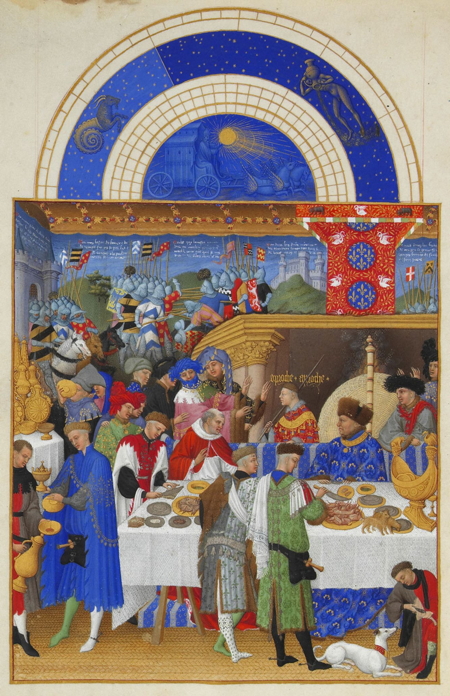
What might be remarkable — or book-markable — is whether the surge in objectifying the book through sumptuous illumination, miniaturization or the creation of book art occurs at definitive moments of shifting media. One-off illuminated manuscripts preceded the invention of moveable type, but was there a definable surge of them in the decades either side of 1450?
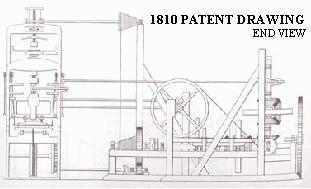
The Audubon double elephant folio books appeared in 1820 about the time of Frederick Koenig‘s invention of the steam-driven letterpress.
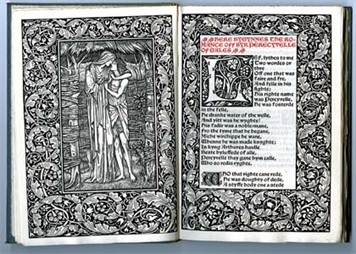
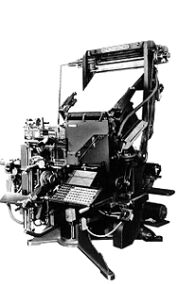
Are William Morris’s fine editions from Kelmscott Press in 1890 a datum in a surge of book objectification either side of Mergenthaler‘s invention of linotype in 1884?
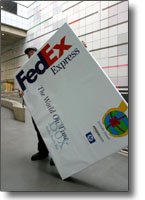
A Visual Odyssey across the Last Himalayan Kingdom, the world’s largest book according to Guinness.
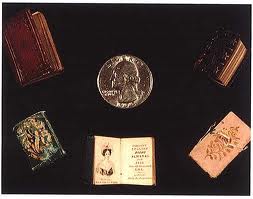
Last week, the New York Times ran an article about Neale Albert‘s collection of miniature books. Is this popular interest in unreadable books and the surge in altered and sculpted books an anxious reflection of another shift in media?
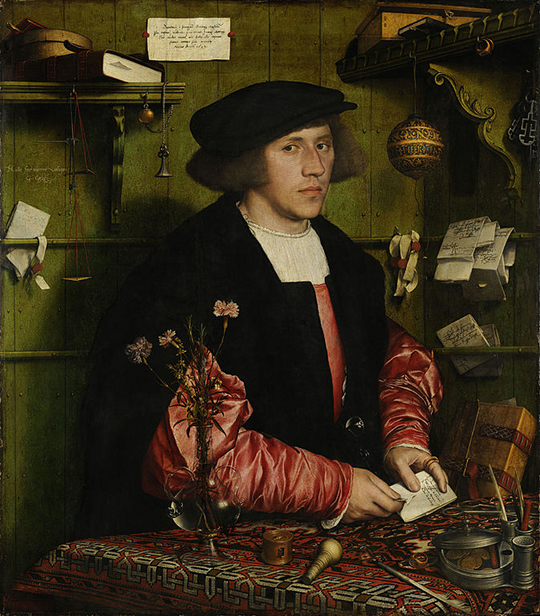
The Merchant Georg Gisze (1532) by Hans Holbein the Younger.
Author of The Things Things Say, Jonathan Lamb has trawled the Internet Archive to link us to 18th and early 19th century examples of the “it-narrative,” stories told from the perspective of a thing such as a watch, a coin or a mouse and generally comic and all-too human in the telling. And yet, Lamb observes,
… for a number of reasons this is seldom how [the it-narrative] deserves to be read. Whether it is owing to its origin and terminus in the narratives of slaves, or to its coincidence with the financial revolution and the growing unaccountability of mass human behaviour, or to the growing appetite for print ephemera, or to the end of feudal tenures and the resulting anomalies of personal portable property, or to the irreversible metamorphoses precipitated by the holocaust, ordinary things situated in banal circumstances develop a salience that has nothing to do with symbolism or hidden meaning. They are just there, eying their human adversaries, implacable and meditating affronts.
Lamb might have added another reason: the growth of the Internet, book art or bookwork and prediction of the printed book’s demise. Until that demise, will our books, just there on their shelves above the lampshade late at night, sit “implacable and meditating affronts”?
Ferris Jabr’s article “The Reading Brain in the Digital Age: The Science of Paper versus Screens” in Scientific American (April 11, 2013) revisits the themes raised in Maryanne Wolf’s Proust and the Squid mentioned in the previous posting. Jabr highlights much insightful writing on the neuroscience of reading, on which more in a bit. He begins, however, with a “haptic” anecdote that will resonate with parents and grandparents of children who are learning to read now or have learned in the last 3-5 years.
In a viral YouTube video from October 2011 a one-year-old girl sweeps her fingers across an iPad’s touchscreen, shuffling groups of icons. In the following scenes she appears to pinch, swipe and prod the pages of paper magazines as though they too were screens. When nothing happens, she pushes against her leg, confirming that her finger works just fine—or so a title card would have us believe.
Earlier the same year, I was lying in bed with an iPad reading Death and the Penguin by Andrey Kurkov. As the story drew me in and admittedly as the hour grew late, I found myself repeatedly reaching into the upper right-hand corner of the screen with my left forefinger and thumb to pick up and “turn the page.” I had not developed the habit of “sweeping” or “tapping” to move through the book. These real-life mirror images of the haptic habits of a young soon-to-be reading brain and an old reading brain bring Wolf’s speculations alive.
Numerous studies cited by Jabr suggest different areas of the brain at work in screen reading vs print reading and connect that to poorer retention and comprehension in screen reading than print reading. But one of the more recent ones (“Metacognitive regulation of text learning: On screen versus on paper,” by Ackerman and Goldsmith) shows that where readers
studied expository texts of 1000–1200 words in one of the two media and for each text […] provided metacognitive prediction-of-performance judgments with respect to a subsequent multiple-choice test[,] [u]nder fixed study time (Experiment 1), test performance did not differ between the two media, but when study time was self-regulated (Experiment 2) worse performance was observed on screen than on paper. The results suggest that the primary differences between the two study media are not cognitive but rather metacognitive—less accurate prediction of performance and more erratic study-time regulation on screen than on paper.
So the reading brain may not be rewiring itself, but print and screen do demand different strategies of reading and study. Might the “haptic habits” of physically turning the page or recalling three dimensionally the place in the book and on the page where a sentence occurs (or pinching, swiping and prodding) be clues to how we learn to learn what we read? What we may be seeing in the one-year old are the beginnings of the metacognitive cues that will raise the performance of tomorrow’s screen reading brains, and in Ackerman’s and Goldsmith’s subjects, the familiarity of today’s reading brains with the metacognitive cues so key to studying from print that the students print out the relevant ebook chapter.
As Jabr concludes, “When it comes to intensively reading long pieces of plain text, paper and ink may still have the advantage. But text is not the only way to read.”
Which harks back to the conclusion of the previous post and Jerome Bruner’s apt observation of Vygotsky’s fondness for Bacon’s epigram, “Nec manus, nisi intellectus, sibi permissus, multum valent” (Neither hand nor intellect left each to itself is worth much)” (247). Perhaps neither print nor digital left each to itself is sufficient.
Clock Watching, 2006, Andrew Eason “What happens when we’re not watching the clocks? A short piece where ordered Newtonian time gives out and something a bit more interesting takes over instead.”
Based in Bristol, Andrew Eason creates and teaches book art. One of his more interesting bookworks is Clock Watching, but he is more than a book artist watching the clock or posterity. Consider these concluding paragraphs to “The Critical Commonwealth,” his essay contributed to the 2010-11 Book Artists’ Yearbook.
If we are to say that artists’ books count in contemporary art practice, we have to connect those circuits up with the wider critical discussion. Books have made this difficult, because in themselves, as objects, they harbour an insular perfection of their own. They have a persuasive individual completeness that only a wider context can begin to describe and elucidate. This security is part of their appeal, of course. But it also trips us up as we try to write about them, as the temptation is to treat every book as a world in itself, separate from any other and from the world outside. Walter Benjamin, writing of the early books of his childhood, confides, ‘whereas now content, theme and subject-matter are extraneous to the book, earlier they were solely and entirely in it’.
We should move towards a perception of practice, tactics and desires extraneous to the insufficiently-permeable identity of ‘artists books’. Like Benjamin, we should allow our perception of what is inside books to be informed by that which is outside them. The critical commonwealth that artists’ books belong to is none other than that of contemporary art practice. This realisation reframes the question of how to discover the relevance of artists’ books. It has nothing to do with their definition, or categorisation, and everything to do with what they say and what they make possible. They’re art.
The digital revolution is one of those extraneities that Eason and other book artists must have in mind. As is evident from the link, his Clock Watching is a pdf flipbook and seems to be viewable only on his website — a book in a browser. Any critique of the work would take into account the artist’s accommodation for non-Flash browsers and his choices of the application’s functionalities (automated page-turning, click to turn, click and drag to turn, thumb-nail presentation, print not allowed, download not allowed, etc.). On the iPad, the ability to zoom in to appreciate the chalk-drawn figures over the tinted collage of landscape foreground and background surpasses that of the cursor-bound MacBook Pro (circa 2009), but the work is dated 2006, and one would have hoped for greater visual control to pore over the tinted rocks and roots in the twilight scenes. But attention to technical extraneities are not the only ones Benjamin or Eason expect of the artist and viewer.
The work poses its question of measured time in words and then in images that suggest the vegetal, cultural and mortal passage of time. The strangely tinted foliage is moving through its seasons. The chalked characters are from different times and suggest Ovid’s Metamorphoses and the influence of other literary and artistic forebearers. But does Clock Watching succeed in bringing what is outside the clock and outside its medium — book, book-in-browser, book art — within itself? Time, as they say, …
In addition to making his own bookworks and inviting us onto the grounds of the critical commonwealth, Andrew Eason has posted a tunnel book: The Thames Tunnel. Be sure to hover over the holes in the cover and click on the dropdown “Look through.”
Here is the collection citation should you happen to be near the Brunel Collection in Bristol and wish to make an appointment to see the work:
Repository University of Bristol Library Special Collections
Level Collection Ref No DM327
TitleIllustrated booklet advertising the Thames Tunnel
Date 1827 Extent 1 item Description ‘Sketches and Memoranda of the works for the Tunnel under the Thames from Rotherhithe to Wapping [London]: published and sold at the Tunnel Works, Rotherhithe, and by Harvey and Darton, 55 Gracechurch Street, 1827’.
26 p., [13] leaves of plates (4 folded). Copy available in the Eyles Collection, TA820.L6 SKE.
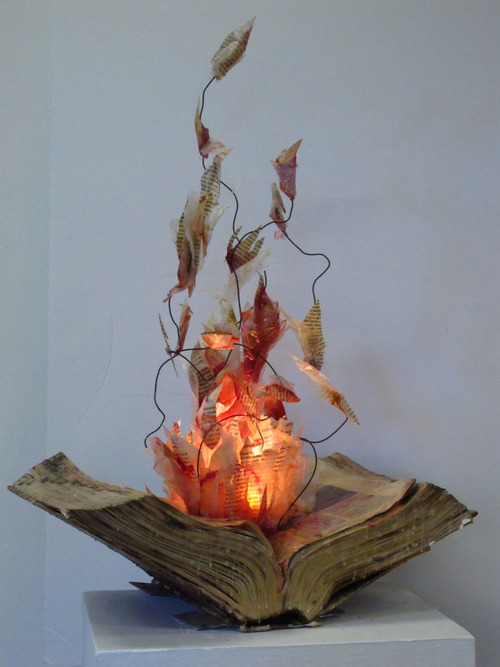
The fate of the book is becoming more and more critical as digital replacements ingrain themselves deeper into our society. To me the possibility of the end of the book is a tragic one; I appreciate books as an object as much as I enjoy the stories and knowledge which they hold. I predominantly work with antiquarian books as they often show evidence of their own personal story, perhaps through an inscription on the cover or a drawing on a page which adds a new layer of narrative. The theme for each sculpture may be inspired by a number of things including the title, size, shape or cover of the book. I work with wire, wadding and strips of book pages to create the impression of the sculpture emerging from within a book.
Ironic that Emma Taylor’s site had its main life on Facebook, to which one must subscribe to read the great number of comments on her bookworks. Her Tumblr website, however, displays many, if not all of her sculptures in the series From Within A Book, and in her posting of 29 March 2013 (here from the Wayback Machine), you can find reference to an article from the Cambridge News covering her work as displayed in the local shop Plurabelle Books.
Of course, the bookwork above (made from Poor Folk in Spain by Jan and Cora Gordon, published by Bodley Head in 1922) represents what appears to be a store clerk taking down a book but could just as easily be a housekeeper dusting the bookshelves (after all the chapter in which it appears is named “Verdolay — Housekeeping”). Why “of course”? Small sculpted books created “from within a book.” Tending and caring for the physical artifact by altering the physical artifact. (A touch more irony could have been had with the addition of a tiny computer, iPad or Kindle.)
One direction Ms Taylor’s craft may take to evolve further into art would be to recognize and reflect that the fate of the book and ebook are as likely intertwined and separate in many respects as have been those of the many forms the codex has taken — from incunabula to paperback, bookkeeping to fiction or reference to textbook.
Paratextual devices such as the manicule, footnote, running heads, etc., have their “analogues” in ereaders, ebooks and books-in-browsers such as navigational icons, hyperlinks, breadcrumb trails, etc. Through the W3C’s open annotation specification, even marginalia may be finding a place in the so-called digital replacement to the printed book. With the insights of Matthew Kirschenbaum and others into digital forensics, the digital replacement and its “perfect” copies may yet yield the “evidence of their own personal story.” And if “social reading” takes deep root in the individual reading experience, the reader’s relationship to the author (and vice versa) could be enriched by the reader-to-reader relationship in ways hard to articulate. Ways that will offer the book artist new opportunities to “make it new.”
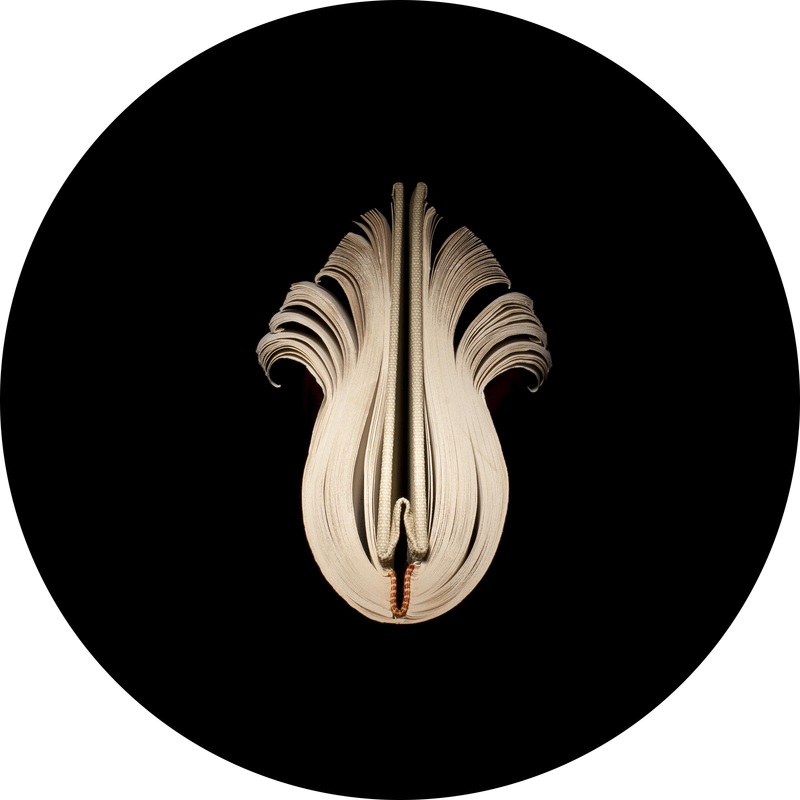
Math Monahan’s installationSpecimen could hardly be more appropriate for the attention of Books on Books.
Specimen
[ The book is an organism. It lived, spread all over the world and, some would consider, is endangered today. These creatures have a life of their own. They manifest themselves in many forms but where did they come from? If they are animals of paper and text, from what kind of beast did they evolve? This series studies those primordial creatures that became the developed beings colonizing our homes and libraries. By looking at growth patterns, mutations, and morphological similarities we can better understand this animal’s rise in population for so many years, as well as its current decline toward extinction. ]
The image above is one of a mesmerizing series on Monahan’s site. It is like looking at photographs of deep-sea creatures or slides of microscopic organisms or impressions of fossils. Like snorkeling or diving for the first time in strange waters, it is beautiful, exhilarating and a bit scary. Reflecting on the images, however, the words fixed alongside them (quoted above) are humorous, wistful and, in the end, a bit scary. The book, evolution, extinction?
Monahan is enrolled in the Master of Fine Arts program at the University of Michigan Ann Arbor, whose library was one of the original five library partners in the Google Library Print Project that began in 2004. Last March 2012, Jennifer Howard reported in The Chronicle of Higher Education that Google’s book-scanning project had reached its 20 millionth volume but was slowing down. Even so, at its average rate, Google should have about 25 million books scanned now. As if foreshadowing Monahan’s metaphor literally, Harvard’s Steven Pinker, Jean-Baptiste Michel and the Google Books Team, “constructed a corpus of digitized texts containing about 4% of all books ever printed [enabling the scholars] … to investigate cultural trends quantitatively” (Science, 14 January 2011: Vol. 331 no. 6014 pp. 176-182, DOI: 10.1126/science.1199644). By tracking the references in the books to years, they created plots for each year between 1875 and 1975:
The plots had a characteristic shape. For example, “1951” was rarely discussed until the years immediately preceding 1951. Its frequency soared in 1951, remained high for 3 years, and then underwent a rapid decay, dropping by half over the next 15 years. Finally, the plots enter a regime marked by slower forgetting: Collective memory has both a short-term and a long-term component.
But there have been changes. The amplitude of the plots is rising every year: Precise dates are increasingly common. There is also a greater focus on the present. For instance, “1880” declined to half its peak value in 1912, a lag of 32 years. In contrast, “1973” declined to half its peak by 1983, a lag of only 10 years. We are forgetting our past faster with each passing year.
Ironic that. Analysis of the “DNA” extracted from over 5 million specimens of the organism designed to preserve our past tells us that we are forgetting it more quickly year by year. Cue, Socrates and Phaedrus:
Soc. I cannot help feeling, Phaedrus, that writing is unfortunately like painting; for the creations of the painter have the attitude of life, and yet if you ask them a question they preserve a solemn silence. And the same may be said of speeches. You would imagine that they had intelligence, but if you want to know anything and put a question to one of them, the speaker always gives one unvarying answer. And when they have been once written down they are tumbled about anywhere among those who may or may not understand them, and know not to whom they should reply, to whom not: and, if they are maltreated or abused, they have no parent to protect them; and they cannot protect or defend themselves.
And yet, we have Socrates’ words and thoughts because Plato chose to write them down, Benjamin Jowett to translate them, countless others to cite them, now one to cut and paste them and others to read them. Like Monahan’s other series, Braided Books, this exploration seems to be unbraiding itself, but is that braiding and unbraiding toward forgetfulness and extinction or memory and renewal?
Doug Beube’s works exude the influence of his studies with Keith A. Smith and Gary Frost, craftsmen and scholars whose work has been referenced here. Eleven years ago, in an interview with Judith Hoffberg in Umbrella, Vol 25, No 3-4 (2002), Beube speaks of experiencing
the whole book as an entity in itself, which can’t be done by reading line by line. The book’s not made to do that. Readers experience the totality of the book by building up linear movement, word-byword, sentence by sentence, etc. and I’m interested in the book as a simultaneous experience.
The experience of the wholeness of the book plays off the major theme of Smith’s The New Structure of the Visual Book and The New Text in the Book Format: “Composing the book, as well as the pictures it contains, creates pacing in turning pages. Just as poetry and cinema are conceived in time, so is a book.” Both Smith and Beube are interested in the structure of the book, “the mechanical aspects of the book as a technology, and how it functions as a container of information,”as Beube puts it.
But where Beube is “trying to solve the problem of experiencing the content of the book as a visual phenomenon, layering it and transforming it into a visual object,” Smith pushes the traditional form of the book to enhance the book experience that “Events depicted in writing unfold through time in space, alongside the physical act of turning pages.”
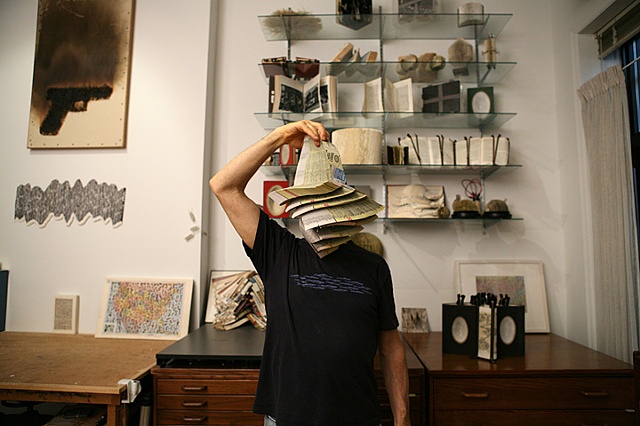
Although Gary Frost’s influence on Beube’s deep-seated inspiration from the history of the book can be seen in the first two examples below, Beube’s more acerbic view of our digital world in Facebook, the third example, is where they part company. Frost is still seeking the possibility of an ongoing link between the print and the digital: “The circumstance of mixed delivery options for books reveals a surprisingly complementary and interdependent relation of affordances and a third stance going forward. We advocate for the interdependence of paper and screen books; neither will flourish without the other.” Beube’s twisted phonebook dangled before his face in Facebook “both acknowledges and satirizes the intended community of computer users.”
Beube divides his bookworks into methodological categories — Fold, Gouge and Cut:
Inspired by a phrase from the Hindu scriptures, the Vedas, in 1989 I began folding the pages of books in on themselves. The phrase goes, “Curving back upon myself, I create again and again.”
Using various power tools I selectively removed parts of the cover, pages, and content, for example, by grinding them away. The underlying pages revealed themselves, as hidden depictions interacting with top layers, interrupting what might have been an undisturbed reading of text and image now viewed as an altered book.
Theoretically and physically I ‘excavate’ the book, as a phenomenological endeavor, creating hypertexts, as if the text block itself is an archaeological site. When I appropriate books, their words are sometimes readable, their shapes are sometimes recognizable, but in every case they are transformed into objects that are visual and speak volumes.
Korzer-Robinson, from Berlin and now working in Bristol, UK, aims to illustrate the process by which we create our past from “fragments of reality in a process that combines the willful aspects of remembering and forgetting with the coincidental and unconscious,” in his own words.
By using pre-existing media as a starting point, certain boundaries are set by the material, which I aim to transform through my process. Thus, an encyclopedia can become a window into an alternate world, much like lived reality becomes its alternate in remembered experience. These books, having been stripped of their utilitarian value by the passage of time, regain new purpose. They are no longer tools to learn about the world, but rather a means to gain insight about oneself.
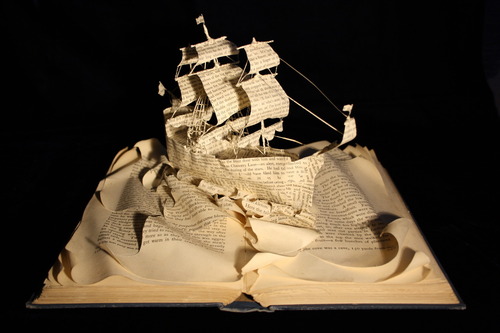
I make book sculptures/cut books by working through a book, page by page, cutting around some of the illustrations while removing others. In this way, I build my composition using only the images found in the book.
These “bookworks” begin as a volume from the Nouveau Larousse Illustré, the Brockhaus Konversationslexikon or The Boy’s Own Annual — reference works, those sources of vivid and fading fact, practical guidance, definition and explanation of our world, now being gradually superseded by the digital, where all will be recorded and nothing forgotten willfully, coincidentally or unconsciously.
More and more quickly, nostalgia is becoming no longer what it once was. See more of Alexander Korzer-Robinson’s sculpted books here.
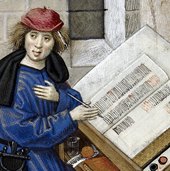
The British Library‘s “Medieval and Earlier Manuscripts” blog is a reliable source of visual delight and provocation to think about the interplay of the print and digital worlds. It also prompts the application of Ezra Pound’s critical technique of juxtaposing works, demonstrated so well in his The ABC of Reading.
I have read A Degree of Mastery from cover to cover twice. Once in New York between 2002 and 2005 when I was teaching “Professional Book and Information Publishing” at NYU and wanted readings to help provide students with a sense of the history, art and craft of the book. The second time here and now in Windsor looking for the “right something” to include in “Books On Books.”
On both occasions ebooks and digital publishing pervaded my thoughts, but only on the second time around did these questions and observations I want to raise now shape themselves as they have.
Annie Tremmel Wilcox weaves a memoir of her apprenticeship under the renowned bookbinder and conservator William Anthony. She weaves it with her diary entries, excerpts from an exhibit brochure “Saving Our Books and Words: The Conservation and Preservation of Books,” newspaper articles, correspondence, passages from “Japanese Woodworking Tools: Their Tradition, Spirit and Use” by Toshio Odate, step by step descriptions of mending torn pages and crumbling leather spines and plainspoken observation of fellow workers, conference attendees, librarians, government officials posing with restored documents, children making “books” from striped computer paper with wallpaper sewn on for covers and, of course, Bill Anthony, the “Johnny Appleseed of bookbinding.”
“Weaves” is the precise word for the structure of her book’s narrative, and it would be the right word for her ebook, if there were one. As I re-read it, this game of word substitution yielded questions that make this memoir a useful means to bookmark the evolution of the book.
Writing about some of the tools she learns to use — lifting knives, translucent bone folders, the spokeshave and others — she says of Anthony’s, “His tools were smarter than mine. They knew the correct way to cut paper or pare leather. By using them I could feel in my hands how the tools were supposed to work.” (48) For Wilcox and her reader, Bill Anthony is the master “shokunin,” craftsman or artisan. And when she quotes from Odate “For the ‘shokunin,’ utility and appearance must be enhanced by the tool’s ‘presence,’ that is its refinement and dignity….,” this reader asks,
What are the tools of the ebook maker? From whence comes their refinement and dignity — their “presence” — with which the “shokunin” imbues his creation as a result of his commitment to his craft? In what tools of the ebookmaker does “the spirit of the tool that records the ‘shokunin’s’ ability through the years to face the uncertainties of life, to overcome them, and to master the art of living” reside?
Too Zen? Perhaps.
An English grad student, Wilcox relished handling the University of Iowa‘s Sir Walter Scott Collection, its Leigh Hunt Collection and The Works of Rudyard Kipling. Confronted with earlier slapdash and botched work on certain volumes of the Kipling, she writes, “Certainly these volumes of Kipling are found on the shelves of numerous libraries across the country, but the integrity of ‘these’ volumes as a complete set has been lost.” (179) What constitutes the “integrity” of an ebook or its constituents? Are ebooks so “immaterial” that such a question is nonsensical?
The author’s apprenticeship included collaboration on the exhibit “Saving Our Books and Words.” In addition to coauthoring the exhibit’s brochure, Wilcox contributed to completing Anthony’s special project of developing for the exhibit a unique collection of models demonstrating “the evolution of the codex – the form of the book as we know it.”(181) In the brochure she touches on the immateriality and materiality of the Center’s work: “Simply defined, preservation is the attempt to save the intellectual content of books while conservation is the attempt to save both the intellectual content and its vehicle — the covers, paper, endbands, etc. The former is concerned with saving what the human record contains without regard to the forms it winds up in. The latter focuses on the artifact itself, attempts to save this book, this sheet.” (192)
What is the “form” of the ebook as we know it? Is the ebook as much “vehicle” as “content”? What are its equivalencies to the page or to what “binds” the “text block”? What does it mean to “conserve” an ebook? Of a digital copy, what are the materials; what is the artifact to be conserved?
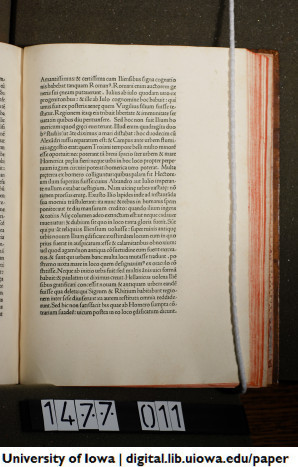
Wilcox ends her memoir with the completion of her “masterpiece,” the restoration of the incunabulum that Bill Anthony assigned her before his death and which she completed after it with the help of “The Restoration of Leather Bindings” by Bernard Middleton, author of the standard text “A History of English Craft Bookbinding Technique.” The work assigned was Pope Pius II’s “Historia Rerum Ubique Gestarum,” printed by Johannes De Colonia and Johannes Manthen in Venice in 1477, which when restored was “not a deluxe edition, but … had great integrity.” In the year 2547, of what will the preservation and conservation of today’s e-incunabula consist? Will some apprentice conservator understand the “form” of these ebooks “in the cradle” and, master of smart tools, restore them to their integrity?
With Ann Tomalak’s essay, perhaps we can see that future through her present lense on the past. Give it a read.




 Books On Books