Books On Books Collection – Moritz Küng (ed.)

Blank. Raw. Illegible… Artists’ Books as Statements, 1960-2022 (2023)
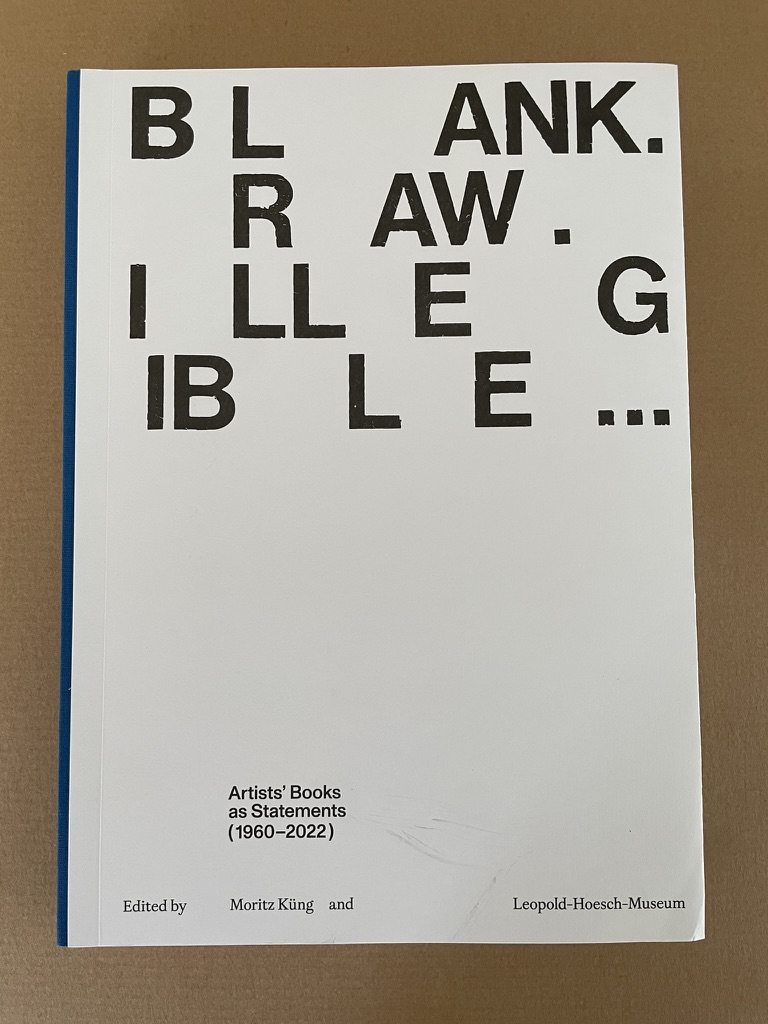
Blank. Raw. Illegible… Artists’ Books as Statements, 1960-2022 (2023)
Leopold-Hoesch-Museum and Moritz Küng (ed.)
Softcover with flaps, reversed “Fälzel” stitch bound. H280 x W200 mm. 272 pages. Edition of 1100. Acquired from Walther & Franz Verlag, 10 May 2023.
Photos: Books On Books Collection.

Published on the occasion of the exhibition by the same name at the Leopold-Hoesch-Museum in Düren, Germany, this tome is far more than an exhibition catalogue. With its thematic structure being a form of commentary on and insight into 259 individual works of 200 book artists, Blank. Raw. Illegible becomes one of the more important reference works on book art to have appeared in the last five years. And this is despite its singular focus on artists’ books blank (most of them), inacessible, or illegible.

The opening spreads for its fifteen thematic sections are shown below.
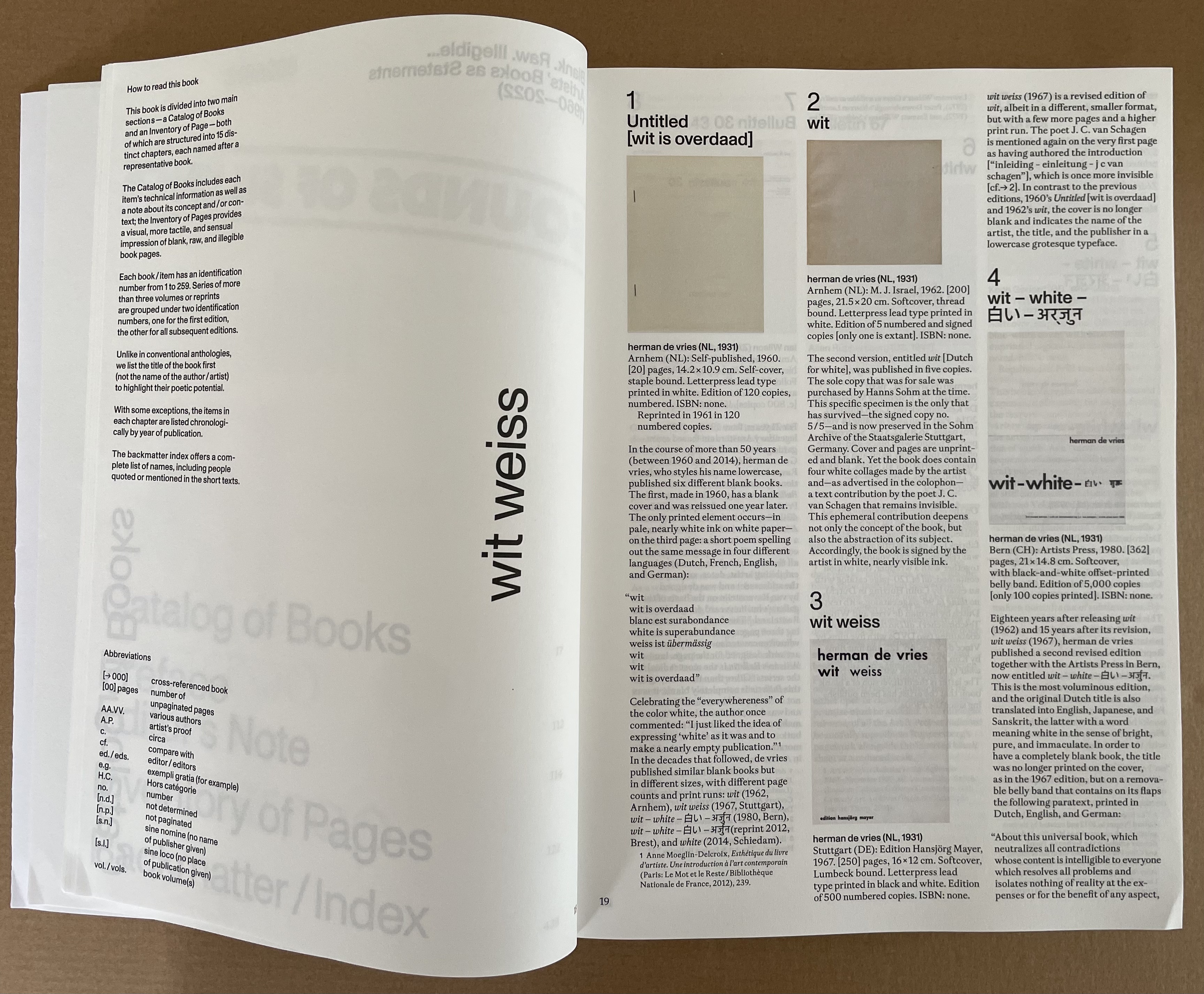
“wit weiss” takes its title from the third of six blank-page works by herman de vries. In addition to cataloging the other five, the section presents sixteen other variations on the theme, including Christiaan Wikkerink’s Conceptual Art for Dummies (1968, 1977, 2010).
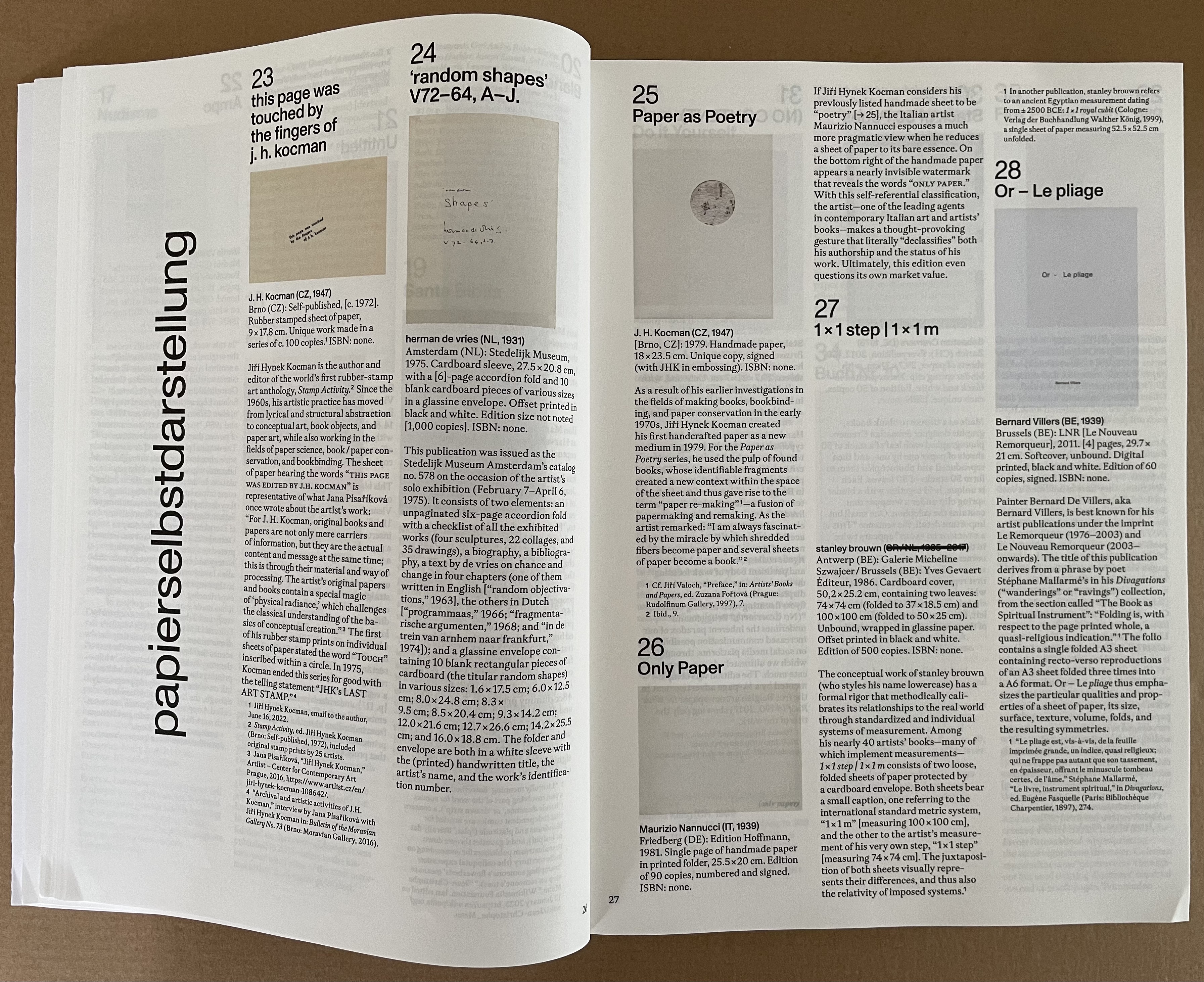
“papierselbstdarstellung” presents us with thirty-three works of “paper self-portrait”. Blank or not, paper takes the conceptual and physical center stage in this section. It’s a pleasure to see the two rare works from the 1970s by J.H. Kocman introducing this group that includes another of herman de vries’ works, one of Bernard Villers’ Mallarméan pieces, some of the output of the prolific polymath Julien Nédélec, a unique piece from Paul Heimbach, Richard Long’s dipped River Avon Book, and more paper-allusive papierselbstdarstellungen.
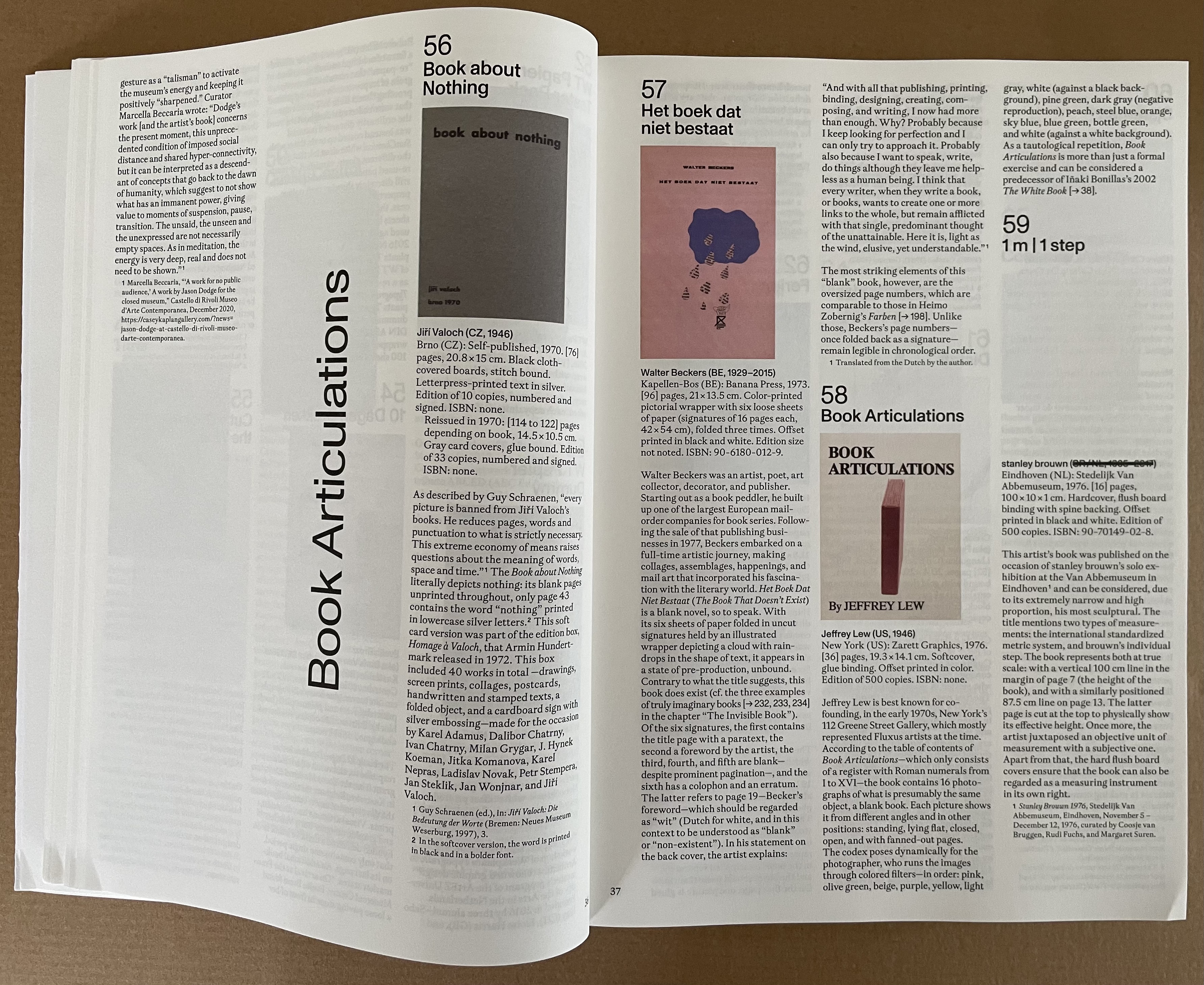
“Book Articulations” takes its title from the work by Jeffrey Lew, which “articulates” the codex through various poses and color filters, but the fourteen other works included explore other forms of “articulation”. The Oxford English Dictionary gives nineteen definitions. Some of those are obsolete, but we can give Küng the benefit of the doubt that this section’s fifteen works exemplify the ones still active.
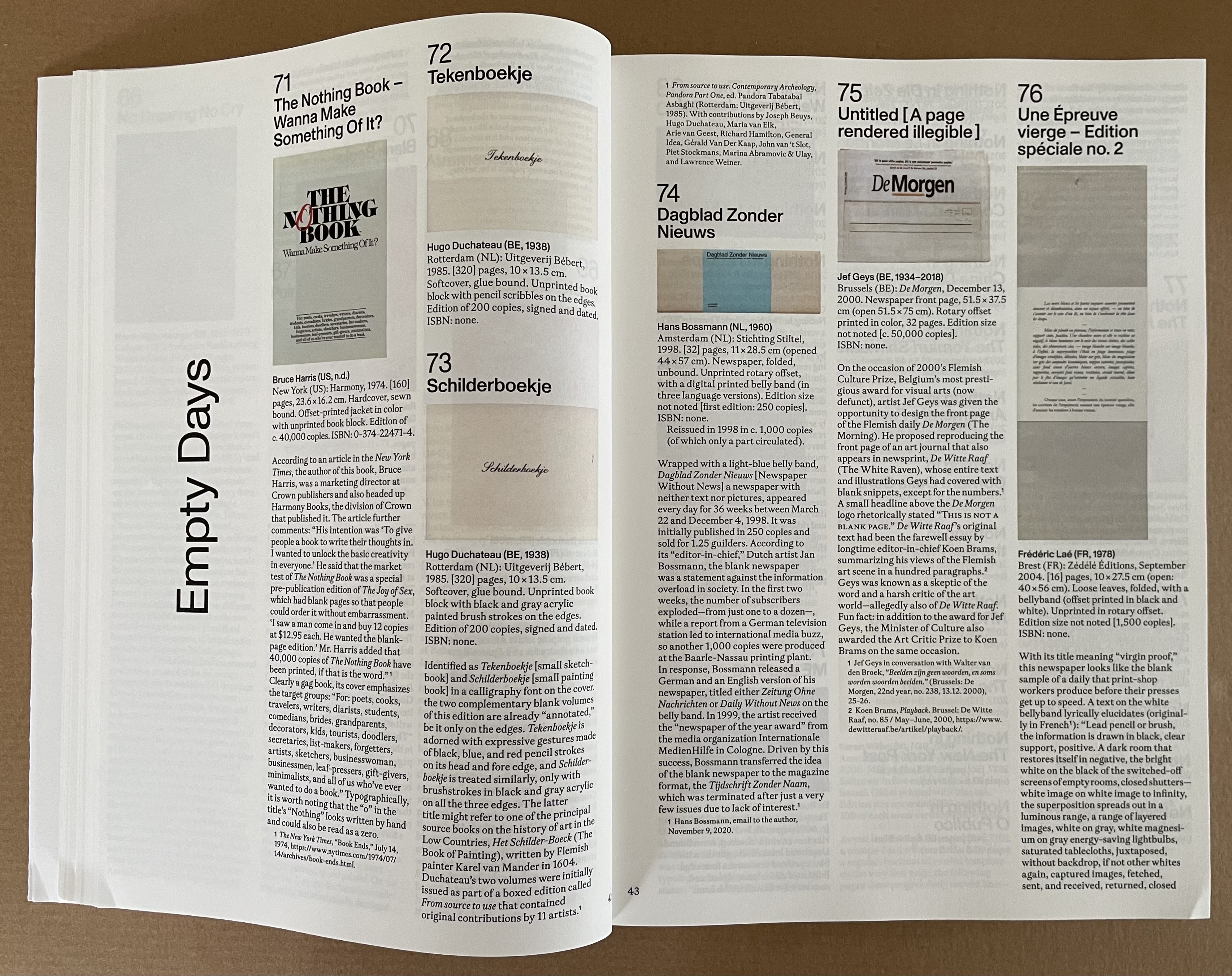
“Empty Days” takes its title from the last work in the section, a volume offered as an annual planner whose pages are blank, its months distinguished by different makes of paper, and its bookmarker printed on both sides with reminders of the names of the days and months. Leading with Bruce Harris’ gag book The Nothing Book, the section follows applications of the blank joke to newspapers, notebooks, exercise books, chronicles, and advice books.

The blank books of “life and work” demonstrate subtleties ranging from Paul Heimbach’s careful inclusion of 273 clear sheets to allude to the 273 seconds of John Cage’s 4’33” (1972) to Arnaud Desjardin’s Why I am no longer an artist.
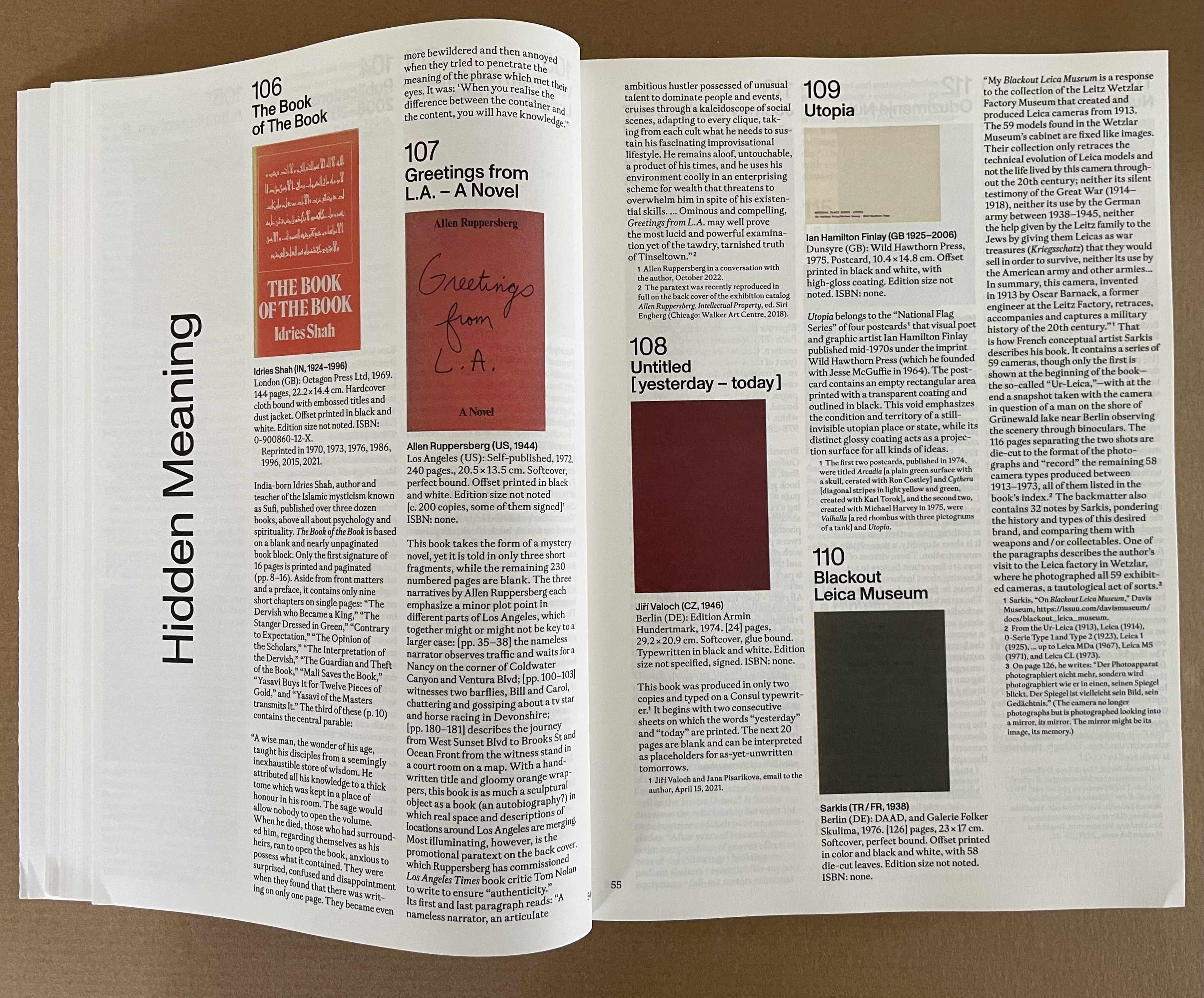
Some of the blank works in “Hidden Meaning” play the joke of being the answer to the title, such as Reasons to Vote for Republicans (2017), a plagiaristic response to Michaels Knowles’ Reasons to Vote for Democrats (2017), published one month before. Other require the reader to uncover the hidden meaning (as in Christian Boltanski’s 2002 Scratch, which reveals images of atrocities when the surfaces of its silvered pages are scratched off) or to hide meaning (as in Russell Weeke’s 2016 blank postcard Hidden Meaning, which has only those words printed in the block where the stamp goes.
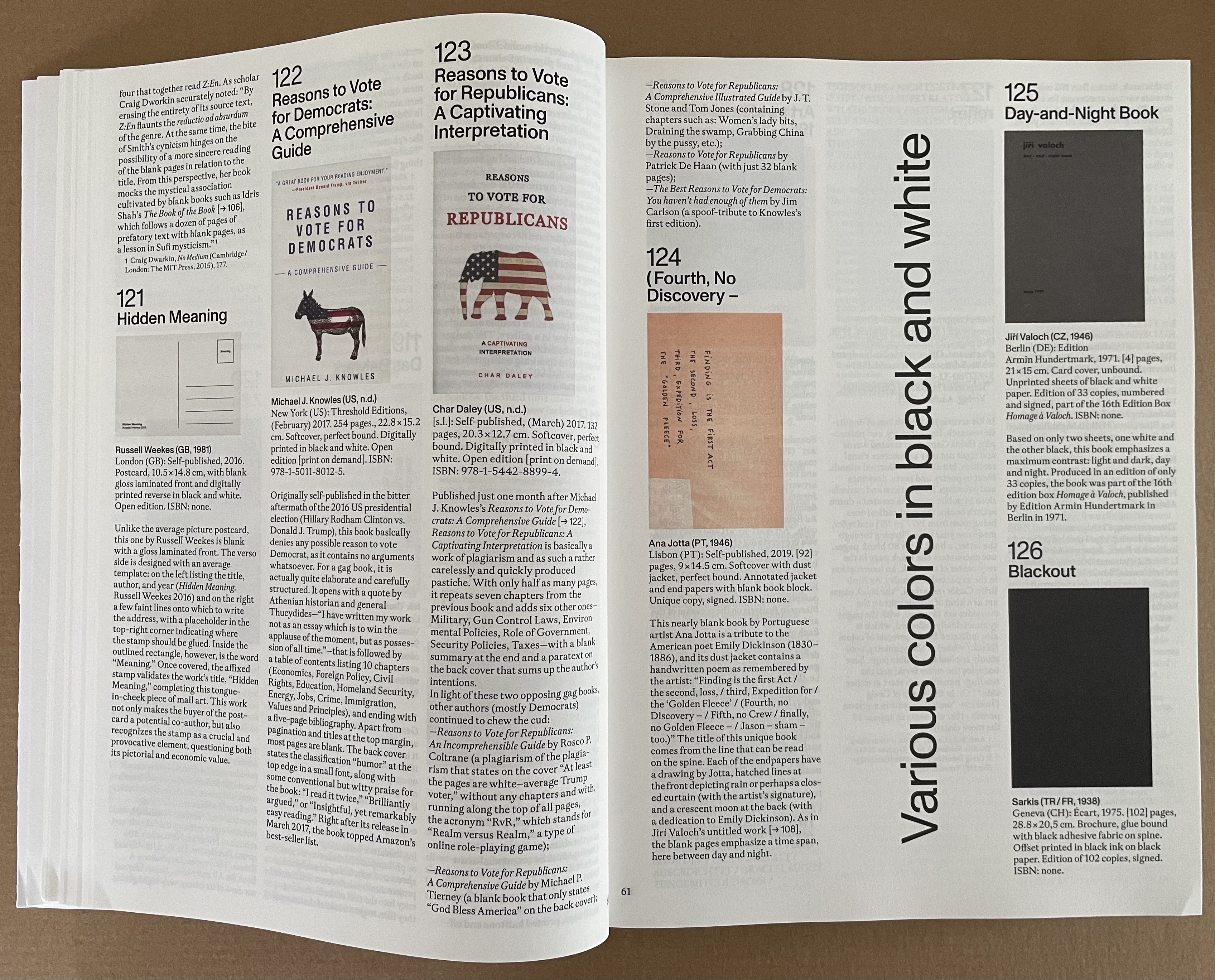
The thirty-one works in this section remind us that for book artists, black and white are also colors on the palette and tools in the book artist’s conceptual tool box. “Various colors in black and white” comes from the title of Pierre Bismuth’s 2005 book with onestar press. Onestar boasts that its artists’ books are “strictly unedited by the publisher”, but there is a cost-control constraint: no color inside the books. So Bismuth demanded a different color for each letter of his name and reproduced 139 monochromatic Pantone colors in black and white, representing a variety of hues in shades of gray.
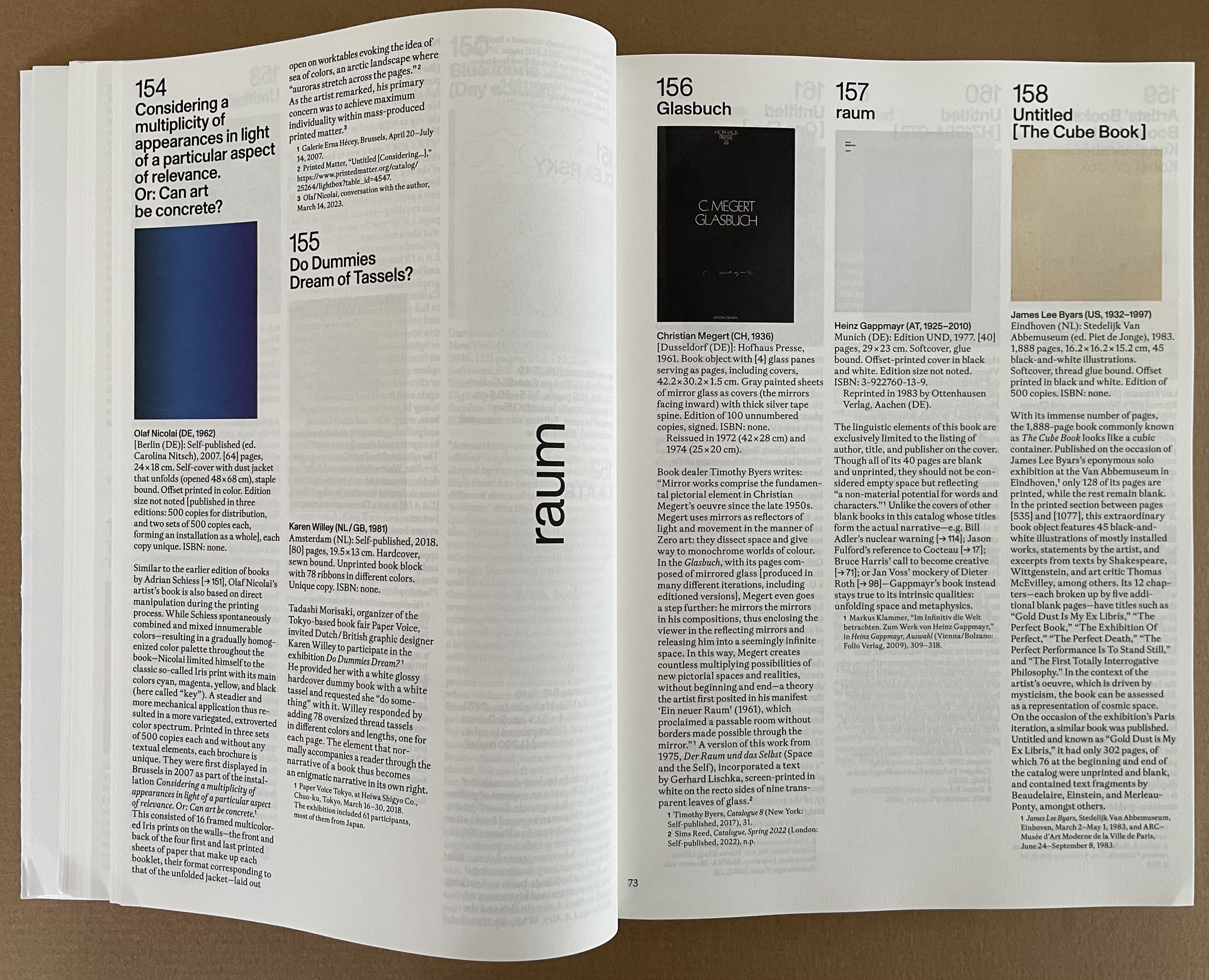
raum means “space, room” in German and is the title of Heinz Gappmayr’s physically and metaphysically blank book. In this section, the other eight blank books take on a more sculptural aspect than others in the exhibition. There’s the massive Your House (2006) by Olafur Eliasson and the slim A Cloud (2007) by Katsumi Komagata, both examples of die cut leaves.
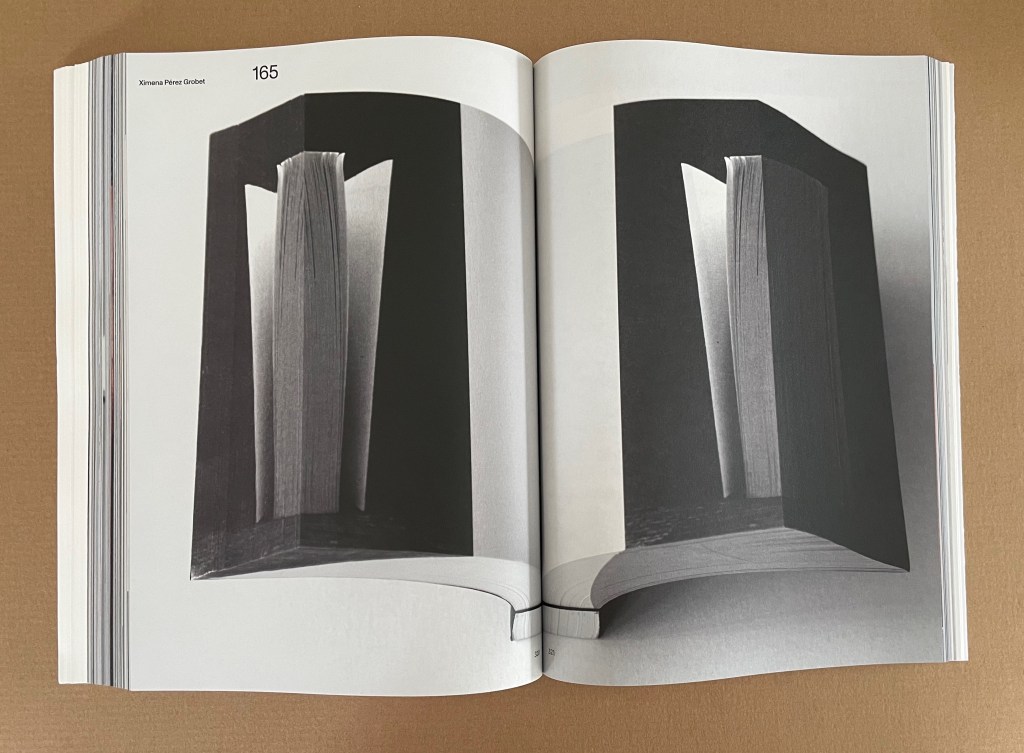
Ximena Pérez Grobet’s Around the Corner (2020) is an extraodinary example of flip-book and fore-edge printing combined. This spread represents the 312 pages of full-page samples of all 259 works in the exhibition.
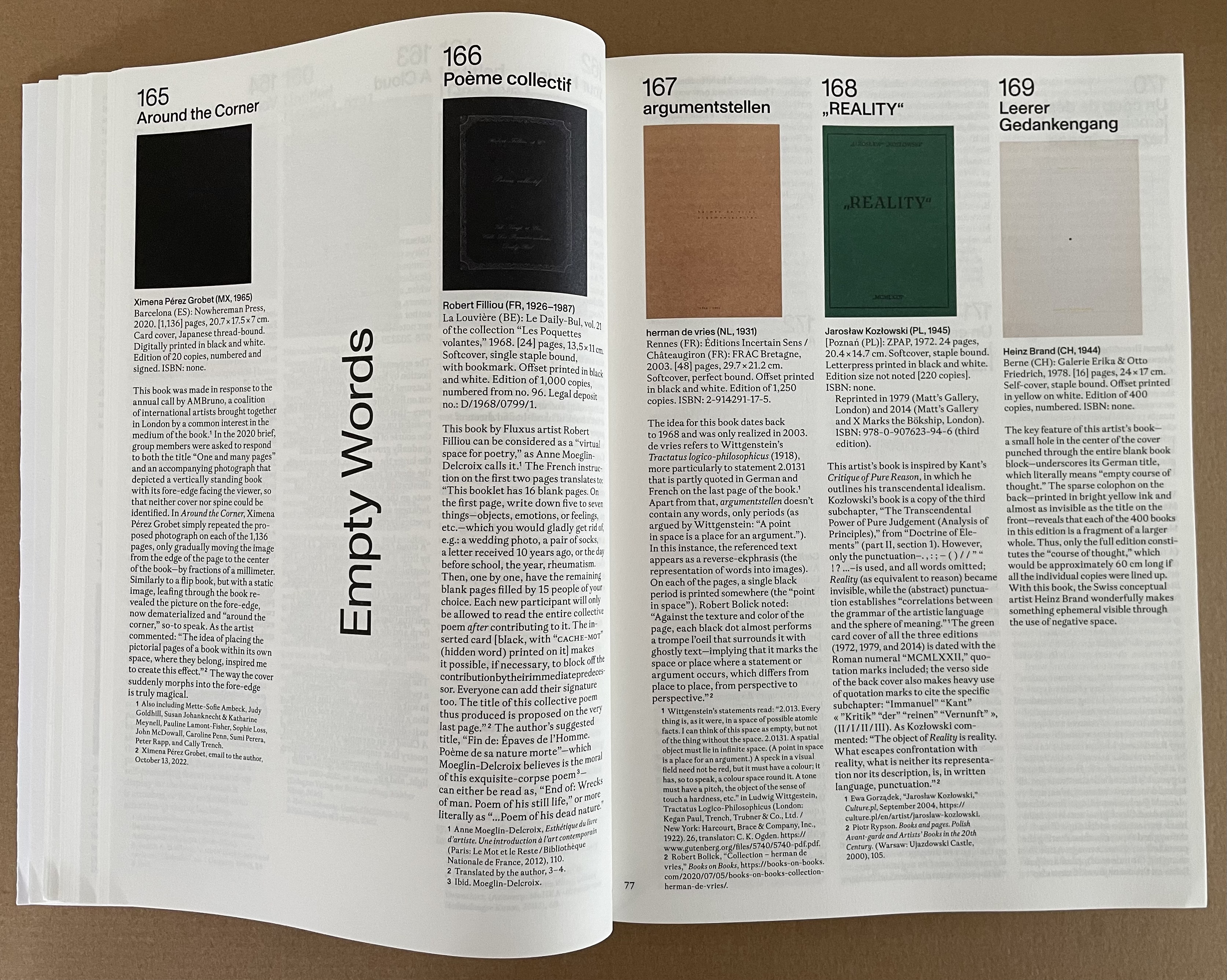
Redaction, excision, erasure , and substitution are the only four “point blank” methods of making empty words in this section. The rest “verb” the word “empty” and go with pages emptied of words to meet the curator’s criterion for inclusion in “Empty Words”. Two exceptions: Roberto Equisoain’s gradual removal of word spaces and merging of the remaining letters into one in La lectura rápida … (2014) and Jürg Lehni and Alex Rich’s hole-punching of letters in their book naturally entitled Empty Words (2011).
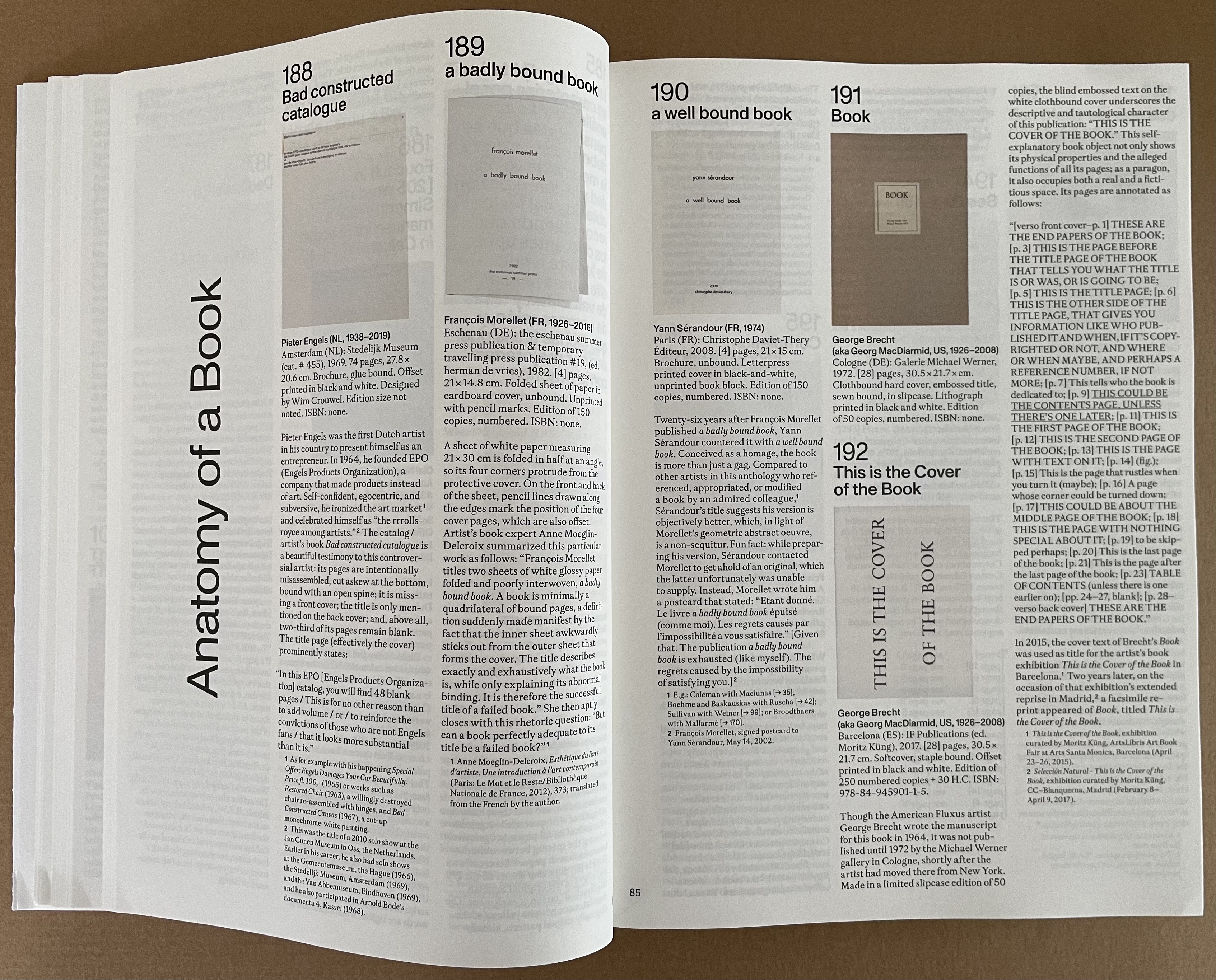
“Anatomy of a Book”, whose title comes from the 2010 unique work by Fiona Banner (aka The Vanity Press), reminds us of how book artists can create works of art by focusing attention on individual parts of the book or simply naming its parts as George Brecht did with This is the Cover of the Book (1972).
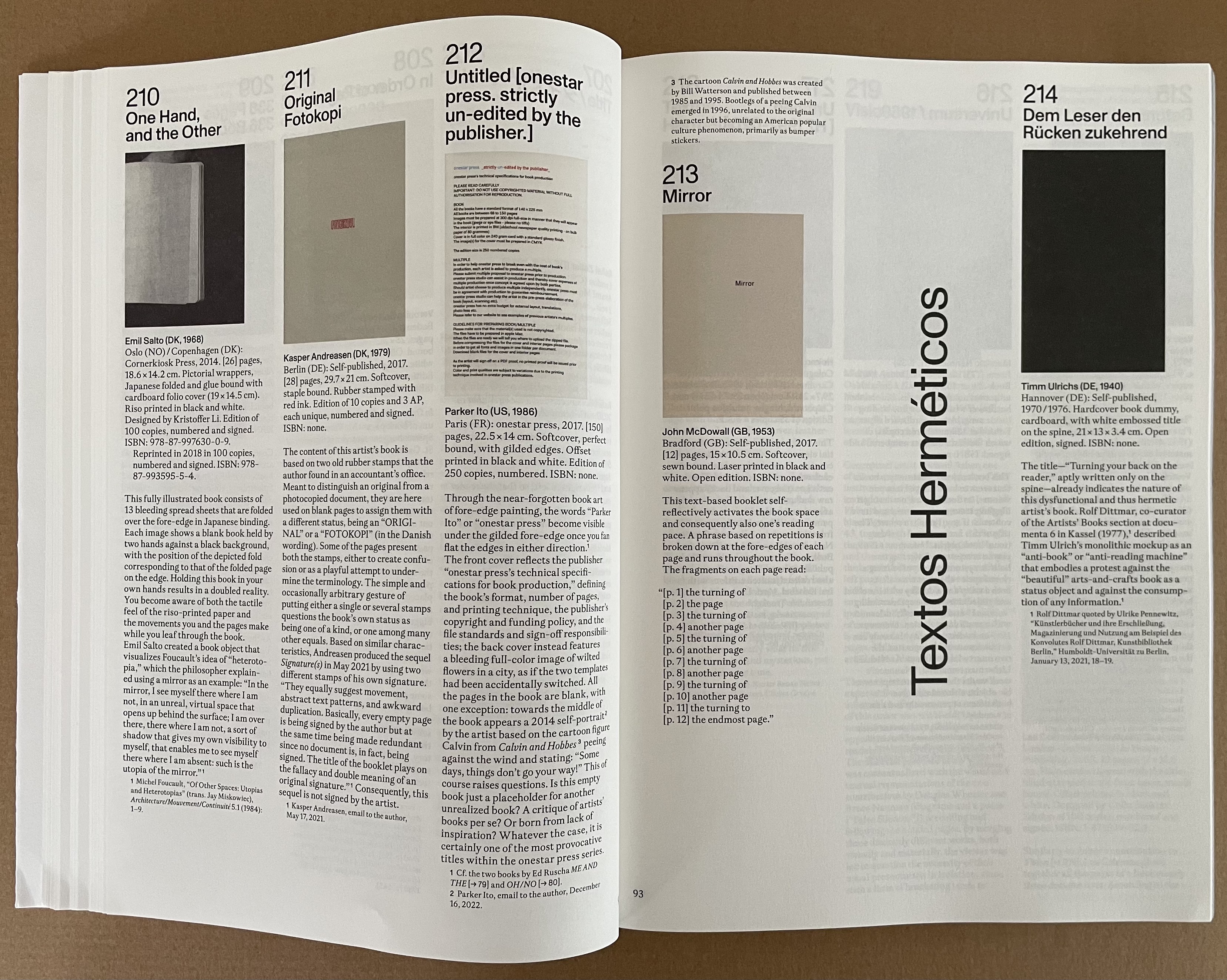
The word hermetic means “sealed”. So naturally, “Textos Herméticos” presents ten examples of artists’ books that physically cannot be opened.
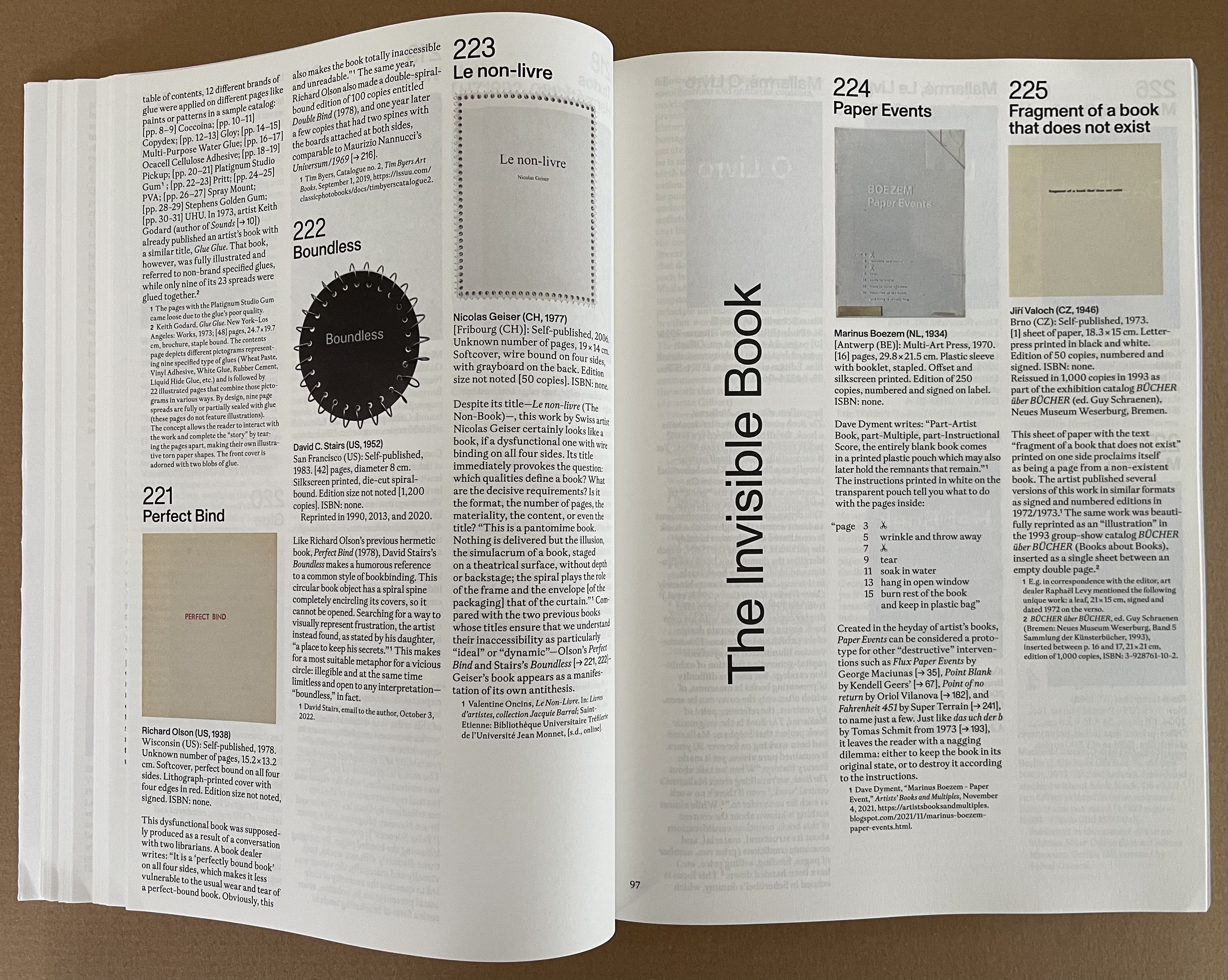
Elizabeth Tonnard’s entry The Invisible Book (2012) entitles this section of thirteen works. It was advertised on the artist’s website in an edition of 100, unnumbered and unsigned at the price of €0.00. After Joachim Schmid scarfed up all 100, Tonnard issued a second edition with a limit of one “copy” per customer. It, too, is now “out of print”. The catalogue’s full-page illustration for it is naturally blank, as is that for Enric Farrés Duran’s Para aprender a encontrar, primero hay que saber esconder (which was offered in a physical store for €20, resulting in only a receipt with the artist’s email address so that the buyer could arrange a face-to-face meeting to have the book explained verbally). Likewise Paul Elliman’s Ariel (the aptly named invisible and non-material typeface used, according to the inventor’s correspondence with Küng, to record extinct human and animal languages as well as sounds obsolete machines) is represented by a blank page.

The three invisible books “displayed”! Photo: Courtesy of Moritz Küng, photo by Peter Hinschläger.

There are seven works in this section “Fahrenheit 451”, although one of Dora Garcia’s is not numbered. None of them are blank, raw, or completely illegible. Nevertheless, their appropriateness for the exhibition is particularly underlined by the blackened pages of #241, which can be read if burned (see below).
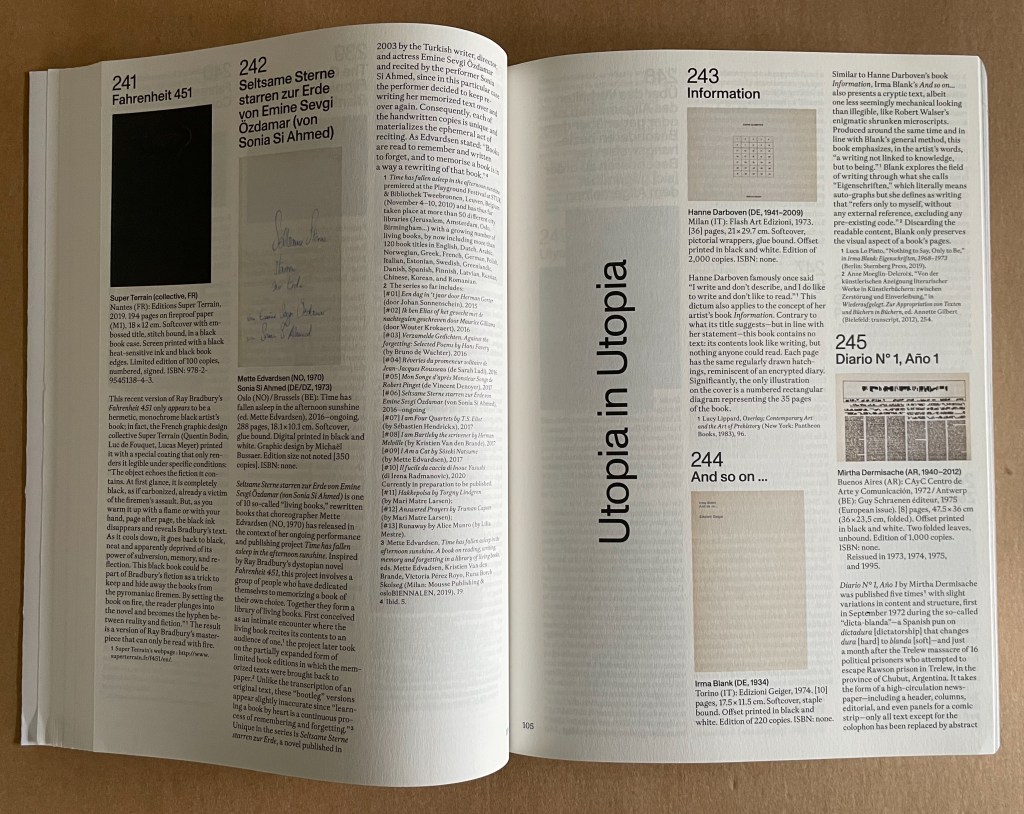
“Utopia in Utopia” pays homage to Thomas More’s satire Utopia (1516) with sixteen works of varying illegibility, several engendered with invented fonts arising from More’s invention of an alphabet for the Utopians. No blank pages, unless you count Irma Blank’s entry (but we’ve had that pun in an earlier section).
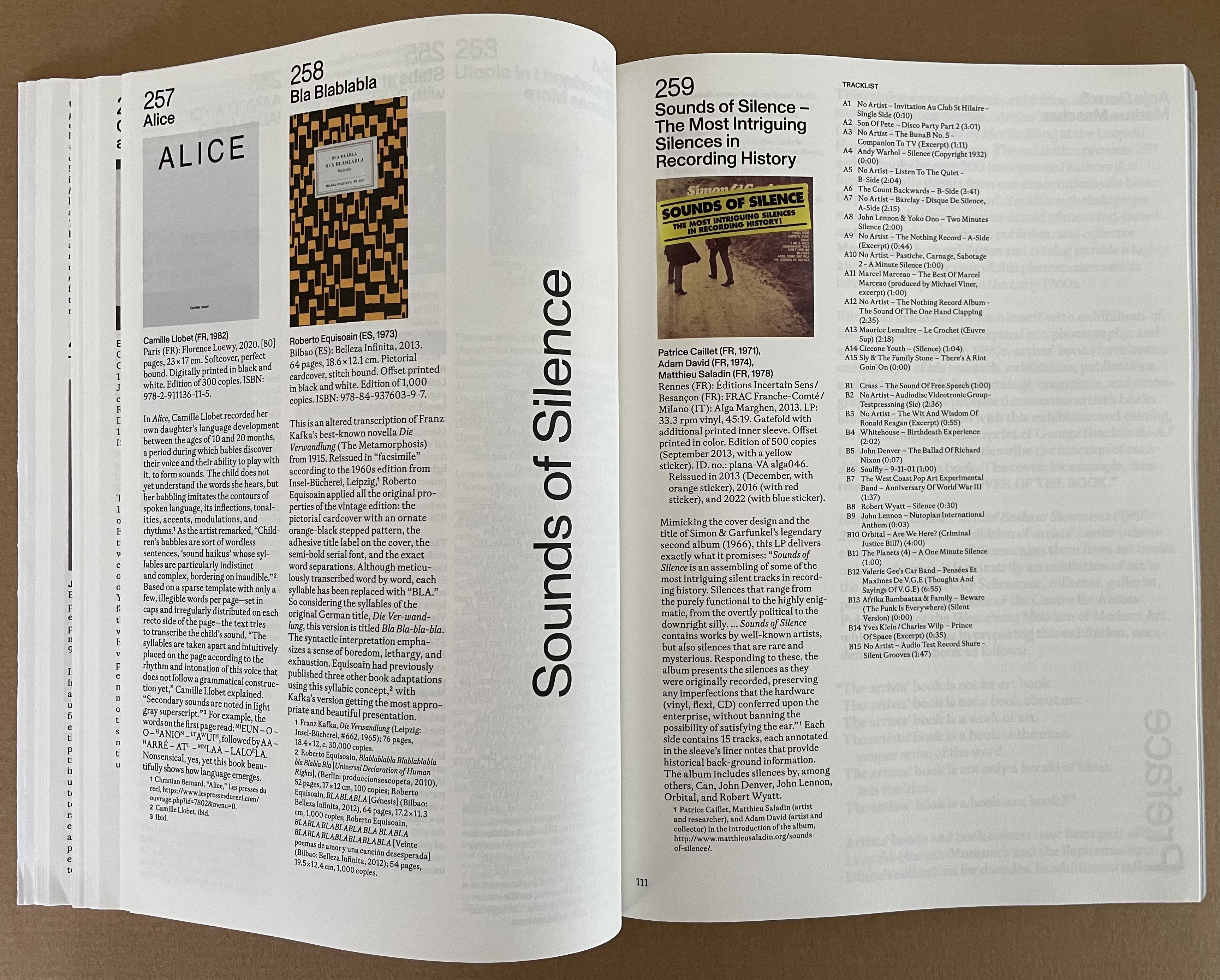
The last section “Sounds of Silence” has only the one entry, and it is a vinyl LP album, not a book. To add to that quibble, there’s oddly no recording of John Cage’s 4″33″ among the tracks of this platter. But as the final entry in the exhibition, it extends the enterprise beyond blankness, rawness, and illegibility to inaudibility!

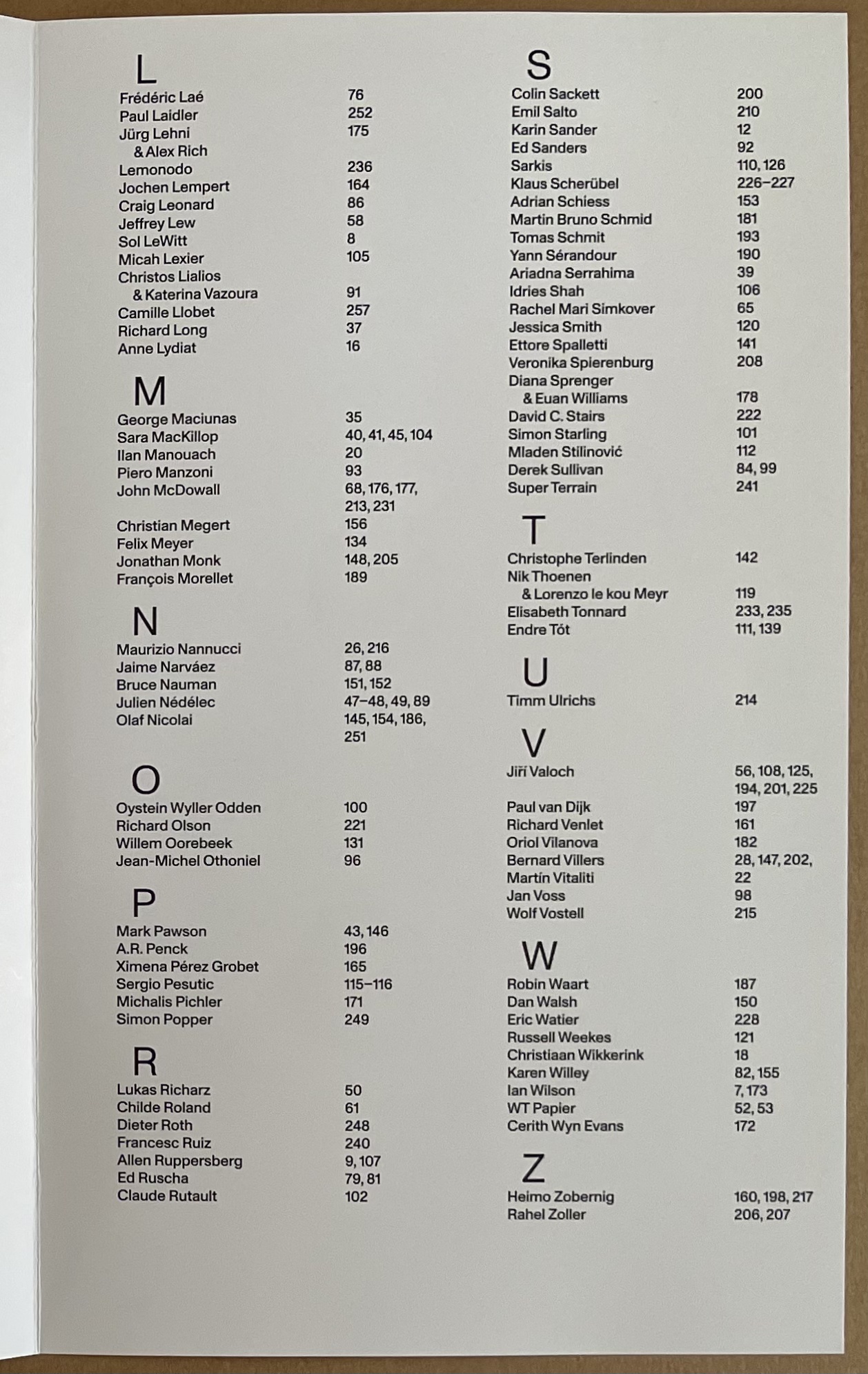
200 artists, 259 works.

Like Megan Liberty’s exhibition in the same year, Craft & Conceptual Art : Reshaping the Legacy of Artists’ Books, it also demonstrates that the factions of the dematerialized and conceptual works, the democratic multiples, the limited editions and the unique finely or rawly crafted works were not so walled off from one another as implied in polemics, manifestos and critical essays so concerned with defining the “artist’s book”, the existence or placement of its apostrophe and securing its role in the larger history of art. With its captions, numerous full-page images, and curation by Moritz Küng, Blank. Raw. Illegible. joins the list of significant exhibitions documenting the evolving history of the artist’s book that David Senior identified in his contribution to Liberty’s catalogue:

Others that could be added include

and Guy Schraenen’s boxed set of 25 catalogues of exhibitions organized by him and representing the archive donated to Neues Museum Weserburg in Bremen, Germany.

Above all, Blank. Raw. Illegible. … Artists’ Books as Statements (2023) demonstrates that the book constitutes a medium for, and genre of, Art. No library or collection that aims to represent book art or Art should be without it.

Further Reading

Bury, Stephen. 2015. Artists’ Books : The Book as a Work of Art 1963-2000. London: Bernard Quaritch Ltd.

Desjardins, Arnaud. 2013. The Book on Books on Artists’ Books. 2nd exp. ed. London: The Everyday Press.

Drucker, Johanna. 2007. The Century of Artists’ Books. New York City: Granary Books.

Hampton, Michael. 2015. Unshelfmarked : Reconceiving the Artists’ Book. Devon: Uniformbooks.

Jury, David, and Peter Rutledge Koch. 2008. Book Art Object. Berkeley, California: Codex Foundation.

Jury, David, and Peter Rutledge Koch. 2013. Book Art Object 2 : Second Catalogue of the Codex Foundation Biennial International Book Exhibition and Symposium, Berkeley, 2011. Berkeley, CA, Stanford: Codex Foundation ; Stanford University Libraries.

Klima, Stefan. 1998. Artists Books : A Critical Survey of the Literature. New York: Granary Books.

Liberty, Megan N., ed. 2023. Craft & Conceptual Art : Reshaping the Legacy of Artists’ Books. First edition. New York: Center for Book Arts.

Lyons, Joan, ed. 1985. Artists’ Books : A Critical Anthology and Sourcebook. Rochester, New York: Visual Studies Workshop Press.

Moeglin-Delcroix, Anne. 2012. Esthétique Du Livre d’Artiste, 1960-1980 Une Introduction À L’art Contemporain. Nouvelle édition revue et augmentée. [S.l.], [Paris]: Le Mot et le reste ; Bibliothèque nationale de France.

Moeglin-Delcroix, Anne. 2004. Guardare, Raccontare, Pensare, Conservare : Quattro Percorsi Del Libro d’Artista Dagli Anni ’60 Ad Oggi. [Mantova]: Casa del Mantegna : Corraini.

Roth, Andrew, Philip Aarons, and Claire Lehmann (eds.). 2017. Artists Who Make Books. London: Phaidon.

Salamony, Sandra, and Peter & Donna Thomas (Firm). 2012. 1000 Artists’ Books : Exploring the Book as Art. Beverly, MA: Quarry Books.

Schraenen, Guy, and Neues Museum Weserburg Bremen. 2011. Ein Museum in Einem Museum = A Museum within a Museum. Bremen: Neues Museum Weserburg Bremen.
Books On Books Collection – Heimo Zobernig

FARBEN ALPHABET (2018)

FARBEN ALPHABET (2018)
Heimo Zobernig
Paperback. H297 x W210 mm. 32 unnumbered pages in two signatures. Edition of 500, of which this is #427. Acquired from Les Presses du Reel, 18 September 2022.
Photos: Books On Books Collection.

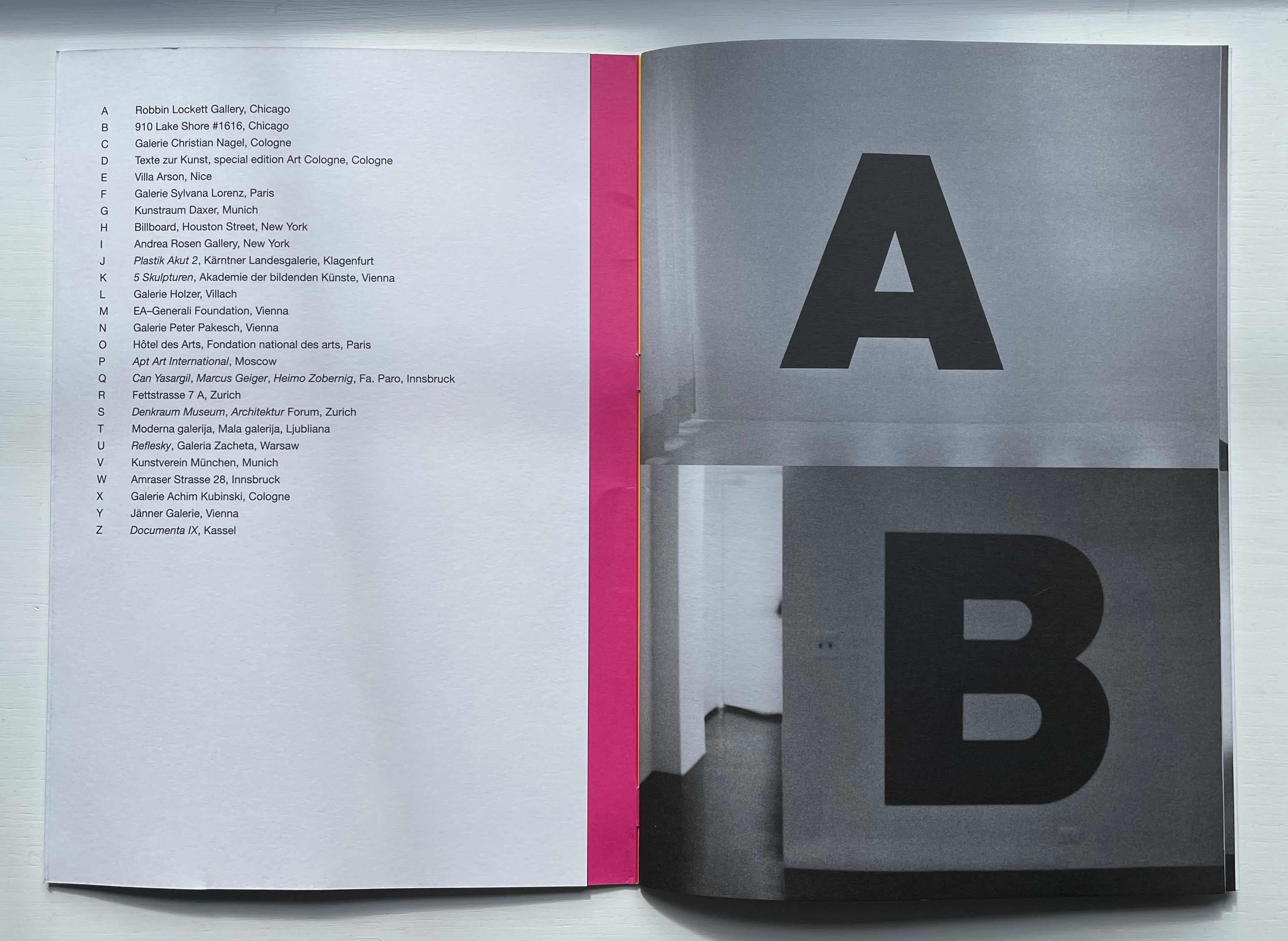
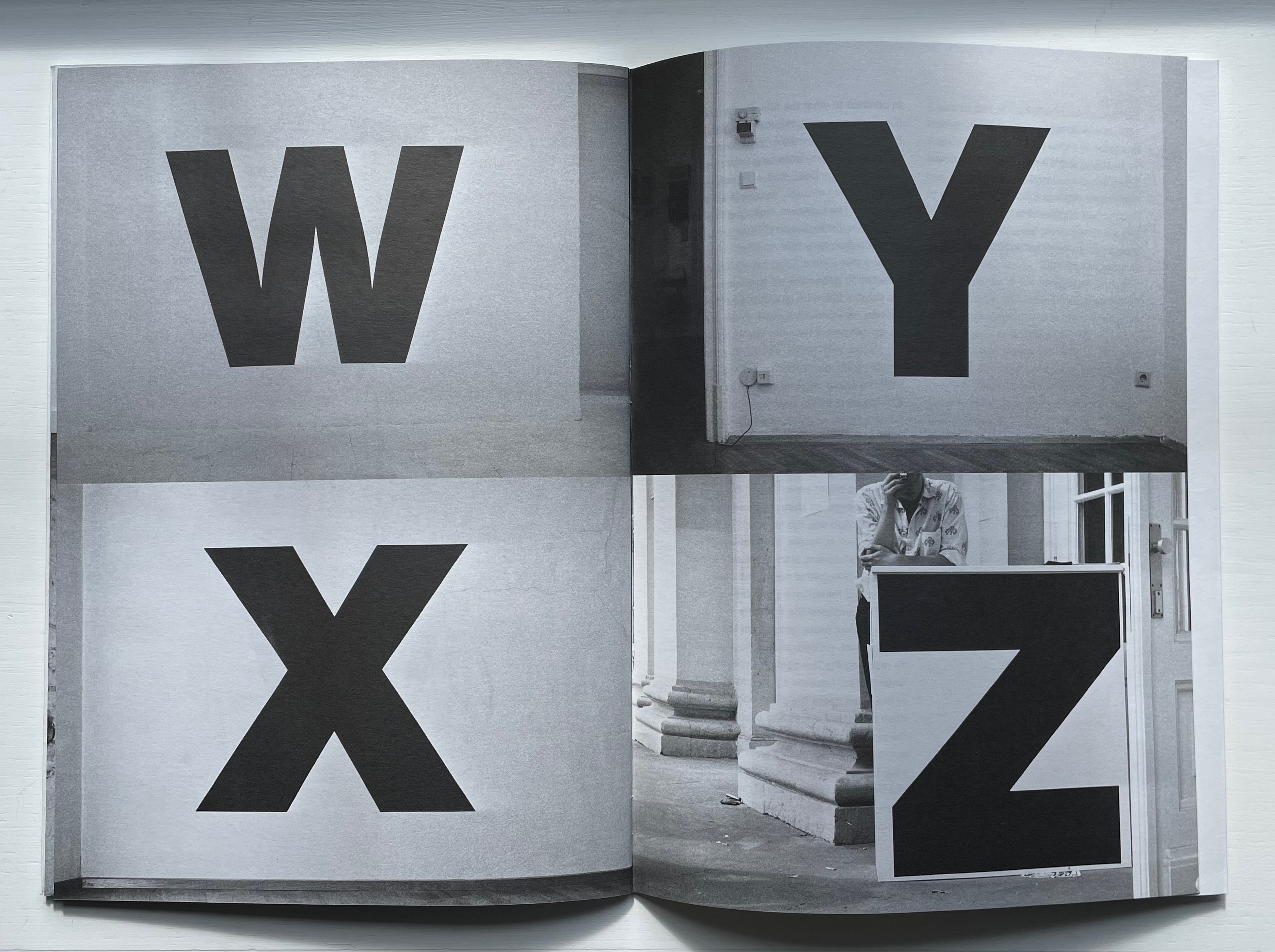
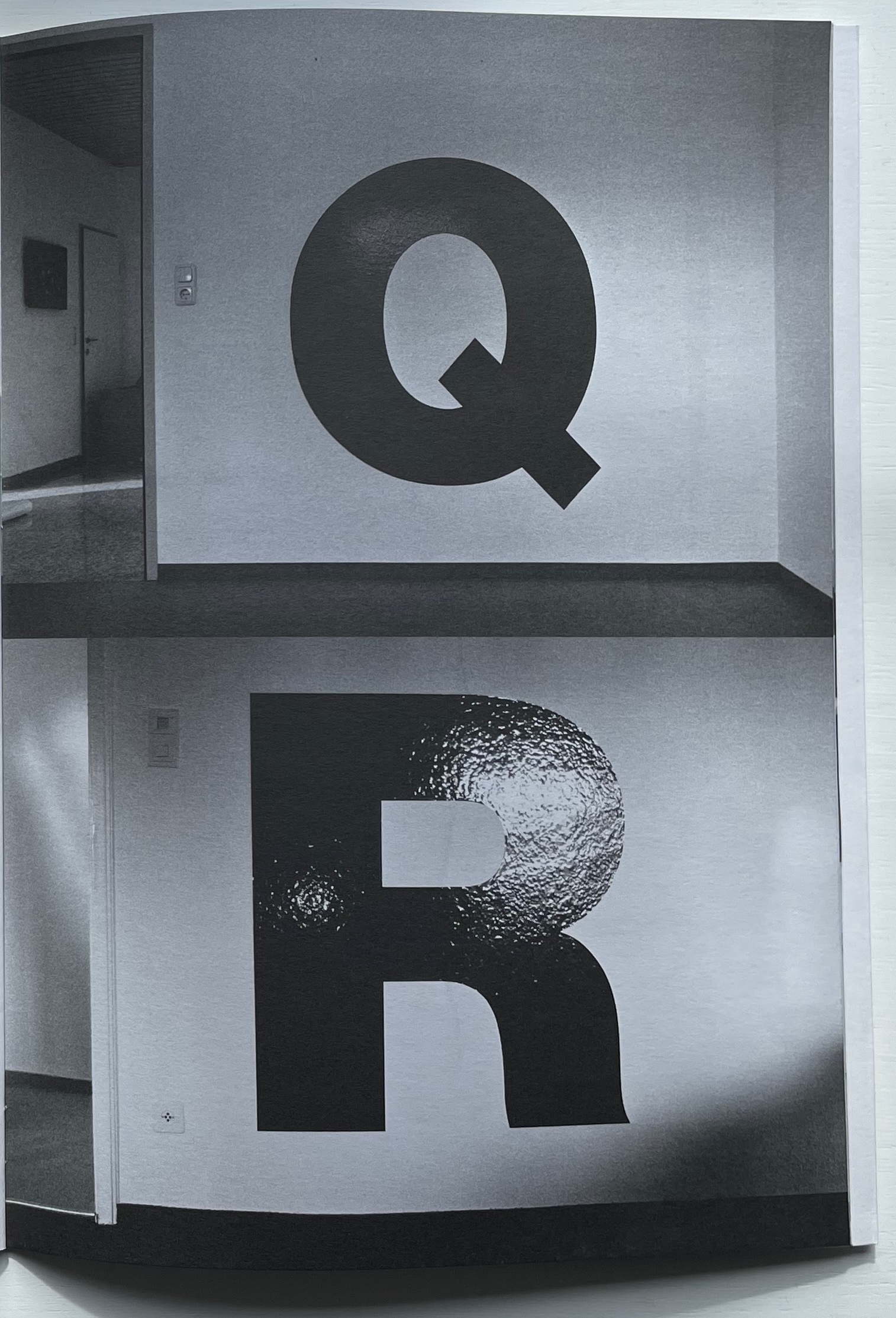
Starting with his first solo exhibit in the US, Heimo Zobernig placed a 115 cm high letter A in black adhesive vinyl foil on a wall near the entrance to the Robbin Locket Gallery in Chicago.

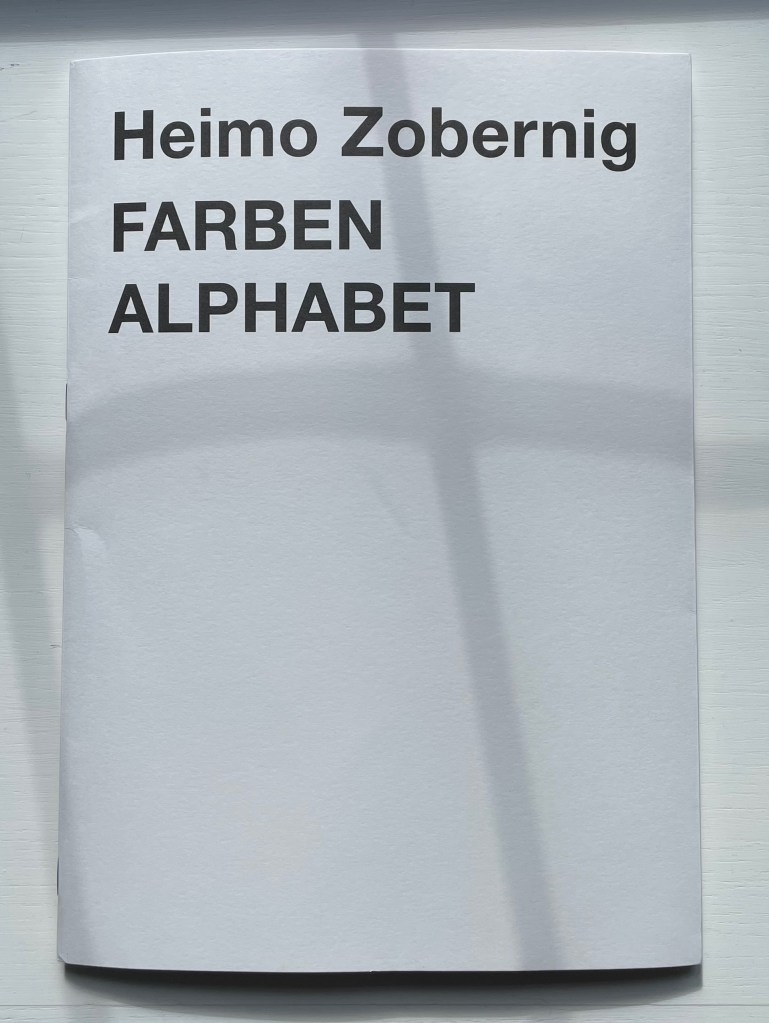
That was in 1990. By 1992 and twenty-five more exhibits later, he had accumulated a complete alphabet, the Z appearing on the ticket counter for Documenta IX in Kassel, Germany. The literary magazine Freibord (Vienna) published Zobernig’s photographic alphabetic record of his exhibitions in its centenary issue (1997). With Zobernig’s cover design, IF Publications (Barcelona) has produced Alphabet for the first time as an artist’s book. Here is the artist’s alphabet book as intervention over time. As the cover’s title and absence of color in these letters suggests, though, “But wait, there’s more”.

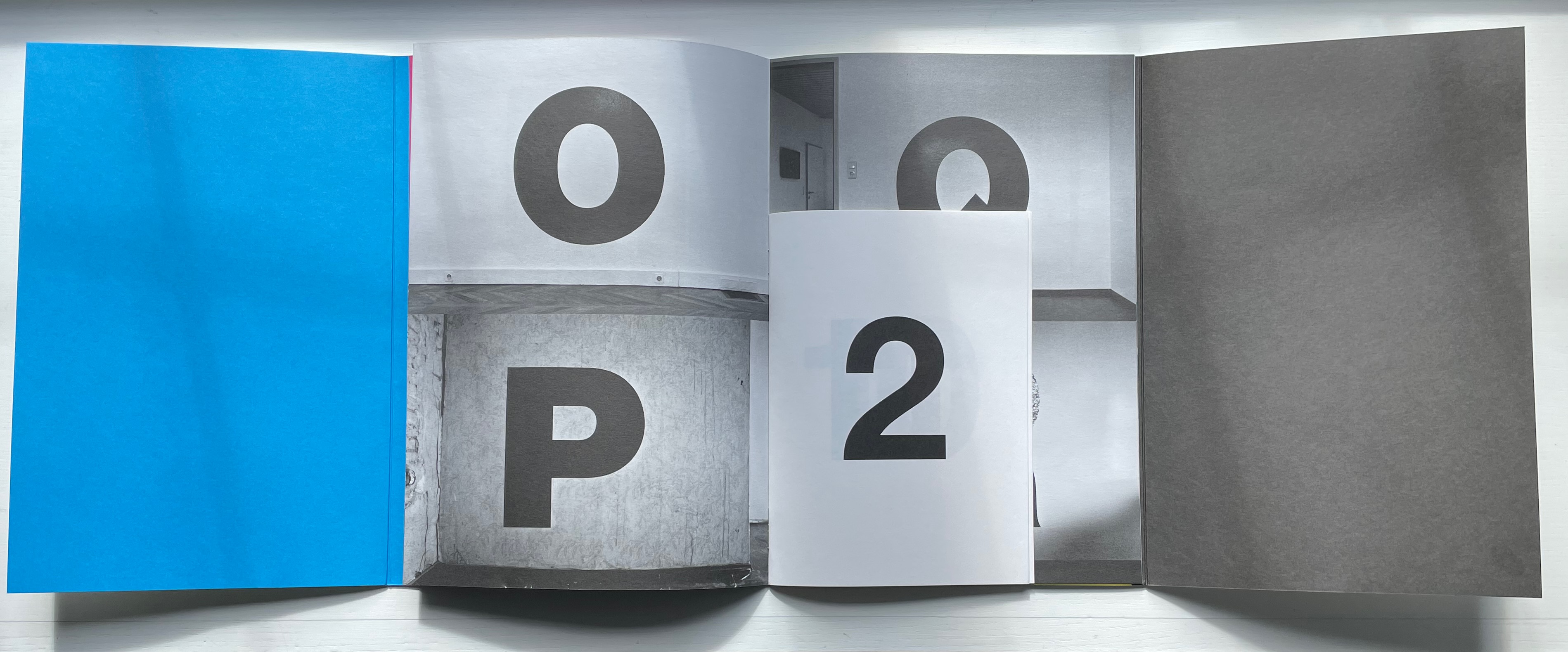
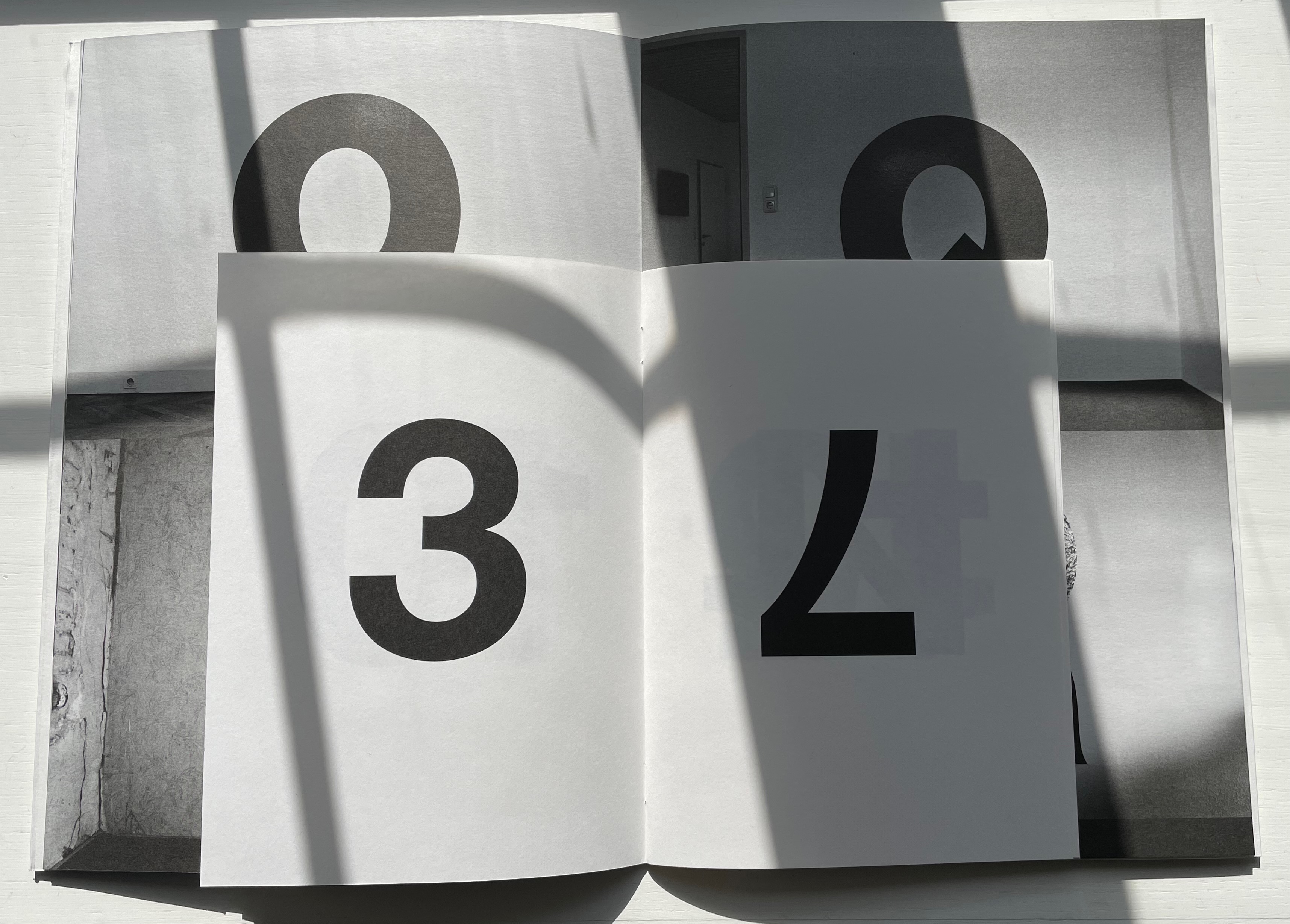
At the center of the photographed alphabet’s 16 pages measuring H297 x W210 mm, another 16-page signature measuring H210 x W150 appears, showing the numeral 2 in 220pt Helvetica on its cover, then the numerals 11 and 10 on the first double-page spread, then 3 and an upside-down 7 on the next spread. On the tenth unnumbered page, the word — FARBEN — appears. As if the numeric disorder were not puzzling enough, the numerals and letters are all in black despite the word FARBEN meaning “COLORS”. At the end of the book, Moritz Küng, the book’s editor, provides two crucial insights for untangling the puzzle.

First, that from the mid-1980s, Zobernig selected fifteen combinations of CMYK to define a palette from which he would not deviate until the early part of this century. Second, that the center signature self-referentially reflects on the principle of imposition (how sheets are printed and folded into signatures). Each number in the center brochure belongs to one of Zobernig’s fifteen CMYK combinations. From the top left of one side of the sheet to the bottom right of the other side of the sheet, Zobernig placed “right reading” numerical representations of these color combinations so that, when the sheet is folded and trimmed to form the booklet, the numbers and title appear in their strange orientation. This orientation that calls attention to the mechanics of the inside booklet’s creation results in the numeral 2 appearing on its cover, seemingly labelling the booklet within a booklet as the second of two volumes. Yet the cover of the outer booklet indicates that FARBEN comes first.

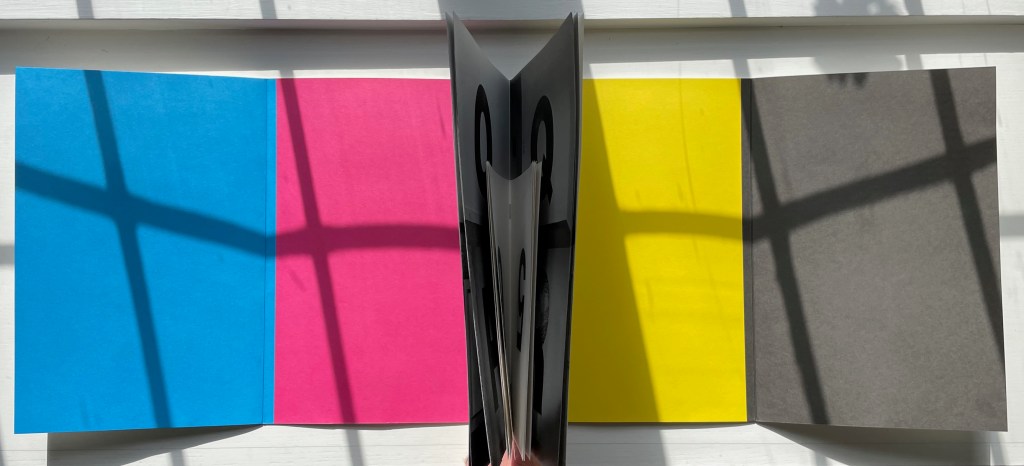
The seemingly contrary self-referencing abstraction does not end there. Or rather, if we stick with the cover of FARBEN ALPHABET with Küng’s clues in mind, it resolves itself. Just as Zobernig’s black and white alphabetic labels abstractly introduced his color-rich 1990-92 exhibitions, the other side of FARBEN ALPHABET’s black and white cover displays cyan, magenta, yellow and black panels, otherwise known as CMYK, the color alphabet from whose combinations Zobernig’s abstract expressionist art is created. Paradoxically, though, Zobernig’s FARBEN ALPHABET challenges such reductive labelling. Abstraction does not merely yield labels, he seems to suggest. It yields art through process and form — such as alphabetizing exhibitions to generate an artist’s alphabet book.

CMYK (2013)

CMYK (2013)
Heimo Zobernig
Perfect bound in glossy card, glossy text paper. H160 x W140 cm. 36 pages. Edition of 300, of which this is #214. Acquired from Pia Jardí, 26 October 2022.
Photos: Books On Books Collection.

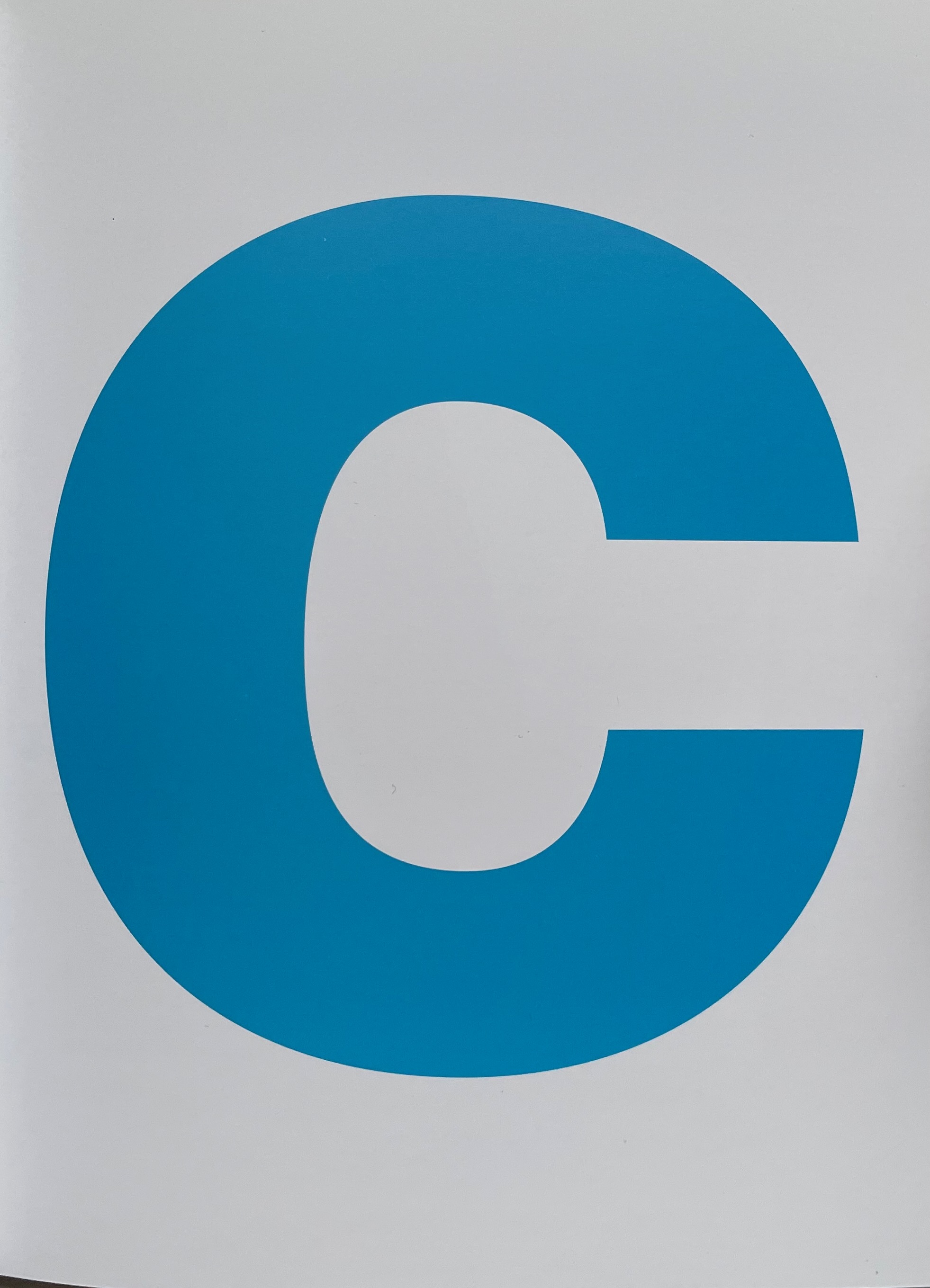
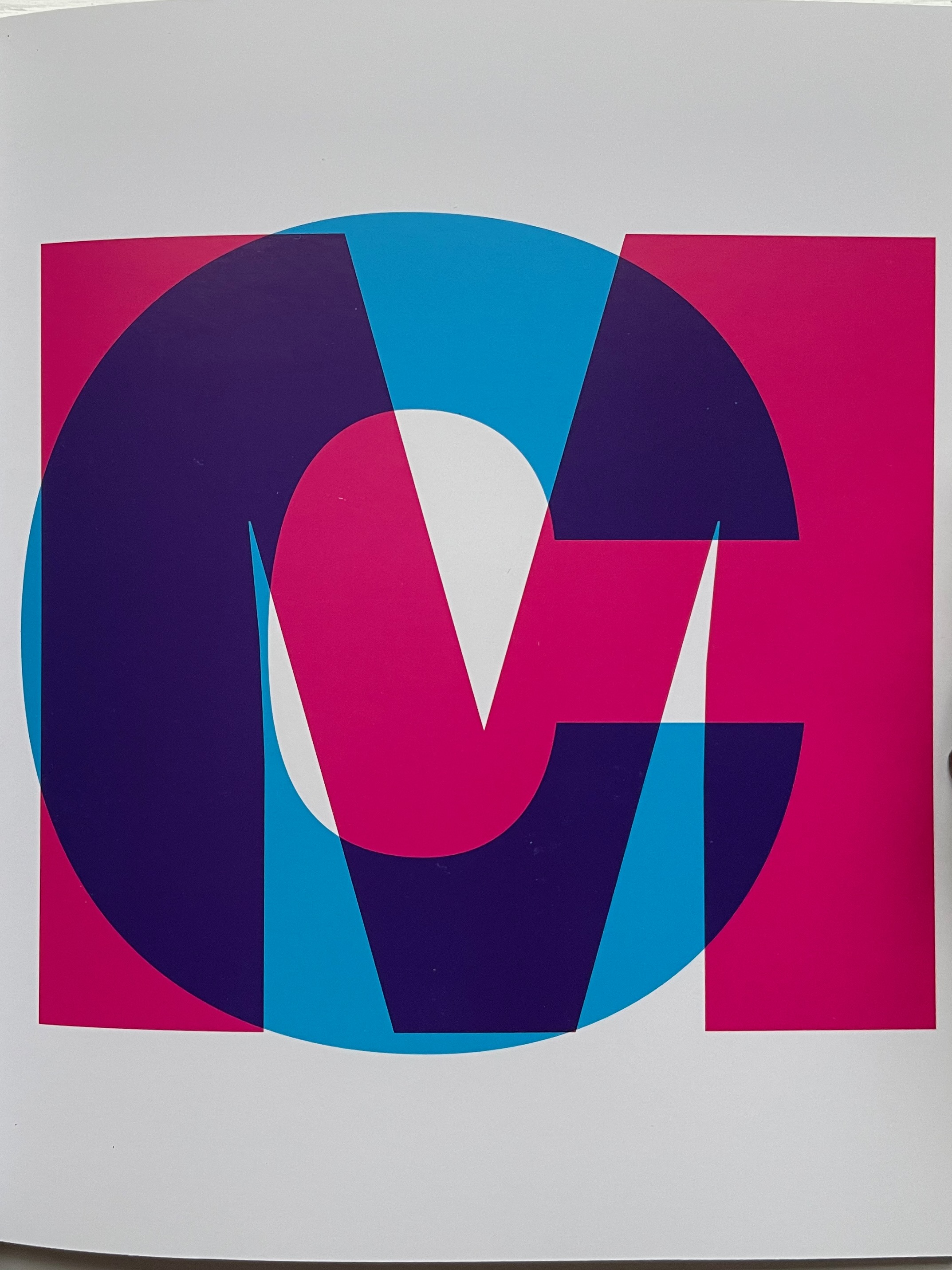
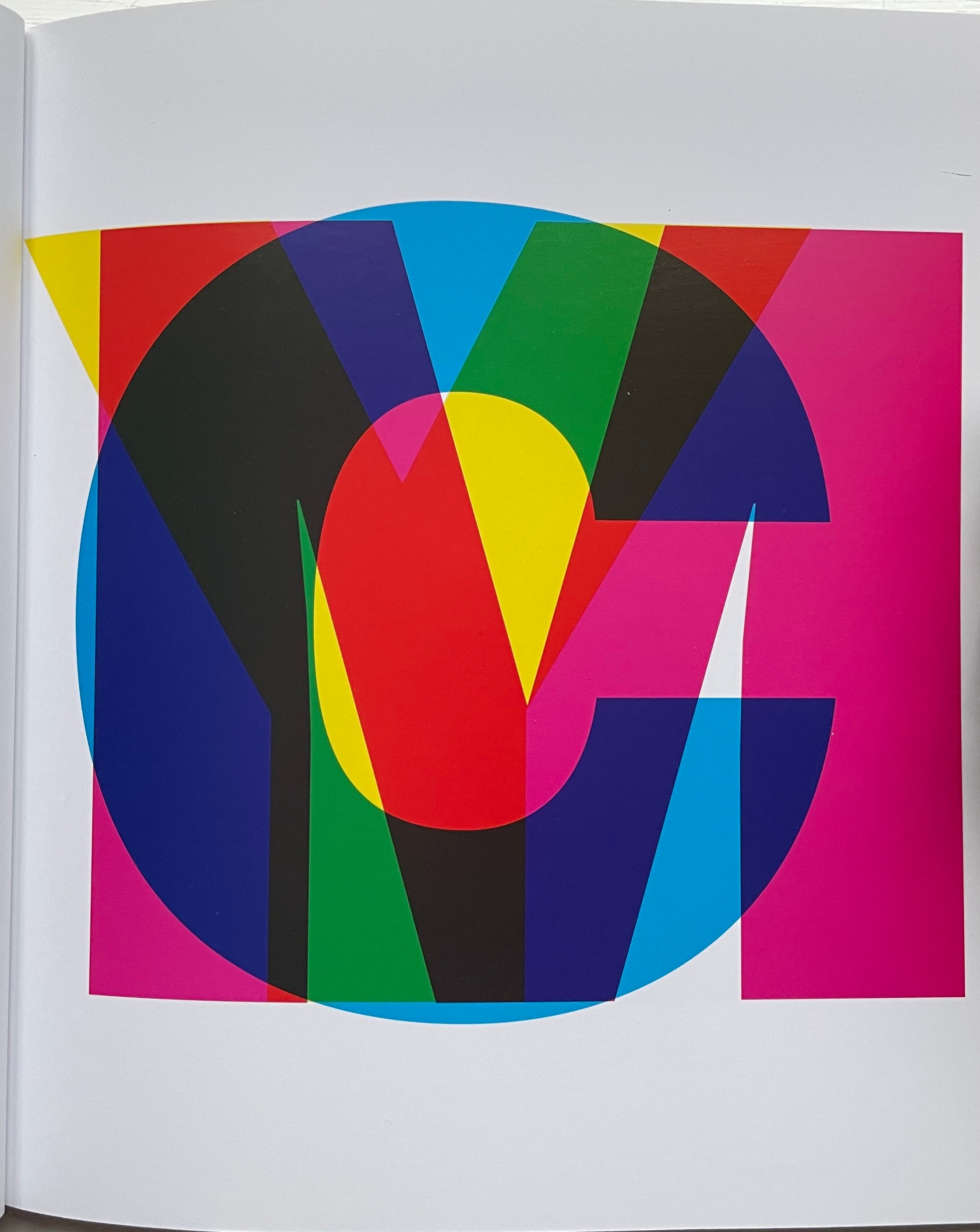
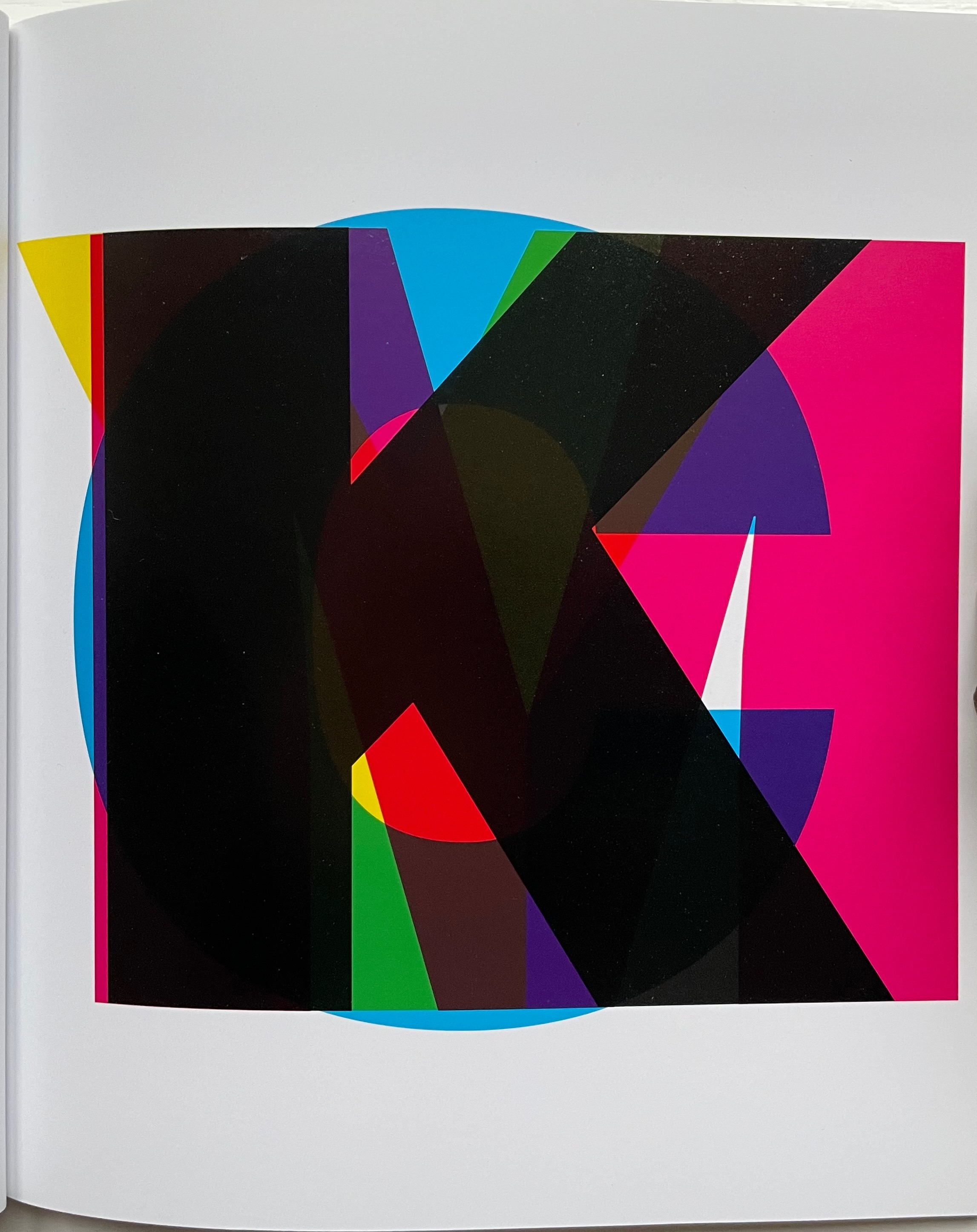
In the additive color model RGB, white includes all the primary colors — red, green and blue — of the light spectrum, and black is the absence of light. In the subtractive color model CMYK — cyan, magenta, yellow and key (black) — white is the absence of any ink leaving the natural color of the paper as the white background on which the combination of all the CMY inks yields black. What better cover for CMYK than pure white paper. Just as Farben Alphabet uses the A-Z alphabet and printing imposition to play with our expectations, this artist’s booklet uses the letters of the color model, the colored inks and the printing process to play with our expectations. C is overlapped by M, then CM is overlapped by Y, and, to yield the letter K, CMY are combined. From there, the booklet cycles through subtracting the letters in reverse, adding them back and so on.

This conceptual, process-driven artist’s booklet, arising from a multi-artist exhibition curated by Pia Jardí for the Open Structure Art Society (OSAS) in Budapest, makes for an interesting contrast with Amy Lapidow’s Spiralbet (1998), Karen Hanmer’s The Spectrum A to Z (2003), Annesas Appel’s Ruiten Alfabet (2006), Carol DuBosch’s Rainbow Alphabet Snowflake (2013) or Rebecca Bingham’s Rainbow (2018).

Further Reading/Viewing

Abecedaries I (in progress)“. Books On Books Collection.

Rebecca Bingham“. Books On Books Collection.

Carol DuBosch“. 13 December 2022. Books On Books Collection.

Karen Hanmer“. 25 October 2021. Books On Books Collection.

Amy Lapidow“. Books On Books Collection.

Jardí, Pia. n.d. “Heimo Zobernig“. Website. Accessed 1 September 2022.

Küng, Moritz. 3 July 2020. Artists’ Books Clips por Moritz Küng. Episode 06 Alphabet Books. Accessed 18 September 2022.

Küng, Moritz. 25 June 2020. Artists’ Books Clips por Moritz Küng. The tautological book. Part 1. Accessed 18 September 2022.

Books On Books Collection – Anja Lutz

Marginalia (2017)

Marginalia (2017)
Anja Lutz
Open back sewn spine with dust jacket 245 x 330 mm. 112 pages. Acquired from The Greenbox Press, 3 August 2022.
Photos: Books On Books Collection. Displayed with permission of the artist.

In 1964, the Fluxus artist George Brecht created a work called Book, which Michael Werner published in 1972 and which Moritz Küng reintroduced in facsimile in 2017. Also sometimes called This is the cover of the book, it proceeds to label each of the otherwise blank pages with its structural label: “These are the end pages of the book”; “This is the page before the title page of the book that tells you what the title is or was, or is going to be”; “This is the title page”; “This is the other side of the title page …” and so on. Like most self-referential or tautological artists’ books, it has its facetiousness. One page is labeled “This is the page with text on it”; another, “This the page that rustles when you turn it (maybe)”. Individual pages and perhaps the whole will lead to pauses to reflect on the thing being defined by labels and self-reference and how the mental funny-bone is being tickled. In the end, the structure or skeleton of the book as a thing — one thing — has been defined by the naming of parts.

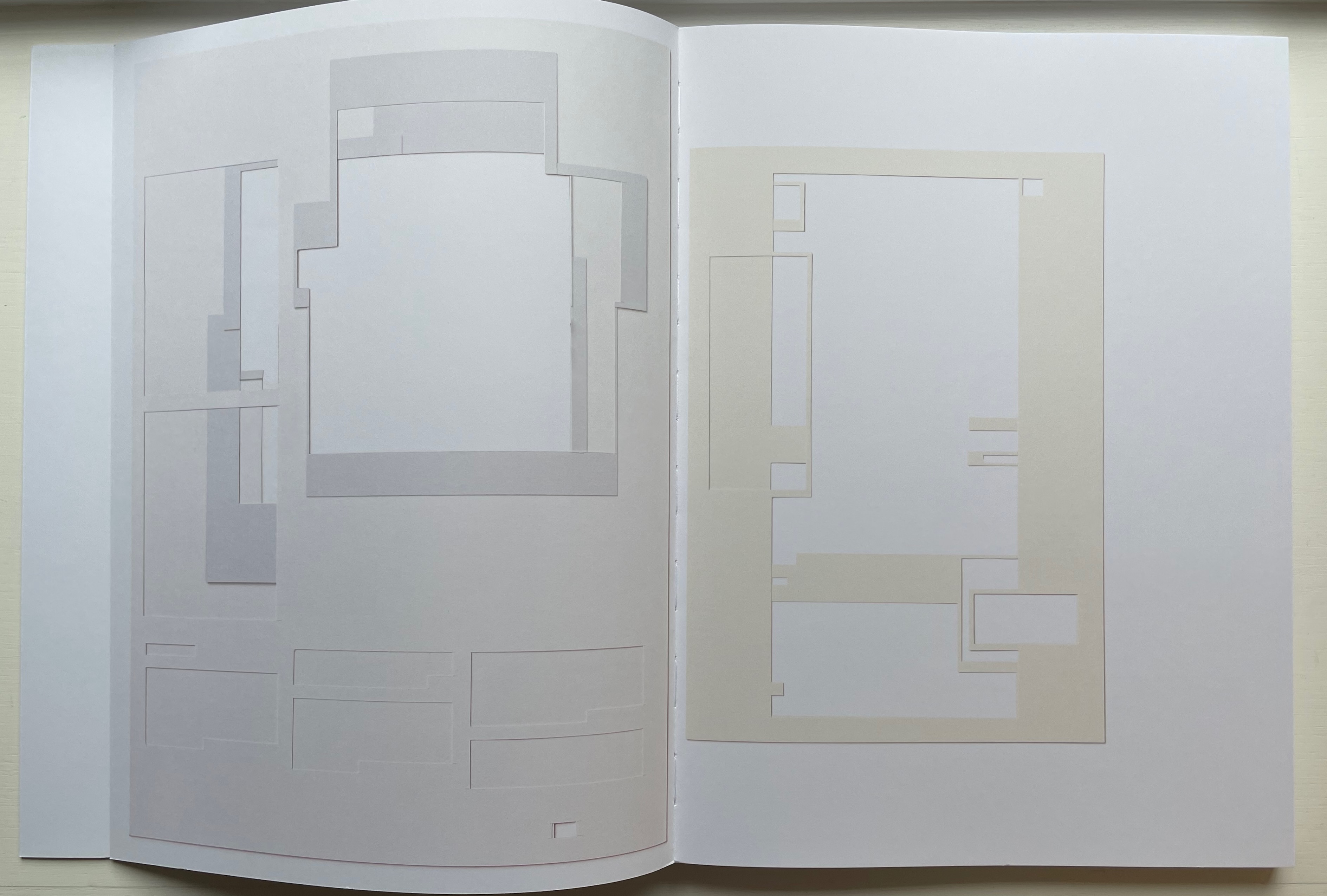
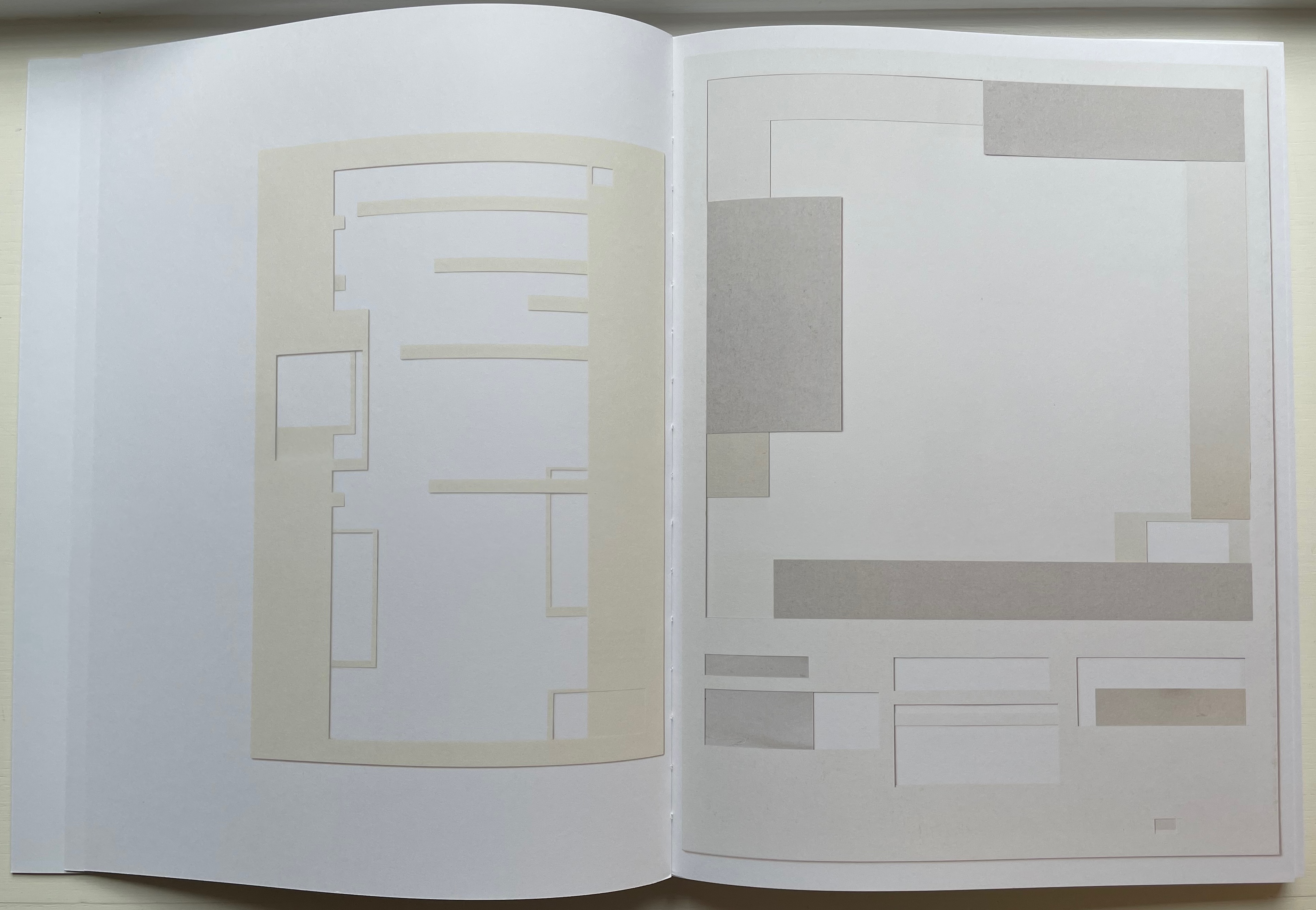
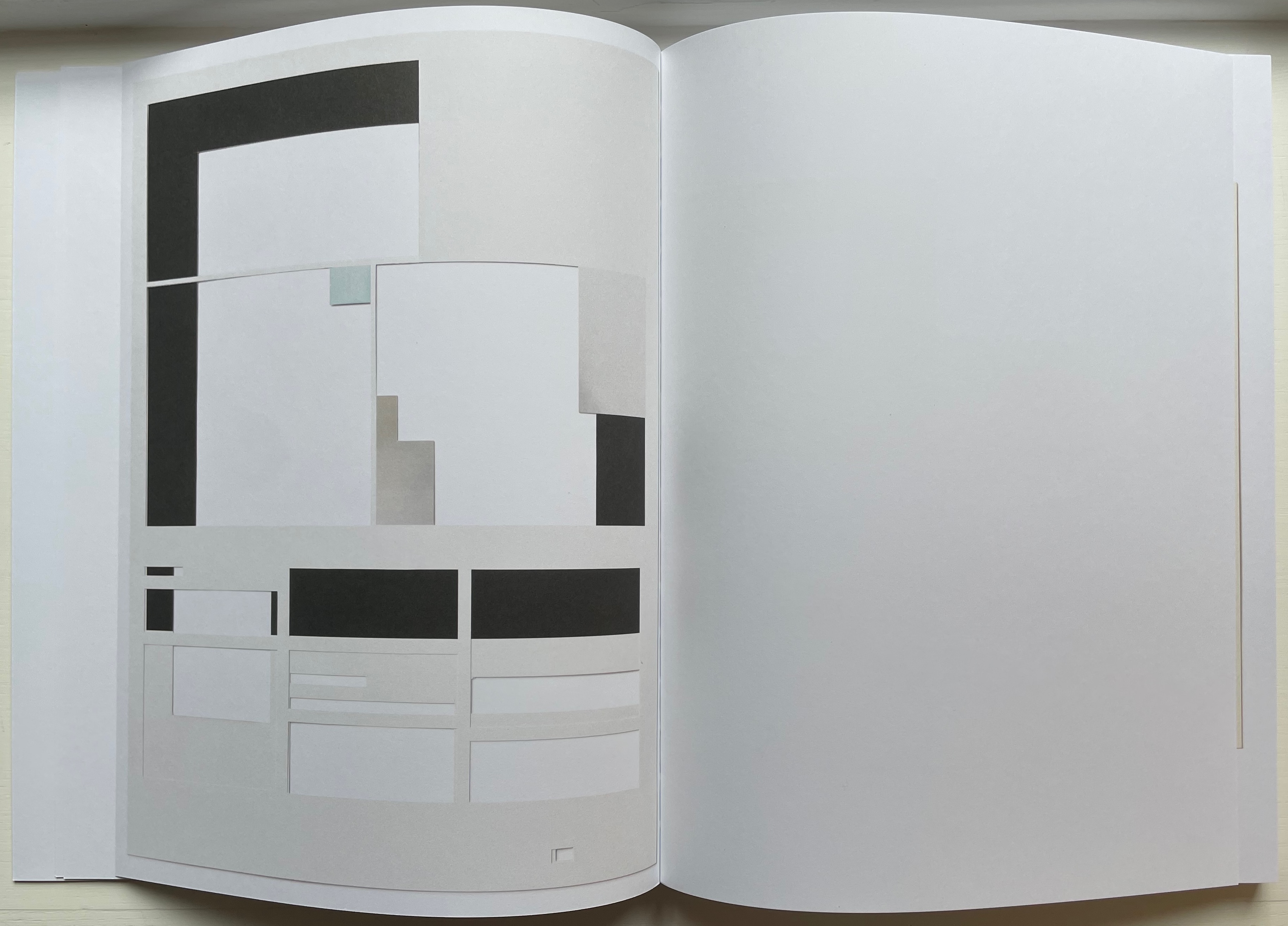
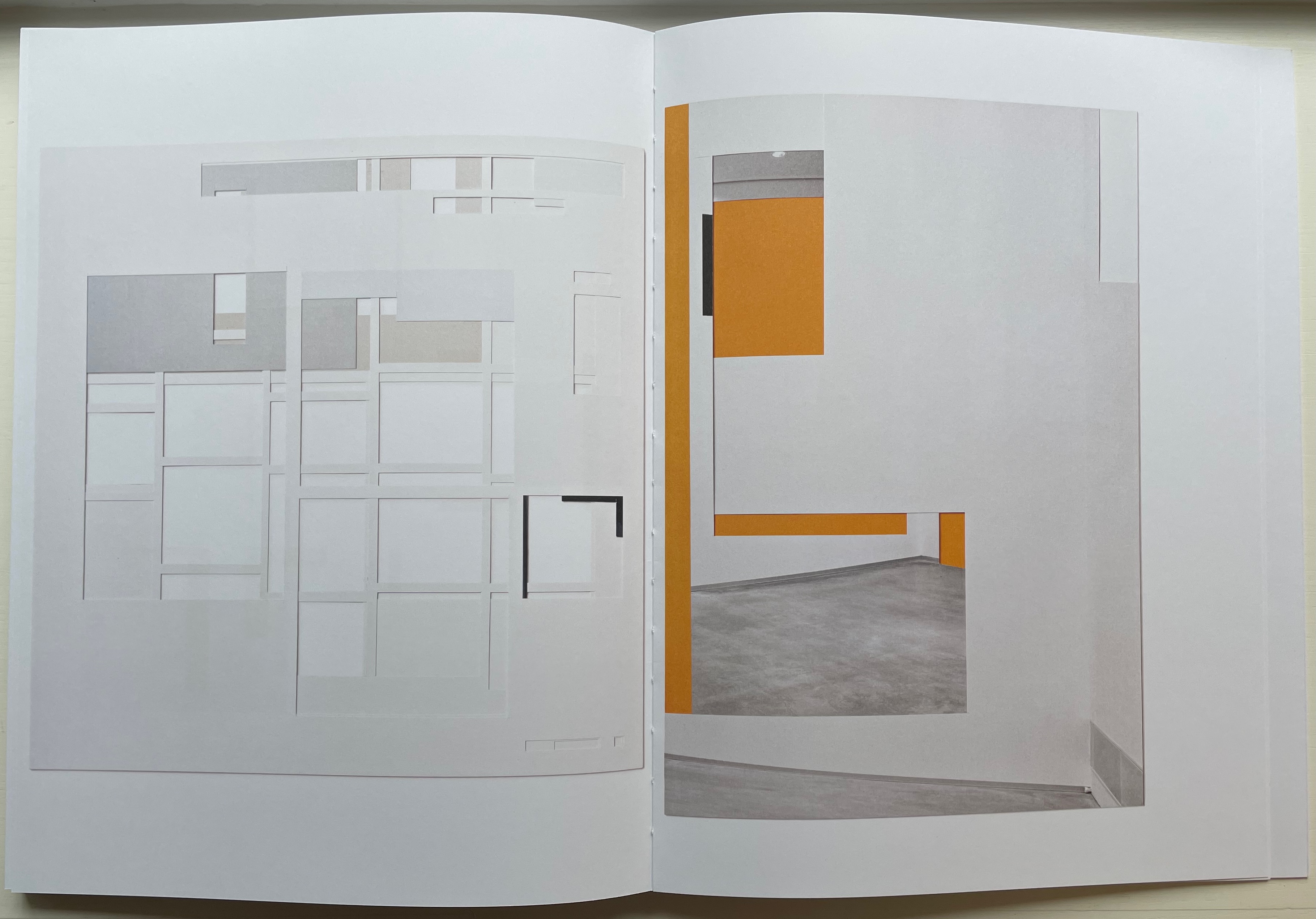
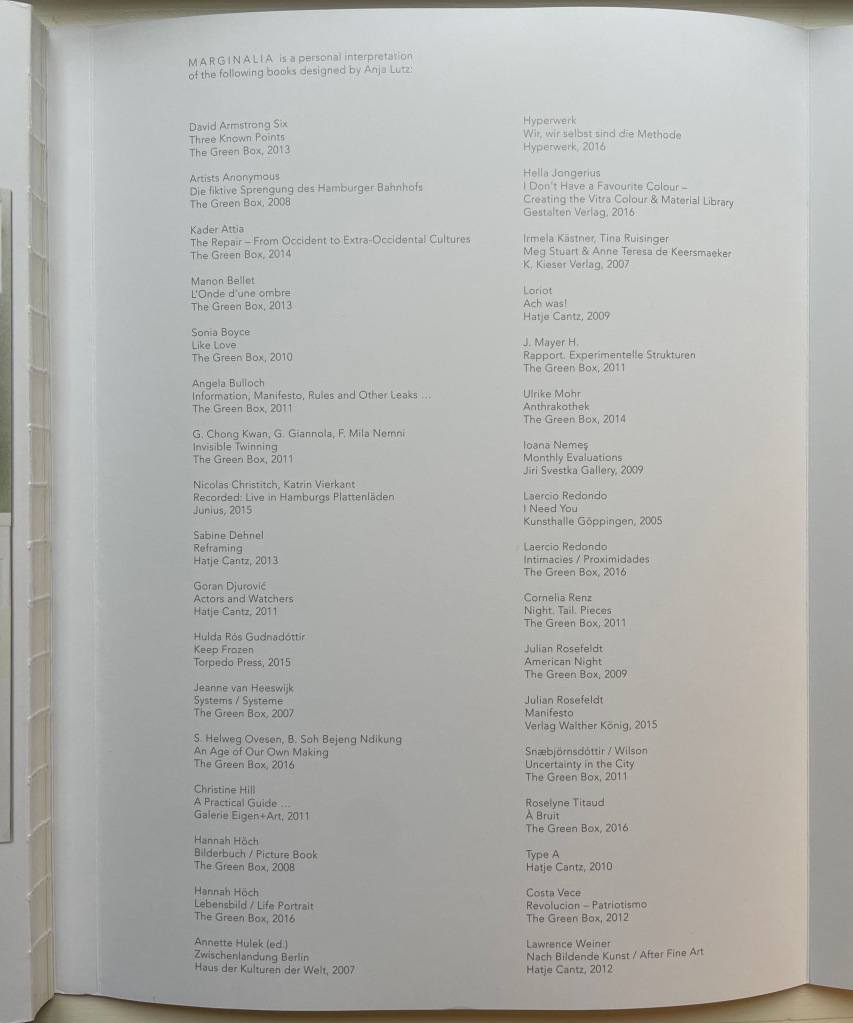
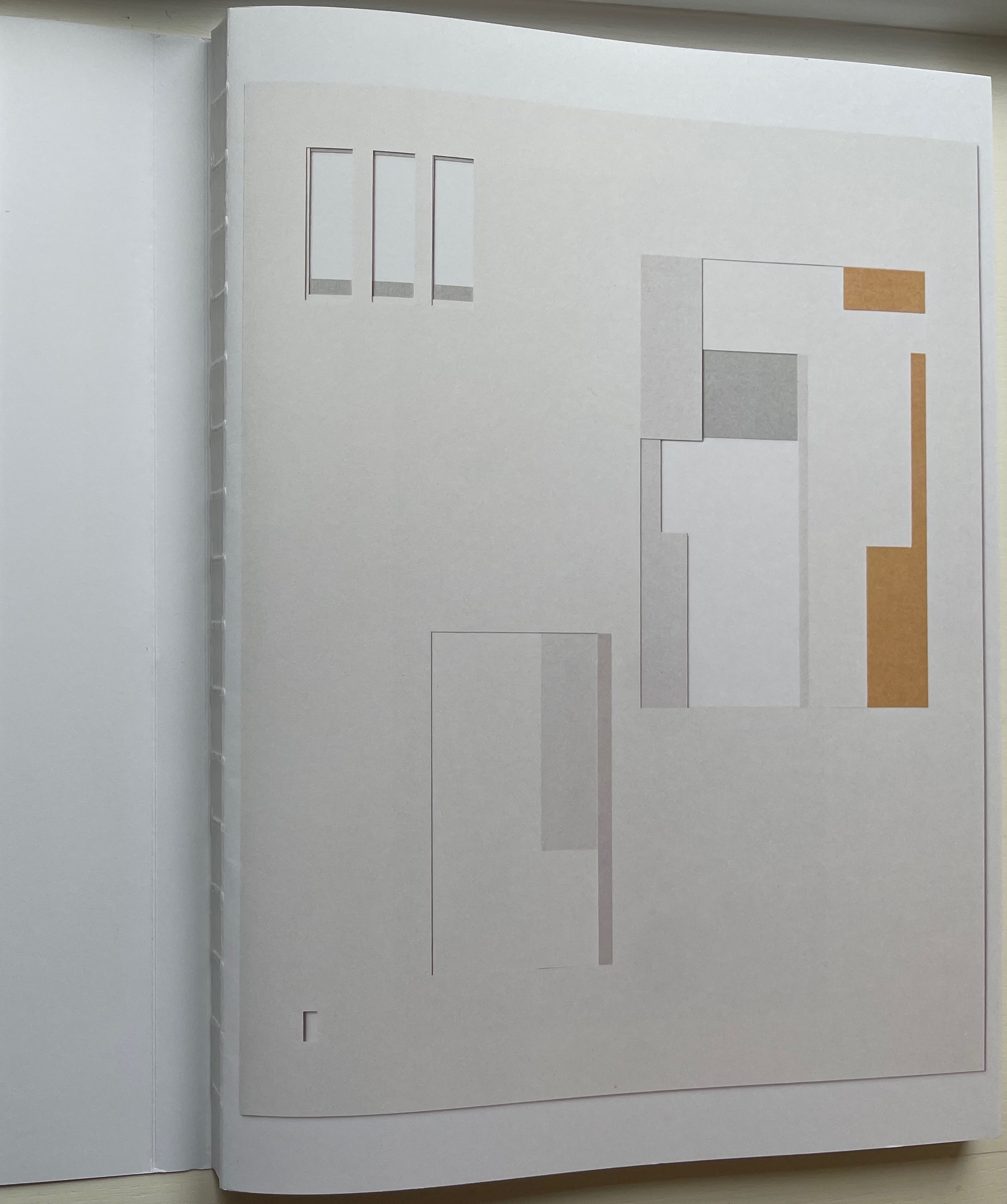
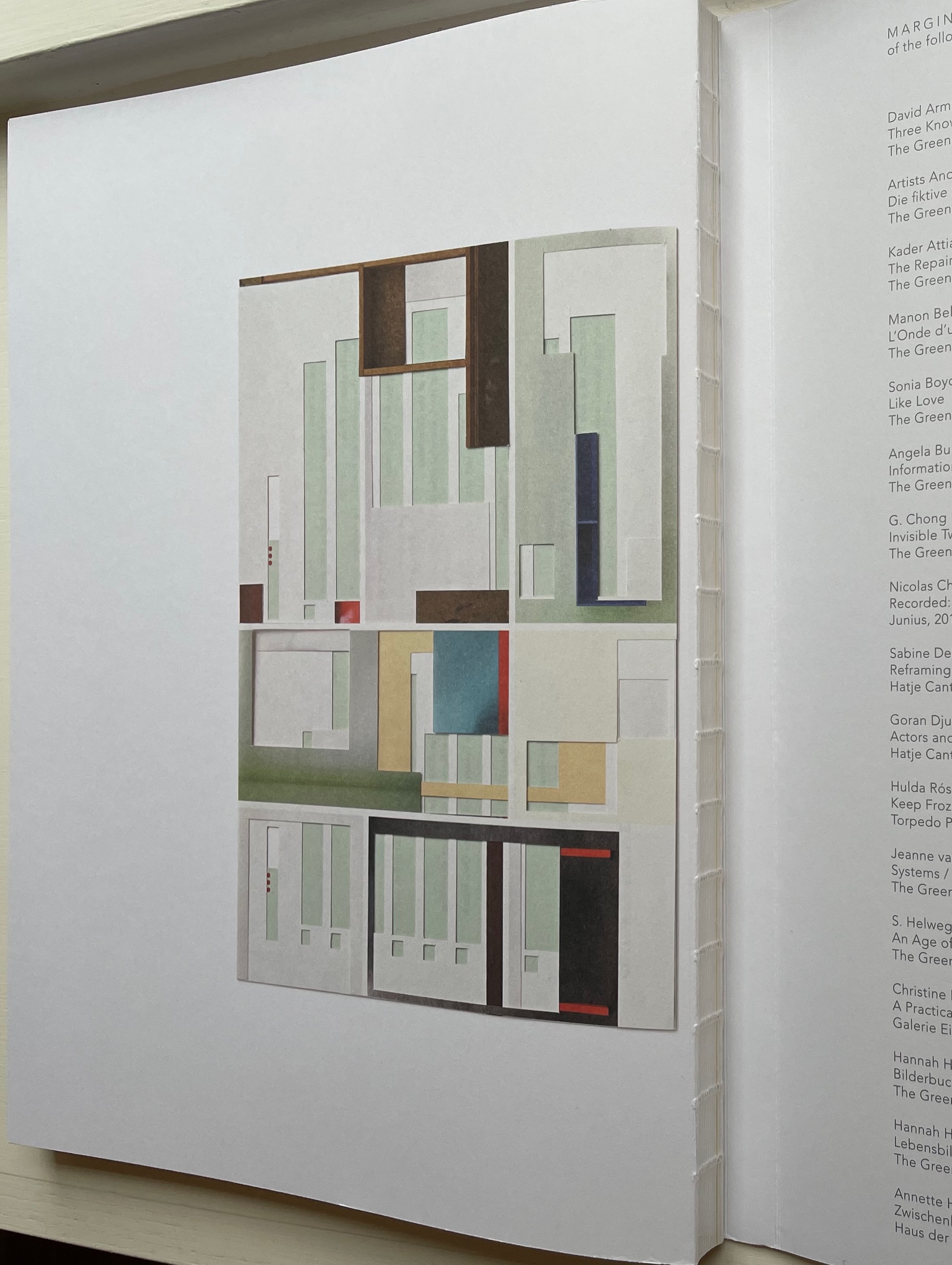
Anja Lutz ‘s Marginalia proceeds differently. Her pages are the pages without text on them — or images, running heads, page numbers, etc. Lutz has taken thirty-four of the books she has designed under her imprint The Greenbox Press and carefully excised from each the text and images layer by layer until the empty spaces define the blank spaces that previously supported the content. But this does not result in the definition of a generic book structure or skeleton.

While Lutz’s technique might be similar to that of other book artists who have altered books by excavating or strip mining them, she is not offering precisely the same invitation that, say, Brian Dettmer offers with Tristram Shandy (2014). Dettmer, too, has excised layers away from an underlying work — the Folio Society’s illustrated edition of Laurence Sterne’s The Life and Opinions of Tristram Shandy, Gentleman (1759-67). While both works invite us to think about the book as thing (or the guts and structure of this thing the book), Dettmer is inviting us to look into the specific underlying work in a different way or consider how the new shape is his response to the underlying work. Sterne’s novel remains present, and we can peer into its crevices and nooks to pick out words, sentences and images — to look into the novel in a new way. Lutz’s surgery does not leave enough of the underlying work to permit a “look in”. We look through instead. Even though she provides a list of the designed books she used, they are not present as Tristram Shandy is.

Each of the books with which Lutz start is, as she puts it, “unique in its choice of format, material, layout, composition, and rhythm”. Despite her nod and the listing of books, this does not mean that she wants us to respond to the results of her surgery with “before and after” comparisons. Rather she invites us to look only at the newly created works. In the end, each has its own structure or skeleton — the struts or bones of the marginal space defined by the negative space of removed content.

But the means of that invitation is this codex entitled Marginalia. With its dust-jacket-like wrapper around the exposed sewn spine, is Marginalia being offered as an artist’s book itself or a catalogue with artist’s book-like features? Beautifully produced, Marginalia is nevertheless not a limited edition. Besides the book, a limited number of collages shown in it are available, each framed floating between two panes of glass. They certainly qualify as works of sculptural book art, and if the artist were to turn her scalpel to copies of Marginalia itself, they too would surely qualify as artist’s books. A collection that held one of the collages, a copy of Marginalia and an altered copy of it would have won a trifecta.

Front and back of the book block, showing the exposed spine.

Neoangin: Das musikalische ABC (2014)

Neoangin: Das musikalische ABC (2014)
Jim Avignon and Anja Lutz
Paperback, saddle stitched, staples. H330 x W240 mm, 60 pages. Acquired from Gallix, 25 July 2022. Photos: Books On Books Collection.

For the entry on Neoangin and Further Reading, see “Jim Avignon & Anja Lutz“. 29 October 2022. Books On Books Collection.

Books On Books Collection – Cerith Wyn Evans

“…” Delay (2009)

“…” Delay (2009)
Cerith Wyn Evans, Moritz Küng and Armand Mevis
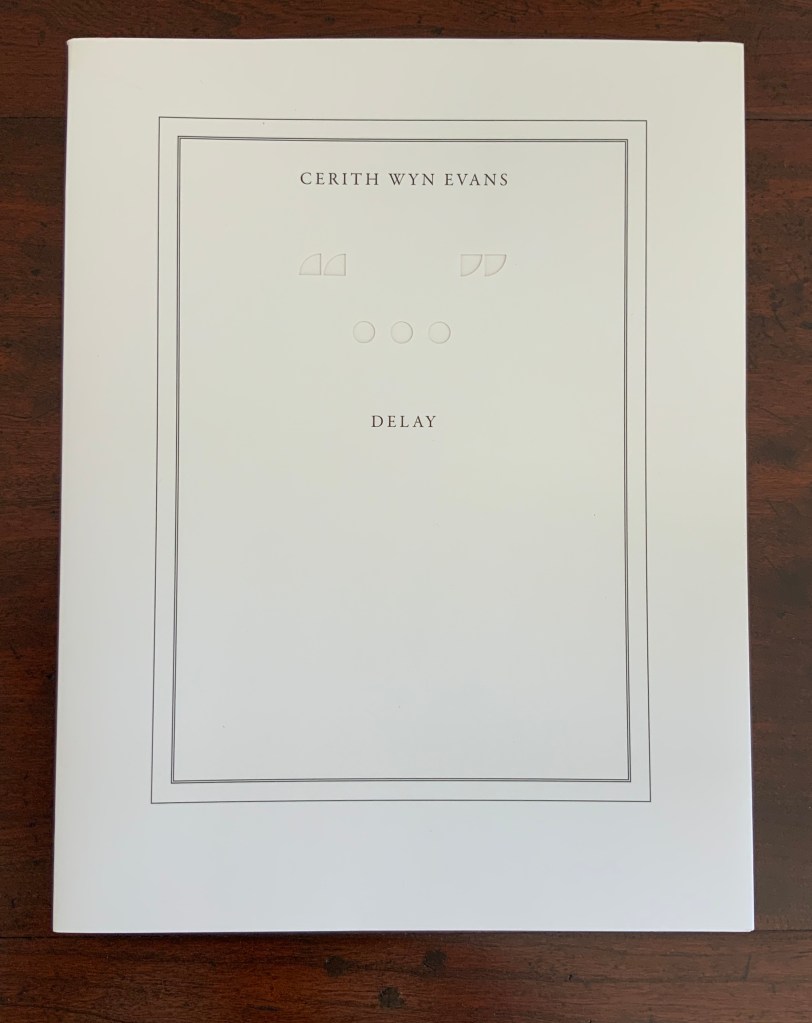
Perfect bound, with laser-cut dust cover. Paper: Munken Lynx 80 (Küng essay and colophon), 170 gms (laser-cut pages), 300 gms (cover). H325 x W250 mm, 32 pages.
Acquired from Taschenbuch, 16 March 2020.

ellipsis: marks or a mark (such as … ) indicating an omission (as of words) or a pause

Merriam-Webster.com

As many bookworks do, Wyn Evans’ “…” offers a puzzle. In this case: What has been omitted? What is coming after the pause or delay?

In his brief essay at the end of the book, Moritz Küng describes this work as a catalogue for Wyn Evans’ exhibition (15 October 2009 – 10 January 2010, deSingel, International arts campus, Antwerp) and characterizes it as “a reciprocate hypertext”, recalling the “trilogy of Un coup de dés by Mallarmé [1914], Broodthaers [1969] and Wyn Evans [2008]”.

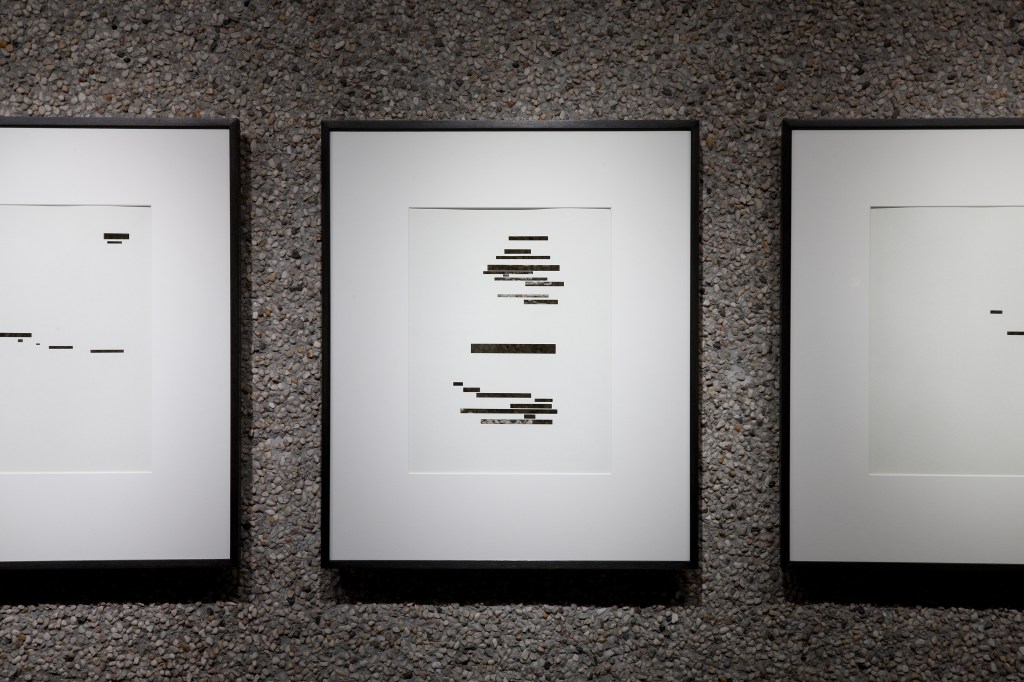
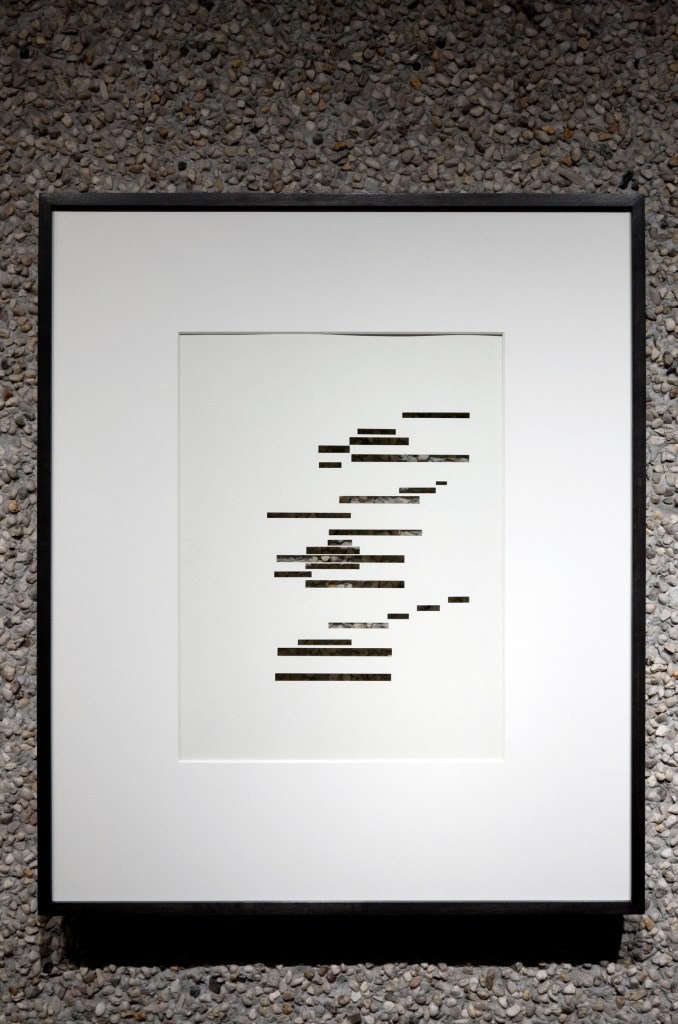
The work “…” (2009) alludes to those other three works by form and materiality, not actual text. It uses the same trim size of the 1914, 1969 and 2008 works. The 2009’s laser cut text is positioned in a way to imply the placement of text in the 1914 work, the placement of black strips in the 1969 work and the positioning of excised blocks in the 2008 work. The 2009 work’s subtitle — DELAY — is even positioned exactly where the subtitle is displayed in the three earlier works. Of course, the title page and subtitle in Wyn Evans’ 2008 version of Un Coup de Dés went along with the rest of his variation on Broodthaers’ 1969 work: the pages are framed and hung, allowing the pebbled wall behind the excisions to show through.

From “Cerith Wyn Evans, 15 October 2008 – 10 January 2009, deSingel, International arts campus, Antwerp
Photos: © Jan Kempenaers

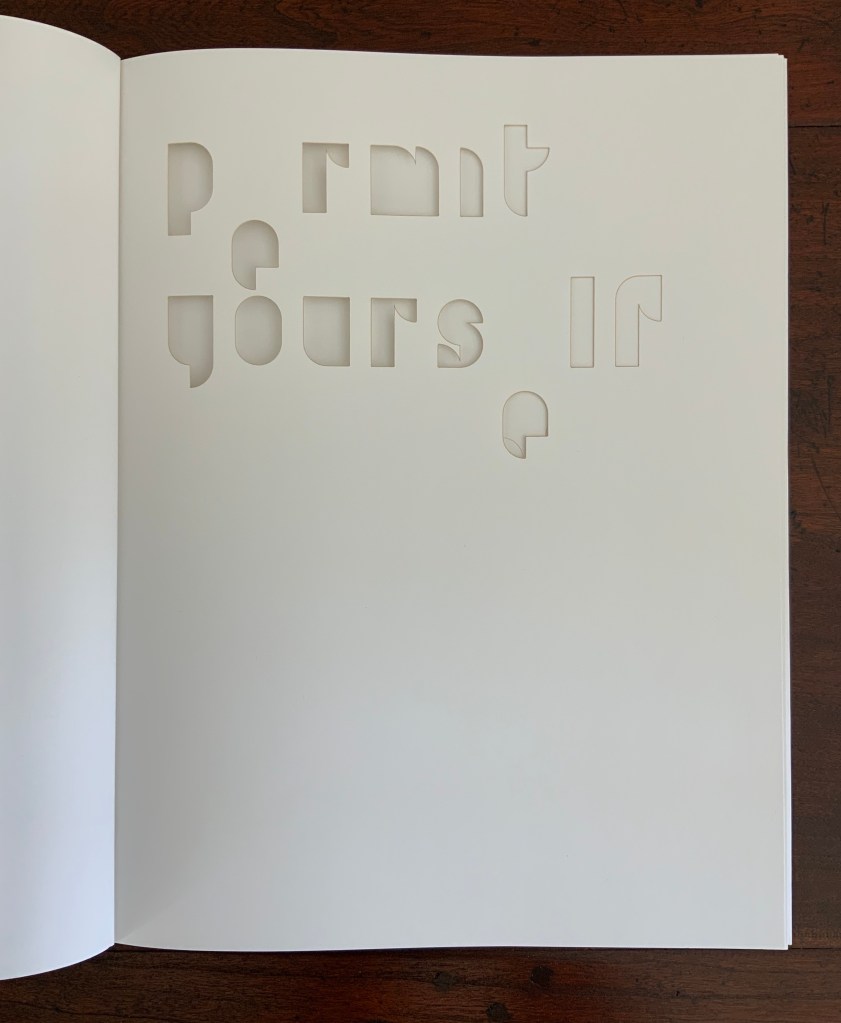
But where the 2008 work excises text, “…” excises paper to create text. The actual text in “…” comes from Stephan Pfohl’s review of Guy Debord’s filmscript In Girum Imus Nocte Et Consumimur Igni: A Film (1991). (The Latin is a palindrome — reads the same backwards as forwards — written by Terenziano Màuro, a grammarian and poet of the late second century CE.)

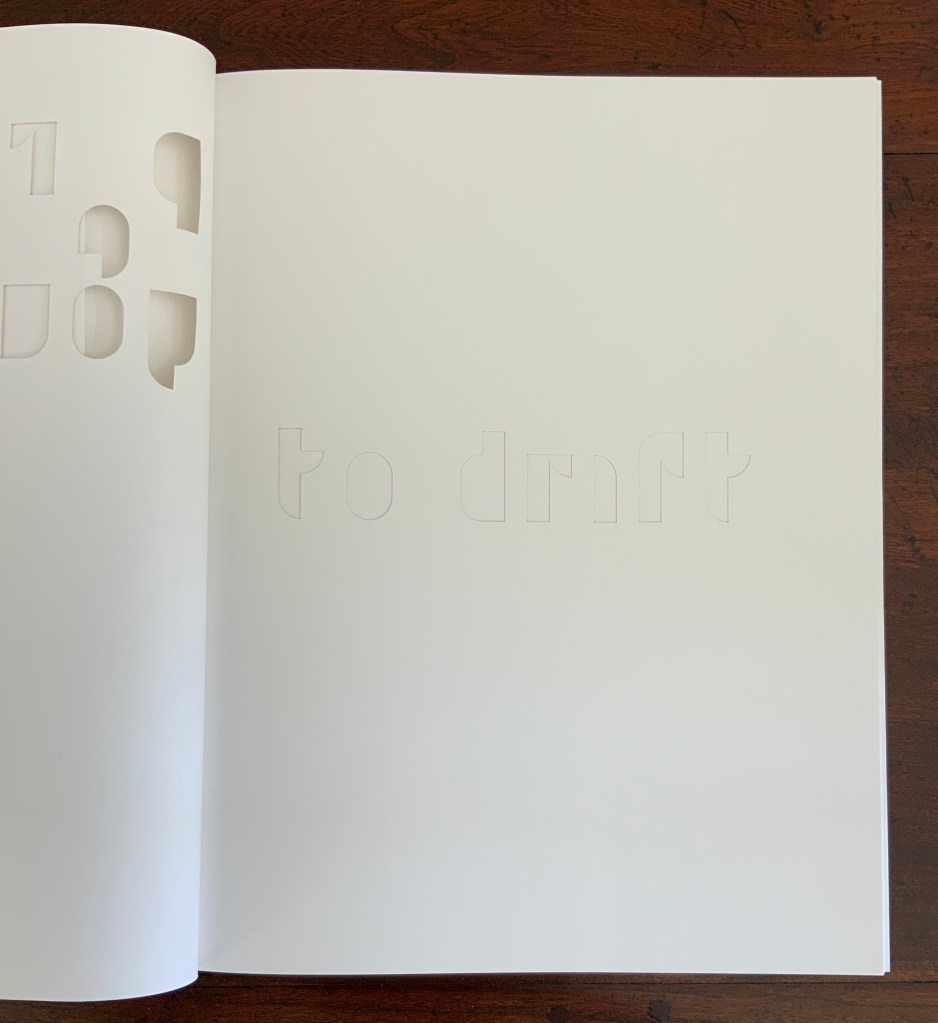
Permit yourself to drift from what you are reading at this very moment into another situation … Imagine a situation that, in all likelihood, you’ve never been in.

Photos: Books On Books Collection

Without knowing the text in question, deciphering the laser cut is a bit difficult, especially also until it becomes apparent that the letter “e” systematically falls below the line. Notice how this happens with “permit” and “yourself” above. Is it a reference to George Perec’s novel La Disparution (1969), written entirely without the letter “e”? Is it an interruption to delay the reader in following an instruction not yet deciphered and read? There is something more going on here than meets the eye — which is, of course, what an omission or pause implies.

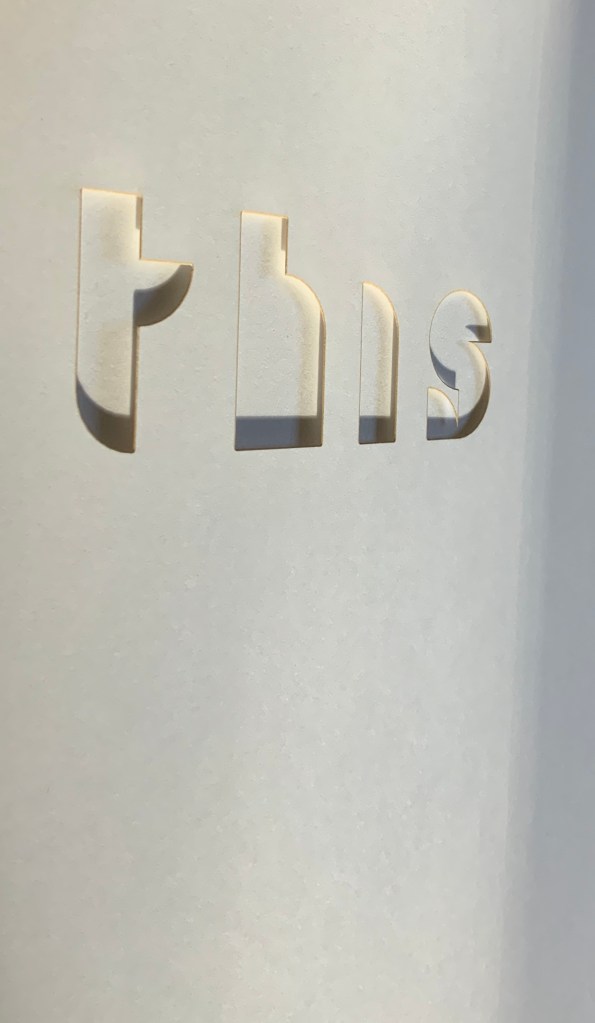
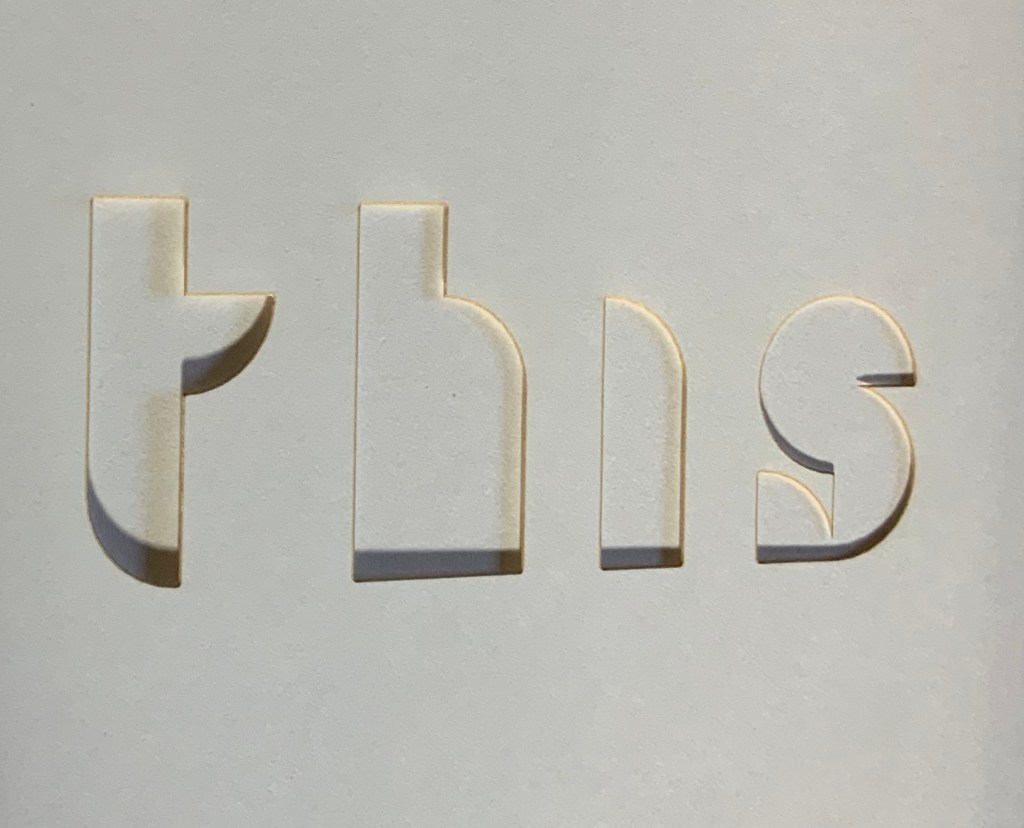
If another display in Wyn Evans’ 2009 deSingel exhibition is taken into account, and if Pfohl’s review is explored further, the laser cutting of the letters offers something else not immediately obvious to the eye. Wyn Evans could have chosen die cutting for the letters but chose (or at least approved) laser cutting instead. The signature singeing from the laser comes with the choice. To what is the choice alluding?

Details of “…”
Photos: Books On Books Collection

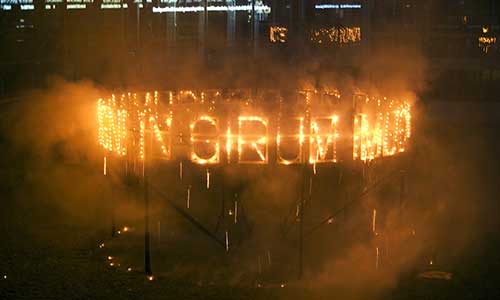
Is it alluding to the firework display that spelled out Debord’s 1978 film title, which translates “We go round and round at night and are consumed by fire”? As Pfohl explicates the filmscript and highlights Debord’s anti-consumerist, anti-capitalist and near-nihilist point of view informing it, he quips, “Look out for the flames”. Is the singeing alluding to that?

Still from fireworks display of In Girum Imus Nocte Et Consumimur Igni
© CC BY-SA 4.0 deSingel 2009
Click here to see the video.

How does the reader/viewer of “…” know to make these connections, to fill in the omissions? Well, after the pause/delay of “ellipsis” come Küng’s essay and the colophon, which provide many but not all of the clues with which to make the connections.

Knowledge of — or the presence of — the 1914 edition of Un coup de Dés, Broodthaers’ 1969 version and Wyn Evans’ 2008 re-version seems essential. Attendance at the fireworks display — or finding the images in the deSingel archive — would seem necessary to make sense of Küng’s reference to the artist’s “fireworks texts”. For the reader/viewer ignorant of Debord’s last and autobiographical film, access to Pfohl’s essay is essential to connect that particular film with Küng’s reference. Also, access to Pfohl’s essay is essential to see the context of the sentences Wyn Evans extracts, essential to find the Latin title of Debord’s film, and essential to pick up Pfohl’s quip.

Does the burden of the elusive, multi-layered allusiveness and self-referencing placed on the reader/viewer diminish and interfere with the work or enhance and help it? Depends on the reader/viewer. Or as Terenziano put it, Pro captu lectoris habent sua fata libelli (The fate of books lies in the capability of their readers).

The colophon also provides a set of details that can shape the reader/viewer’s appreciation of “…” — DELAY. It assigns the concept to Wyn Evans, Armand Mevis and Moritz Küng, the overall graphic design to Mevis & van Deursen and the layout design to Paul Elliman, whose Albernaut font was used for the excised text. Collaboration as recorded in a colophon grounds this work in a lineage that extends far beyond Mallarmé and Vollard. Even before the printed codex, the colophon, or finishing touch, to a scroll or manuscript book recorded how collaborative the effort to make a book actually is. Although book art is leavened with Blakean works of individual creation, the works of artists such as Cerith Wyn Evans remind us how this object is so often the result of multiple talents going round and round and catching fire.

Further Reading, Viewing and Listening

“Cerith Wyn Evans”, desingel.be. Accessed 15 March 2020.

“Cerith Wyn Evans”, Mariangoodman.com. Accessed 15 March 2020.

“Cerith Wyn Evans”, Whitecube.com. Accessed 15 March 2020.

Other works inspired by Terenziano Màuro:

— Architectural installation: Didier Fiuza Faustino

— Choreography: Roberto Castello

— Music: Anders Brødsgaard