Flickbuch, Geschichten um das Flickbuch, and Fresh Breath on the Blow Book (2000, 2001, and 2003)
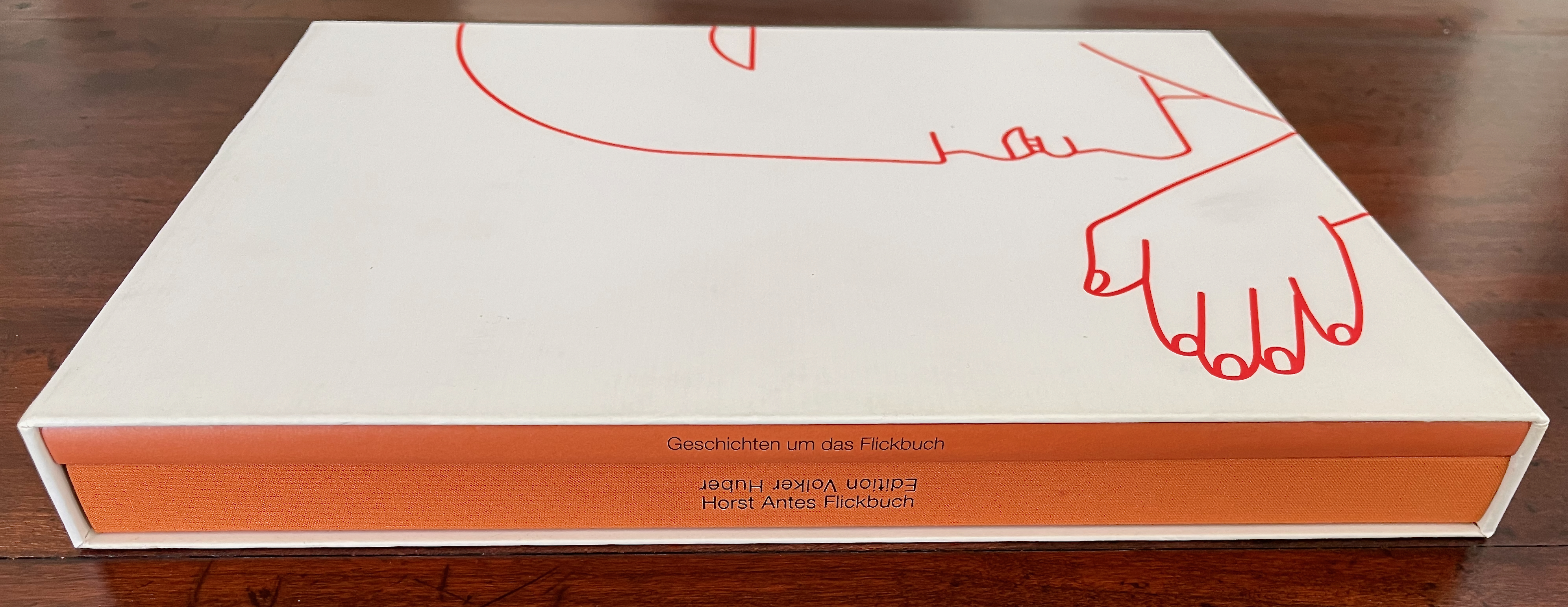
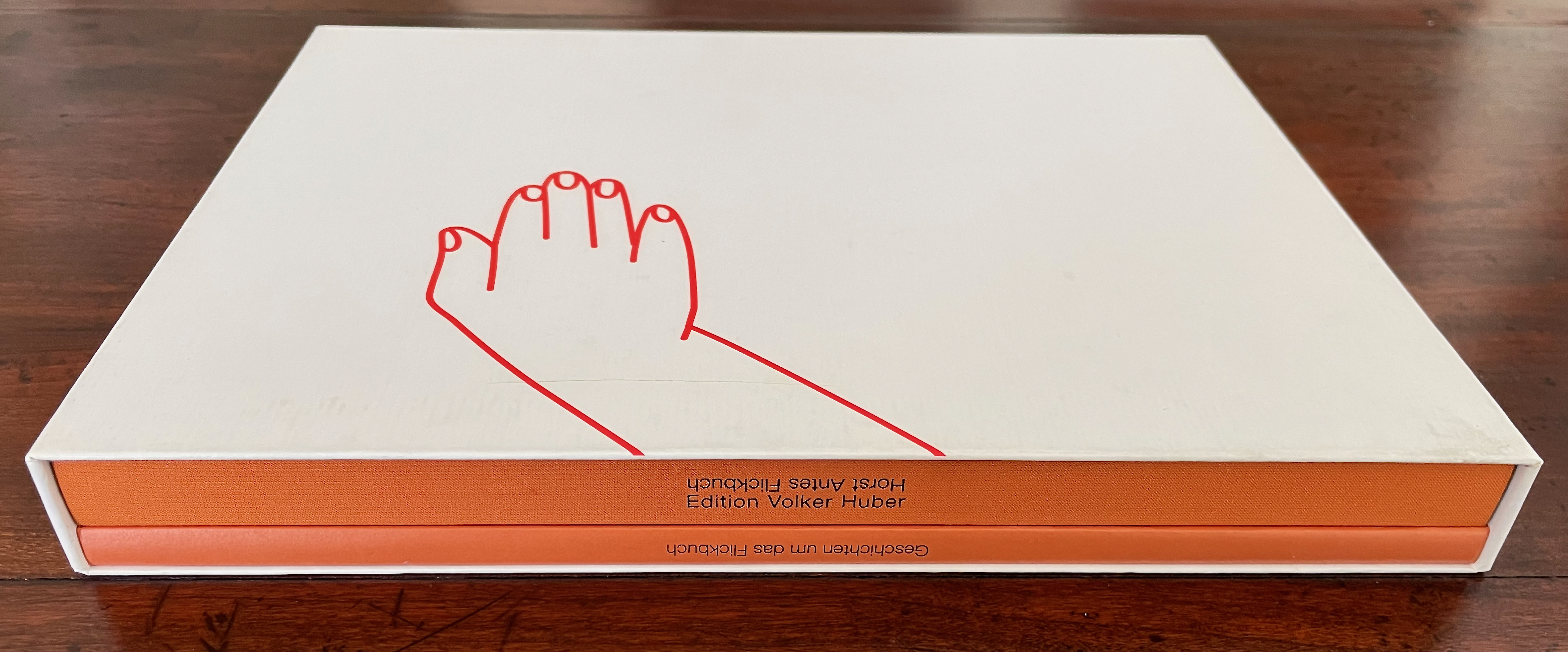
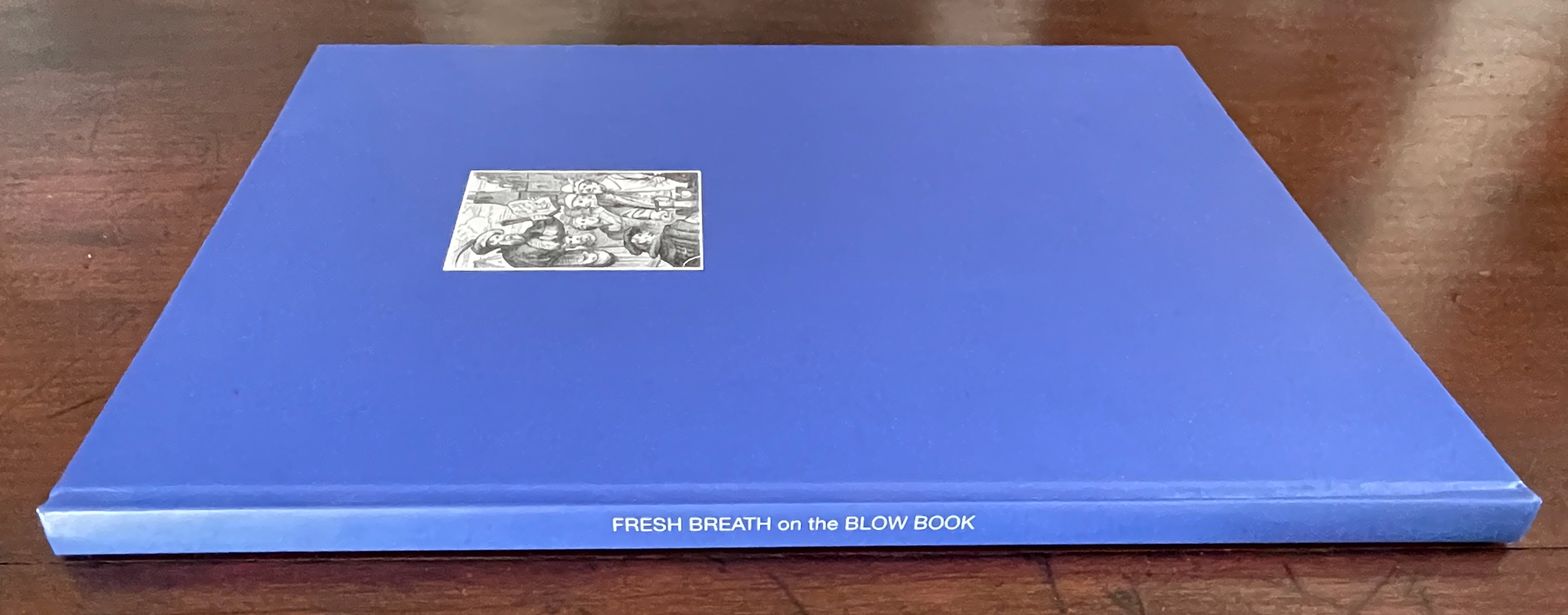
Flickbuch, Geschichten um das Flickbuch, and Fresh Breath on the Blow Book [trans] (2000, 2001, and 2003)
Horst Antes and Volker Huber [Translators: Ariel Frailich, Richard Hatch, and Sharon and Arno Ziesnitz]
Slipcase containing two volumes in German. Single volume in English. Slipcase: H276 x W212 mm. Books: H269 x W209 mm. [164] and 32 pages. Translation volume: H268 x W209 mm. 40 pages. Slipcased edition of 1000, unnumbered copy. Acquired from Ricky Jay Estate, 17 August 2024.
Photos: Books On Books Collection.
I had been looking for Ricky Jay’s The Magic Magic Book (1994) and hoped that the 2024 estate auction would yield a result. It did but an unexpected one. Like Jay, the namesake founder of Volker Huber Edition und Galerie in Offenbach was a collector of magic artifacts. He was also an honorary member of Germany’s Magic Circle, so his acquaintance with the celebrated magician and actor was no surprise. What was a surprise was that he had combined his art interests with those in magic to create a “blow book” with Horst Antes, one of the several well-known German artists he published.
The blow book is best known in its familiar incarnation as the “magic coloring book”. The performer flicks through the book of blank figures to be colored in, calls on an observer to blow on the closed book, and then reopens it to show all of the pictures colored in. Hard-to-see tabs or alternating page widths enable the performer to produce the effect. Jay’s work remains the definitive history of the blow book. It consists of two volumes, one of which is a working blow book with contemporary art by Vija Celmins, Jane Hammond, Glenn Ligon, Philip Taaffe, and William Wegman, the other being the history of the apparatus.
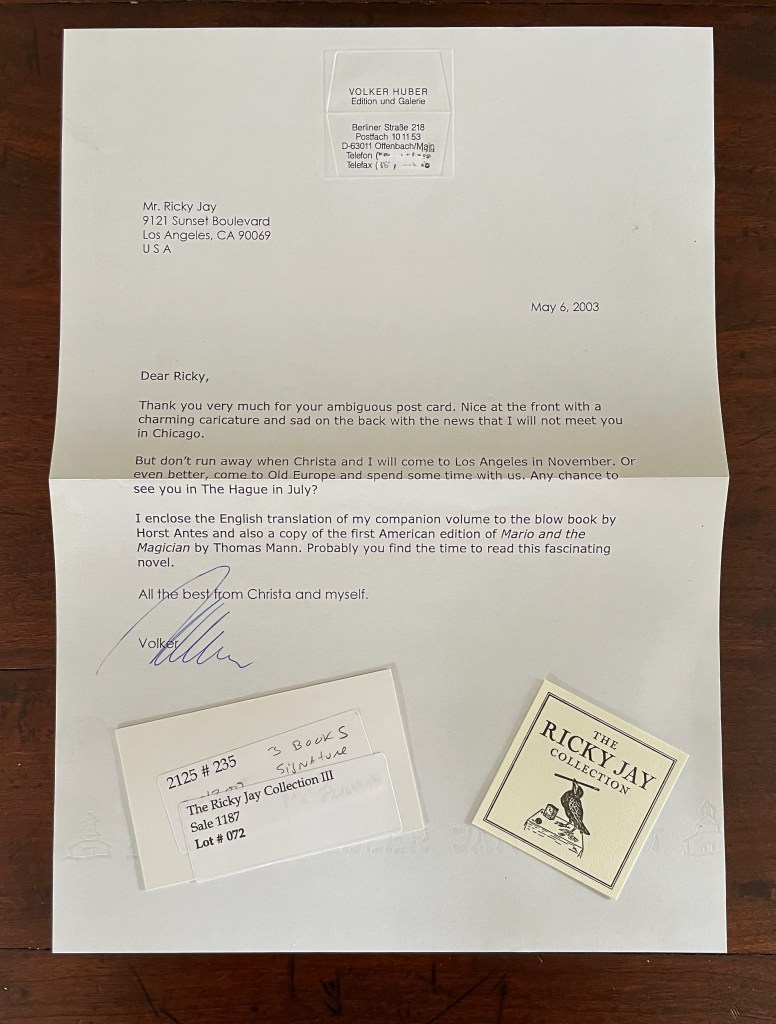
Huber leads the list of acknowledgments in Jay’s book. From that and this piece of ephemera, there is no doubt of their close acquaintance. If, however, you have read the New Yorker profile on Ricky Jay, Huber’s reference to Jay’s “ambiguous post card” will raise an eyebrow. Both Jay’s and Huber’s productions are slipcased, both are in two volumes, both have a working blow book, and both have an accompanying history. Given the New Yorker anecdote about Jay’s harsh reaction to a magician who mentioned he had incorporated Jay’s famous “The Four Queens” routine in his act, might Jay’s “ambiguous post card” have implied that Huber had reperformed Jay’s book trick?
Huber’s Geschichten um das Flickbuch [“History of the Blow Book”*] naturally cites Jay’s book. But it has many of the same illustrations. Unsurprisingly it equally highlight the same source for the first detailed description of the blow book. The main difference is that Huber argues for the existence of a missing blow book that would have accompanied the source, whereas Jay considers it unlikely. As for the working volumes, both have dos-à-dos structures. Admittedly there are differences. Jay uses tabs to facilitate the performer’s switch from sequence to sequence; Huber uses a sloping trim of width. Jay’s has twelve sequences, six to each side of the dos-à-dos; Huber and Antes have only four, two to each side. Might Jay have been a little jealous that those differences are what give Huber and Antes the room to elevate the blow book from a worked example to an artist’s book?
Holding the spine of Flickbuch with the left hand and placing the right thumb against the lower corner of the fore edge, the reader/performer riffles through the book. Twenty pages flip along, displaying the text of three selections from the mid-17th-century picaresque novel by Hans Jakob Christoffel von Grimmelshausen entitled “Simplicissimi Gaukeltasch und erhaltene treffliche Losung” [“Simplicissimus’ Magic Book and its Excellent Profits”]. At the bottom of the text block on each page, a large display letter appears: first H, then O, gradually spelling out HORSTANTES-FLICKBUCH. It is a clever way of appropriating the Simplicissimus tale for Antes.
The next flick-through sequence is accessed by closing the book, shifting the right thumb to the upper corner of the fore edge, and again riffling through the book. “Magically” the text has disappeared, replaced by blank pages that change colors, gradually darkening from a light pink to coral to orange then lightening to yellow. This is another appropriation of the Simplicissimus tale. In the just-vanished text, Simplicissimus, the con artist, has arrayed six glasses of wine before the crowd of dupes gathered by his blow book patter. By adding one drop of magic elixir to the first glass, he changes the wine’s color and quality. The second glass receives two drops, the third three drops, and so on until Simplicissimus and his sidekick Hopalong are relieving their audience of their money in exchange for tins of the elixir that they believe will turn casks of plonk into the finest vintage.
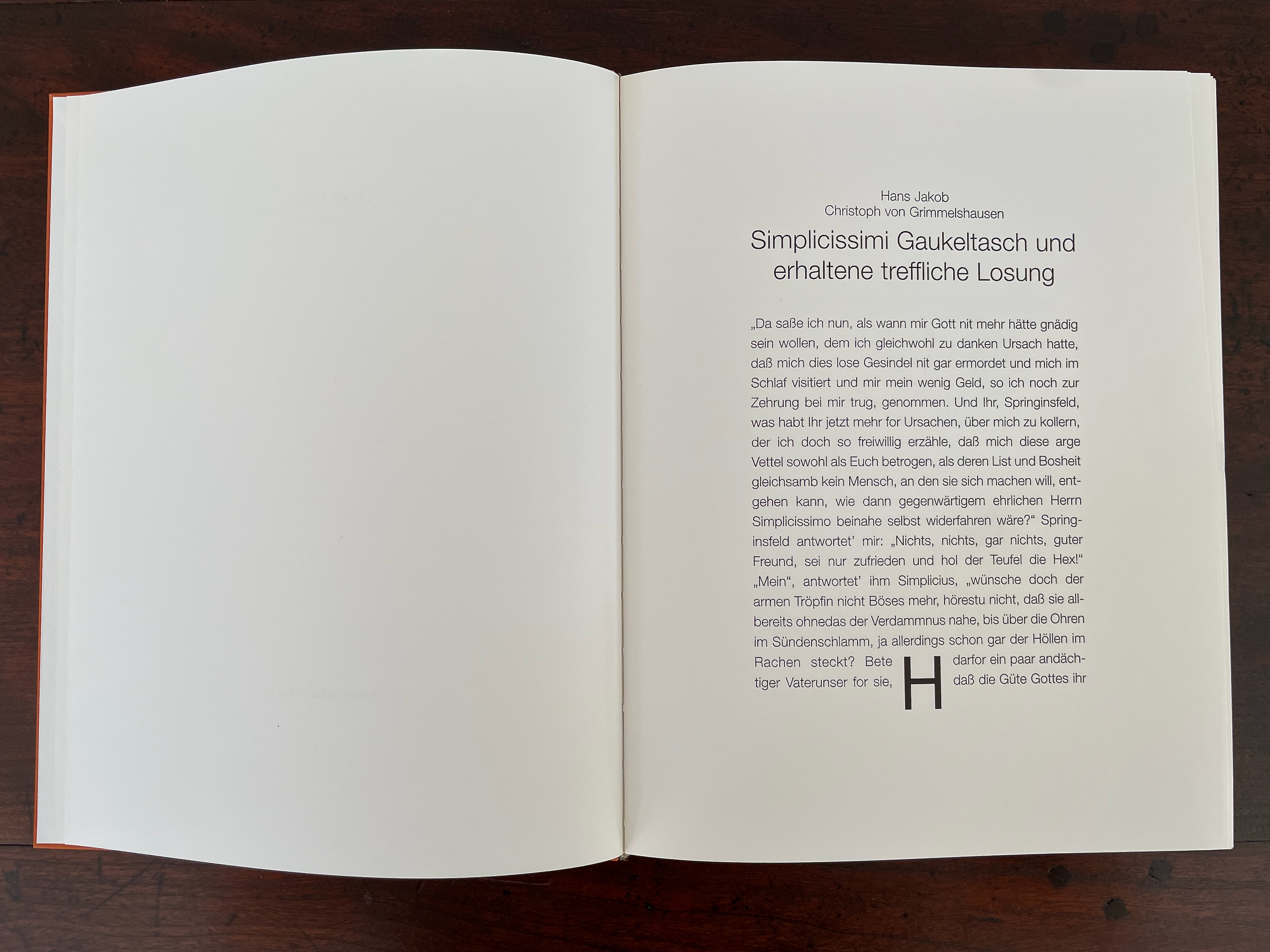
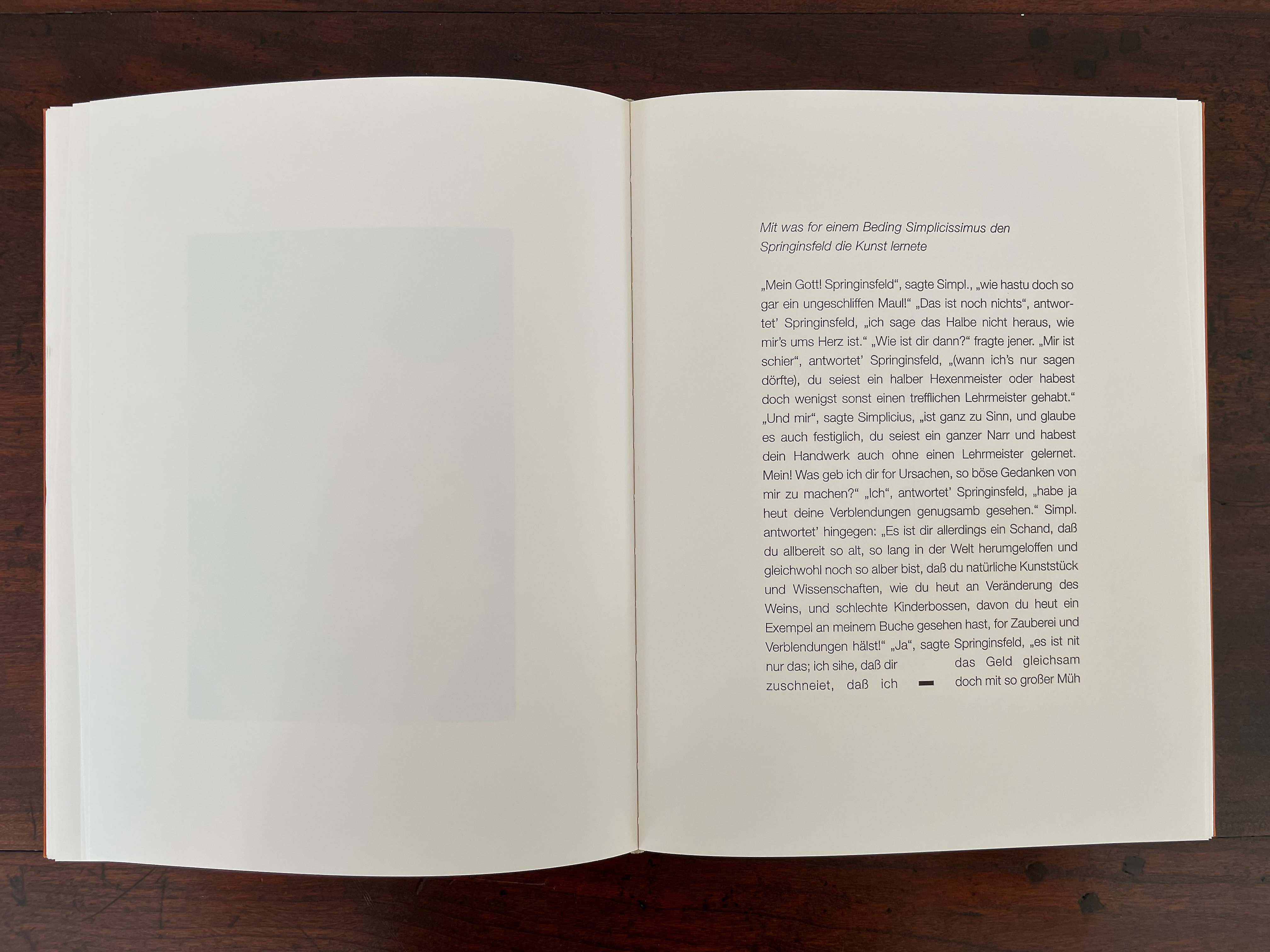
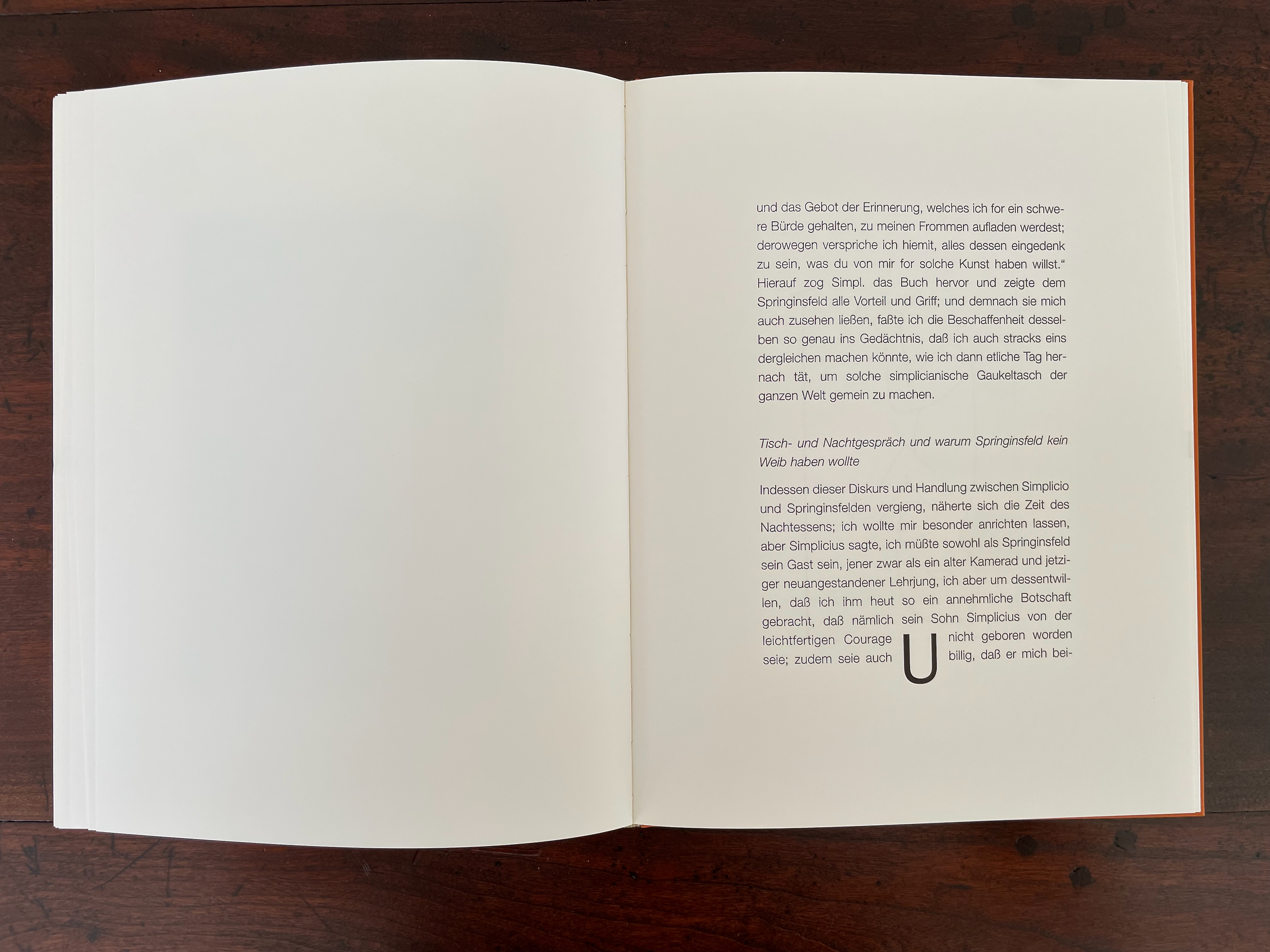
The opening pages of the three Simplicissimus excerpts. Note the display characters H, -, and U, three of the twenty that spell out HORSTANTES-FLICKBUCH.
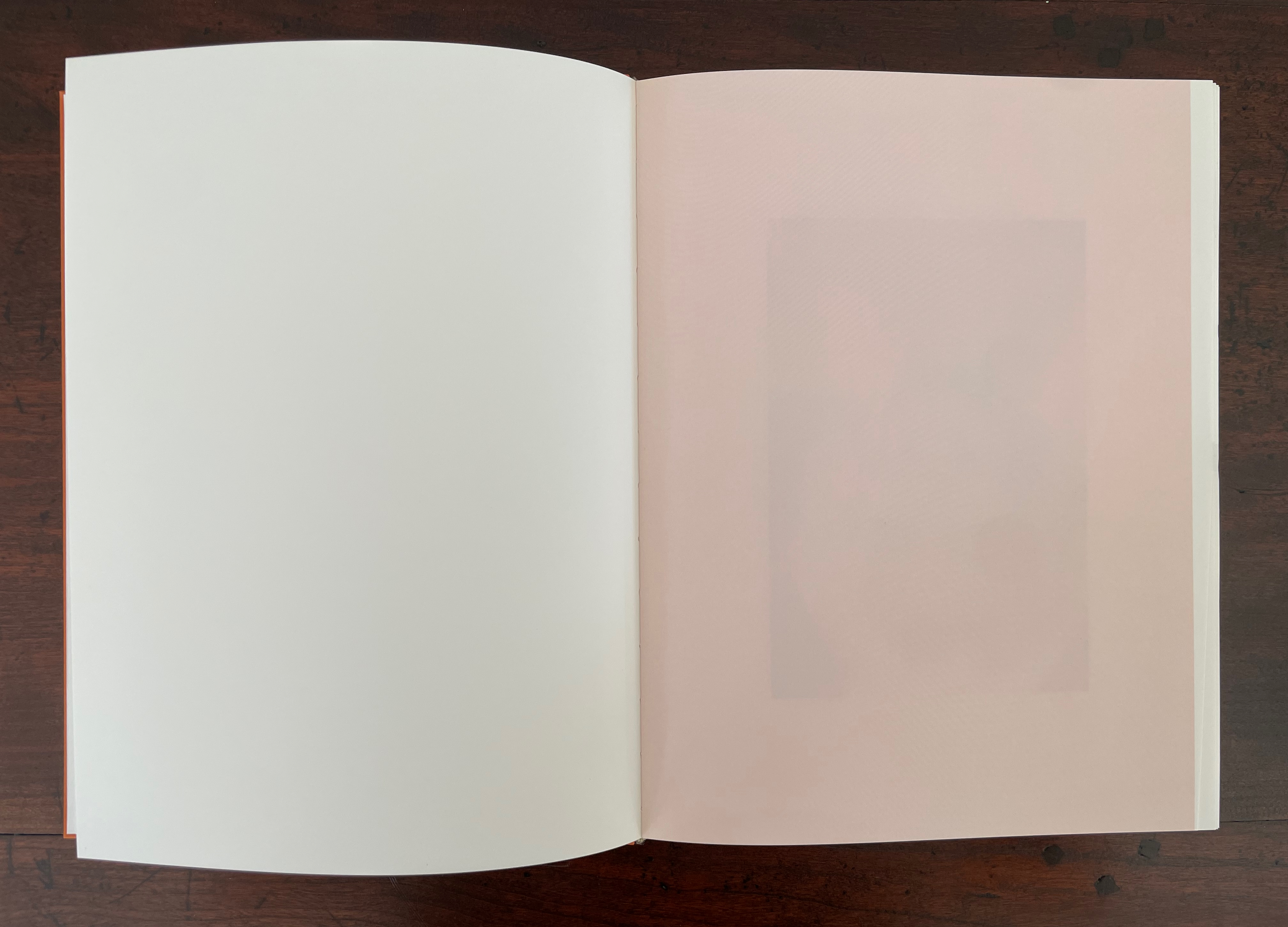
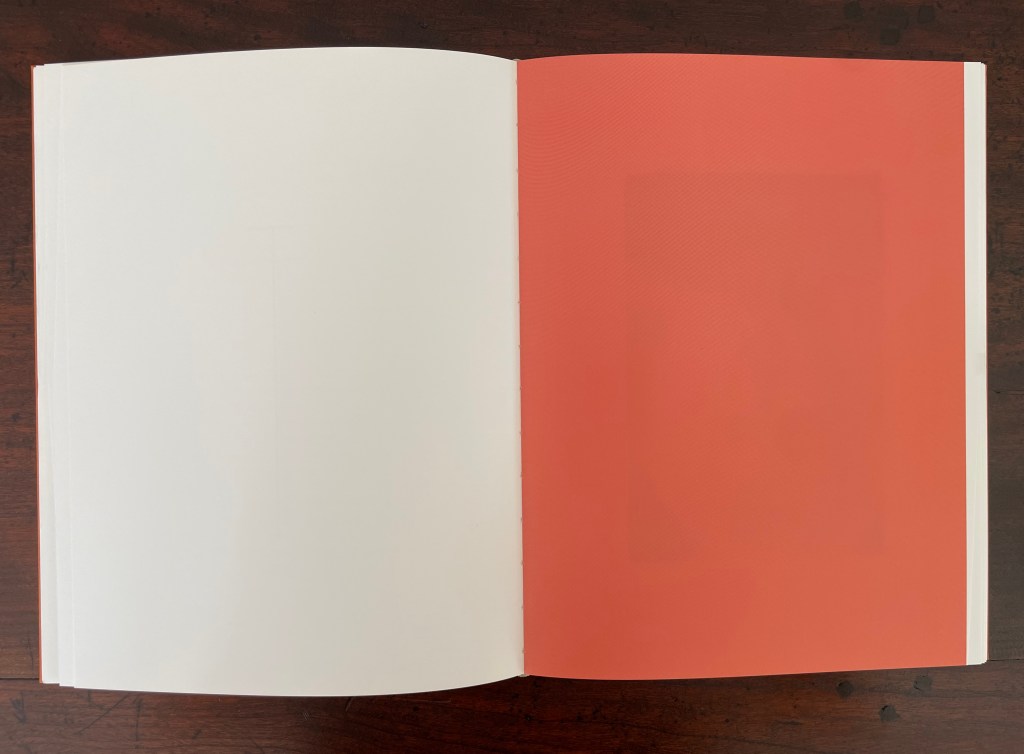
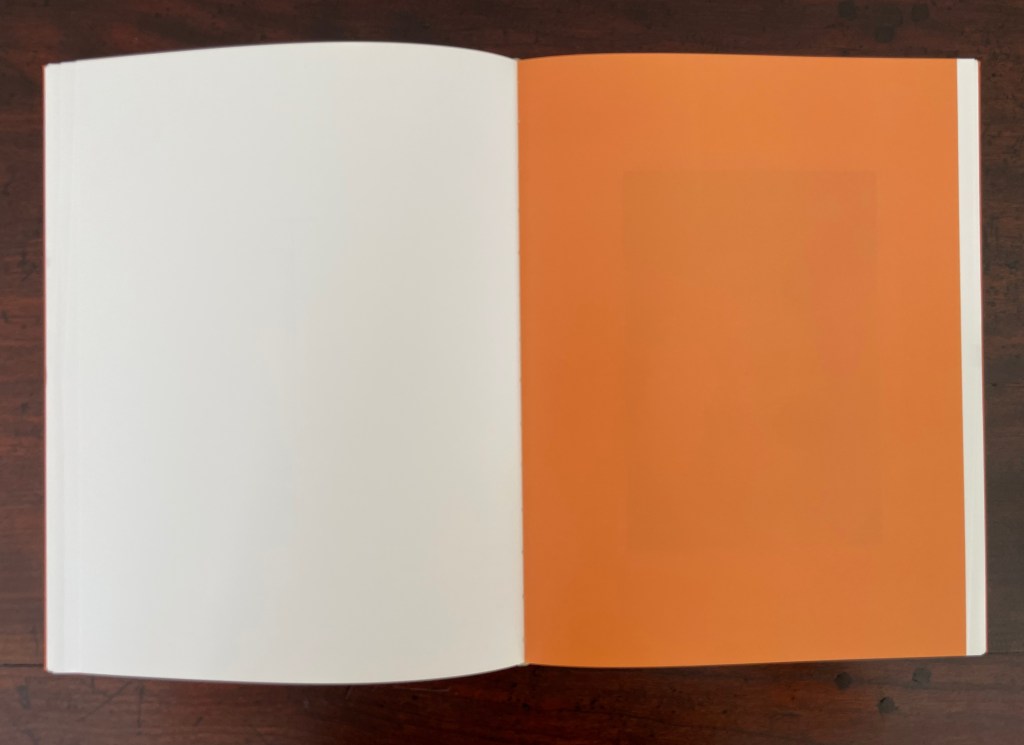
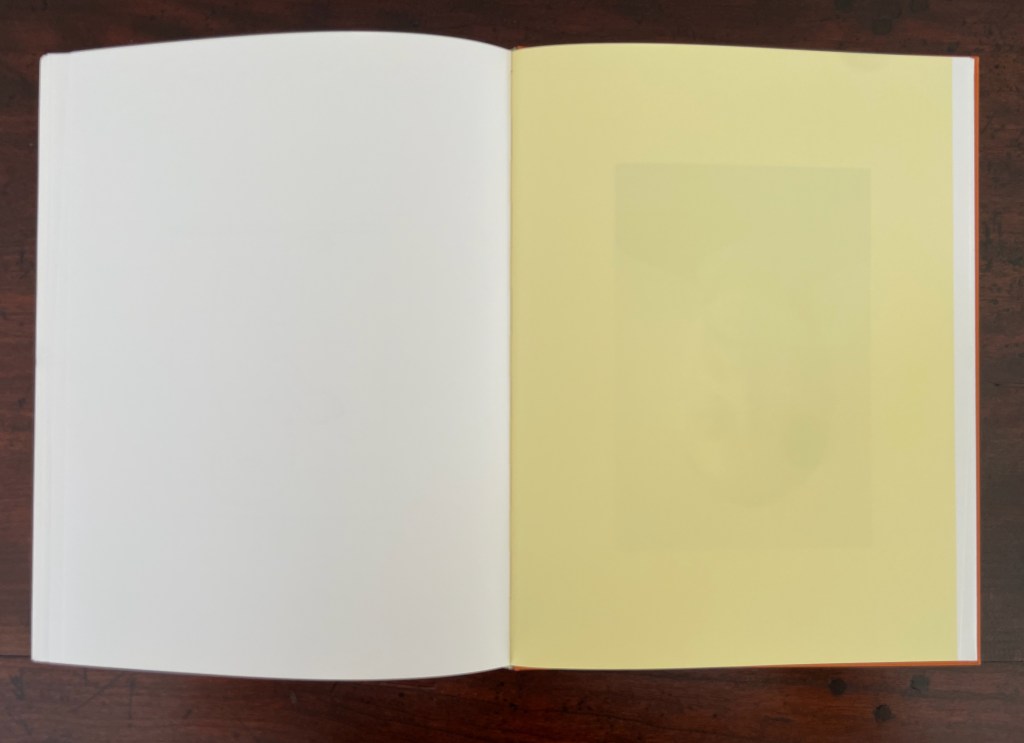
The first, ninth, eleventh, and last spreads of colored blank pages.
On the other side of the dos-à-dos structure, the first flick-through’s sequence of twenty images has Antes’ face morphing into Marilyn Monroe’s. It’s a curious transformation. Perhaps it’s in keeping with the carnivalesque barker Simplicissimus, and after all, the color of the paper does change from cream to white as the artist turns into the bearded lady and the latter turns into Marilyn. The sequence’s twenty-page length facilitates the gradation of the change.
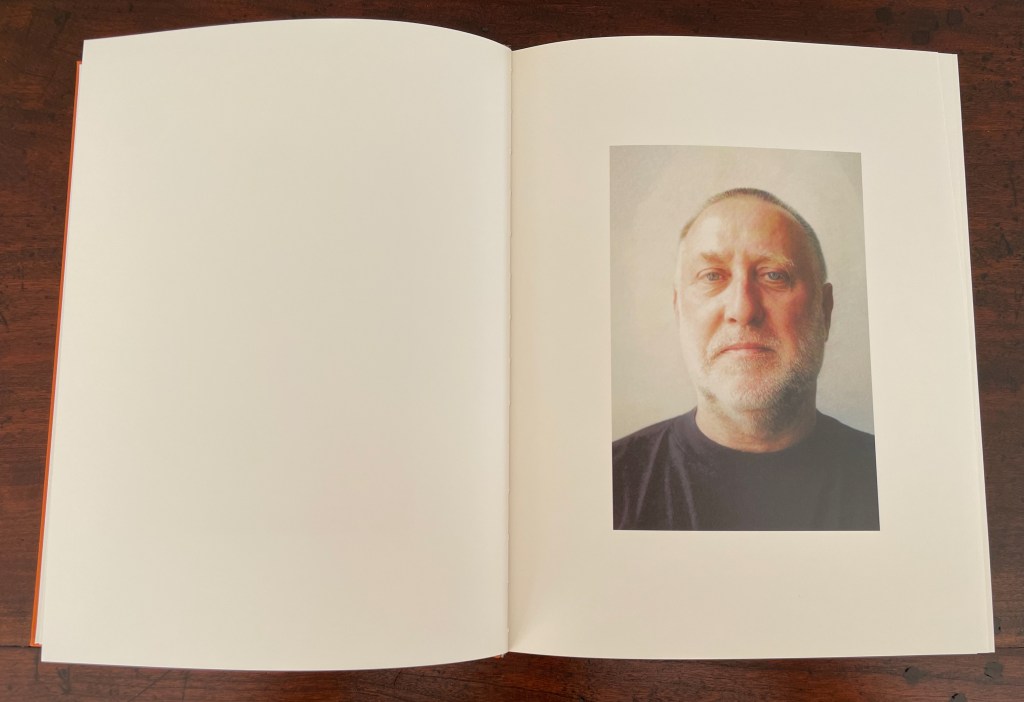
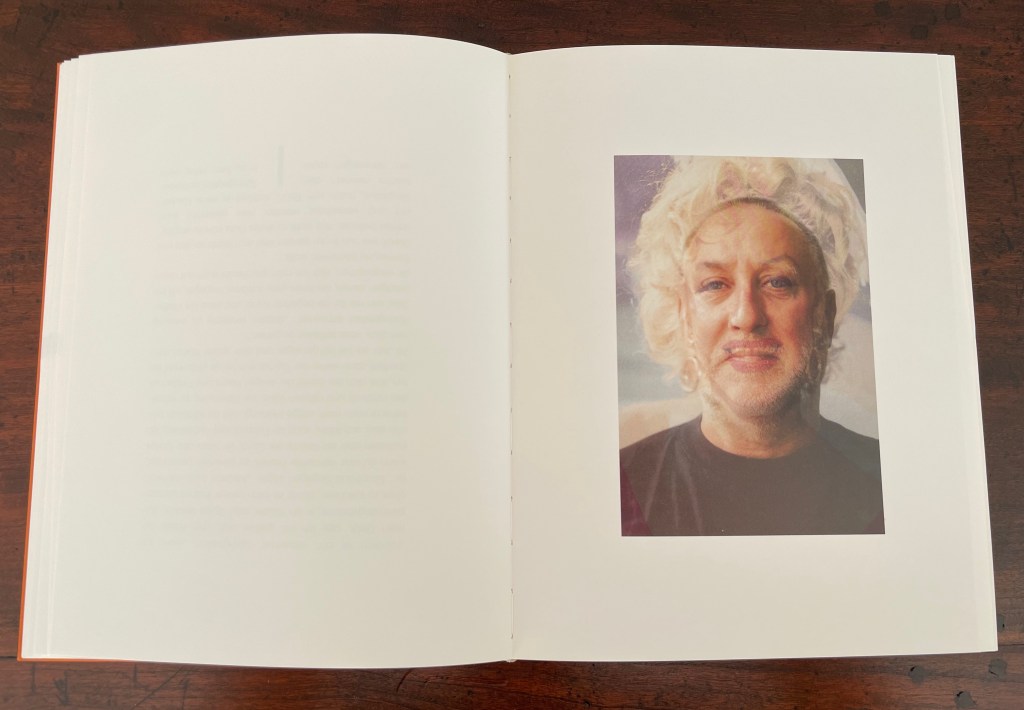
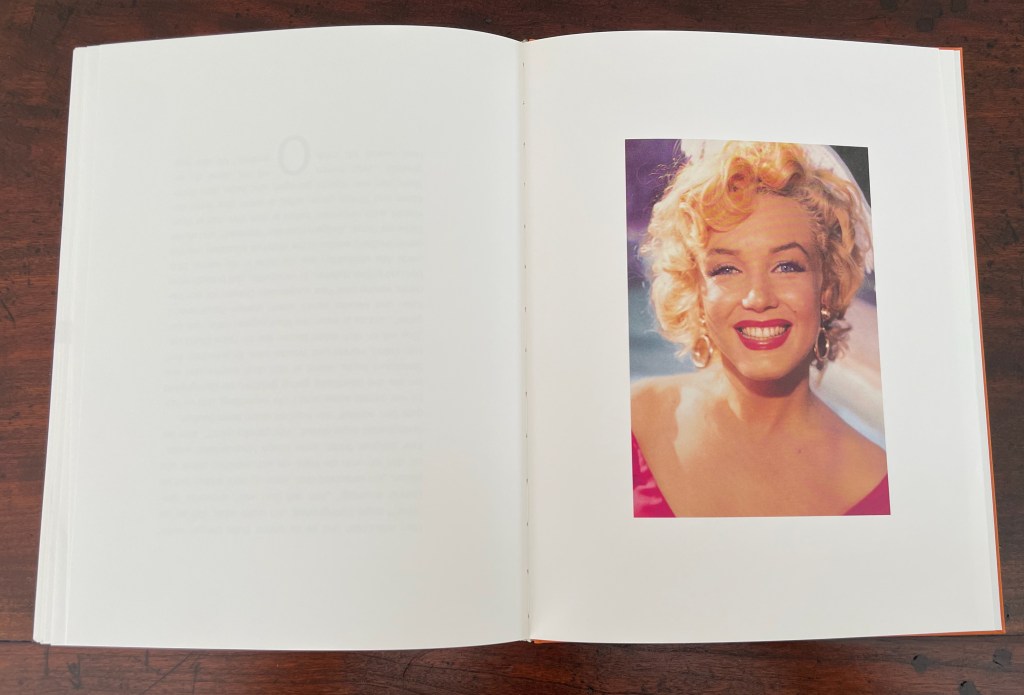
The first portrait image, the mid-point image, and the final image.
The second flick-through presents an ink drawing of one of Horst Antes’ clear acrylic sculptures called Die Figur (1995-97). A version of the sculpture rests in the rooftop foyer of Vienna’s Hofburg. Inscribed in a large plane of acrylic intersecting another plane of acrylic acting as its footing, Antes’ signature figure the Kopffüßler [“Head-Footer”] appears. In Flickbuch, the figure is drawn in red, and the plexiglas in grey ink. Across this flick-through’s twenty spreads, the drawing is animated, turning from the left, gradually showing an edge-on view, and ending up facing right. It captures Ante’s blend of the figurative and abstract for which he is known.
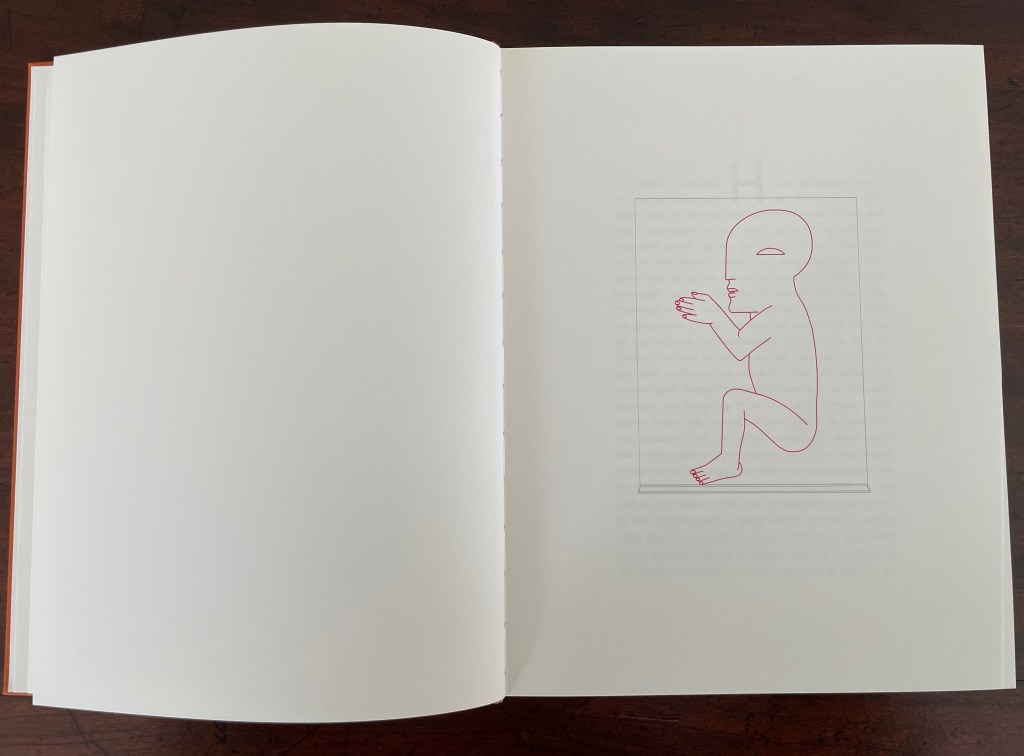
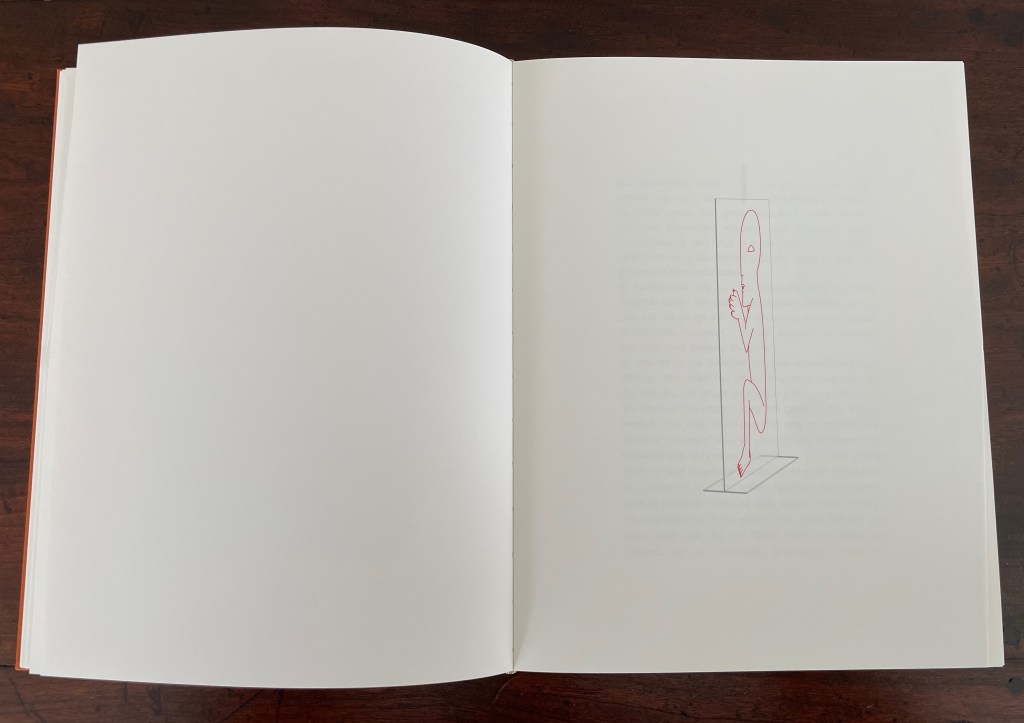
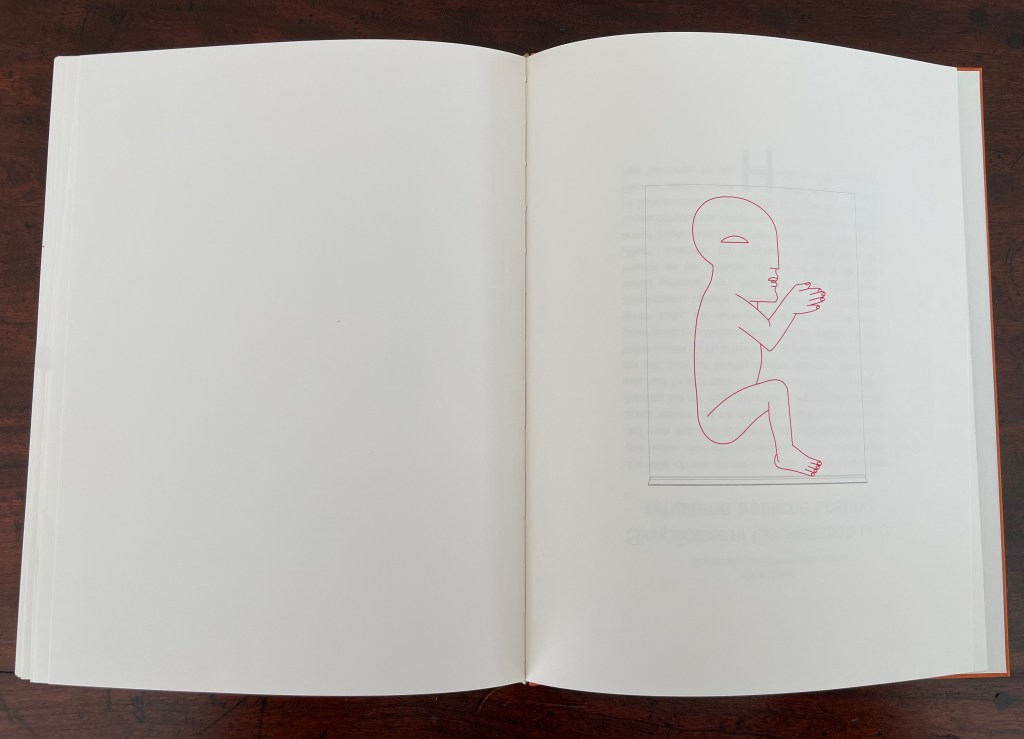
For some reason, Antes’ graphics often appear in German galleries alongside Andy Warhol’s images of Monroe, but here, perhaps it is a dig at Clement Greenberg. In the accompanying volume Geschichten um das Flickbuch, Huber explains how Antes’ work has been a counter-response to Greenberg’s avant gardist art theory that figurative, illusionistic painting belongs to a bygone era that has been superseded by high Abstract art that accepts and self-reflexively explores the nature of its two-dimensionality. In Huber’s view, Antes’ emphasis on two dimensions in his sculptures and paintings nevertheless restores the figurative and three-dimensionality to art, superseding Greenberg’s dicta.
Greenberg also placed photography as second fiddle to the self-reflexive and opaque surface of pure abstract painting.
The art in photography is literary art before it is anything else: its triumphs and monuments are historical, anecdotal, reportorial, observational before they are purely pictorial. Because of the transparency of the medium, the difference between the extra-artistic, real-life meaning of things and their artistic meaning is even narrower in photography than it is in prose. And as in prose, “form” in photography is reluctant to become “content,” and works best when it just barely succeeds in converting its subject into art—that is, when it calls the least attention to itself and lets the almost “practical” meaning of the subject come through. — Greenberg, 1964.
The photography in Flickbuch certainly calls attention to itself. Maybe using the flick book form to play with photos and allude to a literary text actually supports Greenberg’s formalism. Then again, the photography sequence seems to throw shade on another Greenberg polemic: his 1939 salvo for the avant-garde and against kitsch.
Kitsch, using for raw material the debased and academicized simulacra of genuine culture, welcomes and cultivates this insensibility. It is the source of its profits. Kitsch is mechanical and operates by formulas. Kitsch is vicarious experience and faked sensations. Kitsch changes according to style, but remains always the same. Kitsch is the epitome of all that is spurious in the life of our times. Kitsch pretends to demand nothing of its customers except their money—not even their time. — Greenberg, 1939.
There is something a bit tongue-in-cheek about this artist’s book and its creators. The idea of a blow book likely came from Huber to Antes. Together they must have enjoyed that spread placing the artist at one end of the spectrum and the image of Marilyn Monroe, goddess of high Pop and kitsch, at the other. Antes in particular must have enjoyed bringing the three-dimensional Kopffüßler into the two-dimensional confines of pages and, seizing on the blow book’s mechanics, creating a representational illusion of its original three-dimensional self, which of course emphasized an inherent two-dimensionality.
* The German term flichbuch translates as “flick book”. For most book historians and artists, that term and its alternates “flip book” and “flicker book” refer to the structure that creates an animation effect by gradually changing an image from one page to the next.
Further Reading
“Julie Chen & Keri Miki-Lani Schroeder“. 27 May 2025. Books On Books Collection.
“HAP Grieshaber“. 27 August 2023. Books On Books Collection.
“Ricky Jay“. 2 September 2026. Books On Books Collection.
“Nicholas Phillips“. 11 August 2020. Books On Books Collection. Phillips’ Egyptian Cards demonstrate a multiple image changes in a deck of cards.
Aling, Michael. n.d. “Publishing as Architectural Practice“. University of Greenwich. Architectural book designer Michael Aling put the “blow book” principle to work in Negative Equity: House Projects by Neil Spiller & Nic Clear. By adjusting the trim, Aling makes the book display only spreads with Spiller’s work if the codex is flicked through with the right thumb and only Clear’s spreads if flicked through with the left thumb. P. 6, Fig. 2.
Dunstan, Dominique. 10 October 2021. “Treasures of the Library: the magic of blow books“. State Library Victoria. Video.
Greenberg, Clement. 23 January 1964. “Four Photographers“. The New York Review.
Greenberg, Clement. 1939. “Avant-Garde and Kitsch.” Partisan Review. 6:5
Singer, Mark. 29 March 1993. “Secrets of the Magus“. New Yorker.
Stauss, Thomas. 2025. Magic Metamorphosis : The Secrets of a Rare Italian Picture Album Revealed. Basel: Librum Publishers and Editors LLC.


Fantastic and unknown territory to me and probably most. Meantime 410/411 has been published by Rylands librarian and master of the dogear Joe Devlin. Includes a postcard. 410/411
| | | | | |
|
| | | | 410/411
410/411 by Michael Hampton. A limited edition of 50 copies. Riso printed on 100gsm yellow paper with a 200gsm Ac… |
|
|
LikeLike